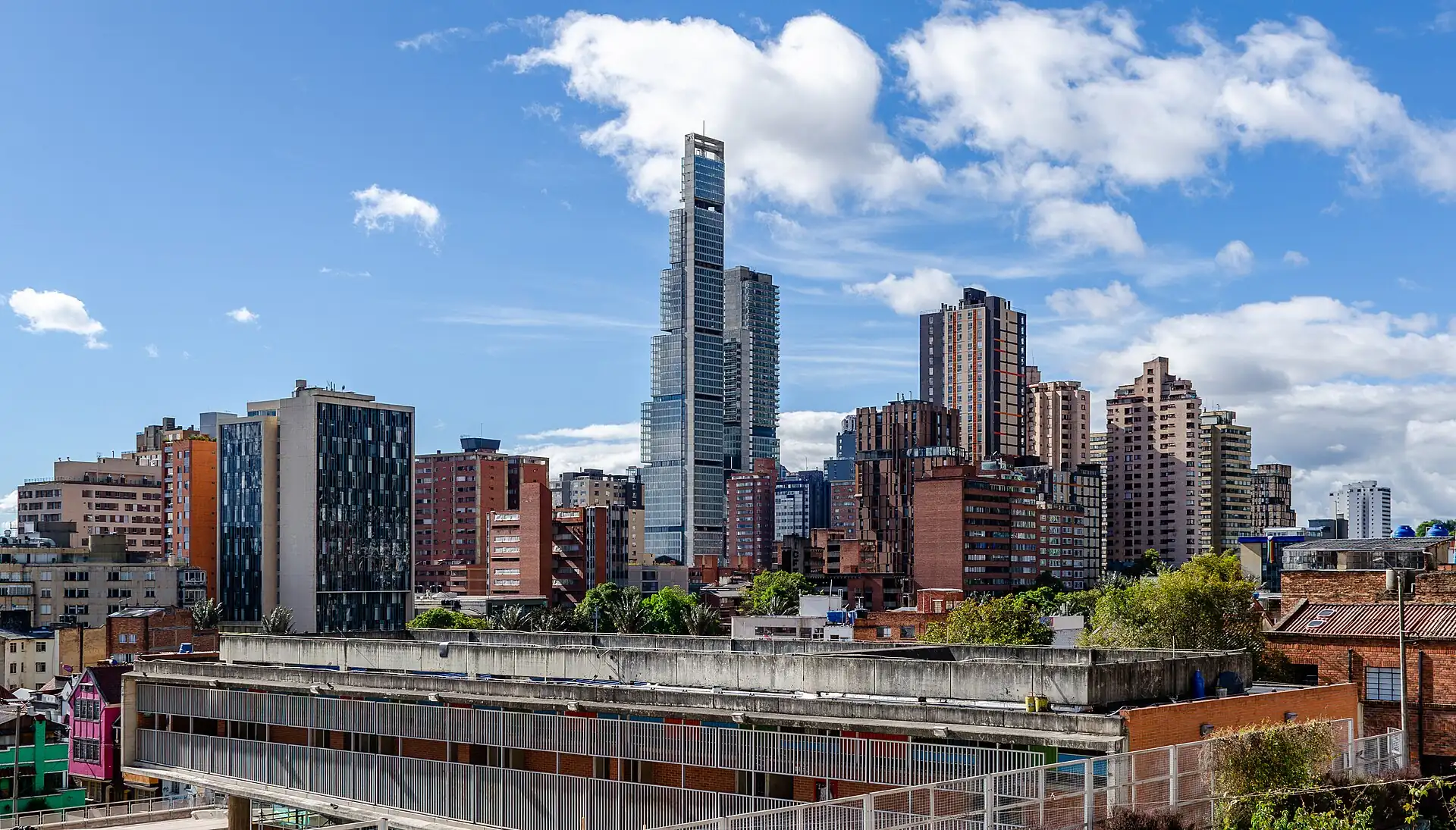
Bogotá
Code CL · 4 walking zones
Bogotá is a museum-and-café city at 2,600 m: do La Candelaria's museums in the morning, expect afternoon rain and slow traffic, and take a booked car after dark instead of walking between neighbourhoods.
Our quick read of Bogotá, scored 1–5 (friction is out of 100). Cash need: how often you still need notes. Heat risk: how hot days get. Stroller: how easy wheels are. Friction: overall effort for a first visit. Desk judgements, so check before relying on them.
- Local time
- --:--
- Weather
- forecast below
- Currency
- COP
- Best months
- Jan · Feb · Jul · Aug · Dec
- Airport
- El Dorado (BOG)
Walking zones: the 4 areas this guide plans a day around. Each is a district you can cover on foot, so you do one zone per half-day and ride the train between them. The code (CL 01, CL 02…) is just the zone's number on the Bogotá line; the line under each name says how bags fare there and how much time it needs.
Map of Bogotá
Use the switches to show or hide each kind of pin. A switch that is on shows its pins on the map; tap it again to hide them. "Show only" keeps just the pins that match (for example, places that fit a suitcase). Tap any pin for its name and a link to its page.
- Where to sleep
- Walking clusters
- Rest stops
From the airport El Dorado (BOG) to your bed
Tap a pin for its card. Places without their own coordinates are shown by their walking cluster.
Why Bogotá
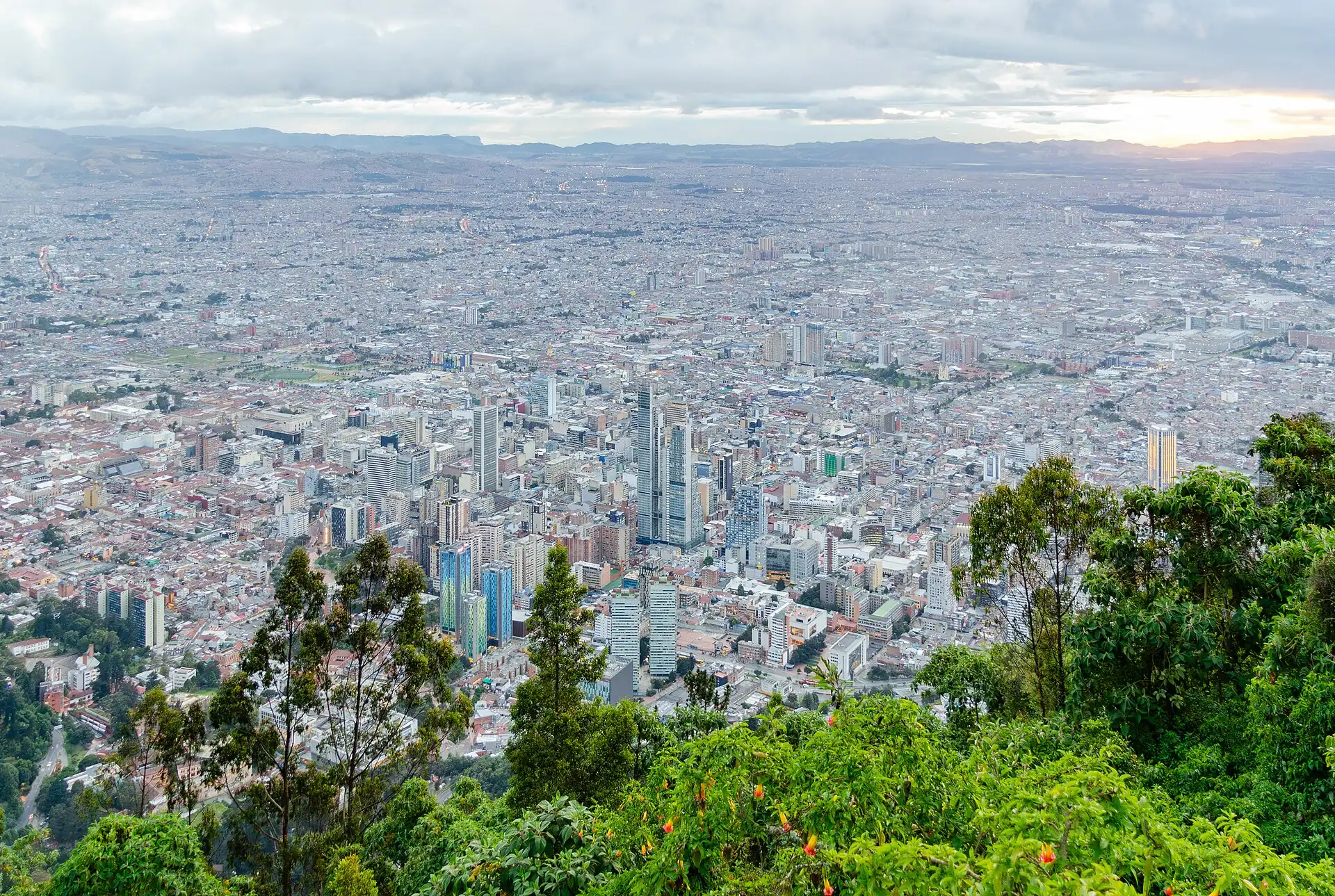
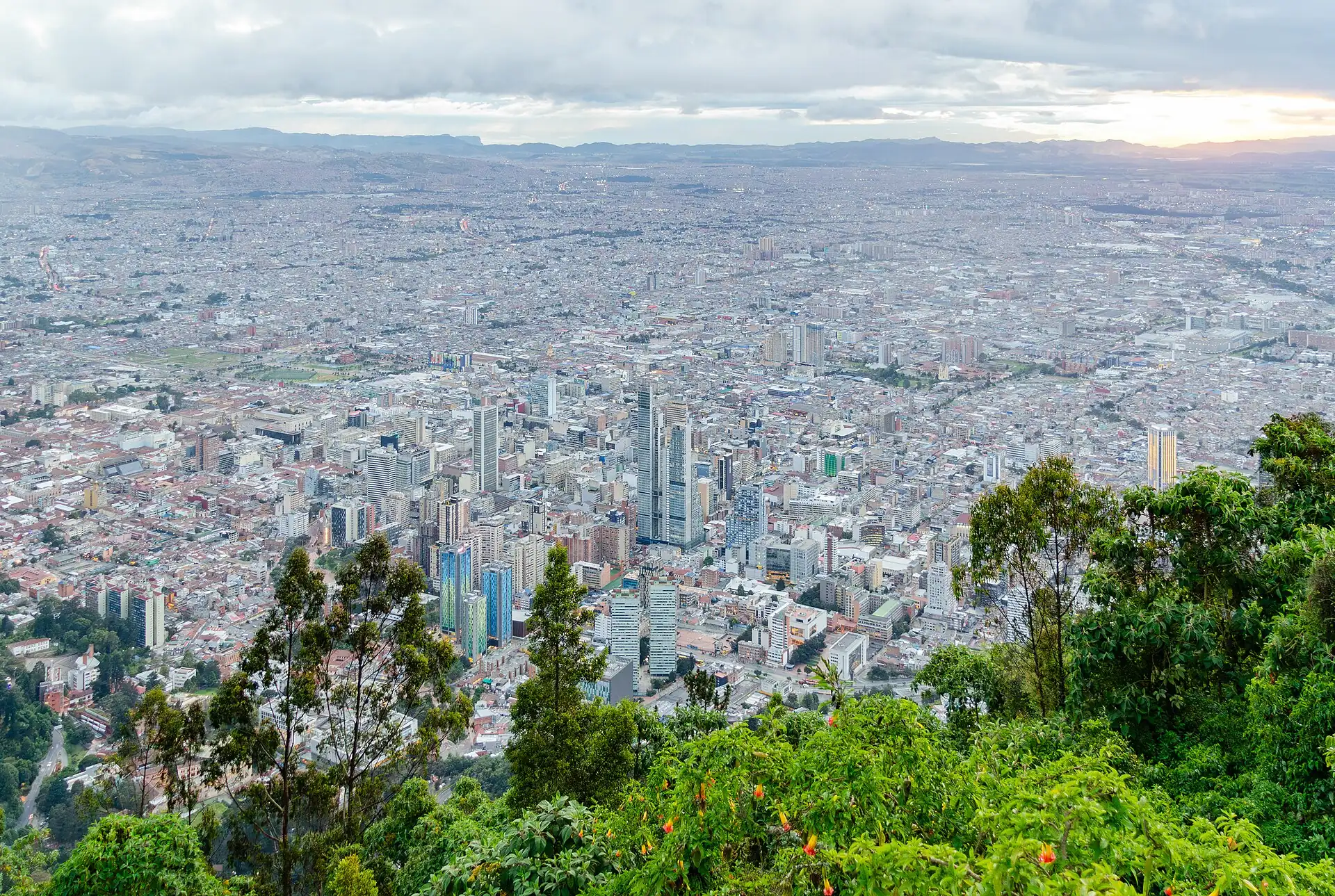
Bogotá's sights are clustered in the old centre, but the city is 30 km long, cool and rainy, and traffic turns a 5 km ride into 40 minutes. The trips that go wrong walk the centre after dark, cross the city at rush hour, or climb Monserrate on the first day at altitude. Four clusters cover a first visit: Candelaria for museums, La Macarena for the national museum and dinner, Zona T for restaurants, Usaquén for the Sunday market.
Fits
- Museum and food trips
- Slow starters who like cool weather
- Short stops before Medellín or the coast
Does not fit
- Anyone who wants to walk between neighbourhoods at night
- Strollers and wheelchairs in the old centre
- Travellers who dislike rain and altitude
How long
- 2 daysLa Candelaria museums + Museo Nacional and La Macarena
- 3 daysCandelaria, Macarena with Monserrate, Usaquén market on the last morning
- 5 daysThree city days + a Zipaquirá salt cathedral day trip + one slow day
About Bogotá
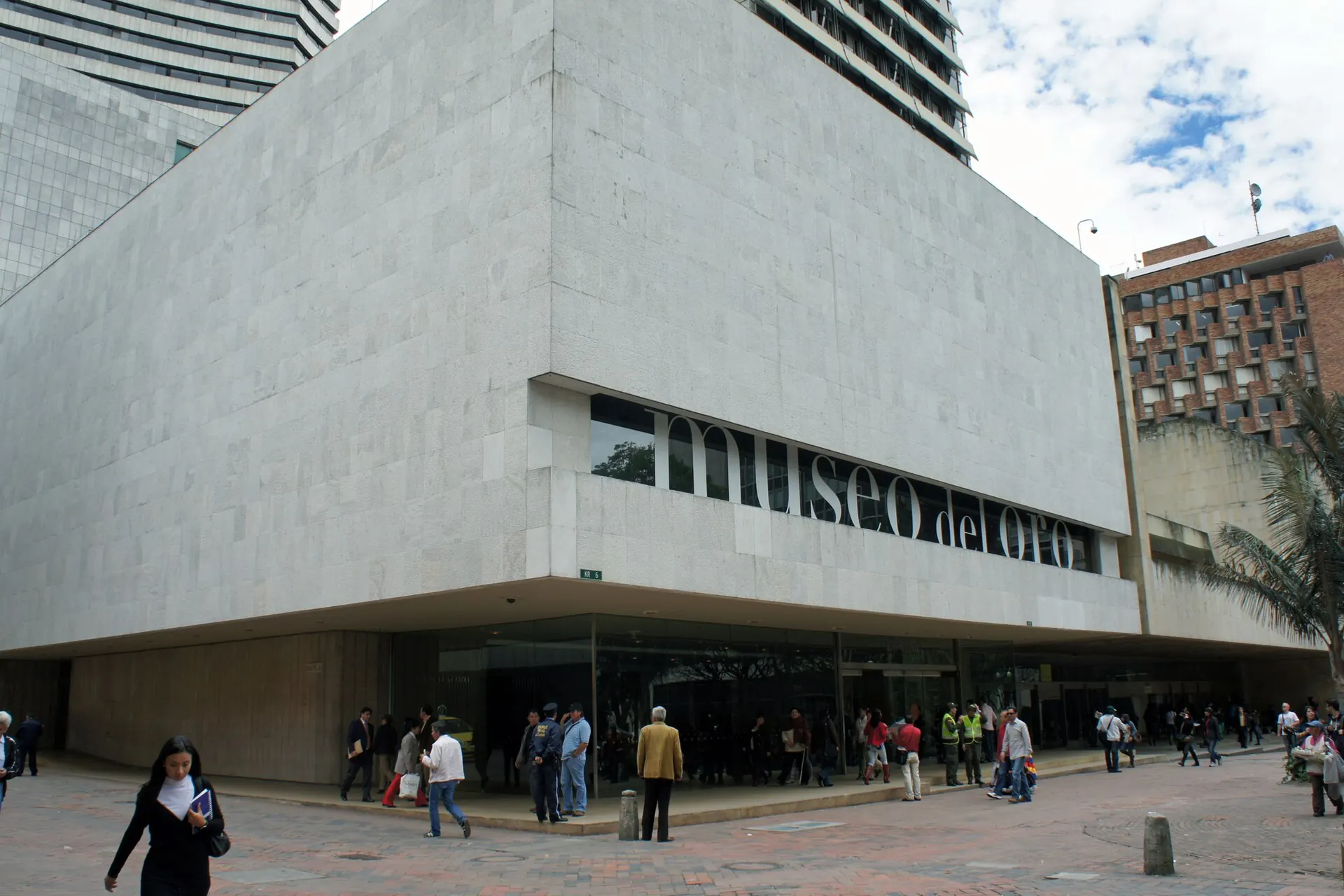
Before the Spanish, the Bogotá savanna was the heart of the Muisca confederation, ruled from Bacatá by a zipa; the Museo del Oro's Muisca raft piece is tied to the El Dorado legend that later drew Spanish conquistadors here.
Gonzalo Jiménez de Quesada founded Santa Fe de Bogotá in 1538; the city became the seat of the Viceroyalty of New Granada, and La Candelaria's street grid and churches still follow the colonial plan.
9 April 1948, the assassination of political leader Jorge Eliécer Gaitán, set off the Bogotazo riots that burned much of the historic centre and helped trigger La Violencia, a decade of political conflict across the country.
Good to know
- La Candelaria is the old centre and its historic core; Chapinero and Zona T are the restaurant districts 8 km north, and Usaquén is a former village at the north edge of the city.
- PIT (Punto de Información Turística) booths run by the city in La Candelaria, El Dorado airport and other points: free maps and event listings — check current hours.
- Free walking tours meet daily near Chorro de Quevedo in La Candelaria; tip-based, English and Spanish options.
Go deeper 11 min read · 6 chapters
Bogotá sits on a high plain the Muisca called the sabana, and it keeps every layer of its story close to the surface: a pre-Hispanic capital under a colonial grid, republican facades beside the scars of a 1948 riot, and a modern high-rise city still finding its way around traffic and altitude. This deep dive reads the city layer by layer, from the Muisca zipas to the street art that now covers La Candelaria's colonial walls.
1History2 min
Long before the Spanish arrived, the high plain around modern Bogotá was the heart of the Muisca confederation, one of the most developed indigenous societies in South America. The Muisca were skilled goldworkers and farmers who organised the sabana into territories under rulers called zipas (based at Bacatá, near today's centre) and zaques (based at Hunza, today's Tunja). Their goldwork, much of it made as offerings rather than jewellery, is the origin of the El Dorado legend: Spanish and other European explorers heard of a ritual in which a new zipa was covered in gold dust and rowed onto Lake Guatavita to make offerings, and the story of a "golden man" grew from there into a search for a lost city of gold that drove decades of expeditions across South America.
Spanish conquistador Gonzalo Jiménez de Quesada reached the sabana in 1538 after a brutal expedition up the Magdalena river, and founded Santa Fe de Bogotá that year on or near a Muisca settlement. The city became the seat of the Nuevo Reino de Granada and, from 1739, the capital of the Viceroyalty of New Granada, which covered roughly modern Colombia, Venezuela, Ecuador and Panama. Colonial Bogotá grew around what is now La Candelaria: a grid of narrow streets, churches and convents built largely with indigenous and enslaved African labour, administered from a distance by Spain.
Independence came in stages: an early, short-lived declaration in 1810 (still marked as Colombia's independence day, 20 July), reconquest by Spain, and final independence secured by Simón Bolívar's campaign, culminating in the 1819 Battle of Boyacá near Tunja. Bogotá became capital of Gran Colombia and then, after that federation broke apart, of the Republic of New Granada and its successor states, eventually the Republic of Colombia. The 19th and early 20th centuries were marked by repeated civil wars between Liberal and Conservative factions, including the brutal Thousand Days' War (1899–1902).
The single most consequential day in the modern city's history is 9 April 1948: the assassination of Liberal leader and presidential hopeful Jorge Eliécer Gaitán on a downtown street triggered the Bogotazo, days of rioting and arson that gutted much of the historic centre and killed an estimated several thousand people. The Bogotazo is usually treated as the opening act of La Violencia, a decade of political killing across the country, and its aftershocks fed into the long internal armed conflict that followed. A 2016 peace agreement with the FARC guerrilla group marked a turning point, though the country's conflict history is not fully closed, and it still shapes how Colombians talk about the city and the country.
- Founded
- 1538, Gonzalo Jiménez de Quesada
- Colonial capital from
- 1739 (Viceroyalty of New Granada)
- Independence declared
- 20 July 1810
- Decisive independence battle
- Boyacá, 7 August 1819
- The Bogotazo
- 9 April 1948
- Population
- About 8 million (city), over 10 million metro area
2Neighbourhood stories2 min
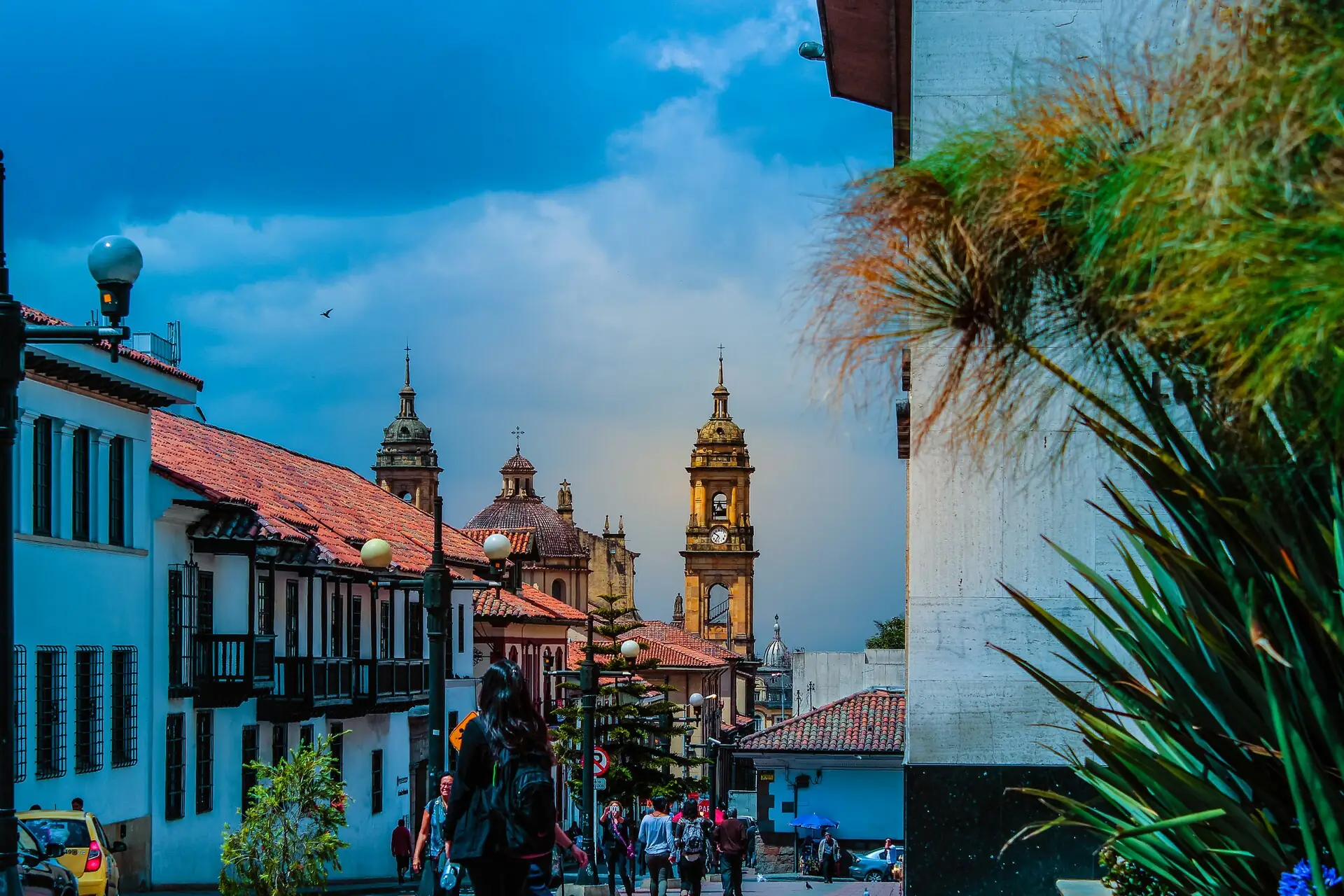
La Candelaria is the colonial core, and its narrow, cobbled grid still follows the plan Jiménez de Quesada laid out in 1538. Spanish colonial city planning worked from a central plaza outward in blocks, and Plaza de Bolívar (originally the Plaza Mayor) is that anchor: cathedral on one side, city and judicial power on the others, a pattern repeated in colonial cities across the Americas. Many of La Candelaria's houses keep the Spanish colonial style — whitewashed walls, wooden balconies, red-tile roofs — though what you see today is largely restoration and reconstruction after the damage of the Bogotazo and decades of later neglect and renewal.
Chapinero began as a separate town south-east of the sabana in the 19th century, absorbed into Bogotá as the city expanded north through the 20th century. It grew wealthy and residential in stretches, then diversified: Chapinero Alto today mixes some of the city's best restaurants with an established LGBTQ+ nightlife scene, one of the more visible and accepted in Latin America. Further north again, Zona Rosa and the "T"-shaped pedestrian streets of Zona T were built up from the 1980s onward as the city's nightlife and shopping district moved away from the aging, less secure centre.
Usaquén was a separate colonial-era village, founded in the 16th century around its own church and plaza, and only absorbed into Bogotá's urban footprint as the city sprawled north through the later 20th century. It kept its village layout and colonial-scale buildings, which is why it feels distinct from the office towers around it, and why its Sunday flea market (Mercado de las Pulgas) has become a fixture: a village square doing what village squares do, on a much bigger city's northern edge.
Much of Bogotá's growth has been driven by displacement rather than choice. Decades of rural conflict pushed millions of Colombians toward cities, and Bogotá's southern and western edges — Ciudad Bolívar, Bosa, Kennedy — grew as informal settlements absorbing that migration, often without full infrastructure for years or decades. The TransMiCable cable-car line into Ciudad Bolívar, opened in 2018, was built explicitly to connect one of these steep, underserved hillside neighbourhoods to the transit network, cutting what had been a long, difficult commute; it is a transit project as much as a monument to the city's unequal growth.
- La Candelaria street plan
- Laid out from 1538, Spanish colonial grid
- Usaquén founded
- 16th century, separate colonial village
- Zona T developed
- From the 1980s
- TransMiCable (Ciudad Bolívar)
- Opened 2018
3Architecture2 min
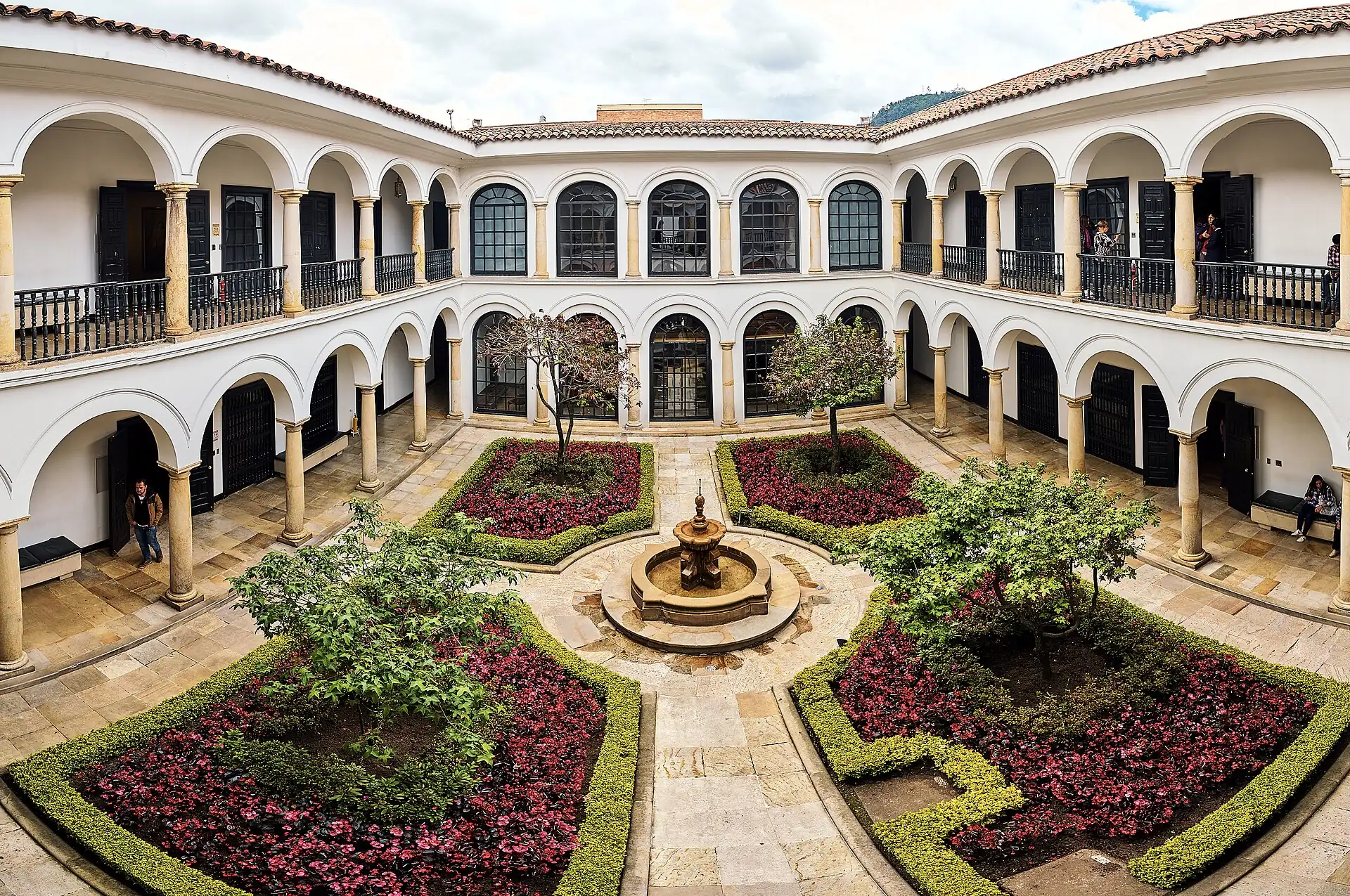
Colonial La Candelaria follows the Spanish rule book: a central plaza, a grid of streets running off it, whitewashed one- and two-storey houses with heavy wooden doors, interior courtyards and overhanging wooden balconies (a style with clear roots in Andalusia). Churches were the biggest and most durable buildings — the Catedral Primada on Plaza de Bolívar (rebuilt several times, the current structure early 19th century), Iglesia de San Francisco (one of the oldest surviving colonial churches, largely 16th–17th century) — and their heavy stone and brick construction is why so many outlasted the Bogotazo's fires, even as timber-and-adobe houses around them burned.
After independence, Bogotá's elite looked to Paris and other European capitals for its public buildings. The Capitolio Nacional on Plaza de Bolívar, begun in 1847 and not finished until the 1920s, is a neoclassical statement of the young republic's ambitions, built slowly and expensively over generations. The early 20th century added Beaux-Arts and eclectic European styles to the wealthier new neighbourhoods spreading north from the centre, visible today in the older houses of Teusaquillo and parts of Chapinero.
The Bogotazo of 1948 reshaped the centre as much as any planning decision: whole blocks of La Candelaria burned, and the rebuilding that followed mixed careful colonial-style restoration with plainer mid-century replacement buildings, so the historic district today is a genuine patchwork of centuries rather than a uniform "old town." From the 1950s, modernist architecture arrived with academic and government buildings — the Universidad Nacional campus and Ciudad Universitaria plan among them — and later Rogelio Salmona, Colombia's best-known 20th-century architect, developed a distinct Bogotá style built around exposed brick, water features and circular forms, visible in works like the Torres del Parque complex beside the bullring in La Macarena.
Contemporary Bogotá has grown upward and outward at once: glass office towers in the financial districts north of Chapinero, dense high-rise residential blocks spreading toward the savanna's edge, and informal, self-built brick housing climbing the hillsides in the south and west. The contrast between the protected low-rise scale of La Candelaria and the towers a few kilometres north is deliberate policy, not accident: height limits protect the historic centre while the rest of the city absorbs growth.
- Catedral Primada
- Current structure early 19th century, on a site rebuilt since the 1500s
- Iglesia de San Francisco
- Largely 16th–17th century; one of the oldest in the city
- Capitolio Nacional
- Begun 1847, completed 1920s
- Torres del Parque
- Rogelio Salmona, 1970, beside the Plaza de Toros
4Food history2 min
Ajiaco, the thick chicken-and-potato soup that is Bogotá's signature dish, is built on ingredients from the sabana itself: three varieties of native potato (including the small, starchy papa criolla), an herb called guascas that grows wild across the plain, and corn on the cob and capers added at the table with cream and avocado. It is cold-weather food for a cold-weather city, and its Muisca-and-colonial roots — indigenous potatoes and herbs, European chicken and dairy — make it a fair snapshot of Bogotá cuisine generally: local highland ingredients cooked in a Spanish-influenced style.
Hot chocolate with cheese (chocolate santafereño) is the city's classic breakfast or afternoon ritual: a piece of fresh white cheese dropped into a cup of hot chocolate to melt, eaten with bread. It is usually explained as a colonial-era adaptation, using dairy and cacao that both reached the highlands through trade, and it remains standard at old-style eateries like La Puerta Falsa near Plaza de Bolívar, open in the same block since the early 19th century.
Tamales and empanadas mark Bogotá's weekend and holiday food. A Bogotá-style tamal — corn dough, meat, vegetables and rice, wrapped and steamed in plantain leaf — is traditionally Sunday breakfast food, often eaten with hot chocolate. Arepas here are typically plain, thick corn cakes rather than the stuffed versions found on the Caribbean coast, usually served alongside a meal rather than as the meal itself.
Coffee is grown across Colombia but historically was mostly exported, not drunk locally at any quality — for decades the best beans left the country and lower grades stayed. A specialty-coffee movement from the 2010s onward changed that in Bogotá's cafés, particularly in Chapinero, where roasters now sell and serve the same grades once reserved for export. Aguardiente, the anise-flavoured sugarcane spirit, and chicha, a fermented maize drink with roots in Muisca ritual use, sit at opposite ends of the city's drinking history: one an industrial, licensed product sold by the bottle in every bar, the other a once-banned traditional drink now served mainly in a handful of La Candelaria chicherías as a link back to the pre-colonial sabana.
- Ajiaco
- Chicken, three potato varieties, guascas herb — the city's signature soup
- La Puerta Falsa
- Operating from the same block since the early 1800s
- Chicha
- Fermented maize drink with pre-colonial (Muisca) roots
- Specialty coffee scene
- Grew mainly from the 2010s
5Festivals2 min
Rock al Parque, held free in Parque Simón Bolívar each July, began in 1995 and has grown into one of Latin America's largest free rock festivals, drawing several hundred thousand people over its run and acts from across the region and beyond. It sits alongside sister festivals in the same park through the year (hip-hop, salsa, jazz), part of the city government's long-running "al Parque" series aimed at keeping major live music free and public.
The Festival Iberoamericano de Teatro, held over about two weeks in March or April in odd-numbered years, is one of the world's largest theatre festivals, bringing companies from across Latin America, Spain, Portugal and beyond to stages and streets across the city — including, in some editions, a signature closing parade through La Candelaria. It began in 1988, during a period when the city and country badly needed a large-scale statement of civic and cultural confidence, and has run through every subsequent political and security cycle since.
Día de las Velitas, on the night of 7 December (the eve of the Catholic feast of the Immaculate Conception), is a genuinely national tradition: streets, windows, gardens and balconies across the city fill with small candles and paper lanterns after dark. It marks the informal start of the Christmas season, followed through December by the Alumbrado Navideño, large-scale light displays along the northern avenues and around Parque Simón Bolívar, among the most elaborate in Latin America.
Every Sunday and public holiday, from about 07:00 to 14:00, Bogotá closes more than 100 km of its main roads to cars for the Ciclovía, letting cyclists, runners, skaters and walkers take over the street network. Started in the 1970s and expanded since, it is one of the largest recurring events of its kind anywhere, less a single festival than a weekly ritual that shapes how residents think about their own streets.
- Rock al Parque
- Since 1995, free, Parque Simón Bolívar, July
- Festival Iberoamericano de Teatro
- Since 1988, odd years, March–April
- Día de las Velitas
- 7 December
- Ciclovía
- Every Sunday and holiday, since the 1970s
6City life2 min
Bogotá's altitude, about 2,640 m, is the single biggest fact about daily life here: the air is thinner, the sun is stronger even under cloud, and the temperature barely moves across the year — daytime highs sit around 14–19°C in January and in July alike. What changes is rain, not heat, in a roughly bimodal pattern (wetter March–May and September–November, drier December–February and June–August), so Bogotanos read the calendar by cloud cover, not by the thermometer most cities use.
The city is genuinely large and genuinely congested: metropolitan Bogotá holds over ten million people across a long, narrow urban area pressed against the eastern hills, with no metro system yet in operation (one is under construction, planned to open through the later 2020s). TransMilenio, the bus-rapid-transit network opened in 2000, was an internationally influential answer to that gap, copied by dozens of other cities, but it runs at capacity during rush hour, which is why ride-hailing, radio taxis and an extensive dedicated bike-lane network (ciclorrutas) all matter as much as the buses for getting around.
"No dar papaya" is close to a civic philosophy: literally "don't give papaya" (don't hand someone an easy opportunity), it is the standard advice Bogotanos give each other, not just visitors, about not displaying phones, cash or jewellery carelessly. It reflects a city that has worked hard, and with real success, to reduce the violence of earlier decades, while opportunistic theft remains a genuine, unglamorous everyday risk that locals plan around rather than panic about.
Café culture and a strong, close-knit family and neighbourhood life sit underneath the traffic and the altitude headlines. Sunday is genuinely quieter — many Bogotanos spend it with extended family, at church, or out on the closed Ciclovía streets — and the phrase "hora colombiana" (Colombian time), a running joke about arriving late to informal plans, coexists with a business culture that keeps meeting times literally. The city's reputation, inside Colombia, as cold and reserved compared with the Caribbean coast is itself a running joke Bogotanos tell about themselves.
- Altitude
- About 2,640 m above sea level
- Metro area population
- Over 10 million
- TransMilenio opened
- 2000
- Metro system
- Under construction; first line planned for the later 2020s
Read, watch, wordsReading · Watching · Glossary · Sources
Reading
- Colombia: A Concise Contemporary History — James D. HendersonA compact account of the political history behind the Bogotazo, La Violencia and the later conflict.
- News of a Kidnapping — Gabriel García MárquezNon-fiction account of the Escobar-era kidnappings, much of it set in and around Bogotá.
- The Sound of Things Falling — Juan Gabriel VásquezA Bogotá-set novel that captures the shadow the drug-trafficking era left on the city's generation who grew up in it.
Watching
- The Bogotá episode of Anthony Bourdain: Parts Unknown — CNN, 2016Food, altitude and the city's post-conflict mood through one visitor's eyes.
Glossary
| Term | Local | Meaning |
|---|---|---|
| Sabana | sabana | The high plain (savanna) Bogotá sits on, about 2,640 m up. |
| Zipa | zipa | Title of the Muisca ruler based near modern Bogotá. |
| No dar papaya | no dar papaya | Don't make yourself an easy target — the city's standard safety advice. |
| Ajiaco | ajiaco | The chicken-potato-guascas soup that is Bogotá's signature dish. |
| Chicha | chicha | Fermented maize drink with pre-colonial roots. |
| Hora colombiana | hora colombiana | "Colombian time" — running late to informal plans. |
| Ciclovía | ciclovía | Sunday and holiday closure of main roads to cars for cyclists and walkers. |
| Puente | puente | A long weekend created when a public holiday falls near a weekend. |
Read for this deep dive
Background reading only: the text above is written by Voykit, not copied from these pages.
Rules in force · 8Above 2,500 m (Bogotá, Quito, Cusco, La Paz) keep the fir…
- South America ↗Above 2,500 m (Bogotá, Quito, Cusco, La Paz) keep the first day light; sleep lower where you can (Sacred Valley before Cusco) and descend if headache comes with vomiting or confusion.
- South America ↗A yellow fever certificate is required on arrival in French Guiana, and asked for on some routes into Bolivia, Paraguay, Suriname and Guyana, or when arriving from Amazon areas — vaccinate at least 10 days before travel and carry the card.
- South America ↗Overnight buses are the norm in Argentina, Chile and Peru, but pick top-tier companies and keep valuables on your body; on-board thefts from overhead racks are the common loss.
- Colombia ↗Check entry rules for your passport with Migración Colombia or a Colombian consulate; some travellers must complete an online migration form before arrival.
- Colombia ↗Security advice lists specific departments and border areas: check your own government's advice for every place on your route, including coastal roads.
- Colombia ↗Never accept drinks, food or cigarettes from strangers, and be careful with people met on dating apps: drugging (including with scopolamine) followed by robbery is a known risk.
- Colombia ↗Fill in Check-MIG only on the official Migración Colombia site; it is free, and lookalike sites charge a fee.
- Bogotá and surroundings ↗The Sabana is cool and rainy in any month: carry a rain jacket and a warm layer even in the dry season.
Entry rules depend on your passport. Full visa guide
Emergency numbers for Bogotá123 ▾
- All emergencies123
Tap a number to call from your phone. These are the numbers listed in this guide; a row marked check has not been verified.
Planning is the full guide. I'm here keeps what is open and the cheat card.
Right now
Checking the weather…
Working out what is open near you…
What is open nowclock, closures, places open
Now in Bogotá
Local time in Bogotá
--:--
Loads in your browser · America/Bogota
This month
Month verdict appears here.
Closed today
See the weekly grid below.
| Weekly closure | Mon | Tue | Wed | Thu | Fri | Sat | Sun |
|---|---|---|---|---|---|---|---|
| Museo Nacional de ColombiacheckConfirm the current closure day before your visit. | ✕ | · | · | · | · | · | · |
If today is a closure day: Monday: many museums (including Museo Nacional and some others) close — check each place before planning a museum day around it.
Weekly closures come from our place pages; local holidays (puentes) can add extra closures not shown here.
Cheat cardthe pocket version
Cheat card
The essentials on one card: save it as an image for your phone, share it, or print it.
Bogotá
- Money
- Keep COP 100,000 in small notes for taxis, markets and tips; withdraw at ATMs inside banks or malls in daytime…
- SIM
- Buy a tourist SIM or eSIM at El Dorado arrivals (Claro, Movistar, Tigo counters) or in the city with your passport.
- Ride app
- inDriver · Cabify · Uber
- Emergency
- 123 All emergencies (not 911, 999 or 000)
- Plugs
- Sockets A/B. US/Canada (A/B): fits · UK/Ireland (G): adapter · Australia/NZ (I): adapter. 110 V: UK and AU 230 V-only devices need a converter; most chargers are dual-voltage.
Say it
- Hello: Hola (OH-lah)
- Thank you: Gracias (GRAH-syahs)
- How much is this?: ¿Cuánto cuesta esto? (KWAN-toh KWES-tah ES-toh)
- Not spicy, please: Sin picante, por favor (seen pee-KAHN-teh por fah-VOR)
- The bill, please: La cuenta, por favor (lah KWEN-tah por fah-VOR)
Top 5
- Museo del Oro (Gold Museum)
- Monserrate
- Plaza de Bolívar
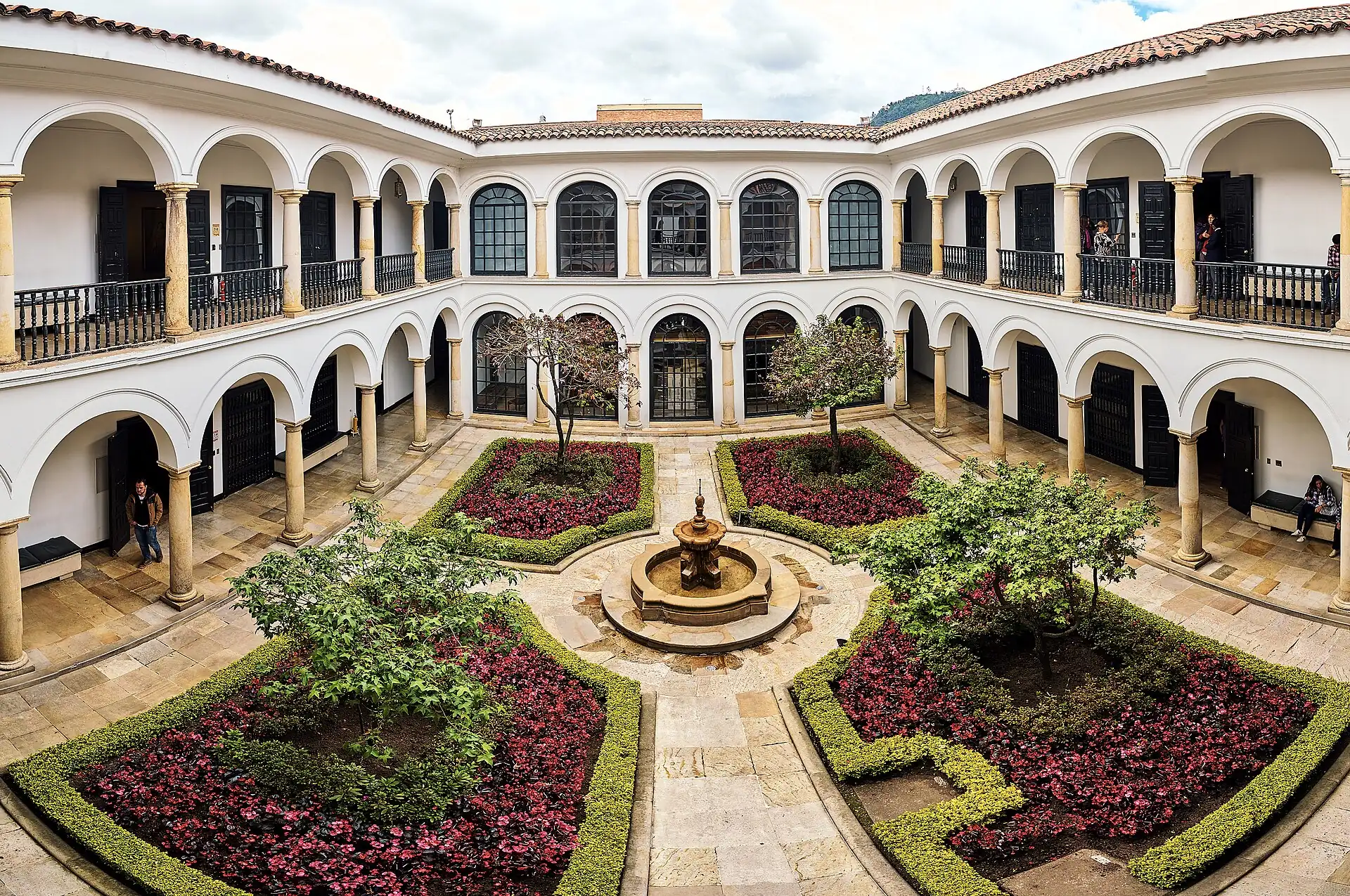
- Museo Botero
- Museo Nacional de Colombia
EssentialsQuick answers, what things cost and how to get around
Essentials
Quick answers, what things cost and how to get around
Quick answers
The questions people ask first about Bogotá, one line each. Tap a card for the full answer.
- Cash or card?Cards work in most restaurants, hotels and malls; carry COP 20,000–50,000 in small notes for taxis, markets, tips and street food.
- SIM or eSIMBuy a tourist SIM or eSIM at El Dorado arrivals (Claro, Movistar, Tigo counters) or in the city with your passport.
- Ride-hailing appinDriver · Cabify · Uber.
- Tap waterTap water is treated and generally safe to drink in Bogotá itself; many visitors still prefer bottled water for the first days while adjusting to the…
- TippingA 10% service charge ("propina voluntaria") is often added to restaurant bills and is genuinely voluntary — you can ask for it removed.
- Plugs & powerSockets A/B. US/Canada (A/B): fits · UK/Ireland (G): adapter · Australia/NZ (I): adapter. 110 V: UK and AU 230 V-only devices need a converter; most chargers are dual-voltage.
Show all 14 answers
- Safe at night?Take more care after dark in La Candelaria, La Macarena, Usaquén and more.
- What to wearBogotá dresses a notch smarter and warmer than a beach city — bring layers, not shorts and flip-flops.
- Emergency numbers123 All emergencies (not 911, 999 or 000)
- Your embassycheckUS, UK, Canada, Australia embassies listed with addresses (check before you go).
- Closed which day?Mon: 1 on our list shut.
- Sundays & holidaysWeekly closures come from our place pages; local holidays (puentes) can add extra closures not shown here.
- Rainy-day planAfternoon showers are common most of the year: do outdoor sights (Plaza de Bolívar, walking La Candelaria, Monserrate views) before midday…
- Landing lateBOG: booked car or official airport taxi to the door runs all night.
Cost cheat-sheetwhat everyday things cost
Cost cheat-sheet
Typical prices for the everyday things, as ranges. Change the currency right here; the local price stays first.
2026 desk estimate · check
- CoffeeCoffee at a specialty caféCOP 6,000–12,000
- Sit-down mealSit-down restaurant meal, per personCOP 40,000–90,000
- Street or quick mealAjiaco or set lunch (menu del día)COP 15,000–25,000
- BeerCraft beer, pintCOP 12,000–20,000
- Taxi, about 5 km (3 mi)Taxi, about 3 mi (5 km)5 km (3.1 mi) ride-hail car3.1 mi (5 km) ride-hail carCOP 12,000–22,000
- SIM or eSIM, a weekTourist SIM or eSIM, about a weekCOP 25,000–50,000
- Museum or sight ticketMuseum entryCOP 0–35,000
- Budget bedHostel dorm bed, a night, per personCOP 35,000
- Mid-range bedHotel double room, a night, per roomCOP 280,000
- High-end bedHotel double room, a night, per roomCOP 700,000
A day, not counting the bed: Budget COP 150,000 · Mid COP 300,000 · High COP 600,000
Local prices, with USD next to them (rates 2026-09 (approximate); change it in the header). Ranges are desk estimates: check locally. Every price and the budget calculator →
Source: Prices in Bogotá
Draft
Written from desk research. Not yet compared with the official source.
No official source is recorded for this figure.
Prices are 2026 desk estimates, not yet compared with an official source. Check on the day.
Not checked in the last 12 months (no check date on file).
DecideWho it suits, the trade-offs and when to go
Decide
Who it suits, the trade-offs and when to go
Best months at a glance
The guide's verdict for each month
Jan
Best
19°C (66°F)66°F (19°C)
Feb
Best
19°C (66°F)66°F (19°C)
Mar
Care
19°C (66°F)66°F (19°C)
Apr
Care
18°C (64°F)64°F (18°C)
May
Care
18°C (64°F)64°F (18°C)
Jun
Care
17°C (63°F)63°F (17°C)
Jul
Best
17°C (63°F)63°F (17°C)
Aug
Best
18°C (64°F)64°F (18°C)
Sep
Care
18°C (64°F)64°F (18°C)
Oct
Care
18°C (64°F)64°F (18°C)
Nov
Care
18°C (64°F)64°F (18°C)
Dec
Best
18°C (64°F)64°F (18°C)
Best: Jul–Aug, Dec–Feb. Mixed: Mar–Jun, Sep–Nov. Month by month →
Warmest Jan (19°C (66°F)66°F (19°C)), coolest Jan (8°C (46°F)46°F (8°C) low), wettest Apr (19 rain days), driest Jan (9). Averages, not a forecast.
Bogotá across the year
Best-looking months for Bogotá: Jan, Feb, Jul.
| Measure | Jan | Feb | Mar | Apr | May | Jun | Jul | Aug | Sep | Oct | Nov | Dec |
|---|---|---|---|---|---|---|---|---|---|---|---|---|
| Weather | Great (good) | Great (good) | Mixed (care) | Mixed (care) | Mixed (care) | Mixed (care) | Great (good) | Great (good) | Mixed (care) | Mixed (care) | Mixed (care) | Great (good) |
| Crowds | High (care) | Medium (ok) | Medium (ok) | Medium (ok) | Low (good) | Medium (ok) | Medium (ok) | High (care) | Low (good) | Low (good) | Medium (ok) | High (care) |
| Prices | High (care) | Medium (ok) | Medium (ok) | Medium (ok) | Low (good) | Medium (ok) | Medium (ok) | High (care) | Low (good) | Low (good) | Medium (ok) | High (care) |
| Events | 1 event (ok) | 1 event (ok) | 2 events (care) | 2 events (care) | None listed (ok) | None listed (ok) | 1 event (ok) | 2 events (ok) | None listed (ok) | None listed (ok) | None listed (ok) | 3 events (care) |
Green is good news, amber needs planning, red is a month to avoid; dashed grey with a question mark means our data does not say. Open the year heatmap →
Not checked in the last 12 months (no check date on file).
Source: Months, temperatures and crowds
Draft
Written from desk research. Not yet compared with the official source.
Monthly highs, rain and crowd levels are climate averages and desk estimates for the city, not a forecast.
Understand the cityUnderstand · Districts
Orientation & districts
Bogotá is long and narrow, running north–south along the base of the eastern hills. A first visit covers four areas: La Candelaria (the historic centre) in the south, La Macarena just north of it, then a long gap of traffic before Chapinero, Zona Rosa/Zona T and Usaquén further north.
Addresses in Bogotá are a grid system (Calle = east–west street, Carrera = north–south street, e.g. "Calle 11 # 4-15"); once you read the pattern it works anywhere in the city.
Shaded shapes: walking areas (click one). Black pins: sleep areas. Grey dots: places. Round badges: arrivals. Click the map to turn on scroll-wheel zoom.
Hover, tap or tab to an area to see what it is like. Pins are sleep areas; arrows at the edge point to the airport.
Not drawn yet (no coordinates in this guide): La Candelaria, La Macarena, Chapinero / Chapinero Alto, Zona Rosa / Zona T, Usaquén, Teusaquillo, Santa Fe (south of Candelaria). They are in the neighbourhood cards below.
Where’s what, as a list:
- La Candelaria: Cobbled, hilly, full of museums and street art; empty and best avoided on foot after dark. Suits: First visit, museums, colonial architecture.
- La Macarena: A quieter arts district just north of Candelaria; good for dinner, a short car ride from your bed. Suits: Museo Nacional, small restaurants, Monserrate access.
- Chapinero / Chapinero Alto: Large district bridging the centre and the north; Chapinero Alto has some of the city's best restaurants. Suits: Restaurants, nightlife, a more residential base.
- Zona Rosa / Zona T: Pedestrian streets (the "T" shape) packed with restaurants and nightlife; safe and busy into the evening. Suits: Restaurants, bars, shopping malls.
- Usaquén: Old plaza and a Sunday flea market; a taxi ride north of the centre, best combined with an afternoon in Zona T. Suits: A weekend market, a former-village feel.
- Teusaquillo: Residential with art-deco houses; not a sight in itself but a calm, central-ish place to sleep. Suits: Quiet, leafy, near Parque Simón Bolívar.
- Santa Fe (south of Candelaria): Adjacent to La Candelaria but with higher visible street crime, especially after dark: stay north of Calle 6. Suits: Not for a first visit.
- La Candelaria: Morning cluster: the old centre's museums, Plaza de Bolívar and cafés; go by 10:00 and be off the streets by dusk.Morning cluster: the old centre's museums, Plaza de Bolívar and cafés; go by 10:00 AM and be off the streets by dusk.
- La Macarena: Late-morning or evening cluster: the national museum, the bullring district and small restaurants; a booked car brings you back.
- Zona T and Chapinero: Evening cluster: restaurants, cafés and bars around Zona T, with busy streets and 24-hour hotel desks; the easiest place to eat late.
- Usaquén: Weekend cluster: the old village square, a Sunday flea market and restaurant terraces; leave by mid-afternoon to avoid rain and traffic.
- Sleep area La Candelaria: suits Families, solo on a budget, price band $$.
- Sleep area Zona T and Chapinero: suits Families, older travellers, wheelchair users, price band $$$.
- El Dorado International Airport (BOG), about 12 km (7.5 mi)7.5 mi (12 km) from the centre, 45–90 min by the usual route.
Neighbourhoods at a glance
One tab per area, pulled together from this guide’s districts table, area notes, sleep-area scores and place pages. Scores are desk judgements (1–5); prices are estimates, check before you book.
La Candelaria
Cobbled, hilly, full of museums and street art; empty and best avoided on foot after dark.
- Suits:
- First visit, museums, colonial architecture
La Macarena
A quieter arts district just north of Candelaria; good for dinner, a short car ride from your bed.
- Suits:
- Museo Nacional, small restaurants, Monserrate access
Chapinero / Chapinero Alto
Large district bridging the centre and the north; Chapinero Alto has some of the city's best restaurants.
- Suits:
- Restaurants, nightlife, a more residential base
Zona Rosa / Zona T
Pedestrian streets (the "T" shape) packed with restaurants and nightlife; safe and busy into the evening.
- Suits:
- Restaurants, bars, shopping malls
Usaquén
Old plaza and a Sunday flea market; a taxi ride north of the centre, best combined with an afternoon in Zona T.
- Suits:
- A weekend market, a former-village feel
Teusaquillo
Residential with art-deco houses; not a sight in itself but a calm, central-ish place to sleep.
- Suits:
- Quiet, leafy, near Parque Simón Bolívar
Santa Fe (south of Candelaria)
Adjacent to La Candelaria but with higher visible street crime, especially after dark: stay north of Calle 6.
- Suits:
- Not for a first visit
La Candelaria
$$La Candelaria
First-timers with museum plans: everything is close, but pick a hotel with a 24-hour desk and a door a car can reach — and plan evenings by car.
- Quiet nights2/5 Low
- Nightlife2/5 Low
- Families2/5 Low
- Late arrival3/5 Medium
Why these scores
- Quiet nights: Quiet after dark because the streets empty out, not because it is calm — some noise from nearby bars.
- Nightlife: A few bars and chicherías, but most nightlife is a taxi ride away in Zona T.
- Families: Cobbles and hills make strollers hard work; altitude adds to the adjustment.
- Late arrival: Smaller hotels may not have a 24-hour desk; confirm arrival arrangements.
Getting around from here
- 15–22 min walk to La Macarena
- Car north: about 45 min to Zona T and Chapinero
- Car north: about 60 min to Usaquén
Zona T and Chapinero
$$$Zona T
Bigger hotels with lifts, a door the car can reach and dinner on your doorstep; the museum centre is a 45-minute ride, so this suits food-first trips.
- Quiet nights3/5 Medium
- Nightlife5/5 Very high
- Families3/5 Medium
- Late arrival5/5 Very high
Why these scores
- Quiet nights: Busy but on wide, well-lit streets; ask for a room away from the pedestrian strip.
- Nightlife: Bars, clubs and restaurants on the doorstep.
- Families: Wider pavements and malls nearby, though this is not a family-first area.
- Late arrival: 24-hour desks are standard at the larger hotels.
Getting around from here
- 45–60 min walk to Usaquén
- Car south: about 45 min to La Candelaria
- BOG: about 11 km (6.8 mi) in a straight line (arrival ride 45–90 min)BOG: about 6.8 mi (11 km) in a straight line (arrival ride 45–90 min)
Ward by ward
8 area guides. Open one for the short answer, the key facts and what the area is like; the full guide is linked inside. Prices marked (check) are estimates.
Chapinero-Zona GBest for: Food-led trips, couples, longer stays, LGBTQ travellers
Stay in Chapinero-Zona G if you want Bogotá's best restaurant cluster, a calmer and greener base than the centre, and easy walking at night. Skip it if you want colonial sightseeing on foot or the cheapest beds. It sits at about 2,600 m, so plan a slow first day.
- Best for:
- Food-led trips, couples, longer stays, LGBTQ travellers
- Skip if:
- You want La Candelaria's colonial streets on your doorstep or hostel prices
- Zona G core:
- Calles 65–71 between Carreras 3 and 7
- Altitude:
- About 2,600 m — first day is for light walking
- Getting around:
- Walkable within the district; Carrera 7 buses run north and south
- Night safety:
- Busy restaurant blocks are fine; quieter side streets need normal city care (check)
- Typical dinner:
- Mid-range to high; 2026 estimate, check the menu before booking
What the area is like
Chapinero is a long, affluent district in the north-east of Bogotá, running roughly from Calle 39 north to Calle 100, bounded by Avenida Caracas on the west and the eastern hills. Zona G — G for gourmet — is its restaurant heart, packed into a few blocks between Calles 65 and 71 and Carreras 3 and 7. Embassies, offices and apartment towers fill the blocks around it.
The streets mix high-rise towers with older mansions. Quinta Camacho, two blocks from Zona G, was laid out in the 1930s and 1940s as a suburb for wealthy Bogotanos, with English and Parisian-style houses; many are now cafés, boutiques and university buildings. It is the most pleasant area to walk in the district.
Chapinero Alto, between Calles 45 and 65, is one of the city's most LGBT-friendly zones, with bars and clubs around the area. Parque Hippies, on Carrera 7 at Calle 60, is a small square by La Salle University with cheap eats and live music at weekends.
This is a working, residential district rather than a sightseeing one. You come here to eat well, sleep in a quieter part of town and use it as a base for the rest of Bogotá.
Full Chapinero-Zona G guideEating and drinking
Zona G is the reason many visitors choose this district. Within a few blocks you get Colombian cooking, Italian, French, Peruvian, Japanese and Middle Eastern kitchens, from mid-range to fine dining. Prices are higher than in the centre; book ahead for weekend dinners, and check menus before you commit.
Quinta Camacho and the streets around Parque Hippies are better for casual meals: bakeries, coffee, sandwiches, and student-priced set lunches at midday. Breakfast and brunch are strong in this district, which matters if you are adjusting to the altitude.
For a cheap, filling meal, look for the set lunch (almuerzo del día) at neighbourhood restaurants away from the Zona G core — usually soup, a main with rice and meat, and a drink. Tipping is the usual 10% 'propina voluntaria' offered on the bill.
La CandelariaBest for: First-time visitors, museum days, short stays of 2–3 nights
Stay in La Candelaria if you want museums, colonial streets and government palaces within a 10-minute walk and you value location over nightlife. Skip it if you want late bars, quiet streets after dark or easy parking; then base in Zona Rosa or Chapinero instead. Two nights covers the core.
- Best for:
- First-time visitors, museum days, short stays of 2–3 nights
- Walkability:
- Almost everything is within 10 minutes on foot; the altitude (about 2,600 m) makes hills feel longer
- After dark:
- Side streets empty out; keep to Carrera 7 and lit blocks, take a taxi for longer hops (check)
- Transmilenio:
- Museo del Oro and Las Aguas stations (J Zone); Avenida Jiménez (A Zone) is often easier
- Museums:
- Museo del Oro, Museo Botero and Casa de Moneda are the core; admission prices check (2026 estimate) (check)
- Altitude:
- About 2,600 m; take the first day slowly
- Currency:
- Colombian peso (COP); roughly 3,900–4,200 per US$ (check)
What the area is like
La Candelaria is the old center of Bogotá, founded here in 1538 and re-founded a few blocks away at the Plaza de Bolívar the following year. Because the city grew north and west, this district kept its colonial layout: narrow cobblestone streets, centuries-old houses and churches, and low buildings that sit beside modern towers.
It is three things at once. It is the seat of national and city government, so you pass the Palacio de Nariño and the Capitol on ordinary walks. It is a university district, which keeps prices low and streets busy in term time. And it is the city's main tourist quarter, with most of the top museums packed into a few blocks.
The historic weight is real: independence-era events, including the escape of Simón Bolívar and the execution of Policarpa Salavarrieta, happened on these streets. Several streets are pedestrian-only, which makes wandering easy but also means you will not find buses on Carrera 7.
Full La Candelaria guideShould you stay here or not
Stay if your Bogotá plan is museums, the Plaza de Bolívar, Monserrate and colonial architecture, and you want to walk to all of it. Two nights is enough for the core; three if you add a day trip or a slow museum day. It also suits short layovers, because the airport run is straightforward by taxi.
Do not stay if you want late-night bars, restaurant choice at 11pm or a quieter residential feel. The district empties after dark and side streets are not the place to wander. For nightlife, look at Zona Rosa or Chapinero-Zona G; for a calmer, greener base, Teusaquillo-Salitre or Usaquén.
Practical trade-offs: hotels are mostly small converted houses, so ask about noise and parking before you book (check), and altitude makes the first walk uphill harder than the map suggests.
NorthwestBest for: Long stays, families, mall shopping, business along Autonorte
Stay in Northwest only if you want big malls, modern apartments and a local, non-touristy Bogotá — Suba is huge, residential and far from the historic centre. Base in La Candelaria or Chapinero for sightseeing; pick Northwest for long stays, families or business near the Autonorte. Without a car or TransMilenio, skip it.
- Best for:
- Long stays, families, mall shopping, business along Autonorte
- Worst for:
- First-timers wanting museums and nightlife on foot
- Main areas:
- Suba (Niza, Lagos de Córdoba, Suba centre), part of Barrios Unidos
- Getting around:
- TransMilenio zones B, C, D and E; C Zone runs along Avenida Suba
- To the historic centre:
- Roughly 45–75 min by TransMilenio plus walking, depending on traffic (check)
- Altitude:
- About 2,600 m — take the first day easy
- Safety:
- Niza and northern Suba are calmer; use normal big-city caution after dark
What the area is like
Northwest Bogotá is mostly the locality of Suba, the city's most populous district, plus a slice of Barrios Unidos. Suba holds over 1.5 million people and behaves like a city of its own: broad residential blocks, financial towers, country clubs, libraries, theatres and dozens of shopping malls. It was a separate pueblo until 1954, and the old Plaza Fundacional de Suba still marks that origin.
The feel changes street by street. Niza and the northern edge are wealthier and quieter; Lagos de Córdoba is a planned 1950s residential district; the Suba hills and wetlands sit at the northern limit of the built-up area. It is not a sightseeing district — there is no colonial core to wander — but it is a comfortable, working part of Bogotá with good food and shopping.
Full Northwest guideShould you stay here
Choose Northwest if your trip is built around long stays, family space, shopping or an office near the Autonorte. Apartments and apartahotels are common, and the residential streets of Niza feel safer and quieter than the centre at night.
Skip it on a first visit of two or three days. The Museo del Oro, Monserrate and La Candelaria are all a long TransMilenio ride away, and you would spend your short trip commuting. If you want nightlife and restaurants on foot, stay in Zona Rosa or Chapinero-Zona G instead.
A middle option: stay in Northwest for the working week and move to the centre for the last nights, or base in Usaquén if you want a northern address with more character.
Santa Fé-Los MártiresBest for: Museums, La Macarena dining, Centro Internacional architecture
Stay here only if you want downtown Bogotá on foot: museums, La Macarena restaurants and TransMilenio on Carrera 7. Most visitors sleep in La Candelaria or Chapinero instead. Los Mártires west of Carrera 10 is a daytime market area, not a base, and it empties after dark.
- Best for:
- Museums, La Macarena dining, Centro Internacional architecture
- Not for:
- Nightlife, families wanting quiet streets, first-time visitors who want a walkable hostel zone
- Where to sleep:
- La Macarena and Centro Internacional edges; avoid Los Mártires after dark
- TransMilenio:
- Stops along Avenida Caracas and Calle 26; Calle 26 and Las Aguas serve La Macarena
- Altitude:
- About 2,600 m; pace the first day
- After dark:
- Take a taxi or app car from restaurants rather than walking (check)
What the area is like
Santa Fé is Bogotá's traditional downtown, wrapped around the historic core of La Candelaria. It mixes republican-era houses with the glass towers of the Centro Internacional, built up from the 1950s, and holds the National Museum of Colombia on Carrera 7. The streets around La Merced and the Centro Internacional are quieter and greener than the main avenues, with older mansions converted into museums and shops.
La Macarena, east of Parque de la Independencia, is the part most travellers come for: a small grid of cafés, galleries and mid-range to upscale restaurants, plus the city planetarium and the bullring, repurposed in 2022 as the Plaza Cultural de Santamaría. It is calm by day and busy at dinner.
Los Mártires sits west of Carrera 10 (Caracas). It is downtown's market end, with San Victorino and its cheap clothing and goods stalls. Foreign visitors mostly pass through for the shopping, and it is not a sightseeing district in its own right.
Full Santa Fé-Los Mártires guideShould you stay here?
Choose Santa Fé if your trip is about museums, downtown architecture and eating well within a few blocks. La Macarena and the streets near the Centro Internacional give you that, with TransMilenio stops on Carrera 7 and Avenida Caracas to reach the rest of the city.
Skip it if you want a hostel strip, late bars at the door, or streets that feel relaxed after 21:00. La Candelaria is the usual first-trip base for the historic centre; Zona Rosa and Chapinero-Zona G have the nightlife and hotel choice; Usaquén is calmer and further north. Los Mártires is a daytime-only area for visitors: go for the market, leave before dark.Skip it if you want a hostel strip, late bars at the door, or streets that feel relaxed after 9:00 PM. La Candelaria is the usual first-trip base for the historic centre; Zona Rosa and Chapinero-Zona G have the nightlife and hotel choice; Usaquén is calmer and further north. Los Mártires is a daytime-only area for visitors: go for the market, leave before dark.
Altitude is the other factor. At about 2,600 m, the first day is for light walking, not for a full museum-and-market circuit.
South
Skip staying in South Bogotá. It is a six-locality residential belt with almost no hotel base, and the sights worth the trip — the TransMiCable ride and Sumapaz moorland — are half-day visits from Candelaria or Chapinero. Go only if you want the cable car or a lechona lunch, and stay on the return leg.
- Verdict:
- Day trip, not a base
- Localities:
- San Cristóbal, Usme, Tunjuelito, Antonio Nariño, Rafael Uribe, Ciudad Bolívar
- Best reason to go:
- TransMiCable ride over Ciudad Bolívar
- TransMiCable fare:
- Free with a TransMilenio transfer; about 2,950 COP without — 2026 estimate (check)
- TransMiCable hours:
- Mon–Sat 04:30–22:00, Sun 05:30–21:00Mon–Sat 4:30 AM–10:00 PM, Sun 5:30 AM–9:00 PM
- Sumapaz:
- Largest moorland (páramo) ecosystem in the world; go with a guide
- Getting in:
- TransMilenio H Zone (Av. Caracas) and L Zone (Cra 10) from downtown
- Safety:
- Generally calm by day; stay on main streets, do not exit the cable car stations
- Altitude:
- Bogotá sits at about 2,600 m
What the area is like
South Bogotá is not one neighborhood but six localities — San Cristóbal, Usme, Tunjuelito, Antonio Nariño, Rafael Uribe and Ciudad Bolívar — spread over the city's southern half and climbing into the hills. It is where a large share of Bogotá's working and middle-income households live, so the streets are busy with daily life rather than visitor infrastructure.
Decades of city investment have added wide avenues, planned housing blocks, parks, libraries and community centres, and the area is calmer than its reputation suggests. Still, it has far fewer sights, hotels and restaurants aimed at travellers than Candelaria, Chapinero or Usaquén, and the interesting parts are spread out.
Two things pull visitors south: the TransMiCable cable car over Ciudad Bolívar, and Sumapaz, the world's largest páramo, a high-altitude moorland south of the city. Both are half-day trips, not a reason to move your bags.
Full South guideShould you stay here
No, for almost every trip. There is no traveller hotel cluster, no evening restaurant strip, and you would spend 30–60 minutes each way on TransMilenio to reach the museums and nightlife you came for. Bogotá's altitude (about 2,600 m) also makes long commutes tiring in the first days.
Stay in La Candelaria for the historic core, Zona Rosa or Chapinero-Zona G for nightlife and restaurants, or Usaquén for a quieter, village-like base. Use South as a daytime excursion from any of them.
The exception is a traveller with a specific reason: a volunteer or family connection in the area, or a very early start toward Villavicencio. Even then, check the exact block before booking.
UsaquénBest for: Couples, families, business travellers, longer stays, anyone who values quiet streets and restaurants over nightlife
Yes, if you want a calm, safe, upscale base north of the centre with good food and malls — and you accept 30–60 min by car to La Candelaria and Monserrate. Stay here for a relaxed first or last night; choose Chapinero or La Candelaria if you want museums and nightlife on foot.
- Best for:
- Couples, families, business travellers, longer stays, anyone who values quiet streets and restaurants over nightlife
- Not for:
- Travellers who want museums, hostels and bars within walking distance
- Distance to La Candelaria:
- About 12–14 km (7.5–8.7 mi) south; 30–60 min by car depending on trafficAbout 7.5–8.7 mi (12–14 km) south; 30–60 min by car depending on traffic (check)
- Flea market:
- Mercado de las Pulgas de Usaquén, Sundays around the main square (check hours) (check)
- Altitude:
- About 2,600 m, same as the rest of Bogotá
- Getting in:
- TransMilenio to Portal del Norte or Calle 116, then walk or short taxi; Uber and taxis from the centre (check)
- Safety:
- One of the calmer districts; normal big-city care after dark (check)
What Usaquén is like
Usaquén is the northernmost of Bogotá's districts and one of the largest, with close to a million residents. Most of it is residential and commercial: high-rise apartment blocks, office towers, country clubs and some of the city's biggest shopping malls along Autopista Norte and Carrera 15.
The part visitors care about is the old village core around Calle 119 and Carrera 5–6, a few blocks of low colonial-style houses, a small square, cafés and restaurants. It was a separate town before Bogotá grew around it, and it still feels like a plaza with a city attached. North of it, the streets turn into the modern district: Unicentro, Hacienda Santa Bárbara, Centro Comercial Santa Fé and the W Hotel.
It is quiet by Bogotá standards, green in places, and well served by restaurants. It is not a sightseeing district: there is no museum or monument here that justifies the trip on its own.
Full Usaquén guideShould you stay in Usaquén?
Stay if you want a low-stress base: a hotel on a quiet street, dinner a short walk away, and a supermarket and pharmacy nearby. It suits couples, families, business travellers and anyone staying several nights who prefers calm to crowds. The Sunday flea market and the colonial square give it more character than a pure business district.
Skip it if your Bogotá list is museums, La Candelaria, Monserrate and nightlife. You would spend 30–60 minutes each way in traffic, and evenings would mean a taxi back north. For that trip, La Candelaria or Chapinero-Zona G puts you closer to what you came for.
A practical compromise: two nights in La Candelaria or Chapinero for the sights, then one or two nights in Usaquén before flying out or heading north to Villa de Leyva.
WestBest for: Airport nights, Maloka with children, big malls, chain hotels
Stay in West Bogotá only if you need El Dorado airport, a chain hotel near it, or Maloka with kids; the sights most visitors come for are in La Candelaria and the north. Base downtown or in Chapinero and treat West as a half-day, unless an early flight changes the maths.
- Best for:
- Airport nights, Maloka with children, big malls, chain hotels
- Worst for:
- First-trip sightseeing on foot; museums and colonial streets are 8–12 km (5–7.5 mi) eastFirst-trip sightseeing on foot; museums and colonial streets are 5–7.5 mi (8–12 km) east
- Localities:
- Engativá, Fontibón and Kennedy
- Airport:
- El Dorado (BOG) sits inside the area
- Getting in:
- TransMilenio to Portal El Dorado; taxi or ride-hail from downtown about 30–50 min (check)
- Altitude:
- About 2,600 m; take the first day easy
- Safety:
- Quiet residential streets by day; use taxis after dark and keep phones out of sight (check)
What the area is like
West Bogotá is not one neighborhood but three localities — Engativá, Fontibón and Kennedy — spread across the flat western side of the city. It mixes working and middle-class barrios with planned residential districts, wide avenues, parks and large shopping centres. It is the practical, everyday side of Bogotá rather than the postcard side.
El Dorado International Airport lies inside this area, which is why so much of the hotel stock is here: international chains, airport shuttles and business travellers. Maloka, the interactive science museum, is a short hop from the terminal in Engativá and is the one sight that pulls families west on purpose.
The rest is parks and monuments. Parque Metropolitano El Tintal in Kennedy has sports fields, a bike path, a public library and a cultural centre. The Monumento a las Banderas on Avenida de las Américas, inaugurated in 1948, honours the countries of the Americas with flags and statues. Both are local landmarks rather than headline attractions, and both sit well away from the historic centre.
Full West guideShould you stay here?
For a normal Bogotá visit, no. The Museo del Oro, La Candelaria, Monserrate and the main restaurant districts are in the centre and north, and crossing the city from West twice a day costs you an hour or more in traffic. Stay here only for a specific reason: a very early departure, a long layover, a business address, or a hotel rate that is clearly better than anything central.
If you do stay west, choose around the airport or Gran Estación for transport and food, and plan your city days as single outings rather than back-and-forth trips. If your trip is about the city itself, base in La Candelaria for the historic core or Chapinero-Zona G for restaurants and nightlife, and use West only as a transfer point.
Zona RosaBest for: Fine dining, shopping malls, upscale hotels, evening walks
Stay in Zona Rosa if you want walkable fine dining, malls and upscale hotels between Calles 79 and 85, and you prefer a polished, well-lit base over colonial atmosphere. Skip it if you want cheap street life or historic streets — La Candelaria and Chapinero-Zona G cost less and feel more local.
- Where it is:
- Between Calles 79 and 85, Carreras 11 and 15, Chapinero, about 2,600 m elevation
- Best for:
- Fine dining, shopping malls, upscale hotels, evening walks
- Not for:
- Budget backpackers, colonial architecture, quiet nights
- TransMilenio:
- Héroes and Calle 85 stations; Calle 76 on Avenida Caracas also works
- Walk to Zona G:
- About 15–20 minutes south along Carrera 11 or 7 (check)
- Walk to Parque 93:
- About 10–15 minutes north (check)
- Typical hotel night:
- 2026 estimate: COP 350,000–900,000 mid-range to upscale; five-star higher (check)
What the area is like
Zona Rosa is Bogotá's shopping and entertainment district, built around the T-shaped junction known as Zona T. The blocks between Calles 79 and 85 and Carreras 11 and 15 hold luxury boutiques, international restaurants, five-star hotels and large malls such as Centro Comercial Andino. It sits inside Chapinero, north of the historic centre and south of Parque 93.
The architecture mixes modern towers and malls with older mansions converted into shops and hotels — the Carolina Herrera store on a 1920s house is the usual example. The streets are busy with office workers, diplomats, expats and visitors, and English is more common here than in most of the city. Evenings are the peak: restaurants fill from about 19:00 and bars run late, especially Thursday to Saturday.The architecture mixes modern towers and malls with older mansions converted into shops and hotels — the Carolina Herrera store on a 1920s house is the usual example. The streets are busy with office workers, diplomats, expats and visitors, and English is more common here than in most of the city. Evenings are the peak: restaurants fill from about 7:00 PM and bars run late, especially Thursday to Saturday.
It is one of the most expensive parts of Bogotá and of Latin America. That buys polished pavements, good lighting, taxis on every corner and a wide choice of food, but not the colonial streetscape or market energy that draw people to La Candelaria.
Full Zona Rosa guideShould you stay here
Choose Zona Rosa if this is your first trip to Bogotá and you want a base where you can walk to dinner, sleep in a comfortable hotel and take a taxi or TransMilenio to the sights. It suits couples, business travellers and anyone who prefers a calm, well-lit evening over a night out in a district with fewer amenities.
Look elsewhere if you are travelling on a tight budget, want hostels and street food, or came for colonial architecture and museums on foot. La Candelaria puts you next to the Museo del Oro and Monserrate cable car at lower prices, with more noise and more petty theft. Chapinero-Zona G is a quieter restaurant district a short walk south. Usaquén is calmer and more village-like, further north.
The main trade-off is that Zona Rosa is not next to the main sights. Reaching La Candelaria or Monserrate takes roughly 20–40 minutes by taxi depending on traffic, or longer by TransMilenio plus a walk.
Decide
The honest trade-off: what you will enjoy, what will wear you down.
You will like
- Museums with strong collections
- Cool weather and coffee
- Street murals and food markets
You will hate
- Rain and traffic
- Altitude on day one
- Dark, empty streets at night
Similar citiesif this one is not quite right
When
Best months: Jan, Feb, Jul, Aug, Dec. Month-by-month verdicts below, with the live forecast first. When to go, month by month →
Bogotá: next 7 days
Loading forecast…
Forecast: Open-Meteo (CC BY 4.0), model data for this point.
Air quality
Loading…
Model estimate (CAMS via Open-Meteo), not a street-level station; readings near busy roads run higher.
Month by month, all 12best Jan, Feb, Jul, Aug, Dec
Dry season; cool mornings, sunny days.
Driest month, best for Monserrate views.
Rains start; carry a jacket.
Wet; showers most afternoons.
Wet; some days grey all day.
Mixed; lower rain, cool wind.
Second dry window; windy, kite season.
Dry and windy; good walking mornings.
Rains return; Festival crowds early Sep.
Wettest period begins.
Wet; heavy afternoon rain.
Dry; Christmas lights, busy weekends.
Climate, calendar and eventsClimate · Calendar · Events · Packing by season
Climate
| Jan | Feb | Mar | Apr | May | Jun | Jul | Aug | Sep | Oct | Nov | Dec | |
|---|---|---|---|---|---|---|---|---|---|---|---|---|
| High | 19°C (66°F)66°F (19°C) | 19°C (66°F)66°F (19°C) | 19°C (66°F)66°F (19°C) | 18°C (64°F)64°F (18°C) | 18°C (64°F)64°F (18°C) | 17°C (63°F)63°F (17°C) | 17°C (63°F)63°F (17°C) | 18°C (64°F)64°F (18°C) | 18°C (64°F)64°F (18°C) | 18°C (64°F)64°F (18°C) | 18°C (64°F)64°F (18°C) | 18°C (64°F)64°F (18°C) |
| Low | 8°C (46°F)46°F (8°C) | 9°C (48°F)48°F (9°C) | 9°C (48°F)48°F (9°C) | 10°C (50°F)50°F (10°C) | 10°C (50°F)50°F (10°C) | 9°C (48°F)48°F (9°C) | 9°C (48°F)48°F (9°C) | 9°C (48°F)48°F (9°C) | 9°C (48°F)48°F (9°C) | 10°C (50°F)50°F (10°C) | 10°C (50°F)50°F (10°C) | 9°C (48°F)48°F (9°C) |
| Rain days | 9 | 11 | 15 | 19 | 19 | 15 | 13 | 13 | 15 | 19 | 19 | 12 |
| Verdict |
- Two drier windows (Dec–Feb, Jun–Aug) and two wetter windows (Mar–May, Sep–Nov): Bogotá does not have a hot or cold "season", it has a wet or dry one.
- Afternoon showers are common even in the drier months; plan outdoor sights for the morning.
- Nights are cool everywhere, year-round: bring a jacket regardless of the month you travel.
Events by month
New Year wind-down
seasonEarly to mid-January · Citywide
A quiet month as New Year holidays wind down by mid-month.
Driest window
seasonFebruary · Citywide, especially Monserrate
The driest month of the year and the best window for clear Monserrate views.
Festival Iberoamericano de Teatro
festivalMarch–April, odd years only · Venues across the city(check dates)
A major international theatre festival — see events for the programme.
Rock al Parque
festivalA weekend in July · Simón Bolívar Park(check dates)
Free outdoor rock festival — see events for the lineup.
Kite season and Festival de Verano
seasonAugust · Parks citywide(check dates)
Windy afternoons bring out kite flyers, alongside Festival de Verano events around the city.
Alumbrado Navideño and Día de las Velitas
festival7–8 December, with lights through the month · Citywide(check dates)
Christmas lighting displays (Alumbrado Navideño) and the candle-lighting night of Día de las Velitas — see events.
Festivals and events that change the plan
| When | What | Effect on your plan |
|---|---|---|
| Late Mar–Apr (odd years, dates move) | Festival Iberoamericano de Teatro | One of the world's largest theatre festivals; hotels fill and La Candelaria gets busy with street performances. |
| Early Jul | Rock al Parque | Free, huge outdoor rock festival in Parque Simón Bolívar; transport and hotels nearby get crowded for the weekend. |
| Aug (dates vary) | Festival de Verano and kite season | Windy, dry month; parks fill with kite flyers and outdoor events. |
| Every Sunday and public holiday, 07:00–14:00 | Ciclovía | Main avenues close to cars for cyclists, runners and walkers — a good low-traffic morning to see the city on foot or by bike. |
| Early Dec | Alumbrado Navideño (Christmas lights) | Parks and the north of the city are decorated with large light displays; evenings get crowded and cold. |
| 7–8 Dec | Día de las Velitas (Day of the Little Candles) | Streets and windows fill with candles the night before Immaculate Conception; a warm, family evening, but book restaurants ahead. |
What to pack, by season
From Bogotá’s own climate table: the coldest, warmest and wettest three months, and what to bring for each.
Coldest months
Jun–Aug
9° to 17°
A light jacket and a sweater.
Warmest months
Feb–Apr
9° to 19°
Layers: warm days, cooler evenings.
Wettest months
Mar–May
18 rain days a month
A compact umbrella or rain jacket and shoes that can get wet.
Arrive & moveGetting in, getting around, and your bags
Arrive & move
Getting in, getting around, and your bags
I land at…
Enter your landing time: what still runs from the airport, where you can eat when you get in, and which areas let you check in that late.
El Dorado International Airport (BOG)
Out of the airport about 23:5311:53 PM (01:00 (next day)1:00 AM (next day) if immigration and bags are slow); in town about 00:38 (next day)12:38 AM (next day).
Transport from the airport
- Any hourBooked car or official airport taxi to the door. Runs all night.
- Any hourOfficial airport taxi queue — take the fare slip, do not accept street offers. Any hour.
- Last resortOvernight near the airport. If nothing else works.
Places to eat open when you get in
We have no confirmed hours for the places to eat here yet. Plan on a convenience store or your hotel. What is open late →
Where to sleep with a late arrival
- Lets you inLa Candelaria 24-hour desk. Smaller hotels may not have a 24-hour desk; confirm arrival arrangements.
- Lets you inZona T and Chapinero 24-hour desk. 24-hour desks are standard at the larger hotels.
Typical times from our airport data, not a timetable: check the last departure on the day. Full airport-to-bed plan for El Dorado International Airport (BOG) →
Arrive
Each gateway has its own airport-to-bed page with timings and the last safe connection.
Move
The default way around, when a pass pays off, and when the last trains go.
- Default
- Walk inside a cluster; booked car or app taxi between clusters.
- Passes
- No pass. Cars between the centre and Zona T cost a few dollars; agree the app fare or use the meter.
- Last trains
- No metro; buses stop running for tourists' purposes at night: use an app or hotel-booked car after dark.desk estimate
- Other modes
- Other modes (Rome2Rio) ↗
Getting around, in detailGet around · Connect
Get around
Connect
| Option | Verdict | What breaks |
|---|---|---|
| Carrier counter in El Dorado arrivals (Claro, Movistar, Tigo) | use | Straightforward with a passport; buy at the branded counter, not a reseller. |
| Tourist eSIM bought before you fly | use | No counter, no queue; check coverage for Colombia specifically. |
inDriver
Cars
You negotiate the fare before accepting a driver; widely used in Bogotá.
Cabify
Cars
Fixed fare shown before the ride.
Uber
Cars
Operates in a legal grey area in Colombia; works in practice but check current status.
Google Maps
Walking and addresses
Works well with the Calle/Carrera grid system.
- Wi-Fi
- Free in most cafés, hotels and malls; ask for the password ("clave") at the counter.
Luggage
Where big bags are a problem, and how to get rid of them for the day.
Rule
- Lockers
- Few public lockers; hotels hold bags after check-out.
- Forwarding
- No forwarding culture; keep the big bag at the Bogotá hotel when you fly on to Medellín or the coast in a day.
- Dead zone
- Late flights out: ask the hotel to hold bags and offer a shower room; many do for a small fee.
Bags, area by area
4 walking areas rated
- Bags painful
- Bags ok
Lockers, forwarding and the gap between check-out and check-in are covered once, under Luggage.
See & doWalking clusters, day plans and the places worth the time
See & do
Walking clusters, day plans and the places worth the time
Clusters
Plan by cluster: each is a walkable area with a rescue point and a bag rule.
Morning cluster: the old centre's museums, Plaza de Bolívar and cafés; go by 10:00 and be off the streets by dusk.
rescue 100% · max p90 5.1′ · half
Late-morning or evening cluster: the national museum, the bullring district and small restaurants; a booked car brings you back.
rescue 100% · max p90 5.1′ · half
Evening cluster: restaurants, cafés and bars around Zona T, with busy streets and 24-hour hotel desks; the easiest place to eat late.
rescue 100% · max p90 5.1′ · half
Weekend cluster: the old village square, a Sunday flea market and restaurant terraces; leave by mid-afternoon to avoid rain and traffic.
rescue 100% · max p90 5.1′ · half
Days
Ready-made day plans, timed against opening hours and walking distances.
How long are you staying?
2 days
La Candelaria museums and Plaza de Bolívar day one; Museo Nacional and Monserrate day two.
Bogotá in 3 days
3 daysMornings for museums, afternoons under a roof or at a café, evenings by booked car; the last day ends with the bags already in the car.
Day by day
Day 1 — Candelaria museums, a 13:00 lunch table
- 08:30Plaza de Bolívar
- Museo Botero
- Museo del Oro (Gold Museum)
- 13:00Lunch table 13:00 (Candelaria)
Day 2 — Museo Nacional, Monserrate, ajiaco
Day 3 — Usaquén market, car to El Dorado at 15:00
- 09:00Usaquén flea market
- 15:00Car to El Dorado at 15:00
Places
“Best time” is when to arrive for the fewest crowds, for example “before 08:30”; “Go any time” means the hour makes little difference. More sights follow under “More sights and museums”.
7 places. Filters use the guide’s own ratings; a place with no rating is left out when a filter is on.
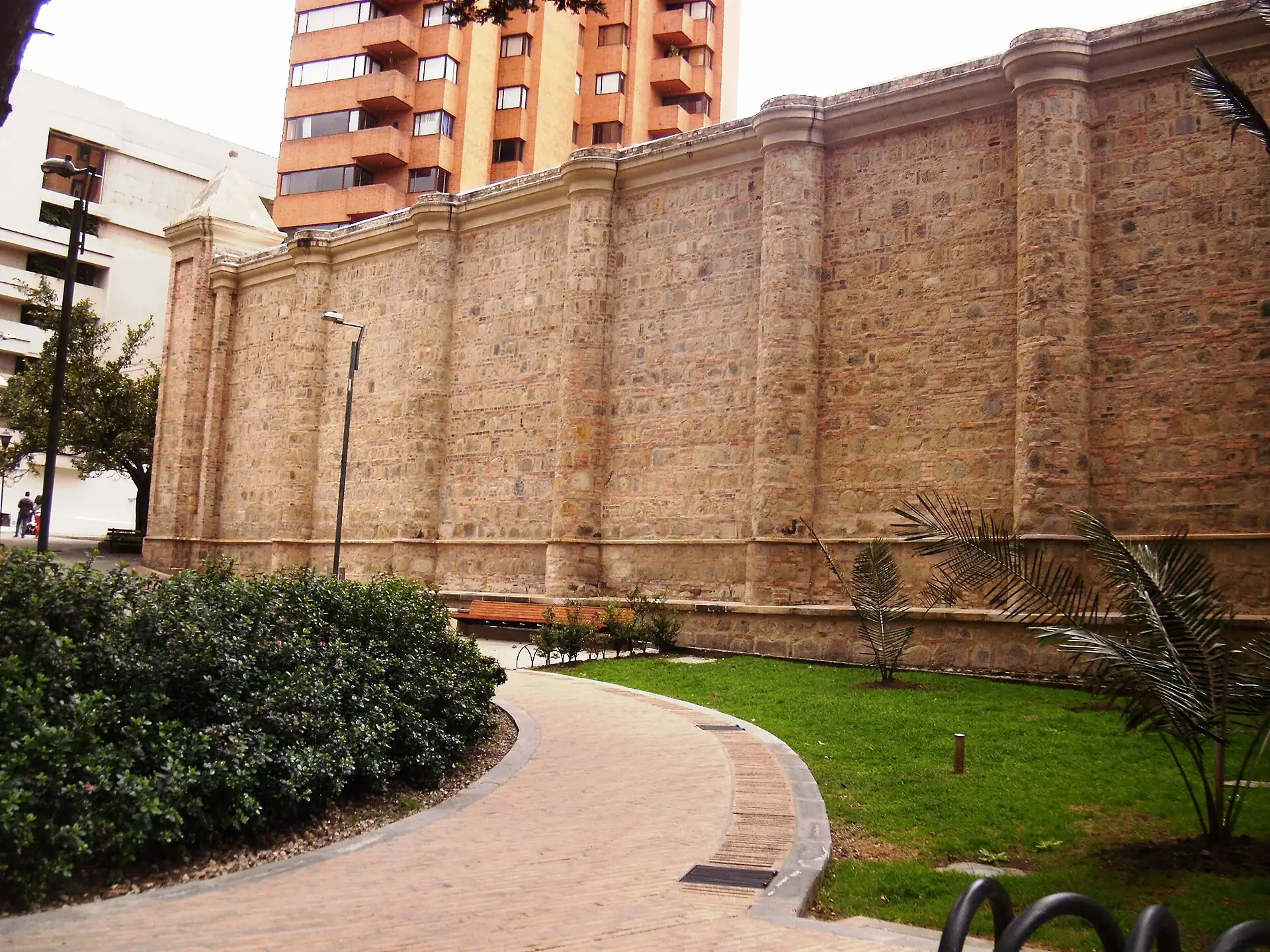
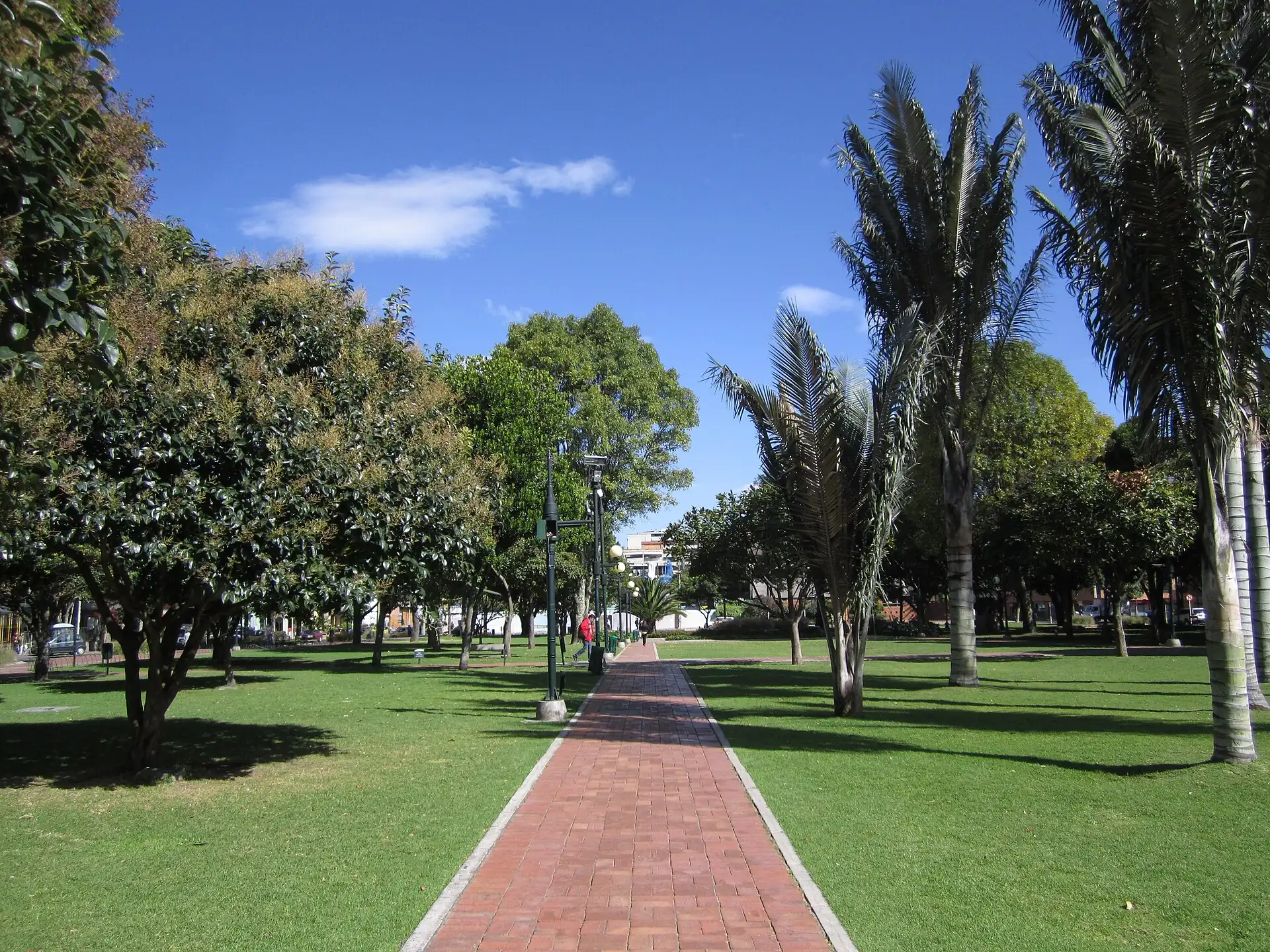
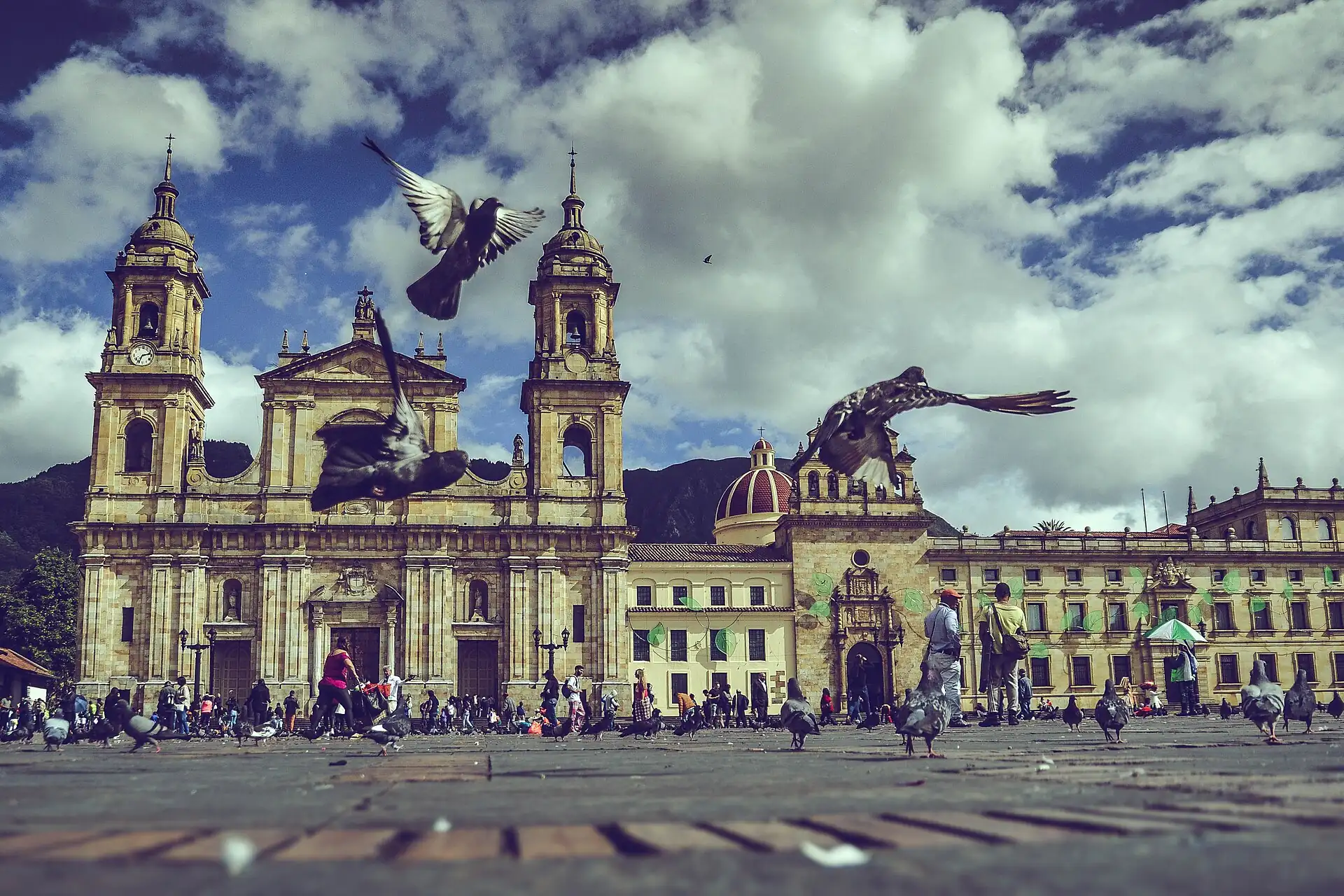
Tours, classes and shows in Bogotá →
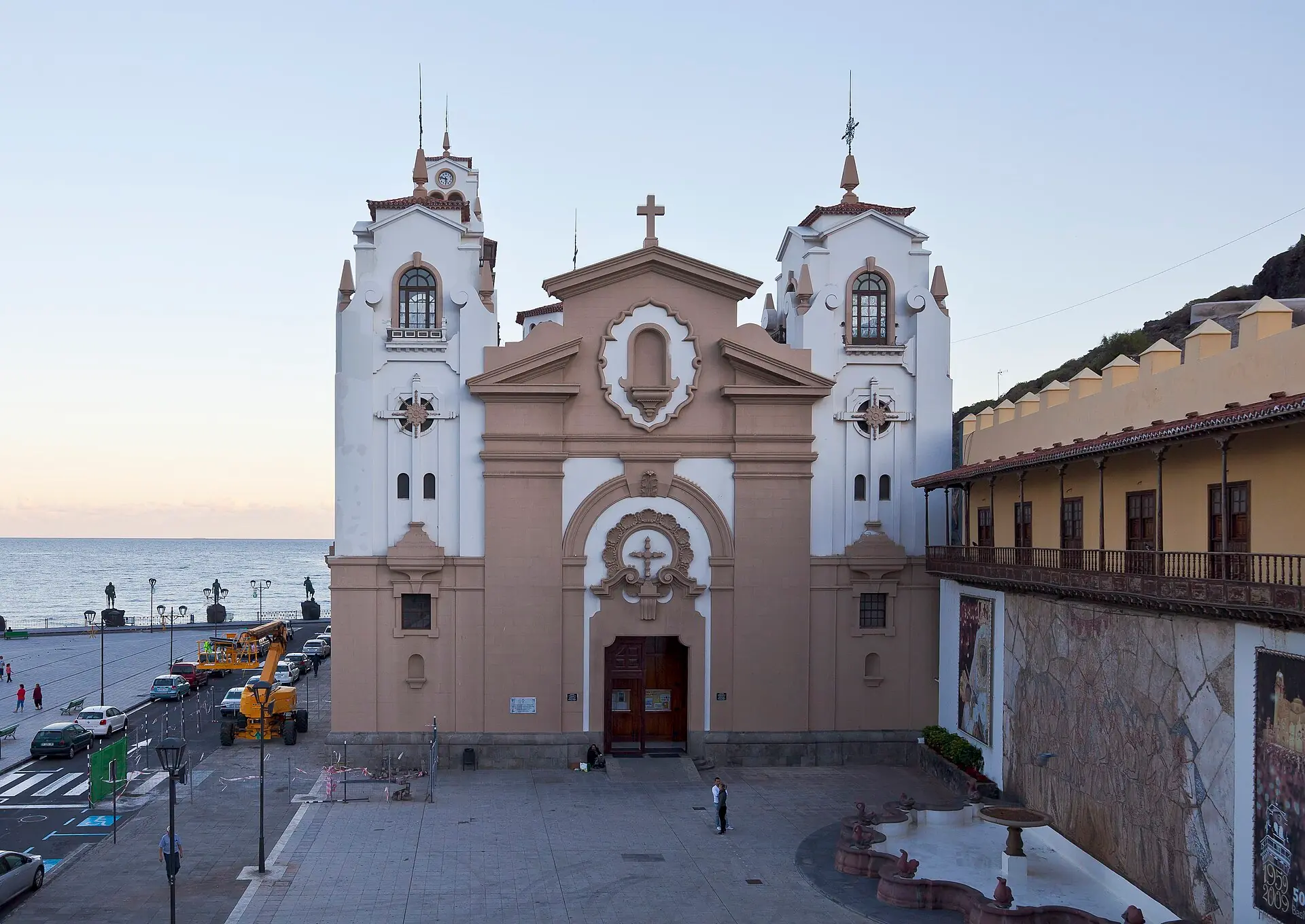
If you do ten things in Bogotá
- 1
- 2
- 3
- 4
- 5
- 6
- 7
La Candelaria street art walk
- 8
- 9
Zipaquirá Salt Cathedral
- 10
Good for…
Neighbourhoods in one line
| Area | Feel | Suits | Go | Avoid |
|---|---|---|---|---|
Tours and classes: book or skip
| Tour or class | Verdict | Typical price | Why | Check before paying |
|---|---|---|---|---|
What each season brings
Dec–Feb (drier)
Mar–May (wetter)
Jun–Aug (drier, windy)
Sep–Nov (wetter)
Photo spots and the light
| Spot | Best light | Tip |
|---|---|---|
| Monserrate | ||
| Plaza de Bolívar | ||
| La Candelaria street art on Carrera 3 and around Chorro de Quevedo |
Bogotá travel FAQ
Is Bogotá safe for tourists?
Yes, if you follow the basics: no dar papaya (do not display valuables), book a car after dark instead of walking, and watch drinks in bars. Petty theft and scams, not violence, are the main risk for visitors who stick to the tourist areas.
Do I need to worry about altitude?
Most visitors feel some breathlessness or a mild headache on day one at 2,640 m. Rest the first afternoon, drink water, and go easy on alcohol and Monserrate on foot until you have adjusted.
Can I drink the tap water?
Bogotá's tap water is treated and generally safe, unlike many other Latin American capitals; many visitors still choose bottled water for the first days.
How many days do I need?
Two days covers the centre's museums and Monserrate; three adds Usaquén; five lets you add a Zipaquirá day trip and a slower pace for the altitude.
More to see and doSee & do · Learn & work · Rain & heat · Free things
Free things to do
Sights in Bogotá that cost nothing to enter. Each is described under Places or More sights; extra costs inside are marked there.
See & do
9 of 9
Bogotá's best-known museum: pre-Hispanic gold and ceramics; give it 90 minutes early, before school groups and midday crowds.
La Candelaria
- other
A compact museum of Fernando Botero's own art and his donated collection: an hour, often free of queues.
La Candelaria
The country's history in a former prison: a good rain-day hour and a half, with a garden café.
La Macarena
- other
The open civic square at the centre of La Candelaria: a free 20–30 minute stop any morning, folded into a museum walk — check for marches before you go, and do not linger after dark.
La Candelaria
- other
The city's best view, reached by cable car or funicular, never on foot unless a hotel or local guide confirms the trail is open and busy: go clear mornings or sunset, not midday haze.
La Macarena
- other
A weekend crafts and food market around the old village square: go before lunch, and check the days it runs.
Usaquén
- other
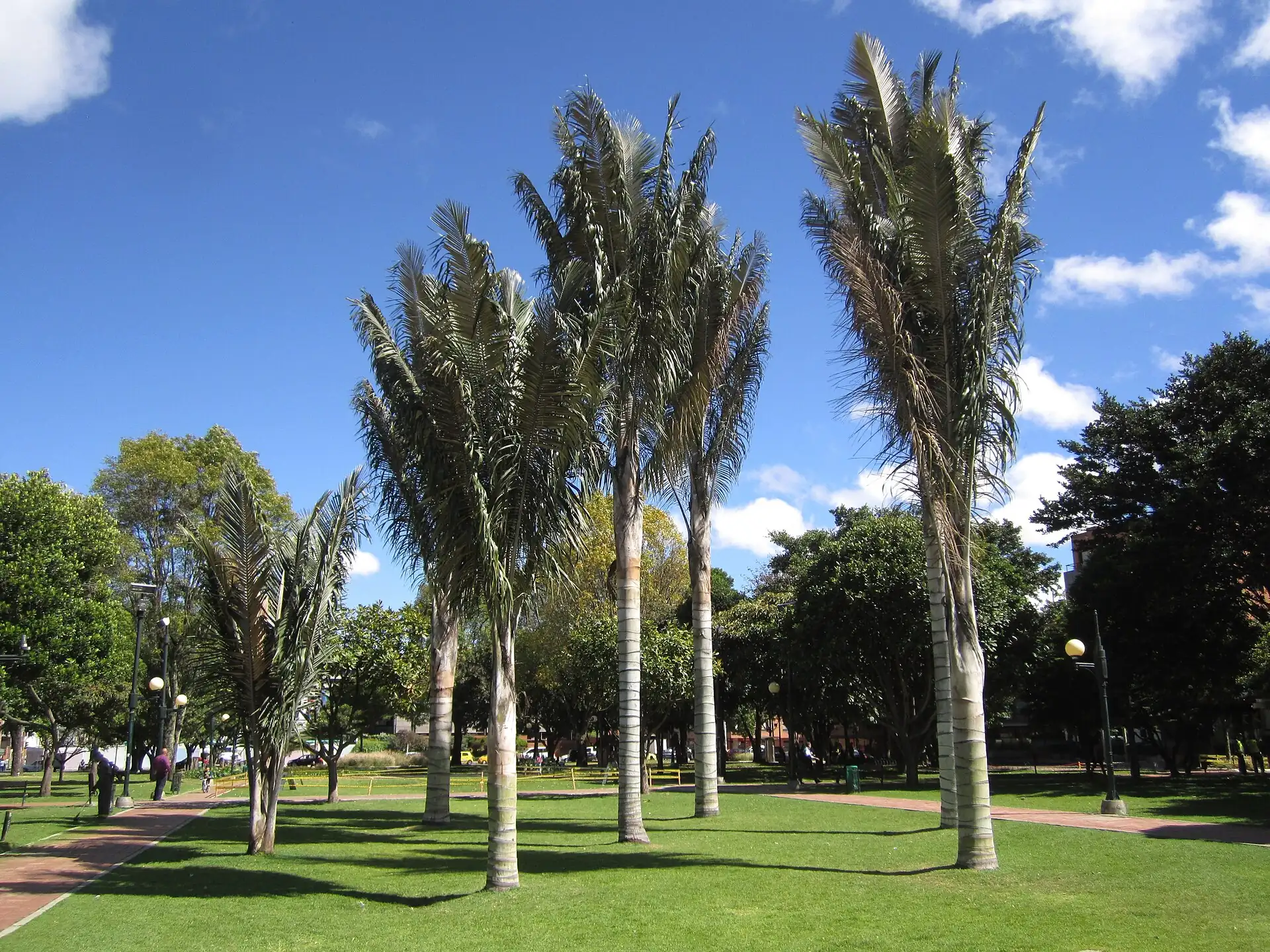
A small, well-kept park ringed by restaurants and offices: a green pause between Zona T meals, not a destination on its own.
Zona T and Chapinero
Free walking tour of La Candelaria
otherGraffiti tour of La Candelaria and Chapinero
other
Learn & work
| What | Where | Cost | Note |
|---|---|---|---|
| Free walking tours | Meet daily near Chorro de Quevedo | Free (tip-based) | Cover colonial and modern history in English and Spanish. |
| Graffiti and street-art tours | La Candelaria and Chapinero | check | Explain the murals of both neighbourhoods. |
| Spanish-language courses | Language schools in Chapinero | check | For longer stays; day workshops in cooking or chocolate-making are bookable through hostels. |
Working here
- Co-working spaces
- Co-working spaces in Chapinero and Zona T (WeWork and local chains) sell day passes.
- Café working
- Cafés in Chapinero and La Candelaria tolerate laptops for the price of a coffee; Wi-Fi is generally reliable.
Rain-day and heat-day plan
Rain day
Afternoon showers are common most of the year: do outdoor sights (Plaza de Bolívar, walking La Candelaria, Monserrate views) before midday, then move indoors.
- 01Museo del Oro (Gold Museum) — Indoor, large and air-conditioned; comfortably fills a rainy morning.
- 02Museo Nacional de Colombia — Indoor; the former-prison building itself is part of the exhibit.
- 03Museo Botero — Small and indoor — pairs with a rainy-day stop at Museo del Oro.
- 04Centro Comercial Andino or Centro Comercial Santafé — Malls with food courts and cinemas for a washed-out afternoon.
Day-trips and nearby
Places you can reach from Bogotá in a day or with one night away, with the route and what it costs. Door to door, not ride time.
Zipaquirá Salt Cathedral
goCar or bus about 1 h; or a heritage train on some weekends (check the calendar)
An underground cathedral carved into a former salt mine; go early to beat tour-bus crowds.
- Time
- Half to full day
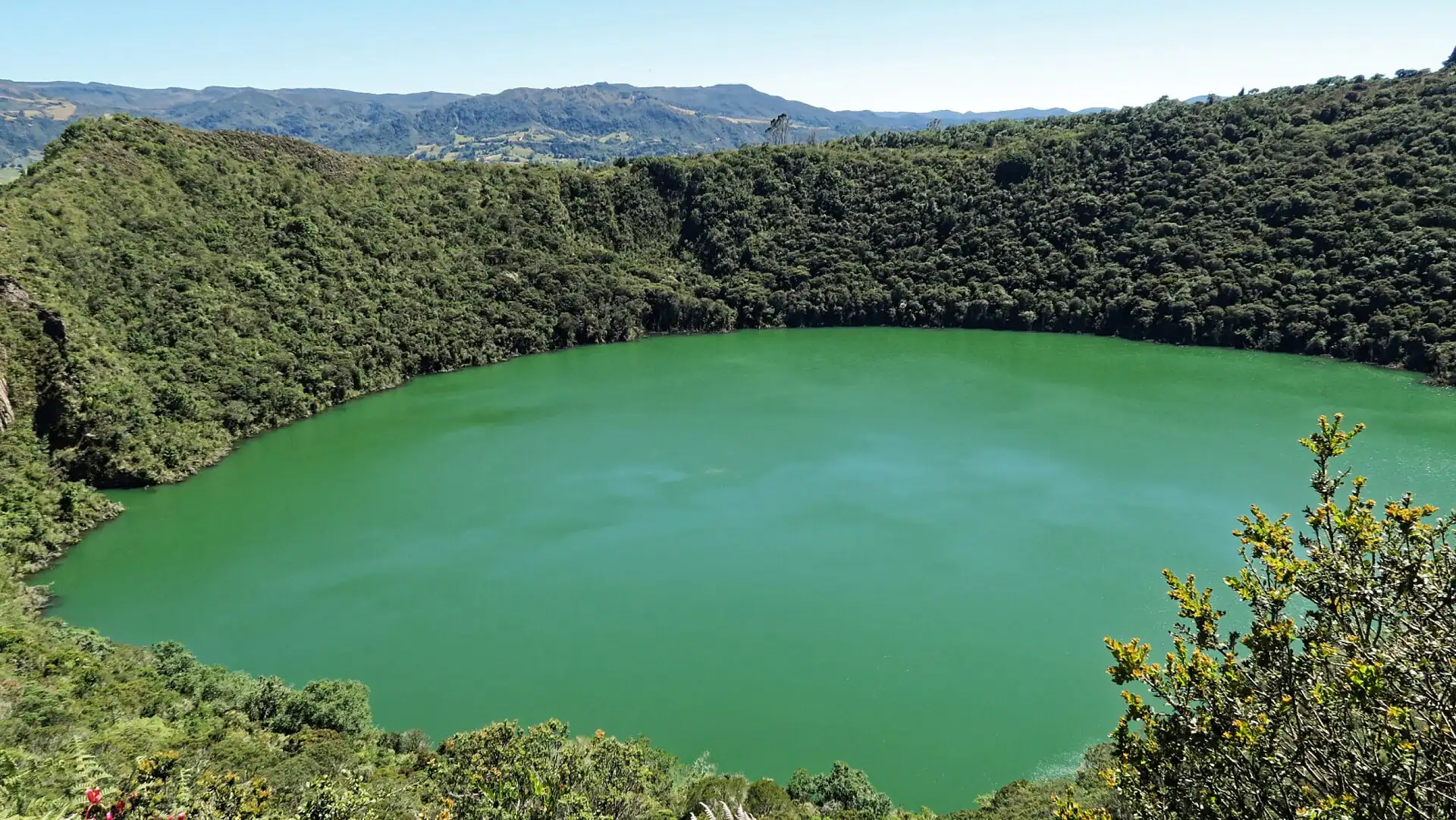 Photo: Burkhard Mücke, CC BY-SA 4.0
Laguna de Guatavita
goCar about 1.5–2 h, then a short guided walk (guide required to enter)
The lake behind the El Dorado legend; combine with Zipaquirá only if you have a full day free.
- Time
- Full day
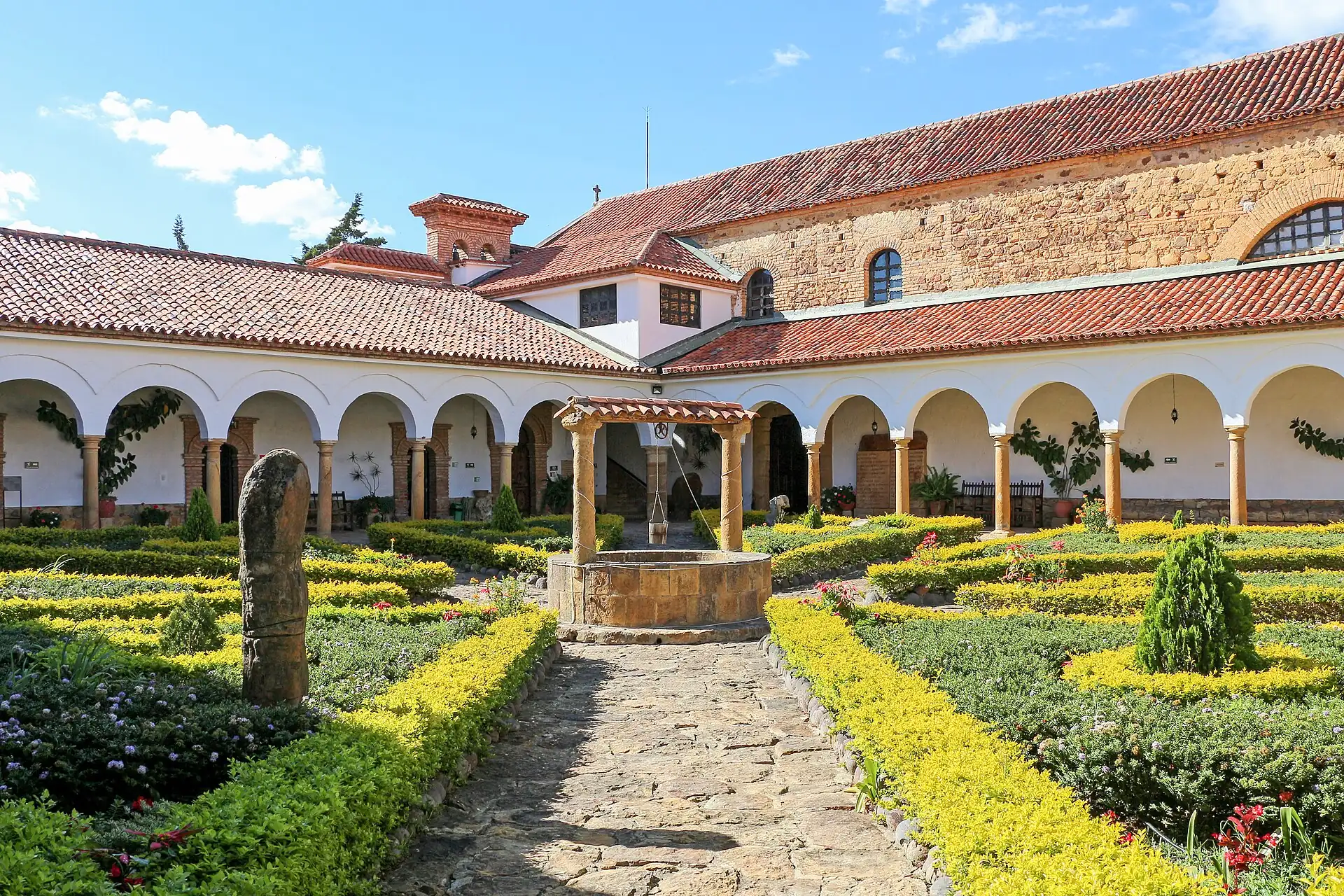 Photo: Bernard Gagnon, CC BY-SA 4.0
Villa de Leyva
overnightCar or bus about 3–3.5 h
A large colonial-era plaza and a slower, warmer town; worth a night if you have five days or more.
- Time
- Overnight is better than a day trip
Chía and the savanna
goCar about 45 min
Home of the Andrés Carne de Res original restaurant and countryside weekend towns.
- Time
- Half day
Go next
Door to door: About 3–4 h airport to hotel including transfers
Flight about 1 h
The classic second stop; cooler Bogotá museums pair well with Medellín's spring-like climate.
Door to door: About 4–5 h airport to hotel
Flight about 1 h 40 min
Hot, coastal, colonial walled city — a strong contrast to cool Bogotá.
Eat & sleepWhere to eat and which area to sleep in
Eat & sleep
Where to eat and which area to sleep in
Eat
A short list of places worth crossing the city for, each with how to get a seat.
Restaurant finder: filter every place to eat in Bogotá →
Vegetarian-friendly score
2.5 / 5 · Workable
- Country diet noteOur country guide rates vegetarian eating as easy.2 / 2
- Places to eat in this guideToo few places with a known answer (0) to judge; 5 not yet checked.0 / 1.5
- Budget eating lines0 vegetarian lines in "Eat by budget".0 / 0.6
- Meat-free national dishes3 meat-free dishes in the country food list.0.3 / 0.4
- Dedicated vegetarian kitchens0 mentions of vegetarian restaurants, Buddhist or fasting kitchens.0 / 0.5
Country note: Easy in cities; hard in small towns where beans may have pork.
Vegetarian places near me →Make a diet card →
How we score
- Country diet note (up to 2): easy 2, workable 1, mixed 0.75, hard 0; no note 0.5.
- City places to eat (up to 1.5): 1.5 × (vegetarian-friendly + half of partly friendly) ÷ places with a known answer; needs 3 or more known places.
- Budget eating lines marked vegetarian (up to 0.6): 0.2 each.
- Meat-free national dishes (up to 0.4): 0.1 each.
- Dedicated vegetarian kitchens mentioned — Buddhist chay, shōjin ryōri, Jain, fasting food, vegan cafés (up to 0.5): 0.1 each.
- Total rounded to the nearest half point, 0 to 5. Built from our own pages only, not from reviews.
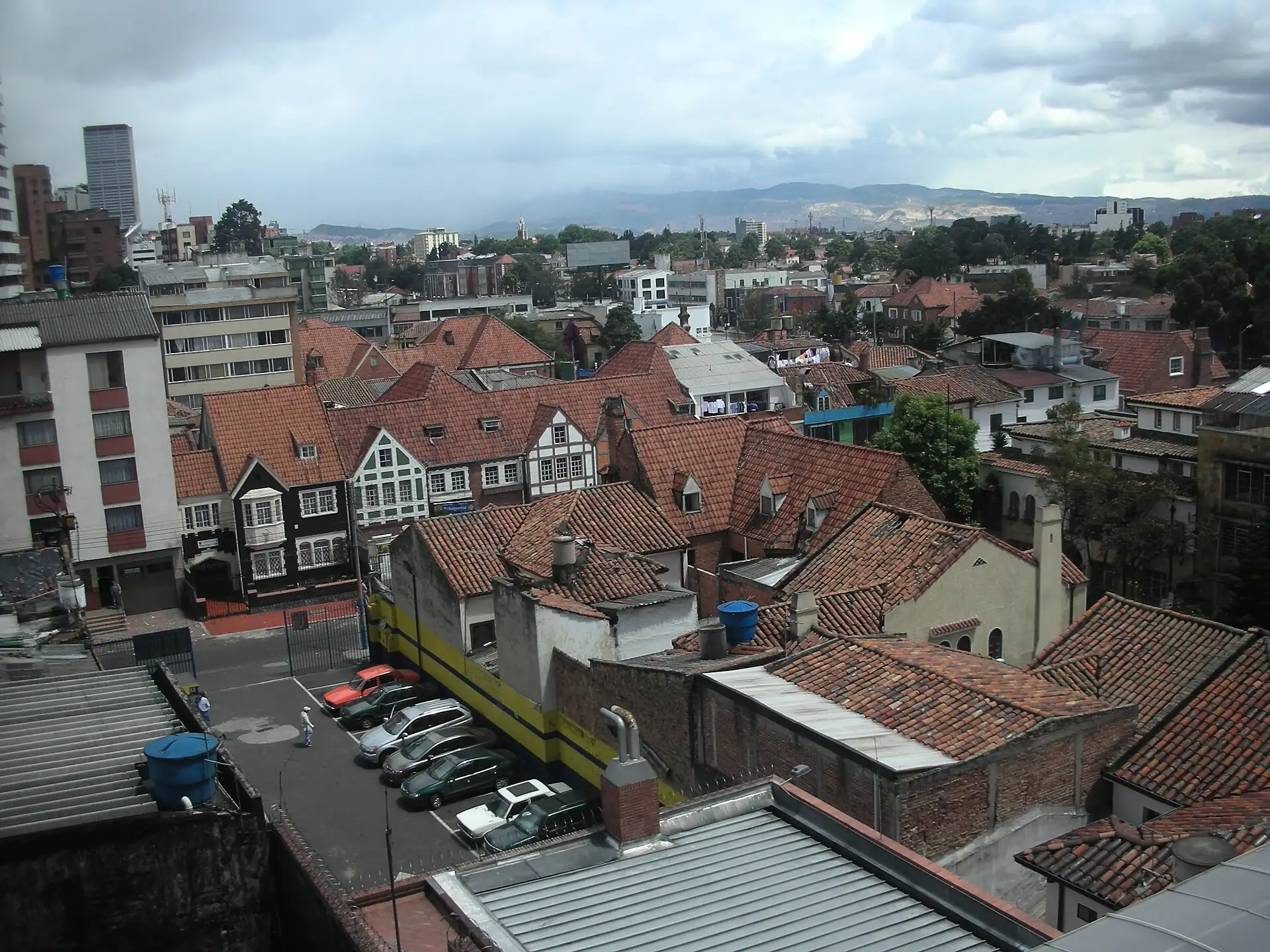
Eating and drinking guideDrink
Drink & nightlife
| Where | What | Until | Note |
|---|---|---|---|
| Zona T and Zona Rosa | Bars, clubs, rooftop lounges | About 02:00–03:00 weekendsAbout 2:00 AM–3:00 AM weekends | Pedestrian streets, well-lit and busy; the easiest place for a night out. |
| La Candelaria chicherías | Chicha (fermented maize drink) bars | Evening, check individual bars | A traditional pre-colonial drink; a cultural experience more than a big night out. |
| Chapinero Alto | Cocktail bars, craft beer | About midnight–01:00About midnight–1:00 AM | Quieter, more local crowd than Zona T. |
By style
| Style | What | Where | Price | Until |
|---|---|---|---|---|
| Aguardiente | Anise-flavoured local spirit, the default round for a groupOrdered by the bottle at the table, not by the glass, in most bars. | Anywhere with a bar; bought in bottles ("botella") to share | COP 40,000–70,000 a bottle (2026 estimate) | — |
| Chicha | Fermented maize drink with pre-colonial rootsAn acquired taste; treat it as a cultural stop, not a session drink. | La Candelaria chicherías | COP 3,000–6,000 a glass | — |
| Craft beer | A growing Bogotá scene: Colombian IPAs, stouts and lagers | Chapinero and Zona T taprooms | COP 12,000–20,000 a pint | — |
Rules that bite
- Never accept a drink you did not see made, in any bar — see the scopolamine warning under scams.
- Taxi or ride-hail home after dark rather than walking between clusters, even a short distance.
Sleep
Pick the area first: it decides your walk home at night and your first morning.
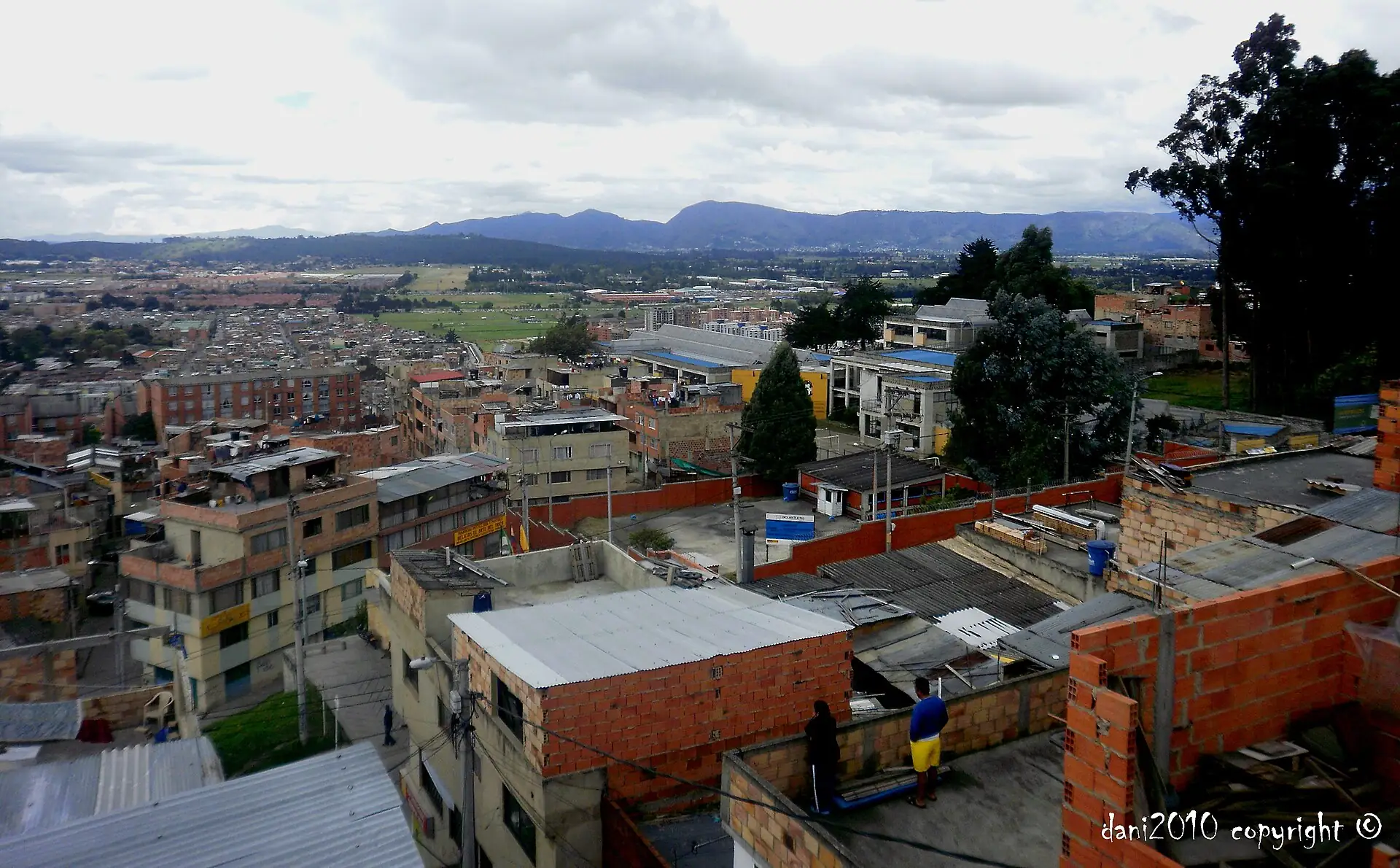
Which neighborhood fits you
Three questions, one recommendation, with the reasons.
Your best fit
- Museums, Plaza de Bolívar and street art all within a 10–15 minute walk.
- Good spread of hostels and mid-range hotels.
Watch out: Quiet after dark because the streets empty out, not because it is calm — some noise from nearby bars.
Next best: Zona T and Chapinero
Built from our 1–5 desk scores per area; your answers stay in this browser.
More on sleepingYour area · With kids
Which area is yours
| If you are | Sleep in | Because |
|---|---|---|
| First visit, museum-focused, 2–3 nights | La Candelaria | Everything is a walk; accept the early-evening curfew on walking. |
| Longer stay, restaurants and nightlife priority | Zona T and Chapinero | Best food and bar scene, a short ride from Usaquén and a booked car to Candelaria. |
First-timers with museum plans: everything is close, but pick a hotel with a 24-hour desk and a door a car can reach — and plan evenings by car.
Bigger hotels with lifts, a door the car can reach and dinner on your doorstep; the museum centre is a 45-minute ride, so this suits food-first trips.
Areas are in our default order until you tick a priority.
Scores are 1–5 desk judgements per priority (2026). Only areas with a sleep-area page are scored; see districts for the wider picture.
With kids
- Altitude affects children the same way it affects adults: plan a slow first day and watch for headaches or breathlessness.
- TransMilenio buses get very crowded at rush hour; use ride-hailing or a taxi with young children instead.
- Maloka interactive science museum and Parque Simón Bolívar's open lawns are good rain-or-shine options with kids.
- Rain or a rest day: Centro Comercial Andino or Centro Comercial Santafé have indoor play areas and food courts.
- Car seats are not standard in taxis or ride-hail cars: ask the hotel to arrange one, or bring a travel booster.
PracticalMoney, essentials, safety and the pocket card
Practical
Money, essentials, safety and the pocket card
Money
What a day costs at three comfort levels, and how to pay.
- Budget
- COP 120,000–200,000 excl. bed / day
- Mid
- COP 200,000–400,000 excl. bed / day
- High
- COP 400,000+ excl. bed / day
- Transit card
- No transit card needed for a first visit: ride-hailing, booked cars and walking. TransMilenio buses need a card and are crowded at rush hour.
- Cash rule
- Keep COP 100,000 in small notes for taxis, markets and tips; withdraw at ATMs inside banks or malls in daytime, not on the street.
More on moneyCosts · Budget · Buy
What things cost
- Arepa or empanada from a street stallCOP 2,000–5,000
- Bottle of water, convenience storeCOP 2,500–4,000
- Ride-hailing car across town (5 km)COP 12,000–22,000
- Car from El Dorado to La CandelariaCOP 35,000–55,000
- Monserrate cable car or funicular, returnCOP 30,000–35,000 (2026 estimate, confirm locally)
Trip budget
| Hotel double room1 × 3 nights × COP 280,000 | COP 840,000 |
| Food, local transport, entries2 × 3 days × COP 300,000 | COP 1,800,000 |
| Airport car, both ways1 × COP 100,000 · one car per 4 people | COP 100,000 |
| eSIM or tourist SIM2 × COP 35,000 | COP 70,000 |
| Buffer 10%Price creep, a taxi you did not plan, one splurge | COP 281,000 |
| Trip total≈ COP 515,000 per person per day, bed included | COP 3,091,000 |
2026 estimate in Colombian pesos; flights and tours excluded.
Prices of common things
| TransMilenio or SITP fare | about COP 3,000 (check current fare) |
2026 estimate; check locally.
Buy
- Bargaining
- Haggling is light and mostly limited to flea markets like Usaquén and San Alejo; fixed-price shops, malls and chain stores do not negotiate.
- Fixed-price check
- Check a supermarket (Éxito, Carulla) or mall price for coffee, chocolate or crafts before buying the same item from a street stall, as a ceiling.
Markets and shopping streets
| Where | What | When | Haggle | Note |
|---|---|---|---|---|
| Mercado de Paloquemao | Fruit, flowers, meat and a prepared-food hall | Early morning to early afternoon (check) | light | Go early for the best fruit selection and to avoid the busiest hours. |
| Usaquén flea market (Mercado de las Pulgas) | Crafts, antiques, food stalls | Sundays and some holidays (check) | light | See the mercado-usaquen place page for the full visit plan. |
| San Alejo antiques market | Antiques, vinyl, old coins and curios | First Sunday of the month, Parque de los Periodistas | light | Smaller and more local than Usaquén; check the date before going. |
Shops by what they sell
| For | Where | Hours | Note |
|---|---|---|---|
| Emeralds | Licensed jewellers only — not street sellers near Avenida Jiménez | Shop hours | Stone quality and price cannot be verified on the street; this is also a common scam area (see scams). |
| Coffee | Specialty roasters in Chapinero and La Candelaria; supermarkets for a cheaper baseline | Shop hours | Colombia exports most of its best beans, so a local specialty roaster is worth the extra cost. |
| Leather goods | Usaquén boutiques, malls | Shop hours | Good value compared with European prices; check stitching before buying. |
Changing money
| Where | Verdict | Why |
|---|---|---|
| Bank branches and casas de cambio | use | Fair rate with a receipt; bring your passport. |
| ATMs inside banks or malls | use | Safer than street ATMs; withdraw in daytime. |
| Hotel front desk | avoid | Convenient but a poor rate. |
ATMs
- Per withdrawal
- Most bank ATMs cap a foreign card at a few hundred thousand pesos per withdrawal (confirm on the screen).
- Fees
- Local ATM fee plus your own bank's fee — take the cap rather than small amounts to reduce the number of withdrawals.
- Where
- Machines inside banks or malls in daylight hours; avoid isolated street ATMs, especially after dark.
Essentials and accessEssentials · Access
Essentials
- Plugs & power
- 110 V; two-pin sockets (types A and B, same as the US). Bring a universal adapter if you are coming from a 220 V, round-pin country.
- Toilets
- Cafés, malls, museums and shopping centres; carry small change or tissues for informal or bus-station toilets.
- Opening hours
- Shops and malls run roughly 10:00–20:00; many museums close on Monday — check each place. Restaurants serve lunch from about 12:00 and dinner from about 19:00.Shops and malls run roughly 10:00 AM–8:00 PM; many museums close on Monday — check each place. Restaurants serve lunch from about 12:00 PM and dinner from about 7:00 PM.
- Health
- Altitude (2,640 m): breathlessness and headache are common the first day or two. UV is strong even on cloudy days. Dengue and mosquito-borne illness risk is low at this elevation but rises on trips down to warmer towns. Travel insurance with medical cover is recommended.
- Accessibility
- Cobbled streets in La Candelaria, uneven pavements and few ramps make wheelchair and stroller use hard outside malls and newer buildings.
- Laundry
- Hotels and neighbourhood lavanderías offer same- or next-day service, usually priced by the kilo.
- Emergency numbers
- National emergency line: 123. Tourist police line: 123 (ask for "policía de turismo").
Pack
- A warm layer and a rain jacket — Bogotá stays around 14–19°C (57–66°F) by day, cooler and often wetA warm layer and a rain jacket — Bogotá stays around 57–66°F (14–19°C) by day, cooler and often wet
- Sunscreen and sunglasses — UV is strong at altitude even under cloud
- Comfortable shoes for cobbles and hills
- A cross-body bag you can keep in front of you in crowds
Accessibility
Bogotá is hard going on wheels: cobbled streets in La Candelaria, high kerbs, broken pavement, and altitude adds physical strain even for walkers without mobility issues. Malls, larger hotels and newer museums are the reliable step-free option.
- Pavements
- Cobbles and uneven paving in La Candelaria; wider, smoother pavements in Zona T and the north.
- TransMilenio
- Level boarding at stations, but very crowded at rush hour — hard for wheelchairs or strollers at peak times.
- Getting around
- A booked car or ride-hailing app is the reliable step-free option door to door.
- Hotels
- Ask for a photo of the entrance and room; many La Candelaria buildings are older with stairs and no lift.
- Toilets
- Accessible toilets in malls and larger museums; rare in small cafés and older buildings.
Sights, step-free or not
| Museo del Oro (Gold Museum) | step-free | Modern building with lifts. |
| Museo Nacional de Colombia | with help | A former prison building; check current step-free routes. |
| Monserrate | with help | The cable car and funicular are step-free at the stations; the summit itself has some uneven paving. |
| Plaza de Bolívar | step-free | Large flat paved square, but surrounded by cobbled approach streets. |
Survive
Safety basics, the lines not to cross, and practical habits that save the day.
Safety
- Do not walk between neighbourhoods after dark; book a car at the door.
- Altitude (2,600 m): rest on the first afternoon, drink water, go easy on alcohol the first night.
- Emergency: 123.
Red lines
- Plaza de Bolívar can host protests: leave if a march forms.
- Ask before photographing people; some will want a tip.
- Monserrate: go by the cable car or funicular, not on foot, unless your hotel or a local guide confirms the trail is open and busy.
Practical
- Toilets: cafés, museums and malls; carry tissues.
- Tap water is treated in Bogotá, but many visitors prefer bottled water on the first days.
More on staying safeStay safe · Stay healthy · Safety map · Solo & women · Etiquette · Cope · Scams
After dark, by area
5 flagged areas
Santa Fe (south of Candelaria)
Avoid after dark- Take care
- Take care
- Take care
- Take care
Day = about 07:00–19:00. What to watch in each area, day and night →
Scams and red flags
Walk away if you see these
- Fake or unlicensed taxis quoting an inflated fare: use an app (inDriver, Cabify, Uber operates in a legal grey area) or a radio taxi booked by the hotel, and confirm the fare or meter before moving.
- Scopolamine ("burundanga") drink and cigarette spiking is a real, documented risk in Colombia: never accept food, drink or a cigarette from a stranger, and watch your own drink being made.
- Emerald sellers near Avenida Jiménez offering "wholesale" stones to tourists: prices and stone quality cannot be checked on the street; buy from a licensed jeweller if at all.
- "Helpful" strangers who point out a stain on your jacket then offer to clean it are a distraction team for pickpocketing: keep walking.
- Fake plainclothes "police" asking to see your wallet or passport: real officers do not need to hold your cash. Ask for ID, and offer to walk to a police station instead.
- Phone snatching from open hands or café tables: keep phones in a pocket or bag on the street, not out on a table facing the road.
Stay safe
Stay healthy
Hospitals and clinics: see Cope.
Safety by area and hour
| Area | Day | Night | What to watch |
|---|---|---|---|
| La Candelaria | fine | caution | Empties out after dark; book a car rather than walking, even a short distance. Keep phones and cameras in a bag. |
| La Macarena | fine | caution | Quiet residential blocks after dark; end the evening with a booked car. |
| Zona T / Zona Rosa | fine | fine | Busy and well-lit; watch drinks and bags in crowded bars. |
| Usaquén | fine | caution | Quiet once the market and restaurants close; taxi back rather than waiting on the street. |
| Santa Fe (south of Candelaria) | avoid | avoid | Higher visible street crime; not part of the tourist route — stay north of Calle 6. |
| Plaza de Bolívar | fine | caution | Can host protests or marches: leave calmly if a demonstration forms. |
- "No dar papaya" — do not display phones, cameras or cash openly, and you remove most of the opportunity for theft.
- Use a booked car or ride-hailing app after dark instead of hailing a taxi on the street.
Solo, women and LGBTQ+ travellers
Solo
- Comfortable for solo travellers who follow the after-dark rules; hostels in La Candelaria are social.
- Book day trips (Zipaquirá, Guatavita) through a hotel or a reviewed operator rather than an unmarked street tour seller.
- Use ride-hailing after dark rather than a hailed street taxi.
Women
- Catcalling happens but serious harassment is uncommon; dress and behave as you would in any large Latin American capital.
- Watch drinks closely in bars — see the scopolamine warning under scams.
- Women-only dorms are available in most La Candelaria hostels.
LGBTQ+
- Same-sex relations and same-sex marriage are both legal in Colombia; Bogotá is generally accepting, especially in Chapinero, which has an established LGBTQ+ scene.
- Public affection is common in Chapinero and Zona T; be more discreet in conservative or outer neighbourhoods.
- Bogotá Pride usually runs in June or July — check current dates.
Etiquette in Bogotá
- Greetings
- A handshake for first meetings; a single cheek kiss (right cheek) between women, or a woman and a man, once you know someone.
- Dress
- Bogotá dresses a notch smarter and warmer than a beach city — bring layers, not shorts and flip-flops.
- Tipping
- A 10% service charge on restaurant bills is voluntary; you can ask for it removed if service was poor.
- Time
- "Hora colombiana" runs a little later than the clock for social plans; business and tour meeting times are taken literally.
- Photos
- Ask before photographing people directly, especially street vendors and performers; a small tip is appreciated if you do.
- Altitude and alcohol
- Locals expect visitors to go easy on alcohol the first night; declining a drink on arrival is normal, not rude.
Cope
Hospitals and clinics that handle foreigners
| Where | Area | Use it for |
|---|---|---|
| Fundación Santa Fe de Bogotá | Chapinero | Large private hospital, English-speaking staff; ask your insurer about direct billing. |
| Clínica del Country | Chapinero Alto | Private hospital popular with expats and travellers. |
| Clínica Reina Sofía | Chapinero | Private hospital with 24 h emergency care. |
Visa extensions
- Office
- Migración Colombia has offices across the city; check the address and hours before going.
- Extending
- Tourist stays can sometimes be extended online through Migración Colombia's portal — check current rules and fees before your visa window closes.
- Overstay
- A fine is charged at the exit point and can affect a future entry: resolve it before flying out.
Embassies and consulates
| Country | Address | Phone | Note |
|---|---|---|---|
| United States | Carrera 45 # 24B-27, Bogotá | — | (check) |
| United Kingdom | Carrera 9 # 76-49, Bogotá | — | (check) |
| Canada | Carrera 7 # 114-33, Bogotá | — | (check) |
| Australia | check current address | — | (check) |
- Lost passport
- Police report, then your embassy, then confirm exit requirements with Migración Colombia before flying: budget several working days.
- Pharmacies
- Cruz Verde and Farmatodo chains post prices and are widely found; many medicines are sold without a prescription — check the active ingredient and dose.
Apps and offline kitOffline kit
Offline kit
Set up before you leave, so Bogotá still works with no signal or a dead roaming plan.
On your phone
- Maps: open the city in Google Maps, tap the place name, then Download offline map (or use an offline-maps app).
- Data: install an eSIM or buy a local SIM before the first taxi; the apps in this guide depend on it.
- Translation: download the local language for camera translation.
- Screenshots: booking confirmations, hotel address in the local script, and the emergency numbers.
This guide
Save the Bogotá guide and its pages on this device; it opens without a connection.
Phrases that do the work
Greeting
Hello
Hola
OH-lah
Thanks
Thank you
Gracias
GRAH-syahs
Market
How much is this?
¿Cuánto cuesta esto?
KWAN-toh KWES-tah ES-toh
Food
Not spicy, please
Sin picante, por favor
seen pee-KAHN-teh por fah-VOR
Café
The bill, please
La cuenta, por favor
lah KWEN-tah por fah-VOR
Taxi
Please take me to this address
Lléveme a esta dirección, por favor
YEH-veh-meh ah ES-tah dee-rek-see-OHN
Taxi
Stop here, please
Pare aquí, por favor
PAH-reh ah-KEE por fah-VOR
Help
I need a doctor
Necesito un médico
neh-seh-SEE-toh oon MEH-dee-koh
Pocket card
Fill in, then print or save as PDF
Stays in this browser only; nothing is sent anywhere.
BogotáBogotá
Pocket card · Voykit
My bed tonight
—
—
—
Lléveme a esta dirección, por favorPlease take me to this address
Emergency
- All emergencies123
Embassy
Most embassies are in Chapinero and the north of the city; write your own embassy's 24-hour line below.
My embassy: —
Fare anchors (2026 estimate)
- El Dorado → La Candelaria, app car: COP 35,000–55,000, 30–50 min depending on traffic
- App car across the centre: COP 12,000–22,000
Say or show
- Hola — Hello (OH-lah)
- Gracias — Thank you (GRAH-syahs)
- ¿Cuánto cuesta esto? — How much is this? (KWAN-toh KWES-tah ES-toh)
- Sin picante, por favor — Not spicy, please (seen pee-KAHN-teh por fah-VOR)
- La cuenta, por favor — The bill, please (lah KWEN-tah por fah-VOR)
- Pare aquí, por favor — Stop here, please (PAH-reh ah-KEE por fah-VOR)
Show the address in the Calle/Carrera format; drivers search that pattern, not neighbourhood names alone.
Deep diveHistory, reading, photos and every source
Deep dive
History, reading, photos and every source
Sources
- officialBogotá city government (official)
- officialColombia tourism (official)
- secondaryWikivoyage — Bogotá
Ask about Bogotá
Loading…
Was this useful?