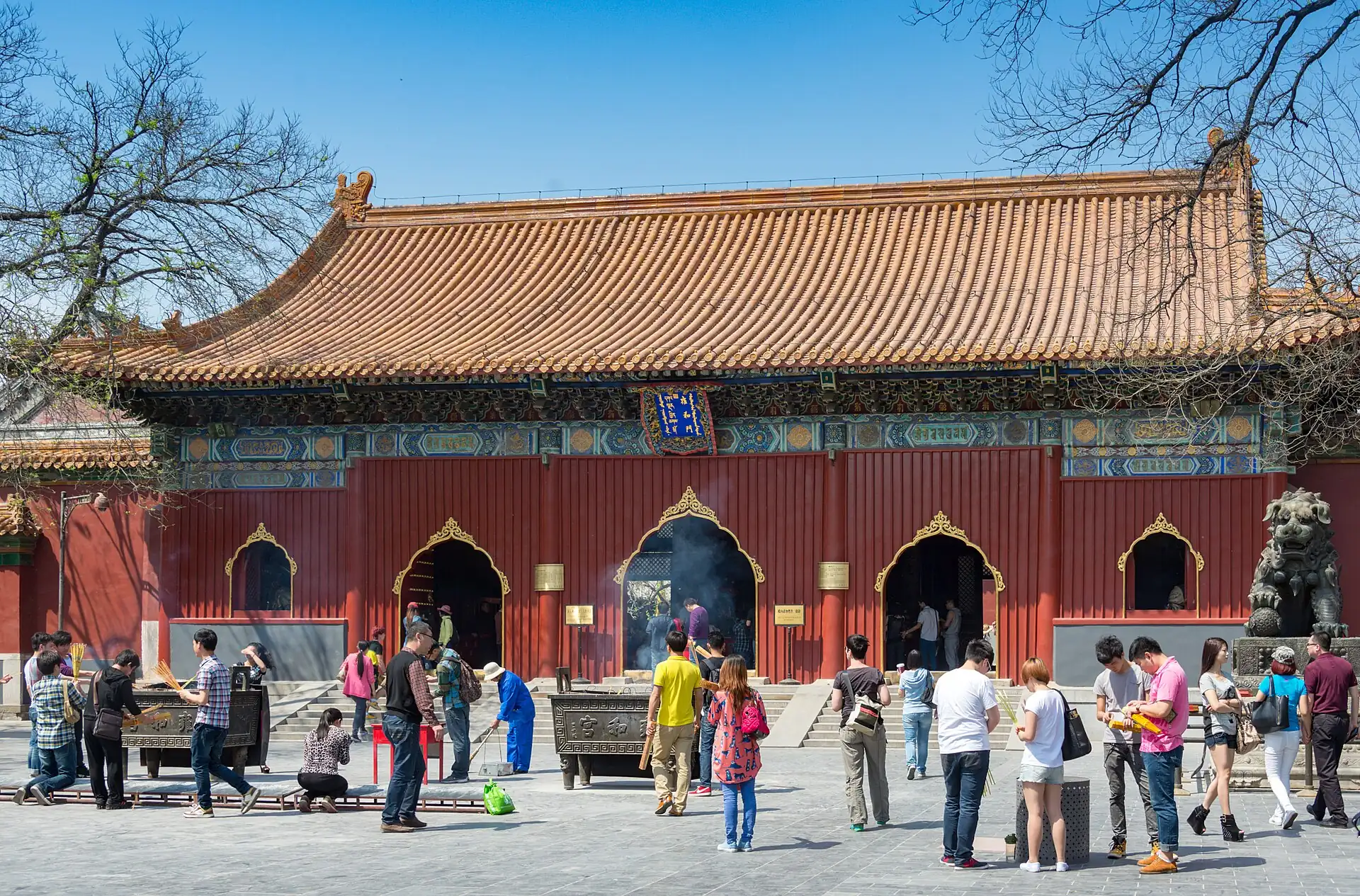
Lama Temple (Yonghegong)
Place · Nanluoguxiang & Gulou hutongs
Beijing's largest and most active Tibetan Buddhist temple, a short subway ride or walk from the Nanluoguxiang hutongs: incense smoke, working monks, and a 18 m sandalwood Buddha in the final hall. 60–90 minutes.
- 18 m sandalwood Buddha
- Working Tibetan Buddhist monastery
- Former Qing prince's residence
- Queue: switch at 20 min
Highlights come from Voykit's own data and desk notes, not from reviews. Hover a tag to see its source.
Rules in force · 10Hutong lanes are too narrow for cars and often unpaved or…
- East Asia ↗Every border in East Asia is a full international border, Hong Kong and Macau included: an entry permission for one never covers the next.
- East Asia ↗Ferries between Korea, Japan and China cancel in rough seas and typhoons; keep a flight or a spare day behind every sea leg.
- China ↗Most nationalities need a visa, a unilateral visa-free entry (the list and end dates change) or the transit exemption below. Confirm your route on the official sites before you buy a ticket.
- China ↗Transit stay without a visa: up to 240 hours (10 days) for citizens of about 55 listed countries who pass through China to a third country or region, with a confirmed onward ticket and a stay inside the permitted area (Beijing, Tianjin and Hebei count as one area). It replaced the 144-hour rule in December 2024, which some older pages still quote. Use the transit lane at immigration, show the onward ticket, and check the current nationality list. Hong Kong and Macau count as separate regions; check whether your ticket qualifies.
- China ↗Foreign visitors must register their address with the police within 24 hours; hotels do it at check-in with your passport. Carry the original passport at all times: hotels, trains, museums, Tiananmen Square and police checks ask for it.
- China ↗Set up Alipay or WeChat Pay with a foreign card before you fly. QR payment is the default in shops, taxis and many stalls, and some places refuse cash or a foreign card. Carry cash as a backup.
- China ↗Google, WhatsApp, Instagram, Facebook, YouTube and many news sites are blocked. Use an eSIM with roaming (it routes through your home network) or install and test a VPN before you fly; VPN sites and app stores are hard to reach inside China, and only government-approved VPNs are officially permitted.
- North China ↗Great Wall sections are exposed and steep: wind, ice and midday heat change the day. Go early and pick the section by the weather, not the brochure.
- Beijing ↗Hutong lanes are too narrow for cars and often unpaved or uneven: large suitcases go from the car to the door, never on a walk.
- Beijing ↗Tiananmen Square, the Forbidden City and many sights check the passport against the ticket at the gate; bring the original, not a photo.
More
Map & directions
Add your hotel to get directions from it. · stays in this browser; shared with the pocket card.
Plan
Open now, best time to go, opening hours
Go now?
hours and prices: check on the day- Open
- Hours not on file: check the official site.
- Crowds
- MonTueWedThuFriSatSun
Quietest Mon–Fri · busiest Sat, Sun · desk estimate
- Time to spend
- 60–90 min · up to 120 min if you linger
Best time to go
Busy on the 1st and 15th of the lunar month with worshippers; otherwise steadier through the day, quieter early morning.
Queue rule: switch if the queue passes 20 min; come back when under 10.
By weekday: quietest Mon–Fri, busiest Sat, Sun.
Opening hours
- Note
- Opening and closing hours change by season; not printed until verified for your date.
Which month is quietest
- Janheavy
- Febpacked
- Marbusy
- Aprbusy
- Maybusy
- Junbusy
- Julbusy
- Augbusy
- Sepbusy
- Octheavy
- Novbusy
- Decbusy
Quietest Mar–Sep · Nov–Dec · busiest Feb.
Estimate: desk reasoning from lunar-calendar worship days and Chinese New Year patterns; not counted. Holidays and events move these weeks.
Weather here, next 7 days
Loading forecast…
Forecast: Open-Meteo (CC BY 4.0), model data for this point.
Not checked in the last 12 months (no check date on file).
On the ground
Getting in, access, sensory load, what to bring, and where to go if it does not work
Getting in
- Stop
- Yonghegong-Lama Temple Station (Lines 2 and 5)
- Ticket
- on site · official site
- Stairs
- Level courtyards; a few raised thresholds between halls.
- Shoes
- Shoes on; incense is offered outside, not carried into halls with bare flame near wooden structures.
Accessibility
- PartialStep-free entrance · Level courtyards; a few raised thresholds between halls.
- Check firstAccessible toilet
Sensory load
- Sensory load3/5 Medium
Exposure: medium
What to bring and the rules
- Clothing that meets the dress rule · Modest dress is respectful; no strict enforced code but avoid beachwear.
- Footwear that suits the rule · Shoes on; incense is offered outside, not carried into halls with bare flame near wooden structures.
- Modest dress is respectful; no strict enforced code but avoid beachwear.
- Not permitted inside the halls with the main Buddha statues; courtyards are fine.
Rules and prices change: check the official site before you go.
Bailouts
- crowd: Confucius Temple and Imperial Academy next door, usually quieter
Nearest rescue anchor: E — Mao'er Hutong café (field-verify)
Problem
Red lines
- No photos inside the halls housing the main Buddha statues; ask before photographing monks.
- Do not step on door thresholds — step over them, a common temple courtesy across China.
Not checked in the last 12 months (no check date on file).
Map and nearby
Where it is, how to get there from your hotel or from where you stand, and what is around it
Map data © OpenStreetMap contributors
Add your hotel to get directions from it. · stays in this browser; shared with the pocket card.
Nearby places
Eat nearby
More detail
Everything else we know about this place
Tickets, prices and entry
Know before you go
- Built in 1694 as the residence of a Qing prince, the building was converted into a Tibetan Buddhist (Gelug school) monastery in 1744 after its occupant became the Yongzheng Emperor — a common Qing practice of converting a former imperial residence into a temple once its owner became emperor.
- The final hall houses an 18-metre-tall statue of the Maitreya Buddha carved from a single piece of white sandalwood, recognised by Guinness World Records as the tallest statue carved from a single piece of wood.
- It remains a working monastery with resident monks, not only a museum piece: expect incense smoke, chanting, and worshippers alongside sightseers.
Tickets & entry
- Where to buy
- Buy at the entrance on the day.
- Buy from the official site or the ticket desk; resellers add a fee for the same ticket.
- Dress code
- Modest dress is respectful; no strict enforced code but avoid beachwear.
- Photos
- Not permitted inside the halls with the main Buddha statues; courtyards are fine.
Time on site, inside and your plan
Time on site
Minimum
45min
Worthwhile
60min
Typical
90min
p95
120min
How much time do you have?
Enough for a typical visit (90 min).
Nothing else in our notes is a short enough walk from here for the time that is left.
Visit times are typical figures, not promises; queues and closing times can change them.
Inside, in order
Overview
Five main halls across five courtyards, ending with the Wanfu Pavilion and its giant Buddha statue; smaller halls display Tibetan Buddhist art and ritual objects.
Step-free check, who it suits, facilities
Step-free check
- Step-free entrance: partly · partlyLevel courtyards; a few raised thresholds between halls.
- Accessible toilet: check · check
Flat courtyards with raised thresholds at each hall entrance; manageable with assistance, awkward alone in a wheelchair.
Facilities on site
| What | Status | Where / note |
|---|---|---|
| Amenities | check | Toilets inside the temple grounds; cafés and shops on Yonghegong Dajie outside. |
Seasons, festivals and night openings
| When | What happens | Effect on your visit | Dates |
|---|---|---|---|
| Year-round | No strong seasonal change | Busiest on the 1st and 15th of the lunar month, and around Chinese New Year, when worshippers come to burn incense in large numbers. | check |
“Check” rows move every year; confirm dates on the official calendar before you plan around them.
Who it suits
| Traveler | Fit | Why |
|---|---|---|
| A working Buddhist temple rather than a museum piece | good | — |
| The giant sandalwood Buddha | good | — |
| A quieter counterpoint to the Forbidden City's crowds | good | — |
Skip it if
- Strong smoke sensitivity — the incense-heavy courtyards can be intense
- Very short on time and already doing a full hutong afternoon
Combine with
Combine with
- 5 minConfucius Temple and Imperial Academy
- 18 minNanluoguxiang lane
- —nanluoguxiang
- —drum-tower
- —Nanluoguxiang hutongs, afterward
Walk the Nanluoguxiang & Gulou hutongs area · the cluster page has the walking order, rescue stops and after-dark notes
Best photo time
Best photo time today
Sun times for today load in your browser.
- The courtyards' incense-smoke light on a clear morning.
- The Confucius Temple and Imperial Academy next door, usually much quieter for photos.
Deep dive
Questions, photos, and where our facts come from
Questions and answers
Questions and answers
Is this the same as the Forbidden City in style?
No — it is a Tibetan Buddhist monastery, architecturally and functionally different from the secular Forbidden City, with a distinct Tibetan-Chinese fusion style in its later halls.
Checked 2026-09-28 · Voykit desk
Do I need to buy incense?
No, it is optional; many visitors simply walk through without making an offering.
Checked 2026-09-28 · Voykit desk
Why is it called the Lama Temple?
'Lama' was the common Western term for Tibetan Buddhist monks; the temple's Chinese name, Yonghegong, refers to its history as a former princely residence ('Yongzheng's harmony palace').
Photos
Photos
Lama Temple Photo: xiquinhosilva, CC BY 2.0
Lama Temple Photo: Ermell, CC BY-SA 4.0
Deep dive
Sources
- officialVisit Beijing (official)
Was this useful?
Add Lama Temple (Yonghegong) to a day
Source: Price
Draft
Written from desk research. Not yet compared with the official source.
Prices are 2026 estimates. The official site has the current price.
Source: Opening hours
Draft
Written from desk research. Not yet compared with the official source.
Source: Best hour
Draft
Written from desk research. Not yet compared with the official source.
No official source is recorded for this figure.
Taken from the desk crowd estimate by hour. It is not a count of visitors.
Source: Bag rating
Draft
Written from desk research. Not yet compared with the official source.
No official source is recorded for this figure.
Rated for the whole walking cluster, from desk research, not for this entrance.