Doha
الدوحة
Code DH · 4 walking zones
Doha is a museum-in-the-morning, souq-after-17:00 city: from May to September do only indoor things, and remember that alcohol is served only in licensed hotels.Doha is a museum-in-the-morning, souq-after-5:00 PM city: from May to September do only indoor things, and remember that alcohol is served only in licensed hotels.
Our quick read of Doha, scored 1–5 (friction is out of 100). Cash need: how often you still need notes. Heat risk: how hot days get. Stroller: how easy wheels are. Friction: overall effort for a first visit. Desk judgements, so check before relying on them.
- Local time
- --:--
- Weather
- forecast below
- Currency
- QAR
- Best months
- Jan · Feb · Mar · Nov · Dec
- Airport
- Hamad (DOH)
Walking zones: the 4 areas this guide plans a day around. Each is a district you can cover on foot, so you do one zone per half-day and ride the train between them. The code (DH 01, DH 02…) is just the zone's number on the Doha line; the line under each name says how bags fare there and how much time it needs.
Map of Doha
Use the switches to show or hide each kind of pin. A switch that is on shows its pins on the map; tap it again to hide them. "Show only" keeps just the pins that match (for example, places that fit a suitcase). Tap any pin for its name and a link to its page.
- Where to sleep
- Places
- Eat
- Walking clusters
- Rest stops
From the airport Hamad (DOH) to your bed
Tap a pin for its card. Places without their own coordinates are shown by their walking cluster.
Why Doha
Doha is compact, air-conditioned and easy, but the rules and the weather are strict. The trips that go wrong land at midnight with a hotel that has no desk, walk the Corniche at noon in June, or arrive in Ramadan expecting daytime restaurants. Four clusters cover a first visit; a stopover of 2–3 nights is enough.
See first
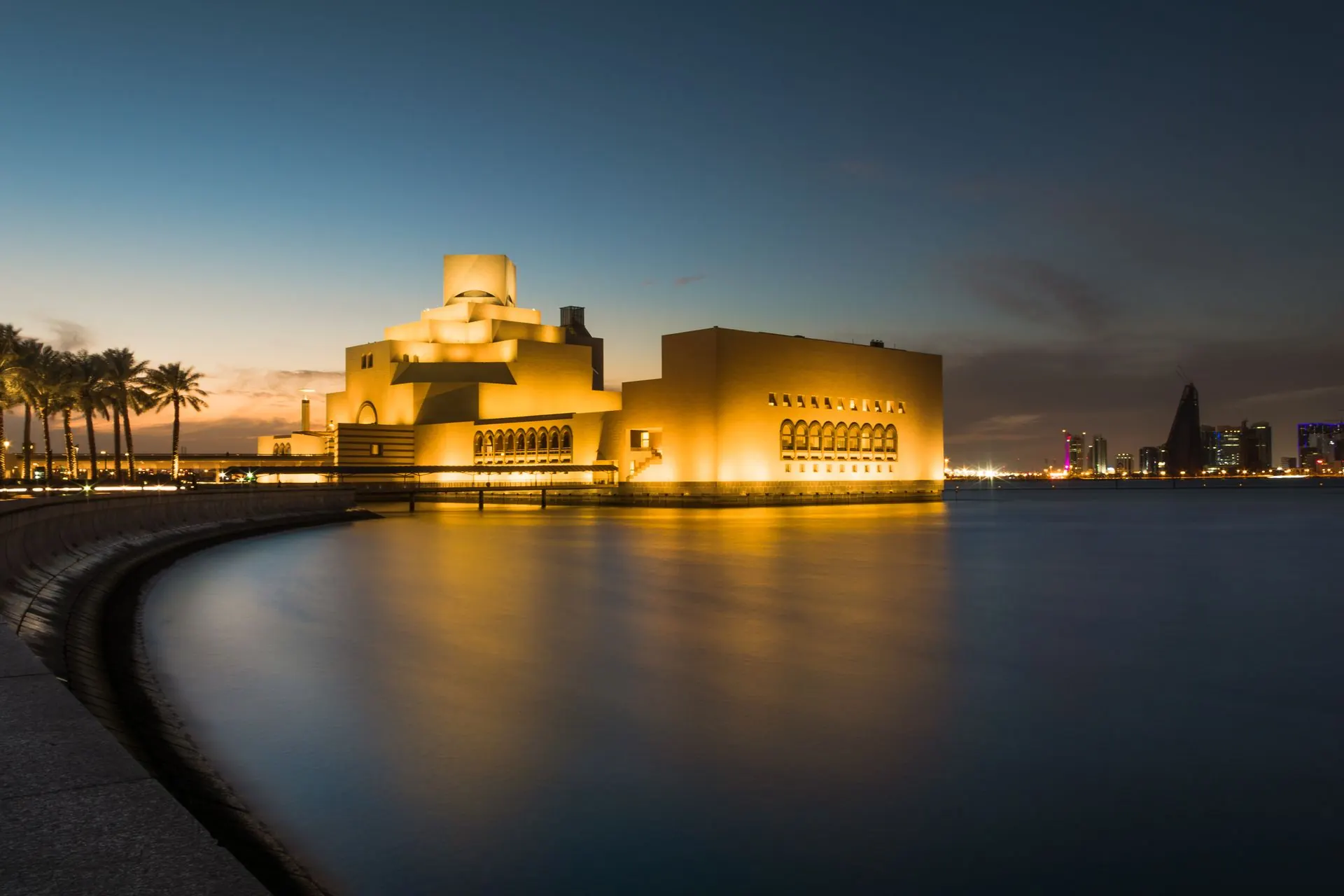
- 1Museum of Islamic Art · 1.5–2 h
- 2
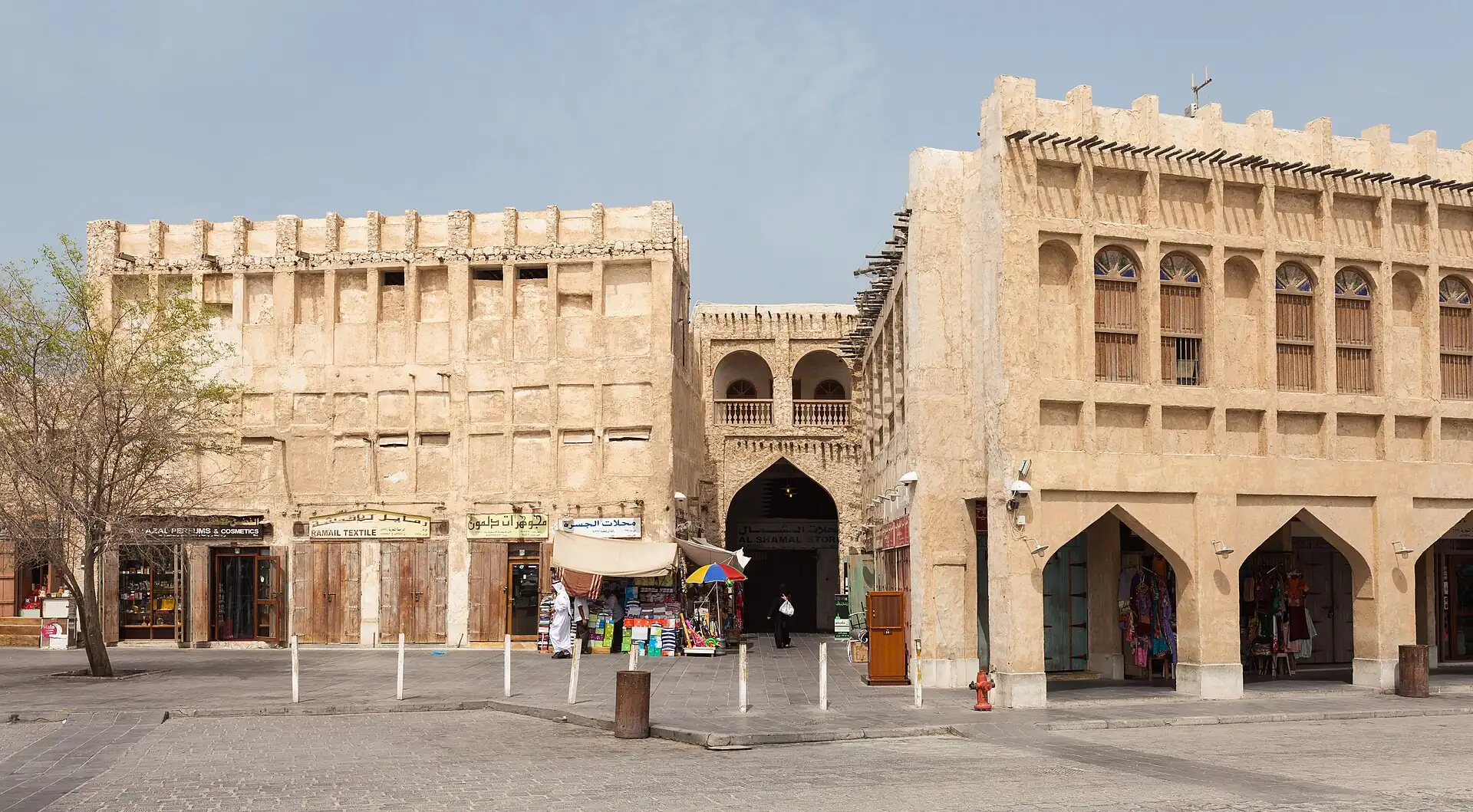 Souq Waqif · 1.5–2 h
- 3
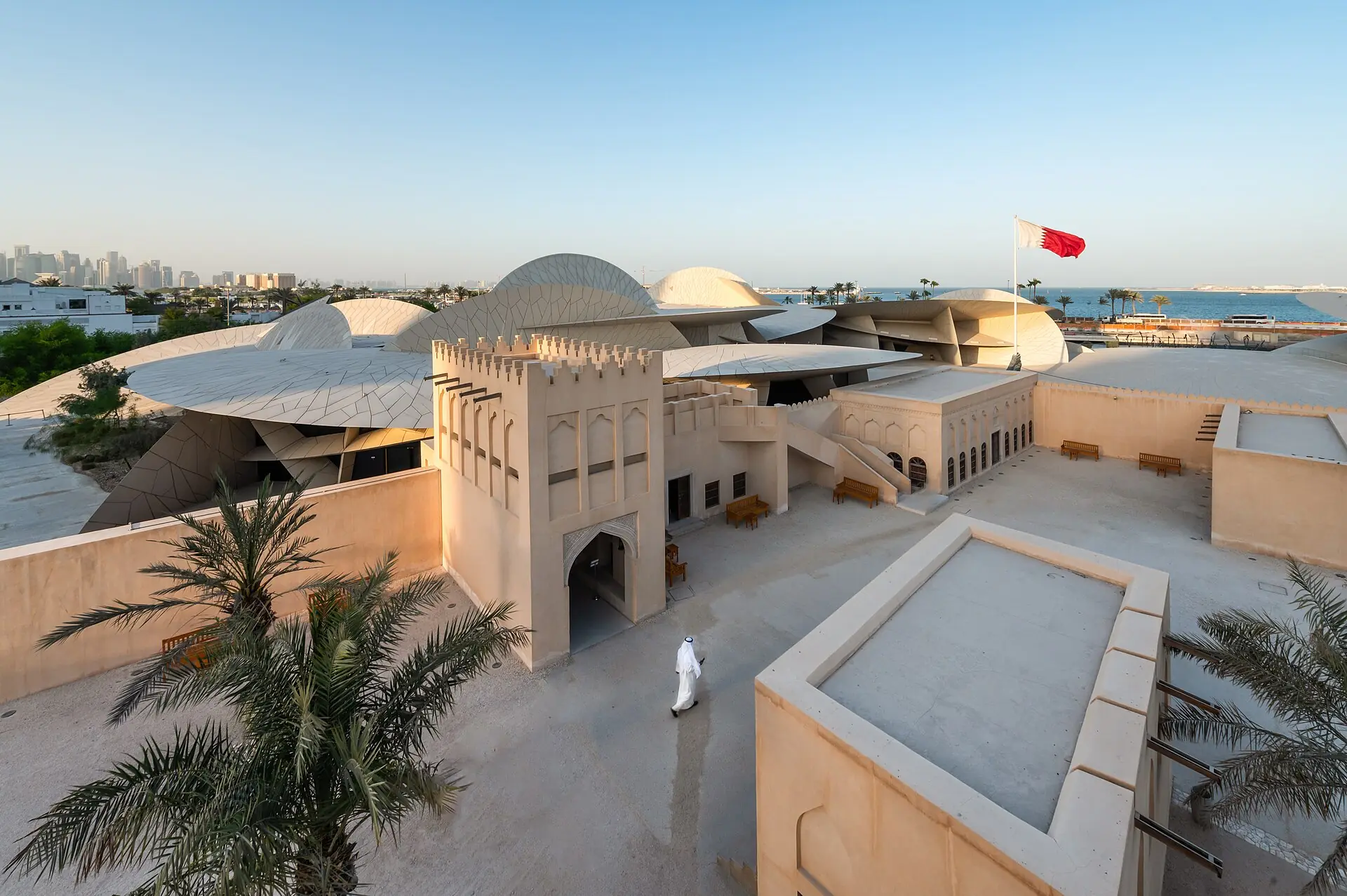
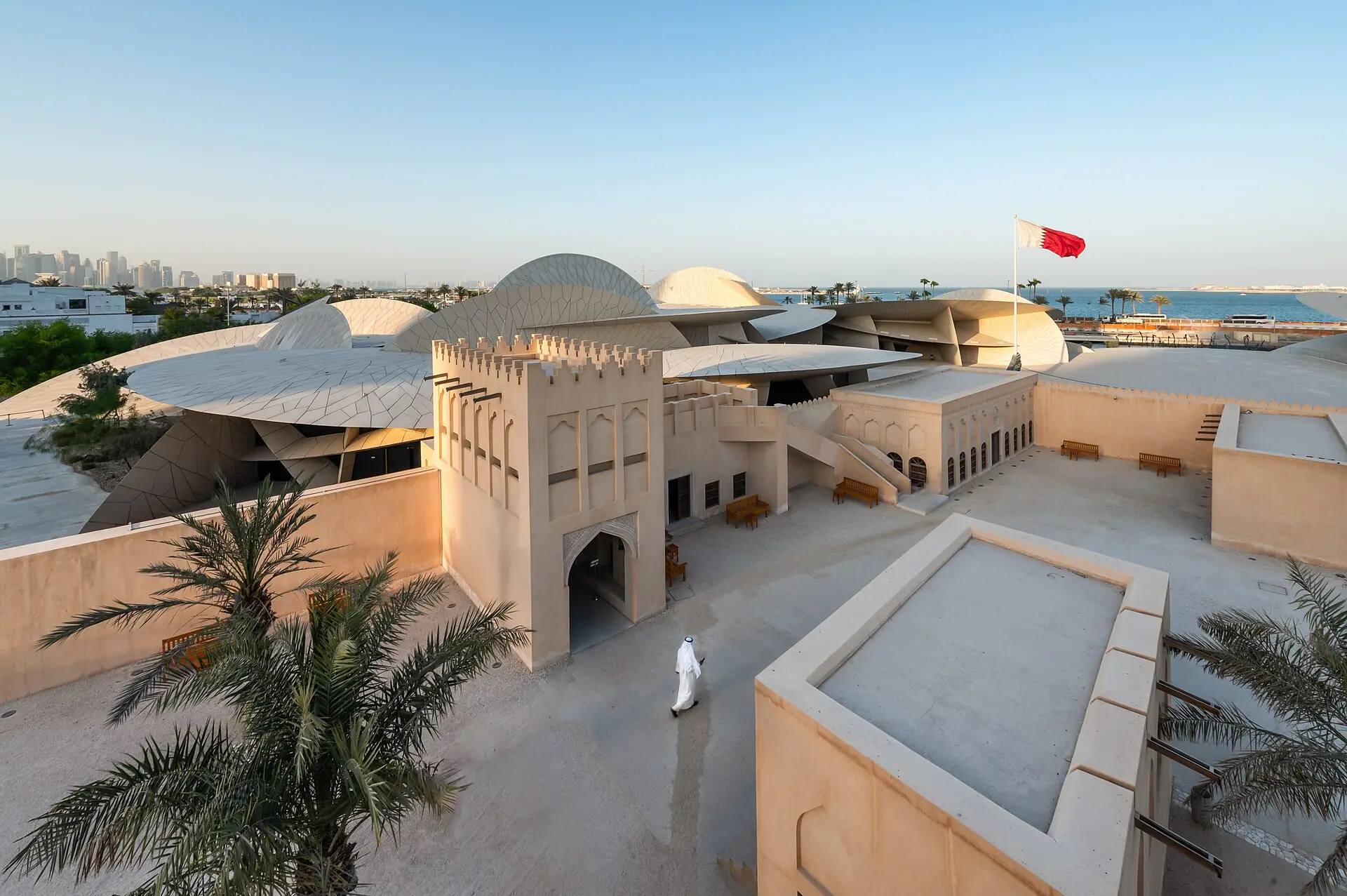 National Museum of Qatar · 2 h
- 4Msheireb Museums · 2–3 h
- 5Corniche at sunset · 45–60 min
Fits
- Stopovers
- Museum and architecture trips
- Winter city breaks
Does not fit
- Summer walkers
- Travellers who want alcohol outside hotels
- Budget backpackers
How long
- 1 daysMuseum of Islamic Art + Souq Waqif in the evening
- 2 daysAdd Katara or The Pearl
- 3 daysFour clusters, mornings and evenings only
- 4 daysAdd a desert or Al Zubarah day trip with a licensed operator
Good for
- First timers
- Foodies
- Budget
- Couples
- Families
- Solo
About Doha
Doha grew from a small pearling and fishing settlement on the east coast of the Qatar peninsula, known in the 19th century as Al Bidda. Pearl diving and the dhow trade fed it until the 1930s, when the Japanese cultured pearl collapsed the market and the town went through a hard decade.
Oil was found at Dukhan on the west coast in 1939 and exported from 1949; the giant North Field gas reserve, discovered offshore in 1971, is the reason the country is rich. Qatar became independent from Britain on 3 September 1971, and Doha went from a low port town to a capital of glass towers in about two generations.
Good to know
- Doha Municipality is the city region; Msheireb is the rebuilt downtown district, Souq Waqif the old market nearby.
- Visit Qatar (the national tourism body) runs the official information and a visa page; hotel front desks are the fastest source for maps, licensed tour operators and driver numbers.
- Booths in Souq Waqif and at Katara that sell desert and dhow trips are often commission agents: compare a written quote and check that the operator holds a Qatar Tourism licence.
Go deeper 17 min read · 7 chapters
Doha grew from a small pearling town on the Gulf into the capital of one of the richest small states in the world in about two generations. This deep dive reads the city by layer: its history, the pearls and gas that paid for it, the buildings that tell its story, the souq at its centre, the food, the rules and rhythms of daily life, and the sea and desert just beyond.
1History2 min
Doha is young as a capital and old as a place. Before the oil age the site was a cluster of fishing and pearling villages on the east coast of the Qatar peninsula, and in the 19th century the main one was known as Al Bidda. The peninsula had no rivers and almost no farmland, so life here meant the sea: pearl banks in the summer, fishing and dhow trade the rest of the year, and small caravans that brought sheep, wool and ghee in from the desert.
Power in the region was contested. The Al Khalifa family ruled Bahrain and claimed the Qatari coast; the Ottomans held a garrison at Doha from 1871 until 1915; and Britain, which policed the Gulf for its route to India, mostly cared about ending piracy and keeping the peace at sea. After a conflict between Bahrain and the Qatari towns in 1867 and 1868, the British treated Qatar as separate from Bahrain and recognised Muhammad bin Thani of the Al Thani family as its leading figure. That is the start of the modern state.
His son, Sheikh Jassim bin Mohammed Al Thani, is remembered as the founder. In 1893 his forces beat an Ottoman column at the Battle of Al Wajbah, just outside today's Doha, and although the Ottomans stayed on paper for two more decades the Al Thani were now the real authority. In 1916, with the Ottoman Empire gone from the Gulf, Qatar signed a treaty that made it a British protectorate; foreign affairs passed to Britain, and the family kept the inside of the country.
The 1930s were hard. The world depression cut demand for pearls, and cultured pearls from Japan finished the trade; many divers were in debt and left. Oil, found at Dukhan on the west coast in 1939 and first shipped in 1949, turned that around. In 1971 Britain withdrew from the Gulf and Qatar became fully independent on 3 September. The giant offshore North Field, found the same year, later made Qatar one of the world's largest exporters of liquefied natural gas.
Since the 1990s the story has been about rapid change. Al Jazeera started here in 1996, the Emir's court funded museums and a university district, and in 2010 Qatar won the right to host the FIFA World Cup, which it did in November and December 2022. Between June 2017 and January 2021 Saudi Arabia, the UAE, Bahrain and Egypt cut land, sea and air links with Qatar; the country turned to Turkey and Iran for routes and to its own farms and ports, and the dispute ended with an agreement signed at Al Ula. Visitors today see the result: a capital that is only a few decades old in its current form, and very conscious of building a story.
- Battle of Al Wajbah
- 1893, Sheikh Jassim bin Mohammed Al Thani
- British protectorate treaty
- 1916
- Oil found / first exports
- 1939 at Dukhan / 1949
- Independence
- 3 September 1971
- FIFA World Cup
- 20 November – 18 December 2022
2Pearls, oil and gas2 min
Until the 1930s pearls were the country's main business. From about June to September, when the water was warm enough, dhows left the coast for weeks at a time. Each boat had a captain (the nokhada), divers (ghawwas) who went down on one breath with a nose clip and a stone weight, and pullers (saib) who hauled them up. There were no wages: a share of the catch went to the captain, and advances taken before the season often left a crew in debt for life.
The industry ended fast. The Great Depression cut demand, and Japanese cultured pearls undercut natural ones; by the 1940s the banks were empty of buyers. That is why the oil years matter so much in Doha's story, and why the city's older residents speak about the 1950s and 1960s as the time when money first arrived.
Oil and then gas changed the balance. Oil exports began in 1949 and paid for the first schools, roads and hospitals. Gas was the bigger prize. The North Field, shared under the sea with Iran's South Pars, is often described as the largest gas field in the world. From the late 1990s Qatar built liquefaction plants at Ras Laffan, north of Doha, and it now sells liquefied natural gas by tanker to buyers in Asia and Europe. That income is why a small country with about three million people can run a national airline, a sovereign wealth fund and a museum programme.
The other side of the economy is labour. Roughly nine in ten residents are foreign workers, from South Asia, the Philippines, East Africa and the Arab world, and they staff the building sites, hotels, shops and taxis. Under the older sponsorship system an employer controlled a worker's exit and job changes, and human-rights groups documented abuse and unpaid wages, especially in the construction boom before 2022. From 2020 Qatar changed its rules so that most workers no longer need permission to change jobs or leave and introduced a minimum wage; how well these rules work in practice is still debated, and visitors will hear both views.
What a visitor sees is a service economy at work. The person who drives your taxi, cooks your lunch or cleans your room is very likely a migrant worker, and small kindnesses matter: a tip, a greeting, a fair price, and the habit of not haggling hard with a cafeteria cook. The same economy explains why Doha's food is so international, why cheap cafeterias serve dal and biryani beside karak, and why the city changes character with the season: in summer many residents leave, and in winter the museums, beaches and souq fill again.
Pearling is not entirely gone. A few boats still dive for oysters as heritage, the Corniche keeps a dhow harbour, and the Katara Traditional Dhow Festival in November re-enacts the pearling season with boats, songs and crafts. Watching it is the closest a visitor can get to the world Doha came from.
- Pearl-diving season
- About June to September
- Share of residents who are expatriates
- About nine in ten (2026 estimate)
- Main gas plants
- Ras Laffan, north of Doha
- Labour rule changes
- 2020 (exit and job-change permissions relaxed)
3Building the new Doha2 min
Almost everything a first-time visitor photographs in Doha was built in the last twenty years. That gives the city a coherent look, and a set of buildings that each tell part of the same story: a small state using architecture to explain what it wants to be.
The Museum of Islamic Art, opened in 2008, is the anchor. It was designed by I. M. Pei, then in his 90s, who came out of retirement for the job and spent months travelling through the Islamic world before choosing a site. The museum stands on its own artificial island off the Corniche so that nothing can be built beside it. Pei drew on the fountain in the courtyard of the 9th-century Ibn Tulun mosque in Cairo, and the limestone, the cube-on-cube massing and the stepped dome all repeat that idea. Inside, objects from Spain to India are shown in a way that is calm rather than crowded.
The National Museum of Qatar, opened in 2019, is a different sort of building. Jean Nouvel modelled it on the desert rose, the crystal that forms in salty sand, and the result is a cluster of large, tilted discs that seem to have grown from the ground. It wraps around the restored palace of Sheikh Abdullah bin Jassim Al Thani, which dates from 1901 and was home to the ruler and later a museum, so old and new are joined. The galleries tell the story of the land, the sea and the oil years, with film on the walls.
Msheireb Downtown, close to the souq, is a planned district built on the site of an older neighbourhood. Some houses were kept and turned into the Msheireb Museums; the lanes between them are shaded, narrow and lined with new buildings that borrow the old scale. The idea was a compact, walkable centre that works with the climate rather than fighting it, and the metro interchange sits underneath.
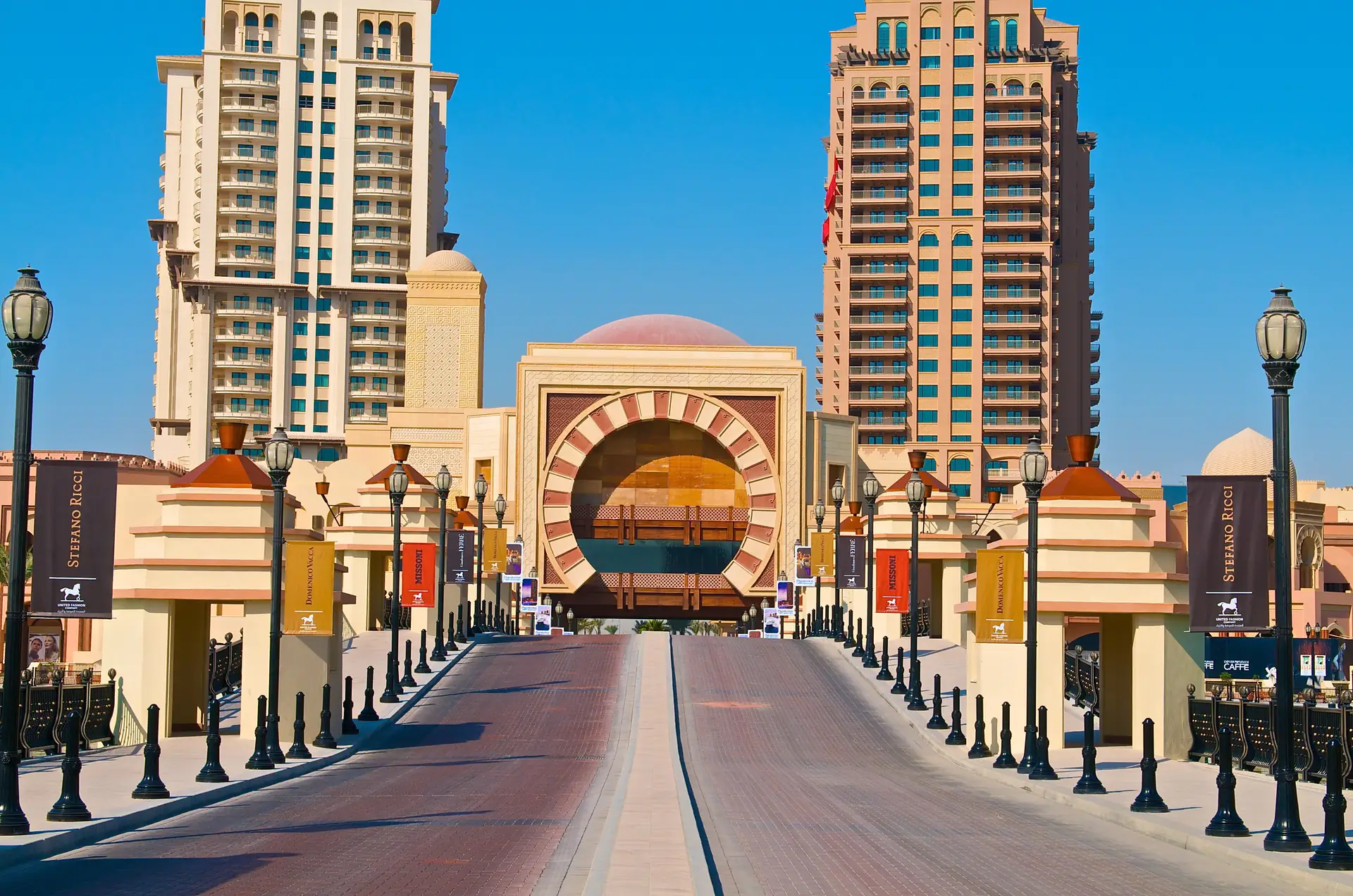
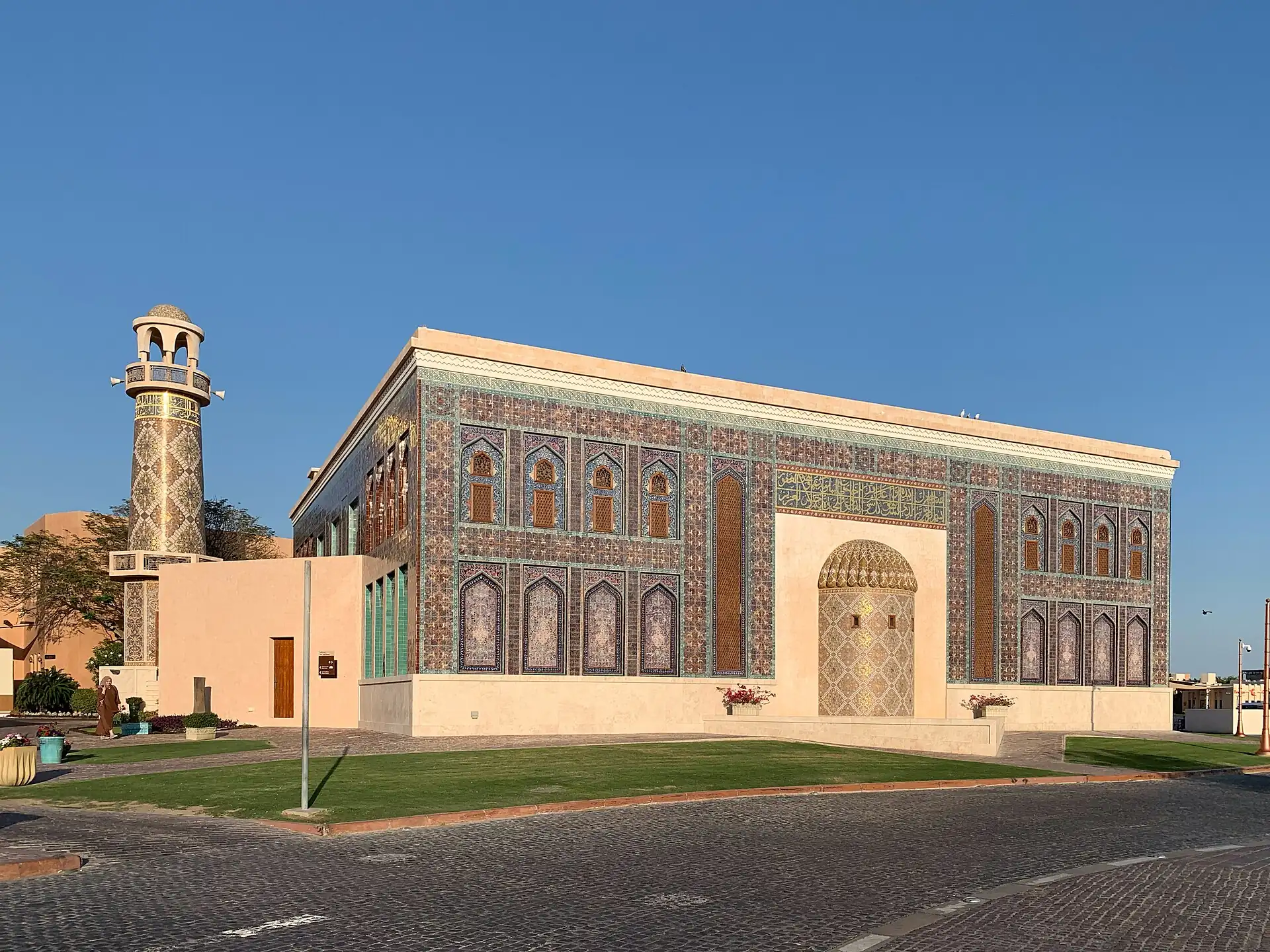
Katara Cultural Village, opened in 2010, mixes performance and faith: an amphitheatre for a few thousand people, an opera house, galleries, and two mosques that are decoration on a large scale, one in blue and purple tile and one in gold mosaic. The Pearl-Qatar, on reclaimed land further north, borrows from Venice and the Riviera, with a marina, arcades and canals, and it is a residential district more than a sight.
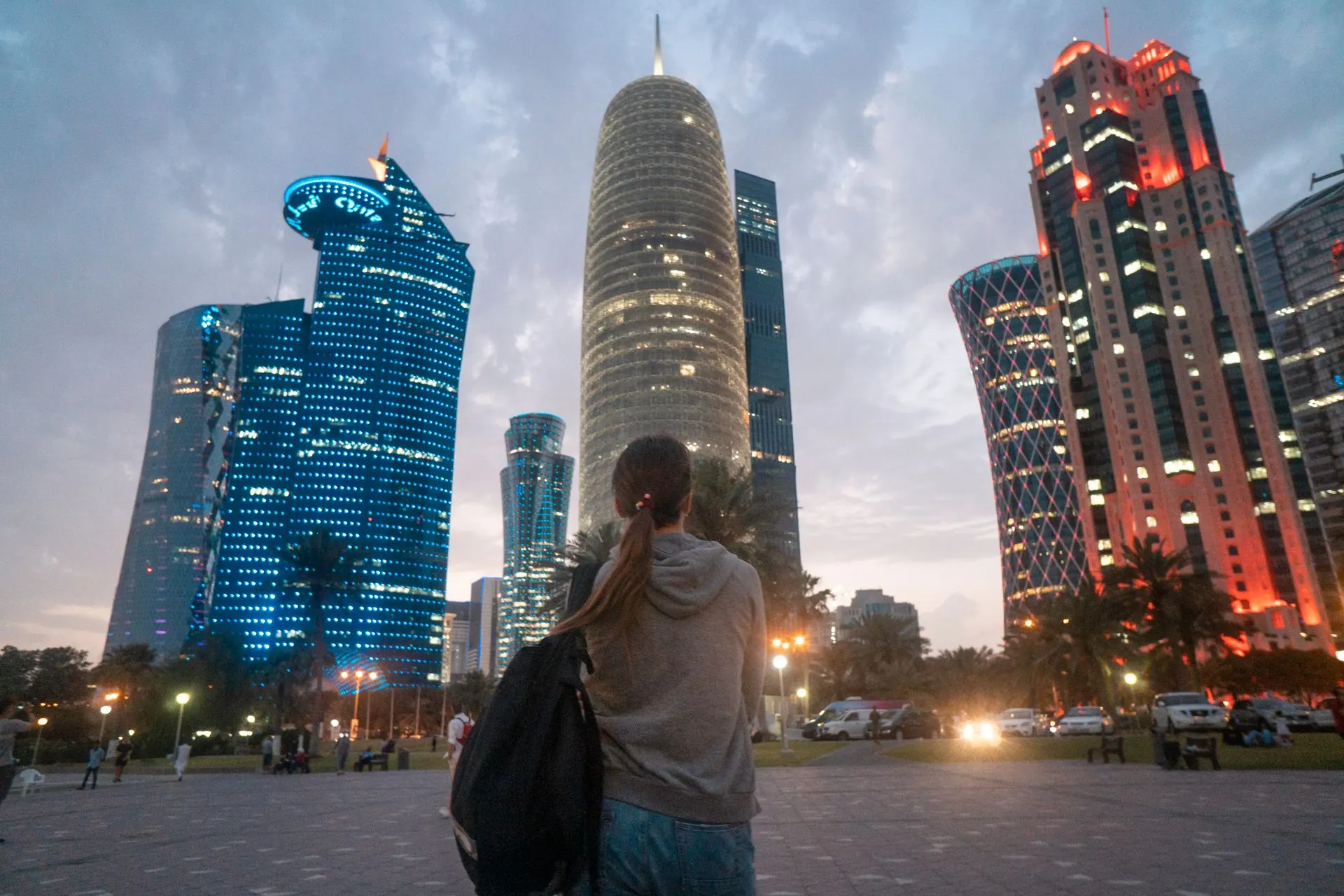
West Bay's towers, mostly built from the 1990s to the 2010s, show another Doha again, the global business city, and beyond them Lusail is a whole new city built for the World Cup. The Education City campus, with the Qatar National Library by Rem Koolhaas, joins universities from several countries.
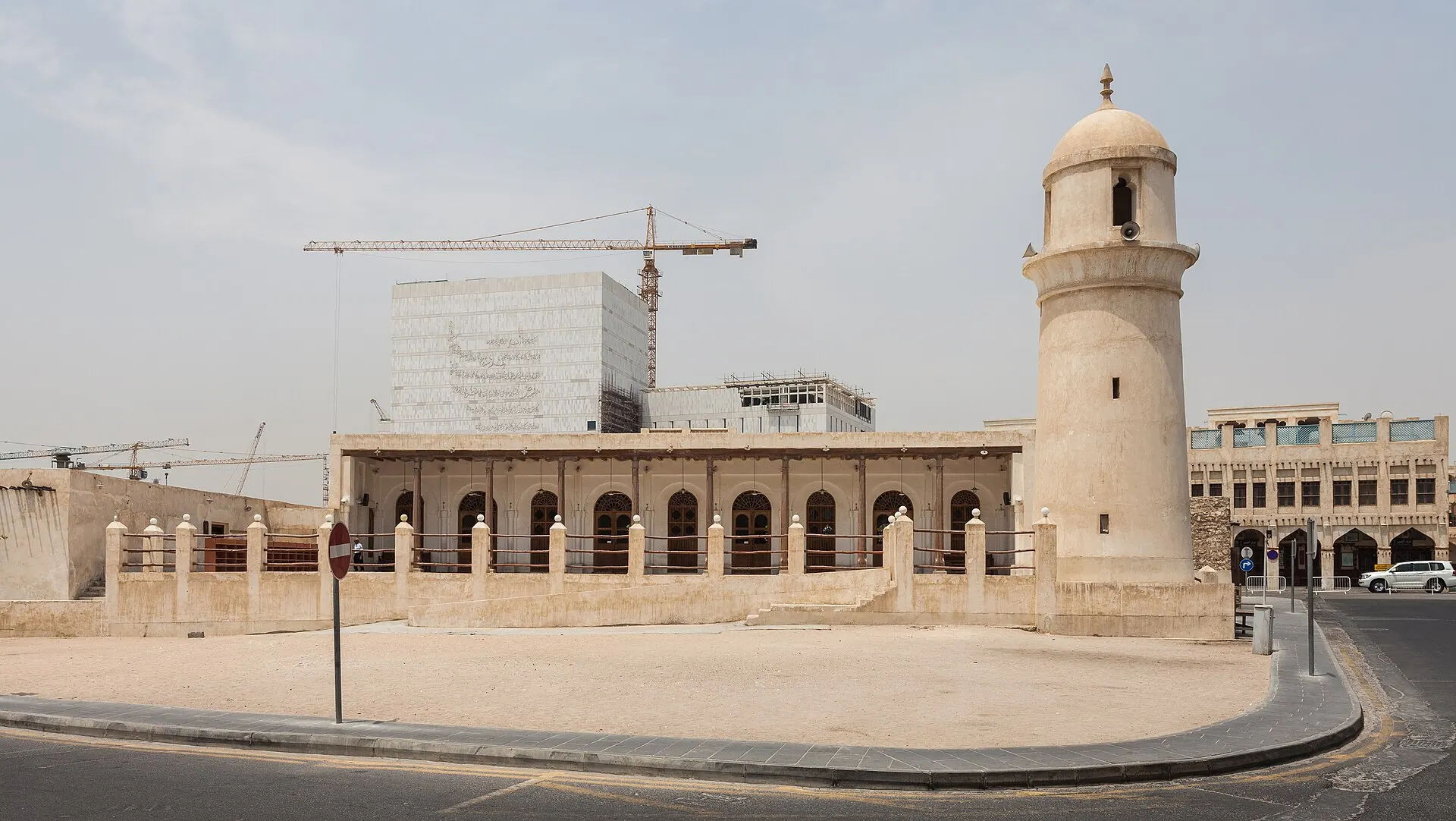
A simple way to read Doha is by decade: the old dhows and souq, the 1970s to 1990s concrete town, then the 2000s to 2020s statement buildings. The metro, opened in 2019, links many of them, and its stations are a small architecture tour in themselves.
- Museum of Islamic Art opened
- 2008, architect I. M. Pei
- National Museum of Qatar opened
- 2019, architect Jean Nouvel
- Palace inside the National Museum
- Built 1901 for Sheikh Abdullah bin Jassim Al Thani
- Katara Cultural Village
- Opened 2010
- Doha Metro
- Opened 2019: Red, Green and Gold lines
4Souq Waqif and the market tradition2 min
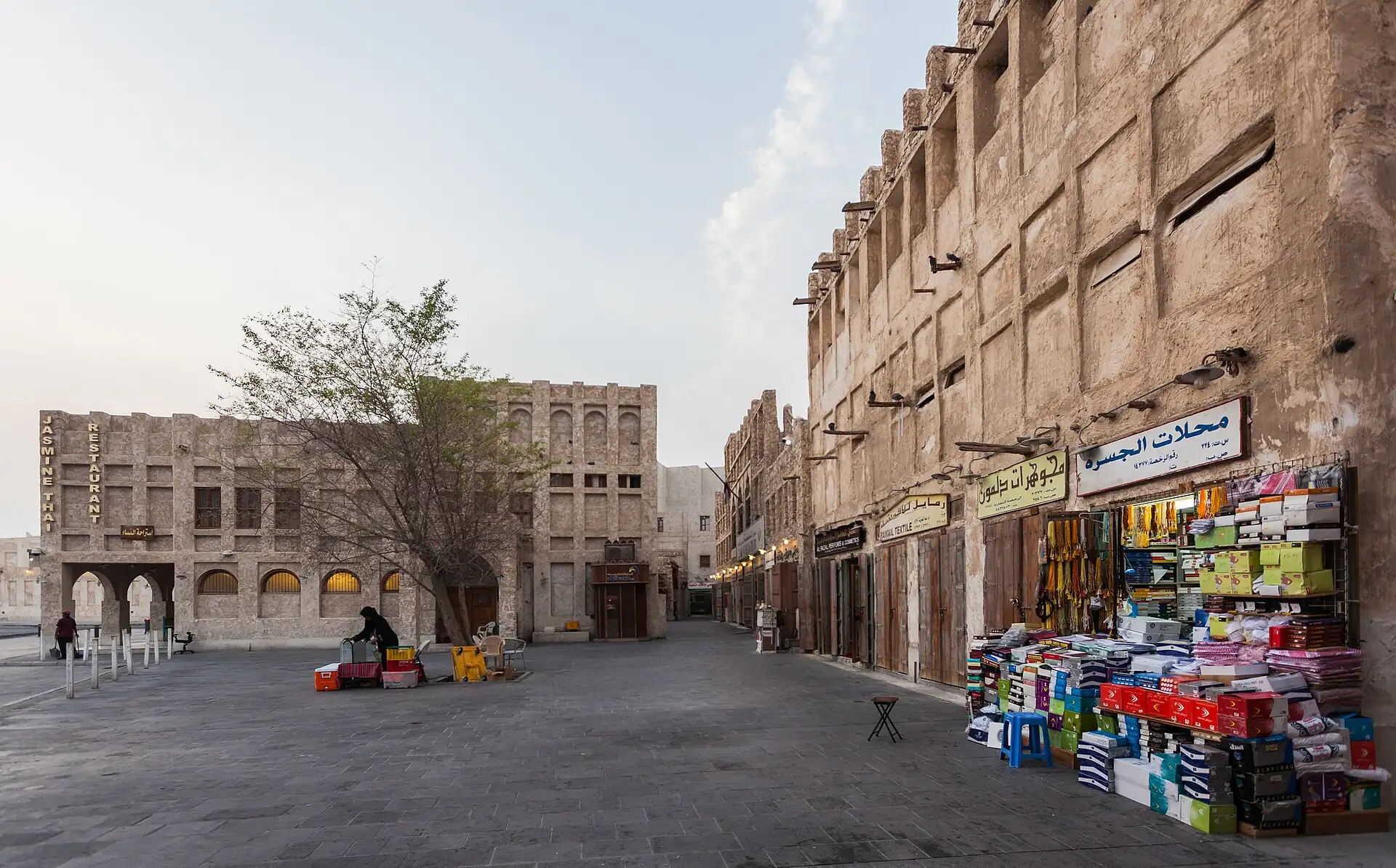
Souq Waqif means the standing market. The usual explanation is that the sellers stood, without shops, on the banks of a dry riverbed, the Wadi Musheireb, and sold to Bedouin families who came in from the desert to trade sheep, wool, ghee and dates for rice, cloth and tools. Whatever the origin, the souq was the centre of old Doha, and in the 20th century, as the city moved to new streets and malls, the old buildings decayed.
In the 2000s the state restored the souq to look like an earlier version of itself. Concrete was stripped away, buildings were rebuilt in mud-coloured render with wooden beams, and the lanes were paved. The result is not an untouched relic; it is a careful rebuild, and worth knowing about, because it explains why it feels tidy. Even so it works as a real market, with shops that sell spices, incense, textiles, tools and gold, and it is where many Doha families come in the evenings.
Several markets sit inside the main one. The spice lanes are the best introduction: pyramids of saffron, dried limes, cardamom and cinnamon, bags of dates and blocks of incense. The gold and jewellery shops sell by weight at the day's rate plus a making charge. Perfume shops sell oud, the resinous wood that Gulf perfumers blend into oils, and it is worth trying a few before you buy. The Falcon Souq is a small district with perches, hoods and equipment for falconry, a tradition tied to desert hunting and now a national symbol; the nearby falcon hospital treats birds and arranges visits.
The rhythm of the day matters. Shops open in the morning, then many close for the midday heat and reopen around 16:00, staying open until 22:00 or later. After the sun goes down the terraces fill: families with children, groups of friends, couples, visitors, and Qataris who come for tea and shisha. On Friday, shops close for the midday prayer and reopen in the afternoon, and Thursday and Friday evenings are the busiest.
Bargaining is expected in the small shops but is gentle. A first price is often 30 to 50 per cent above what settles; smile, ask for a better price once or twice, and if you do not agree, thank the seller and walk on. Compare two shops for saffron, gold and perfume. Do not haggle over food in a restaurant or in a mall, where prices are fixed.
The etiquette is simple. Dress modestly, ask before photographing anyone, do not touch the birds without permission, and accept a coffee or a sweet with the right hand if it is offered. Alcohol is not served in the souq, which is one reason it is so comfortable for families, and one of its charms for visitors who want a slow evening rather than a bar.
- Name
- Souq Waqif: the standing market
- Restored
- In the 2000s, as a rebuilt traditional market
- Best hours
- After 17:00; many shops shut at middayAfter 5:00 PM; many shops shut at midday
- Bargaining
- Expected but gentle; not in malls or restaurants
5Food2 min
Doha's food has three layers. The oldest is Qatari and Gulf: rice, dates, fish, lamb, chicken and spices carried by the pearl and spice trade. The second is the region's cooking, Lebanese, Syrian, Yemeni, Persian and Egyptian, brought by migrants and businesses over the last fifty years. The third is the cooking of the expatriate workforce, above all South Asian and Filipino, which fills the cafeterias and is often the best value in the city.
Machboos, sometimes written majboos, is the national dish: rice cooked with lamb, chicken or fish, tomatoes, onion, dried lime and a spice blend that usually includes cardamom, turmeric and cinnamon. It is served on a big platter, and it is meant to be shared. Mandi, from Yemen, uses meat cooked slowly in a pit or oven, and the rice takes on a smoky flavour. Harees is a porridge of wheat and meat that is beaten until smooth and is common in Ramadan and at weddings. Thareed is bread soaked in a meat and vegetable stew, and madrouba is a thick spiced rice porridge with chicken.
Breakfast is its own tradition. Balaleet is sweet vermicelli with saffron and cardamom, topped with an omelette, and it looks strange until you taste it. Chebab are thin sweet pancakes with date syrup. Khubz, the bread, comes fresh from tandoor ovens all over town. Fish is a Gulf staple; hamour (grouper) is the well-known local fish, grilled, or cooked with rice.
Drinks matter as much as dishes. Arabic coffee, or gahwa, is light, cardamom-scented and served in small cups with dates; if you want more, hold the cup out, and if you have had enough, shake it gently. Karak, the sweet cardamom tea boiled with milk, came from the subcontinent and became the national street drink, sold in tiny cups for a riyal or two at counters everywhere. Juices, laban (salted yoghurt) and lemon-and-mint drinks fill the gaps where beer would be elsewhere.
Sweets are a large part of hospitality. Luqaimat are small fried dough balls in date syrup, dates come filled or plain, and a plate of sweets often arrives with coffee. Ramadan brings its own patterns: at sunset the fast is broken with dates and water, and then a big meal, iftar, with harees, samosas, soups, grilled meat and desserts.
For a visitor the practical rules are simple. Lunch is the main meal, and at Souq Waqif the best time for machboos is before 15:00 when the pots are fresh. The cheapest good food is in cafeterias, where a paratha and karak can cost under QAR 10. Higher-end restaurants in hotels serve alcohol and cost far more. Service is often added to the bill, so check before tipping. Eat with the right hand or a spoon, share the platter, and say no politely if you are full.
- National dish
- Machboos: spiced rice with lamb, chicken or fish
- Street drink
- Karak tea, about QAR 1–4
- Coffee etiquette
- Shake the cup gently to say no more
- Fast-breaking
- Dates and water at sunset, then iftar
6Faith, rules and daily life3 min
Qatar is a conservative Muslim country, and much of what surprises visitors comes from that. The call to prayer sounds five times a day from mosques all over Doha. Prayer times follow the sun, so they move through the year and are published in newspapers and apps. Many shops close for a short time at prayer, especially the midday prayer on Friday, when the streets go quiet and stay that way until the early afternoon.
The weekend is Friday and Saturday. Friday morning is slow; families go out in the late afternoon and evening, and Thursday night is the busiest evening for restaurants and the souq. Government offices and banks run in the morning; malls stay open until late.
Ramadan is the ninth month of the Islamic year and moves about eleven days earlier each Gregorian year. From dawn to sunset Muslims fast, and visitors are asked not to eat, drink or smoke in public in daylight. Many restaurants close by day, opening again at sunset; some hotels serve meals to non-Muslim guests out of public view. Office hours shorten. After dark the city comes alive with iftar tents, late shopping and family visits. Eid al-Fitr ends the month with a public holiday of several days.
The rules for visitors are strict but not hard to follow. Dress modestly: shoulders and knees covered for both men and women, in malls, museums and the souq. Swimwear belongs on the beach and at the hotel pool. Public displays of affection are not accepted, for couples of any kind. Alcohol is served only in licensed hotel bars and restaurants, and you cannot buy it in shops as a visitor; being drunk in public is an offence. Drugs carry severe sentences, and some medicines that are legal elsewhere are controlled here, so keep them in their original packs and carry a doctor's letter. Photograph nothing military or governmental, and ask before you photograph anyone. Same-sex relations are illegal.
Hospitality is the other side of the rules. Qataris and long-term residents will offer coffee, dates and a seat, and it is polite to accept. Greetings matter: say as-salamu alaykum, and wait for a woman to offer her hand before you offer yours. Use your right hand to eat and to pass things. Do not point the sole of your foot at someone, and do not lose your temper in public.
Everyday life is shaped by the heat. From May to September temperatures reach 40 degrees and the city works around it: air-conditioned malls, indoor entertainment, activities after dark, and many families leaving for the summer. In winter, from November to March, the weather is mild, and Doha is at its best: a walk on the Corniche, an evening at Katara, a dhow ride, dinner at the marina.
Nine in ten residents are expatriates, so Doha is a mix of languages and food. English works almost everywhere, Arabic is the official language, and Hindi, Urdu, Malayalam, Tagalog and others are common. Metro trains have a family and women area. Nothing about this needs planning: a few respectful habits, and you will find people friendly and helpful.
- Weekend
- Friday and Saturday
- Call to prayer
- Five times a day; times shift with the sun
- Ramadan 2027
- About February–March 2027 (moves yearly, check)
- Alcohol
- Only in licensed hotel venues; none in shops for visitors
7Sea and desert beyond the city2 min
Qatar is small: from Doha, almost anything of interest is inside two hours by road. The peninsula is mostly flat limestone and sand, with a few rocky ridges in the west, mangroves in the north-east, and dunes in the south. Half a day or a full day is enough to see the main sites, and a driver or a licensed tour makes the trip easy.
Al Zubarah, on the north-west coast, is the country's only UNESCO World Heritage site, listed in 2013. It was a planned trading and pearling town in the 18th and early 19th centuries, with a harbour, streets, houses and a mosque behind walls, and it was abandoned after a series of wars and raids. Much of it lies beneath the sand, and what visitors see are low foundations and the fort, built in 1938 on older ground. It is quiet, windy and a good place to understand what Qatar looked like before oil. Allow about an hour there, and up to a half day with the drive.
Zekreet, on the west coast, is known for limestone cliffs and rock formations, an old fort and film-set ruins, and for Richard Serra's East-West/West-East, four large steel plates set in the desert over about a kilometre, which draw the eye across the flat land. Late afternoon in winter is the best time, when the light is low and the temperature is bearable.
In the south, Khor Al Adaid, the Inland Sea, is a sea inlet ringed by dunes near the Saudi border, reached only by 4x4 and best visited with a licensed operator who knows the routes and lowers tyre pressure for the sand. Dune driving is loud and bumpy, and it is not for everyone, but the meeting of sea and sand at sunset is what many visitors remember longest. The season for it is November to March.
Al Thakira, north of Doha, has mangrove channels that you can explore by kayak, and the Purple Island area is a good place for birds. Al Wakrah, south of the city, has a small souq and a beach, and is an easier evening trip than the desert. Al Jassasiya, on the north-east coast, has ancient rock carvings, though access rules can change, so check first.
Plan carefully. Outside the cool months, desert trips are miserable and sometimes unsafe. Book a licensed operator, take water, tell someone where you are going, and do not drive off the road without local knowledge. In winter the desert is at its best, cool, clear and quiet, and a day out of the city makes a good counterweight to the museums and the souq.
- Al Zubarah
- UNESCO World Heritage site, listed 2013
- Zekreet artwork
- Richard Serra's East-West/West-East, four steel plates
- Best season for the desert
- November to March
- Khor Al Adaid
- Inland sea inlet; 4x4 with a licensed operator
Read, watch, wordsGlossary · Sources
Glossary
| Term | Local | Meaning |
|---|---|---|
| Souq | سوق | A market. |
| Waqif | واقف | Standing; the name of the old market and of the rebuilt souq. |
| Karak | كرك | Strong sweet milk tea with cardamom. |
| Gahwa | قهوة | Light Arabic coffee served in small cups. |
| Machboos | مجبوس | Spiced rice with lamb, chicken or fish; the national dish. |
| Majlis | مجلس | A sitting room or gathering for guests. |
| Dhow | داو | A traditional wooden sailing boat used for pearling and trade. |
| Ghawwas | غواص | A pearl diver. |
| Iftar | إفطار | The meal that breaks the fast at sunset in Ramadan. |
Read for this deep dive
- Wikipedia — Doha ↗
- Wikipedia — Qatar ↗
- UNESCO — Al Zubarah Archaeological Site ↗
- Visit Qatar ↗
- Wikivoyage — Doha ↗
Background reading only: the text above is written by Voykit, not copied from these pages.
Rules in force · 5
- Qatar ↗Check entry rules for your passport on the official Visit Qatar and Hayya pages only; lookalike sites charge extra.
- Qatar ↗Alcohol is served only in licensed hotel bars and restaurants; do not bring it into the country or drink in public.
- Qatar ↗Dress modestly in public: shoulders and knees covered for everyone; swimwear only at beaches and hotel pools.
- Qatar ↗In Ramadan, do not eat, drink or smoke in public during daylight.
- Doha Municipality ↗Dune driving and the Inland Sea: use a licensed operator; do not drive off-road alone.
Entry rules depend on your passport. Full visa guide
Emergency numbers for Doha999 ▾
- Police, fire, ambulance999
- Non-emergency policecheck locally
Tap a number to call from your phone. These are the numbers listed in this guide; a row marked check has not been verified.
Planning is the full guide. I'm here keeps what is open and the cheat card.
Right now
Checking the weather…
Working out what is open near you…
What is open nowclock, closures, places open
Now in Doha
Local time in Doha
--:--
Loads in your browser · Asia/Qatar
This month
Month verdict appears here.
Closed today
See the weekly grid below.
If today is a closure day: Check the current Doha Metro Friday hours, the weekly museum closing days and Ramadan dates before you fix a day plan.
Weekly closures come from our place pages; public holidays and Ramadan dates move (see the calendar).
Open now
The sights and places to eat on our list that are open at this moment, in the city's time, nearest first from where you are staying.
Loads in your browser with the city's local time.
Hours marked (check) are typical, not confirmed. Walking times are straight-line estimates. Open at another time →
Cheat cardthe pocket version
Cheat card
The essentials on one card: save it as an image for your phone, share it, or print it.
Doha
الدوحة
- Money
- Keep QAR 200 in small notes for taxis and souq stalls; use bank ATMs in malls or hotels.
- SIM
- Ooredoo and Vodafone Qatar tourist SIMs at Hamad airport; passport needed.
- Ride app
- Karwa (Mowasalat) taxi app · Uber and Careem
- Emergency
- 999 police, fire, ambulance · check locally Non-emergency police
- Plugs
- Sockets G. US/Canada (A/B): adapter · UK/Ireland (G): fits · Australia/NZ (I): adapter. 230 V: US 120 V-only devices (hair dryers) need a converter; most chargers are dual-voltage.
Say it
- Thank you: Shukran (SHOOK-ran)
- How much is this?: Kam hatha? (kam HA-tha)
- No, thank you: La, shukran (la SHOOK-ran)
- The bill, please: Al-hisab, min fadlak (al-hi-SAB min FAD-lak)
- Stop here, please: Wagif hena, min fadlak (WA-gif HE-na min FAD-lak)
Top 5
- Museum of Islamic Art
- Souq Waqif
- National Museum of Qatar
- Msheireb Museums
- Corniche at sunset
EssentialsQuick answers, what things cost and how to get around
Essentials
Quick answers, what things cost and how to get around
Quick answers
The questions people ask first about Doha, one line each. Tap a card for the full answer.
- Cash or card?Cards work almost everywhere; carry some riyals for souq stalls, small cafeterias and tips.
- SIM or eSIMOoredoo and Vodafone Qatar tourist SIMs at Hamad airport; passport needed.
- Ride-hailing appKarwa (Mowasalat) taxi app · Uber and Careem.
- Tap waterTap water is treated; most people drink bottled water.
- TippingNot required but appreciated; round up taxis and leave 5–10% for good service if it is not already added (10–12% service is common).
- Plugs & powerSockets G. US/Canada (A/B): adapter · UK/Ireland (G): fits · Australia/NZ (I): adapter. 230 V: US 120 V-only devices (hair dryers) need a converter; most chargers are dual-voltage.
Show all 14 answers
- Safe at night?The central areas on our map are rated fine at night.
- What to wearCover shoulders and knees in public places, malls and the souq.
- RestroomsMalls, museums, hotels and mosques; carry tissue.
- Emergency numberscheck999 police, fire, ambulance · check locally Non-emergency police
- Your embassycheckUS, UK, Canada, Australia embassies listed with addresses (check before you go).
- Sundays & holidaysWeekly closures come from our place pages; public holidays and Ramadan dates move (see the calendar).
- Rainy-day planRain is rare and short; when it comes, roads flood and traffic slows.
- Landing lateDOH: taxi or ride-hailing car to the door runs all night.
Cost cheat-sheetwhat everyday things cost
Cost cheat-sheet
Typical prices for the everyday things, as ranges. Change the currency right here; the local price stays first.
2026 desk estimate · check
- CoffeeSpecialty coffeeQAR 18–30
- Sit-down mealSit-down restaurant meal, per personQAR 80–180
- Taxi, about 5 km (3 mi)Taxi, about 3 mi (5 km)Taxi across the centreQAR 15–40
- Metro or bus rideMetro single ride (standard class)about QAR 2 (check)
- SIM or eSIM, a weekTourist SIM, about a week of dataQAR 50–100
- Museum or sight ticketMuseum entry (visitors)QAR 0–50 (check)
- Budget bedServiced apartment, a night, per roomQAR 350
- Mid-range bedHotel double room, a night, per roomQAR 550
- High-end bedHotel double room, a night, per roomQAR 1,500
A day, not counting the bed: Budget QAR 200 · Mid QAR 450 · High QAR 1,200
Local prices, with USD next to them (rates 2026-09 (approximate); change it in the header). Ranges are desk estimates: check locally. Every price and the budget calculator →
Source: Prices in Doha
Draft
Written from desk research. Not yet compared with the official source.
No official source is recorded for this figure.
Prices are 2026 desk estimates, not yet compared with an official source. Check on the day.
Not checked in the last 12 months (no check date on file).
DecideWho it suits, the trade-offs and when to go
Decide
Who it suits, the trade-offs and when to go
Best months at a glance
The guide's verdict for each month
Jan
Best
22°C (72°F)72°F (22°C)
Feb
Best
24°C (75°F)75°F (24°C)
Mar
Best
28°C (82°F)82°F (28°C)
Apr
Care
34°C (93°F)93°F (34°C)
May
Avoid
40°C (104°F)104°F (40°C)
Jun
Avoid
42°C (108°F)108°F (42°C)
Jul
Avoid
42°C (108°F)108°F (42°C)
Aug
Avoid
42°C (108°F)108°F (42°C)
Sep
Avoid
40°C (104°F)104°F (40°C)
Oct
Care
36°C (97°F)97°F (36°C)
Nov
Best
29°C (84°F)84°F (29°C)
Dec
Best
24°C (75°F)75°F (24°C)
Best: Nov–Mar. Mixed: Apr, Oct. Avoid: May–Sep. Month by month →
Warmest Jun (42°C (108°F)108°F (42°C)), coolest Jan (14°C (57°F)57°F (14°C) low), wettest Jan (2 rain days), driest May (0). Averages, not a forecast.
Doha across the year
Best-looking months for Doha: Jan, Feb, Mar. Rated avoid: May, Jun, Jul, Aug, Sep.
| Measure | Jan | Feb | Mar | Apr | May | Jun | Jul | Aug | Sep | Oct | Nov | Dec |
|---|---|---|---|---|---|---|---|---|---|---|---|---|
| Weather | Great (good) | Great (good) | Great (good) | Mixed (care) | Avoid (avoid) | Avoid (avoid) | Avoid (avoid) | Avoid (avoid) | Avoid (avoid) | Mixed (care) | Great (good) | Great (good) |
| Crowds | High (care) | High (care) | Medium (ok) | Medium (ok) | Low (good) | Low (good) | Low (good) | Low (good) | Low (good) | Medium (ok) | High (care) | High (care) |
| Prices | High (care) | High (care) | Medium (ok) | Medium (ok) | Low (good) | Low (good) | Low (good) | Low (good) | Low (good) | Medium (ok) | High (care) | High (care) |
| Events | None listed (ok) | 2 events (ok) | 2 events (ok) | None listed (ok) | 1 event (ok) | None listed (ok) | None listed (ok) | None listed (ok) | None listed (ok) | None listed (ok) | 2 events (ok) | 2 events (ok) |
Green is good news, amber needs planning, red is a month to avoid; dashed grey with a question mark means our data does not say. Open the year heatmap →
Not checked in the last 12 months (no check date on file).
Source: Months, temperatures and crowds
Draft
Written from desk research. Not yet compared with the official source.
Monthly highs, rain and crowd levels are climate averages and desk estimates for the city, not a forecast.
Understand the cityUnderstand · Districts
Orientation & districts
A first visit covers four areas in a long arc: Souq Waqif and Msheireb inland, the Corniche and the Museum of Islamic Art on the water, Katara Cultural Village north of West Bay, and The Pearl-Qatar on its own island further north. Everything between them is a short taxi or metro ride.
Doha uses zone, street and building numbers rather than reliable house numbers; give the driver a landmark or a pin from a map app.
Shaded shapes: walking areas (click one). Black pins: sleep areas. Grey dots: places. Round badges: arrivals. Click the map to turn on scroll-wheel zoom.
Hover, tap or tab to an area to see what it is like. Pins are sleep areas; arrows at the edge point to the airport.
Not drawn yet (no coordinates in this guide): West Bay and Lusail. They are in the neighbourhood cards below.
Where’s what, as a list:
- Souq Waqif: The rebuilt market: low mud-coloured lanes, spice and perfume shops, a falcon souq and restaurants with terraces. Best after 17:00.The rebuilt market: low mud-coloured lanes, spice and perfume shops, a falcon souq and restaurants with terraces. Best after 5:00 PM. Suits: Evenings, shopping, first-night dinner.
- Msheireb Downtown: A planned downtown with heritage houses turned into museums, tree-lined lanes and staffed 24-hour hotels; the metro interchange is here. Suits: First stay, easy walk to the souq, metro interchange. Price band $$$.
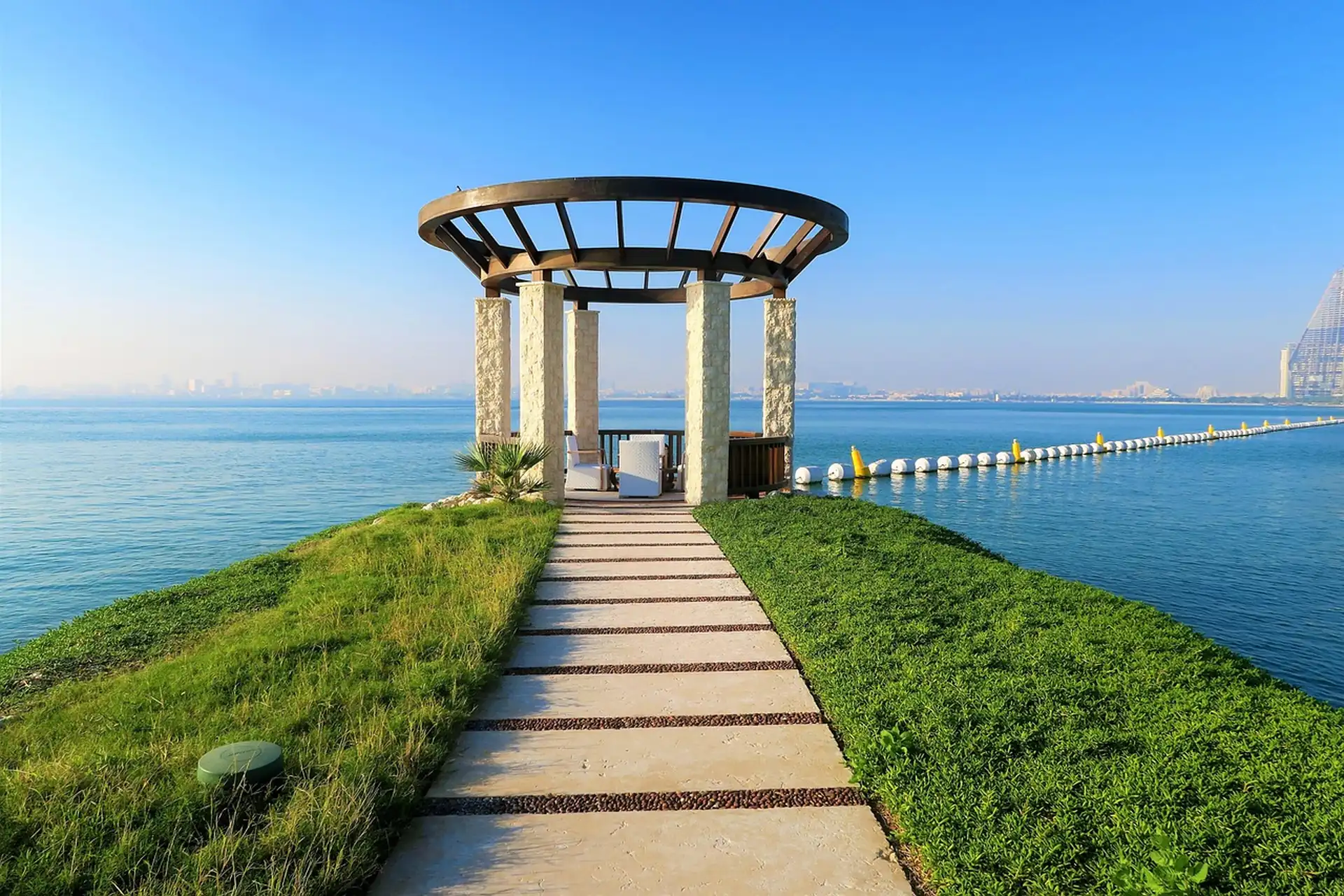
- Corniche and Museum of Islamic Art: The bay promenade, MIA Park, the museum on its own island and the National Museum of Qatar a little to the south; wide, flat, and exposed to sun. Suits: Museum morning, sunset walks in winter.
- Katara Cultural Village: A cultural complex with an amphitheatre, two decorated mosques, a beach front and restaurants; a car ride from the centre. Suits: Winter mornings, evenings, beach and mosques.
- The Pearl-Qatar: An artificial island of marinas, boutiques and waterfront restaurants; easy and calm, but a dinner district and not a sight. Suits: Evening dinner, longer stays, polished waterfront. Price band $$$.
- West Bay and Lusail: Towers, malls and conference hotels north of the centre; car-dependent and far from the sights. Suits: Business trips, skyline hotels.
- Sleep area Msheireb Downtown: suits First stay, easy walk to the souq, metro interchange, price band $$$.
- Sleep area The Pearl-Qatar: suits Evening dinner, longer stays, polished waterfront, price band $$$.
- Hamad International Airport (DOH), about 8 km (5 mi)5 mi (8 km) from the centre, 30–50 min by the usual route.
Neighbourhoods at a glance
One tab per area, pulled together from this guide’s districts table, area notes, sleep-area scores and place pages. Scores are desk judgements (1–5); prices are estimates, check before you book.
Souq Waqif
The rebuilt market: low mud-coloured lanes, spice and perfume shops, a falcon souq and restaurants with terraces. Best after 17:00.The rebuilt market: low mud-coloured lanes, spice and perfume shops, a falcon souq and restaurants with terraces. Best after 5:00 PM.
- Suits:
- Evenings, shopping, first-night dinner
- Best time:
- After 17:00After 5:00 PM
Pick this if: Evenings, first nights
Watch out for: Midday, when it is shut and hot.
Getting around from here
- Car north-east: about 8 min to Corniche & Museum of Islamic Art
- Car north: about 25 min to Katara Cultural Village
- DOH: about 8 km (5 mi) in a straight line (arrival ride 30–50 min)DOH: about 5 mi (8 km) in a straight line (arrival ride 30–50 min)
Msheireb Downtown
$$$A planned downtown with heritage houses turned into museums, tree-lined lanes and staffed 24-hour hotels; the metro interchange is here.
- Suits:
- First stay, easy walk to the souq, metro interchange
- Best time:
- After 17:00After 5:00 PM
- Rooms:
- QAR 350–700 (from the sleep guide)
Pick this if: Evenings, first nights
Watch out for: Midday, when it is shut and hot.
- Quiet nights4/5 High
- Nightlife2/5 Low
- Families4/5 High
- Late arrival5/5 Very high
Why these scores
- Quiet nights: Calm lanes; the metro and the souq are near but not loud.
- Nightlife: Some cafés and lounges; alcohol only in a few hotel bars.
- Families: Wide pedestrian lanes and short taxi rides; easy with a stroller.
- Late arrival: Staffed 24-hour desks, and the metro interchange is close.
Getting around from here
- 25–35 min walk to Corniche & Museum of Islamic Art
- Car north: about 25 min to Katara Cultural Village
- DOH: about 8 km (5 mi) in a straight line (arrival ride 30–50 min)DOH: about 5 mi (8 km) in a straight line (arrival ride 30–50 min)
Corniche and Museum of Islamic Art
The bay promenade, MIA Park, the museum on its own island and the National Museum of Qatar a little to the south; wide, flat, and exposed to sun.
- Suits:
- Museum morning, sunset walks in winter
- Best time:
- Early morning and sunset in winter
Pick this if: Museum mornings and sunset walks
Watch out for: Midday walks in summer.
Getting around from here
- Car south-west: about 8 min to Souq Waqif & Falcon Souq
- DOH: about 8 km (5 mi) in a straight line (arrival ride 30–50 min)DOH: about 5 mi (8 km) in a straight line (arrival ride 30–50 min)
Katara Cultural Village
A cultural complex with an amphitheatre, two decorated mosques, a beach front and restaurants; a car ride from the centre.
- Suits:
- Winter mornings, evenings, beach and mosques
- Best time:
- Morning or after 17:00Morning or after 5:00 PM
Pick this if: Winter mornings and evenings
Watch out for: Summer daytime, when it is empty and hot.
Getting around from here
- Car south: about 25 min to Souq Waqif & Falcon Souq
- Car east: about 12 min to The Pearl-Qatar
- DOH: about 13 km (8.1 mi) in a straight line (arrival ride 30–50 min)DOH: about 8.1 mi (13 km) in a straight line (arrival ride 30–50 min)
The Pearl-Qatar
$$$An artificial island of marinas, boutiques and waterfront restaurants; easy and calm, but a dinner district and not a sight.
- Suits:
- Evening dinner, longer stays, polished waterfront
- Best time:
- Evening
- Rooms:
- QAR 700–2,000+ (from the sleep guide)
Pick this if: Dinner and a marina walk
Watch out for: Expecting a sight; it is a dinner district.
- Quiet nights4/5 High
- Nightlife3/5 Medium
- Families4/5 High
- Late arrival4/5 High
Why these scores
- Quiet nights: Calm and orderly; marina and lounge noise stays low.
- Nightlife: Waterfront restaurants and a few licensed hotel bars; not a party district.
- Families: Promenade, playgrounds and calm cafés; easy on foot inside the island.
- Late arrival: Most hotels keep 24-hour desks; taxis and rides run late.
Getting around from here
- Car south: about 30 min to Souq Waqif & Falcon Souq
- DOH: about 13 km (8.1 mi) in a straight line (arrival ride 30–50 min)DOH: about 8.1 mi (13 km) in a straight line (arrival ride 30–50 min)
West Bay and Lusail
Towers, malls and conference hotels north of the centre; car-dependent and far from the sights.
- Suits:
- Business trips, skyline hotels
Decide
The honest trade-off: what you will enjoy, what will wear you down.
You will like
- Museums with AC
- Souq evenings
- Short taxi rides
You will hate
- Summer heat
- Strict public-behaviour rules
- Car-dependent distances
Similar citiesif this one is not quite right
Similar cities
If Doha does not fit your dates or budget, these match it on season, cost and feel.
- Dubai
United Arab Emirates
- Good in the same months: Jan, Feb, Mar, Nov, Dec
- Works well for first-timers, couples, families
- A similar climate through the year
- Muscat
Oman
- Good in the same months: Jan, Feb, Mar, Nov, Dec
- Works well for first-timers, couples, families
- A similar climate through the year
- Kuwait City
Kuwait
- Good in the same months: Jan, Feb, Mar, Nov, Dec
- Works well for couples
- A similar climate through the year
When
Best months: Jan, Feb, Mar, Nov, Dec. Month-by-month verdicts below, with the live forecast first. When to go, month by month →
Doha: next 7 days
Loading forecast…
Forecast: Open-Meteo (CC BY 4.0), model data for this point.
Air quality
Loading…
Model estimate (CAMS via Open-Meteo), not a street-level station; readings near busy roads run higher.
Month by month, all 12best Jan, Feb, Mar, Nov, Dec
Cool days 14–22°C (57–72°F); the best month.Cool days 57–72°F (14–22°C); the best month.
Pleasant; good for Katara and the Corniche.
Warm and dry; still fine outdoors.
35°C (95°F)+ by afternoon; mornings only.95°F (35°C)+ by afternoon; mornings only.
40°C (104°F)+ and humid.104°F (40°C)+ and humid.
Extreme heat and dust.
Extreme heat and humidity.
Extreme heat and humidity.
Still 40°C (104°F)+; indoor plan only.Still 104°F (40°C)+; indoor plan only.
Heat easing; late October is better.
Comfortable; the main season.
Cool; Qatar National Day on Dec 18 closes roads.
Climate, calendar and eventsClimate · Calendar · Events · Packing by season
Climate
| Jan | Feb | Mar | Apr | May | Jun | Jul | Aug | Sep | Oct | Nov | Dec | |
|---|---|---|---|---|---|---|---|---|---|---|---|---|
| High | 22°C (72°F)72°F (22°C) | 24°C (75°F)75°F (24°C) | 28°C (82°F)82°F (28°C) | 34°C (93°F)93°F (34°C) | 40°C (104°F)104°F (40°C) | 42°C (108°F)108°F (42°C) | 42°C (108°F)108°F (42°C) | 42°C (108°F)108°F (42°C) | 40°C (104°F)104°F (40°C) | 36°C (97°F)97°F (36°C) | 29°C (84°F)84°F (29°C) | 24°C (75°F)75°F (24°C) |
| Low | 14°C (57°F)57°F (14°C) | 15°C (59°F)59°F (15°C) | 18°C (64°F)64°F (18°C) | 23°C (73°F)73°F (23°C) | 27°C (81°F)81°F (27°C) | 30°C (86°F)86°F (30°C) | 32°C (90°F)90°F (32°C) | 32°C (90°F)90°F (32°C) | 29°C (84°F)84°F (29°C) | 25°C (77°F)77°F (25°C) | 20°C (68°F)68°F (20°C) | 16°C (61°F)61°F (16°C) |
| Rain days | 2 | 2 | 2 | 1 | 0 | 0 | 0 | 0 | 0 | 0 | 1 | 2 |
| Verdict |
- The usable season is roughly November to March. From May to September highs pass 40 °C (104 °F) and humidity on the coast makes it feel worse; plan only indoor stops and short car legs.The usable season is roughly November to March. From May to September highs pass 104 °F (40 °C) and humidity on the coast makes it feel worse; plan only indoor stops and short car legs.
- Rain is rare and short but can flood underpasses and roads for a few hours; drivers are slow after a storm.
- Dust and haze come with the shamal wind in early summer and with occasional spring storms; bring a scarf or mask if you are sensitive.
Events by month
Ramadan (2027)
religiousRoughly February–March 2027 (moves yearly) · Citywide
No public eating or drinking by day; many restaurants close until sunset; the souq and malls fill after dark. Shorter opening hours by day.
Eid al-Fitr (2027)
holidayAbout early to mid March 2027 (check) · Citywide
Several days of public holiday: shops and offices shut, hotels are busy, families out at Katara and the Corniche.
Qatar Sports Day
holidaySecond Tuesday of February · Citywide
Public holiday; parks and the Corniche fill with families and events.
Eid al-Adha (2027)
holidayAbout mid May 2027 (check) · Citywide
Public holiday of several days; many residents travel, hotels are quieter, and heat is already extreme.
Katara Traditional Dhow Festival
festivalMid to late November (check) · Katara beach
Dhow races, pearl-diving shows, crafts; Katara is busy on weekends.
Formula 1 Qatar Grand Prix (Lusail)
eventLate November or early December (check) · Lusail circuit
Hotels and taxis are booked and priced high that weekend; book early.
Qatar National Day
holiday18 December · Citywide, Corniche
Public holiday; road closures on the Corniche, parades and fireworks.
Festivals and events that change the plan
| When | What | Effect on your plan |
|---|---|---|
| Feb–Mar 2027 (moves yearly) | Ramadan | No public eating or drinking by day; restaurants open after sunset; shorter hours in museums and shops. |
| About 9–10 Mar 2027 (check) | Eid al-Fitr | Several days of public holiday; shops and offices close; the Corniche and Katara fill with families. |
| Second Tuesday of February | Qatar Sports Day | Public holiday; Corniche and parks host events. |
| Mid to late November (check) | Katara Traditional Dhow Festival | Dhow races and crafts at Katara; busy on weekends. |
| Late November to early December (check) | Formula 1 Qatar Grand Prix | Hotels and taxis are booked and expensive; book early. |
| 18 December | Qatar National Day | Public holiday; road closures around the Corniche; parades and fireworks. |
What to pack, by season
From Doha’s own climate table: the coldest, warmest and wettest three months, and what to bring for each.
Coldest months
Dec–Feb
15° to 23°
A light jacket and a sweater.
Warmest months
Jun–Aug
31° to 42°
Light, breathable clothes, a sun hat and sunscreen; plan midday indoors and carry water.
Wettest months
Jan–Mar
2 rain days a month
Showers are occasional: a light shell is enough.
Arrive & moveGetting in, getting around, and your bags
Arrive & move
Getting in, getting around, and your bags
I land at…
Enter your landing time: what still runs from the airport, where you can eat when you get in, and which areas let you check in that late.
Hamad International Airport (DOH)
Out of the airport about 23:5811:58 PM (01:00 (next day)1:00 AM (next day) if immigration and bags are slow); in town about 00:28 (next day)12:28 AM (next day).
Transport from the airport
- Any hourTaxi or ride-hailing car to the door. Runs all night.
- GoneDoha Metro Red Line from the airport to Msheireb, then a short walk or car. Stops about 22:30.Stops about 10:30 PM.
- Last resortOvernight at the airport hotel. If nothing else works.
Places to eat open when you get in
We have no confirmed hours for the places to eat here yet. Plan on a convenience store or your hotel. What is open late →
Where to sleep with a late arrival
- Lets you inMsheireb Downtown 24-hour desk. Staffed 24-hour desks, and the metro interchange is close.
- Lets you inThe Pearl-Qatar 24-hour desk. Most hotels keep 24-hour desks; taxis and rides run late.
Typical times from our airport data, not a timetable: check the last departure on the day. Full airport-to-bed plan for Hamad International Airport (DOH) →
Arrive
Each gateway has its own airport-to-bed page with timings and the last safe connection.
Getting in, in detailGet in
Get in by rail and road
| Station | Mode | Serves | Where | To the centre |
|---|---|---|---|---|
| Hamad International Airport (DOH)use | airport | International flights; the only commercial airport for the city | About 15 km south-east of the centre · Airport | Metro or taxi 30–50 minTaxis and rides queue at arrivals; the metro connects the terminal to Msheireb by day. |
| Abu Samra land border (Saudi Arabia)check | border | Cars and coaches from Saudi Arabia | About 100 km south-west of the city · Border | About 1 h by roadCheck visa and vehicle rules with your operator; not a route for casual visitors. |
| Hotel and operator pick-upsuse | Coach | Al Zubarah, Khor Al Adaid, Zekreet and desert tours | Your hotel door | Already thereThe easiest way to do a day trip; confirm the pick-up time and the price in writing. |
- Book a taxi at the official rank or use a ride app; do not accept rides from touts inside arrivals.
- Doha has no cross-border trains or intercity trains for visitors; long trips are by road.
Move
The default way around, when a pass pays off, and when the last trains go.
- Default
- Walk inside a cluster; taxi or ride-hailing between clusters.
- Passes
- No pass. Short rides in the centre are cheap; insist on the meter or the app fare.
- Last trains
- The metro closes overnight and opens late on Fridays; taxis and ride-hailing run all night.desk estimate
- Other modes
- Other modes (Rome2Rio) ↗
Getting around, in detailGet around · Connect
Get around
Walk inside a cluster in the cool hours, use the metro for the centre and the airport by day, and take a taxi or app car between clusters and after dark.
| Mode | Verdict | Fare | Use it for | What breaks |
|---|---|---|---|---|
| Walking | use | Free | Inside Souq Waqif, Msheireb, the Corniche and Katara in cool hours | Pavements are good in new districts; heat is the limit. |
| Doha Metro (Red, Green and Gold lines) | use | about QAR 2 standard (check) | Airport, Msheireb, Souq Waqif area and West Bay; check which station is nearest your stop | Clean, quiet and air-conditioned; opens late on Fridays and closes late evening. Buy or top up a travel card. |
| Karwa taxi | use | Metered, QAR 15–40 across the centre | Between clusters, bags, night | Metered; insist on the meter or use the Karwa app. |
| Uber or Careem | use | Shown in the app before you ride | Late night, fixed fare, easy pick-up | Set the pin exactly; pick-ups in the souq lanes are hard for cars. |
| Hire car | maybe | QAR 100–200 a day plus fuel | Day trips to the north-west | Fast roads, aggressive drivers, and strict alcohol and speeding laws; take an international licence. |
| Tram at Lusail and Education City | maybe | check | Only if your hotel is there | Not part of a first visit. |
Taxis and ride-hailing
Karwa taxi
metered taxi
Licensed, metered; hail on the street or order by app.
Uber
app
Fare shown before you ride.
Careem
app
Similar to Uber; sometimes cheaper.
On foot and car-free hours
| Where | When | Note |
|---|---|---|
| Souq Waqif | After 17:00After 5:00 PM | Lanes are pedestrian-only; wear shoes you can walk in and carry water. |
| Corniche | Early morning or sunset in winter | A long flat promenade; no shade in summer. |
| Msheireb Downtown | Any cool hour | Shaded lanes and courtyards by design. |
More on getting around
Roads have zones and street numbers; addresses are often given as building, street and zone numbers, plus a landmark.
Connect
| Option | Verdict | What breaks |
|---|---|---|
| Ooredoo or Vodafone Qatar kiosks at Hamad airport arrivals | use | Passport needed; tourist SIMs come with a data bundle and are activated at the counter. |
| Ooredoo or Vodafone shops in malls | use | Same registration; wider choice of bundles. |
| Home-network roaming | ok | Convenient for a short stay but expensive; check your plan before you fly. |
Karwa (Mowasalat) taxi app
Licensed taxis
The national taxi company; fare shown on the meter and in the app.
Uber and Careem
Cars
Both work in Doha; the fare is shown before you ride.
Google Maps or a similar map app
Maps and transit
Metro lines, timings and walking routes; save an offline map for the souq.
Doha Metro and Karwa bus apps
Transit
Check the operator's current app for timetables and card top-ups.
- Wi-Fi
- Free Wi-Fi in hotels, malls, cafés and Hamad airport; speeds are fast.
- Voice-over-internet apps
- Some calling features on messaging apps have been restricted in the Gulf; texting normally works. Check before relying on video calls; use a hotel line if it matters.
- Power
- 230 V, UK-style type G sockets; bring an adapter.
Luggage
Where big bags are a problem, and how to get rid of them for the day.
Rule
- Lockers
- Few public lockers; hotels hold bags.
- Forwarding
- No forwarding service culture; keep the big bag at the hotel.
- Dead zone
- Late departures: ask the hotel to hold bags and for a shower room.
Bags, area by area
4 walking areas rated
Lockers, forwarding and the gap between check-out and check-in are covered once, under Luggage.
See & doWalking clusters, day plans and the places worth the time
See & do
Walking clusters, day plans and the places worth the time
Clusters
Plan by cluster: each is a walkable area with a rescue point and a bag rule.
Evening cluster: the souq is at its best after 17:00 when the heat drops; morning is for the falcon souq and quiet lanes. Compact and flat, 90 minutes to half a day.
rescue 100% · max p90 5.3′ · half
Morning cluster, October–April only: the museum from opening, then the Corniche and MIA Park; part of the box is water and the walk is fully in the sun.
rescue 100% · max p90 5.3′ · half
Half-day, evening or winter morning: amphitheatre, mosques and the beach promenade; a car ride away from the centre.
rescue 100% · max p90 5.3′ · half
Evening cluster: marina promenade and cafés; polished and easy, but it is a car-and-dinner district, not a sight.
rescue 100% · max p90 5.3′ · 90m
Days
Ready-made day plans, timed against opening hours and walking distances.
How long are you staying?
Loose outlines in the city's rhythm: museums in the morning, the souq after 17:00. The timed day plans check heat and opening days.
1 day
A stopover between flights
- 08:30Museum of Islamic Art — Museum of Islamic Art
- 12:30Machboos and mandi houses, Souq Waqif — Lunch in Souq Waqif
- 14:00Rest at the hotel or in a mall
- 17:30Souq Waqif — Souq Waqif lanes and the Falcon Souq
- 20:00Parisa Souq Waqif — Dinner in the souq
Skip: Katara, The Pearl and the desert: each needs its own half day or evening.
Doha in 3 days
3 daysMornings at the museum and Katara, evenings in the souq, middays in the AC; the last day ends with the bags already in the car (October–April; in summer swap outdoors for malls).
Day by day
Day 1 — Museum of Islamic Art, lunch table in the souq
- 08:30Museum of Islamic Art
- Doha Corniche promenade (optional)
- 12:30Lunch table 12:30 (Souq Waqif)
Day 2 — Souq Waqif, Falcon Souq, tea
Day 3 — Katara, car to Hamad at 12:00
- 08:30Katara Cultural Village (optional)
- 12:00Car to Hamad at 12:00
Places
“Best time” is when to arrive for the fewest crowds, for example “before 08:30”; “Go any time” means the hour makes little difference. More sights follow under “More sights and museums”.
7 places. Filters use the guide’s own ratings; a place with no rating is left out when a filter is on.
If you do ten things in Doha
Ranked for a first visit of 2–3 days. Prices are 2026 estimates.
- 1
The best museum in the Gulf and a fine building on the water.
- Time
- 1.5–2 h
- Best
- Opening
- Cost
- check
- 2
The evening centre of the city and the easiest first night.
- Time
- 1.5–2 h
- Best
- After 17:00
- Cost
- Free
- 3
A large, well-made story of the land and the people.
- Time
- 2 h
- Best
- Late morning
- Cost
- about QAR 50 (check)
- 4
Four heritage houses with the oil, trade and slavery story.
- Time
- 2–3 h
- Best
- Afternoon
- Cost
- check
- 5
The skyline, the dhows and cool air off the bay.
- Time
- 45–60 min
- Best
- Sunset, Oct–Apr
- Cost
- Free
- 6
Amphitheatre, mosques and a beach in a landscaped setting.
- Time
- 1.5–2 h
- Best
- Morning or evening
- Cost
- Free
- 7
A polished waterfront evening with a breeze.
- Time
- 2 h
- Best
- Dinner
- Cost
- QAR 100–250 meal
- 8
Dhow ride
The skyline from the water, short and easy.
- Time
- 30–60 min
- Best
- Late afternoon
- Cost
- QAR 30–100 (check)
- 9
Desert safari
The dunes and the inland sea inlet.
- Time
- Half day
- Best
- Afternoon, winter
- Cost
- QAR 250–600 (check)
- 10
Al Zubarah Fort
The one UNESCO site in the country; a pearling town in ruins.
- Time
- Half day trip
- Best
- Morning, winter
- Cost
- Entry check
Good for…
Verdict is how well Doha works for that traveller, not how nice it is.
Compact, safe and easy; the rules and the heat are the only traps.
- 1msheireb — walk to the souq and a metro interchange next door.
- 2Doha in 3 days — the 3-day plan already avoids the heat and closing days.
Great Gulf, Persian and South Asian food; less variety in alcohol and nightlife.
- 1Machboos and mandi houses, Souq Waqif — the national rice dish.
- 2Parisa Souq Waqif — a decorated Persian hall on the souq.
- 3Karak and cafeteria counters, Msheireb and old Doha — cheap, sweet tea and paratha at all hours.
Doha is not cheap; food can be, beds are not.
- 1The metro — a QAR 2 ride against a QAR 40+ taxi (check).
- 2Free sights — the souq, Corniche, Katara and the Pearl cost nothing.
Sunset on the Corniche, a dhow, a marina dinner.
- 1Marina dinner, Porto Arabia — the polished dinner option.
- 2Doha Corniche promenade — sunset walk in winter.
Clean, air-conditioned and family-friendly; the summer heat is the limit.
- 1
 Katara Cultural Village — a calm beach and open plaza.
- 2Museum of Islamic Art — child-friendly galleries and the park outside.
Safe and easy for solo visitors; less social than a backpacker city.
- 1A tour or cooking class — the easiest way to meet people.
- 2Souq Waqif — busy, safe and full of cafés.
Tours and classes: book or skip
Book through the hotel or a Qatar Tourism-licensed operator with written inclusions and a cancellation policy. Prices per person, group tour unless stated.
| Tour or class | Verdict | Typical price | Why | Check before paying |
|---|---|---|---|---|
| Desert safari with dune driving | book | QAR 250–600 (check) | The desert is the main thing outside the city; a driver and 4x4 are needed. | Licensed operator, safety belts, drivers' record, water and shade included. |
| Dhow cruise | maybe | QAR 30–100 (check) | Short, easy and photogenic; go at sunset. | Agree the duration and price first; some boats are tourist-heavy. |
| Al Zubarah and north-west day tour | book | QAR 300–700 (check) | Transport and context are hard to arrange alone. | Entry fees, guide, lunch and pick-up included. |
| Cooking class | book | QAR 200–450 (check) | A good rainy or hot-day option and a way to learn the dishes. | Hands-on stations per person. |
| Souq food walk | maybe | QAR 150–300 (check) | Helps on night one to learn the dishes. | Group size, number of tastings, alcohol-free. |
| City sightseeing bus or private car tour | skip | QAR 200–500 (check) | Clusters are close and taxis are cheap. | Only if mobility limits your walking. |
What each season brings
Winter
Dec–Feb
The best weather: cool days, breezy evenings, Katara and the Corniche at their best.
Watch: Peak prices, National Day closures and the F1 weekend.
Spring
Mar–Apr
Warm and dry; still fine for mornings and evenings.
Watch: Dust storms and rising heat by April.
Summer
May–Sep
Cheap rooms and empty museums; life moves indoors and after dark.
Watch: 40 °C+ and humidity; no walking between 10:00 and 17:00.
Autumn
Oct–Nov
Heat eases; November feels like the start of the season.
Watch: October can still be hot; prices rise late in the month.
Photo spots and the light
Light times are for clear days; dust and haze flatten the light.
| Spot | Best light | Tip |
|---|---|---|
| MIA from MIA Park | Sunset | Frame the stone building and the towers behind it from the lawn or the water edge. |
| West Bay skyline | Blue hour | Shoot from the Corniche near the dhows; tripods are usually fine on public land. |
| Souq lanes and the minaret | Late afternoon and evening | Ask before photographing shopkeepers; never photograph women without permission. |
| Amphitheatre and mosques | Morning | Do not photograph inside a mosque unless signs allow it. |
| Porto Arabia at night | Evening | Yachts and towers reflect on the water; dusk is best. |
Doha travel FAQ
Answers are 2026 desk estimates; fares and rules marked (check) change.
When is the best time to visit Doha?
November to March. From May to September it reaches 40 °C (104 °F) and the only comfortable hours are indoors or after dark.November to March. From May to September it reaches 104 °F (40 °C) and the only comfortable hours are indoors or after dark.
Can I drink alcohol in Doha?
Only in licensed hotel bars and restaurants; there is no retail alcohol for visitors, and public drunkenness is an offence. Do not bring alcohol into the country.
What should I wear?
Cover shoulders and knees in public places and malls. Loose, light cotton works; swimwear only at the beach and hotel pool.
Is Doha safe?
Yes, for crime. The risks are heat, traffic and breaking rules by mistake (photography, public behaviour, alcohol).
How do I get from Hamad airport to the centre?
Taxi or app car, QAR 40–80 and 30–50 min; or the metro by day (about QAR 2–10, check).
Do I need a visa?
Many nationalities enter visa-free for a set stay; others need a visa. Check the official Visit Qatar and Ministry of Interior pages.
How many days do I need?
Two or three days cover the museums, the souq, Katara and The Pearl. Add a day for the desert or Al Zubarah.
Is Ramadan a bad time to go?
It is a different trip: shorter days, quieter museums, restaurants closed by day and lively after sunset. Some visitors like it; plan around opening hours.
Can I use my phone and apps?
Yes; buy a local SIM at the airport. Some voice-over-internet features are limited; check before you rely on them.
Can I use the metro?
Yes; it is clean, air-conditioned and step-free. Check the current Friday and late-night hours.
More to see and doSee & do · Learn & work · Rain & heat · Free things · Wheelchair and stroller
Free things to do
Sights in Doha that cost nothing to enter. Each is described under Places or More sights; extra costs inside are marked there.
Wheelchair and stroller, place by place
How each place in this guide works for wheels, from its own page. Ratings are desk estimates unless a page says it was checked on the ground.
| Place | Step-free | Wheelchair | Stroller | What to know |
|---|---|---|---|---|
| Doha Corniche promenade | yes | good | good | Wide, flat, paved promenade with benches; shade is the issue. |
| Katara Cultural Village | yes | good | good | Paved plazas and ramps; the amphitheatre steps are the exception. |
| Msheireb Museums | partial | ok | ok | Restored houses with courtyards; some steps and thresholds (check per house). |
| Museum of Islamic Art | yes | good | good | Ramps and lifts inside; long distances between galleries; benches in many rooms (check on the day). |
| National Museum of Qatar | yes | good | good | Level floors, ramps and lifts; long walking distances inside. |
| Souq Waqif | partial | ok | ok | Mostly level lanes with some kerbs and uneven stones; crowds and heat are the strain. |
| The Pearl-Qatar, Porto Arabia marina | yes | good | good | Flat paved promenade; easy step-free access. |
See & do
17 of 17
- Museums
I. M. Pei's stone museum on its own island: Islamic metalwork, ceramics, textiles and manuscripts from three continents. Give it a full morning.
Corniche · Most days from about 09:00 to 19:00; Friday opens in the afternoon; one weekly closing day (check)Most days from about 9:00 AM to 7:00 PM; Friday opens in the afternoon; one weekly closing day (check) · check(check)
- Museums
Jean Nouvel's desert-rose building around the old palace of Sheikh Abdullah bin Jassim: Qatar's land, sea and oil story in large rooms with film. 2 h.
Corniche south · Most days from about 09:00 to 19:00; Friday afternoon (check)Most days from about 9:00 AM to 7:00 PM; Friday afternoon (check) · about QAR 50 for visitors (check)(check)
- Markets
The rebuilt old market: spices, perfume, textiles, a falcon souq and terraces for tea or a meal.
Souq Waqif · Open lanes; shops keep their own hours, busiest after 17:00Open lanes; shops keep their own hours, busiest after 5:00 PM · Free(check)
- Museums
Four restored houses: a merchant's home, the oil company's office, a slavery-and-trade story (Bin Jelmood House), and the Radwani house. 2–3 h for all four.
Msheireb Downtown · Most days from about 09:00 to 17:00; Friday afternoon (check)Most days from about 9:00 AM to 5:00 PM; Friday afternoon (check) · check(check)
- waterfront
The 7 km (4.3 mi) crescent along Doha Bay: the skyline, dhows and lawns. Best at sunset, October to April.The 4.3 mi (7 km) crescent along Doha Bay: the skyline, dhows and lawns. Best at sunset, October to April.
Corniche · Open promenade · Free(check)
- culture
An amphitheatre, two decorated mosques, a beach front and restaurants in one landscaped complex; better in winter.
Katara · Open plaza; venues keep their own hours · Free (events extra)(check)
The Pearl-Qatar, Porto Arabia marina
waterfrontA polished marina promenade with a Venice-style canal quarter; a dinner district rather than a sight.
The Pearl-Qatar · Open; venues keep their own hours · Free(check)
Doha Corniche dhow ride
waterfrontA short trip on a wooden dhow in Doha Bay; the West Bay skyline from the water. Agree the price and the length first.
Corniche · Late afternoon and evening (check) · about QAR 30–100 (check)(check)
Museum of Islamic Art Park
parkLawns, a playground and the best view of the museum island and towers; go before 10:00 or after 16:30 in winter.Lawns, a playground and the best view of the museum island and towers; go before 10:00 AM or after 4:30 PM in winter.
Corniche · Open · Free(check)
Qatar National Library
ArchitectureA large book-shelf hall by Rem Koolhaas; worth a look if you are in Education City.
Education City · Check the opening hours · Free(check)
Falcon Souq and the falcon hospital
MarketsFalcons on perches, hoods and gear; a rare Gulf-tradition sight. Ask before you photograph or touch.
Souq Waqif · Open lanes; the hospital tour is by appointment (check) · Free to look; tour price check(check)
Souq Waqif evening walk and tea
walkThe classic first-night plan: wander the lanes, then karak or Arabic coffee on a terrace.
Souq Waqif · 17:00–22:005:00 PM–10:00 PM · Free plus tea(check)
Desert safari with dune driving
tourA 4x4 tour into the southern dunes with a sunset stop; go with a licensed operator and check the safety kit.
Khor Al Adaid road · Half day · QAR 250–600 per person (check)(check)
Cooking class: machboos and Qatari breakfast
ClassesA hands-on introduction to the Gulf kitchen: rice with spices, breads and sweets.
Msheireb / Souq Waqif area (check operator) · 2–3 h · QAR 200–450 (check)(check)
Dhow ride and sunset
boatA short cruise past the skyline; go 45 minutes before sunset.
Corniche · Late afternoon · QAR 30–100 (check)(check)
Museum morning (MIA, then NMoQ)
MuseumsA full indoor block; the safe plan for a hot or wet day.
Corniche · 09:00–13:009:00 AM–1:00 PM · check(check)
Kayaking in Al Thakira mangroves
kayakQuiet mangrove channels away from the city; bring a hat and water.
About 1 h north · Morning, 2 h · QAR 150–300 (check)(check)
- Booking
- Desert and dhow trips are best booked a day or two ahead through your hotel or a Qatar Tourism-licensed operator; get the inclusions in writing.
- Weather
- Outdoor tours run only in the cooler months; in summer they move to sunset, or are cancelled.
Learn & work
| What | Where | Cost | Note |
|---|---|---|---|
| Arabic language (Gulf and Modern Standard) | Language institutes and university programmes in Doha (check current offers) | Course fees vary (check) | Most visitors need only a few phrases; the Gulf dialect differs from Egyptian and Levantine.(check) |
| Calligraphy and Islamic art workshops | Museum of Islamic Art programmes, Katara studios (check) | QAR 100–300 (check) | Short workshops run around museum events; check the current calendar.(check) |
| Cooking classes for Qatari and Gulf dishes | Hotel schools and private hosts (check operator) | QAR 200–450 (check) | Machboos, harees, luqaimat and breads; ask if the class is hands-on.(check) |
| Falconry and desert culture introductions | Licensed desert camps and cultural operators (check) | QAR 200–600 (check) | Half-day sessions; look for operators who show ethical handling.(check) |
Working here
- Tourist entry
- Visa-free or visa-on-arrival rules depend on your passport; entry is for a short stay only. Check the Visit Qatar and Ministry of Interior pages.
- Work permit
- Legal work needs an employer-sponsored residence permit; the employer arranges it. Working on a visitor entry is not allowed.
- Coworking and remote work
- Coworking spaces and cafés with strong Wi-Fi exist in Msheireb, West Bay and Lusail; remote work on a tourist entry is a grey area, so check with the authorities first.
- Cost of living
- Rent and hotels are the big costs; food, transport and utilities are cheap by Western standards. No personal income tax for residents (check current rules).
Rain-day and heat-day plan
Rain day
Rain is rare and short; when it comes, roads flood and traffic slows. Move indoors and pick museums.
- 01Museum of Islamic Art — The whole morning is indoors; the café and galleries are the rain plan.
- 02National Museum of Qatar — Air-conditioned and large enough for a full half-day.
- 03Msheireb Museums — Four heritage houses close together; short walks between them.
- 04A mall (Villaggio, City Center or Doha Festival City) — AC, food courts and cinemas for a washed-out or 40 °C (104 °F) afternoon.AC, food courts and cinemas for a washed-out or 104 °F (40 °C) afternoon.
Heat day
From May to September, no outdoor walks between 10:00 and 17:00; do everything in the first two hours or after sunset. In April and October, the Corniche and Katara are fine before 10:00 and after 17:00.
- 08:30Museum of Islamic Art — The museum opens; MIA Park is outdoor and shadeless, so do it first or skip it.
- 11:00National Museum of Qatar — A long indoor block for the middle of the day.
- 13:00Lunch and rest in a mall or hotel — The dead hours: stay inside.
- 17:30Souq Waqif — The souq wakes up after 17:00; the light and the temperature both drop.The souq wakes up after 5:00 PM; the light and the temperature both drop.
- 19:30The Pearl-Qatar, Porto Arabia marina — Dinner on the marina if you have a car; breezy in winter.
Day-trips and nearby
Places you can reach from Doha in a day or with one night away, with the route and what it costs. Door to door, not ride time.
Al Zubarah Fort and archaeological site
goCar about 1 h 15 min north-west
A UNESCO World Heritage site: the ruins of an 18th-century pearling and trading town with a fort; go in the morning in winter.
- Time
- Half a day
Khor Al Adaid (Inland Sea) desert safari
book4x4 with a licensed operator, about 1 h 30 min south
Dunes, the sea inlet and a long drive; use a licensed operator.
- Time
- Half a day to a full day
Zekreet and Richard Serra's East-West/West-East
goCar about 1 h 15 min west
Steel plates in the desert and limestone cliffs; go in the late afternoon in winter.
- Time
- Half a day
Al Thakira mangroves (Purple Island)
goCar about 1 h north
Quiet kayaking through mangroves; best in cooler months.
- Time
- Half a day
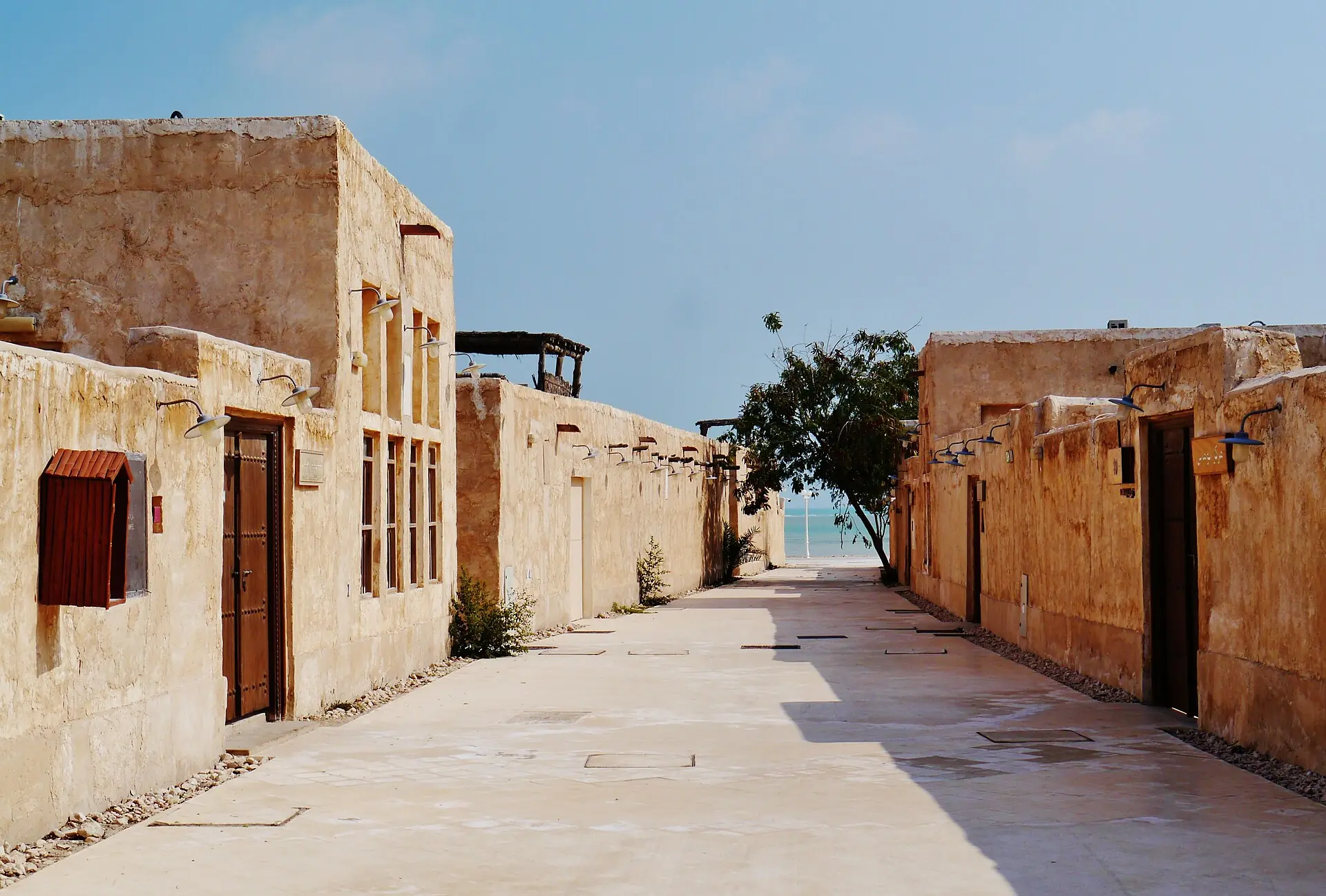 Photo: Zairon, CC BY 4.0
Al Wakrah
maybeCar or metro and taxi, about 25 min south
A smaller souq and a beach; a slower evening than Souq Waqif.
- Time
- Half a day
Eat & sleepWhere to eat and which area to sleep in
Eat & sleep
Where to eat and which area to sleep in
Eat
A short list of places worth crossing the city for, each with how to get a seat.
Restaurant finder: filter every place to eat in Doha →
Vegetarian-friendly score
3.5 / 5 · Good
- Country diet noteOur country guide rates vegetarian eating as easy.2 / 2
- Places to eat in this guide3 of 6 places with a known answer are vegetarian-friendly, 3 partly.1.13 / 1.5
- Budget eating lines0 vegetarian lines in "Eat by budget".0 / 0.6
- Meat-free national dishes5 meat-free dishes in the country food list.0.4 / 0.4
- Dedicated vegetarian kitchens0 mentions of vegetarian restaurants, Buddhist or fasting kitchens.0 / 0.5
Country note: Easy thanks to Indian and Levantine food: dal, paneer, falafel, hummus, fattoush.
Vegetarian places near me →Make a diet card →
How we score
- Country diet note (up to 2): easy 2, workable 1, mixed 0.75, hard 0; no note 0.5.
- City places to eat (up to 1.5): 1.5 × (vegetarian-friendly + half of partly friendly) ÷ places with a known answer; needs 3 or more known places.
- Budget eating lines marked vegetarian (up to 0.6): 0.2 each.
- Meat-free national dishes (up to 0.4): 0.1 each.
- Dedicated vegetarian kitchens mentioned — Buddhist chay, shōjin ryōri, Jain, fasting food, vegan cafés (up to 0.5): 0.1 each.
- Total rounded to the nearest half point, 0 to 5. Built from our own pages only, not from reviews.
Eating and drinking guideEat by budget · Drink
Before you sit down to eat
Short version; full text linked
Eat by budget
Under QAR 40 a meal
| Where | Order | Area | Price | Note |
|---|---|---|---|---|
| Karak and cafeteria counters, Msheireb and old Doha | Karak tea with paratha or a sandwich | Msheireb and old Doha | QAR 5–20 | Cafeteria counters; pay at the till; open very late. |
| Shawarma and falafel counters | Shawarma wrap | Souq Waqif edges and Msheireb | QAR 8–15 | Fast, cheap and open late. |
| South Asian cafeterias | Biryani, dal and paratha plates | Msheireb, Al Mansoura, Najma (check) | QAR 10–25 | Large expatriate communities keep the cheapest and best home cooking in these cafeterias.(check) |
Dishes to know
| Dish | What it is | Where to look | When | Price |
|---|---|---|---|---|
| Machboos (majboos) | Spiced rice cooked with lamb, chicken or fish, dried lime and tomatoes. | Souq restaurants and Qatari home-cooking places | Lunch, early dinner | QAR 30–70 |
| Harees | Slow-cooked wheat and meat porridge, served at Ramadan and festivals. | Traditional restaurants; seasonal | Ramadan evenings, weekends | QAR 20–40 |
| Thareed | Bread soaked in a meat and vegetable stew. | Traditional restaurants | Dinner | QAR 30–60 |
| Balaleet | Sweet vermicelli with saffron and cardamom topped with an omelette. | Qatari breakfast places | Breakfast | QAR 15–30 |
| Luqaimat | Small fried dough balls in date syrup. | Cafés, festivals, Katara | Afternoon, evening | QAR 15–30 |
| Karak | Strong tea boiled with milk and cardamom. | Cafeterias and stalls everywhere | All day | QAR 1–4 |
| Arabic coffee (gahwa) with dates | Light, cardamom coffee in a small cup. | Souq cafés, hotels | After a meal | QAR 5–20 |
- Order the local dish at lunch and early dinner: cooks run out of machboos by 15:00.Order the local dish at lunch and early dinner: cooks run out of machboos by 3:00 PM.
- Eat with the right hand or a spoon; do not use your left hand to pass food.
- Service is often added to the bill (about 10–12%); check before tipping more.
- In Ramadan, plan to eat at sunset (iftar) or in a hotel restaurant; most places are closed by day.
Drink & nightlife
| Where | What | Until | Note |
|---|---|---|---|
| Hotel bars and rooftop lounges, West Bay and The Pearl | Licensed bars | Late, to about 01:00 (check)Late, to about 1:00 AM (check) | The only places to drink alcohol; smart-casual dress, ID and a booking on Thursdays and Fridays. |
| Souq Waqif terraces and shisha lounges | Cafés, shisha, tea | Late evening | No alcohol, but an easy late-night social scene; sharing shisha is common. |
| Specialty coffee shops, Msheireb and Katara | Coffee | Evening | Gulf coffee culture is strong; good for the middle of the afternoon. |
By style
| Style | What | Where | Price | Until |
|---|---|---|---|---|
| Karak | Sweet milk tea with cardamom and sometimes saffronThe national street drink; ask for 'karak' and pay at the counter. | Cafeterias and stalls everywhere | QAR 1–4 | Very late |
| Arabic (gahwa) coffee | Light, cardamom coffee in small cups with datesShake the cup gently to signal you have had enough. | Souq cafés, hotel lobbies, majlis-style rooms | QAR 5–20 | Evening |
| Juices and fresh cocktails (mocktails) | Lemon and mint, mango, pomegranateThe soft-drink scene is strong; ice is from filtered water in most places. | Juice counters, cafeterias | QAR 8–20 | Late |
| Shisha | Flavoured tobacco water-pipeNot indoors in every venue now; ask, and ask the price first. | Souq Waqif lounges | QAR 40–100 (check) | Late evening |
Rules that bite
- Do not bring alcohol into the country; customs at Hamad checks bags.
- Never drink and drive; the penalties are severe, and public drunkenness leads to arrest.
- Vape and tobacco products have restrictions and duty; check current rules before you bring supplies.
Sleep
Pick the area first: it decides your walk home at night and your first morning.
Which neighborhood fits you
Three questions, one recommendation, with the reasons.
Your best fit
- Souq Waqif is a 10–15 minute walk, the Msheireb museums are on the doorstep, MIA is a short car ride.
- Calm lanes; the metro and the souq are near but not loud.
- Staffed 24-hour desks, and the metro interchange is close.
Watch out: Mostly mid to upmarket hotels.
Next best: The Pearl-Qatar
Built from our 1–5 desk scores per area; your answers stay in this browser.
More on sleepingSleep by budget · Your area · With kids
Sleep by budget
| Band | Price | Where | Room types | What to expect |
|---|---|---|---|---|
| budget | QAR 200–350 | Old Doha and Al Mansoura guesthouses and budget hotels | Budget hotels and small guesthouses | Small rooms, basic breakfast, thin walls; few hostels in the city. |
| mid | QAR 350–700 | Msheireb, Souq Waqif and Corniche 4-star hotels | 4-star business and boutique hotels | Lift, breakfast, pool, 24-hour desk; the best base for a first visit. |
| high | QAR 700–2,000+ | The Pearl, West Bay and Msheireb luxury hotels | 5-star and resort hotels | Pools, private beach access, several restaurants, licensed bars. |
Booking checks
- Alcohol is sold only in hotel bars, so 'licensed hotel' matters if you want a drink.
- Rates spike around the F1 Grand Prix, National Day and school holidays; book early.
- Confirm airport transfer and check-in time in advance for a night arrival; the launch profile assumes a 24-hour desk.
Which area is yours
| If you are | Sleep in | Because |
|---|---|---|
| First visit, 2–3 nights | Msheireb Downtown | Metro interchange, walk to the souq, and easy car legs to the museums. |
| Families wanting calm and space | The Pearl-Qatar | Marina, playgrounds and restaurants; you pay for it in car rides to the sights. |
| Business trip | West Bay towers (check hotel) | Close to conference centres and embassies; every sight is a ride. |
First-timers: a staffed 24h hotel by the metro interchange, 10–15 minutes' walk to the souq and the car reaches the door.
Quieter, resort-style nights on the marina; far from the museum and souq, so every sight is a car ride.
Areas are in our default order until you tick a priority.
Scores are 1–5 desk judgements per priority (2026).
With kids
- Doha is easy with children: clean, air-conditioned, short taxi rides, and hotels with large pools. Child seats are legal in cars but many taxis carry none; a folding booster or your own seat is worth the weight.
- MIA Park and the Corniche have lawns, playgrounds and dhows to watch; go before 10:00 or after 16:30 from October to April.MIA Park and the Corniche have lawns, playgrounds and dhows to watch; go before 10:00 AM or after 4:30 PM from October to April.
- Katara's beach front is calm and shallow enough for young children in winter; the amphitheatre steps and plaza are safe to run around.
- Souq Waqif's lanes are crowded in the evening; a carrier works better than a stroller, but the main lane is wide enough for one.
- Malls have play areas and cinemas: the standard summer plan. Mothers' rooms are widely available in malls and museums (check on arrival).
PracticalMoney, essentials, safety and the pocket card
Practical
Money, essentials, safety and the pocket card
Money
What a day costs at three comfort levels, and how to pay.
- Budget
- QAR 150–300 excl. bed / day
- Mid
- QAR 300–700 excl. bed / day
- High
- QAR 700+ excl. bed / day
- Transit card
- No transit card needed for one trip: taxis and ride-hailing; a metro card is optional.
- Cash rule
- Keep QAR 200 in small notes for taxis and souq stalls; use bank ATMs in malls or hotels.
More on moneyCosts · Budget · Buy
What things cost
- Karak tea, cafeteriaQAR 1–4
- Shawarma or cafeteria mealQAR 8–25
- Machboos or mandi at a restaurantQAR 30–70
- Bottled waterQAR 1–3
- Car from Hamad airport to MsheirebQAR 40–80
Trip budget
| Hotel double room1 × 3 nights × QAR 550 | QAR 1,650 |
| Food, local transport, entries2 × 3 days × QAR 450 | QAR 2,700 |
| Airport car, both ways1 × QAR 160 · one car per 4 people; the metro is cheaper by day | QAR 160 |
| Tourist SIM, about a week2 × QAR 70 | QAR 140 |
| Buffer 12%Price creep, a taxi you did not plan, one splurge | QAR 558 |
| Trip total≈ QAR 868 per person per day, bed included | QAR 5,208 |
2026 estimate in QAR; flights, visa and tours excluded. Doha is not a budget city: hotels drive the cost, food can be cheap.
Prices of common things
| Karak tea, cafeteria | QAR 1–4 |
| Shawarma or a cafeteria meal | QAR 8–25 |
| Machboos or mandi at a restaurant | QAR 30–70 |
| Bottled water | QAR 1–3 |
| Dhow ride on the Corniche | about QAR 30–100 (check) |
2026 estimate; check locally.
Buy
- Bargaining
- In Souq Waqif's small shops a first price is often 30–50% above what settles; smile, ask for a better price once or twice, and walk on if it does not move. Do not haggle in malls or in supermarkets: prices are fixed.
- Fixed-price check
- Check the price of dates, spices, perfume and gold against a mall or supermarket first so you know a fair range. Gold is sold by weight at the day's rate plus a making charge.
Markets and shopping streets
| Where | What | When | Haggle | Note |
|---|---|---|---|---|
| Souq Waqif | Spices, dates, incense, oud perfume, textiles, cushions, souvenirs, falcon gear | Most shops about 09:00–12:00 and 16:00–22:00; some stay open all day (check)Most shops about 9:00 AM–12:00 PM and 4:00 PM–10:00 PM; some stay open all day (check) | soft | Go after 17:00; midday is empty and shut.Go after 5:00 PM; midday is empty and shut. |
| Falcon Souq | Falcons, hoods, perches and falconry kit | Similar to the main souq | fixed | Photography of birds is usually fine if you ask; the trade is serious, so do not touch the birds without permission. |
| Gold and jewellery lanes, Souq Waqif | Gold jewellery sold by weight | Shop hours | soft | Compare making charges between two or three shops; ask for the day's gold rate and a written receipt. |
Shops by what they sell
| For | Where | Hours | Note |
|---|---|---|---|
| Malls (AC, cinemas, supermarkets, prayer rooms) | Villaggio, City Center Doha, Doha Festival City, Mall of Qatar, Place Vendôme | About 10:00–22:00, later on weekends | Fixed prices; the heat-day refuge. Most are car or metro rides from the centre. |
| Books, crafts and design | Katara Cultural Village shops and Msheireb boutiques | Shop hours | Smaller, quieter than the souq; prices are fixed. |
| Dates, Arabic sweets, saffron | Souq Waqif and supermarkets | Shop hours | Good gifts that pack flat; check customs rules for your home country on food. |
Changing money
| Where | Verdict | Why |
|---|---|---|
| Banks and exchange houses in the centre | use | Fair rates; bring a passport. |
| Hamad airport booths | ok | Change a small amount for the ride and first evening only. |
| Street or souq offers | avoid | Unneeded and unofficial; the riyal is pegged to the US dollar at about 3.64. |
ATMs
- Where
- Bank ATMs are common in malls, hotels and around Msheireb; they give riyals and take most international cards.
- Cards
- Cards work almost everywhere except small souq stalls and some cafeterias; keep some cash.
- Limits
- Your home bank sets the daily limit; tell it you travel.
Essentials and accessEssentials · Access
Essentials
- Plugs & power
- 230 V; UK-style three-pin sockets (type G).
- Opening hours
- Weekend is Friday and Saturday; shops close for the Friday midday prayer and reopen in the afternoon. Offices about 07:00–15:00; malls to 22:00.Weekend is Friday and Saturday; shops close for the Friday midday prayer and reopen in the afternoon. Offices about 7:00 AM–3:00 PM; malls to 10:00 PM.
- Health
- Heat and dust; bring any regular medicine in its original pack with a doctor's letter.
- Accessibility
- New districts are step-free; Souq Waqif and older streets have kerbs and uneven stones. The metro is step-free.
- Laundry
- Hotel laundry is priced by the item; malls and neighbourhoods have cheap laundry counters.
- Emergency numbers
- 999 police, fire and ambulance.
Pack
- Light, loose clothes that cover shoulders and knees, plus a light layer for air conditioning.
- A scarf for mosques and cool interiors; comfortable shoes for the souq.
- A sun hat, sunglasses and high-SPF sunscreen; a reusable water bottle.
- A UK-type plug adapter and a power bank.
- Prescription medicines in their original packs with a doctor's letter.
Accessibility
Doha is better than most of the region for wheels: new pavements, metro stations with lifts, ramps in museums and malls. Heat and distances are the barrier, not the surfaces.
- Pavements
- Smooth in the new districts (Msheireb, The Pearl, Katara, the Corniche), rougher and with high kerbs in older streets and parts of Souq Waqif.
- Metro
- All Doha Metro stations are step-free with lifts and tactile paving; staff can help (check the day's service).
- Taxis
- Some Karwa vehicles are adapted; ask when you book. Ride-hailing cars are standard saloons.
- Toilets
- Accessible toilets in malls, museums and larger hotels; fewer in the souq (check).
Sights, step-free or not
| Museum of Islamic Art | good | Ramps and lifts; wide galleries; bench seating throughout (check). |
| National Museum of Qatar | good | Level floors, lifts and ramps; long distances inside. |
| Souq Waqif | step-free | Mostly level lanes with some kerbs and uneven stones; crowds and heat are the strain. |
| Doha Corniche promenade | good | A wide flat promenade with benches; shade is the issue. |
Survive
Safety basics, the lines not to cross, and practical habits that save the day.
Safety
- Heat: no walking in the midday sun May–Sep; carry water.
- Drink-driving and drugs carry severe penalties.
- Emergency: 999 for police, fire and ambulance.
Red lines
- No alcohol outside licensed hotels and restaurants; drunkenness in public is an offence.
- Dress modestly in public: shoulders and knees covered.
- No public displays of affection; do not photograph people without permission or government buildings.
Practical
- Toilets: malls and museums.
- Tap water is safe but most people drink bottled water.
More on staying safeStay safe · Stay healthy · Safety map · Solo & women · Etiquette · Cope · Scams
Scams and red flags
Walk away if you see these
- Taxi drivers who refuse the meter and name a flat fare; use the Karwa app or Uber.
- Souq shopkeepers who quote a very high first price; compare shops and walk on.
- Commission agents at Souq Waqif or Katara who push a desert or dhow trip; check the licence and inclusions.
- Unlicensed 'tour guides' at attractions who ask for a fee after a short walk; agree a price first or use a licensed guide.
Stay safe
Crossing the road
- 01Drivers are fast and do not always stop at crossings; cross at lights, use underpasses and wait for the walk signal.
- 02Do not step into the road from between parked cars; wide roads and speed make it easy to misjudge.
Hustles specific to this city
| Hustle | Where | The tell | What to do |
|---|---|---|---|
| Unmetered taxi | Airport, hotels, street | Driver names a flat price and no meter | Ask for the meter or use Karwa/Uber; agree the price before you get in. |
| Souq tourist prices | Souq Waqif small shops | First price is well above the shop next door | Compare two shops and walk away; do not accept a 'special price' at the door. |
| Commission tour agents | Souq Waqif and Katara booths | Big claims for a desert or dhow trip and pressure to pay now | Check the operator's licence and inclusions in writing; pay by card. |
- Police
- 999 for any emergency; the police are professional and speak English.
- Laws
- Alcohol, drugs, public behaviour, photography and dress laws are strict; ignorance is not an excuse.
- Passport
- Carry a copy; the original stays in the hotel safe unless you are asked for it.
- Heat
- Heat stroke is the most common problem: shade, water and no walking at midday.
Stay healthy
- Heat
- May–Sep: shade and AC every hour, water with electrolytes, no walks between 10:00 and 17:00.May–Sep: shade and AC every hour, water with electrolytes, no walks between 10:00 AM and 5:00 PM.
- Tap water
- Tap water is treated but most people drink bottled water; ask your hotel.
- Vaccines
- Routine vaccines are enough for most visitors; check your health authority's current advice for Qatar.
- Medicines
- Some medicines, including certain sleep and pain medicines, are controlled in Qatar; carry the original packs and a doctor's letter.
- Air conditioning
- Temperature shifts between 42 °C (108 °F) outside and 20 °C (68 °F) inside cause colds and sore throats; pack a light layer.Temperature shifts between 108 °F (42 °C) outside and 68 °F (20 °C) inside cause colds and sore throats; pack a light layer.
- Food
- Standards are high; eat where turnover is fast and check that chicken and fish are cooked through.
Hospitals and clinics: see Cope.
Safety by area and hour
| Area | Day | Night | What to watch |
|---|---|---|---|
| Souq Waqif | fine | fine | Crowded on weekend evenings; watch bags, and never photograph people without asking. |
| Msheireb Downtown | fine | fine | Quiet lanes at night; stay on lit streets and use a car after the metro closes. |
| Corniche and MIA Park | fine | fine | Heat, not crime; the seafront is long and shadeless. |
| Katara | fine | fine | Dress modestly on the plaza and near the mosques. |
| The Pearl-Qatar | fine | fine | Traffic on the island roads; swimwear only at the beach and hotel pool. |
- Doha has very low street crime; leave the valuables at the hotel anyway and keep a copy of your passport.
- Traffic is fast and drivers do not always stop at crossings; use marked crossings and lit underpasses.
- Photograph nothing military or governmental, and never photograph people (especially women and families) without permission.
Solo, women and LGBTQ+ travellers
Solo
- Very easy for solo visitors: low crime, plenty of ride-hailing and hotel desks used to solo guests.
- Meeting people is easier through tours, cooking classes or hostel events than in bars.
Women
- Doha is considered one of the safer Gulf cities for women travelling alone. Dress modestly (shoulders and knees covered) in public, malls and the souq; a loose scarf is handy for mosques.
- Metro carriages have a family-and-women area; taxis are normal alone, but sit in the back and use an app or licensed Karwa taxi.
LGBTQ+
- Same-sex relations are illegal in Qatar and public displays of affection are not accepted for any couple. Keep discretion and read your government's current travel advice before you go.
Etiquette in Doha
- Dress
- Cover shoulders and knees in public places, malls and the souq. Loose clothes are fine for both sexes; swimwear only at the beach and hotel pool.
- Greetings
- Say 'as-salamu alaykum' (peace be upon you). Wait for a woman to offer a hand before you offer yours; a hand on the heart is always polite.
- Right hand
- Eat, pass and receive with the right hand; do not point the sole of your foot at anyone.
- Photography
- Ask before photographing anyone, especially women and families. Never photograph government buildings, military sites or airports.
- Ramadan
- During daylight in Ramadan, do not eat, drink or smoke in public. Many restaurants close until sunset, then stay open late.
- Mosques
- Enter only where visitors are welcome, outside prayer times, with covered shoulders and knees; women cover their hair where signs ask. Remove shoes.
- Public behaviour
- No public displays of affection, no swearing or rude gestures, no loud arguments; the law treats these as offences.
- Alcohol and drugs
- Alcohol only in licensed hotel venues; drugs of any kind carry severe sentences, including some medicines that are legal elsewhere.
Cope
Hospitals and clinics that handle foreigners
| Where | Area | Use it for |
|---|---|---|
| Hamad General Hospital | Rumailah, west of the centre | Main public hospital and trauma centre; the emergency department takes visitors. |
| Sidra Medicine | Education City, Al Luqta | Large women's and children's hospital. |
| Al Ahli Hospital | Doha (check address) | Major private hospital used by expats; ask your insurer for direct billing. |
| Doha Clinic Hospital | Doha (check address) | Private hospital and clinics with foreign-language staff (check). |
Visa extensions
- Entry
- Many nationalities enter visa-free for a set number of days; others need a visa in advance. Check the official Visit Qatar and Ministry of Interior pages for your passport.
- Extending
- Extensions go through the Ministry of Interior's services and its app; ask your hotel or sponsor. Allow several days.
- Overstay
- Overstays carry fines that grow daily, and unpaid fines can block departure; sort them before your flight.
Embassies and consulates
| Country | Address | Phone | Note |
|---|---|---|---|
| United States | Doha, diplomatic area (check current address) | — | (check) |
| United Kingdom | Doha, West Bay area (check current address) | — | (check) |
| Canada | West Bay (check current address) | — | (check) |
| Australia | Doha (check current address) | — | (check) |
| India | Doha (check current address) | — | (check) |
- Lost passport
- Report it at the nearest police station, then go to your embassy for an emergency document; the exit process needs both.
- Pharmacies
- Pharmacies are common in malls and streets; some drugs allowed elsewhere are controlled here, so carry a doctor's letter for prescriptions.
- Emergency
- Call 999 for police, fire or ambulance.
- Travel insurance
- Take a policy that includes medical care and evacuation; hospital bills for visitors can be high.
Apps and offline kitOffline kit
Offline kit
Set up before you leave, so Doha still works with no signal or a dead roaming plan.
On your phone
- Maps: open the city in Google Maps, tap the place name, then Download offline map (or use an offline-maps app).
- Data: install an eSIM or buy a local SIM before the first taxi; the apps in this guide depend on it.
- Translation: download the local language for camera translation.
- Screenshots: booking confirmations, hotel address in the local script, and the emergency numbers.
This guide
Save the Doha guide and its pages on this device; it opens without a connection.
Phrases that do the work
Greeting
Hello / peace be upon you
As-salamu alaykum (reply: wa alaykum as-salam)
as-sa-LAA-mu a-LAY-kum
Greeting
Hello (casual)
Marhaba
mar-HA-ba
Thanks
Thank you
Shukran
SHOOK-ran
Thanks
You're welcome
Afwan
AF-wan
Shopping
How much is this?
Kam hatha?
kam HA-tha
Shopping
No, thank you
La, shukran
la SHOOK-ran
Taxi
Stop here, please
Wagif hena, min fadlak
WA-gif HE-na min FAD-lak
Restaurant
The bill, please
Al-hisab, min fadlak
al-hi-SAB min FAD-lak
Help
Help!
Musa'ada!
moo-SAA-ada
Pocket card
Fill in, then print or save as PDF
Stays in this browser only; nothing is sent anywhere.
Dohaالدوحة
Pocket card · Voykit
My bed tonight
—
—
—
Min fadlak, khudni ila hadha al-anwanPlease take me to this address
Emergency
- Police, fire, ambulance999
- Non-emergency policecheck locally
Embassy
Most embassies are in West Bay and the diplomatic area; write your own embassy's 24-hour line below.
My embassy: —
Fare anchors (2026 estimate)
- Hamad airport → Msheireb, taxi or app car: QAR 40–80, 30–50 min
- Hamad airport → Msheireb by metro: about QAR 2–10 by day, 30–45 min (check)
- Short taxi across the centre: QAR 15–40
Say or show
- Shukran — Thank you (SHOOK-ran)
- Kam hatha? — How much is this? (kam HA-tha)
- La, shukran — No, thank you (la SHOOK-ran)
- Al-hisab, min fadlak — The bill, please (al-hi-SAB min FAD-lak)
- Wagif hena, min fadlak — Stop here, please (WA-gif HE-na min FAD-lak)
Show a map pin or the building and zone number; drivers work from landmarks and pins more than house numbers.
Deep diveHistory, reading, photos and every source
Deep dive
History, reading, photos and every source
Sources
- officialVisit Qatar
- officialHamad International Airport
- secondaryWikivoyage — Doha
Ask about Doha
Loading…
Was this useful?