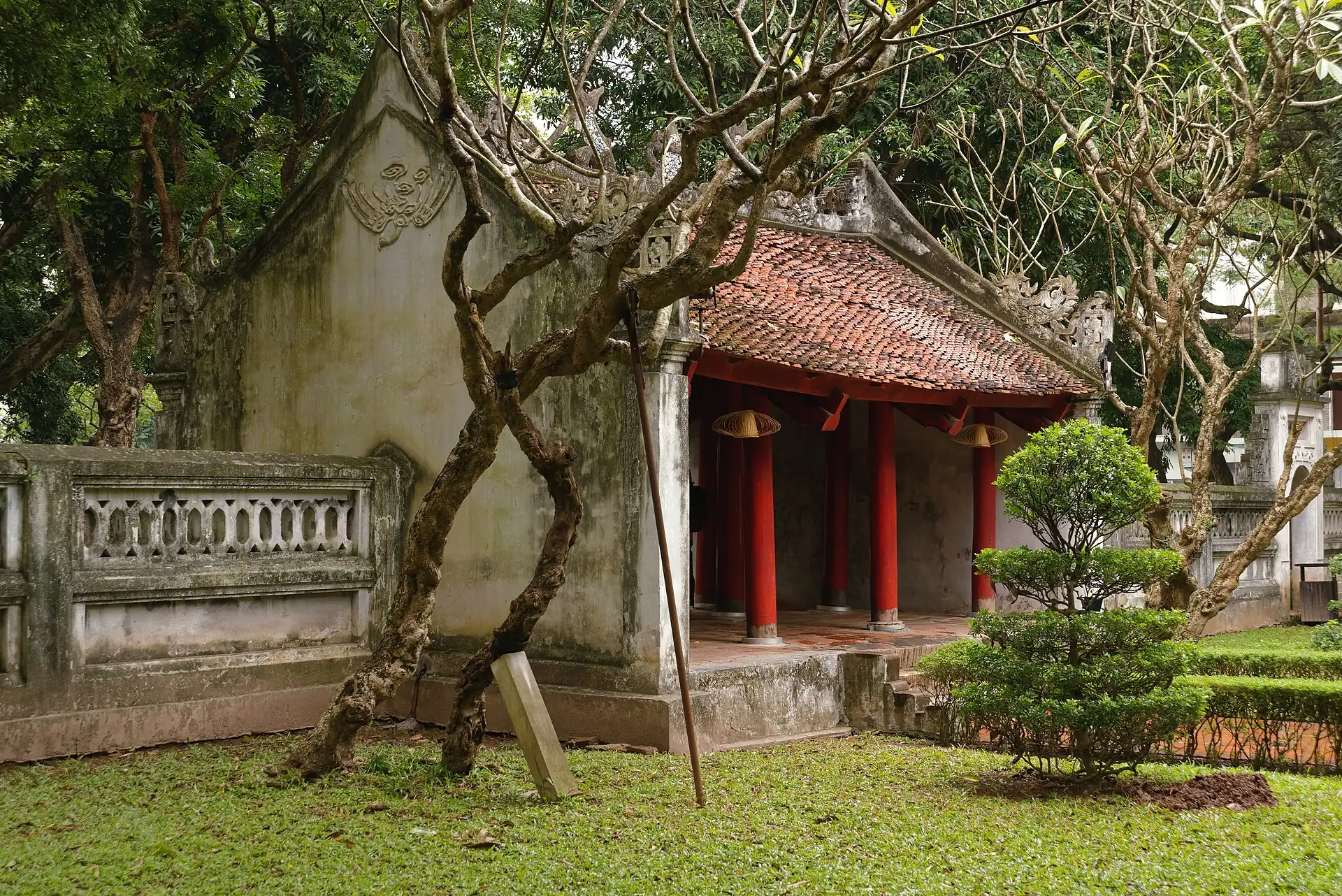
Temple of Literature
Place · Ba Đình & Temple of Literature
Go at opening or after 15:30; 45 minutes through five courtyards; graduation-photo crowds in spring.
- Five courtyards in order
- Go at opening or after 15:30
- Go at opening
- Bring cash
- Queue: switch at 15 min
- Works with kids
Highlights come from Voykit's own data and desk notes, not from reviews. Hover a tag to see its source.
Rules in force · 9Drug trafficking can carry the death penalty in Singapore…Old Quarter pavements are blocked by parked motorbikes an…
- Southeast Asia ↗Drug trafficking can carry the death penalty in Singapore, Malaysia, Indonesia, Vietnam, Laos, Thailand, Brunei and Myanmar; never carry a bag or parcel for anyone.
- Southeast Asia ↗Carry a passport valid for at least six months from entry with two blank pages; airlines refuse boarding on less.
- Vietnam ↗Apply for the e-visa only on the official government portal; lookalike sites charge extra.
- Vietnam ↗Crossing streets: walk slowly and steadily; motorbikes flow around you — do not stop or run.
- Vietnam ↗Carry Vietnamese đồng in small notes; many stalls and taxis are cash-only.
- North Vietnam ↗Dec–Feb in the north is cool and damp (10–18°C): pack a warm layer.
- North Vietnam ↗Sa Pa and Hà Giang can drop near freezing in December–January and fog in for days; keep a spare night and do not plan a single-day summit.
- Hanoi ↗Old Quarter pavements are blocked by parked motorbikes and stalls: large suitcases go from the car to the door, never on a walk.
- Hanoi ↗Around Hoàn Kiếm Lake, streets close to cars on Friday–Sunday evenings; taxis drop you at the edge.
More
Map & directions
Add your hotel to get directions from it. · stays in this browser; shared with the pocket card.
Plan
Open now, best time to go, opening hours
Go now?
hours and prices: check on the day- Open
- Usually 08:00–17:00Usually 8:00 AM–5:00 PM
- Crowds
Go at opening
MonTueWedThuFriSatSunQuietest Mon–Fri · busiest Sat, Sun · desk estimate
- Tickets
- Adult: about ₫70,000 (≈ US$3) (2026 estimate)
Students and children pay less with ID; cash at the gate.
- Time to spend
- 45–60 min · up to 90 min if you linger
Best time to go
Student groups mid-morning; graduation photos Mar–May.
Queue rule: switch if the queue passes 15 min; come back when under 5.
By weekday: quietest Mon–Fri, busiest Sat, Sun.
Opening hours
- Hours
- 08:00–17:00 (typical, check)
- Note
- Opening hours differ by season; not printed until verified.
- Hours note
- Longer summer hours are common; check the gate board.
Which month is quietest
- Janheavy
- Febpacked
- Marbusy
- Aprbusy
- Mayheavy
- Junheavy
- Jullight
- Auglight
- Sepbusy
- Octheavy
- Novheavy
- Decheavy
Quietest Jul–Aug · busiest Feb.
Estimate: desk reasoning from school-trip, weekend, season and holiday patterns; not counted. Holidays and events move these weeks.
Weather here, next 7 days
Loading forecast…
Forecast: Open-Meteo (CC BY 4.0), model data for this point.
Not checked in the last 12 months (no check date on file).
On the ground
Getting in, access, sensory load, what to bring, and where to go if it does not work
Getting in
- Stop
- Car to the Quốc Tử Giám street gate
- Ticket
- on site · official site · bring cash
- Stairs
- courtyards: low steps between gates
- Shoes
- Shoes on.
Accessibility
- PartialStep-free entrance · Low steps at each of the five gates; paved paths between.
- NoLifts
- Check firstAccessible toilet
- PartialWheelchair · Mostly flat, but each gate has a raised threshold — help needed.
- PartialStroller · caution
Sensory load
- Sensory load3/5 Medium
Exposure: medium
What to bring and the rules
- Cash · The ticket desk is likely to take cash only.
- No strict code, but shoulders covered is expected at the altar halls.
- Allowed everywhere outdoors; drones banned.
Rules and prices change: check the official site before you go.
Bailouts
- heat: Điện Biên Phủ café row (AC)
- rain: Inner halls of the fifth courtyard
Nearest rescue anchor: C — Temple of Literature inner courtyard (WC)
Problem
Red lines
- Do not climb on stelae or rub the turtles.
Not checked in the last 12 months (no check date on file).
Map and nearby
Where it is, how to get there from your hotel or from where you stand, and what is around it
Map data © OpenStreetMap contributors
Add your hotel to get directions from it. · stays in this browser; shared with the pocket card.
Nearby places
Eat nearby
More detail
Everything else we know about this place
Tickets, prices and entry
Tickets & entry
- Where to buy
- Buy at the entrance on the day.
- Buy from the official site or the ticket desk; resellers add a fee for the same ticket.
- Bring cash; cards may not be taken (check).
- Queues
- Arrive at opening; the courtyards fill with school groups and, in spring, graduation photos.
- Free days
Free entry days in Hanoi (pick Hanoi in the tool; check)
- Dress code
- No strict code, but shoulders covered is expected at the altar halls.
- Photos
- Allowed everywhere outdoors; drones banned.
- What's closed
- WeeklyOpen every day.
- Tết (Lunar New Year)checkShort closures or changed hours on the first days of Tết; very crowded in the days after.
- Graduation seasoncheckSpring and early summer: groups of students in gowns fill the courtyards on weekends — go at opening.
“Check” dates move year to year: confirm on the official page for your date.
| Ticket | Price | Note |
|---|---|---|
| Adult entry | about ₫70,000 (≈ US$3) (2026 estimate) | Students and children pay less with ID; cash at the gate. |
What to see, in order
01
Văn Miếu gate and the first two courtyards
Gardens and ponds; quiet at opening before school groups arrive.
02
Khuê Văn Các (Pavilion of Constellations)
The symbol of Hanoi on the ₫100,000 note.
03
Stelae of the doctoral laureates
Stone tablets on turtles recording exam graduates from the 15th to 18th centuries — look, don't touch.
04
Đại Thành hall
The main hall dedicated to Confucius.
05
Imperial Academy (Quốc Tử Giám)
The last courtyard, Vietnam's first university; small exhibition upstairs.
How to do it well
- 1Arrive at opening; the courtyards fill with school groups and, in spring, graduation photos.
- 2Enter at the main gate on Quốc Tử Giám street and walk straight through all five courtyards in order.
- 3Allow 45–60 minutes; the last courtyard has shade and seats.
- 4Combine with the Hồ Chí Minh Mausoleum earlier the same morning, by a short car ride.
Facilities
- toilets
- Inside the complex, near the rear courtyards.
- tickets
- Buy at the gate; cash is safest (about ₫70,000 (≈ US$3), check the posted price).
- shade
- Limited in the front courtyards — hat and water in summer.
Time on site, inside and your plan
Time on site
Minimum
30min
Worthwhile
45min
Typical
60min
p95
90min
How much time do you have?
Enough for a typical visit (60 min).
Nothing else in our notes is a short enough walk from here for the time that is left.
Visit times are typical figures, not promises; queues and closing times can change them.
Inside, in order
Văn Miếu gate and the first two courtyards
Gardens and ponds; quiet at opening before school groups arrive.
Khuê Văn Các (Pavilion of Constellations)
The symbol of Hanoi on the ₫100,000 (≈ US$4) note.
Stelae of the doctoral laureates
Stone tablets on turtles recording exam graduates from the 15th to 18th centuries — look, don't touch.
Đại Thành hall
The main hall dedicated to Confucius.
Imperial Academy (Quốc Tử Giám)
The last courtyard, Vietnam's first university; small exhibition upstairs.
Step-free check, who it suits, facilities
Step-free check
- Step-free entrance: partly · partlyLow steps at each of the five gates; paved paths between.
- Lifts: no · no
- Accessible toilet: check · check
- Wheelchair: partly · partlyMostly flat, but each gate has a raised threshold — help needed.
- Stroller: partly · partlycaution
Paved courtyards; each of the five gates has a raised threshold or low steps — help needed on wheels.
Rules on site
- stelae
- Do not touch the stone turtles or climb on the stelae; they are fenced for a reason.
With kids
- with kids
- Walled, traffic-free and shaded at the back; a good first stop for children.
- child price
- children and students pay less with ID (check the board)
Combine with
Combine with
- 2 minVăn Miếu lake park (Hồ Văn) — Across Quốc Tử Giám street; quiet benches.
- 6 minVietnam Fine Arts Museum — Indoor, AC; rain or heat option (check opening days).
- 18 minOne Pillar Pagoda
- —Hồ Chí Minh Mausoleum (same morning)
Walk the Ba Đình & Temple of Literature area · the cluster page has the walking order, rescue stops and after-dark notes
Best photo time
Best photo time today
Sun times for today load in your browser.
Deep dive
Questions, photos, and where our facts come from
Questions and answers
Questions and answers
Is there shade?
Little in the front courtyards; bring a hat and water in summer. The last courtyard has shade and seats.
Checked 2026-09-28 · Voykit desk
Why is it so busy in spring?
Graduating students take photos here from about March to May, and families visit around exams.
Checked 2026-09-28 · Voykit desk
Photos
Photos
Temple of Literature Photo: Jakub Hałun, CC BY 4.0
Temple of Literature Photo: Edgardo W. Olivera from Montevideo, Uruguay, CC BY 2.0
Temple of Literature Photo: Jakub Hałun, CC BY 4.0
Deep dive
Deep dive
The Temple of Literature is two institutions in one: a temple to Confucius and a royal academy that trained and honoured the country’s scholar-officials for seven centuries. Read as a sequence of courtyards moving from the everyday world towards learning and ritual, it explains how Vietnam was governed and why exams still matter so much to Vietnamese families.
1History1 min
King Lý Thánh Tông founded the Văn Miếu, the temple to Confucius, in 1070, sixty years after the capital moved to Thăng Long. In 1076 his successor Lý Nhân Tông added the Quốc Tử Giám, the Imperial Academy, first to educate princes and sons of high officials. Under the Trần and Lê dynasties it opened to talented commoners who had passed the provincial examinations, and it became the training ground for the mandarins who ran the state.
Vietnam’s Confucian examination system had three levels: provincial (thi hương), metropolitan (thi hội) and the palace examination (thi đình), where the king set the final questions. Those who passed at the top level earned the title tiến sĩ, doctor. From 1484, King Lê Thánh Tông ordered that the names of successful doctors be carved on stone stelae here, beginning with the examination of 1442. The last examination recorded took place in 1779.
When the Nguyễn dynasty moved the capital to Huế in 1802, it built a new national academy there, and this site became a regional school. The pavilion of Khuê Văn Các was added in 1805. Parts of the complex were damaged in fighting in 1946–47, and the restorations of the 20th century included a new building in the fifth courtyard, completed in 2000 on the site of the old academy. The doctors’ stelae were inscribed on UNESCO’s Memory of the World register in 2011.
- Văn Miếu founded
- 1070, King Lý Thánh Tông
- Imperial Academy
- 1076
- Doctors’ stelae
- 82 surviving, 1,307 names, exams of 1442–1779
- Khuê Văn Các
- 1805
- UNESCO Memory of the World
- 2011
2What you are looking at1 min
The complex is a long walled rectangle of about 5.4 hectares, oriented north–south and divided into five courtyards. You enter through the Văn Miếu gate, pass two quiet garden courtyards with lawns and trees, and move steadily towards the ritual core. Across the street in front lies Văn Lake, once part of the temple’s grounds. The walls and gates are deliberately plain; the carving and colour are saved for the altar halls.
The second courtyard ends at Khuê Văn Các, the Pavilion of the Constellation of Literature, a small two-storey pavilion raised on four square white pillars, its upper room opening through round windows with radiating bars that suggest a star. It is the official symbol of Hà Nội and appears on the ₫100,000 note. Beyond it, the third courtyard centres on a square pond, Thiên Quang Tỉnh, the Well of Heavenly Clarity. On either side stand the 82 stone stelae, each mounted on the back of a stone turtle.
Look closely at the stelae. Early examples from the 15th century are slim, with fine floral borders and turtles with small heads; later ones from the 18th century are larger, heavier and bolder. Each lists the year of the examination, the examiners and the names and home villages of the graduates. The fourth courtyard is the ritual centre, with the Đại Thành hall dedicated to Confucius and his four main disciples. The fifth, the Thái Học courtyard, holds a large bronze bell and drum, and altars to the kings who founded and expanded the academy.
- Area
- About 5.4 ha, five courtyards
- Symbol of Hà Nội
- Khuê Văn Các, also on the ₫100,000 note
- Central pond
- Thiên Quang Tỉnh, Well of Heavenly Clarity
- Main hall
- Đại Thành, to Confucius and four disciples
3Legends and meaning1 min
The turtles carrying the stelae stand for longevity and for the endurance of learning; the names on their backs were meant to last as long as stone. Khuê refers to a constellation that in Chinese astronomy governs literature, so the pavilion is, in effect, a small observatory for learning. The pond reflects the pavilion, joining earth and heaven, an image any scholar of the time would have recognised.
The academy is also linked to the teacher Chu Văn An, who taught here in the 14th century. Tradition holds that he petitioned King Trần Dụ Tông to execute seven corrupt officials, and when the king ignored him, he resigned and retired to the mountains. He is remembered as the model of an honest teacher, and many schools in Vietnam carry his name. His altar is in the fifth courtyard.
For generations students rubbed the turtles’ heads for luck before examinations, and the stone on many of them is visibly polished smooth. The habit, combined with weather and crowds, threatened carvings that had lasted five centuries, so the rows of stelae are now roped off and guards will stop anyone who reaches over. The belief has simply moved: students now touch the altar rails, leave small offerings and tuck folded wishes near the shrines instead. Reading the stelae works just as well as a mark of respect, and the names are carved large enough to see from the path.
- Turtle
- Symbol of longevity and learning
- Khuê star
- Constellation of literature
- Chu Văn An
- 14th-century teacher and model scholar
4How locals use it1 min
Before exams, especially the national high school graduation exam in June, students come to pray, leave offerings and write wishes on paper. Parents come too, often on the 1st or 15th of the lunar month, and some bring the admission slip or a pen to be blessed at the altar. In spring, graduating students from Hà Nội universities arrive in gowns to take photographs among the courtyards, which is why weekends from March to May are busy.
At Tết the temple is a centre for calligraphy. Ông đồ, calligraphers in traditional dress, set up tables to write characters such as phúc (blessing) or tâm (heart) in Chinese characters or stylised Vietnamese script. Families buy these to hang at home for the new year, and the queue for a well-known calligrapher can be long. On the full moon of the first lunar month the temple also hosts the Vietnam Poetry Day gathering, with readings and poems hung on banners across the courtyards.
Outside those peaks it is one of the calmer places in central Hà Nội. Older residents come in the early morning for the shade of the first courtyards, and schools bring classes to learn about the exam system, often standing in front of the stelae while a teacher reads out names from their own province. Late afternoon light is soft on Khuê Văn Các and the crowds thin, which makes it the most pleasant time to walk the full length of the courtyards. Mid-morning on weekdays is when school groups are largest.
- Exam season
- June, for high school graduation
- Graduation photos
- March–May
- Tết calligraphy
- Around Lunar New Year
Read, watch, wordsReading · Watching · Glossary · Sources
Reading
- Vietnam and the Chinese Model — Alexander WoodsideExplains how the Confucian bureaucracy and exams shaped the Vietnamese state.
- Hanoi: Biography of a City — William S. LoganPlaces the temple in the story of Thăng Long.
- Vietnam: A New History — Christopher GoschaCovers the role of Confucianism and scholar-officials.
Watching
- Vietnam: A Television History — WGBH, 1983Its first episode covers the Confucian tradition and resistance to China.
Glossary
| Term | Local | Meaning |
|---|---|---|
| Văn Miếu | Văn Miếu / 文廟 | Temple of Literature, dedicated to Confucius. |
| Quốc Tử Giám | Quốc Tử Giám / 國子監 | Imperial Academy. |
| Khuê Văn Các | Khuê Văn Các / 奎文閣 | Pavilion of the Constellation of Literature. |
| tiến sĩ | tiến sĩ / 進士 | Doctor, holder of the highest exam degree. |
| trạng nguyên | trạng nguyên / 狀元 | First-ranked doctor in a palace exam. |
| bia đá | bia đá | Stone stele. |
| ông đồ | ông đồ | Calligrapher, traditionally a village teacher. |
| Thiên Quang Tỉnh | Thiên Quang Tỉnh / 天光井 | Well of Heavenly Clarity. |
Read for this deep dive
Background reading only: the text above is written by Voykit, not copied from these pages.
Sources
- officialTemple of Literature (official)
Was this useful?
Add Temple of Literature to a day
Source: Price
Draft
Written from desk research. Not yet compared with the official source.
Prices are 2026 estimates. The official site has the current price.
Source: Opening hours
Source: Best hour
Draft
Written from desk research. Not yet compared with the official source.
No official source is recorded for this figure.
The quietest window written into this guide. Crowd levels are desk estimates, not counts.
Source: Bag rating
Draft
Written from desk research. Not yet compared with the official source.
No official source is recorded for this figure.
Rated for the whole walking cluster, from desk research, not for this entrance.