Kraków
Code PO · 4 walking zones
Kraków is a walkable old-town city: the market square and Wawel in one day each, Kazimierz in the evening, and Auschwitz-Birkenau and the salt mine only as booked day trips from the same bed.
Our quick read of Kraków, scored 1–5 (friction is out of 100). Cash need: how often you still need notes. Heat risk: how hot days get. Stroller: how easy wheels are. Friction: overall effort for a first visit. Desk judgements, so check before relying on them.
- Local time
- --:--
- Weather
- forecast below
- Currency
- PLN
- Best months
- Apr · May · Jun · Sep · Oct · Dec
- Airport
- Kraków John Paul II (KRK)
Walking zones: the 4 areas this guide plans a day around. Each is a district you can cover on foot, so you do one zone per half-day and ride the train between them. The code (PO 01, PO 02…) is just the zone's number on the Kraków line; the line under each name says how bags fare there and how much time it needs.
Map of Kraków
Use the switches to show or hide each kind of pin. A switch that is on shows its pins on the map; tap it again to hide them. "Show only" keeps just the pins that match (for example, places that fit a suitcase). Tap any pin for its name and a link to its page.
- Where to sleep
- Places
- Eat
- Walking clusters
- Rest stops
From the airport John Paul II (KRK) to your bed
Tap a pin for its card. Places without their own coordinates are shown by their walking cluster.
Why Kraków
Kraków's centre is small and flat: the Main Market Square, the Planty park ring, Wawel hill and the old Jewish quarter of Kazimierz are all within a 25-minute walk. The trips that go wrong pay too much for cars, arrive at Wawel without a timed ticket in summer, or try to fit Auschwitz-Birkenau into a free afternoon. Four clusters cover a first visit: the Old Town, Wawel, Kazimierz and Podgórze; keep one bed and book the memorial and the salt mine ahead.
See first
- 1
 Wawel hill · 2–3 h
- 2
 St Mary's Basilica and the hejnał · 45–60 min
- 3Cloth Hall and Rynek Underground · 1–1.5 h
- 4
 Remuh Synagogue and cemetery · 30–45 min
- 5Schindler's Factory · 2–3 h
Fits
- Walking city breaks
- History and food trips
- Short stays with one booked day trip
Does not fit
- Wheelchair users on the cobbles and ramps
- Summer visitors who want no crowds on the square
- Trips that skip booking Wawel and the memorial
How long
- 2 daysOld Town and Wawel, Kazimierz and Podgórze
- 3 daysFour clusters, one per half day; add a booked Auschwitz-Birkenau or salt mine day
- 4 daysThree city days plus one booked day trip
Good for
- First timers
- Families
- Budget
- Couples
- Wheelchair
About Kraków
Kraków is Poland's old royal capital and its second city, with about 800,000 residents on the Vistula in the south of the country. Kings were crowned and buried here for centuries, and the historic centre was among the first sites on the UNESCO World Heritage list in 1978. Today it is a university town, a tourist magnet and a base for the memorials and mines of Lesser Poland.
The centre is small and flat. A ring of parkland, the Planty, follows the line of the old walls and holds the Old Town inside it, with the Main Market Square at its heart. Wawel hill rises just south of the ring, and the old Jewish quarter of Kazimierz and the district of Podgórze lie a short walk or tram ride further south.
Good to know
- The Old Town (Stare Miasto) is the walled-core district; Kazimierz is the former Jewish quarter south of it; Podgórze is across the Vistula from Kazimierz.
- The city runs tourist information points in the Old Town and near the main station (check the current addresses on the official site).
- The city card can cover museums and public transport: compare it with your own list before buying.
Go deeper 11 min read · 6 chapters
Kraków is the old royal capital of Poland and one of the best preserved historic cities in Central Europe. It escaped the destruction that flattened Warsaw, so its medieval grid, its churches and its royal hill are largely intact. This deep dive reads the city in layers: the market square and its church, the royal hill, the Jewish quarter of Kazimierz, the war and Podgórze, the food and the practical rhythm of a visit.
1From royal capital to Habsburg city2 min
Kraków grew where the Vistula bends below a limestone hill, a natural fort and a river crossing. A settlement on Wawel hill is recorded from the early Middle Ages, and by the 11th century Kraków was a ducal and later royal seat. Kings of Poland were crowned and buried at Wawel for most of the following centuries.
In 1241 a Mongol raid burned the town. When it was rebuilt, a new city charter of 1257 laid out the Main Market Square as a grid, roughly 200 metres on each side, which is still the largest medieval town square in Europe. The square, the streets that run off it and the ring of walls that once enclosed them define the Old Town today.
The 14th century was a high point. King Casimir the Great built up the city, founded the university in 1364 and created the town of Kazimierz, named for him, to the south. The university later took the name Jagiellonian, and Nicolaus Copernicus was among its students. Kraków became a centre of learning, trade and Renaissance culture.
In 1596 the royal court moved to Warsaw, although coronations at Wawel continued into the 18th century. Poland was then partitioned in the late 1700s, and Kraków passed under Austrian rule. Under the Habsburgs it became a centre of Polish culture and national feeling, with theatres, painters and writers gathering in its cafés. The walls were pulled down in the early 19th century and replaced by the Planty park that rings the Old Town today.
The 20th century brought occupation and war. The German occupation from 1939 to 1945 devastated the city's Jewish community, which had made up a quarter of the population. Yet Kraków's buildings came through the war largely intact. After 1945 the communist government built the steelworks and the planned district of Nowa Huta to the east. The city entered UNESCO's first list of World Heritage sites in 1978, and today it is one of Poland's most visited places.
- New city charter
- 1257
- University founded
- 1364
- Court moves to Warsaw
- 1596
- UNESCO listing
- 1978
- Main Market Square
- About 200 m by 200 m
2The Main Market Square and St Mary's2 min
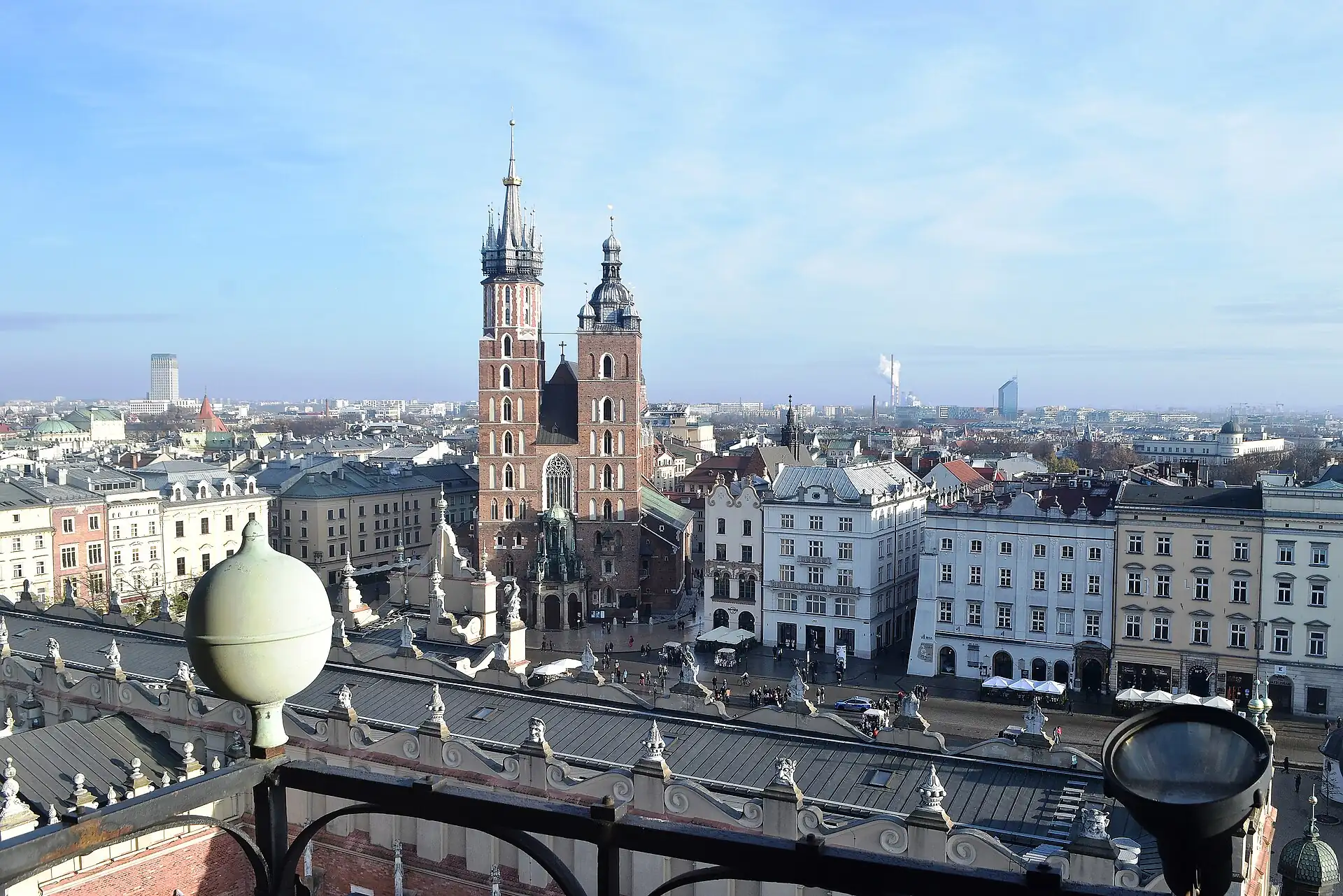
The Rynek Główny is the living room of the city. It is a vast open square, cobbled and edged with tall townhouses, and at its centre stands the Cloth Hall, a long arcaded trading hall that dates from the 14th century and was reshaped in the Renaissance. Souvenir stalls fill the arcade, and a gallery of Polish art sits upstairs.
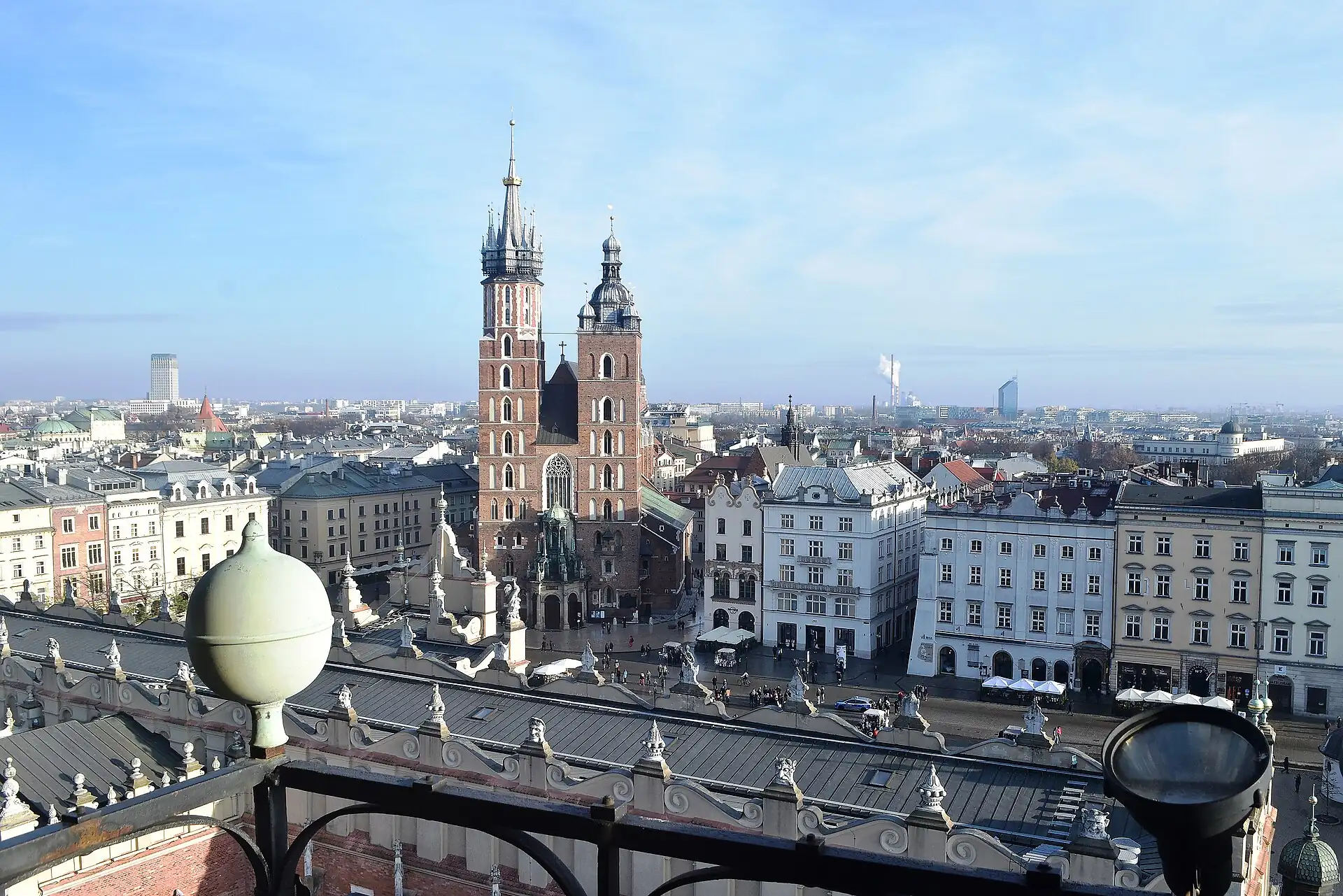
The square's landmark is St Mary's Basilica on the east side. It is easy to spot: two towers of different height. The taller one carries a trumpet call, the hejnał, played on the hour from a window, and the melody breaks off in mid-phrase to recall the town watchman who is said to have been shot while warning of a Mongol attack. It is worth stopping to hear it.
Inside, the church is packed with colour: a blue vault sprinkled with stars, painted walls and, above all, the great Gothic altarpiece carved by the sculptor Veit Stoss in the late 15th century. The wings of the altarpiece are usually closed and opened at set times, so check the hours before you go and dress modestly.
Beneath the square is the Rynek Underground, a museum built over the excavated remains of medieval market stalls and streets. It shows what the square looked like eight centuries ago, using screens, sound and objects, and it is a cool refuge on a hot day. Book a timed slot in summer and at weekends, because the numbers are limited.
Around the square the side streets are the working heart of the Old Town: Floriańska leads north to the Barbican and the Florian Gate, the surviving parts of the defences, and Grodzka leads south toward Wawel. Cafés, cellar bars and small museums line both. The Planty park ring is a five-minute walk in any direction and a good place to sit.
The square changes with the hour. Early on a weekday it is calm, with street sweepers, pigeons and the smell of coffee. By noon in summer it is crowded, and evenings are loud with terraces, buskers and stag groups. Choose your hour, and remember that food and drink on the square itself cost more than a street away.
- Landmark church
- St Mary's Basilica
- Trumpet call
- Every hour, ends mid-note
- Altarpiece
- Veit Stoss, late 15th century
- Museum under the square
- Rynek Underground
3Wawel, the royal hill2 min
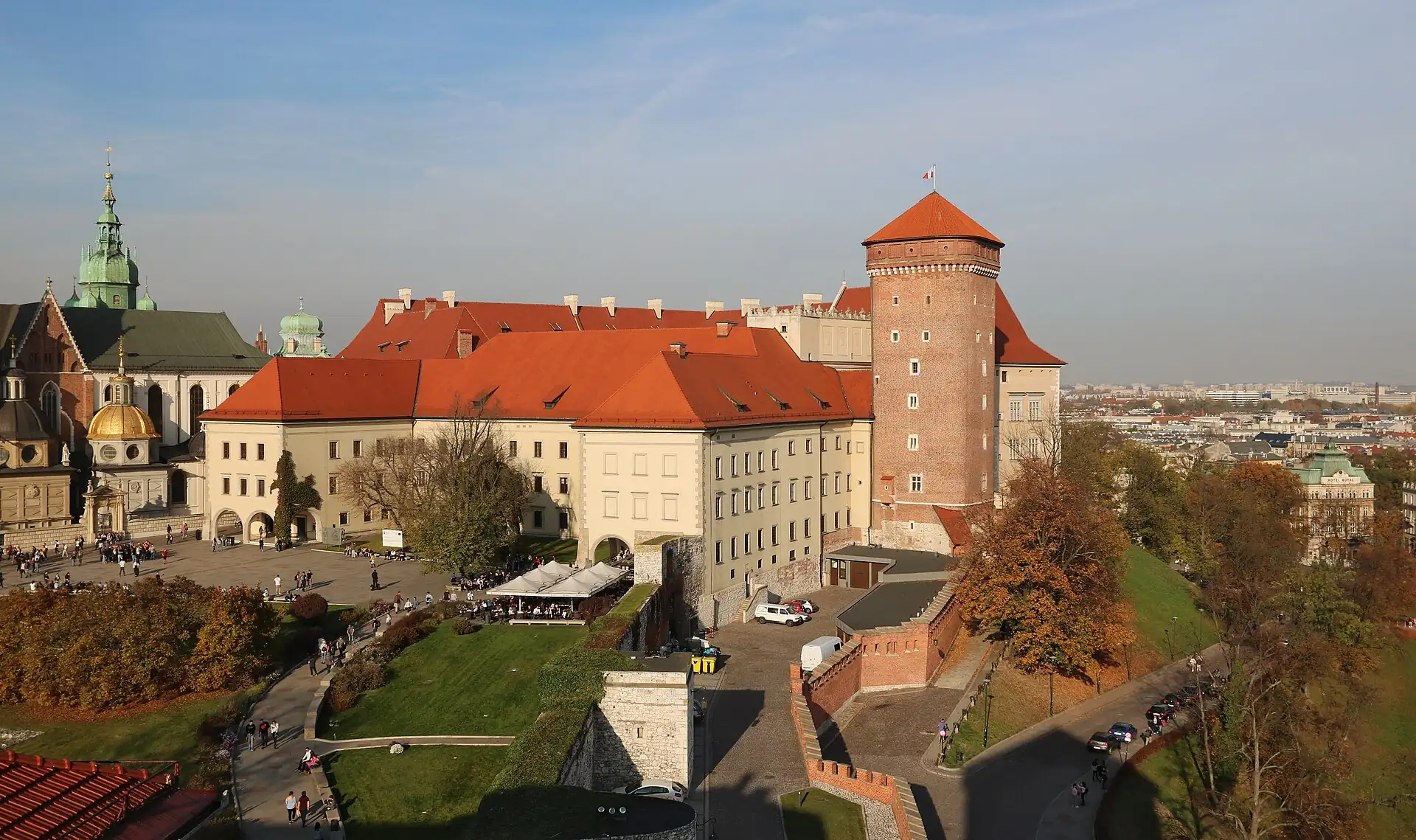
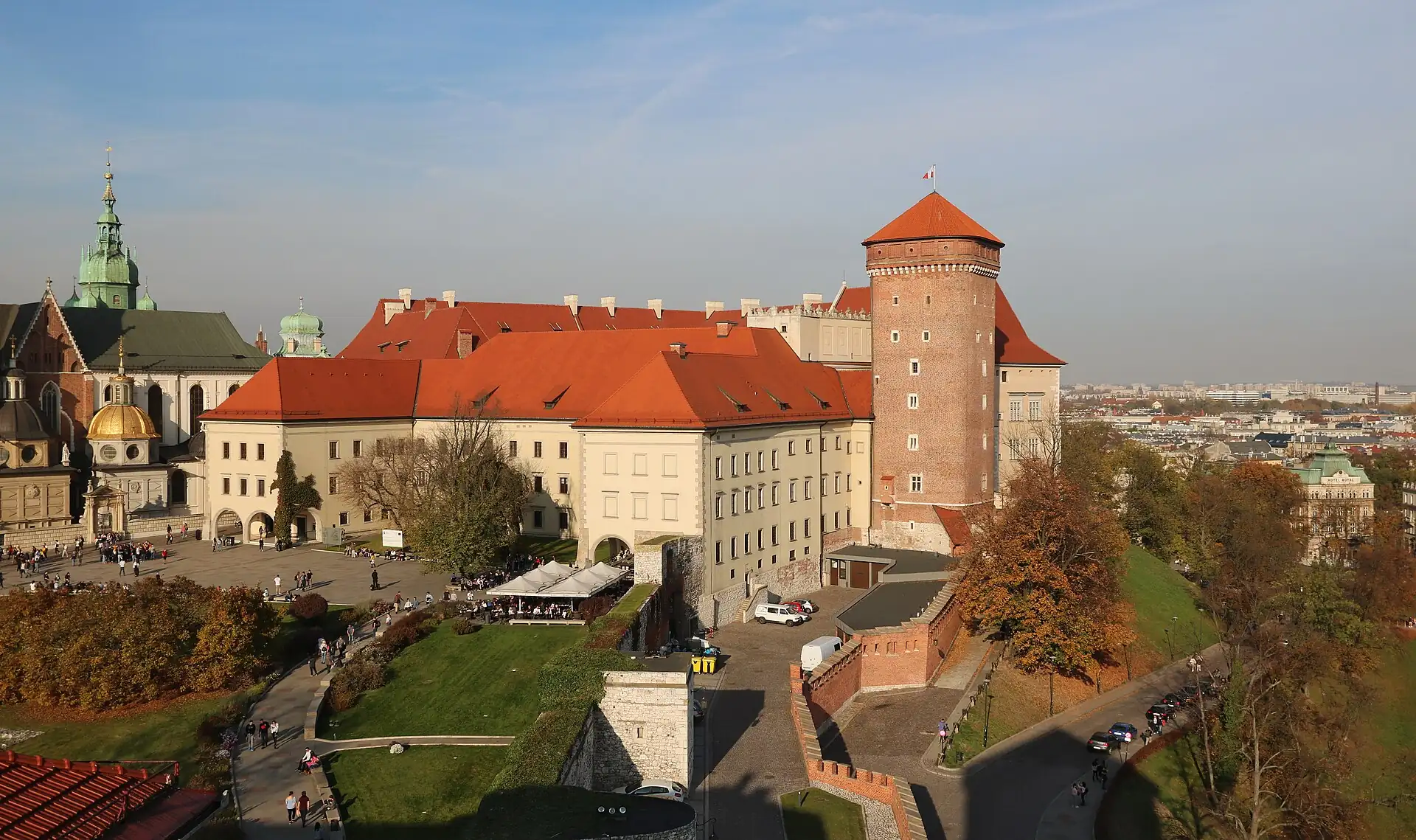
Wawel is a limestone hill on the Vistula, crowned by a castle and a cathedral, and it is the place that Poles treat as the national shrine. Kings were crowned and buried in the cathedral for centuries, and later heroes and poets were laid to rest there too. The complex is large, with several separate tickets, so decide before you go what you want inside.
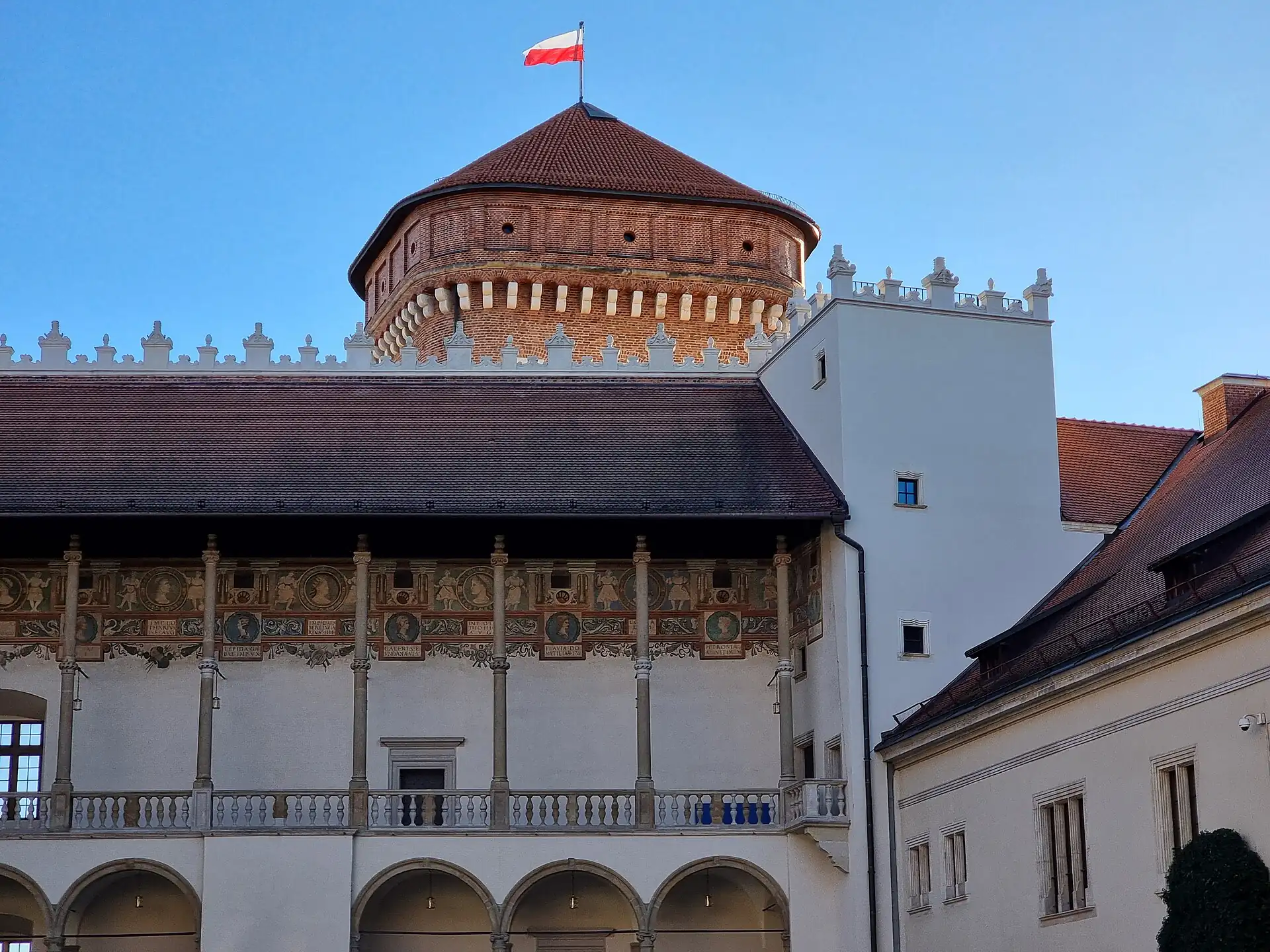
The castle was rebuilt in the Renaissance style in the early 16th century, with an arcaded courtyard that is one of the finest in Europe. Inside are state rooms, royal apartments, a treasury and an armoury, with tapestries collected by the Jagiellonian kings. The cathedral has the royal tombs, the golden-domed Sigismund Chapel and the Sigismund Bell, which is rung on major occasions. A climb to the bell tower is worth it for the view.
Tickets for the state rooms and the cathedral are timed in summer, so book ahead or arrive early. The courtyard and the grounds are open without a ticket at most times, and they are pleasant even if you skip the interiors. Plan two to three hours for a full visit, less if you choose one or two exhibitions.
On the river side of the hill, a cave called the Dragon's Den lies at the foot of the walls, with a statue of the Wawel Dragon that breathes fire on a timer. The legend of the dragon is one of the city's oldest stories: a monster who lived in the cave until a clever cobbler tricked it into eating a sheep stuffed with sulphur.
Below the hill, a flat path follows the river toward Kazimierz. It gives the best view of Wawel from below, and the riverbank has cafés and boat bars in summer. It makes a pleasant end to a morning on the hill and a natural walk to lunch.
For a smooth visit, go in the morning, wear comfortable shoes for cobbles, and carry water. The ramps and stairs are steep in places, so check accessibility if you need step-free access. Large bags are usually checked, and some rooms restrict photography.
- Castle style
- Renaissance, early 16th century
- Tickets
- Separate for castle rooms, cathedral and towers
- Suggested time
- 2–3 h
- Best hour
- Morning, booked
4Kazimierz and Jewish Kraków2 min
Kazimierz began as a separate town founded by Casimir the Great in 1335. From 1494 it became home to Kraków's Jewish community, who were moved out of the walled city, and for the next four and a half centuries it was the centre of Jewish life in the region. Synagogues, schools, shops and prayer houses filled a compact grid of streets.
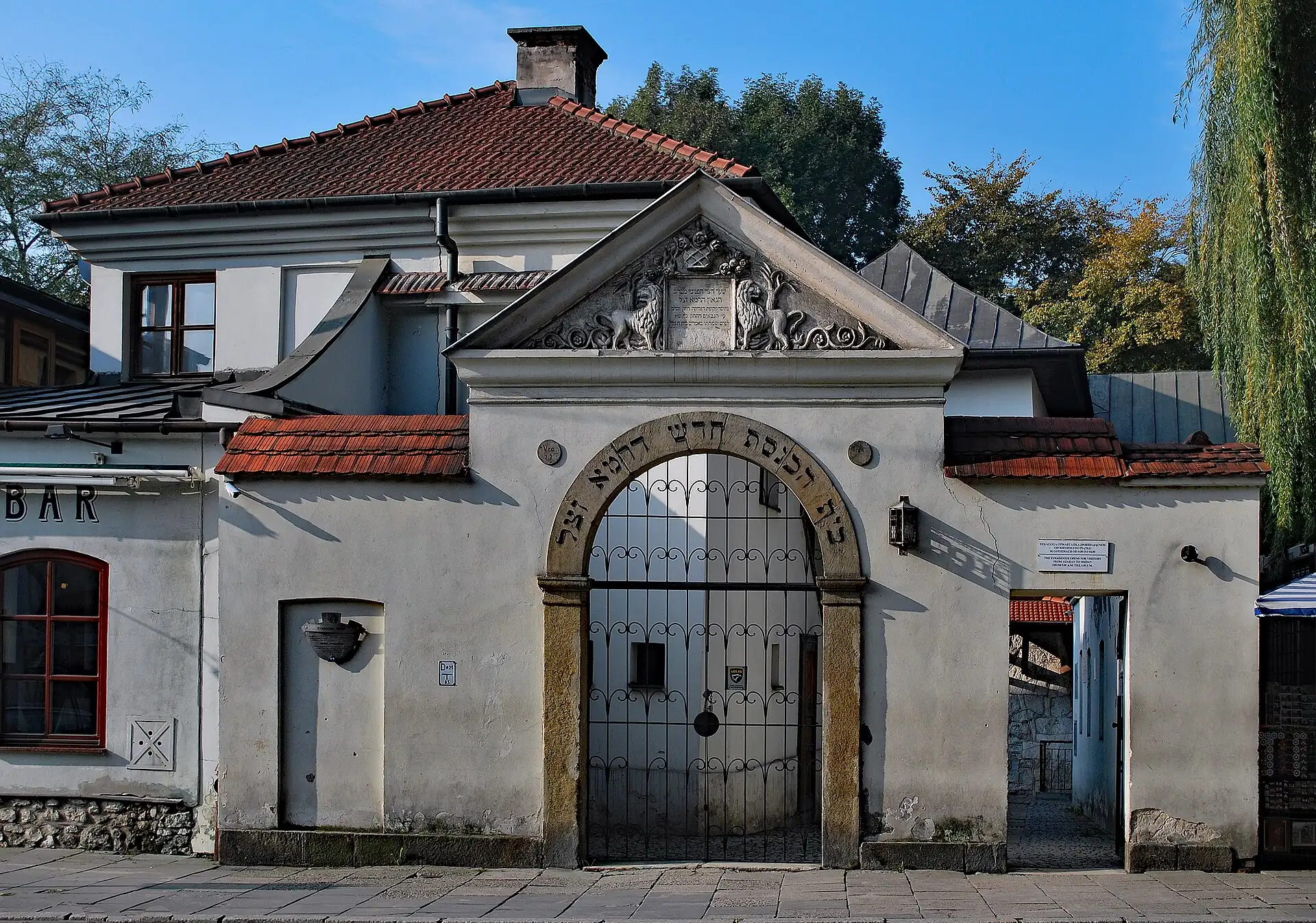
The Old Synagogue, which dates from the 15th century and is now a museum, is the oldest surviving synagogue building in Poland. The Remuh Synagogue on Szeroka street, founded in 1553, is still used for prayer, and its adjoining cemetery contains gravestones from the Renaissance. Together with other synagogues nearby they form the core of Jewish heritage in the district.
The Second World War ended that world. Kraków's Jews were forced into the Podgórze ghetto in 1941 and were deported or killed in the following two years. Kazimierz was left quiet and run-down for decades. After 1989 it began to recover, and in the 1990s a film shot in the district drew international attention. Today it is one of the liveliest districts in the city, full of galleries, cafés and bars, with the annual Jewish Culture Festival in late June or July.
For visitors, Kazimierz is best in two halves. By day it is a heritage walk: the Remuh Synagogue and cemetery, the Old Synagogue, Szeroka street and the Jewish Cultural Centre. In the evening it is a food and drink district, with Plac Nowy at its centre, where a round market hall serves zapiekanki from small windows.
A few cautions apply. Synagogues and the cemetery close on Shabbat and Jewish holidays, and visiting hours change. Dress modestly, keep voices low and follow the rules on photography. Some of the shops and restaurants use Jewish themes as decoration: choose places that are open about their history, and treat the cemetery as a place of prayer.
It is a short walk from the Old Town, about 20 minutes, or a quick tram or ride. If you sleep in Kazimierz, you will have more choice of small guesthouses and better prices than in the Old Town, but weekend nights are loud.
- Founded
- 1335, by Casimir the Great
- Remuh Synagogue
- 1553, still used for prayer
- Old Synagogue
- 15th century, now a museum
- Jewish Culture Festival
- Late June to July
5The war, Podgórze and the memorials2 min
Across the Vistula from Kazimierz, Podgórze is the district where the German authorities created the Kraków ghetto in March 1941. It held around 15,000 people, and it was liquidated in March 1943. The district today is quiet and residential, but its streets hold the memory of that time, and two places explain it best.
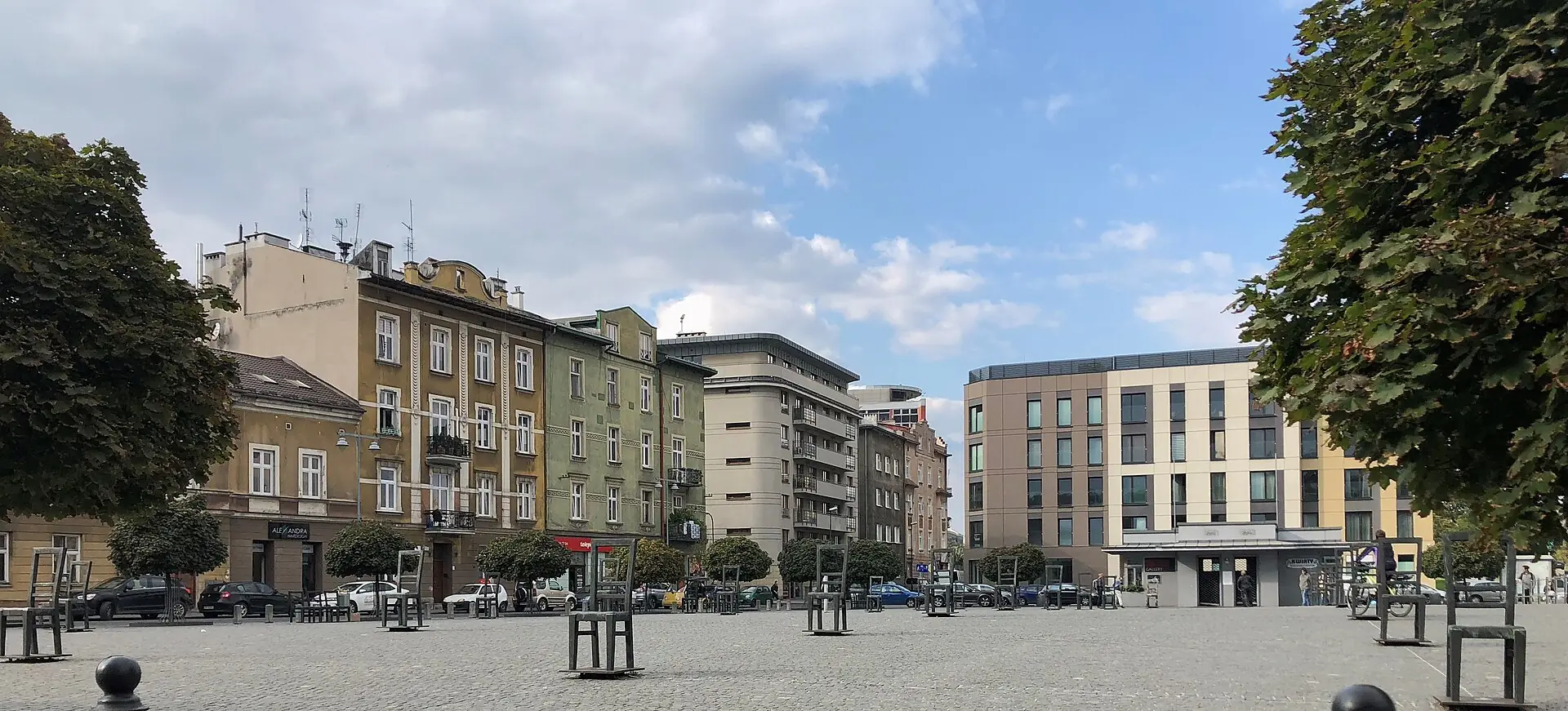
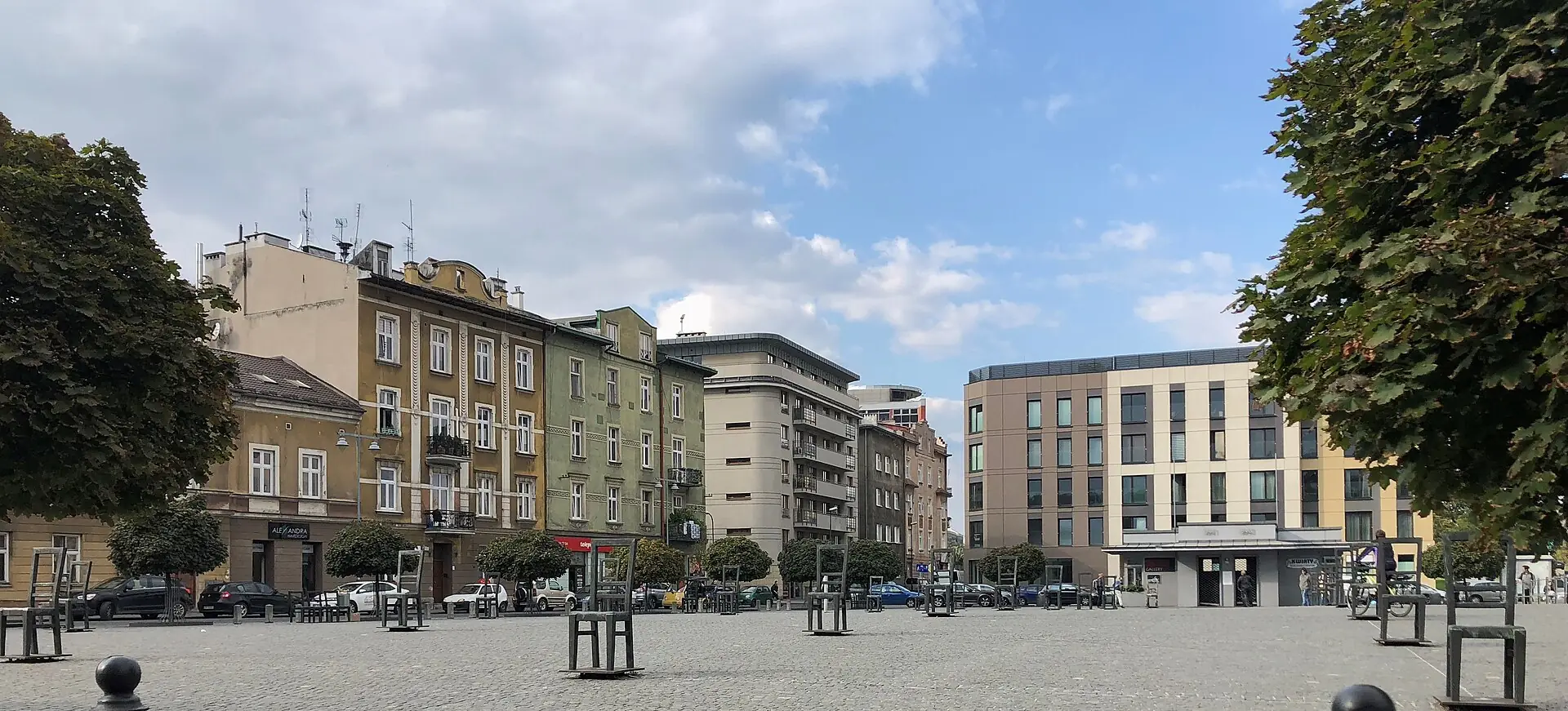
Ghetto Heroes Square was the ghetto's main square, and the memorial there is simple: seventy large empty chairs stand in the open space, each one standing for the lives lost. Stand back, read the plaques and keep your voice low. A small pharmacy museum on the square tells the story of its owner, who stayed to help the ghetto's inhabitants.
Schindler's Factory, a short walk away, is the former enamel works where Oskar Schindler employed Jewish workers and protected many of them. Today the administration block houses a large museum about Kraków under occupation between 1939 and 1945. It is not a museum about one man. It is a walk-through of everyday life, fear and resistance, told with rooms, sound and objects. Book a timed ticket, arrive early and allow two to three hours.
Both places deal with hard subjects, and the museum gives age guidance for children, so check before you bring young ones. Leave time afterwards to walk or sit outside before the next thing on your day. Many visitors find that a slow lunch in Podgórze helps.
Two more sites often appear on itineraries. Auschwitz-Birkenau, the former German concentration and extermination camp, lies about 70 km to the west, and it needs a full day, timed tickets and respect for the rules on bags and behaviour. Nowa Huta, to the east, is a planned socialist district built in the 1950s and is very different in tone. Book ahead for the first and go with a local guide for the second.
The main point is to choose depth over volume. One of these places done properly is better than three done in a rush, and Kraków has other days for cafés and cake. Plan the memorial for the morning, keep the afternoon light and be careful about photographs.
- Ghetto period
- March 1941 to March 1943
- Memorial
- Seventy large empty chairs
- Museum
- Schindler's Factory, book a timed slot
- Auschwitz-Birkenau
- About 70 km (43 mi) west; full dayAbout 43 mi (70 km) west; full day
6Food, seasons and getting around2 min
Kraków is a good food city for its price. The staples are pierogi, filled dumplings with cheese, potato, meat or cabbage, żurek, a sour rye soup, and pork cutlets with potatoes and cabbage. Cheap versions are served in milk bars, the state-era cafeterias where a full meal costs PLN 20 to 35, and better ones in sit-down restaurants for PLN 40 to 70. Try an obwarzanek, a ring of boiled and baked dough from a street cart, and a zapiekanka, a toasted open baguette with mushrooms and cheese, from a Plac Nowy window.
Cafés are part of the city's identity. Jama Michalika on Floriańska street is a historic Art Nouveau café where writers and painters met in the early 20th century, and it is a good place for cake and coffee outside dinner hours. Elsewhere, craft-beer bars, vodka bars in cellars and cafés in Kazimierz fill the evenings, and the legal drinking age is 18.
The season decides comfort. May to September is the usual visiting season, with long days and terraces, but the square is crowded in July and August and the Wawel queues are longest. Autumn is mild and quieter. Winter is cold and can bring smog on still days, but it also brings a Christmas market on the square and cheaper rooms. Spring is changeable, with rain in May. Big events include the Jewish Culture Festival, Wianki in June and the Christmas market.
The centre is small and flat, so walk. Trams cover Kazimierz, Podgórze and the station, and tickets are cheap and easiest in the jakdojade app. Ride-hailing cars, such as Bolt and Uber, cost PLN 15 to 35 across the centre and are the best option late at night or with bags. From the airport, a direct train takes about 20 minutes to Kraków Główny station, next to the Old Town.
Book the big sights early. Wawel's state rooms, the salt mine at Wieliczka, Auschwitz-Birkenau and Schindler's Factory all use timed tickets that sell out in summer. Keep one day for a booked trip, and use the others for walking and cafés.
Most shops close on most Sundays under Polish trading rules, and many museums close on Mondays, so plan groceries for Saturday and museums for Tuesday to Sunday. The currency is the złoty, not the euro, so decline currency conversion at card terminals and ATMs. Emergency number 112 works everywhere, and tap water is safe to drink.
- Milk-bar meal
- PLN 20–35
- Airport to Kraków Główny
- About 20 min by train
- Ride-hailing across the centre
- PLN 15–35
- Currency
- Złoty, decline conversion
- Sunday
- Most shops closed
Read, watch, wordsReading · Glossary · Sources
Reading
- Wikivoyage — Kraków — Wikivoyage contributorsA community travel guide to compare against this one.
Glossary
| Term | Local | Meaning |
|---|---|---|
| Rynek | Rynek Główny | The Main Market Square. |
| Bar mleczny | Bar mleczny | A milk bar: a cheap state-era cafeteria. |
| Zapiekanka | Zapiekanka | A toasted open baguette with mushrooms and cheese. |
| Obwarzanek | Obwarzanek krakowski | A ring of boiled and baked dough sold from street carts. |
Read for this deep dive
Background reading only: the text above is written by Voykit, not copied from these pages.
Rules in force · 9Non-EU visitors get 90 days in any rolling 180-day window…
- Europe ↗Non-EU visitors get 90 days in any rolling 180-day window, counted across all 29 Schengen states together — not per country; the Entry/Exit System now logs each crossing, so an overstay is detected automatically.
- Europe ↗On the first Schengen entry since EES began, non-EU travellers give four fingerprints and a face photo at the border instead of a passport stamp; there is nothing to apply for or pay in advance.
- Central Europe ↗Six of the nine countries here — Austria, Switzerland, Czechia, Slovakia, Hungary and Slovenia — charge a time-based motorway vignette, mostly digital and linked to the number plate; buy it before the first motorway past the border, because cameras, not toll booths, do the checking.
- Central Europe ↗Temporary police checks at internal Schengen borders are common in this region in 2026 (Germany, Austria, Poland, Slovenia among others — check): keep your passport on you on every cross-border train, bus and road even though there is no fixed control post.
- Poland ↗Poland is in the EU and the Schengen area: check entry rules, the EU Entry/Exit System and any travel authorisation requirement for your passport on official sources.
- Poland ↗The currency is the Polish złoty (PLN), not the euro: decline dynamic currency conversion.
- Poland ↗Most shops close on most Sundays under the trading law; small convenience stores and station shops are the exception.
- Poland ↗The border areas with Belarus and Russia's Kaliningrad region have restricted zones; follow your own government's advice before travelling near them.
- Lesser Poland ↗Book Auschwitz-Birkenau and Wieliczka for timed entry ahead on their official sites; summer slots fill weeks in advance.
Entry rules depend on your passport. Full visa guide
Emergency numbers for Kraków112 ▾
Tap a number to call from your phone. These are the numbers listed in this guide; a row marked check has not been verified.
Planning is the full guide. I'm here keeps what is open and the cheat card.
Right now
Checking the weather…
Working out what is open near you…
What is open nowclock, closures, places open
Now in Kraków
Local time in Kraków
--:--
Loads in your browser · Europe/Warsaw
This month
Month verdict appears here.
Closed today
See the weekly grid below.
| Weekly closure | Mon | Tue | Wed | Thu | Fri | Sat | Sun |
|---|---|---|---|---|---|---|---|
| Many museumscheckCheck each museum before you go. | ✕ | · | · | · | · | · | · |
| Most shopscheckPoland restricts Sunday trading with some exceptions. | · | · | · | · | · | · | ✕ |
If today is a closure day: It is a Sunday or a public holiday: most shops are closed, so plan museums, cafés and the Planty and buy food on Saturday.
Many museums close on Monday; some are free one day a week (check).
Cheat cardthe pocket version
Cheat card
The essentials on one card: save it as an image for your phone, share it, or print it.
Kraków
- Money
- Keep PLN 100 in small notes for kiosks and markets; withdraw at bank ATMs and decline conversion to euros or dollars.
- SIM
- Install an eSIM before you fly, or buy a SIM at a shop or in the airport (passport may be needed).
- Ride app
- Bolt and Uber
- Emergency
- 112 All emergencies · 997 police · 999 ambulance
- Plugs
- Sockets C/E. US/Canada (A/B): adapter · UK/Ireland (G): adapter · Australia/NZ (I): adapter. 230 V: US 120 V-only devices (hair dryers) need a converter; most chargers are dual-voltage.
Top 5
- Wawel hill
- St Mary's Basilica and the hejnał
- Cloth Hall and Rynek Underground
- Remuh Synagogue and cemetery
- Schindler's Factory
EssentialsQuick answers, what things cost and how to get around
Essentials
Quick answers, what things cost and how to get around
Quick answers
The questions people ask first about Kraków, one line each. Tap a card for the full answer.
- Cash or card?Cards and contactless work almost everywhere; carry a little cash for kiosks and market stalls.
- SIM or eSIMInstall an eSIM before you fly, or buy a SIM at a shop or in the airport (passport may be needed).
- Ride-hailing appBolt and Uber.
- Tap waterTap water is safe; bottled water is cheap.
- TippingAbout 10% in sit-down restaurants when service is not added; round up for taxis.
- Plugs & powerSockets C/E. US/Canada (A/B): adapter · UK/Ireland (G): adapter · Australia/NZ (I): adapter. 230 V: US 120 V-only devices (hair dryers) need a converter; most chargers are dual-voltage.
Show all 14 answers
- Safe at night?Take more care after dark in Old Town, Kazimierz.
- What to wearCover shoulders and knees; keep quiet during services.
- Emergency numbers112 All emergencies · 997 police · 999 ambulance
- Your embassyEmbassies are in Warsaw; some countries have consulates in Kraków.
- Closed which day?Mon: 1 on our list shut · Sun: 1 on our list shut.
- Sundays & holidayscheckMost shops close on most Sundays; museums often close on Mondays; check each place.
- Rainy-day planRain is common in late spring and summer: keep museums for the wet hour and a café for the cold.
- Landing lateKRK: last airport train to Kraków Główny about 23:00, then city bus from the airport to the main station (route and last departure unverified) until about 23:15.KRK: last airport train to Kraków Główny about 11:00 PM, then city bus from the airport to the main station (route and last departure unverified) until about 11:15 PM.
Cost cheat-sheetwhat everyday things cost
Cost cheat-sheet
Typical prices for the everyday things, as ranges. Change the currency right here; the local price stays first.
2026 desk estimate · check
- CoffeePLN 12–20 (≈ US$4–6)
- Sit-down mealSit-down restaurant meal, per personPLN 60–120 (≈ US$17–35)
- Street or quick mealZapiekanka (open baguette) from a Plac Nowy stallPLN 15–25 (≈ US$5–7)
- BeerPint of beerPLN 12–20 (≈ US$4–6)
- Taxi, about 5 km (3 mi)Taxi, about 3 mi (5 km)Ride-hailing car across the centrePLN 15–35 (≈ US$5–10)
- Metro or bus rideTram single ticketPLN 5–7 (≈ US$2)
- SIM or eSIM, a weekTourist eSIM, about a week of dataPLN 30–70 (≈ US$9–20)
- Museum or sight ticketWawel or museum ticketPLN 30–70 (≈ US$9–20)
- Budget bedHostel dorm bed, a night, per personzł 70
- Mid-range bedHotel double room, a night, per roomzł 450
- High-end bedHotel double room, a night, per roomzł 900
A day, not counting the bed: Budget zł 160 · Mid zł 320 · High zł 650
Local prices, with USD next to them (rates 2026-09 (approximate); change it in the header). Ranges are desk estimates: check locally. Every price and the budget calculator →
Source: Prices in Kraków
Draft
Written from desk research. Not yet compared with the official source.
No official source is recorded for this figure.
Prices are 2026 desk estimates, not yet compared with an official source. Check on the day.
Not checked in the last 12 months (no check date on file).
DecideWho it suits, the trade-offs and when to go
Decide
Who it suits, the trade-offs and when to go
Best months at a glance
The guide's verdict for each month
Jan
Care
2°C (36°F)36°F (2°C)
Feb
Care
4°C (39°F)39°F (4°C)
Mar
Care
9°C (48°F)48°F (9°C)
Apr
Best
15°C (59°F)59°F (15°C)
May
Best
20°C (68°F)68°F (20°C)
Jun
Best
23°C (73°F)73°F (23°C)
Jul
Care
25°C (77°F)77°F (25°C)
Aug
Care
25°C (77°F)77°F (25°C)
Sep
Best
20°C (68°F)68°F (20°C)
Oct
Best
14°C (57°F)57°F (14°C)
Nov
Care
7°C (45°F)45°F (7°C)
Dec
Best
3°C (37°F)37°F (3°C)
Best: Apr–Jun, Sep–Oct, Dec. Mixed: Jan–Mar, Jul–Aug, Nov. Month by month →
Warmest Jul (25°C (77°F)77°F (25°C)), coolest Jan (−4°C (25°F)25°F (−4°C) low), wettest May (13 rain days), driest Sep (9). Averages, not a forecast.
Kraków across the year
Best-looking months for Kraków: May, Jun, Sep.
| Measure | Jan | Feb | Mar | Apr | May | Jun | Jul | Aug | Sep | Oct | Nov | Dec |
|---|---|---|---|---|---|---|---|---|---|---|---|---|
| Weather | Mixed (care) | Mixed (care) | Mixed (care) | Good (good) | Great (good) | Great (good) | Mixed (care) | Mixed (care) | Great (good) | Good (good) | Mixed (care) | Good (good) |
| Crowds | Low (good) | Low (good) | Low (good) | Medium (ok) | Medium (ok) | High (care) | High (care) | High (care) | Medium (ok) | Low (good) | Low (good) | Medium (ok) |
| Prices | Low (good) | Low (good) | Low (good) | Medium (ok) | Medium (ok) | Medium (ok) | High (care) | High (care) | Medium (ok) | Low (good) | Low (good) | Medium (ok) |
| Events | None listed (ok) | None listed (ok) | 2 events (care) | 1 event (care) | 2 events (care) | 2 events (ok) | None listed (ok) | None listed (ok) | None listed (ok) | None listed (ok) | 2 events (ok) | 3 events (care) |
Green is good news, amber needs planning, red is a month to avoid; dashed grey with a question mark means our data does not say. Open the year heatmap →
Not checked in the last 12 months (no check date on file).
Source: Months, temperatures and crowds
Draft
Written from desk research. Not yet compared with the official source.
Monthly highs, rain and crowd levels are climate averages and desk estimates for the city, not a forecast.
Understand the cityUnderstand · Districts
Orientation & districts
A first visit fits in a box about 3 km across: the Old Town inside the Planty ring, Wawel hill to its south, Kazimierz south-east and Podgórze across the river. Everything is walkable, with trams for tired legs.
Streets have long Polish names: give a driver the hotel name, the street and the number.
Shaded shapes: walking areas (click one). Black pins: sleep areas. Grey dots: places. Round badges: arrivals. Click the map to turn on scroll-wheel zoom.
Hover, tap or tab to an area to see what it is like. Pins are sleep areas; arrows at the edge point to the airport.
Off the map: Kraków John Paul II International Airport (KRK) (20–30 min by the usual route).
Where’s what, as a list:
- Old Town (Stare Miasto): Cobbled, lively and expensive; noisy on summer nights. Suits: First visit, cafés, the main squares. Price band $$.
- Wawel (Wawel): A hill and a riverside path south of the Old Town. Suits: Castle, cathedral, river walk.
- Kazimierz (Kazimierz): Small hotels and a busy bar scene around Plac Nowy. Suits: Evenings, food, Jewish heritage. Price band $$.
- Podgórze (Podgórze): Across the Vistula from Kazimierz: Schindler's Factory and Ghetto Heroes Square. Suits: Museums and memorials.
- Sleep area Kazimierz: suits Evenings, food, Jewish heritage, price band $$.
- Sleep area Old Town: suits First visit, cafés, the main squares, price band $$.
- Kraków John Paul II International Airport (KRK), 20–30 min by the usual route.
Neighbourhoods at a glance
One tab per area, pulled together from this guide’s districts table, area notes, sleep-area scores and place pages. Scores are desk judgements (1–5); prices are estimates, check before you book.
Old Town
$$Stare Miasto
Cobbled, lively and expensive; noisy on summer nights.
- Suits:
- First visit, cafés, the main squares · First visit, walking, evenings
- Best time:
- Early morning and evening
- Rooms:
- PLN 400–800 per room per night (mid-range); more in summer and at Christmas
Pick this if: First visits, walking everywhere
Skip this if: You want quiet nights or arrive with heavy bags
- Quiet nights2/5 Low
- Nightlife5/5 Very high
- Families3/5 Medium
- Late arrival4/5 High
Why these scores
- Quiet nights: Bars and hen groups on the square; ask for a courtyard room.
- Nightlife: The most bars and late restaurants.
- Families: Flat and central, but noisy.
- Late arrival: Many 24-hour desks and the main station nearby.
Getting around from here
- 12–18 min walk to Wawel Hill
- 20–28 min walk to Kazimierz & Plac Nowy
Wawel
Wawel
A hill and a riverside path south of the Old Town.
Feels: Royal hill above the river
- Suits:
- Castle, cathedral, river walk
- Best time:
- Morning
Pick this if: History, walks
Watch out for: Summer noon queues.
Getting around from here
- Walk north: about 12 min to Old Town & Main Market Square
- Walk east: about 12 min to Kazimierz & Plac Nowy
Kazimierz
$$Kazimierz
Small hotels and a busy bar scene around Plac Nowy.
- Suits:
- Evenings, food, Jewish heritage · Food, nightlife, heritage
- Best time:
- Late afternoon and evening
- Rooms:
- PLN 350–700 per room per night (mid-range)
Pick this if: Evenings, cafés, a quieter base
Skip this if: You arrive very late and need a staffed desk
- Quiet nights3/5 Medium
- Nightlife5/5 Very high
- Families3/5 Medium
- Late arrival4/5 High
Why these scores
- Quiet nights: Quiet in the daytime, busy on weekend nights around Plac Nowy.
- Nightlife: The bar and cafe centre of the city.
- Families: Character and cafés, but nightlife noise.
- Late arrival: Trams and taxis run late.
Getting around from here
- 12–18 min walk to Wawel Hill
- 20–28 min walk to Old Town & Main Market Square
- Walk over the Vistula footbridge: about 12 min to Podgórze & Schindler's Factory
Podgórze
Podgórze
Across the Vistula from Kazimierz: Schindler's Factory and Ghetto Heroes Square.
- Suits:
- Museums and memorials
- Best time:
- Morning
Pick this if: History
Watch out for: Rushed visits.
Getting around from here
- Walk over the Vistula footbridge: about 12 min to Kazimierz & Plac Nowy
Ward by ward
5 area guides. Open one for the short answer, the key facts and what the area is like; the full guide is linked inside. Prices marked (check) are estimates.
EastBest for: Socialist-realist architecture, Cold War history, cheap rooms, free parking
Stay in East Kraków only if Nowa Huta's socialist-realist district is the point of your visit; most first-timers should sleep in the Old Town or Kazimierz and ride tram 4 out for half a day. Base here for cheap rooms and quiet streets, not for nightlife or walkable sightseeing.
- Best for:
- Socialist-realist architecture, Cold War history, cheap rooms, free parking
- Not for:
- First-timers wanting walkable sights, nightlife, restaurant choice
- Tram from the centre:
- Line 4 from near the main station, about 30 minutes (check current route)
- Ticket:
- Time-based city ticket; buy a 1-hour ticket for the trip (2026 estimate)
- Core sights:
- Plac Centralny, Aleja Róż, Nowa Huta Museum, Wanda Mound, Aviation Museum
- Walkability:
- District is spread out; trams and buses do most of the work
- Evening:
- Quiet; eat before you ride back or pick a milk bar locally
What the area is like
East Kraków is a broad slice of the city on the north bank of the Vistula, and the name travellers use for it is Nowa Huta. The district was laid out from 1949 around a steelworks, with apartment blocks on axes radiating from Plac Centralny (Central Square) and Aleja Róż (Alley of Roses). It is one of Europe's clearest surviving examples of socialist-realist town planning.
The early blocks mix Renaissance detail with Soviet monumentalism; later phases turn modernist, then prefabricated concrete. The district was built as an atheist counterweight to Catholic, middle-class Kraków, and the first church only arrived in the 1970s. That story, plus the steelworks, is what draws visitors today.
Between the housing estates sit older villages absorbed by the city, the Aviation Museum on the former airfield, and green edges along the river. It is residential, low-rise in feel and much quieter than the centre.
Full East guideShould you stay here or not
Choose East if you want space, lower prices and a tram ride into the centre, or if you are specifically here for Nowa Huta and the Aviation Museum. Rooms and apartments cost less than the Old Town, streets are calm at night, and driving and parking are far easier than in the centre.
Skip it for a first visit of two or three nights. The Old Town and Kazimierz put the main sights, bars and restaurants within walking distance, and you would spend 30 minutes each way on tram 4. Skip it too if you want evening atmosphere on your doorstep.
A middle path works well: sleep in the centre, ride out for half a day, and eat lunch in a local milk bar before returning.
KazimierzBest for: Nightlife, food, Jewish heritage, lower hotel prices than the Old Town core
Stay in Kazimierz if you want bars, food and Jewish history within a 15-minute walk of the Old Town; skip it if you need quiet nights or a car. Book 2–4 weeks ahead for spring and summer weekends, and pick the western side near Plac Wolnica if street noise matters.
- Best for:
- Nightlife, food, Jewish heritage, lower hotel prices than the Old Town core
- Walk to Rynek Główny:
- 15–25 min via ul. Stradom or ul. Starowiślna
- Walk to Podgórze:
- 5–10 min over Kładka Bernatka footbridge
- Quietest streets:
- West of ul. Krakowska, around Plac Wolnica
- Noisiest streets:
- ul. Szeroka, ul. Miodowa, Plac Nowy after 22:00ul. Szeroka, ul. Miodowa, Plac Nowy after 10:00 PM
- Tram stop:
- Plac Wolnica / ul. Starowiślna (check lines)
- Tipping:
- About 10% in restaurants
- Currency:
- Polish złoty (PLN, zł); about 4.2–4.3 to the euro in 2026 — check
What the area is like
Kazimierz was a separate town founded in 1335 on an island in the Vistula, and only became part of Kraków in 1791. The river branch between it and the Old Town was later filled in, so today you walk south from the Old Town with no water in between. The old split still shows: the western half around Plac Wolnica and the Skałka church was Christian, the eastern half around ul. Szeroka and Plac Nowy was Jewish.
From the late 15th century Jews settled here in numbers after being pushed out of Kraków, and by the 1930s this was one of the largest Jewish quarters in Poland. In 1943 the Nazi occupiers forced Kraków's Jews into a ghetto in Podgórze, across the river, and from there to the camps. After the war the empty streets filled with poorer residents and the district got a rough reputation.
That changed from the 1990s, when the annual Jewish Culture Festival began, synagogues were restored and cafés and clubs opened. Gentrification has since pushed rents up and small galleries are giving way to hotels. Expect a busy, mixed district: heritage sites in the morning, packed bars at night.
Full Kazimierz guideShould you stay here
Yes for most first-time visitors who want to walk to dinner and drinks and still reach the Old Town on foot. Kazimierz has more mid-range and budget beds than the Old Town core, and the streets around Plac Nowy and ul. Szeroka are the centre of Kraków's nightlife. If you are here for two or three nights and plan to be out late, this is the practical base.
No if you sleep lightly and book a room on a bar street, if you are travelling with a car (parking is scarce and paid), or if you want the postcard view of the Rynek from your window. Families and light sleepers do better west of ul. Krakowska or in the Old Town itself.
Book 2–4 weeks ahead for May–September and December weekends; the Jewish Culture Festival in late June and early July fills the district early. Prices are a 2026 estimate and swing hard with events.
Old TownBest for: First visit, 2–3 nights, walking to Wawel, Rynek Główny and the station
Yes — stay in Old Town if you want Wawel, the Rynek Główny and the main station within a 5–20 minute walk, and you accept higher hotel prices and evening crowds. Choose Kazimierz instead for cheaper rooms, bars and a quieter night's sleep.
- Best for:
- First visit, 2–3 nights, walking to Wawel, Rynek Główny and the station
- Walk across the district:
- About 20 minutes from the main station to Wawel
- Room prices:
- Higher than Kazimierz; book early for May–Sep and December (2026 estimate)
- Quietest streets:
- West of the Rynek, toward ul. Szpitalna and the Planty ring
- Noisiest:
- Rynek Główny frontage and the streets around it, busy until late
- Main station and bus station:
- Just north of the district, walkable with luggage (check)
- Wawel castle tickets:
- Timed entry, sell out in summer and at weekends; buy before climbing the hill (check)
What the area is like
Old Town (Stare Miasto) is the historic core of Kraków and the first base for most visitors. It is bounded by the Planty, the ring of parkland that replaced the medieval walls and moat, and it includes Wawel, the fortified hill above the Vistula at the southern end. Everything radiates from Rynek Główny, the Main Market Square, which is the centre of the city as well as the district.
The page also covers Śródmieście, the inner city built outside the old walls, running west to the Trzech Wieszczów ring road and east to the railway tracks. Together they form district I. Practically, this means the district is larger than the postcard: Grodzka and Floriańska are the busy spines, while the streets behind them hold offices, schools and ordinary apartment blocks.
The main railway and bus stations sit just north of the district, which is why Old Town works so well on a short trip. You can arrive by train, drop your bag and be on the Rynek within 15 minutes without a taxi.
Full Old Town guideShould you stay here or not
Stay in Old Town if this is your first trip to Kraków and you want the sights, restaurants and station on foot. It costs more per night than Kazimierz and the streets around the Rynek stay loud until late, so light sleepers should ask for a room at the back or pick a side street.
Skip it if you want cheaper rooms, a bar-led evening or a calmer base — Kazimierz, 15–20 minutes south on foot, does all three. Old Town is also the least convenient base if your days are built around day trips, since you still have to reach the station area each morning, though that walk is short.
For a 2–3 night first visit, Old Town is the default. For a longer stay or a second visit, split the nights between Old Town and Kazimierz.
SouthBest for: Podgórze: Schindler's Factory, Ghetto Heroes Square, riverside walks, quieter evenings
Stay in South (Podgórze) if you want the Schindler factory, the ghetto memorials and quiet riverside streets within a 15–20 minute walk of the Old Town; skip it if you want nightlife at the door or a short tram to the main station. Dębniki and the far-south districts are residential, so pick them only for cheaper beds.
- Best for:
- Podgórze: Schindler's Factory, Ghetto Heroes Square, riverside walks, quieter evenings
- Walk to Old Town:
- About 15–20 minutes over the Bernatek footbridge and through Kazimierz
- Tram to Kraków Główny:
- About 15–20 minutes from Podgórze
- Far south:
- Łagiewniki, Kurdwanów, Bieżanów are mostly residential — few sights
- Main rail station in the area:
- Kraków Płaszów, regional trains only; Kraków Główny is more useful
- Prices:
- 2026 estimate: beds in Podgórze often 10–20% below Old Town rates (check)
- Book ahead:
- Schindler's Factory timed tickets, especially weekends and Mondays (check)
What the area is like
South Kraków is six districts, but only two matter to visitors. Podgórze sits on the right bank of the Vistula, directly opposite the Old Town, and was an independent city until 1915. Dębniki lies further west along the same bank. The districts beyond them — Łagiewniki, Kurdwanów, Bieżanów — are housing and commuter country with almost nothing for a short trip.
Podgórze's story is heavy. The Nazi occupation authorities forced Kraków's Jews into a ghetto here in 1941, and deported them in 1943. Ghetto Heroes Square (Plac Bohaterów Getta) holds a memorial of empty metal chairs, recalling the belongings left behind before the transports. The Płaszów camp area south of the district is now grass and hills with a stone monument, and Amon Göth's villa still stands.
The same streets are now the city's industrial-turned-creative quarter. Former factory buildings hold museums, studios and offices, and the area has become one of the more relaxed places to sleep in Kraków — close enough to walk in, far enough to escape the stag-party noise.
Full South guideShould you stay here or not
Choose Podgórze if you want museums and memorials on your doorstep, a river walk in the evening, and a bed that costs less than the Old Town. It suits couples, solo travellers and anyone staying three nights or more who does not mind a 15–20 minute walk or a short tram ride to the main sights.
Look elsewhere if you want to step out of your hotel into the Main Market Square, if you are arriving or leaving by train at odd hours (Kraków Główny is across the river), or if you are here for two nights and want everything within five minutes. Dębniki is fine for a quiet, cheaper base but adds distance. The far-south districts have no reason to be on a visitor's list.
WestBest for: Green space, Kościuszko and Piłsudski Mounds, the zoo, quiet hotels
Stay in West only if you want green space, the mounds and the zoo, or a hotel near the airport road; most first-timers should sleep in the Old Town and visit West by tram. Pick West for quiet nights and family days out, skip it if you want restaurants and bars on your doorstep.
- Best for:
- Green space, Kościuszko and Piłsudski Mounds, the zoo, quiet hotels
- Worst for:
- Nightlife, dense restaurant choice, walking to Old Town sights
- Walk to Old Town:
- About 20–30 min from Błonia; tram is faster
- Tram:
- Lines run west along the riverbank to Salwator and northwest to Cichy Kącik (check)
- Airport:
- Kraków Airport is west of the city; airport train stops at Młynówka and Łobzów (check)
- Main rail and bus station:
- About 500 m north of the Old Town bastions
- Kościuszko Mound ticket:
- Adult 20 zł, concession 15 zł (2026 estimate) (check)
- National Museum:
- Adult 35 zł, concession 25 zł, free Sundays (2026 estimate) (check)
What the area is like
West covers the districts that Kraków swallowed as it grew in the early 20th century, on the north side of the river and mostly west of the Old Town. Almost all of it is ordinary residential city: apartment blocks, schools, offices and a strip of visitor accommodation along the road running north. The sightseeing is concentrated in two places — the ring of streets a short walk from the Old Town, and the western parkland of Zwierzyniec.
Zwierzyniec is the part worth planning around. Błonia Park is a 48-hectare meadow immediately west of the Old Town, drained in the 19th century from grazing marsh and now used for mass gatherings; popes and Napoleon have addressed crowds here. Beyond it the land rises into the woods around the Kościuszko Mound, and further west into Lasek Wolski, the forest that wraps the Piłsudski Mound and the zoo. This is where locals go to run, cycle and walk on a Sunday.
Salwator, where the riverside trams turn around, is a small cluster of old churches and a large 19th-century cemetery. It is a quiet, low-rise pocket rather than a destination in itself. Note that this page does not cover the areas south of the river, Kazimierz or the eastern new town.
Full West guideShould you stay here
For a first trip to Kraków, no — base yourself in the Old Town or Kazimierz, where the sights, restaurants and bars are within a walk, and treat West as a half-day. The exception is travellers who value quiet, green surroundings and a hotel with parking, or who arrive late at the airport and want a short transfer. Families with children often prefer it because of the zoo and the open parkland.
The trade-off is real: from Błonia you are looking at roughly 20–30 minutes on foot to the Old Town edge, and the tram is the sensible way to do it. Evenings in West are residential, so you will be travelling for dinner unless your hotel has a restaurant. If your plan is museums, cafés and nightlife, the extra tram ride each way gets old by day two.
Decide
The honest trade-off: what you will enjoy, what will wear you down.
You will like
- Flat, walkable centre
- Cheap food and cafés
- Booked day trips from one bed
You will hate
- Cobbles with luggage
- Summer crowds on the square
- Sunday shop closures
Similar citiesif this one is not quite right
Similar cities
If Kraków does not fit your dates or budget, these match it on season, cost and feel.
- Ljubljana
Slovenia
- Good in the same months: Apr, May, Jun, Sep and 2 more
- A mid-range day costs about the same (≈US$110 vs US$88, excl. bed)
- Works well for first-timers, families, couples
- A similar climate through the year
- Bratislava
Slovakia
- Good in the same months: Apr, May, Jun, Sep and 2 more
- A mid-range day costs about the same (≈US$99 vs US$88, excl. bed)
- A similar climate through the year
- Pristina
Kosovo
- Good in the same months: Apr, May, Jun, Sep, Oct
- A mid-range day costs about the same (≈US$76 vs US$88, excl. bed)
- Works well for first-timers, tight budgets, couples
- A similar climate through the year
When
Best months: Apr, May, Jun, Sep, Oct, Dec. Month-by-month verdicts below, with the live forecast first. When to go, month by month →
Kraków: next 7 days
Loading forecast…
Forecast: Open-Meteo (CC BY 4.0), model data for this point.
Air quality
Loading…
Model estimate (CAMS via Open-Meteo), not a street-level station; readings near busy roads run higher.
Month by month, all 12best Apr, May, Jun, Sep, Oct, Dec
Cold; short days.
Cold; grey.
Cool; changeable.
Mild; Easter closures.
Warm; long days.
Warm; long days; good for walking.
Warm, busy; book Wawel and the memorial ahead.
Busy; the hottest month; Aug 15 holiday.
Warm and bright; less crowded.
Cool; autumn colour.
Damp, cold; Nov 1 holiday.
Christmas market on the square; cold.
Climate, calendar and eventsClimate · Calendar · Events · Packing by season
Climate
| Jan | Feb | Mar | Apr | May | Jun | Jul | Aug | Sep | Oct | Nov | Dec | |
|---|---|---|---|---|---|---|---|---|---|---|---|---|
| High | 2°C (36°F)36°F (2°C) | 4°C (39°F)39°F (4°C) | 9°C (48°F)48°F (9°C) | 15°C (59°F)59°F (15°C) | 20°C (68°F)68°F (20°C) | 23°C (73°F)73°F (23°C) | 25°C (77°F)77°F (25°C) | 25°C (77°F)77°F (25°C) | 20°C (68°F)68°F (20°C) | 14°C (57°F)57°F (14°C) | 7°C (45°F)45°F (7°C) | 3°C (37°F)37°F (3°C) |
| Low | −4°C (25°F)25°F (−4°C) | −3°C (27°F)27°F (−3°C) | 0°C (32°F)32°F (0°C) | 4°C (39°F)39°F (4°C) | 9°C (48°F)48°F (9°C) | 13°C (55°F)55°F (13°C) | 15°C (59°F)59°F (15°C) | 14°C (57°F)57°F (14°C) | 10°C (50°F)50°F (10°C) | 5°C (41°F)41°F (5°C) | 1°C (34°F)34°F (1°C) | −2°C (28°F)28°F (−2°C) |
| Rain days | 11 | 10 | 10 | 10 | 13 | 13 | 13 | 11 | 9 | 9 | 11 | 12 |
| Verdict |
- Winter is cold and can bring smog days; May to September is the comfortable season, with showers.
- Summer afternoons can reach the high 20s or more: plan museums for the middle of the day.
Events by month
Misteria Paschalia
festivalAround Easter (check) · Churches(check dates)
Concerts and services; some closures.
Juwenalia
festivalMay (check) · Across the city(check dates)
Student festival; crowds and noise.
Wianki
festivalAround midsummer (check) · Vistula riverbank(check dates)
Concerts and wreaths on the river; crowds.
Jewish Culture Festival
festivalLate June to July (check) · Kazimierz(check dates)
Concerts and workshops; hotels fill.
All Saints Day
holiday1 November · Cemeteries
Public holiday; many shops closed and heavy traffic.
Christmas market
festivalLate November to December · Main Market Square(check dates)
Stalls and crowds; higher hotel rates.
Festivals and events that change the plan
| When | What | Effect on your plan |
|---|---|---|
| Easter weekend | Easter | Most shops close on Easter Sunday and Monday; limited services. |
| Nov 1 | All Saints' Day | Nationwide cemetery visits; roads and trains are packed and shops close. |
| Dec 24–26 | Christmas | Shops, restaurants and museums close; reduced transport. |
| Late Nov–Dec | Christmas Market | Stalls on the Main Market Square; crowded evenings. |
| Every Sunday | Trading law | Most shops closed; cafés and station shops stay open. |
What to pack, by season
From Kraków’s own climate table: the coldest, warmest and wettest three months, and what to bring for each.
Coldest months
Dec–Feb
-3° to 3°
Warm coat, hat, gloves and a thermal layer.
Warmest months
Jun–Aug
14° to 24°
Light clothes, sunglasses and sunscreen; a thin layer for air conditioning.
Wettest months
May–Jul
13 rain days a month
A compact umbrella or rain jacket and shoes that can get wet.
Arrive & moveGetting in, getting around, and your bags
Arrive & move
Getting in, getting around, and your bags
I land at…
Enter your landing time: what still runs from the airport, where you can eat when you get in, and which areas let you check in that late.
Kraków John Paul II International Airport (KRK)
Out of the airport about 23:4511:45 PM (00:35 (next day)12:35 AM (next day) if immigration and bags are slow); in town about 00:15 (next day)12:15 AM (next day).
Transport from the airport
- GoneAirport train to Kraków Główny. Last one about 23:00: gone by the time you are out.
- GoneCity bus from the airport to the main station (route and last departure unverified). Stops about 23:15.Stops about 11:15 PM.
- Any hourRide-hailing car or taxi to your door. Any hour.
- Last resortOvernight at the airport. If nothing else works.
Places to eat open when you get in
We have no confirmed hours for the places to eat here yet. Plan on a convenience store or your hotel. What is open late →
Where to sleep with a late arrival
Typical times from our airport data, not a timetable: check the last departure on the day. Full airport-to-bed plan for Kraków John Paul II International Airport (KRK) →
Arrive
Each gateway has its own airport-to-bed page with timings and the last safe connection.
Getting in, in detailGet in
Get in by rail and road
| Station | Mode | Serves | Where | To the centre |
|---|---|---|---|---|
| Kraków Główny stationDworzec Głównyuse | Train | Airport train, Warsaw, Wrocław, Katowice, Prague and Vienna connections | Beside the Planty ring and the Galeria Krakowska · Old Town edge | Walk 10 min to the Main Market SquareBuy tickets on the app or at the station; keep small bags close. |
| Bus station (MDA)Małopolski Dworzec Autobusowyuse | Bus | Long-distance and regional coaches including Zakopane | Next to the main station | Walk 10 minCheck which platform your bus leaves from. |
- The airport train takes about 20 minutes to Główny and is cheaper than a taxi.
- Book Warsaw and Prague trains early on the Polish rail site for lower fares.
Move
The default way around, when a pass pays off, and when the last trains go.
- Default
- Walk inside the centre; tram, or ride-hailing, to Kazimierz and Podgórze in bad weather.
- Passes
- No pass for a short stay: single tram tickets in the jakdojade app are cheap; a 24-hour ticket pays off after four rides.
- Last trains
- Trams run late and night lines cover the small hours. Check the app for your line.desk estimate
- Other modes
- Other modes (Rome2Rio) ↗
Getting around, in detailGet around · Connect
Get around
Walk inside the centre and take a tram between clusters. Ride-hailing cars are cheap and good late at night.
| Mode | Verdict | Fare | Use it for | What breaks |
|---|---|---|---|---|
| Walking | use | Free | Old Town, Wawel, Kazimierz | Flat but cobbled. |
| Tram and bus | use | PLN 5–7 (≈ US$2) (check) | Kazimierz, Podgórze, the station | Buy tickets in the app or at a machine. |
| Ride-hailing | use | PLN 15–35 (≈ US$5–10) across the centre | Late nights and bags | Check the price first. |
| Horse carriage | skip | PLN 200 (≈ US$55)+ | A short tour | Expensive; agree the price before you sit. |
City buses a visitor actually uses
| Bus | Route | Useful for | Fare | Note |
|---|---|---|---|---|
| Trams to Nowa Huta | Old Town to Nowa Huta | The socialist-era district | PLN 5–7 (≈ US$2) | Check the line before you go.(check) |
Taxis and ride-hailing
Taxi ranks
street
At the station and on the main squares.
Ride-hailing apps
app
Bolt and Uber work; check the price.
On foot and car-free hours
| Where | When | Note |
|---|---|---|
| Planty ring | Any time | A park path around the Old Town. |
More on getting around
Car-free zones cover most of the Old Town; do not drive into the centre.
Connect
| Option | Verdict | What breaks |
|---|---|---|
| EU SIM or tourist eSIM | use | EU roaming rules apply for EU SIMs; check your plan. |
| Local carrier shop | use | A prepaid SIM needs a passport and is cheap. |
jakdojade
Trams, buses and tickets
The standard app for timetables and tickets.
Bolt and Uber
Rides
Cheaper than street taxis; check the price first.
- Wi-Fi
- Free in most cafés, hotels and the main square (check).
Luggage
Where big bags are a problem, and how to get rid of them for the day.
Rule
- Lockers
- Lockers at the main station and shopping centre; hotels hold bags after check-out.
- Forwarding
- No forwarding service culture; keep the big bag at the hotel for trips away.
- Dead zone
- Late flights: ask the hotel to hold bags; the airport train from Kraków Główny is quick.
Bags, area by area
4 walking areas rated
- Bags forbidden
- Bags painful
Lockers, forwarding and the gap between check-out and check-in are covered once, under Luggage.
See & doWalking clusters, day plans and the places worth the time
See & do
Walking clusters, day plans and the places worth the time
Clusters
Plan by cluster: each is a walkable area with a rescue point and a bag rule.
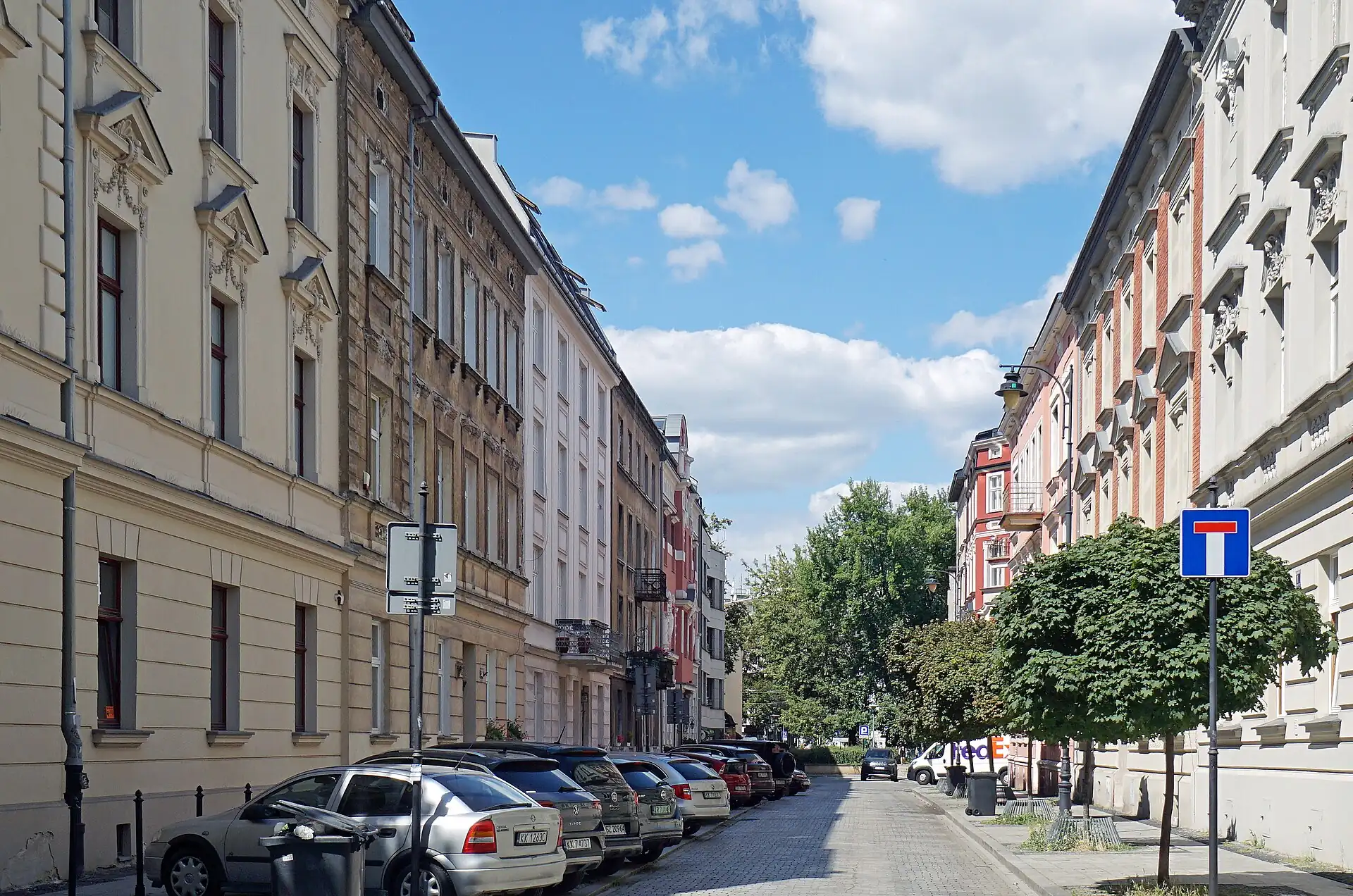
The core cluster: the Main Market Square, the Cloth Hall, St Mary's Basilica and the Planty park ring; flat, cobbled, crowded at noon in summer.
rescue 100% · max p90 4.1′ · half
A morning cluster: the castle and cathedral on the hill and the Vistula riverbank below; timed tickets in summer, open ground, little shade.
rescue 100% · max p90 4.1′ · half
An evening cluster: synagogues, cafés and the Plac Nowy stalls; flat and low-key by day, busy at night.
rescue 100% · max p90 4.1′ · half
A half-day cluster across the river: Ghetto Heroes Square and the Schindler's Factory museum; flat, with a museum for wet weather.
rescue 100% · max p90 4.1′ · half
Days
Ready-made day plans, timed against opening hours and walking distances.
How long are you staying?
Loose outlines: Old Town and Wawel by day, Kazimierz in the evening.
1 day
A stopover
- 09:00Wawel Royal Castle — Wawel hill
- 12:30Milk bar (bar mleczny) in the Old Town — Lunch in the Old Town
- 15:00Cloth Hall and Rynek Underground — Main Market Square and Cloth Hall
Skip: Kazimierz and Podgórze.
Kraków in 3 days
3 daysThe market square and a long lunch, then the castle hill and a Kazimierz snack, then a museum morning across the river; the last day ends with the bags already in hand for the airport train.
Day by day
Day 1: St Mary's Basilica, Cloth Hall, a 13:00 lunch table
- 09:00Obwarzanek ring-bread stalls (optional)
- St Mary's Basilica
- Cloth Hall and Rynek Underground (optional)
- 13:00Lunch table 13:00 (Old Town)
Day 2: Wawel hill and Plac Nowy zapiekanki
Day 3: Podgórze museum morning, train to the airport
- 08:30Schindler's Factory museum
- Ghetto Heroes Square (optional)
- 12:30Leave the hotel for the airport train at 12:30
Places
“Best time” is when to arrive for the fewest crowds, for example “before 08:30”; “Go any time” means the hour makes little difference. More sights follow under “More sights and museums”.
7 places. Filters use the guide’s own ratings; a place with no rating is left out when a filter is on.
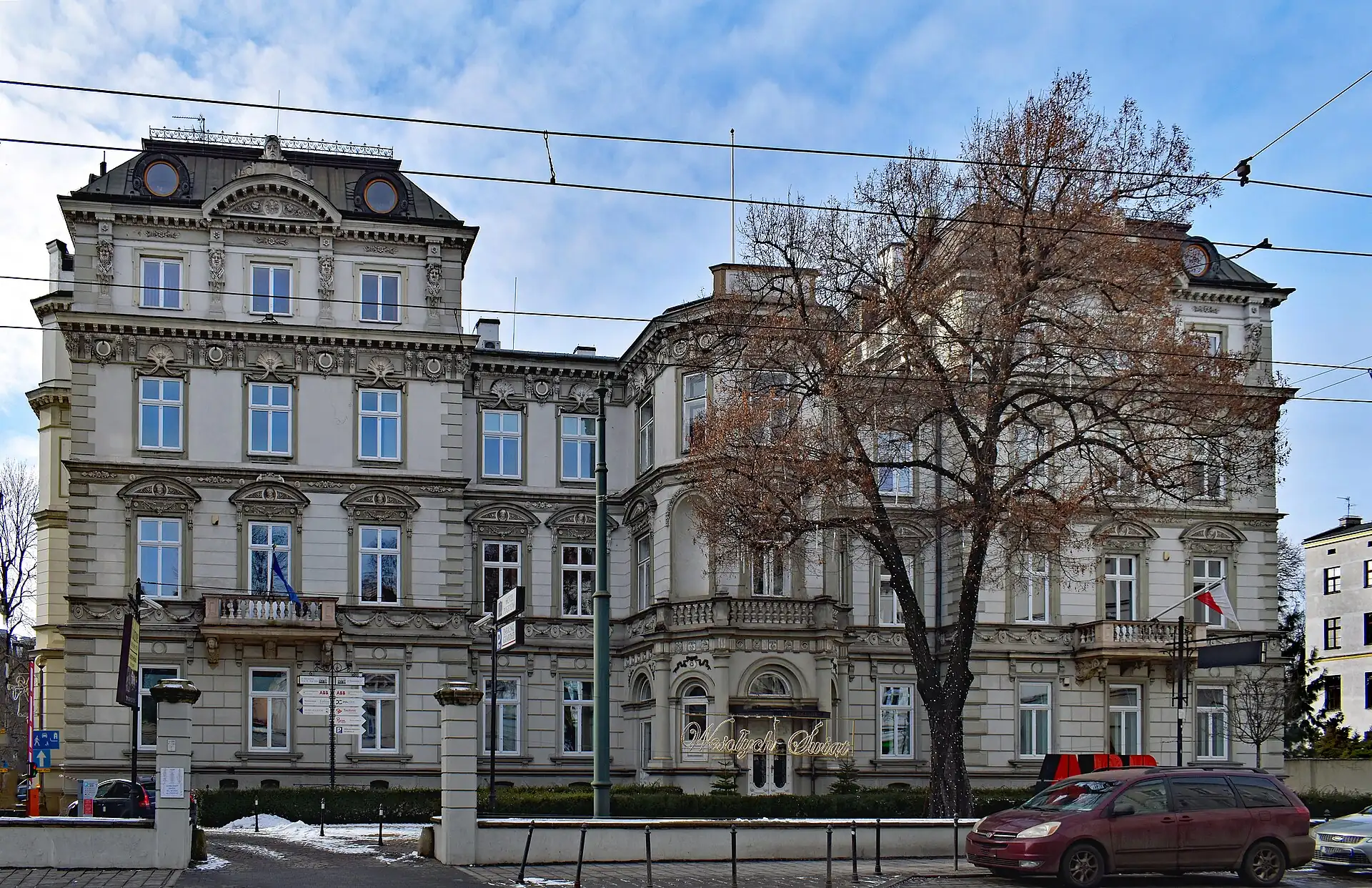
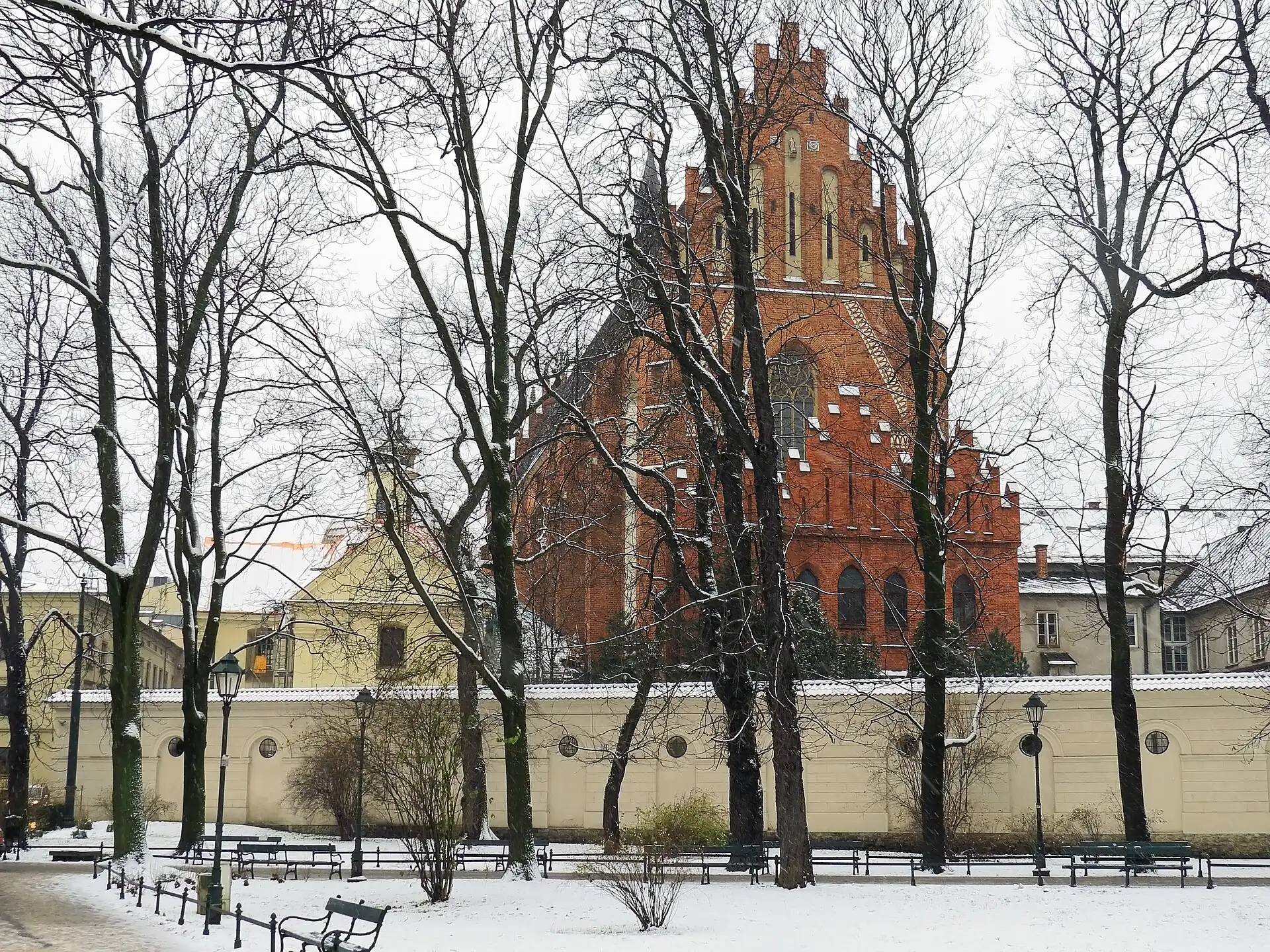
If you do ten things in Kraków
Ranked for a first visit of 2–4 days. Prices are 2026 estimate.
- 1
The royal castle and cathedral, the heart of Polish history.
- Time
- 2–3 h
- Best
- Morning
- Cost
- PLN 30–70 (≈ US$9–20) (check)
- 2
St Mary's Basilica and the hejnał
The Gothic altarpiece and the hourly trumpet call.
- Time
- 45–60 min
- Best
- Before noon
- Cost
- About PLN 20 (≈ US$6) (check)
- 3
Cloth Hall and Rynek Underground
A museum under the square that shows medieval Kraków.
- Time
- 1–1.5 h
- Best
- Midday
- Cost
- About PLN 30–40 (≈ US$9–11) (check)
- 4
The living centre of Jewish heritage in Kazimierz.
- Time
- 30–45 min
- Best
- Morning
- Cost
- About PLN 20 (≈ US$6) (check)
- 5
A large museum on the city under occupation.
- Time
- 2–3 h
- Best
- Morning, booked
- Cost
- About PLN 40–50 (≈ US$11–14) (check)
- 6
The classic Kraków street snack.
- Time
- 20–30 min
- Best
- Evening
- Cost
- PLN 15–25 (≈ US$5–7)
Good for…
Verdict is how well Kraków works for that traveller, not how nice it is.
Compact, clear and rich in sights.
- 1Wawel Royal Castle — The main royal sight.
- 2St Mary's Basilica — The square's landmark.
Flat centre, parks and trams.
- 1Wawel riverbank path — A flat river path.
- 2Cloth Hall and Rynek Underground — A hands-on museum.
Cheap food and beer by European standards.
- 1Milk bar (bar mleczny) in the Old Town — The cheapest hot lunch.
- 2Plac Nowy zapiekanka stalls — A cheap snack.
Cafés, cellar bars and river walks.
- 1Jama Michalika — A historic café.
Low-floor trams and a flat centre, but cobbles.
- 1Schindler's Factory museum — A modern museum with lifts.
Tours and classes: book or skip
Book through the hotel or an operator with written inclusions and a cancellation policy.
| Tour or class | Verdict | Typical price | Why | Check before paying |
|---|---|---|---|---|
| Old Town walking tour | maybe | PLN 50–100 (≈ US$14–30) (check) | Context for the square and Wawel. | Language, group size and meeting point. |
| Auschwitz-Birkenau guided visit | book | PLN 150–250 (≈ US$45–70) (check) | Timed entry and a guide are required or advised. | Ticket type, transport and bag rules. |
| Wieliczka salt mine tour | book | PLN 100–150 (≈ US$30–45) (check) | A booked slot avoids queues. | Language and time slot. |
| Nowa Huta communist tour | maybe | PLN 100–180 (≈ US$30–50) (check) | A different city in one district. | Vehicle and duration. |
What each season brings
Spring
Mar–May
Parks in flower and Easter events.
Watch: Rain in May.
Summer
Jun–Aug
Long days and terraces.
Watch: Crowds on the square and afternoon heat.
Autumn
Sep–Nov
Warm days and thinner crowds.
Watch: Rain and early dark in November.
Winter
Dec–Feb
Christmas market and cheaper rooms.
Watch: Cold, smog days and icy cobbles.
Photo spots and the light
Light times are for clear days.
| Spot | Best light | Tip |
|---|---|---|
| Wawel from the river | Evening | Shoot from the riverbank with the hill above. |
| St Mary's towers from the square | Morning | Step back near the Cloth Hall. |
| Kazimierz lanes | Golden hour | Look for the old shopfronts. |
Kraków travel FAQ
Answers are 2026 desk estimates; items marked (check) change.
Is Kraków expensive?
It is cheaper than Western Europe; budget PLN 160–320 (≈ US$45–90) a day excluding a bed.
Do I need to book Auschwitz-Birkenau?
Yes: book a timed ticket ahead, especially in summer.
Can I use euros?
Poland uses złoty; some places take euros at poor rates.
How do I get from the airport to the centre?
The train to Kraków Główny takes about 20 minutes.
Is the tap water safe?
Yes.
More to see and doSee & do · Learn & work · Rain & heat · Wheelchair and stroller
Wheelchair and stroller, place by place
How each place in this guide works for wheels, from its own page. Ratings are desk estimates unless a page says it was checked on the ground.
| Place | Step-free | Wheelchair | Stroller | What to know |
|---|---|---|---|---|
| Cloth Hall and Rynek Underground | partial | check | check | Lifts serve the underground; the square is cobbled. |
| Ghetto Heroes Square | yes | check | check | Level paved square. |
| Remuh Synagogue and cemetery | partial | check | check | Old building and uneven cemetery paths. |
| Schindler's Factory museum | yes | check | check | Modern museum with lifts and ramps. |
| Wawel riverbank path | partial | check | check | Steps at some access points; ramps exist (check). |
See & do
9 of 9
Kościuszko MoundKopiec Kościuszki
ViewsA man-made hill with a wide view over the city.
Zwierzyniec · Daylight (check) · About PLN 20 (≈ US$6) (check)(check)
Barbican and Florian GateBarbakan
landmarkThe surviving brick gate and the fortified round tower.
Old Town · Seasonal (check) · About PLN 15–20 (≈ US$5–6) (check)(check)
Old SynagogueStara Synagoga
MuseumsThe oldest surviving synagogue in Poland, now a museum.
Kazimierz · Closed Tuesday (check) · About PLN 20 (≈ US$6) (check)(check)
Nowa HutaNowa Huta
landmarkA planned socialist district; tours run from the centre.
East · Any time · Free(check)
Jagiellonian University Collegium Maius
MuseumsThe old university building with a museum of scientific instruments.
Old Town · Check · About PLN 20 (≈ US$6) (check)(check)
A flat path along the Vistula below the hill.
Wawel · Any time · Free(check)
Vistula river cruise
boatA short boat ride past Wawel; check the operator.
Wawel · Seasonal (check) · About PLN 40–60 (≈ US$11–17) (check)(check)
Food tour of Kazimierz
foodA guided walk with tastings; book ahead.
Kazimierz · Mornings and evenings · PLN 150–250 (≈ US$45–70) (check)(check)
Evening bar crawl
NightCellar bars and craft beer; watch the price of shots.
Old Town and Kazimierz · Evenings · PLN 100 (≈ US$30)+(check)
- Booking
- Book Wawel, Auschwitz-Birkenau, the salt mine and Schindler's Factory ahead in summer.
Learn & work
| What | Where | Cost | Note |
|---|---|---|---|
| Polish language courses | Language schools and the Jagiellonian University (check) | Varies (check) | Short courses run in summer.(check) |
| History and Jewish studies | Universities and heritage centres (check) | Varies (check) | Public lectures are sometimes open.(check) |
Working here
- Tourist entry
- Schengen rules apply; check your nationality.
- Work permit
- Work needs a visa or permit unless you are an EU citizen; check with the Polish authorities.
Rain-day and heat-day plan
Rain day
Rain is common in late spring and summer: keep museums for the wet hour and a café for the cold.
- 01Cloth Hall and Rynek Underground — The Rynek Underground museum is dry and well laid out.
- 02Schindler's Factory museum — A big indoor museum.
- 03Café stop — Old cafés such as Jama Michalika are good wet-day stops.
Heat day
Above 28 °C, do Wawel and the walks in the morning and rest indoors at midday.
- 08:30Wawel Royal Castle — Cooler air and thin queues.
- 13:00Cloth Hall and Rynek Underground — Cool museum halls.
- 19:00Remuh Synagogue and cemetery — Cool light in Kazimierz.
Day-trips and nearby
Places you can reach from Kraków in a day or with one night away, with the route and what it costs. Door to door, not ride time.
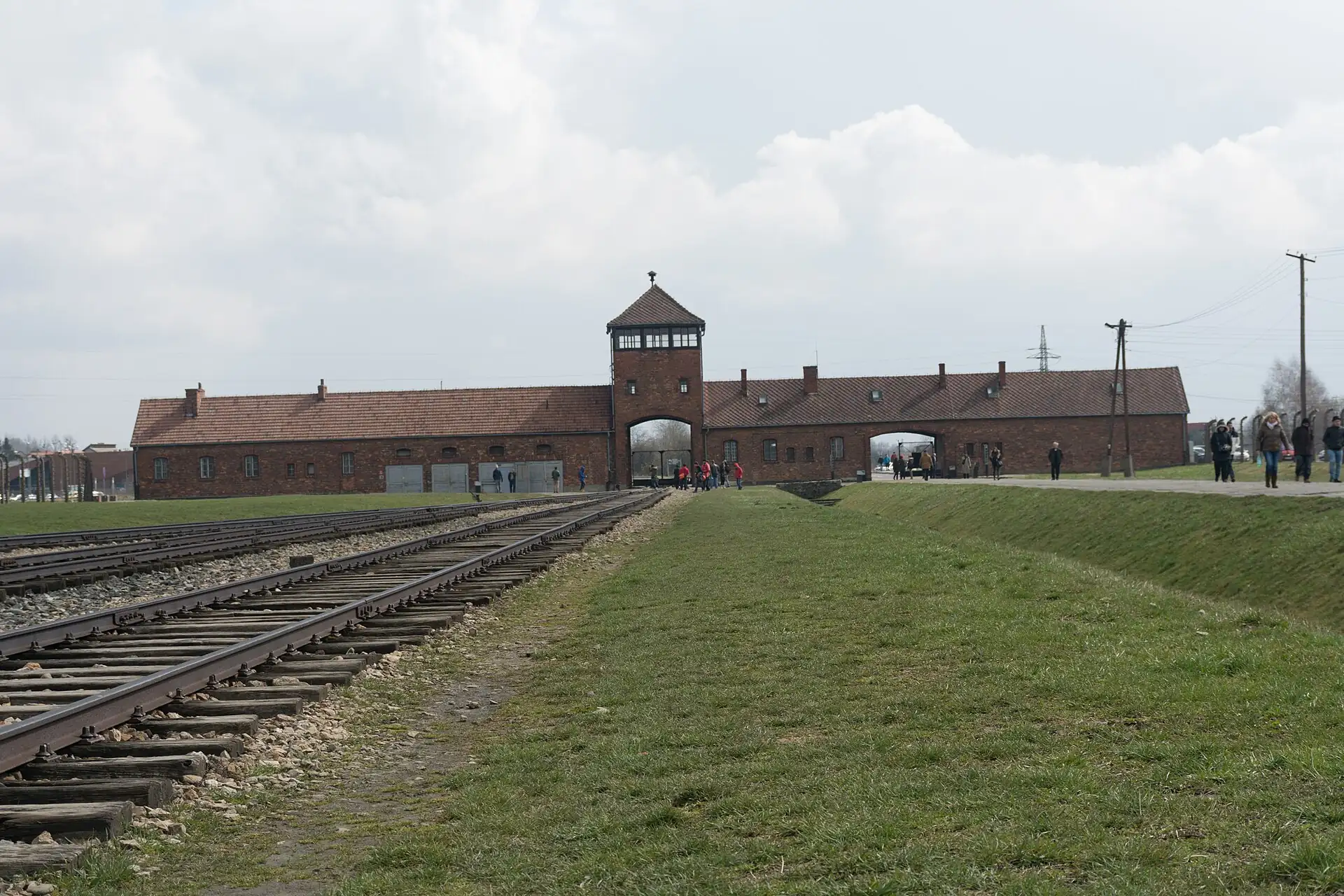 Photo: Lajos Gál, CC BY-SA 3.0
Auschwitz-Birkenau Memorial
goBus or tour about 1.5 h each way
Book a timed entry ahead on the official memorial site; large bags are not allowed.
- Time
- Full day (about 6–7 h)
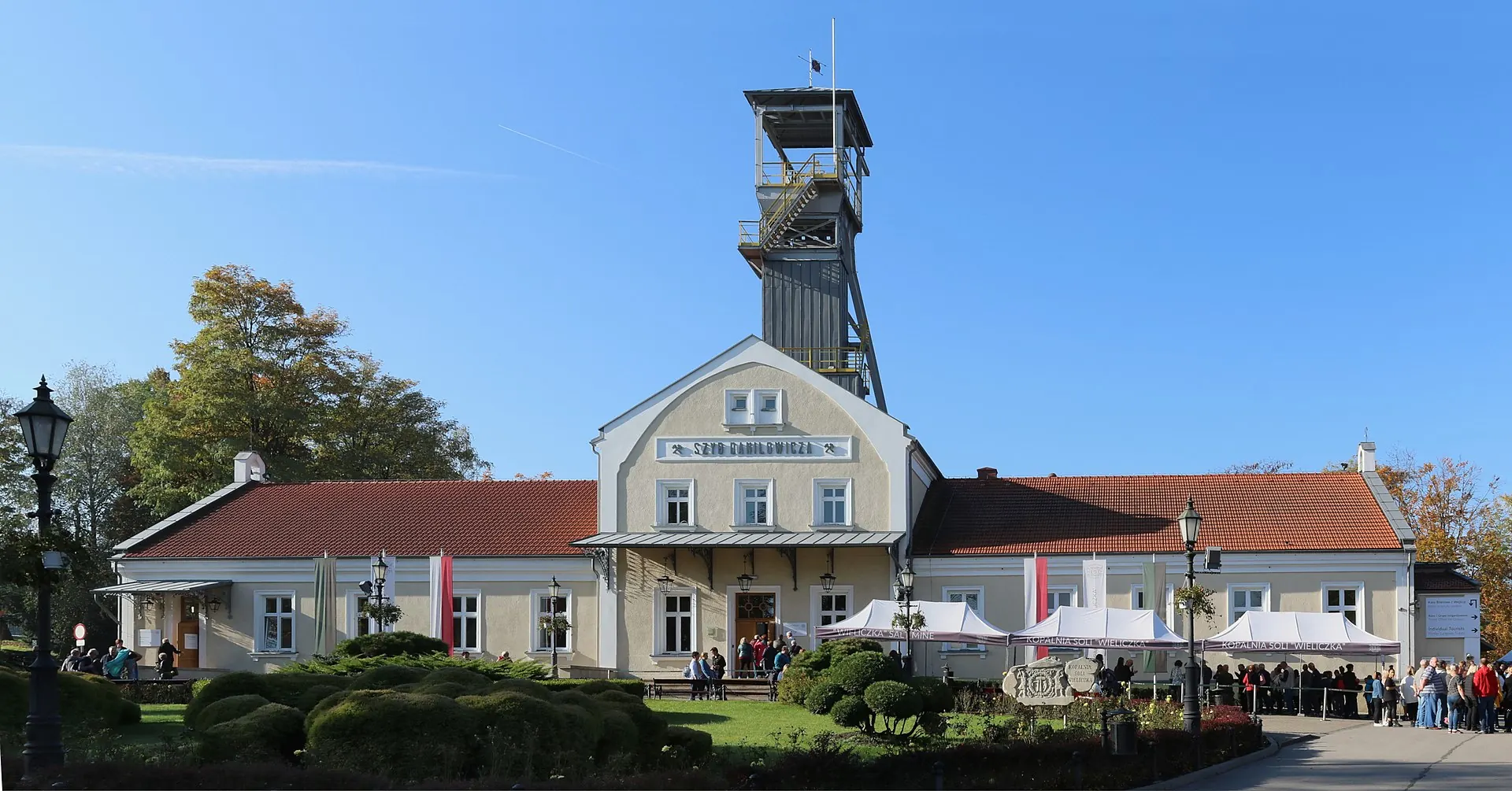 Photo: Ingo Mehling, CC BY-SA 4.0
Wieliczka Salt Mine
goTrain or bus about 30 min
Book a timed ticket ahead; steps down, lift up.
- Time
- Half day
Zakopane and the Tatras
overnightBus about 2–2.5 h each way
A separate 2-night trip, not a day trip at weekends.
- Time
- Too long as a day trip
Go next
Wrocław
maybeDoor to door: About 4 h
Train about 3 h 30
Better as an overnight.
Eat & sleepWhere to eat and which area to sleep in
Eat & sleep
Where to eat and which area to sleep in
Eat
A short list of places worth crossing the city for, each with how to get a seat.
Restaurant finder: filter every place to eat in Kraków →
Vegetarian-friendly score
3.5 / 5 · Good
- Country diet noteOur country guide rates vegetarian eating as easy.2 / 2
- Places to eat in this guide3 of 5 places with a known answer are vegetarian-friendly, 2 partly.1.2 / 1.5
- Budget eating lines0 vegetarian lines in "Eat by budget".0 / 0.6
- Meat-free national dishes6 meat-free dishes in the country food list.0.4 / 0.4
- Dedicated vegetarian kitchens0 mentions of vegetarian restaurants, Buddhist or fasting kitchens.0 / 0.5
Country note: Easy in cities (pierogi ruskie, placki, many vegan bistros); Warsaw is one of Europe's best vegan cities.
Vegetarian places near me →Make a diet card →
How we score
- Country diet note (up to 2): easy 2, workable 1, mixed 0.75, hard 0; no note 0.5.
- City places to eat (up to 1.5): 1.5 × (vegetarian-friendly + half of partly friendly) ÷ places with a known answer; needs 3 or more known places.
- Budget eating lines marked vegetarian (up to 0.6): 0.2 each.
- Meat-free national dishes (up to 0.4): 0.1 each.
- Dedicated vegetarian kitchens mentioned — Buddhist chay, shōjin ryōri, Jain, fasting food, vegan cafés (up to 0.5): 0.1 each.
- Total rounded to the nearest half point, 0 to 5. Built from our own pages only, not from reviews.
Eating and drinking guideEat by budget · Drink
Before you sit down to eat
Short version; full text linked
- Queues and hours
- Per person, one dish or one meal, 2026 estimate. More →
Eat by budget
Under PLN 30 (≈ US$9) a meal
| Where | Order | Area | Price | Note |
|---|---|---|---|---|
| Plac Nowy zapiekanka stalls | Zapiekanka | Kazimierz | PLN 15–25 (≈ US$5–7) | Eat standing at the window. |
| Obwarzanek ring-bread stalls | Obwarzanek ring bread | Old Town | PLN 3–5 (≈ US$1–2) | A street-corner snack. |
| Milk bar (bar mleczny) in the Old Town | Pierogi or soup | Old Town | PLN 20–35 (≈ US$6–10) | Cheap and quick; lunch hours. |
Dishes to know
| Dish | What it is | Where to look | When | Price |
|---|---|---|---|---|
| PierogiPierogi | Filled dumplings with cheese, potato, meat or cabbage | Milk bars and restaurants | Lunch and dinner | PLN 25–45 (≈ US$7–13) |
| ŻurekŻurek | A sour rye soup with sausage and egg | Restaurants | Lunch | PLN 20–35 (≈ US$6–10) |
| ObwarzanekObwarzanek krakowski | A ring of boiled and baked dough sold from street stalls | Main Market Square and street corners | Any time | PLN 3–5 (≈ US$1–2) |
- Cheap lunches: look for a bar mleczny (milk bar) or lunch set.
- Restaurants on the main square charge more; walk a street away.
- Many restaurants close by 22:00 outside the Old Town.Many restaurants close by 10:00 PM outside the Old Town.
Drink & nightlife
| Where | What | Until | Note |
|---|---|---|---|
| Kazimierz bar streets | Craft beer, cocktails and vodka bars | About 03:00 (check)About 3:00 AM (check) | Busy on weekend nights. |
| Old Town cellar bars | Beer and vodka in stone cellars | About 02:00About 2:00 AM | Watch prices on menus without a listed price. |
By style
| Style | What | Where | Price | Until |
|---|---|---|---|---|
| Polish beer | Lagers and craft beersAsk for a local brew. | Craft pubs and beer halls | PLN 12–20 (≈ US$4–6) a pint | About 02:00 |
| Vodka | Flavoured vodkas served in shotsPace yourself and eat first. | Vodka bars | PLN 10–20 (≈ US$3–6) a shot | Late |
Rules that bite
- Drinking in public is banned; do not carry open drinks in the street.
- Hen and stag groups are common at weekends: expect noise in the Old Town.
Sleep
Pick the area first: it decides your walk home at night and your first morning.
Which neighborhood fits you
Three questions, one recommendation, with the reasons.
More on sleepingSleep by budget · Your area · With kids
Sleep by budget
| Band | Price | Where | Room types | What to expect |
|---|---|---|---|---|
| budget | PLN 70–110 (≈ US$20–35) dorm bed · PLN 220–320 (≈ US$65–90) double | Kazimierz and the Old Town edge | Hostels and small guesthouses | Small rooms; check noise. |
| mid | PLN 350–700 (≈ US$100–200) | Old Town | 3–4 star hotels | Breakfast often included; check the walk with bags. |
Booking checks
- Ask for a courtyard room away from the square.
- Check the hotel's distance from the station for arrival.
Which area is yours
| If you are | Sleep in | Because |
|---|---|---|
| First visit and short stay | Old Town | Walk to the square, the Cloth Hall and Wawel. |
| Evenings, food and value | Kazimierz | Better prices and the most interesting streets after dark. |
01Old Town
First-timers: a hotel inside the Planty ring with a 24h desk; everything is a walk, but the lanes are cobbled and noisy at night.
Cafés, old synagogues and evening life: a quieter base, 20 minutes' walk from the square, with more apartments than big hotels.
Areas are in our default order until you tick a priority.
Scores are 1–5 desk judgements per priority (2026).
With kids
- The Planty park and Błonia meadow are easy for children; pavements are cobbled in the Old Town and Kazimierz.
- Trams are low-floor; strollers work on the flat centre but not always on cobbles.
- Museums with hands-on rooms, such as the Rynek Underground, suit older children.
PracticalMoney, essentials, safety and the pocket card
Practical
Money, essentials, safety and the pocket card
Money
What a day costs at three comfort levels, and how to pay.
- Budget
- PLN 120–200 (≈ US$35–55) excl. bed / day
- Mid
- PLN 200–400 (≈ US$55–110) excl. bed / day
- High
- PLN 400 (≈ US$110)+ excl. bed / day
- Transit card
- No transit card needed for the centre: walking, trams and ride-hailing; buy tickets in the jakdojade app.
- Cash rule
- Keep PLN 100 (≈ US$30) in small notes for kiosks and markets; withdraw at bank ATMs and decline conversion to euros or dollars.
More on moneyCosts · Budget · Buy
What things cost
- Milk-bar (bar mleczny) mealPLN 20–35 (≈ US$6–10)
- Bottle of water, shopPLN 4–7 (≈ US$2)
- Airport train to Kraków GłównyPLN 17–25 (≈ US$5–7)
Trip budget
| Hotel double room1 × 3 nights × zł 450 | zł 1,350 |
| Food, local transport, entries2 × 3 days × zł 320 | zł 1,920 |
| Airport train to Kraków Główny2 × zł 20 | zł 40 |
| Auschwitz-Birkenau day with transport2 × zł 180 | zł 360 |
| Salt mine ticket2 × zł 120 | zł 240 |
| eSIM2 × zł 50 | zł 100 |
| Buffer 10%Price creep, a taxi you did not plan, one splurge | zł 401 |
| Trip total≈ zł 735 per person per day, bed included | zł 4,411≈ US$1,300 |
2026 estimate in złoty; flights and tours excluded. Your choices decide the total.
Prices of common things
| Zapiekanka | PLN 15–25 (≈ US$5–7) |
| Milk-bar meal | PLN 20–35 (≈ US$6–10) |
2026 estimate; check locally.
Buy
- Bargaining
- Prices are fixed in shops, cafés and restaurants. A little bargaining is acceptable at flea markets in Kazimierz, but not elsewhere.
- Fixed-price check
- Souvenirs on the Main Market Square and in the Cloth Hall cost more than in side streets; compare before you buy.
Markets and shopping streets
| Where | What | When | Haggle | Note |
|---|---|---|---|---|
| Plac Nowy market | Antiques, vintage clothes and street food | Weekends (check) | little | The round building on the square is the market hall. |
| Stary Kleparz | Fresh produce, flowers and food stalls | Daily except Sunday (check) | no | A local produce market a short walk north of the Old Town. |
Shops by what they sell
| For | Where | Hours | Note |
|---|---|---|---|
| Amber, silver and crafts | Cloth Hall stalls and Old Town shops | About 09:00–19:00 | Ask for a certificate for expensive amber. |
| Groceries and water | Supermarkets and small shops across the centre | About 06:00–22:00 | Most shops close on most Sundays. |
Changing money
| Where | Verdict | Why |
|---|---|---|
| Bank ATMs | use | Withdraw złoty at bank ATMs; decline conversion to euros or dollars. |
| Exchange counters (kantor) | caution | Rates vary; compare before you exchange and avoid airport counters. |
ATMs
- Where
- Bank ATMs across the centre; avoid stand-alone machines with poor rates.
- Fees
- Fees are set by your own bank and the machine (2026 estimate); always choose to pay in złoty.
Essentials and accessEssentials · Access
Essentials
- Plugs & power
- 230 V; two-pin sockets (types C and E).
- Toilets
- Cafés, shopping centres and museums; carry small coins.
- Health
- Winter cold and smog days, summer heat, crowded pavements. Travel insurance with medical cover.
- Accessibility
- Cobbles and kerbs in the Old Town and Kazimierz; trams are low-floor; Wawel has ramps and steps.
- Laundry
- Hotels and self-service launderettes; check prices.
- Emergency numbers
- 112 (the EU number) works everywhere.
Pack
- Layers year-round and a rain jacket
- Shoes with grip for cobbles
- Something that covers shoulders for churches
- A light bag for Auschwitz (large bags are restricted)
Accessibility
Trams are low-floor and the centre is flat, but the Old Town and Kazimierz are cobbled and many buildings have steps. Wawel has ramps and stairs.
- Pavements
- Cobbles in the Old Town and Kazimierz; smooth asphalt elsewhere.
- Public transport
- Most trams are low-floor and there are ramps at many stops (check).
Sights, step-free or not
| St Mary's Basilica | step-free | Step-free entrance; the towers are stairs only. |
| Wawel Royal Castle | with help | Ramps and stairs; check which rooms are accessible. |
| Schindler's Factory museum | step-free | Modern museum with lifts. |
| Remuh Synagogue and cemetery | with help | Old building and uneven cemetery paths. |
Survive
Safety basics, the lines not to cross, and practical habits that save the day.
Safety
- Pickpockets work the market square, trams and the station: keep phones and wallets zipped.
- Use ride-hailing apps or the official taxi rank; avoid unmarked cars offering rides at the station.
- Winter ice on cobbles: shoes with grip.
- Emergency: 112 (the EU number) works everywhere.
Red lines
- Auschwitz-Birkenau is a memorial: dress respectfully, keep quiet and do not pose for photos.
- Churches: cover shoulders and keep quiet during services.
- Do not photograph people at close range without asking.
Practical
- Toilets: cafés, shopping centres and museums; carry small coins for public ones.
- Tap water is safe to drink; many people still choose bottled.
More on staying safeStay safe · Stay healthy · Safety map · Solo & women · Etiquette · Cope · Scams
After dark, by area
2 flagged areas
Day = about 07:00–19:00. What to watch in each area, day and night →
Scams and red flags
Walk away if you see these
- Unlicensed taxis at the station: use a ride-hailing app or the official rank.
- Restaurants near the square that add a service charge: check the menu before you order.
- ATMs that offer to convert to your home currency: decline and pay in złoty.
Stay safe
Crossing the road
- 01Trams have priority: look both ways at crossings.
- 02Cyclists use shared lanes on the Planty; step aside.
Hustles specific to this city
| Hustle | Where | The tell | What to do |
|---|---|---|---|
| Unlicensed taxis | Station and airport | Drivers approaching you in the hall | Use the rank or an app. |
| Drink-menu prices | Old Town cellar bars | No prices listed | Ask for the price before ordering. |
| Bogus street petitions | Main square | Someone asks you to sign | Say no and walk on. |
- Pickpockets
- Common on trams and the main square; keep bags zipped.
- Emergency
- 112 from any phone.
Stay healthy
Air quality by month
| Jan | Feb | Mar | Apr | May | Jun | Jul | Aug | Sep | Oct | Nov | Dec |
|---|---|---|---|---|---|---|---|---|---|---|---|
| ok | ok | ok | ok | ok | ok | ok | ok | ok | ok | ok | ok |
Winter smog can be bad on still, cold days; check an air-quality app.
- Cold
- Winter is cold: hat, gloves and shoes with grip.
- Sun
- Summer sun on the cobbles: hat and water.
- Water
- Tap water is safe.
Hospitals and clinics: see Cope.
Safety by area and hour
| Area | Day | Night | What to watch |
|---|---|---|---|
| Old Town | fine | caution | Pickpockets on the square; noisy weekend groups. |
| Wawel | fine | fine | Quiet river paths at night. |
| Kazimierz | fine | caution | Late bar crowds; keep bags close. |
| Podgórze | fine | fine | Fewer people at night around the bridge. |
- Use ride-hailing or the official taxi rank at night.
- Watch drinks and belongings in crowded bars.
Solo, women and LGBTQ+ travellers
Solo
- Very safe and easy; hostels are social and food is cheap.
- Join a walking tour to meet others.
Women
- Safe in the main areas; take ride-hailing late at night.
- Cover shoulders for churches.
LGBTQ+
- Legal in Poland, but attitudes are more conservative than in Western Europe; be careful with public displays outside a few venues.
Etiquette in Kraków
- Greetings
- Say Dzień dobry when entering a shop or café.
- Churches
- Cover shoulders and knees; keep quiet during services.
- Memorials
- Keep voices low and do not pose for photos at Auschwitz-Birkenau or the Ghetto Heroes Square.
- Tipping
- About 10% in restaurants if service is not added; round up for taxis.
- Punctuality
- Be on time for timed tickets and tours.
Cope
Hospitals and clinics that handle foreigners
| Where | Area | Use it for |
|---|---|---|
| University Hospital (Szpital Uniwersytecki) | Prokocim and the centre | Large hospital with emergency care; check the site for the nearest emergency department. |
| Pharmacies (apteka) | Across the city | Duty pharmacies stay open at night; the list is posted on the door. |
Visa extensions
- Entry
- Poland is in the Schengen area; check the entry rules for your nationality.
- Extending
- Short visits cannot usually be extended; ask the regional immigration office if you must.
Embassies and consulates
| Country | Address | Phone | Note |
|---|---|---|---|
| Most countries | Embassies are in Warsaw; the US, the UK and some others have consulates in Kraków | check | (check) |
- Lost passport
- File a police report, then contact your embassy or consulate.
- Emergency
- 112 works everywhere; police 997, ambulance 999, fire 998.
Apps and offline kitOffline kit
Offline kit
Set up before you leave, so Kraków still works with no signal or a dead roaming plan.
On your phone
- Maps: open the city in Google Maps, tap the place name, then Download offline map (or use an offline-maps app).
- Data: install an eSIM or buy a local SIM before the first taxi; the apps in this guide depend on it.
- Translation: download the local language for camera translation.
- Screenshots: booking confirmations, hotel address in the local script, and the emergency numbers.
This guide
Save the Kraków guide and its pages on this device; it opens without a connection.
Phrases that do the work
Greeting
Hello
Dzień dobry
jen doh-bri
Thanks
Thank you
Dziękuję
jen-koo-yeh
Please
Please / you're welcome
Proszę
pro-sheh
Market
How much is this?
Ile to kosztuje?
ee-leh toh kosh-too-yeh
Food
Delicious!
Pyszne!
pish-neh
Café
The bill, please
Poproszę rachunek
po-pro-sheh rah-hoo-nek
Basics
Excuse me
Przepraszam
psheh-prah-shahm
Basics
Yes / No
Tak / Nie
tahk / nyeh
Pocket card
Fill in, then print or save as PDF
Stays in this browser only; nothing is sent anywhere.
KrakówKraków
Pocket card · Voykit
My bed tonight
—
—
—
Proszę na ten adresPlease take me to this address
Emergency
- All emergencies112
- Police997
- Ambulance999
- Fire998
Embassy
Embassies are in Warsaw; some countries have consulates in Kraków.
My embassy: —
Fare anchors (2026 estimate)
- Airport train to Kraków Główny: About 20 min; PLN 17–25 (≈ US$5–7)
- Ride-hailing across the centre: PLN 15–35 (≈ US$5–10)
- Tram or bus ticket: PLN 5–7 (≈ US$2) for a time-limited ticket (check)
Show the address on your phone; your hotel can write the street and number on a card.
Deep diveHistory, reading, photos and every source
Deep dive
History, reading, photos and every source
Sources
- officialUK FCDO travel advice: Poland
- officialVisit Kraków (official city tourism site)
- officialKraków Airport
- secondaryWikivoyage: Kraków
Ask about Kraków
Loading…
Was this useful?