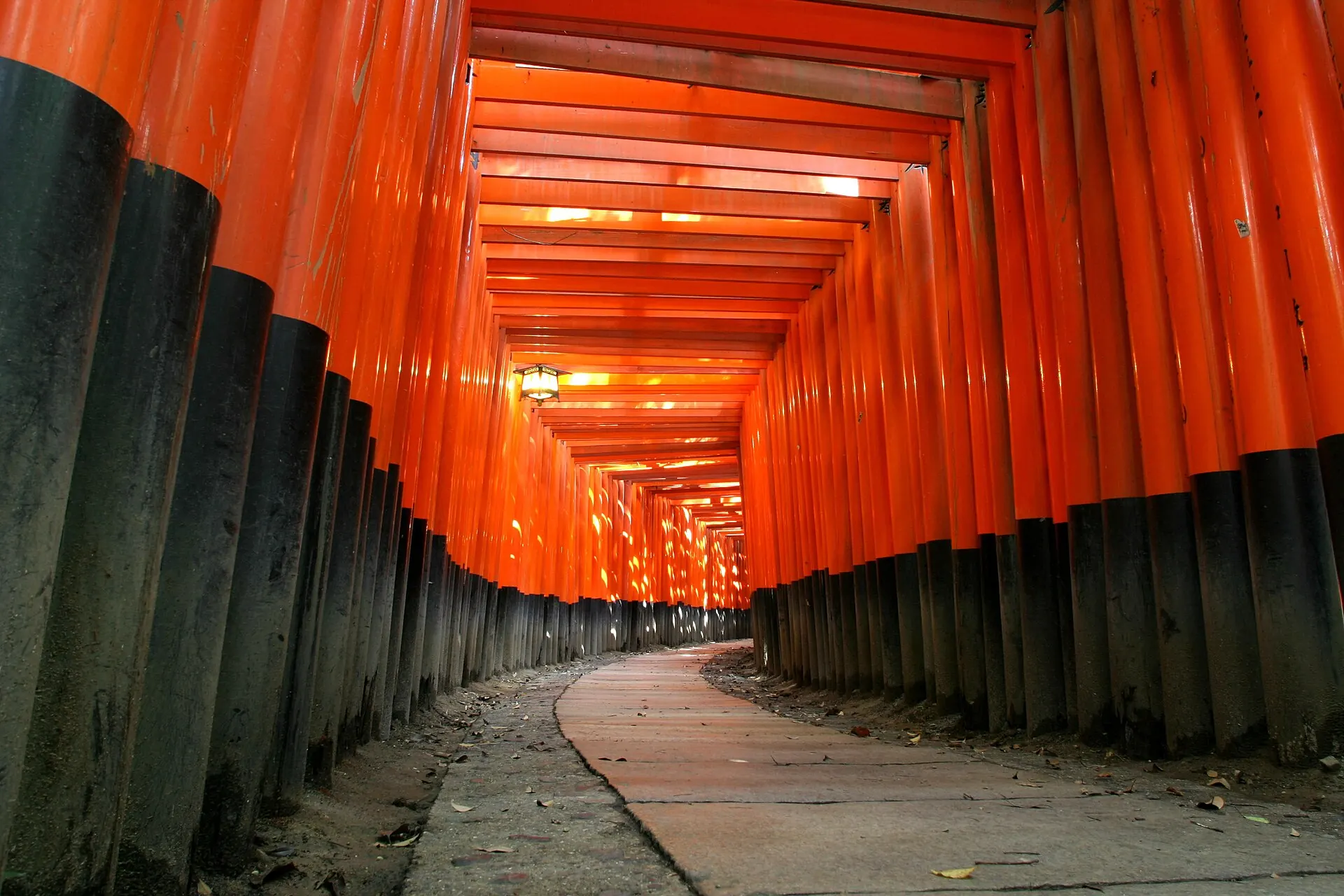
Fushimi Inari Taisha
Place · Fushimi (Inari)
Go before 08:00; turn back at Yotsutsuji unless you want 2–3 hours of steps. No entry cutoff — the grounds do not close.
- Grounds never close
- Turn back at Yotsutsuji
- Go before 08:00
- Free entry
Highlights come from Voykit's own data and desk notes, not from reviews. Hover a tag to see its source.
Rules in force · 8Large suitcases on Kyoto city buses
- East Asia ↗Every border in East Asia is a full international border, Hong Kong and Macau included: an entry permission for one never covers the next.
- East Asia ↗Ferries between Korea, Japan and China cancel in rough seas and typhoons; keep a flight or a spare day behind every sea leg.
- Japan ↗IC cards (ICOCA/Suica) are topped up with cash at station machines.
- Japan ↗Smoking while walking is banned in most city centres; use designated areas.
- Japan ↗Shinkansen bags 160–250 cm (L+W+H) need a seat reserved with the oversized-baggage area.
- Kansai ↗ICOCA is the default IC card; Suica works too.
- Kyoto ↗Large suitcases on Kyoto city buses: do not. Buses are crowded and oversized bags are refused or block aisles.
- Kyoto ↗Kyoto accommodation tax is often collected in cash at the front desk.
More
Map & directions
Add your hotel to get directions from it. · stays in this browser; shared with the pocket card.
Plan
Open now, best time to go, opening hours
Go now?
hours and prices: check on the day- Open
- Open 24 hours
- Crowds
Go before 08:00
MonTueWedThuFriSatSunQuietest Mon–Thu · busiest Sat, Sun · desk estimate
- Tickets
- Adult: Free
- Time to spend
- 90–150 min · up to 200 min if you linger
Best time to go
Lower gates crowded 09:00–17:00; above Yotsutsuji thins quickly.
By weekday: quietest Mon–Thu, busiest Sat, Sun.
Opening hours
- Hours
- Open 24 hours
- Note
- Shrine grounds are open at all hours; offices and prayer services keep their own hours.
- Hours note
- Grounds and gate trail open 24 hours; offices and shops keep their own hours.
Which month is quietest
- Janheavy
- Feblight
- Marheavy
- Aprpacked
- Mayheavy
- Junlight
- Julbusy
- Augbusy
- Sepbusy
- Octheavy
- Novpacked
- Decbusy
Quietest Feb · Jun · busiest Apr · Nov.
Estimate: desk reasoning from school-trip, weekend, season and holiday patterns; not counted. Holidays and events move these weeks.
Weather here, next 7 days
Loading forecast…
Forecast: Open-Meteo (CC BY 4.0), model data for this point.
Not checked in the last 12 months (no check date on file).
On the ground
Getting in, access, sensory load, what to bring, and where to go if it does not work
Getting in
- Stop
- JR Inari station (opposite the main gate) or Keihan Fushimi-Inari
- Exit
- JR Inari: walk straight to the torii
- Ticket
- free · official site
- Stairs
- up to yotsutsuji: 800 · full loop: well over 1,000 (estimate)
- Shoes
- Shoes on.
Accessibility
- PartialStep-free entrance · up to yotsutsuji: 800 · full loop: well over 1,000 (estimate)
- Check firstAccessible toilet
Sensory load
- Sensory load3/5 Medium
Exposure: medium
Bailouts
- fatigue: Yotsutsuji teahouses (seated)
- rain: Back to Kyoto Station (JR, 10 min)
Nearest rescue anchor: B — Main hall rest area
Problem
Red lines
- Night hikes above Yotsutsuji: poor lighting; not recommended for families.
Not checked in the last 12 months (no check date on file).
Map and nearby
Where it is, how to get there from your hotel or from where you stand, and what is around it
Map data © OpenStreetMap contributors
Add your hotel to get directions from it. · stays in this browser; shared with the pocket card.
Nearby places
Eat nearby
More detail
Everything else we know about this place
Tickets, prices and entry
Tickets & entry
- Where to buy
- No ticket needed.
- Free days
- Always free — Gardens and sub-temples inside these grounds often charge.
Free entry days in Kyoto (pick Kyoto in the tool; check)
Time on site, inside and your plan
Time on site
Minimum
45min
Worthwhile
90min
Typical
150min
p95
200min
How much time do you have?
Enough for a typical visit (150 min).
Visit times are typical figures, not promises; queues and closing times can change them.
Step-free check, who it suits, facilities
Step-free check
- Step-free entrance: partly · partlyup to yotsutsuji: 800 · full loop: well over 1,000 (estimate)
- Accessible toilet: check · check
The main shrine buildings and the first torii stretch are reachable; the mountain path is stone steps all the way up.
Combine with
Combine with
- —Yotsutsuji viewpoint (turnaround)
Walk the Fushimi (Inari) area · the cluster page has the walking order, rescue stops and after-dark notes
Best photo time
Best photo time today
Sun times for today load in your browser.
Deep dive
Questions, photos, and where our facts come from
Questions and answers
Questions and answers
How long does the full hike take?
2–3 hours to the summit and back; Yotsutsuji viewpoint is about 45–60 minutes up.
Checked 2026-09-28 · Voykit desk
Is it open at night?
Yes, the grounds are open all night and the lower gates are lit; bring a light higher up.
Checked 2026-09-28 · Voykit desk
Photos
Photos
Fushimi Inari Taisha Photo: Paul Vlaar, CC BY-SA 3.0
Fushimi Inari Taisha Photo: Jakub Hałun, CC BY 4.0
Fushimi Inari Taisha Photo: Basile Morin, CC BY-SA 4.0
Deep dive
Deep dive
Fushimi Inari Taisha (伏見稲荷大社) is the head shrine of Inari, the kami of rice and, later, of business, and the whole of Mount Inari behind it is the shrine. The famous tunnels of torii are not decoration but thousands of individual thank-you notes from companies and families. This deep dive explains how to read them, what the foxes are holding, and why the mountain is still covered in private altars.
1History1 min
The shrine dates its founding to 711, when the Hata, an influential clan descended from immigrants from the Korean peninsula, enshrined a kami on the three peaks of Inariyama. An old story in the provincial records tells of a Hata noble who used a rice cake as an archery target; it turned into a white bird, flew to the mountain and rice sprouted where it landed. The name Inari is often explained as ine-nari, ‘rice growing’. The mountain, 233 m high, was sacred before any building stood on it.
Like most of Kyoto, the shrine burned in the Ōnin War. The main sanctuary (honden) was rebuilt in 1499 and is the oldest structure on the site. Toyotomi Hideyoshi paid for the two-storey tower gate, the rōmon, in 1589, according to tradition in thanks for his mother’s recovery from illness. As merchants grew rich in the Edo period, Inari’s role widened from harvests to trade, and the custom of donating a torii to give thanks for a granted wish spread from about the 17th century.
Fushimi is the head of a network the shrine puts at around 30,000 Inari shrines across Japan, roughly a third of all Shinto shrines in the country. You will find small branches on department-store roofs, in office car parks and at farm edges; many large companies still keep one. The shrine marked its 1,300th anniversary in 2011. Branch shrines receive their kami by ritual division from Fushimi, which is why priests from across the country still come here.
- Founded
- 711, by the Hata clan
- Mountain height
- 233 m
- Main hall
- 1499
- Rōmon gate
- 1589, donated by Toyotomi Hideyoshi
- Branch shrines
- about 30,000 across Japan
2What you are looking at1 min
There are roughly 10,000 torii on the mountain. Each carries the name of its donor and a date, painted in black on the pillars. The inscriptions are on the uphill-facing side, so on the way up the tunnel looks like an unbroken run of orange; turn around and look down and every pillar is covered in writing. Most donors are businesses, from construction firms to small restaurants, often with their address. The shrine prices torii by size, from a few hundred thousand yen for the smallest to over a million for the largest, and a gate is replaced when it rots.
The colour is vermilion (shu), historically made with cinnabar and associated with warding off evil and with the vitality of the harvest. The feet of each gate are painted black to protect the wood from damp. Senbon Torii (‘a thousand torii’) is the stretch of two parallel tunnels just behind the main hall, where the gates are small and densely packed. It leads to the Okusha, the inner worship hall, where the omokaru-ishi stand: you make a wish and lift a stone lantern top; if it feels lighter than you expected, the wish is likely to come true.
Above and beside the trail are otsuka, thousands of small stone altars set up by families and groups, each inscribed with the name of their own form of the kami, such as Suehiro Ōkami. They are often crowded with miniature torii left as offerings. The trail climbs past teahouses to the Yotsutsuji crossroads, about 30–45 minutes from the bottom, which has a wide view over the south of the city. The full loop over the summit takes two to three hours.
- Torii on the mountain
- roughly 10,000
- Trail length
- about 4 km (2.5 mi)about 2.5 mi (4 km)
- To Yotsutsuji
- about 30–45 minutes
- Full loop
- 2–3 hours
3Legends and meaning1 min
The fox statues are not Inari but its messengers, kitsune. They come in pairs and usually hold something in their mouths. A key stands for the key to a rice granary; a ball or jewel for the spirit of the kami or for wishes granted; a scroll for wisdom; a sheaf of rice for the harvest. Many wear red bibs tied by worshippers. Some scholars think the fox itself was once worshipped as a rice spirit, since foxes hunted the rodents that raided granaries.
Foxes in Japanese folklore are shape-shifters, often taking human form, and are said to be fond of fried tofu. That is where the food names come from: kitsune udon is noodles topped with sweet fried tofu, and inari-zushi is rice packed into a pouch of it. Worshippers leave both as offerings at small altars. Fox-shaped wooden prayer boards (ema), on which visitors draw a face before writing a wish, are sold at the shrine and hung near the main hall.
Inari has no single fixed image. The kami is shown as a young woman carrying rice, or as an old man with a sheaf over his shoulder, and in Buddhist settings is linked to the figure of Dakiniten riding a white fox. At Fushimi, five kami are enshrined together. The flexibility is part of the appeal: many devotees give their household’s Inari a personal name, which is what the otsuka on the mountain record.
- Messenger animal
- fox (kitsune)
- Common objects in fox mouths
- key, jewel, scroll, rice sheaf
- Kami enshrined
- 5
- Offering food
- aburaage (fried tofu)
4How locals use it1 min
Business owners are the core congregation. In the first days of January the shrine receives huge numbers of New Year visitors, and the first Day of the Horse in February, Hatsuuma, is the traditional day to climb the mountain and pray for trade, carrying a sprig of cedar home as a charm. In spring the Inari Matsuri takes the kami out in portable shrines to a temporary shrine in the neighbourhood before bringing them back in early May.
Rice is still at the centre of the calendar. A rice-planting ceremony is held in the shrine’s sacred paddy in early June and a harvest rite in autumn, and in summer the Motomiya-sai fills the approach with lanterns donated by worshippers. The trail stays open at all hours, and local people walk it at dawn and in the evening as exercise, which is when the upper mountain is most quiet.
The streets between the stations and the gate have long sold pilgrims’ food. Stalls along the approach sell inari-zushi, kitsune udon and grilled skewers, and some older shops serve grilled sparrow and quail, a dish once common here. Fushimi’s sake breweries are a short train ride south, and shops near the shrine sell small fox-shaped earthenware bells and dolls, the Fushimi ningyō, one of Japan’s oldest clay toy traditions.
- Hatsuuma
- first Day of the Horse in February
- Inari Matsuri
- late April to early May
- Opening hours
- grounds open at all hours
- Local craft
- Fushimi ningyō clay dolls
Read, watch, wordsReading · Watching · Glossary · Sources
Reading
- The Fox and the Jewel: Shared and Private Meanings in Contemporary Japanese Inari Worship — Karen A. SmyersAn anthropologist’s study of Inari worship, largely based on fieldwork at Fushimi, that explains the otsuka and personal kami.
- Kitsune: Japan’s Fox of Mystery, Romance and Humor — Kiyoshi NozakiA collection of fox lore that explains why the statues look and act as they do.
- Kyoto: A Cultural History — John DougillSets the Hata clan and early Shinto sites in the story of the Kyoto basin.
Watching
- Memoirs of a Geisha — Rob Marshall, 2005Its best-known scene was filmed in the Senbon Torii tunnels, which explains many of the photographers there.
- Core Kyoto — NHK World-Japan, seriesShort documentaries on Kyoto shrines and festivals, including Inari worship.
Glossary
| Term | Local | Meaning |
|---|---|---|
| torii | 鳥居 | gate marking the entrance to sacred ground |
| Senbon Torii | 千本鳥居 | ‘a thousand torii’, the twin tunnels behind the main hall |
| kitsune | 狐 | fox, Inari’s messenger |
| otsuka | お塚 | private stone altar on the mountain dedicated to a personal form of Inari |
| omokaru-ishi | おもかる石 | ‘heavy-light stone’ lifted to test whether a wish will be granted |
| rōmon | 楼門 | two-storey tower gate |
| ema | 絵馬 | wooden prayer board; here shaped like a fox face |
| Hatsuuma | 初午 | first Day of the Horse in February, Inari’s main festival day |
| aburaage | 油揚げ | fried tofu, said to be the fox’s favourite food |
Read for this deep dive
Background reading only: the text above is written by Voykit, not copied from these pages.
Sources
| Field | Value | Source type | Confidence |
|---|---|---|---|
| cutoff.status | open 24h | secondary | 75% |
- officialFushimi Inari Taisha (official)
Was this useful?
Add Fushimi Inari Taisha to a day
Source: Price
Draft
Written from desk research. Not yet compared with the official source.
Prices are 2026 estimates. The official site has the current price.
Source: Opening hours
Source: Best hour
Draft
Written from desk research. Not yet compared with the official source.
No official source is recorded for this figure.
The quietest window written into this guide. Crowd levels are desk estimates, not counts.
Source: Bag rating
Draft
Written from desk research. Not yet compared with the official source.
No official source is recorded for this figure.
Rated for the whole walking cluster, from desk research, not for this entrance.