Taipei
臺北
Code TP · 4 walking zones
Taipei is an MRT city: temples and old streets in the morning, air-conditioned malls and museums at midday, night markets after 18:00 — and carry cash and an umbrella.Taipei is an MRT city: temples and old streets in the morning, air-conditioned malls and museums at midday, night markets after 6:00 PM — and carry cash and an umbrella.
Our quick read of Taipei, scored 1–5 (friction is out of 100). Cash need: how often you still need notes. Heat risk: how hot days get. Stroller: how easy wheels are. Friction: overall effort for a first visit. Desk judgements, so check before relying on them.
- Local time
- --:--
- Weather
- forecast below
- Currency
- TWD
- Best months
- Mar · Apr · Oct · Nov · Dec
- Airport
- Taoyuan (TPE)
Walking zones: the 4 areas this guide plans a day around. Each is a district you can cover on foot, so you do one zone per half-day and ride the train between them. The code (TP 01, TP 02…) is just the zone's number on the Taipei line; the line under each name says how bags fare there and how much time it needs.
Map of Taipei
Use the switches to show or hide each kind of pin. A switch that is on shows its pins on the map; tap it again to hide them. "Show only" keeps just the pins that match (for example, places that fit a suitcase). Tap any pin for its name and a link to its page.
- Where to sleep
- Places
- Eat
- Walking clusters
- Rest stops
From the airport Taoyuan (TPE) to your bed
Tap a pin for its card. Places without their own coordinates are shown by their walking cluster.
Why Taipei
Taipei's sights are spread over a flat basin and the MRT connects them, but the city is hot and wet for much of the year and small food stalls are cash-only. The trips that go wrong pay for it in three ways: noon walks in July, no umbrella in a typhoon-season shower, and a landing after 23:00 when the airport MRT has stopped. Four walking clusters cover a first visit; one bed is enough.
See first
- 1
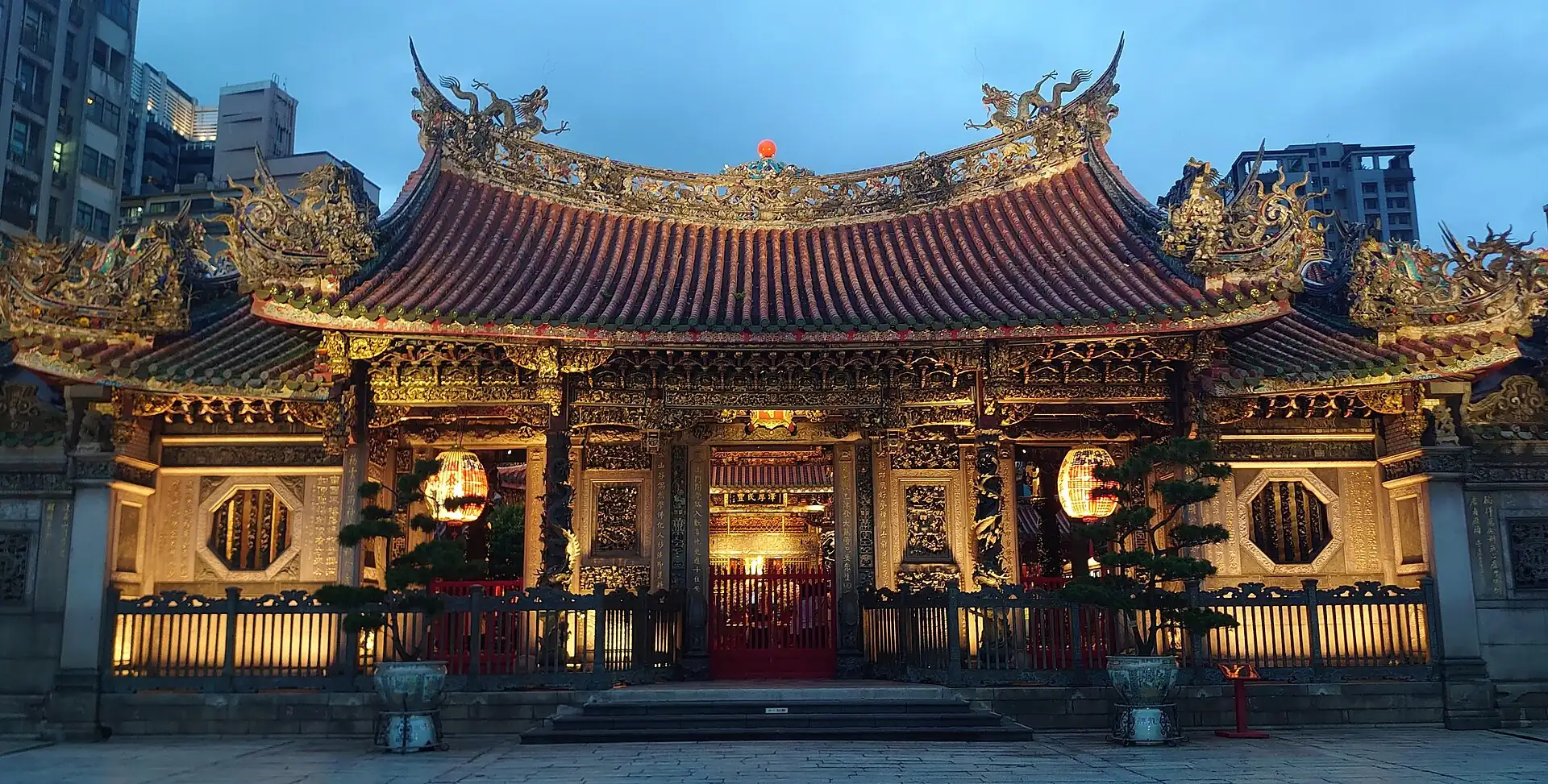 Longshan Temple · 45–60 min
- 2
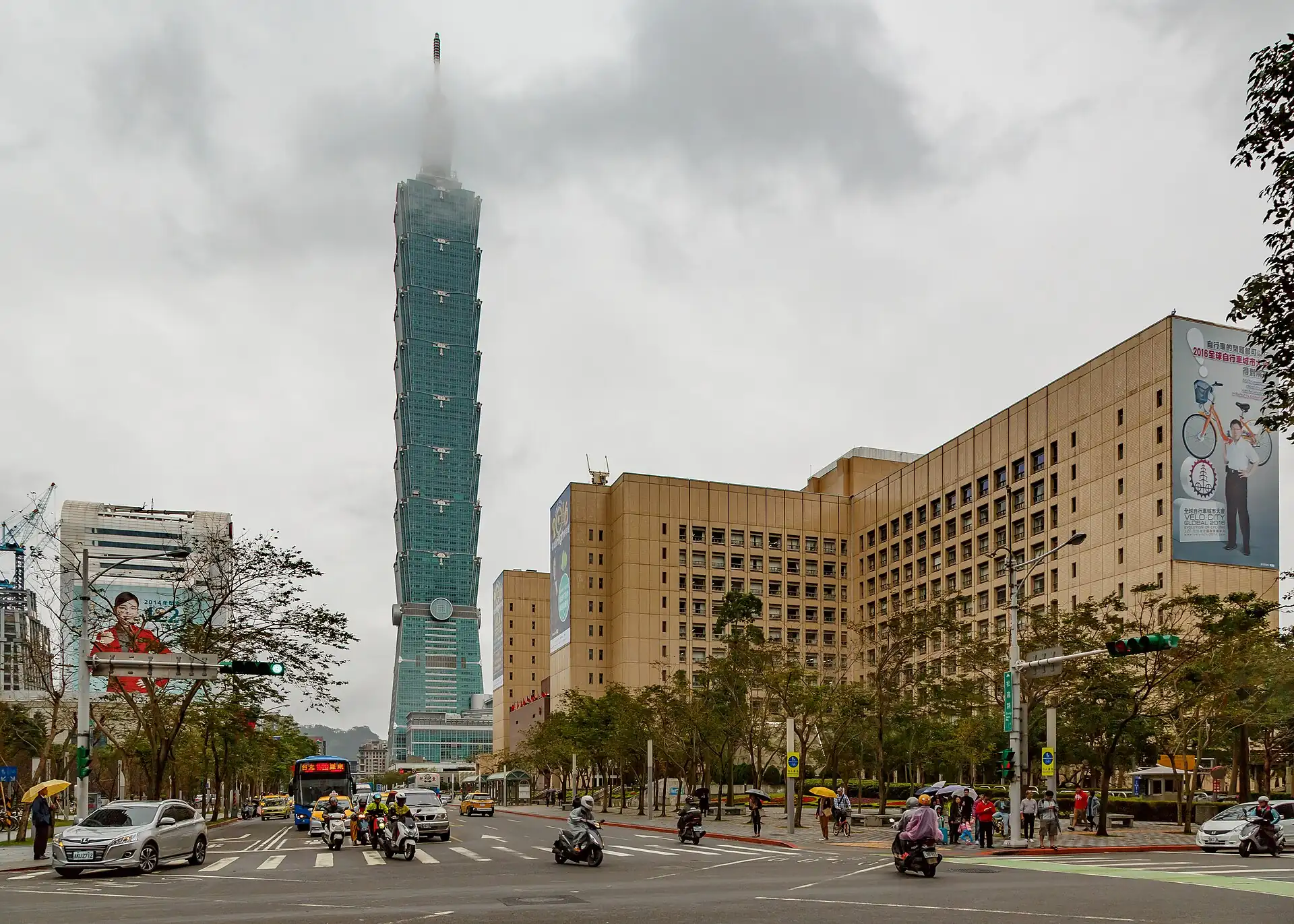 Taipei 101 and Xinyi · 1.5–3 h
- 3National Palace Museum · 3–4 h
- 4A night market (Shilin or Ningxia) · 2 h
- 5
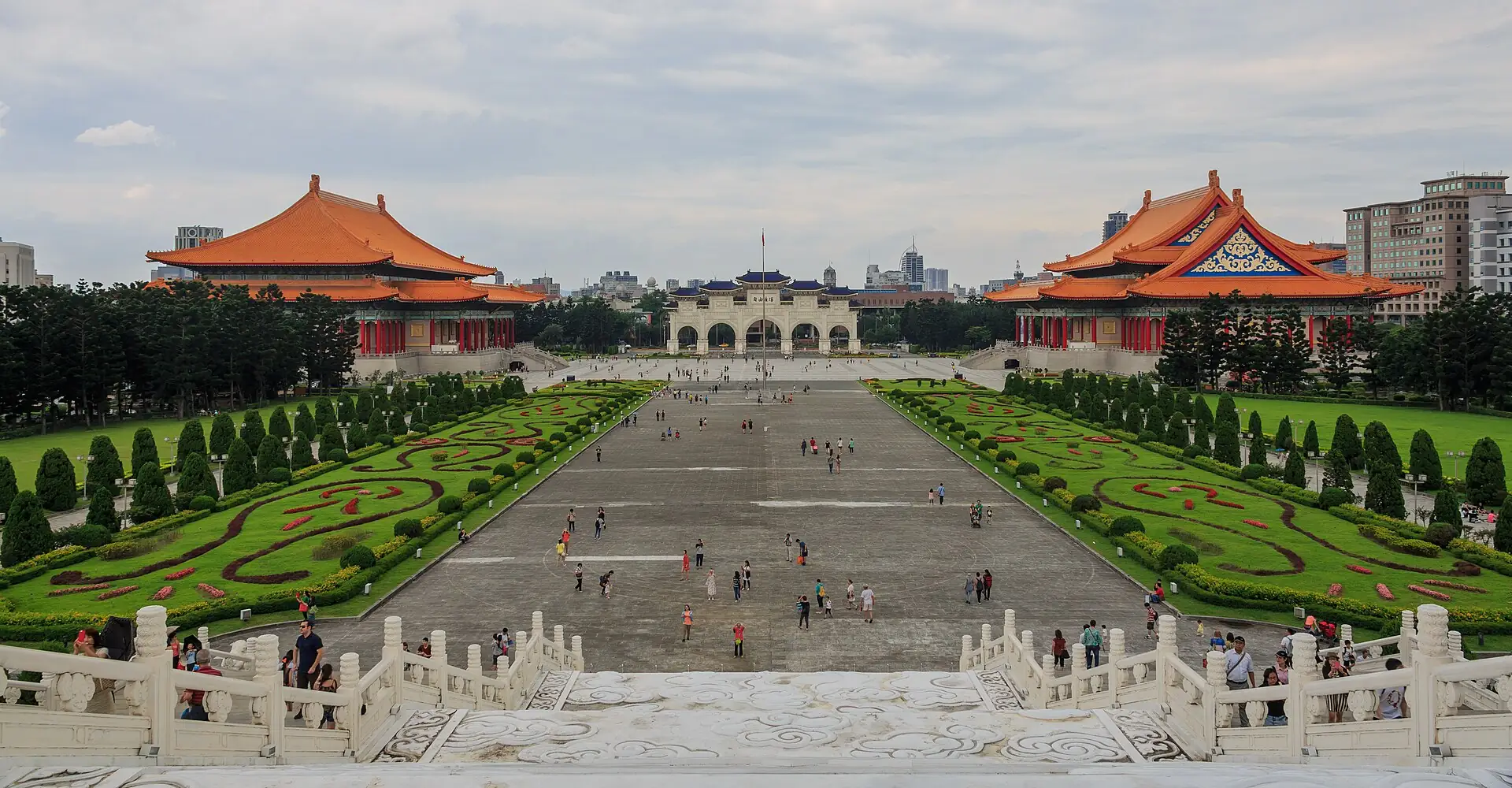 Chiang Kai-shek Memorial Hall · 1 h
Fits
- Food and night-market trips
- Temples and museums
- Short city breaks with rail day trips
Does not fit
- Midday walkers in summer
- Travellers who dislike humidity and rain
- Anyone who needs to avoid scooter traffic
How long
- 2 daysLongshan + Ximending, Chiang Kai-shek Hall + Xinyi
- 3 daysFour clusters, one per half-day
- 5 daysFour clusters + Beitou or Jiufen day trip + one slow day
Good for
- First timers
- Foodies
- Budget
- Couples
- Solo
- Families
About Taipei
Taipei sits in a bowl-shaped basin at the northern end of Taiwan, ringed by green mountains, with the Tamsui River curving along its west and north. Roughly 2.5 million people live in the city and about 7 million in the wider metro area. Taiwan (officially the Republic of China) governs itself, and Taipei is its capital and the centre of government, tech and culture. The city is compact and dense, and you rarely wait more than a few minutes for a train.
Good to know
- Ximending is the pedestrian shopping district; Ximen is the MRT station; Taipei Main Station is the rail and airport MRT hub.
- The Taipei Visitor Information Centre at Taipei Main Station and desks at the airport give free maps and English help (check opening hours).
- The Taiwan Tourism Administration runs a 24-hour helpline in English: 0800-011-765.
Go deeper 13 min read · 6 chapters
Taipei is a warm, wet basin city where a working temple, a Japanese-era market, a memorial to a general and the tallest building of its decade stand within a short MRT ride of each other. It is easy to enjoy on the surface, with its night markets, bubble tea and a train that arrives every few minutes. This deep dive reads the surface as layers: who built the port, who ruled the island, what changed when martial law ended, and how a small city turned its everyday food and tea into an identity. Each chapter points to a page in this guide where you can see the layer for yourself.
1History2 min
The Taipei basin was home to Indigenous Ketagalan people long before Han Chinese settlers arrived from Fujian in the 1700s. The settlers built river ports on the Tamsui and its tributaries: Bangka, now Wanhua, and later Dadaocheng, where tea and camphor were shipped out to the world. Longshan Temple was founded in Bangka in 1738 by settlers from Quanzhou who wanted a place to give thanks for the crossing and to pray for safety, and it has been rebuilt after fires, earthquakes and the bombing of the Second World War.
A walled city was built in the 1880s when the Qing government made Taiwan a province and named Taipei its capital. In 1895, after the first Sino-Japanese War, the island was ceded to Japan, and Taipei became a colonial capital for 50 years. Japan tore down most of the walls, laid out wide boulevards and built the Presidential Office, the National Taiwan Museum and the Ximen Red House, an octagonal market opened in 1908. Taiwan's modern water, rail and sewer systems began in this period, and the grid you see in the middle of the city comes from it.
In 1945 Japan surrendered and the Republic of China took over the island. Tension grew, and on 28 February 1947 a street incident in Taipei set off an uprising that the government put down harshly, with thousands killed. It is known as the 228 Incident, and it shaped the next four decades. In 1949 the Republic of China government lost the civil war on the mainland and moved to Taipei with about a million and a half soldiers and civilians. Martial law was imposed and lasted until 1987, one of the longest periods in the world, and public discussion of 228 was banned until the 1990s.
Since the 1980s Taipei has changed fast. Martial law ended in 1987, the first direct presidential election took place in 1996, and the first MRT line opened the same year. Taipei 101 opened in 2004 and was the tallest building in the world until 2010. Taiwan became the first place in Asia to legalise same-sex marriage in 2019. For a visitor, the value of the history is that it explains a mix that can look odd at first: a Japanese-era brick market beside a Qing-era temple, a memorial to a general beside a park to the victims of 228, and a high-tech district built around a shopping mall.
Today about 2.5 million people live in Taipei city and roughly 7 million in the metropolitan area. It governs itself, and its future status is a live political question, but daily life for a visitor is calm and practical. You can walk from a temple to a night market to a museum without meeting a single political sign, although you will see flags on National Day and posters at election time.
- Longshan Temple founded
- 1738, in the river port of Bangka (now Wanhua)
- Japanese rule
- 1895–1945; the Red House market opened in 1908
- Martial law
- Imposed 1949, lifted 15 July 1987
- First direct presidential election
- 1996
- Taipei 101
- Opened 2004; 508 m; tallest building in the world until 2010
2Layout and districts2 min
Taipei sits in a basin ringed by hills: Yangmingshan to the north, the Xindian hills to the south and the low ridges of Neihu and Nangang to the east. The Tamsui River runs down the west and north side, and the Keelung River curves through the northeast. The old city grew along the river and the newer city grew east, which is why Longshan Temple and Ximending are in the west and Taipei 101 is in the east.
Think of the city as three belts. The west belt (Wanhua, Ximending and Dadaocheng) is the old port and trading quarter. Its streets are narrow, its shophouses have arcades, and its temples are working temples. The middle belt (Zhongzheng and Da'an) holds the government, the museums and the parks, and it follows the wide boulevards laid out under Japan. The east belt (Xinyi) is the newer business and mall district, with Taipei 101 at its centre. Zhongshan and Datong sit north of the middle belt and have grown into a café and design area.
The MRT was built to connect these belts. The Red line runs from the Tamsui river mouth through Taipei Main Station and the memorial hall to Taipei 101. The Blue line runs east to west along the old boulevard through Ximen and Longshan Temple. The Green line links Ximen with the memorial hall and Da'an. A visitor can cover a first visit by learning three transfers: Taipei Main (Red and Blue), Ximen (Blue and Green) and CKS Memorial Hall (Red and Green).
Addresses use a road name plus a section number, then lane and alley numbers, so Xinyi Road Sec. 5 is a different place from Xinyi Road Sec. 2. Odd and even house numbers sit on opposite sides of the street. Google Maps handles all of it, but a taxi driver needs the address in Chinese characters, and your hotel can write the next stop on a card.
For planning, four clusters fit a first visit. Longshan Temple and Bopiliao make a dawn walk, Ximending is an afternoon and evening stop, the memorial hall and Liberty Square are a morning stop, and Taipei 101 with the Xinyi malls is a late-afternoon and rainy-day stop. Each cluster is flat and walkable inside, and each is one to three MRT stops from the next.
- Basin
- About 272 sq km for the city; hills on three sides
- MRT lines
- Red, Blue, Green, Orange and Brown, plus the Circular line
- Key transfers
- Taipei Main, Ximen and CKS Memorial Hall
- Address format
- Road, section, lane, alley, number; use Chinese characters for taxis
3Temples and everyday belief2 min
Taipei has several hundred temples, and they are not museums. Longshan Temple is a Buddhist and Daoist temple where the main hall is dedicated to Guanyin, the bodhisattva of mercy, and the rear halls hold gods of fortune, of the sea, of examinations and of matchmaking. People come before work, kneel, offer incense and leave, and you can watch in a few minutes how the ritual runs.
The etiquette is simple. Enter by the right-hand door, called the dragon door, and leave by the left-hand tiger door. Do not step on the raised threshold. Take the free incense at the entrance, hold it with both hands, bow toward the sky and place it in the burner outside. Inside, follow the person ahead of you around the altars. Do not point at statues, and do not take flash photos of worshippers.
You will also see the moon blocks and the fortune sticks. A worshipper asks a question, drops two crescent-shaped wooden blocks and reads the result: one flat and one round means yes, two round means unclear, two flat means no. If the answer is yes, they shake a cup of numbered bamboo sticks until one falls out, and take the matching poem slip to be read by a volunteer or a book. You can try it, but do not stand in the way of someone who is praying.
Belief in Taipei is also practical. Small offering tables appear on the street in the seventh lunar month, known as Ghost Month, when the gates of the underworld are said to open. Locals avoid weddings, big purchases and swimming in this period, and hotels often drop their prices. Businesses set out food at their door on the 1st and 15th of each lunar month, and shop counters often hold a small shrine with fruit and incense.
Xiahai City God Temple in Dadaocheng is a small, busy temple famous for matchmaking prayers, and Xingtian Temple in Zhongshan is a large Guan Yu temple where offerings are made without burning incense. For a visitor, the best way to see belief at work is to spend 45 minutes at Longshan at 07:00, watch a full round of prayers and then walk to the herbal tea shops on Herb Lane.
Taiwan is also open in a way that shows in temple life: a Buddhist temple, a Daoist temple and a Confucian temple may sit within a few hundred metres of each other, and local people visit all of them. A visitor is welcome at each, as long as they follow the rules of the day.
- Main god at Longshan
- Guanyin, with many other deities in the rear halls
- Door rule
- Enter right (dragon), leave left (tiger); do not step on thresholds
- Ghost Month
- The seventh lunar month, usually August–September
- Peak prayer days
- The 1st and 15th of each lunar month
4Food and night markets2 min
Taipei is one of the best cities in Asia to eat in because so much of the good food is cheap and a short walk from the MRT. The base of it is Taiwanese food, which grew from Fujianese and Hakka roots and picked up Japanese influences from the colonial period. After 1949 mainlanders arrived from every province and brought their noodles, dumplings and breakfast breads, so a single street can offer a Hokkien oyster omelette and a Shanghai soup dumpling.
Beef noodle soup is often called the national dish, and its origin in Taiwan is tied to soldiers and civilians who came after 1949. It is a braised beef and wheat-noodle soup, cooked in a soy-and-spice broth, and there is an annual contest for the best bowl. You can try one at Yong Kang Beef Noodle Shop near Dongmen Station, or at any neighbourhood shop for a lower price. Xiaolongbao, steamed soup dumplings with thin skins, are the other signature, and Din Tai Fung, which began in Taipei, made them known worldwide.
Breakfast is a category of its own. At places like Fuhang Soy Milk in Huashan Market, people queue at 06:00 for warm salty soy milk with vinegar and dried shrimp, a baked flatbread and a fried dough stick. It is a Taiwanese habit to eat a savoury breakfast out, on the way to work, in a shop that is closed by noon.
The night market is the most visible food institution. Stalls set up at dusk on streets and in covered lanes, and each one sells a single dish. Ningxia Night Market is a short street of local snacks, Huaxi Street is a covered market near Longshan Temple, Shilin is the largest, and Raohe has a temple at one end. Eat what has a queue, carry cash and small notes, and do not be alarmed by stinky tofu: the smell is stronger than the taste.
Drinks matter as much. Bubble tea, milk tea with tapioca pearls, was invented in Taiwan in the 1980s, and a shop on every corner sells it. Order by choosing the sugar level and the ice level, for example half sugar and less ice. Tea shops on Dihua Street and Yongkang Street serve oolong grown in the mountains, and a tasting of two or three teas costs less than a large bubble tea.
A few rules keep it easy. Look for a busy stall with a short menu, ask the price before they cook, and tip nothing. Vegetarians can use the Buddhist vegetarian buffets that appear on every block and are marked with the character 素. Food safety is generally good, and the risk is heat and crowds more than water.
- Beef noodle soup
- NT$200–450 a bowl; shop prices vary widely
- Xiaolongbao
- About NT$250–320 for 10 at Din Tai Fung (2026 estimate)
- Night-market snack
- NT$50–120; carry cash
- Bubble tea
- NT$50–80; order sugar and ice levels
5Monuments, memory and modern Taipei2 min
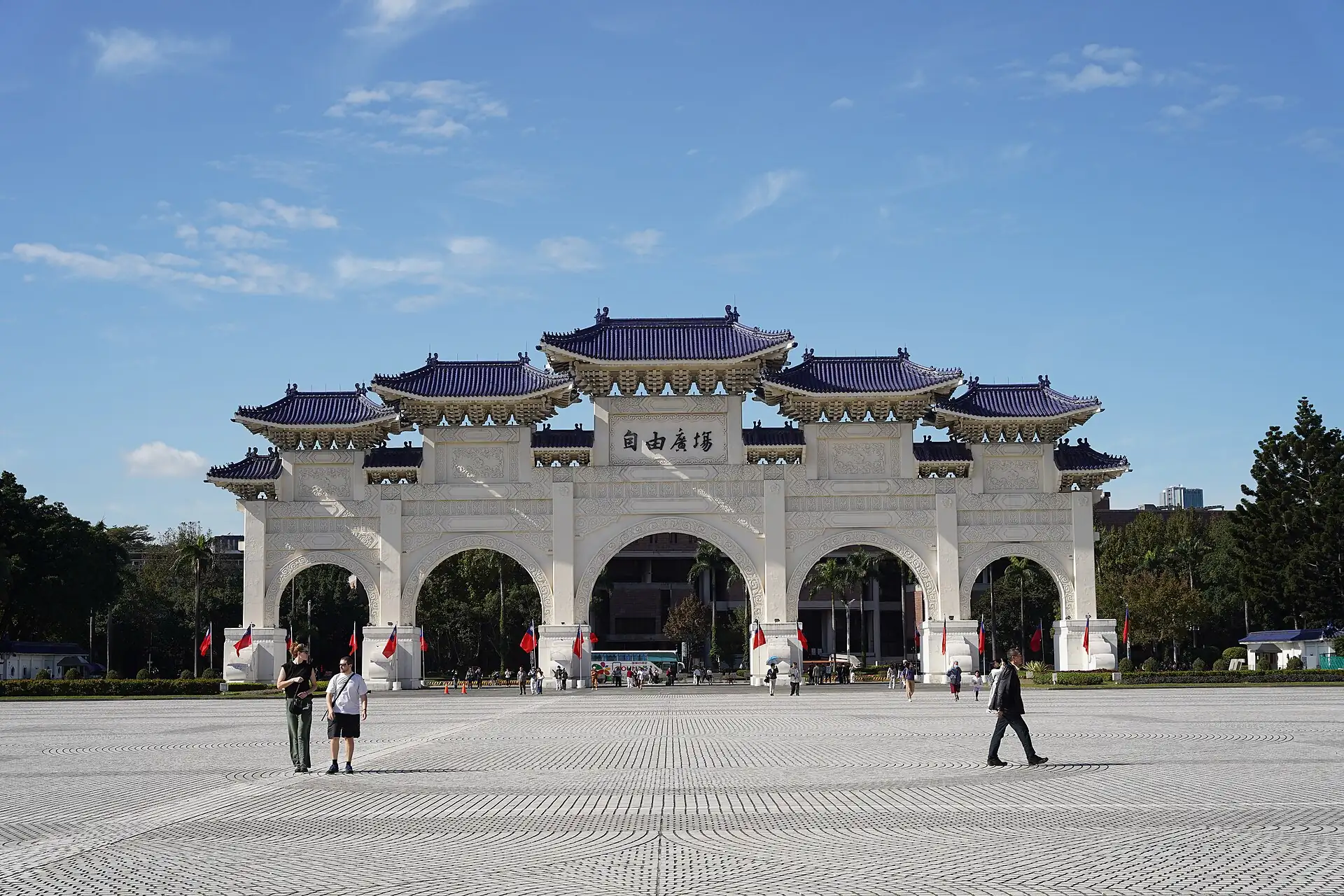
Two big public spaces in the middle of the city show how Taiwan has argued with its own history. The Chiang Kai-shek Memorial Hall, completed in 1980, is a white octagonal hall with a blue roof at the top of 89 steps, a nod to his age at death by Chinese counting, and it faces a vast plaza with a three-part arch. It was built as the centrepiece of a personality cult under martial law, and after democratisation it became a place to debate what to do with that legacy. Today it holds an exhibition on his life and a changing programme, and the plaza hosts concerts and school events.
A short walk away, 228 Peace Memorial Park and its museum tell the other side of the story. The museum documents the 1947 uprising and the decades of White Terror that followed. Together, the hall and the museum are a lesson in how a democracy has chosen to display the past: it has kept the hall and added a place to remember the victims. Change is still under discussion, so check the current display when you visit.
Taipei 101 is the modern counterpart. It rises 508 metres, and its shape of stacked segments echoes a pagoda and a bamboo stem. A huge steel ball called the tuned mass damper hangs between the 87th and 92nd floors to steady the building in typhoons and earthquakes, and you can see it from the observatory. The tower was the tallest building in the world from 2004 to 2010, and the mall at its base is one of the city's most popular.
Smaller sites fill in the middle. The Red House Theater has been a market, a cinema, a theatre and a creative-market plaza, and the neighbouring streets became a centre of LGBTQ life after martial law ended. Bopiliao Old Street was saved from demolition and restored as a heritage block, and it now hosts exhibitions and film shoots. The Songshan Cultural and Creative Park, a former tobacco factory, and Huashan 1914, a former winery, show how old industrial buildings became design spaces.
For a visitor, a good way to see this layer is a single morning: the memorial hall at opening, 228 Park and its museum, then the Presidential Office building from the outside before the lunch queue at a beef noodle shop. Keep quiet during the guard ceremony, avoid the marked route, and if you photograph the statue, do not climb on the steps.
- Memorial Hall
- Completed 1980; 89 steps; free
- Taipei 101
- 508 m, opened 2004; tuned mass damper of about 660 tonnes
- 228 Incident
- The 1947 uprising; commemorated on 28 February
- Same-sex marriage
- Legal since 2019, the first in Asia
6The year and daily life2 min
Taipei's year follows the weather and the lunar calendar. The best window for a visit is October to early December: 20 to 27 degrees, lower humidity and less rain. Summer, June to September, is hot, humid and stormy, with typhoons from July to October. Winter is cool and drizzly, around 13 to 20 degrees, and buildings often have thin walls and no central heating, so it can feel colder than the number.
The lunar calendar brings the big holidays. Lunar New Year, in late January or February, closes many shops and small restaurants for several days and fills trains and flights. The Lantern Festival ends the season, with lantern displays and busy temples. Tomb Sweeping in early April is a long weekend for family visits, Dragon Boat Festival in June brings rice dumplings and boat races, and Mid-Autumn Festival in September or October is a time for moon-viewing and barbecues. Ghost Month falls in August or September.
Daily life for a resident is dense and convenient. Most people live in apartments, ride the MRT or a scooter, and eat out for many meals. Convenience stores every few hundred metres act as parcel points, bill-payment desks and cafés. Sports fans follow professional baseball, and many people exercise in parks at dawn: expect to see tai chi, dancing and group walking in Da'an Forest Park and around the memorial hall before 08:00.
A few habits will help you fit in. Stand on the right of escalators, queue for the MRT on the marked spots, do not eat or drink in the paid area, and keep your voice low on trains. Take your shoes off if you enter a home, and do not stick chopsticks upright in a bowl. Tipping is not expected. If you are unsure how something works, ask; people are usually patient, and translation apps handle the rest.
For a first trip, the most useful planning rule is to match the weather. Do outdoor sights before 10:00 or after 17:00 in summer, keep a museum or mall for the afternoon storm, and carry a compact umbrella in every month. Go to a night market on a dry evening, take a taxi or Uber after midnight when the MRT has stopped, and keep two or three days free of a fixed schedule. Taipei rewards slow days more than a packed list.
- Best months
- October to early December
- Typhoon season
- July to October
- Lunar New Year
- Late January or February; many shops close for days
- MRT hours
- About 06:00–00:00; check the last trainAbout 6:00 AM–12:00 AM; check the last train
Read, watch, wordsReading · Watching · Glossary · Sources
Reading
- Taipei People — Pai Hsien-yungShort stories about mainlanders who moved to Taipei after 1949.
- Notes of a Desolate Man — Chu T’ien-wenA novel of a man in Taipei looking back at the city’s changes.
Watching
- A City of Sadness — Hou Hsiao-hsien (1989)A family drama about Taiwan after 1945, including the 228 Incident.
- Yi Yi — Edward Yang (2000)A family in modern Taipei; a slow, humane film.
- Taipei Story — Edward Yang (1985)A couple in 1980s Taipei as the city changes.
Glossary
| Term | Local | Meaning |
|---|---|---|
| MRT | 捷運 | Mass Rapid Transit, the Taipei metro. |
| EasyCard | 悠遊卡 | A rechargeable transport and payment card. |
| Xiaolongbao | 小籠包 | Steamed soup dumplings with thin skins. |
| Night market | 夜市 | An evening street market of food stalls, games and shopping. |
| Bubble tea | 珍珠奶茶 | Milk tea with tapioca pearls, invented in Taiwan. |
| Guanyin | 觀音 | The bodhisattva of mercy, the main god at Longshan. |
| Ghost Month | 鬼月 | The seventh lunar month, when offerings are made to wandering spirits. |
| 228 | 二二八 | Shorthand for the 28 February 1947 uprising and its aftermath. |
| Bian-dang | 便當 | A lunch box of rice, meat and vegetables. |
Read for this deep dive
Background reading only: the text above is written by Voykit, not copied from these pages.
Rules in force · 6
- East Asia ↗Every border in East Asia is a full international border, Hong Kong and Macau included: an entry permission for one never covers the next.
- East Asia ↗Ferries between Korea, Japan and China cancel in rough seas and typhoons; keep a flight or a spare day behind every sea leg.
- Taiwan ↗Check visa-exemption length, passport validity and the online arrival card (TWAC) on the official sites before you fly.
- Taiwan ↗An EasyCard (or iPASS) covers MRT, buses, local trains and many convenience-store purchases; buy one at the airport or a station.
- Taiwan ↗When a local government declares a typhoon day, transport and sights can close for the day; follow the official notice, not the forecast alone.
- Northern Taiwan ↗The north coast and Jiufen are wet for much of the year; carry a compact umbrella and do not plan a sunset view around clear skies.
Entry rules depend on your passport. Full visa guide
Emergency numbers for Taipei110 ▾
- Police110
- Fire and ambulance119
- Tourism helpline (English, 24 h)0800-011-765
Tap a number to call from your phone. These are the numbers listed in this guide; a row marked check has not been verified.
Planning is the full guide. I'm here keeps what is open and the cheat card.
Right now
Checking the weather…
Working out what is open near you…
What is open nowclock, closures, places open
Now in Taipei
Local time in Taipei
--:--
Loads in your browser · Asia/Taipei
This month
Month verdict appears here.
Closed today
See the weekly grid below.
| Weekly closure | Mon | Tue | Wed | Thu | Fri | Sat | Sun |
|---|---|---|---|---|---|---|---|
| Fuhang Soy Milk (Huashan Market)checkReported closed on Mondays; confirm before you go. | ✕ | · | · | · | · | · | · |
If today is a closure day: Monday: many museums close (check the National Palace Museum and small galleries) and some shops keep short hours; use the day for Longshan Temple, CKS Hall, Taipei 101 and a night market. Rainy day: the Palace Museum, malls and the National Taiwan Museum are the dry choices.
Open every day: Bopiliao Old Street, Chiang Kai-shek Memorial Hall, Liberty Square and the Arch, Longshan Temple, Red House Theater (Ximen Red House), Taipei 101, Ximending Pedestrian Zone.
- check National Palace Museum: Open most days; check the weekly closure and holiday hours on the official site.
- check Many small shops and cafés: Small shops close on their own days; check the sign or Google Maps.
Weekly closures come from our place pages. Public holidays (Lunar New Year, Tomb Sweeping, Dragon Boat, Mid-Autumn, National Day) add closures not shown here.
Open now
The sights and places to eat on our list that are open at this moment, in the city's time, nearest first from where you are staying.
Loads in your browser with the city's local time.
Hours marked (check) are typical, not confirmed. Walking times are straight-line estimates. Open at another time →
Cheat cardthe pocket version
Cheat card
The essentials on one card: save it as an image for your phone, share it, or print it.
Taipei
臺北
- Money
- Keep NT$1,000 in small notes for night markets; use convenience-store or bank ATMs, not machines on dark streets.
- SIM
- Install an eSIM before you fly, or buy a prepaid tourist SIM at the airport counters in the arrivals hall (passport…
- Ride app
- Uber
- Emergency
- 110 police · 119 fire and ambulance · 0800-011-765 Tourism helpline (English, 24 h) (not 911, 999 or 000)
- Plugs
- Sockets A. US/Canada (A/B): fits · UK/Ireland (G): adapter · Australia/NZ (I): adapter. 110 V: UK and AU 230 V-only devices need a converter; most chargers are dual-voltage.
Say it
- Hello: 你好 (nee-how)
- Thank you: 謝謝 (syeh-syeh)
- How much is this?: 這個多少錢? (juh-guh dwo-shao chyen)
- Not spicy: 不要辣 (boo yao la)
- Toilet: 廁所 (tsuh-swo)
Top 5
- Longshan Temple
- Taipei 101 and Xinyi
- National Palace Museum
- A night market (Shilin or Ningxia)
- Chiang Kai-shek Memorial Hall
EssentialsQuick answers, what things cost and how to get around
Essentials
Quick answers, what things cost and how to get around
Quick answers
The questions people ask first about Taipei, one line each. Tap a card for the full answer.
- Cash or card?Cards work in hotels, malls, department stores, chain restaurants and convenience stores.
- SIM or eSIMInstall an eSIM before you fly, or buy a prepaid tourist SIM at the airport counters in the arrivals hall (passport needed).
- Ride-hailing appUber.
- Tap waterDo not drink straight from the tap.
- TippingNot expected.
- Plugs & powerSockets A. US/Canada (A/B): fits · UK/Ireland (G): adapter · Australia/NZ (I): adapter. 110 V: UK and AU 230 V-only devices need a converter; most chargers are dual-voltage.
Show all 14 answers
- Safe at night?Take more care after dark in Longshan Temple and Bopiliao, Huaxi Street night market.
- What to wearLight, breathable clothes and a rain layer; a sweater for the cold air-conditioning.
- Emergency numbers110 police · 119 fire and ambulance · 0800-011-765 Tourism helpline (English, 24 h) (not 911, 999 or 000)
- Your embassyThe American Institute in Taiwan is in Neihu; the other offices are in Xinyi and Songshan.
- Closed which day?Mon: 1 on our list shut.
- Sundays & holidaysPublic holidays (Lunar New Year, Tomb Sweeping, Dragon Boat, Mid-Autumn, National Day) add closures not shown here.
- Rainy-day planShowers pass in 30–60 minutes and happen most days from May to September.
- Landing latecheckTPE: last airport MRT (express or commuter) to Taipei Main Station about 23:00, then airport bus to Taipei Main Station (check the last departure on the board) until about 23:30.TPE: last airport MRT (express or commuter) to Taipei Main Station about 11:00 PM, then airport bus to Taipei Main Station (check the last departure on the board) until about 11:30 PM.
Cost cheat-sheetwhat everyday things cost
Cost cheat-sheet
Typical prices for the everyday things, as ranges. Change the currency right here; the local price stays first.
2026 desk estimate · check
- Sit-down mealSit-down dinner, mid-range, per personNT$500–1,000 (≈ US$17–35)
- Street or quick mealSoy-milk breakfast (soy milk and a flatbread)NT$60–150 (≈ US$2–5)
- Taxi, about 5 km (3 mi)Taxi, about 3 mi (5 km)Taxi startA 10–15 minute ride is NT$150–250.NT$85 (≈ US$3)
- Metro or bus rideMRT ride with EasyCardFare depends on distance.NT$16–45 (≈ US$1–2)
- SIM or eSIM, a weekTourist SIM or eSIM, about a weekNT$250–500 (≈ US$9–17)
- Budget bedHostel dorm bed, a night, per personNT$700 (≈ US$25)
- Mid-range bedHotel double room, a night, per roomNT$3,500 (≈ US$120)
- High-end bedHotel double room, a night, per roomNT$7,500 (≈ US$250)
A day, not counting the bed: Budget NT$1,200 (≈ US$40) · Mid NT$2,500 (≈ US$85) · High NT$5,000 (≈ US$170)
Local prices, with USD next to them (rates 2026-09 (approximate); change it in the header). Ranges are desk estimates: check locally. Every price and the budget calculator →
Source: Prices in Taipei
Draft
Written from desk research. Not yet compared with the official source.
No official source is recorded for this figure.
Prices are 2026 desk estimates, not yet compared with an official source. Check on the day.
Not checked in the last 12 months (no check date on file).
DecideWho it suits, the trade-offs and when to go
Decide
Who it suits, the trade-offs and when to go
Best months at a glance
The guide's verdict for each month
Jan
Care
19°C (66°F)66°F (19°C)
Feb
Care
19°C (66°F)66°F (19°C)
Mar
Best
22°C (72°F)72°F (22°C)
Apr
Best
26°C (79°F)79°F (26°C)
May
Care
29°C (84°F)84°F (29°C)
Jun
Care
32°C (90°F)90°F (32°C)
Jul
Avoid
35°C (95°F)95°F (35°C)
Aug
Avoid
34°C (93°F)93°F (34°C)
Sep
Care
31°C (88°F)88°F (31°C)
Oct
Best
27°C (81°F)81°F (27°C)
Nov
Best
24°C (75°F)75°F (24°C)
Dec
Best
20°C (68°F)68°F (20°C)
Best: Mar–Apr, Oct–Dec. Mixed: Jan–Feb, May–Jun, Sep. Avoid: Jul–Aug. Month by month →
Warmest Jul (35°C (95°F)95°F (35°C)), coolest Jan (14°C (57°F)57°F (14°C) low), wettest May (14 rain days), driest Jul (10). Averages, not a forecast.
Taipei across the year
Best-looking months for Taipei: Apr, Oct, Nov. Rated avoid: Jul, Aug.
| Measure | Jan | Feb | Mar | Apr | May | Jun | Jul | Aug | Sep | Oct | Nov | Dec |
|---|---|---|---|---|---|---|---|---|---|---|---|---|
| Weather | Mixed (care) | Mixed (care) | Good (good) | Great (good) | Mixed (care) | Mixed (care) | Avoid (avoid) | Avoid (avoid) | Mixed (care) | Great (good) | Great (good) | Good (good) |
| Crowds | Medium (ok) | High (care) | Medium (ok) | Medium (ok) | Medium (ok) | Medium (ok) | High (care) | High (care) | Medium (ok) | Medium (ok) | Medium (ok) | Medium (ok) |
| Prices | Medium (ok) | High (care) | Medium (ok) | Medium (ok) | Medium (ok) | Medium (ok) | High (care) | High (care) | Medium (ok) | Medium (ok) | Medium (ok) | Medium (ok) |
| Events | 3 events (ok) | 3 events (ok) | 1 event (ok) | 2 events (ok) | 1 event (ok) | 1 event (ok) | 1 event (ok) | 1 event (ok) | 3 events (ok) | 2 events (ok) | 1 event (ok) | 4 events (ok) |
Green is good news, amber needs planning, red is a month to avoid; dashed grey with a question mark means our data does not say. Open the year heatmap →
Not checked in the last 12 months (no check date on file).
Source: Months, temperatures and crowds
Draft
Written from desk research. Not yet compared with the official source.
Monthly highs, rain and crowd levels are climate averages and desk estimates for the city, not a forecast.
Understand the cityUnderstand · Districts
Orientation & districts
Four areas cover a first visit, all on or near the MRT: Ximending and Wanhua in the old west, Zhongzheng around the memorial hall and Taipei Main Station, Zhongshan and Datong to the north for cafés and Dihua Street, and Xinyi in the east for Taipei 101. The Songshan-Xindian (Green), Bannan (Blue) and Tamsui-Xinyi (Red) lines link them; most rides are under 20 minutes.
Places are addressed by road and section (Sec. 1, Sec. 2). Google Maps and the Taipei MRT app route trains, buses and walking well. Show Chinese characters to taxi drivers.
Shaded shapes: walking areas (click one). Black pins: sleep areas. Grey dots: places. Round badges: arrivals. Click the map to turn on scroll-wheel zoom.
Hover, tap or tab to an area to see what it is like. Pins are sleep areas; arrows at the edge point to the airport.
Not drawn yet (no coordinates in this guide): Da’an and Yongkang Street, Shilin, Beitou. They are in the neighbourhood cards below.
Where’s what, as a list:
- Ximending (西門町): A pedestrian shopping district beside Ximen Station with the Red House and a Japanese-era grid; crowded and loud at night. Suits: First visit, snacks, cinemas, late nights. Price band $$.
- Wanhua and Longshan (萬華): Taipei’s oldest port district: Longshan Temple, Bopiliao and the Huaxi Street night market; the edges are rough after dark. Suits: Temples, old streets, herbal shops.
- Zhongzheng and Taipei Main Station (中正): Government buildings, the memorial hall and the rail hub for the airport, high-speed rail and Taiwan Railways. Suits: Transport links, the memorial hall and museums.
- Zhongshan and Datong (中山 / 大同): Larger hotels along the Red line and a young café scene; Dihua Street in Dadaocheng sells tea, herbs and cloth. Suits: Quiet stays, cafés, Ningxia night market, Dihua Street. Price band $$$.
- Da’an and Yongkang Street (大安): Restaurants around Dongmen Station and Da’an Forest Park; a good lunch area, easy from CKS Hall. Suits: Beef noodles, dumplings and the park.
- Xinyi (信義): A modern business and shopping district; air-conditioned and easy to walk between malls. Suits: Taipei 101, malls, evening views.
- Shilin (士林): In the north; the Palace Museum is a bus ride from Shilin Station and the night market is a short walk from the station. Suits: Night market, National Palace Museum.
- Beitou (北投): A thermal valley in the north; day trip by MRT Red line. Suits: Hot springs.
- Sleep area Ximending: suits First visit, snacks, cinemas, late nights, price band $$.
- Sleep area Zhongshan: suits Quiet stays, cafés, Ningxia night market, Dihua Street, price band $$$.
- Taoyuan International Airport (TPE), about 29 km (18 mi)18 mi (29 km) from the centre, 40–55 min by the usual route.
Neighbourhoods at a glance
One tab per area, pulled together from this guide’s districts table, area notes, sleep-area scores and place pages. Scores are desk judgements (1–5); prices are estimates, check before you book.
Ximending
$$西門町
A pedestrian shopping district beside Ximen Station with the Red House and a Japanese-era grid; crowded and loud at night.
- Suits:
- First visit, snacks, cinemas, late nights
- Best time:
- Late afternoon to 22:00Late afternoon to 10:00 PM
- Rooms:
- NT$600–1,000 dorm bed · NT$1,500–2,500 private room (from the sleep guide)
Pick this if: First timers, snack lovers, night owls
Watch out for: Saturday night if you dislike crowds.
- Quiet nights1/5 Very low
- Nightlife5/5 Very high
- Families2/5 Low
- Late arrival4/5 High
Why these scores
- Quiet nights: Loud until 01:00 on weekends; ask for a back room.
- Nightlife: Snacks, cinemas and bars at the door.
- Families: Crowded and loud at night; lifts are small.
- Late arrival: Most hotels have 24-hour desks; streets are busy late.
Getting around from here
- 15–22 min walk to Longshan Temple & Bopiliao
- MRT Green line: about 15 min to Chiang Kai-shek Memorial Hall & Liberty Square
- TPE: about 28 km (17 mi) in a straight line (arrival ride 40–55 min)TPE: about 17 mi (28 km) in a straight line (arrival ride 40–55 min)
Wanhua and Longshan
萬華
Taipei’s oldest port district: Longshan Temple, Bopiliao and the Huaxi Street night market; the edges are rough after dark.
- Suits:
- Temples, old streets, herbal shops
- Best time:
- 06:00–09:006:00 AM–9:00 AM
Pick this if: Culture, photographers, early risers
Watch out for: Side lanes after dark.
Getting around from here
- MRT or walk east: about 15 min to Ximending & Red House
- MRT: about 12 min to Chiang Kai-shek Memorial Hall & Liberty Square
- TPE: about 28 km (17 mi) in a straight line (arrival ride 40–55 min)TPE: about 17 mi (28 km) in a straight line (arrival ride 40–55 min)
Zhongzheng and Taipei Main Station
中正
Government buildings, the memorial hall and the rail hub for the airport, high-speed rail and Taiwan Railways.
- Suits:
- Transport links, the memorial hall and museums
- Best time:
- Morning
Pick this if: Sightseers, families, photographers
Watch out for: Midday sun.
Getting around from here
- MRT Red line: about 15 min to Xinyi & Taipei 101
- MRT Green line: about 15 min to Ximending & Red House
- TPE: about 30 km (19 mi) in a straight line (arrival ride 40–55 min)TPE: about 19 mi (30 km) in a straight line (arrival ride 40–55 min)
Zhongshan and Datong
$$$中山 / 大同
Larger hotels along the Red line and a young café scene; Dihua Street in Dadaocheng sells tea, herbs and cloth.
- Suits:
- Quiet stays, cafés, Ningxia night market, Dihua Street
- Best time:
- Evening
- Rooms:
- NT$12,000–25,000+ (from the sleep guide)
Pick this if: Quiet stays and cocktail bars
Watch out for: Nothing in particular.
- Quiet nights4/5 High
- Nightlife3/5 Medium
- Families4/5 High
- Late arrival4/5 High
Why these scores
- Quiet nights: Quieter streets and thicker walls.
- Nightlife: Cocktail bars and cafés, not clubs.
- Families: Bigger rooms and department-store food courts.
- Late arrival: 24-hour desks; the Red line runs to the airport hub.
Getting around from here
- 20–30 min walk to Ximending & Red House
- 25–35 min walk to Chiang Kai-shek Memorial Hall & Liberty Square
- TPE: about 29 km (18 mi) in a straight line (arrival ride 40–55 min)TPE: about 18 mi (29 km) in a straight line (arrival ride 40–55 min)
Da’an and Yongkang Street
大安
Restaurants around Dongmen Station and Da’an Forest Park; a good lunch area, easy from CKS Hall.
- Suits:
- Beef noodles, dumplings and the park
Xinyi
信義
A modern business and shopping district; air-conditioned and easy to walk between malls.
- Suits:
- Taipei 101, malls, evening views
- Best time:
- Late afternoon to evening
Pick this if: Shoppers, rainy days, views
Watch out for: New Year’s Eve if you want quiet.
Getting around from here
- MRT Red line: about 15 min to Chiang Kai-shek Memorial Hall & Liberty Square
- MRT: about 25 min to Ximending & Red House
- TPE: about 34 km (21 mi) in a straight line (arrival ride 40–55 min)TPE: about 21 mi (34 km) in a straight line (arrival ride 40–55 min)
Shilin
士林
In the north; the Palace Museum is a bus ride from Shilin Station and the night market is a short walk from the station.
- Suits:
- Night market, National Palace Museum
- Best time:
- Museum morning; market evening
Pick this if: Food and museum lovers
Watch out for: The market at peak weekend hours.
Beitou
北投
A thermal valley in the north; day trip by MRT Red line.
- Suits:
- Hot springs
- Best time:
- Weekday morning
Pick this if: A slow day
Watch out for: Weekend afternoons.
Ward by ward
8 area guides. Open one for the short answer, the key facts and what the area is like; the full guide is linked inside. Prices marked (check) are estimates.
BeitouBest for: Hot-spring hotels, families, slow mornings, Yangmingshan day hikes
Stay in Beitou if you want hot springs at your door and a quieter, greener Taipei; skip it if night markets, bars and late food matter more, since the last MRT trains downtown leave before midnight. Two nights is enough; one is fine if you only want a soak.
- Best for:
- Hot-spring hotels, families, slow mornings, Yangmingshan day hikes
- Worst for:
- Nightlife, late dinners, first-timers who want everything walkable
- MRT:
- Red line to Beitou, then the one-stop Xinbeitou branch to the springs
- Downtown ride:
- About 25–35 min to Taipei Main Station on the red line (check)
- Sulphur smell:
- Strong around Qinshui Park; noticeable in some rooms
- Room rates:
- 2026 estimate: NT$2,500–4,000 mid-range, NT$6,000+ for a private in-room spring
- Public soak:
- 2026 estimate: NT$40–60 at the public baths, more at resort spas (check)
What Beitou is like
Beitou is Taipei's northern hot-spring district, on the red MRT line. It splits in two. Old Beitou, around Beitou Station and Beitou Market, is an ordinary working neighborhood with cheap eats and local life. Xinbeitou, one stop further on the pink branch line, is the resort strip: Qinshui Park, the Hot Springs Museum, spa hotels and steam rising off the creek.
The Japanese built the first resorts here in the early 1900s and brought bathing culture with them; the name itself comes from an Indigenous word for 'witch', after the valley's sulphur haze. The 1960s concrete hotels have mostly been rebuilt as spa hotels, and the district now runs green and residential, popular with families who want space and a short commute.
Practical consequence: Beitou is quiet by 22:00. If your Taipei plan is night markets, bars and eating at 23:00, you will be riding the MRT home early or paying for taxis.Practical consequence: Beitou is quiet by 10:00 PM. If your Taipei plan is night markets, bars and eating at 11:00 PM, you will be riding the MRT home early or paying for taxis.
Full Beitou guideShould you stay here
Yes, for two groups. First, travellers who want a hot-spring soak without a separate trip — book a hotel with an in-room spring and it becomes the reason to stay. Second, families and slower travellers who value a park, a market and a mountain bus over a bar street.
No, if this is your first Taipei trip and you want the classic version: Ximending, Zhongzheng and the East District put night markets, temples and late food within walking distance. Beitou works better as a two-night add-on at the end, or as a base if you plan to spend a day on Yangmingshan.
A middle option many people use: stay downtown and come out for a half-day soak, then ride back for dinner.
East DistrictBest for: First trips, business travel, shopping, MRT convenience
Stay in the East District if you want Taipei's modern core — Taipei 101, malls, offices and the MRT red, blue, green and orange lines — within walking distance. Skip it if you want old streets, temples and cheap night-market dinners; Zhongshan, Zhongzheng or Old Taipei fit that better. It is the priciest, most convenient base for a first trip.
- Best for:
- First trips, business travel, shopping, MRT convenience
- Worst for:
- Budget beds, old-town atmosphere, temple sightseeing
- MRT lines:
- Red, blue, green and orange lines serve the area
- Anchor sight:
- Taipei 101, 508 m, observatory on floors 89 and 91
- Green space:
- Daan Forest Park, 26 hectares
- Walkability:
- High between Taipei 101, City Hall and Sun Yat-sen Memorial Hall
- Room rates:
- Higher than Zhongzheng or Zhongshan; 2026 estimate (check)
What the area is like
The East District is Taipei's financial and commercial centre, built on land that was mostly wetlands until the city expanded east. That late start is why it has wide blocks, towers and malls rather than the narrow lanes of the old town.
Taipei City Hall, the Taipei World Trade Center and Taipei 101 sit in Xinyi, with Daan to the west around Daan Forest Park. Days here are offices and shopping; evenings are restaurants, bars and the illuminated tower. It is the most modern part of Taipei and reads that way.
Full East District guideShould you stay here
Yes for a first visit if your days are built around Taipei 101, the MRT and easy taxis home at night. The red, blue, green and orange lines all touch the area, so most of the city is one or two changes away.
No if you want cheap beds, street-food breakfasts outside your door or the temple-and-lane atmosphere of the older districts. Look at Zhongshan, Zhongzheng or Old Taipei instead, and treat the East District as a half-day visit.
NeihuBest for: Hikers, families, tech-park business trips, longer stays
Stay in Neihu only if you want lakes, mountain trails and quieter nights, or you have business in the tech park; first-time visitors should base in Zhongzheng or the East District and ride the Brown Line out for a day. Neihu suits hikers, families and repeat visitors, not nightlife or temple sightseeing.
- Best for:
- Hikers, families, tech-park business trips, longer stays
- Skip if:
- You want night markets, bars and walkable sightseeing on your doorstep
- Metro:
- Brown Line (Wenhu Line) runs through Neihu to Nangang and downtown
- To Taipei Main Station:
- About 25–35 min by MRT with a change (check)
- To Taoyuan Airport (TPE):
- About 60–80 min by MRT and airport line (check)
- Room prices:
- Mid-range doubles roughly NT$2,500–4,500 a night, 2026 estimate (check)
- Quiet at night:
- Yes; most restaurants close by 21:30–22:00Yes; most restaurants close by 9:30 PM–10:00 PM
What Neihu is like
Neihu (內湖) sits in Taipei's east, on the north bank of the Keelung River, wrapped around two lakes and a ridge of low mountains. It is the city's tech and office district: Neihu Technology Park fills the middle, and the MRT Brown Line threads through it towards Nangang, where the exhibition halls and the Blue Line are.
The feel is suburban by Taipei standards. You get wide roads, office towers, apartment blocks, lakeside parks and trailheads rather than the dense lanes of Wanhua or Zhongshan. Evenings are calm; the food is everyday Taiwanese rather than destination dining, with a few night-market streets and plenty of small noodle and hotpot shops.
Two lakes anchor the district. Dahu Park (大湖公園) has a large lake, an arched bridge and Egret Mountain next to it; Bihu Park (碧湖公園) is a 13-hectare park around its own lake. Both are looped by paths and backed by hiking trails, which is the main reason to sleep here.
Full Neihu guideShould you stay in Neihu
Stay if your trip is about hiking, lakes and a quiet base, or if you are here for work in the tech park or at the Nangang exhibition halls. Hotels are cheaper and larger than downtown for the same money, and the Brown Line gets you into the city without a car.
Do not stay if this is your first visit and you want temples, night markets and bars within walking distance. The downtown sights sit 20–35 minutes away by MRT, and after the last trains the area is very quiet. Most first-timers are better off in Zhongzheng, the East District or Zhongshan, and treating Neihu as a half-day trip.
A workable compromise: two or three nights in Neihu for the trails and lakes, then move downtown for the rest of the trip. Changing hotels once in Taipei is cheap and quick by MRT.
Old TaipeiBest for: Temples, Dihua Street dry goods and tea, Longshan Temple, Ximending youth shopping, Huaxi Street Night Market
Stay in Old Taipei (Datong and Wanhua) if you want temples, Dihua Street and night markets within a 20-minute walk and don't mind a quieter evening scene; skip it if you want malls, bars and late-night buzz, and base in the East District instead. Two nights is enough.
- Best for:
- Temples, Dihua Street dry goods and tea, Longshan Temple, Ximending youth shopping, Huaxi Street Night Market
- Not for:
- Malls, cocktail bars, late-night dining beyond night markets — that is East District
- Metro:
- Beimen (green), Zhongshan (green/red), Ximen (green/blue), Longshan Temple (blue)
- Airport:
- Taoyuan (TPE) to Taipei Main Station by airport MRT, about 35–50 min, then 1–2 metro stops (2026 estimate)
- Walkability:
- Longshan Temple to Dihua Street is about 2.5 km (1.6 mi), 30–35 min on footLongshan Temple to Dihua Street is about 1.6 mi (2.5 km), 30–35 min on foot
- Quiet hours:
- Night markets wind down around 23:00; Dihua Street shops mostly close by 18:00–19:00 (check)Night markets wind down around 11:00 PM; Dihua Street shops mostly close by 6:00 PM–7:00 PM (check)
- Cash:
- Many Dihua Street and night market stalls are cash-only; carry NT$500–1,000 in small notes
What the area is like
Old Taipei means the two western districts of Datong and Wanhua, the oldest settled part of the city, on the flat land beside the Tamsui River. This was the commercial heart of Taipei until the 1990s, when the economic centre moved southeast to Zhongzheng and then to Daan and Xinyi. Much of the original architecture is gone, but the street pattern, the temple life and the wholesale trade remain.
The area splits into three usable pieces. Wanhua, in the south, is anchored by Longshan Temple and the Bopiliao brick lanes, with Ximending — the city's youth shopping and eating hub — just north of it. Dadaocheng, in Datong, is Dihua Street: restored shophouses selling Chinese medicinal herbs, dried goods, tea and, increasingly, crafts and coffee. Between them sits the North Gate, the only surviving Qing-era city gate, and Beimen station.
Practically, this is a daytime and early-evening district. Dihua Street shops mostly close by 18:00–19:00 (check), night markets run to about 23:00, and after that the streets go quiet. If you want bars and late restaurants, you will be taking the metro or a taxi east.Practically, this is a daytime and early-evening district. Dihua Street shops mostly close by 6:00 PM–7:00 PM (check), night markets run to about 11:00 PM, and after that the streets go quiet. If you want bars and late restaurants, you will be taking the metro or a taxi east.
Full Old Taipei guideShould you stay here
Yes if your Taipei list is temples, old streets, tea and night markets, and you want to walk to most of it. The metro is good: Beimen on the green line, Ximen on green and blue, Zhongshan on green and red, Longshan Temple on blue. Taipei Main Station, the airport MRT terminus and the high-speed rail, is one or two stops from Beimen or Zhongshan.
No if you want the modern city on your doorstep. Old Taipei has fewer international hotels than Zhongshan or the East District, quieter evenings, and some blocks around Longshan Temple and the old Wanhua commercial streets look worn. It is not unsafe, but it is not polished either.
A workable plan: two nights here for the old city, then move east or north for the rest of the trip. Staying the whole time is fine if you value the metro over walking out your door into nightlife.
ShilinBest for: Museums, night market food, families, Yangmingshan day trips
Stay in Shilin if you want the National Palace Museum, Yangmingshan and Taipei's biggest night market on one MRT line, and you accept a 15–20 minute ride to downtown. Skip it if you plan late nights in the East District or want to walk everywhere — Zhongshan or Zhongzheng puts you closer.
- Best for:
- Museums, night market food, families, Yangmingshan day trips
- Not for:
- Walk-to-everything downtown stays; nightlife crowds
- MRT:
- Shilin and Jiantan stations, Tamsui–Xinyi (red) line
- To Taipei Main Station:
- About 15–20 minutes by MRT, no transfer (check)
- Night market:
- Shilin Night Market, near Jiantan and Shilin stations; busiest after 18:00Shilin Night Market, near Jiantan and Shilin stations; busiest after 6:00 PM (check)
- Museum ticket:
- National Palace Museum NT$350 adults, free under 18 (check)
- Hotel range:
- Budget guesthouses to mid-range city hotels; 2026 estimate NT$1,500–4,500 a night (check)
What the area is like
Shilin is a large residential district in northern Taipei, not a single square. It runs from the dense streets around Shilin and Jiantan MRT stations up through Tianmu, an older expat and diplomatic quarter with its own shops and restaurants, to the edge of Yangmingshan National Park.
The district holds Taipei's biggest concentration of museums: the National Palace Museum, the Shung Ye Museum of Formosan Aborigines opposite it, the Taipei Astronomical Museum and the National Taiwan Science Education Center, all within a short bus or walk of each other. Shilin Night Market, the city's largest, sits between Jiantan and Shilin stations and is the reason many visitors know the name.
Day to day it feels local rather than touristy. Streets are wide, there are schools, hospitals and wet markets, and evenings belong to families eating at the night market. Tianmu adds a quieter, greener pocket with international supermarkets and a cinema.
Full Shilin guideShould you stay here
Choose Shilin if your Taipei list is museum-heavy, if you want Yangmingshan or Beitou within a short ride, or if you are travelling with children and value a calmer base. The red line runs straight to Taipei Main Station and downtown without a transfer, so the district is convenient even though it is not central.
Look elsewhere if you want to step out of your hotel into bars, cafés and the East District shopping streets, or if most of your evenings will end downtown after the MRT slows down. Zhongshan and Zhongzheng are more central for a first short trip; the East District suits nightlife.
Within Shilin, staying near Shilin or Jiantan station keeps the night market and the MRT walkable. Tianmu is quieter and greener but needs a bus or a longer walk to the red line.
WenshanBest for: Maokong tea hills, Taipei Zoo, gondola rides, quieter residential streets
Stay in Wenshan only if you want tea hills, the zoo and Maokong, or a cheaper room near NCCU — not for nightlife or first-trip sightseeing. Base in Zhongzheng or the East District instead, and ride the Brown Line south for a half-day in Maokong.
- Best for:
- Maokong tea hills, Taipei Zoo, gondola rides, quieter residential streets
- Not for:
- Nightlife, first-trip sightseeing, late-night food
- Metro:
- Brown Line (Taipei Zoo, Muzha) and Green Line (Jingmei, Wanlong)
- To Taipei Main Station:
- About 25–35 min by MRT with one change (check)
- Maokong Gondola fare:
- NT$70/100/120 by station count; NT$20 off with EasyCard on weekdays (check)
- Gondola hours:
- Mon–Fri 09:00–17:00, Sat–Sun 08:30–20:00; closed Mondays except the first of the month (check)Mon–Fri 9:00 AM–5:00 PM, Sat–Sun 8:30 AM–8:00 PM; closed Mondays except the first of the month (check)
- Taipei Zoo admission:
- NT$65 adults (check)
- Room prices:
- 2026 estimate: NT$1,800–3,500 double, cheaper than central Taipei
What Wenshan is like
Wenshan is the southern edge of Taipei, formed from the older towns of Jingmei and Muzha. The flat part along the Green Line is ordinary city: markets, schools, apartment blocks, a night market at Jingmei. The hills behind Muzha are something else — tea terraces, trails and the Maokong ridge, which is why people come.
It is a residential district first. Students fill the streets around National Chengchi University, families use the riverside parks, and the evenings are quiet. Two MRT lines serve it but meet at opposite ends, so getting across the district usually means a bus or a change of line.
Full Wenshan guideShould you stay in Wenshan?
For a first trip to Taipei, no. The sights you came for — the Palace Museum, Ximending, Yongkang Street, the big night markets — are 20–40 minutes away, and you will spend that time twice a day. Stay in Zhongzheng or the East District and visit Wenshan as a half-day.
Stay here if you have been to Taipei before, if you want a hotel near NCCU or the zoo, or if you are travelling with children and want the gondola and zoo on your doorstep. Rooms are cheaper than central Taipei and the streets are calm at night. The trade-off is real: last MRT trains run around midnight, taxis back from the centre cost money, and dinner options thin out after 21:00.Stay here if you have been to Taipei before, if you want a hotel near NCCU or the zoo, or if you are travelling with children and want the gondola and zoo on your doorstep. Rooms are cheaper than central Taipei and the streets are calm at night. The trade-off is real: last MRT trains run around midnight, taxis back from the centre cost money, and dinner options thin out after 9:00 PM.
ZhongshanBest for: Central location, MRT red and green lines, cafés, boutiques, museums
Yes — stay in Zhongshan if you want central Taipei with the MRT red and green lines, walkable cafés and boutiques around Zhongshan station, and easy access to the Grand Hotel and Xingtian Temple. Skip it if you want night-market bustle on your doorstep or cheaper rooms; look at Zhongzheng or the East District instead.
- Best for:
- Central location, MRT red and green lines, cafés, boutiques, museums
- Not for:
- Night-market atmosphere at the door, budget dorms, big green space
- MRT:
- Zhongshan station (red and green lines); also Shuanglian, Zhongshan Junior High School, Songjiang Nanjing
- Airport:
- Taoyuan (TPE) by airport MRT to Taipei Main Station, then 1–2 stops on the red line
- Walkability:
- High around Zhongshan and the Linsen/Changan lanes; less pleasant on the big roads
- Room prices:
- Mid-range NT$2,500–5,000 a night, 2026 estimate (check)
- Quietest hours:
- Weekday mornings; the bar lanes get loud late on weekends
What the area is like
Zhongshan sits in central Taipei, north of Taipei Main Station and west of the Songshan Airport corridor. The MRT red and green lines cross here, so most of the city is one or two changes away. The district is a mix of office blocks, older apartment lanes, department stores and a dense grid of small streets.
The part most visitors mean by "Zhongshan" is the block around Zhongshan MRT station and the lanes off Linsen North Road and Nanjing East Road. This is where the cafés, independent boutiques, small galleries and design shops cluster. It is a walking area, but the main roads are wide and busy; the good streets are the narrow ones behind them.
Zhongshan also holds several sights worth half a day: the Grand Hotel on the hill above Yuanshan, the Taipei Fine Arts Museum and the Taipei Story House next to it, Xingtian Temple near Minquan East Road, and the Miniatures Museum of Taiwan and Su Ho Memorial Paper Museum toward Songjiang Nanjing. The hills behind the Grand Hotel have a network of trails used by locals.
Full Zhongshan guideShould you stay here
Stay in Zhongshan if your trip is about the city rather than one sight: you want to walk out for coffee, come back late by MRT, and reach Taipei Main Station, the East District or the riverside in a few stops. It suits couples, solo travellers and anyone who values a central base over a specific view.
Look elsewhere if you want a night market outside your door — Shilin or the area around Ningxia in Datong fits better — or if you want cheaper rooms and a more local street feel, where Zhongzheng or the lanes near Taipei Main Station often win. Families may prefer quieter blocks near Shuanglian or further out.
Within Zhongshan, the trade-off is noise against convenience. Rooms on the bar lanes off Linsen North Road can be loud until late on weekends; rooms on the back streets toward Changan East Road are calmer and still a short walk from the station.
ZhongzhengBest for: First-timers who want one base on the MRT, TRA and HSR network
Stay in Zhongzheng if you want Taipei Main Station, the MRT interchange and the HSR under your hotel, plus the Chiang Kai-shek Memorial Hall and 228 Peace Park on foot. Skip it for night-market evenings or a quieter residential feel — pick Zhongshan or the East District instead.
- Best for:
- First-timers who want one base on the MRT, TRA and HSR network
- Landmark:
- Chiang Kai-shek Memorial Hall, free entry, CKS station on the Songshan-Xindian (Green) line
- Station:
- Taipei Main Station: Red and Blue lines, plus TRA and HSR
- Gongguan:
- University quarter at the south end, Green line, student food and bookshops
- Luggage:
- Lockers at Taipei Main Station; longer storage at the baggage service centre near East Exits 1 and 3, from NT$30 per day by bag size (check)
- Quiet hours:
- Government and office blocks thin out after 20:00; nightlife sits in other districtsGovernment and office blocks thin out after 8:00 PM; nightlife sits in other districts (check)
- Room rates:
- 2026 estimate: mid-range double near the station NT$2,500–4,500 per night (check)
What the area is like
Zhongzheng is the administrative centre of Taiwan. Ministries, the Presidential Office Building and the National Taiwan Museum sit within a few blocks of Taipei Main Station, and the wide avenues around them are busy with commuters on weekdays and quiet on Sunday mornings.
The southern end turns academic. Gongguan is the National Taiwan University quarter, with National Taiwan Normal University nearby, and the streets around the main gate fill with cheap eats, bookshops and tea stands aimed at students rather than tourists.
Two green spaces break up the concrete: 228 Peace Park beside the museum, and the grounds of the Chiang Kai-shek Memorial Hall, where locals practise martial arts around sunrise and honour guards change on the hour. The Taipei Botanical Garden and the National Museum of History sit at the western edge.
Full Zhongzheng guideShould you stay here
Yes, if transport is your priority. Taipei Main Station puts the Red and Blue MRT lines, the TRA network and the high-speed rail in one building, so day trips to Jiufen, Tamsui or the south start without a taxi. Hotels cluster on the streets north and west of the station.
No, if you want evenings out of the door. Zhongzheng is offices and monuments; the bar and restaurant clusters are in the East District and Zhongshan, and the big night markets are in Shilin and elsewhere. Gongguan has student nightlife, but it is a 15-minute ride from the station hotels.
It also suits short stopovers: you can walk to the memorial hall, the museum and the park, and be back at the station for a train in under 20 minutes.
Decide
The honest trade-off: what you will enjoy, what will wear you down.
You will like
- Night markets
- A cheap MRT
- Temples and tea
You will hate
- Summer humidity
- Rain and typhoons
- Scooter traffic
Similar citiesif this one is not quite right
Similar cities
If Taipei does not fit your dates or budget, these match it on season, cost and feel.
- Macau Peninsula
Macau
- Good in the same months: Mar, Apr, Oct, Nov, Dec
- Works well for first-timers, food trips, tight budgets
- A similar climate through the year
- Hong Kong Island and Kowloon
Hong Kong
- Good in the same months: Mar, Apr, Oct, Nov, Dec
- A mid-range day costs about the same (≈US$115 vs US$82, excl. bed)
- Works well for first-timers, food trips, solo travel
- A similar climate through the year
- Hanoi
Vietnam
- Good in the same months: Mar, Apr, Oct, Nov, Dec
- A mid-range day costs about the same (≈US$53 vs US$82, excl. bed)
- Works well for first-timers, food trips, tight budgets
- A similar climate through the year
When
Best months: Mar, Apr, Oct, Nov, Dec. Month-by-month verdicts below, with the live forecast first. When to go, month by month →
Taipei: next 7 days
Loading forecast…
Forecast: Open-Meteo (CC BY 4.0), model data for this point.
Air quality
Loading…
Model estimate (CAMS via Open-Meteo), not a street-level station; readings near busy roads run higher.
Month by month, all 12best Mar, Apr, Oct, Nov, Dec
Cool, damp and grey; check Lunar New Year dates.
Cool, wet; New Year closures some years.
Mild, drizzle.
Warm; Tomb Sweeping long weekend.
Plum rains and rising heat.
Hot, humid, afternoon storms.
Hot, humid; typhoon season starts.
Hottest; typhoon risk.
Still hot; typhoon risk; Mid-Autumn some years.
Warm and drier; a good month.
Comfortable; a good month.
Cool and damp; bring a layer.
Climate, calendar and eventsClimate · Calendar · Events · Packing by season
Climate
| Jan | Feb | Mar | Apr | May | Jun | Jul | Aug | Sep | Oct | Nov | Dec | |
|---|---|---|---|---|---|---|---|---|---|---|---|---|
| High | 19°C (66°F)66°F (19°C) | 19°C (66°F)66°F (19°C) | 22°C (72°F)72°F (22°C) | 26°C (79°F)79°F (26°C) | 29°C (84°F)84°F (29°C) | 32°C (90°F)90°F (32°C) | 35°C (95°F)95°F (35°C) | 34°C (93°F)93°F (34°C) | 31°C (88°F)88°F (31°C) | 27°C (81°F)81°F (27°C) | 24°C (75°F)75°F (24°C) | 20°C (68°F)68°F (20°C) |
| Low | 14°C (57°F)57°F (14°C) | 14°C (57°F)57°F (14°C) | 16°C (61°F)61°F (16°C) | 19°C (66°F)66°F (19°C) | 22°C (72°F)72°F (22°C) | 24°C (75°F)75°F (24°C) | 26°C (79°F)79°F (26°C) | 26°C (79°F)79°F (26°C) | 24°C (75°F)75°F (24°C) | 21°C (70°F)70°F (21°C) | 18°C (64°F)64°F (18°C) | 15°C (59°F)59°F (15°C) |
| Rain days | 13 | 12 | 13 | 13 | 14 | 14 | 10 | 12 | 13 | 10 | 11 | 11 |
| Verdict |
- October to early December is the best window: 20–27 °C (68–81 °F), less rain and lower humidity than summer.October to early December is the best window: 68–81 °F (20–27 °C), less rain and lower humidity than summer.
- June to September is hot and humid (30–35 °C (86–95 °F), feels hotter) with afternoon storms and typhoon risk from July to October; plan indoors from noon to 16:00.June to September is hot and humid (30–35 °C (86–95 °F), feels hotter) with afternoon storms and typhoon risk from July to October; plan indoors from noon to 4:00 PM.June to September is hot and humid (86–95 °F (30–35 °C), feels hotter) with afternoon storms and typhoon risk from July to October; plan indoors from noon to 16:00.June to September is hot and humid (86–95 °F (30–35 °C), feels hotter) with afternoon storms and typhoon risk from July to October; plan indoors from noon to 4:00 PM.
- December to February is 13–20 °C (55–68 °F), grey and drizzly; bring a jacket, as it feels colder with damp air and wind.December to February is 55–68 °F (13–20 °C), grey and drizzly; bring a jacket, as it feels colder with damp air and wind.
Events by month
Taipei New Year countdown
festival31 December to 1 January · Xinyi and Taipei 101(check dates)
A fireworks display and crowds; book hotels months ahead.
Lunar New Year
holidayLate January to mid February (check) · Whole city(check dates)
Many shops and small restaurants close for several days; sights stay open but trains and flights sell out.
Lantern Festival
festival15th day of the lunar new year (check) · Temples and parks(check dates)
Lantern displays and busy temples in the evening.
Peace Memorial Day
holiday28 February · 228 Peace Memorial Park(check dates)
A public holiday; ceremonies and a long weekend.
Tomb Sweeping long weekend
holiday4–5 April · Whole city(check dates)
A domestic travel peak; trains fill and prices rise.
Cherry-blossom and spring flowers
seasonLate February to April · Yangmingshan and parks(check dates)
Weekend crowds in the hills; buses are busy.
Plum rains
seasonMay to mid June · Whole city
Wet and humid; carry an umbrella.
Dragon Boat Festival
holidayFifth day of the fifth lunar month (check) · Rivers and temples(check dates)
A holiday weekend with boat races and rice dumplings; some shops close.
Typhoon season begins
seasonJuly to October · Whole city
Storms and possible typhoon days; buy flexible tickets and check forecasts.
Ghost Month
cultureThe seventh lunar month (check) · Whole city(check dates)
Offerings and rituals; fewer weddings and moves, so hotel prices dip.
Mid-Autumn Festival
holidayFifteenth day of the eighth lunar month (check) · Whole city(check dates)
Moon-viewing and barbecues; a public holiday.
National Day (Double Ten)
holiday10 October · Presidential Office
Ceremonies, flag displays and road closures.
Taipei Pride
festivalLate October or November (check) · City Hall plaza(check dates)
One of Asia’s largest pride marches.
Golden Horse Film Festival
cultureLate November (check) · Cinemas across the city(check dates)
Film screenings; book popular shows early.
Taipei Marathon
sportDecember (check) · Around City Hall and Xinyi(check dates)
Road closures on the course and hotel demand.
Christmas and winter lights
festivalLate November to early January · Xinyi and Banqiao
Light displays and busy malls.
Festivals and events that change the plan
| When | What | Effect on your plan |
|---|---|---|
| Jan–Feb | Lunar New Year | Many shops, small restaurants and some sights close for 3–7 days; trains and flights sell out. Temples and the markets on the eve are busy and worth seeing. |
| Feb–Mar | Lantern Festival | Lantern displays and crowds at temples on the 15th day of the lunar year. |
| Apr 4–5 | Tomb Sweeping long weekend | Domestic travel peak; trains and roads fill and some hotel prices rise. |
| Aug–Sep | Ghost Month | Offerings on street corners and some locals avoid weddings and moves; sights stay open and hotel prices often dip. |
| Oct 10 | National Day | Flag displays and ceremonies near the Presidential Office; crowds and some road closures. |
| Dec 31 | Taipei 101 New Year’s Eve fireworks | Xinyi is packed from mid-afternoon; the MRT runs extra late hours; book hotels early. |
What to pack, by season
From Taipei’s own climate table: the coldest, warmest and wettest three months, and what to bring for each.
Coldest months
Dec–Feb
14° to 19°
A light jacket and a sweater.
Warmest months
Jun–Aug
25° to 34°
Light, breathable clothes, a sun hat and sunscreen; plan midday indoors and carry water.
Wettest months
Apr–Jun
14 rain days a month
A compact umbrella or rain jacket and shoes that can get wet.
Arrive & moveGetting in, getting around, and your bags
Arrive & move
Getting in, getting around, and your bags
I land at…
Enter your landing time: what still runs from the airport, where you can eat when you get in, and which areas let you check in that late.
Taoyuan International Airport (TPE)
Out of the airport about 23:5811:58 PM (00:50 (next day)12:50 AM (next day) if immigration and bags are slow); in town about 00:48 (next day)12:48 AM (next day).
Transport from the airport
- GoneAirport MRT (express or commuter) to Taipei Main Station. Last one about 23:00: gone by the time you are out.
- GoneAirport bus to Taipei Main Station (check the last departure on the board). Stops about 23:30.Stops about 11:30 PM.
- Any hourTaxi from TPE to your door (night surcharge). Any hour.
- Last resortOvernight at the airport. If nothing else works.
Places to eat open when you get in
None of the 6 places with published hours is open then. Plan on a convenience store or your hotel. What is open late →
Where to sleep with a late arrival
Typical times from our airport data, not a timetable: check the last departure on the day. Full airport-to-bed plan for Taoyuan International Airport (TPE) →
Arrive
Each gateway has its own airport-to-bed page with timings and the last safe connection.
Getting in, in detailGet in
Get in by rail and road
| Station | Mode | Serves | Where | To the centre |
|---|---|---|---|---|
| Taipei Main Station臺北車站use | Train | Airport MRT, Taiwan Railways, High-speed rail, Bannan and Tamsui-Xinyi MRT lines, long-distance buses | Zhongzheng district, the city’s central hub · Zhongzheng | Everything is 1–3 MRT stops away; Ximen is one stop by Bannan lineA large maze of levels: follow the MRT signs or the airport MRT signs; lockers and the visitor centre are here. |
| Taoyuan International Airport (TPE)use | Air | International flights | About 40 km west of the city · Taoyuan | Airport MRT to Taipei Main Station, about 35–50 min, NT$160 (≈ US$6)First train about 06:00 and last about 23:00; a taxi at night is NT$1,200–1,500 (≈ US$40–50) (check).First train about 6:00 AM and last about 11:00 PM; a taxi at night is NT$1,200–1,500 (≈ US$40–50) (check). |
| Songshan Airport (TSA)松山機場use | Air | Domestic flights and some flights to Tokyo, Seoul and Shanghai | Inside the city, Songshan district · Songshan | MRT Brown line to central Taipei; taxi 15 minSmall and central; useful for a short flight to Japan or Korea. |
| High-speed rail (THSR) Taipei Stationuse | Train | Taichung, Tainan, Kaohsiung and the west coast | Inside Taipei Main Station · Zhongzheng | Same building as the MRTBook online or use the ticket machines; reserved seats sell out on Fridays and Sundays. |
| Taiwan Railways (TRA)use | Train | East coast (Hualien, Taitung), north coast and Yilan | Taipei Main Station · Zhongzheng | Same building as the MRTThe Taroko Express to Hualien needs a seat booked ahead; book online or at the counter. |
| Taipei Bus Stationuse | Bus | Long-distance buses to Taichung, Kaohsiung and the airport | Beside Taipei Main Station · Zhongzheng | Walk 5 min to the MRTBuses run overnight and are cheap; seats are wide. |
- Buy an EasyCard at the airport MRT counter or any 7-Eleven; it works on the MRT, buses, YouBike and in shops.
- The Airport MRT has an express train (A1 to A13) and a commuter train that stops at more stations; take the express if you are in a rush.
- For the High-speed rail and Taiwan Railways, book tickets a week ahead for weekends and holidays.
- Taipei Main Station is a huge complex: use exit signs and ask for the Taipei Visitor Information Centre if you are lost.
Move
The default way around, when a pass pays off, and when the last trains go.
- Default
- Walk inside a cluster; MRT between clusters; taxi at night or with bags.
- Passes
- No pass. An MRT ride is NT$20–35 with an EasyCard; a short taxi starts near NT$85.
- Last trains
- The MRT stops around midnight; taxis and Uber run all night. Check the last train in Google Maps before dinner.desk estimate
- Other modes
- Other modes (Rome2Rio) ↗
Getting around, in detailGet around · Connect
Get around
Walk inside a cluster and take the MRT between clusters. The MRT covers nearly everything a visitor wants and runs about 06:00–00:00; buses fill the gaps; Uber and taxis handle bags and late nights.Walk inside a cluster and take the MRT between clusters. The MRT covers nearly everything a visitor wants and runs about 6:00 AM–12:00 AM; buses fill the gaps; Uber and taxis handle bags and late nights.
| Mode | Verdict | Fare | Use it for | What breaks |
|---|---|---|---|---|
| Walking | use | Free | Inside Ximending, Dihua Street, Yongkang Street and the Xinyi malls | Add 5 minutes for narrow pavements and waiting for signals; in summer avoid the noon sun. |
| MRT (metro) | use | NT$16–65 (≈ US$1–3) with EasyCard; single-journey tokens cost the same or slightly more | Everything between clusters and the airport | Clean, quiet and frequent (3–8 minutes); no eating or drinking; stops around 00:00 (check).Clean, quiet and frequent (3–8 minutes); no eating or drinking; stops around 12:00 AM (check). |
| City bus | ok | NT$15 (≈ under US$1) a section (EasyCard) | Places off the MRT, such as the National Palace Museum and Yangmingshan | Check the route in Google Maps; tap in and out; buses are cheap and air-conditioned. |
| Taxi and Uber | use | Start NT$85 (≈ US$3); NT$150–350 (≈ US$5–12) across the centre; a night surcharge may apply | Luggage, night, rain and the airport late at night | Yellow cabs run the meter; Uber shows the fare in advance; show the address in Chinese. |
| YouBike 2.0 | ok | About NT$10 (≈ under US$1) per 30 minutes | Short rides along the river and in parks | Registration can be fiddly for visitors; the river paths are great in the evening (check the current rules). |
| Walking and cycling along the river | maybe | Free or bike hire | A sunset ride from Dadaocheng to Guandu | Flat riverside paths; mind the heat and the humidity. |
| Tour bus | skip | About NT$500–700 (≈ US$17–25) | Orientation | Not needed: the MRT is quicker and cheaper. |
Metro and rail lines
The MRT (Taipei Metro) has five main lines plus the Circular line; you will use the Red, Blue and Green lines most. Exit numbers matter, so check the exit before you tap out.
Red (Tamsui-Xinyi)
Tamsui to Xiangshan via Taipei Main, CKS Memorial Hall and Taipei 101
- Taipei Main Station — Rail, buses and the airport MRT
- CKS Memorial Hall — The hall and Liberty Square
- Taipei 101/World Trade Center — The tower and malls
Also the line to Beitou and Tamsui.
Blue (Bannan)
Dingpu to Nangang Exhibition Center via Ximen and Longshan Temple
- Ximen — Ximending
- Longshan Temple — Temple and Bopiliao
- Taipei Main Station — Transfers
The east-west line for the old west.
Green (Songshan-Xindian)
Xindian to Songshan via CKS Memorial Hall and Ximen
- Ximen — Ximending
- CKS Memorial Hall — The hall
- Taipower Building — Gongguan, Da’an
Connects Ximen, the hall and Da’an.
Orange (Zhonghe-Xinlu)
Nanshijiao to Luzhou via Dongmen
- Dongmen — Yongkang Street
Good for Yongkang Street and Dihua-side Dadaocheng.
Brown (Wenhu)
Nangang to Taipei Zoo via Songshan Airport
- Taipei Zoo — Maokong gondola
A light-rail style line, useful for the zoo and Maokong.
City buses a visitor actually uses
| Bus | Route | Useful for | Fare | Note |
|---|---|---|---|---|
| Airport buses (1819 and Kuo-Kuang) | TPE ↔ Taipei Main and central Taipei hotels | Late arrivals after the last MRT | About NT$90–150 (≈ US$3–5) (check) | Run into the night; check the route number for your hotel area.(check) |
| 1062 | Zhongxiao Fuxing MRT ↔ Jiufen and Jinguashi | The Jiufen day trip | About NT$100 (≈ US$4) (check) | Buses fill on weekends; go on a weekday.(check) |
| Bus 304 and 255 | Central Taipei ↔ National Palace Museum (via Shilin) | The Palace Museum | About NT$15–30 (≈ under US$1) | From Shilin MRT take a short bus or taxi to the museum (check the current route).(check) |
Taxis and ride-hailing
Uber
app
Fixed price shown before you ride; cards accepted; English interface.
Taxi Taiwan and LINE Taxi
app
Local apps; may need a local number.
Street taxi (yellow)
metered
Run the meter; ask for the receipt; drivers rarely speak English, so show the address.
Airport taxi rank
airport
Use the official rank; do not use a driver who approaches you in the hall.
On foot and car-free hours
| Where | When | Note |
|---|---|---|
| Ximending pedestrian streets | Afternoon to 22:00Afternoon to 10:00 PM | Flat and busy; watch for scooters at crossings. |
| Dihua Street | Morning | Old shophouses; narrow pavement. |
| Yongkang Street | Midday | Cafés and shops; shade from tree cover. |
| Da’an Forest Park | Morning | Big park with shade; a pleasant break from traffic. |
More on getting around
Addresses are written by road, section, lane, alley and number (for example Sec. 2, Lane 31, No. 5). Google Maps understands them. Every MRT station has a numbered exit; the right exit saves a long walk.
Connect
| Option | Verdict | What breaks |
|---|---|---|
| Tourist eSIM bought before you fly | use | No counter or queue; data-only on most plans. |
| Airport telecom counters (Chunghwa, Taiwan Mobile, FarEasTone) | use | Prepaid tourist SIMs from about NT$250–500 (≈ US$9–17) for several days; passport needed; 5–15 min. |
| City telecom stores and convenience stores | caution | Fine if you need a top-up; ask for the English data plan and test it before leaving. |
| Roaming on a US, UK, Canadian or Australian plan | caution | Check daily fees; often more than an eSIM. |
Google Maps
Walking, MRT and bus
Works well and gives live train times; download the offline map.
Taipei Metro Go / TW MRT apps
MRT fares and exits
Shows the exit number to use.
Uber
Cars and taxis
The easiest way to avoid a language gap; cards accepted.
LINE
Messages, bookings and buses
Used by locals; some hotels and restaurants message through it.
YouBike 2.0 app
Public bikes
Registration needs a phone number or an EasyCard; check current rules for visitors.
Inline / Tabelog Taiwan
Restaurant booking
Many popular restaurants use Inline for queue numbers and bookings.
- Wi-Fi
- Free in MRT stations (Taipei Free), cafés and hotels; the iTaiwan network needs a registration.
- Power
- 110 V, two flat pins; US plugs fit.
Luggage
Where big bags are a problem, and how to get rid of them for the day.
Rule
- Lockers
- Lockers at Taipei Main Station and many MRT stations; hotels hold bags after check-out.
- Forwarding
- Hotels and the airport can arrange bag delivery for a fee; ask before you fly.
- Dead zone
- Late check-out flights: ask the hotel to hold bags; Taipei Main Station has lockers and, for some airlines, in-town check-in (field-verify).
Bags, area by area
4 walking areas rated
- Bags painful
Ximending & Red HouseLongshan Temple & BopiliaoChiang Kai-shek Memorial Hall & Liberty Square
- Bags ok
Lockers, forwarding and the gap between check-out and check-in are covered once, under Luggage.
See & doWalking clusters, day plans and the places worth the time
See & do
Walking clusters, day plans and the places worth the time
Clusters
Plan by cluster: each is a walkable area with a rescue point and a bag rule.
Late-afternoon and evening cluster: pedestrian streets, cinemas and snack stalls; flat, covered in parts, busy after 18:00.
rescue 99% · max p90 6.6′ · half
Morning cluster: incense and prayers at Longshan from 06:00–08:00, the restored Bopiliao lane, then the older Wanhua streets; flat and covered by arcades.
rescue 100% · max p90 6.8′ · half
Early-morning cluster: the hall's open square before 10:00, the guard change on the hour, and the concert-hall plaza; wide, flat and shadeless.
rescue 99% · max p90 6.4′ · half
Sunset and evening cluster: Taipei 101, the malls and the cinema streets; air-conditioned and flat, so it is the rain and heat fallback.
rescue 98% · max p90 6.9′ · half
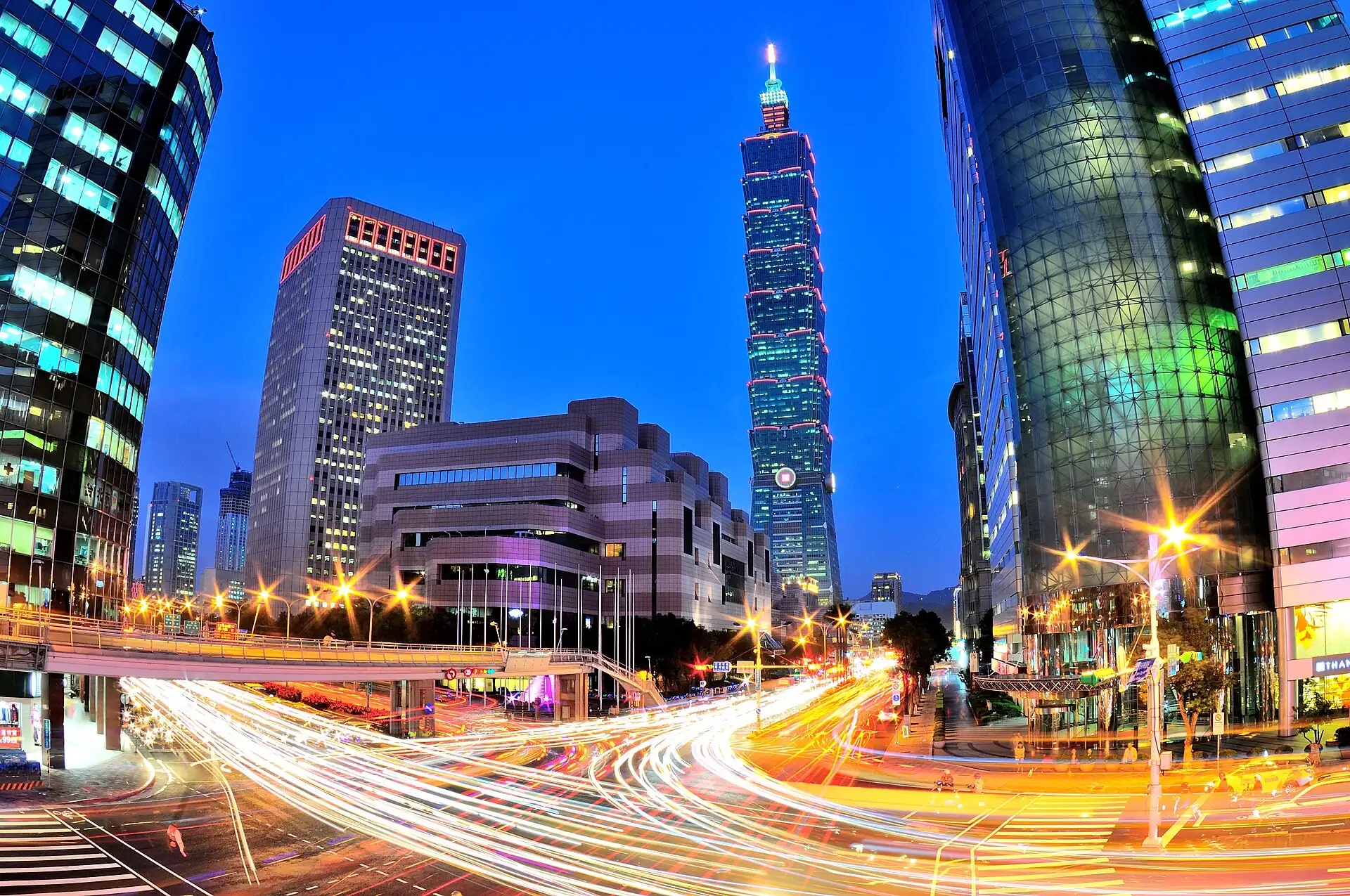
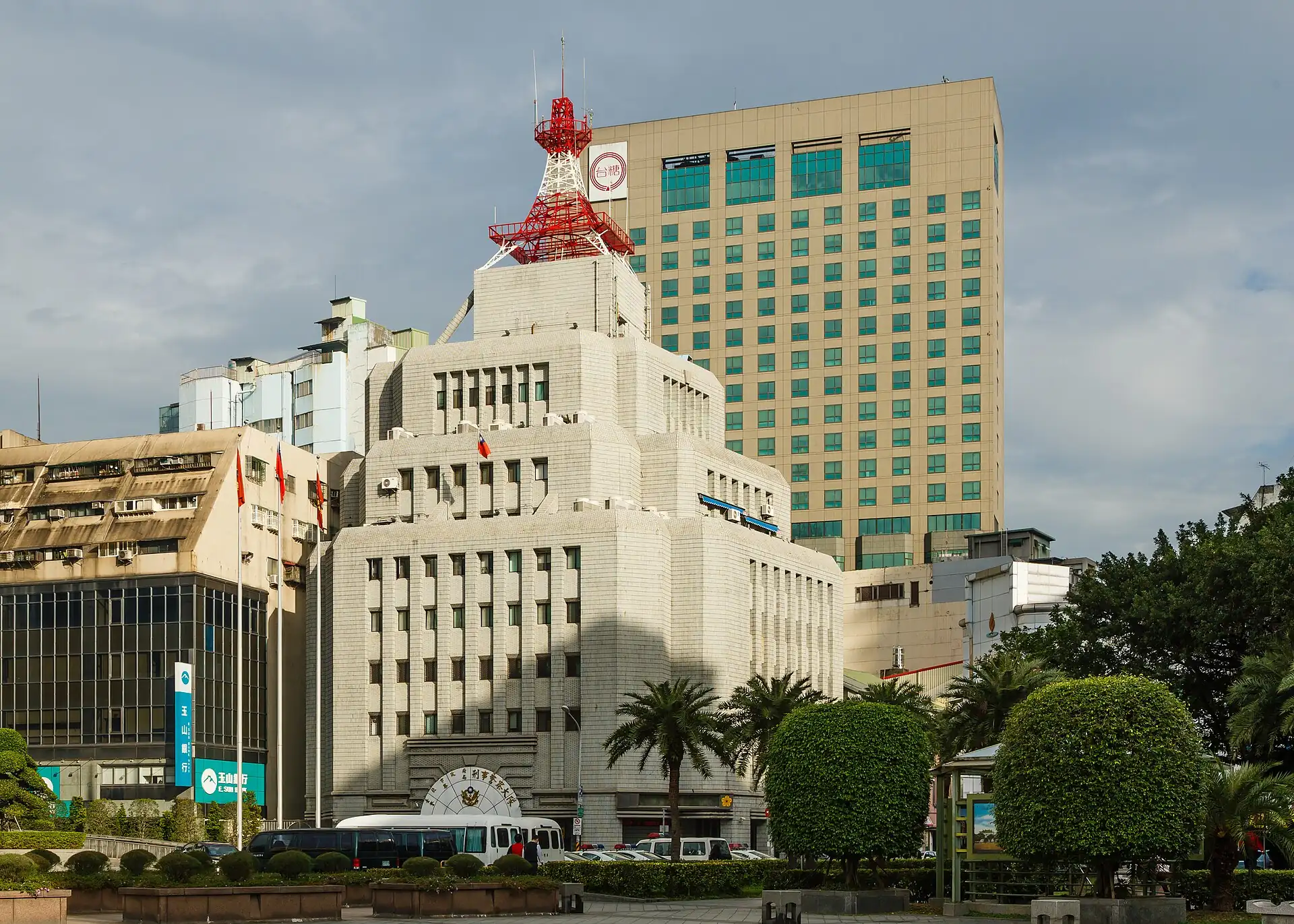
Days
Ready-made day plans, timed against opening hours and walking distances.
How long are you staying?
Loose outlines in the city’s rhythm: temples and monuments in the morning, malls at midday, night markets after dark. The timed day plans check opening days and walking.
1 day
A stopover
- 07:00Longshan Temple — Longshan Temple at dawn
- 09:00Bopiliao Old Street — Bopiliao Old Street
- 10:30Fuhang Soy Milk (Huashan Market) — Soy-milk breakfast or noodles
- 12:30Yong Kang Beef Noodle Shop — Beef noodle lunch near Yongkang Street
- 14:30Chiang Kai-shek Memorial Hall — CKS Memorial Hall
- 17:00Taipei 101 — Taipei 101 at sunset
- 19:00Din Tai Fung, Taipei 101 branch — Dinner at Din Tai Fung
Skip: The Palace Museum and the hot springs; both need a half-day.
Taipei in 3 days
3 daysTemples and monuments in the morning, malls at midday, night markets after dark; the last day ends with the bags already at Taipei Main Station.
Day by day
Day 1 — Longshan at dawn, Bopiliao, a 11:30 noodle bowl
- 07:30Longshan Temple
- Bopiliao Old Street (optional)
- 11:30Noodles by 11:30, before the queue
Day 2 — Chiang Kai-shek Hall at opening, Taipei 101 at sunset
Day 3 — Ximending morning, airport MRT from Taipei Main at 12:00
- 08:30Red House Theater (Ximen Red House)
- Ximending Pedestrian Zone (optional)
- 12:00Airport MRT from Taipei Main at 12:00
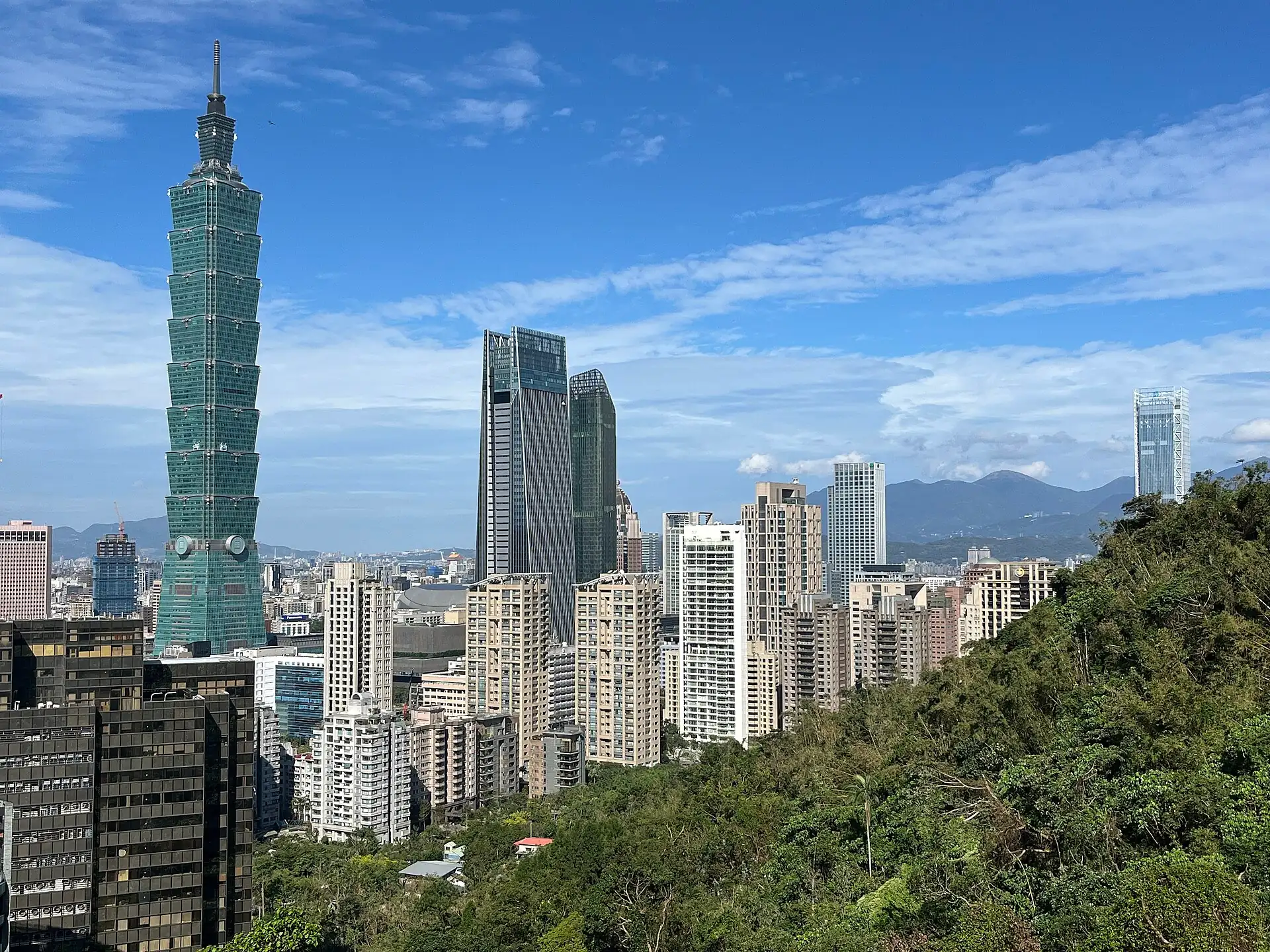
Places
“Best time” is when to arrive for the fewest crowds, for example “before 08:30”; “Go any time” means the hour makes little difference. More sights follow under “More sights and museums”.
7 places. Filters use the guide’s own ratings; a place with no rating is left out when a filter is on.
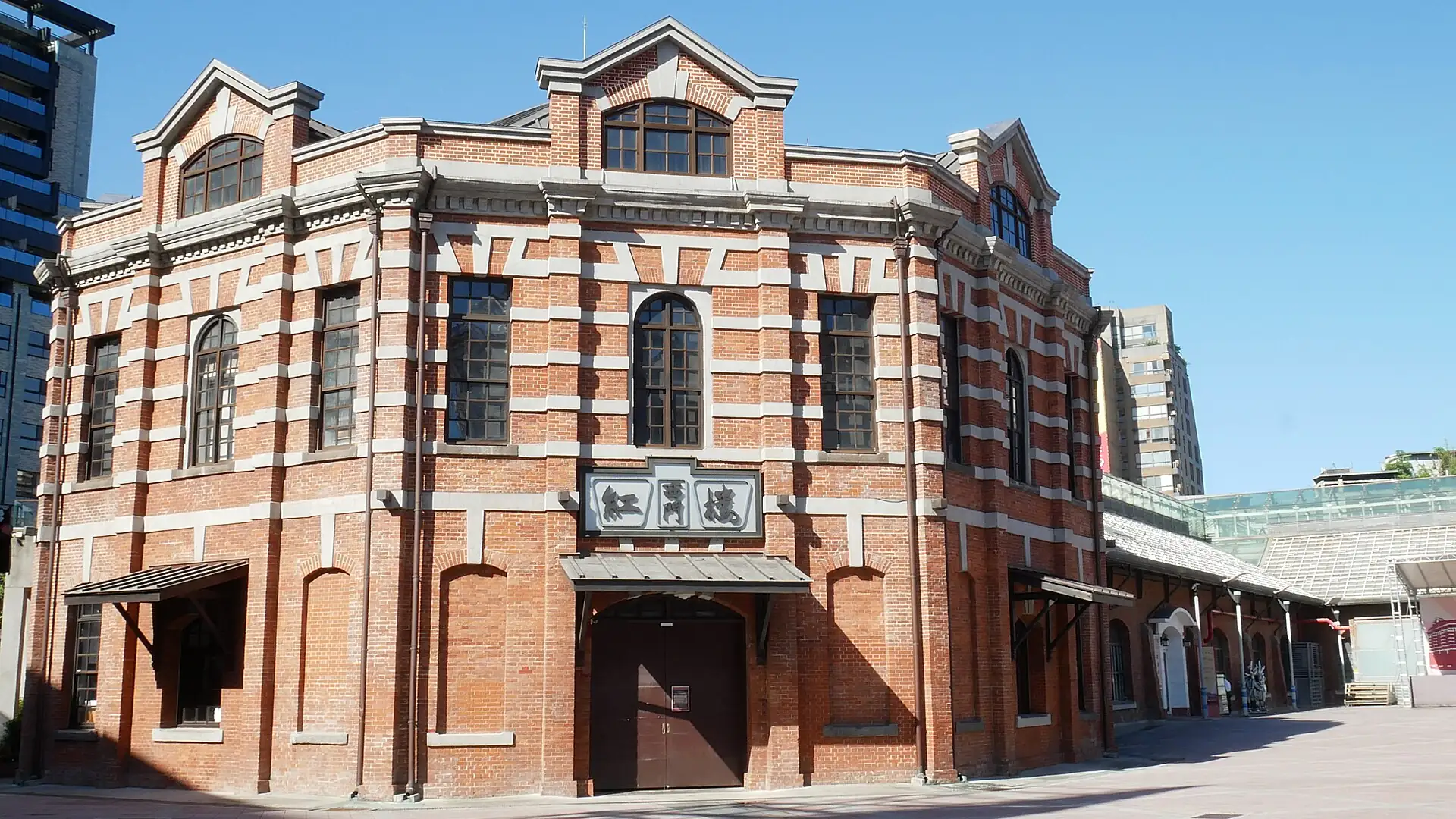
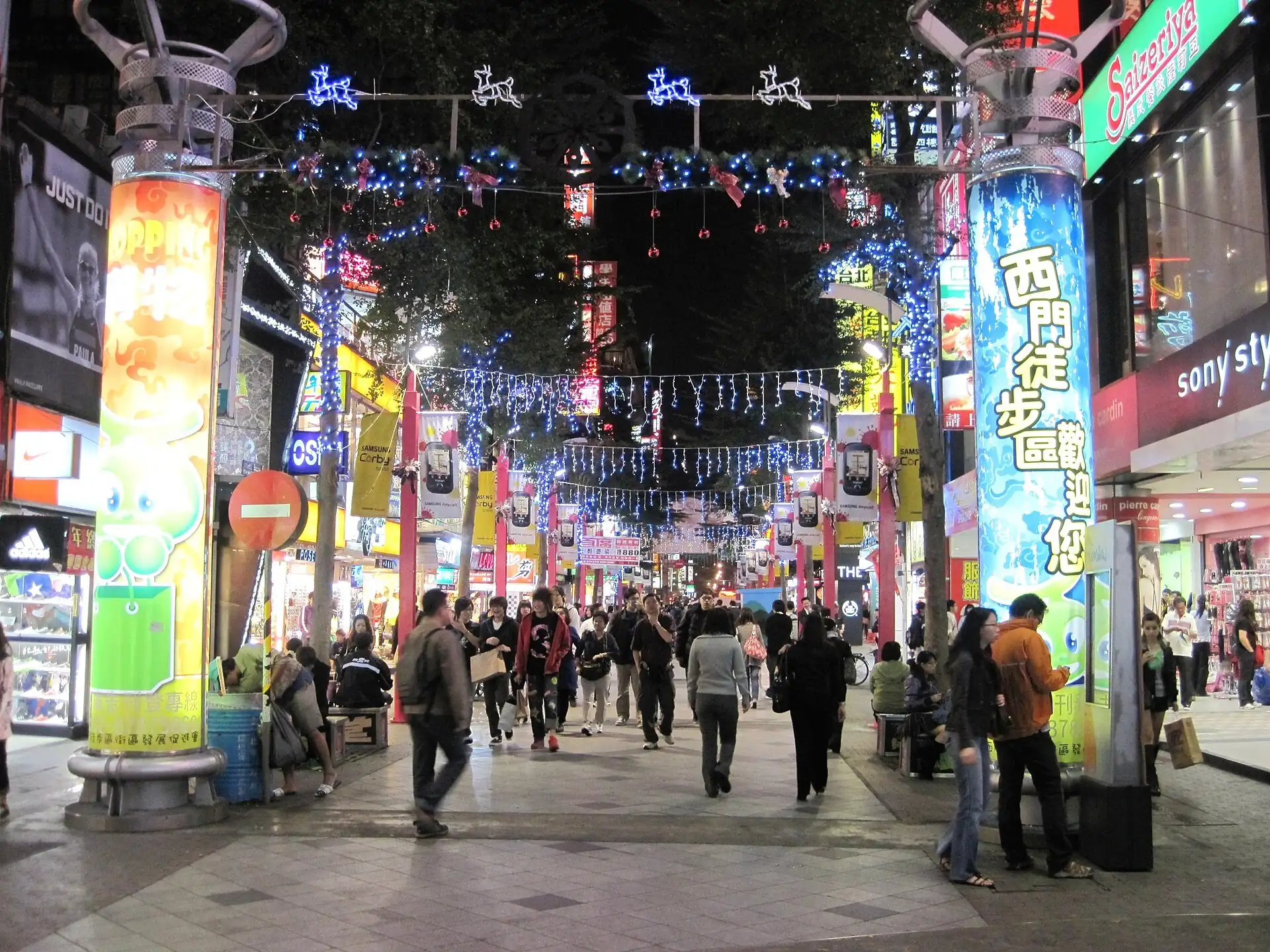
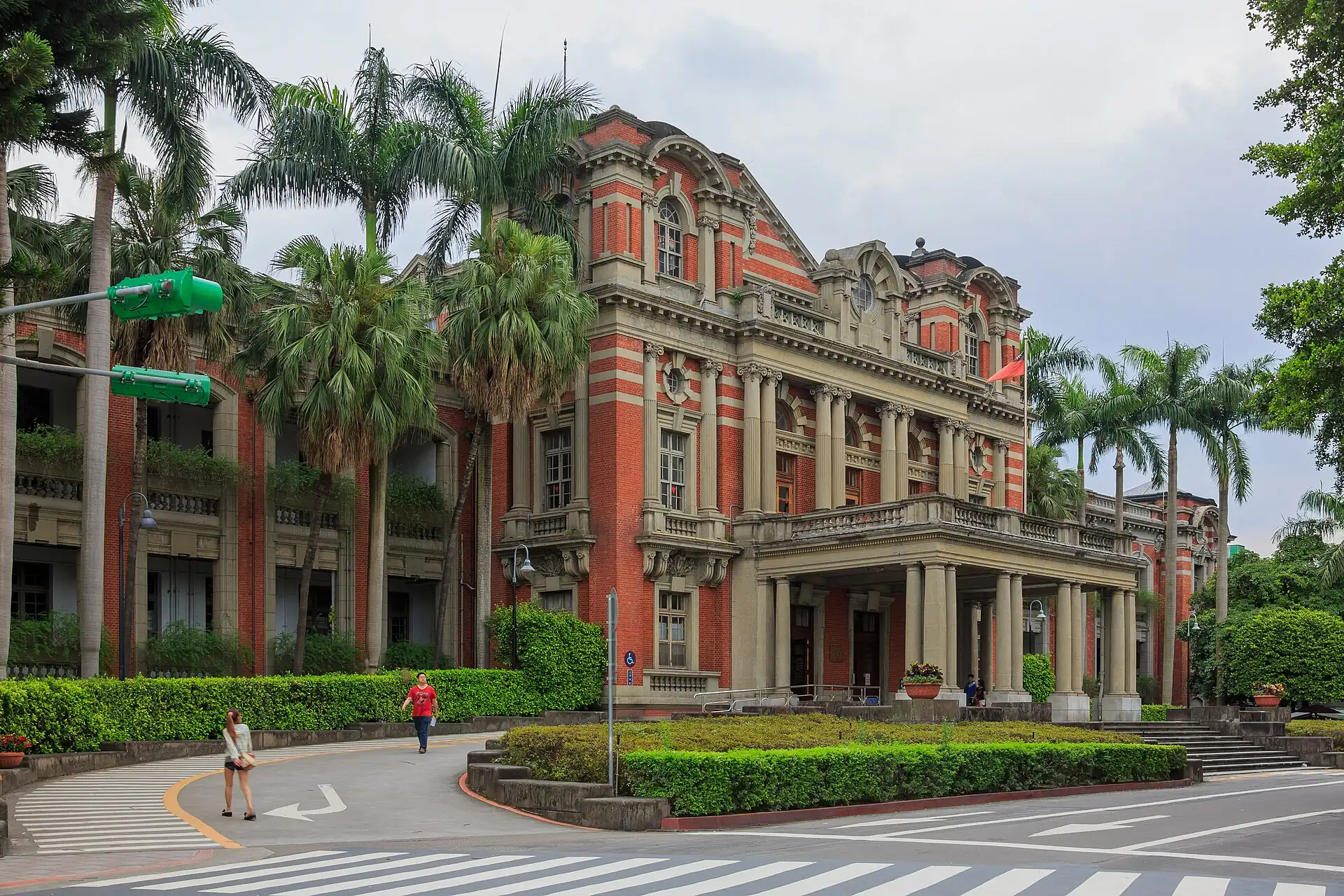
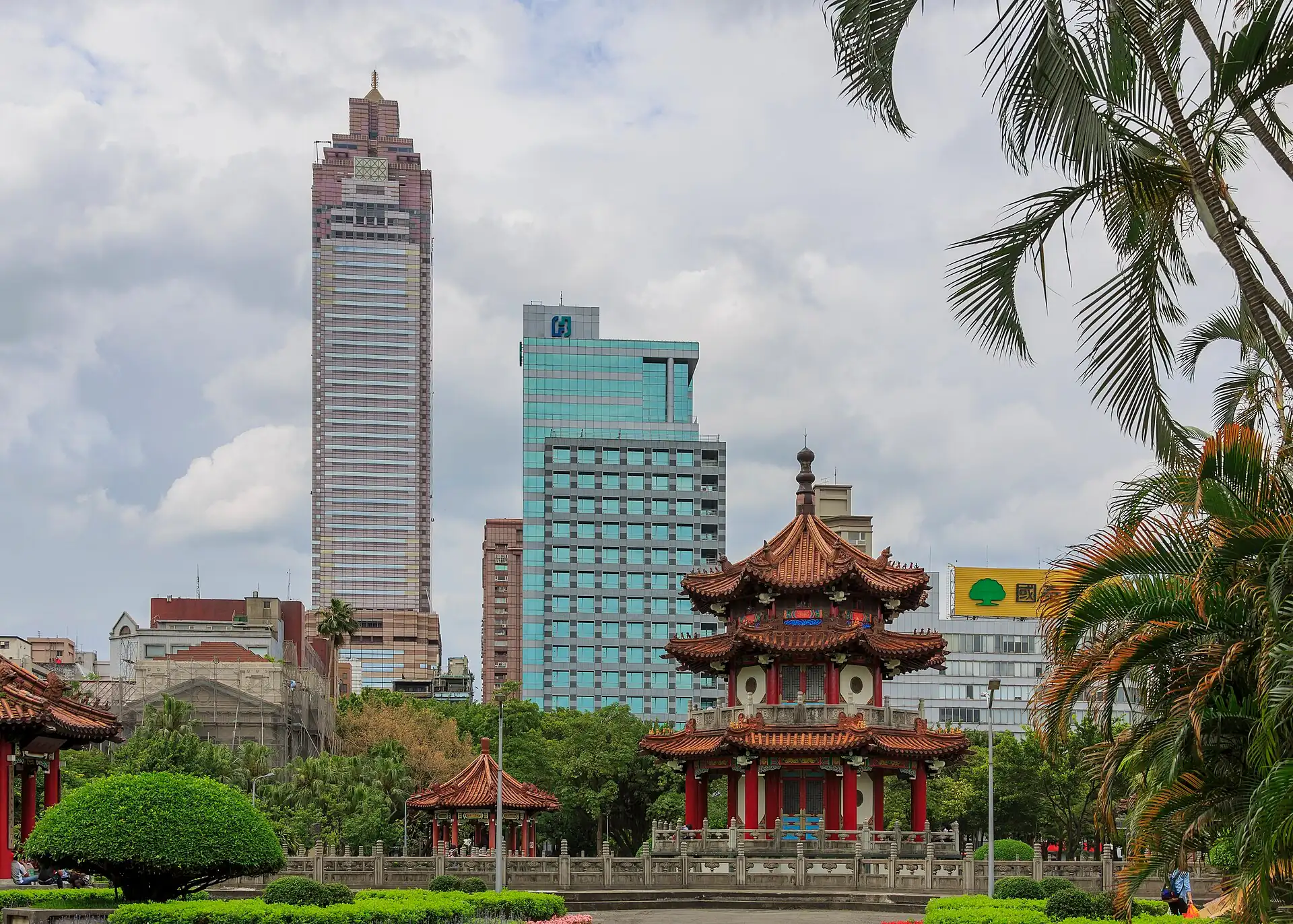
If you do ten things in Taipei
Ranked for a first visit of 2–4 days. Prices are 2026 estimates; hours marked (check) on the linked pages still need confirmation.
- 1
The city’s oldest working temple; incense, prayers and carved dragons; go at dawn.
- Time
- 45–60 min
- Best
- 06:00–08:00
- Cost
- Free
- 2
The landmark tower with a 37-second lift to a view; malls for a wet day.
- Time
- 1.5–3 h
- Best
- Late afternoon to dusk
- Cost
- About NT$600 (≈ US$20)
- 3
National Palace Museum
A huge collection of Chinese imperial art, including the Jadeite Cabbage; plan half a day.
- Time
- 3–4 h
- Best
- Weekday morning
- Cost
- About NT$350 (≈ US$12)
- 4
A night market (Shilin or Ningxia)
The food that defines the city; eat the local snacks at the stalls.
- Time
- 2 h
- Best
- 17:30–20:00
- Cost
- NT$300–600 (≈ US$10–20)
- 5
A vast plaza and a guard change; free and easy to combine with Yongkang Street lunch.
- Time
- 1 h
- Best
- Opening
- Cost
- Free
- 6
Elephant Mountain sunset
The classic view of Taipei 101 from a short climb; free.
- Time
- 1.5–2 h
- Best
- Sunset
- Cost
- Free
- 7
Old streets with tea, herbs and history; walkable half-day.
- Time
- 2 h
- Best
- Morning
- Cost
- Free
- 8
The famous soup dumplings from the best-known name; a queue is normal.
- Time
- 1 h
- Best
- 11:00 or 14:00
- Cost
- NT$400–700 (≈ US$14–25)
- 9
Beitou hot springs
Public baths and a thermal valley; an easy half-day by MRT.
- Time
- 3–4 h
- Best
- Weekday
- Cost
- NT$40–800 (≈ US$2–30)
- 10
Jiufen and the north-east coast
Hillside tea houses and steep lanes; go on a weekday morning.
- Time
- Full day
- Best
- Weekday morning
- Cost
- NT$300–800 (≈ US$10–30) for transport and tea
Good for…
Verdict is how well Taipei works for that traveller, not how nice it is.
Easy, safe and compact; four clusters cover a first visit.
- 1Taipei 101 — the landmark and a wet-day fallback.
- 2Longshan Temple — the best morning in the old city.
- 3Sleep near Ximen or Zhongshan station — both are on the MRT and easy for the airport.
One of Asia’s best food cities and very cheap for the quality.
- 1Fuhang Soy Milk (Huashan Market) — the breakfast that is worth the queue.
- 2Yong Kang Beef Noodle Shop — the classic bowl.
- 3Ningxia Night Market — a single street of snacks.
Cheap food and transport; beds are mid-priced.
- 1Huaxi Street Tourist Night Market — dinner under NT$300 (≈ US$10).
- 2An EasyCard — MRT and buses cost NT$16–45 (≈ US$1–2) a ride.
Sunsets, hot springs and late food.
- 1Taipei 101 — a view at dusk.
- 2Beitou hot springs — a private bath for two.
Very safe and easy to eat alone.
- 1Ay-Chung Flour-Rice Noodle — a standing bowl in the street.
- 2A walking tour — a group for a few hours.
Clean, safe and full of things kids like; heat is the problem.
- 1Taipei Zoo and Maokong gondola — pandas and a glass-bottom gondola.
- 2Da’an Forest Park — a shaded playground.
Step-free MRT and taxis are cheap; heat and stairs at temples.
- 1Chiang Kai-shek Memorial Hall — a flat plaza and a lift.
- 2Taxi between clusters — saves a long walk in summer.
Excellent hotels and food; not a shopping city.
- 1A Xinyi hotel with a view — high floors over Taipei 101.
- 2A tasting-menu dinner — book weeks ahead.
The MRT and malls are step-free; pavements and old temples are not.
- 1Taipei 101 — lifts throughout.
- 2Chiang Kai-shek Memorial Hall — lift and ramp.
Tours and classes: book or skip
Book through the operator’s own site or the hotel, with written inclusions and a cancellation policy. Prices per person, group tour unless stated.
| Tour or class | Verdict | Typical price | Why | Check before paying |
|---|---|---|---|---|
| Taipei 101 observatory ticket | book | About NT$600 (≈ US$20) | Book online and pick the sunset slot to avoid queues. | Sky conditions and the outdoor deck opening. |
| Night-market food tour | maybe | NT$1,200–2,000 (≈ US$40–70) | A guide chooses stalls and orders for you; useful if you dislike menus in Chinese. | Group size and how many dishes are included. |
| Jiufen and Shifen day tour | book | NT$900–1,500 (≈ US$30–50) | Easier than the bus on weekends and includes Shifen lanterns. | Pick-up point, group size and return time. |
| National Palace Museum guided visit | maybe | Free (audio guide) or NT$1,500 (≈ US$50) private | An audio guide is enough for most visitors. | The museum’s own audio guide and a docent tour schedule. |
| Beitou hot-spring day pass | do it yourself | NT$40–800 (≈ US$2–30) | No tour needed: the MRT and a public bath are simple. | Bathing rules (swimwear, no tattoos rule at some baths). |
| Hop-on hop-off bus | skip | NT$500–700 (≈ US$17–25) | The MRT is faster and cheaper. | Only if mobility is limited. |
| Dumpling or cooking class | maybe | NT$1,200–2,200 (≈ US$40–75) | A rainy-day plan and a souvenir skill. | Class size and whether English is spoken. |
| Yangmingshan half-day tour | maybe | NT$800–1,200 (≈ US$30–40) | The buses are infrequent; a tour saves time. | Season and clear-sky forecast. |
What each season brings
Spring
Mar–May
Mild days, drizzle, cherry blossoms in the hills and Tomb Sweeping.
Watch: Plum rains from May and the Tomb Sweeping crowd.
Summer
Jun–Aug
Long evenings, shaved ice, night markets and cheap mangoes.
Watch: 35 °C heat, thunderstorms and typhoons.
Autumn
Sep–Nov
Clearer skies from October, warm evenings and the best walking weather.
Watch: September typhoons and October holiday crowds.
Winter
Dec–Feb
Hot springs, hot pot and Lunar New Year lights.
Watch: Grey drizzle, 13–20 °C and Lunar New Year closures.
Photo spots and the light
Light times are for clear days; overcast days flatten the colours.
| Spot | Best light | Tip |
|---|---|---|
| Elephant Mountain viewing platforms | Sunset and blue hour | Arrive 45 minutes before sunset; the top platform is crowded, so bring a small tripod or use a wall. |
| Longshan Temple courtyard | Early morning | Incense smoke in the sun is best at 07:00; do not use a flash near worshippers. |
| The arch and hall from Liberty Square | Morning | Stand at the arch for a straight shot; the guard change is on the hour. |
| The Red House octagon | Late afternoon | Warm light on the brick; cross to the plaza behind for a full frame. |
| Dihua Street at dawn | Early morning | The shophouse facades are best before the shops open; be polite to residents. |
| Tamsui sunset | Sunset | The river promenade faces west; arrive an hour early. |
| Shilin Night Market | Night | Shoot from the entrance for the crowd and the neon; ask before photographing stallholders. |
Taipei travel FAQ
Answers are 2026 desk estimates; fares and rules marked (check) change.
How many days do I need in Taipei?
Two days for the centre, three with the Palace Museum or Beitou, and four or five with a day trip to Jiufen or Tamsui.
Is Taipei safe?
Yes. Street crime is low; the main risks are scooters, heat and a bag snatch in crowds. Women can walk alone at night on main streets.
Do I need cash?
Yes. Night markets, soy-milk shops and many noodle counters are cash only. Carry NT$1,000–2,000 (≈ US$35–70) in small notes.
Do I need a visa?
US, UK, Irish, Canadian, Australian and New Zealand citizens can stay up to 90 days visa-free (check the current rules and fill in the online arrival card).
How do I get from Taoyuan Airport to the city?
Take the Airport MRT to Taipei Main Station: about 35–50 minutes, NT$160 (≈ US$6). The last train is about 23:00; after that use a taxi (NT$1,200–1,500 (≈ US$40–50)) or the night bus.Take the Airport MRT to Taipei Main Station: about 35–50 minutes, NT$160 (≈ US$6). The last train is about 11:00 PM; after that use a taxi (NT$1,200–1,500 (≈ US$40–50)) or the night bus.
What is the best month to visit?
October and November: 20–27 °C (68–81 °F), less rain and lower humidity. December is cool and damp; July and August are hot.October and November: 68–81 °F (20–27 °C), less rain and lower humidity. December is cool and damp; July and August are hot.
Should I get an EasyCard?
Yes. Buy one at the airport MRT counter or a 7-Eleven; it pays the MRT, buses and many shops.
Can I drink the tap water?
Not straight from the tap. Boil it or use the filtered dispensers in hotels and stations.
How much should I tip?
No tip is expected. A 10% service charge is added in many restaurants and hotels.
Is it worth going up Taipei 101?
Yes on a clear evening, if you book a sunset slot. On a cloudy day skip it and climb Elephant Mountain for the view instead.
Do people speak English?
Increasingly, in hotels and malls; less so at stalls and taxis. Show addresses in Chinese and use translation apps.
Is Taipei good for vegetarians?
Very: Buddhist vegetarian buffets are everywhere. Watch for fish sauce and pork in “vegetable” dishes and say “wo chi su”.
Which power plug do I need?
Taiwan uses 110 V with US-style flat pins, so US and Canadian plugs fit. UK, Irish and Australian visitors need an adapter.
What should I wear?
Light, breathable clothes and a rain layer; a sweater for the cold air-conditioning. Shoulders and knees covered for temples.
Is Taipei accessible for wheelchairs?
The MRT and malls are step-free; pavements and old temples have steps. See the accessibility section.
What about typhoons?
Typhoons hit July to October. The city often declares a typhoon day (shops and schools close) but the MRT usually keeps running; check the forecast and keep a flexible schedule.
Can I use Uber?
Yes. Uber works in Taipei and is useful with a language gap; fares are shown in advance.
Is it easy to do a day trip?
Yes. Jiufen, Tamsui, Beitou and Maokong are all reachable by MRT or bus within about 1.5 hours.
How much money do I need per day?
A mid-range traveller spends about NT$1,800–3,500 (≈ US$60–120) a day excluding a bed; a tight budget is about NT$1,000–1,800 (≈ US$35–60).
Are night markets safe for children?
Yes, but crowded and noisy; go at 17:30 and hold hands.Yes, but crowded and noisy; go at 5:30 PM and hold hands.
More to see and doSee & do · Learn & work · Rain & heat · Free things · Wheelchair and stroller
Free things to do
Sights in Taipei that cost nothing to enter. Each is described under Places or More sights; extra costs inside are marked there.
Wheelchair and stroller, place by place
How each place in this guide works for wheels, from its own page. Ratings are desk estimates unless a page says it was checked on the ground.
| Place | Step-free | Wheelchair | Stroller | What to know |
|---|---|---|---|---|
| Bopiliao Old Street | partial | caution | ok | A few steps at the halls. |
| Chiang Kai-shek Memorial Hall | yes | good | good | 89 steps to the hall; use the lift. |
| Liberty Square and the Arch | yes | good | good | None on the plaza. |
| Longshan Temple | partial | caution | ok | A few steps at each door threshold. |
| Red House Theater (Ximen Red House) | yes | good | good | A few steps at some shops. |
| Taipei 101 | yes | good | good | None. |
| Ximending Pedestrian Zone | yes | good | ok | Small steps at some shops. |
See & do
38 of 38
- Temples & pagodas
An 18th-century temple full of incense and prayers; go at dawn.
Wanhua · Daily about 06:00–22:00 (check)Daily about 6:00 AM–10:00 PM (check) · Free(check)
- monument
A vast white memorial with a plaza and a guard ceremony.
Zhongzheng · Daily about 09:00–18:00; guard change on the hour (check)Daily about 9:00 AM–6:00 PM; guard change on the hour (check) · Free(check)
- tower
The 508 m tower with an observatory and a mall.
Xinyi · Observatory about 09:00–22:00 (check)Observatory about 9:00 AM–10:00 PM (check) · About NT$600 (≈ US$20)(check)
Red House Theater (Ximen Red House)
Citadel & old cityAn octagonal red-brick market of 1908, now a creative-market plaza.
Ximending · About 11:00–21:30 (check)About 11:00 AM–9:30 PM (check) · Free to walk(check)
- Citadel & old city
A restored Qing-era street with red-brick arcades and a history block.
Wanhua · Street always; the museum block about 09:00–18:00, closed Monday (check)Street always; the museum block about 9:00 AM–6:00 PM, closed Monday (check) · Free(check)
The large plaza with the arch, the theatre and the concert hall.
Zhongzheng · Open always · Free(check)
Pedestrian shopping streets with street snacks and cinemas.
Ximending · Shops about 11:00–22:00Shops about 11:00 AM–10:00 PM · Free
National Palace Museum國立故宮博物院
MuseumsChinese imperial art from the Forbidden City collection; half a day, and the Jadeite Cabbage is the famous piece.
Shilin · Daily about 09:00–17:00; check the weekly closureDaily about 9:00 AM–5:00 PM; check the weekly closure · About NT$350 (≈ US$12)(check)
Elephant Mountain (Xiangshan)
coastA 20–30 minute stair climb to a view of Taipei 101; go at sunset or blue hour.
Xinyi · Open always; go at sunset · Free(check)
Dihua Street迪化街
streetJapanese-era shophouses selling tea, herbs and cloth.
Dadaocheng · About 09:00–18:00 (check)About 9:00 AM–6:00 PM (check) · Free(check)
Xiahai City God Temple霞海城隍廟
Temples & pagodasA small, busy temple famous for matchmaking prayers.
Dadaocheng · Daily (check) · Free(check)
Shilin Night Market
MarketsThe largest night market; a food hall and stalls.
Shilin · About 17:00–00:00About 5:00 PM–12:00 AM · Free to enter(check)
Ningxia Night Market
MarketsA short food-only night market on Ningxia Road.
Datong · About 17:00–00:00About 5:00 PM–12:00 AM · Free to enter(check)
Raohe Street Night Market
MarketsA single-street market with a temple at the end.
Songshan · About 17:00–00:00About 5:00 PM–12:00 AM · Free to enter(check)
Songshan Cultural and Creative Park
MuseumsA former tobacco factory with design shops, a museum and cafés; a rainy-day stop.
Xinyi · Park about 09:00–18:00; exhibits varyPark about 9:00 AM–6:00 PM; exhibits vary · Free to walk(check)
228 Peace Memorial Park
parkA city park with a museum on the 1947 uprising and martial law.
Zhongzheng · Park always open; museum Tue–Sun (check) · Park free; museum about NT$20–30 (≈ under US$1)(check)
Presidential Office Building
Citadel & old cityA red-brick landmark of 1919; check the tour days and bring passport.
Zhongzheng · Guided tours on some weekdays (check) · Free(check)
Taipei Zoo and the Maokong Gondola
parkPandas and a gondola to tea gardens.
Wenshan · Zoo 09:00–17:00; the gondola closes some Mondays (check)Zoo 9:00 AM–5:00 PM; the gondola closes some Mondays (check) · Zoo about NT$60 (≈ US$2); gondola about NT$120–150 (≈ US$4–5)(check)
Beitou Hot Spring Museum and thermal valley
Spa & massagePublic baths and a 1913 bathhouse museum.
Beitou · Museum Tue–Sun about 09:00–17:00 (check)Museum Tue–Sun about 9:00 AM–5:00 PM (check) · Museum free; baths about NT$40–500 (≈ US$2–17)(check)
Huashan 1914 Creative Park
MuseumsA former winery turned into a design and events park.
Zhongzheng · About 10:00–21:00 (check)About 10:00 AM–9:00 PM (check) · Free to walk(check)
Da’an Forest Park
parkA large city park with a playground and shade; a quiet morning.
Da’an · Open always · Free(check)
Xingtian Temple
Temples & pagodasA busy Guan Yu temple where locals make offerings and have fortunes told.
Zhongshan · Daily about 04:00–22:30 (check)Daily about 4:00 AM–10:30 PM (check) · Free(check)
Taipei Fine Arts Museum
MuseumsContemporary Taiwanese art.
Zhongshan · Tue–Sun about 09:30–17:30 (check)Tue–Sun about 9:30 AM–5:30 PM (check) · About NT$30 (≈ under US$1)(check)
Taiwan Railway Museum
MuseumsA restored railway workshop and old locomotives.
Datong · Wed–Sun (check) · About NT$100 (≈ US$4)(check)
Tamsui Old Street
coastA river promenade with fish-ball snacks and a sunset view.
Tamsui · Open always · Free(check)
Yangmingshan National Park
parkVolcanic hills with trails, hot springs and flower fields; a bus ride from Shilin.
Beitou / Shilin · Park open daily; flower season in spring (check) · Free to enter(check)
Night-market food crawl
Food toursTry oyster omelette, fried chicken, taro balls and sweet soup at the stalls; go early to avoid the worst crowd.
Shilin, Ningxia or Huaxi Street · From about 17:30From about 5:30 PM · NT$300–600 (≈ US$10–20)(check)
Bubble tea and tea tasting
Food toursCompare a bubble tea with a proper oolong pot at a specialist shop.
Dihua Street and Yongkang Street · Day · NT$100–400 (≈ US$4–14)(check)
Soy-milk breakfast
Food toursSalty soy milk, a flaky flatbread and a fried dough stick.
Shandao Temple and Yongkang Street · About 05:30–11:00About 5:30 AM–11:00 AM · NT$60–150 (≈ US$2–5)(check)
Hot-spring soak in Beitou
Spa & massageA public bath is cheap; a private room costs more.
Beitou · About 07:00–21:30 (check)About 7:00 AM–9:30 PM (check) · NT$40–800 (≈ US$2–30)(check)
Maokong gondola and tea house
ActiveRide up and have tea with a city view; skip in wind.
Wenshan · About 09:00–21:00 (check)About 9:00 AM–9:00 PM (check) · About NT$120–150 (≈ US$4–5) plus tea(check)
Elephant Mountain sunset climb
ActiveThe best free view of Taipei 101; wear grippy shoes.
Xinyi · Late afternoon · Free(check)
Dumpling-making class
ClassesMake and eat xiaolongbao or dumplings; book a day ahead.
Centre · About 2–3 hours · NT$1,200–2,200 (≈ US$40–75)(check)
Temple visit and fortune stick
Shows & musicWatch worshippers; a volunteer or staff member may explain how to draw a fortune.
Longshan, Xingtian · Early morning · Free(check)
River bike ride
ActiveFlat, well marked and cooler near sunset.
Dadaocheng to Guandu · Late afternoon · Bike hire about NT$10 (≈ under US$1) per 30 min(check)
Cinema in Ximending
CinemaA rainy-day plan in a cold cinema; check whether the film is subtitled.
Ximending · Afternoon and evening · NT$300–450 (≈ US$10–15)(check)
Karaoke (KTV) with friends
Shows & musicPrivate rooms with food and drinks; a Taiwanese night out.
Ximending, Zhongshan · Late evening · NT$300–600 (≈ US$10–20) per person per session(check)
Baseball game
SportThe CPBL season runs about March to October; a cheerleader-led show and street food (check schedules).
Tianmu or Taipei Dome · Evening on game days (check) · NT$200–800 (≈ US$7–30)(check)
- Booking
- Night markets, temples and walks need no booking. Book Taipei 101, dumpling classes and popular restaurants ahead; Din Tai Fung has an online queue number.
Learn & work
| What | Where | Cost | Note |
|---|---|---|---|
| Mandarin courses | Language centres at National Taiwan Normal University (Mandarin Training Center) and National Taiwan University | From about NT$15,000–25,000 (≈ US$500–850) for a term (check) | Traditional characters and Bopomofo are used; well known for visitors.(check) |
| Tea, cooking and dumpling classes | Cooking schools and tea houses in the centre | NT$1,000–3,000 (≈ US$35–100) for a half day | Book a day or two ahead; some have English guides. |
| Calligraphy and traditional crafts | Studios in Dadaocheng and Songshan | NT$800–1,500 (≈ US$30–50) per session | A short class is a good rainy-day plan (check).(check) |
Working here
- Tourist entry
- Citizens of the US, UK, Ireland, Canada, Australia and New Zealand can visit visa-free for up to 90 days (check). Tourist entry does not allow paid work.
- Work permits
- Foreign professionals need a work permit from an employer; the Employment Gold Card visa combines a work permit, residence and re-entry for some skilled workers (check the current rules).
- Working holiday
- Working Holiday visas exist for some countries, including Australia, Canada, New Zealand, the UK and Ireland (check the current list).
- Remote work
- Fast Wi-Fi and 24-hour cafés make Taipei a good remote-work base; a tourist stay does not permit work for a Taiwanese company.
- Coworking
- Coworking spaces in Zhongshan, Da’an and Xinyi; many cafés welcome laptops (check the power outlets).
Rain-day and heat-day plan
Rain day
Showers pass in 30–60 minutes and happen most days from May to September. Carry a compact umbrella; use the MRT and covered arcades; go to a museum in the worst hour.
- 01National Palace Museum — Imperial treasures; a long indoor visit, about half a day from the centre.
- 02Taipei 101 — The mall and food court are indoors; the observatory needs a clear sky.
- 03Chiang Kai-shek Memorial Hall — The exhibition floors and the hall are indoors.
- 04Songshan Cultural and Creative Park — Old tobacco factory with design shops and cafés; covered walks.
- 05Museum of Drinking Water or the Beitou Hot Spring Museum — Small, dry stops for a slow hour.
Heat day
Above 32 °C with humidity feels much hotter: sunscreen, water, and an air-conditioned stop every 60–90 minutes. Do outdoor sights before 10:00 or after 17:00.
- 07:00Longshan Temple — Cool, quiet and full of prayers.
- 09:30Chiang Kai-shek Memorial Hall — Open plaza before the sun climbs.
- 12:00Department store or MRT concourse — Cold air-conditioning and a food court.
- 17:00Taipei 101 — Shopping mall by day, view at dusk.
- 19:00A night market — Cooler air and fewer tour groups than midday.
Day-trips and nearby
Places you can reach from Taipei in a day or with one night away, with the route and what it costs. Door to door, not ride time.
Jiufen and Shifen
goBus 1062 from Zhongxiao Fuxing MRT or a train and bus, about 1–1.5 h each way
Hillside teahouses, steep lanes and lantern releasing; go on a weekday, as weekends are a crush.
- Time
- Full day
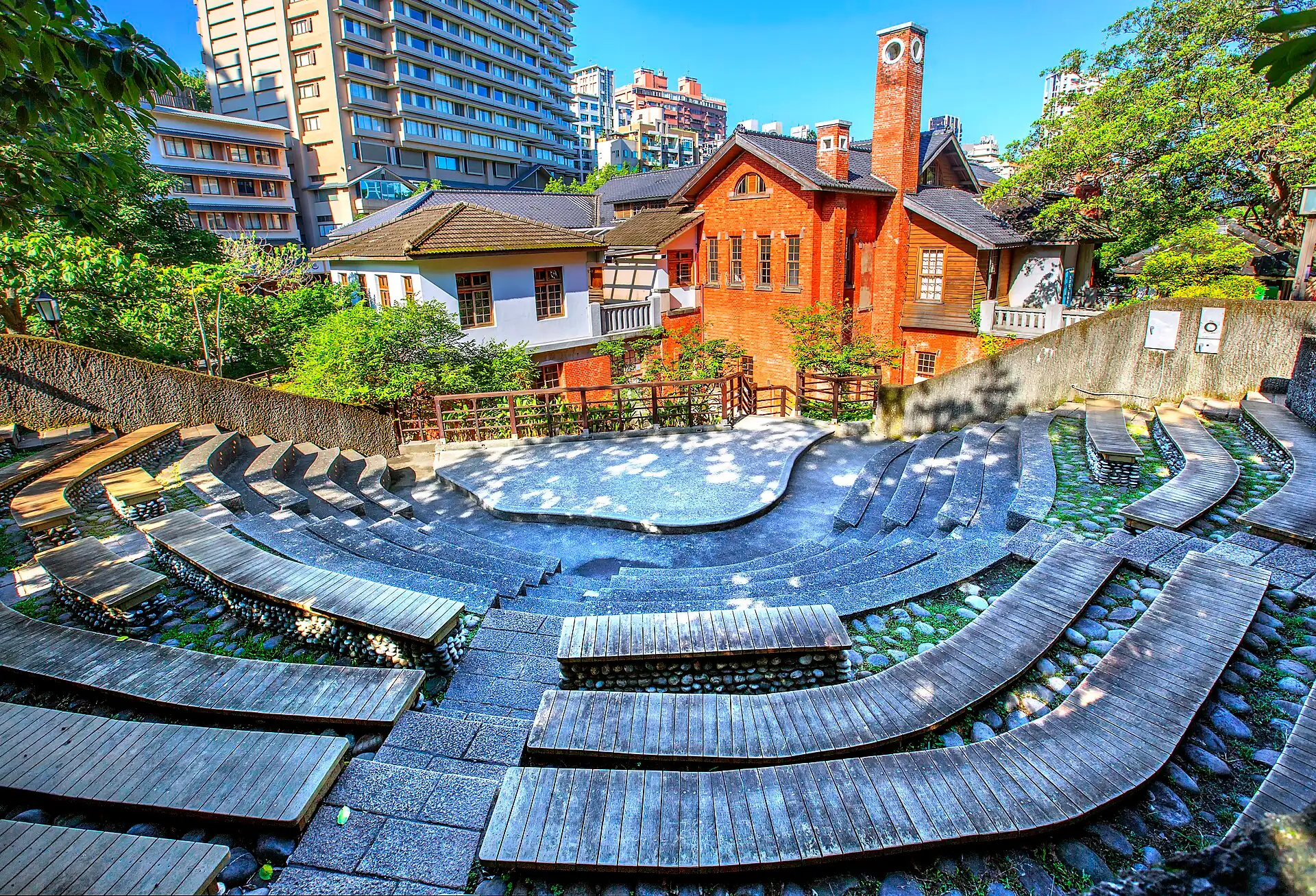 Photo: 李鎮國, CC BY-SA 4.0
Beitou hot springs
goMRT Red line to Beitou, about 30–40 min
Public and hotel springs, a thermal valley and a museum; bring swimwear for the public baths.
- Time
- Half day
Tamsui and Bali coast
goMRT Red line to Tamsui, about 45 min
River promenade, old street and a sunset; go late afternoon.
- Time
- Half day
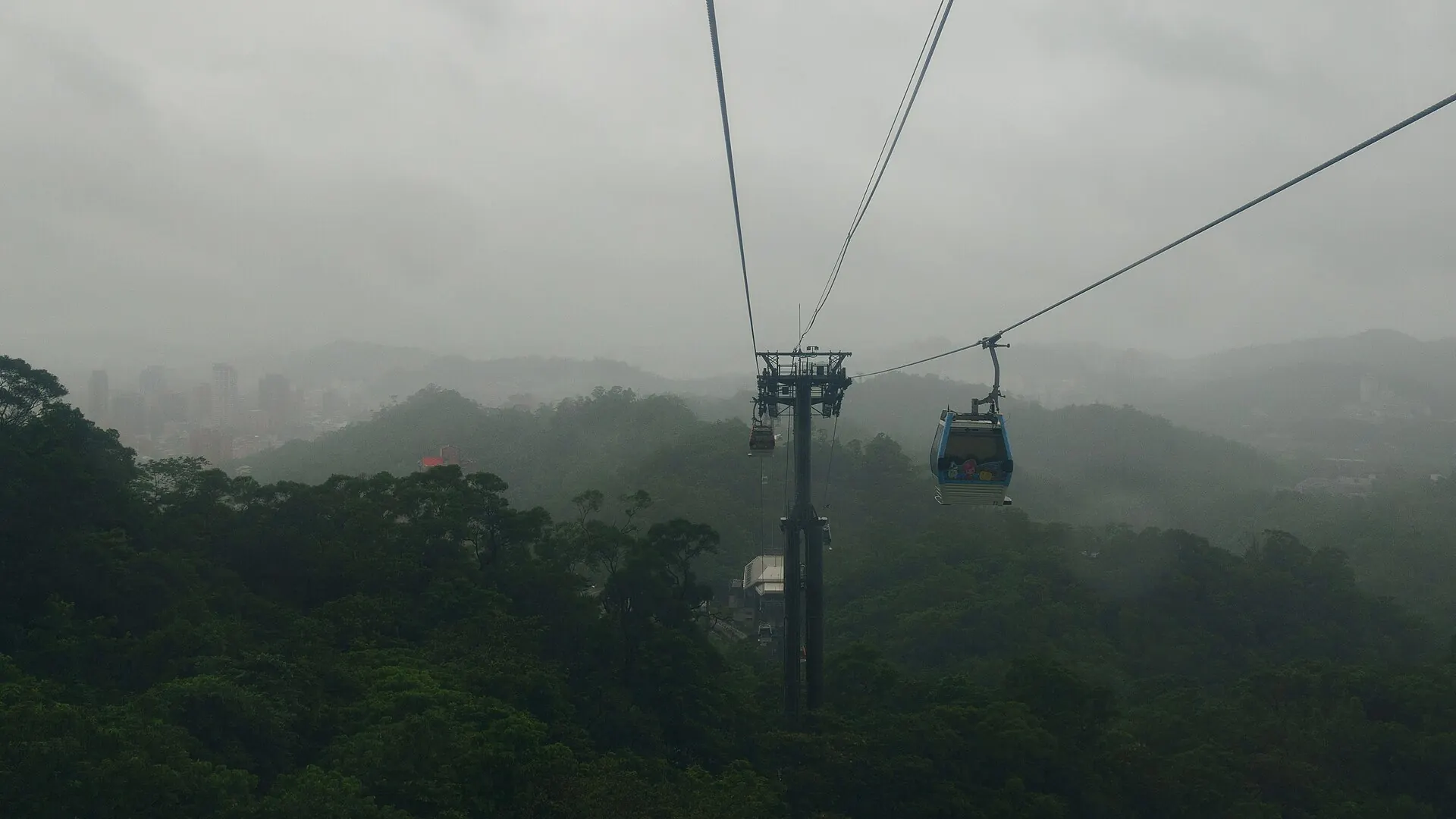 Photo: eugene_o, CC BY 2.0
Maokong gondola
goMRT to Taipei Zoo, then the gondola, about 45 min
Tea gardens and city views; skip when the forecast is rain or wind.
- Time
- Half day
Yehliu Geopark and the north coast
maybeBus from Taipei Main or Tamsui, about 1.5 h
Rock formations by the sea; hot and shadeless in summer.
- Time
- Half to full day
Taroko Gorge and Hualien
overnightTaroko Express train, about 2–2.5 h
The east coast gorge is better with a night; book the train ahead.
- Time
- Overnight
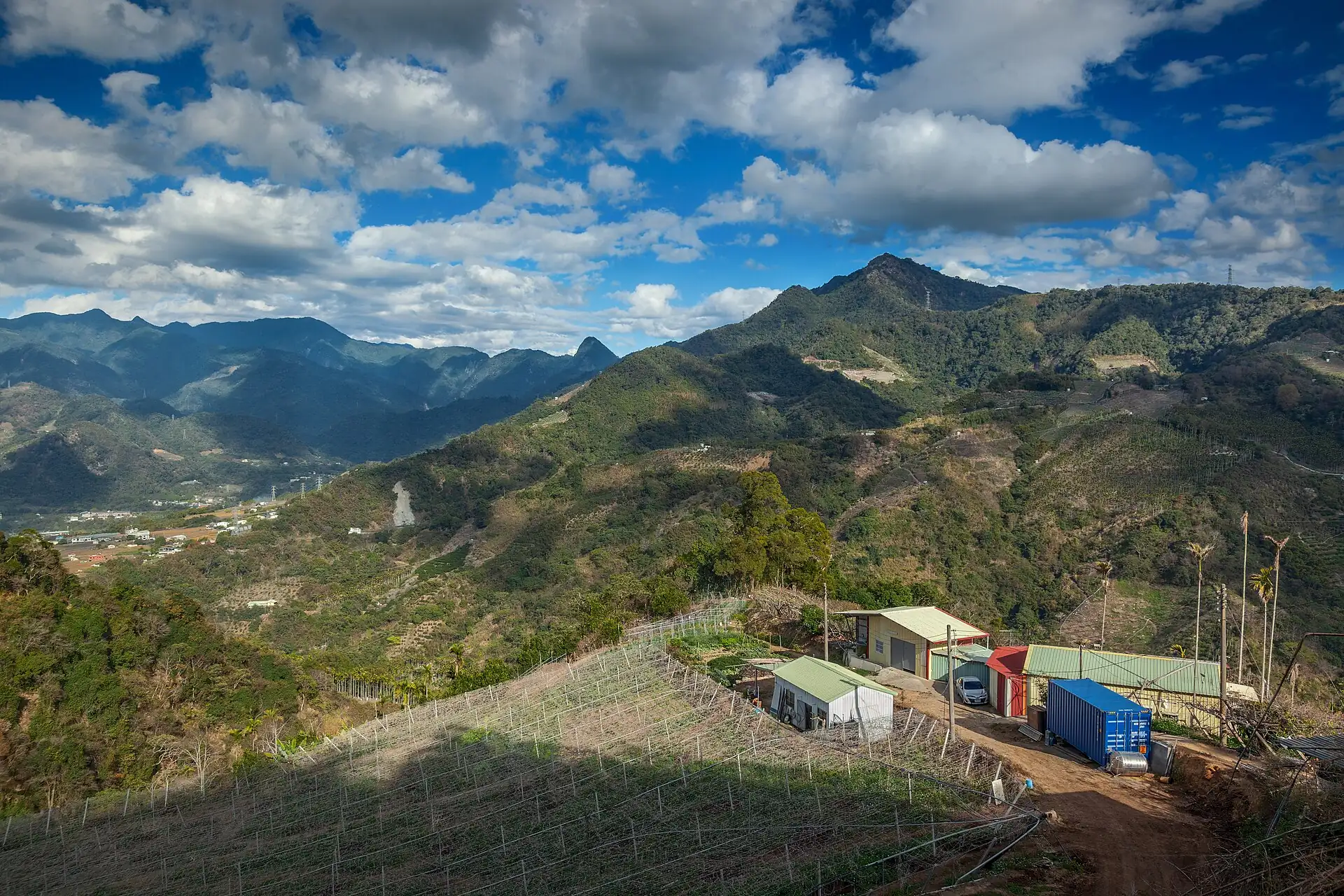 Photo: Tiouraren (Y.-C. Tsai), CC BY-SA 4.0
Taichung
maybeHigh-speed rail from Taipei Main, about 50–60 min
Second city; possible in a day but rushed.
- Time
- Full day or overnight
Go next
Hualien and Taroko Gorge
overnightDoor to door: 2.5–3 h
Express train from Taipei Main, about 2–2.5 h
Book seats ahead, especially on weekends.
Tainan and Kaohsiung
overnightDoor to door: 2–2.5 h
High-speed rail, about 1.5–2 h
Southern food cities; better with one or two nights.
Sun Moon Lake
overnightDoor to door: 3.5–4 h
High-speed rail to Taichung, then bus, about 3 h
A lake in the mountains; stay a night.
Eat & sleepWhere to eat and which area to sleep in
Eat & sleep
Where to eat and which area to sleep in
Eat
A short list of places worth crossing the city for, each with how to get a seat.
Restaurant finder: filter every place to eat in Taipei →
Vegetarian-friendly score
3.0 / 5 · Good
- Country diet noteOur country guide rates vegetarian eating as easy.2 / 2
- Places to eat in this guide1 of 6 places with a known answer are vegetarian-friendly, 3 partly.0.63 / 1.5
- Budget eating lines0 vegetarian lines in "Eat by budget".0 / 0.6
- Meat-free national dishes4 meat-free dishes in the country food list.0.4 / 0.4
- Dedicated vegetarian kitchens1 mention of vegetarian restaurants, Buddhist or fasting kitchens.0.1 / 0.5
Country note: Easy: Buddhist vegetarian restaurants are everywhere (look for 素 su).
Vegetarian places near me →Make a diet card →
How we score
- Country diet note (up to 2): easy 2, workable 1, mixed 0.75, hard 0; no note 0.5.
- City places to eat (up to 1.5): 1.5 × (vegetarian-friendly + half of partly friendly) ÷ places with a known answer; needs 3 or more known places.
- Budget eating lines marked vegetarian (up to 0.6): 0.2 each.
- Meat-free national dishes (up to 0.4): 0.1 each.
- Dedicated vegetarian kitchens mentioned — Buddhist chay, shōjin ryōri, Jain, fasting food, vegan cafés (up to 0.5): 0.1 each.
- Total rounded to the nearest half point, 0 to 5. Built from our own pages only, not from reviews.
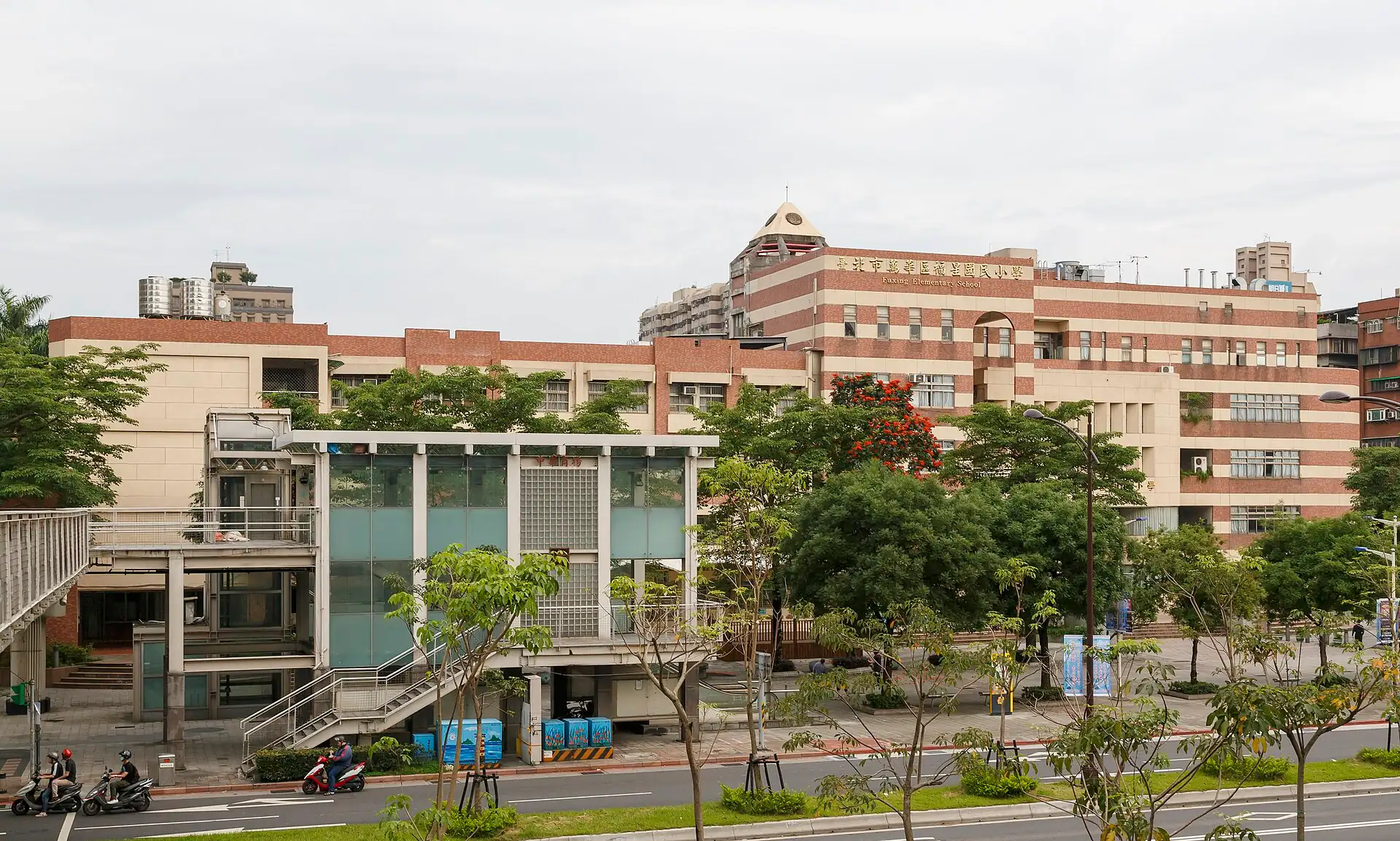
Eating and drinking guideEat by budget · Drink
Before you sit down to eat
Short version; full text linked
Eat by budget
Under NT$150 (≈ US$5) a meal
| Where | Order | Area | Price | Note |
|---|---|---|---|---|
| Fuhang Soy Milk (Huashan Market) | Salty soy milk and a flaky flatbread | Shandao Temple | NT$60–150 (≈ US$2–5) | Go at 06:00–07:00; closed Mondays.Go at 6:00 AM–7:00 AM; closed Mondays. |
| Ay-Chung Flour-Rice Noodle | Oyster vermicelli in a bowl | Ximending | NT$60–80 (≈ US$2–3) | Standing only. |
| A convenience store meal | Rice ball, tea egg and a drink | Any 7-Eleven or FamilyMart | NT$60–120 (≈ US$2–4) | Cheap and cold, with seating in some stores. |
| A lunch box shop (bian-dang) | Rice with meat and vegetables | Any street | NT$80–120 (≈ US$3–4) | A local lunch; point at the trays. |
Dishes to know
| Dish | What it is | Where to look | When | Price |
|---|---|---|---|---|
| Beef noodle soup牛肉麵 | Braised beef and wheat noodles in a rich soy or spicy broth | Noodle shops on Yongkang Street and near Taipei Main | Lunch or dinner | NT$200–450 (≈ US$7–15) |
| Xiaolongbao小籠包 | Steamed soup dumplings with pork | Din Tai Fung and dumpling shops | Lunch or dinner | NT$250–320 (≈ US$9–11) for 10 |
| Oyster omelette蚵仔煎 | Oysters cooked in egg and starch with a sweet-sour sauce | Night markets | Evening | NT$60–100 (≈ US$2–4) |
| Fried chicken cutlet雞排 | A palm-sized fried chicken steak with spice powder | Night markets and street stalls | Evening | NT$70–100 (≈ US$3–4) |
| Stinky tofu臭豆腐 | Fermented tofu, fried or steamed with kimchi and sauce | Night markets | Evening | NT$60–100 (≈ US$2–4) |
| Braised pork rice滷肉飯 | Minced pork in soy over rice | Rice shops | Any time | NT$30–70 (≈ US$1–3) |
| Salty soy milk and flatbread鹹豆漿與燒餅 | Warm soy milk with vinegar and fried dough, and a baked flatbread | Breakfast shops | Breakfast | NT$60–150 (≈ US$2–5) |
| Oyster vermicelli蚵仔麵線 | Thin noodles in a thick broth with oysters or intestine | Ximending and night markets | Any time | NT$60–80 (≈ US$2–3) |
| Mango shaved ice芒果冰 | Shaved ice or milk ice topped with fresh mango | Dessert shops | Summer afternoon | NT$180–300 (≈ US$6–10) |
| Bubble tea珍珠奶茶 | Milk tea with tapioca pearls | Everywhere | Any time | NT$50–80 (≈ US$2–3) |
| Pineapple cake鳳梨酥 | A buttery pastry with pineapple filling | Bakeries and airport shops | Gifts | NT$35–60 (≈ US$2) each |
| Taro balls in sweet soup芋圓 | Chewy taro dumplings in syrup, served hot or cold | Dessert stalls in Jiufen and night markets | Dessert | NT$60–100 (≈ US$2–4) |
- Look for a busy stall with a short menu; a queue of locals is a good sign.
- Carry small notes and coins: most stalls are cash only.
- Order at the counter, pay first at small shops, and return the tray or bowl if there is a stack.
- Vegetarian food (素食) is easy to find at Buddhist vegetarian buffets; say “wo chi su”, and ask if there is garlic or egg if you avoid it.
Drink & nightlife
| Where | What | Until | Note |
|---|---|---|---|
| Ximending bars and rooftops | Casual bars and small clubs | About 01:00–02:00About 1:00 AM–2:00 AM | Busy on weekend nights; pick a place with a menu and prices on the wall. |
| Zhongshan and Da’an cocktail bars | Cocktail bars in side streets | About 00:00–02:00About 12:00 AM–2:00 AM | Quieter and often reservation-friendly; check opening on the day. |
| Yongkang Street | Cafés, tea shops and a few bars | About 22:00–00:00About 10:00 PM–12:00 AM | Better for tea and dessert than for late nights. |
| Taipei 101 area bars | Hotel and rooftop bars | About 00:00–02:00About 12:00 AM–2:00 AM | Views, high prices; a dress code may apply. |
By style
| Style | What | Where | Price | Until |
|---|---|---|---|---|
| Bubble tea | Milk tea with tapioca pearls, invented in TaiwanOrder sugar and ice levels: half sugar, less ice is a good start. | Every street; chains and small shops | NT$50–80 (≈ US$2–3) | About 22:00 |
| Oolong and high-mountain tea | Lightly roasted, floral tea from the mountainsAsk for a tasting; a pot refills many times. | Tea shops on Dihua Street, Maokong and Yongkang Street | NT$100–400 (≈ US$4–14) a pot | About 18:00 |
| Taiwan beer | A crisp local lager; the gold can is the classicOften drunk with fried snacks at a stall. | Convenience stores and rechao (quick-fry) restaurants | NT$40–60 (≈ US$2) a can | 24 hours in shops |
| Kaoliang and whisky | Strong sorghum spirit; Kavalan whisky is a local successKaoliang is strong; sip it with food. | Bars and liquor shops | NT$200–500 (≈ US$7–17) a glass | Bar hours |
| Fresh juice and soy milk | Papaya milk, sugarcane juice, sweet or salty soy milkA cheap cool drink on a hot day. | Juice stalls and breakfast shops | NT$30–70 (≈ US$1–3) | Morning to evening |
Rules that bite
- Drinking and eating are banned on the MRT paid area and platforms, with a fine of about NT$1,500 (≈ US$50) or more.
- The legal blood-alcohol limit for driving is 0.03%; the fine and prison risk for drunk driving are severe. Take a taxi or Uber.
- Do not accept a drink from a stranger or a “friendly” group in a bar; stick to bar-tab venues with visible prices.
Sleep
Pick the area first: it decides your walk home at night and your first morning.
Which neighborhood fits you
Three questions, one recommendation, with the reasons.
Your best fit
- Longshan and Red House within 15 minutes; Taipei Main is one stop.
- Many hostels and mid-range hotels.
- Most hotels have 24-hour desks; streets are busy late.
Watch out: Loud until 01:00 on weekends; ask for a back room.
Next best: Zhongshan
Built from our 1–5 desk scores per area; your answers stay in this browser.
More on sleepingSleep by budget · Your area · With kids
Sleep by budget
| Band | Price | Where | Room types | What to expect |
|---|---|---|---|---|
| budget | NT$600–1,000 (≈ US$20–35) dorm bed · NT$1,500–2,500 (≈ US$50–85) private room | Ximending, near Taipei Main Station | Hostels, small guesthouses | Small rooms, shared bathrooms in the cheapest, street noise on weekends. A key card and 24-hour desk in many. |
| mid | NT$2,500–5,500 (≈ US$85–190) | Ximending, Zhongshan, Taipei Main Station | 3–4 star hotels, business hotels | A lift, breakfast sometimes included, a compact room and a good bed. Quietest rooms face the back. |
| high | NT$6,000–12,000 (≈ US$200–400) | Xinyi, Zhongshan, Da’an | 4–5 star hotels | Larger rooms, pools, lounges and views of Taipei 101; ask for a high floor. |
| splurge | NT$12,000–25,000 (≈ US$400–850)+ | Xinyi, Zhongshan | Five-star and luxury hotels | Full service, spa and restaurants; a service charge may be added. |
Booking checks
- Book early for Lunar New Year, Tomb Sweeping and New Year’s Eve, when rooms sell out.
- Business hotels near Taipei Main Station are convenient for the airport MRT and high-speed rail.
- Check for a lift and a window: some cheap rooms in older buildings have neither.
- In summer ask for a room away from the street to avoid scooter noise.
- Hotels hold bags for free after check-out; ask before you book a late flight.
Which area is yours
| If you are | Sleep in | Because |
|---|---|---|
| First visit, 2–4 nights, snacks and nightlife | Ximending | Shortest walk to street food, cinemas and one stop to Taipei Main. |
| Quiet nights, families or business | Zhongshan | Bigger rooms, calmer streets and a direct Red line to the airport hub. |
First-timers: Ximen Station is one stop from Taipei Main, and the pedestrian streets are at the door; choose a hotel with a 24-hour desk and a lift.
Quieter nights near Zhongshan Station: larger hotels, cafés and the Red line to the airport hub; 10 minutes to Taipei Main.
Areas are in our default order until you tick a priority.
Scores are 1–5 desk judgements per priority (2026). Ximending and Zhongshan have sleep-area pages.
With kids
- Taipei is easy with children: clean toilets and nursing rooms in MRT stations and department stores, priority seats on the MRT, and food that kids like (dumplings, noodles, tea, sweet potato). The MRT is free for children under 6 and half price for older kids with a child EasyCard.
- Strollers work on the MRT and in malls but not on the narrow pavements of older streets; carry a light, folding one and a carrier.
- Free or cheap stops: Da’an Forest Park playground, the Taipei Children’s Amusement Park, the Museum of Drinking Water and the Taipei Zoo with its panda house (check hours; the zoo is closed on some Mondays).
- Maokong gondola with its glass-bottom cars and Beitou’s hot spring museum are easy half-day trips for children.
- Night markets are noisy and crowded; go early (17:30) and hold hands. Food is usually fine but check spice levels.Night markets are noisy and crowded; go early (5:30 PM) and hold hands. Food is usually fine but check spice levels.
- In summer, plan an indoor midday break; children overheat quickly in 34 °C (93 °F) and 80% humidity.In summer, plan an indoor midday break; children overheat quickly in 93 °F (34 °C) and 80% humidity.
PracticalMoney, essentials, safety and the pocket card
Practical
Money, essentials, safety and the pocket card
Money
What a day costs at three comfort levels, and how to pay.
- Budget
- NT$1,000–1,800 (≈ US$35–60) excl. bed / day
- Mid
- NT$1,800–3,500 (≈ US$60–120) excl. bed / day
- High
- NT$3,500 (≈ US$120)+ excl. bed / day
- Transit card
- Buy an EasyCard at the airport or an MRT station; it pays MRT, buses and many convenience-store items.
- Cash rule
- Keep NT$1,000 (≈ US$35) in small notes for night markets; use convenience-store or bank ATMs, not machines on dark streets.
More on moneyCosts · Budget · Buy
What things cost
- Bubble milk tea or fruit teaNT$50–80 (≈ US$2–3)
- Breakfast at a soy-milk shopNT$60–150 (≈ US$2–5)
- Night-market snackNT$50–120 (≈ US$2–4)
- MRT ride in the city (EasyCard)NT$16–45 (≈ US$1–2)
- Airport MRT to Taipei Main StationNT$160 (≈ US$6)
- Taipei 101 observatory ticketAbout NT$600 (≈ US$20)
Trip budget
| Hotel double room1 × 4 nights × NT$3,500 | NT$14,000 |
| Food, local transport, entries2 × 4 days × NT$2,500 | NT$20,000 |
| Airport MRT, both ways2 × NT$320 · NT$160 each way; a taxi is NT$1,200–1,500 one way | NT$640 |
| eSIM or tourist SIM2 × NT$400 | NT$800 |
| Buffer 10%Price creep, a taxi you did not plan, one splurge | NT$3,540 |
| Trip total≈ NT$4,870 per person per day, bed included | NT$38,980≈ US$1,300 |
Lunar New Year and long weekends: add 30–100%.
2026 estimate in NT$; flights, visas and tours excluded. Your choices stay in this browser.
Prices of common things
| Bubble milk tea | NT$50–80 (≈ US$2–3) |
| Night-market snack | NT$50–120 (≈ US$2–4) |
| Airport MRT to Taipei Main | NT$160 (≈ US$6) |
| Taipei 101 observatoryCheaper than a similar tower in many cities; book online. | About NT$600 (≈ US$20) |
| Din Tai Fung xiaolongbao, 10 pieces | NT$250–320 (≈ US$9–11) |
2026 estimate; check locally.
Buy
- Bargaining
- Prices are fixed in shops, malls and convenience stores. At night-market stalls the price on the sign is the price; you can ask for a small discount when buying several items of clothing or a bundle, but do not bargain hard.
- Fixed-price check
- Tea and gift items in tourist streets can cost twice what a department store charges. Compare a tin of oolong at a specialist tea shop, a supermarket and a department-store food hall before you buy.
Markets and shopping streets
| Where | What | When | Haggle | Note |
|---|---|---|---|---|
| Shilin Night Market | Street food, clothes, games and gadgets | About 17:00–00:00 (check)About 5:00 PM–12:00 AM (check) | light | The largest in the city; the food hall is in the basement by Jiantan Station. |
| Ningxia Night Market | Local snacks, mostly food | About 17:00–00:00 (check)About 5:00 PM–12:00 AM (check) | none | A short single street; good for a food crawl without the shopping crowd. |
| Huaxi Street Tourist Night Market | Street food, herbal shops and games | About 18:00–00:00 (check)About 6:00 PM–12:00 AM (check) | none | Covered and near Longshan Temple. |
| Dihua Street | Dried goods, tea, herbs, cloth and gifts | About 09:00–18:00; Sunday shorter (check)About 9:00 AM–6:00 PM; Sunday shorter (check) | light | A Japanese-era shophouse street in Dadaocheng; busy the week before Lunar New Year. |
| Guanghua Digital Plaza | Electronics and computer parts | About 11:00–20:00 (check)About 11:00 AM–8:00 PM (check) | light | Near Zhongxiao Xinsheng; buy a warranty and check the plug fits your country. |
Shops by what they sell
| For | Where | Hours | Note |
|---|---|---|---|
| Oolong tea and tea sets | Dihua Street tea shops, Yongkang Street, department-store food halls | About 10:00–19:00 | Ask to taste before buying; vacuum-packed tins travel well. |
| Pineapple cakes and gift snacks | Bakeries near Taipei Main Station and Ximending, airport shops | About 09:00–21:00 | A box of 10 costs about NT$350–600 (≈ US$12–20) (2026 estimate); check the expiry date. |
| Stationery, design goods and books | Eslite bookstores, Songshan Cultural and Creative Park, Zhongshan | About 11:00–22:00 | Taiwanese design is strong; the Eslite Xinyi store is open late. |
| Herbal and dried goods | Dihua Street, Wanhua | About 09:00–18:00 | Check import rules for herbs and meat products before you fly home. |
| Electronics | Guanghua Digital Plaza, Syntrend and department stores | About 11:00–20:00 | Not always cheaper than at home; compare and check the voltage. |
Changing money
| Where | Verdict | Why |
|---|---|---|
| Bank branches (Bank of Taiwan, Cathay United, E.SUN) | use | Fair rate; bring your passport; open about 09:00–15:30 on weekdays.Fair rate; bring your passport; open about 9:00 AM–3:30 PM on weekdays. |
| Taoyuan Airport bank counters | use | Fair rate and open on arrival; change only what you need for the first day. |
| Hotel front desks | caution | Poorer rate; use for a small emergency amount. |
| Street exchange stalls | avoid | Rarely seen; skip them. |
| Your card at an ATM | use | Best rate at 7-Eleven, Chunghwa Post and bank ATMs; choose NT$ if the machine offers a choice. |
ATMs
- Per withdrawal
- ATMs cap a foreign card at about NT$20,000 (≈ US$700) per withdrawal (the screen shows the limit); fewer than that on some cards.
- Fees
- Bank and 7-Eleven ATMs charge about NT$100–150 (≈ US$4–5) per foreign-card withdrawal, plus your home bank’s fee. Withdraw larger sums less often.
- Currency choice
- If the ATM or card reader offers to charge in your home currency, choose NT$; the home-currency rate is worse.
- Tax refund
- Visitors can claim a 5% VAT refund on purchases above about NT$2,000 (≈ US$70) in one day at participating shops; ask for the form and take it to the airport counter (check current rules).
Essentials and accessEssentials · Access
Essentials
- Tipping
- Not expected. Hotels and many sit-down restaurants add a 10% service charge to the bill; taxi drivers do not expect a tip and round the fare to the nearest NT$5 (≈ under US$1) or NT$10 (≈ under US$1).
- Plugs & power
- 110 V, 60 Hz, two flat pins (type A, sometimes with a ground pin, type B). US and Canadian plugs fit as they are; UK, Irish, Australian and New Zealand visitors need an adapter and a dual-voltage charger.
- Toilets
- Free and usually clean in MRT stations, department stores, parks and convenience stores. Many older buildings ask you to put used tissue in the bin, not the bowl; look for the sign. Carry tissues, as paper is sometimes missing.
- Opening hours
- Shops and malls open about 11:00–21:30. Museums often close on Mondays. Night markets run about 17:00–00:00. Convenience stores (7-Eleven, FamilyMart) are open 24 hours and act as ATMs, parcel points and ticket counters.Shops and malls open about 11:00 AM–9:30 PM. Museums often close on Mondays. Night markets run about 5:00 PM–12:00 AM. Convenience stores (7-Eleven, FamilyMart) are open 24 hours and act as ATMs, parcel points and ticket counters.
- Health
- Take travel insurance with medical cover. Taiwan has a strong hospital system and English-speaking doctors at the main hospitals, but a visitor pays the full self-pay price.
- Accessibility
- The MRT has lifts and tactile paths at every station and step-free trains. Pavements are narrow and often blocked by scooters and stalls, and many older buildings have steps.
- Laundry
- Self-service laundromats are around most neighbourhoods (NT$60–100 (≈ US$2–4) a wash, coin or card). Hotels charge per item; guesthouses often have a machine.
- Emergency numbers
- 110 police, 119 fire and ambulance; the Tourism Administration hotline is 0800-011-765 (24 hours, English).
Pack
- A compact umbrella or light rain jacket, in every season
- Light, breathable clothes; a layer for the very cold air-conditioning in malls and trains
- Comfortable shoes with grip for wet marble and temple stones
- Small notes and a coin purse for night markets
- A refillable bottle for hotel filtered water
Accessibility
Taipei is one of the easier Asian cities on wheels: every MRT station has a lift and tactile paths, and trains are step-free. The problems are narrow pavements blocked by scooters, uneven paving in older streets, and steps at temples and small restaurants.
- Pavements
- Wide near big roads and malls; narrow and blocked by parked scooters in older districts.
- MRT
- Lifts, tactile paths and a wheelchair space on every train; stations have accessible toilets.
- Buses
- Most city buses are low-floor with a ramp.
- Taxis
- Wheelchair-accessible taxis exist; book through the app or by phone (check).
- Temples and old streets
- Steps at temple thresholds and uneven stone; Longshan has ramps at some entrances (check).
Sights, step-free or not
| Chiang Kai-shek Memorial Hall | step-free | A lift and a ramp to the main hall; the plaza is flat but shadeless. |
| Taipei 101 | step-free | Lifts to the observatory; step-free throughout. |
| Longshan Temple | with help | Thresholds and steps; some ramps (check). |
| Red House Theater (Ximen Red House) | step-free | Level plaza and a ramp; small steps in some shops. |
| Bopiliao Old Street | with help | Old paving and a raised pavement; a short flat stretch. |
Survive
Safety basics, the lines not to cross, and practical habits that save the day.
Safety
- Cross at signals; scooters turn against the light.
- Summer heat and humidity: AC stop every 60–90 minutes; drink water.
- Emergency: 110 police, 119 fire and ambulance; tourist helpline 0800-011-765.
Red lines
- Temples: do not step on thresholds or point at statues; follow signs on photos.
- MRT: no eating, drinking or chewing gum in the paid area.
- Do not photograph worshippers at close range.
Practical
- Public toilets are in MRT stations, parks and convenience stores; carry tissues.
- Tap water is not for drinking; use filtered or bottled water.
More on staying safeStay safe · Stay healthy · Safety map · Solo & women · Etiquette · Cope · Scams
After dark, by area
2 flagged areas
- Take care
Huaxi Street night market
Take care
Day = about 07:00–19:00. What to watch in each area, day and night →
Scams and red flags
Walk away if you see these
- Taxi driver who says the meter is broken or takes a long route: use the Uber app or a licensed yellow cab with the meter running; the meter start is NT$85 (≈ US$3).
- Tea-house or “art student” invitations near tourist spots: decline; the bill arrives at a very high price.
- Fake “friendly” guides at the airport and Taipei Main Station: use the official desks and the MRT.
- Night-market stalls with no prices: ask the price before they cook, and pay only what was named.
- Unofficial ticket sellers outside Taipei 101 and the Palace Museum: buy on the official site or at the counter.
Stay safe
Crossing the road
- 01Look both ways: scooters and cars turn on green and ride on pavements.
- 02Use the pedestrian countdown signal; do not step out when it flashes red.
- 03Stay off the scooter-parking area in front of shops; walk on the marked pedestrian line where one exists.
Hustles specific to this city
| Hustle | Where | The tell | What to do |
|---|---|---|---|
| Meter “broken” taxi | Airport and stations | A driver who says the meter is broken or quotes a fixed price | Get out and use Uber or another cab; insist on the meter. |
| “Art student” tea house | Near Taipei 101 and Ximending | Friendly students invite you to a tea or art event | Decline; check the bill in advance. |
| Unofficial tour and ticket sellers | Outside tourist attractions | A seller offers a “special” ticket or tour | Buy from the official counter or site. |
| Night-market unmarked prices | Night markets | No price on the sign | Ask before they cook; walk away if they hesitate. |
| Pickpockets | Ximending, night markets and the MRT at rush hour | A jostle or spill | Front pockets and zipped bags. |
- Police
- 110; the tourist police at Taipei Main Station (check) help with lost items.
- Scooters
- The most common danger; stay away from parked scooters at the pavement edge.
- Night
- Very safe on main streets; use a taxi from the quiet Wanhua lanes after 22:00.Very safe on main streets; use a taxi from the quiet Wanhua lanes after 10:00 PM.
Stay healthy
Air quality by month
| Jan | Feb | Mar | Apr | May | Jun | Jul | Aug | Sep | Oct | Nov | Dec |
|---|---|---|---|---|---|---|---|---|---|---|---|
| ok | ok | ok | ok | ok | ok | ok | ok | ok | ok | ok | ok |
Air quality is usually good, with occasional smog from regional pollution and the spring dust season (March–April) on some days. Check an AQI app if you have asthma.
- Tap water
- Not for drinking straight; boil or use filtered dispensers; ice in restaurants is made from filtered water.
- Heat
- Heat exhaustion is real at 34 °C (93 °F) and 80% humidity: drink water, wear a hat and rest in the AC.Heat exhaustion is real at 93 °F (34 °C) and 80% humidity: drink water, wear a hat and rest in the AC.
- Mosquitoes
- Dengue fever occurs in southern Taiwan and occasionally in Taipei in summer and autumn; use repellent, especially at dusk.
- Sun
- UV is high from May to September; use sun cream and a hat.
- Food
- Street food is generally safe; choose busy stalls and cooked-to-order food.
- Insurance
- Take medical travel insurance; a visitor pays the self-pay price at hospitals.
- Air conditioning
- Very cold in malls and trains; carry a light layer.
Hospitals and clinics: see Cope.
Safety by area and hour
| Area | Day | Night | What to watch |
|---|---|---|---|
| Ximending | fine | fine | Crowds on weekend nights; pickpockets in the packed streets. |
| Longshan Temple and Bopiliao | fine | caution | Quiet lanes and some adult venues around the temple after dark; stay on lit main streets. |
| Huaxi Street night market | fine | caution | Busy on the main covered street; side lanes east of it are rougher. |
| CKS Memorial Hall | fine | fine | Open plaza; heat at midday. |
| Xinyi and Taipei 101 | fine | fine | Very safe; watch for the crowd on New Year’s Eve. |
| Zhongshan and Datong | fine | fine | Fine; a few side streets are quiet late. |
- Cross at signals; scooters turn against the light and ride on pavements.
- At night, take a licensed taxi or Uber rather than walking through the quiet lanes near Wanhua.
Solo, women and LGBTQ+ travellers
Solo
- A very easy city alone: counters and one-person portions are normal, and the MRT is simple to use.
- Convenience stores and 24-hour cafés give a safe place to wait at any hour.
- After midnight take Uber or a licensed taxi, as the MRT has stopped.
Women
- Very safe for solo women; street harassment is rare. Keep bags zipped in crowds and at night markets.
- MRT has women-only waiting areas marked on the platform at some stations; use them late at night.
- Dress is casual; cover shoulders and knees for temples if you can.
LGBTQ+
- Taiwan legalised same-sex marriage in 2019, the first in Asia; Taipei is open and relaxed.
- The Taipei Pride march is in October or November and is one of the largest in Asia (check the date).
- Ximending’s Red House area has a long-running gay bar scene.
Etiquette in Taipei
- MRT
- No eating, drinking or chewing gum in the paid area; stand on the right of escalators and let people pass on the left; give priority seats to those who need them.
- Temples
- Enter by the right (dragon) door and leave by the left (tiger) door; do not step on thresholds; be quiet near worshippers; photos are fine outside prayers.
- Queues
- Orderly at bus stops and counters; line up on the marked spots for the MRT.
- Tipping
- Not expected; a 10% service charge is added in many restaurants.
- Shoes
- Take them off when entering a home or a guesthouse room with a shoe rack.
- Chopsticks
- Do not stick chopsticks upright in rice or pass food chopstick to chopstick.
- Photos
- Ask before photographing people at prayer or in shops; do not photograph inside some museums and government buildings.
Cope
Hospitals and clinics that handle foreigners
| Where | Area | Use it for |
|---|---|---|
| National Taiwan University Hospital (NTUH) | Zhongzheng, near NTU Hospital MRT | Large public hospital with an emergency department and English-speaking staff. |
| Mackay Memorial Hospital | Zhongshan | A large private hospital with an international clinic. |
| Taipei Veterans General Hospital | Beitou / Shipai | A large hospital with an international care service. |
| Pharmacies and 24-hour clinics | Across the city | Pharmacists can help with minor problems; many medicines need no prescription. |
Visa extensions
- Office
- National Immigration Agency service centre in Taipei (check the current address and hours before you go).
- Stay
- Citizens of the US, UK, Ireland, Canada, Australia and New Zealand can visit visa-free for up to 90 days; check the current rules and fill in the online arrival card before you fly.
- Extending
- Visitor stays are rarely extended; apply at the immigration agency before your stay ends (check the current rules).
Embassies and consulates
| Country | Address | Phone | Note |
|---|---|---|---|
| United States (American Institute in Taiwan) | No. 100, Jingmao 2nd Road, Neihu District, Taipei | — | (check) |
| United Kingdom (British Office Taipei) | 26F, No. 1, Songzhi Road, Xinyi District (check) | — | (check) |
| Canada (Canadian Trade Office in Taipei) | 13F, 365 Fuxing North Road, Songshan District (check) | — | (check) |
| Australia (Australian Office Taipei) | 27F, No. 333 Keelung Road, Sec. 1, Xinyi District (check) | — | (check) |
| New Zealand (New Zealand Commerce and Industry Office) | Room 1603, 16F, 333 Keelung Road, Sec. 1 (check) | — | (check) |
- Emergency
- 110 police, 119 fire and ambulance; the tourism helpline 0800-011-765 is in English.
- Lost passport
- Report it to the police, then contact your country’s office. Carry a copy on your phone.
- Pharmacies
- Cosmed, Watsons and Poya chains sell basic medicine; pharmacists speak basic English.
- Police
- Zhongzheng First and Wanhua stations handle tourist reports; the tourist police desk is at Taipei Main Station (check).
Apps and offline kitOffline kit
Offline kit
Set up before you leave, so Taipei still works with no signal or a dead roaming plan.
On your phone
- Maps: open the city in Google Maps, tap the place name, then Download offline map (or use an offline-maps app).
- Data: install an eSIM or buy a local SIM before the first taxi; the apps in this guide depend on it.
- Translation: download the local language for camera translation.
- Screenshots: booking confirmations, hotel address in the local script, and the emergency numbers.
This guide
Save the Taipei guide and its pages on this device; it opens without a connection.
Phrases that do the work
Greeting
Hello
你好
nee-how
Greeting
Thank you
謝謝
syeh-syeh
Greeting
Excuse me / sorry
不好意思
boo-how ee-suh
Food
How much is this?
這個多少錢?
juh-guh dwo-shao chyen
Food
One of these, please
我要一個這個
wo yao ee-guh juh-guh
Food
No meat, please
我吃素
wo chr soo
Food
Not spicy
不要辣
boo yao la
Food
To go
外帶
wye-dye
Food
The bill, please
買單
my-dan
Transport
Where is the MRT station?
捷運站在哪裡?
jyeh-yun jan dzai na-lee
Transport
Please take me to this address
請帶我去這個地址
ching dye wo chyu juh-guh dee-jr
Signs
Toilet
廁所
tsuh-swo
Signs
Exit
出口
choo-ko
Help
Help / police
救命 / 警察
jyoh-ming / jing-cha
Pocket card
Fill in, then print or save as PDF
Stays in this browser only; nothing is sent anywhere.
Taipei臺北
Pocket card · Voykit
My bed tonight
—
—
—
請帶我去這個地址Please take me to this address
Emergency
- Police110
- Fire and ambulance119
- Tourism helpline (English, 24 h)0800-011-765
Embassy
The American Institute in Taiwan is in Neihu; the other offices are in Xinyi and Songshan. Write your own office’s 24-hour line below.
My embassy: —
Fare anchors (2026 estimate)
- TPE → Taipei Main, airport MRT: NT$160 (≈ US$6), about 35–50 min; last train about 23:00 (check)NT$160 (≈ US$6), about 35–50 min; last train about 11:00 PM (check)
- TPE → Taipei, taxi: NT$1,200–1,500 (≈ US$40–50), 45–60 min; night surcharge may apply
- Ximen → Longshan Temple, MRT: About NT$20 (≈ under US$1), 8–11 min
Say or show
- 你好 — Hello (nee-how)
- 謝謝 — Thank you (syeh-syeh)
- 這個多少錢? — How much is this? (juh-guh dwo-shao chyen)
- 不要辣 — Not spicy (boo yao la)
- 廁所 — Toilet (tsuh-swo)
- 買單 — The bill, please (my-dan)
Deep diveHistory, reading, photos and every source
Deep dive
History, reading, photos and every source
Sources
- officialTaiwan Tourism Administration
- officialTaipei Travel (Taipei City tourism)
- secondaryWikivoyage - Taipei
Ask about Taipei
Loading…
Was this useful?