Amman
عمّان
Code AM · 4 walking zones
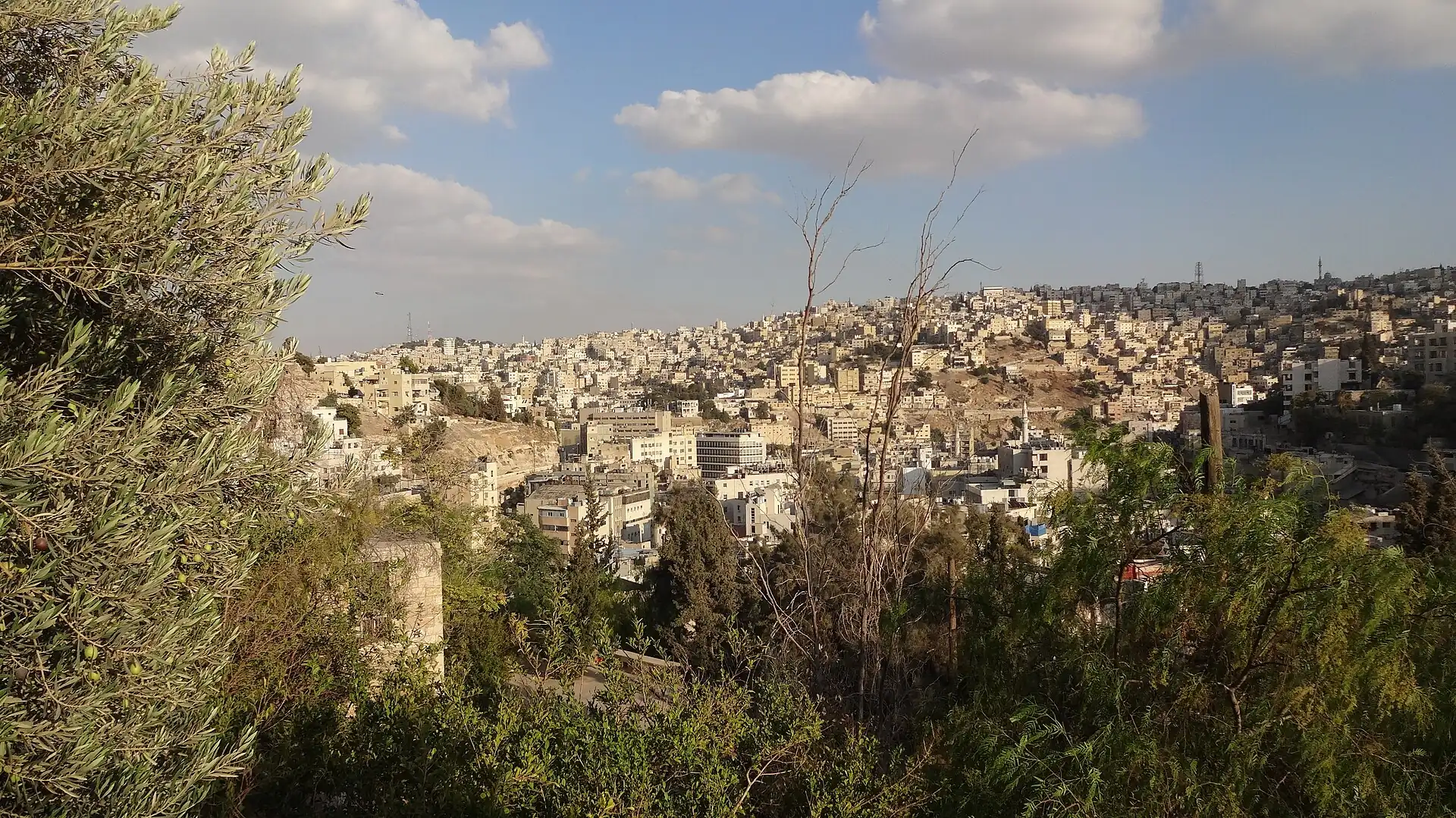
Amman is a hill city: do the Roman Theatre and the Citadel in the morning, eat downtown at midday, spend evenings on Jabal Amman and Weibdeh, and take a taxi uphill.
Our quick read of Amman, scored 1–5 (friction is out of 100). Cash need: how often you still need notes. Heat risk: how hot days get. Stroller: how easy wheels are. Friction: overall effort for a first visit. Desk judgements, so check before relying on them.
- Local time
- --:--
- Weather
- forecast below
- Currency
- JOD
- Best months
- Mar · Apr · May · Sep · Oct · Nov
- Airport
- Queen Alia (AMM)
Walking zones: the 4 areas this guide plans a day around. Each is a district you can cover on foot, so you do one zone per half-day and ride the train between them. The code (AM 01, AM 02…) is just the zone's number on the Amman line; the line under each name says how bags fare there and how much time it needs.
Map of Amman
Use the switches to show or hide each kind of pin. A switch that is on shows its pins on the map; tap it again to hide them. "Show only" keeps just the pins that match (for example, places that fit a suitcase). Tap any pin for its name and a link to its page.
- Where to sleep
- Places
- Eat
- Walking clusters
- Rest stops
From the airport Queen Alia (AMM) to your bed
Tap a pin for its card. Places without their own coordinates are shown by their walking cluster.
Why Amman
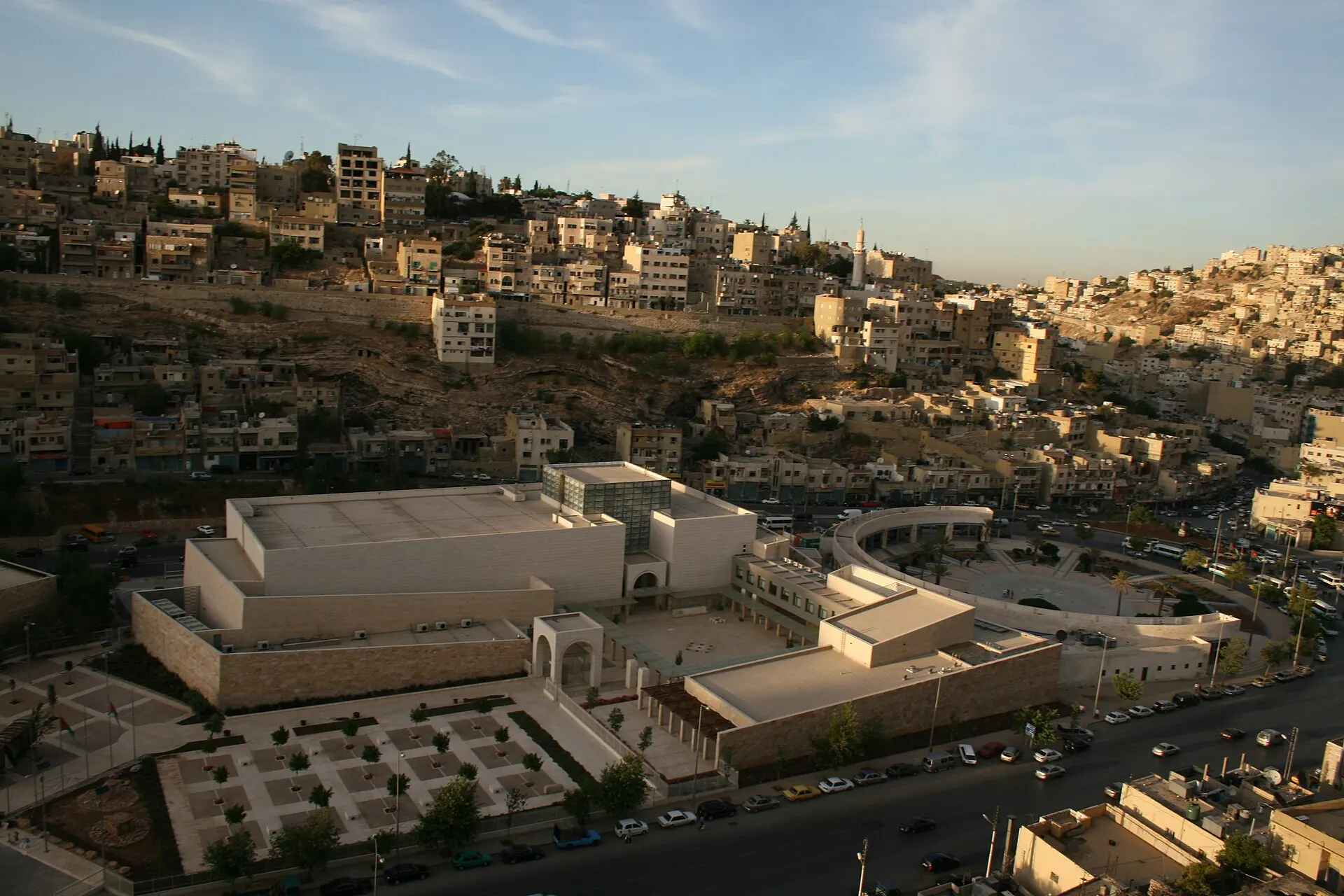
Amman's sights sit on seven hills, and the stairs between them are steeper than the map shows. The trips that go wrong walk Downtown to the Citadel at noon in July, forget that Friday morning is quiet, or plan Petra as a day trip. Four clusters cover a first visit: Downtown with the Roman Theatre, the Citadel, Rainbow Street on Jabal Amman, and Jabal Weibdeh.
Fits
- History-first trips
- Food-led city breaks
- Travellers who want a base for Petra and the Dead Sea
Does not fit
- Strollers and wheelchairs (hills, steps)
- Midday walkers in July and August
- One-day Petra trips from the airport
How long
- 2 daysDowntown + Roman Theatre, Citadel
- 3 daysFour clusters, mornings and evenings; middays indoors
- 5 daysFour clusters + Jerash or Dead Sea day trip + one slow day
About Amman
Amman is built on hills (traditionally counted as seven, now closer to twenty as the city has grown), and the numbered traffic circles running from First Circle near Downtown out through Jabal Amman still shape how people give directions, even where the roundabouts themselves have been replaced by junctions.
The lower town, Downtown or Al-Balad, sits in the valley around the Roman Theatre and the old souq: this is the oldest continuously inhabited part of the modern city and the most affordable place to eat and shop. The hills above it — Jabal Amman, Jabal al-Weibdeh, Abdoun, Shmeisani — hold the hotels, cafés, embassies and newer development.
Good to know
- Downtown (Al-Balad) is the old bazaar valley; Jabal Amman (Rainbow Street) and Jabal Weibdeh are hill districts a taxi ride up; the Citadel is on its own hill above Downtown.
- Jordan Tourism Board information points operate at some major sites and at Queen Alia International Airport; hours and locations change — check before relying on one.
- The Jordan Pass (bought online before arrival) bundles the visa fee waiver with entry to the Citadel, Jerash, Petra and dozens of other sites — worth pricing out if you plan two or more paid sites plus Petra.
Go deeper 11 min read · 6 chapters
Amman has answered to at least three names in three languages — Rabbath-Ammon, Philadelphia, Amman — and abandoned two of them for centuries at a stretch. The Citadel hilltop and the Roman valley below it were nearly empty when Circassian refugees resettled the site in 1878; almost everything else visible today was built in the century since. This deep dive reads the city hill by hill and layer by layer, from the Iron Age capital under the Citadel to the café terraces of Rainbow Street.
1History2 min
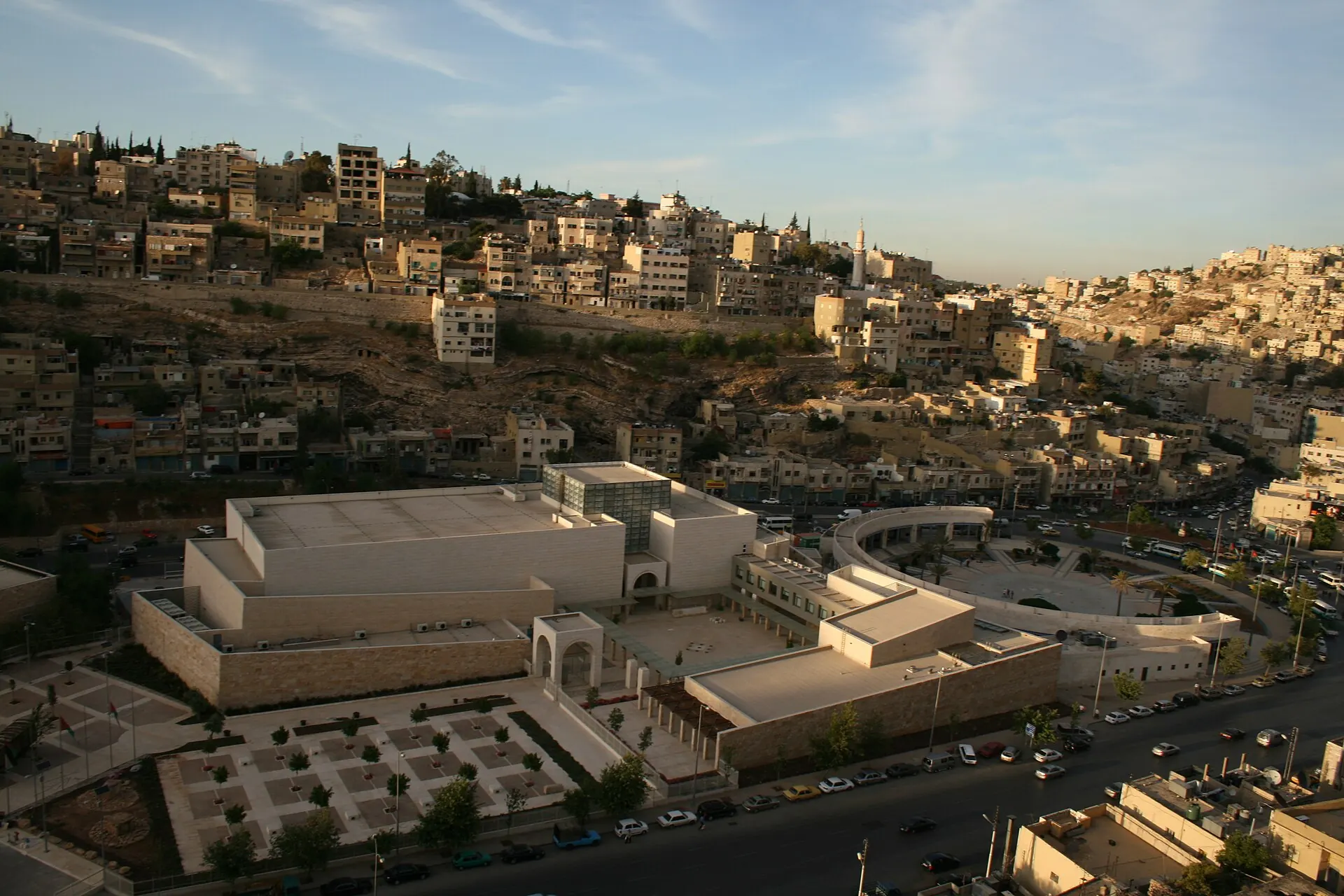
The Citadel hill has been inhabited on and off since the Neolithic period, and nearby Ain Ghazal, now a suburb on the city's eastern edge, was home to one of the largest known Neolithic settlements in the Near East around 7250–5950 BCE — its plaster-and-lime statues, among the oldest large human figures ever found, are the oldest objects a visitor can see in the city, at the Jordan Museum. By the Iron Age the hill carried Rabbath-Ammon, capital of the Ammonite kingdom named several times in the Hebrew Bible.
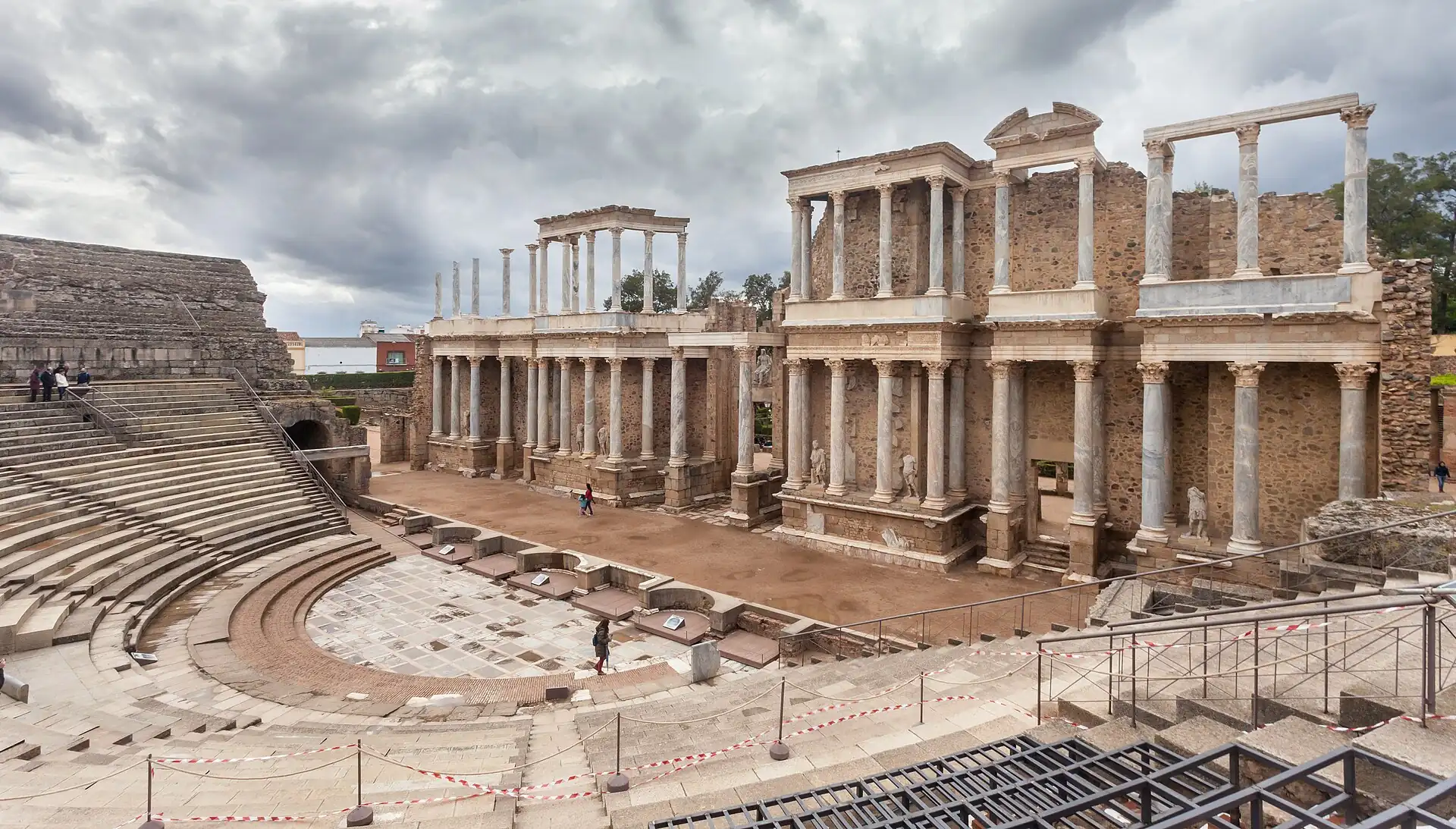
Alexander's successors reshaped the city twice: Ptolemy II Philadelphus refounded it as Philadelphia in the 3rd century BCE, and it later joined the Decapolis, a loose league of ten Hellenistic-then-Roman cities across the region. Roman rule from the 1st century CE brought the Theatre, the smaller Odeon beside it, and a Nymphaeum (monumental public fountain), all built into the valley below the Citadel — the Theatre alone seated roughly 6,000 people and is the best preserved of its kind in Jordan.
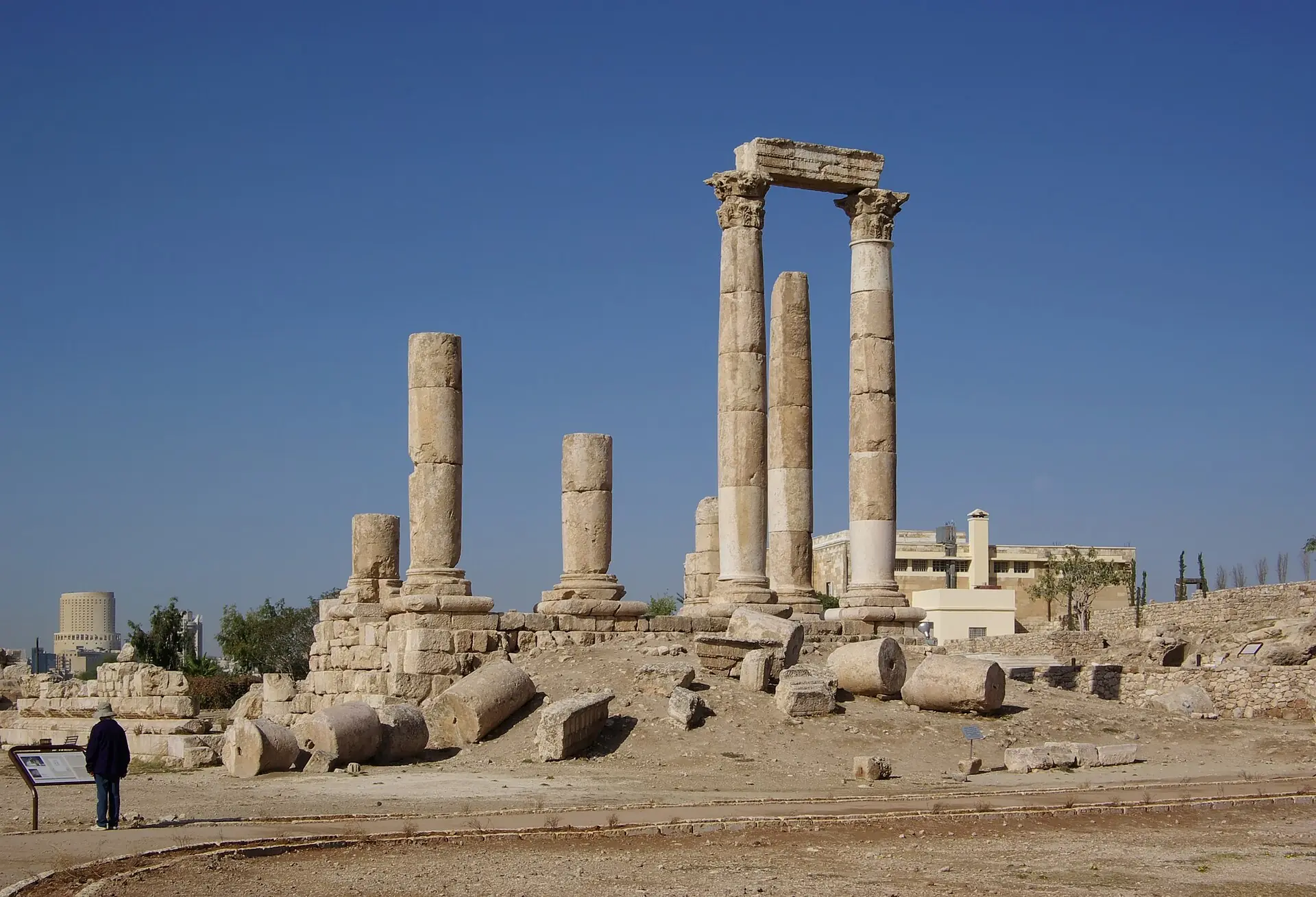
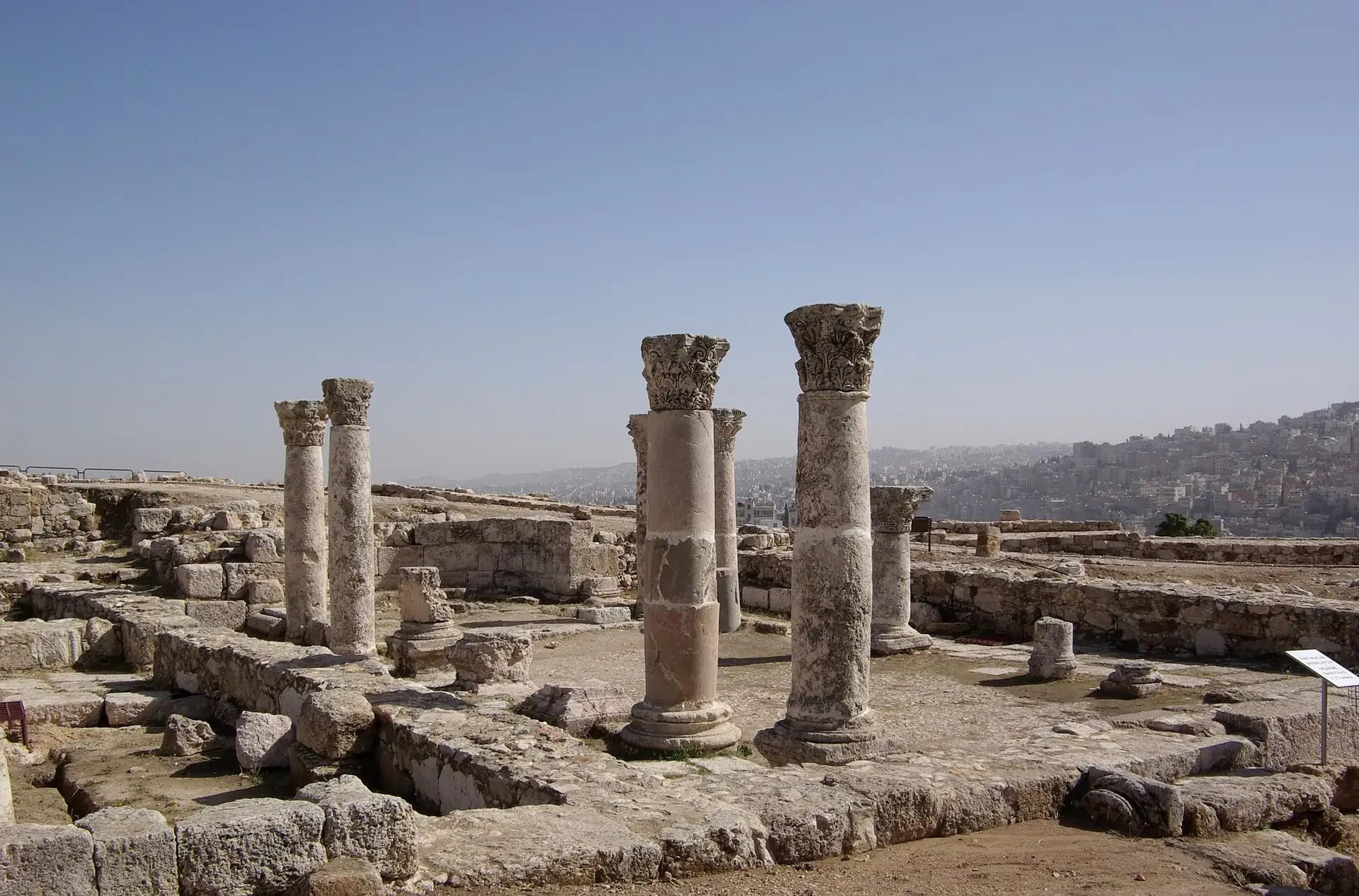
Byzantine Philadelphia held a bishopric, and the Umayyad caliphate that followed the Islamic conquest of the 630s CE rebuilt the Citadel hilltop with a governor's residence, the Umayyad Palace, along with a cistern and a monumental gateway — the ruins still standing there today date mostly from this period, not the Roman one. A major earthquake in 749 CE, and shifting trade routes as regional power moved elsewhere, left the site declining for centuries; by the Ottoman period it was a small village, largely emptied.
In 1878 Ottoman authorities settled Circassian refugees fleeing Russian expansion in the Caucasus into the depopulated valley; their descendants remain a small but visible community in the city today. Amman's modern rise began in 1921, when Emir Abdullah I made it the capital of the newly created Emirate of Transjordan, later the Hashemite Kingdom of Jordan after independence in 1946. The city's population exploded with refugee waves that followed regional wars — Palestinians in 1948 and again in 1967, Iraqis from the 1990s onward, and Syrians in large numbers after 2011 — each adding a layer to the city's neighbourhoods and food.
- Earlier names
- Rabbath-Ammon, Philadelphia
- Ain Ghazal settlement
- About 7250–5950 BCE
- Capital of Transjordan
- From 1921, Emir Abdullah I
- Circassian resettlement
- 1878
- Population
- About 4 million in Greater Amman (2020s estimate)
2Neighbourhood stories2 min
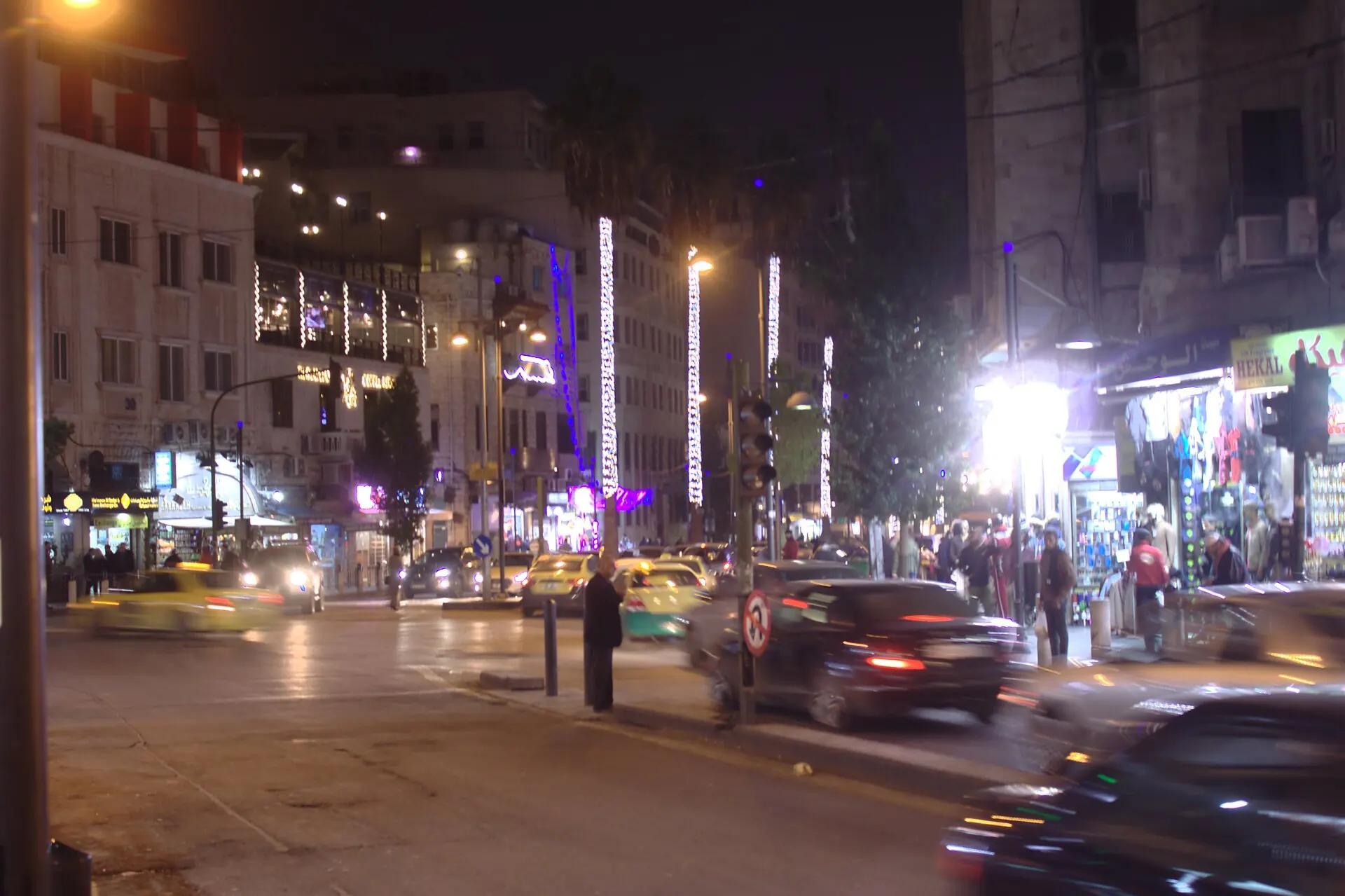
Downtown, Al-Balad, sits in the valley around the Roman Theatre and the old souq — it is the oldest continuously inhabited part of the modern city and still its commercial heart for ordinary Ammanis, not only visitors. King Faisal and King Hussein streets carry gold shops, spice sellers, clothing stalls and the counters that draw both locals and tourists for falafel, hummus and knafeh. Friday mornings are quiet here, since it is the main weekend day and many shops open only after midday prayer.
Jabal Amman, the hill directly above Downtown, was one of the first areas developed after 1921 and still carries the numbered traffic circles — First through Eighth — that Ammanis use for directions more than street names. Rainbow Street, on the lower slope of the hill, took its current form as a pedestrian-friendlier café strip in the 2000s, named for a long-closed cinema; the stone steps at its western end drop down past restored Ottoman-era houses, including Duke's Diwan, toward the older residential lanes.
Jabal al-Weibdeh, the next hill north, developed in the mid-20th century as a quieter residential quarter and kept that character even as galleries — Darat al Funun among them — and cafés moved in. Its streets are flatter and calmer than Jabal Amman's, and it remains one of the few central areas where original 1950s and 1960s houses, rather than newer apartment blocks, still line the streets.
West Amman — Abdoun, Shmeisani, and the newer Abdali district around the Boulevard — grew fastest from the 1990s onward as the city's business and diplomatic quarter. It holds most of the embassies, international restaurants and shopping malls, and reads as a different city again from Downtown: wider roads, car-dependent distances, and a skyline of glass rather than stone. The contrast between a Downtown falafel counter and an Abdali Boulevard café captures the range of the modern city in a single afternoon.
- Downtown weekend day
- Friday; many shops open only after midday
- Rainbow Street
- Pedestrian-focused café strip since the 2000s
- Traffic circles
- First through Eighth Circle, Jabal Amman to west Amman
- Abdali Boulevard
- Business and retail district built from the 2000s onward
3Architecture2 min
Amman's most visible architectural fact is not any one building but a colour: since building regulations from the 1970s required most new construction to be faced in local limestone, the hillsides read as a nearly uniform pale cream or white from a distance, whatever the age or function of the building underneath. The rule was meant to preserve a visual identity for a city expanding faster than any planning tradition could otherwise manage, and from the Citadel hilltop the effect is immediate: a stone-clad skyline climbing every hill in view.
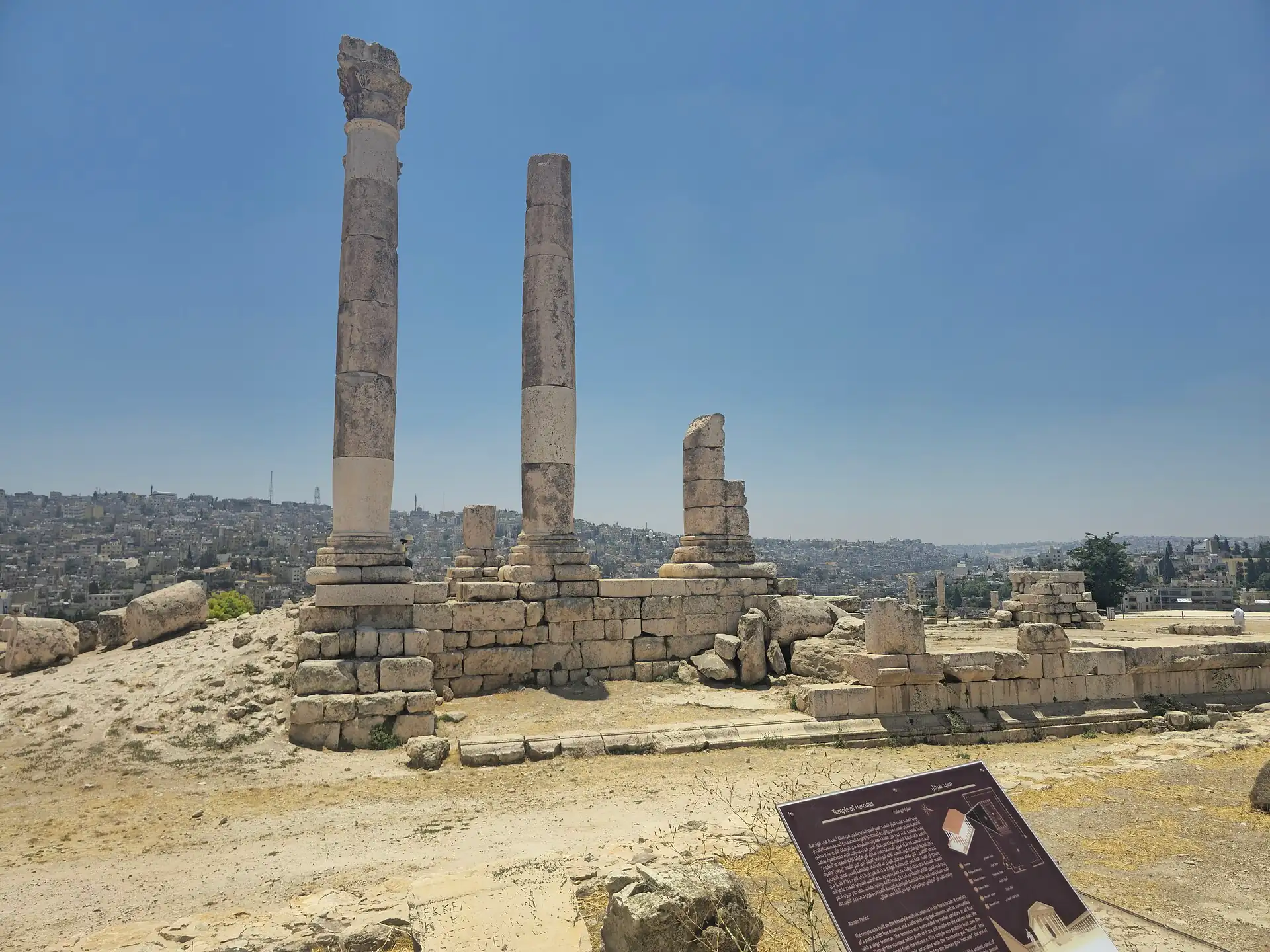
The Roman and Umayyad remains on the Citadel and in the valley are the oldest visible architecture: the Roman Theatre's cut-stone seating for about 6,000, the smaller Odeon, the Nymphaeum's fountain facade, and the Umayyad Palace's domed audience hall and cistern, rebuilt after the 749 CE earthquake damaged the original structure. Little survives from the centuries between the Umayyad decline and the Ottoman period, since the site was largely abandoned.
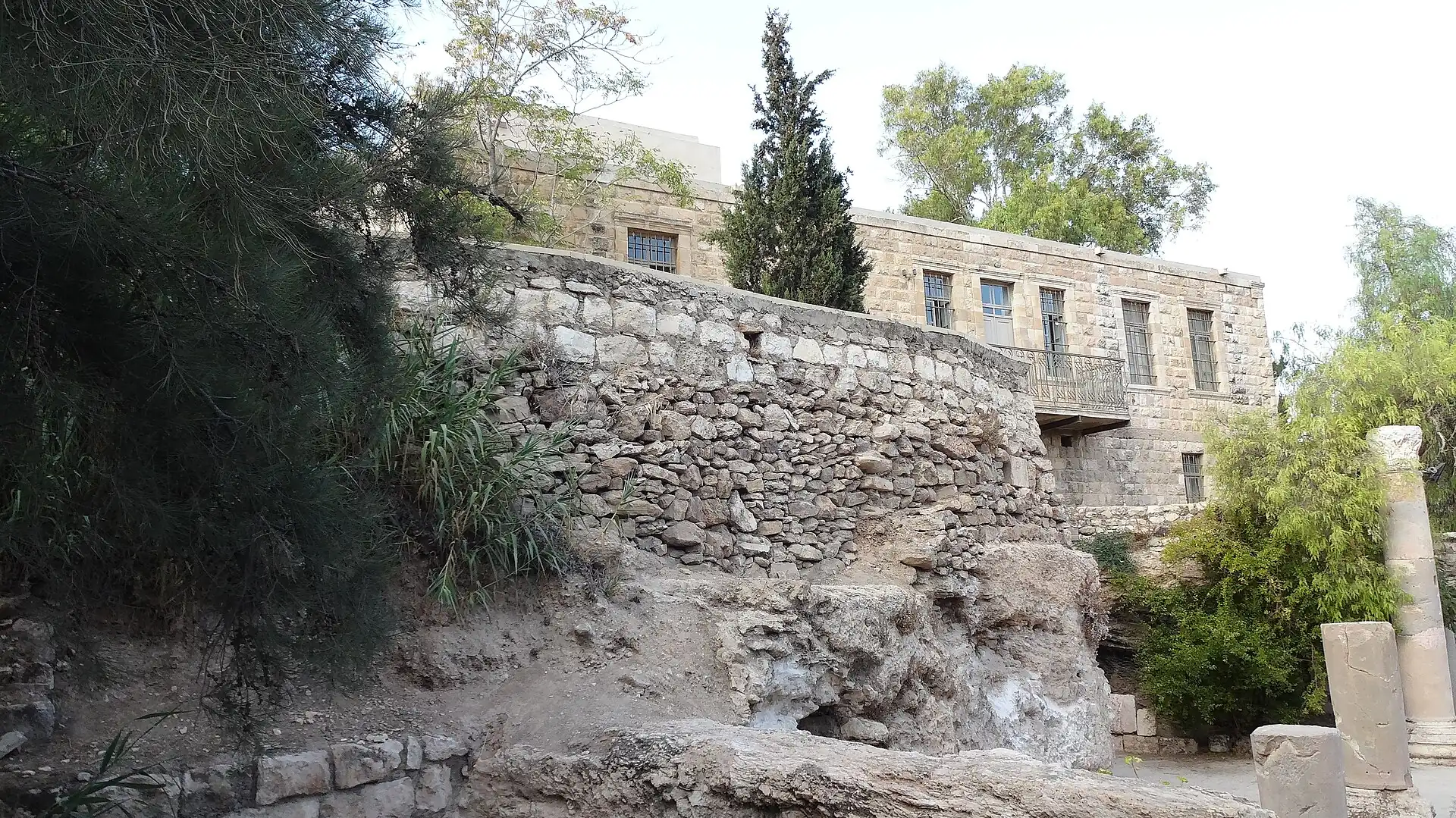
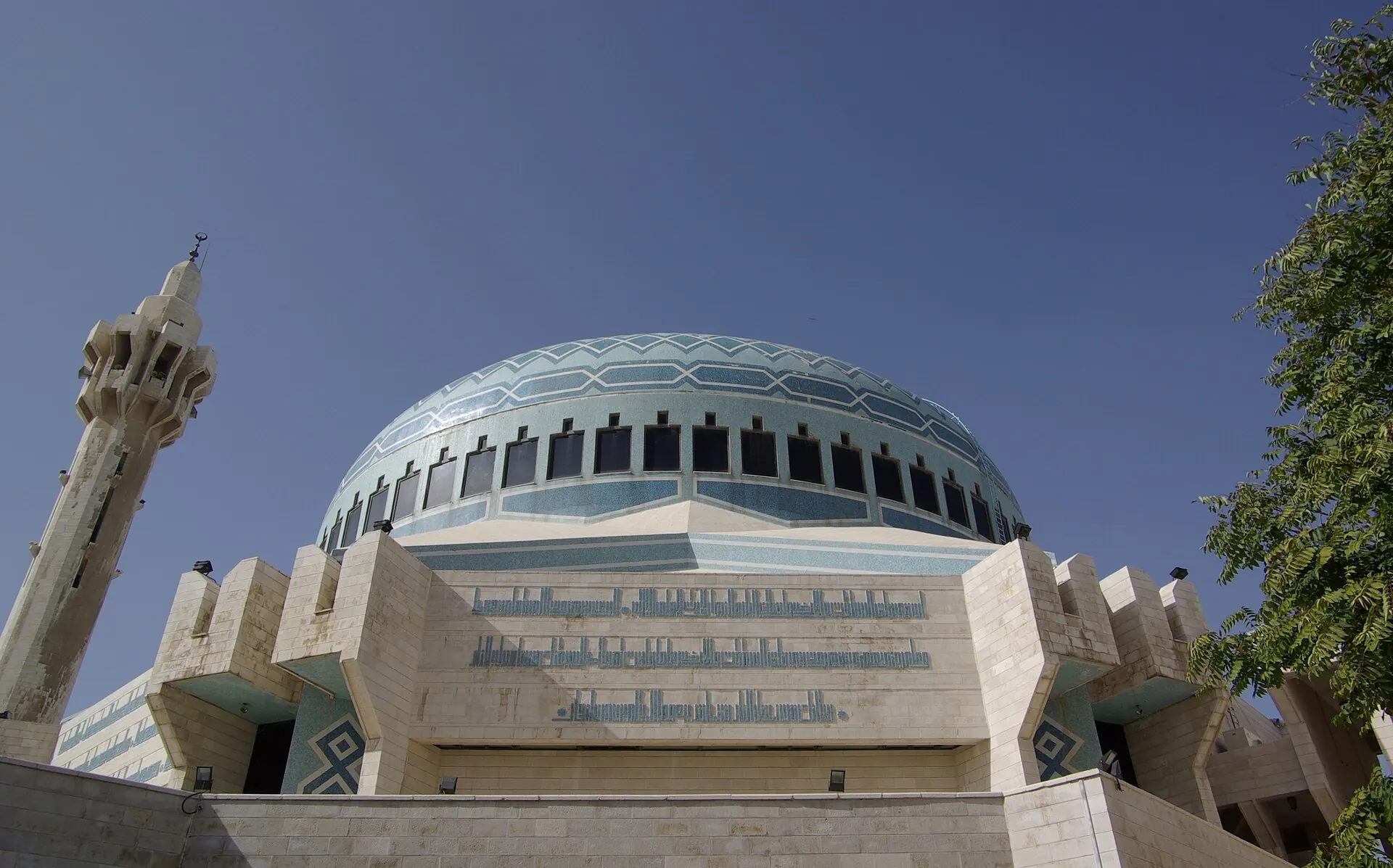
Early-20th-century Amman, built after the 1921 founding of the emirate and the 1878 Circassian settlement, produced the modest stone houses that still stand in parts of Jabal Amman and Jabal al-Weibdeh — single- or two-storey buildings with shuttered windows and small gardens, several now restored as galleries, cafés or cultural venues like Darat al Funun and Duke's Diwan. King Abdullah I Mosque, finished in the 1980s under King Hussein in memory of his grandfather, represents the later 20th century: a single blue-mosaic dome roughly 35 m across, with no interior columns, built in a modern reinterpretation of Islamic architectural forms rather than a historicist copy.
From the 1990s, west Amman's growth produced a second architectural city: glass office towers, shopping malls and gated residential compounds around Abdali, Abdoun and Shmeisani, largely disconnected in scale and material from the stone hillsides to the east. The contrast is deliberate in neither direction — it reflects two different building economies, one regulated for a historic silhouette, one built fast for a growing business district — and a visitor moving between them in one day feels the difference immediately.
- Stone-cladding rule
- In force since the 1970s for most new construction
- Roman Theatre capacity
- About 6,000 seats
- King Abdullah I Mosque dome
- About 35 m across, finished 1980s
- Umayyad Palace
- Rebuilt after the 749 CE earthquake
4Food history2 min
Mansaf, lamb cooked in a sauce of fermented dried yogurt (jameed) over rice and flatbread, is treated as Jordan's national dish and carries weight beyond the table: it is the meal served at weddings, funerals and reconciliations among Bedouin and rural Jordanian families, traditionally eaten by hand from a single shared platter. Its ingredients — dried yogurt that keeps without refrigeration, rice, bread — reflect a pastoral and desert-edge food economy rather than a coastal or riverine one, unlike much of the wider Levantine table.
Amman's everyday street food — falafel, hummus, foul (stewed fava beans) — belongs to the broader Levantine repertoire shared with Damascus, Beirut and Jerusalem, but the city's counters carry their own local reputations built up over generations; several of Downtown's best-known falafel and hummus shops have been run by the same families since the mid-20th century, feeding a city that grew explosively around them. Knafeh, the sweet cheese pastry soaked in syrup and topped with crushed pistachio, arrived with the same Levantine tradition and is sold hot from trays in Downtown sweet shops through the afternoon and evening.
Refugee waves reshaped what Amman eats as much as who lives here: Palestinian arrivals from 1948 brought dishes like maqluba (upside-down spiced rice and meat) into wider circulation, and more recent Iraqi and Syrian communities have added their own bakeries, sweets and restaurants, concentrated in specific neighbourhoods rather than spread evenly across the city. A meal in Amman is, in this sense, a rough map of a century of regional displacement as much as a menu.
Ramadan reorders the city's eating calendar entirely: restaurants that operate normally the rest of the year close in daylight and reopen at sunset for iftar, streets fill after dark rather than at midday, and sweets shops sell qatayef, a folded stuffed pancake specific to the month, alongside the usual knafeh. Coffee culture — both Arabic qahwa, cardamom-spiced and unsweetened, served as a gesture of hospitality, and Turkish-style sweet coffee sold in cafés — runs through the year independent of the fasting calendar.
- Mansaf
- Jordan's national dish; lamb in jameed sauce over rice
- Jameed
- Dried fermented yogurt, historically a way to preserve dairy without refrigeration
- Qatayef
- Folded stuffed pancake sold specifically during Ramadan
- Knafeh
- Cheese pastry in syrup, sold hot from trays in Downtown
5Festivals2 min
Ramadan is the year's dominant rhythm shift rather than a single festival day: for a lunar month, daylight hours empty of public eating and drinking, and the city's energy moves to the evening, when families and friends gather for iftar and streets, malls and cafés stay busy well past midnight. Eid al-Fitr follows immediately, a multi-day public holiday of family visits, new clothes and closed shops; Eid al-Adha comes roughly seventy days later on the Islamic calendar and is marked in a similar way, with the added tradition of animal sacrifice and meat distributed to those in need.
The Jerash Festival of Culture and Arts, held most years in July at the Roman ruins about an hour north of Amman, is the country's best-known secular arts festival: musicians, theatre and dance companies perform among the colonnades and the Oval Plaza, and it has drawn regional and international acts since it began in the 1980s, though scale and dates vary year to year and it has occasionally been paused. It is close enough to combine with an Amman base rather than requiring a separate trip.
Independence Day on 25 May marks Jordan's 1946 independence from British administration and is a public holiday with flags and modest official events rather than mass public celebration; King Abdullah II's birthday and other royal or national anniversaries bring similar, low-key marks on the calendar — flags on public buildings, occasional evening lighting displays — rather than street festivals in the way Ramadan or Eid transform the city.
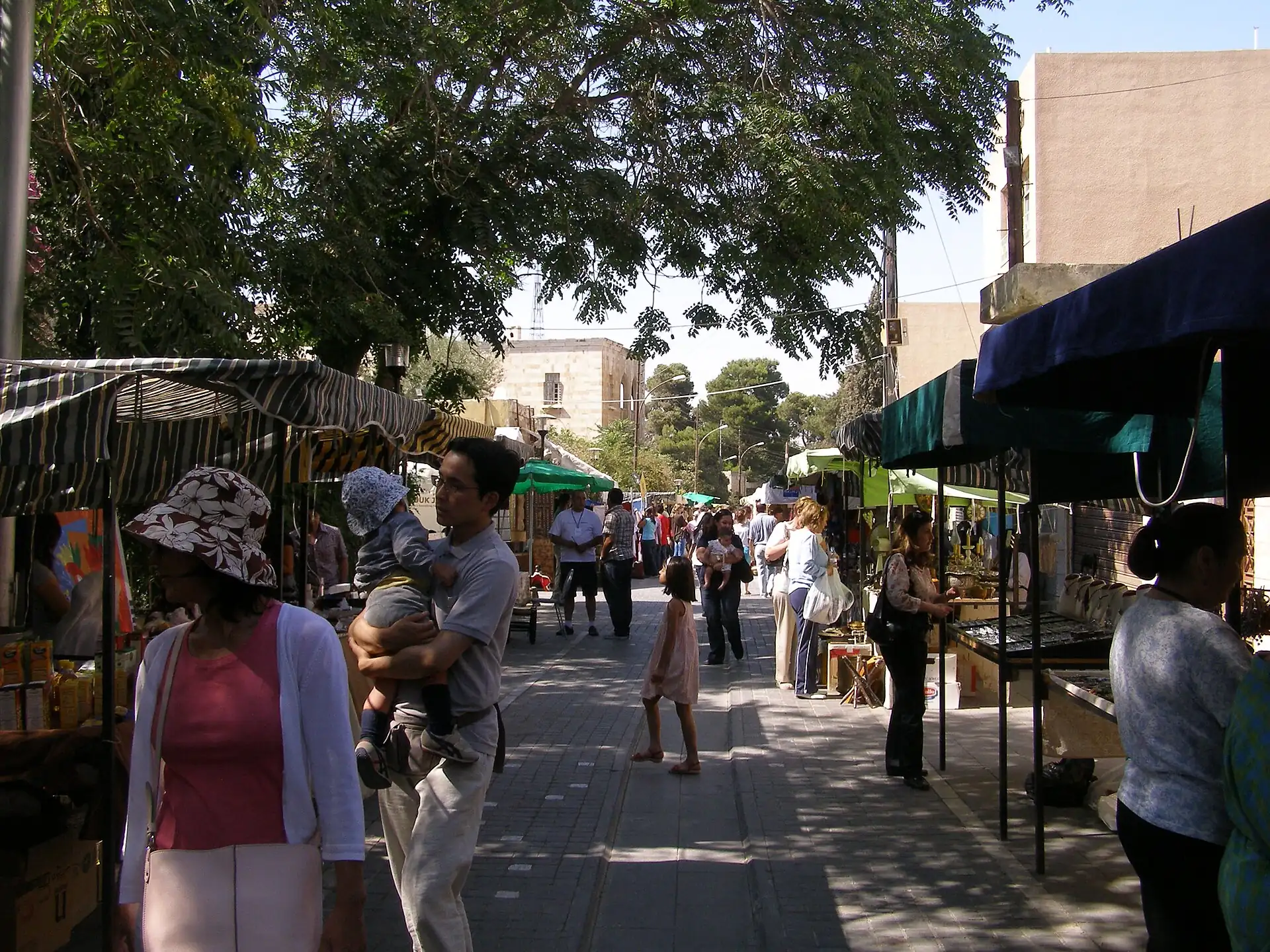
Souk Jara, the seasonal Friday craft and food market that runs on Rainbow Street through the warmer months, is a newer and smaller-scale tradition, begun in the 2000s as a platform for local designers and craftspeople rather than a historic event — it functions as much as a social gathering point for Ammanis as a shopping stop, and its informal, non-fixed nature (it does not run every Friday of the year) is itself characteristic of how much of the city's civic and cultural life outside the religious calendar has been built from the ground up in the last two decades.
- Ramadan
- Lunar month; dates move roughly 11 days earlier each year
- Jerash Festival
- Most years in July, since the 1980s
- Independence Day
- 25 May, marking 1946 independence
- Souk Jara
- Seasonal Friday market, Rainbow Street, since the 2000s
6City life2 min
Amman wakes later than some regional capitals: shops in Downtown open through the mid-morning, and the souq builds toward its busiest hours around midday and again in the early evening rather than at dawn. Friday, the main weekend day, runs on its own schedule entirely — quiet streets and shuttered shops through the morning, then a shift toward family gatherings and, for some, midday prayer at the mosque, before the city reopens in the afternoon.
Hospitality carries real social weight: coffee or tea offered by a shopkeeper, a host or even a stranger giving directions is a courtesy that costs little to accept and can cause mild offence to refuse outright — a light tap or wave over the cup is the accepted way to signal enough without rejecting the gesture. Greetings run longer than a quick hello, with inquiries after health and family treated as genuine rather than perfunctory.
The seven hills once used to describe the city are now more like twenty as Greater Amman has spread outward, but the hill-and-valley geography still governs daily life more than any grid: getting from one neighbourhood to another usually means a ride rather than a walk, and Ammanis navigate by traffic circle numbers, landmarks and neighbourhood names more than street addresses. Ride-hailing apps have largely replaced hailing a taxi on the street for anyone who can use one.
Café culture on Rainbow Street and in Jabal al-Weibdeh represents a newer, more cosmopolitan layer of city life that has grown steadily since the 2000s — a generation of Ammanis and long-term residents who work, meet and spend evenings in spaces that look outward toward a wider region's café and bar culture, while Downtown's souq economy continues on its own older rhythm a few hundred metres and one steep hill away. Both are equally Amman; neither replaces the other.
- Weekend day
- Friday (with Saturday also often off for many workplaces)
- Hills, traditional count
- Seven, historically; closer to twenty as the city has grown
- Main navigation method
- Traffic circles and landmarks, not street numbers
Read, watch, wordsReading · Watching · Glossary · Sources
Reading
- Amman: The City of the Seven Hills — Ammar Khammash and others (ed.)An overview of the city's growth from Ottoman-era village to modern capital, with historical photographs.
- Jordan: A Timeline of a Nation — Assad David BesharaA concise national history that places Amman's growth in the context of Jordan's founding and regional upheavals.
- Lawrence in Arabia — Scott AndersonNot Amman-specific, but essential background on the Hashemite family and the regional politics that made Amman a capital in 1921.
Watching
- Theeb — Naji Abu Nowar, 2014A Bedouin-perspective film set in the WWI-era desert that shaped modern Jordan and its Hashemite rulers, filmed largely in Wadi Rum.
Glossary
| Term | Local | Meaning |
|---|---|---|
| Al-Balad | البلد | Downtown Amman, literally 'the town'. |
| Jabal | جبل | Hill or mountain; prefixes most of Amman's hill-district names (Jabal Amman, Jabal al-Weibdeh). |
| Mansaf | منسف | Jordan's national dish: lamb in a fermented dried-yogurt sauce over rice. |
| Jameed | جميد | Dried fermented yogurt, the base of mansaf's sauce. |
| Souq | سوق | Market or bazaar street. |
| Iftar | إفطار | The sunset meal that breaks the daily Ramadan fast. |
| Qahwa | قهوة | Arabic coffee, cardamom-spiced and unsweetened, offered as hospitality. |
| Circassian | شركسي | Descendant of Caucasus refugees resettled in Amman from 1878. |
Read for this deep dive
- Wikipedia — Amman ↗
- Wikipedia — Philadelphia (Jordan) ↗
- Wikipedia — History of Jordan ↗
- Wikipedia — Ain Ghazal ↗
- Wikipedia — Jerash Festival ↗
Background reading only: the text above is written by Voykit, not copied from these pages.
Rules in force · 5
- Jordan ↗Get the visa or the Jordan Pass only on official channels; lookalike sites charge extra.
- Jordan ↗Yellow taxis must use the meter; if the driver refuses, use a ride-hailing app instead.
- Jordan ↗In Ramadan, eating, drinking or smoking in public in daylight is not accepted; hotels and tourist restaurants serve.
- Jordan ↗Do not pack a drone: import without a prior permit is refused and the drone is held at the border.
- Amman Governorate ↗Plan every leg by taxi, ride-hailing or a private driver; there is no useful rail, and buses run to their own timetable.
Entry rules depend on your passport. Full visa guide
Emergency numbers for Amman911 ▾
- Police / ambulance / fire911
- Tourist policecheck
Tap a number to call from your phone. These are the numbers listed in this guide; a row marked check has not been verified.
Planning is the full guide. I'm here keeps what is open and the cheat card.
Right now
Checking the weather…
Working out what is open near you…
What is open nowclock, closures, places open
Now in Amman
Local time in Amman
--:--
Loads in your browser · Asia/Amman
This month
Month verdict appears here.
Closed today
See the weekly grid below.
| Weekly closure | Mon | Tue | Wed | Thu | Fri | Sat | Sun |
|---|---|---|---|---|---|---|---|
| Darat al FununHistorically closed Fridays — check before you go. | · | · | · | · | ✕ | · | · |
| Souk JaraRuns on Fridays only, and only in season — check current-year dates. | ✕ | ✕ | ✕ | ✕ | · | ✕ | ✕ |
| Darat al FununcheckHistorically closed Fridays; confirm before you plan a Friday visit. | · | · | · | · | ✕ | · | · |
| Souk JaraRuns Fridays only, and only in season — check current dates. | ✕ | ✕ | ✕ | ✕ | · | ✕ | ✕ |
If today is a closure day: Friday morning: much of Downtown is quiet or closed until midday, so start with the Citadel or Jabal Weibdeh instead and move the souq walk to the afternoon or another day.
Open every day: Jordan Museum, King Abdullah I Mosque, Rainbow Street.
- check Jordan Museum: Not confirmed — check before you go.
- check King Abdullah I Mosque: Open daily outside prayer times; Friday morning is the exception — see closures.
- check Rainbow Street: Open street; no closures, though individual cafés keep their own hours.
- check King Abdullah I Mosque (non-Muslim visiting): Paused during the five daily prayers and Friday until after midday prayer.
Weekly closures and prayer-time pauses come from our place pages; Ramadan, Eid dates and state events add closures not shown here.
Open now
The sights and places to eat on our list that are open at this moment, in the city's time, nearest first from where you are staying.
Loads in your browser with the city's local time.
Hours marked (check) are typical, not confirmed. Walking times are straight-line estimates. Open at another time →
Cheat cardthe pocket version
Cheat card
The essentials on one card: save it as an image for your phone, share it, or print it.
Amman
عمّان
- Money
- Keep a few small dinar notes for taxis and food counters; withdraw at bank ATMs or in malls.
- SIM
- Buy a local SIM (Zain, Orange, Umniah) at Queen Alia arrivals or a shop in the city with your passport…
- Ride app
- Careem · Uber
- Emergency
- 911 police / ambulance / fire · check tourist police
- Plugs
- Sockets C. US/Canada (A/B): adapter · UK/Ireland (G): adapter · Australia/NZ (I): adapter. 230 V: US 120 V-only devices (hair dryers) need a converter; most chargers are dual-voltage.
Say it
- Hello: مرحبا (marhaba)
- Thank you: شكرا (shukran)
- How much is this?: قديش هاد؟ (addaysh hayda)
- Not spicy, please: بدون حار من فضلك (bidoon har min fadlak)
- The bill, please: الحساب من فضلك (al-hisab min fadlak)
Top 5
- Amman Citadel
- Roman Theatre
- Jordan Museum
- Rainbow Street at dusk
- Darat al Funun
EssentialsQuick answers, what things cost and how to get around
Essentials
Quick answers, what things cost and how to get around
Quick answers
The questions people ask first about Amman, one line each. Tap a card for the full answer.
- Cash or card?Cash for taxis, small restaurants, souq stalls and street food; cards in hotels, malls and many mid-range and upmarket restaurants.
- SIM or eSIMBuy a local SIM (Zain, Orange, Umniah) at Queen Alia arrivals or a shop in the city with your passport, or install an eSIM before you fly.
- Ride-hailing appCareem · Uber.
- Tap waterTap water is treated but not generally recommended for visitors to drink; use bottled or filtered water.
- TippingNot automatic.
- Plugs & powerSockets C. US/Canada (A/B): adapter · UK/Ireland (G): adapter · Australia/NZ (I): adapter. 230 V: US 120 V-only devices (hair dryers) need a converter; most chargers are dual-voltage.
Show all 14 answers
- Safe at night?Take more care after dark in Citadel hill.
- What to wearShoulders and knees covered, shoes off inside, headscarf for women; no entry during the five daily prayers.
- Emergency numberscheck911 police / ambulance / fire · check tourist police
- Your embassycheckUS, UK, Australia, Canada embassies listed with addresses (check before you go).
- Closed which day?Mon: 2 on our list shut · Tue: 2 on our list shut.
- Sundays & holidaysRamadan: Many restaurants close in daylight and open after sunset (iftar); no eating, drinking or smoking in public during the day…
- Rainy-day planRain (Nov–Mar) is usually steady rather than stormy: carry a light rain layer and expect slippery stone paving on the Citadel and in the souq.
- Landing lateAMM: ride-hailing car to the door runs all night.
Cost cheat-sheetwhat everyday things cost
Cost cheat-sheet
Typical prices for the everyday things, as ranges. Change the currency right here; the local price stays first.
2026 desk estimate · check
- CoffeeCoffee (Turkish-style, café)JOD 2–4
- Sit-down mealMansaf, sit-down restaurantJOD 8–15
- Street or quick mealFalafel or hummus plateJOD 1–3
- Taxi, about 5 km (3 mi)Taxi, about 3 mi (5 km)Short ride-hail car in the centreJOD 2–4
- SIM or eSIM, a weekLocal SIM, about a week of dataJOD 8–15
- Museum or sight ticketMuseum or site entryThe Citadel and Jerash cost more; the Jordan Museum and Darat al Funun are cheaper or free.JOD 1–10
- Budget bedHostel dorm bed, a night, per personJOD 8
- Mid-range bedHotel double room, a night, per roomJOD 55
- High-end bedHotel double room, a night, per roomJOD 130
A day, not counting the bed: Budget JOD 25 · Mid JOD 50 · High JOD 100
Local prices, with USD next to them (rates 2026-09 (approximate); change it in the header). Ranges are desk estimates: check locally. Every price and the budget calculator →
Source: Prices in Amman
Draft
Written from desk research. Not yet compared with the official source.
No official source is recorded for this figure.
Prices are 2026 desk estimates, not yet compared with an official source. Check on the day.
Not checked in the last 12 months (no check date on file).
DecideWho it suits, the trade-offs and when to go
Decide
Who it suits, the trade-offs and when to go
Best months at a glance
The guide's verdict for each month
Jan
Care
12°C (54°F)54°F (12°C)
Feb
Care
13°C (55°F)55°F (13°C)
Mar
Best
17°C (63°F)63°F (17°C)
Apr
Best
22°C (72°F)72°F (22°C)
May
Best
27°C (81°F)81°F (27°C)
Jun
Care
30°C (86°F)86°F (30°C)
Jul
Care
32°C (90°F)90°F (32°C)
Aug
Care
32°C (90°F)90°F (32°C)
Sep
Best
30°C (86°F)86°F (30°C)
Oct
Best
26°C (79°F)79°F (26°C)
Nov
Best
19°C (66°F)66°F (19°C)
Dec
Care
14°C (57°F)57°F (14°C)
Best: Mar–May, Sep–Nov. Mixed: Jun–Aug, Dec–Feb. Month by month →
Warmest Jul (32°C (90°F)90°F (32°C)), coolest Jan (4°C (39°F)39°F (4°C) low), wettest Jan (9 rain days), driest Jun (0). Averages, not a forecast.
Amman across the year
Best-looking months for Amman: Apr, May, Nov.
| Measure | Jan | Feb | Mar | Apr | May | Jun | Jul | Aug | Sep | Oct | Nov | Dec |
|---|---|---|---|---|---|---|---|---|---|---|---|---|
| Weather | Mixed (care) | Mixed (care) | Good (good) | Great (good) | Great (good) | Mixed (care) | Mixed (care) | Mixed (care) | Good (good) | Great (good) | Great (good) | Mixed (care) |
| Crowds | Low (good) | Low (good) | Medium (ok) | High (care) | Medium (ok) | Low (good) | Medium (ok) | Medium (ok) | Medium (ok) | High (care) | Medium (ok) | Low (good) |
| Prices | Low (good) | Low (good) | Medium (ok) | High (care) | Medium (ok) | Low (good) | Medium (ok) | Medium (ok) | Medium (ok) | High (care) | Medium (ok) | Medium (ok) |
| Events | 1 event (ok) | 2 events (care) | 3 events (care) | 1 event (ok) | 2 events (care) | 1 event (ok) | 1 event (ok) | 1 event (ok) | 1 event (ok) | 1 event (ok) | 1 event (ok) | 1 event (ok) |
Green is good news, amber needs planning, red is a month to avoid; dashed grey with a question mark means our data does not say. Open the year heatmap →
Not checked in the last 12 months (no check date on file).
Source: Months, temperatures and crowds
Draft
Written from desk research. Not yet compared with the official source.
Monthly highs, rain and crowd levels are climate averages and desk estimates for the city, not a forecast.
Understand the cityUnderstand · Districts
Orientation & districts
A first visit fits inside a rough triangle: Downtown (Al-Balad) in the valley, Jabal Amman and Rainbow Street on the hill above it to the west, and Jabal al-Weibdeh on the hill to the north. The Citadel sits on its own hill overlooking Downtown. Everything outside that triangle — Abdoun, Shmeisani, the airport road — is a ride.
Amman addresses are commonly given by neighbourhood, landmark and traffic-circle number (First Circle through Eighth Circle along Zahran Street) rather than street number; ride-hailing apps work from pinned locations better than spoken addresses.
Shaded shapes: walking areas (click one). Black pins: sleep areas. Grey dots: places. Round badges: arrivals. Click the map to turn on scroll-wheel zoom.
Hover, tap or tab to an area to see what it is like. Pins are sleep areas; arrows at the edge point to the airport.
Off the map: Queen Alia International Airport (AMM) (45–70 min by the usual route).
Not drawn yet (no coordinates in this guide): Abdoun, Shmeisani. They are in the neighbourhood cards below.
Where’s what, as a list:
- Downtown (Al-Balad) (البلد): Steep streets and steps; not for wheeled suitcases. Many shops close Friday morning. Suits: Sightseeing, cheap eating, a first morning. Price band $.
- Citadel hill (Jabal al-Qal'a) (جبل القلعة): No shade at midday; go at opening or in the last afternoon hours. Suits: One exposed hilltop visit.
- Jabal Amman / Rainbow Street (جبل عمان): Steps at the Rainbow Street stairs; otherwise a walkable hill. Suits: Cafés, evenings, a base with easy taxis to everywhere else. Price band $$$.
- Jabal al-Weibdeh (جبل اللويبدة): Short, flat streets once you are up the hill; a taxi up is easier than the walk. Suits: Galleries, quiet cafés, a slower afternoon.
- Abdoun: West Amman; sights are thin, but the food and bar scene is strong. A ride from the centre. Suits: Upmarket restaurants, embassies.
- Shmeisani: Mid-range hotels and banks; not a sightseeing base. Suits: Business hotels, offices.
- Abdali: A newer commercial district around the Boulevard; the museum and mosque are the reasons to come. Suits: Jordan Museum and King Abdullah I Mosque.
- Sleep area Downtown (Al-Balad): suits Sightseeing, cheap eating, a first morning, price band $.
- Sleep area Jabal Amman (Rainbow Street): suits Cafés, evenings, a base with easy taxis to everywhere else, price band $$$.
- Queen Alia International Airport (AMM), 45–70 min by the usual route.
Neighbourhoods at a glance
One tab per area, pulled together from this guide’s districts table, area notes, sleep-area scores and place pages. Scores are desk judgements (1–5); prices are estimates, check before you book.
Downtown (Al-Balad)
$البلد
Steep streets and steps; not for wheeled suitcases. Many shops close Friday morning.
- Suits:
- Sightseeing, cheap eating, a first morning
- Quiet nights2/5 Low
- Nightlife2/5 Low
- Families2/5 Low
- Late arrival3/5 Medium
Why these scores
- Quiet nights: Traffic noise and the souq's daytime bustle; quieter at night.
- Nightlife: Thin after dark; most evening life is up the hills.
- Families: Steps and traffic make it hard going with a stroller; fine with older children.
- Late arrival: Smaller hotels may not keep 24-hour staff; confirm the arrangement.
Getting around from here
- 20–30 min walk to Amman Citadel (Jabal al-Qal'a)
- Taxi up to Jabal Amman: about 12 min to Rainbow Street (Jabal Amman)
Citadel hill (Jabal al-Qal'a)
جبل القلعة
No shade at midday; go at opening or in the last afternoon hours.
- Suits:
- One exposed hilltop visit
Getting around from here
- Taxi down: about 10 min to Downtown (Al-Balad) & Roman Theatre
- Taxi: about 10 min to Jabal Weibdeh
Jabal Amman / Rainbow Street
$$$جبل عمان
Steps at the Rainbow Street stairs; otherwise a walkable hill.
- Suits:
- Cafés, evenings, a base with easy taxis to everywhere else
- Quiet nights3/5 Medium
- Nightlife4/5 High
- Families3/5 Medium
- Late arrival4/5 High
Why these scores
- Quiet nights: Café strips are lively into the evening; ask for a room off the main street for a quieter night.
- Nightlife: Rainbow Street cafés and bars are on the doorstep.
- Families: Manageable with a car for every outing; the hill itself has steps in places.
- Late arrival: Most hotels keep a night desk; confirm on booking.
Getting around from here
- 15–22 min walk to Jabal Weibdeh
- Taxi down: about 12 min to Downtown (Al-Balad) & Roman Theatre
Jabal al-Weibdeh
جبل اللويبدة
Short, flat streets once you are up the hill; a taxi up is easier than the walk.
- Suits:
- Galleries, quiet cafés, a slower afternoon
Getting around from here
- Short taxi: about 8 min to Amman Citadel (Jabal al-Qal'a)
- Short taxi or walk: about 12 min to Rainbow Street (Jabal Amman)
Abdoun
West Amman; sights are thin, but the food and bar scene is strong. A ride from the centre.
- Suits:
- Upmarket restaurants, embassies
Shmeisani
Mid-range hotels and banks; not a sightseeing base.
- Suits:
- Business hotels, offices
Abdali
A newer commercial district around the Boulevard; the museum and mosque are the reasons to come.
- Suits:
- Jordan Museum and King Abdullah I Mosque
Getting around from here
- Taxi or a steep climb up: about 10 min to Amman Citadel (Jabal al-Qal'a)
- Taxi up to Jabal Amman: about 12 min to Rainbow Street (Jabal Amman)
Decide
The honest trade-off: what you will enjoy, what will wear you down.
You will like
- Roman stones in the middle of the city
- Falafel and hummus counters
- Cafés on the hills at dusk
You will hate
- Steep streets and stairs
- Winter cold and rain
- Traffic on the main roads
Similar citiesif this one is not quite right
Similar cities
If Amman does not fit your dates or budget, these match it on season, cost and feel.
When
Best months: Mar, Apr, May, Sep, Oct, Nov. Month-by-month verdicts below, with the live forecast first. When to go, month by month →
Amman: next 7 days
Loading forecast…
Forecast: Open-Meteo (CC BY 4.0), model data for this point.
Air quality
Loading…
Model estimate (CAMS via Open-Meteo), not a street-level station; readings near busy roads run higher.
Month by month, all 12best Mar, Apr, May, Sep, Oct, Nov
Cold and wet; snow is possible; bring a coat.
Cold, rain; some roads close after snow.
Mild, green; spring showers.
Best month; warm days, cool nights.
Warm and dry; May 25 is Independence Day.
Hot and dry; walk early.
Hot and dry at midday; cool evenings.
Hot; long dry days.
Warm; good visibility.
Mild; best month for walking.
Cooling; first rain.
Cold, wet; bring a coat.
Climate, calendar and eventsClimate · Calendar · Events · Packing by season
Climate
| Jan | Feb | Mar | Apr | May | Jun | Jul | Aug | Sep | Oct | Nov | Dec | |
|---|---|---|---|---|---|---|---|---|---|---|---|---|
| High | 12°C (54°F)54°F (12°C) | 13°C (55°F)55°F (13°C) | 17°C (63°F)63°F (17°C) | 22°C (72°F)72°F (22°C) | 27°C (81°F)81°F (27°C) | 30°C (86°F)86°F (30°C) | 32°C (90°F)90°F (32°C) | 32°C (90°F)90°F (32°C) | 30°C (86°F)86°F (30°C) | 26°C (79°F)79°F (26°C) | 19°C (66°F)66°F (19°C) | 14°C (57°F)57°F (14°C) |
| Low | 4°C (39°F)39°F (4°C) | 4°C (39°F)39°F (4°C) | 7°C (45°F)45°F (7°C) | 10°C (50°F)50°F (10°C) | 14°C (57°F)57°F (14°C) | 17°C (63°F)63°F (17°C) | 19°C (66°F)66°F (19°C) | 19°C (66°F)66°F (19°C) | 17°C (63°F)63°F (17°C) | 14°C (57°F)57°F (14°C) | 9°C (48°F)48°F (9°C) | 6°C (43°F)43°F (6°C) |
| Rain days | 9 | 8 | 7 | 4 | 1 | 0 | 0 | 0 | 1 | 3 | 6 | 8 |
| Verdict |
- Amman's altitude (about 750–1,100 m across its hills) keeps summer evenings cooler than the Jordan Valley or the Dead Sea below; days are dry and hot, nights are comfortable.
- Winter (Dec–Feb) is genuinely cold and wet by regional standards, and snow closes roads and schools every few years — bring a real coat if travelling then, not just a jacket.
- Rain is rare from June to September; the dry season is long and reliable for walking, but shade is thin on the hilltop sites.
Events by month
Coldest month
seasonJan
Coldest month; occasional snow closes hilltop roads for a day.
Cold and wet
seasonFeb
Still cold and wet; fewer crowds at the sites.
Shoulder season begins
seasonMar
Mild and green; a good shoulder month for walking.
Best month
seasonApr
Best month: warm days, cool nights, low rain.
Independence Day
holiday25 May
Warming fast; Independence Day.
Hot season begins
seasonJun
Hot and dry; walk the hilltop sites early.
Jerash Festival
festivalCheck current year · Jerash, about an hour from Amman(check dates)
Hot; Jerash Festival dates can be worth a day trip.
Hottest month
seasonAug
Hottest month; plan indoor midday breaks.
Cooling
seasonSep
Cooling, still dry; a good month for walking returns.
Best month (alongside April)
seasonOct
Mild; arguably the best month alongside April.
First rain
seasonNov
Cooling fast; first rain of the season.
Cold and wet
seasonDec
Cold, wet; snow is possible on the hills.
Festivals and events that change the plan
| When | What | Effect on your plan |
|---|---|---|
| Moves yearly with the Islamic calendar | Ramadan | Many restaurants close in daylight and open after sunset (iftar); no eating, drinking or smoking in public during the day; evenings are busier and livelier than usual. |
| Two days after Ramadan (moves yearly) | Eid al-Fitr | Public holiday; many shops close for a few days; family gatherings fill restaurants that stay open. |
| About 70 days after Eid al-Fitr (moves yearly) | Eid al-Adha | Public holiday, several days; transport and hotels can book up. |
| May 25 | Independence Day | Flags and some closures; low disruption for visitors. |
| July (dates vary; check current year) | Jerash Festival of Culture and Arts | A major arts festival at the Jerash ruins, about an hour from Amman; worth a day trip if the dates align, book transport ahead. |
| Fridays, in season (check current dates) | Souk Jara | A seasonal craft and food market on Rainbow Street; check it is running before you plan around it. |
What to pack, by season
From Amman’s own climate table: the coldest, warmest and wettest three months, and what to bring for each.
Coldest months
Dec–Feb
5° to 13°
A warm coat and layers.
Warmest months
Jun–Aug
18° to 31°
Light, breathable clothes, a sun hat and sunscreen; plan midday indoors and carry water.
Wettest months
Dec–Feb
8 rain days a month
A compact umbrella.
Arrive & moveGetting in, getting around, and your bags
Arrive & move
Getting in, getting around, and your bags
I land at…
Enter your landing time: what still runs from the airport, where you can eat when you get in, and which areas let you check in that late.
Queen Alia International Airport (AMM)
Out of the airport about 23:5311:53 PM (01:00 (next day)1:00 AM (next day) if immigration and bags are slow); in town about 00:38 (next day)12:38 AM (next day).
Transport from the airport
- Any hourRide-hailing car to the door. Runs all night.
- GoneAirport express bus to the city (Abdali; schedule unverified). Stops about 22:00.Stops about 10:00 PM.
- Last resortOvernight near the airport. If nothing else works.
Places to eat open when you get in
We have no confirmed hours for the places to eat here yet. Plan on a convenience store or your hotel. What is open late →
Where to sleep with a late arrival
- Lets you inDowntown (Al-Balad) 24-hour desk. Smaller hotels may not keep 24-hour staff; confirm the arrangement.
- Lets you inJabal Amman (Rainbow Street) 24-hour desk. Most hotels keep a night desk; confirm on booking.
Typical times from our airport data, not a timetable: check the last departure on the day. Full airport-to-bed plan for Queen Alia International Airport (AMM) →
Arrive
Each gateway has its own airport-to-bed page with timings and the last safe connection.
Getting in, in detailGet in
Get in by rail and road
| Station | Mode | Serves | Where | To the centre |
|---|---|---|---|---|
| Queen Alia International Airport (AMM)use | Air | The main gateway, about 30–35 km (19–22 mi) south of the cityThe main gateway, about 19–22 mi (30–35 km) south of the city | Taxi or ride-hail, about 40–70 min depending on traffic | |
| King Hussein (Allenby) Bridgecaution | land | Crossing to/from Israel/Palestine, near the Dead Sea | Hours and permitted transport vary — check current rules before relying on one. | |
| Sheikh Hussein (north) and Wadi Araba (south) crossingscaution | land | Further crossings to/from Israel/Palestine | Hours and permitted transport vary — check current rules. | |
| Land borders with Saudi Arabiacaution | land | Less used by short-trip visitors | Check current visa and transport rules. |
Move
The default way around, when a pass pays off, and when the last trains go.
- Default
- Walk inside a cluster; ride-hailing car or taxi between clusters, and always uphill.
- Passes
- No pass. Short car rides inside the centre are cheap; use the meter or see the fare in the app.
- Last trains
- No metro. Ride-hailing runs all night; availability drops in heavy rain and snow.desk estimate
- Other modes
- Other modes (Rome2Rio) ↗
Getting around, in detailGet around · Connect
Get around
Ride-hail or taxi between the hills, walk inside a cluster; there is no metro and the bus network is not set up for short-stay visitors.
| Mode | Verdict | Fare | Use it for | What breaks |
|---|---|---|---|---|
| Ride-hailing (Careem, Uber) | use | check | Most trips between hills and clusters | The default for most visitors: fare shown before the ride, no haggling. |
| Taxis | ok | check | Street hail when apps are slow | Plentiful; insist on the meter or agree a price before getting in. |
| Walking | use | Free | Inside Downtown, Rainbow Street or Weibdeh | Fine within a cluster; the hills between clusters are steep, so most visitors ride between them. |
| Public buses | caution | check | Budget travel with local knowledge | A city bus network exists but is not set up for short-stay visitors without local knowledge; ride-hailing is simpler. |
Connect
| Option | Verdict | What breaks |
|---|---|---|
| Zain, Orange or Umniah counter at Queen Alia arrivals | use | Passport needed; 10–20 min for activation. |
| Carrier shop in the city | use | Same carriers, sometimes a shorter queue than the airport. |
| Tourist eSIM bought before you fly | use | No counter, no queue; data-only on most plans. |
| Resellers or unofficial kiosks | caution | Check the price board and test data before walking away. |
Careem
Cars
The most widely used ride-hailing app in Amman; fare shown before you ride.
Uber
Cars
Also operates in Amman; compare fares with Careem.
Google Maps
Walking, addresses
Reliable for the centre; search landmarks and circle numbers rather than street numbers in older areas.
Messaging
Widely used by hotels, drivers and tour operators for booking and confirmation.
- Wi-Fi
- Free in most cafés, hotels and malls; ask staff for the password.
Luggage
Where big bags are a problem, and how to get rid of them for the day.
Rule
- Lockers
- Few public lockers; hotels hold bags after check-out.
- Forwarding
- No forwarding service culture; keep the big bag at the Amman hotel for trips away.
- Dead zone
- Late flights: ask the hotel to hold bags and for a shower room; many do for a small fee.
Bags, area by area
4 walking areas rated
- Bags forbidden
Downtown (Al-Balad) & Roman TheatreAmman Citadel (Jabal al-Qal'a)
- Bags painful
Lockers, forwarding and the gap between check-out and check-in are covered once, under Luggage.
See & doWalking clusters, day plans and the places worth the time
See & do
Walking clusters, day plans and the places worth the time
Clusters
Plan by cluster: each is a walkable area with a rescue point and a bag rule.
Morning cluster: Roman Theatre, Hashemite Plaza and Al-Husseini Mosque in the valley, then falafel; out before the heat; steps and traffic.
rescue 100% · max p90 5.1′ · half
Morning or late-afternoon cluster: Temple of Hercules and the hilltop museum; exposed, no shade, view over the city; go by taxi.
rescue 100% · max p90 5.1′ · half
Evening cluster: cafés and restaurants along Rainbow Street and the side lanes from 17:00; flat along the ridge, steep to get to it.
rescue 100% · max p90 5.1′ · half
Late-morning and evening cluster: galleries, Darat al Funun and cafés along the hill's quiet streets; short, flat and shaded.
rescue 100% · max p90 5.1′ · 90m
Days
Ready-made day plans, timed against opening hours and walking distances.
How long are you staying?
1 day
Roman Theatre and the souq in the morning, Citadel at opening or late afternoon, dinner on Rainbow Street.
Amman in 3 days
3 daysDowntown and the Citadel in the mornings, Weibdeh lunch, Rainbow Street at dusk; the last day ends with the bags already in the car.
Day by day
Day 1 — Roman Theatre, the souq and a falafel lunch
Day 2 — The Citadel, a 12:30 lunch table in Weibdeh
- 08:30Amman Citadel
- 12:30Lunch table 12:30 (Jabal Weibdeh)
Day 3 — Rainbow Street and Darat al Funun, car to Queen Alia at 11:00
- 08:30Rainbow Street
- Darat al Funun (optional)
- 11:00Car to Queen Alia at 11:00
Places
“Best time” is when to arrive for the fewest crowds, for example “before 08:30”; “Go any time” means the hour makes little difference. More sights follow under “More sights and museums”.
7 places. Filters use the guide’s own ratings; a place with no rating is left out when a filter is on.
Tours, classes and shows in Amman →
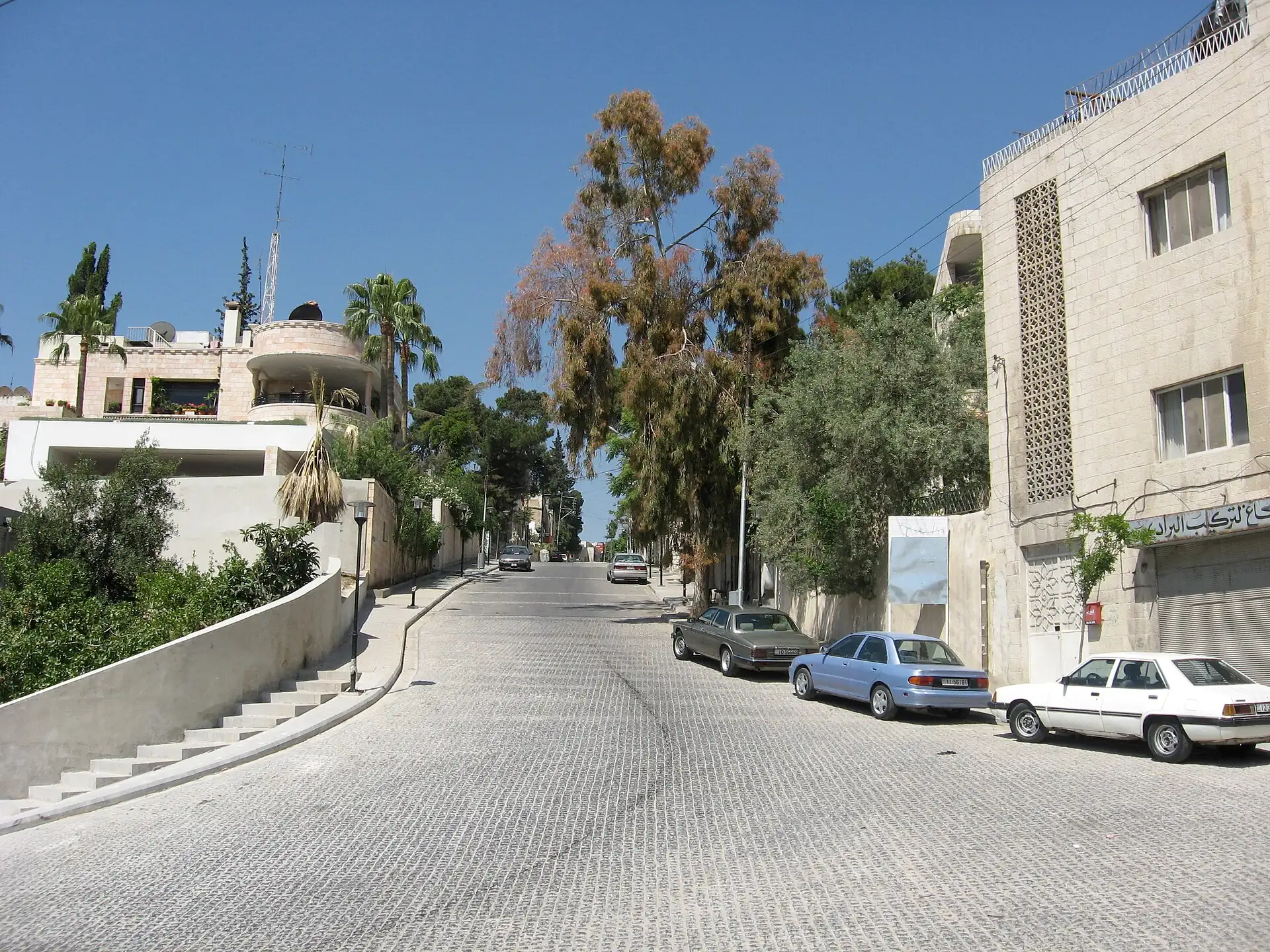
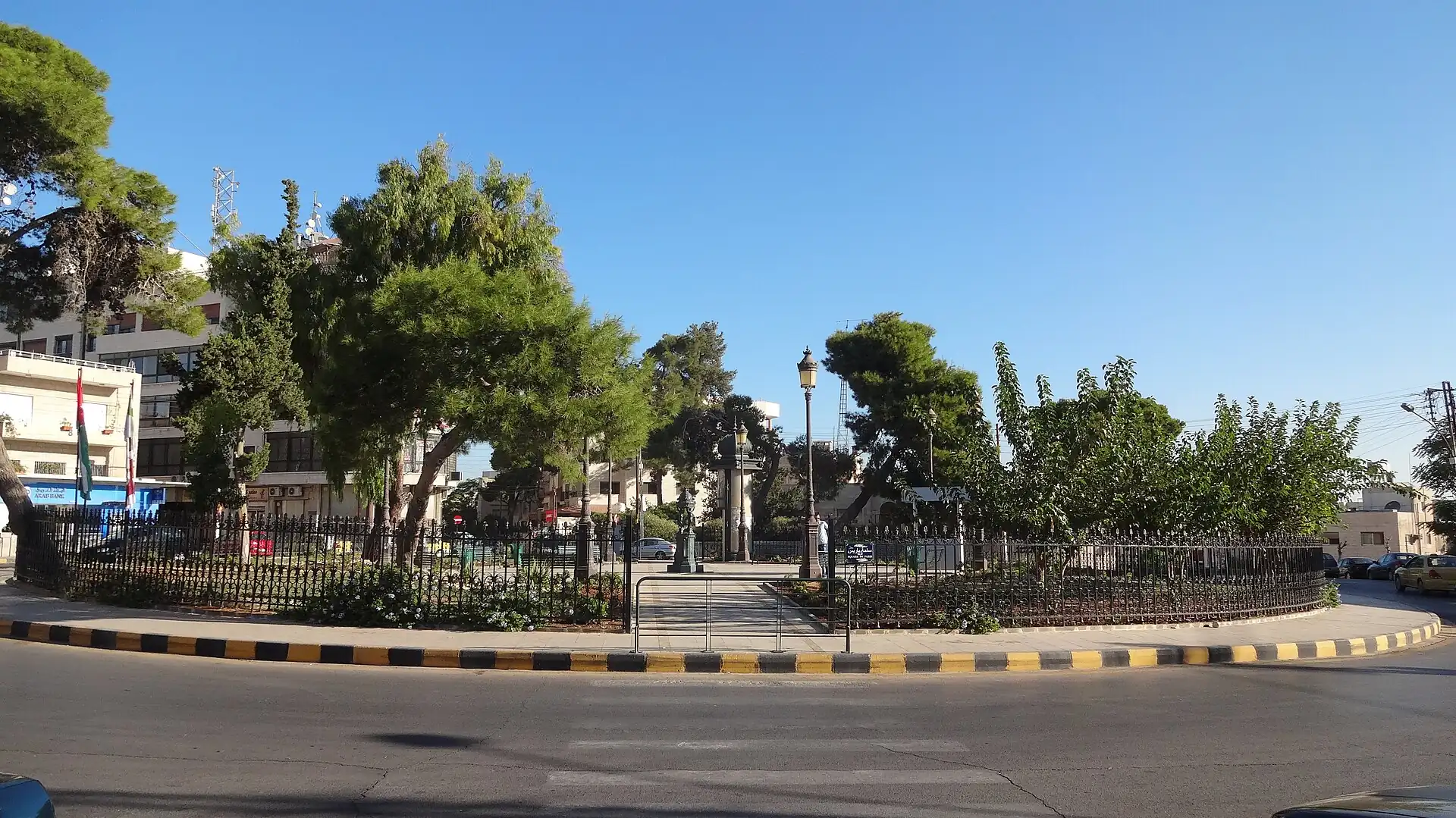
If you do ten things in Amman
- 1
- 2
- 3
- 4
- 5
- 6
- 7
- 8
- 9
- 10
Good for…
Neighbourhoods in one line
| Area | Feel | Suits | Go | Avoid |
|---|---|---|---|---|
Tours and classes: book or skip
| Tour or class | Verdict | Typical price | Why | Check before paying |
|---|---|---|---|---|
What each season brings
Spring (Mar–May)
Summer (Jun–Aug)
Autumn (Sep–Nov)
Winter (Dec–Feb)
Photo spots and the light
Amman travel FAQ
Do I need a visa for Jordan?
Most nationalities need a visa on arrival or an e-visa; the fee is waived for travellers who buy a Jordan Pass and stay at least 3 nights. Check current rules for your passport before flying.
Is Amman walkable?
Within a cluster (Downtown, Rainbow Street, Jabal Weibdeh) yes; between them the hills are steep, so most visitors take a short taxi or ride-hail car.
How many days does Amman need?
Two full days covers the core sights; three lets you add Jabal Weibdeh's galleries or a Friday at Souk Jara without rushing.
Can I drink alcohol in Amman?
Yes, in licensed restaurants, bars and some shops; public drinking is not the norm, and sales pause or restrict during parts of Ramadan and some religious holidays.
More to see and doSee & do · Learn & work · Rain & heat · Free things · Wheelchair and stroller
Free things to do
Sights in Amman that cost nothing to enter. Each is described under Places or More sights; extra costs inside are marked there.
Wheelchair and stroller, place by place
How each place in this guide works for wheels, from its own page. Ratings are desk estimates unless a page says it was checked on the ground.
| Place | Step-free | Wheelchair | Stroller | What to know |
|---|---|---|---|---|
| Darat al Funun | partial | caution | caution | Hillside garden on terraces with steps between levels; the ground-floor galleries are flatter. |
| Jordan Museum | full | ok | ok | Flat galleries and a lift between the three floors; one of the easier step-free sights in the city. |
| King Abdullah I Mosque | partial | caution | caution | Flat forecourt and prayer hall; a shallow step or two at some entrances. |
| Rainbow Street | partial | caution | caution | The main street is walkable and largely flat; the stairs at the Duke's Diwan end are not step-free. |
| Souk Jara | full | ok | caution | Flat, outdoor lot; can get crowded in the narrow stall aisles. |
See & do
9 of 9
- Citadel & old city
Hilltop Roman, Byzantine and Umayyad remains with a city view.
Citadel hill · check · check(check)
- Citadel & old city
Best-preserved Roman theatre in Jordan, in the Downtown valley.
Downtown · check · check(check)
- Museums
The national museum: the Ain Ghazal statues and a Dead Sea Scroll fragment.
Abdali · check · check(check)
- Temples & pagodas
The blue-domed mosque open to non-Muslim visitors outside prayer times.
Abdali · check · Free(check)
- Museums
Free contemporary-art complex with Roman-era garden remains.
Jabal al-Weibdeh · check · Free(check)
- Neighbourhoods
Cafés, shops and a skyline view as the heat drops.
Jabal Amman · Dusk · Free
- Markets
Fridays in season; crafts, books and street food.
Jabal Amman · Fridays, in season · Free(check)
Eat mansaf the traditional way
Food toursBy hand, from a shared platter, at a sit-down restaurant.
Jabal Amman · check · check
- Active
The single best Roman site near the capital.
Jerash (day trip) · Half to full day · check
Learn & work
| What | Where | Cost | Note |
|---|---|---|---|
| Among the oldest large human figures known, found on Amman's edge. | |||
| The governor's palace and cistern on the Citadel hilltop. | |||
| Free rotating exhibitions in restored early-20th-century houses. |
Working here
- Co-working
- Co-working spaces exist in Abdali, Abdoun and Shmeisani; day passes are available at most.
- Café laptop culture
- Café laptop culture is common on Rainbow Street and in Weibdeh; buy a drink and ask before settling in for hours.
- Wi-Fi
- Wi-Fi is generally reliable in hotels, cafés and malls; speeds vary by venue.
Rain-day and heat-day plan
Rain day
Rain (Nov–Mar) is usually steady rather than stormy: carry a light rain layer and expect slippery stone paving on the Citadel and in the souq.
- 01Jordan Museum — Indoor, air-conditioned, a lift between floors; about 75–90 minutes.
- 02City Mall or Abdali Boulevard — Shops, food courts and cinemas for a washed-out afternoon.
- 03Darat al Funun — Gallery interiors are indoors; the garden is the part to skip in rain.
Heat day
Above 32 °C (Jun–Aug): outdoor hilltop sites before 10:00 or after 16:00, AC in between, water every hour.
- 08:00Amman Citadel — Open, exposed hilltop; done before the midday sun.
- 10:00Roman Theatre — Some shade in the lower seating; the upper rows are exposed.
- 12:30Jordan Museum — Air-conditioned midday stop.
- 17:00Rainbow Street — Cooler hill air and café terraces as the sun drops.
Day-trips and nearby
Places you can reach from Amman in a day or with one night away, with the route and what it costs. Door to door, not ride time.
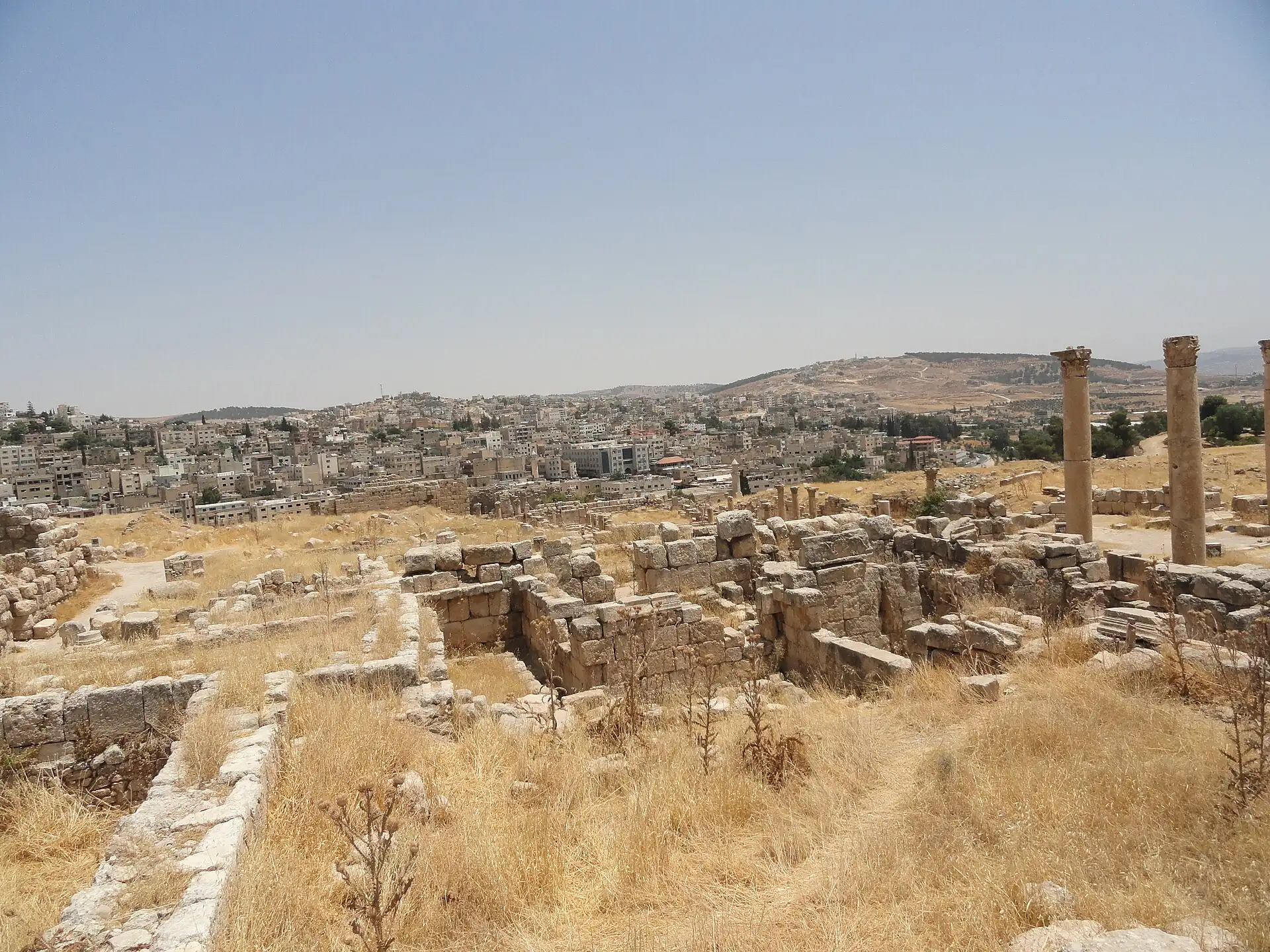 Photo: Freedom's Falcon, CC BY-SA 3.0
Jerash (Roman ruins)
goCar or bus about 45–60 min each way
One of the best-preserved Roman provincial cities anywhere; go early to beat the heat and tour groups.
- Time
- Half to full day
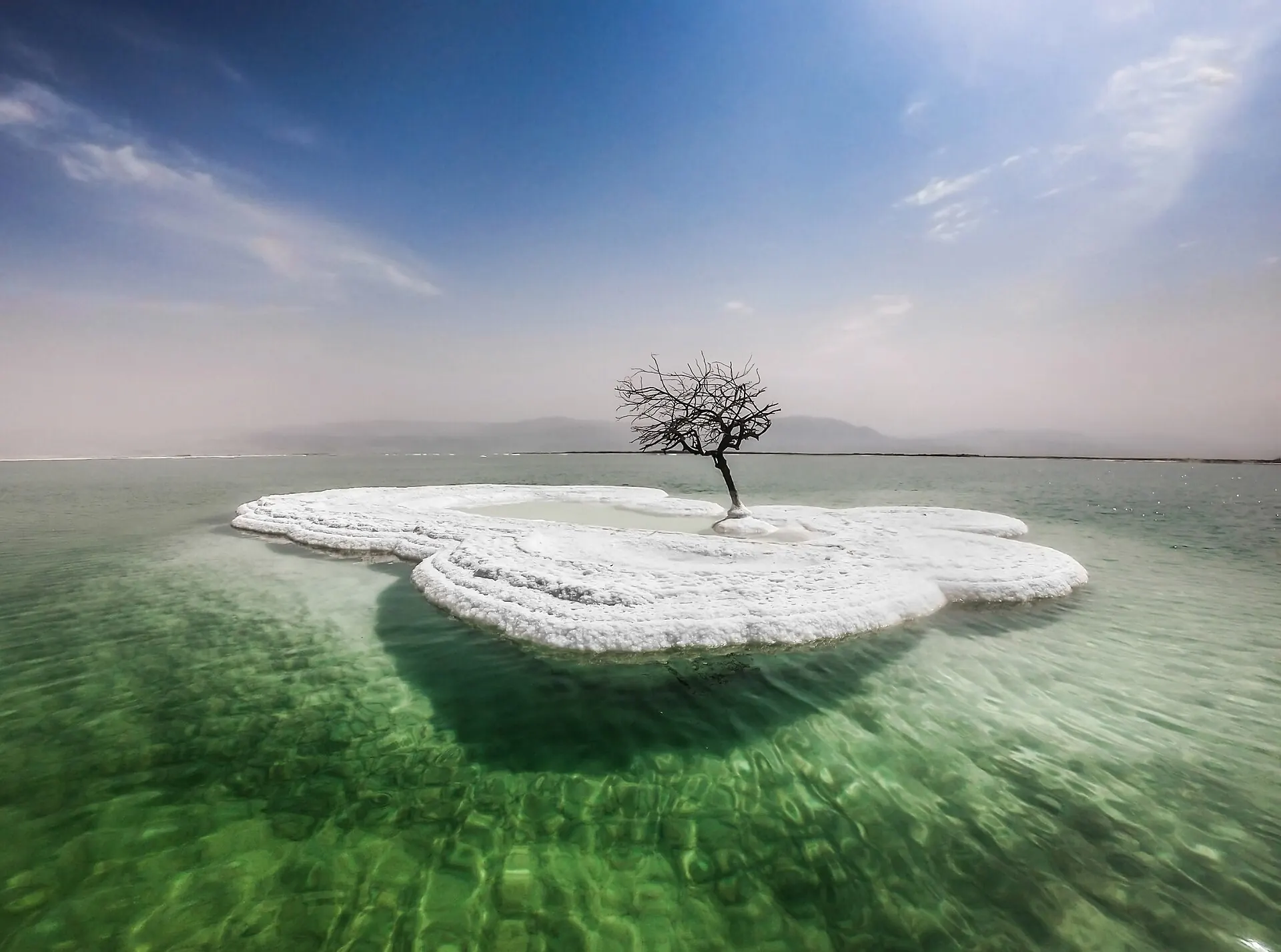 Photo: ערן רזניק, CC BY-SA 4.0
Dead Sea
goCar about 45–60 min each way
Float, mud, and a hotel or public beach day pass; go for sunset if staying into the evening.
- Time
- Half to full day
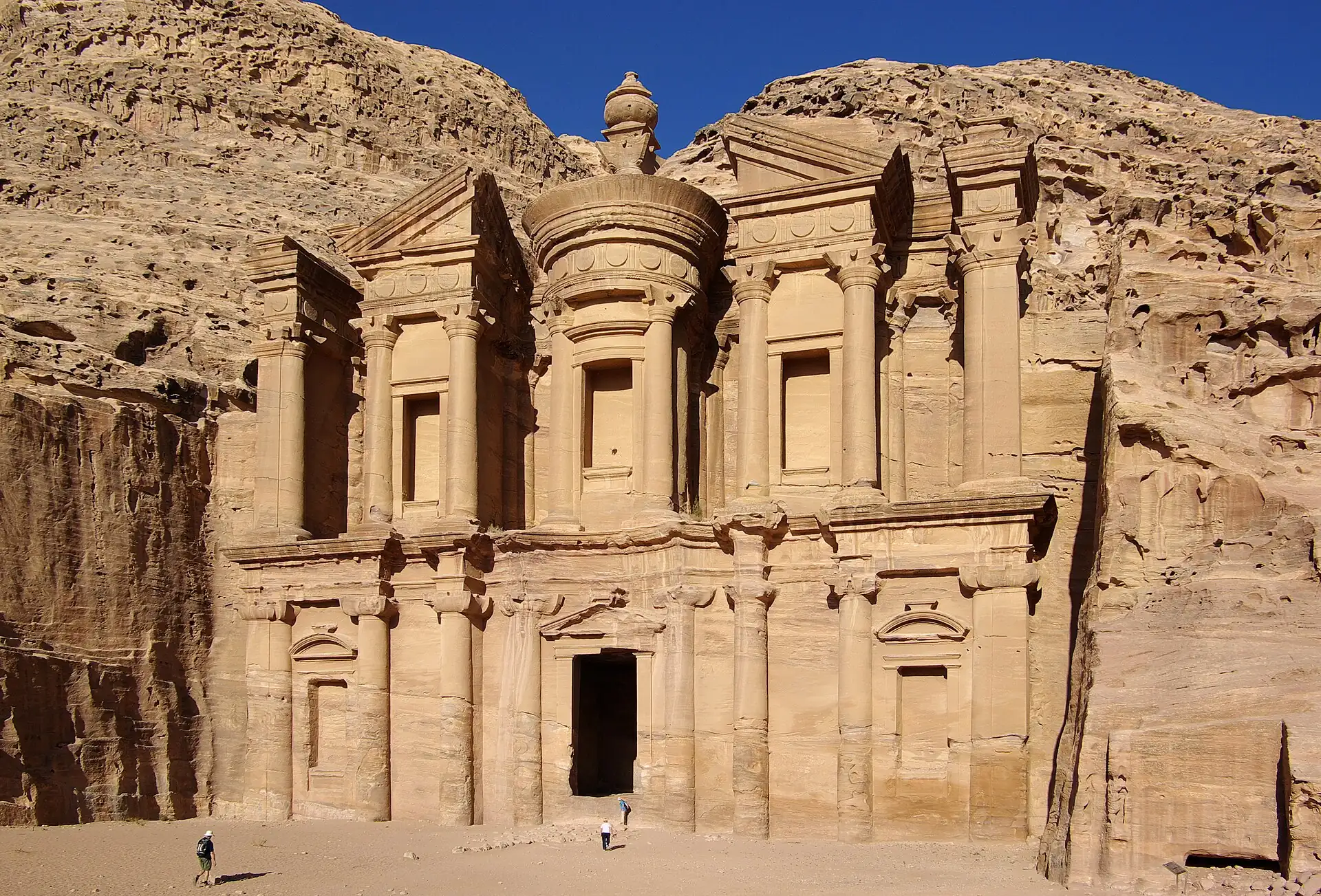 Photo: Berthold Werner, Public domain
Petra
overnightCar or bus 3–3.5 h each way
A one-day round trip from Amman is long and rushed; stay a night in Wadi Musa if you can.
- Time
- Full day, but an overnight is strongly preferred
Madaba and Mount Nebo
goCar about 45 min each way
Byzantine mosaics in Madaba and the view over the Jordan Valley from Mount Nebo.
- Time
- Half day
Ajloun Castle and forest
goCar about 1–1.5 h each way
A 12th-century Islamic castle and green hill country; combine with Jerash on the same road.
- Time
- Half to full day
Go next
Door to door: 3.5–4 h by road
Car about 3.5–4 h, or fly to Aqaba and drive
Desert camp nights; combine with Petra on the way south.
Eat & sleepWhere to eat and which area to sleep in
Eat & sleep
Where to eat and which area to sleep in
Eat
A short list of places worth crossing the city for, each with how to get a seat.
Restaurant finder: filter every place to eat in Amman →
Vegetarian-friendly score
3.5 / 5 · Good
- Country diet noteOur country guide rates vegetarian eating as easy.2 / 2
- Places to eat in this guide4 of 6 places with a known answer are vegetarian-friendly, 2 partly.1.25 / 1.5
- Budget eating lines0 vegetarian lines in "Eat by budget".0 / 0.6
- Meat-free national dishes7 meat-free dishes in the country food list.0.4 / 0.4
- Dedicated vegetarian kitchens0 mentions of vegetarian restaurants, Buddhist or fasting kitchens.0 / 0.5
Country note: Easy: mezze, fuul, falafel, hummus, salads and vegetable stews. Some stews use meat stock.
Vegetarian places near me →Make a diet card →
How we score
- Country diet note (up to 2): easy 2, workable 1, mixed 0.75, hard 0; no note 0.5.
- City places to eat (up to 1.5): 1.5 × (vegetarian-friendly + half of partly friendly) ÷ places with a known answer; needs 3 or more known places.
- Budget eating lines marked vegetarian (up to 0.6): 0.2 each.
- Meat-free national dishes (up to 0.4): 0.1 each.
- Dedicated vegetarian kitchens mentioned — Buddhist chay, shōjin ryōri, Jain, fasting food, vegan cafés (up to 0.5): 0.1 each.
- Total rounded to the nearest half point, 0 to 5. Built from our own pages only, not from reviews.
Eating and drinking guideDrink
Before you sit down to eat
Short version; full text linked
- Tipping
- Not automatic. More →
Drink & nightlife
| Where | What | Until | Note |
|---|---|---|---|
| Rainbow Street cafés and bars | Coffee by day, cocktails and shisha by night | About 00:00–01:00; later Thu/FriAbout 12:00 AM–1:00 AM; later Thu/Fri | The main evening strip for visitors and young Ammanis alike. |
| Books@Cafe rooftop | Coffee, bar, view | About 00:00About 12:00 AM | One of the better skyline views on the hill. |
| Abdoun and Weibdeh bars | Cocktails, craft beer where available | About 00:00–01:00About 12:00 AM–1:00 AM | A short ride from the centre; more of a local scene than a tourist one. |
| Hotel bars | Cocktails | About 00:00–01:00About 12:00 AM–1:00 AM | Reliable during Ramadan, when some independent venues close or restrict service in daylight. |
By style
| Style | What | Where | Price | Until |
|---|---|---|---|---|
| Arabic coffee (qahwa) | Cardamom-spiced, unsweetened, served in small cupsA light tap of the cup or a hand-wave over it signals you have had enough. | Homes, offices, some cafés as a welcome gesture | Often free with hospitality | — |
| Turkish-style coffee | Strong, sweet or unsweetened, grounds settle at the bottomDo not drink the last, gritty sip. | Cafés across the city | JOD 1–3 | Café hours |
| Café culture | Espresso drinks, shisha, mint tea | Rainbow Street, Jabal Weibdeh, Abdali Boulevard | JOD 2–5 | About 23:00–01:00 |
| Beer and cocktails | Local (Petra, Philadelphia) and international brands, plus a small cocktail-bar scene | Licensed restaurants and bars, mostly West Amman and Rainbow Street | JOD 4–9 a drink | About 00:00–01:00 |
Rules that bite
- Drinking in public streets and parks is not the norm and can draw attention; keep alcohol to licensed venues.
- During Ramadan, eating, drinking or smoking in public in daylight is against local custom and, for residents, against the law in some circumstances; visitors should avoid it too, even outside the fasting hours if unsure.
Sleep
Pick the area first: it decides your walk home at night and your first morning.
Which neighborhood fits you
Three questions, one recommendation, with the reasons.
Your best fit
- Roman Theatre, the souq and the Citadel (by taxi) all within reach.
- The cheapest beds and food in the city.
Watch out: Traffic noise and the souq's daytime bustle; quieter at night.
Next best: Jabal Amman (Rainbow Street)
Built from our 1–5 desk scores per area; your answers stay in this browser.
More on sleepingYour area · With kids
Which area is yours
| If you are | Sleep in | Because |
|---|---|---|
| First visit, cafés and an easy base | Jabal Amman (Rainbow Street) | Walk to Rainbow Street; taxi to everything else. |
| Tight budget, want to be by the sights and the souq | Downtown (Al-Balad) | Cheapest beds and food, but accept the noise and the steps. |
First-timers: restaurants and cafés at the door, quieter nights, a taxi ride down to Downtown; choose a hotel with a 24h desk and a lift.
Cheaper rooms next to the Roman Theatre and the souq; loud early and late, and the hills start at the door.
Areas are in our default order until you tick a priority.
Scores are 1–5 desk judgements per priority (2026).
With kids
- Hills and steps mean a carrier, not a stroller, for Downtown and the Citadel; Jabal Weibdeh and parts of Rainbow Street are flatter.
- The Citadel and Roman Theatre have low or absent barriers at some edges — hold hands near the drop-offs.
- The Jordan Museum is air-conditioned, flat and has a lift — an easy indoor stop with children.
- Heat or a rain day: malls (City Mall, Abdali Boulevard) have play areas and food courts.
- Ride-hailing cars rarely carry child seats: ask the hotel to arrange one, or bring a travel booster.
PracticalMoney, essentials, safety and the pocket card
Practical
Money, essentials, safety and the pocket card
Money
What a day costs at three comfort levels, and how to pay.
- Budget
- JOD 20–35 excl. bed / day
- Mid
- JOD 35–70 excl. bed / day
- High
- JOD 70+ excl. bed / day
- Transit card
- No transit card needed: ride-hailing apps, taxis and walking.
- Cash rule
- Keep a few small dinar notes for taxis and food counters; withdraw at bank ATMs or in malls.
More on moneyCosts · Budget · Buy
What things cost
- Falafel sandwich or hummus plateJOD 1–3
- Knafeh sliceJOD 1–3
- Bottle of water, shopJOD 0.25–0.50
- Short ride-hail car across the centreJOD 2–4
- Car from Queen Alia to central AmmanJOD 20–28
- Amman Citadel or Roman Theatre ticket (or Jordan Pass)check
Trip budget
| Hotel double room1 × 3 nights × JOD 55 | JOD 165 |
| Food, local transport, entries2 × 3 days × JOD 50 | JOD 300 |
| Airport car, both ways1 × JOD 45 · one car per 4 people | JOD 45 |
| Local SIM or eSIM2 × JOD 10 | JOD 20 |
| Buffer 10%Price creep, a taxi you did not plan, one splurge | JOD 53 |
| Trip total≈ JOD 97 per person per day, bed included | JOD 583 |
2026 estimate in dinars; flights, visas and tours excluded. Your choices stay in this browser.
Buy
- Bargaining
- In the Downtown souq and with street vendors, a first price to a visitor can run well above the local rate: counter firmly, settle around 60–70% of the opening ask, and walk away politely if it will not move. Do not bargain in shops with printed price tags, supermarkets, malls, or at food counters with a posted menu.
- Fixed-price check
- Check a supermarket (Cozmo, Carrefour, Safeway) or mall shop's price for coffee, spices or dried fruit before buying the same thing in the souq — that is your ceiling.
Markets and shopping streets
| Where | What | When | Haggle | Note |
|---|---|---|---|---|
| Downtown souq (King Faisal / King Hussein streets) | Spices, dried fruit, clothing, household goods, gold | Shop hours; quieter Friday morning | hard | The commercial heart of the old city; expect to bargain outside fixed-price shops. |
| Souk Jara | Crafts, jewellery, secondhand books, street food | Fridays, in season only — confirm dates | light | On Rainbow Street; check it is running before planning a visit around it. |
| Gold souq (Downtown) | Gold jewellery by weight | Shop hours | hard | Priced largely by the day's gold rate; compare two or three shops. |
| Malls (City Mall, Abdali Boulevard, Taj Mall) | International and local brands, food courts, cinemas | About 10:00–22:00About 10:00 AM–10:00 PM | no | Fixed prices; the AC and heat-day refuge. |
Shops by what they sell
| For | Where | Hours | Note |
|---|---|---|---|
| Ceramics, mosaics, olive-wood carvings | Rainbow Street and Jabal Weibdeh craft shops; Jordan River Foundation outlets | Shop hours | Jordan River Foundation and similar non-profits sell handmade goods with a fixed, transparent price. |
| Dead Sea cosmetics (mud, salts, creams) | Pharmacies, malls, souvenir shops | Shop hours | Widely sold and generally genuine in pharmacies and malls; check ingredient lists at souvenir-stall prices. |
| Spices, nuts, dried fruit | Downtown souq | Shop hours | Ask for a small taste and a per-kilo price before buying. |
| Books | Books@Cafe and other Rainbow Street shops; Jabal Amman bookshops | Shop hours | English-language selection is decent on Rainbow Street; limited elsewhere. |
Changing money
| Where | Verdict | Why |
|---|---|---|
| Bank branches and exchange offices (licensed) | use | Fair, posted rates; passport sometimes requested for larger sums. |
| Queen Alia airport exchange counters | ok | Slightly worse rate; change enough for the taxi and the first day. |
| Hotel front desk | avoid | Convenient, poor rate. |
| Street money-changers outside licensed offices | avoid | Count notes carefully or avoid; short-changing risk. |
ATMs
- Availability
- ATMs are common in Downtown, on Rainbow Street, and in malls; withdraw at bank-branded machines rather than unbranded ones.
- Fees
- Local fee plus your home bank's foreign-ATM fee applies; check your own bank's terms before the trip (2026: fees not published here — confirm with your bank).
- Conversion
- If the ATM offers to charge your home currency, decline and pay in dinars.
Essentials and accessEssentials · Access
Essentials
- Tipping
- Not automatic. Round up for taxis; 10% is common in restaurants that do not already add a service charge — check the bill.
- Plugs & power
- 230 V; sockets are mostly type C and type G (three-pin, UK-style, common in older buildings). Bring a universal adapter.
- Toilets
- Cafés, malls, hotels and museums; carry small notes or tissues for public ones.
- Opening hours
- Friday is the main weekend day: many Downtown shops and some sites open only after midday. During Ramadan, many restaurants close in daylight hours and open after sunset (iftar).
- Health
- Summer heat (Jun–Aug), winter cold and occasional snow (Dec–Feb), dry air. Travel insurance with medical cover is worth carrying.
- Accessibility
- A hill city with steep streets and stairs in Downtown and between clusters; step-free access is limited outside hotels, malls and newer museums.
- Laundry
- Hotels and neighbourhood laundries offer same- or next-day service, usually priced by the kilo or per item.
- Emergency numbers
- 911 covers police, ambulance and fire.
Pack
- Layers: hot days can still have cool evenings, especially spring and autumn
- A warm coat for December–February; snow is possible
- Something to cover shoulders and knees for mosques
- Flat, grippy shoes for the hills and steps
Accessibility
Amman is a hill city with steps everywhere between levels, so step-free access is patchy outside malls, larger hotels and newer museums. Plan door-to-door taxi or ride-hail rides and a hotel with a lift.
- Streets
- Steep grades and stairs, especially in Downtown and on the way up to the Citadel; the Rainbow Street stairs are steps only.
- Getting around
- Ride-hail cars are the practical step-free option; buses are not consistently accessible.
- Hotels
- Larger hotels on the hills have lifts; smaller Downtown guesthouses may not — ask for a photo of the entrance and stairs before booking.
- Toilets
- Accessible toilets in malls and larger hotels; rare at open-air sites.
- Crossings
- Few signalled pedestrian crossings on main roads; cross with others where possible.
Sights, step-free or not
| Amman Citadel | with help | Uneven stone paths and some steps; no shade. |
| Roman Theatre | with help | Steep original stone seating; the forecourt and lower rows are more manageable. |
| Jordan Museum | step-free | Flat galleries and a lift between floors — one of the easier step-free sights in the city. |
| King Abdullah I Mosque | with help | Mostly flat, with a shallow step or two at some entrances. |
| Darat al Funun | with help | Terraced hillside garden with steps between levels. |
| Rainbow Street | with help | The main street is walkable; the stairs section is not step-free. |
Survive
Safety basics, the lines not to cross, and practical habits that save the day.
Safety
- Steep streets and stairs: wear shoes with grip; use a taxi uphill.
- Cross roads slowly and at lights; drivers do not always stop.
- Emergency: 911 (police, ambulance and fire).
Red lines
- Mosques: covered shoulders and knees, scarf for women, shoes off; do not enter during prayer.
- Do not photograph military or government sites, or people without asking.
- Ramadan: no eating, drinking or smoking in public in daylight.
Practical
- Toilets: cafés, malls and museums; carry small notes for public ones.
- Tap water is not for drinking; buy bottled water.
More on staying safeStay safe · Stay healthy · Safety map · Solo & women · Etiquette · Cope · Scams
After dark, by area
1 flagged area
- Take care
Day = about 07:00–19:00. What to watch in each area, day and night →
Scams and red flags
Walk away if you see these
- Unmetered taxis quoting a flat 'tourist' fare: ask for the meter (ir Kayed) or use a ride-hailing app instead.
- Souvenir sellers near the Citadel and Roman Theatre naming a first price several times the local rate: counter hard or check a shop with printed tags first.
- 'Free' guiding offers at the sites that end with a demand for payment: agree a price and scope first, or decline.
- Money-changers offering a rate notably better than the board: count your dinars before you walk away.
Stay safe
Stay healthy
Hospitals and clinics: see Cope.
Safety by area and hour
| Area | Day | Night | What to watch |
|---|---|---|---|
| Downtown (Al-Balad) | fine | fine | Uneven paving and steps; overcharging by a few unmetered taxis — use the meter or a ride-hailing app. |
| Citadel hill | fine | caution | Exposed edges with light barriers in places; quiet and unlit after dark. |
| Rainbow Street / Jabal Amman | fine | fine | Steps at the Rainbow Street stairs; otherwise a well-used, well-lit evening strip. |
| Jabal al-Weibdeh | fine | fine | Quiet residential streets; fine after dark near the café corners, less lit in the side lanes. |
- Crossing main roads is the main daily hazard: drivers do not always stop at crossings; cross with the flow of others where possible.
- Heat (Jun–Sep): carry water, plan hilltop sites for the morning or after 16:00, and use AC stops at midday.Heat (Jun–Sep): carry water, plan hilltop sites for the morning or after 4:00 PM, and use AC stops at midday.
Solo, women and LGBTQ+ travellers
Solo
- Amman is manageable alone: cafés on Rainbow Street and in Weibdeh are used to single diners, and hotel staff are a reliable source of local advice.
- Book day trips to Jerash, the Dead Sea or Petra through the hotel or an operator with written inclusions; ask about a solo supplement.
- Use ride-hailing apps after dark rather than flagging an unmetered taxi on the street.
Women
- Harassment toward visiting women is not the norm, but street attention (comments, staring) is reported by some solo travellers; dressing modestly reduces it somewhat and is respectful in any case.
- Cover shoulders and knees at mosques, and bring or borrow a headscarf for the mosque interior if you are a woman planning to enter.
- West Amman cafés and restaurants are relaxed and mixed; Downtown is busier and more male-dominated in the daytime street scene.
LGBTQ+
- Consensual same-sex relations between adults are not criminalised in Jordan, but there is no legal recognition of same-sex relationships and public attitudes are conservative.
- Public displays of affection of any kind are low-key for all couples in Jordan; keep this in mind regardless of orientation.
- There is no visible public LGBTQ+ scene in Amman comparable to some other capitals; discretion is the norm.
Etiquette in Amman
- Mosques
- Shoulders and knees covered, shoes off inside, headscarf for women; no entry during the five daily prayers.
- Greetings
- A handshake is common between men; wait for a woman to offer her hand first. 'As-salamu alaykum' (peace be upon you) is a standard greeting.
- Ramadan
- No eating, drinking or smoking in public in daylight, even if you are not fasting; many restaurants close until sunset.
- Right hand
- Use the right hand, or both hands, to give or receive money, food or a business card.
- Hospitality
- Coffee or tea offered by a shopkeeper or host is a courtesy, not a hard sell; a light tap or wave over the cup signals you have had enough.
- Photos
- Ask before photographing people up close, especially women; never photograph military or government buildings and checkpoints.
- Dress
- Modest dress (shoulders and knees covered) is respectful citywide, not just at religious sites; West Amman cafés are more relaxed than Downtown or mosques.
Cope
Hospitals and clinics that handle foreigners
| Where | Area | Use it for |
|---|---|---|
| Jordan Hospital | Zahran Street, Jabal Amman | Large private hospital; ask your insurer about direct billing. |
| Istishari Hospital | Um Uthaina, west Amman | Private; emergency and specialists. |
| King Hussein Medical Center | Marka | Major public hospital; foreign visitors typically use private hospitals instead. |
Visa extensions
- Office
- Directorate of Residency and Foreigners' Affairs handles visa extensions and residency; check current address and hours before going.
- Extending
- Tourist visas can generally be extended at a local police station or the residency office within the visa validity period — rules and offices change, confirm locally.
- Jordan Pass note
- Travellers who bought a Jordan Pass and stay 3+ nights get the entry visa fee waived on arrival; keep the pass QR code accessible at immigration.
Embassies and consulates
| Country | Address | Phone | Note |
|---|---|---|---|
| United States | Al-Umawyeen Street, Abdoun | — | (check) |
| United Kingdom | Damascus Street, Abdoun | — | (check) |
| Australia | Prince Faisal Street, Khalda | — | (check) |
| Canada | Pindus Street, Rabieh | — | (check) |
| France | Zahran Street, Jabal Amman | — | (check) |
| Germany | Ibn Khaldoun Street, Abdoun | — | (check) |
- Lost passport
- Police report first, then your embassy for an emergency travel document; budget a few working days.
- Pharmacies
- Common across the city (many open late); staff often speak some English and can advise on common ailments.
- Laundry
- Hotels and neighbourhood laundries, usually priced by weight or per item; same- or next-day service.
- Gyms and pools
- Day passes at hotel gyms and some private clubs; few public pools open to visitors.
Apps and offline kitOffline kit
Offline kit
Set up before you leave, so Amman still works with no signal or a dead roaming plan.
On your phone
- Maps: open the city in Google Maps, tap the place name, then Download offline map (or use an offline-maps app).
- Data: install an eSIM or buy a local SIM before the first taxi; the apps in this guide depend on it.
- Translation: download the local language for camera translation.
- Screenshots: booking confirmations, hotel address in the local script, and the emergency numbers.
This guide
Save the Amman guide and its pages on this device; it opens without a connection.
Phrases that do the work
Greeting
Hello
مرحبا
marhaba
Thanks
Thank you
شكرا
shukran
Market
How much is this?
قديش هاد؟
addaysh hayda
Food
Not spicy, please
بدون حار من فضلك
bidoon har min fadlak
Food
Delicious
زاكي
zaki
Café
The bill, please
الحساب من فضلك
al-hisab min fadlak
Taxi
Please take me to this address
خدني عالعنوان هذا من فضلك
khudni al-onwan hatha min fadlak
Taxi
Stop here, please
وقف هون من فضلك
waqqef hon min fadlak
Pocket card
Fill in, then print or save as PDF
Stays in this browser only; nothing is sent anywhere.
Ammanعمّان
Pocket card · Voykit
My bed tonight
—
—
—
خدني عالعنوان هذا من فضلكPlease take me to this address
Emergency
- Police / ambulance / fire911
- Tourist policecheck
Embassy
Most embassies are in Abdoun and west Amman. Write your own embassy's 24-hour line below.
My embassy: —
Fare anchors (2026 estimate)
- Queen Alia → central Amman, ride-hail or taxi: About JOD 20–28, 40–60 min
- Queen Alia → centre, airport bus: About JOD 3–4 (check)
- Ride-hail across the centre: JOD 2–4
Say or show
- مرحبا — Hello (marhaba)
- شكرا — Thank you (shukran)
- قديش هاد؟ — How much is this? (addaysh hayda)
- بدون حار من فضلك — Not spicy, please (bidoon har min fadlak)
- الحساب من فضلك — The bill, please (al-hisab min fadlak)
- وقف هون من فضلك — Stop here, please (waqqef hon min fadlak)
Show the address as a pin in the ride-hailing app where possible; spoken street addresses are less reliable than in grid-planned cities.
Deep diveHistory, reading, photos and every source
Deep dive
History, reading, photos and every source
Sources
- officialVisit Jordan (Jordan Tourism Board)
- officialJordan Pass
- secondaryWikivoyage — Amman
Ask about Amman
Loading…
Was this useful?