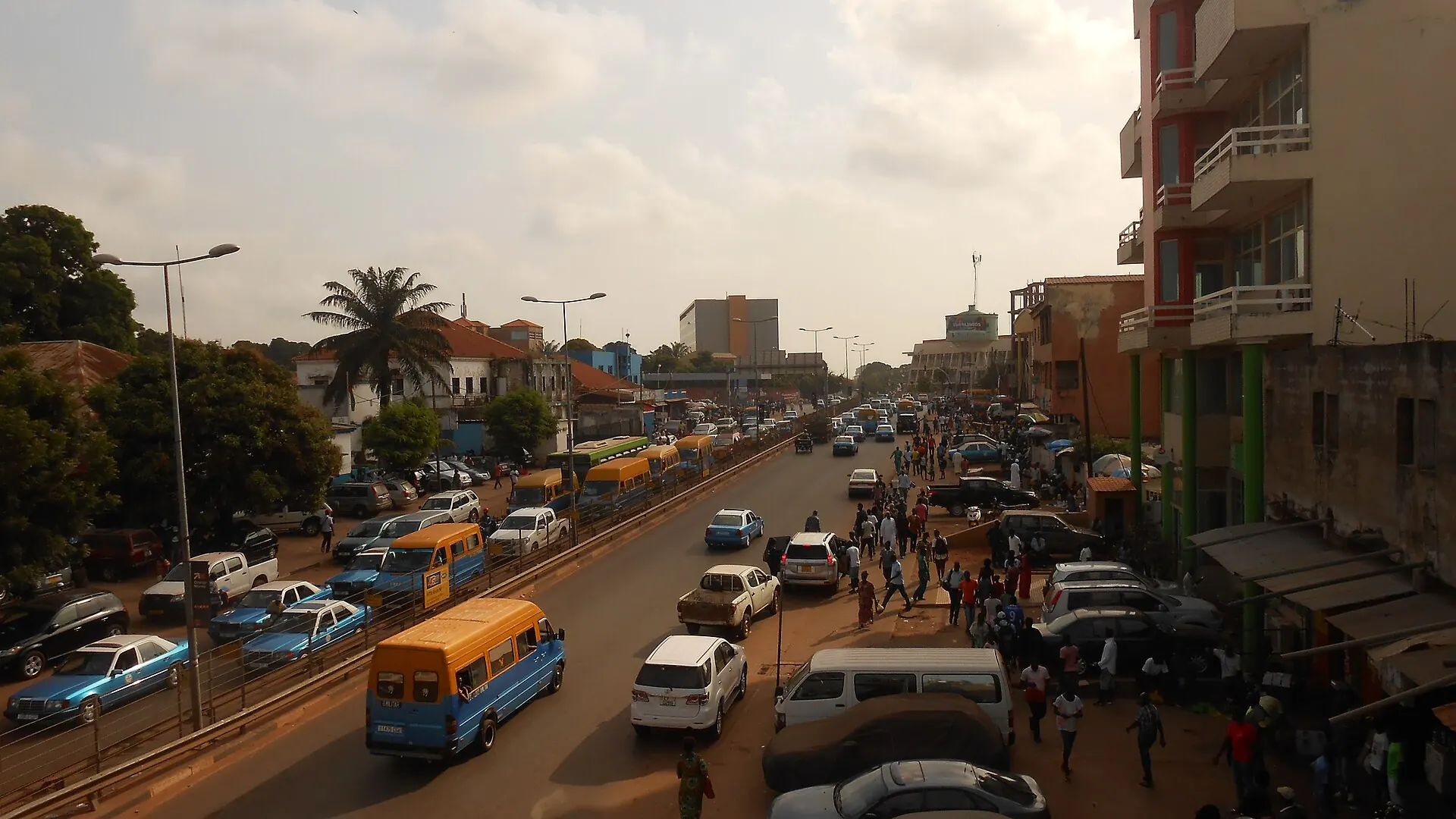
Bissau
Code GI · 4 walking zones
Bissau is a one-to-two-night base: see the old fort and the port in the morning, keep midday indoors, take a car after dark — and settle the island boat and the return flight before you leave the city.
Our quick read of Bissau, scored 1–5 (friction is out of 100). Cash need: how often you still need notes. Heat risk: how hot days get. Stroller: how easy wheels are. Friction: overall effort for a first visit. Desk judgements, so check before relying on them.
- Local time
- --:--
- Weather
- forecast below
- Currency
- XOF
- Best months
- Jan · Feb · Nov · Dec
- Airport
- Osvaldo Vieira (OXB)
Walking zones: the 4 areas this guide plans a day around. Each is a district you can cover on foot, so you do one zone per half-day and ride the train between them. The code (GI 01, GI 02…) is just the zone's number on the Bissau line; the line under each name says how bags fare there and how much time it needs.
Map of Bissau
Use the switches to show or hide each kind of pin. A switch that is on shows its pins on the map; tap it again to hide them. "Show only" keeps just the pins that match (for example, places that fit a suitcase). Tap any pin for its name and a link to its page.
- Where to sleep
- Eat
- Walking clusters
- Rest stops
From the airport Osvaldo Vieira (OXB) to your bed
Tap a pin for its card. Places without their own coordinates are shown by their walking cluster.
Why Bissau
Bissau is a small capital with few services, few flights and almost no cash machines that take foreign cards. The trips that go wrong arrive with no ride arranged, carry too little cash, or plan an island boat without a buffer night. Four clusters cover a first visit; the Bijagós boat leaves from a separate quay and the lodge arranges it. The political situation can change at short notice: check your government's advice before you book.
See first
- 1São José da Amura fort at opening · 30–45 min
- 2Grilled fish lunch near the port · 45–60 min
Fits
- A night or two before or after the Bijagós islands
- Travellers who arrange a driver and check their government's advice
- Early risers
Does not fit
- Strollers and wheelchairs (pavements)
- Travellers who need cards and cash machines
- Midday walkers
- Anyone who cannot check current safety advice before travel
How long
- 1 daysOld fort and port morning, Bandim market
- 2 daysFour clusters, mornings and evenings only
- 3 daysFour clusters + a buffer day before the island boat or the flight
Good for
- A Bijagós stopover
- First-time solo backpackers
- Families with small children
- History and politics readers
- Beach travellers
About Bissau
Bissau grew from a Portuguese fort and trading post founded in 1687 at the mouth of the Geba river, part of a network of slave and later cashew and groundnut trade that ran along this coast for three centuries.
It became the colonial capital in 1941, replacing Bolama, and kept growing after independence in 1973–74 as people moved in from the countryside; today it holds close to a third of the country's population.
The city carries the marks of Guinea-Bissau's difficult politics: the 1998–99 civil war and repeated coups, most recently in November 2025, have left burnt-out and shelled buildings standing unrepaired next to markets and cafés that never stopped trading.
Good to know
- Bissau is the capital on the Geba estuary; the Bijagós islands are a boat ride offshore and are booked through a lodge.
- There is no full-time tourist information office confirmed for Bissau; your hotel desk is the practical first stop for a driver, a SIM and current safety notes.
Go deeper 9 min read · 6 chapters
Bissau is a small capital that has carried a large share of its country's history: a 17th-century river fort, a 1959 massacre that pushed a colony toward war, a 1973 declaration of independence, and a 1998–99 civil war whose ruins still stand a few streets from the market. This deep dive reads the city itself, block by block, rather than the whole country, which has its own deep dive.
1History2 min
Bissau began as a Portuguese fortified trading post, built in 1687 at a bend of the Geba estuary to control river traffic and the slave and produce trade running along this coast. For more than two centuries it was a minor post: the colonial administration of Portuguese Guinea was run from Bolama, an island further south, and Bissau remained a garrison town of forts, a church and a handful of trading houses.
That changed in the 20th century. Portugal moved the colonial capital from Bolama to Bissau in 1941, and the city grew quickly as the administrative and commercial centre of the colony: government offices, a cathedral, a central market and the Avenida that still carries the city's daily life today were built or expanded in this period. The population that had been a few thousand grew into tens of thousands within a generation.
On 3 August 1959, Portuguese colonial police opened fire on striking dockworkers at Pidjiguiti, the port on Bissau's waterfront, killing dozens. The massacre convinced Amílcar Cabral and the PAIGC that peaceful pressure would not end colonial rule, and armed struggle began in 1963. Fighting was heaviest in the countryside, but Bissau remained the seat of Portuguese power and a PAIGC target throughout the war.
Independence was declared unilaterally on 24 September 1973, in the middle of the war, and recognised by Portugal the following year after the Carnation Revolution in Lisbon. Bissau became the capital of the new state, and Praça dos Heróis Nacionais, the square in front of the old colonial buildings, was made the symbolic centre of the new republic. What followed was not calm: coups, an attempted union with Cape Verde that collapsed in 1980, and a civil war in 1998–99 that saw the army split and shell parts of the capital, including the Presidential Palace, whose burnt shell still stands. The most recent disruption came in November 2025, when the army took control after disputed elections; check current travel advice before any visit.
- Fort built
- 1687
- Capital moved here from Bolama
- 1941
- Pidjiguiti massacre
- 3 August 1959
- Independence declared
- 24 September 1973
- Civil war damage to the city
- 1998–99
2Neighbourhood stories2 min
Bissau Velho, the old town around the fort, is the closest thing the city has to a preserved historic quarter. Its narrow, part-cobbled lanes hold the oldest surviving Portuguese buildings: single-storey trading houses with shuttered windows and deep verandas, built to keep the worst of the heat out, many now faded, subdivided or simply abandoned. Walking it in the early morning, before the heat and the traffic, is the closest a short visit gets to seeing the pre-1941 town.
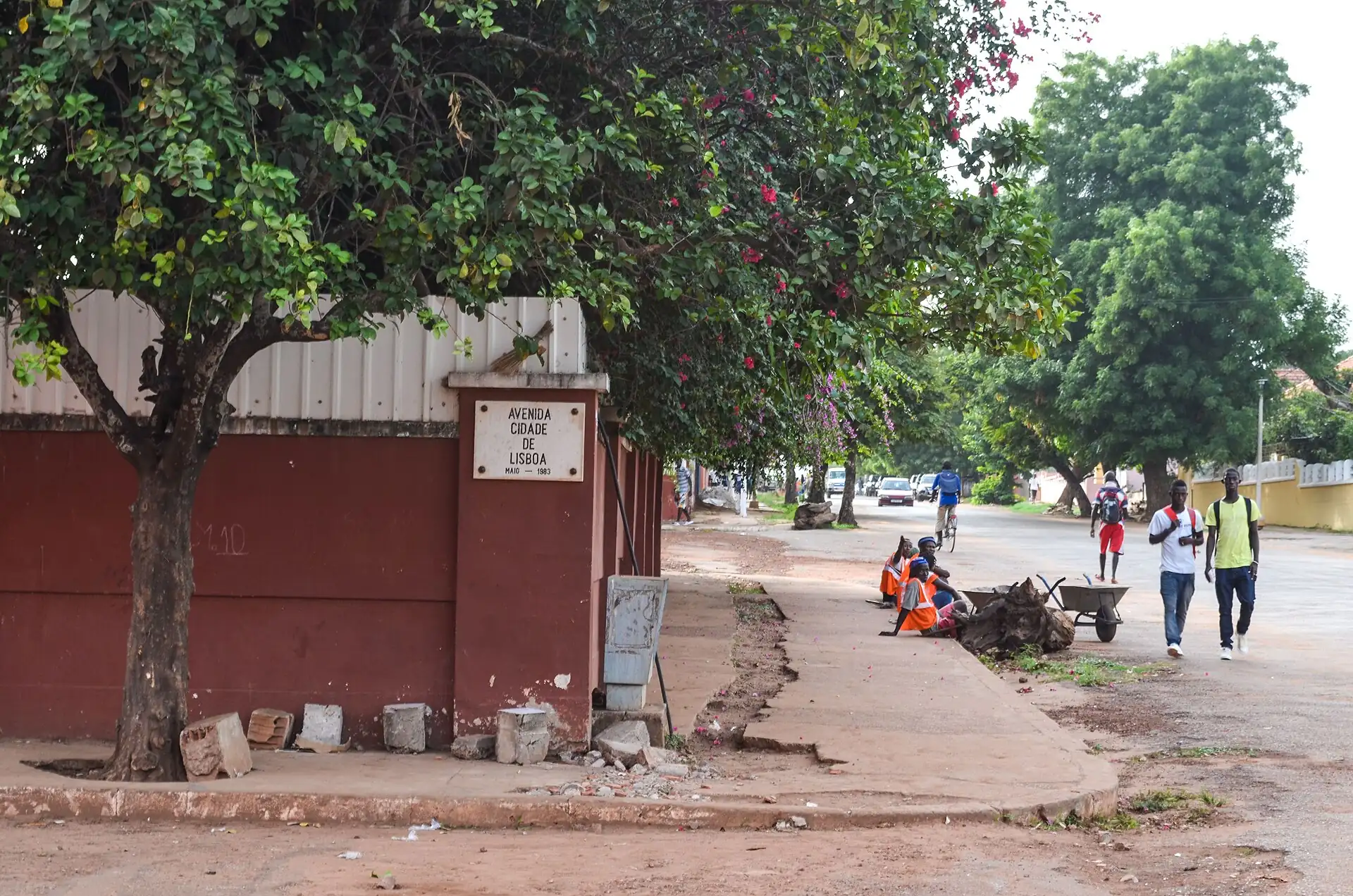
The Avenida Amílcar Cabral, laid out as Bissau grew into a colonial capital from the 1940s, is the newer, more formal face of the city: a straight boulevard running from the cathedral and the square toward the newer suburbs, lined with the ministries, banks, cafés and the handful of hotels a visitor is likely to use. It is also the most political ground in the city — the square, the cathedral and the ruined palace all sit within a few minutes of each other, so the Avenida carries the weight of both government and everyday commerce.
Bandim, inland from the centre, grew as a market neighbourhood and is now home to the country's largest informal market — a dense grid of stalls selling food, cloth and household goods that draws traders from across the region and has been studied for decades as a barometer of the city's health and economy. It is also one of the poorest and most crowded parts of Bissau, and the contrast with the Avenida a short drive away is sharp.
Pidjiguiti, the port district on the waterfront, is still a working quay: fishing boats, cargo lighters and the ferries that leave for the Bijagós islands share the same stretch of water where the 1959 massacre took place. Fish is grilled and sold within sight of the memorial, so a visit here moves quickly between a heavy history and an ordinary lunch.
- Oldest quarter
- Bissau Velho, around the fort
- Main avenue
- Avenida Amílcar Cabral
- Largest market
- Bandim
- Working port
- Pidjiguiti
3Colonial architecture1 min
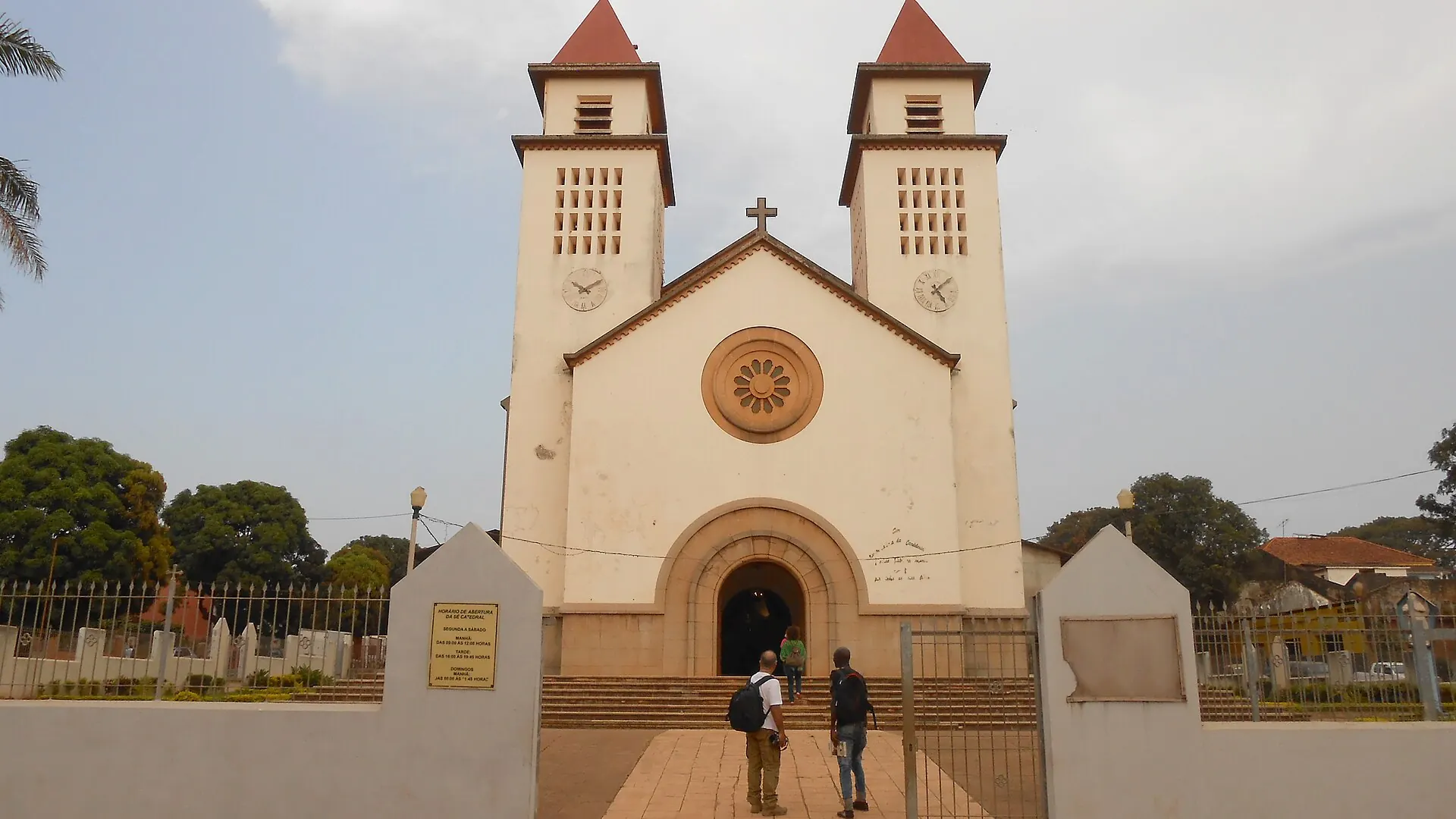
Bissau's oldest surviving building is the fort itself, São José da Amura, a low, thick-walled structure of stone and lime render built to withstand both the climate and attack from the river. Inside its grounds is the tomb of Amílcar Cabral, added after independence and turning a colonial military site into a place of national memory — a combination that repeats across the city.
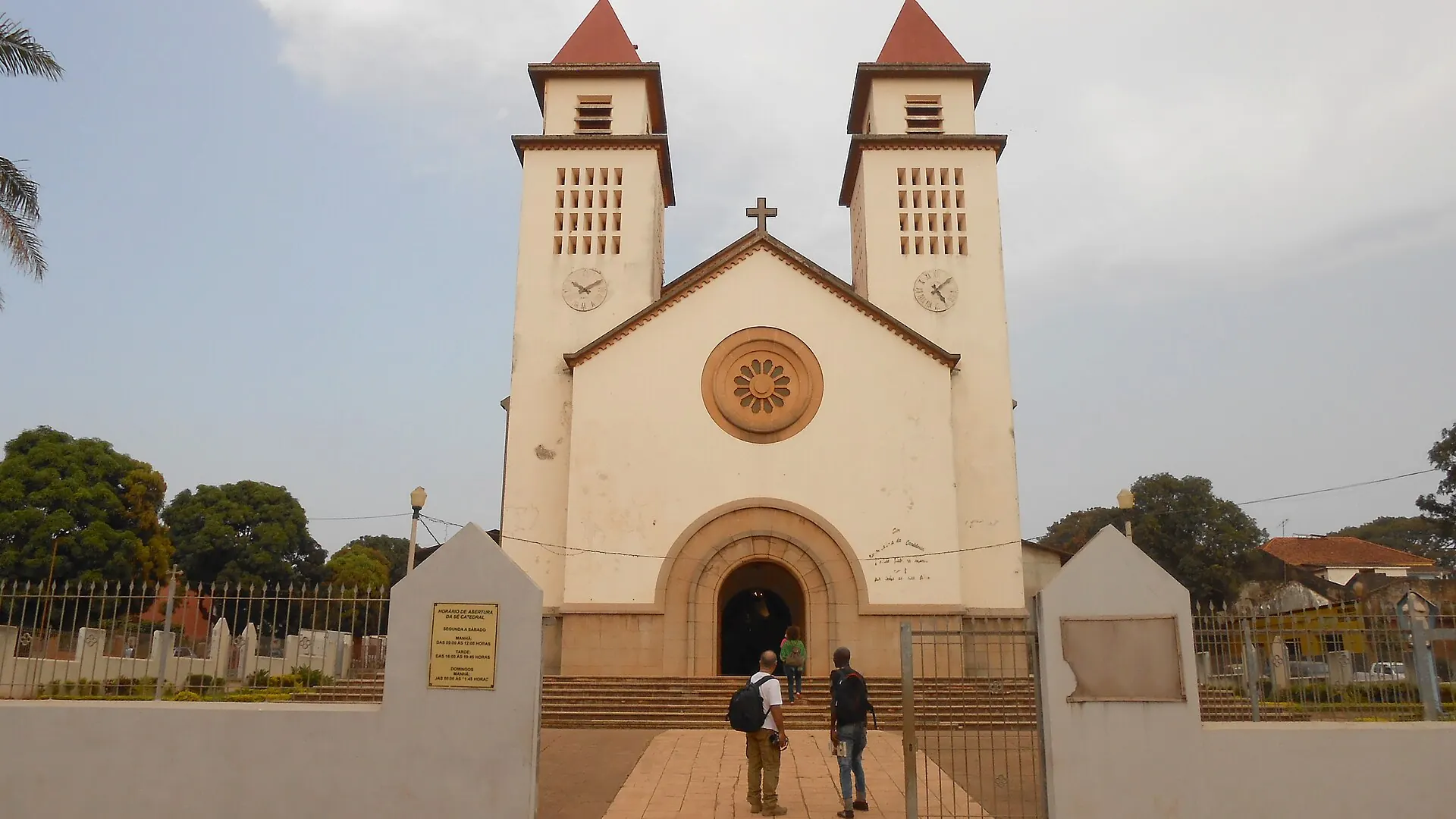
The cathedral on the Avenida, built in the 1930s as the colony's administrative importance grew, is a plain, whitewashed structure in a simplified European style, more functional than ornate, reflecting a colony that was never wealthy enough for grand civic architecture. The same restraint marks most of the surviving government buildings from the 1940s onward: rendered concrete and stucco, deep eaves and shutters against the sun, and little decoration.
The single building that says the most about the last thirty years is the Presidential Palace, a mid-20th-century government building shelled and gutted during the 1998–99 civil war and left standing ever since, its windows empty and its walls scorched. Guinea-Bissau has never had the money to restore or demolish it, so it stands as an unplanned monument in the middle of the city, visible from the water and from the square.
Away from the formal centre, most housing is built the way it has been for generations: single-storey compounds of rendered block or mud brick under corrugated iron or thatch, arranged around a shared yard. Concrete apartment blocks are rare and mostly recent, clustered near the Avenida; almost everywhere else, the skyline stays low.
- Fort
- 1687, stone and lime render
- Cathedral
- Built in the 1930s
- Presidential Palace ruin
- Shelled 1998–99, never rebuilt
- Typical housing
- Single-storey compounds, block or mud brick
4Food history1 min
Bissau's everyday plate is built on three staples that long predate the Portuguese: rice, grown in reclaimed mangrove fields along the rivers by Balanta farmers; fish, caught along the estuary and the Bijagós channels; and groundnuts (peanuts), ground into the sauce that gives caldo de mancarra, the city's signature stew, its body and colour. Palm oil, used across the Guinea coast, adds the other common base, chabéu, a red, rich sauce for fish or meat.
Portuguese contact added bread, added a taste for grilled and dried fish prepared with salt and lime, and brought new crops from other parts of the Portuguese world, most importantly the cashew tree, introduced from Brazil in the colonial period. Guinea-Bissau took to it more completely than almost anywhere else: cashew nuts are now the country's dominant export, and the fruit around the nut, too soft to travel, is turned locally into juice, wine and the distilled spirit cana rather than wasted.
Markets, not restaurants, still do most of the city's cooking. Bandim and the smaller neighbourhood markets sell raw ingredients in the morning and cooked food from mid-morning on: fried bean cakes, grilled fish, rice dishes and fruit sold from trays and low tables. A proper sit-down restaurant scene exists mainly around the Avenida and inside hotels, aimed as much at NGO staff, diplomats and business travellers as at tourists, of whom there are very few.
The cashew harvest, from about April to June, is the closest the food calendar comes to a season worth planning around: fresh vinho de caju appears in bars and at roadside stands, sold within days of pressing before it turns too sharp, and the smell of the ripe fruit is part of the city's early-summer air.
- Signature dish
- Caldo de mancarra, peanut stew
- Main export crop
- Cashew nuts
- Cashew wine season
- About April–June
- Everyday cooking
- Markets and street stalls, not restaurants
5Festivals and carnival1 min
Carnival is Bissau's largest annual event and, unusually for a Portuguese-founded city, draws heavily on the traditions of the country's many ethnic groups rather than a single Catholic pre-Lenten template. Neighbourhood and ethnic associations spend months building masks and costumes — cows, sharks, devils and spirits drawn from Bijagós, Balanta, Papel and other traditions — and parade them down the Avenida over several days in February or March, judged in front of large crowds.
Independence Day, 24 September, and Pidjiguiti Day, 3 August, are the two dates that turn the city's own history into public commemoration: flags, official ceremonies at the square and the port memorial, and a general holiday feel rather than a street festival. Both are quieter and more solemn than carnival, and both can bring extra security around government buildings.
Religious calendars run in parallel rather than merging into one civic tradition. Cathedral feast days bring out Bissau's Catholic minority, while Ramadan and its breaking of the fast shape the rhythm of Muslim-majority neighbourhoods, particularly in the Fula and Mandinka communities; both are worth knowing about because they change when food stalls open and how busy the evenings are, even if you are not observing either.
Music runs through all of it. Gumbé, the polyrhythmic style that grew out of Bissau's mix of traditions in the mid-20th century, and bands like Super Mama Djombo, who sang for the liberation generation, are still played at family gatherings, bars and, loudest of all, at carnival.
- Carnival
- February or March, dates move
- Independence Day
- 24 September
- Pidjiguiti Day
- 3 August
- Local music style
- Gumbé
6City life1 min
Bissau wakes early to beat the heat. By six the streets around Bandim are already busy with traders setting up, and the fort and the Avenida are at their most pleasant before eight, when the sun turns hard. Offices and shops that keep a full day often close for a long midday break and reopen in the cooler late afternoon, a rhythm shaped as much by unreliable power for fans and air conditioning as by tradition.
Power and water are the two facts of daily life a visitor notices fastest. Mains electricity cuts are frequent even in the centre, and most hotels and many businesses run their own generator; water can be similarly patchy outside the largest buildings. None of this is presented as a crisis by residents — it is simply planned around, with candles, torches and generators treated as normal household items rather than emergency gear.
Kriol, not Portuguese, is the language of the street, the market and most homes, even though Portuguese remains the language of government, schools and the media. A visitor who learns a Kriol greeting will notice the difference in how quickly a conversation warms up, in the market or anywhere else.
The political instability that runs through the country's recent history is visible but not constant: most days in Bissau look like an ordinary, slow, hot capital city going about its business around a market, a port and a handful of cafés. It is the sudden days — a disputed election, a coup, a call for a demonstration — that can change the picture within hours, which is why the city's own guidance is to check advice before booking and again before flying, not to avoid the city outright.
- Daily rhythm
- Early starts, midday break, cooler evenings
- Power supply
- Frequent cuts; hotels run generators
- Street language
- Kriol
- Official language
- Portuguese
Read, watch, wordsReading · Watching · Glossary · Sources
Reading
- Amílcar Cabral: Revolutionary Leadership and People's War — Patrick ChabalCovers Cabral's Bissau years and the war that shaped the independent capital.
- No Fist Is Big Enough to Hide the Sky — Basil DavidsonA first-hand account of the liberation war, with Bissau as the colonial seat under pressure.
Watching
- Mortu Nega — Flora Gomes, 1988Shot largely in and around Bissau; the war and its aftermath from a Guinea-Bissauan director.
Glossary
| Term | Local | Meaning |
|---|---|---|
| Kriol | Kriol | Portuguese-based creole, the everyday language of Bissau. |
| caldo de mancarra | caldo di mancara | Peanut stew, the city's everyday dish. |
| vinho de caju | vinho di caju | Fermented cashew-apple wine. |
| cana | cana | Distilled cashew spirit. |
| gumbé | gumbé | Polyrhythmic popular music style from Guinea-Bissau. |
Read for this deep dive
Background reading only: the text above is written by Voykit, not copied from these pages.
Rules in force · 8Nine African countries on this site have no trip line bec…Carry an original yellow fever vaccination certificate on…
- Africa ↗When a route touches a yellow-fever country — even a transit of 12 hours or more — keep the original yellow card (ICVP) in your hand luggage; health desks and airlines can refuse boarding or entry without it.
- Africa ↗Nine African countries on this site have no trip line because governments advise against travel; several others have no-go regions. Read your government's advice for every country on the route before paying deposits.
- West Africa ↗Carry an original yellow fever vaccination certificate on any West African trip: several countries on the coast road demand it of every arrival, and the rest demand it after you have passed through a neighbour.
- West Africa ↗Cross land borders and drive between cities in daylight only; plan each crossing as a full travel day with cash for fees and passport copies for checkpoints.
- Guinea-Bissau ↗Check visa and entry rules for your passport on official Guinea-Bissau government sources before booking.
- Guinea-Bissau ↗Political instability occurs; avoid gatherings and check your government's advice before and during the trip.
- Guinea-Bissau ↗A yellow fever vaccination certificate is required of all arriving travellers; carry the original with your passport.
- Bissau area ↗Sleep in Bissau the night before an international flight: boats and the airport road can run late.
Entry rules depend on your passport. Full visa guide
Emergency numbers for Bissauopen ▾
- No reliable national numberUse your hotel, driver and insurer's numbers
Tap a number to call from your phone. These are the numbers listed in this guide; a row marked check has not been verified.
Planning is the full guide. I'm here keeps what is open and the cheat card.
Right now
Checking the weather…
Working out what is open near you…
What is open nowclock, closures, places open
Now in Bissau
Local time in Bissau
--:--
Loads in your browser · Africa/Bissau
This month
Month verdict appears here.
Closed today
See the weekly grid below.
If today is a closure day: Check your government's travel advice before you book and again before you fly: the political situation can add curfews, roadblocks or flight disruption at short notice.
Open every day: National Ethnographic Museum, Presidential Palace ruins.
- check National Ethnographic Museum: Hours are not reliably published: treat as check-on-arrival rather than a fixed weekly closure.
- check Presidential Palace ruins: Nothing to visit inside; always viewable from outside.
- check National Ethnographic Museum: Hours are not reliably published; confirm before building a plan around it.
Weekly closures for individual places come from their own pages; political events add closures not shown here.
Cheat cardthe pocket version
Cheat card
The essentials on one card: save it as an image for your phone, share it, or print it.
Bissau
- Money
- Bring euros in cash and change at a bank or licensed bureau; do not count on cash machines accepting foreign cards.
- SIM
- Buy a local SIM (Orange or MTN) with your passport at a shop on the Avenida…
- Emergency
- Use your hotel, driver and insurer's numbers No reliable national number (not 911, 999 or 000)
- Plugs
- Sockets C/F. US/Canada (A/B): adapter · UK/Ireland (G): adapter · Australia/NZ (I): adapter. 220 V: US 120 V-only devices (hair dryers) need a converter; most chargers are dual-voltage.
Top 5
- São José da Amura fort at opening
- National Heroes' Square
- Presidential Palace ruins
- Pidjiguiti memorial
- Bandim market
EssentialsQuick answers, what things cost and how to get around
Essentials
Quick answers, what things cost and how to get around
Quick answers
The questions people ask first about Bissau, one line each. Tap a card for the full answer.
- Cash or card?Cash (XOF) for almost everything outside hotels; few places take cards, and cash machines rarely accept foreign cards.
- Cash & ATMsBring euros in cash and change at a bank or licensed bureau; do not count on cash machines accepting foreign cards.
- SIM or eSIMBuy a local SIM (Orange or MTN) with your passport at a shop on the Avenida, or a tourist eSIM before you fly if your provider covers Guinea-Bissau.
- Tap waterTap water is not for drinking; buy sealed bottles.
- TippingNot expected at stalls.
- Plugs & powerSockets C/F. US/Canada (A/B): adapter · UK/Ireland (G): adapter · Australia/NZ (I): adapter. 220 V: US 120 V-only devices (hair dryers) need a converter; most chargers are dual-voltage.
Show all 14 answers
- Safe at night?Take more care after dark in Avenida Amílcar Cabral and the centre, Bissau Velho and the fort, Pidjiguiti port and more.
- What to wearCover shoulders and knees; ask before photographing worshippers.
- RestroomsHotels and the larger cafés; carry tissues, there is little else.
- Emergency numbersUse your hotel, driver and insurer's numbers No reliable national number (not 911, 999 or 000)
- Your embassyFew countries keep a resident embassy in Bissau; write your own embassy's nearest office (often Dakar) and number below before you fly.
- Sundays & holidaysPidjiguiti Day: Commemorates the 1959 dockworkers' massacre; low-key official ceremonies near the memorial.
- Rainy-day planJun–Oct: expect a heavy afternoon downpour most days — do outdoor stops before midday, then move indoors or under cover.
- Landing lateOXB: pre-booked hotel car to the door runs all night.
Cost cheat-sheetwhat everyday things cost
Cost cheat-sheet
Typical prices for the everyday things, as ranges. Change the currency right here; the local price stays first.
2026 desk estimate · check
- CoffeeBread, pastry and coffee at a bakeryXOF 500–1,500
- Taxi, about 5 km (3 mi)Taxi, about 3 mi (5 km)Short taxi ride across the centreXOF 1,000–2,000
- SIM or eSIM, a weekTourist SIM with data, about a weekXOF 3,000–6,000
- Museum or sight ticketMuseum or fort entryXOF 1,000–2,000
- Budget bedLarger room or suite, a night, per roomXOF 40,000
- Mid-range bedHotel double room, a night, per roomXOF 45,000
- High-end bedHotel double room, a night, per roomXOF 90,000
A day, not counting the bed: Budget XOF 15,000 · Mid XOF 30,000 · High XOF 60,000
Local prices, with USD next to them (rates 2026-09 (approximate); change it in the header). Ranges are desk estimates: check locally. Every price and the budget calculator →
Source: Prices in Bissau
Draft
Written from desk research. Not yet compared with the official source.
No official source is recorded for this figure.
Prices are 2026 desk estimates, not yet compared with an official source. Check on the day.
Not checked in the last 12 months (no check date on file).
DecideWho it suits, the trade-offs and when to go
Decide
Who it suits, the trade-offs and when to go
Best months at a glance
The guide's verdict for each month
Jan
Best
32°C (90°F)90°F (32°C)
Feb
Best
33°C (91°F)91°F (33°C)
Mar
Care
33°C (91°F)91°F (33°C)
Apr
Care
33°C (91°F)91°F (33°C)
May
Care
32°C (90°F)90°F (32°C)
Jun
Care
31°C (88°F)88°F (31°C)
Jul
Avoid
29°C (84°F)84°F (29°C)
Aug
Avoid
29°C (84°F)84°F (29°C)
Sep
Avoid
30°C (86°F)86°F (30°C)
Oct
Care
31°C (88°F)88°F (31°C)
Nov
Best
32°C (90°F)90°F (32°C)
Dec
Best
32°C (90°F)90°F (32°C)
Best: Nov–Feb. Mixed: Mar–Jun, Oct. Avoid: Jul–Sep. Month by month →
Warmest Feb (33°C (91°F)91°F (33°C)), coolest Jan (18°C (64°F)64°F (18°C) low), wettest Aug (21 rain days), driest Jan (0). Averages, not a forecast.
Bissau across the year
Best-looking months for Bissau: Jan, Feb, Dec. Rated avoid: Jul, Aug, Sep.
| Measure | Jan | Feb | Mar | Apr | May | Jun | Jul | Aug | Sep | Oct | Nov | Dec |
|---|---|---|---|---|---|---|---|---|---|---|---|---|
| Weather | Great (good) | Great (good) | Mixed (care) | Mixed (care) | Mixed (care) | Mixed (care) | Avoid (avoid) | Avoid (avoid) | Avoid (avoid) | Mixed (care) | Good (good) | Great (good) |
| Crowds | Medium (ok) | Medium (ok) | Medium (ok) | Low (good) | Low (good) | Low (good) | Low (good) | Low (good) | Low (good) | Low (good) | Low (good) | Medium (ok) |
| Prices | Medium (ok) | Medium (ok) | Medium (ok) | Medium (ok) | Low (good) | Low (good) | Low (good) | Low (good) | Low (good) | Low (good) | Medium (ok) | Medium (ok) |
| Events | 1 event (ok) | 1 event (ok) | 1 event (ok) | None listed (ok) | None listed (ok) | None listed (ok) | None listed (ok) | 1 event (ok) | 1 event (ok) | None listed (ok) | None listed (ok) | None listed (ok) |
Green is good news, amber needs planning, red is a month to avoid; dashed grey with a question mark means our data does not say. Open the year heatmap →
Not checked in the last 12 months (no check date on file).
Source: Months, temperatures and crowds
Draft
Written from desk research. Not yet compared with the official source.
Monthly highs, rain and crowd levels are climate averages and desk estimates for the city, not a forecast.
Understand the cityUnderstand · Districts
Orientation & districts
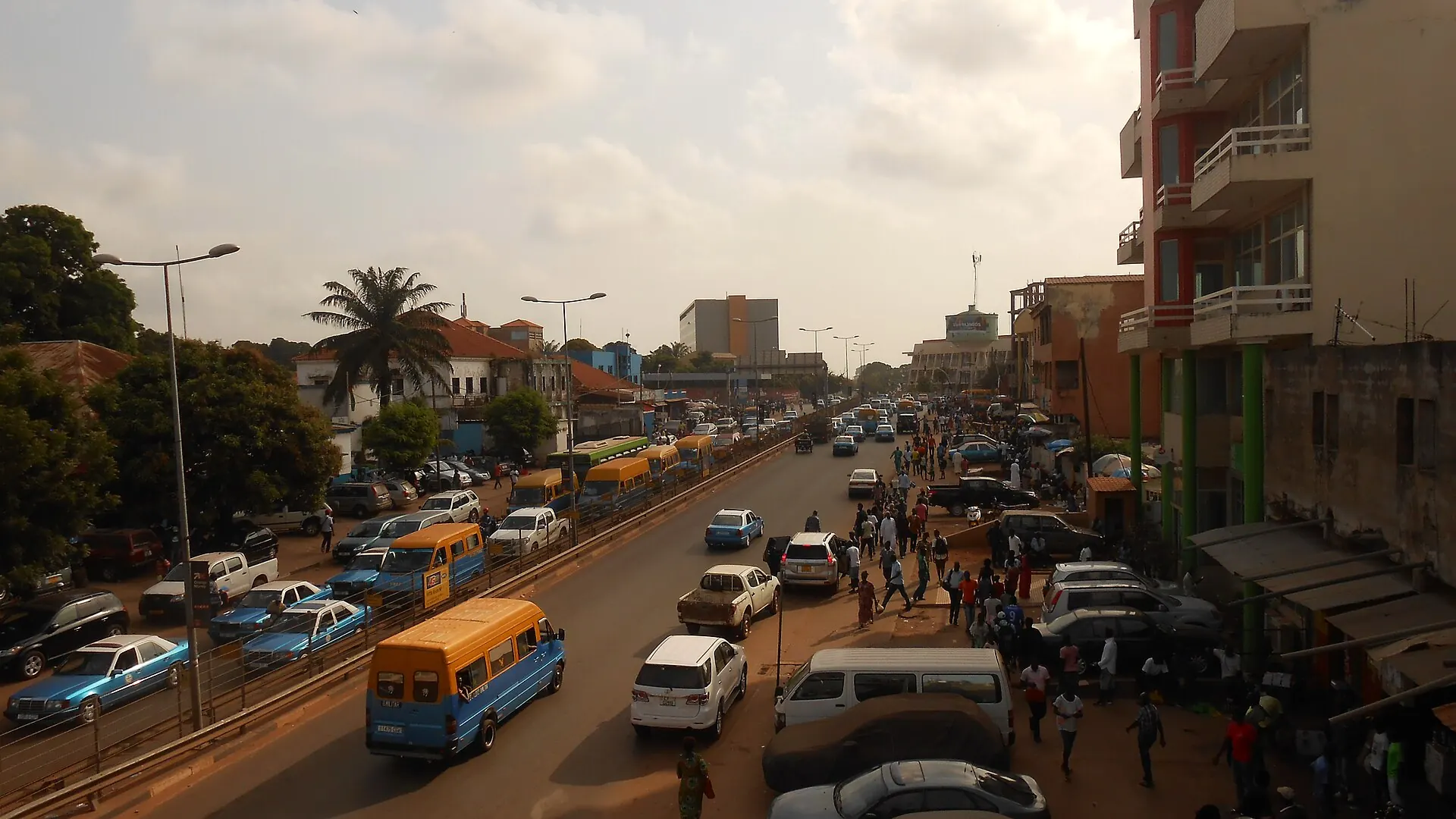
A first visit fits inside a compact stretch of the peninsula: Bissau Velho and the fort by the water, the Avenida Amílcar Cabral running north-east from the square, Pidjiguiti port on the waterfront, and Bandim market inland. Everything else is a car ride.
Street numbering is inconsistent and many addresses are given by landmark, not number: tell your driver the nearest known building, not a street address.
Shaded shapes: walking areas (click one). Black pins: sleep areas. Grey dots: places. Round badges: arrivals. Click the map to turn on scroll-wheel zoom.
Hover, tap or tab to an area to see what it is like. Pins are sleep areas; arrows at the edge point to the airport.
Off the map: Osvaldo Vieira International Airport (OXB) (25–50 min by the usual route).
Not drawn yet (no coordinates in this guide): Chão de Papel, Antula, Bra and the outer suburbs. They are in the neighbourhood cards below.
Where’s what, as a list:
- Bissau Velho (old town) (Bissau Velho): Cobbled, uneven lanes; no stroller. A handful of guesthouses here. Suits: A morning of colonial streets and the fort. Price band $$.
- Avenida Amílcar Cabral and the centre (Avenida Amílcar Cabral): The main hotels, cafés with AC and the cathedral; the base for a short stay. Suits: Most first-time visitors. Price band $$.
- Pidjiguiti and the port: A working port; keep to the memorial and the food stalls, not the dock itself. Suits: An early-morning stop for the memorial and grilled fish.
- Bandim: The largest market in the country, crowded and hot by mid-morning; a driver who waits, not a place to linger. Suits: The market, once.
- Chão de Papel, Antula, Bra and the outer suburbs: Residential districts with little for a short stay; not covered here. Suits: Not a first visit.
- Sleep area Avenida and the centre: suits Most first-time visitors, price band $$.
- Sleep area Bissau Velho: suits A morning of colonial streets and the fort, price band $$.
- Osvaldo Vieira International Airport (OXB), 25–50 min by the usual route.
Neighbourhoods at a glance
One tab per area, pulled together from this guide’s districts table, area notes, sleep-area scores and place pages. Scores are desk judgements (1–5); prices are estimates, check before you book.
Bissau Velho (old town)
$$Bissau Velho
Cobbled, uneven lanes; no stroller. A handful of guesthouses here.
- Suits:
- A morning of colonial streets and the fort
- Rooms:
- XOF 15,000–25,000 (from the sleep guide)
- Quiet nights4/5 High
- Nightlife1/5 Very low
- Families2/5 Low
- Late arrival2/5 Low
Why these scores
- Quiet nights: Quieter than the Avenida after dark.
- Nightlife: Little beyond a guesthouse bar.
- Families: Uneven pavements make it harder work than the Avenida.
- Late arrival: Confirm night access before you book; not all guesthouses staff a night desk.
Getting around from here
- Car north: about 8 min to Avenida Amílcar Cabral
- Car east: about 8 min to Pidjiguiti port
- Car north-east: about 15 min to Bandim market
Avenida Amílcar Cabral and the centre
$$Avenida Amílcar Cabral
The main hotels, cafés with AC and the cathedral; the base for a short stay.
- Suits:
- Most first-time visitors
- Rooms:
- XOF 25,000–50,000 (from the sleep guide)
- Quiet nights3/5 Medium
- Nightlife3/5 Medium
- Families3/5 Medium
- Late arrival3/5 Medium
Why these scores
- Quiet nights: Traffic and generators on the Avenida; ask for a back room.
- Nightlife: Hotel bars and cashew-wine spots are the extent of it.
- Families: A reasonable base: flat pavement on the Avenida itself, cars for everything else.
- Late arrival: Most hotels keep a night desk; confirm before you book.
Getting around from here
- Car south: about 8 min to Bissau Velho & the fort
- Car north-east: about 10 min to Bandim market
Pidjiguiti and the port
A working port; keep to the memorial and the food stalls, not the dock itself.
- Suits:
- An early-morning stop for the memorial and grilled fish
Getting around from here
- Car west: about 8 min to Bissau Velho & the fort
- Car north: about 15 min to Bandim market
Bandim
The largest market in the country, crowded and hot by mid-morning; a driver who waits, not a place to linger.
- Suits:
- The market, once
Getting around from here
- Car south-west: about 10 min to Avenida Amílcar Cabral
- Car south-west: about 15 min to Bissau Velho & the fort
Chão de Papel, Antula, Bra and the outer suburbs
Residential districts with little for a short stay; not covered here.
- Suits:
- Not a first visit
Decide
The honest trade-off: what you will enjoy, what will wear you down.
You will like
- Colonial-era fort and streets
- Markets and grilled fish
- A gateway to the islands
You will hate
- Heat and humidity
- Cash-only payments
- Few flights and few taxis
Similar citiesif this one is not quite right
Similar cities
If Bissau does not fit your dates or budget, these match it on season, cost and feel.
- Siem Reap
Cambodia
- Good in the same months: Jan, Feb, Nov, Dec
- A similar climate through the year
- Bangkok
Thailand
- Good in the same months: Jan, Feb, Nov, Dec
- A similar climate through the year
- Nouakchott
Mauritania
- Good in the same months: Jan, Feb, Nov, Dec
- A similar climate through the year
When
Best months: Jan, Feb, Nov, Dec. Month-by-month verdicts below, with the live forecast first. When to go, month by month →
Bissau: next 7 days
Loading forecast…
Forecast: Open-Meteo (CC BY 4.0), model data for this point.
Air quality
Loading…
Model estimate (CAMS via Open-Meteo), not a street-level station; readings near busy roads run higher.
Month by month, all 12best Jan, Feb, Nov, Dec
Dry season, hot; Harmattan haze some days.
Dry; Carnival some years (Feb or Mar).
Hot and humid; Carnival some years.
Very hot.
Hot; first rains.
Rainy season begins.
Heavy rain and flooded streets.
Very wet.
Very wet.
Rains ease.
Dry season starts.
Dry, cooler.
Climate, calendar and eventsClimate · Calendar · Events · Packing by season
Climate
| Jan | Feb | Mar | Apr | May | Jun | Jul | Aug | Sep | Oct | Nov | Dec | |
|---|---|---|---|---|---|---|---|---|---|---|---|---|
| High | 32°C (90°F)90°F (32°C) | 33°C (91°F)91°F (33°C) | 33°C (91°F)91°F (33°C) | 33°C (91°F)91°F (33°C) | 32°C (90°F)90°F (32°C) | 31°C (88°F)88°F (31°C) | 29°C (84°F)84°F (29°C) | 29°C (84°F)84°F (29°C) | 30°C (86°F)86°F (30°C) | 31°C (88°F)88°F (31°C) | 32°C (90°F)90°F (32°C) | 32°C (90°F)90°F (32°C) |
| Low | 18°C (64°F)64°F (18°C) | 19°C (66°F)66°F (19°C) | 21°C (70°F)70°F (21°C) | 22°C (72°F)72°F (22°C) | 24°C (75°F)75°F (24°C) | 24°C (75°F)75°F (24°C) | 23°C (73°F)73°F (23°C) | 23°C (73°F)73°F (23°C) | 23°C (73°F)73°F (23°C) | 23°C (73°F)73°F (23°C) | 21°C (70°F)70°F (21°C) | 19°C (66°F)66°F (19°C) |
| Rain days | 0 | 0 | 1 | 1 | 4 | 11 | 19 | 21 | 17 | 10 | 2 | 0 |
| Verdict |
- Nov–Feb is the dry season and the easiest time to visit; Harmattan dust haze can dull the sky on some days.
- Mar–May turns hot and humid before the rains; by April the heat is heavy even in the shade.
- Jun–Oct is the wet season: expect heavy afternoon downpours, flooded low streets and a harder time keeping to any outdoor plan.
Events by month
Carnival (moves, usually Feb or Mar)
festivalCheck yearly · Avenida Amílcar Cabral(check dates)
Mask parades and street parties; the country's biggest festival — book ahead.
Pidjiguiti Day
culture3 August · Pidjiguiti memorial
Low-key commemorations of the 1959 massacre.
Independence Day
holiday24 September · Citywide
National holiday; offices and many shops close.
Festivals and events that change the plan
| When | What | Effect on your plan |
|---|---|---|
| 3 August | Pidjiguiti Day | Commemorates the 1959 dockworkers' massacre; low-key official ceremonies near the memorial. |
| 24 September | Independence Day | National holiday; flags and some events around the city, offices closed. |
| February–March (moves yearly) | Carnival | Mask parades and street parties on the Avenida; the country's biggest festival — book accommodation ahead. |
| Ramadan (moves yearly) | Ramadan | Daytime food-stall hours shorten in Muslim-majority neighbourhoods; evenings are livelier after the fast breaks. |
| Any date | Political events | Demonstrations, roadblocks or curfews can appear at short notice: check your government's travel advice before you book and again before you fly. |
What to pack, by season
From Bissau’s own climate table: the coldest, warmest and wettest three months, and what to bring for each.
Coldest months
Dec–Feb
19° to 32°
Light layers; evenings can still feel cool.
Warmest months
Apr–Jun
23° to 32°
Light, breathable clothes, a sun hat and sunscreen; plan midday indoors and carry water.
Wettest months
Jul–Sep
19 rain days a month
A compact umbrella or rain jacket and shoes that can get wet.
Arrive & moveGetting in, getting around, and your bags
Arrive & move
Getting in, getting around, and your bags
I land at…
Enter your landing time: what still runs from the airport, where you can eat when you get in, and which areas let you check in that late.
Osvaldo Vieira International Airport (OXB)
Out of the airport about 00:00 (next day)12:00 AM (next day) (01:25 (next day)1:25 AM (next day) if immigration and bags are slow); in town about 00:25 (next day)12:25 AM (next day).
Transport from the airport
- Any hourPre-booked hotel car to the door. Runs all night.
- Last resortOvernight near the airport. If nothing else works.
Places to eat open when you get in
We have no confirmed hours for the places to eat here yet. Plan on a convenience store or your hotel. What is open late →
Where to sleep with a late arrival
- Lets you inAvenida and the centre 24-hour desk. Most hotels keep a night desk; confirm before you book.
- Call aheadBissau Velho Desk hours not confirmed: message the hotel with your flight number. Confirm night access before you book; not all guesthouses staff a night desk.
Typical times from our airport data, not a timetable: check the last departure on the day. Full airport-to-bed plan for Osvaldo Vieira International Airport (OXB) →
Arrive
Each gateway has its own airport-to-bed page with timings and the last safe connection.
Getting in, in detailGet in
Get in by rail and road
| Station | Mode | Serves | Where | To the centre |
|---|---|---|---|---|
| Road border with Senegal (São Domingos / Ziguinchor)caution | Bus | Northern approach from Senegal | North of the city | Car 2–3 h from the border to BissauConfirm the border is open and check your government's advice before relying on this route.(check) |
| Road border with Guinea (Guinea-Conakry)caution | Bus | Southern and eastern approach | South-east of the city | Car several hours from the border to Bissau(check) |
| Pidjiguiti quayuse | Bus | Boats to the Bijagós islands and Bolama | Pidjiguiti port · Pidjiguiti | Already in the cityLodges arrange the boat; do not book an informal boat yourself. |
- Confirm any land border crossing and current advice with your government before you rely on it; the political situation changes routes and rules with little notice.
Move
The default way around, when a pass pays off, and when the last trains go.
- Default
- Walk inside a cluster by day; a taxi or hotel-arranged car between clusters and after dark.
- Passes
- No pass. Agree the fare before you get in; hire a driver by the half-day for several stops.
- Last trains
- No rail. Taxis are few after dark: ask the hotel to book the ride back before you go out.desk estimate
- Other modes
- Other modes (Rome2Rio) ↗
Getting around, in detailGet around · Connect
Get around
Walk inside a cluster by day, take a taxi or hotel-arranged car between clusters and always after dark. There is no metro and no formal bus network for visitors to rely on.
| Mode | Verdict | Fare | Use it for | What breaks |
|---|---|---|---|---|
| Walking | use | Free | Inside a cluster, daytime only | Broken pavements and heat outside the Avenida; carry water. |
| Hotel-arranged car | use | XOF 1,500–2,500 a short hop; XOF 15,000–25,000 a half day | Between clusters, bags, after dark | Agree the fare or the half-day rate before you start. |
| Street taxi (shared or private) | caution | Agree first: about XOF 1,000–2,000 for a short hop | Daytime hops if a hotel car is not available | Shared taxis run fixed routes; a private hire needs the fare agreed up front. |
More on getting around
There is no ride-hailing app confirmed for Bissau: your hotel books the car, or you hail a taxi and agree the fare before getting in. Traffic is lighter than a big regional capital but the Avenida slows in the late afternoon; add time after a downpour, when low streets flood.
Connect
| Option | Verdict | What breaks |
|---|---|---|
| Orange or MTN shop on the Avenida | use | Bring your passport; data plans are inexpensive but coverage thins outside the city. |
| Tourist eSIM bought before you fly | caution | Check your provider actually covers Guinea-Bissau; not all regional eSIMs do. |
Messaging, and often how hotels and drivers confirm a booking
The default way to reach a driver or a lodge; save numbers before you fly.
Google Maps
Walking, addresses
Patchy in the outer city; landmarks work better than addresses with a driver.
- Wi-Fi
- Available in most hotels and some cafés; slower and less reliable than a local SIM.
Luggage
Where big bags are a problem, and how to get rid of them for the day.
Rule
- Lockers
- No public lockers; hotels hold bags after check-out.
- Forwarding
- No forwarding service; keep the big bag at the hotel for trips away.
- Dead zone
- Late check-out flights: ask the hotel to hold bags and for a shower room.
Bags, area by area
4 walking areas rated
Lockers, forwarding and the gap between check-out and check-in are covered once, under Luggage.
See & doWalking clusters, day plans and the places worth the time
See & do
Walking clusters, day plans and the places worth the time
Clusters
Plan by cluster: each is a walkable area with a rescue point and a bag rule.
Morning cluster: the old town lanes and the fort at the water's edge; go before 10:30, on foot with a driver on call.
rescue 100% · max p90 3.8′ · half
Late-morning cluster: the main avenue, the cathedral and the national heroes' square; cafés with AC for the midday break.
rescue 100% · max p90 3.8′ · half
Early-morning cluster: the working port and the memorial to the 1959 dockers' strike; go with a driver who waits, before 09:30.
rescue 100% · max p90 3.8′ · half
Early-morning cluster: the largest market in Bissau, crowded and hot by 09:30; go with a driver who waits, carry little and leave by 10:30.
rescue 100% · max p90 3.8′ · half
Days
Ready-made day plans, timed against opening hours and walking distances.
How long are you staying?
Loose outlines in the city's rhythm: outdoors early, indoors or resting at midday. The timed day plan (see Days) checks stops and heat.
1 night
A stopover before or after the Bijagós or a flight
- 07:30São José da Amura fort — Fort and Amílcar Cabral's tomb
- 09:00Bissau Cathedral — Cathedral and the square
- 12:30Lunch on the Avenida
- 13:00AC break
- 16:30Presidential Palace ruins — Presidential Palace ruins by car
Skip: Bandim market and Pidjiguiti: both need their own morning.
Bissau in 3 days
3 daysThe fort and the avenue in the morning, the port at opening on the second day, Bandim market on the last; every long leg is a car, and the last day ends with the bags already in it.
Day by day
Day 1 — Fort, cathedral, a 12:30 lunch table on the Avenida
- 08:00São José da Amura fort
- Bissau Cathedral (optional)
- 12:30Lunch table 12:30 (Avenida)
Day 2 — Pidjiguiti quay at 07:30, grilled fish lunch
Day 3 — Bandim market at 07:30, car to the airport at 12:00
- 07:30Bandim market
- Café and bakery on the Avenida (optional)
- 12:00Car to the airport at 12:00
Places
“Best time” is when to arrive for the fewest crowds, for example “before 08:30”; “Go any time” means the hour makes little difference. More sights follow under “More sights and museums”.
7 places. Filters use the guide’s own ratings; a place with no rating is left out when a filter is on.
If you do ten things in Bissau
Ranked for a short, careful first visit. Prices are 2026 estimates in XOF; hours marked (check) still need confirmation.
- 1
São José da Amura fort at opening
The city's oldest structure and Amílcar Cabral's tomb, quiet before the heat.
- Time
- 30–45 min
- Best
- 07:30–09:00
- Cost
- Free–XOF 1,000 (check)
- 2
The central monument to the independence war, a short walk from the cathedral.
- Time
- 10–15 min
- Best
- Morning
- Cost
- Free
- 3
A blunt, unmissable reminder of the 1998–99 civil war, seen from the road.
- Time
- 10–15 min
- Best
- Any time
- Cost
- Free
- 4
Marks the 1959 massacre that pushed the country toward independence.
- Time
- 15–20 min
- Best
- Morning
- Cost
- Free
- 5
The country's biggest market, loud and full, best seen early and briefly.
- Time
- 20–30 min
- Best
- 07:30–09:30
- Cost
- Free
- 6
Grilled fish lunch near the port
Fresh fish off the boats, eaten at open-air stalls.
- Time
- 45–60 min
- Best
- 12:00–14:00
- Cost
- XOF 2,000–3,500
- 7
A small window onto Bijagós and mainland material culture, if it is open.
- Time
- 30–45 min
- Best
- Mid-morning
- Cost
- XOF 1,000–2,000 (check)
Good for…
Verdict is how well Bissau works for that traveller, not how nice it is.
Neighbourhoods in one line
One line per area. The districts table covers where to sleep; this is about how each place feels.
| Area | Feel | Suits | Go | Avoid |
|---|---|---|---|---|
| The city's one properly paved, café-lined street; the closest thing to a promenade. | ||||
| Quiet, cobbled, half-restored colonial streets around the fort. | ||||
| A working quay: boats, nets and grilled fish, with a heavy history behind it. | ||||
| Loud, packed and fast-moving; the real economic heart of the city. |
Tours and classes: book or skip
Book through your hotel or a lodge with written inclusions; independent tour operators in Bissau are few and not independently verified by Voykit.
| Tour or class | Verdict | Typical price | Why | Check before paying |
|---|---|---|---|---|
| Negotiate locally | ||||
| Varies widely by lodge and island |
What each season brings
Light times are for clear days; Harmattan haze in the dry season flattens colours.
Nov–Feb (dry, cooler)
Mar–May (hot, building)
Jun–Oct (wet)
Photo spots and the light
Answers are 2026 desk estimates; always ask before photographing people, and never photograph soldiers, police or government buildings.
| Spot | Best light | Tip |
|---|---|---|
| São José da Amura fort | ||
| Presidential Palace ruins | ||
| Bandim market |
Bissau travel FAQ
Answers are 2026 desk estimates; facts marked (check) still need confirmation.
Is Bissau safe to visit right now?
Check your government's current travel advice before you book and again before you fly: the political situation has changed quickly before, most recently in November 2025.
Can I use my card and withdraw cash?
Do not count on it. Bring euros to change and keep a stock of small XOF notes; foreign cards are not reliably accepted at cash machines.
How do I get to the Bijagós from here?
Through a lodge, which arranges the boat from a separate quay; do not book an informal boat yourself.
Do I need a yellow-fever certificate?
Check the current rule for your route; it is commonly required if you are arriving from an at-risk country.
More to see and doSee & do · Learn & work · Rain & heat · Free things
Free things to do
Sights in Bissau that cost nothing to enter. Each is described under Places or More sights; extra costs inside are marked there.
See & do
10 of 10
17th-century Portuguese fort with Amílcar Cabral's tomb inside.
Bissau Velho · Free–XOF 1,000 (check)
- church
The city's Catholic cathedral on the main avenue.
Avenida Amílcar Cabral · Free
- monument
Central square and monument to the independence war.
Avenida Amílcar Cabral · Free
- memorial
Marks the 1959 dockworkers' massacre that pushed the PAIGC toward armed struggle.
Pidjiguiti port · Free
- Markets
The country's largest market; go early, keep a driver waiting.
Bandim · Free
The shelled Presidential Palace, a ruin since the 1998–99 civil war.
Bissau Velho · Free
- Museums
Small national collection of masks and everyday objects, including Bijagós pieces.
Avenida Amílcar Cabral · XOF 1,000–2,000 (check)
Carnival parade (Feb–Mar, dates move)
festivalMask parades and music; the country's biggest street event.
Avenida Amílcar Cabral · Check the current date · Free(check)
Cashew-wine tasting at a bar or stall
Food toursTaste vinho de caju and cana, the country's own drinks.
Avenida Amílcar Cabral · Evenings · XOF 300–1,000
Walk the fort and colonial streets of Bissau Velho
ActiveThe best-preserved colonial-era streets, done before the heat.
Bissau Velho · Morning · Free
- Booking
- There is little to book ahead in Bissau beyond a driver and a hotel; the Bijagós boat and lodge are the exception and need advance arrangement.
Learn & work
| What | Where | Cost | Note |
|---|---|---|---|
| Portuguese or Kriol with a private tutor | Arranged informally through your hotel or a language school in the centre | Negotiate locally | No large formal language-school sector confirmed; ask your hotel to help arrange a tutor. |
Working here
- Tourist entry
- Check current visa rules before you fly; they can change with the political situation. Tourist entry does not permit paid work.
- Remote work
- No digital-nomad visa; power cuts and patchy internet make Bissau a hard base for remote work beyond a short stay.
Rain-day and heat-day plan
Rain day
Jun–Oct: expect a heavy afternoon downpour most days — do outdoor stops before midday, then move indoors or under cover.
- 01National Ethnographic Museum — Small and indoor; the rain-day fallback.
- 02Hotel café on the Avenida — AC and shelter for a washed-out afternoon.
Heat day
Above 32 °C, most of the dry season: outdoor stops before 10:30 and after 16:00, AC in between, water every hour.
- 07:00São José da Amura fort — The coolest hour of the day; go before the sun is high.
- 09:30Bissau Cathedral — A short stop, then indoors.
- 12:00Hotel café on the Avenida — AC through the hottest hours.
Day-trips and nearby
Places you can reach from Bissau in a day or with one night away, with the route and what it costs. Door to door, not ride time.
Bijagós islands (Bubaque and the archipelago)
overnightBoat from a separate quay, arranged by your lodge, 2–4 h depending on the island
A trip on its own, not a day trip from Bissau; the lodge arranges the boat and the return.
- Time
- Overnight minimum
Bolama, the old colonial capital
overnightBoat or light aircraft, about 2–3 h by boat
Decaying Portuguese-era buildings, very few services; arrange transport and a guide before you go.
- Time
- Full day or overnight
 Photo: jbdodane, CC BY 2.0
Cacheu
cautionCar, about 2.5–3 h each way on paved and unpaved road
16th-century fort and the country's oldest colonial town; check road conditions in the rainy season.
- Time
- Full day
Varela and the Cacheu river beaches
overnightCar, about 3–4 h each way
Northern coast beaches near the Senegal border; few services outside one or two lodges.
- Time
- Overnight better than a day trip
Go next
Door to door: About 1 h by air; a full day or more by road
Flight where available, or a long road trip via the northern border
Check current border and flight status before relying on this route.
Eat & sleepWhere to eat and which area to sleep in
Eat & sleep
Where to eat and which area to sleep in
Eat
A short list of places worth crossing the city for, each with how to get a seat.
Restaurant finder: filter every place to eat in Bissau →
Vegetarian-friendly score
1.0 / 5 · Hard work
- Country diet noteOur country guide rates vegetarian eating as hard.0 / 2
- Places to eat in this guide1 of 5 places with a known answer are vegetarian-friendly, 4 partly.0.9 / 1.5
- Budget eating lines0 vegetarian lines in "Eat by budget".0 / 0.6
- Meat-free national dishes1 meat-free dish in the country food list.0.1 / 0.4
- Dedicated vegetarian kitchens0 mentions of vegetarian restaurants, Buddhist or fasting kitchens.0 / 0.5
Country note: Hard; rice, beans, eggs and bread.
Vegetarian places near me →Make a diet card →
How we score
- Country diet note (up to 2): easy 2, workable 1, mixed 0.75, hard 0; no note 0.5.
- City places to eat (up to 1.5): 1.5 × (vegetarian-friendly + half of partly friendly) ÷ places with a known answer; needs 3 or more known places.
- Budget eating lines marked vegetarian (up to 0.6): 0.2 each.
- Meat-free national dishes (up to 0.4): 0.1 each.
- Dedicated vegetarian kitchens mentioned — Buddhist chay, shōjin ryōri, Jain, fasting food, vegan cafés (up to 0.5): 0.1 each.
- Total rounded to the nearest half point, 0 to 5. Built from our own pages only, not from reviews.
Eating and drinking guideEat by budget · Drink
Before you sit down to eat
Short version; full text linked
Eat by budget
Under XOF 2,000 a meal
| Where | Order | Area | Price | Note |
|---|---|---|---|---|
| Peanut stew (caldo de mancarra) eatery | Caldo de mancarra (peanut stew) | Avenida Amílcar Cabral | XOF 1,500–2,500 | The everyday dish; ask what protein is in today's pot. |
| Fried snack stalls at Bandim market | Akara and market fruit | Bandim | XOF 300–1,000 | Breakfast, standing or take away. |
| Café and bakery on the Avenida | Bread, pastries and coffee | Avenida Amílcar Cabral | XOF 500–1,500 |
Dishes to know
| Dish | What it is | Where to look | When | Price |
|---|---|---|---|---|
| Caldo de mancarra | Peanut stew with fish, chicken or meat over rice | Home-style eateries off the Avenida | Lunch | XOF 1,500–2,500 |
| Peixe grelhado | Grilled fish, usually with rice or fried plantain | Port-area stalls | Midday | XOF 2,000–3,500 |
| Rice with tomato and oil (jollof-style) | Tomato-and-oil rice, sometimes with fish or meat | Market and street stalls | Any | XOF 1,000–2,000 |
| Akara | Deep-fried bean cakes | Bandim and other market stalls | Morning | XOF 100–300 each |
- Eat where the pot or the oil is visibly hot and turning over; a quiet stall is the one to skip.
- Cash only almost everywhere outside hotels; carry small notes, stalls rarely have change for large ones.
Drink & nightlife
| Where | What | Until | Note |
|---|---|---|---|
| Hotel bars on the Avenida | Beer, cashew wine, simple cocktails | About 22:00–23:00About 10:00 PM–11:00 PM | The easiest and safest evening option for visitors. |
| Open-air cashew-wine bars | Vinho de caju, cana, grilled skewers | Evening, variable | Plastic chairs, cash only; book the car home before the first round. |
By style
| Style | What | Where | Price | Until |
|---|---|---|---|---|
| Vinho de caju | Fermented cashew-apple wine, mild and tangyThe country's own drink; strength varies by how long it has fermented. | Bars across the centre, best around the April–June harvest | XOF 300–600 a glass | Evening |
| Cana | Distilled cashew spiritStrong; avoid unlabelled home-made bottles. | Same bars, ask for a sealed bottle | XOF 500–1,000 a shot | Evening |
| Beer | Local and imported lager | Hotel bars and cafés | XOF 800–1,500 a bottle | About 22:00–23:00 |
Rules that bite
- Drink-driving is unwise everywhere and unpoliced formally here: fix your ride home before you start.
- Only drink cashew wine or cana from a bottle you saw opened, never an unlabelled jug.
Sleep
Pick the area first: it decides your walk home at night and your first morning.
Which neighborhood fits you
Three questions, one recommendation, with the reasons.
Your best fit
- The fort and old colonial streets on the doorstep.
- Quieter than the Avenida after dark.
Watch out: Confirm night access before you book; not all guesthouses staff a night desk.
Next best: Avenida and the centre
Built from our 1–5 desk scores per area; your answers stay in this browser.
More on sleepingSleep by budget · Your area · With kids
Sleep by budget
| Band | Price | Where | Room types | What to expect |
|---|---|---|---|---|
| budget | XOF 15,000–25,000 | Bissau Velho and the centre | Simple guesthouses | Basic rooms, fan or weak AC, uneven street access. |
| mid | XOF 25,000–50,000 | Avenida Amílcar Cabral | Mid-range hotels | AC, breakfast, a generator for power cuts — the most reliable choice for a short stay. |
| splurge | XOF 60,000+ | Avenida Amílcar Cabral | The city's few upper-tier hotels | Pool or garden, restaurant, airport transfer arranged. |
Booking checks
- Ask whether the hotel has its own generator: mains power cuts are frequent, even in the centre.
- Confirm the hotel can arrange a driver and airport transfer before you book anywhere outside the Avenida.
Which area is yours
| If you are | Sleep in | Because |
|---|---|---|
| First visit, one or two nights | Avenida and the centre | Cafés with AC, the cathedral and square on foot, everything else a short car ride. |
| Travellers who want the old-town feel | Bissau Velho | Fort and colonial lanes outside the door; confirm the guesthouse's night access first. |
First-timers: the cathedral, the cafés and the fort are a short car ride away; choose a hotel with a 24-hour desk, a generator and a car door.
Quieter at night and nearest to the fort and the port; a car ride from the market and the airport road.
Areas are in our default order until you tick a priority.
Scores are 1–5 desk judgements per priority (2026).
With kids
- Broken pavements and heat make strollers impractical: bring a carrier.
- Bandim market and the port are crowded and not built for small children; keep a hand held at all times.
- Heat: plan outdoor time before 10:30 and after 16:00, with an AC break at midday.Heat: plan outdoor time before 10:30 AM and after 4:00 PM, with an AC break at midday.
- No dedicated child health facilities confirmed: bring a full travel medical kit and check malaria prevention for children with a travel clinic before you fly.
PracticalMoney, essentials, safety and the pocket card
Practical
Money, essentials, safety and the pocket card
Money
What a day costs at three comfort levels, and how to pay.
- Budget
- XOF 8,000–15,000 excl. bed / day
- Mid
- XOF 15,000–35,000 excl. bed / day
- High
- XOF 35,000+ excl. bed / day
- Transit card
- No transit card: taxis, hotel cars and walking short distances.
- Cash rule
- Bring euros in cash and change at a bank or licensed bureau; do not count on cash machines accepting foreign cards. Keep XOF 10,000 in small notes for rides and stalls.
More on moneyCosts · Budget · Buy
What things cost
- Plate of caldo de mancarra or grilled fish with riceXOF 1,500–2,500
- Bottle of waterXOF 300–600
- Glass of cashew wine (vinho de caju)XOF 300–600
- Half-day car with a driverXOF 15,000–25,000 (2026 estimate)
- Car from OXB to the AvenidaXOF 5,000–10,000
- Bijagós lodge boat transfer, returnXOF 40,000–80,000 (2026 estimate; lodge-dependent)
Trip budget
| Hotel double room1 × 2 nights × XOF 45,000 | XOF 90,000 |
| Food, local transport, entries2 × 2 days × XOF 30,000 | XOF 120,000 |
| Half-day car with a driver1 × XOF 20,000 | XOF 20,000 |
| Tourist SIM with data, about a week2 × XOF 5,000 | XOF 10,000 |
| Buffer 15%Price creep, a taxi you did not plan, one splurge | XOF 36,000 |
| Trip total≈ XOF 69,000 per person per day, bed included | XOF 276,000 |
2026 estimate in CFA francs (XOF); flights and the Bijagós boat or lodge excluded. Your choices stay in this browser.
Prices of common things
| Plate of caldo de mancarra or grilled fish | XOF 1,500–2,500 |
| Bottle of water | XOF 300–600 |
| Half-day car with a driverAgree the rate and stops before you start. | XOF 15,000–25,000 |
2026 estimate; check locally.
Buy
- Bargaining
- At Bandim and other markets the first price to a foreigner runs high: counter at about half and settle around 60–70%. Shops with a posted price do not haggle.
- Fixed-price check
- Supermarkets in the centre sell bottled water, snacks and toiletries at a fixed, printed price; use that as your ceiling before bargaining for the same thing at a stall.
Markets and shopping streets
| Where | What | When | Haggle | Note |
|---|---|---|---|---|
| Bandim market | Food, cloth, household goods, informal everything | Dawn to early afternoon | hard | The country's largest market; go early, carry little, keep a driver waiting. |
| Central supermarkets on the Avenida | Bottled water, snacks, toiletries | Shop hours, some closed midday | no | Your fixed-price reference. |
Shops by what they sell
| For | Where | Hours | Note |
|---|---|---|---|
| Cashew products (nuts, wine, spirit) | Avenida shops and market stalls | Shop hours | Cashew is the country's main export; nuts and cana travel well. |
| Fabric and tailoring | Streets around Bandim | Shop hours | Wax-print cloth by the metre; a local tailor can make it up in a day or two. |
Essentials and accessEssentials · Access
Essentials
- Tipping
- Not expected at stalls. Round up for drivers; 5–10% in hotel restaurants if you were pleased.
- Plugs & power
- 220 V; two-pin European sockets (types C and F). Bring a universal adapter.
- Opening hours
- Shops and offices mostly run mornings and again from about 15:00, closed through the midday heat; markets start at dawn and thin out by mid-morning.Shops and offices mostly run mornings and again from about 3:00 PM, closed through the midday heat; markets start at dawn and thin out by mid-morning.
- Health
- Malaria risk year-round: take prophylaxis and use repellent. A yellow-fever vaccination certificate is required for entry from at-risk countries, and cholera outbreaks occur in the rainy season — check current advice and travel with insurance that covers medical evacuation.
- Accessibility
- Pavements are broken or absent outside the Avenida; step-free access is rare outside hotels. Plan every outing as a door-to-door car ride.
- Laundry
- Hotels handle laundry, usually same- or next-day; no self-service laundromats confirmed.
- Emergency numbers
- No reliable national emergency number: save your hotel's, driver's and insurer's numbers before you arrive.
Pack
- Light, breathable clothes and a hat; a light rain layer June–October
- A torch: power cuts are common, even in the centre
- Repellent and treated clothing or a net for malaria protection
- A modest outfit for the cathedral and for meeting officials
Accessibility
Bissau is hard going on wheels or with a stroller: pavements are broken, unpaved or absent outside the Avenida, and step-free access exists mainly inside hotels. Plan every outing as a door-to-door car ride and budget extra time for heat breaks.
- Pavements
- Cracked, unpaved or missing outside the Avenida; Bissau Velho's lanes are cobbled and uneven.
- Getting around
- A hired car with a driver is the practical step-free option; agree the stops and the wait.
- Hotels
- Larger Avenida hotels are the safest bet for a lift and step-free rooms; ask for photos before booking elsewhere.
- Toilets
- Accessible toilets are not confirmed outside a few larger hotels.
Sights, step-free or not
| São José da Amura fort | with help | Uneven ground inside the fort walls. |
| Presidential Palace ruins | step-free | Viewed from a flat perimeter road; no entry. |
| Bandim market | hard | Packed, uneven, sometimes wet market lanes. |
Survive
Safety basics, the lines not to cross, and practical habits that save the day.
Safety
- Political events can lead to demonstrations, roadblocks and curfews at short notice: check your government's travel advice before you book and again before you fly.
- Use hotel-arranged cars after dark; do not walk between clusters.
- Emergency numbers vary and may not always connect: save your hotel's, driver's and insurer's numbers.
- Health: see a travel clinic well before you fly about vaccinations and malaria prevention, and check the yellow-fever certificate rules for your route.
- Heat: AC stop every 60–90 minutes; drink sealed bottled water.
Red lines
- Do not photograph military sites, soldiers, police, the port or government buildings.
- Ask before photographing people, and at the markets.
- Greet people before any question or purchase.
Practical
- Toilets: hotels and larger cafés; carry tissues.
- Tap water is not for drinking; buy sealed bottles.
- Portuguese is official and Kriol is widely spoken: greet people first, then ask.
More on staying safeStay safe · Stay healthy · Safety map · Solo & women · Etiquette · Cope · Scams
After dark, by area
4 flagged areas
- Avoid after dark
- Avoid after dark
- Take care
Day = about 07:00–19:00. What to watch in each area, day and night →
Scams and red flags
Walk away if you see these
- XOF notes look similar across denominations: count change slowly and in front of the seller.
- Unofficial money-changers offering a better rate than a bank or bureau: short-changing and fake notes are the risk.
- A driver who names a per-person or per-stop price at the end of a ride: agree the total fare, or the half-day rate, before you get in.
- Anyone offering unasked to 'help' with your bags at the airport or the port: agree a price first or decline.
Stay safe
Crossing the road
- 01Traffic is lighter than a big regional capital, but drivers do not always stop for pedestrians: cross at a clear gap and watch both ways.
Hustles specific to this city
| Hustle | Where | The tell | What to do |
|---|---|---|---|
| Fare creep | Citywide | A taxi or driver adds stops or a 'waiting fee' not agreed at the start | Agree the total fare or the half-day rate before you get in, and confirm what it covers. |
| Unofficial money-changers | Streets, markets | A better rate than a bank or bureau, paid in cash on the spot | Change money at a bank or licensed bureau; count what you are given before you leave the counter. |
- Police
- Report thefts at the nearest police post with your passport and hotel staff to help; keep a copy of the report for your insurer.
- Political events
- Avoid any demonstration or gathering and follow your government's current advice; situations can shift from calm to a curfew within a day.
Stay healthy
- Malaria
- Present year-round: take prophylaxis prescribed by a travel clinic and use repellent, long sleeves and a net at night.
- Yellow fever
- A vaccination certificate is required for entry from at-risk countries; check the current rule for your route before you fly.
- Cholera and water-borne illness
- Outbreaks occur in the rainy season in crowded, low-lying areas; drink only bottled or treated water and eat food cooked hot in front of you.
- Heat
- AC break every 60–90 minutes outdoors; drink sealed water, watch for heat exhaustion.
- Medical evacuation
- Hospital care is very limited; travel insurance that covers evacuation (often to Dakar) is essential, not optional.
Hospitals and clinics: see Cope.
Safety by area and hour
| Area | Day | Night | What to watch |
|---|---|---|---|
| Avenida Amílcar Cabral and the centre | fine | caution | Use a car after dark; keep bags close in any crowd. |
| Bissau Velho and the fort | fine | caution | Uneven, unlit lanes after dark; go by car, not on foot. |
| Pidjiguiti port | fine | avoid | A working port; keep to the memorial and food stalls, and do not linger after dark. |
| Bandim market | caution | avoid | Pickpocketing in the crowd; carry only what you will spend, and leave by mid-morning. |
- Political demonstrations, roadblocks or curfews can appear with little warning: avoid any gathering and check your government's advice before you book and again before you fly.
- Do not photograph military sites, soldiers, the port or government buildings anywhere in the city.
Solo, women and LGBTQ+ travellers
Solo
- Manageable with a hotel-arranged driver for anything after dark; solo walking between clusters is not recommended.
- Confirm your government's current travel advice before you go — Bissau is not a routine solo backpacking stop.
Women
- Harassment is not commonly reported, but the basics apply: dress modestly, especially near the cathedral and markets, and avoid walking alone after dark.
LGBTQ+
- Guinea-Bissau has no law explicitly criminalising same-sex relations, but there is little public visibility and no known scene; keep a low profile and avoid public displays of affection.
Etiquette in Bissau
- Greetings
- Greet before you ask anything — a question or purchase without a greeting first reads as rude.
- Cathedral and mosques
- Cover shoulders and knees; ask before photographing worshippers.
- Photos
- Never photograph soldiers, police, military sites, the port or government buildings; ask before photographing people generally.
- Political talk
- Keep opinions on current politics to yourself in public; the situation is sensitive and fast-moving.
- Paying and haggling
- Haggle at markets, not in shops with a posted price; hand money over with the right hand.
Cope
Hospitals and clinics that handle foreigners
| Where | Area | Use it for |
|---|---|---|
| Hospital Nacional Simão Mendes | Bissau centre | The main public hospital; limited equipment and supplies. Serious cases are usually evacuated (often to Dakar); travel insurance with medical evacuation is essential. |
| Private clinics on the Avenida | Bissau centre | A few small private clinics for routine care; ask your hotel or embassy for a current recommendation. |
Visa extensions
- Office
- Immigration authority (Direção de Migração) in Bissau; check current visa and entry rules before you fly, as they can change with the political situation.
- Extending
- Extensions are handled through the immigration office; expect a slow, in-person process and bring extra passport photos.
Embassies and consulates
| Country | Address | Phone | Note |
|---|---|---|---|
| Portugal | Bissau centre | check | (check) |
| France | Bissau centre | check | (check) |
| Senegal | Bissau centre | — | Useful for onward travel by road(check) |
- Lost passport
- Report to the nearest police post, then your embassy; few countries keep a resident embassy in Bissau, so many travellers deal with an embassy in Dakar instead.
- Pharmacies
- A handful on the Avenida; stock is inconsistent, bring what you need from home.
Apps and offline kitOffline kit
Offline kit
Set up before you leave, so Bissau still works with no signal or a dead roaming plan.
On your phone
- Maps: open the city in Google Maps, tap the place name, then Download offline map (or use an offline-maps app).
- Data: install an eSIM or buy a local SIM before the first taxi; the apps in this guide depend on it.
- Translation: download the local language for camera translation.
- Screenshots: booking confirmations, hotel address in the local script, and the emergency numbers.
This guide
Save the Bissau guide and its pages on this device; it opens without a connection.
Phrases that do the work
Greeting
Hello
Olá / Bon dia
oh-LAH / bon DEE-ah
Thanks
Thank you
Obrigado/a
oh-bree-GAH-doo
Market
How much is this?
Quanto custa?
KWAN-too KOOS-tah
Food
Not spicy, please
Sem pimenta, por favor
sain pee-MEN-tah poor fah-VOR
Café
The bill, please
A conta, por favor
ah KON-tah poor fah-VOR
Taxi
Please take me to this address
Leve-me a este endereço, por favor
LEH-veh meh ah ESH-teh en-deh-REH-soo
Kriol greeting
How are you?
Kuma ku bo sta?
KOO-mah koo bo STAH
Pocket card
Fill in, then print or save as PDF
Stays in this browser only; nothing is sent anywhere.
BissauBissau
Pocket card · Voykit
My bed tonight
—
—
—
Leve-me a este endereço, por favorPlease take me to this address
Emergency
- No reliable national numberUse your hotel, driver and insurer's numbers
Embassy
Few countries keep a resident embassy in Bissau; write your own embassy's nearest office (often Dakar) and number below before you fly.
My embassy: —
Fare anchors (2026 estimate)
- OXB to the Avenida, hotel car: XOF 5,000–10,000, 15–25 min
- Short taxi ride across the centre: XOF 1,000–2,000
Landmarks work better than street addresses with a driver; show the hotel name and the nearest known building.
Deep diveHistory, reading, photos and every source
Deep dive
History, reading, photos and every source
Sources
- officialUK FCDO travel advice — Guinea-Bissau
- secondaryWikivoyage — Bissau
Ask about Bissau
Loading…
Was this useful?