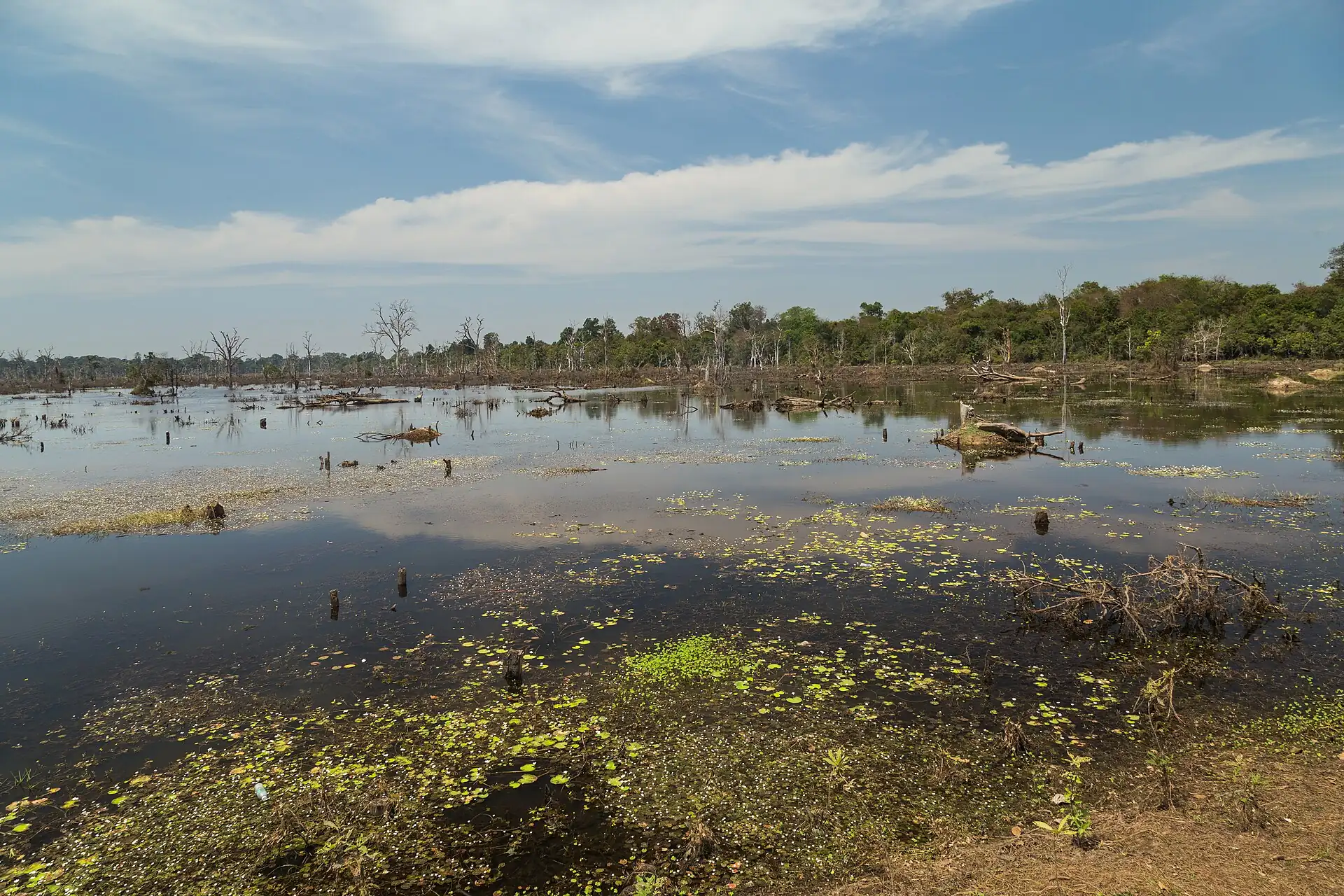
Siem Reap
ក្រុងសៀមរាប
Code SR · 4 walking zones
Siem Reap is a sunrise-and-siesta town: Angkor Wat before 08:00, back to the hotel for the middle of the day, Bayon and the town in the late afternoon — and the airport is about 40 km (25 mi) away, so a late landing is the trap.Siem Reap is a sunrise-and-siesta town: Angkor Wat before 8:00 AM, back to the hotel for the middle of the day, Bayon and the town in the late afternoon — and the airport is about 40 km (25 mi) away, so a late landing is the trap.Siem Reap is a sunrise-and-siesta town: Angkor Wat before 08:00, back to the hotel for the middle of the day, Bayon and the town in the late afternoon — and the airport is about 25 mi (40 km) away, so a late landing is the trap.Siem Reap is a sunrise-and-siesta town: Angkor Wat before 8:00 AM, back to the hotel for the middle of the day, Bayon and the town in the late afternoon — and the airport is about 25 mi (40 km) away, so a late landing is the trap.
Our quick read of Siem Reap, scored 1–5 (friction is out of 100). Cash need: how often you still need notes. Heat risk: how hot days get. Stroller: how easy wheels are. Friction: overall effort for a first visit. Desk judgements, so check before relying on them.
- Local time
- --:--
- Weather
- forecast below
- Currency
- KHR
- Best months
- Jan · Feb · Nov · Dec
- Airport
- Siem Reap–Angkor (SAI)
Walking zones: the 4 areas this guide plans a day around. Each is a district you can cover on foot, so you do one zone per half-day and ride the train between them. The code (SR 01, SR 02…) is just the zone's number on the Siem Reap line; the line under each name says how bags fare there and how much time it needs.
Map of Siem Reap
Use the switches to show or hide each kind of pin. A switch that is on shows its pins on the map; tap it again to hide them. "Show only" keeps just the pins that match (for example, places that fit a suitcase). Tap any pin for its name and a link to its page.
- Where to sleep
- Places
- Eat
- Walking clusters
- Rest stops
From the airport Siem Reap–Angkor (SAI) to your bed
Tap a pin for its card. Places without their own coordinates are shown by their walking cluster.
Why Siem Reap
The town is small and flat, but the temples are 6–10 km out and the heat is heavy from about 10:00. The trips that go wrong are the ones that fight the sun: noon walks at Angkor, a one-day pass spent on the wrong temple, or a 21:00 landing at an airport that is far from any bed. Four clusters cover a first visit — two in the temples, two in town — with one kept bed.
See first
- 1
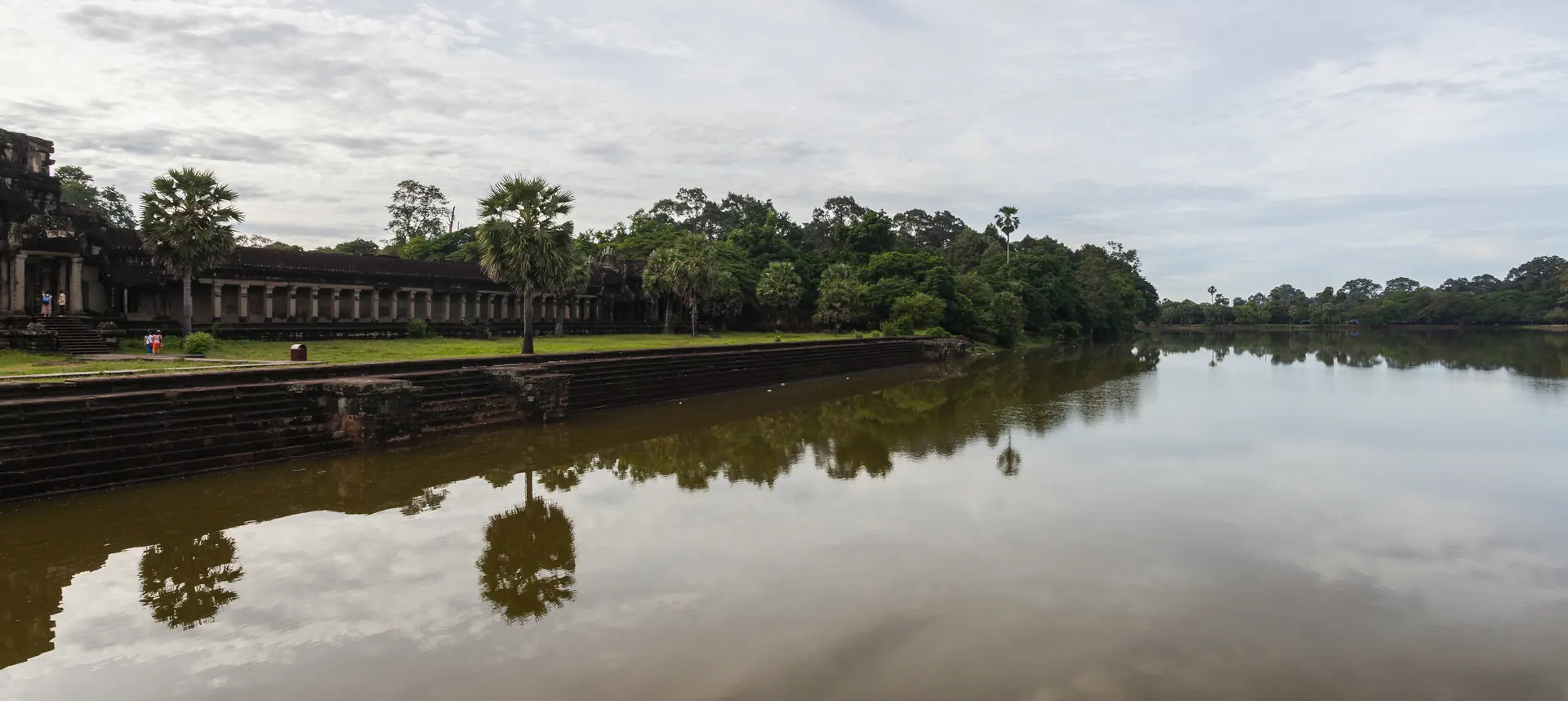 Angkor Wat at sunrise · 2–3 h
- 2
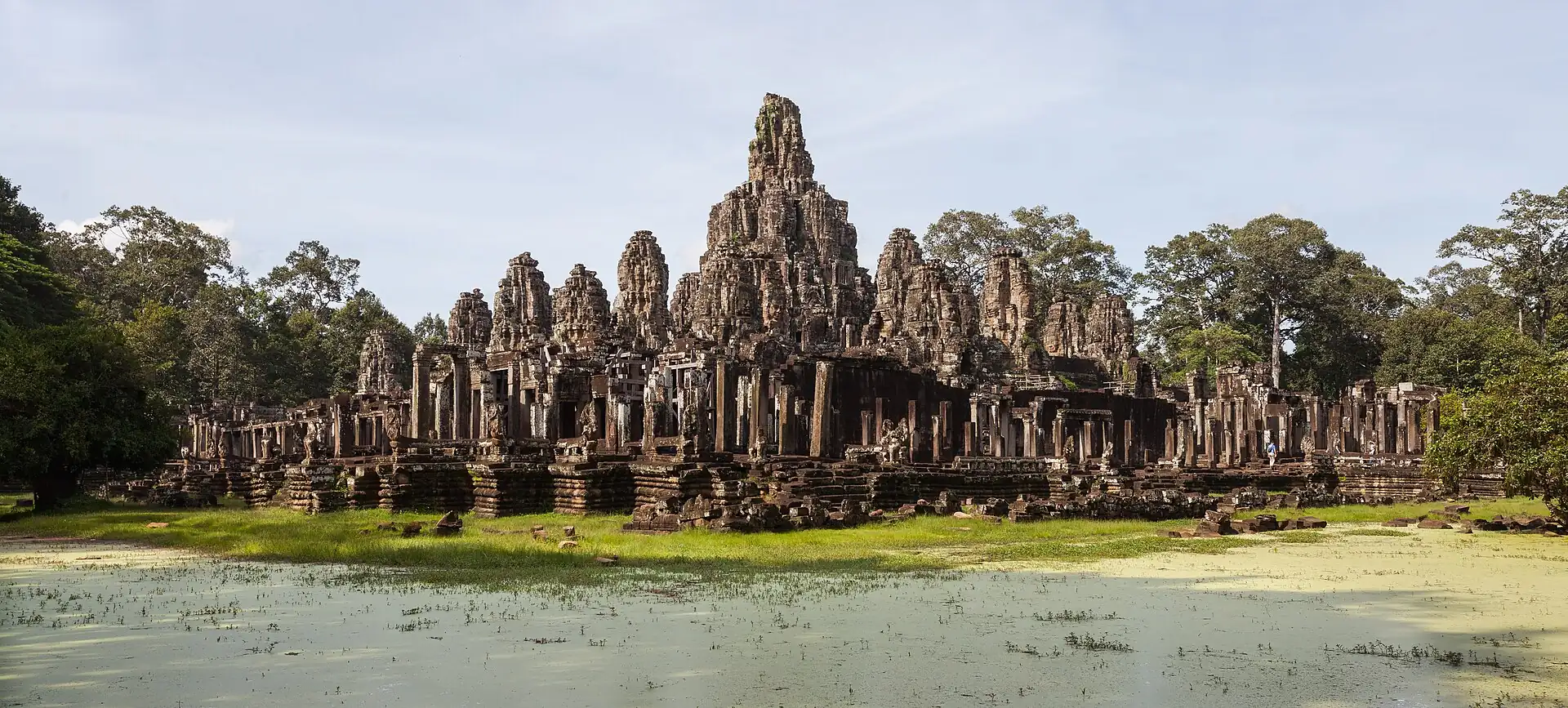 The Bayon · 1–1.5 h
- 3
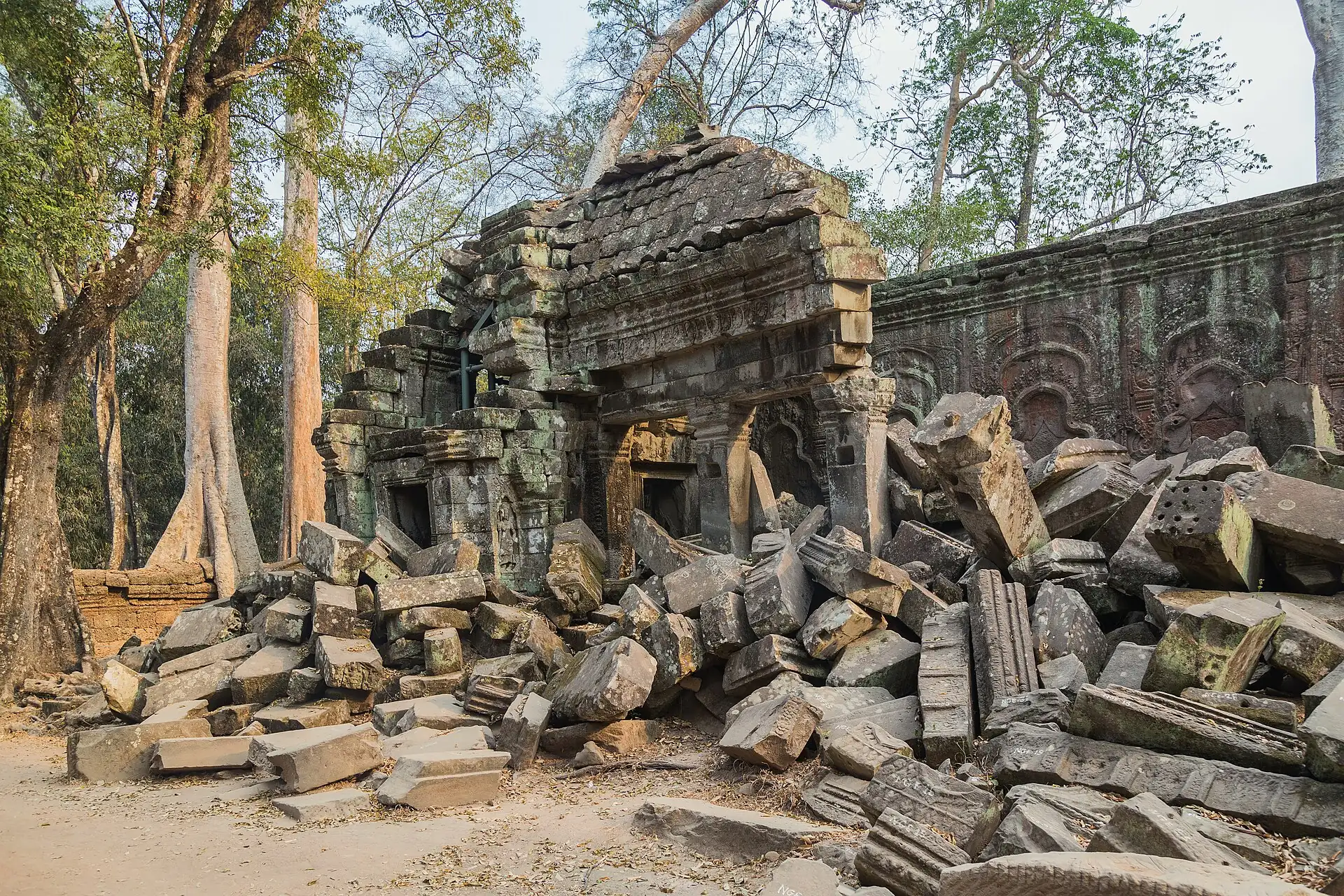 Ta Prohm · 1–1.5 h
- 4
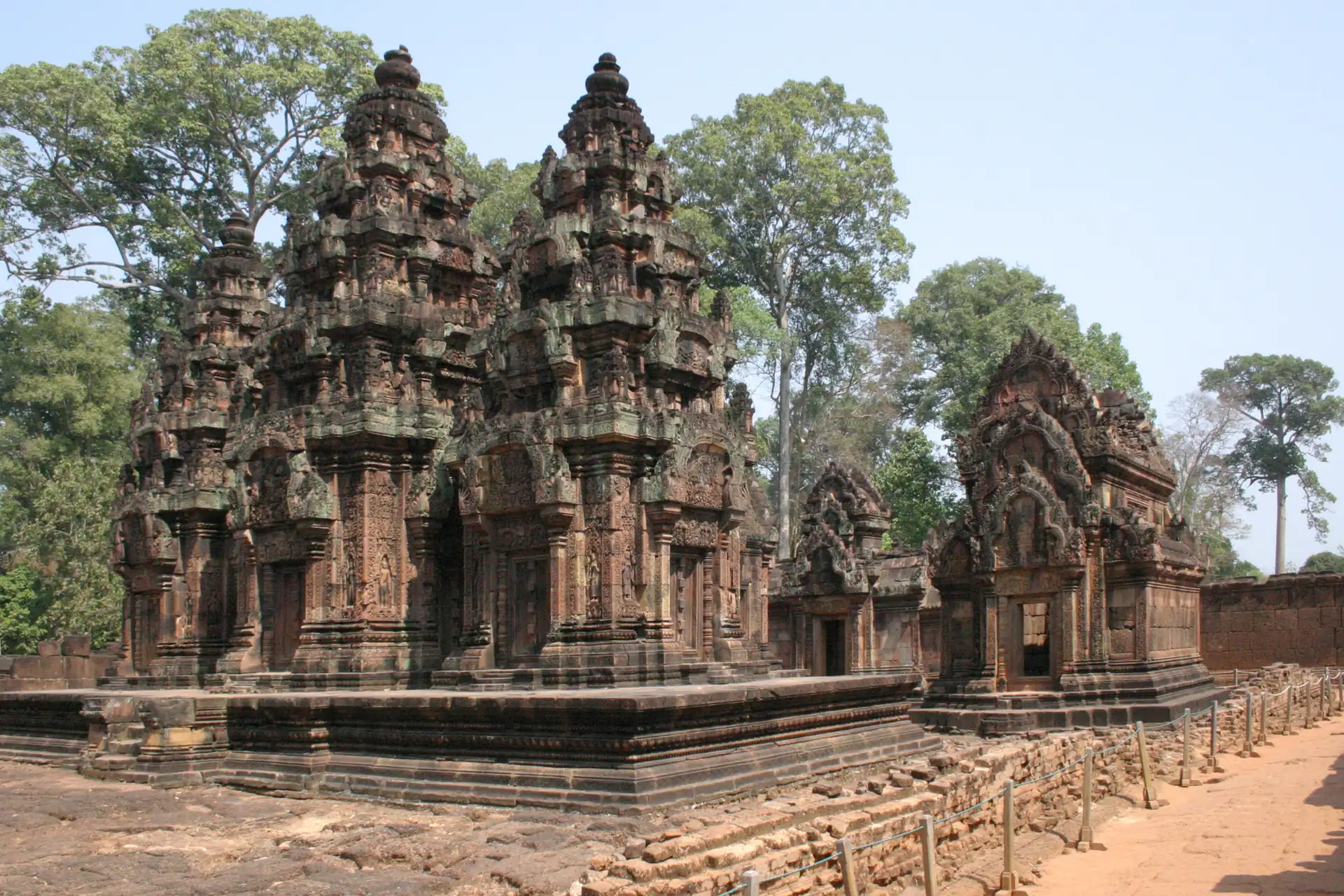 Banteay Srei · 1–1.5 h plus the drive
- 5
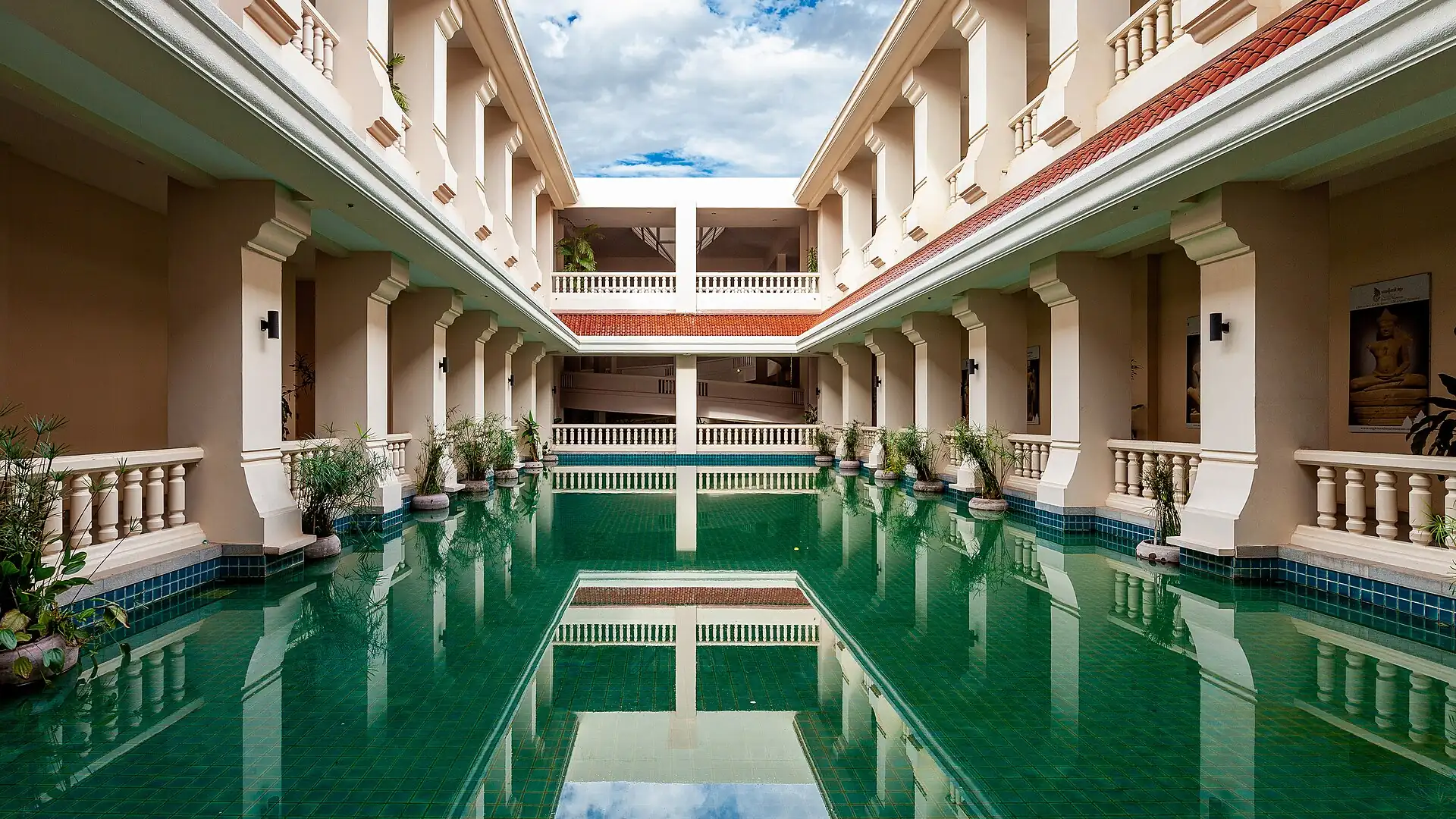 Angkor National Museum · 1.5 h
Fits
- Temple travellers
- Early risers
- Short breaks with a pool break at noon
Does not fit
- Strollers and wheelchairs (steps at temples)
- Midday walkers in Mar–May
- Travellers who dislike hot, dusty roads
How long
- 2 daysAngkor Wat at sunrise, Bayon and Angkor Thom the next morning
- 3 daysFour clusters, mornings and late afternoons only
- 4 daysFour clusters + one farther temple by car + one slow day
Good for
- First timers
- Foodies
- Budget
- Couples
- Families
- Luxury
About Siem Reap
Siem Reap is a market town that grew up beside the largest religious monument in the world. Angkor was the capital region of the Khmer Empire from the 9th century, when Jayavarman II was consecrated god-king at Phnom Kulen in 802, to the 15th century. Suryavarman II built Angkor Wat in the early 12th century as a temple to Vishnu; Jayavarman VII rebuilt the capital as Angkor Thom in the late 12th century and put the giant faces of the Bayon at its centre.
Good to know
- Angkor is a park of many temples, not one site: Angkor Wat, Angkor Thom (with the Bayon) and Ta Prohm are separate stops, 6–15 km from town.
- The Angkor ticket office, on the road toward the park, sells the Angkor pass and has a tourist police post nearby (check hours). It is the only place to buy the pass.
- The Ministry of Tourism site lists registered guides and operators; hotel desks are the practical source of maps and driver contacts. Compare one written quote before you pay for a tour.
Go deeper 11 min read · 6 chapters
Siem Reap is a small town with a very large neighbour. Angkor was once one of the biggest cities in the pre-industrial world, and its temples, reservoirs and roads still shape how a visit works: the sun, the water and the stone decide the schedule. This deep dive reads the region in layers, so that a sunrise at Angkor Wat, a noodle breakfast and an afternoon at the pool fit together.
1History: the Khmer Empire and Angkor2 min
Angkor was the centre of the Khmer Empire from the early 9th century to the 15th. Tradition dates the start to 802, when Jayavarman II had himself consecrated as a universal ruler on the sacred hill of Phnom Kulen, north-east of today's town. His successors moved the capital around the plain south of the hill, building a temple-mountain for each king and a reservoir beside it. Over six centuries the area became a low-density city of temples, houses of wood, canals and rice fields spread across some 400 square kilometres. Recent laser surveys from the air have shown a network of roads, enclosures and water works far larger than the temples alone suggested, which is why archaeologists now call Angkor a city, not a group of monuments.
Two kings shaped what visitors see. Suryavarman II ruled in the first half of the 12th century and built Angkor Wat as a state temple dedicated to Vishnu. It faces west, unusual for a Khmer temple, and its long galleries carry carved scenes from Hindu epics and from the king's own wars. About sixty years later, after a Cham attack on the capital, Jayavarman VII rebuilt the city as Angkor Thom and made Mahayana Buddhism the state faith. The Bayon, at the centre of the walled city, carries about two hundred stone faces on its towers; Ta Prohm and Preah Khan were built as temples and monasteries in his reign. He also built roads, rest houses and hospitals across the empire, according to inscriptions.
The empire weakened in the 14th and 15th centuries, and the court moved south of the great lake after a Siamese attack around 1431, the traditional date of the end of the Angkor period. Angkor Wat did not empty: monks kept it as a Buddhist temple, and travellers from Asia and Europe described it for centuries. The French naturalist Henri Mouhot brought it to a wide Western audience in 1860, and the École française d'Extrême-Orient spent decades clearing, mapping and restoring the temples. Siem Reap province returned to Cambodia from Siam in 1907. War, then the Khmer Rouge years of 1975–79, cut the region off; Angkor was damaged but not destroyed. UNESCO listed it in 1992, and restoration teams from many countries work in the park today.
- Angkor period
- About 802 to 1431 (traditional dates)
- Angkor Wat
- Early 12th century, Suryavarman II
- Angkor Thom and the Bayon
- Late 12th to early 13th century, Jayavarman VII
- UNESCO listing
- 1992
- Park manager
- The APSARA Authority
2How the town and the park are laid out2 min
Siem Reap is easy to read. The Siem Reap river runs north to south through the town, and the Old Market (Psar Chas) and Pub Street sit on its west bank, a few minutes' walk from most mid-range hotels. South and south-east are guesthouses and Wat Damnak; north are the royal gardens, the Angkor National Museum and the road that heads straight to the temples. The airport is not near: the new Siem Reap–Angkor International Airport, open since October 2023, is about 40 km east, so the last leg of any flight is a 45–75 minute car ride.
The Angkor Archaeological Park begins about 6 km north of the centre. The ticket office sits on the approach road, and every visitor buys the pass there; the pass is checked at the temple gates, so keep it and your ID on you. Angkor Wat is the first big stop at the end of the road. Angkor Thom, the walled city with the Bayon, is a few kilometres beyond it, and Ta Prohm, Preah Khan and other temples lie to the east and north. The tuk-tuk day circuits are named for these loops: the small circuit covers Angkor Wat, Angkor Thom and Ta Prohm, and the grand circuit adds more distant temples.
Further out are Banteay Srei, about 25–35 km north-east, and the mountain of Phnom Kulen and Beng Mealea, each a day trip by car. The great lake, Tonlé Sap, lies south of the town, and its villages are reached by road and boat. In practice this means the geography of a visit is one straight road north, with side trips at each end. Plan around the sun: temples in the first and last hours of the day, town and pool in the middle. Give your driver the temple and the gate you want, agree a return time, and let him wait: the drives, not the walks, are what use up a day.
- Town to Angkor Wat
- About 6–7 km (3.7–4.3 mi), 20–30 minutes by tuk-tukAbout 3.7–4.3 mi (6–7 km), 20–30 minutes by tuk-tuk
- Town to Banteay Srei
- About 25–35 km (16–22 mi), 45–60 minutesAbout 16–22 mi (25–35 km), 45–60 minutes
- Town to the airport (SAI)
- About 40 km (25 mi), 45–75 minutesAbout 25 mi (40 km), 45–75 minutes
- Angkor pass
- Only at the official ticket office; check the current price
3Gods, kings and how to read the carvings2 min
Angkor is a religious landscape, and the buildings make more sense once you know what they were for. A Khmer king built a temple-mountain as a model of Mount Meru, the home of the gods in Hindu and Buddhist cosmology, with a central tower and a moat for the cosmic ocean. Angkor Wat is a Vishnu temple; the Bayon is a Buddhist one, though its shrines also hold older Hindu ideas; Banteay Srei is a Shiva temple. Later, in the 13th and 14th centuries, many Hindu images were defaced and Buddhist ones added, and Theravada Buddhism, the faith of most Cambodians today, became the norm. That is why you can walk past a monk in orange robes at the foot of a Hindu temple.
The carvings are the fastest way in. The bas-reliefs on the outer galleries of Angkor Wat show the Battle of Kurukshetra from the Mahabharata, the army of Suryavarman II, scenes of heaven and hell, and the Churning of the Sea of Milk, in which gods and demons pull a serpent to make an elixir. At the Bayon the reliefs turn to daily life: markets, boats, a cockfight, a crowd around a meal. Banteay Srei is small and carved so deeply that it looks like wood. Look for the female figures, called devatas, standing in the walls at Angkor Wat: their hair, jewellery and faces are all different.
Some habits help. Walk galleries in the direction the carvings run, which at Angkor Wat is counter-clockwise. Stay off carved walls and do not touch the stone; oils from many hands wear it down. A guide with a licence can bring the stories to life in an hour, and it is worth paying for on your first day. Then use the second day to look alone, without a group, at whatever caught your eye. The temples are also places of worship: incense burns, people leave offerings, and some monks and nuns tend small shrines, so speak quietly and cover your shoulders and knees. Ask before photographing any person.
- Angkor Wat
- Vishnu temple, faces west
- The Bayon
- Buddhist state temple of Jayavarman VII
- Banteay Srei
- Shiva temple in red sandstone
- Dress code
- Shoulders and knees covered
4Water, rice and the great lake2 min
Angkor ran on water. The Khmer built great reservoirs, called barays, and a system of canals that stored the monsoon rain and spread it across rice fields. The West Baray, about 8 km long and 2 km wide, still holds water; the moats around each temple were part of the same system. The idea was to secure rice in a climate with a long dry season and a wet one. Some scholars think that a series of droughts and floods in the 14th and 15th centuries, and damage to the water network, helped weaken the city. The debate is still open, but the link between water and power is clear when you see the size of the barays.
South of the town lies Tonlé Sap, the largest freshwater lake in South-East Asia. Its river flows the wrong way for half the year. In the dry season it drains from the lake to the Mekong, and when the Mekong swells in the monsoon, the flow reverses and the lake floods forest and fields, growing several times over in area. That pulse feeds one of the richest freshwater fisheries in the world, and the fish, more than rice, feed most Cambodians. Villages such as Kampong Phluk stand on tall stilts or float, and the trip by boat changes completely between the dry and wet seasons.
The same rhythm shapes a visit. From about November the rains stop and the fields dry out; the temples are cool in the mornings and the dust rises. By March the heat builds, and by May the rains begin again, turning the moats green and the roads to mud in places. In the wet season, mornings are often clear and afternoons stormy, and the flooded forest is at its best in September to November. Ask about water levels before booking a lake trip. For a first visit, remember that the water is why the temples are where they are, and that the land is still farmed: rice fields, sugar palms and water buffalo line the roads outside the park.
- West Baray
- About 8 km (5 mi) by 2 km (1.2 mi)About 5 mi (8 km) by 1.2 mi (2 km)
- Tonlé Sap
- Its river reverses direction each monsoon
- Flooded forest season
- Roughly Sep–Nov; check locally
- Rice
- Grown across the plain; harvest around Nov–Dec
5Food, markets and daily life2 min
Khmer food is milder than Thai food and built on herbs and fermented flavours. The base of many dishes is kroeung, a paste of lemongrass, galangal, turmeric, garlic and kaffir lime, pounded fresh. Fish amok, a coconut-cream fish curry steamed in banana leaf, is the dish most visitors are told to try, and it is good in a sit-down restaurant. Lok lak, stir-fried beef with a lime-pepper dip, is another. Morning brings noodle soup, kuy teav, sold from stalls and shophouses, and grilled pork over rice, bai sach chrouk. Sour soups, green mango salads and fried fish make up the rest of a meal, with rice at the centre.
Where to eat depends on the time. Breakfast is at a noodle stall or a bakery with a baguette, a legacy of the French period. Lunch can be a plate at the Old Market, cheap and quick, before the heat closes in. The mid-afternoon is quiet: many stalls close, and the town rests. Dinner is a sit-down meal in the lanes off Pub Street or a graze among the night market stalls. Prices are low: a local plate is a couple of dollars, a restaurant meal five to ten, and a beer under two. Cards work in better restaurants, often with a small surcharge, while stalls take cash, usually US dollars with riel as change.
Daily life follows the sun. Local people are up before dawn, monks walk the streets collecting alms early, and markets are at their best by 07:00. The heat of the middle of the day is spent in the shade, and the streets fill again in the evening, when families gather at the riverside and in the parks. Most Cambodians are Theravada Buddhists, and pagodas are community centres as well as temples. Be kind and polite: greet with the palms-together sampeah, do not touch a person's head, keep your feet off seats, and avoid raising your voice. Give to a school or a registered charity rather than to children on the street.
- Local plate
- About US$1.50–4
- Restaurant dinner
- About US$5–12
- Currency
- US dollars for prices; riel for change (about ៛4,000 to US$1)
- Greeting
- Sampeah, palms together with a small bow
6The year, the heat and how to time a visit2 min
The calendar has three seasons. The cool dry season, roughly November to February, has clear skies, cooler mornings around 20 °C and afternoons near 30 °C. It is the busiest time, and hotels and drivers are booked up around Christmas and New Year. The hot season, from March to May, brings temperatures above 35 °C at midday and dust in the air. The wet season, from about June to October, is greener, with fewer visitors and cheaper rooms. Rain comes as heavy afternoon storms, and mornings are usually clear; the stone steps are slippery and some roads flood in September and October.
Festivals add another layer. Khmer New Year, on 13 to 16 April, is the biggest holiday: many people go home, shops close for days, and water fights break out in the streets, which is fun if you expect it. Pchum Ben, in September or October, is a fifteen-day festival of ancestors when families take food to pagodas, with a public holiday at the peak. Visak Bochea marks the Buddha's birthday in May, and the Water Festival in November is centred on Phnom Penh, though buses and hotels fill across the country. Independence Day is 9 November. Dates that follow the lunar calendar move each year, so check before you plan a trip around one.
A workable day in any season is the same: leave at first light for the temple, be at breakfast by 08:30, and back at the hotel by 10:30 or 11:00. Spend the hot hours at the pool, in a museum or at a long lunch, then go out again at 15:30 or 16:00 for the low sun and the quieter roads. In the hot months, do not walk the temples from 11:00 to 15:00. In the wet months, keep a poncho in your bag and plan for an indoor stop at 15:00. Drink more water than you think you need, wear a hat and sunscreen, and protect yourself from mosquito bites, which spread dengue by day. A relaxed pace is the best way to see Angkor.
- Dry cool season
- Nov–Feb
- Hot season
- Mar–May; above 35 °C (95 °F) at middayMar–May; above 95 °F (35 °C) at midday
- Wet season
- Roughly Jun–Oct
- Khmer New Year
- 13–16 April
Read, watch, wordsGlossary · Sources
Glossary
| Term | Local | Meaning |
|---|---|---|
| Wat | វត្ត | A Buddhist temple or pagoda compound. |
| Prasat | ប្រាសាទ | A temple tower or a temple; the word is in many temple names. |
| Baray | បារាយណ៍ | A large man-made reservoir. |
| Tuk-tuk | A motorbike with a passenger carriage; the standard way to visit the temples. | |
| Sampeah | សំពះ | The palms-together greeting and sign of respect. |
| Krama | ក្រមា | A checked cotton scarf worn by Cambodians and useful as a sun scarf. |
Read for this deep dive
Background reading only: the text above is written by Voykit, not copied from these pages.
Rules in force · 6Drug trafficking can carry the death penalty in Singapore…
- Southeast Asia ↗Drug trafficking can carry the death penalty in Singapore, Malaysia, Indonesia, Vietnam, Laos, Thailand, Brunei and Myanmar; never carry a bag or parcel for anyone.
- Southeast Asia ↗Carry a passport valid for at least six months from entry with two blank pages; airlines refuse boarding on less.
- Cambodia ↗Apply for the e-visa only on the official government portal; lookalike sites charge extra. Some nationalities can also get a visa on arrival.
- Cambodia ↗Angkor Wat and other active temples enforce a dress code: shoulders and knees covered, or you are turned away at the gate.
- Cambodia ↗US dollars are used for most tourist prices; carry clean, undamaged small notes and some riel for change under one dollar.
- Northwest Cambodia ↗Shoulders and knees covered at every Angkor temple; guards check at the main gates.
Entry rules depend on your passport. Full visa guide
Emergency numbers for Siem Reapopen ▾
- Police117 (check)
- Fire118 (check)
- Ambulance119 (check)
Tap a number to call from your phone. These are the numbers listed in this guide; a row marked check has not been verified.
Planning is the full guide. I'm here keeps what is open and the cheat card.
Right now
Checking the weather…
Working out what is open near you…
What is open nowclock, closures, places open
Now in Siem Reap
Local time in Siem Reap
--:--
Loads in your browser · Asia/Phnom_Penh
This month
Month verdict appears here.
Closed today
See the weekly grid below.
If today is a closure day: Before you set an alarm, book a car for 04:45 and buy the pass at the ticket office the afternoon before: the office sells next-day entry from late afternoon (check the hours) and the sunrise queue is the slow part.
Open every day: Angkor National Museum, Angkor Wat, Banteay Srei, Bayon, Ta Prohm, Wat Damnak.
Weekly closures come from our place pages; public holidays (Khmer New Year, Pchum Ben) close many shops and change bus times.
Open now
The sights and places to eat on our list that are open at this moment, in the city's time, nearest first from where you are staying.
Loads in your browser with the city's local time.
Hours marked (check) are typical, not confirmed. Walking times are straight-line estimates. Open at another time →
Cheat cardthe pocket version
Cheat card
The essentials on one card: save it as an image for your phone, share it, or print it.
Siem Reap
ក្រុងសៀមរាប
- Money
- Keep ៛80,000 (about US$20) in small clean notes; withdraw at bank ATMs in daylight and expect a fee.
- SIM
- An eSIM before you fly, or a Cellcard, Smart or Metfone SIM at the airport or a shop in town (passport needed).
- Ride app
- PassApp · Grab
- Emergency
- 117 (check) police · 118 (check) fire · 119 (check) ambulance (not 911, 999 or 000)
- Plugs
- Sockets A/C/G. US/Canada (A/B): fits · UK/Ireland (G): fits · Australia/NZ (I): adapter. 230 V: US 120 V-only devices (hair dryers) need a converter; most chargers are dual-voltage.
Top 5
- Angkor Wat at sunrise
- The Bayon
- Ta Prohm
- Banteay Srei
- Angkor National Museum
EssentialsQuick answers, what things cost and how to get around
Essentials
Quick answers, what things cost and how to get around
Quick answers
The questions people ask first about Siem Reap, one line each. Tap a card for the full answer.
- Cash or card?US dollars are used for almost every tourist price; riel is used for change under US$1 (about ៛4,000 to the dollar).
- SIM or eSIMAn eSIM before you fly, or a Cellcard, Smart or Metfone SIM at the airport or a shop in town (passport needed).
- Ride-hailing appPassApp · Grab.
- Tap waterDo not drink tap water.
- TippingNot required.
- Plugs & powerSockets A/C/G. US/Canada (A/B): fits · UK/Ireland (G): fits · Australia/NZ (I): adapter. 230 V: US 120 V-only devices (hair dryers) need a converter; most chargers are dual-voltage.
Show all 14 answers
- Safe at night?Take more care after dark in Old Market & Pub Street, Wat Damnak & the river, Angkor Wat and more.
- What to wearCover shoulders and knees; guards at Angkor Wat turn people away.
- RestroomsHotels, cafés and temple stops (small fee at some).
- Emergency numberscheck117 (check) police · 118 (check) fire · 119 (check) ambulance (not 911, 999 or 000)
- Your embassyMost embassies are in Phnom Penh; write your own embassy's 24-hour line below.
- Sundays & holidaysWeekly closures come from our place pages; public holidays (Khmer New Year, Pchum Ben) close many shops and change bus times.
- Rainy-day planWet-season showers are short and heavy: do the temple first thing, then rest or go to the museum in the afternoon.
- Landing lateREP: licensed taxi or hotel car to the door runs all night.
Cost cheat-sheetwhat everyday things cost
Cost cheat-sheet
Typical prices for the everyday things, as ranges. Change the currency right here; the local price stays first.
2026 desk estimate · check
- CoffeeCoffee (café)US$1.50–3
- Sit-down mealSit-down dinner, per person, Old Market areaUS$8–20
- Street or quick mealNoodle soup at a stallUS$1.50–3
- BeerBeer on Pub StreetUS$0.50–2
- Taxi, about 5 km (3 mi)Taxi, about 3 mi (5 km)Tuk-tuk ride across townAgree the fare before you get in.US$2–4
- SIM or eSIM, a weekTourist SIM, about a weekUS$5–12
- Museum or sight ticketTuk-tuk for a day at the small temple circuitUS$15–20
- Budget bedHostel dorm bed, a night, per personKHR 20,000
- Mid-range bedHotel double room, a night, per roomKHR 140,000
- High-end bedHotel double room, a night, per roomKHR 400,000
A day, not counting the bed: Budget KHR 80,000 · Mid KHR 180,000 · High KHR 400,000
Local prices, with USD next to them (rates 2026-09 (approximate); change it in the header). Ranges are desk estimates: check locally. Every price and the budget calculator →
Source: Prices in Siem Reap
Draft
Written from desk research. Not yet compared with the official source.
No official source is recorded for this figure.
Prices are 2026 desk estimates, not yet compared with an official source. Check on the day.
Not checked in the last 12 months (no check date on file).
DecideWho it suits, the trade-offs and when to go
Decide
Who it suits, the trade-offs and when to go
Best months at a glance
The guide's verdict for each month
Jan
Best
31°C (88°F)88°F (31°C)
Feb
Best
33°C (91°F)91°F (33°C)
Mar
Care
34°C (93°F)93°F (34°C)
Apr
Avoid
35°C (95°F)95°F (35°C)
May
Care
34°C (93°F)93°F (34°C)
Jun
Care
32°C (90°F)90°F (32°C)
Jul
Care
31°C (88°F)88°F (31°C)
Aug
Care
31°C (88°F)88°F (31°C)
Sep
Care
31°C (88°F)88°F (31°C)
Oct
Care
30°C (86°F)86°F (30°C)
Nov
Best
30°C (86°F)86°F (30°C)
Dec
Best
30°C (86°F)86°F (30°C)
Best: Nov–Feb. Mixed: Mar, May–Oct. Avoid: Apr. Month by month →
Warmest Apr (35°C (95°F)95°F (35°C)), coolest Jan (20°C (68°F)68°F (20°C) low), wettest Sep (19 rain days), driest Jan (1). Averages, not a forecast.
Siem Reap across the year
Best-looking months for Siem Reap: Jan, Feb, Dec. Rated avoid: Apr.
| Measure | Jan | Feb | Mar | Apr | May | Jun | Jul | Aug | Sep | Oct | Nov | Dec |
|---|---|---|---|---|---|---|---|---|---|---|---|---|
| Weather | Great (good) | Great (good) | Mixed (care) | Avoid (avoid) | Mixed (care) | Mixed (care) | Mixed (care) | Mixed (care) | Mixed (care) | Mixed (care) | Good (good) | Great (good) |
| Crowds | High (care) | High (care) | Medium (ok) | Medium (ok) | Low (good) | Low (good) | Low (good) | Low (good) | Low (good) | Low (good) | Medium (ok) | High (care) |
| Prices | High (care) | High (care) | Medium (ok) | Medium (ok) | Low (good) | Low (good) | Low (good) | Low (good) | Low (good) | Low (good) | Medium (ok) | High (care) |
| Events | 3 events (ok) | 1 event (ok) | None listed (ok) | 1 event (ok) | 1 event (ok) | None listed (ok) | None listed (ok) | None listed (ok) | 1 event (ok) | 1 event (ok) | 3 events (ok) | 2 events (ok) |
Green is good news, amber needs planning, red is a month to avoid; dashed grey with a question mark means our data does not say. Open the year heatmap →
Not checked in the last 12 months (no check date on file).
Source: Months, temperatures and crowds
Draft
Written from desk research. Not yet compared with the official source.
Monthly highs, rain and crowd levels are climate averages and desk estimates for the city, not a forecast.
Understand the cityUnderstand · Districts
Orientation & districts
The town is a grid around the Old Market (Psar Chas) and Pub Street on the west bank of the Siem Reap river, with Wat Damnak and quieter guesthouses to the south-east, the royal gardens and museums to the north, and the Angkor Archaeological Park 6–10 km further north. Everything in town is walkable in the cool hours; the temples are a tuk-tuk ride.
Tell the driver the temple and the gate, not just "Angkor": the park has several entrances and dozens of temples.
Shaded shapes: walking areas (click one). Black pins: sleep areas. Grey dots: places. Round badges: arrivals. Click the map to turn on scroll-wheel zoom.
Hover, tap or tab to an area to see what it is like. Pins are sleep areas; arrows at the edge point to the airport.
Off the map: Siem Reap–Angkor International Airport (SAI) (50–75 min by the usual route).
Not drawn yet (no coordinates in this guide): Sivutha Boulevard & the night market, Airport road & big resorts, Tonlé Sap villages. They are in the neighbourhood cards below.
Where’s what, as a list:
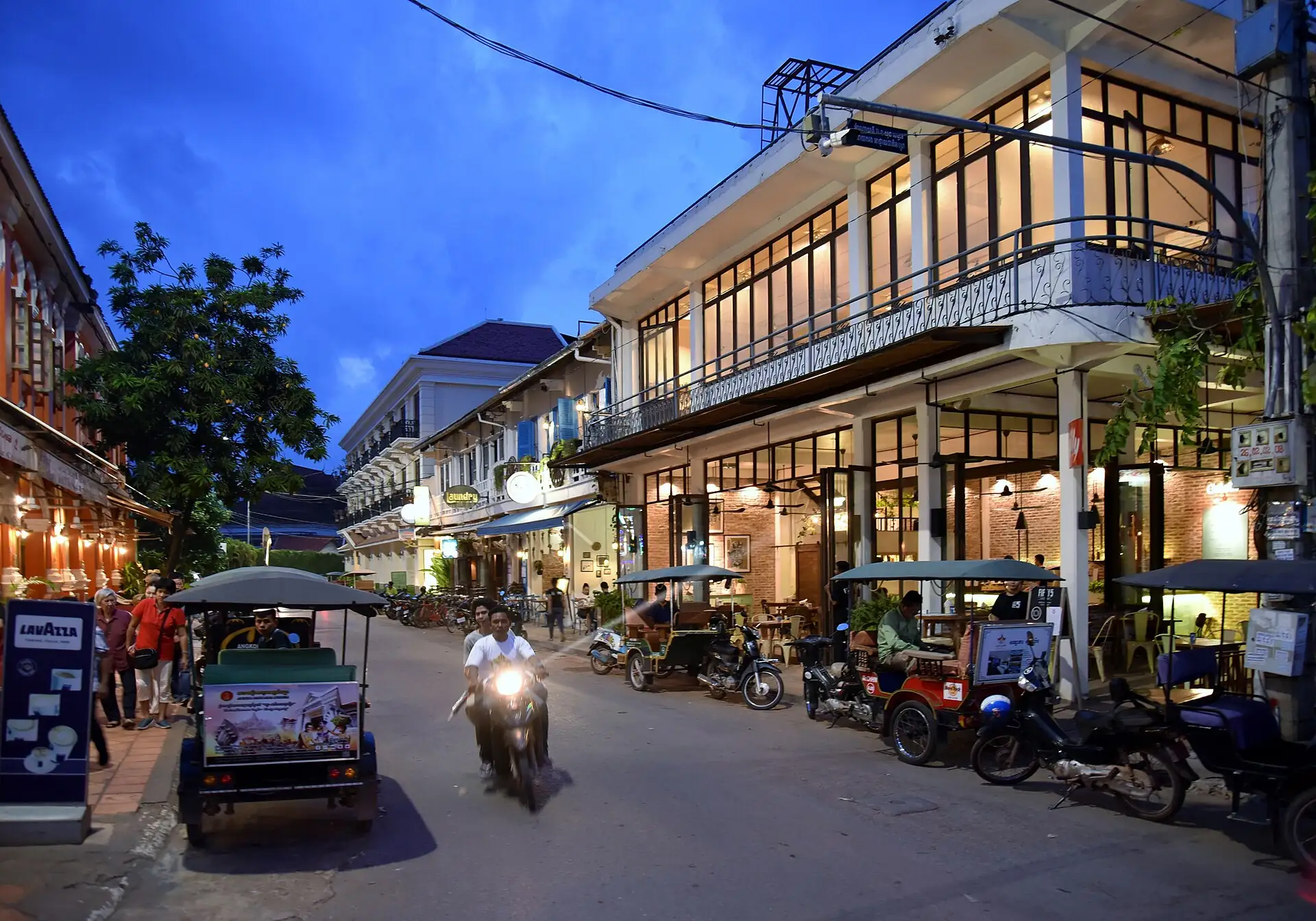
- Old Market & Pub Street: The busiest lanes: market stalls by day, bars and restaurants at night. Choose a hotel on a side lane, not on Pub Street. Suits: First nights, food and evening walks. Price band $$.
- Wat Damnak & the river: A calmer strip of guesthouses and cafés south-east of the market, ten minutes on foot from Pub Street. Suits: Quieter stays and a slower pace. Price band $$$.
- Royal Gardens & museum: The Angkor National Museum, the small shrine of Preah Ang Chek and shaded gardens on the north side of town. Suits: A heat break or rain plan.
- Angkor Wat: The great temple, 6–7 km (3.7–4.3 mi) north of the centre; the first stop for most visitors.The great temple, 3.7–4.3 mi (6–7 km) north of the centre; the first stop for most visitors. Suits: Sunrise, or late afternoon.
- Angkor Thom & Bayon: The walled city with the Bayon and the Baphuon; Ta Prohm and Banteay Srei are separate drives beyond it. Suits: The next morning.
- Sivutha Boulevard & the night market: Long strip of shops, cafés and the night markets; more spread out than Pub Street. Suits: Evening browsing.
- Airport road & big resorts: Large hotels far from the lanes and the market; every meal or outing is a car ride. Suits: Pool-and-transfer stays.
- Tonlé Sap villages: Floating and stilt villages on the lake, 30–50 km (19–31 mi) away; a trip, not a base.Floating and stilt villages on the lake, 19–31 mi (30–50 km) away; a trip, not a base. Suits: A half-day boat trip.
- Sleep area Old Market & Pub Street: suits First nights, food and evening walks, price band $$.
- Sleep area Wat Damnak & the river's east bank: suits Quieter stays and a slower pace, price band $$$.
- Siem Reap–Angkor International Airport (SAI), 50–75 min by the usual route.
Neighbourhoods at a glance
One tab per area, pulled together from this guide’s districts table, area notes, sleep-area scores and place pages. Scores are desk judgements (1–5); prices are estimates, check before you book.
Old Market & Pub Street
$$The busiest lanes: market stalls by day, bars and restaurants at night. Choose a hotel on a side lane, not on Pub Street.
- Suits:
- First nights, food and evening walks
- Best time:
- Early morning and 18:00–24:00Early morning and 6:00 PM–12:00 AM
- Rooms:
- US$8–20 (from the sleep guide)
Pick this if: Food, shopping, nightlife
Watch out for: The market at midday in the heat.
- Quiet nights2/5 Low
- Nightlife5/5 Very high
- Families3/5 Medium
- Late arrival4/5 High
Why these scores
- Quiet nights: Loud on Pub Street until late; a side-lane hotel is far calmer.
- Nightlife: Bars, food and night markets within a few minutes on foot.
- Families: Pools and family restaurants nearby, but lanes are busy and pavements broken.
- Late arrival: Many hotels keep a night desk; confirm for a late transfer from the new airport.
Getting around from here
- 20–28 min walk to Royal Gardens & Angkor National Museum
- Tuk-tuk north: about 22 min to Angkor Wat
Wat Damnak & the river
$$$A calmer strip of guesthouses and cafés south-east of the market, ten minutes on foot from Pub Street.
- Suits:
- Quieter stays and a slower pace
- Best time:
- Early morning and 18:00–24:00Early morning and 6:00 PM–12:00 AM
- Rooms:
- US$25–60 (from the sleep guide)
Pick this if: Food, shopping, nightlife
Watch out for: The market at midday in the heat.
- Quiet nights4/5 High
- Nightlife3/5 Medium
- Families4/5 High
- Late arrival3/5 Medium
Why these scores
- Quiet nights: A calmer strip along the river; the market is a ten-minute walk.
- Nightlife: Pub Street is a short walk or a cheap tuk-tuk ride away.
- Families: Quieter streets and pools help; take a hat and a stroller-free plan.
- Late arrival: Smaller hotels may have limited night staff; message your flight number.
Getting around from here
- 22–30 min walk to Royal Gardens & Angkor National Museum
- Tuk-tuk north: about 22 min to Angkor Wat
Royal Gardens & museum
The Angkor National Museum, the small shrine of Preah Ang Chek and shaded gardens on the north side of town.
- Suits:
- A heat break or rain plan
- Best time:
- Late morning
Pick this if: A midday break, rain plan
Watch out for: Expecting a lot of restaurants nearby.
Getting around from here
- Tuk-tuk south: about 8 min to Old Market & Pub Street
Angkor Wat
The great temple, 6–7 km (3.7–4.3 mi) north of the centre; the first stop for most visitors.The great temple, 3.7–4.3 mi (6–7 km) north of the centre; the first stop for most visitors.
- Suits:
- Sunrise, or late afternoon
- Best time:
- 05:00–09:005:00 AM–9:00 AM
Pick this if: First light and late afternoon
Watch out for: Midday tours and the heat.
Getting around from here
- Tuk-tuk north: about 20 min to Bayon & Angkor Thom
- Tuk-tuk south: about 22 min to Old Market & Pub Street
Angkor Thom & Bayon
The walled city with the Bayon and the Baphuon; Ta Prohm and Banteay Srei are separate drives beyond it.
- Suits:
- The next morning
- Best time:
- Early morning
Pick this if: A morning walk
Watch out for: Trying to see it all in the heat.
Getting around from here
- Tuk-tuk south: about 20 min to Angkor Wat
- Tuk-tuk south: about 28 min to Old Market & Pub Street
Sivutha Boulevard & the night market
Long strip of shops, cafés and the night markets; more spread out than Pub Street.
- Suits:
- Evening browsing
Airport road & big resorts
Large hotels far from the lanes and the market; every meal or outing is a car ride.
- Suits:
- Pool-and-transfer stays
Tonlé Sap villages
Floating and stilt villages on the lake, 30–50 km (19–31 mi) away; a trip, not a base.Floating and stilt villages on the lake, 19–31 mi (30–50 km) away; a trip, not a base.
- Suits:
- A half-day boat trip
Decide
The honest trade-off: what you will enjoy, what will wear you down.
You will like
- Temples at dawn
- Cheap tuk-tuks
- Slow evenings in town
You will hate
- Heat and dust
- Crowds at sunrise
- Long airport transfers
Similar citiesif this one is not quite right
Similar cities
If Siem Reap does not fit your dates or budget, these match it on season, cost and feel.
- Bangkok
Thailand
- Good in the same months: Jan, Feb, Nov, Dec
- Works well for first-timers, tight budgets, couples
- A similar climate through the year
- Bissau
Guinea-Bissau
- Good in the same months: Jan, Feb, Nov, Dec
- A similar climate through the year
- Dhaka
Bangladesh
- Good in the same months: Jan, Feb, Nov, Dec
- A similar climate through the year
When
Best months: Jan, Feb, Nov, Dec. Month-by-month verdicts below, with the live forecast first. When to go, month by month →
Siem Reap: next 7 days
Loading forecast…
Forecast: Open-Meteo (CC BY 4.0), model data for this point.
Air quality
Loading…
Model estimate (CAMS via Open-Meteo), not a street-level station; readings near busy roads run higher.
Month by month, all 12best Jan, Feb, Nov, Dec
Cool, dry; the busiest month.
Dry, warming; good visibility.
Hot; sunrise and late afternoon only.
Hottest month; Khmer New Year closes businesses mid-month.
Hot, humid, first storms.
Rain most afternoons; green and quieter.
Wet season; mornings are usually fine.
Wet; some roads flood.
Heavy rain; Pchum Ben near the end of the month.
Rain easing; Pchum Ben some years.
Dry, comfortable; water festival crowds.
Cool mornings; book ahead.
Climate, calendar and eventsClimate · Calendar · Events · Packing by season
Climate
| Jan | Feb | Mar | Apr | May | Jun | Jul | Aug | Sep | Oct | Nov | Dec | |
|---|---|---|---|---|---|---|---|---|---|---|---|---|
| High | 31°C (88°F)88°F (31°C) | 33°C (91°F)91°F (33°C) | 34°C (93°F)93°F (34°C) | 35°C (95°F)95°F (35°C) | 34°C (93°F)93°F (34°C) | 32°C (90°F)90°F (32°C) | 31°C (88°F)88°F (31°C) | 31°C (88°F)88°F (31°C) | 31°C (88°F)88°F (31°C) | 30°C (86°F)86°F (30°C) | 30°C (86°F)86°F (30°C) | 30°C (86°F)86°F (30°C) |
| Low | 20°C (68°F)68°F (20°C) | 22°C (72°F)72°F (22°C) | 24°C (75°F)75°F (24°C) | 25°C (77°F)77°F (25°C) | 25°C (77°F)77°F (25°C) | 25°C (77°F)77°F (25°C) | 24°C (75°F)75°F (24°C) | 24°C (75°F)75°F (24°C) | 24°C (75°F)75°F (24°C) | 24°C (75°F)75°F (24°C) | 22°C (72°F)72°F (22°C) | 20°C (68°F)68°F (20°C) |
| Rain days | 1 | 2 | 5 | 9 | 15 | 16 | 17 | 18 | 19 | 17 | 8 | 3 |
| Verdict |
- Nov–Feb is the dry, cooler season and the busiest; Mar–May is the hottest and driest stretch before the rains, often above 35 °C (95 °F) at midday.Nov–Feb is the dry, cooler season and the busiest; Mar–May is the hottest and driest stretch before the rains, often above 95 °F (35 °C) at midday.
- The wet season (roughly May–Oct) brings afternoon downpours, greener temples, fewer people and lower prices; mornings are usually fine.
- Heat and humidity are the constant. In every season the temples are for the first two hours after opening and the last two before close.
Events by month
Peak season begins
seasonDec–Jan · Temples citywide
The busiest and most expensive weeks; book hotels and the sunrise driver early.
Khmer New Year
festival13–16 April · Citywide
Public holiday; many shops close and locals travel; water fights on Pub Street.
Visak Bochea
religiousLunar calendar · Pagodas(check dates)
Public holiday; temples busy with worshippers.
Pchum Ben
religiousFifteen days, peak varies · Pagodas citywide(check dates)
Public holiday at the peak; families gather at pagodas; some shops close.
Independence Day
holiday9 November · Citywide
Public holiday; flags and events.
Water Festival (Bon Om Touk)
festivalFull moon of Nov · Mainly Phnom Penh(check dates)
Buses and hotels fill in town; public holiday.
Angkor half marathon (check dates)
sportEarly Dec · Angkor park(check dates)
Some roads close for a morning.
Festivals and events that change the plan
| When | What | Effect on your plan |
|---|---|---|
| 13–16 Apr | Khmer New Year (Choul Chnam Thmey) | Many locals leave for the provinces; shops close for days, water fights on Pub Street, and the hottest week of the year. |
| Sep–Oct (moves yearly) | Pchum Ben (Ancestors' Day) | Fifteen days of offerings at pagodas, with a public holiday at the peak; shops and buses are affected for two or three days. |
| Early Nov | Independence Day and the Water Festival | Independence Day is 9 Nov; the Water Festival (Bon Om Touk) is a Phnom Penh event, but town buses and hotels fill. |
| Nov–Dec | Angkor Photo Festival and half marathon (check dates) | Evening screenings and a race through the park; some roads close for a morning. |
| May (moves yearly) | Visak Bochea | Buddha's birthday, a public holiday; temples and pagodas are busy with local worshippers. |
What to pack, by season
From Siem Reap’s own climate table: the coldest, warmest and wettest three months, and what to bring for each.
Coldest months
Nov–Jan
21° to 30°
Light layers; evenings can still feel cool.
Warmest months
Mar–May
25° to 34°
Light, breathable clothes, a sun hat and sunscreen; plan midday indoors and carry water.
Wettest months
Jul–Sep
18 rain days a month
A compact umbrella or rain jacket and shoes that can get wet.
Arrive & moveGetting in, getting around, and your bags
Arrive & move
Getting in, getting around, and your bags
I land at…
Enter your landing time: what still runs from the airport, where you can eat when you get in, and which areas let you check in that late.
Siem Reap–Angkor International Airport (SAI)
Out of the airport about 23:5811:58 PM (01:05 (next day)1:05 AM (next day) if immigration and bags are slow); in town about 00:48 (next day)12:48 AM (next day).
Transport from the airport
- Any hourLicensed taxi or hotel car to the door. Runs all night.
- Last resortOvernight in a hotel with a night desk. If nothing else works.
Places to eat open when you get in
We have no confirmed hours for the places to eat here yet. Plan on a convenience store or your hotel. What is open late →
Where to sleep with a late arrival
- Lets you inOld Market & Pub Street Desk hours not confirmed: message the hotel with your flight number. Many hotels keep a night desk; confirm for a late transfer from the new airport.
- Call aheadWat Damnak & the river's east bank Desk hours not confirmed: message the hotel with your flight number. Smaller hotels may have limited night staff; message your flight number.
Typical times from our airport data, not a timetable: check the last departure on the day. Full airport-to-bed plan for Siem Reap–Angkor International Airport (SAI) →
Arrive
Each gateway has its own airport-to-bed page with timings and the last safe connection.
Getting in, in detailGet in
Get in by rail and road
| Station | Mode | Serves | Where | To the centre |
|---|---|---|---|---|
| Bus terminal and company officesSiem Reap bus stationuse | Bus | Phnom Penh, Battambang, Bangkok via Poipet and other provinces | On the edge of town; buses often stop at company offices (check) | Tuk-tuk 15–30 minBook with a named company at the hotel or on its website; a tuk-tuk is waiting for every bus. |
| Tonlé Sap boat (seasonal)Battambang boatlimited | boat | Battambang in the high-water season (roughly Aug–Dec) | Pier south of town (check) | Car 30–45 min(check) |
| Hotel or operator pick-upsuse | Coach | Temple tours, floating village and airport transfers | Your hotel door | Already thereThe easiest option for early starts and transfers. |
- Long-distance buses run on fixed times but can run late; leave slack before flights.
- For the airport, book a car in advance: SAI is about 40 km (25 mi) from town and there is no cheap public shuttle for most visitors (check).For the airport, book a car in advance: SAI is about 25 mi (40 km) from town and there is no cheap public shuttle for most visitors (check).
Move
The default way around, when a pass pays off, and when the last trains go.
- Default
- Walk inside the town; tuk-tuk or ride-hailing car to the temples and the airport.
- Passes
- No pass. A tuk-tuk for the day is cheaper than several short rides; agree the fare and the route first.
- Last trains
- No rail; ride-hailing runs late but availability drops in heavy rain.desk estimate
- Other modes
- Other modes (Rome2Rio) ↗
Getting around, in detailGet around · Connect
Get around
Walk inside the Old Market area in the cool hours; use a tuk-tuk or an app car for everything else. Temples are 6–20 km (3.7–12 mi) out, so a tuk-tuk driver for the day is usually cheaper than several short rides.Walk inside the Old Market area in the cool hours; use a tuk-tuk or an app car for everything else. Temples are 3.7–12 mi (6–20 km) out, so a tuk-tuk driver for the day is usually cheaper than several short rides.
| Mode | Verdict | Fare | Use it for | What breaks |
|---|---|---|---|---|
| Walking | use | Free | Old Market, Pub Street, the river | Pavements are broken; walk in the cool hours only. |
| Tuk-tuk | use | US$2–4 across town; US$15–20 for a day at the small circuit | Temples, town, evening | Agree the fare and the route first; a day price is better than short rides. |
| Ride-hailing car or tuk-tuk (PassApp, Grab) | use | US$1.50–5 in town | Airport, evening, rain | Fare shown before you ride; availability drops in heavy rain. |
| Car with driver | use | US$35–60 a day (check) | Banteay Srei, Kulen, families, heat | Air-conditioned, the step-free option; book through the hotel. |
| Bicycle | ok | US$2–5 a day | The early-morning Angkor circuit for fit riders | Traffic on the road out is fast; go before 07:00.Traffic on the road out is fast; go before 7:00 AM. |
| Motorbike | caution | US$8–12 a day | Experienced riders only | Tourists are often not covered by insurance; check the licence rules and wear a helmet. |
| Electric scooter (park rental, check) | ok | US$10–20 a day | Small circuit, low speed | Rules vary; confirm you can ride in the park. |
Taxis and ride-hailing
PassApp
app
Local app with fixed fares (check).
Grab
app
Available in Siem Reap; cars and tuk-tuks.
Hotel-booked drivers
booking
Book through the hotel and confirm the price and time.
On foot and car-free hours
| Where | When | Note |
|---|---|---|
| Old Market to the river and Wat Damnak | Early morning or evening | Flat and shady in patches; ten minutes to the river. |
| Along the river path (both banks) | Late afternoon | A pleasant, shaded stretch toward the royal gardens. |
More on getting around
Give the driver the temple name, the gate and a return time; most drivers will wait for you between temples on a day hire. Carry small notes in dollars so you are not stuck without change.
The road north to Angkor is a straight 6–7 km; add 10 minutes on either side around sunrise and closing time.
Connect
| Option | Verdict | What breaks |
|---|---|---|
| Airport counters (Cellcard, Smart, Metfone) | use | Passport needed; easy to pick up on landing; check the price before you pay. |
| Carrier shops in town | use | Same registration, more choice of data plans; cheap. |
| eSIM before you fly | use | Works the moment you land; useful for the app car from SAI. |
PassApp
Tuk-tuks and cars
A local app with a price shown before you ride (check the current app).
Grab
Cars and tuk-tuks
Available in Siem Reap; a fixed fare in the app beats bargaining.
Google Maps
Walking, driver pins
Good in town; confirm temple gates with the driver.
Cash and USD
Everything else
Most street payments are still cash.
- Wi-Fi
- Free and fast in most hotels, cafés and restaurants; slow at the temples.
Luggage
Where big bags are a problem, and how to get rid of them for the day.
Rule
- Lockers
- No public lockers; hotels hold bags after check-out.
- Forwarding
- No forwarding service culture; keep the big bag at the hotel for trips away.
- Dead zone
- Late departures: ask the hotel to hold bags and to arrange a car; the airport is 45–75 minutes away.
Bags, area by area
4 walking areas rated
- Bags forbidden
- Bags painful
Old Market & Pub StreetRoyal Gardens & Angkor National Museum
Lockers, forwarding and the gap between check-out and check-in are covered once, under Luggage.
See & doWalking clusters, day plans and the places worth the time
See & do
Walking clusters, day plans and the places worth the time
Clusters
Plan by cluster: each is a walkable area with a rescue point and a bag rule.
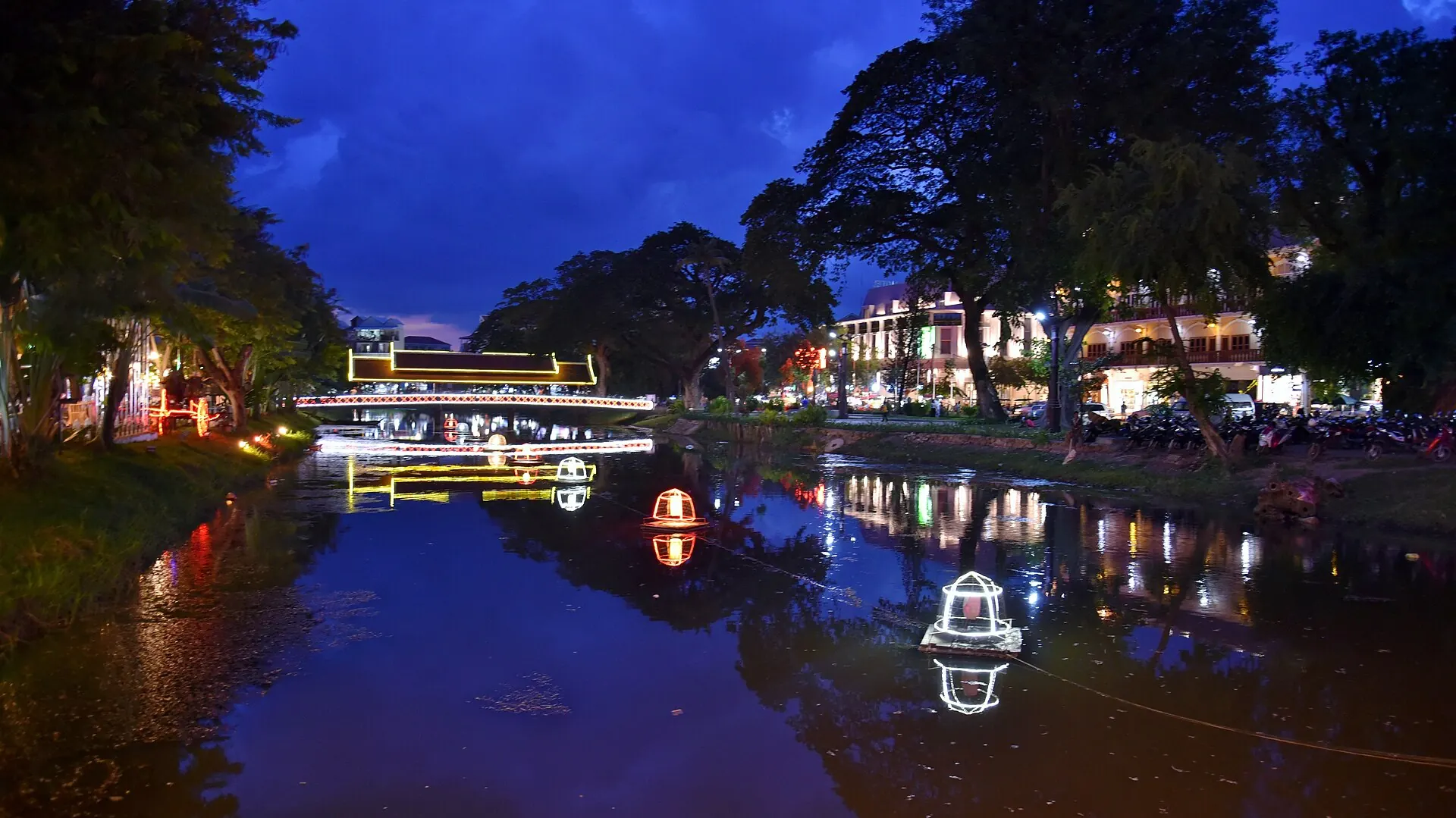
Evening and early-morning cluster: Old Market food and shopping, the Pub Street lanes after 17:00, Wat Damnak in the quiet hour; flat, hot, and full of tuk-tuk touts.
rescue 99% · max p90 6.8′ · half
Late-morning or late-afternoon cluster: the national museum's air conditioning, the shrine of Preah Ang Chek and the shaded royal gardens; a good heat break.
rescue 95% · max p90 7′ · half
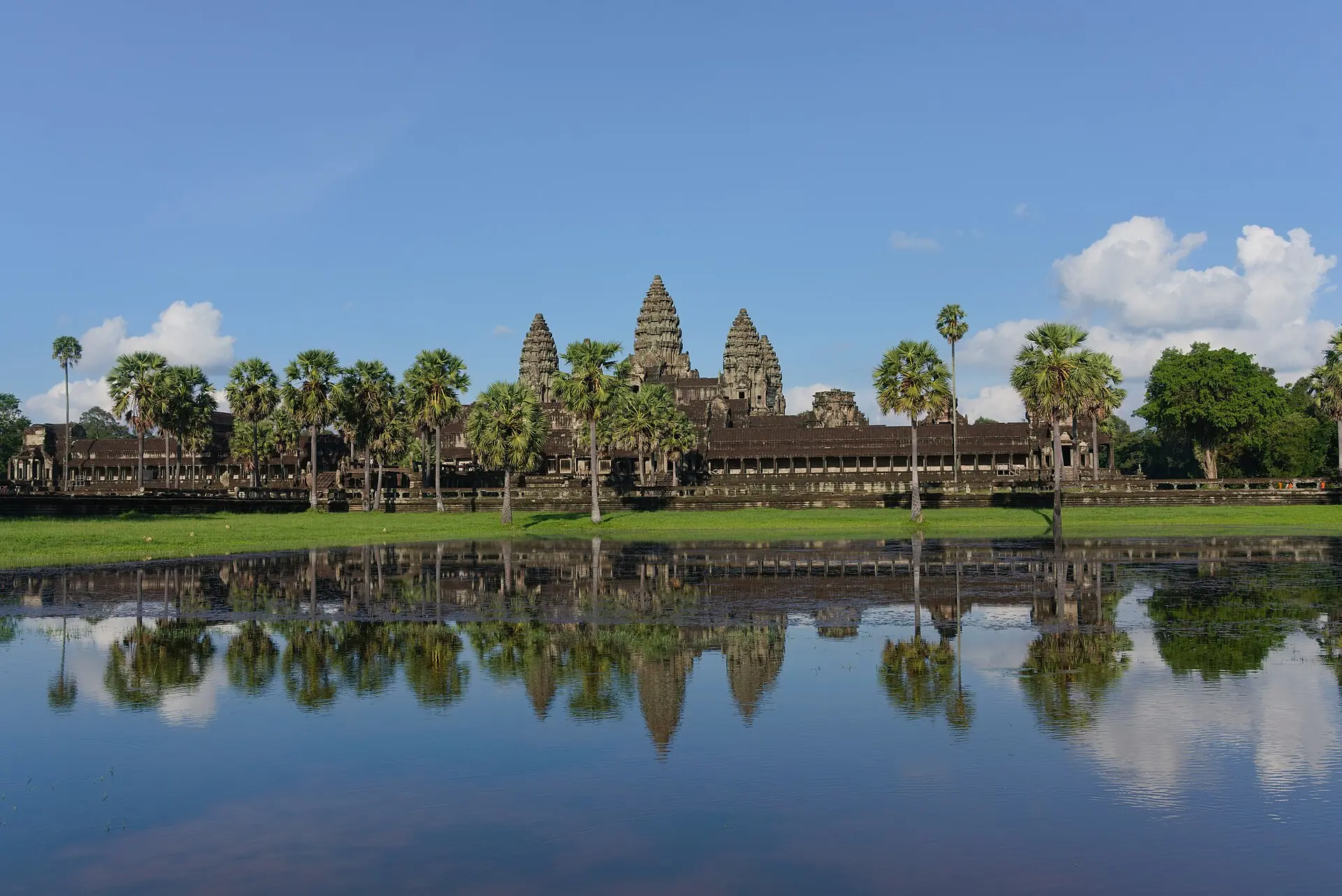
Sunrise-and-done cluster: arrive before first light, walk the west causeway, see the reliefs and the upper level in the cool, and leave before 09:30; shade is scarce and the steps are steep.
rescue 100% · max p90 6.7′ · half
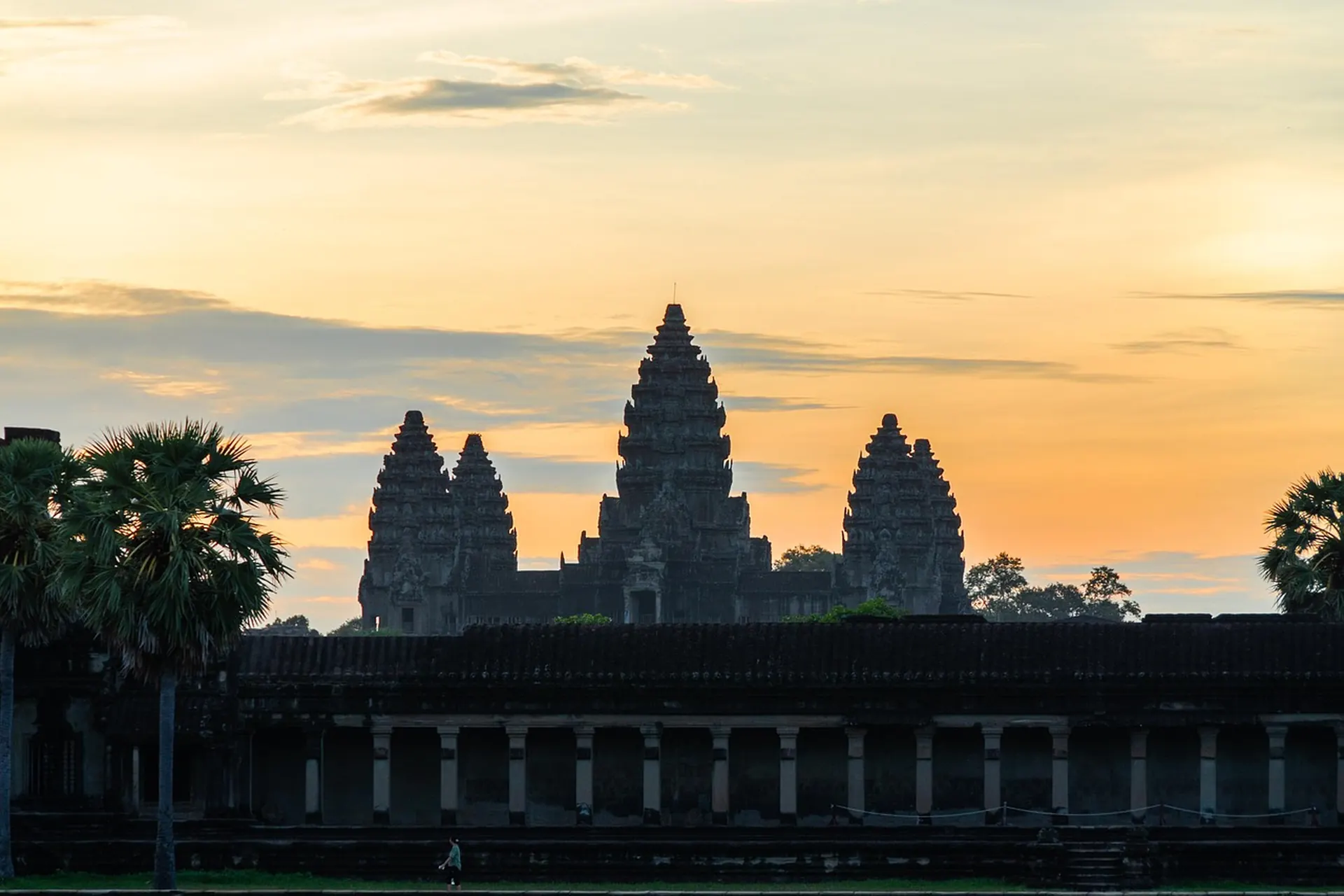
Morning cluster: the Bayon's carved faces in the low light, then the Baphuon and the walled city on foot; go before 09:30 or after 15:30.
rescue 92% · max p90 7′ · half
Days
Ready-made day plans, timed against opening hours and walking distances.
How long are you staying?
Loose outlines in the town's rhythm: temples at first light and late in the day, the pool in the middle.
1 day
A stopover or a short break
- 04:45Angkor Wat — Tuk-tuk or car to Angkor Wat for sunrise
- 08:30Angkor Wat gate noodle stalls — Breakfast at the gate stalls
- 10:00Bayon — The Bayon before the tour groups
- 12:30Old Market food stalls — Old Market lunch, then the hotel pool
- 17:00Wat Damnak — Wat Damnak in the quiet hour
- 19:30Khmer restaurant for fish amok (confirm locally) — Fish amok for dinner
Skip: Ta Prohm, Banteay Srei: they need another morning.
Siem Reap in 3 days
3 daysTemples in the cool hours, the hotel in the middle of the day, the market in the evening; the last day ends with the bags already in the car.
Day by day
Day 1 — Angkor Wat at sunrise, a 12:30 lunch table
- 04:45Angkor Wat
- 12:30Lunch table 12:30 (Old Market)
Day 2 — Bayon and Angkor Thom in the morning
Day 3 — Museum and market, car to the airport at 12:00
- Angkor National Museum
- Wat Damnak (optional)
- Old Market food stalls
- 12:00Car to the airport at 12:00
Places
“Best time” is when to arrive for the fewest crowds, for example “before 08:30”; “Go any time” means the hour makes little difference. More sights follow under “More sights and museums”.
6 places. Filters use the guide’s own ratings; a place with no rating is left out when a filter is on.
Tours, classes and shows in Siem Reap →
Things to do in Siem Reap: shows, nightlife and activities →
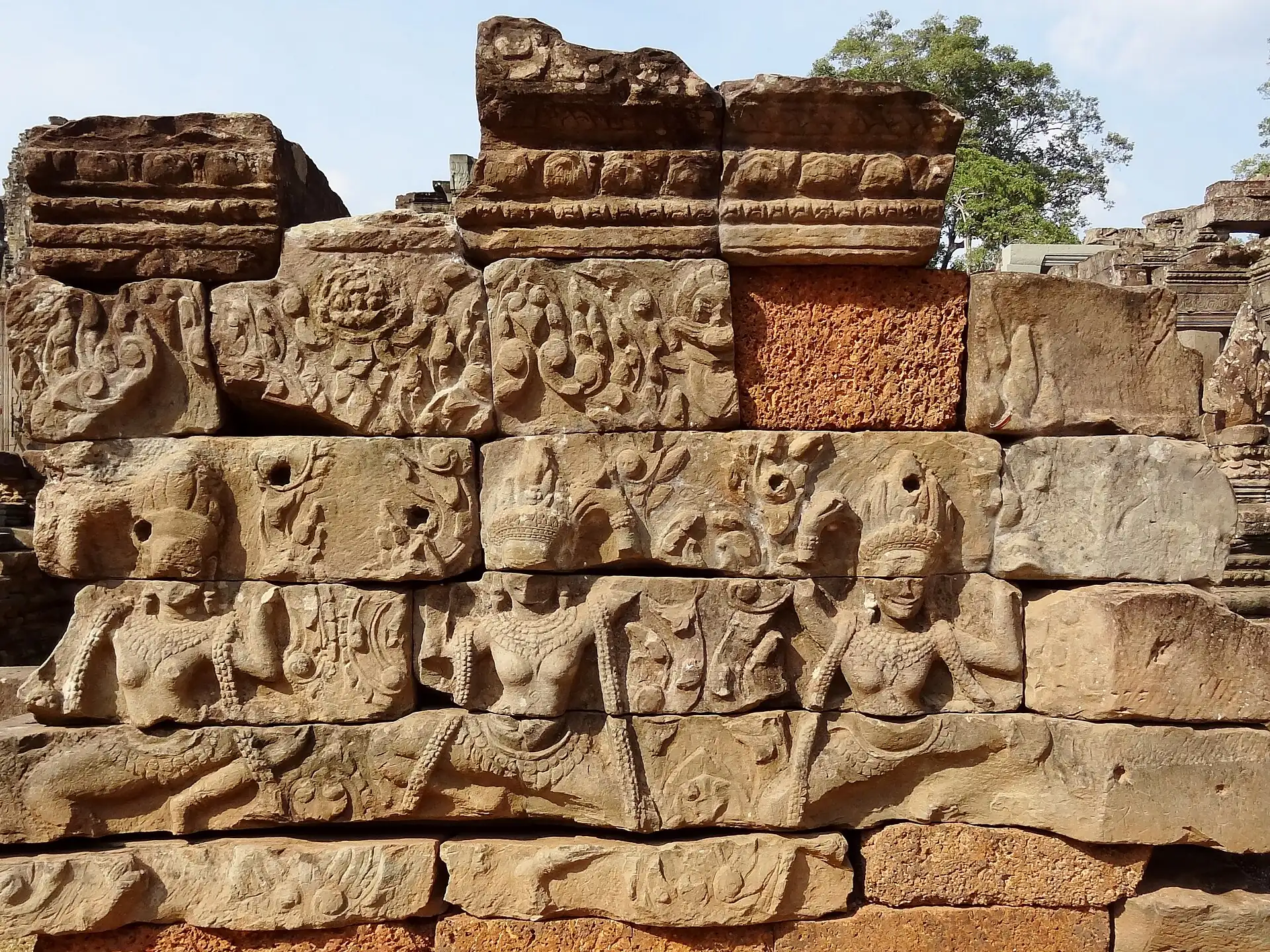
If you do ten things in Siem Reap
Ranked for a first visit of 2–3 days. Prices are 2026 estimates in US dollars.
- 1
The great temple in the cool of the morning, with the towers reflected in the pond.
- Time
- 2–3 h
- Best
- Sunrise
- Cost
- Angkor pass
- 2
A temple of carved faces at the centre of Angkor Thom, best in low light.
- Time
- 1–1.5 h
- Best
- First light or after 15:30
- Cost
- Angkor pass
- 3
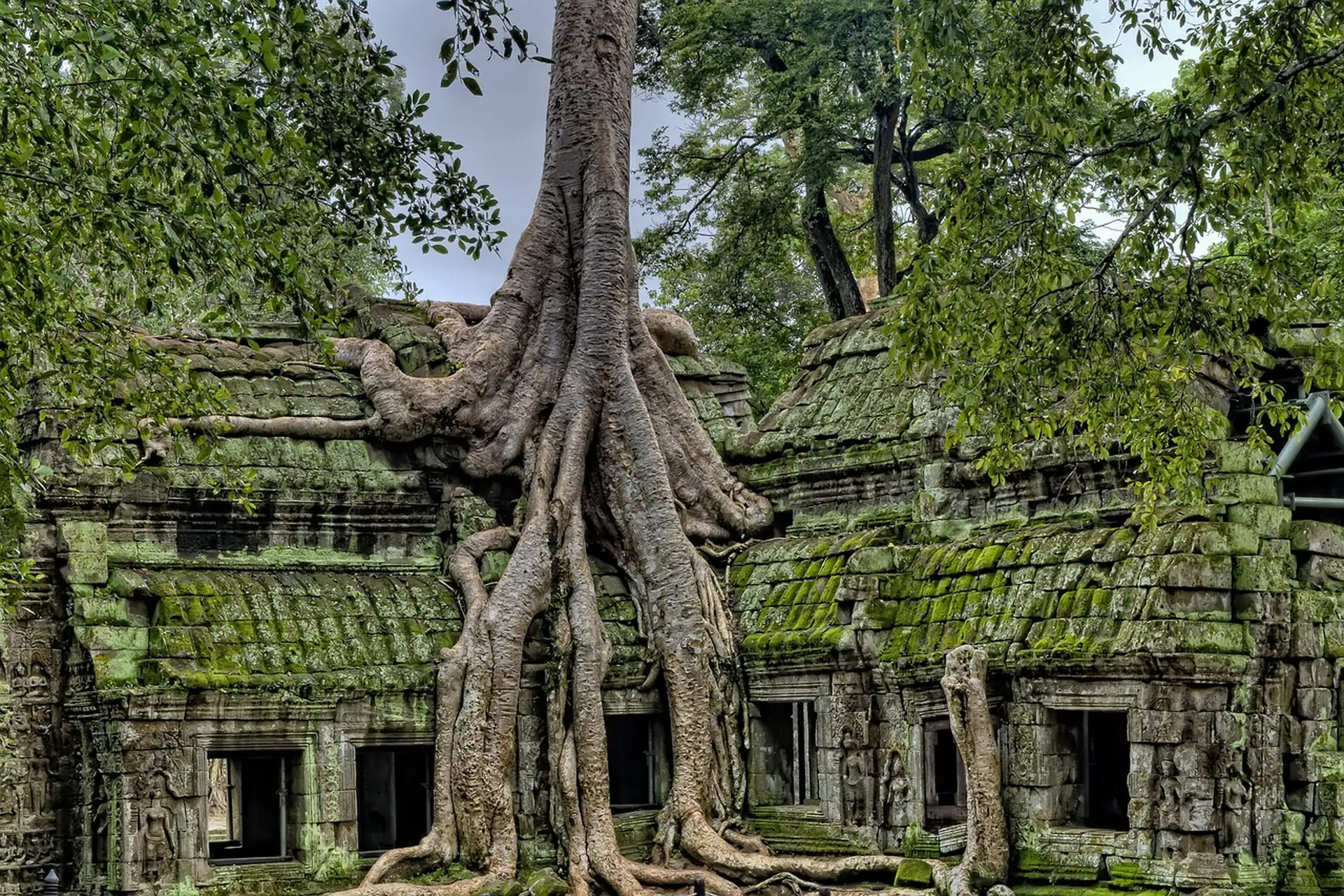
A temple held by tree roots; shady and quiet in the early morning.
- Time
- 1–1.5 h
- Best
- Early morning
- Cost
- Angkor pass
- 4
A small pink-stone temple with fine carving, 25–35 km (16–22 mi) out.A small pink-stone temple with fine carving, 16–22 mi (25–35 km) out.
- Time
- 1–1.5 h plus the drive
- Best
- Morning
- Cost
- Angkor pass
- 5
An air-conditioned hour that explains what you are seeing.
- Time
- 1.5 h
- Best
- Midday heat
- Cost
- US$15–20
- 6
- 7
- 8
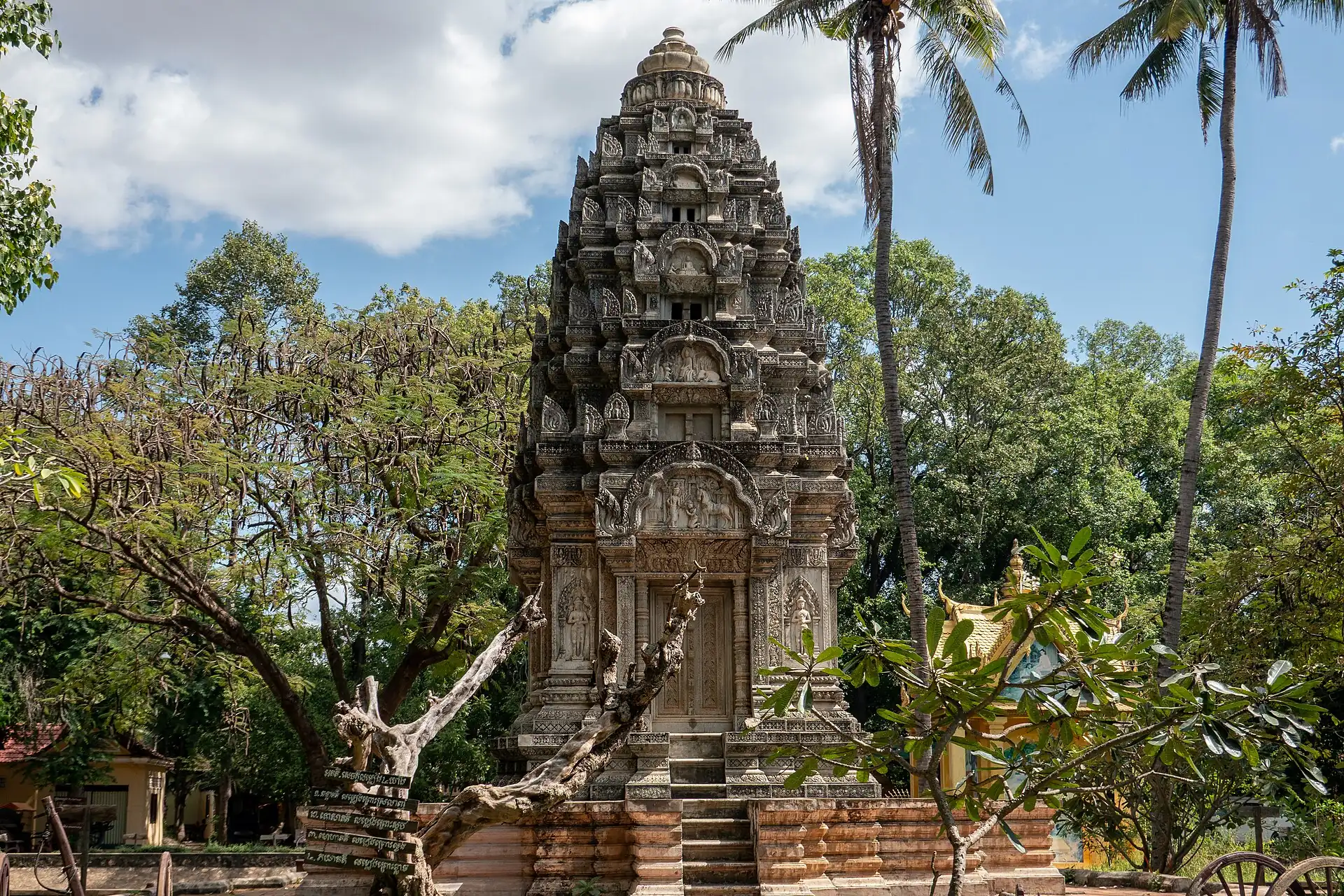
A working pagoda in the cool of the day, close to the centre.
- Time
- 30–45 min
- Best
- Late afternoon
- Cost
- Free (donation)
- 9
Phare, the Cambodian Circus
A evening of acrobatics and music by young performers.
- Time
- 1.5–2 h
- Best
- Evening
- Cost
- US$18–40 (check)
- 10
A Tonlé Sap village boat trip
Stilt houses and flooded forest, best in high-water months.
- Time
- Half day
- Best
- Aug–Dec
- Cost
- US$25–50 (check)
Good for…
Verdict is how well Siem Reap works for that traveller, not how nice it is.
Easy to read and full of things to see, with a clear rhythm: temples early, pool at noon.
- 1Angkor Wat — the reason to come, at sunrise or late afternoon.
- 2Bayon — the faces, the next morning.
Cheap, good Khmer food; the tourist streets lean toward international menus, so look for the local stalls.
- 1Kuy teav breakfast stall — the local breakfast.
- 2Khmer restaurant for fish amok (confirm locally) — the dish to order once.
Dorm beds under US$10, meals under US$3 and beers under US$2.
- 1Old Market food stalls — a filling lunch for a couple of dollars.
- 2Free sights — Wat Damnak, the river path and Preah Ang Chek cost nothing.
- 1Angkor Wat — sunrise together, then a long breakfast.
- 2A river-side boutique hotel — quiet, with a pool and a short ride to the market.
Kids like the temples but the heat and steps are hard; use mornings and a pool afternoon.
- 1Angkor National Museum — a cool indoor hour.
- 2A hotel with a pool — the middle of the day for everyone.
- 1A resort with a private driver — cool rooms and the temples before the crowds.
Steps, stone and broken pavements make most of the temples hard; the museum and outer galleries are the best options.
- 1Angkor National Museum — lifts and level floors.
- 2A car with a driver — the step-free way around.
Tours and classes: book or skip
Book through the hotel or a licensed operator with written inclusions and a cancellation policy. Prices per person, group tour unless stated.
| Tour or class | Verdict | Typical price | Why | Check before paying |
|---|---|---|---|---|
| Tuk-tuk day at the small circuit | book | US$15–20 per tuk-tuk (check) | The simplest way to see Angkor Wat, the Bayon and Ta Prohm with waiting time built in. | The route, sunrise pick-up time and waiting time. |
| Guided temple tour | book | US$25–50 a day for a guide (check) | Explains the carvings and stories; a good guide changes what you see. | A licensed guide with a card, English level and the temple list. |
| Sunrise photography or private car tour | maybe | US$40–100 (check) | Air-conditioned and comfortable; useful for families and heat. | Pick-up time, gate choice and whether the pass is included. |
| Tonlé Sap floating village tour | maybe | US$25–50 (check) | Boat access and a driver in one price; the experience depends on the season. | Whether the fee goes to the village and the season's water level. |
What each season brings
Dry cool
Nov–Feb
Cool mornings and clear light; the peak season.
Watch: Crowds at sunrise and full hotels.
Hot dry
Mar–May
Very hot, the driest and dustiest stretch; quiet temples early.
Watch: Above 35 °C at midday; Khmer New Year closures in April.
Wet
Jun–Oct
Green and quieter, with cheaper rooms; mornings are mostly clear.
Watch: Heavy afternoon rain, slippery steps and some flooded roads in Aug–Oct.
Photo spots and the light
Light times are for clear days; haze in the dry season flattens contrast.
| Spot | Best light | Tip |
|---|---|---|
| Angkor Wat, west causeway and pond | 05:30–06:30 | Arrive before first light for a place at the pond; the towers reflect in still water. Sunrise crowds are heavy. |
| The Bayon faces | First light or 15:30–17:00 | Low, warm light on the stone; go up to the upper terrace for the closest faces. |
| Ta Prohm roots | 07:30–09:00 | Soft light through the trees; people queue at the famous roots, so try the side courtyards. |
| Banteay Srei carvings | 08:00–10:00 | The pink stone glows in morning light; keep behind the barriers. |
Siem Reap travel FAQ
Answers are 2026 desk estimates; fares and rules marked (check) change.
Is Siem Reap safe for visitors?
Generally yes. The common problems are bag snatching from tuk-tuks and motorbikes, drink spiking on Pub Street, and touts; violent crime against visitors is uncommon. Use a driver or an app car after dark.
Do I need a visa?
Most visitors need an e-visa or a visa on arrival; check the current fee and your passport's rules on the official site before you fly.
Which currency should I bring?
US dollars in clean, undamaged notes. Riel is used for change under US$1, at about ៛4,000 to the dollar. ATMs give dollars.
Where do I buy the Angkor pass?
Only at the official ticket office on the road to Angkor. It sells one-, three- and seven-day passes; the price has been rising, so check the current price. Carry it with your ID; it is checked at every temple.
How many days do I need?
Two days covers Angkor Wat and the Bayon; three days adds Ta Prohm and the town; four days adds Banteay Srei or a village trip.
What should I wear at the temples?
Shoulders and knees covered. Guards turn people away at Angkor Wat, the Bayon and Ta Prohm. A light scarf or shirt in your day bag solves it.
Tuk-tuk, taxi or ride-hailing?
Tuk-tuk for temples, an app or hotel car for the airport and rain. Agree the fare and the route before you set off.
Is the tap water safe?
No. Drink bottled or filtered water.
How far is the airport?
The Siem Reap–Angkor International Airport (SAI) is about 40 km (25 mi) east of town, 45–75 minutes by car. Book a hotel car or use the airport taxi counter.The Siem Reap–Angkor International Airport (SAI) is about 25 mi (40 km) east of town, 45–75 minutes by car. Book a hotel car or use the airport taxi counter.
When is the best time to go?
Nov–Feb for cooler mornings, or the wet months for fewer people and green temples; April is the hottest and Khmer New Year closes many shops.
More to see and doSee & do · Learn & work · Rain & heat · Free things
Free things to do
Sights in Siem Reap that cost nothing to enter. Each is described under Places or More sights; extra costs inside are marked there.
See & do
13 of 13
- Temples & pagodas
The great temple, five towers and a mile of carved galleries. Sunrise is the classic and the crowd; the late afternoon is quieter.
Angkor · Daily, about 05:00–17:30 (check)Daily, about 5:00 AM–5:30 PM (check) · Angkor pass
- Temples & pagodas
The temple of about 200 giant stone faces at the centre of the walled city.
Angkor Thom · Daily, day hours (check) · Angkor pass
- Temples & pagodas
A temple left half swallowed by silk-cotton and strangler-fig roots; shady and photogenic.
East of Angkor Thom · Daily, day hours (check) · Angkor pass
- Temples & pagodas
A small 10th-century temple in red sandstone with some of the finest carving in the region.
25–35 km (16–22 mi) north-east16–22 mi (25–35 km) north-east · Daily, day hours (check) · Angkor pass
- Museums
Air-conditioned galleries on Khmer history and the temples; a good first hour to understand what you will see.
Royal Gardens · Daily, day hours (check) · US$15–20
- Temples & pagodas
A working pagoda compound with a quiet courtyard and monks, ten minutes from Pub Street.
Old Market · Daily, day hours (check) · Free (donation)
Preah Ang Chek shrine
ShrinesA small, busy shrine beside the river where locals leave offerings.
Royal Gardens · Free
Phnom Bakheng at sunset
ViewsA hilltop temple with views over the park; crowds are limited by a queue at busy times (check).
Angkor · Angkor pass
Phare, the Cambodian Circus
performanceAcrobatics, music and theatre by graduates of a Battambang arts school; book online before the day.
Old Market area · Evening show (check the schedule) · US$18–40 depending on the seat (check)
Cambodian cooking class
ClassesMarket visit and a set menu of amok, lok lak or a curry; book through your hotel.
Old Market and river · Half day · US$15–30 (check)
Kampong Phluk or another Tonlé Sap village boat trip
boatStilt houses and flooded forest; the trip changes a lot between the dry and wet seasons.
Tonlé Sap, 30–50 km (19–31 mi)Tonlé Sap, 19–31 mi (30–50 km) · Half day · US$25–50 with transport (check)
Countryside bicycle or e-scooter ride
ActiveRice fields, pagodas and village lanes with a guide, away from the tour-bus roads.
Around town · Early morning · US$15–35 (check)
Apsara dance dinner
performanceClassical dance with a buffet; go for the dance, not the food.
Old Market and hotels · Evening · US$12–25 (check)
- Booking
- Circus tickets and cooking classes are best booked a day or two ahead; a tuk-tuk day needs booking only the evening before.
Learn & work
| What | Where | Cost | Note |
|---|---|---|---|
| Khmer language lessons | Language schools in the centre (check) | Around US$10–20 an hour | Short lessons for visitors are available; a few phrases open doors. |
| Cooking classes | Cafés and cooking schools around the river | US$15–30 (check) | A half-day class with a market visit. |
| Traditional crafts and weaving | Workshop-shops (check) | US$10–30 | Half-day workshops in silk, pottery or wood; ask about the maker. |
Working here
- Tourist entry
- Most visitors get an e-visa or a visa on arrival; check the current fee and rules for your passport. A tourist visa does not allow paid work.
- Work permit
- Legal work needs an employer-backed work permit and an extended business visa, with a work card.
- Remote work
- Working remotely for a foreign employer is common in the cafés of Siem Reap; a business visa (the "ordinary" extension) is the usual route for a longer stay, so check the rules.
Rain-day and heat-day plan
Rain day
Wet-season showers are short and heavy: do the temple first thing, then rest or go to the museum in the afternoon. Steps and stone get slippery.
- 01Angkor National Museum — Air-conditioned galleries; allow about 1.5 h.
- 02Wat Damnak — Covered pavilions if the rain is light.
- 03Old Market food stalls — Covered market hall and stalls for lunch.
Heat day
Above 33 °C the temples are for 05:00–09:30 and after 15:30. Between 11:00 and 15:00 use the pool or a café with air-conditioning.
- 05:00Angkor Wat — Sunrise light and the coolest air of the day.
- 09:30 — Breakfast and back to the hotel before the tour buses.
- 12:00Angkor National Museum — Cold air and cheap ticket for a mid-day break.
- 16:00Bayon — Low light on the faces once the heat eases.
Day-trips and nearby
Places you can reach from Siem Reap in a day or with one night away, with the route and what it costs. Door to door, not ride time.
Ta Prohm and the outer Angkor temples
goTuk-tuk or car, 20–40 min
The Bayon, Ta Prohm and Banteay Kdei circuit is the classic small circuit; the Angkor pass covers all of it.
- Time
- Half day
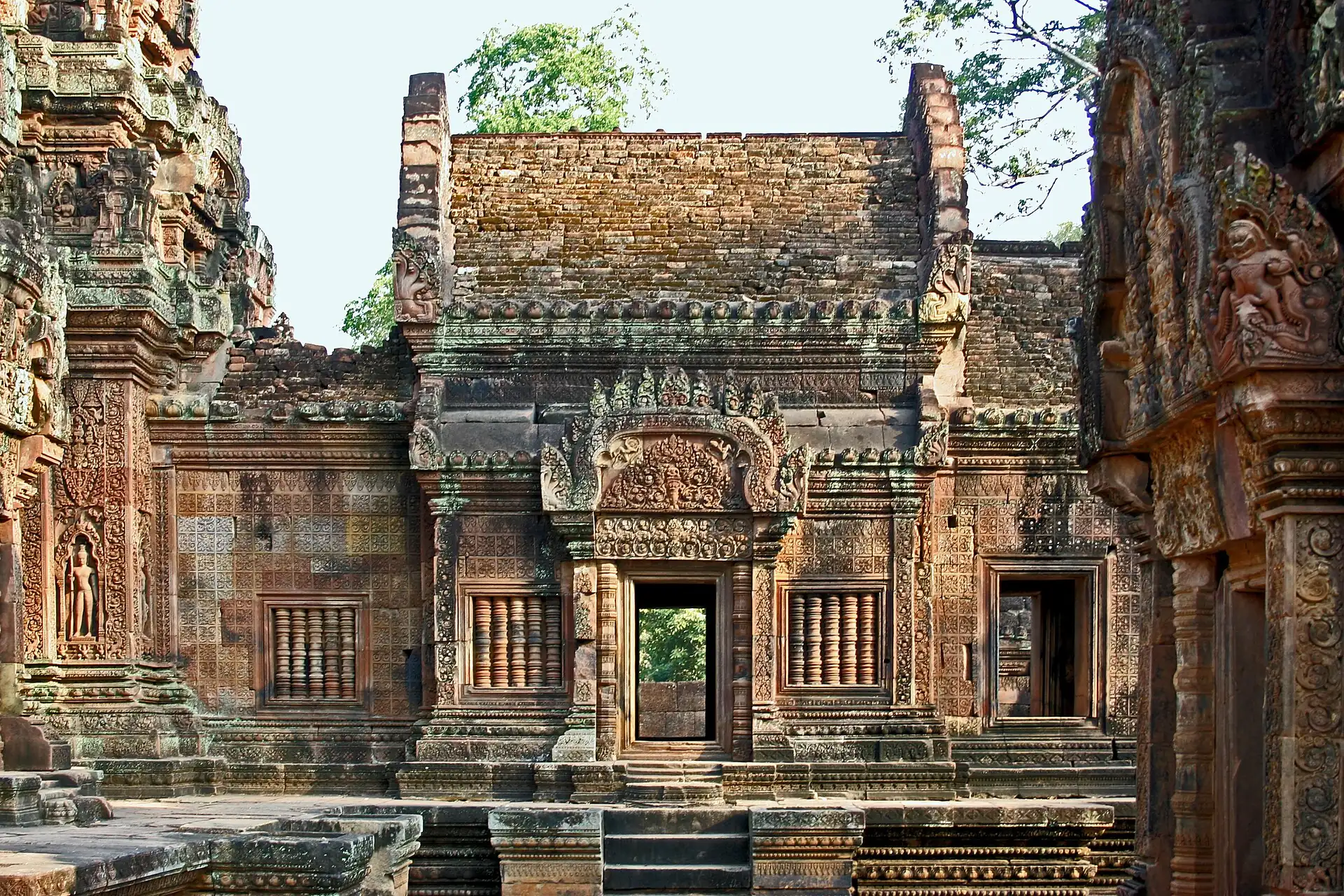 Photo: Gerd Eichmann, CC BY-SA 4.0
Banteay Srei
goTuk-tuk or car about 45–60 min
A small red-sandstone temple with fine carving; pair it with the Cambodia Landmine Museum on the way (check hours).
- Time
- Half day
Kampong Phluk floating village and Tonlé Sap
goCar and boat about 1.5 h
Stilt houses and flooded forest; the water level changes the trip a lot, so ask which season the boat runs in.
- Time
- Half day
Phnom Kulen and Kbal Spean
goCar about 1.5 h
A sacred hill with a waterfall and a carved riverbed; separate entry fees and no Angkor pass cover.
- Time
- Full day
Beng Mealea and Koh Ker
overnightCar 1.5–3 h
Overgrown and far from town; go with a driver who knows the roads.
- Time
- Full day
Go next
Door to door: 3–4 h
Bus about 3–4 h
A quieter colonial-era town with a circus school and bamboo train nearby.
Bangkok
overnightDoor to door: 8–10 h by land; about 1 h by air
Bus and border crossing at Poipet, or a flight
Flying is simpler than the land border; land crossings have queues and touts, so allow a full day.
Kampot and the coast
overnightDoor to door: Long by land
Via Phnom Penh, or a flight to Sihanoukville
Beaches and pepper farms; allow a night in Phnom Penh on the way.
Eat & sleepWhere to eat and which area to sleep in
Eat & sleep
Where to eat and which area to sleep in
Eat
A short list of places worth crossing the city for, each with how to get a seat.
Restaurant finder: filter every place to eat in Siem Reap →
Vegetarian-friendly score
1.5 / 5 · Hard work
- Country diet noteOur country guide rates vegetarian eating as mixed.0.75 / 2
- Places to eat in this guide0 of 5 places with a known answer are vegetarian-friendly, 5 partly.0.75 / 1.5
- Budget eating lines0 vegetarian lines in "Eat by budget".0 / 0.6
- Meat-free national dishes1 meat-free dish in the country food list.0.1 / 0.4
- Dedicated vegetarian kitchens0 mentions of vegetarian restaurants, Buddhist or fasting kitchens.0 / 0.5
Country note: Prahok and fish sauce are in most dishes; tourist towns have vegetarian cafés and many menus mark vegetarian versions.
Vegetarian places near me →Make a diet card →
How we score
- Country diet note (up to 2): easy 2, workable 1, mixed 0.75, hard 0; no note 0.5.
- City places to eat (up to 1.5): 1.5 × (vegetarian-friendly + half of partly friendly) ÷ places with a known answer; needs 3 or more known places.
- Budget eating lines marked vegetarian (up to 0.6): 0.2 each.
- Meat-free national dishes (up to 0.4): 0.1 each.
- Dedicated vegetarian kitchens mentioned — Buddhist chay, shōjin ryōri, Jain, fasting food, vegan cafés (up to 0.5): 0.1 each.
- Total rounded to the nearest half point, 0 to 5. Built from our own pages only, not from reviews.
Eating and drinking guideEat by budget · Drink
Before you sit down to eat
Short version; full text linked
Eat by budget
Under US$3 a meal
| Where | Order | Area | Price | Note |
|---|---|---|---|---|
| Old Market food stalls | Rice or noodle plate | Old Market | US$1.50–3 | Fans, not AC; go before 11:30 or after 14:00.Fans, not AC; go before 11:30 AM or after 2:00 PM. |
| Kuy teav breakfast stall | Kuy teav (pork or beef noodle soup) | Royal Gardens and local lanes | US$1.50–2.50 | The local breakfast. |
| Angkor Wat gate noodle stalls | Noodle soup or rice | Angkor Wat gate | US$2–4 | Convenient; prices are a touch higher inside the park. |
Dishes to know
| Dish | What it is | Where to look | When | Price |
|---|---|---|---|---|
| Fish amok | Steamed fish curry in coconut cream and kroeung paste, served in banana leaf | Khmer restaurants | Lunch, dinner | US$5–8 |
| Lok lak | Stir-fried beef with a lime-pepper dipping sauce, salad and rice | Restaurants and stalls | Lunch, dinner | US$4–7 |
| Kuy teav | Rice-noodle soup with pork or beef, herbs and lime | Local stalls | Breakfast | US$1.50–2.50 |
| Num banh chok | Fresh rice noodles with green fish curry and herbs | Morning market stalls | Breakfast | US$1–2 |
| Bai sach chrouk | Grilled pork over rice with pickles | Street carts | Breakfast | US$1.50–2.50 |
| Samlar machu | Sour soup with fish or pork, pineapple and herbs | Local restaurants | Lunch | US$3–6 |
| Iced Khmer coffee | Strong coffee with sweetened milk over ice | Everywhere | Any time | US$1–2.50 |
| Fresh coconut and fruit shakes | Coconut water, mango and other shakes | Street carts | Daytime | US$1–3 |
- Eat where the turnover is fast and the food is hot and freshly cooked.
- Where prices are not posted, ask before you order.
- Ice in busy cafés is usually made from safe water, but be careful with street ice if you are sensitive.
Drink & nightlife
| Where | What | Until | Note |
|---|---|---|---|
| Pub Street and Alley | Bars, restaurants and street stalls | Late, especially Fri–Sat | Loud, cheap beer and cocktails, a lot of promotions; watch bags and drinks. |
| The Old Market lanes | Cafés and bars | About 23:00About 11:00 PM | A little quieter; good for a coffee or a fruit shake after dark. |
| Riverside cafés and small bars | Cafés, wine and cocktail bars | About 23:00About 11:00 PM | A calmer end to the evening along the river and the side lanes. |
| Rooftop and pool bars | Hotel terraces | About midnight | Higher prices, cooler air; check the dress and the minimum spend. |
By style
| Style | What | Where | Price | Until |
|---|---|---|---|---|
| Draught beer | Local lager, often on promotionCheap; drink water between rounds. | Pub Street | US$0.50–2 | Late |
| Iced coffee and fruit shakes | Sweet iced Khmer coffee, mango and coconut shakesA cold stop when the sun is high. | Cafés and street carts | US$1–3 | Daytime |
| Cocktails | International-style bars | Riverside and hotel bars | US$3–7 | About midnight |
Rules that bite
- Pay as you go and watch your glass; spiked or watered drinks are rare but not unknown near the busy end of Pub Street.
- Agree the tuk-tuk fare home before you climb in, or book an app car.
- Do not buy drinks for people who approach you on the street.
Sleep
Pick the area first: it decides your walk home at night and your first morning.
Which neighborhood fits you
Three questions, one recommendation, with the reasons.
Your best fit
- The widest choice of cheap rooms and dorm beds.
- Many hotels keep a night desk; confirm for a late transfer from the new airport.
Watch out: Loud on Pub Street until late; a side-lane hotel is far calmer.
Next best: Wat Damnak & the river's east bank
Built from our 1–5 desk scores per area; your answers stay in this browser.
More on sleepingSleep by budget · Your area · With kids
Sleep by budget
| Band | Price | Where | Room types | What to expect |
|---|---|---|---|---|
| budget | US$8–20 | Old Market side lanes | Hostels, dorm beds and guesthouses | Fan or AC, hot showers, a small breakfast. |
| mid | US$25–60 | River and Wat Damnak | Boutique hotels and guesthouses with a pool | AC, breakfast, a pool, and tuk-tuk booking. |
| splurge | US$100–300+ | Riverside and airport-road resorts | Resort hotels and villas | A large pool, spa, private drivers and quiet grounds. |
Booking checks
- Choose a hotel with a pool: the middle of the day is for the hotel, not for the temples.
- Confirm a driver for the 04:45 sunrise start and the airport, and ask for a late-arrival plan if you land at SAI in the evening.Confirm a driver for the 4:45 AM sunrise start and the airport, and ask for a late-arrival plan if you land at SAI in the evening.
- The hotel registers your passport details; it may photocopy it but should return the original.
Which area is yours
| If you are | Sleep in | Because |
|---|---|---|
| First visit, 2–3 nights, want everything close | Old Market & Pub Street | Food, tuk-tuks and the market at the door; pick a side lane. |
| Quieter base, families, slow evenings | Wat Damnak & the river's east bank | Calmer streets and pools, still close to the centre. |
| Budget backpacker | Old Market & Pub Street | The most dorm beds and the cheapest food. |
First-timers: restaurants and tuk-tuks at the door, but pick a hotel on a side lane, not on Pub Street, and ask about a late arrival from the far airport.
Quieter nights a 10-minute walk from Old Market: shade, small hotels and cafés, and a car ride for the temple mornings.
Areas are in our default order until you tick a priority.
Scores are 1–5 desk judgements per priority (2026).
With kids
- Temples are step-heavy and hot: a carrier works better than a stroller, and mornings suit children best.
- Angkor Wat and Ta Prohm work well for children who like climbing over roots and looking for carvings; the top level of Angkor Wat has age limits and closes at times (check).
- Pools are the midday plan; most hotels have one, and the Angkor National Museum is a cool indoor hour.
- Car seats are rare in tuk-tuks and taxis; bring a travel booster or ask the hotel for a car with one.
PracticalMoney, essentials, safety and the pocket card
Practical
Money, essentials, safety and the pocket card
Money
What a day costs at three comfort levels, and how to pay.
- Budget
- ៛60,000–120,000 excl. bed (about US$15–30) / day
- Mid
- ៛120,000–300,000 excl. bed (about US$30–75) / day
- High
- ៛300,000+ excl. bed (about US$75+) / day
- Transit card
- No transit card: tuk-tuk, ride-hailing car or walking.
- Cash rule
- Keep ៛80,000 (about US$20) in small clean notes; withdraw at bank ATMs in daylight and expect a fee.
More on moneyCosts · Budget · Buy
What things cost
- Fish amok or a Khmer curry in a restaurant, per dishUS$4–8
- Bottle of water, shopUS$0.30–0.60
- Tuk-tuk across townUS$2–4
- Tuk-tuk for a day at the main temples (small circuit)US$15–20
- Car and driver from the airport to townUS$25–35
- Angkor pass, 1 dayUS$37 or more; the price has been rising, check the official price
Trip budget
| Hotel double room1 × 3 nights × KHR 140,000 | KHR 420,000 |
| Food, local transport, entries2 × 3 days × KHR 180,000 | KHR 1,080,000 |
| Airport car, both ways1 × KHR 260,000 · one car per 4 people | KHR 260,000 |
| Angkor pass, 3 days (price changes, check)2 × KHR 250,000 | KHR 500,000 |
| Tourist SIM, about a week2 × KHR 28,000 | KHR 56,000 |
| Buffer 15%Price creep, a taxi you did not plan, one splurge | KHR 347,400 |
| Trip total≈ KHR 443,900 per person per day, bed included | KHR 2,663,400 |
2026 estimate in riel (about ៛4,000 = US$1); flights, visas and the Angkor pass excluded. Your choices stay in this browser.
Buy
- Bargaining
- At markets and with tuk-tuk drivers, bargain with a smile: counter at about half the first price, settle around 60–70%, and walk on politely if it does not move. Do not bargain in shops with printed tags or at restaurants.
- Fixed-price check
- Check a fixed-price shop or a supermarket for water, sunscreen and snacks before buying the same item at a temple stall; that is your ceiling.
Markets and shopping streets
| Where | What | When | Haggle | Note |
|---|---|---|---|---|
| Old Market (Psar Chas) | Silk scarves, spices, produce, souvenirs, food stalls | Early morning to evening | hard | The most visited market; first prices to visitors are high. |
| Night markets (Sivutha Boulevard area) | T-shirts, crafts, snacks, small souvenirs | From about 17:00 to lateFrom about 5:00 PM to late | hard | Cooler for browsing; stalls repeat each other. |
| Phsar Leu (local produce market, check location) | Vegetables, fish, meat, household goods | Early morning | light | A working market; go early and look, not for gifts. |
| Supermarkets and convenience stores | Water, sunscreen, snacks, repellent | About 08:00–22:00About 8:00 AM–10:00 PM | no | Fixed prices and air-conditioning. |
Shops by what they sell
| For | Where | Hours | Note |
|---|---|---|---|
| Silk, weaving and handicrafts from workshop-shops | Around the river and the centre (check the workshop) | Shop hours | Some workshops train and employ local artisans and are open for tours; ask to see the workshop, not only the shop. |
| Krama (checked cotton scarf) and cotton clothes | Old Market and the night markets | Shop hours | A krama is a useful, cheap souvenir that also works as a sun scarf at the temples. |
| Pepper, palm sugar and spice blends | Old Market spice stalls | Shop hours | Vacuum-packed pepper and palm sugar travel well; check the origin on the pack. |
Changing money
| Where | Verdict | Why |
|---|---|---|
| Bank branches | use | Fair rate for US dollars to riel and back; passport needed for some services; office hours. |
| Hotel front desk | ok | Convenient for small amounts, weaker rate. |
| Licensed exchange counters in the centre | ok | Often fine for small sums: count the notes before you leave. |
| Street money-changers | avoid | Short-changing risk; not a good idea. |
ATMs
- Dispenses
- Most ATMs give US dollars, some riel; the screen shows the choice.
- Fees
- Expect a fee of about US$4–5 per withdrawal plus your own bank's charge; take larger amounts less often.
- Where
- Bank ATMs in daylight, in a bank lobby or mall, not on a dark street.
- Conversion
- If an ATM or card terminal offers to charge in your home currency, decline and pay in US dollars.
Essentials and accessEssentials · Access
Essentials
- Tipping
- Not required. US$1–2 for a good guide or driver, a dollar or two at a restaurant if service was good; rounding up is normal.
- Plugs & power
- 230 V; plug types A, C and G all appear. Carry a universal adapter.
- Drinking water
- Do not drink tap water. Bottled water is cheap; hotels and cafés often offer filtered water.
- Opening hours
- Temples open around 05:00 and close about 17:30. Shops and markets run from early morning to about 22:00; Pub Street is busiest 18:00–01:00. Museums often close for a weekly day; check each one.Temples open around 5:00 AM and close about 5:30 PM. Shops and markets run from early morning to about 10:00 PM; Pub Street is busiest 6:00 PM–1:00 AM. Museums often close for a weekly day; check each one.
- Health
- Heat and dehydration, dengue (bites by day) and traffic. Wear repellent, drink plenty, and have travel insurance with medical cover. A clinic visit and a private hospital exist in town; see the cope section.
- Accessibility
- Steps and uneven stone at every temple; town pavements are patchy and often used for parking. A car with a driver is the step-free choice.
- Laundry
- Laundries in every backpacker lane charge by the kilo, usually same day; hotels charge by the item.
- Emergency numbers
- 117 police, 118 fire, 119 ambulance (draft figures; check with your hotel). Tourist police also operate at the Angkor ticket area.
Pack
- Light, loose clothes that cover shoulders and knees for the temples
- A scarf or thin shirt, a hat and sunscreen
- Closed shoes or sandals with grip for stone steps
- A rain jacket or poncho for the wet season (May–Oct)
- Repellent and a refillable bottle
Accessibility
Siem Reap is hard going on wheels. Temples are stone with steep steps and no ramps, town pavements are broken or used for parking, and heat limits how long anyone can stay out. Book a car with a driver and choose the outer galleries.
- Pavements
- Broken, high kerbs and parked motorbikes; roads are the practical route.
- Getting around
- A car with a driver is the step-free option; a tuk-tuk needs a step up. Book ahead for a larger vehicle if needed.
- Hotels
- Mid-range and upmarket hotels have lifts and ground-floor rooms; guesthouses often do not.
- Toilets
- Accessible toilets in the museum, larger hotels and malls; rare at the temples.
- Temples
- Angkor Wat has a ramped path to the west gate and a lift-free upper level; the Bayon and Ta Prohm are reachable at ground level only in part (check).
Sights, step-free or not
| Angkor Wat | with help | Level causeway and outer galleries; the central tower has steep steps. |
| Bayon | with help | Upper terraces are stairs; the outer galleries are level. |
| Ta Prohm | with help | Uneven stone and roots; wooden walkways in parts. |
| Angkor National Museum | step-free | Lifts and level floors inside. |
| Wat Damnak | step-free | Paved compound; a few steps to some buildings. |
Survive
Safety basics, the lines not to cross, and practical habits that save the day.
Safety
- Heat: water, hat and an AC stop every 60–90 minutes; do not walk Angkor between 11:00 and 15:00 in the hot season.Heat: water, hat and an AC stop every 60–90 minutes; do not walk Angkor between 11:00 AM and 3:00 PM in the hot season.
- Bag snatching from tuk-tuks and motorbikes: carry the bag on the side away from the road.
- Traffic at night is unlit on the airport road; use a licensed car and wear the seat belt.
- Emergency: 117 police, 118 fire, 119 ambulance (draft figures).
Red lines
- Angkor temples: shoulders and knees covered, no climbing on fenced structures, no touching carvings.
- Monks: women do not touch or hand things directly to monks.
- Do not give money to begging children or visit orphanages.
Practical
- Toilets: cafés and temple stops (small fee at some); carry tissues and small notes.
- Tap water is not for drinking.
- Power: 230 V, plug types A, C and G.
More on staying safeStay safe · Stay healthy · Safety map · Solo & women · Etiquette · Cope · Scams
After dark, by area
4 flagged areas
- Take care
- Take care
- Take care
- Take care
Day = about 07:00–19:00. What to watch in each area, day and night →
Scams and red flags
Walk away if you see these
- Tuk-tuk drivers who say the ticket office is closed or the temple is shut, then offer a shop or a "better" price for the day: the official ticket office is on the road to Angkor and sells the pass to everyone.
- Children or mothers selling postcards and bracelets or asking for milk powder and money: buying and giving keep the trade going. Decline kindly; support a school or a registered charity instead.
- Orphanage visits and "volunteer" tours: many are commercial and harm children. Do not visit them.
- Fake or spiked drinks and hostess bars on Pub Street: check the price of a drink before you order, pay as you go, and watch your glass.
- Bag snatching from a tuk-tuk or motorbike: carry your bag on the side away from the road, and keep phones off the kerb side.
Stay safe
Crossing the road
- 01Traffic is dense with motorbikes and tuk-tuks that do not stop for pedestrians: cross slowly and steadily.
- 02Pavements are used for parking and stalls; walk in the road edge with care.
Hustles specific to this city
| Hustle | Where | The tell | What to do |
|---|---|---|---|
| Closed-ticket-office or closed-temple story | Old Market and roadside | A driver says the office is closed and offers a shop or a better price | Ignore it; the ticket office is open every day (check the hours). |
| Children selling and asking | Temples and lanes | Children with postcards, bracelets or a plea for money | Decline kindly; donate to a registered charity instead. |
| Overpriced gem or silk shop stops | Tuk-tuk drivers' commission stops | A driver detours to a shop | Say no; agree the route first. |
| Bag snatching from vehicles | Pub Street and the main roads | A bag hangs on the road side | Carry the bag in front and on the inside of the tuk-tuk. |
- Police
- Report thefts at the nearest police station and the tourist police; bring your passport and an interpreter (hotel staff can help). Insurers need the written report.
- Night
- The main risks are traffic, theft and drink spiking, not violent crime against visitors; use a tuk-tuk after dark rather than walking dark lanes.
- Landmines
- Stay on marked paths in the countryside and temples off the tourist routes; unexploded ordnance remains in some rural areas.
Stay healthy
- Dengue
- Present year-round; the mosquitoes bite by day. Use repellent, cover up at the temples and in shady spots.
- Heat
- Drink water constantly, wear a hat, take shade and AC breaks, and avoid midday exertion.
- Food and water
- Bottled or filtered water only; eat where the food is hot and busy; wash your hands or use wipes.
- Rabies and animals
- Dogs and monkeys near temples can bite; do not feed or touch them. Ask about a pre-travel rabies vaccine.
- Vaccinations
- Routine vaccines plus hepatitis A and typhoid are usual advice; ask a travel clinic a few weeks before you go.
Hospitals and clinics: see Cope.
Safety by area and hour
| Area | Day | Night | What to watch |
|---|---|---|---|
| Old Market & Pub Street | fine | caution | Bag snatching from passing motorbikes and tuk-tuks; watch your drink. |
| Wat Damnak & the river | fine | caution | Poorly lit lanes at night; take a tuk-tuk rather than walking. |
| Royal Gardens & museum | fine | fine | Quiet and fine by day; traffic is the risk. |
| Angkor Wat | fine | caution | Dark before sunrise: go with your driver and a torch. |
| Angkor Thom & Bayon | fine | caution | Remote after dark; visit in daylight hours only. |
- Carry your bag on the side away from the road and do not let it hang on the tuk-tuk frame.
- Use a tuk-tuk driver arranged through your hotel or an app for early starts and late returns.
Solo, women and LGBTQ+ travellers
Solo
- Comfortable and social: hostels and Pub Street make it easy to find company; use an app car or a hotel-booked driver after dark.
- For sunrise, book the driver the night before and confirm the pick-up time in writing.
Women
- Harassment is uncommon but a firm no works; tuk-tuk and street touts are persistent, not dangerous.
- Cover shoulders and knees at the temples; a scarf helps in the heat and at pagodas.
LGBTQ+
- Same-sex relations are legal in Cambodia and attitudes in the tourist scene are relaxed, though the wider society is conservative and public displays of affection of any kind are best kept low-key.
- Same-sex marriage is not recognised; there are a few friendly bars, but no large scene.
Etiquette in Siem Reap
- Temples and pagodas
- Cover shoulders and knees; guards at Angkor Wat turn people away. Take hats off inside sanctuaries and shoes off before entering a pagoda hall.
- Monks
- Women should not touch monks or hand things directly to them. Do not photograph monks up close without asking.
- The head and feet
- The head is respected and the feet are not: do not touch a person's head, do not point your feet at people or Buddha images, and do not step over people's legs.
- Greeting
- The sampeah (palms together, small bow) is polite; the higher the hands, the more respect. Use it for elders and monks.
- Photos
- Ask before photographing people and never photograph officials or soldiers. Drones need a permit at the park and are usually banned.
- Bargaining
- Do it lightly and kindly; a large argument over a dollar is a loss of face for both sides.
Cope
Hospitals and clinics that handle foreigners
| Where | Area | Use it for |
|---|---|---|
| Royal Angkor International Hospital | Airport road area | Private international hospital with 24 h emergency; ask your insurer about direct billing and confirm the address. |
| Angkor Hospital for Children | Central Siem Reap | A children's hospital that treats local children and travellers' emergencies (check the current admission rules). |
| Clinics in the centre | Old Market area | Small private clinics for coughs, stomach bugs and minor injuries; pay upfront, claim later. |
Visa extensions
- Office
- Siem Reap immigration office near the centre, weekday hours; check the address and hours before going.
- Extending
- Tourist visa extensions are handled by the immigration department or a travel agent for a fee; allow a few working days.
- Overstay
- A daily fine applies; resolve problems before you get to the airport.
Embassies and consulates
| Country | Address | Phone | Note |
|---|---|---|---|
| Most countries | Phnom Penh, about 5–6 h by road or 45 min by air | — | (check) |
- Lost passport
- Police report from the nearest station, then your embassy in Phnom Penh; budget a few working days and a flight or a bus.
- Pharmacies
- Pharmacies in the centre sell many medicines without prescription; check expiry dates and buy a sealed pack.
- Gyms and pools
- Most mid-range hotels have a pool; some sell day passes for US$5–15 (check).
- Co-working
- A few cafés and co-working spaces in the centre sell day passes; good Wi-Fi in many cafés.
- Laundry
- Laundries in the lanes charge by the kilo, usually a few dollars a load.
Apps and offline kitOffline kit
Offline kit
Set up before you leave, so Siem Reap still works with no signal or a dead roaming plan.
On your phone
- Maps: open the city in Google Maps, tap the place name, then Download offline map (or use an offline-maps app).
- Data: install an eSIM or buy a local SIM before the first taxi; the apps in this guide depend on it.
- Translation: download the local language for camera translation.
- Screenshots: booking confirmations, hotel address in the local script, and the emergency numbers.
This guide
Save the Siem Reap guide and its pages on this device; it opens without a connection.
Phrases that do the work
Greeting
Hello
សួស្តី
sua-s-dei
Thanks
Thank you
អរគុណ
aw-koon
Market
How much is this?
នេះថ្លៃប៉ុន្មាន?
nih t-lai pon-man
Food
Not spicy, please
អត់ហិរ
ot het
Tuk-tuk
Stop here, please
ឈប់ទីនេះ
chop tee-nih
Café
The bill, please
គិតលុយ
kit luy
Everyday
Sorry / excuse me
សុំទោស
som toh
Market
Too expensive
ថ្លៃពេក
t-lai pake
Pocket card
Fill in, then print or save as PDF
Stays in this browser only; nothing is sent anywhere.
Siem Reapក្រុងសៀមរាប
Pocket card · Voykit
My bed tonight
—
—
—
សូមនាំខ្ញុំទៅទីនេះPlease take me to this temple gate
Emergency
- Police117 (check)
- Fire118 (check)
- Ambulance119 (check)
Embassy
Most embassies are in Phnom Penh; write your own embassy's 24-hour line below.
My embassy: —
Fare anchors (2026 estimate)
- Airport (SAI) → town, licensed taxi or hotel car: US$25–35, 45–75 minutes
- Tuk-tuk across town: US$2–4
- Tuk-tuk day, small temple circuit: US$15–20
Save your hotel name and address in Khmer, and the temple names, on your phone.
Deep diveHistory, reading, photos and every source
Deep dive
History, reading, photos and every source
Sources
- officialMinistry of Tourism of Cambodia
- officialUNESCO — Angkor
- secondaryWikivoyage — Siem Reap
Ask about Siem Reap
Loading…
Was this useful?