Dhaka
ঢাকা
Code DK · 4 walking zones
Dhaka is a one-cluster-per-outing city: pick the morning, do Old Dhaka or Lalbagh before the traffic builds, go back to the hotel at midday, and leave for the airport with a very wide margin.
Our quick read of Dhaka, scored 1–5 (friction is out of 100). Cash need: how often you still need notes. Heat risk: how hot days get. Stroller: how easy wheels are. Friction: overall effort for a first visit. Desk judgements, so check before relying on them.
- Local time
- --:--
- Weather
- forecast below
- Currency
- BDT
- Best months
- Jan · Feb · Nov · Dec
- Airport
- Hazrat Shahjalal (DAC)
Walking zones: the 4 areas this guide plans a day around. Each is a district you can cover on foot, so you do one zone per half-day and ride the train between them. The code (DK 01, DK 02…) is just the zone's number on the Dhaka line; the line under each name says how bags fare there and how much time it needs.
Map of Dhaka
Use the switches to show or hide each kind of pin. A switch that is on shows its pins on the map; tap it again to hide them. "Show only" keeps just the pins that match (for example, places that fit a suitcase). Tap any pin for its name and a link to its page.
- Where to sleep
- Places
- Eat
- Walking clusters
- Rest stops
From the airport Hazrat Shahjalal (DAC) to your bed
Tap a pin for its card. Places without their own coordinates are shown by their walking cluster.
Why Dhaka
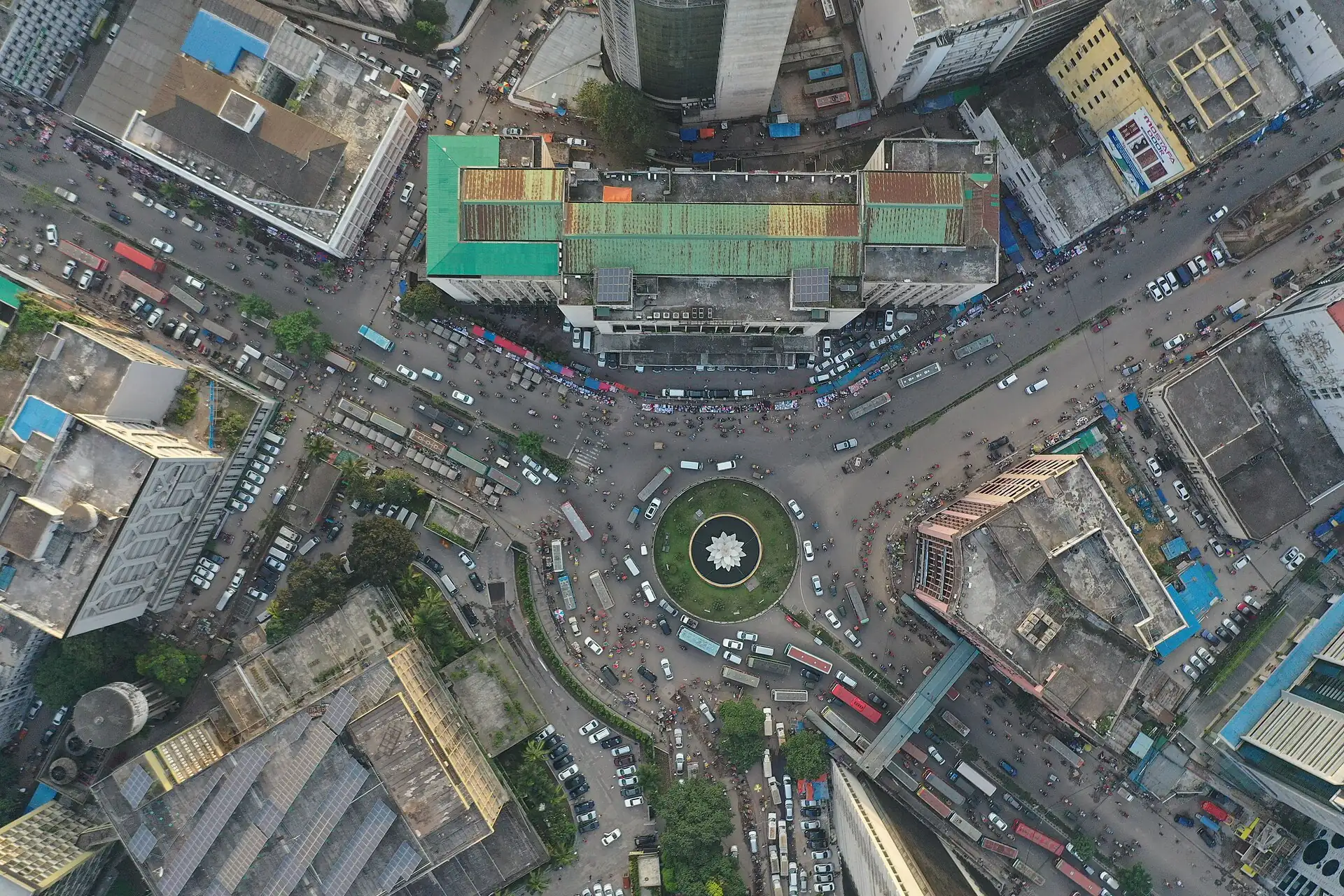
Dhaka is one of the densest cities on earth. Its sights are a few kilometres apart, but a short ride can take an hour or more, pavements are missing or blocked, and the air is poor in winter. The trips that go wrong stack three clusters into a day, drag suitcases through Old Dhaka, or leave for the airport with less than a half-day margin. Four clusters cover a first visit, and Friday mornings, when roads are quietest, suit Old Dhaka and the forts best.
Fits
- Culture-first short trips
- Travellers with a local guide or host
- Early risers
Does not fit
- Strollers and wheelchairs (pavements, rickshaws)
- Travellers who dislike crowds, heat and noise
- Tight connections and day-of-flight sightseeing
How long
- 2 daysOld Dhaka morning + Lalbagh, Gulshan evening
- 3 daysThree or four clusters, one per outing, mornings first
- 5 daysFour clusters + Sonargaon day-trip + one slow day
About Dhaka
Dhaka became a provincial capital of Mughal Bengal about 1610 and was renamed Jahangirnagar for a time; it grew as a river port and textile trading centre on the Buriganga, on the delta of the Ganges, Brahmaputra and Meghna.
The Nawab of Dhaka family, an important merchant and landowning line, built the Ahsan Manzil palace and shaped 19th-century Old Dhaka. After the 1947 partition Dhaka became the capital of East Bengal, later East Pakistan, and in 1952 a language movement here helped set Bengali nationalism in motion.
Bangladesh became independent in 1971 after a nine-month war, and Dhaka is now its capital and biggest city: one of the most densely populated urban areas in the world, with a huge garment industry, more than ten million people in the city and many more in the wider region (estimates vary).
Good to know
- Old Dhaka is the historic river district in the south; Gulshan and Banani are the modern northern districts, 10–15 km away.
- There is no reliably open central tourist office: your hotel desk and a licensed local guide are the practical sources of local information.
- The Bangladesh Parjatan Corporation (national tourism body) runs some information services; hours and staffing vary (check).
Go deeper 13 min read · 6 chapters
Dhaka is a Mughal river capital that became the capital of a country, and its story is told in three layers: the old city on the Buriganga, the university and language-movement quarter around Shahbag, and the new northern districts. This deep dive works through the history, the neighbourhoods, the buildings, the food, the river and traffic, and the memory of 1952 and 1971 that shapes how Bangladeshis see their capital.
1From Mughal capital to national capital2 min
Dhaka's story as a major city starts in the early 17th century. About 1610 the Mughal governor Islam Khan made it the provincial capital of Bengal and the city was, for a time, called Jahangirnagar after the emperor. The choice was practical: the site sat on the Buriganga river, close to the meeting of the delta's great rivers, and could be reached by boat from the rice-growing countryside and the cotton-weaving towns to the east. Under later governors, above all Shaista Khan, the city gained forts, caravanserais, mosques and a reputation for cheap rice and fine cloth.
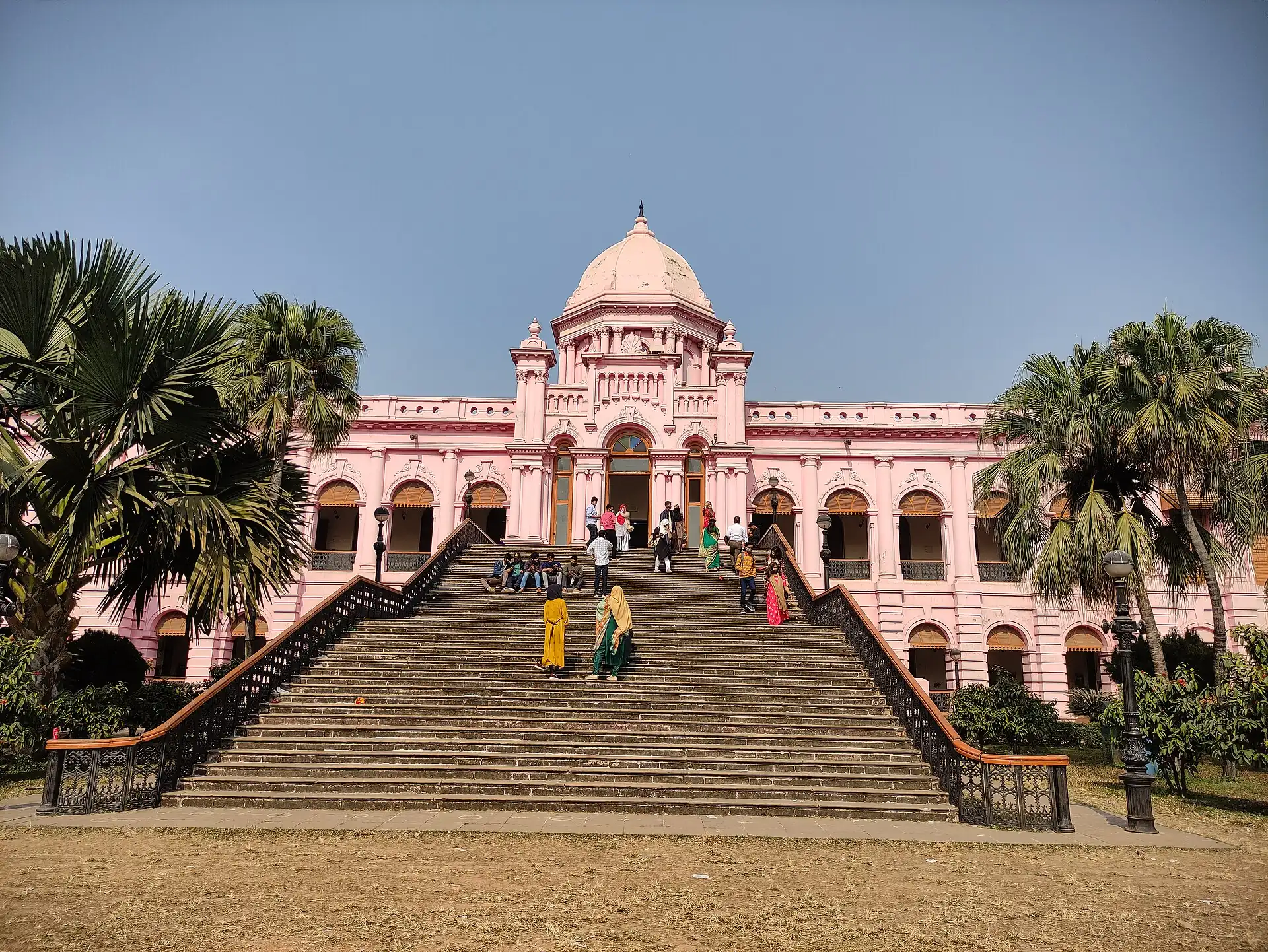
The Mughal centre of power moved to Murshidabad in the early 18th century and Dhaka slowed down. British rule after 1765 brought new landowners and merchants, and a local family, the Nawabs of Dhaka, rose to lead the city's Muslim community. Nawab Abdul Ghani built the pink Ahsan Manzil palace on the river in the 1860s. In 1905 the partition of Bengal made Dhaka the capital of a new province for a few years, and in 1921 the University of Dhaka opened, setting up the academic quarter around Shahbag that still shapes the city centre.
In 1947 the British left India and Dhaka became the capital of East Bengal, later East Pakistan. The 1952 Language Movement, in which students and others demanding recognition of Bangla were shot at by police on 21 February, was the first great political turn. Bengali nationalism grew through the 1960s, and after the March 1971 crackdown and a nine-month war, Pakistani forces surrendered in Dhaka on 16 December 1971. Bangladesh's capital has been Dhaka ever since.
Since then the city has grown enormously. The garment industry and migration from rural areas have turned a town of a few hundred thousand in the 1950s into a region of tens of millions by common estimates. That growth explains most of what a visitor sees: the density, the traffic, the shortage of pavements and the way old and new layers sit next to each other. It also explains why so few places from the Mughal and Nawab eras survive in good condition: they were built for a small river town and have been surrounded, and sometimes built over, by a very large city.
For a first visit, treat the three eras as three outings. Lalbagh Fort and the Old Dhaka lanes are the Mughal and Nawab city. Shahbag, the National Museum and the Shaheed Minar are the 20th-century city of the university and the language movement. Gulshan and the north are the post-1971 city of embassies, hotels and offices. Trying to see all three in one day is the usual mistake, because traffic turns a short map distance into an hour or more.
- Mughal capital of Bengal
- about 1610
- Ahsan Manzil built
- 1859–1872
- Language Movement shootings
- 21 February 1952
- Victory Day
- 16 December 1971
2Old Dhaka: lanes, trades and neighbourhoods2 min
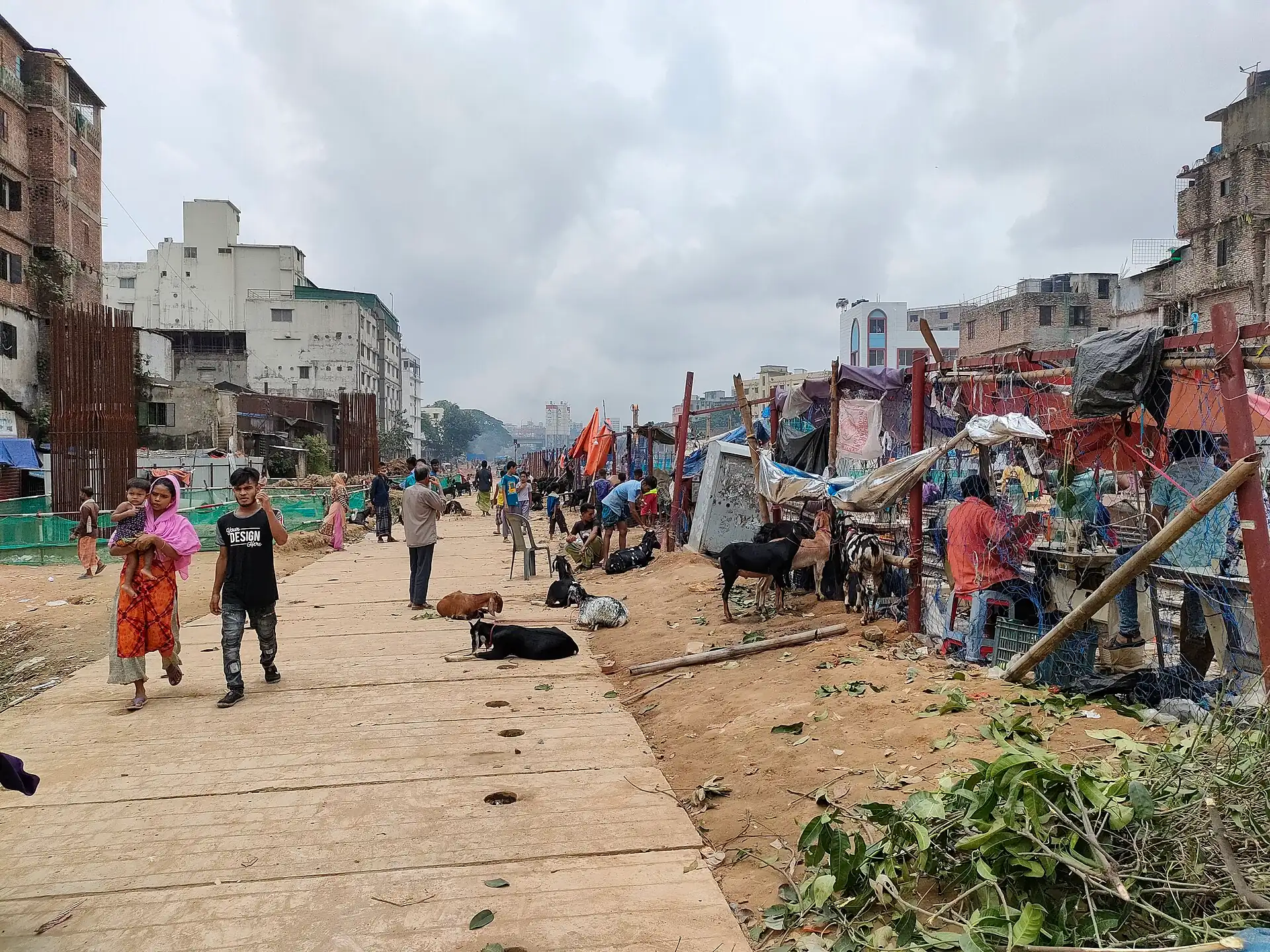
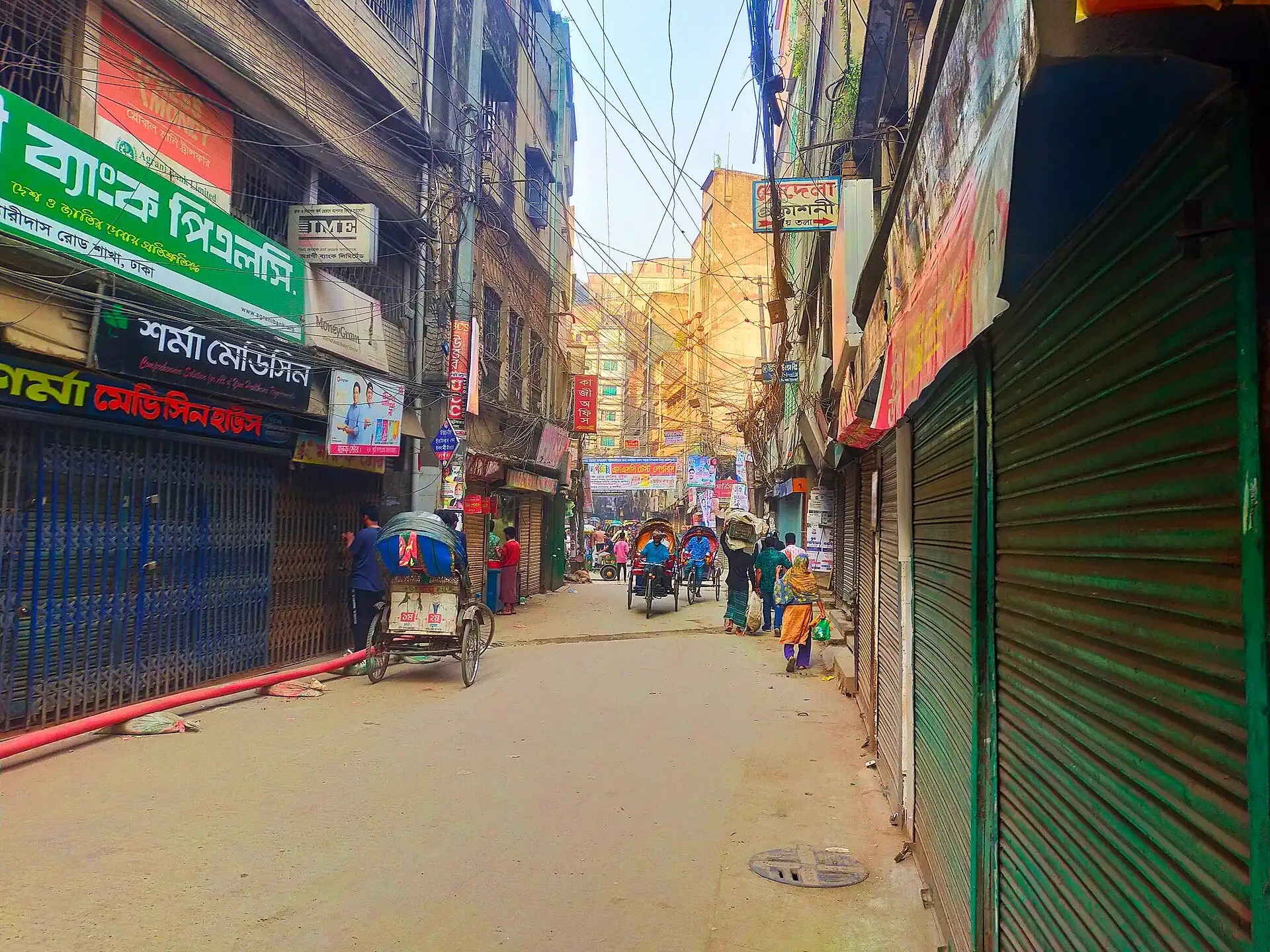
Old Dhaka, called Puran Dhaka locally, is the part of the city that grew around the Buriganga river before the modern city spread north. It is a grid of narrow lanes, three- and four-storey shophouses, workshops and residential houses packed against each other, with shops on the ground floor and families above. Motorbikes, rickshaws and handcarts share the same lanes as pedestrians, and open drains run along the sides. On a first visit it is loud, close and slow, and most visitors are glad to have a guide.
Many of the neighbourhoods are named for the trade that once filled them. Shankhari Bazar is the lane of the shell-cutters, Hindu artisans who cut and polish conch shell into bangles. Tanti Bazar was the weavers' quarter. Chawkbazar is a large market with a mosque at its centre and a night market in Ramadan. Armanitola, a short distance north, takes its name from the Armenian merchants who lived there and left behind a small church built in 1781. The trades have thinned as factories and imports moved in, but the lane names and some workshops remain.
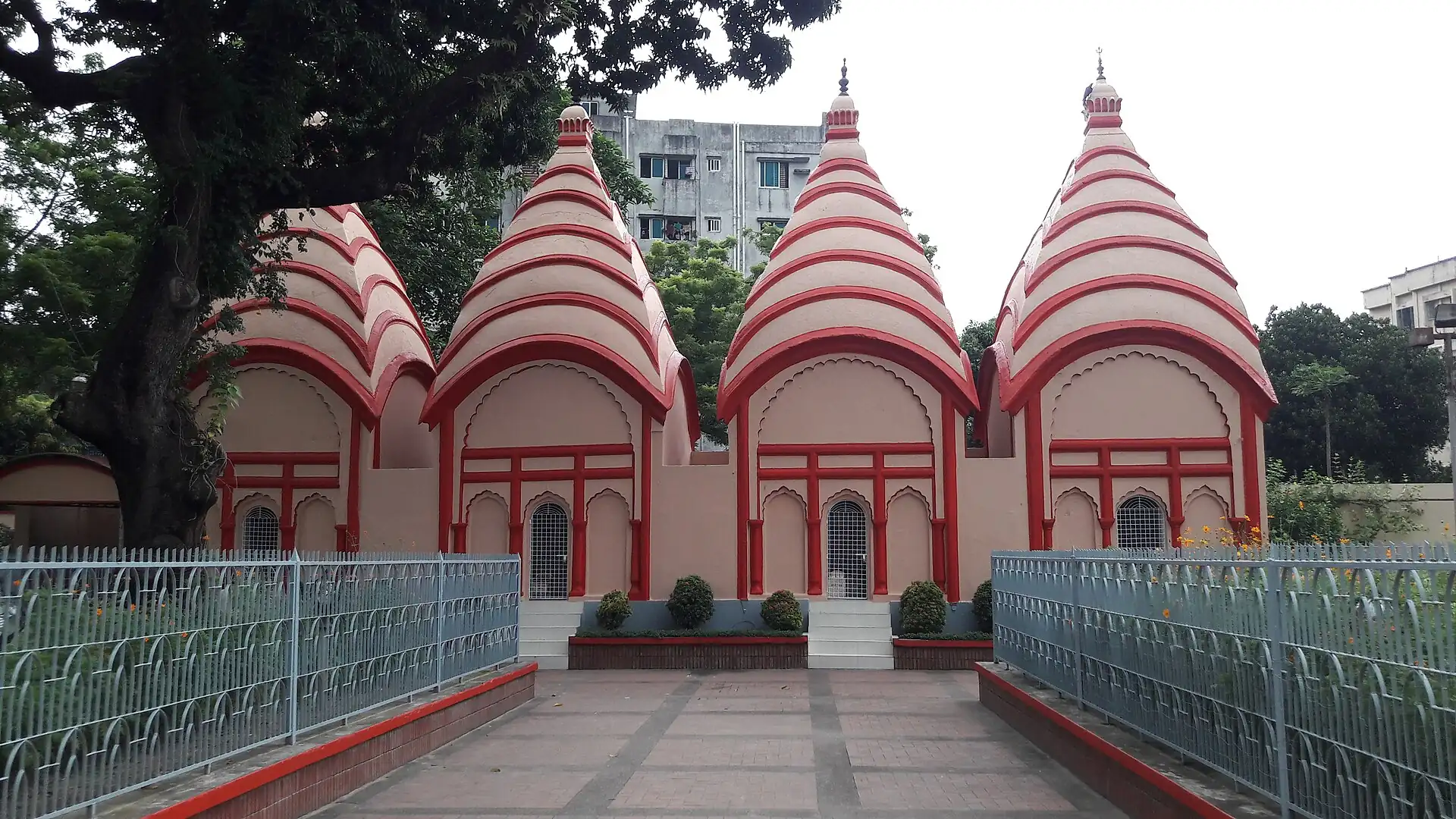
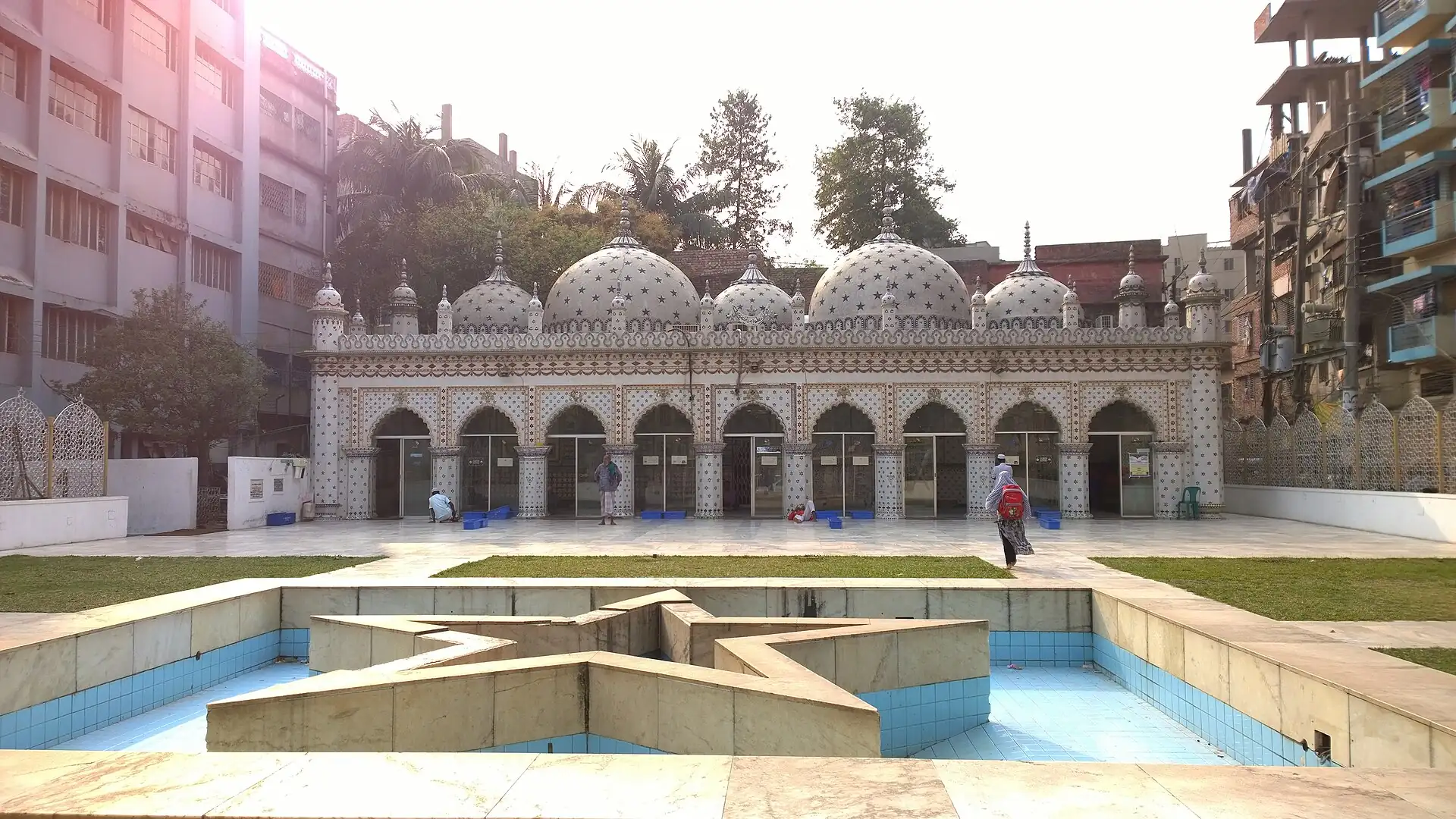
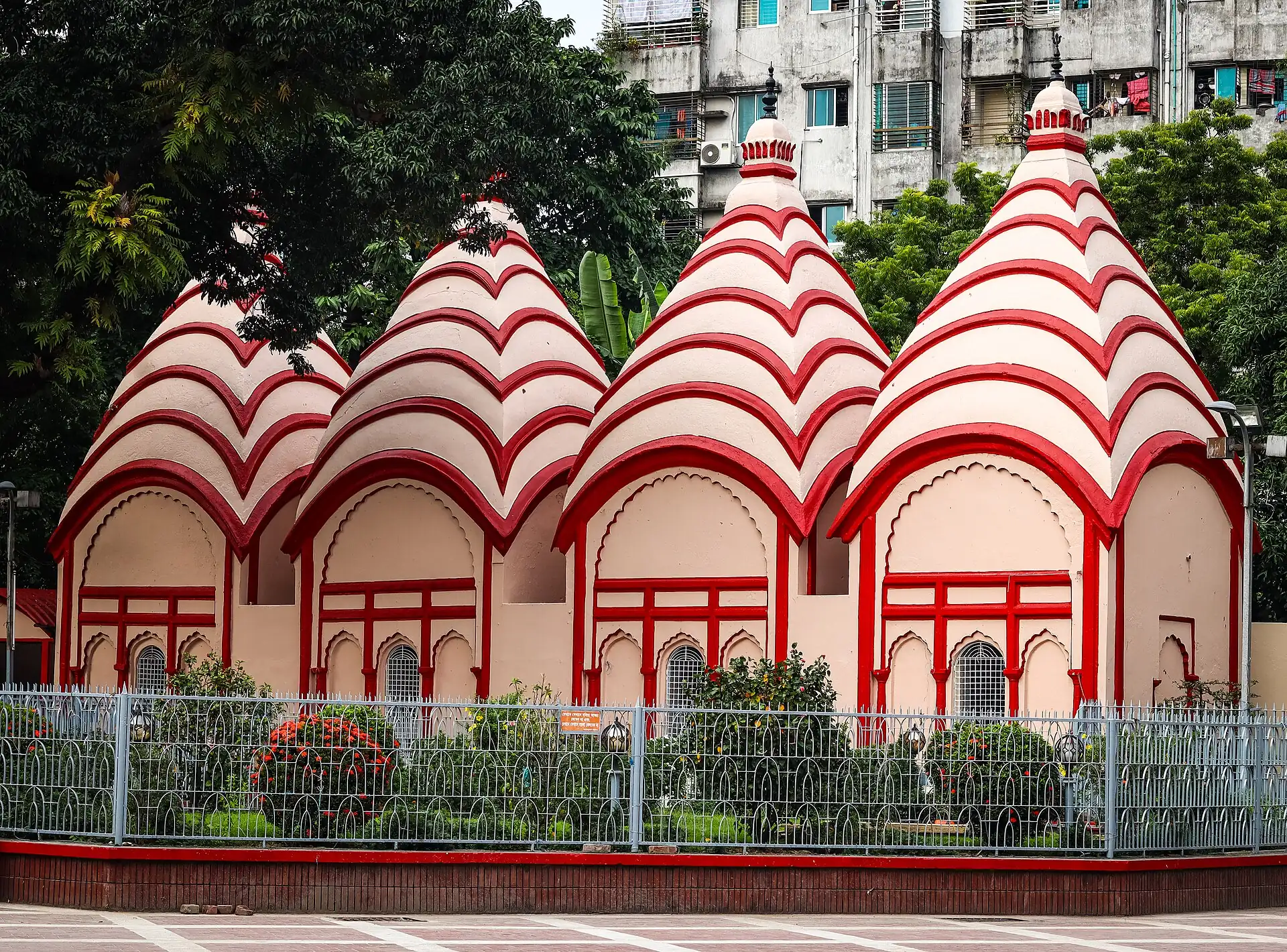
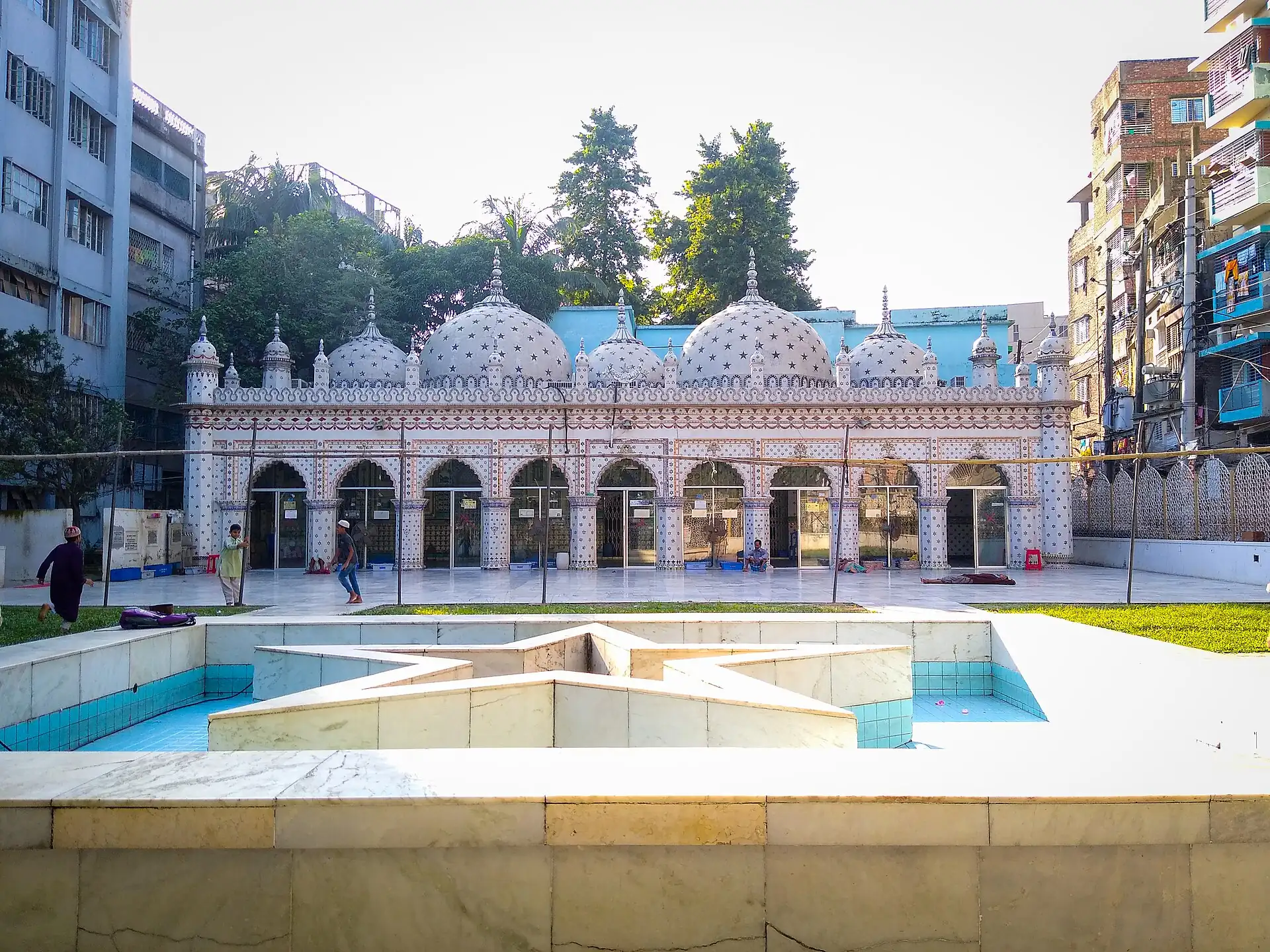
Religious and community life is part of the streetscape. The Star Mosque has a covering of star-shaped china tile patterns added in the early 20th century. Dhakeshwari Temple, the largest Hindu temple in the city, lies a little to the west near Lalbagh. Husseini Dalan, a 17th-century Shia hall, and many small mosques and temples share the lanes. Old Dhaka is also known for the rhythm of prayer times: shops pause at midday on Friday and roads empty for the congregation, and after sunset in Ramadan the lanes fill for iftar.
For a visitor, the practical rules matter more than the map. Go early, before the traffic and heat build, and go by ride-hail to the edge of a lane rather than into it. Leave big bags at the hotel: the lanes are too narrow and broken for suitcases. Hire a licensed guide for at least the first morning and agree the price and the route before you start. Carry small notes for rickshaws and snacks, and eat only food that is cooked in front of you.
You do not need to see everything. A good Old Dhaka morning is Ahsan Manzil at opening, the Star Mosque and Armenian Church in Armanitola, a sweet shop, and a biryani lunch by 13:00. That is already a full day for most people. Add the river at Sadarghat only with a guide, and treat it as a short look rather than a boat trip unless you have arranged one.
- Local name
- Puran Dhaka
- Shankhari Bazar
- conch-shell bangle cutters' lane
- Armenian Church
- built 1781
3Forts, palaces and one famous parliament2 min
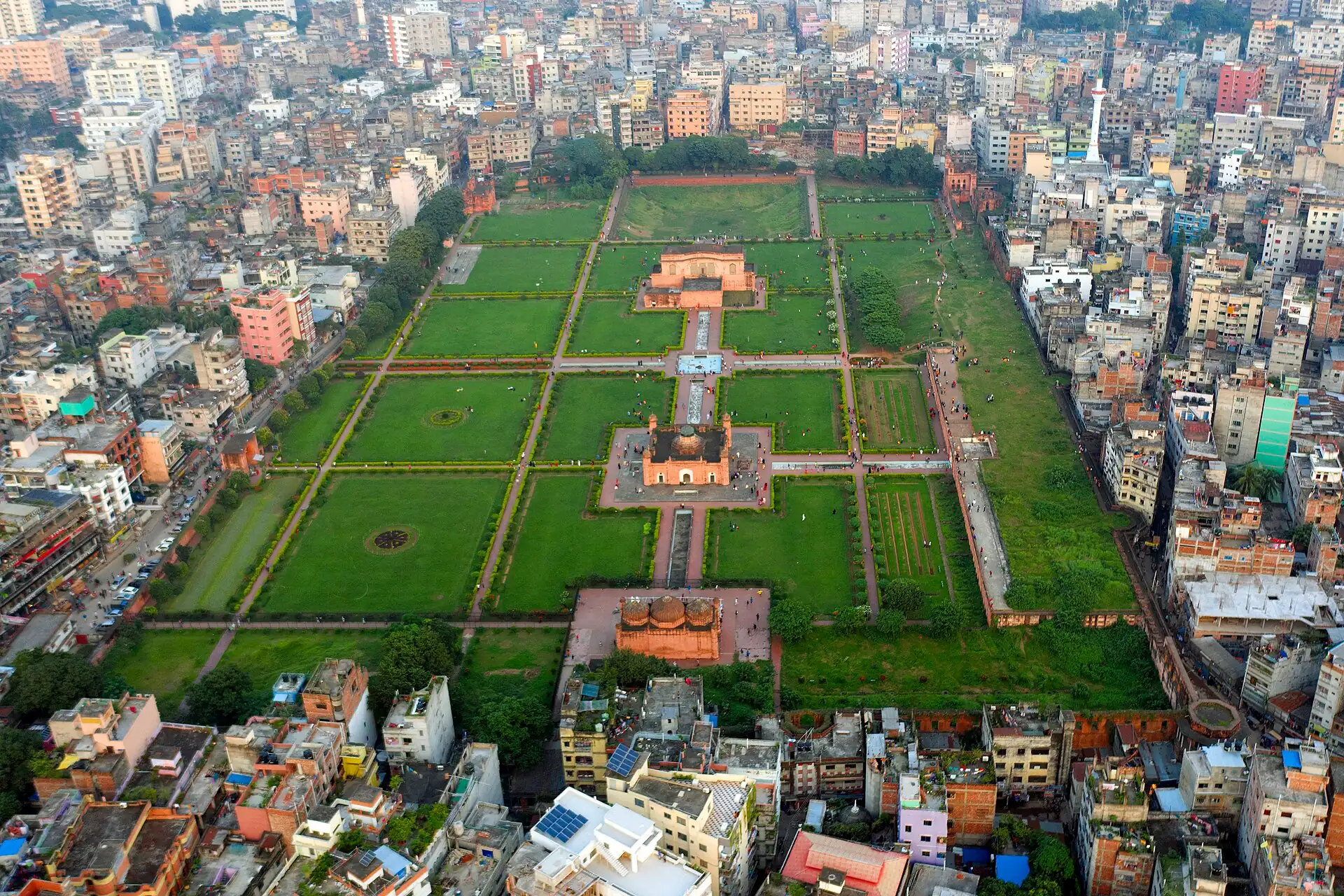
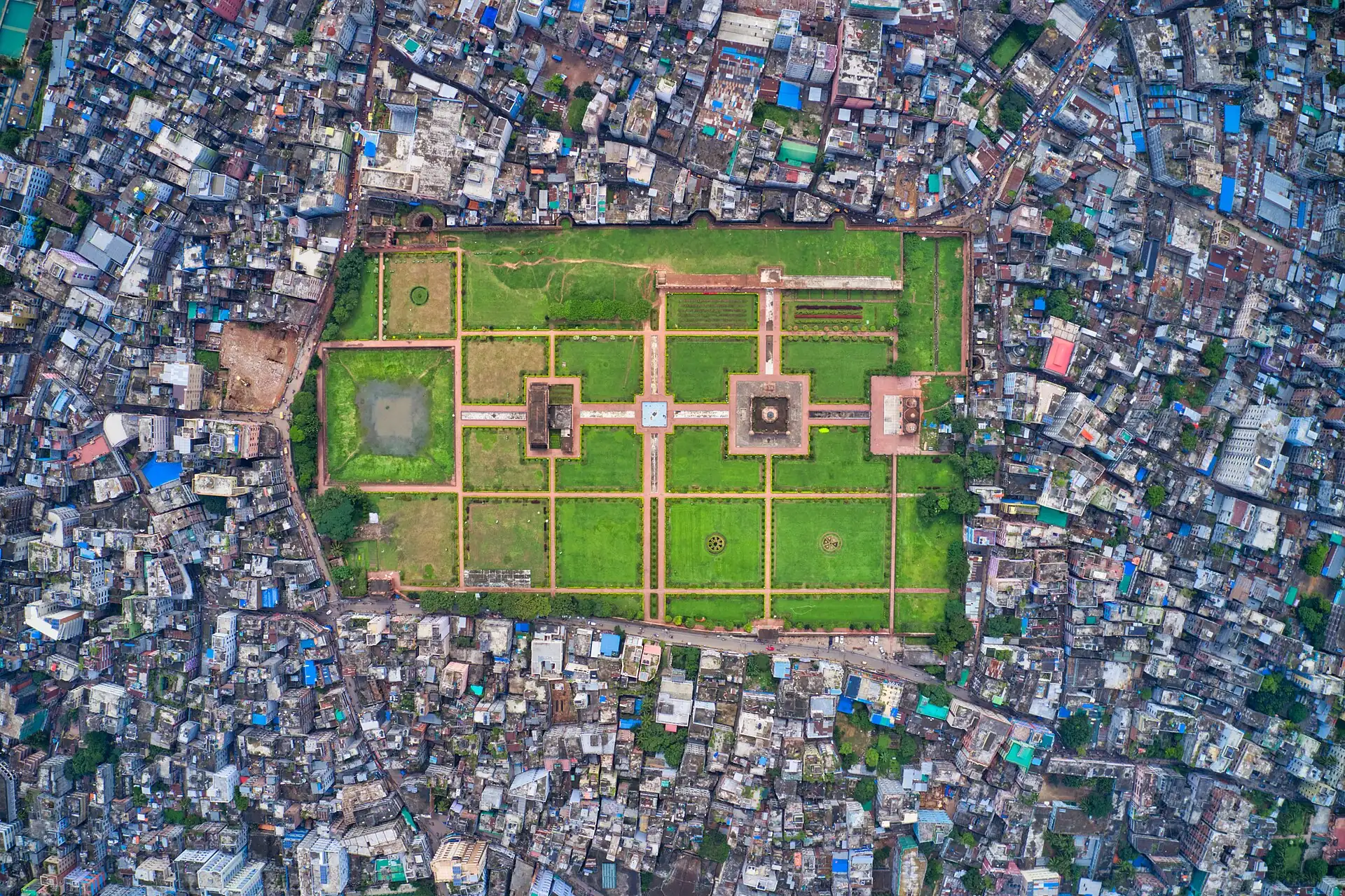
Dhaka's buildings run from Mughal to modern, and the best way to read them is by date. The oldest big monument in the city is Lalbagh Fort, begun in 1678 by Prince Muhammad Azam and left unfinished when the governor's daughter Pari Bibi died and was buried in a tomb inside. What survives is a mosque, the tomb of Pari Bibi, an audience hall used as a small museum, and lawns and walls. It is a quiet complex, best at opening, and a good first stop because it shows Mughal proportions without the crowds of larger forts elsewhere in South Asia.
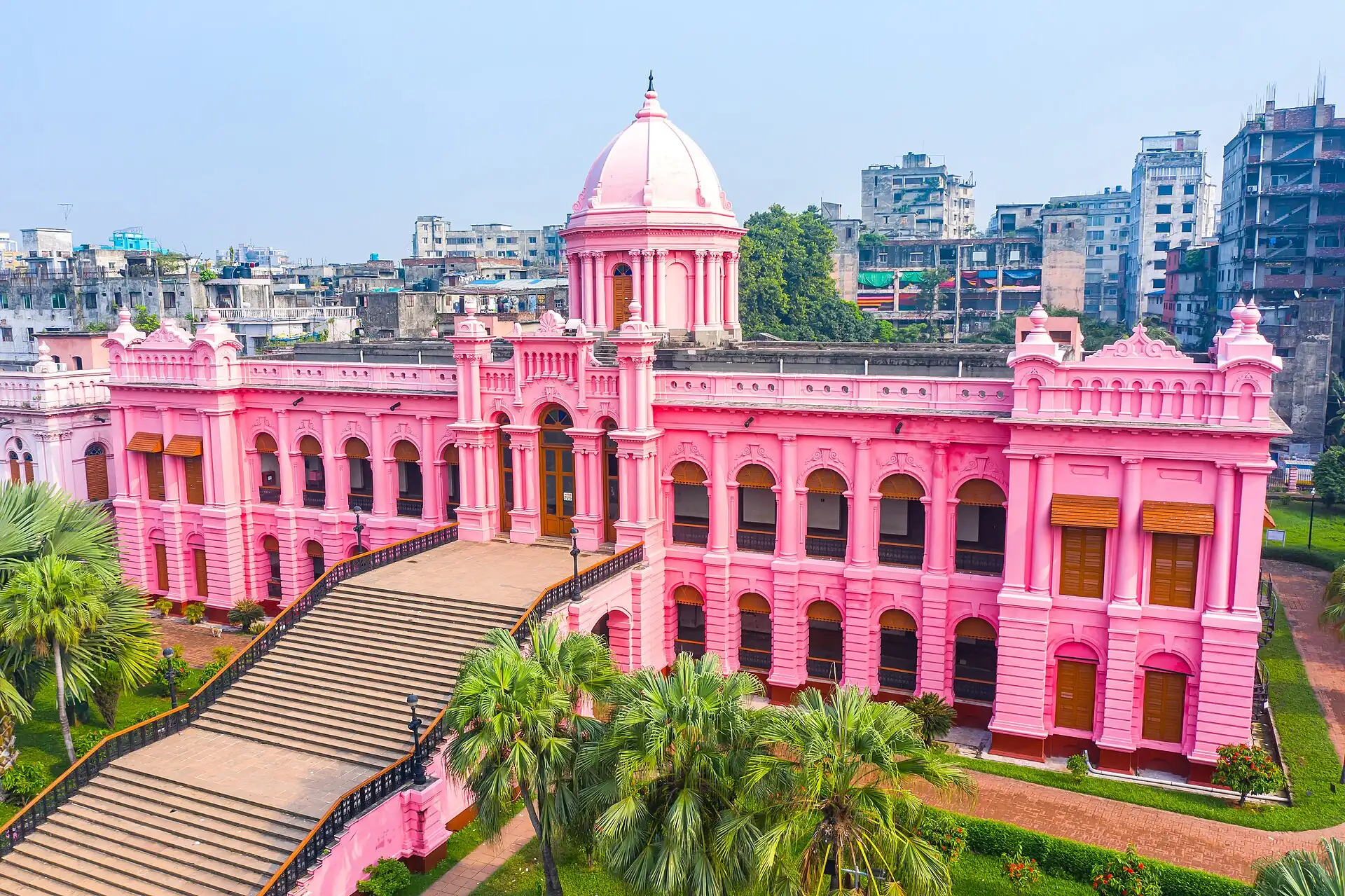
The 19th century added the Nawab's palace. Ahsan Manzil was built by Nawab Abdul Ghani in 1859 to 1872, in the Indo-Saracenic style: a pink building with a domed central tower and a grand double staircase facing the Buriganga. A tornado in 1888 damaged it and it was rebuilt. It became a museum in the 1990s and shows rooms as the Nawab family used them. Curzon Hall, on the university campus, and the Armenian Church in Armanitola come from the same broad period of colonial and local building.
Religious buildings show the city's mix. The Star Mosque is small but famous for its surface of china tile stars. Dhakeshwari Temple is the main Hindu temple, rebuilt over the centuries and damaged in 1971. The National Mosque, Baitul Mukarram, is a large modern mosque in the commercial district of Paltan. These are worth seeing for what they show about Dhaka's communities, not for grand scale.
The building the wider world knows best is the National Parliament House in Sher-e-Bangla Nagar, designed by the American architect Louis Kahn. It was designed in the early 1960s and finished in 1982, after Kahn's death. Its concrete and marble blocks with large circular and triangular openings are among the most admired modern buildings in South Asia. Access to the inside is controlled and the area is a government zone: ask your hotel or a guide whether visits are possible and treat photography with caution.
A short architecture day is easy to plan in three parts. The morning is Lalbagh Fort and Dhakeshwari Temple, which are close. Midday is a break at the hotel or a café in Dhanmondi. The late afternoon is the exterior of Curzon Hall and the university campus, or the National Museum for the air-conditioned galleries. Keep the Parliament as a separate outing, only if you can confirm access and the security situation on the day.
- Lalbagh Fort begun
- 1678
- Ahsan Manzil
- 1859–1872, Indo-Saracenic
- Parliament House architect
- Louis Kahn; completed 1982
4Biryani, bakarkhani and Bengali street food2 min
Dhaka eats rice and fish daily, but the food that visitors notice first is meat: biryani in Old Dhaka and kebab and roast in the north. The classic Old Dhaka dish is kacchi biryani, where raw marinated mutton, potato and rice are layered and cooked together in a sealed pot, so the meat steams in its own juices. It is served with borhani, a salty, sour, minty yoghurt drink that cuts the richness. Haji Biryani in Nazira Bazar is a well-known small place for this style; several chains, such as Fakruddin, serve it across the city.
Bread is the second local speciality. Bakarkhani is a layered, crisp flatbread from Old Dhaka, eaten with tea in the morning or with curry later in the day; one story ties the name to a Mughal-era noble, but treat that as folklore. Parathas, luchi and rutis fill breakfast plates. Tea in Dhaka is boiled with milk and sugar, and the stalls on every corner are the social heart of a street: sit on a stool, say 'kom chini' for less sugar, and watch the block go by.
Sweets are a proper meal in themselves. Bengali milk sweets such as sandesh, roshgolla, chomchom and mishti doi, a sweet set yoghurt, are sold by the piece in old shops and gift boxes. Old Dhaka has shops that have run for generations, such as Bhimnag in Shankhari Bazar, and buying a box is the usual way to say thank you to a host. Sweets keep for a day or two without fridge, which makes them good gifts to take on the road.
Fish matters more than any other single ingredient. Hilsa, called ilish, is the national fish and is cooked in mustard, steamed in banana leaf or fried; it is best in the monsoon. On Pohela Boishakh, the Bengali new year on 14 April, many families eat panta bhat (fermented rice) with fried hilsa. In the rainy months, bhuna khichuri, a spiced rice and lentil dish, is the traditional comfort dish. In winter, pitha, small sweet or savoury rice-flour cakes, appear at street stalls and in homes.
Street food is cheap and popular but carries a risk for visitors. Fuchka, chotpoti and jhalmuri are the well-known snacks: fuchka is a crisp shell filled with potato and tamarind water, chotpoti a plate of spiced chickpeas with egg, and jhalmuri a cone of spiced puffed rice. Eat only what is freshly cooked or assembled in front of you, choose busy stalls, and skip the tamarind water if your stomach is sensitive. Drink sealed bottled water, and expect chilli in almost everything: ask for 'jhal kom' if you want less.
- Signature dish
- Kacchi biryani with borhani
- Bread
- Bakarkhani, crisp and layered
- Fish
- Hilsa (ilish), best in the monsoon
5The river, the rickshaws and the traffic2 min
Dhaka lives by moving on its river and its streets. The Buriganga, meaning Old Ganges, runs along the southern edge of the old city, and Sadarghat, the launch terminal, is where large passenger ferries leave for the south of the country, while small wooden boats cross the river all day. The water is heavily polluted, so it is a place to look at rather than touch. A short visit with a guide at dawn or dusk shows river life at its busiest: cargo boats, ferries, porters and tea stalls at the ghat.
On land, the cycle rickshaw is the city's signature vehicle. Dhaka is often called the rickshaw capital of the world, and estimates put the number in the hundreds of thousands. Many are hand-painted with film stars, animals, flowers and landscapes, a folk art that is now fading as more rickshaws are plain. Rickshaws are banned on many main roads, so they fill the lanes and back streets, while CNG autos, buses and cars use the arteries. The rule for visitors is simple: agree the fare before you get in, keep your bag in your lap, and do not use a rickshaw across busy junctions.
Traffic is the defining condition. Dhaka is one of the densest cities on earth, and its road space is small for its size. A 10 km ride can take 30 minutes on a Friday morning and two hours at a weekday peak. Rain makes it worse: streets flood and vehicles stop. The city has responded with new infrastructure: an elevated expressway from the airport, and the MRT Line 6, a north–south metro that opened in stages from 2022 and now links Uttara to Motijheel with stops at Shahbag and Dhaka University (check current service). For a visitor these help on specific routes but do not change the basic rule that every ride needs a long margin.
For planning, use the roads' quietest hours. Friday morning is the calmest time of the week; early morning before 08:00 is quiet on other days; the evening peak from 16:00 to 20:00 is the worst. Book a ride-hail car for the outing, tell the driver the return time if you plan to hire for the morning, and build a cushion into anything with a hard time, especially a flight. The airport is only about 15 to 20 km from the centre but should be given at least three hours on the day.
There are quieter ways to see the water. Some hotels arrange river cruises on private boats, and the lakes of Dhanmondi and Gulshan have promenades that are calm in the early morning. If you want to leave the city for a day, a car to Sonargaon takes you past canals and rice fields, and gives a very different sense of the delta. Whatever you choose, keep the day short and leave the last two hours free.
- River
- Buriganga, meaning Old Ganges
- Metro
- MRT Line 6, Uttara to Motijheel (opened in stages from 2022)
- Quietest road day
- Friday morning
6Language, memory and 19712 min
To understand modern Dhaka you need two dates: 21 February 1952 and 16 December 1971. The first is Language Martyrs' Day. In 1952 the government of Pakistan said that Urdu alone would be the national language, though most of the population in the east spoke Bangla. Students and others protested in Dhaka on 21 February; police opened fire near Dhaka Medical College and several people were killed. The event turned a language dispute into a wider movement for Bengali identity and rights.
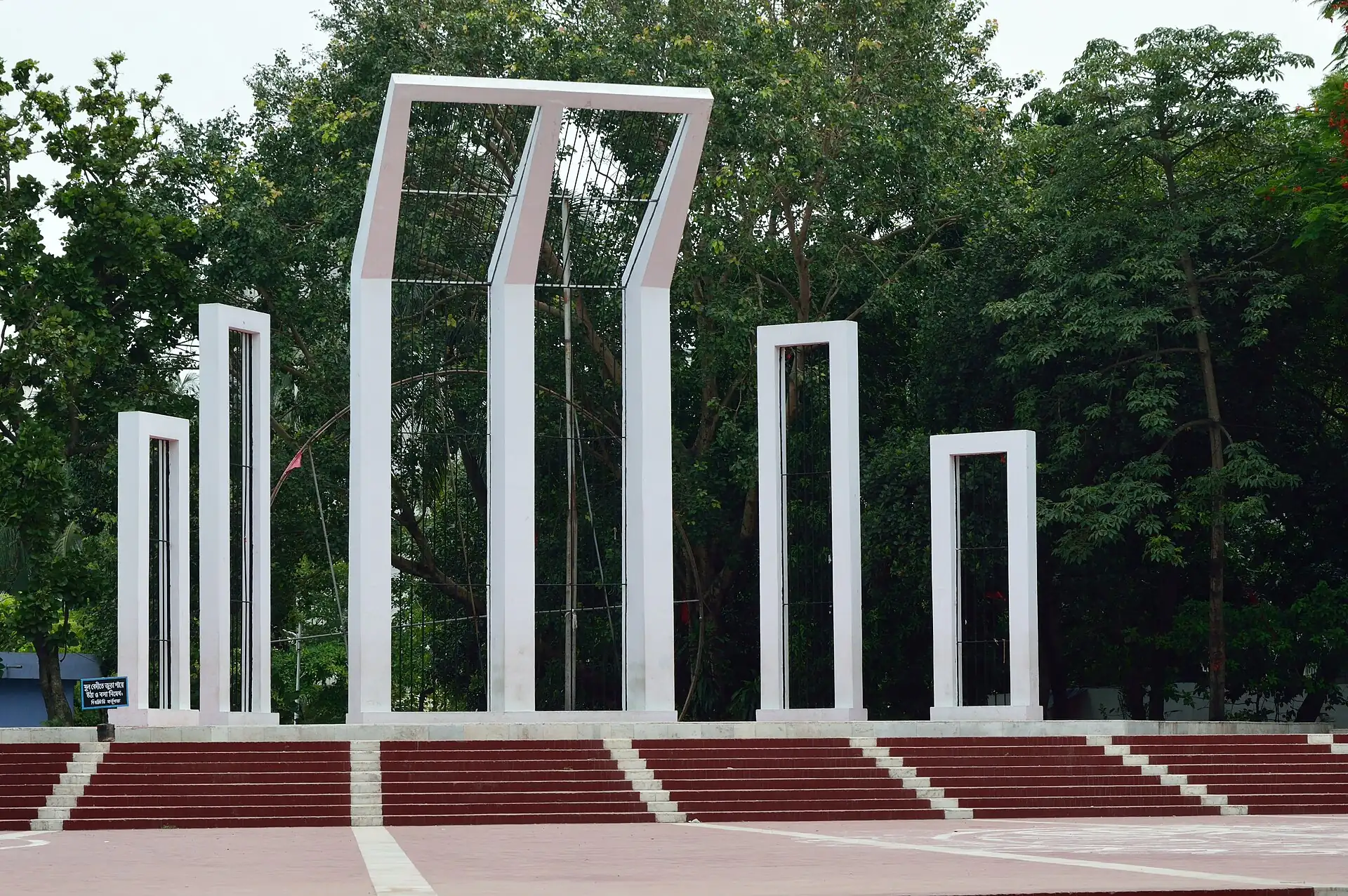
Every year on 21 February, from just after midnight on 20 February, huge queues of people walk barefoot to the Central Shaheed Minar to lay flowers. Roads around Shahbag and the university are closed and the mood is quiet and serious. The date was proclaimed International Mother Language Day by UNESCO in 1999 and has been observed worldwide since 2000. For a visitor, it is a moving occasion, but it is not a day for sightseeing; if you go, dress modestly, go early or late, and follow local guidance.
The second date is 16 December 1971, Victory Day. After the March crackdown and nine months of war, in which very large numbers of people died and millions fled to India, Pakistani forces surrendered in Dhaka. The 1971 war shapes how the country talks about itself, and many museums and monuments treat it as the central story. The National Martyrs' Memorial in Savar, a tall memorial of folded triangular walls about 35 km from Dhaka, is the national monument to the dead, and the Liberation War Museum in Agargaon tells the story with documents, photographs and personal objects.
These places are worth a visit for anyone who wants to understand Bangladesh, but they need thought. The subject is painful and the museum is sober; take time and avoid taking photographs where signs forbid it. Political tensions in Dhaka are real: rallies, strikes and, in 2024, a major uprising have shaped the city's politics, and memorials can become gathering points. Check local news and your government's travel advice on the day.
A respectful half-day plan is simple. Start at the National Museum's Liberation War gallery for orientation, then visit the Central Shaheed Minar on the way back, and end with a quiet lunch. If you have another day, go to Savar or the Liberation War Museum. Speak quietly, ask before taking photos of people, and if a crowd or rally starts, leave and return to the hotel.
- Language Martyrs' Day
- 21 February, from 1952
- Victory Day
- 16 December, from 1971
- International Mother Language Day
- declared by UNESCO in 1999
Read, watch, wordsGlossary · Sources
Glossary
| Term | Local | Meaning |
|---|---|---|
| Puran Dhaka | পুরান ঢাকা | Old Dhaka, the historic river district in the south of the city. |
| Borhani | বোরহানি | A salty, sour spiced yoghurt drink served with biryani. |
| Bakarkhani | বাকরখানি | A layered, crisp flatbread from Old Dhaka, eaten with tea or curry. |
| Ilish | ইলিশ | Hilsa, the national fish, cooked in mustard or fried; best in the monsoon. |
| CNG | A green three-wheeled auto-rickshaw that runs on compressed natural gas; common for short and medium rides. |
Read for this deep dive
Background reading only: the text above is written by Voykit, not copied from these pages.
Photos
Nakhalpara Hossain Ali High School (school in Dhaka, Dhaka Mahanagari, Bangladesh) Photo: Mahbubur, CC BY-SA 4.0
Rules in force · 7
- South Asia ↗Trekking regions, border districts and several Indian states need separate permits on top of the visa; check the permit before you book transport into them.
- South Asia ↗Remove shoes (and in many Jain and Hindu temples, leather) before entering; cover shoulders and legs; ask before photographing people or rituals.
- Bangladesh ↗Apply for a visa only on the official government e-visa portal or at an embassy; lookalike sites charge extra, and the rules differ by nationality.
- Bangladesh ↗Dress modestly in cities and near mosques: cover shoulders and knees, and women carry a scarf for mosques and shrines.
- Bangladesh ↗Carry Bangladeshi taka in small notes; rickshaws, markets and small shops are cash-only, and foreign cards are not accepted everywhere.
- Bangladesh ↗Political rallies, strikes (hartal) and blockades can close roads and cut mobile internet with little notice: check the news and your hotel before any transfer day and stay away from demonstrations.
- Dhaka Division ↗Fridays are the weekend and the quietest day for traffic: Old Dhaka's monuments are calmer, though many shops and museums shorten their hours.
Entry rules depend on your passport. Full visa guide
Emergency numbers for Dhaka999 ▾
- Police, fire, ambulance999
Tap a number to call from your phone. These are the numbers listed in this guide; a row marked check has not been verified.
Planning is the full guide. I'm here keeps what is open and the cheat card.
Right now
Checking the weather…
Working out what is open near you…
What is open nowclock, closures, places open
Now in Dhaka
Local time in Dhaka
--:--
Loads in your browser · Asia/Dhaka
This month
Month verdict appears here.
Closed today
See the weekly grid below.
If today is a closure day: Check current conditions before you fix dates: political events, strikes and road blockades can start with little notice, and the Eid holidays empty the city and close shops for days.
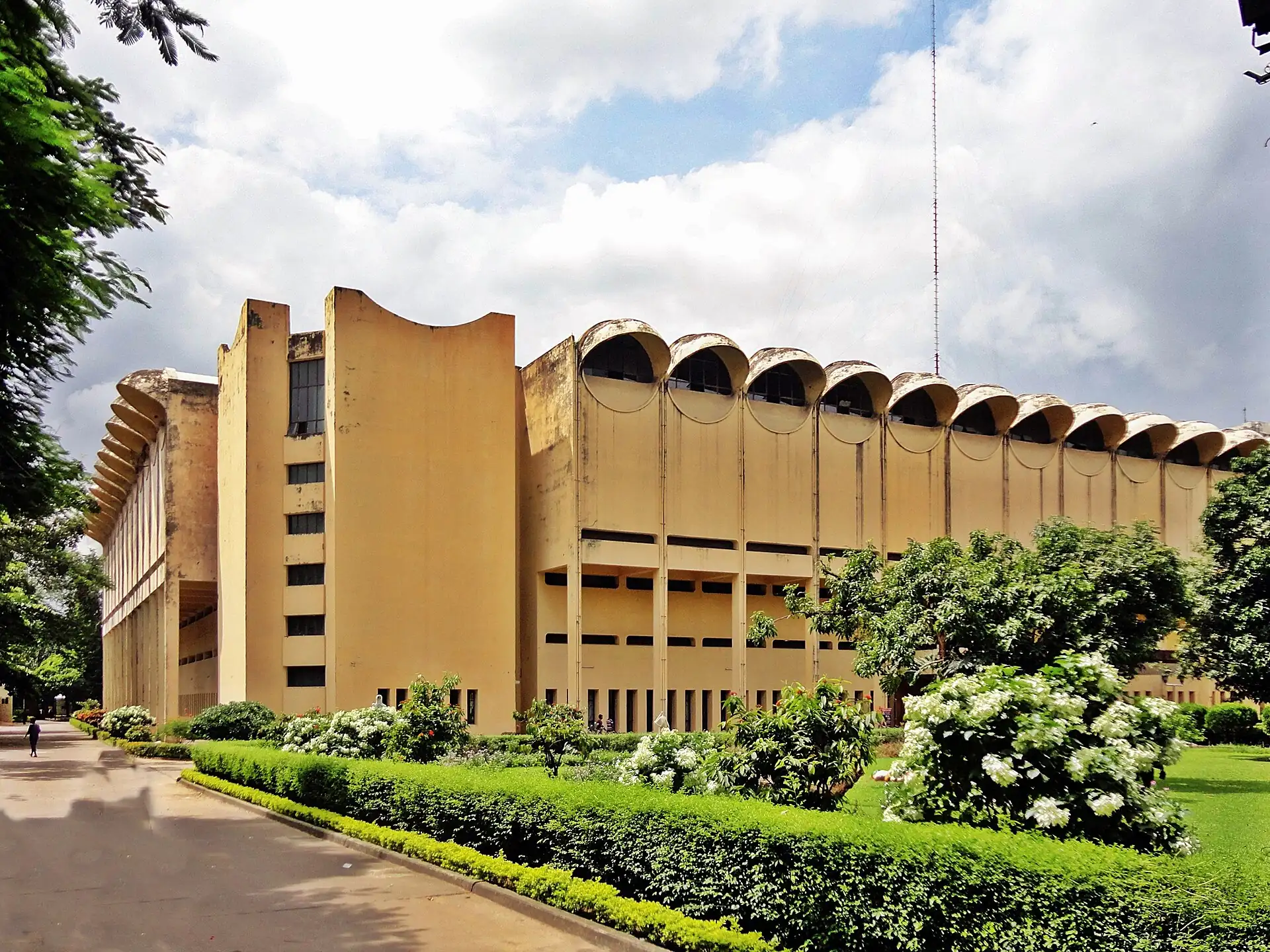
Open every day: Armenian Church (Church of the Holy Resurrection), Dhakeshwari National Temple, Bangladesh National Museum, Central Shaheed Minar, Star Mosque (Tara Masjid).
- check Armenian Church (Church of the Holy Resurrection): Access depends on the caretaker; do not plan a fixed time around it.
- check Dhakeshwari National Temple: Open daily; festival days change access.
- check Bangladesh National Museum: Weekly closing day differs from the Friday-Saturday weekend pattern: check before planning the morning.
- check Central Shaheed Minar: Open all day; restricted around 21 February.
- check Star Mosque (Tara Masjid): Open daily as a mosque; visiting is not a guided or ticketed activity.
- check Bangladesh National Museum: Weekly closing day not confirmed; check before you go.
- check Lalbagh Fort: Weekly closing day not confirmed; check before you go.
Weekly closures come from our place pages; national holidays and political events can add closures not shown here.
Cheat cardthe pocket version
Cheat card
The essentials on one card: save it as an image for your phone, share it, or print it.
Dhaka
ঢাকা
- Money
- Keep BDT 3,000 in small notes; use ATMs inside banks, hotels or malls in daylight.
- SIM
- Buy a SIM from the airport booth or a carrier shop (Grameenphone, Robi, Banglalink) with your passport…
- Ride app
- Pathao · Uber
- Emergency
- 999 police, fire, ambulance
- Plugs
- Sockets C/D/G/K. US/Canada (A/B): adapter · UK/Ireland (G): fits · Australia/NZ (I): adapter. 240 V: US 120 V-only devices (hair dryers) need a converter; most chargers are dual-voltage.
Say it
- Thank you: ধন্যবাদ (dhon-no-BAD)
- How much is this?: এটার দাম কত? (E-tar dam KOTO)
- Less spicy, please: ঝাল কম (jhal KOM)
- The bill, please: বিল দিন (bill DIN)
Top 5
- Ahsan Manzil
- Lalbagh Fort
- Bangladesh National Museum
- Dhakeshwari National Temple
- Central Shaheed Minar
EssentialsQuick answers, what things cost and how to get around
Essentials
Quick answers, what things cost and how to get around
Quick answers
The questions people ask first about Dhaka, one line each. Tap a card for the full answer.
- Cash or card?Cash is the norm outside hotels, malls and larger restaurants.
- SIM or eSIMBuy a SIM from the airport booth or a carrier shop (Grameenphone, Robi, Banglalink) with your passport…
- Ride-hailing appPathao · Uber.
- Tap waterTap water is not safe to drink; use sealed bottled or filtered water, and avoid ice unless the source is known.
- TippingNot obligatory; round up for drivers and leave 5–10% at sit-down restaurants where no service charge is added.
- Plugs & powerSockets C/D/G/K. US/Canada (A/B): adapter · UK/Ireland (G): fits · Australia/NZ (I): adapter. 240 V: US 120 V-only devices (hair dryers) need a converter; most chargers are dual-voltage.
Show all 14 answers
- Safe at night?Take more care after dark in Old Dhaka and Lalbagh, Shahbag and Ramna.
- What to wearCover shoulders and knees in public; women cover their hair in mosques and at some shrines.
- Emergency numbers999 police, fire, ambulance
- Your embassycheckUS, UK embassies listed with addresses (check before you go).
- Sundays & holidaysWeekly closures come from our place pages; national holidays and political events can add closures not shown here.
- Late at nightcheckGovernment offices and museums close on Fridays and Saturdays or on one weekly day (check); shops open late morning and close about 21:00…Government offices and museums close on Fridays and Saturdays or on one weekly day (check); shops open late morning and close about 9:00 PM…
- Rainy-day planIndoor picks: Monsoon, June to September · Pre-monsoon storms, April to May.
- Landing lateDAC: pre-booked hotel car or ride-hail to the hotel door runs all night.
Cost cheat-sheetwhat everyday things cost
Cost cheat-sheet
Typical prices for the everyday things, as ranges. Change the currency right here; the local price stays first.
2026 desk estimate · check
- CoffeeCoffee at a Gulshan caféBDT 250–500
- Sit-down mealPlate of biryani, sit-downBDT 300–700
- Street or quick mealMilk tea at a street stallBDT 15–40
- Taxi, about 5 km (3 mi)Taxi, about 3 mi (5 km)Short ride-hail ride (5 km (3.1 mi))Short ride-hail ride (3.1 mi (5 km))BDT 200–500 (traffic changes the fare)
- SIM or eSIM, a weekTourist SIM, about a weekBDT 500–1,500
- Museum or sight ticketMuseum or fort ticket, foreign visitorBDT 200–600 (check)
- Budget bedBudget guesthouse room, a night, per roomBDT 2,500
- Mid-range bedHotel double room, a night, per roomBDT 9,000
- High-end bedHotel double room, a night, per roomBDT 20,000
A day, not counting the bed: Budget BDT 2,500 · Mid BDT 7,500 · High BDT 15,000
Local prices, with USD next to them (rates 2026-09 (approximate); change it in the header). Ranges are desk estimates: check locally. Every price and the budget calculator →
Source: Prices in Dhaka
Draft
Written from desk research. Not yet compared with the official source.
No official source is recorded for this figure.
Prices are 2026 desk estimates, not yet compared with an official source. Check on the day.
Not checked in the last 12 months (no check date on file).
DecideWho it suits, the trade-offs and when to go
Decide
Who it suits, the trade-offs and when to go
Best months at a glance
The guide's verdict for each month
Jan
Best
25°C (77°F)77°F (25°C)
Feb
Best
28°C (82°F)82°F (28°C)
Mar
Care
32°C (90°F)90°F (32°C)
Apr
Avoid
34°C (93°F)93°F (34°C)
May
Avoid
33°C (91°F)91°F (33°C)
Jun
Avoid
32°C (90°F)90°F (32°C)
Jul
Avoid
31°C (88°F)88°F (31°C)
Aug
Avoid
32°C (90°F)90°F (32°C)
Sep
Avoid
32°C (90°F)90°F (32°C)
Oct
Care
31°C (88°F)88°F (31°C)
Nov
Best
29°C (84°F)84°F (29°C)
Dec
Best
26°C (79°F)79°F (26°C)
Best: Nov–Feb. Mixed: Mar, Oct. Avoid: Apr–Sep. Month by month →
Warmest Apr (34°C (93°F)93°F (34°C)), coolest Jan (12°C (54°F)54°F (12°C) low), wettest Jul (18 rain days), driest Jan (1). Averages, not a forecast.
Dhaka across the year
Best-looking months for Dhaka: Jan, Feb, Nov. Rated avoid: Apr, May, Jun, Jul, Aug, Sep.
| Measure | Jan | Feb | Mar | Apr | May | Jun | Jul | Aug | Sep | Oct | Nov | Dec |
|---|---|---|---|---|---|---|---|---|---|---|---|---|
| Weather | Good (good) | Great (good) | Mixed (care) | Avoid (avoid) | Avoid (avoid) | Avoid (avoid) | Avoid (avoid) | Avoid (avoid) | Avoid (avoid) | Mixed (care) | Great (good) | Good (good) |
| Crowds | Medium (ok) | Medium (ok) | Low (good) | Low (good) | Low (good) | Low (good) | Low (good) | Low (good) | Low (good) | Medium (ok) | Medium (ok) | High (care) |
| Prices | Medium (ok) | Medium (ok) | Low (good) | Low (good) | Low (good) | Low (good) | Low (good) | Low (good) | Low (good) | Medium (ok) | Medium (ok) | High (care) |
| Events | 1 event (ok) | 2 events (ok) | 3 events (care) | 1 event (ok) | 1 event (care) | None listed (ok) | None listed (ok) | None listed (ok) | None listed (ok) | 1 event (ok) | None listed (ok) | 1 event (ok) |
Green is good news, amber needs planning, red is a month to avoid; dashed grey with a question mark means our data does not say. Open the year heatmap →
Not checked in the last 12 months (no check date on file).
Source: Months, temperatures and crowds
Draft
Written from desk research. Not yet compared with the official source.
Monthly highs, rain and crowd levels are climate averages and desk estimates for the city, not a forecast.
Understand the cityUnderstand · Districts
Orientation & districts
Old Dhaka and Lalbagh lie in the south by the river; Shahbag and Ramna are the central academic and park district; Gulshan and Banani are the northern hotel and dining districts, 10–15 km from the old city.
Distance in kilometres is a poor guide: traffic makes any cross-city ride 45 to 120 minutes. Pick one district per outing.
Shaded shapes: walking areas (click one). Black pins: sleep areas. Grey dots: places. Round badges: arrivals. Click the map to turn on scroll-wheel zoom.
Hover, tap or tab to an area to see what it is like. Pins are sleep areas; arrows at the edge point to the airport.
Off the map: Hazrat Shahjalal International Airport (DAC) (30–75 min by the usual route).
Where’s what, as a list:
- Old Dhaka: Mughal- and Nawab-era sights, the river and street food; not a place to sleep or drag luggage. Suits: A morning with a guide.
- Lalbagh: The fort, the tomb of Pari Bibi and the mosque, set among lawns. Suits: A weekday morning.
- Shahbag and Ramna: The National Museum, the university, Ramna Park and the Shaheed Minar. Suits: A museum and park morning.
- Gulshan and Banani: Wider streets, embassies, restaurants and 24-hour hotel desks; a long ride to every sight. Suits: First-timers wanting hotels and cafés. Price band $$$.
- Dhanmondi: Lakeside and residential, with cafés and guesthouses; closer to Shahbag than Gulshan is. Suits: A quieter, more local base. Price band $.
- Sleep area Dhanmondi: suits A quieter, more local base, price band $.
- Sleep area Gulshan: suits First-timers wanting hotels and cafés, price band $$$.
- Hazrat Shahjalal International Airport (DAC), 30–75 min by the usual route.
Neighbourhoods at a glance
One tab per area, pulled together from this guide’s districts table, area notes, sleep-area scores and place pages. Scores are desk judgements (1–5); prices are estimates, check before you book.
Old Dhaka
Mughal- and Nawab-era sights, the river and street food; not a place to sleep or drag luggage.
- Suits:
- A morning with a guide
Getting around from here
- Rickshaw or car west: about 30 min to Lalbagh Fort
- Car north: about 35 min to Shahbag and Ramna
- Car north-east: about 60 min to Gulshan and Banani
Lalbagh
The fort, the tomb of Pari Bibi and the mosque, set among lawns.
- Suits:
- A weekday morning
See
Getting around from here
- Rickshaw or car east: about 30 min to Old Dhaka
- Car north: about 30 min to Shahbag and Ramna
- Car north-east: about 60 min to Gulshan and Banani
Shahbag and Ramna
The National Museum, the university, Ramna Park and the Shaheed Minar.
- Suits:
- A museum and park morning
Getting around from here
- Car south: about 35 min to Old Dhaka
- Car south: about 30 min to Lalbagh Fort
- Car north-east: about 45 min to Gulshan and Banani
Gulshan and Banani
$$$Wider streets, embassies, restaurants and 24-hour hotel desks; a long ride to every sight.
- Suits:
- First-timers wanting hotels and cafés
- Quiet nights3/5 Medium
- Nightlife3/5 Medium
- Families4/5 High
- Late arrival5/5 Very high
Why these scores
- Quiet nights: Busy roads but calmer than the old city.
- Nightlife: Cafés and hotel bars; little street life after 23:00.
- Families: Hotel pools, cafés and malls nearby.
- Late arrival: 24-hour hotel desks are common.
Getting around from here
- 45–100 min walk to Shahbag and Ramna
- Car south: about 60 min to Old Dhaka
- Car south-west: about 60 min to Lalbagh Fort
Dhanmondi
$Lakeside and residential, with cafés and guesthouses; closer to Shahbag than Gulshan is.
- Suits:
- A quieter, more local base
- Quiet nights3/5 Medium
- Nightlife2/5 Low
- Families3/5 Medium
- Late arrival3/5 Medium
Why these scores
- Quiet nights: Lakeside and residential lanes.
- Nightlife: Cafés and restaurants; few bars.
- Families: Parks and lakeside walks; the roads are busy.
- Late arrival: Varies by property: confirm reception hours.
Getting around from here
- 40–60 min walk to Lalbagh Fort
- Car south: about 35 min to Old Dhaka
- Car north-east: about 45 min to Gulshan and Banani
Ward by ward
4 area guides. Open one for the short answer, the key facts and what the area is like; the full guide is linked inside. Prices marked (check) are estimates.
Central
Stay in Central if you need easy access to government offices, banks and the University of Dhaka; it’s best for business or short trips, but expect traffic and limited nightlife.
- Main attractions:
- Motijheel business district, Baitul Mukarram Mosque, National Museum, Liberation War Museum, Curzon Hall
- Transport hub:
- Well‑served by buses, rickshaws and the Dhaka Airport Rail Link (check) (check)
- Safety:
- Generally safe during daylight; stay alert after dark, especially near busy roads (check) (check)
Quick answer
Central works for travelers who need proximity to ministries, banks and the university campus. It’s convenient for day trips and business meetings, but it is noisy, crowded and has few quiet cafés.
Full Central guideCharacteristics
The area mixes modern office towers in Motijheel with historic sites around the University of Dhaka. Museums, the national mosque and colonial buildings give cultural stops, while shopping malls and street markets provide everyday amenities.
North
North Dhaka is suitable for travellers who want upscale hotels, diplomatic ambience and easy access to Gulshan‑Banani dining, plus Mirpur’s zoo and gardens; skip if you prefer low‑cost local vibe.
- Main zones:
- Gulshan‑Banani (upscale, diplomatic) and Mirpur (industrial, zoo, stadium)
- Transport hub:
- Well‑served by city buses, rickshaws and MRT (planned) – approx 20 min from Hazrat Shahjalal Airport by car (check)
- Typical hotel price:
- BDT 4,000–7,000 per night for 4‑star (≈ USD 45–80) (check)
Quick answer
Stay in North if you value modern hotels, safe streets, and proximity to upscale restaurants; it also gives easy trips to Mirpur’s zoo and botanical gardens. Avoid if you need budget lodging or want the historic feel of Old Dhaka.
Full North guideCharacteristics
North Dhaka splits into Gulshan‑Banani, the city’s diplomatic and commercial centre with many five‑star hotels and international eateries, and Mirpur, an industrial district that hosts the national zoo, the Sher‑e‑Bangla cricket stadium and the 205‑acre National Botanical Gardens.
Old Dhaka
Stay in Old Dhaka if you want historic sites and street food and can handle noisy streets and limited public transport; skip it if you prefer quiet, modern hotels and easy metro access.
- Coordinates:
- 23.7189, 90.3881
- Main transport:
- Cycle rickshaws and taxis; buses are confusing for tourists
- River terminal:
- Sadarghat river terminal serves inter‑city boats
Quick answer
Old Dhaka is best for travellers who love historic architecture, bustling markets and cheap street food. It’s noisy, hot and has limited metro links, so bring patience and plan short walks.
Full Old Dhaka guideCharacteristics
The neighbourhood sits on the Buriganga River and is dense with Mughal‑era mosques, temples and colonial churches. Streets are narrow, traffic is chaotic and the heat can be intense, making walking a challenge.
Outer
Stay in Outer if you need budget hotels, easy airport access and quieter streets; it works well for families and long‑term visitors. Skip it if you want historic Old Dhaka ambience or lively nightlife. Avoid peak traffic hours and bring a rain plan for the monsoon season.
- Location:
- North‑east suburbs of Dhaka, part of Dhaka Metropolitan Area
- Main transport hub:
- Shahjalal International Airport (30 km (19 mi) north)Shahjalal International Airport (19 mi (30 km) north)
- Typical hotel price:
- BDT 2,500–4,500 per night (≈ US$30–55) (check)
- Rain season:
- June–October, frequent flooding
Quick answer
Outer is suitable for budget‑conscious travellers, families staying longer, and anyone needing quick airport access. Skip if you prefer nightlife or historic Old Dhaka ambience.
Full Outer guideWhat to expect
The outer suburbs are semi‑rural with new residential blocks, industrial zones and several parks. Flooding can affect low‑lying streets during the monsoon (June‑Oct).
Uttara, the northern part, hosts the airport gateway and a growing commercial centre with malls, restaurants and the RAJUK Uttara Apartment Project food court.
Decide
The honest trade-off: what you will enjoy, what will wear you down.
You will like
- Mughal-era and colonial-era monuments
- Rickshaw rides and river life
- Biryani and sweets
You will hate
- Traffic and noise
- Heat, humidity and winter smog
- Crowds
Similar citiesif this one is not quite right
Similar cities
If Dhaka does not fit your dates or budget, these match it on season, cost and feel.
- Siem Reap
Cambodia
- Good in the same months: Jan, Feb, Nov, Dec
- A similar climate through the year
- Nouakchott
Mauritania
- Good in the same months: Jan, Feb, Nov, Dec
- A similar climate through the year
- Bangkok
Thailand
- Good in the same months: Jan, Feb, Nov, Dec
- A similar climate through the year
When
Best months: Jan, Feb, Nov, Dec. Month-by-month verdicts below, with the live forecast first. When to go, month by month →
Dhaka: next 7 days
Loading forecast…
Forecast: Open-Meteo (CC BY 4.0), model data for this point.
Air quality
Loading…
Model estimate (CAMS via Open-Meteo), not a street-level station; readings near busy roads run higher.
Month by month, all 12best Jan, Feb, Nov, Dec
Cool, dry, the best weather; winter smog can be heavy.
Cool and dry; Feb 21 (Language Martyrs Day) crowds at the Shaheed Minar.
Heat builds; Mar 26 national holiday.
Hot and humid; Pohela Boishakh (Apr 14) crowds and road closures.
Hottest; pre-monsoon storms.
Monsoon; waterlogged streets.
Heavy rain; flooding.
Rain and flooding; dengue season begins.
Rain; dengue risk is high.
Rain tapering; Durga Puja closures; dengue still present.
Dry and comfortable.
Cool; Dec 16 Victory Day; smog builds.
Climate, calendar and eventsClimate · Calendar · Events · Packing by season
Climate
| Jan | Feb | Mar | Apr | May | Jun | Jul | Aug | Sep | Oct | Nov | Dec | |
|---|---|---|---|---|---|---|---|---|---|---|---|---|
| High | 25°C (77°F)77°F (25°C) | 28°C (82°F)82°F (28°C) | 32°C (90°F)90°F (32°C) | 34°C (93°F)93°F (34°C) | 33°C (91°F)91°F (33°C) | 32°C (90°F)90°F (32°C) | 31°C (88°F)88°F (31°C) | 32°C (90°F)90°F (32°C) | 32°C (90°F)90°F (32°C) | 31°C (88°F)88°F (31°C) | 29°C (84°F)84°F (29°C) | 26°C (79°F)79°F (26°C) |
| Low | 12°C (54°F)54°F (12°C) | 15°C (59°F)59°F (15°C) | 20°C (68°F)68°F (20°C) | 24°C (75°F)75°F (24°C) | 25°C (77°F)77°F (25°C) | 26°C (79°F)79°F (26°C) | 26°C (79°F)79°F (26°C) | 26°C (79°F)79°F (26°C) | 26°C (79°F)79°F (26°C) | 24°C (75°F)75°F (24°C) | 19°C (66°F)66°F (19°C) | 14°C (57°F)57°F (14°C) |
| Rain days | 1 | 2 | 4 | 7 | 13 | 16 | 18 | 17 | 14 | 8 | 2 | 1 |
| Verdict |
- Nov–Feb is the best window: dry and warm, though smog builds in Dec–Jan.
- Mar–May are hot and humid, with pre-monsoon storms; keep outings to early morning.
- Jun–Sep bring monsoon rain and street flooding; dengue peaks Aug–Oct.
Events by month
Language Martyrs' Day and the Ekushey Book Fair
holiday21 February; book fair through the month · Central Shaheed Minar and Bangla Academy
Heavy crowds and road closures; the book fair fills the Bangla Academy grounds.
Independence Day
holiday26 March · National Memorial, Savar, and city centre
National holiday; ceremonies and road closures.
Pohela Boishakh
festival14 April · Ramna Park and Shahbag
Bengali New Year: fairs, processions and closed roads.
Durga Puja
festivalAround October; dates vary · Dhakeshwari Temple and city-wide(check dates)
Large Hindu festival; crowds and road closures near temples.
Victory Day
holiday16 December · National Memorial and Suhrawardy Udyan
National holiday; ceremonies and closures.
Festivals and events that change the plan
| When | What | Effect on your plan |
|---|---|---|
| 21 Feb | Language Martyrs' Day (Ekushey February) | Roads around the Central Shaheed Minar close and very large crowds gather from midnight. |
| 14 Apr | Pohela Boishakh (Bengali New Year) | Processions and street fairs, road closures around Ramna and Shahbag, and heavy crowds. |
| Ramadan (about Feb–Mar in 2026) | Ramadan and the Chawkbazar iftar market | Restaurants close by day and fill at sunset; Old Dhaka's iftar market is famous, and roads are jammed before sunset (check dates). |
| Eid ul-Fitr and Eid ul-Adha (dates move each year) | Eid holidays | Many residents leave Dhaka, shops and offices close for days, and roads to the airport and bus stations are packed (check dates). |
| 16 Dec | Victory Day | National holiday; ceremonies and road closures near the National Memorial and Suhrawardy Udyan. |
What to pack, by season
From Dhaka’s own climate table: the coldest, warmest and wettest three months, and what to bring for each.
Coldest months
Dec–Feb
14° to 26°
A light jacket and a sweater.
Warmest months
Apr–Jun
25° to 33°
Light, breathable clothes, a sun hat and sunscreen; plan midday indoors and carry water.
Wettest months
Jun–Aug
17 rain days a month
A compact umbrella or rain jacket and shoes that can get wet.
Arrive & moveGetting in, getting around, and your bags
Arrive & move
Getting in, getting around, and your bags
I land at…
Enter your landing time: what still runs from the airport, where you can eat when you get in, and which areas let you check in that late.
Hazrat Shahjalal International Airport (DAC)
Out of the airport about 00:15 (next day)12:15 AM (next day) (01:45 (next day)1:45 AM (next day) if immigration and bags are slow); in town about 00:45 (next day)12:45 AM (next day).
Transport from the airport
- Any hourPre-booked hotel car or ride-hail to the hotel door. Runs all night.
- Any hourRide-hailing app or a licensed taxi (agree the fare before you get in). Any hour.
- Last resortOvernight near the airport. If nothing else works.
Places to eat open when you get in
We have no confirmed hours for the places to eat here yet. Plan on a convenience store or your hotel. What is open late →
Where to sleep with a late arrival
Typical times from our airport data, not a timetable: check the last departure on the day. Full airport-to-bed plan for Hazrat Shahjalal International Airport (DAC) →
Arrive
Each gateway has its own airport-to-bed page with timings and the last safe connection.
Getting in, in detailGet in
Get in by rail and road
| Station | Mode | Serves | Where | To the centre |
|---|---|---|---|---|
| Hazrat Shahjalal International Airport (DAC)use | Air | About 15–20 km north of the city centre | Most international arrivals land at night: confirm your hotel car before you fly. Immigration can be slow; allow a long margin. | |
| Kamalapur railway stationok | Train | Trains to Chittagong, Sylhet and other cities | Busy and hard to navigate with bags; useful only for a specific train. | |
| Land border crossingscaution | land | India (Benapole–Petrapole, Akhaura–Agartala) and others | Crossing rules and hours change; check current status before planning.(check) |
Move
The default way around, when a pass pays off, and when the last trains go.
- Default
- Walk inside a cluster; ride-hailing car or CNG auto-rickshaw between clusters (agree the fare or use the app price); rickshaw for the last kilometre.
- Passes
- No pass. Short rides are cheap; agree the fare before you ride or use a ride-hailing app.
- Last trains
- The metro line in the north does not reach the old city; ride-hailing runs late but is thin in heavy rain and during protests.desk estimate
- Other modes
- Other modes (Rome2Rio) ↗
Getting around, in detailGet around · Connect
Get around
Ride-hail cars and CNG autos move you between clusters, rickshaws cover short hops and Old Dhaka lanes, and the MRT Line 6 helps on its north–south line. Plan one cluster per outing.
| Mode | Verdict | Fare | Use it for | What breaks |
|---|---|---|---|---|
| Ride-hail car (Uber, Pathao, inDrive) | use | Shown in the app before booking | Between clusters | The most reliable way to move; give it double the time in traffic. |
| Rickshaw | use | BDT 50–150 per short hop (agree first) | The last kilometre and Old Dhaka lanes | Banned on many main roads; agree the fare before you get in. |
| CNG auto-rickshaw (green three-wheeler) | ok | Negotiated or metered (check) | Short to medium rides | Open sides and heavy fumes; agree the fare and avoid rush hours. |
| MRT Line 6 (metro) | ok | Distance-based (check) | North–south trips along Uttara to Motijheel, including Shahbag and Dhaka University stations | Fast and air-conditioned; it does not reach the old city (check current extensions and hours). |
| Local buses | skip | Very cheap | None for visitors | Crowded, unsigned and unsafe for visitors. |
Connect
| Option | Verdict | What breaks |
|---|---|---|
| Carrier booth at Hazrat Shahjalal airport (Grameenphone, Robi, Banglalink) | use | Passport and biometric registration; straightforward on arrival. |
| Carrier shop in Gulshan or Dhanmondi | use | Same process; sometimes a bit cheaper. |
| Tourist eSIM bought before you fly | ok | Check coverage for Bangladesh before buying. |
Pathao
Ride-hailing, motorbike and car rides
The most used local app; fare shown before booking.
Uber
Ride-hailing cars
Available in Dhaka; fare shown before booking.
Google Maps
Walking and driving directions
Reasonable in the centre; time estimates in traffic are optimistic.
- Wi-Fi
- Common in hotels, cafés and malls; ask for the password.
Luggage
Where big bags are a problem, and how to get rid of them for the day.
Rule
- Lockers
- Few public lockers; hotels hold bags after check-out.
- Forwarding
- No forwarding culture: keep the big bag at the Dhaka hotel for any trip away.
- Dead zone
- Late flights: ask the hotel to hold bags and give a shower room; many do for a fee. Leave for the airport very early.
Bags, area by area
4 walking areas rated
- Bags forbidden
- Bags painful
- Bags ok
Lockers, forwarding and the gap between check-out and check-in are covered once, under Luggage.
See & doWalking clusters, day plans and the places worth the time
See & do
Walking clusters, day plans and the places worth the time
Clusters
Plan by cluster: each is a walkable area with a rescue point and a bag rule.
Morning cluster: Ahsan Manzil palace museum and the Buriganga riverside lanes; the roads here are the most congested in the city, so go early and go with a local guide.
rescue 100% · max p90 5.3′ · half
Morning cluster: the Mughal-era fort with lawns, a mosque and a tomb; calmer than the streets around it; 90 minutes.
rescue 100% · max p90 5.3′ · 90m
Late-morning cluster: the National Museum, Dhaka University's old buildings and Ramna Park; shade under trees, but the junctions around it are busy.
rescue 100% · max p90 5.5′ · half
Evening cluster and the place to sleep: cafés, restaurants and embassies; traffic-heavy, but the most car-friendly doors in the city.
rescue 100% · max p90 5.3′ · half
Days
Ready-made day plans, timed against opening hours and walking distances.
How long are you staying?
2 days
Old Dhaka morning (Ahsan Manzil, Star Mosque, biryani) and a Lalbagh morning; Gulshan evenings.
Dhaka in 3 days
3 daysOne cluster per outing, mornings first; the last day ends with the bags in the car very early.
Day by day
Day 1 — Lalbagh Fort, a 13:00 lunch table in Gulshan
- 08:00Lalbagh Fort
- Dhakeshwari National Temple (optional)
- 13:00Lunch table 13:00 (Gulshan)
Day 2 — Old Dhaka: Ahsan Manzil, then biryani
Day 3 — National Museum and Ramna, car to the airport at 11:00
- 08:00Bangladesh National Museum
- Central Shaheed Minar (optional)
- Fuchka and chotpoti stalls near TSC (Dhaka University) (optional)
- 11:00Car to Hazrat Shahjalal at 11:00
Places
“Best time” is when to arrive for the fewest crowds, for example “before 08:30”; “Go any time” means the hour makes little difference. More sights follow under “More sights and museums”.
Tours, classes and shows in Dhaka →

If you do ten things in Dhaka
- 1
- 2
- 3
- 4
- 5
- 6
- 7
- 8
- 9
- 10
Good for…
Neighbourhoods in one line
| Area | Feel | Suits | Go | Avoid |
|---|---|---|---|---|
Tours and classes: book or skip
| Tour or class | Verdict | Typical price | Why | Check before paying |
|---|---|---|---|---|
What each season brings
Winter (Nov–Feb)
Hot season (Mar–May)
Monsoon (Jun–Sep)
Autumn (Oct)
Photo spots and the light
| Spot | Best light | Tip |
|---|---|---|
Dhaka travel FAQ
Is Dhaka worth a short visit?
Yes for a 2 to 3 day stop if you like heritage, food and river life; it is not an easy city and works best with one outing a day and a guide.
How many days do I need?
Three days cover four clusters. Add a fourth for Sonargaon or Savar.
Is it safe?
Violent crime aimed at visitors is uncommon; the risks are traffic, pickpocketing and sudden political disruption. Follow your government's current travel advice.
Can I use cards?
In Gulshan hotels, malls and larger restaurants yes; elsewhere carry cash.
When should I go?
November to February: dry and warm, though winter smog builds.
More to see and doSee & do · Learn & work · Rain & heat · Free things · Wheelchair and stroller
Free things to do
Sights in Dhaka that cost nothing to enter. Each is described under Places or More sights; extra costs inside are marked there.
Wheelchair and stroller, place by place
How each place in this guide works for wheels, from its own page. Ratings are desk estimates unless a page says it was checked on the ground.
| Place | Step-free | Wheelchair | Stroller | What to know |
|---|---|---|---|---|
| Armenian Church (Church of the Holy Resurrection) | partial | caution | caution | Flat courtyard; a few steps at the church door; the lane outside is broken. |
| Dhakeshwari National Temple | partial | caution | ok | Flat courtyards; steps at shrine entrances; shoes-off floors. |
| Bangladesh National Museum | partial | caution | caution | Ramps and lifts are not confirmed; pavements outside are broken. |
| Central Shaheed Minar | partial | ok | ok | Open plaza; steps at the platform. |
| Star Mosque (Tara Masjid) | partial | poor | poor | Steps at the entrance and uneven ground in the lane; a wheelchair needs help. |
See & do
11 of 11
- Citadel & old city
The unfinished Mughal-era fort with a mosque, a tomb and lawns.
Lalbagh Fort · check · Foreign ticket (check)(check)
- Museums
The pink Nawab's palace museum on the Buriganga.
Old Dhaka · check · Foreign ticket (check)(check)
- Temples & pagodas
A small mosque in Armanitola with a star-pattern tile mosaic.
Old Dhaka · Outside prayer times · Free(check)
An 18th-century Armenian church and graveyard.
Old Dhaka · check · Free(check)
- Temples & pagodas
The main Hindu temple of Dhaka.
Old Dhaka · check · Free(check)
- Museums
The national museum of history, art and the 1971 war.
Shahbag and Ramna · check · Foreign ticket (check)(check)
- War history
The 1952 language movement memorial.
Shahbag and Ramna · Daylight · Free(check)
Old Dhaka with a guide
NeighbourhoodsA morning in the lanes, the river ghat and the sweet and biryani shops.
Old Dhaka · Morning · Guide fee (agree first)
Rickshaw ride through Old Dhaka lanes
ActiveA short, agreed ride; bring water.
Old Dhaka · Morning · BDT 50–150 per hop
Boat trip across the Buriganga at Sadarghat
ActiveSmall wooden boats cross the river; go with a local guide and agree the price first.
Old Dhaka · Daytime · check(check)
Street food tasting
Food toursFuchka, chotpoti, bakarkhani and sweets; eat only what is freshly made.
Old Dhaka and Shahbag · Afternoon · BDT 100–400
Learn & work
| What | Where | Cost | Note |
|---|---|---|---|
| Bengali history and the 1971 war | National Museum and the Liberation War Museum (Agargaon) | check | The war museum is a dedicated site; check hours and location. |
| Jamdani weaving | Workshops in the wider Dhaka area (Rupganj), through a guide | check | Arrange with a guide or an Aarong-linked programme (check). |
Working here
- Co-working and cafés
- Gulshan and Banani have co-working spaces and Wi-Fi cafés; power cuts are possible, so carry a power bank.
Rain-day and heat-day plan
Rain day
- 01Monsoon, June to September — Streets flood and traffic stops: give every ride double the time, wear waterproof shoes, and plan indoor stops (museum, café).
- 02Pre-monsoon storms, April to May — Short heavy storms in the afternoon; plan outdoor sights before noon.
Day-trips and nearby
Places you can reach from Dhaka in a day or with one night away, with the route and what it costs. Door to door, not ride time.
Sonargaon (Panam Nagar) and the Folk Art Museum
goCar about 1.5–3 h each way, depending on traffic
The old capital of Bengal's sultans and a street of 19th-century merchant houses, in poor repair; start very early.
- Time
- Full day
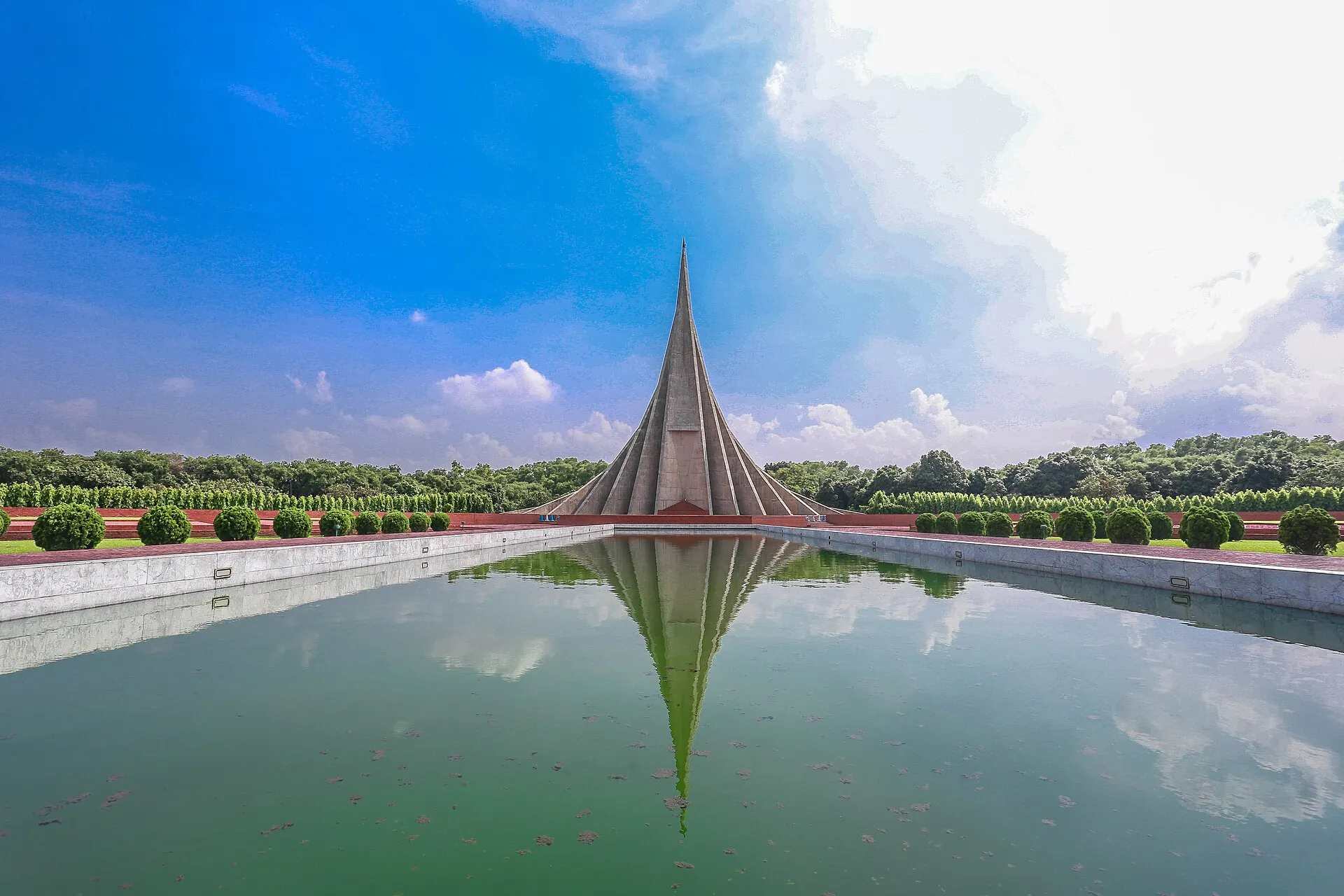 Photo: Shahriar Amin Fahim247, CC BY-SA 4.0
National Martyrs' Memorial, Savar
goCar about 1.5–3 h each way
A large memorial to the 1971 war dead; the road out is among the slowest in the region.
- Time
- Half to full day
Bagerhat (mosque city) and Sundarbans
overnightFlight to Jashore then car, or an overland or river journey of many hours
Not a day trip: fly or plan an overnight.
- Time
- 2–3 days
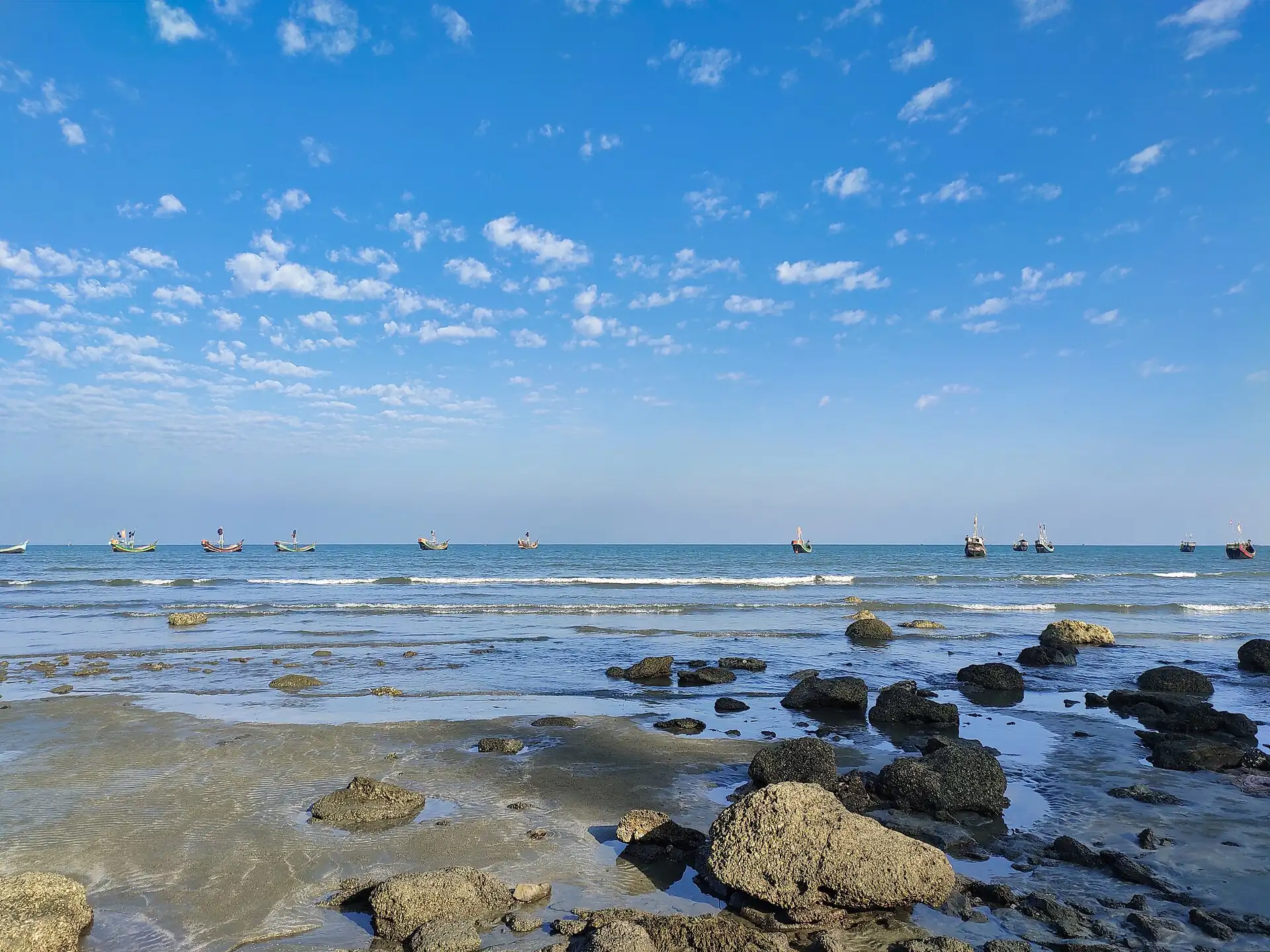 Photo: Rocky Masum This work was made by Masum-al-Hasan Rocky and released under the license(s) stated below. Please feel free to use it for any pu, CC BY-SA 4.0
Cox's Bazar
overnightFlight about 1 hour
The long beach; a separate trip from Dhaka.
- Time
- Overnight minimum
Sylhet tea country
overnightFlight about 45 minutes, or a long train or road journey
Tea gardens and hills; a separate trip.
- Time
- Overnight minimum
Eat & sleepWhere to eat and which area to sleep in
Eat & sleep
Where to eat and which area to sleep in
Eat
A short list of places worth crossing the city for, each with how to get a seat.
Restaurant finder: filter every place to eat in Dhaka →
Vegetarian-friendly score
2.0 / 5 · Workable
- Country diet noteOur country guide rates vegetarian eating as mixed.0.75 / 2
- Places to eat in this guide4 of 6 places with a known answer are vegetarian-friendly.1 / 1.5
- Budget eating lines0 vegetarian lines in "Eat by budget".0 / 0.6
- Meat-free national dishes6 meat-free dishes in the country food list.0.4 / 0.4
- Dedicated vegetarian kitchens0 mentions of vegetarian restaurants, Buddhist or fasting kitchens.0 / 0.5
Country note: Dal, bhorta and vegetable curries exist, but fish is in much of the food and 'vegetarian' may include fish.
Vegetarian places near me →Make a diet card →
How we score
- Country diet note (up to 2): easy 2, workable 1, mixed 0.75, hard 0; no note 0.5.
- City places to eat (up to 1.5): 1.5 × (vegetarian-friendly + half of partly friendly) ÷ places with a known answer; needs 3 or more known places.
- Budget eating lines marked vegetarian (up to 0.6): 0.2 each.
- Meat-free national dishes (up to 0.4): 0.1 each.
- Dedicated vegetarian kitchens mentioned — Buddhist chay, shōjin ryōri, Jain, fasting food, vegan cafés (up to 0.5): 0.1 each.
- Total rounded to the nearest half point, 0 to 5. Built from our own pages only, not from reviews.
Eating and drinking guideDrink
Drink & nightlife
| Where | What | Until | Note |
|---|---|---|---|
| Gulshan and Banani cafés | Coffee, tea, light food | About 22:00–23:00About 10:00 PM–11:00 PM | |
| Hotel bars (licensed) | Beer, spirits; check policies | Varies (check) |
By style
| Style | What | Where | Price | Until |
|---|---|---|---|---|
| Milk tea (cha) | Black tea boiled with milk and sugarSay 'kom chini' for less sugar. | Street stalls and cafés | BDT 15–40 | Throughout the day |
| Borhani | A salty, sour spiced yoghurt drink served with biryani | Biryani restaurants | BDT 40–100 | Restaurant hours |
| Sugarcane juice | Fresh-pressed juice from a street cartSkip if your stomach is sensitive; ice is the risk. | Street carts | BDT 30–60 | Daytime |
Rules that bite
- Do not buy alcohol from unlicensed sellers.
- Public drinking is not accepted and can cause trouble.
Sleep
Pick the area first: it decides your walk home at night and your first morning.
Which neighborhood fits you
Three questions, one recommendation, with the reasons.
More on sleepingYour area · With kids
Which area is yours
| If you are | Sleep in | Because |
|---|---|---|
| First visit, hotel with a 24-hour desk | Gulshan | Easy airport transfer and reliable hotels. |
| Closer to the old city, mid-range budget | Dhanmondi | Shorter rides to Shahbag and Lalbagh. |
01Gulshan
First-timers: hotels have 24h desks and a door the car can reach; the cafés and restaurants are near, but every sight is a long ride away.
Cheaper guesthouses and serviced apartments near the lake, closer to the old city; night staffing varies, so confirm before you fly.
Areas are in our default order until you tick a priority.
Scores are 1–5 desk judgements per priority (2026).
With kids
- Traffic and noise tire small children fast: plan one outing a day and rest in the hotel at midday.
- Lalbagh Fort's lawns and Ramna Park are open spaces where children can run.
- Old Dhaka's lanes are unsafe for strollers: use a carrier and keep children by the hand near traffic.
- Hotel swimming pools and mall play areas (Bashundhara City) are the reliable rest options.
PracticalMoney, essentials, safety and the pocket card
Practical
Money, essentials, safety and the pocket card
Money
What a day costs at three comfort levels, and how to pay.
- Budget
- BDT 2,500–5,000 excl. bed / day
- Mid
- BDT 5,000–12,000 excl. bed / day
- High
- BDT 12,000+ excl. bed / day
- Transit card
- No transit card needed for this plan: ride-hailing cars, CNG auto-rickshaws and rickshaws, and walking inside a cluster.
- Cash rule
- Keep BDT 3,000 in small notes; use ATMs inside banks, hotels or malls in daylight.
More on moneyCosts · Budget · Buy
What things cost
- Street snack (fuchka, chotpoti, jhalmuri)BDT 30–90
- Bottled water, 1 litreBDT 20–40
- Rickshaw, short hopBDT 50–150 (agree first)
- Airport to Gulshan, ride-hail carBDT 500–1,200 (2026 estimate, check)
Trip budget
| Hotel double room1 × 3 nights × BDT 9,000 | BDT 27,000 |
| Food, local transport, entries2 × 3 days × BDT 7,500 | BDT 45,000 |
| Airport car, one way1 × BDT 900 · one car per 4 people | BDT 900 |
| Local SIM or eSIM2 × BDT 1,000 | BDT 2,000 |
| Guide for an Old Dhaka morning1 × BDT 4,000 · agree the price first | BDT 4,000 |
| Buffer 12%Price creep, a taxi you did not plan, one splurge | BDT 9,470 |
| Trip total≈ BDT 14,730 per person per day, bed included | BDT 88,370 |
Prices rise around Eid and major holidays.
2026 estimate in Bangladeshi taka (BDT); flights, visas and day-trip transport excluded.
Prices of common things
| Ride-hail across the centre | BDT 200–500 |
2026 estimate; check locally.
Buy
- Bargaining
- Bargain at markets and with rickshaws and craft sellers; fixed prices apply in malls, supermarkets, Aarong and restaurants.
- Fixed-price check
- Aarong (a craft chain with several outlets) and supermarkets show fixed prices and set your ceiling for crafts and packaged goods.
Markets and shopping streets
| Where | What | When | Haggle | Note |
|---|---|---|---|---|
| New Market and Chandni Chowk | Clothing, fabric, crafts, shoes | Roughly 10:00–21:00; closed one weekday (check)Roughly 10:00 AM–9:00 PM; closed one weekday (check) | hard | Crowded and loud; keep valuables secure and bargain to about half the first price. |
| Shankhari Bazar and Tanti Bazar, Old Dhaka | Shell bangles, brass, fabric | Daytime (check) | light | Working lanes of the old city, best with a local guide. |
| Chawkbazar | Food, spices, fabric; the Ramadan iftar market | Daytime; night market in Ramadan (check) | light | Busy and hard to navigate; go with a guide and leave big bags at the hotel. |
| Karwan Bazar | Wholesale fish, vegetables and fruit | Early morning to late morning (check) | light | A very large working market; not for luggage or strollers. |
Shops by what they sell
| For | Where | Hours | Note |
|---|---|---|---|
| Craft and clothing (jamdani, nakshi kantha, jute) | Aarong outlets and craft stalls in Gulshan and Dhanmondi | About 10:00–21:00 | Jamdani is a hand-woven cotton fabric with woven patterns; check for machine-made versus handmade before paying a handmade price. |
| Malls (AC) | Bashundhara City and Jamuna Future Park | About 10:00–22:00 | Fixed prices; the heat-day and rain-day refuge. |
Changing money
| Where | Verdict | Why |
|---|---|---|
| Bank branches | use | Fair rate and a receipt; bring your passport. |
| Hotel exchange desks | ok | Slightly worse rate but safe. |
| Airport exchange booths | ok | Change enough for the ride and first day. |
| Street money-changers | avoid | Short-changing and counterfeit risk. |
ATMs
- Where
- ATMs inside banks, hotels and malls in daylight; skip stand-alone street machines.
- Fees
- Local fees plus your home bank's foreign fee; withdrawal limits per transaction are low, so expect several withdrawals.
- Conversion
- Decline any 'convert to home currency' prompt and pay in taka.
Essentials and accessEssentials · Access
Essentials
- Plugs & power
- 220–240V, 50Hz. Sockets vary between types C, D, G and K: bring a universal adaptor.
- Toilets
- Hotels, malls and larger restaurants; public toilets are few. Carry tissues and hand sanitiser.
- Health
- Pharmacies are common; carry your own prescription medication and rehydration salts. Travel insurance with medical evacuation cover is strongly recommended.
- Accessibility
- Pavements are missing, broken or blocked; rickshaws and CNG autos are not accessible. See the accessibility section.
- Laundry
- Hotel laundry is the reliable option; ask the price per item first.
- Emergency numbers
- 999 for police, fire and ambulance.
Pack
- Light, loose clothing that covers shoulders and knees
- Closed walking shoes you can slip off at mosques
- Face mask rated for fine particles (Nov–Feb smog)
- Insect repellent (dengue)
- Small BDT notes
- Rehydration salts and hand sanitiser
Accessibility
Dhaka is very hard for wheelchairs, strollers and visitors with limited mobility: pavements are broken or missing, rickshaws and CNG autos are not accessible, and traffic is heavy. Use pre-booked cars and pick hotels and sights that confirm lifts.
- Pavements
- Missing, broken, or blocked by stalls and parked motorbikes; walking is often in the road.
- Getting around
- A pre-booked car or ride-hail car is the only practical step-free option; the MRT has lifts at stations (check).
- Hotels
- Larger hotels in Gulshan usually have lifts and ramps; guesthouses often do not.
- Toilets
- Accessible toilets are rare outside international hotels and malls.
Sights, step-free or not
| Lalbagh Fort | with help | Paved paths and lawns; steps at the mosque and tomb. |
| Ahsan Manzil | with help | Steps and stairs inside; check the ground floor. |
| Bangladesh National Museum | with help | Ground floor is manageable; lifts to upper floors are unconfirmed. |
| Central Shaheed Minar | step-free | Open plaza, mostly level. |
Survive
Safety basics, the lines not to cross, and practical habits that save the day.
Safety
- Traffic: cross with local pedestrians, slowly and steadily; vehicles rarely give way.
- Air quality is poor in winter: a mask rated for fine particles helps on long walks.
- Mosquito-borne dengue is present in the monsoon and after: use repellent and cover up at dusk.
- Political rallies, strikes and road blockades can start with little notice: stay away from demonstrations and follow your hotel's advice.
- Emergency: 999 for police, fire and ambulance.
Red lines
- Mosques and shrines: cover shoulders and knees, remove shoes, and women cover their hair where signs require it.
- Do not photograph women, police, government buildings or demonstrations without asking.
- Buriganga river: go with a local guide; boats are crowded and the water is polluted.
Practical
- Toilets: hotels, malls and larger restaurants; carry tissues.
- Tap water is not for drinking; use bottled or filtered water.
More on staying safeStay safe · Stay healthy · Safety map · Solo & women · Etiquette · Cope · Scams
After dark, by area
2 flagged areas
- Take care
- Take care
Day = about 07:00–19:00. What to watch in each area, day and night →
Scams and red flags
Walk away if you see these
- Rickshaw and CNG drivers quoting a tourist fare well above the meter or app price: agree before you ride, or use a ride-hail app.
- Unlicensed 'guides' at Lalbagh, Ahsan Manzil and Old Dhaka who offer a tour and then ask a large fee: agree a price first, or decline.
- Money-changers on the street or at the airport quoting a rate that looks better than the bank: change at a bank or hotel, and count every note.
- Ride-hail drivers who cancel and ask you to pay cash for a higher fare: cancel and rebook in the app.
- Overpriced goods at tourist stalls near heritage sites: ask a local or your host what the price should be.
Stay safe
Stay healthy
Hospitals and clinics: see Cope.
Safety by area and hour
| Area | Day | Night | What to watch |
|---|---|---|---|
| Old Dhaka and Lalbagh | fine | caution | Narrow lanes and dark stretches at night: go by day with a guide, and keep phones and bags secure. |
| Shahbag and Ramna | fine | caution | Student protests and rallies gather at Shahbag and the Shaheed Minar; avoid them and check the news. |
| Gulshan and Banani | fine | fine | Standard city caution; street begging and phone snatching near the circles. |
| Dhanmondi | fine | fine | Standard city caution; traffic near Road 27 and Satmasjid Road. |
- Cross roads with local pedestrians, slowly and steadily; vehicles rarely give way.
- If a demonstration, strike or road blockade starts, go back to your hotel and follow local advice; check your government's travel advice before you fly.
Solo, women and LGBTQ+ travellers
Solo
- Manageable with common sense; use ride-hail apps rather than street taxis, and hire a licensed guide for Old Dhaka.
- Foreign visitors draw attention: expect stares and requests for photographs, and decline politely if you prefer.
Women
- Dress modestly: loose clothing covering shoulders and knees, and carry a scarf for mosques.
- Harassment and staring happen in crowds; sit in the back of ride-hail cars, avoid empty streets after dark, and walk with a companion where you can.
- Some restaurants and rickshaw stands are used mainly by men; a quieter café is easier.
LGBTQ+
- Same-sex acts are criminalised in Bangladesh and public attitudes are conservative: be discreet and keep affection private.
Etiquette in Dhaka
- Greeting
- A handshake between men is normal; a woman may prefer to greet with a nod and a hand on the chest. Wait for the woman to offer her hand.
- Dress
- Cover shoulders and knees in public; women cover their hair in mosques and at some shrines.
- Shoes
- Remove shoes at mosques, temples and inside homes.
- Left hand
- Eat, pass and receive with the right hand; the left is considered unclean.
- Photography
- Ask before photographing people, especially women; do not photograph police, military, government buildings, bridges or airports.
- Friday
- Friday midday prayer closes many shops and mosques to visitors: plan around it.
Cope
Hospitals and clinics that handle foreigners
| Where | Area | Use it for |
|---|---|---|
| Private hospitals in Gulshan, Dhanmondi and Bashundhara | Check current recommendations from your insurer | Better equipped than public hospitals; serious conditions are often best managed by evacuation to Singapore, Bangkok or home. |
| International SOS or similar assistance providers | Contacted via your travel insurer | Useful for coordinating care and evacuation. |
Visa extensions
- Visa
- Most visitors need a visa arranged before arrival; the rules and any e-visa or visa-on-arrival options change, so check with the Bangladesh embassy or official portal well before you fly.
- Extending a stay
- Handled through the immigration authorities; process and requirements change, so check current guidance.
Embassies and consulates
| Country | Address | Phone | Note |
|---|---|---|---|
| United States | Gulshan and Baridhara diplomatic area (check current address) | — | (check) |
| United Kingdom | Gulshan (check current address) | — | (check) |
| India | Baridhara (check current address) | — | (check) |
- Lost passport
- Report to the police, then contact your embassy for an emergency document.
- Pharmacies
- Common in every district; check the expiry date and bring any specific medication yourself.
- Laundry
- Hotel laundry is the reliable option.
Apps and offline kitOffline kit
Offline kit
Set up before you leave, so Dhaka still works with no signal or a dead roaming plan.
On your phone
- Maps: open the city in Google Maps, tap the place name, then Download offline map (or use an offline-maps app).
- Data: install an eSIM or buy a local SIM before the first taxi; the apps in this guide depend on it.
- Translation: download the local language for camera translation.
- Screenshots: booking confirmations, hotel address in the local script, and the emergency numbers.
This guide
Save the Dhaka guide and its pages on this device; it opens without a connection.
Phrases that do the work
Greeting
Hello (Muslim greeting)
আসসালামু আলাইকুম
as-sa-LA-mu a-LAI-kum
Greeting
Hello (general)
নমস্কার
no-mosh-KAR
Thanks
Thank you
ধন্যবাদ
dhon-no-BAD
Polite
Please
দয়া করে
DO-ya KO-re
Help
Do you speak English?
আপনি কি ইংরেজি বলতে পারেন?
AP-ni ki ing-RE-ji BOL-te PA-ren
Shop
How much is this?
এটার দাম কত?
E-tar dam KOTO
Taxi
Stop here, please
এখানে থামুন
e-KHA-ne THA-mun
Cafe
Less spicy, please
ঝাল কম
jhal KOM
Cafe
The bill, please
বিল দিন
bill DIN
Help
I need a doctor
আমার ডাক্তার দরকার
A-mar DAK-tar DO-rkar
Pocket card
Fill in, then print or save as PDF
Stays in this browser only; nothing is sent anywhere.
Dhakaঢাকা
Pocket card · Voykit
My bed tonight
—
—
—
দয়া করে আমাকে এই ঠিকানায় নিয়ে যানPlease take me to this address
Emergency
- Police, fire, ambulance999
Embassy
My embassy: —
Fare anchors (2026 estimate)
- Airport → Gulshan, ride-hail car: BDT 500–1,200, 30–90 min (2026 estimate, check)
- Short ride-hail ride in Gulshan: BDT 150–400
- Rickshaw, short hop in Old Dhaka: BDT 50–150 (agree first)
Say or show
- ধন্যবাদ — Thank you (dhon-no-BAD)
- এটার দাম কত? — How much is this? (E-tar dam KOTO)
- ঝাল কম — Less spicy, please (jhal KOM)
- বিল দিন — The bill, please (bill DIN)
Show the address written down and use a pinned map location; drivers do not always read English addresses.
Deep diveHistory, reading, photos and every source
Deep dive
History, reading, photos and every source
Sources
- officialBangladesh National Portal
- officialCivil Aviation Authority of Bangladesh
- secondaryWikivoyage — Dhaka
Ask about Dhaka
Loading…
Was this useful?