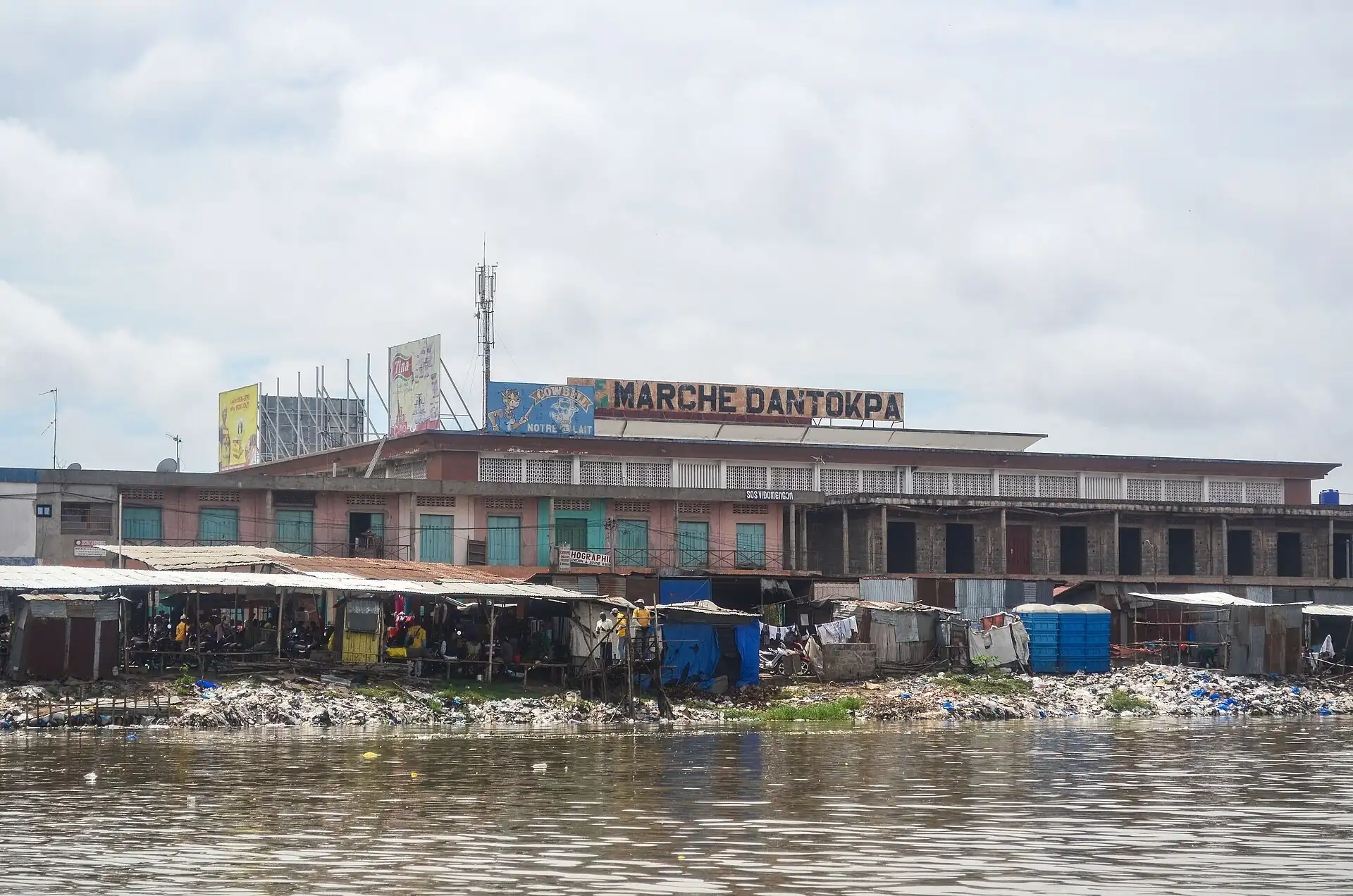
Cotonou
Code BE · 4 walking zones
Cotonou is a morning-and-evening city: the market at first light, air conditioning at midday, and dinner in Haie Vive — always by car, and with cash in your pocket.
Our quick read of Cotonou, scored 1–5 (friction is out of 100). Cash need: how often you still need notes. Heat risk: how hot days get. Stroller: how easy wheels are. Friction: overall effort for a first visit. Desk judgements, so check before relying on them.
- Local time
- --:--
- Weather
- forecast below
- Currency
- XOF
- Best months
- Jan · Feb · Mar · Nov · Dec
- Airport
- Cadjehoun (COO)
Walking zones: the 4 areas this guide plans a day around. Each is a district you can cover on foot, so you do one zone per half-day and ride the train between them. The code (BE 01, BE 02…) is just the zone's number on the Cotonou line; the line under each name says how bags fare there and how much time it needs.
Map of Cotonou
Use the switches to show or hide each kind of pin. A switch that is on shows its pins on the map; tap it again to hide them. "Show only" keeps just the pins that match (for example, places that fit a suitcase). Tap any pin for its name and a link to its page.
- Where to sleep
- Places
- Eat
- Walking clusters
- Rest stops
From the airport Cadjehoun (COO) to your bed
Tap a pin for its card. Places without their own coordinates are shown by their walking cluster.
Why Cotonou
Cotonou is Benin's economic capital, spread flat along the coast and a lagoon. Distances are short but traffic, heat and motorbike taxis make walking between districts a poor idea. The trips that go wrong run out of cash, take a motorbike without a helmet, or swim off the surf beach. Four clusters cover a first visit; Porto-Novo and Ganvié are trips from one kept bed.
See first
- 1
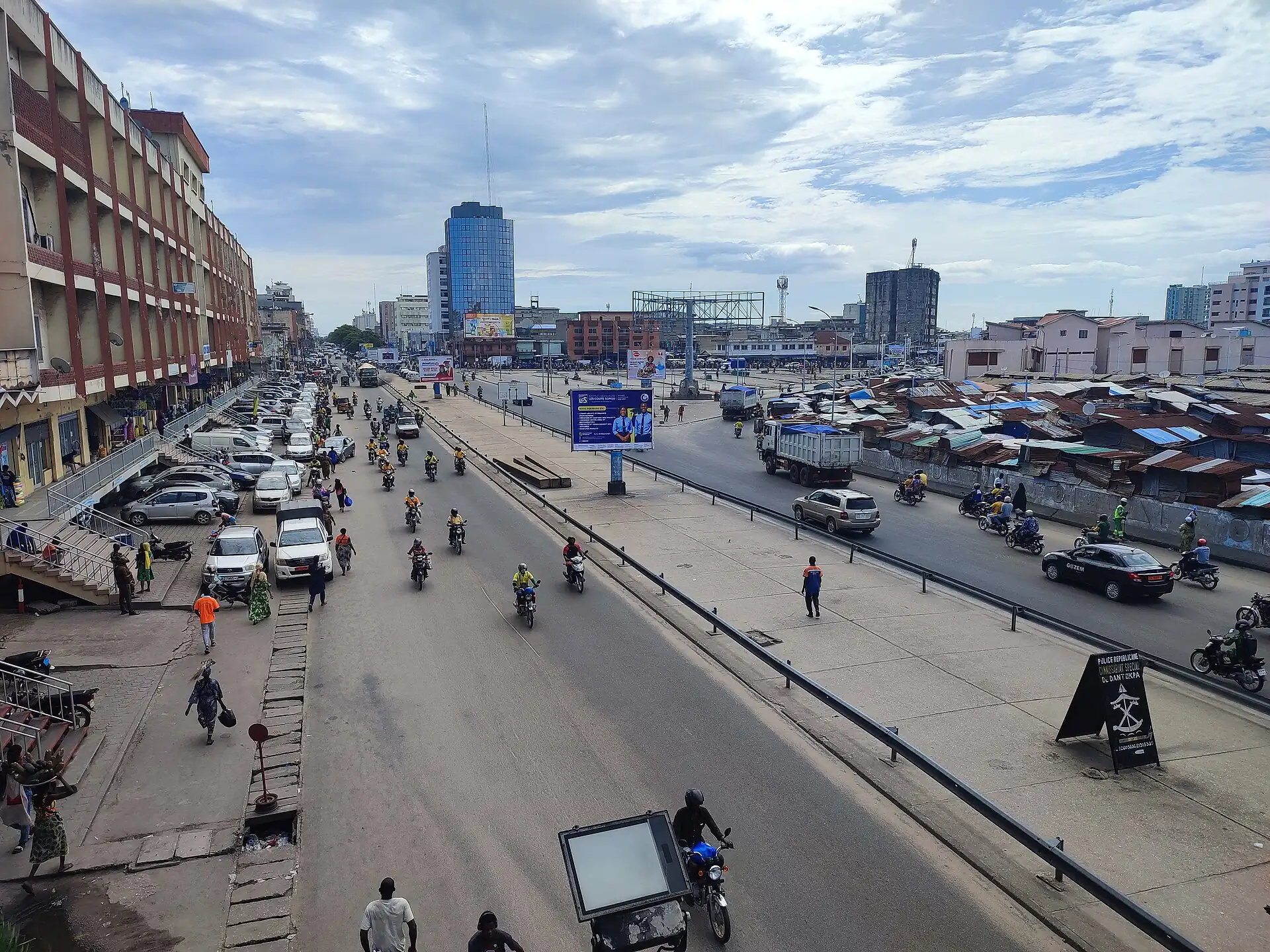 Dantokpa Market at first light · 45–75 min
- 2Fondation Zinsou · 45–60 min
- 3
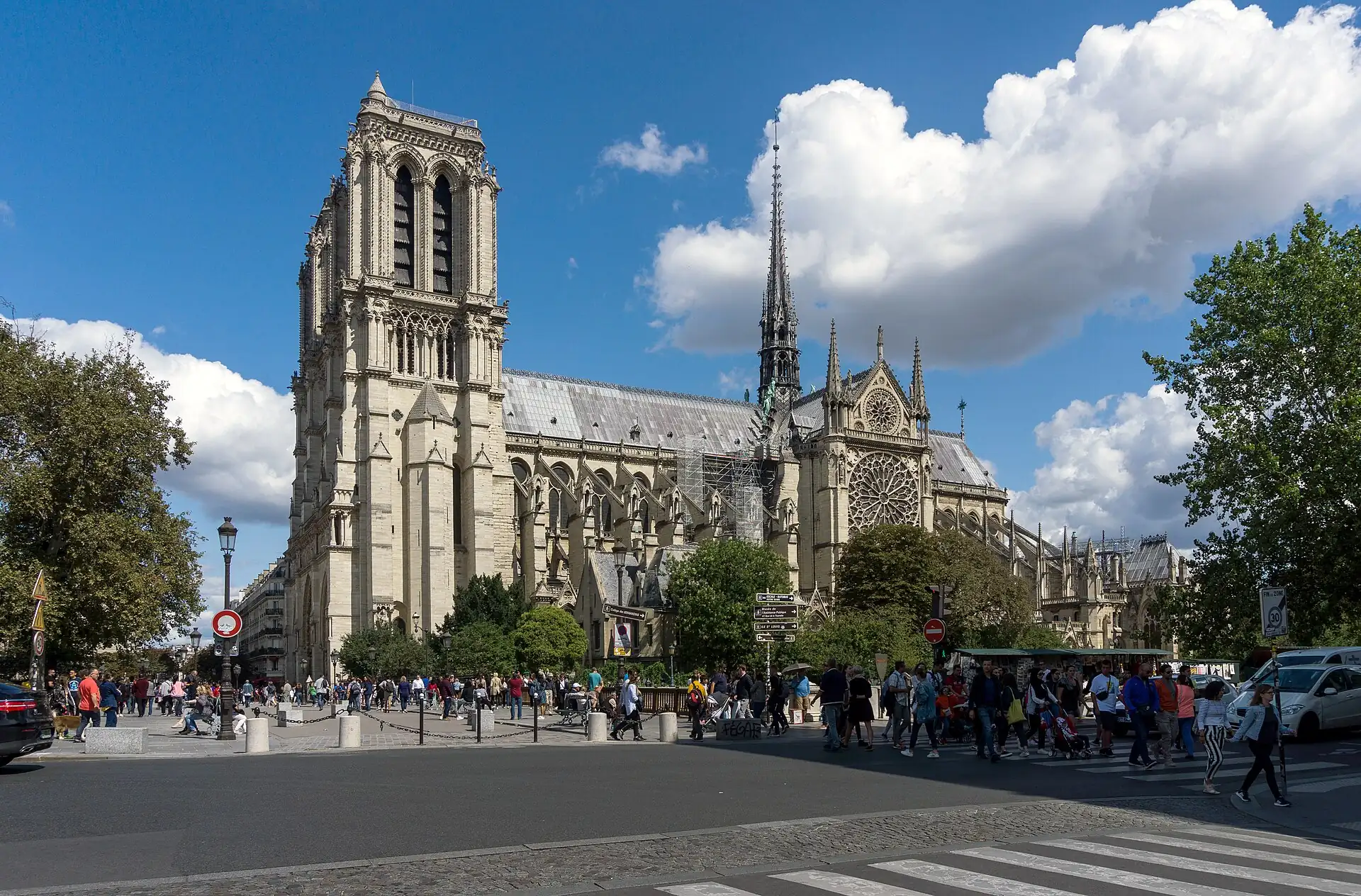 Notre-Dame Cathedral · 15–20 min
- 4Fidjrossè beach · 60–90 min
- 5Grilled fish on the beach · 1–1.5 h
Fits
- Culture and market trips
- Short city stays before Ouidah or Abomey
- Travellers who use a driver
Does not fit
- Independent walkers
- Card-only travellers
- Strollers and wheelchairs
How long
- 2 daysDantokpa and cathedral morning, Haie Vive evening
- 3 daysFour clusters, mornings and evenings
- 5 daysFour clusters + Porto-Novo day trip + Ganvié half-day
Good for
- First timers
- Foodies
- Budget
- Families
- Solo
- Wheelchair
About Cotonou
Cotonou is Benin's largest city and its working capital: the port, the international airport, the main market, the banks and most ministries are here. Porto-Novo, about an hour east, is the official capital.
The city grew from a fishing settlement between the Atlantic and Lake Nokoué. The French took control in the 1890s, built a wharf and later a railway north, and the port opened in the 1960s. Trade with Nigeria and with the landlocked countries to the north still drives the economy.
Benin is the home of Vodun, and the shrines and festivals are part of ordinary life, alongside large Catholic, Methodist and Muslim communities. Most days here are made of a market, a plate of pâte and sauce, and a lot of motorbikes.
Good to know
- Cotonou is the economic capital and the main gateway; Porto-Novo, about an hour away, is the official capital.
- There is no reliable walk-in tourist office. Your hotel front desk, a licensed guide and the Benin tourism ministry pages are the practical sources.
- For excursions, ask your hotel for a driver and confirm the total price before you leave.
Go deeper 14 min read · 6 chapters
Cotonou is a city of trade. It began as a fishing settlement between the Atlantic and Lake Nokoué, became a French customs post and wharf, and grew into the economic capital of Benin while Porto-Novo kept the title of official capital. It has no old centre to walk. It has a market, a port, a channel, a beach road and a great many motorbikes, and its interest is in how those fit together. This deep dive covers how the city grew, how its districts and traffic work, the Vodun religion that runs through Benin, the food, the art scene and the trade that pays for it all.
1History2 min
Before the French, the coast between Ouidah and Porto-Novo was a patchwork of fishing villages and small states on the lagoons. Cotonou was a settlement on a sandbar between the sea and the lake, and it sat within the reach of the Dahomey kingdom, whose capital was Abomey, inland. A common story derives the name from the Fon words for the mouth of the river of death. It is folklore rather than a documented fact, but it is the one people tell.
France came to the coast for trade. In 1868 it obtained rights to a trading post at Cotonou from Dahomey, and in the 1880s and 1890s that foothold turned into control. After fighting with the forces of King Béhanzin in 1890 and 1892–94, France took the whole of Dahomey and made it a colony. Cotonou became the port. Because there was no sheltered harbour, goods were carried through the surf, first by canoe and then over a wharf, and the wharf became the reason the town grew. The railway north from Cotonou, begun in the early twentieth century, extended the colony's reach toward Parakou and was meant to carry goods from the interior to the sea.
Independence came on 1 August 1960. The new state was called Dahomey, and its first years were marked by coups and short-lived governments. In 1972 Mathieu Kérékou took power and in 1974 he declared a Marxist-Leninist state. The country was renamed Benin in 1975 and the red-star monument on the airport road is a leftover of those years. The deep-water Port of Cotonou had opened in 1965, and the economy leaned on it even as the state controlled much of it. Benin's economy struggled through the 1980s, and in 1989 a crisis forced change.
In February 1990 a national conference stripped the president of most of his powers and ended one-party rule, an event that later became a model for other African countries. Multiparty elections followed in 1991, and Kérékou returned to office by the ballot box in 1996. Power has since passed through elections, although recent years have seen tensions over the opposition and press freedom. Check current advice before any trip that depends on politics.
One event stayed in memory: in January 1977 a group of mercenaries landed at Cotonou airport and attacked the city in an attempt to overthrow the government. It failed, and it shaped years of official caution about security. That caution explains why photographing the airport, the port and government buildings is still discouraged.
Today Cotonou is the seat of most ministries and the presidency in practice, while Porto-Novo remains the official capital and the seat of the parliament (check current arrangements). The city has merged with Abomey-Calavi to the north and Sèmè-Podji to the east, and it is one of the fastest-growing urban areas in West Africa.
- French trading post
- 1868, Cotonou
- Colony of Dahomey
- Established in the 1890s
- Independence
- 1 August 1960
- Deep-water port opens
- 1965
- Renamed Benin
- 1975
- National conference
- February 1990
2Lagoon, channel and districts3 min
Cotonou is a flat strip between two bodies of water. To the south is the Atlantic, with a surf beach that has no sheltered anchorage. To the north is Lake Nokoué, a shallow lagoon fed by the Ouémé and Sô rivers. The two are joined by a narrow channel that cuts the city in half. The channel was dredged to give the port and the fishermen access to the sea, and it is the reason bridges matter so much to how long a trip takes: a ride from Haie Vive to Akpakpa on the east bank can take 15 minutes or an hour, depending on the traffic at the crossing.
The middle of the city is Ganhi, the old commercial district, with banks, wholesalers and the cathedral. Nearby is Dantokpa, the market on the lagoon side, which is the economic heart of the city. Toward the airport, on the western side, are Haie Vive and Cadjehoun, where most of the hotels, embassies, restaurants and art spaces are. Fidjrossè, farther west, is a beach quarter with palm bars and a working fishing shore. Across the channel is Akpakpa, a dense district of houses, workshops and markets that most visitors never reach.
The plan of the centre is French. The old districts follow a grid, with wide boulevards, and the streets in the newer parts are dust and paving. Numbers are thin on the ground. People navigate by landmark: the roundabout, the church, the petrol station, the bank. If you ask a driver to take you to an address, he will ask you for the nearest landmark, and the reply is often more useful than a map.
Traffic is the shaping force of the day. The city is built for cars, but most of the traffic is motorbikes. The zémidjan (in Fon, "take me quickly") riders wear yellow or green shirts and carry passengers and goods across town for a few hundred francs. The word is now used across Benin and beyond. The bikes are fast and cheap, and they are the main reason the roads are dangerous. Rules about helmets, colours and numbers have changed over the years, so ask locally. The sensible visitor uses a car and reserves the bike, if at all, for short hops with a helmet.
Rush hours are 07:00 to 09:00 and 16:30 to 19:00, and rain makes them worse. A five-kilometre trip can take 15 minutes at noon and 50 minutes at dusk. It is worth planning the day around this. The market is best at first light before the roads fill, the cool indoor stops sit in the afternoon, and the beach is an evening trip on a road that is already slowing down.
The city is also spreading: Abomey-Calavi to the north has grown into a large district of universities and housing, and the Sèmè-Podji coast to the east is a corridor toward Nigeria. The area now called Grand Cotonou is home to more than two million people (2026 estimate), and the centre is only a part of it. The best way to feel this is to take the car north toward the lake or east toward Porto-Novo and watch how the city thins into villages and fields.
- Ocean
- Atlantic, surf beach
- Lake
- Nokoué, joined to the sea by a channel
- Grand Cotonou population
- Over 2 million (2026 estimate)
- Rush hours
- 07:00–09:00 and 16:30–19:007:00 AM–9:00 AM and 4:30 PM–7:00 PM
3Trade, the market and the port2 min
Cotonou lives on trade. The port handles goods for Benin and for the landlocked countries to the north: Niger, Burkina Faso and Mali all use it, and trucks line the roads out of the city. A large part of the trade is with Nigeria, sometimes in goods that are re-exported across the border. This informal trade is part of the economy, and the border closure of 2019–2020 showed how much of the city depends on it, from the porters to the wholesalers.
Dantokpa is where that trade meets ordinary life. It is often described as the largest market in West Africa, and it is certainly the largest in Benin. It sits on the edge of the lagoon, and boats bring goods to its shore. Inside you can find food, cloth, hardware, motorbike parts, palm oil and dried fish, sold in lanes that are organised by product. Some sellers have been in the same lane for decades. Prices are negotiated, and the first price to a visitor is well above the price a neighbour would pay.
The market is also a social institution. Many of the stallholders are women, and trading has long been a route to independent income for women in the south. Today the cloth trade in particular is squeezed by cheap imports, and the sellers you meet are often adapting to that: buying from wholesalers on credit, selling in smaller lots, or moving to phone accessories and household goods.
The port, by contrast, is a closed space. It is a place to see from a distance, and photographs are not welcome. The road that runs along the sea passes the container yards and the harbour cranes, and the city's freight traffic goes through them.
Money is mostly cash. The CFA franc (XOF) is pegged to the euro at about 656 francs per euro, and it is shared by eight West African countries. Cards work in a few hotels and supermarkets. For a visitor this means that cash management is one of the real tasks of the day: change money at a bank, carry small notes and do not rely on an ATM.
If you want to understand Cotonou in one hour, spend it at Dantokpa at 07:00. Buy a small thing, drink a coffee at a stall and watch the way the lane has been organised. Then leave before the heat.
- Currency
- CFA franc (XOF), about 656 per euro
- Port serves
- Benin, Niger, Burkina Faso, Mali
- Nigeria border closure
- 2019–2020
- Best time at Dantokpa
- 07:00–10:307:00 AM–10:30 AM
4Vodun and religion2 min
Benin is the birthplace of Vodun, one of the oldest religions in West Africa, and it is easy to underestimate how much of daily life it touches. Vodun is not one belief but a family of them, built around a creator, a set of spirits (vodun) that each look after a part of the world, and the ancestors. The spirits include Legba, the messenger who guards the crossroads and the doorways; Mami Wata, the water spirit associated with wealth; Hevioso, the spirit of thunder; and Sakpata, associated with the earth and disease. Shrines are found in houses, at crossroads and in the open, and most of them are small.
The religion spread with the slave trade. Enslaved people taken from the coast around Ouidah carried it to Haiti, Brazil and Cuba, where it merged with other traditions and became Haitian Vodou, Candomblé and Santería. Ouidah, about 40 kilometres from Cotonou, was one of the main departure ports, and the road from the old slave market to the beach is now a memorial route. It ends at a monument called the Door of No Return.
In Benin, Vodun was suppressed in the colonial period and again under the Marxist state, and it came back into public life after 1990. The government made Vodun Day, on 10 January, a national holiday in the 1990s, and it is celebrated most visibly in Ouidah. Other festivals mark the ancestors, including the masquerades called Egungun in the Yoruba areas near the Nigerian border and the night guardians called Zangbeto in the coastal towns.
Vodun sits beside other faiths. Christianity is widespread in the south, with large Catholic and Methodist congregations, and Cotonou's cathedral is a landmark. There are also large Muslim communities, especially in the north. Many families practise more than one tradition, and it is normal to find a church on one corner and a shrine on the next.
A visitor who wants to see something of Vodun should go with a guide who has a relationship with the shrines. Ouidah is the place for this, not Cotonou. Ask before photographing, do not touch objects or step over ritual items, and be ready to give a donation or a small gift. Some ceremonies are open to outsiders and many are not, and a guide will tell you which is which. Beware of anyone who sells a "ceremony" on the street.
The best introduction in Cotonou itself is at the art foundation and the craft market, where Vodun-related objects, bronzes and appliqué cloths are sold and explained. Buy new work made for sale, not sacred objects, and check the export rules for anything old.
- Vodun Day
- 10 January, public holiday
- Main Vodun centre
- Ouidah, about 40 km (25 mi) westOuidah, about 25 mi (40 km) west
- Spirits
- Legba, Mami Wata, Hevioso, Sakpata
- Diaspora
- Haitian Vodou, Candomblé and Santería descend from it
5Food2 min
Beninese food is built on starch and sauce. The starch is usually pâte, a firm paste made from maize, cassava or yam flour, cooked and stirred until smooth. You eat it with your right hand: tear off a piece, roll it into a ball, press a dent with your thumb and scoop up the sauce. The sauces are the variety: tomato, okra (gombo), peanut, or a green sauce made from leaves. In the south the paste is often the red version called amiwo, cooked with tomato and palm oil.
Fish is the centre of the coast. Fish from the sea and the lagoon is grilled over coals (poisson braisé), with onion and pepper sauce, and it is sold by size. It is the classic meal at a beach table. The other star is the local free-range chicken, called poulet bicyclette, which is leaner and chewier than the farm bird and best grilled or in sauce. Beans and rice cooked together, called atassi, come with fried fish or meat, and aloko, the fried ripe plantain, is the side that goes with everything.
Breakfast is a world of its own. Street stalls sell beignets, the bean fritters called akara, and porridges of maize or millet (bouillie). Akassa, a fermented corn dough wrapped in leaves, is eaten with sauce or sugar. Wagashi, a fried Fulani cheese, is sold at the roadside. Many of these are cheap enough to try in a handful of coins, and the rule is to eat what is fried in front of you and served hot.
To drink, the local lager is La Béninoise. Bissap, a hibiscus drink, and ginger juice are sold in the street and in cafés. Sodabi is the palm spirit that is distilled locally and poured for the ancestors at ceremonies. It is strong, and homemade versions are risky. Drink a small measure from a sealed bottle or a source you trust.
Where to eat depends on what you want. The buvette or maquis is the everyday local eating place: a few tables, a grill or a pot, and a menu that is whatever is fresh. It is cheap and slow. The beach tables at Fidjrossè are for grilled fish and a sunset. The hotel restaurants in Haie Vive serve French and West African menus at higher prices. In all of them the trick is to ask the price before the food is cooked, particularly for a whole fish or chicken.
The cuisine has a wider family. The cooking of neighbouring Nigeria, Togo and Ghana shares the starch and sauce pattern, and the Benin versions have French touches: baguettes at breakfast, sauces made with butter, and pastry shops in Haie Vive. It is common to see a plate of grilled fish and fried plantain served beside a fresh baguette.
- Everyday starch
- Pâte (maize, cassava or yam)
- Coast dish
- Poisson braisé (grilled fish)
- Local chicken
- Poulet bicyclette
- Local beer
- La Béninoise
- Palm spirit
- Sodabi
6Art, music and memory2 min
Benin has a stronger art scene than its size suggests, and Cotonou is where it is visible. The Fondation Zinsou, founded in 2005 by Marie-Cécile Zinsou, was the first major contemporary art foundation in the country, and it has a record of shows for children, local artists and young audiences. It opened a second site in Ouidah in 2013. It is free to enter (check), it is air-conditioned, and it is an easy morning or midday stop.
The older art of the region lies in Abomey and the palaces of the Dahomey kings, whose bas-reliefs, thrones and cloths tell the history of the kingdom. In 2021 France returned 26 royal treasures taken from Abomey in 1892, and they were shown in Cotonou in 2022. A plan for a permanent museum in Abomey is under way (check status). The appliqué cloth you see at the craft market is a descendant of the cloth banners made for those kings, and its bright figures often show animals that represent kings.
Music is the other great export. Cotonou was the home of the Orchestre Poly-Rythmo de Cotonou, a band that in the 1960s and 1970s mixed Vodun rhythms, funk and Afrobeat, and whose records were rediscovered by collectors from the 2000s. The singer Angélique Kidjo, from Ouidah, has carried Beninese sound to the world. Live music is found in Haie Vive bars, at festivals and at the beach on weekends, and hotels are usually the best source for what is on this week.
Memory is a public subject. The Route des Esclaves in Ouidah runs from the old slave market to the Door of No Return on the beach, and the museum in the Portuguese fort tells the history of the trade. The Amazons of Dahomey, the women's regiment of the kingdom, are also part of the story, and a recent film brought them into wide public view. The history is contested and painful, and the best way to see it is with a local guide and time.
The city also has a modern urge for public art. Murals appear on walls in Haie Vive and around the centre, and young designers use the cloth and craft traditions in contemporary fashion. A visit to the craft market followed by a gallery in the afternoon is a simple way to see both the old forms and the new ones.
If you have a day, spend the morning at the market, the midday at the foundation and the late afternoon at the beach. If you have two, take one of them to Ouidah. The city gives you the trade and the present. The towns around it give you the past.
- Fondation Zinsou founded
- 2005, Cotonou
- Royal treasures returned from France
- 26 objects, 2021
- Orchestre Poly-Rythmo
- Cotonou band, 1960s–70s
- Route des Esclaves
- Ouidah, about 40 km (25 mi) westOuidah, about 25 mi (40 km) west
Rules in force · 8Nine African countries on this site have no trip line bec…Carry an original yellow fever vaccination certificate on…
- Africa ↗When a route touches a yellow-fever country — even a transit of 12 hours or more — keep the original yellow card (ICVP) in your hand luggage; health desks and airlines can refuse boarding or entry without it.
- Africa ↗Nine African countries on this site have no trip line because governments advise against travel; several others have no-go regions. Read your government's advice for every country on the route before paying deposits.
- West Africa ↗Carry an original yellow fever vaccination certificate on any West African trip: several countries on the coast road demand it of every arrival, and the rest demand it after you have passed through a neighbour.
- West Africa ↗Cross land borders and drive between cities in daylight only; plan each crossing as a full travel day with cash for fees and passport copies for checkpoints.
- Benin ↗Check visa and entry rules for your passport on official Beninese government sources; an e-visa exists for many nationalities.
- Benin ↗Governments advise against travel to parts of northern Benin near the Burkina Faso and Niger borders, including areas around the national parks; check your own government's advice.
- Benin ↗Vodun is a living religion: ask before photographing shrines and ceremonies, and follow your guide's instructions.
- Cotonou and Porto-Novo ↗Travel in daylight, use a car with a driver, and avoid motorbike taxis unless you have a helmet.
Entry rules depend on your passport. Full visa guide
Emergency numbers for Cotonouopen ▾
- Police, ambulance, firecheck locally
- Hotel front desksave on arrival
Tap a number to call from your phone. These are the numbers listed in this guide; a row marked check has not been verified.
Planning is the full guide. I'm here keeps what is open and the cheat card.
Right now
Checking the weather…
Working out what is open near you…
What is open nowclock, closures, places open
Now in Cotonou
Local time in Cotonou
--:--
Loads in your browser · Africa/Porto-Novo
This month
Month verdict appears here.
Closed today
See the weekly grid below.
If today is a closure day: On the morning you go out, confirm road conditions after rain, market hours and any government travel advice with your hotel. Conditions change and are not tracked live here.
This page is a first-visit structure, not live status. Always check locally before a trip outside the city.
Cheat cardthe pocket version
Cheat card
The essentials on one card: save it as an image for your phone, share it, or print it.
Cotonou
- Money
- Keep XOF 10,000 in small notes; use ATMs inside banks or hotels, not on the street…
- SIM
- Buy a local SIM (MTN Benin or Moov Africa) with your passport at the airport or a shop; data bundles are cheap.
- Ride app
- Ride-hailing apps
- Emergency
- check locally police, ambulance, fire · save on arrival Hotel front desk (not 911, 999 or 000)
- Plugs
- Sockets C/E. US/Canada (A/B): adapter · UK/Ireland (G): adapter · Australia/NZ (I): adapter. 220 V: US 120 V-only devices (hair dryers) need a converter; most chargers are dual-voltage.
Top 5
- Dantokpa Market at first light
- Fondation Zinsou
- Notre-Dame Cathedral
- Fidjrossè beach
- Grilled fish on the beach
EssentialsQuick answers, what things cost and how to get around
Essentials
Quick answers, what things cost and how to get around
Quick answers
The questions people ask first about Cotonou, one line each. Tap a card for the full answer.
- Cash or card?Cash (XOF) for markets, maquis, taxis and zémidjans.
- SIM or eSIMBuy a local SIM (MTN Benin or Moov Africa) with your passport at the airport or a shop; data bundles are cheap.
- Ride-hailing appRide-hailing apps.
- Tap watercheckDo not drink tap water; use sealed bottled water and check the cap.
- TippingNot expected at stalls.
- Plugs & powerSockets C/E. US/Canada (A/B): adapter · UK/Ireland (G): adapter · Australia/NZ (I): adapter. 220 V: US 120 V-only devices (hair dryers) need a converter; most chargers are dual-voltage.
Show all 14 answers
- Safe at night?Take more care after dark in Haie Vive and Cadjehoun, Ganhi and the centre, Dantokpa and more.
- What to wearNeat and covered shoulders and knees in churches and near shrines; Sunday best is common at church.
- RestroomsHotels, larger cafés and restaurants; carry tissues and hand gel.
- Emergency numberscheckcheck locally police, ambulance, fire · save on arrival Hotel front desk (not 911, 999 or 000)
- Your embassycheckUS, UK embassies listed with addresses (check before you go).
- Sundays & holidaysVodun Day (Fête nationale du Vodun): Public holiday.
- Rainy-day planFrom April to July and again in September and October heavy rain can start within minutes and flood the roads.
- Landing lateCOO: pre-booked hotel car to the door runs all night.
Cost cheat-sheetwhat everyday things cost
Cost cheat-sheet
Typical prices for the everyday things, as ranges. Change the currency right here; the local price stays first.
2026 desk estimate · check
- Sit-down mealSit-down restaurant meal, per personXOF 8,000–20,000
- BeerLocal beer, bottleXOF 800–1,500
- Taxi, about 5 km (3 mi)Taxi, about 3 mi (5 km)Motorbike taxi (zémidjan), short hopXOF 300–1,000
- SIM or eSIM, a weekLocal SIM with data, about a weekXOF 3,000–8,000
- Budget bedFamily or larger room, a night, per roomXOF 40,000
- Mid-range bedHotel double room, a night, per roomXOF 60,000
- High-end bedHotel double room, a night, per roomXOF 150,000
A day, not counting the bed: Budget XOF 12,000 · Mid XOF 28,000 · High XOF 60,000
Local prices, with USD next to them (rates 2026-09 (approximate); change it in the header). Ranges are desk estimates: check locally. Every price and the budget calculator →
Source: Prices in Cotonou
Draft
Written from desk research. Not yet compared with the official source.
No official source is recorded for this figure.
Prices are 2026 desk estimates, not yet compared with an official source. Check on the day.
Not checked in the last 12 months (no check date on file).
DecideWho it suits, the trade-offs and when to go
Decide
Who it suits, the trade-offs and when to go
Best months at a glance
The guide's verdict for each month
Jan
Best
31°C (88°F)88°F (31°C)
Feb
Best
32°C (90°F)90°F (32°C)
Mar
Best
32°C (90°F)90°F (32°C)
Apr
Care
32°C (90°F)90°F (32°C)
May
Avoid
31°C (88°F)88°F (31°C)
Jun
Avoid
29°C (84°F)84°F (29°C)
Jul
Care
28°C (82°F)82°F (28°C)
Aug
Care
28°C (82°F)82°F (28°C)
Sep
Care
29°C (84°F)84°F (29°C)
Oct
Care
30°C (86°F)86°F (30°C)
Nov
Best
31°C (88°F)88°F (31°C)
Dec
Best
31°C (88°F)88°F (31°C)
Best: Nov–Mar. Mixed: Apr, Jul–Oct. Avoid: May–Jun. Month by month →
Warmest Feb (32°C (90°F)90°F (32°C)), coolest Jul (23°C (73°F)73°F (23°C) low), wettest Jun (15 rain days), driest Jan (2). Averages, not a forecast.
Cotonou across the year
Best-looking months for Cotonou: Jan, Feb, Dec. Rated avoid: May, Jun.
| Measure | Jan | Feb | Mar | Apr | May | Jun | Jul | Aug | Sep | Oct | Nov | Dec |
|---|---|---|---|---|---|---|---|---|---|---|---|---|
| Weather | Great (good) | Great (good) | Good (good) | Mixed (care) | Avoid (avoid) | Avoid (avoid) | Mixed (care) | Mixed (care) | Mixed (care) | Mixed (care) | Good (good) | Great (good) |
| Crowds | High (care) | Medium (ok) | Low (good) | Low (good) | Low (good) | Low (good) | Low (good) | Medium (ok) | Low (good) | Low (good) | Low (good) | Medium (ok) |
| Prices | High (care) | Medium (ok) | Medium (ok) | Low (good) | Low (good) | Low (good) | Low (good) | Medium (ok) | Low (good) | Low (good) | Medium (ok) | Medium (ok) |
| Events | 3 events (care) | None listed (ok) | 1 event (ok) | None listed (ok) | 1 event (ok) | None listed (ok) | 1 event (ok) | 2 events (ok) | None listed (ok) | None listed (ok) | 1 event (ok) | 2 events (ok) |
Green is good news, amber needs planning, red is a month to avoid; dashed grey with a question mark means our data does not say. Open the year heatmap →
Not checked in the last 12 months (no check date on file).
Source: Months, temperatures and crowds
Draft
Written from desk research. Not yet compared with the official source.
Monthly highs, rain and crowd levels are climate averages and desk estimates for the city, not a forecast.
Understand the cityUnderstand · Districts
Orientation & districts
A flat coastal strip about 12 km long. Ganhi and the market sit near the middle, Haie Vive and Cadjehoun toward the airport, Fidjrossè on the beach road to the west, and Akpakpa across the channel to the east.
Addresses are given by landmark and district; street numbering is thin. Agree the destination by landmark with your driver, and keep a map pin as backup.
Shaded shapes: walking areas (click one). Black pins: sleep areas. Grey dots: places. Round badges: arrivals. Click the map to turn on scroll-wheel zoom.
Hover, tap or tab to an area to see what it is like. Pins are sleep areas; arrows at the edge point to the airport.
Off the map: Cadjehoun International Airport (COO) (15–40 min by the usual route).
Not drawn yet (no coordinates in this guide): Akpakpa. They are in the neighbourhood cards below.
Where’s what, as a list:
- Haie Vive and Cadjehoun: Restaurants, art and hotels 10 minutes from the airport; the most comfortable base. Suits: First visit, hotel-based stays. Price band $$$.
- Ganhi and the centre: Busy by day, quiet after dark; go by car and leave by evening. Suits: The cathedral, banks, the old commercial streets.
- Dantokpa: The huge market on the lagoon; not a place to stay. Suits: One early market morning.
- Fidjrossè: Palm bars and fishing boats on the western coast road; far from the market. Suits: Beach evenings, a quieter bed. Price band $$.
- Akpakpa: A dense residential and market district east of the channel; a bridge-traffic detour. Suits: Not a first-visit area.
- Sleep area Fidjrossè beach: suits Beach evenings, a quieter bed, price band $$.
- Sleep area Haie Vive: suits First visit, hotel-based stays, price band $$$.
- Cadjehoun International Airport (COO), 15–40 min by the usual route.
Neighbourhoods at a glance
One tab per area, pulled together from this guide’s districts table, area notes, sleep-area scores and place pages. Scores are desk judgements (1–5); prices are estimates, check before you book.
Haie Vive and Cadjehoun
$$$Restaurants, art and hotels 10 minutes from the airport; the most comfortable base.
- Suits:
- First visit, hotel-based stays
- Best time:
- Evening
- Rooms:
- XOF 45,000–90,000 (from the sleep guide)
Pick this if: A first visit and easy evenings
Watch out for: Walking between venues after dark.
- Quiet nights3/5 Medium
- Nightlife3/5 Medium
- Families3/5 Medium
- Late arrival4/5 High
Why these scores
- Quiet nights: Generators and traffic hum at night.
- Nightlife: Restaurants and a few bars within a short car ride.
- Families: Manageable with a car for every outing.
- Late arrival: Hotels here keep a 24-hour desk; 10 minutes from the airport.
Ganhi and the centre
Busy by day, quiet after dark; go by car and leave by evening.
- Suits:
- The cathedral, banks, the old commercial streets
- Best time:
- Morning
Pick this if: A short late-morning stop
Watch out for: The evening, when it empties.
Getting around from here
- Car to Dantokpa: about 12 min to Dantokpa
Dantokpa
The huge market on the lagoon; not a place to stay.
- Best time:
- 07:00–10:307:00 AM–10:30 AM
Pick this if: One early market morning
Watch out for: Midday crowds and carrying anything you need.
Getting around from here
- Car to Cathedral and Ganhi: about 12 min to Cathedral and Ganhi
Fidjrossè
$$Palm bars and fishing boats on the western coast road; far from the market.
- Suits:
- Beach evenings, a quieter bed
- Best time:
- Late afternoon
- Rooms:
- XOF 20,000–40,000 (from the sleep guide)
Pick this if: A slow afternoon and grilled fish
Watch out for: Swimming in the surf.
- Quiet nights3/5 Medium
- Nightlife3/5 Medium
- Families3/5 Medium
- Late arrival2/5 Low
Why these scores
- Quiet nights: Sea noise and beach-bar music on weekends.
- Nightlife: Beach bars within walking distance.
- Families: Beach access, but currents make it a place to paddle only.
- Late arrival: Fewer 24-hour desks; confirm arrival and an airport car.
Akpakpa
A dense residential and market district east of the channel; a bridge-traffic detour.
- Suits:
- Not a first-visit area
Decide
The honest trade-off: what you will enjoy, what will wear you down.
You will like
- Big market energy
- Coast and lagoon scenery
- Grilled fish with pâte
You will hate
- Heat and humidity
- Motorbike traffic
- Bargaining and cash-only shopping
Similar citiesif this one is not quite right
Similar cities
If Cotonou does not fit your dates or budget, these match it on season, cost and feel.
- Malé
Maldives
- Good in the same months: Jan, Feb, Mar, Nov, Dec
- Works well for food trips
- A similar climate through the year
- Conakry
Guinea
- Good in the same months: Jan, Feb, Mar, Nov, Dec
- A similar climate through the year
- Monrovia
Liberia
- Good in the same months: Jan, Feb, Mar, Nov, Dec
- A similar climate through the year
When
Best months: Jan, Feb, Mar, Nov, Dec. Month-by-month verdicts below, with the live forecast first. When to go, month by month →
Cotonou: next 7 days
Loading forecast…
Forecast: Open-Meteo (CC BY 4.0), model data for this point.
Air quality
Loading…
Model estimate (CAMS via Open-Meteo), not a street-level station; readings near busy roads run higher.
Month by month, all 12best Jan, Feb, Mar, Nov, Dec
Dry season; dusty haze; Vodun Day on 10 Jan.
Dry and hot.
Hot; rains begin late.
Rains begin; humid.
Heavy rain and flooded streets.
Peak rains.
Rains easing.
Short dry spell; cloudy.
Second rains.
Rainy but warm.
Rains end; comfortable.
Dry; dust haze begins.
Climate, calendar and eventsClimate · Calendar · Events · Packing by season
Climate
| Jan | Feb | Mar | Apr | May | Jun | Jul | Aug | Sep | Oct | Nov | Dec | |
|---|---|---|---|---|---|---|---|---|---|---|---|---|
| High | 31°C (88°F)88°F (31°C) | 32°C (90°F)90°F (32°C) | 32°C (90°F)90°F (32°C) | 32°C (90°F)90°F (32°C) | 31°C (88°F)88°F (31°C) | 29°C (84°F)84°F (29°C) | 28°C (82°F)82°F (28°C) | 28°C (82°F)82°F (28°C) | 29°C (84°F)84°F (29°C) | 30°C (86°F)86°F (30°C) | 31°C (88°F)88°F (31°C) | 31°C (88°F)88°F (31°C) |
| Low | 24°C (75°F)75°F (24°C) | 25°C (77°F)77°F (25°C) | 26°C (79°F)79°F (26°C) | 26°C (79°F)79°F (26°C) | 25°C (77°F)77°F (25°C) | 24°C (75°F)75°F (24°C) | 23°C (73°F)73°F (23°C) | 23°C (73°F)73°F (23°C) | 24°C (75°F)75°F (24°C) | 24°C (75°F)75°F (24°C) | 24°C (75°F)75°F (24°C) | 24°C (75°F)75°F (24°C) |
| Rain days | 2 | 3 | 6 | 9 | 13 | 15 | 9 | 6 | 9 | 10 | 4 | 2 |
| Verdict |
- The long dry season (Nov–Mar) is the best window: the sea breeze helps, but harmattan dust can haze the sky from December to February.
- The main rains fall from April to July, with June the peak; streets flood and taxis vanish for an hour at a time.
- A short dry spell in August, a second rainy spell in September and October, then the dry season returns in November.
- The heat is a steady 28–32 C; humidity, not the number, is what wears you down.
Events by month
Vodun Day
holiday10 January · Ouidah and around Cotonou
Public holiday; ceremonies and heavy traffic on the Ouidah road.
Independence Day
holiday1 August · Citywide
Public holiday; parades and closed offices.
Assumption
holiday15 August · Churches
Public holiday; the cathedral is full for mass.
All Saints
holiday1 November · Cemeteries and churches
Public holiday; quiet centre.
Christmas and New Year
holiday24 Dec – 1 Jan · Churches, homes, hotels
Family gatherings; prices rise.
Eid and Tabaski holidays
holidayDates move each year — check · Muslim districts(check dates)
Public holidays; some shops close.
Festivals and events that change the plan
| When | What | Effect on your plan |
|---|---|---|
| 10 January | Vodun Day (Fête nationale du Vodun) | Public holiday. Ceremonies in Ouidah and around Cotonou; roads and hotels fill up. Check where to watch respectfully. |
| 1 August | Independence Day | Public holiday; parades and closed banks and offices. |
| 15 August | Assumption | Public holiday; churches full and offices closed. |
| 1 November | All Saints | Public holiday; cemeteries busy and offices closed. |
| 25 December and 1 January | Christmas and New Year | Family gatherings; restaurants raise prices and taxis are scarce late at night. |
| Dates move each year | Eid al-Fitr and Eid al-Adha (Tabaski) | Public holidays for Muslim families; shops in some districts close, and cars are hard to find. |
| Easter Monday, Ascension, Whit Monday, 1 May | Christian and labour holidays | Banks and offices closed; markets open but thinner. |
What to pack, by season
From Cotonou’s own climate table: the coldest, warmest and wettest three months, and what to bring for each.
Coldest months
Jun–Aug
23° to 28°
Light layers; evenings can still feel cool.
Warmest months
Feb–Apr
26° to 32°
Light, breathable clothes, a sun hat and sunscreen; plan midday indoors and carry water.
Wettest months
Apr–Jun
12 rain days a month
A compact umbrella or rain jacket and shoes that can get wet.
Arrive & moveGetting in, getting around, and your bags
Arrive & move
Getting in, getting around, and your bags
I land at…
Enter your landing time: what still runs from the airport, where you can eat when you get in, and which areas let you check in that late.
Cadjehoun International Airport (COO)
Out of the airport about 00:00 (next day)12:00 AM (next day) (01:10 (next day)1:10 AM (next day) if immigration and bags are slow); in town about 00:15 (next day)12:15 AM (next day).
Transport from the airport
- Any hourPre-booked hotel car to the door. Runs all night.
- Any hourLicensed taxi from the rank or an app car (agree the fare first). Any hour.
Places to eat open when you get in
We have no confirmed hours for the places to eat here yet. Plan on a convenience store or your hotel. What is open late →
Where to sleep with a late arrival
- Lets you inHaie Vive 24-hour desk. Hotels here keep a 24-hour desk; 10 minutes from the airport.
- Call aheadFidjrossè beach Desk hours not confirmed: message the hotel with your flight number. Fewer 24-hour desks; confirm arrival and an airport car.
Typical times from our airport data, not a timetable: check the last departure on the day. Full airport-to-bed plan for Cadjehoun International Airport (COO) →
Arrive
Each gateway has its own airport-to-bed page with timings and the last safe connection.
Getting in, in detailGet in
Get in by rail and road
| Station | Mode | Serves | Where | To the centre |
|---|---|---|---|---|
| Cadjehoun International Airport (COO)Aéroport international Cardinal Bernardin Gantinuse | Air | International and regional flights | Inside the city, near the coast road | Hotel car 10–30 minBook a hotel car with your flight number; do not photograph the terminal or the apron. |
| Hillacondji border (Togo)check | road | Road from Lomé | About 125 km west of Cotonou | Car 2–3 h from the borderA separate country and visa; confirm current rules and hours.(check) |
| Kraké / Sèmè border (Nigeria)check | road | Road from Lagos | About 100 km east | Car 2–4 hSlow and prone to queues and closures; check current rules.(check) |
- Arrange your airport pickup with the hotel in advance and confirm the driver's name and car.
- Have your e-visa, yellow-fever certificate and a printed hotel address ready at immigration.
Move
The default way around, when a pass pays off, and when the last trains go.
- Default
- Car between clusters; walk only inside a cluster and only in daylight.
- Passes
- No pass. Agree the fare or use an app car; short rides in town are cheap.
- Last trains
- No fixed late-night limit; taxi supply drops after dark and in heavy rain, so use a hotel car.desk estimate
- Other modes
- Other modes (Rome2Rio) ↗
Getting around, in detailGet around · Connect
Get around
Use a car for anything between clusters. Walk only inside a cluster, in daylight. Zémidjans are quick but risky.
| Mode | Verdict | Fare | Use it for | What breaks |
|---|---|---|---|---|
| Hotel-arranged car | use | XOF 2,000–5,000 across town; XOF 20,000–35,000 for a half day | Everything between clusters and after dark | Agree the total before you set off. |
| Ride-hailing app | ok | Fixed price shown in the app | Short rides in town | Availability changes; check on arrival. |
| Zémidjan (motorbike taxi) | caution | XOF 300–1,000 for a short hop | Short hops only, and only with a helmet | Crashes are frequent; rules and colours change, so check locally. |
| Walking | caution | Free | Inside a cluster in daylight | Broken paving, open drains and traffic; stop well before dusk. |
| Shared taxi | caution | Cheap | Trips to Porto-Novo or Ouidah with your hotel's advice | Crowded and slow; a private car is easier for bags. |
More on getting around
There is no metro or bus network worth planning around. Distances are short, but bridges and rain make times unpredictable, so add 50% to any estimate at rush hours (07:00–09:00 and 16:30–19:00).
Connect
| Option | Verdict | What breaks |
|---|---|---|
| Airport or a phone shop (MTN Benin, Moov Africa) | use | Bring your passport for registration; buy data on the spot. |
| Hotel-arranged SIM | ok | Easy but sometimes marked up. |
Drivers, hotels and guides
The default way to arrange a car; get your driver's number before you need it.
Ride-hailing apps
Fixed-price rides
Availability shifts; check which app works in Benin when you arrive.
Google Maps
Orientation
Coverage is uneven; confirm places by landmark with your driver.
- Wi-Fi
- Available in most mid-range hotels and cafés; slow and prone to drop during power cuts.
Luggage
Where big bags are a problem, and how to get rid of them for the day.
Rule
- Lockers
- No public lockers; hotels hold bags after check-out.
- Forwarding
- No forwarding service culture; keep the big bag at the Cotonou hotel for trips away.
- Dead zone
- Late check-out flights: ask the hotel to hold bags and give you a shower room; many do for a fee.
Bags, area by area
4 walking areas rated
- Bags forbidden
- Bags painful
- Bags ok
Lockers, forwarding and the gap between check-out and check-in are covered once, under Luggage.
See & doWalking clusters, day plans and the places worth the time
See & do
Walking clusters, day plans and the places worth the time
Clusters
Plan by cluster: each is a walkable area with a rescue point and a bag rule.
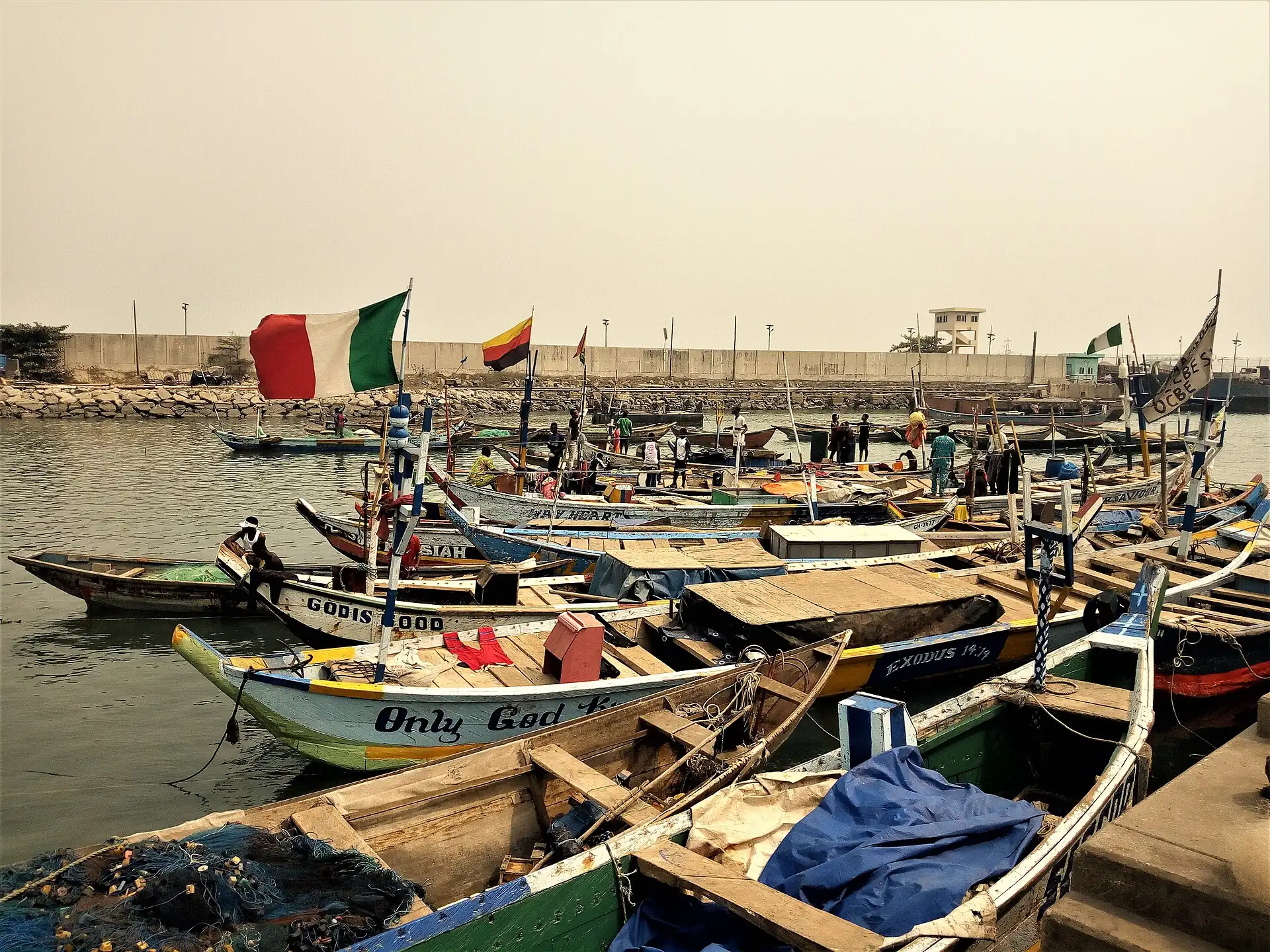
Early-morning cluster: West Africa's largest market by the lagoon; go at first light, hold your bag in front, and leave by 10:30 before the crush and heat.
rescue 100% · max p90 6.5′ · 90m
Central colonial-era district by the sea road: a short late-morning cluster with the cathedral and the harbour side.
rescue 100% · max p90 6.5′ · 90m
The evening and rest cluster: hotels, restaurants and art spaces on the west side of the city; a car ride from the market and cathedral.
rescue 100% · max p90 6.6′ · half
The beach strip on the west side: a slow afternoon or last morning by the sea; swim only where it is calm.
rescue 100% · max p90 6.5′ · half
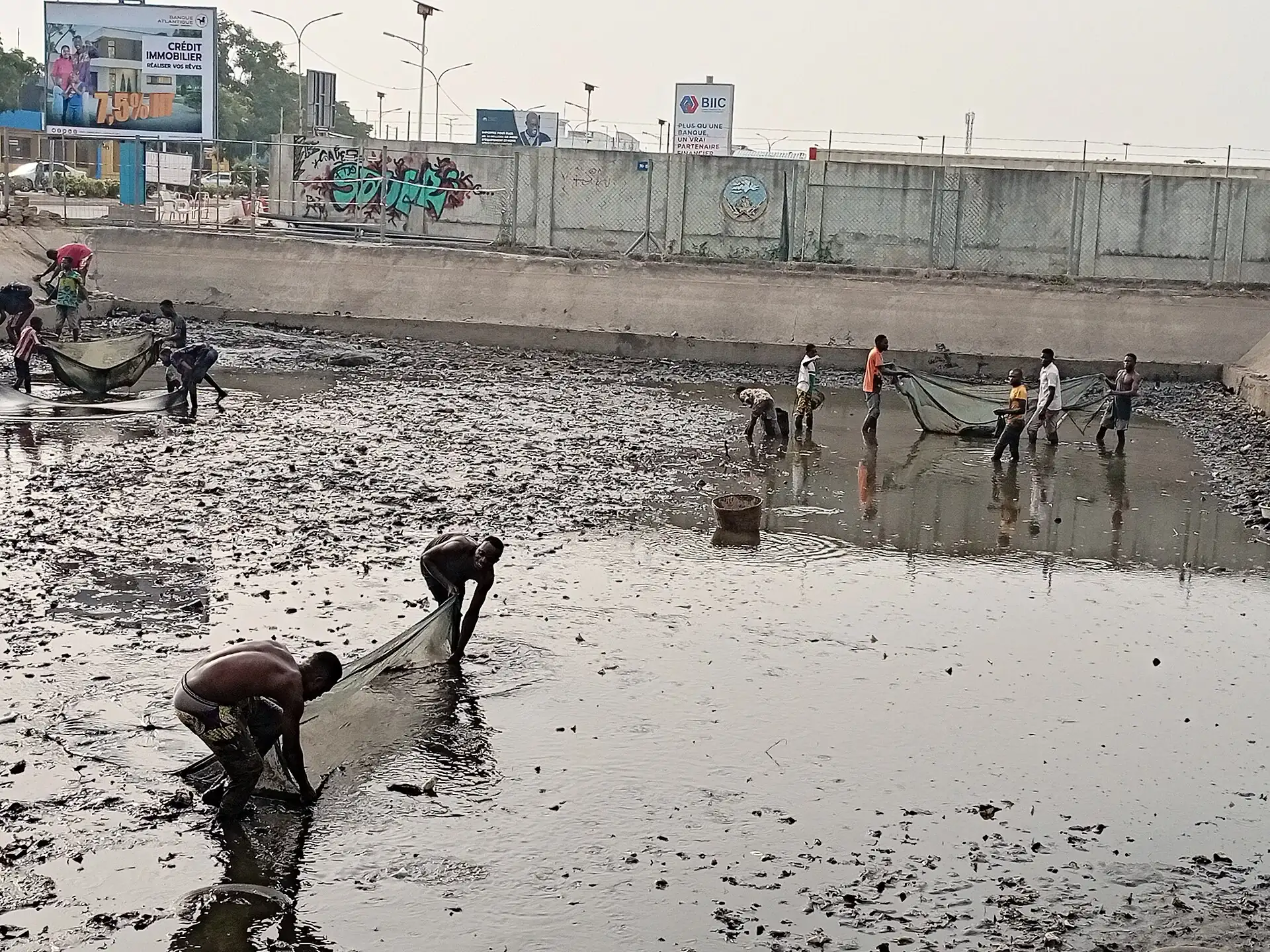
Days
Ready-made day plans, timed against opening hours and walking distances.
How long are you staying?
Loose outlines in the city's rhythm: markets and streets before the heat, a car for everything between clusters.
1 day
A stopover before or after Ouidah or Abomey
- 07:00Dantokpa Market — Dantokpa Market
- 09:30Notre-Dame Cathedral — Notre-Dame Cathedral
- 11:30Pâte buvette in Ganhi — Pâte and sauce lunch in Ganhi
- 13:00Fondation Zinsou — Fondation Zinsou, in the cool
- 17:00Fidjrossè beach — Fidjrossè beach and grilled fish
Skip: Ganvié: it needs its own half day.
Cotonou in 3 days
3 daysMarket at first light, indoors in the heat, the sea last; the final day ends with the bags already in the car.
Day by day
Day 1 — Dantokpa at first light, then the cathedral
Day 2 — Art, then a maquis lunch
Day 3 — Beach, car to the airport at 14:00
- 09:00Fidjrossè beach
- Grilled fish on the beach (optional)
- 14:00Car to Cadjehoun at 14:00
Places
“Best time” is when to arrive for the fewest crowds, for example “before 08:30”; “Go any time” means the hour makes little difference. More sights follow under “More sights and museums”.
6 places. Filters use the guide’s own ratings; a place with no rating is left out when a filter is on.
If you do ten things in Cotonou
Ranked for a first visit of 2–4 days. Prices are 2026 estimates in CFA francs; hours marked (check) still need confirmation.
- 1
Dantokpa Market at first light
The largest market in the country; the plainest introduction to how the city works.
- Time
- 45–75 min
- Best
- 07:00
- Cost
- Free
- 2
Contemporary art in air conditioning, a good midday break.
- Time
- 45–60 min
- Best
- Midday
- Cost
- Free (check)
- 3
The red-and-white striped landmark of the centre.
- Time
- 15–20 min
- Best
- Late morning
- Cost
- Free
- 4
Fishing boats, palms and grilled fish at the end of the day.
- Time
- 60–90 min
- Best
- Late afternoon
- Cost
- Free
- 5
The classic Cotonou meal: agree the price first.
- Time
- 1–1.5 h
- Best
- Lunch or sunset
- Cost
- XOF 4,000–8,000
- 6
Bronzes, cloth and carvings you can compare in one place.
- Time
- 30–45 min
- Best
- Late morning
- Cost
- Free to browse
- 7
Ganvié by boat
The lake village on stilts, a half-day trip from the city.
- Time
- Half day
- Best
- Morning
- Cost
- XOF 20,000–30,000
Good for…
Verdict is how well Cotonou works for that traveller, not how nice it is.
A structured two- or three-day stop if you use a driver and carry cash.
- 1Dantokpa Market — the most direct view of how the city works.
- 2A hotel-arranged driver for the whole stay — solves transport, bargaining and safety in one booking.
Grilled fish, pâte and sauce, poulet bicyclette and street snacks reward a curious eater.
- 1Grilled fish on the beach — the classic seafront meal.
- 2Pâte buvette in Ganhi — a plain local plate at a fair price.
Local kitchens and stalls are cheap; lodging and cars are not.
- 1Food stalls at Dantokpa — a breakfast for less than a bottle of water at a hotel.
Heat, traffic and no ramps make outings tiring; the beach is for paddling only.
Fine with a trusted driver and a plan; not a city to improvise alone after dark.
Broken paving and few ramps; plan by car and check every venue.
Tours and classes: book or skip
Book through your hotel, which vets local drivers and guides; get the price in writing before you go.
| Tour or class | Verdict | Typical price | Why | Check before paying |
|---|---|---|---|---|
| Half-day city tour with driver-guide | book | XOF 20,000–35,000 | Solves transport, translation and bargaining in one booking. | That the price covers the car for the whole half day and any fees. |
| Ganvié stilt village by boat | maybe | Boat XOF 20,000–30,000 (ask) | A different view of lagoon life, worth a half day. | Licensed boat, life jackets, and the full price before you board. |
| Ouidah day trip with a guide | book | XOF 40,000–70,000 with car | The Route des Esclaves and Vodun sites are hard to read alone. | A licensed guide; what is open on your day. |
What each season brings
Long dry season
Nov–Mar
The most comfortable months for walking, markets and the beach road.
Watch: Harmattan dust haze from December to February; dry, hot afternoons.
Main rains
Apr–Jul
Green and cooler evenings.
Watch: Heavy downpours, flooded streets and scarce taxis, peaking in June.
Short dry spell and second rains
Aug–Oct
Fewer visitors and calmer roads.
Watch: Cloudy skies in August and showers in September and October.
Photo spots and the light
Never photograph police, soldiers, the airport, the port or government buildings, even from these spots.
| Spot | Best light | Tip |
|---|---|---|
| Fidjrossè beach at sunset | Late afternoon | Frame the palms and the boats; ask before photographing fishermen. |
| Dantokpa from a raised spot at the entrance | Early morning | Keep the phone in hand only briefly; ask before photographing sellers. |
| Cathedral forecourt | Morning | The striped brick facade is best in low sun; not during services. |
Cotonou travel FAQ
Answers are 2026 desk estimates; facts marked (check) still need confirmation.
Is Cotonou safe for visitors?
The main risks are traffic, phone and bag snatching and heat, not violence. Use cars, keep valuables out of sight and avoid walking after dark. Check your government's advice for northern Benin before any trip there.
Do I need cash?
Yes, almost everywhere. Cards work at a few hotels and supermarkets; carry XOF in small notes and euros to change.
Is Cotonou the capital of Benin?
It is the largest city and seat of government in practice, but Porto-Novo is the official capital.
Can I swim at Fidjrossè?
No. Currents are strong and there are no rescue services; paddle at the edge only.
Do I need a visa?
Most visitors need an e-visa arranged before flying. Use only the official portal and confirm the current rules with your embassy.
Should I take a zémidjan?
They are fast and cheap but crashes are common. Use a car, or ride only with a helmet.
How many days do I need?
Two to three days cover the market, the centre, the art foundation and the beach. Add days for Ganvié, Ouidah or Porto-Novo.
More to see and doSee & do · Learn & work · Rain & heat · Free things · Wheelchair and stroller
Free things to do
Sights in Cotonou that cost nothing to enter. Each is described under Places or More sights; extra costs inside are marked there.
Wheelchair and stroller, place by place
How each place in this guide works for wheels, from its own page. Ratings are desk estimates unless a page says it was checked on the ground.
| Place | Step-free | Wheelchair | Stroller | What to know |
|---|---|---|---|---|
| Craft market and shops | partial | caution | caution | Uneven ground; some shops have steps. |
| Dantokpa Market | no | poor | poor | Narrow lanes, open drains and mud after rain; not usable with a wheelchair or stroller. |
| Place de l'Étoile Rouge | no | poor | poor | A traffic island; view from the car only. |
| Fidjrossè beach | partial | poor | poor | Sand and steps; bars closer to the road are easier. |
| Fondation Zinsou | check | check | check | Confirm ramps and toilets when you contact the desk. |
| Notre-Dame Cathedral | partial | caution | ok | A few steps at the entrance; confirm a side ramp with the parish. |
See & do
11 of 11
- Markets
The largest market in the country, on the lagoon; go at first light.
Dantokpa · Free to enter(check)
- church
The red-and-white striped cathedral in the centre; a short stop.
Ganhi · Free(check)
- gallery
A contemporary-art foundation with air conditioning; a cool midday stop.
Haie Vive · Free (check)(check)
- beach
A long palm-fringed shore with fishing boats; for watching, not swimming.
Fidjrossè · Free
- shopping
Bronzes, wood carvings, cloth and appliqué; agree prices first.
Ganhi · Free to browse(check)
- landmark
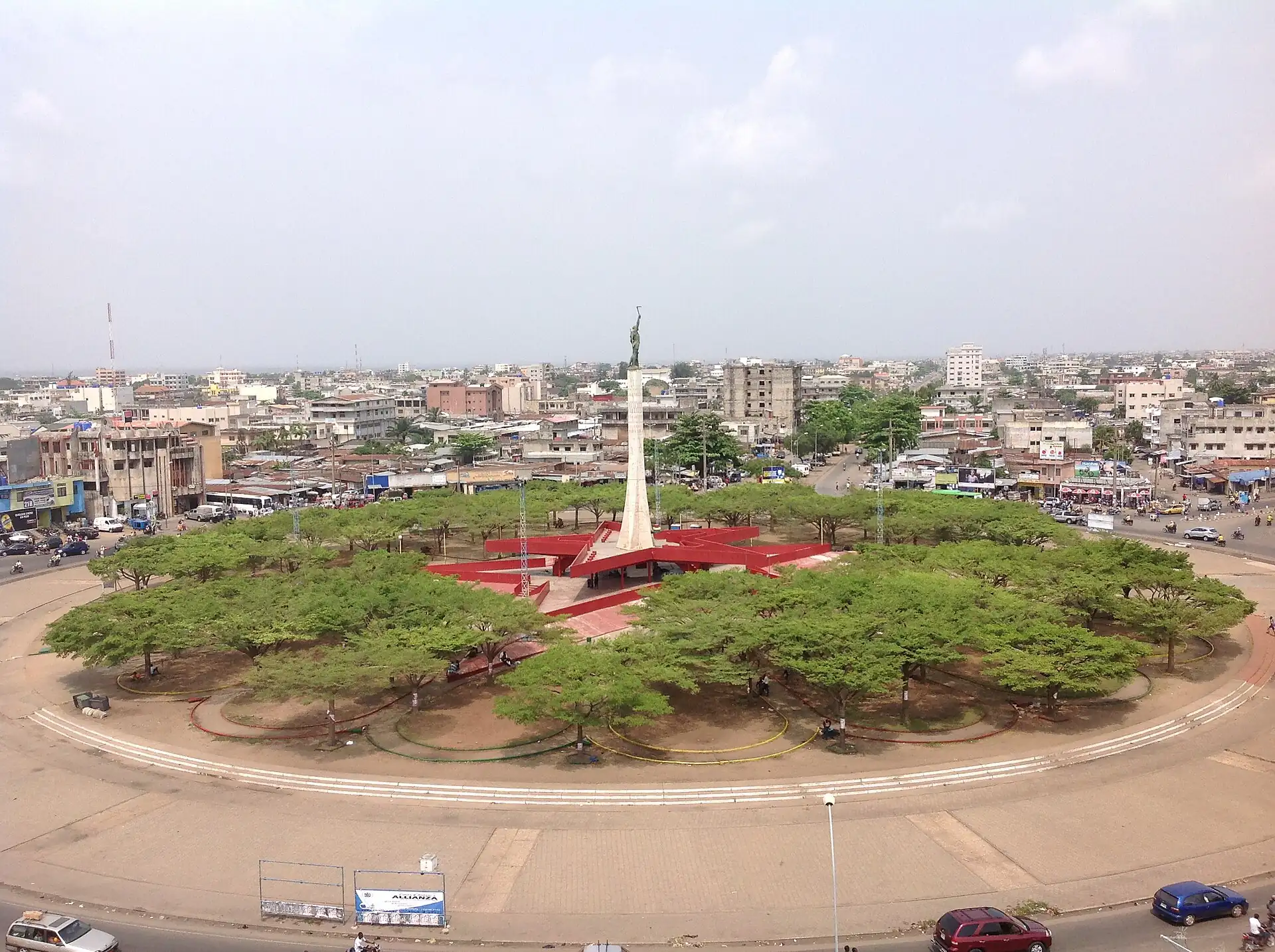
The red-star monument on the airport road, a leftover of the Marxist years.
Cadjehoun · Free to view from the car(check)
Presidential palace area (exterior only)
landmarkDo not photograph it or the guards.
Marina · Free to view from outside(check)
Market morning at Dantokpa
cultureThe best single hour in the city if you go early and light.
Dantokpa · 07:00–10:307:00 AM–10:30 AM · Free
Sunset at Fidjrossè beach
ActiveWatch fishing boats and have a beer; do not swim.
Fidjrossè · 17:00–19:005:00 PM–7:00 PM · Free
Afternoon at Fondation Zinsou
cultureA cool break in the hottest hours.
Haie Vive · Check · Free (check)
Ganvié by boat
tourThe stilt village on the lake; agree everything at the landing.
Lake Nokoué · Half day · Boat about XOF 20,000–30,000(check)
- Booking
- Almost everything is arranged through your hotel or a driver, not online; confirm a day ahead.
Learn & work
| What | Where | Cost | Note |
|---|---|---|---|
| French language | Institut français du Bénin runs French courses | Check current fees | French is the working language; a phrasebook covers a short trip.(check) |
| Fon and Yoruba greetings | Best learned informally from a driver or guide | Free, or a tip | A few words of Fon or Yoruba earn warmth in markets. |
| Batik and dyeing workshops | Ask your hotel or a guide | Check | Occasional short classes; confirm they exist before you rely on them.(check) |
Working here
- Tourist entry
- A tourist e-visa does not allow paid work.
- Work permit
- Legal work needs an employer-sponsored permit and a slow process.
- Remote work
- No dedicated digital-nomad visa is confirmed. Internet is decent in hotels and cafés but power cuts interrupt calls; check a coworking option before you commit.
Rain-day and heat-day plan
Rain day
From April to July and again in September and October heavy rain can start within minutes and flood the roads. Do the outdoor stops in the morning and have an indoor fallback.
- 01Fondation Zinsou — Air-conditioned galleries; about an hour.
- 02Hotel lobby or supermarket café — A table and AC while a downpour passes.
Heat day
Middays are hot and humid all year. Keep walking to the morning and rest indoors from about 12:00 to 16:00.
- 07:00Dantokpa Market — Cooler air and the market at its busiest.
- 13:00Fondation Zinsou — A cool, quiet room in the hottest hour.
- 17:00Fidjrossè beach — Sea breeze and softer light.
Day-trips and nearby
Places you can reach from Cotonou in a day or with one night away, with the route and what it costs. Door to door, not ride time.
Ganvié stilt village
goCar to the Abomey-Calavi or So-Ava landing, then a paddled or motor boat on Lake Nokoué
A lake village built on stilts. Agree the boat price at the landing and treat photos as a matter to ask about. Check which landing is used now.
- Time
- Half day, about 4 h door to door
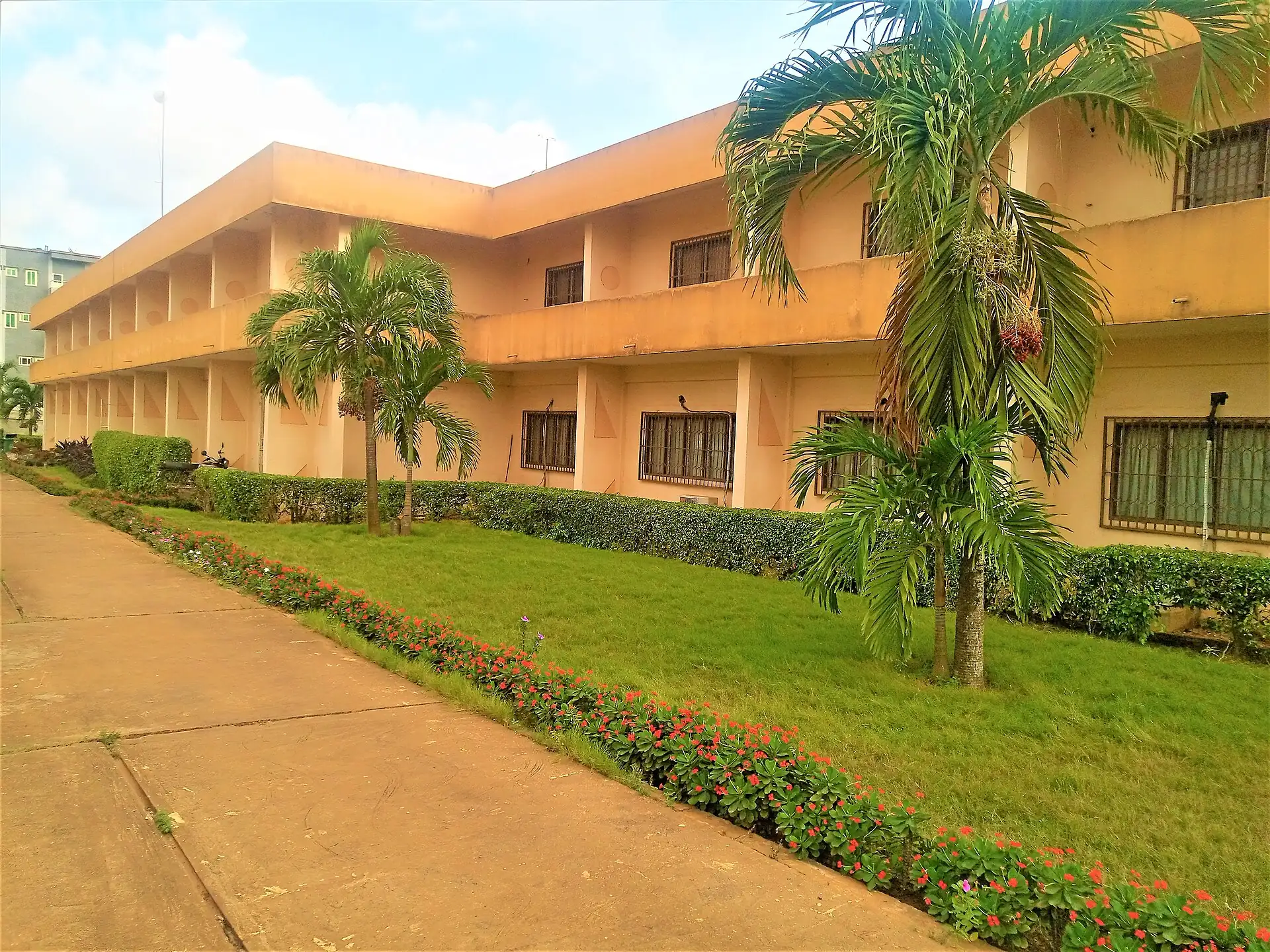 Photo: MASSODEM, CC BY-SA 4.0
Porto-Novo
goCar or shared taxi about 30 km (19 mi) eastCar or shared taxi about 19 mi (30 km) east
The official capital: the Honmè royal palace museum, the Da Silva museum and the Brazilian-style mosque. Check museum hours before you leave.
- Time
- Full day
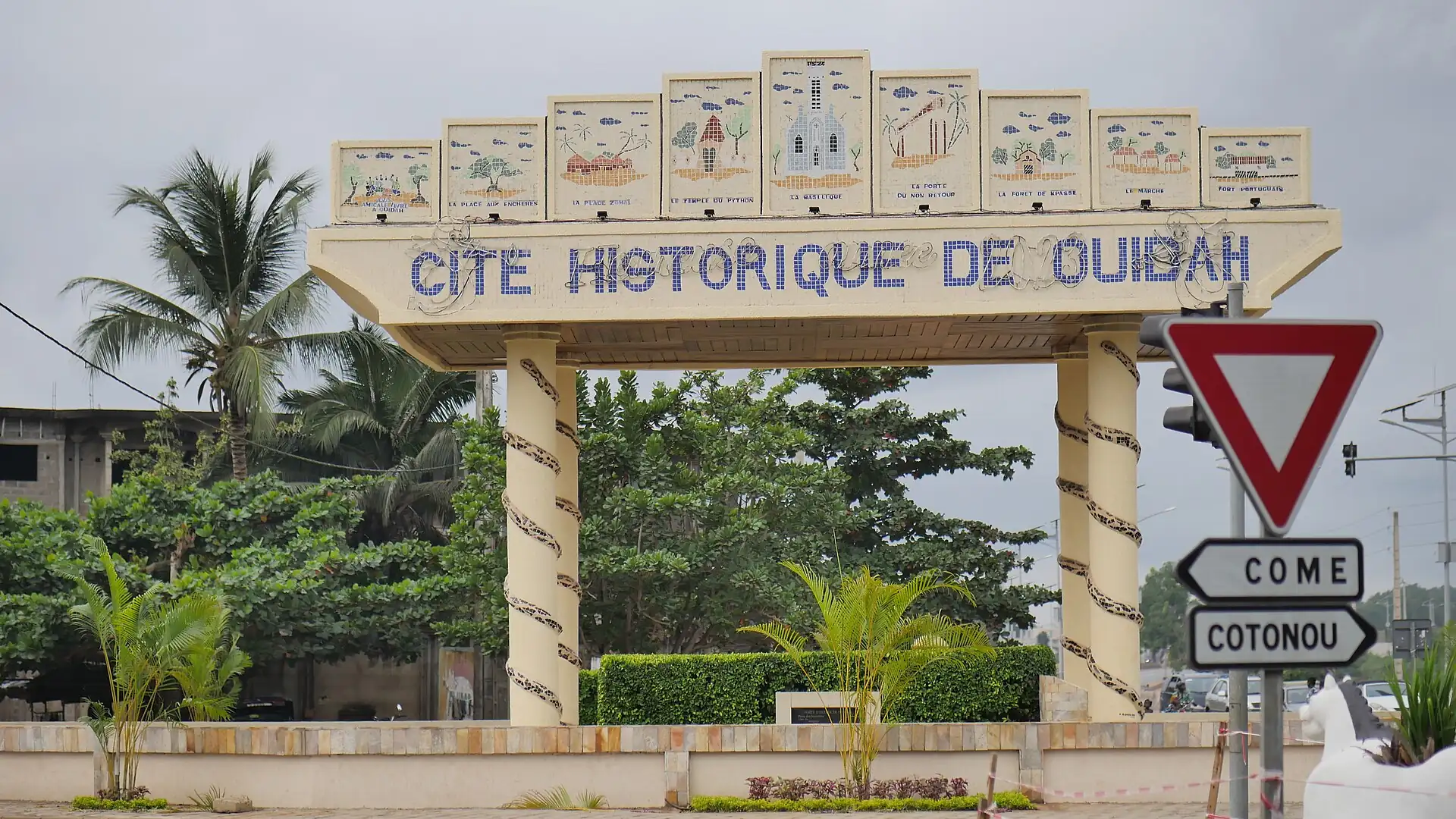 Photo: Ahouansouanna, CC0
Ouidah
goCar about 40 km (25 mi) west, roughly 1–1.5 hCar about 25 mi (40 km) west, roughly 1–1.5 h
The Route des Esclaves, the Door of No Return and the Vodun sites: the heart of the coast trip. Hire a licensed guide.
- Time
- Full day
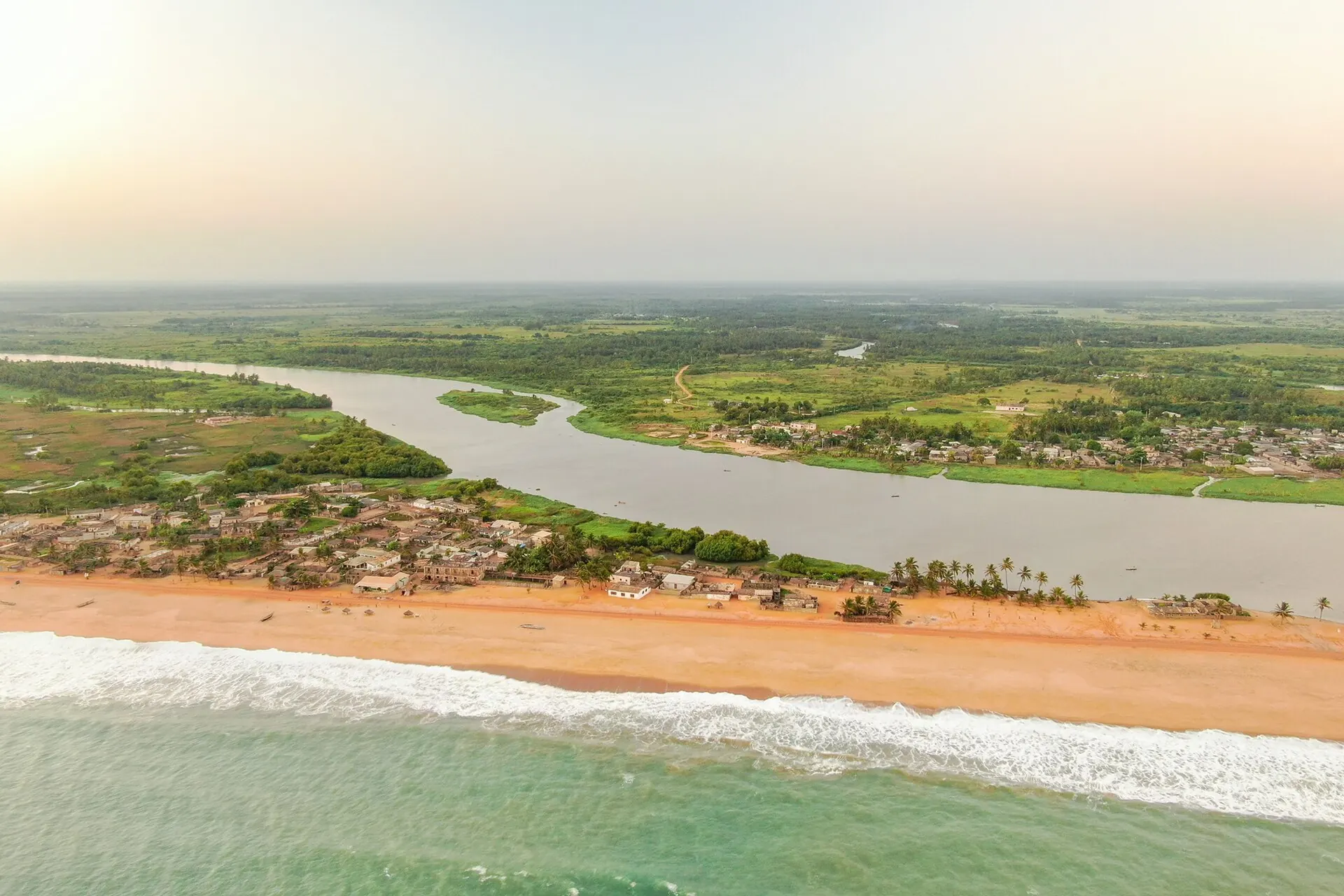 Photo: Sampo Kiviniemi, CC BY-SA 4.0
Grand-Popo
overnightCar about 2 h west
A quiet beach and river-mouth town; check the sea before swimming.
- Time
- Overnight
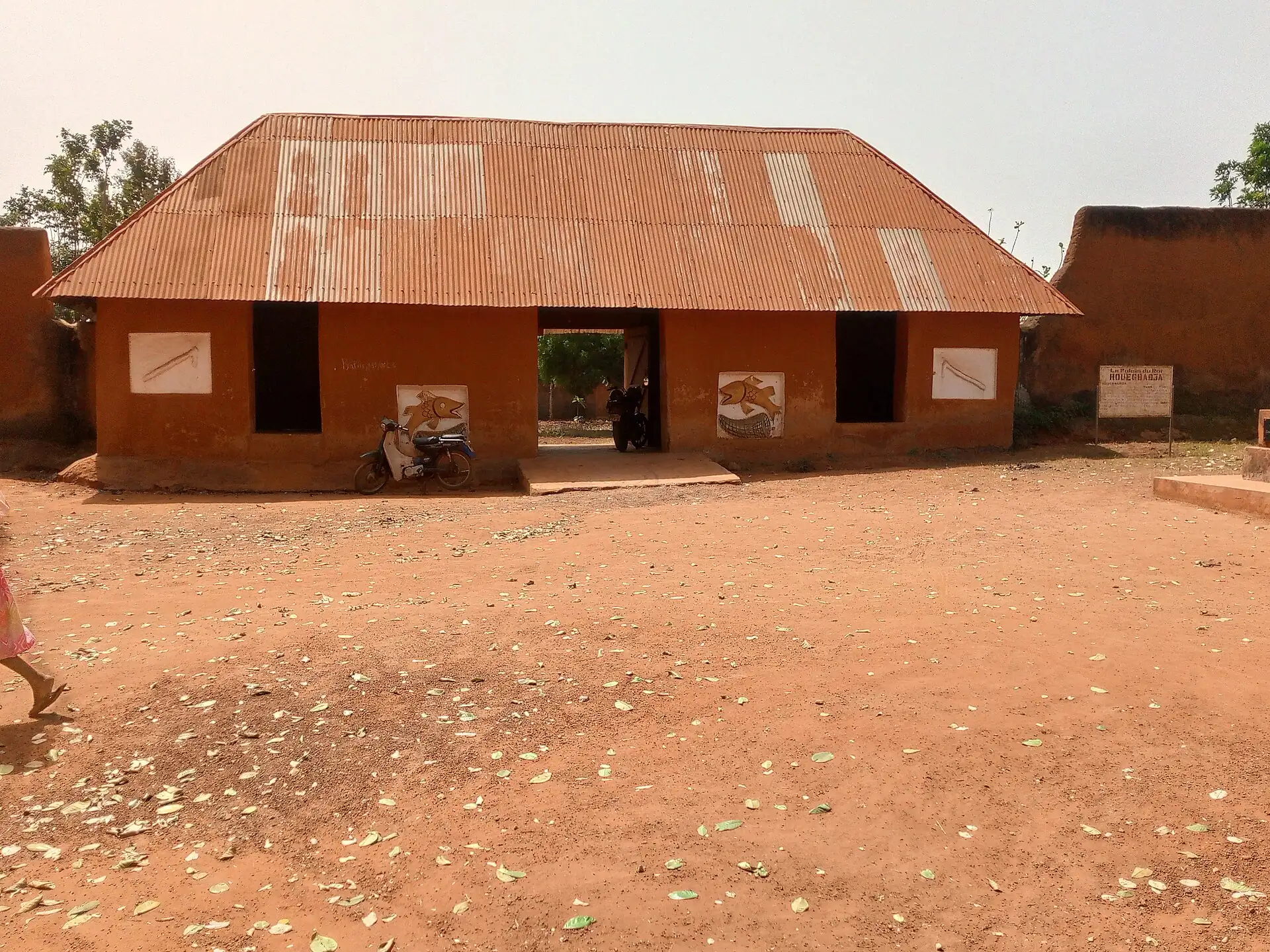 Photo: Gbehlon, CC BY-SA 4.0
Abomey
overnightCar about 2.5–3 h north
The royal palaces of the old Dahomey kingdom (UNESCO). Confirm what is open.
- Time
- Full day is long; overnight is better
Go next
Lomé (Togo)
checkDoor to door: 3–5 h with formalities
Road about 130 km (81 mi) west via the Hillacondji borderRoad about 81 mi (130 km) west via the Hillacondji border
A separate country and visa; confirm current rules and border hours before you go.
Eat & sleepWhere to eat and which area to sleep in
Eat & sleep
Where to eat and which area to sleep in
Eat
A short list of places worth crossing the city for, each with how to get a seat.
Restaurant finder: filter every place to eat in Cotonou →
Vegetarian-friendly score
1.5 / 5 · Hard work
- Country diet noteOur country guide rates vegetarian eating as mixed.0.75 / 2
- Places to eat in this guide0 of 3 places with a known answer are vegetarian-friendly, 2 partly.0.5 / 1.5
- Budget eating lines0 vegetarian lines in "Eat by budget".0 / 0.6
- Meat-free national dishes4 meat-free dishes in the country food list.0.4 / 0.4
- Dedicated vegetarian kitchens0 mentions of vegetarian restaurants, Buddhist or fasting kitchens.0 / 0.5
Country note: Sauces usually contain fish or stock cubes; beans, plantain and wagasi help.
Vegetarian places near me →Make a diet card →
How we score
- Country diet note (up to 2): easy 2, workable 1, mixed 0.75, hard 0; no note 0.5.
- City places to eat (up to 1.5): 1.5 × (vegetarian-friendly + half of partly friendly) ÷ places with a known answer; needs 3 or more known places.
- Budget eating lines marked vegetarian (up to 0.6): 0.2 each.
- Meat-free national dishes (up to 0.4): 0.1 each.
- Dedicated vegetarian kitchens mentioned — Buddhist chay, shōjin ryōri, Jain, fasting food, vegan cafés (up to 0.5): 0.1 each.
- Total rounded to the nearest half point, 0 to 5. Built from our own pages only, not from reviews.
Eating and drinking guideEat by budget · Drink
Before you sit down to eat
Short version; full text linked
Eat by budget
Under XOF 3,000 a meal
| Where | Order | Area | Price | Note |
|---|---|---|---|---|
| Food stalls at Dantokpa | Beignets, akara or aloko with bouillie | Dantokpa | XOF 300–1,500 | |
| Pâte buvette in Ganhi | Pâte with sauce and fish | Ganhi | XOF 1,500–3,000 | |
| Fried plantain (aloko) and fried fish | Aloko and fish | Street stalls | XOF 1,000–2,500 |
Dishes to know
| Dish | What it is | Where to look | When | Price |
|---|---|---|---|---|
| Pâte with sauce | A firm maize or cassava paste, eaten with the fingers with tomato, okra or leaf sauce | Buvettes and maquis | Lunch, dinner | XOF 1,500–3,500 |
| Amiwo (pâte rouge) | Pâte cooked in tomato and palm oil until red and rich | Local kitchens | Lunch | XOF 1,500–3,000 |
| Poisson braisé | Whole grilled fish, often carp or tilapia, with onion and pepper sauce | Beach and lagoon tables | Lunch, dinner | XOF 4,000–8,000 |
| Poulet bicyclette | Free-range chicken, lean and firm, grilled or in sauce | Grills and maquis | Lunch, dinner | XOF 5,000–8,000 |
| Wagashi | Fried or grilled Fulani cheese | Street sellers and grills | Any time | XOF 300–1,000 |
| Atassi | Rice and beans cooked together, served with sauce and fried fish or meat | Local kitchens | Lunch | XOF 1,000–2,500 |
| Akassa and bouillie | Fermented corn dough wrapped in leaves, or a thin porridge with beignets, for breakfast | Markets and street stalls | Breakfast | XOF 200–800 |
- Eat where turnover is fast and the food is hot; a busy stall is a safer bet than an empty one.
- Agree the price of a whole fish or chicken before it is cooked, and keep the receipt.
- Bottled water only, with the cap seal checked; ice is a risk if you do not know the source.
Drink & nightlife
| Where | What | Until | Note |
|---|---|---|---|
| Haie Vive hotel bars and restaurants | Beer and cocktails | Late evening | The easiest evening option; taxis are easy to find at the door. |
| Fidjrossè beach bars | Beer, grilled fish, music | Evening | Lively on weekends; agree the price of the fish first. |
By style
| Style | What | Where | Price | Until |
|---|---|---|---|---|
| Local lager | La Béninoise and other regional lagersServed very cold; the standard order. | Maquis and bars citywide | XOF 800–1,500 | Evening |
| Sodabi | A strong palm spirit, distilled locallyVery strong and sometimes homemade; buy a bottled brand and drink little. | Local bars and roadside sellers | Cheap | — |
| Bissap and ginger juice | Hibiscus and ginger drinksOften made with tap water and ice; choose a bottled or sealed version if unsure. | Street sellers and cafés | XOF 200–800 | Daytime |
Rules that bite
- Arrange the car both ways before you go out; do not walk between venues after dark.
- Do not leave a phone on a table or a bag on the ground.
- Photographing the port, ministries or police near a bar can draw attention; keep the phone down.
Sleep
Pick the area first: it decides your walk home at night and your first morning.
Which neighborhood fits you
Three questions, one recommendation, with the reasons.
Next best: Fidjrossè beach
Built from our 1–5 desk scores per area; your answers stay in this browser.
More on sleepingSleep by budget · Your area · With kids
Sleep by budget
| Band | Price | Where | Room types | What to expect |
|---|---|---|---|---|
| budget | XOF 20,000–40,000 | Haie Vive side streets, Fidjrossè | Guesthouses | Simple rooms; check for AC, a reliable lock and generator backup. |
| mid | XOF 45,000–90,000 | Haie Vive | Mid-range hotels | AC, breakfast, generator, a 24-hour desk and a car to the airport. |
| splurge | XOF 100,000+ | Haie Vive and the waterfront | International-standard hotels | Pool, restaurants, reliable Wi-Fi and generators. |
Booking checks
- Ask about generator backup, AC hours and Wi-Fi before booking.
- Confirm the airport pickup with the hotel in advance rather than arranging a taxi on arrival.
Which area is yours
| If you are | Sleep in | Because |
|---|---|---|
| First visit, 2–4 nights | Haie Vive | Ten minutes from the airport, the restaurants nearby and a 24-hour desk. |
| Beach evenings, a slower stay | Fidjrossè beach | Palm bars and fishing boats at the end of the day; accept the car rides. |
First-timers: sleep in Haie Vive in a hotel with a 24-hour desk and its own car; it is 10 minutes from the airport and has the restaurants.
Beach stay for a slower trip, 25–40 minutes by car from the market; ask about the late-arrival rule.
Areas are in our default order until you tick a priority.
Scores are 1–5 desk judgements per priority (2026).
With kids
- Cotonou is a city for older children on a short cultural stop, not a family playground: heat, traffic and no ramps make outings tiring.
- The beach at Fidjrossè is for paddling and watching fishing boats, not swimming: currents are strong and there are no rescue services.
- Ganvié by boat is the most memorable outing for children who like water; life jackets are not always offered, so ask before you board.
- Bring a car seat if you need one: hotel-arranged cars rarely carry them.
- Pâte with mild sauce, grilled chicken and fried plantain are easy meals for most children.
PracticalMoney, essentials, safety and the pocket card
Practical
Money, essentials, safety and the pocket card
Money
What a day costs at three comfort levels, and how to pay.
- Budget
- XOF 8,000–15,000 excl. bed / day
- Mid
- XOF 15,000–35,000 excl. bed / day
- High
- XOF 35,000+ excl. bed / day
- Transit card
- No transit card: taxis, app cars and hotel cars. Agree the fare before you go; app cars show a price.
- Cash rule
- Keep XOF 10,000 in small notes; use ATMs inside banks or hotels, not on the street, and expect some to reject foreign cards.
More on moneyCosts · Budget · Buy
What things cost
- Pâte or rice with sauce and fish at a local buvetteXOF 1,500–3,000
- Whole grilled fish with sides at a beach or maquis tableXOF 4,000–8,000
- Grilled free-range chicken (poulet bicyclette), whole, at a grillXOF 5,000–8,000
- Bottled water, 1.5 LXOF 500–800
- Car or app ride across townXOF 2,000–5,000
- Fondation Zinsou and the cathedralFree (check)
Trip budget
| Hotel double room1 × 3 nights × XOF 60,000 | XOF 180,000 |
| Food, local transport, entries2 × 3 days × XOF 28,000 | XOF 168,000 |
| Airport car, both ways1 × XOF 15,000 · one hotel-arranged car | XOF 15,000 |
| Local SIM with data2 × XOF 5,000 | XOF 10,000 |
| Ganvié boat and guide1 × XOF 25,000 · ask the price before you board | XOF 25,000 |
| Buffer 15%Price creep, a taxi you did not plan, one splurge | XOF 59,700 |
| Trip total≈ XOF 76,300 per person per day, bed included | XOF 457,700 |
2026 estimate in CFA francs; flights and visas excluded. Your choices stay in this browser.
Prices of common things
| Bottled water, 1.5 L | XOF 500–800 |
| Pâte and sauce with fish, local buvette | XOF 1,500–3,000 |
| Grilled fish plate at a beach table | XOF 4,000–8,000 |
| Car or app ride across town | XOF 2,000–5,000 |
| Zémidjan, short hop | XOF 300–1,000 |
2026 estimate; check locally.
Buy
- Bargaining
- In markets the first price to a foreigner is often two to three times the local price. Counter with half, settle around two-thirds, and walk away calmly if it does not move. Do not bargain where a price is posted.
- Fixed-price check
- Supermarkets and hotel shops post fixed prices; use them as a ceiling before you bargain in a market.
Markets and shopping streets
| Where | What | When | Haggle | Note |
|---|---|---|---|---|
| Dantokpa | Food, cloth, household goods, everything | Daytime, best 07:00–10:30Daytime, best 7:00 AM–10:30 AM | hard | The largest market in the country; go with a plan, a driver who waits and no valuables. |
| Cotonou craft market and craft shops | Textiles, bronzes, wood carvings, appliqué cloth | Daytime | hard | Confirm where the craft market is now; ask your hotel. |
| Neighbourhood fish landing at Fidjrossè | Fresh fish, on the beach | Morning | light | Good for watching, not for buying unless you have a kitchen. |
Shops by what they sell
| For | Where | Hours | Note |
|---|---|---|---|
| Batik and wax-print cloth (pagnes) | Dantokpa and Ganhi shops | Daytime | Buy the cloth, then have a tailor near your hotel make it up. |
| Appliqué wall hangings and bronzes | The craft market | Daytime | Ask what is old; new pieces are often sold as antiques. Export rules apply to some old objects: check before you buy. |
| Supermarkets (water, basics, some imports) | Haie Vive and the centre | Roughly 08:00–20:00 | The most reliable card acceptance in the city. |
Changing money
| Where | Verdict | Why |
|---|---|---|
| Bank branch | use | Official rate, passport needed, weekday hours. |
| Hotel desk | ok | Convenient for euros; check the rate against a bank. |
| Street changers | avoid | Short counts and fake notes. |
ATMs
- Availability
- Use ATMs inside banks or hotels; street machines fail often and some reject foreign cards.
- Bring euros
- The CFA franc is pegged to the euro, so euros change easily. Bring clean, recent notes.
- Cards
- Accepted at some hotels and supermarkets only; assume cash at every market and maquis.
Essentials and accessEssentials · Access
Essentials
- Tipping
- Not expected at stalls. Round up a driver; 5–10% in a hotel restaurant if no service charge is on the bill.
- Plugs & power
- 220 V; two-pin European sockets (types C and E). Bring an adapter; power cuts happen, so a hotel with a generator is worth paying for.
- Opening hours
- Markets roughly 07:00–18:00, busiest early. Shops and banks weekdays, banks close in the afternoon; many restaurants shut between lunch and early evening.Markets roughly 7:00 AM–6:00 PM, busiest early. Shops and banks weekdays, banks close in the afternoon; many restaurants shut between lunch and early evening.
- Health
- Malaria risk all year: take prophylaxis as a travel clinic advises. A yellow-fever certificate is required on entry; carry it.
- Accessibility
- Broken paving, open drains and no ramps outside big hotels. Plan every outing by car.
- Laundry
- Hotels launder by the piece; small local pressing shops charge less. No launderette culture.
- Emergency numbers
- Emergency numbers are unreliable. Save your hotel, driver and insurer numbers, and confirm the local police and ambulance numbers with your hotel on arrival.
Pack
- Light, breathable clothes and a hat; a rain jacket for the wet months
- Copies of passport, e-visa and yellow-fever certificate, kept apart from the originals
- Insect repellent and malaria tablets as advised
- A small torch for power cuts and small XOF notes in a front pocket
Accessibility
Cotonou is hard on wheels: broken pavement, open drains, no ramps and heavy traffic. Plan each outing by car and confirm access before you book.
- Pavements
- Uneven, blocked by parked bikes or absent.
- Getting around
- A hotel car is the only reliable step-free option; taxis and zémidjans are not adapted.
- Hotels
- Larger hotels in Haie Vive have lifts; ask before booking.
- Toilets
- Accessible toilets are rare outside major hotels.
Survive
Safety basics, the lines not to cross, and practical habits that save the day.
Safety
- Heat and humidity: AC stop every 60–90 minutes; drink bottled water.
- Motorbike taxis crash often; use a car or wear a helmet.
- Pickpocketing in markets and at night: keep phones out of sight.
- Emergency numbers may not connect: save your hotel's, driver's and insurer's numbers; check your government's advice page.
- Malaria and yellow-fever advice: see a travel clinic before you fly.
Red lines
- Do not photograph police, military, airports or government buildings.
- Ask before photographing people, shrines or ceremonies.
- Greet before you ask or buy; skipping the greeting is rude.
Practical
- Toilets: hotels and larger cafés; carry tissues.
- Tap water is not for drinking.
- French is the main language; a greeting in French helps.
More on staying safeStay safe · Stay healthy · Safety map · Solo & women · Etiquette · Cope · Scams
After dark, by area
5 flagged areas
- Avoid after dark
- Avoid after dark
- Take care
- Take care
Northern Benin and the border regions
Not checked
Day is roughly 07:00–18:00. What to watch in each area, day and night →
Scams and red flags
Walk away if you see these
- Airport "helpers" who take your bag toward a taxi they own: wait for your named hotel driver, or agree the fare before you get in a rank taxi.
- Street money-changers offering better rates than banks: short counts and fake notes. Change at a bank or hotel desk.
- A zémidjan or taxi that quotes a price "per person" or changes the fare on arrival: agree the total, in XOF, before you start.
- A "guide" at Dantokpa or the beach who takes a cut from every stall: hire a driver or a guide through your hotel, or go alone with a fixed plan.
- Requests for a "fee" to photograph a shrine, a fisherman or a house: ask first, agree the amount, or skip the photo.
Stay safe
Crossing the road
- 01Traffic is dense and mostly motorbikes; cross with locals and never step out between parked vehicles.
Hustles specific to this city
| Hustle | Where | The tell | What to do |
|---|---|---|---|
| Airport "helpers" | Cadjehoun arrivals | Someone grabs your bag and says a taxi is ready | Wait for your named hotel driver or agree a fare at the official rank. |
| Unfixed taxi and zémidjan fares | Everywhere | A price that changes on arrival | Agree the total in XOF before you get in. |
| Photo "fees" | Markets, beaches, shrines | A demand for payment after the shot | Ask first and agree the amount, or skip the photo. |
- Bags
- Keep phones and bags off tables and out of open cars; snatching from motorbikes happens at junctions.
- After dark
- Use a car every time; do not walk between venues.
- Photography
- Never photograph police, soldiers, the airport, the port or government buildings.
- Sea
- Do not swim off the surf beach: strong currents and no rescue services.
Stay healthy
- Malaria
- Risk all year; take prophylaxis as a travel clinic advises and use repellent, a net or AC.
- Yellow fever
- A certificate is required for entry; carry it.
- Food and water
- Bottled water only; eat hot, freshly cooked food.
- Heat
- Drink often and take an AC break every 60–90 minutes.
- Evacuation
- Local facilities are limited for serious problems: carry travel insurance with medical evacuation cover.
Hospitals and clinics: see Cope.
Safety by area and hour
| Area | Day | Night | What to watch |
|---|---|---|---|
| Haie Vive and Cadjehoun | fine | caution | Use a car after dark; bag snatching from motorbikes at junctions. |
| Ganhi and the centre | fine | avoid | Empties after work hours; phone theft on the street. |
| Dantokpa | caution | avoid | Pickpockets and crowds; go early with almost nothing on you. |
| Fidjrossè beach road | fine | caution | Do not swim; keep bags off the sand; go by car after dark. |
| Northern Benin and the border regions | check | check | Some governments advise against travel to parts of the north: check current advice before any trip there. |
- Motorbike taxis crash often: use a car, or ride only with a helmet.
- Keep your phone out of sight at junctions and in open cars.
Solo, women and LGBTQ+ travellers
Solo
- Manageable with a driver arranged through your hotel and a plan made before you leave; do not walk alone after dark.
- Share your itinerary with someone at home and register with your embassy if one operates locally.
Women
- Dress for heat but modestly in markets and near churches or shrines. Harassment at markets is mostly persistent selling, but theft is the bigger risk.
- Use a car after dark; agree the fare before you set off.
LGBTQ+
- Same-sex relations are not criminalised by law, but attitudes are conservative and there is no visible scene: keep a low public profile.
Etiquette in Cotonou
- Greetings
- Greet before you ask or buy: a handshake, "Bonjour", and a word of thanks. Skipping the greeting reads as rude.
- Photos
- Ask before photographing people, stalls or shrines; never photograph police, soldiers, the airport, the port or government buildings.
- Dress
- Neat and covered shoulders and knees in churches and near shrines; Sunday best is common at church.
- Hands
- Use your right hand to give, take or eat.
- Shrines
- Do not touch sacred objects or step over ritual items; ask a local guide what is acceptable and what a donation should be.
- Paying
- Bargain with a smile in markets and never where a price is posted; agree a taxi fare before you get in.
Cope
Hospitals and clinics that handle foreigners
| Where | Area | Use it for |
|---|---|---|
| Private clinics in Haie Vive and Cadjehoun | Haie Vive | Better equipped for routine care; pay upfront and claim later. Ask your hotel for a current recommendation. |
| Centre national hospitalier et universitaire (CNHU) | Cotonou | The main public hospital; for anything serious, call your insurer about evacuation. |
| Pharmacies | Citywide | Easy to find; check expiry dates and buy known brands. |
Visa extensions
- Visas
- Most visitors need an e-visa arranged online before flying; use only the official Benin e-visa portal and check the current rules with the nearest embassy.
- Yellow fever
- A vaccination certificate is required on entry.
- Overstay
- Fix any visa issue before your flight; fines and delays happen at the airport.
Embassies and consulates
| Country | Address | Phone | Note |
|---|---|---|---|
| France | Cotonou | — | (check) |
| United States | Cotonou | — | (check) |
| United Kingdom | No resident embassy confirmed; check your government's advice | — | (check) |
- Lost passport
- Report to the police first, then to your embassy or consulate; budget several days.
- Lost cards
- Call your bank; cash is the real safety net here, so carry a reserve in a separate place.
Apps and offline kitOffline kit
Offline kit
Set up before you leave, so Cotonou still works with no signal or a dead roaming plan.
On your phone
- Maps: open the city in Google Maps, tap the place name, then Download offline map (or use an offline-maps app).
- Data: install an eSIM or buy a local SIM before the first taxi; the apps in this guide depend on it.
- Translation: download the local language for camera translation.
- Screenshots: booking confirmations, hotel address in the local script, and the emergency numbers.
This guide
Save the Cotonou guide and its pages on this device; it opens without a connection.
Phrases that do the work
Greeting
Hello
Bonjour
bohn-zhoor
Thanks
Thank you
Merci
mehr-see
Market
How much is this?
C'est combien ?
seh kom-byen
Market
It is too expensive
C'est trop cher
seh troh shair
Food
Not spicy, please
Pas pimenté, s'il vous plaît
pah pee-mon-tay, seel voo pleh
Food
Grilled fish, please
Du poisson braisé, s'il vous plaît
dew pwah-son breh-zay, seel voo pleh
Taxi
Please take me to this address
Conduisez-moi à cette adresse, s'il vous plaît
kon-dwee-zay mwah ah set ah-dress
Taxi
Stop here, please
Arrêtez ici, s'il vous plaît
ah-reh-tay ee-see, seel voo pleh
Taxi
Slow down, please
Doucement, s'il vous plaît
doos-mon, seel voo pleh
Photos
May I take a photo?
Je peux prendre une photo ?
zhuh puh prondr oon foh-toh
Pocket card
Fill in, then print or save as PDF
Stays in this browser only; nothing is sent anywhere.
CotonouCotonou
Pocket card · Voykit
My bed tonight
—
—
—
Conduisez-moi à cette adresse, s'il vous plaîtPlease take me to this address
Emergency
- Police, ambulance, firecheck locally
- Hotel front desksave on arrival
Embassy
Confirm your own embassy's address and 24-hour line before you travel; not every nationality has a resident office in Cotonou.
My embassy: —
Fare anchors (2026 estimate)
- Airport to Haie Vive, hotel car: XOF 5,000–10,000, 10–20 min
- Car across town: XOF 2,000–5,000
Emergency numbers are unreliable: your hotel and driver numbers are your real safety net.
Deep diveHistory, reading, photos and every source
Deep dive
History, reading, photos and every source
Sources
- officialGovernment of Benin
- officialUK FCDO foreign travel advice: Benin
- secondaryWikivoyage — Cotonou
Ask about Cotonou
Loading…
Was this useful?