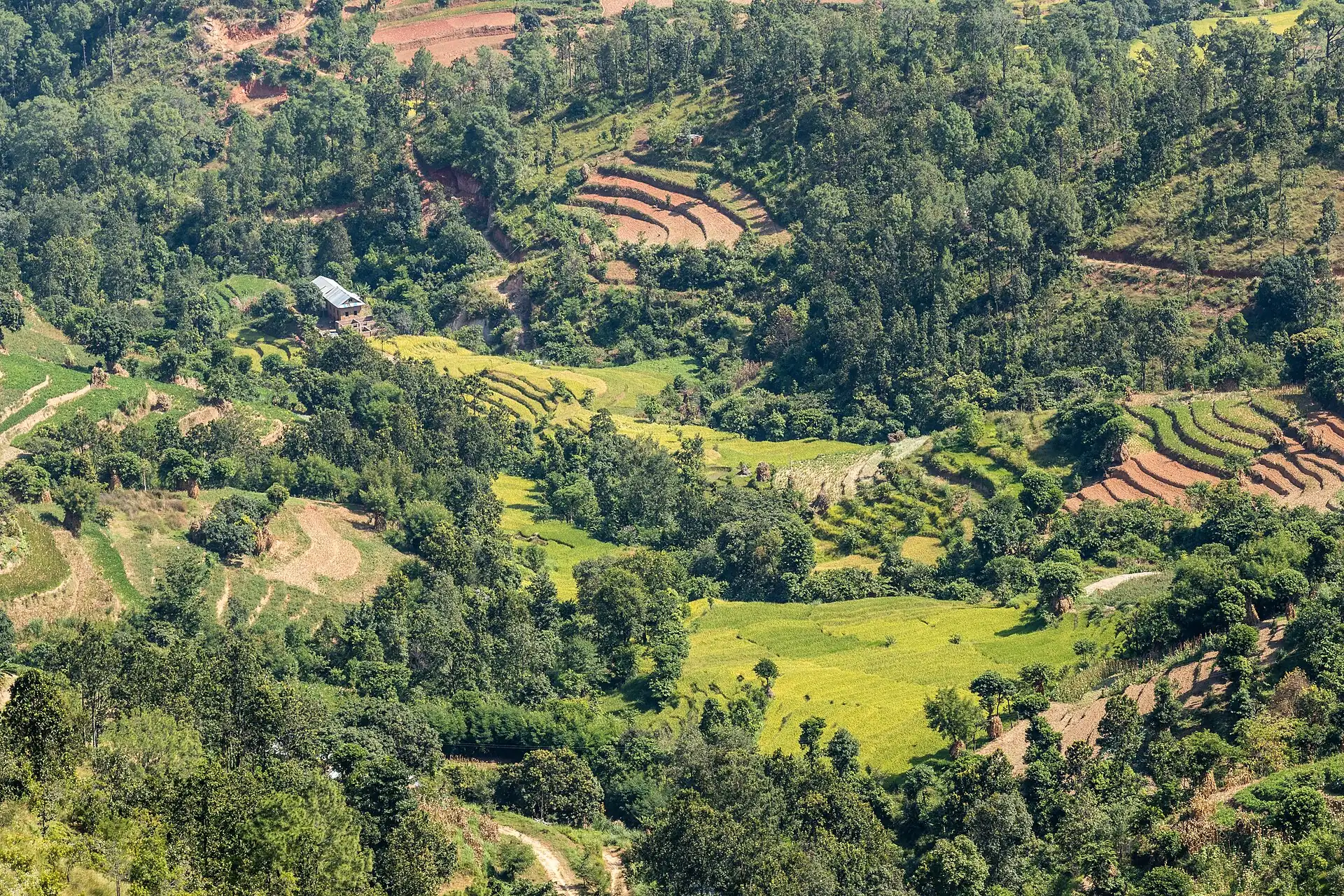
Kathmandu
काठमाडौँ
Code KT · 4 walking zones
Kathmandu is a dawn-and-dusk city: do the temple squares and the stupa before 10:00, leave the afternoon for cafés and rest, and never plan a transfer on a strike day.Kathmandu is a dawn-and-dusk city: do the temple squares and the stupa before 10:00 AM, leave the afternoon for cafés and rest, and never plan a transfer on a strike day.
Our quick read of Kathmandu, scored 1–5 (friction is out of 100). Cash need: how often you still need notes. Heat risk: how hot days get. Stroller: how easy wheels are. Friction: overall effort for a first visit. Desk judgements, so check before relying on them.
- Local time
- --:--
- Weather
- forecast below
- Currency
- NPR
- Best months
- Jan · Feb · Mar · Oct · Nov · Dec
- Airport
- Tribhuvan (KTM)
Walking zones: the 4 areas this guide plans a day around. Each is a district you can cover on foot, so you do one zone per half-day and ride the train between them. The code (KT 01, KT 02…) is just the zone's number on the Kathmandu line; the line under each name says how bags fare there and how much time it needs.
Map of Kathmandu
Use the switches to show or hide each kind of pin. A switch that is on shows its pins on the map; tap it again to hide them. "Show only" keeps just the pins that match (for example, places that fit a suitcase). Tap any pin for its name and a link to its page.
- Where to sleep
- Places
- Eat
- Walking clusters
- Rest stops
From the airport Tribhuvan (KTM) to your bed
Tap a pin for its card. Places without their own coordinates are shown by their walking cluster.
Why Kathmandu
Kathmandu's sights are old, close together and crowded, and the streets between them are dusty, narrow and shared with motorbikes. The trips that go wrong drag suitcases through Thamel at night, walk at noon in the smoke haze, or book a flight out on the morning of a festival or strike. Four clusters cover a first visit: Thamel to sleep and eat, Durbar Square, Boudhanath and Patan. Bhaktapur and the valley rim are trips from one kept bed.
See first
- 1
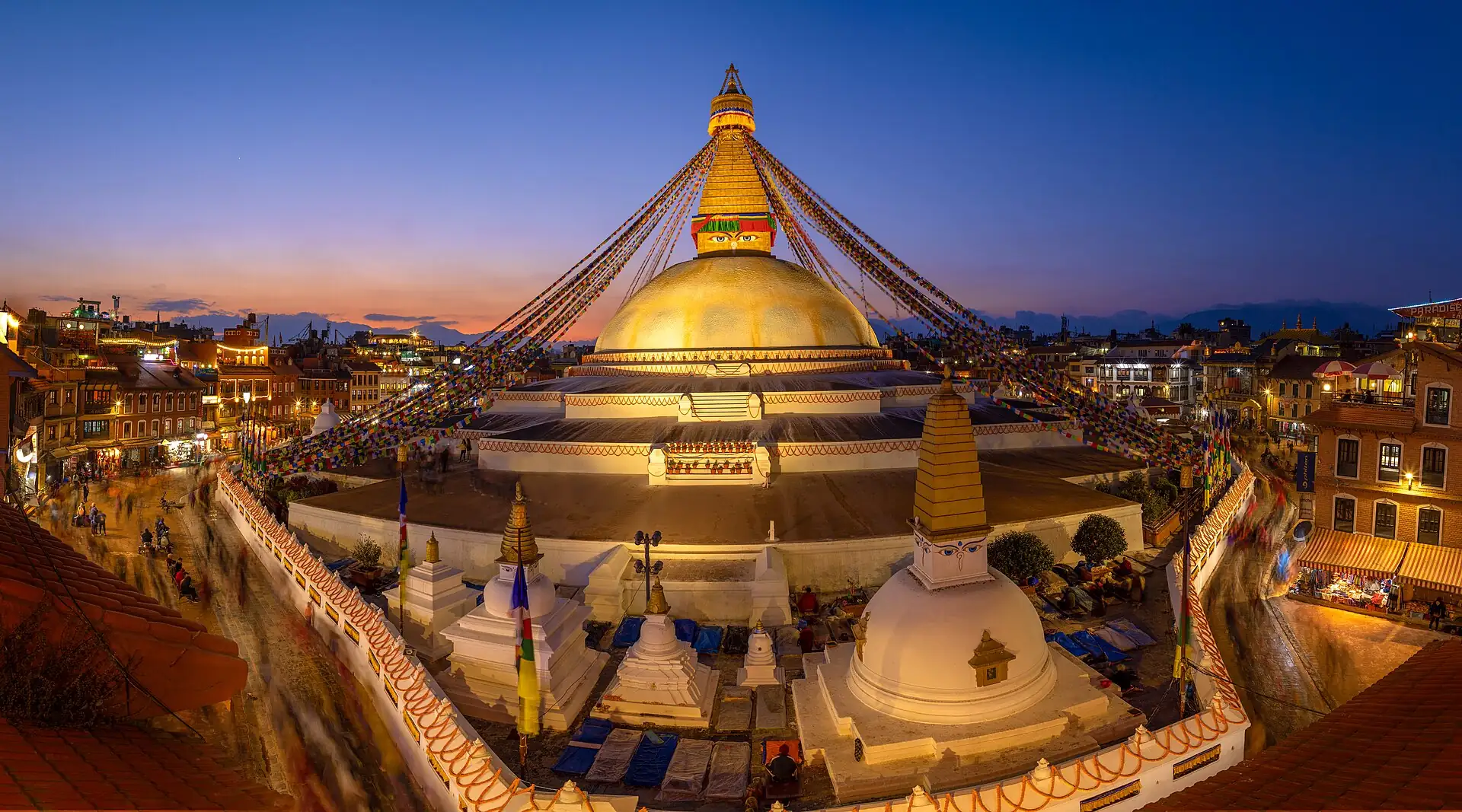 Boudhanath at dawn or dusk · 1–1.5 h
- 2
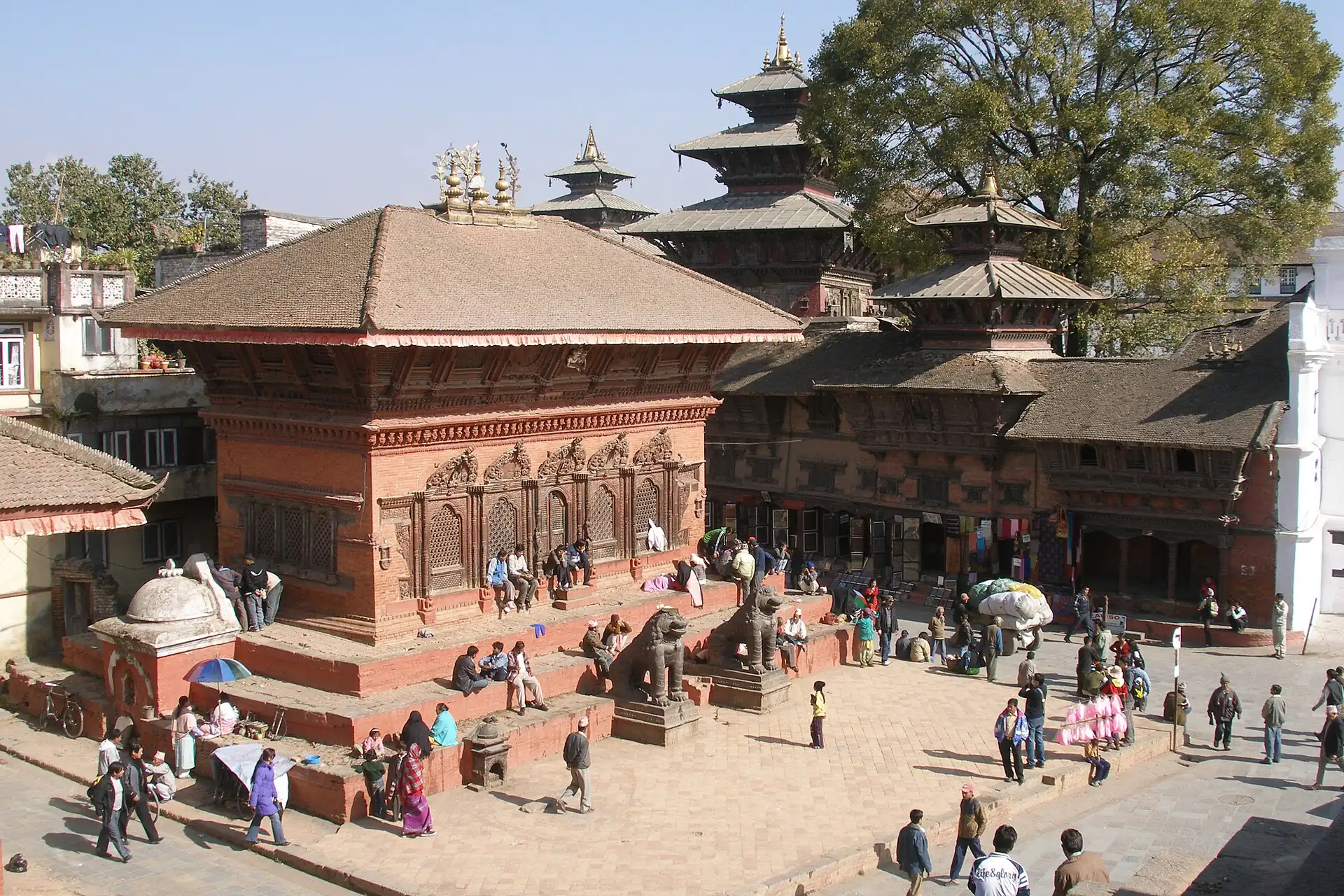 Kathmandu Durbar Square · 1.5–2 h
- 3
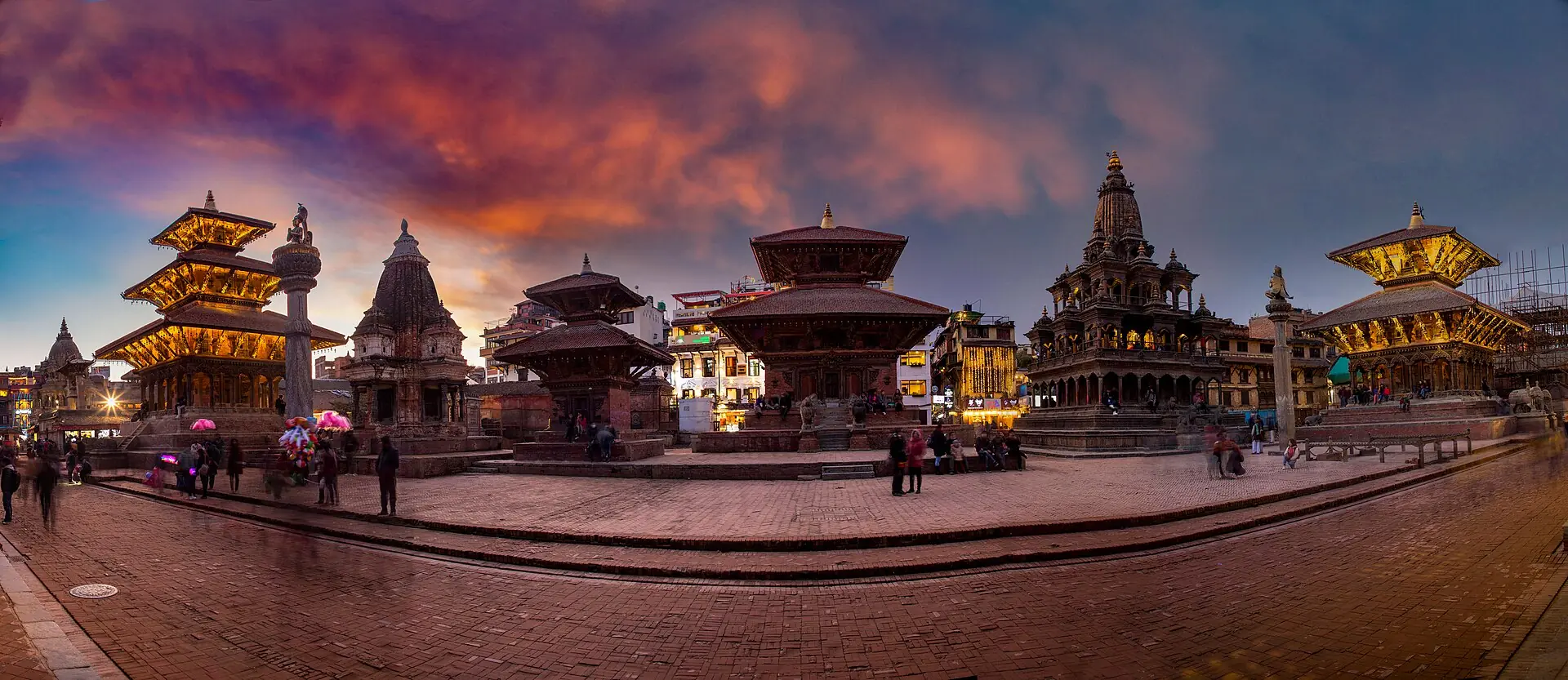 Patan Durbar Square and museum · 2–3 h
- 4Pashupatinath · 1–1.5 h
- 5
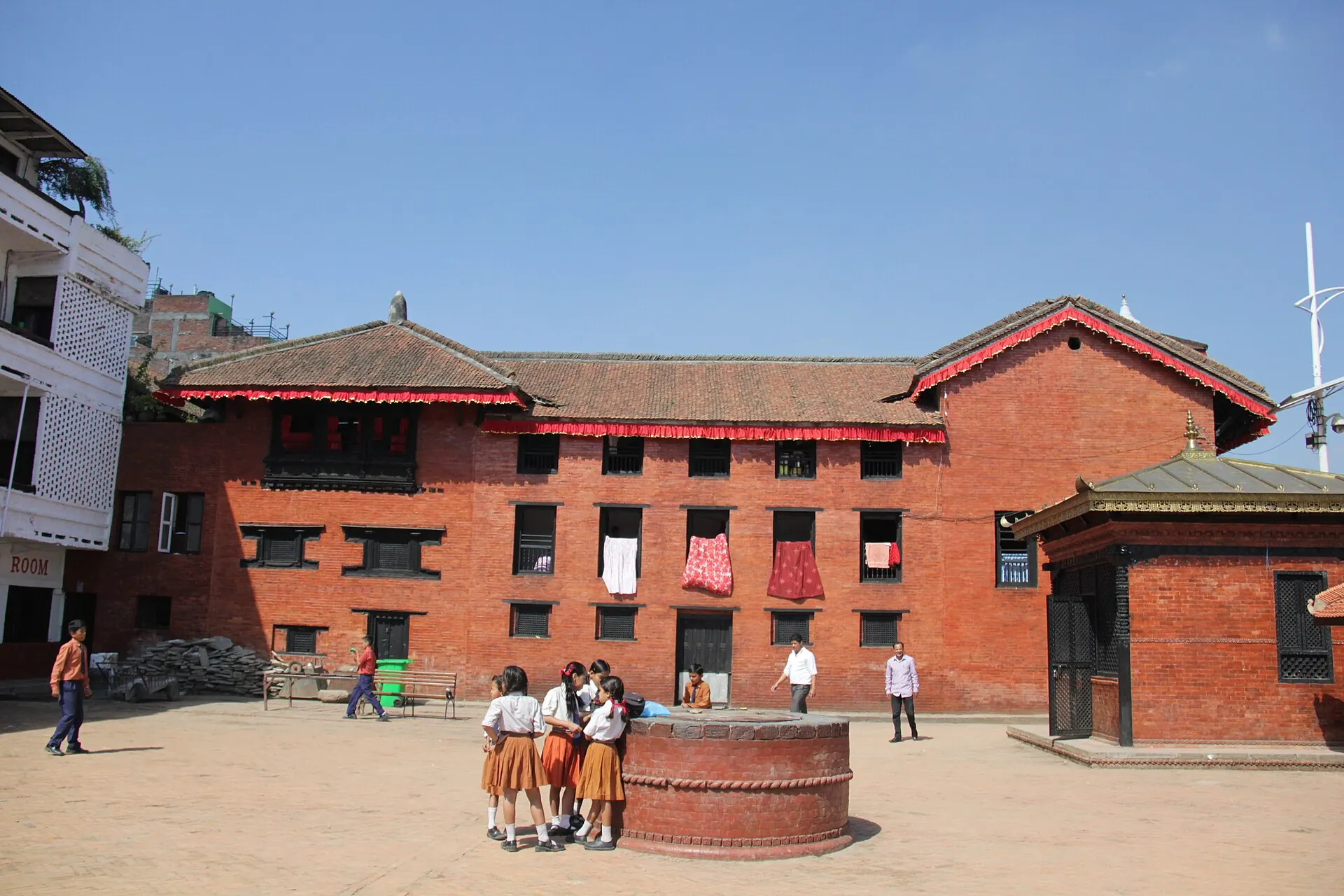 Kumari Ghar · 20–30 min
Fits
- Culture-first short trips
- Early risers
- Base for Himalayan treks
Does not fit
- Strollers and wheelchairs (pavements, plinths)
- Travellers sensitive to dust and traffic noise
- Tight connections around festivals and strikes
How long
- 2 daysDurbar Square morning + Thamel evening
- 3 daysDurbar Square, Boudhanath, Patan; mornings and late afternoons only
- 5 daysFour clusters + Bhaktapur day-trip + one slow day
Good for
- First timers
- Foodies
- Budget
- Couples
- Families
- Luxury
About Kathmandu
Kathmandu sits at about 1,400 metres in a bowl-shaped valley in the middle of Nepal, with the Himalaya on the northern horizon on clear days. The valley held three city-kingdoms, Kathmandu, Patan (Lalitpur) and Bhaktapur, ruled by Malla kings from the 13th to the 18th century, and each kept its own royal square, its own temples and its own festivals. The Newar people, the valley's original urban culture, built most of what visitors come to see.
Good to know
- Kathmandu, Patan (Lalitpur) and Bhaktapur are separate old towns inside one valley; each has its own Durbar Square and its own entry ticket.
- The Nepal Tourism Board runs a visitor centre at Bhrikutimandap; hours vary, so use it as a backup to your hotel desk.
- Trekking agencies and permit desks are concentrated in Thamel; use a registered agency and ask for the current permit rules.
Go deeper 10 min read · 6 chapters
Kathmandu is a valley of old towns rather than a single city: a bowl of fertile land at about 1,400 metres where Newar kings, Buddhist monks, Hindu priests, Tibetan refugees and modern trekkers have piled up their own layers. It is noisy and dusty, and the temples are not museums but working shrines. This deep dive follows how the valley became a kingdom, how Newar craftsmen built its squares and stupas, what an earthquake did to them, why food and festivals still drive the calendar, and how the world arrived by trail and by air.
1History2 min
Geologists say the Kathmandu Valley was a lake, drained long ago, and local legend credits the bodhisattva Manjushri with cutting a gorge to let the water out. What the archaeology shows is a fertile valley with early settlements and, by the first millennium CE, a kingdom under the Licchavi dynasty, whose inscriptions and stone carvings survive around the older temples. Pashupatinath and the stupas at Swayambhu and Boudha have roots in this early period. By the 13th century the Malla dynasty ruled the valley and, after a family split in the 15th century, it divided into three rival city-kingdoms: Kathmandu, Patan and Bhaktapur.
The Mallas competed in building. Each king added temples, palace courts and pillars in his own square, and the competition produced most of the monuments that visitors see today, from the Krishna Mandir at Patan, built in 1637, to the multi-storeyed temples of Kathmandu's Durbar Square. The valley also sat on the main trade road between India and Tibet, and the taxes and skills that trade brought funded the art. In 1768 Prithvi Narayan Shah, king of Gorkha, took the valley after a long siege, and made Kathmandu the capital of a unified Nepal. The country avoided colonisation but lost territory after a war with the East India Company, which ended in the treaty of 1816.
From 1846 to 1951 the Rana family held power as hereditary prime ministers, building neoclassical palaces and keeping the country closed to most outsiders. The 1950s brought a return of royal power and the first trekkers, and Everest was climbed in 1953. A civil war ended in 2006, the monarchy was abolished in 2008, and Nepal became a federal republic. Kathmandu is now a capital of several million people, a growing city that has swallowed the villages around it. A visitor sees the layers in one walk: a Licchavi carving, a Malla temple, a Rana palace and a modern shopping mall.
- Malla city-kingdoms
- Kathmandu, Patan, Bhaktapur
- Krishna Mandir built
- 1637
- Unification by Gorkha
- 1768
- Rana rule
- 1846–1951
- Monarchy abolished
- 2008
2The Newars and their craft2 min
The Newars are the valley's original urban people, with their own language, Newar, and a culture that blends Hindu and Buddhist practice in a way found nowhere else. A Newar family may worship both Shiva and the Buddha, and a festival may be observed in a Buddhist monastery courtyard and a Hindu temple on the same day. Newar society was organised into castes and guilds, and the craftsmen among them, brick-makers, woodcarvers, metalworkers, painters and stone carvers, built the temples and squares of the valley. A Newar artist, Araniko, travelled to Tibet and then China in the 13th century, where he designed a stupa in Beijing that still stands.
The typical Newar house is built of narrow brick, with carved wooden windows that project over the street and a tiled roof; the streets they line are tight and shaded, with courtyards behind. Guthi, a system of community trusts, has long funded and run rituals, festivals and upkeep, and many temples and rest houses (sattal) depend on it. Newari craft is still alive in workshops in Patan, where metalworkers cast statues by the lost-wax method and painters produce thangka scrolls, and a visitor who walks into a lane behind Patan Durbar Square can watch a piece being made.
Language and food carry the same identity. Newar cooking has a separate vocabulary of dishes, feasts and festival foods, from beaten rice with spiced meat to rice-flour crepes and sweet yogurt from Bhaktapur. Festivals are the clearest window: Indra Jatra in Kathmandu, in which the Kumari, the living goddess, is drawn through the streets in a chariot, and Bisket Jatra in Bhaktapur, with its tug of war between neighbourhoods, are both Newar in origin. To understand the valley, go to a Newar festival, a Newar restaurant or a Newar workshop, and listen to the language spoken there.
- People
- Newars, the valley’s original urban culture
- Community trusts
- Guthi
- Metal casting
- Lost-wax method, still used in Patan
- Living goddess
- The Kumari, chosen from the Newar community
3Architecture and the earthquakes2 min
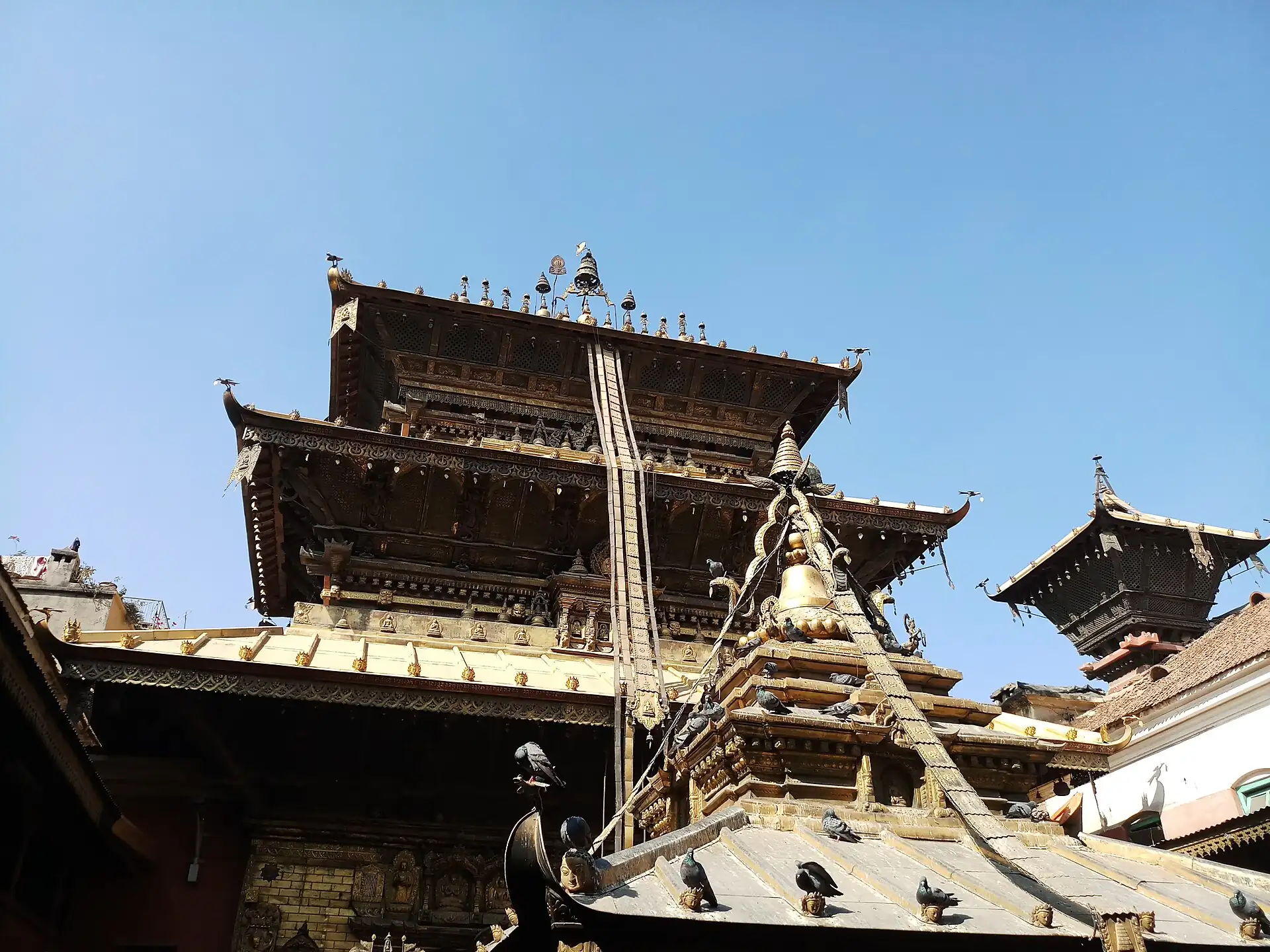
Two building types dominate the valley: the pagoda-style temple and the stupa. The pagoda temple rises in stacked tiers of tiled roofs on struts carved with gods and animals, often on a stepped brick plinth. The stupa is a solid white dome topped by a square tower with painted eyes and a spire of gilded rings. The Kathmandu name itself comes from the Kasthamandap, the wooden pavilion by the old trade road, whose name means the wooden shelter. It was among the monuments that collapsed in 2015, and rebuilding has been under way since.
The valley sits on an active seismic zone and has been hit before. The earthquake of 1934 destroyed many buildings, and the rebuilding gave the city some of its Rana-era neoclassical facades. The earthquake of 25 April 2015, with a magnitude of 7.8, killed thousands of people across Nepal, brought down the Dharahara tower in the city centre, and damaged temples in all three squares. Boudhanath's spire cracked and was repaired within a few years; Patan's Krishna Mandir survived with less damage; Kathmandu's Durbar Square lost several temples, some of which have been rebuilt with traditional methods and new steel supports, while others still stand propped or empty. Repair is slow, expensive and the subject of arguments about which materials and methods to use.
For a visitor this means scaffolding and fenced areas alongside restored monuments, and a lively debate about how much to rebuild and how. The best way to read the valley's architecture is to compare the three squares: Kathmandu for scale and the palace, Patan for proportion and stone, Bhaktapur for brick and quiet. Look up at the struts carved with deities, down at the worn steps where locals sit, and around at the houses with carved windows. And expect the view to change: some buildings you saw on a page online may be different when you arrive.
- Temple form
- Multi-tiered pagoda on a stepped plinth
- Stupa form
- White dome, painted eyes, gilded spire
- Earthquake of 1934
- Destroyed many buildings in the valley
- Earthquake of 2015
- Magnitude 7.8, 25 April
- Dharahara tower
- Collapsed 2015; rebuilt later (check)
4Faith, Tibet and the festival year2 min
Religion in Kathmandu is visible on every corner: small shrines set into walls, marigold garlands, butter lamps, incense and the sound of bells. Most people in the valley are Hindu or Buddhist, and many are both. Pashupatinath, on the Bagmati river, is the most important Shiva temple in Nepal and draws pilgrims from India and beyond. The main temple is closed to non-Hindus, but the riverside ghats where the dead are cremated can be seen from the far bank. Swayambhunath, on a hill west of the city, is a stupa that Newar Buddhists and Tibetan pilgrims both use.
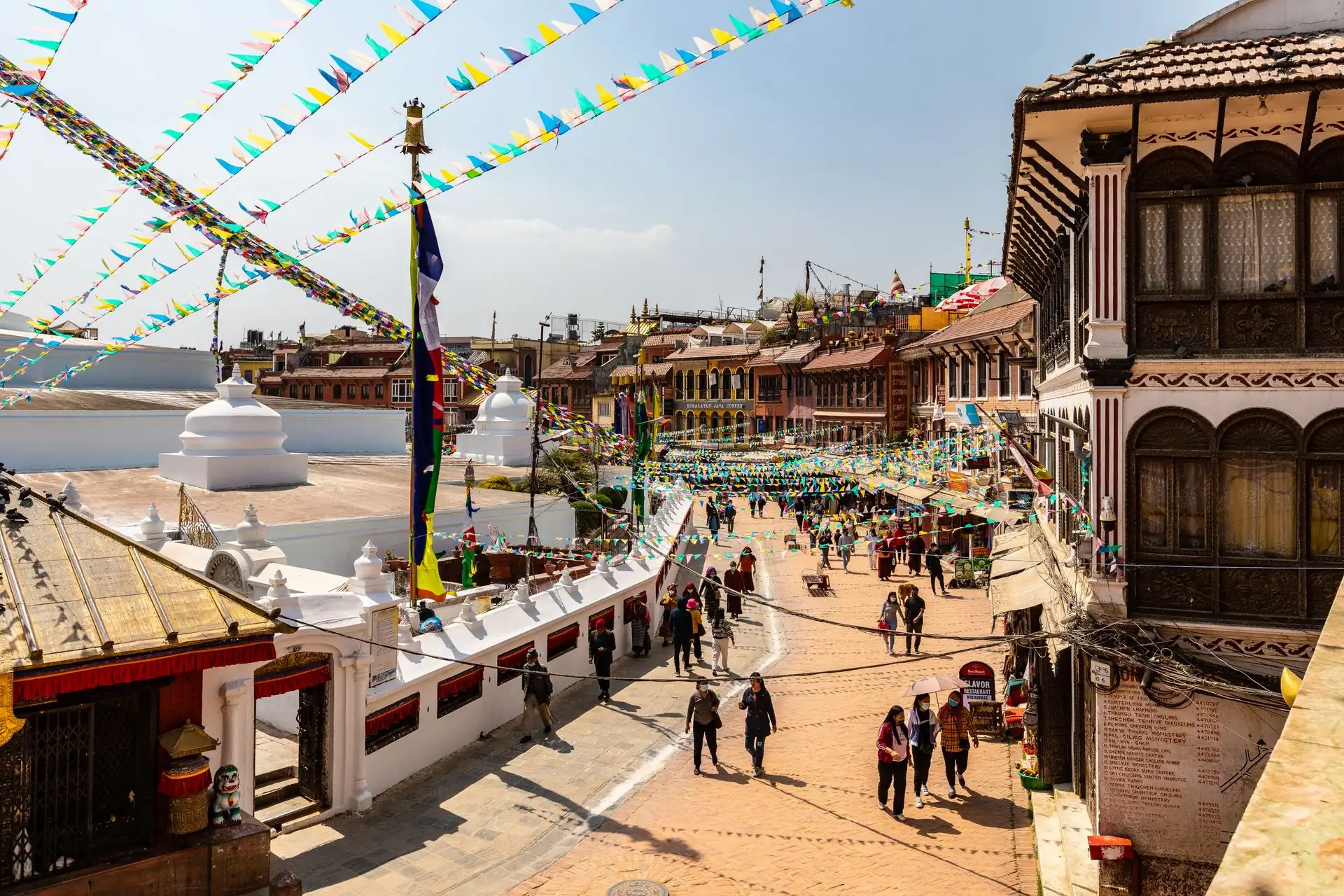
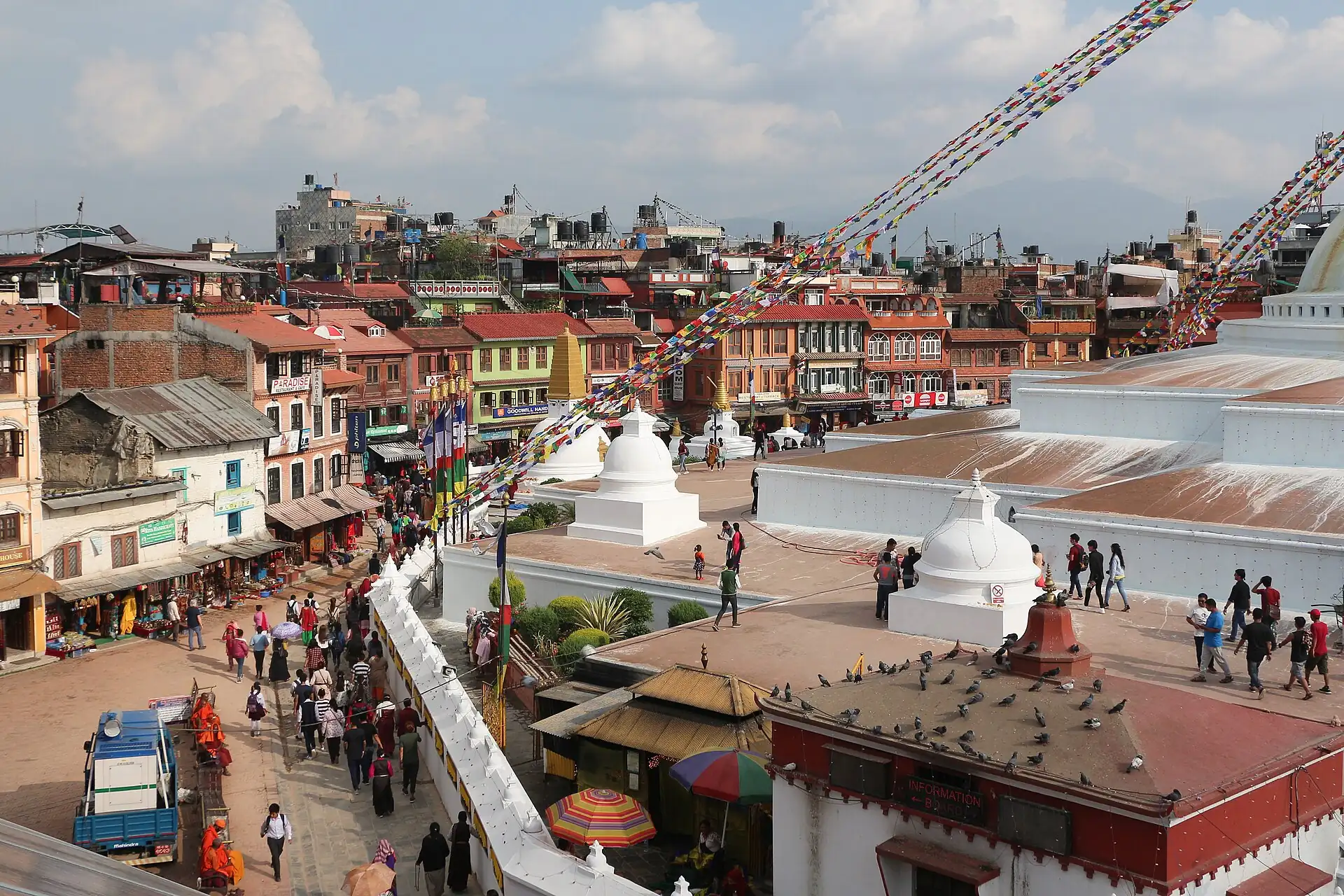
Boudhanath is the centre of Tibetan Buddhism in Nepal. After 1959, when many Tibetans fled the Chinese takeover, they settled around the great stupa, built monasteries and opened shops and guesthouses. Every morning and evening pilgrims walk clockwise around the stupa, spinning prayer wheels and murmuring mantras, and on festivals like Losar, the Tibetan New Year in February or March, the plaza fills with lamps and prayer flags. The stupa is around 36 metres high, one of the largest of its type in the world, and its painted eyes look in the four directions.
The festival calendar follows the lunar cycle and its dates move each year. Holi in March brings coloured powder and water, Maha Shivaratri in February or March fills Pashupatinath with pilgrims and sadhus, Buddha Jayanti in May draws crowds to the stupas, Indra Jatra in September brings the Kumari's chariot through Durbar Square, and Dashain and Tihar in autumn are the biggest holidays of the year, when families travel and shops close. A visitor who lands in the middle of one will find crowds and closures, and also the best chance to see the city at its most alive. Check the year's dates before you book, and give festival days extra time.
- Main Shiva temple
- Pashupatinath, on the Bagmati
- Tibetan refugees arrive
- From 1959
- Boudhanath stupa height
- About 36 m
- Biggest holidays
- Dashain and Tihar, autumn
- Tibetan New Year
- Losar, February or March
5Food history2 min
The everyday meal in Nepal is dal bhat: rice with lentil soup, a vegetable curry, a pickle and often a meat dish, served on a large plate with refills. It is the food that carries people through a day of work or a trek, and many Nepalis eat it twice a day. Around it sits a wider table shaped by the country's geography. The Newars of the valley eat rice-flour crepes, beaten rice with spiced buffalo meat, fermented and pickled sides and a sweet yogurt called juju dhau that is made in clay pots in Bhaktapur. The hill communities bring millet, corn and buckwheat, while the Tibetan and Sherpa communities add noodle soups and butter tea.
Momo, the dumpling, has a mixed history. Most food historians place its origin in Tibet or in the Newar trading community, and it spread through Nepal and across the Himalaya. In Kathmandu it is a citywide snack, steamed or fried, with a tomato and sesame dip. Tea is the other daily habit: milky, sweet and spiced with cardamom, sold from tea stalls and drunk at every visit. Drinks include a millet beer called tongba, drunk from a wooden mug refilled with hot water, and stronger rice spirits, aila and raksi, served in ceremonies and small bars.
Food follows the festival year too. A feast at Dashain features goat meat and rice, at Tihar there are sweets and garlands, and Newar festivals have their own dishes, offered to the gods and then eaten by the family. For a visitor the practical rule is to eat by the hour: tea and sel roti in the morning, dal bhat at lunch, momo in the afternoon, and a longer meal at night. Choose busy places with hot food, drink bottled or filtered water, and let a local friend or a food walk teach you the vocabulary. The cost of a full meal is small, and the range is wide.
- Everyday meal
- Dal bhat
- Street snack
- Momo with tomato-sesame chutney
- Newar sweet
- Juju dhau from Bhaktapur
- Local millet beer
- Tongba
- Daily drink
- Chiya, milk tea with spice
6The trail and the world outside2 min
Nepal stayed closed to most foreigners until the 1950s. When it opened, Kathmandu became a stop on the overland trail, and in the 1960s a small street near Durbar Square, known as Freak Street, became famous with young travellers who came for cheap rooms and the temples. The 1953 ascent of Everest by Edmund Hillary and Tenzing Norgay turned the country into a destination for climbers, and in the following decades trekking routes to Annapurna, Langtang and Everest grew into a national industry. Thamel, north of the old city, grew from a few guesthouses into a district of gear shops, agencies and cafés built around the trek.
Today Kathmandu is the gateway for most visitors, and its main work is logistics. People arrive at Tribhuvan Airport, spend a few days in the valley, and set out for the mountains by bus or by small plane. The valley itself is a rewarding destination, but it is easy to treat it as a waiting room. A short valley stay gives you the context for what you see on the trail: the Tibetan prayer flags at Boudha, the Hindu ceremonies at Pashupatinath, the Newar temples in the squares, and the food that fuels the trek. It also gives your body time to adjust and your paperwork time to be checked.
The modern city has its own pressures: traffic, dust, an overstretched water supply and a fast-growing population. The air is at its worst in the dry months, and many long-term residents wear masks. Visitors should plan for it: carry a mask, pick clearer mornings for long walks, and give yourself rest between sights. For those who trek, use a registered agency, check the current permit rules, buy insurance that covers evacuation, and leave a buffer day at the end for weather. The reward of all that planning is a place where the mountains, the temples and the food are all within a few hours of each other.
- Everest first climbed
- 1953
- Old traveller street
- Freak Street, near Durbar Square
- Modern visitor district
- Thamel
- Main airport
- Tribhuvan International
- Season for views
- October to early December
Read, watch, wordsReading · Watching · Glossary · Sources
Reading
- Into Thin Air — Jon KrakauerA first-hand account of the 1996 Everest disaster that shows the trekking and climbing world from Kathmandu outward.
- Seven Years in Tibet — Heinrich HarrerA classic of Himalayan travel writing; a window on the region before 1959.
Watching
- Himalaya (also released as Caravan) — Eric Valli, 1999A film about a salt caravan in the high Himalaya, shot with local non-professional actors.
Glossary
| Term | Local | Meaning |
|---|---|---|
| Namaste | नमस्ते | A greeting with palms together; also used as goodbye. |
| Stupa | स्तूप | A dome-shaped Buddhist monument; walk clockwise around it. |
| Durbar | दरबार | A royal palace or court; also the name of the squares. |
| Kumari | कुमारी | A young girl worshipped as the living goddess. |
| Dal bhat | दाल भात | Rice and lentils; the national meal. |
| Momo | मम | A steamed or fried dumpling. |
| Chiya | चिया | Milk tea with spice. |
| Guthi | गुठी | A Newar community trust that funds rituals and upkeep. |
| Bandh | बन्द | A strike that closes shops and roads. |
| Sadhu | साधु | A Hindu ascetic; some at Pashupatinath ask for payment for photographs. |
Read for this deep dive
Background reading only: the text above is written by Voykit, not copied from these pages.
Rules in force · 7
- South Asia ↗Trekking regions, border districts and several Indian states need separate permits on top of the visa; check the permit before you book transport into them.
- South Asia ↗Remove shoes (and in many Jain and Hindu temples, leather) before entering; cover shoulders and legs; ask before photographing people or rituals.
- Nepal ↗Get visa information only from the Department of Immigration; visa-service lookalike sites charge extra, and the rules differ by nationality.
- Nepal ↗At stupas walk clockwise; at temples and homes remove shoes where there is a rack or a raised floor; cover shoulders and knees.
- Nepal ↗Carry Nepalese rupees in small notes: many stalls, taxis and tea shops are cash-only, and shops rarely take foreign notes.
- Nepal ↗Strikes (bandh) and protests can close roads without notice: check the news and your hotel the night before any airport or highway day.
- Kathmandu Valley ↗In the dry season (Nov–Apr) the valley fills with haze and dust: viewpoints often show nothing after 09:00, so go at dawn or skip.
Entry rules depend on your passport. Full visa guide
Emergency numbers for Kathmandu100 ▾
Tap a number to call from your phone. These are the numbers listed in this guide; a row marked check has not been verified.
Planning is the full guide. I'm here keeps what is open and the cheat card.
Right now
Checking the weather…
Working out what is open near you…
What is open nowclock, closures, places open
Now in Kathmandu
Local time in Kathmandu
--:--
Loads in your browser · Asia/Kathmandu
This month
Month verdict appears here.
Closed today
See the weekly grid below.
| Weekly closure | Mon | Tue | Wed | Thu | Fri | Sat | Sun |
|---|---|---|---|---|---|---|---|
| Government offices and some museumscheckNepal's weekend is Saturday (and often Friday afternoon); many offices and some sights close. | · | · | · | · | · | ✕ | · |
If today is a closure day: Do the temple squares and the stupa before 10:00, rest in the afternoon, and leave dinner for Thamel. Watch for strike days (bandh) and festival closures before you book flights.
Weekly closures come from our place pages; public holidays, festivals, strikes and dry days add closures not shown here.
Cheat cardthe pocket version
Cheat card
The essentials on one card: save it as an image for your phone, share it, or print it.
Kathmandu
काठमाडौँ
- Money
- Keep NPR 3,000 in small notes; use ATMs inside banks, hotels or malls in daylight, not on dark lanes.
- SIM
- Buy an Ncell or Nepal Telecom SIM at the airport or a branded shop with your passport and a photo…
- Ride app
- Pathao · inDrive
- Emergency
- 100 police · 101 fire · 102 ambulance (not 911, 999 or 000)
- Plugs
- Sockets C/D/M. US/Canada (A/B): adapter · UK/Ireland (G): adapter · Australia/NZ (I): adapter. 230 V: US 120 V-only devices (hair dryers) need a converter; most chargers are dual-voltage.
Top 5
- Boudhanath at dawn or dusk
- Kathmandu Durbar Square
- Patan Durbar Square and museum
- Pashupatinath
- Kumari Ghar
EssentialsQuick answers, what things cost and how to get around
Essentials
Quick answers, what things cost and how to get around
Quick answers
The questions people ask first about Kathmandu, one line each. Tap a card for the full answer.
- Cash or card?Cash (NPR) for small shops, taxis, food stalls and entry fees; cards at hotels, malls and upmarket restaurants.
- SIM or eSIMBuy an Ncell or Nepal Telecom SIM at the airport or a branded shop with your passport and a photo; registration is required.
- Ride-hailing appPathao · inDrive.
- Tap waterDo not drink tap water; use bottled or filtered water.
- TippingNot expected at tea stalls.
- Plugs & powerSockets C/D/M. US/Canada (A/B): adapter · UK/Ireland (G): adapter · Australia/NZ (I): adapter. 230 V: US 120 V-only devices (hair dryers) need a converter; most chargers are dual-voltage.
Show all 14 answers
- Safe at night?Take more care after dark in Thamel, Durbar Square and Basantapur, Pashupatinath.
- What to wearRemove shoes where marked; walk clockwise around stupas; do not touch offerings or step over them.
- Emergency numbers100 police · 101 fire · 102 ambulance (not 911, 999 or 000)
- Your embassycheckUS, UK, Australia embassies listed with addresses (check before you go).
- Closed which day?Sat: 1 on our list shut.
- Sundays & holidaysWeekly closures come from our place pages; public holidays, festivals, strikes and dry days add closures not shown here.
- Rainy-day planIn the monsoon (June to September) mornings are the driest: do outdoor sights before noon and keep the afternoon for museums, cafés and a slow lunch.
- Landing lateKTM: pre-booked pickup or prepaid taxi to the hotel door runs all night.
Cost cheat-sheetwhat everyday things cost
Cost cheat-sheet
Typical prices for the everyday things, as ranges. Change the currency right here; the local price stays first.
2026 desk estimate · check
- Sit-down mealSit-down restaurant meal, per personNPR 800–2,000
- Street or quick mealDal bhat set lunchNPR 350–800
- Beerbar or restaurantNPR 400–800
- Taxi, about 5 km (3 mi)Taxi, about 3 mi (5 km)Short taxi rideAgree the fare or use an app.NPR 300–700
- SIM or eSIM, a weekTourist SIM, about a weekNPR 600–1,500
- Museum or sight ticketMonument entry, foreignerVaries by site; check.NPR 400–1,000
- Budget bedHostel dorm bed, a night, per personNPR 700
- Mid-range bedHotel double room, a night, per roomNPR 6,000
- High-end bedHotel double room, a night, per roomNPR 18,000
A day, not counting the bed: Budget NPR 3,000 · Mid NPR 6,500 · High NPR 15,000
Local prices, with USD next to them (rates 2026-09 (approximate); change it in the header). Ranges are desk estimates: check locally. Every price and the budget calculator →
Source: Prices in Kathmandu
Draft
Written from desk research. Not yet compared with the official source.
No official source is recorded for this figure.
Prices are 2026 desk estimates, not yet compared with an official source. Check on the day.
Not checked in the last 12 months (no check date on file).
DecideWho it suits, the trade-offs and when to go
Decide
Who it suits, the trade-offs and when to go
Best months at a glance
The guide's verdict for each month
Jan
Best
19°C (66°F)66°F (19°C)
Feb
Best
21°C (70°F)70°F (21°C)
Mar
Best
25°C (77°F)77°F (25°C)
Apr
Care
28°C (82°F)82°F (28°C)
May
Care
29°C (84°F)84°F (29°C)
Jun
Avoid
29°C (84°F)84°F (29°C)
Jul
Avoid
28°C (82°F)82°F (28°C)
Aug
Avoid
28°C (82°F)82°F (28°C)
Sep
Care
27°C (81°F)81°F (27°C)
Oct
Best
26°C (79°F)79°F (26°C)
Nov
Best
22°C (72°F)72°F (22°C)
Dec
Best
19°C (66°F)66°F (19°C)
Best: Oct–Mar. Mixed: Apr–May, Sep. Avoid: Jun–Aug. Month by month →
Warmest May (29°C (84°F)84°F (29°C)), coolest Jan (3°C (37°F)37°F (3°C) low), wettest Jul (22 rain days), driest Nov (1). Averages, not a forecast.
Kathmandu across the year
Best-looking months for Kathmandu: Jan, Feb, Oct. Rated avoid: Jun, Jul, Aug.
| Measure | Jan | Feb | Mar | Apr | May | Jun | Jul | Aug | Sep | Oct | Nov | Dec |
|---|---|---|---|---|---|---|---|---|---|---|---|---|
| Weather | Good (good) | Good (good) | Good (good) | Mixed (care) | Mixed (care) | Avoid (avoid) | Avoid (avoid) | Avoid (avoid) | Mixed (care) | Great (good) | Great (good) | Good (good) |
| Crowds | Low (good) | Low (good) | Medium (ok) | High (care) | Medium (ok) | Low (good) | Low (good) | Low (good) | Medium (ok) | High (care) | High (care) | Medium (ok) |
| Prices | Low (good) | Low (good) | Medium (ok) | High (care) | Medium (ok) | Low (good) | Low (good) | Low (good) | Medium (ok) | High (care) | High (care) | Medium (ok) |
| Events | None listed (ok) | 2 events (ok) | 3 events (ok) | 1 event (ok) | 1 event (ok) | None listed (ok) | None listed (ok) | 2 events (ok) | 3 events (ok) | 2 events (ok) | 2 events (ok) | None listed (ok) |
Green is good news, amber needs planning, red is a month to avoid; dashed grey with a question mark means our data does not say. Open the year heatmap →
Not checked in the last 12 months (no check date on file).
Source: Months, temperatures and crowds
Draft
Written from desk research. Not yet compared with the official source.
Monthly highs, rain and crowd levels are climate averages and desk estimates for the city, not a forecast.
Understand the cityUnderstand · Districts
Orientation & districts
The old city, Thamel and Durbar Square lie on the west bank of the Bagmati river; Boudhanath and Pashupatinath are about 6–8 km east; Patan is just across the river to the south; Swayambhunath sits on a hill to the west. Traffic decides every trip: allow double the map time.
Addresses are given by neighbourhood, chowk (square) and a nearby landmark; give your driver a landmark and show the pin.
Shaded shapes: walking areas (click one). Black pins: sleep areas. Grey dots: places. Round badges: arrivals. Click the map to turn on scroll-wheel zoom.
Hover, tap or tab to an area to see what it is like. Pins are sleep areas; arrows at the edge point to the airport.
Off the map: Tribhuvan International Airport (KTM) (30–60 min by the usual route).
Not drawn yet (no coordinates in this guide): Swayambhunath, Bhaktapur. They are in the neighbourhood cards below.
Where’s what, as a list:
- Thamel: A dense visitor quarter of narrow lanes, hotels, trekking shops and restaurants; noisy at night, dusty by day. Suits: Trip logistics, gear, cafés, first nights. Price band $.
- Durbar Square and Basantapur: The historic centre with Malla palaces and temples; crowded with shrines, pigeons and vendors. Suits: The royal square, temples, the Kumari.
- Boudhanath: A Tibetan Buddhist neighbourhood around a huge stupa; quieter at night than Thamel. Suits: The stupa, monasteries, a calmer base. Price band $$.
- Pashupatinath: Reached by taxi from Boudha; a place of worship and funerals. Suits: The great Shiva temple and cremation ghats.
- Patan (Lalitpur): A Newar city with a beautiful square and metalwork workshops; often the easier day. Suits: A calmer old square, museums, crafts.
- Swayambhunath: A hilltop stupa west of the city with monkeys; about 365 steps from the eastern stair. Suits: Sunrise and city views from a hill temple.
- Bhaktapur: About 13 km (8.1 mi) east; well preserved and quieter than Kathmandu; entry fee for foreigners.About 8.1 mi (13 km) east; well preserved and quieter than Kathmandu; entry fee for foreigners. Suits: A medieval town by day trip.
- Sleep area Boudha: suits The stupa, monasteries, a calmer base, price band $$.
- Sleep area Thamel: suits Trip logistics, gear, cafés, first nights, price band $.
- Tribhuvan International Airport (KTM), 30–60 min by the usual route.
Neighbourhoods at a glance
One tab per area, pulled together from this guide’s districts table, area notes, sleep-area scores and place pages. Scores are desk judgements (1–5); prices are estimates, check before you book.
Thamel
$A dense visitor quarter of narrow lanes, hotels, trekking shops and restaurants; noisy at night, dusty by day.
- Suits:
- Trip logistics, gear, cafés, first nights
- Best time:
- Afternoon to late
- Rooms:
- NPR 1,500–3,500 (from the sleep guide)
Pick this if: Logistics and dinners
Watch out for: Hauling luggage through the lanes.
- Quiet nights2/5 Low
- Nightlife5/5 Very high
- Families2/5 Low
- Late arrival4/5 High
Why these scores
- Quiet nights: Noisy at night from bars and traffic; ask for a room at the back.
- Nightlife: The main bar and restaurant scene of the city.
- Families: Dust, noise and touts; better for adults.
- Late arrival: Restaurants and taxis until about midnight.
Getting around from here
- 18–25 min walk to Kathmandu Durbar Square
- Car east: about 30 min to Boudhanath
- Car south: about 30 min to Patan Durbar Square
Durbar Square and Basantapur
The historic centre with Malla palaces and temples; crowded with shrines, pigeons and vendors.
- Suits:
- The royal square, temples, the Kumari
- Best time:
- 07:00–10:007:00 AM–10:00 AM
Pick this if: A dawn visit
Watch out for: Midday crowds.
Getting around from here
- Walk north: about 18 min to Thamel
- Car south: about 25 min to Patan Durbar Square
Boudhanath
$$A Tibetan Buddhist neighbourhood around a huge stupa; quieter at night than Thamel.
- Suits:
- The stupa, monasteries, a calmer base
- Best time:
- Dawn and after 16:00Dawn and after 4:00 PM
- Rooms:
- NPR 4,500–9,000 (from the sleep guide)
Pick this if: Dawn and dusk circuits
Watch out for: Midday heat on the plaza.
- Quiet nights4/5 High
- Nightlife2/5 Low
- Families3/5 Medium
- Late arrival2/5 Low
Why these scores
- Quiet nights: Calmer at night; the stupa circuit is lively until about 21:00.
- Nightlife: Rooftop cafés; not a bar scene.
- Families: Gentler pace, but dust and traffic on the ring road.
- Late arrival: Few restaurants after 21:00; the ring road is far from Thamel.
Getting around from here
- 30–45 min walk to Thamel
- Car south-west: about 30 min to Kathmandu Durbar Square
Pashupatinath
Reached by taxi from Boudha; a place of worship and funerals.
- Suits:
- The great Shiva temple and cremation ghats
- Best time:
- Dawn and after 16:00Dawn and after 4:00 PM
Pick this if: Dawn and dusk circuits
Watch out for: Midday heat on the plaza.
Getting around from here
- Car west: about 30 min to Thamel
- Car south-west: about 30 min to Kathmandu Durbar Square
Patan (Lalitpur)
A Newar city with a beautiful square and metalwork workshops; often the easier day.
- Suits:
- A calmer old square, museums, crafts
- Best time:
- Morning
Pick this if: A calmer second day
Watch out for: Late afternoon closings.
Getting around from here
- Car north: about 30 min to Thamel
- Car north: about 25 min to Kathmandu Durbar Square
Swayambhunath
A hilltop stupa west of the city with monkeys; about 365 steps from the eastern stair.
- Suits:
- Sunrise and city views from a hill temple
Bhaktapur
About 13 km (8.1 mi) east; well preserved and quieter than Kathmandu; entry fee for foreigners.About 8.1 mi (13 km) east; well preserved and quieter than Kathmandu; entry fee for foreigners.
- Suits:
- A medieval town by day trip
Ward by ward
3 area guides. Open one for the short answer, the key facts and what the area is like; the full guide is linked inside. Prices marked (check) are estimates.
CentralBest for: First-timers, short stays, business and embassy visits, walkable access to Ratna Park transport
Yes for a first trip of 2–4 nights: Central puts Ratna Park buses, New Road shops, the former palace and the embassy quarter within a 20–30 minute walk of Durbar Square, and most luxury hotels sit here. Choose it if you want walkable logistics; go West or East for quieter, cheaper stays.
- Best for:
- First-timers, short stays, business and embassy visits, walkable access to Ratna Park transport
- Walk to Durbar Square:
- About 20–30 minutes from New Road; 10–15 minutes by taxi (check)
- Main transport hub:
- Ratna Park bus station — most buses and micro-buses start and end here
- Room range:
- Luxury and mid-range hotels cluster here; budget guesthouses are more common in the tourist quarter (2026 estimate)
- Noise:
- Traffic and horns on the main roads; ask for a room away from the street
- Air:
- Dust and exhaust are worst in the dry winter months; a mask helps (check)
What the area is like
Central Kathmandu is the administrative and commercial heart of the city. It covers Ratna Park, the former royal palace, New Road and the embassy quarter, and it holds a large share of the city's luxury hotels. This is where offices, banks, airlines and government buildings sit, so the streets are busy with commuters rather than only travellers.
The layout is compact but not calm. New Road is the main shopping spine, Ratna Park is the transport hub, and the old palace area anchors the north side. Between them you get a mix of concrete office blocks, older Newar buildings, temple courtyards and market stalls. Walking is possible, but pavements are uneven and traffic does not stop for pedestrians.
It is a practical base rather than a scenic one. The big sights — Durbar Square, Swayambhunath and Pashupatinath — are a short taxi ride away, and the tourist restaurant strip around Thamel is walkable from the western edge of the area.
Full Central guideShould you stay here or not
Stay in Central if your trip is short, you want to walk to shops and offices, or you are arriving or leaving by bus from Ratna Park. It also suits travellers who prefer a hotel with reliable power, hot water and a desk over a guesthouse in the backpacker quarter.
Skip it if you want quiet evenings, mountain views or a street full of trekking shops and cafés. Those are found in the tourist quarter and in the West and East neighborhoods, where rooms are often cheaper and the atmosphere is more relaxed. Central is also the least green part of the city, so light sleepers should weigh the traffic noise.
EastBest for: Boudhanath stupa, Tibetan monasteries, momos and thukpa, a calm base
Stay in East Kathmandu if Boudhanath's stupa and Tibetan monastery life are your reason for coming — it is quiet, walkable and best for two or three nights. Skip it if you want nightlife or a short walk to Durbar Square; the centre is a 20–40 minute taxi away.
- Best for:
- Boudhanath stupa, Tibetan monasteries, momos and thukpa, a calm base
- Not for:
- Nightlife, bars after 21:00, walking distance to Durbar Square or ThamelNightlife, bars after 9:00 PM, walking distance to Durbar Square or Thamel
- Anchor sight:
- Boudhanath stupa, UNESCO World Heritage since 1979
- Getting in:
- Taxi from Thamel or the centre, roughly 20–40 minutes depending on traffic (check)
- Airport:
- Tribhuvan International Airport is east of the centre; Boudhanath is a short ride from it (check)
- Quiet hours:
- Most shops and restaurants around the stupa close by about 20:00Most shops and restaurants around the stupa close by about 8:00 PM
- Circumambulation:
- Walk clockwise around the stupa; three or more laps is the local practice
- Busiest days:
- Full moon and new moon, when pilgrims and incense fill the kora
What the area is like
East Kathmandu means Boudhanath, usually shortened to Boudha: a ring of Tibetan monasteries and guesthouses wrapped around one of the largest Buddhist stupas anywhere. The site has drawn pilgrims from Nepal and Tibet for centuries and sat on the old trade route to Lhasa. UNESCO listed it in 1979.
The daily rhythm is religious, not touristic. Residents and monks walk the kora — the paved loop around the base — clockwise, often three or more times, turning prayer wheels and chanting. On full and new moon days the circuit fills with incense and butter lamps. By about 20:00 the shops and restaurants shut and the area goes quiet, which is either the point of staying here or the reason not to.The daily rhythm is religious, not touristic. Residents and monks walk the kora — the paved loop around the base — clockwise, often three or more times, turning prayer wheels and chanting. On full and new moon days the circuit fills with incense and butter lamps. By about 8:00 PM the shops and restaurants shut and the area goes quiet, which is either the point of staying here or the reason not to.
The population is heavily Tibetan and Sherpa, and the food follows: momos, thukpa, butter tea and Tibetan bread rather than the pizza-and-live-music circuit of Thamel. Streets are narrow, dusty in the dry season and muddy after rain, and the stupa is reached on foot from almost any guesthouse in the district.
Full East guideShould you stay here
Stay if the stupa is a highlight of your Kathmandu list, if you want early-morning and evening kora walks without a taxi, or if you are heading to or from a Tibet or Everest trek and want monastery atmosphere on the way. Two or three nights is enough for most travellers; the district is small.
Do not stay if you want restaurants and bars open late, if you plan to spend most days around Durbar Square, Swayambhunath and Thamel, or if you have an early domestic flight and would rather be closer to the airport road. Families and older travellers generally find the flat, short walks around the stupa easy; the surrounding lanes are uneven.
WestBest for: First trips: walkable base for Durbar Square, Swayambhunath and Thamel
Yes for most first-time visitors: West Kathmandu holds Thamel, Durbar Square and Swayambhunath, and its core lanes are traffic-free. Stay here if you want walkable guesthouses, trekking shops and cafés; go elsewhere if you need quiet nights or easy vehicle access, since Thamel's alleys are narrow and loud.
- Best for:
- First trips: walkable base for Durbar Square, Swayambhunath and Thamel
- Core lanes:
- Traffic-free in the Thamel area
- Walk to Durbar Square:
- About 20–25 minutes from central Thamel (check)
- Walk to Swayambhunath:
- About 30–40 minutes uphill from Thamel, or a short taxi ride (check)
- Airport transfer:
- Taxi to Thamel roughly 30–45 minutes, longer in traffic; fare 2026 estimate (check)
- Quiet at night:
- No — bars, dogs and early trekking departures
- Coordinates:
- 27.7152, 85.3101 (approximate, district centre) (check)
What the area is like
West Kathmandu is the old tourist core: a dense grid of alleys around Thamel packed with handicraft shops, guesthouses, cafés, trekking outfitters and bookshops. The busiest lanes are closed to vehicles, so you move on foot between shops and restaurants, with motorbikes squeezing through the wider streets.
The district also holds two of the city's headline sights. Kathmandu Durbar Square, the old royal and temple complex, sits at its southern edge, and Swayambhunath, the hilltop Buddhist stupa known as the Monkey Temple, rises to the west. Freak Street, south of Durbar Square, is the older backpacker strip and is now quieter than Thamel.
Expect narrow pavements, uneven surfaces, honking, and a lot of construction and renovation work. It is convenient and full of services rather than calm or residential.
Full West guideShould you stay here
Stay in West Kathmandu if you want to walk to dinner, book a trek in person, and be within a short ride of Durbar Square and Swayambhunath. It suits first-time visitors, solo travellers and anyone spending only a few nights in the city before heading to Pokhara or a trailhead.
Look at Central or East Kathmandu instead if you want quieter nights, more space, or easier car access. Trekkers who leave before dawn may prefer a hotel away from Thamel's noise, though the trade-off is a longer ride to the shops and agencies.
Book ahead for October–November and March–April, the peak seasons, and around major festivals when rooms fill and prices rise.
Decide
The honest trade-off: what you will enjoy, what will wear you down.
You will like
- Temples and stupas in use
- Cheap food and tea
- Trek-gear and craft shopping
You will hate
- Dust and exhaust
- Uneven pavements
- Touts and aggressive shop calls
Similar citiesif this one is not quite right
Similar cities
If Kathmandu does not fit your dates or budget, these match it on season, cost and feel.
- Mexico City
Mexico
- Good in the same months: Jan, Feb, Mar, Oct and 2 more
- Works well for food trips, tight budgets, couples
- A similar climate through the year
- Marrakech
Morocco
- Good in the same months: Jan, Feb, Mar, Oct and 2 more
- Works well for food trips, tight budgets, couples
- A similar climate through the year
- San Salvador
El Salvador
- Good in the same months: Jan, Feb, Mar, Nov, Dec
- Works well for food trips, tight budgets
When
Best months: Jan, Feb, Mar, Oct, Nov, Dec. Month-by-month verdicts below, with the live forecast first. When to go, month by month →
Kathmandu: next 7 days
Loading forecast…
Forecast: Open-Meteo (CC BY 4.0), model data for this point.
Air quality
Loading…
Model estimate (CAMS via Open-Meteo), not a street-level station; readings near busy roads run higher.
Month by month, all 12best Jan, Feb, Mar, Oct, Nov, Dec
Cold mornings and nights, clear days; fog can delay flights.
Cool and dry; haze builds late in the month.
Warming; smoke haze in the valley some years.
Warm and hazy; dusty streets, bring a mask.
Hot and dusty; pre-monsoon storms.
Monsoon starts; heavy rain, landslides on highways.
Peak monsoon; roads and flights disrupted.
Monsoon; cloud hides the mountains.
Rain tapering; Dashain can start (dates move yearly).
Clearest skies; Dashain and Tihar crowds, closures and sold-out transport.
Dry and clear, cool mornings.
Cold mornings and nights; bring layers.
Climate, calendar and eventsClimate · Calendar · Events · Packing by season
Climate
| Jan | Feb | Mar | Apr | May | Jun | Jul | Aug | Sep | Oct | Nov | Dec | |
|---|---|---|---|---|---|---|---|---|---|---|---|---|
| High | 19°C (66°F)66°F (19°C) | 21°C (70°F)70°F (21°C) | 25°C (77°F)77°F (25°C) | 28°C (82°F)82°F (28°C) | 29°C (84°F)84°F (29°C) | 29°C (84°F)84°F (29°C) | 28°C (82°F)82°F (28°C) | 28°C (82°F)82°F (28°C) | 27°C (81°F)81°F (27°C) | 26°C (79°F)79°F (26°C) | 22°C (72°F)72°F (22°C) | 19°C (66°F)66°F (19°C) |
| Low | 3°C (37°F)37°F (3°C) | 5°C (41°F)41°F (5°C) | 9°C (48°F)48°F (9°C) | 12°C (54°F)54°F (12°C) | 16°C (61°F)61°F (16°C) | 19°C (66°F)66°F (19°C) | 20°C (68°F)68°F (20°C) | 20°C (68°F)68°F (20°C) | 18°C (64°F)64°F (18°C) | 13°C (55°F)55°F (13°C) | 8°C (46°F)46°F (8°C) | 4°C (39°F)39°F (4°C) |
| Rain days | 2 | 3 | 4 | 7 | 11 | 16 | 22 | 22 | 15 | 4 | 1 | 1 |
| Verdict |
- October to early December is the clearest period, with dry weather and mountain views; it is also the busiest and the most festival-heavy.
- January and February are cold at night and clear by day; haze and dust build from March to May before the monsoon.
- June to September is the monsoon: heavy rain, humidity, landslides on roads and cloud that hides the mountains.
Events by month
Maha Shivaratri
religiousLunar calendar, moves yearly · Pashupatinath(check dates)
A huge festival at the temple; the area is packed and roads close.
Losar (Tibetan New Year)
religiousLunar calendar, moves yearly · Boudhanath(check dates)
Prayer flags, masked dances and crowds at the stupa.
Holi (Fagu Purnima)
festivalFull moon of Phalgun · Citywide, Durbar Square(check dates)
Coloured powder and water; wear old clothes and protect cameras.
Nepali New Year and Bisket Jatra
festivalMid April · Bhaktapur and citywide(check dates)
Processions and public holidays; Bhaktapur is packed.
Buddha Jayanti
religiousFull moon of Baisakh · Boudhanath and Swayambhunath(check dates)
Crowds and prayers at stupas.
Indra Jatra
festivalLunar calendar, moves yearly · Durbar Square(check dates)
Chariot procession with the living goddess Kumari; roads close.
Dashain
festivalLunar calendar, moves yearly · Citywide(check dates)
The biggest national festival; offices and shops close for days and transport is booked out.
Tihar (Deepawali)
festivalLunar calendar, moves yearly · Citywide(check dates)
Lights and garlands for five days; shops close in parts.
Festivals and events that change the plan
| When | What | Effect on your plan |
|---|---|---|
| Feb–Mar | Maha Shivaratri | A huge festival at Pashupatinath; the area is packed and roads close. |
| Feb–Mar | Losar | Tibetan New Year at Boudhanath; crowds and prayer flags. |
| Mar | Holi | Coloured powder and water; wear old clothes and protect cameras. |
| Sep–Oct | Dashain | The biggest national festival; offices and shops close for days and transport is booked out. |
| Oct–Nov | Tihar | Lights and garlands for five days; some shops close. |
| Variable | Bandh (strikes) | Roads and shops can close for a day; check the news before you book flights. |
What to pack, by season
From Kathmandu’s own climate table: the coldest, warmest and wettest three months, and what to bring for each.
Coldest months
Dec–Feb
4° to 20°
A warm coat and layers.
Warmest months
Jun–Aug
20° to 28°
Light clothes, sunglasses and sunscreen; a thin layer for air conditioning.
Wettest months
Jun–Aug
20 rain days a month
A compact umbrella or rain jacket and shoes that can get wet.
Arrive & moveGetting in, getting around, and your bags
Arrive & move
Getting in, getting around, and your bags
I land at…
Enter your landing time: what still runs from the airport, where you can eat when you get in, and which areas let you check in that late.
Tribhuvan International Airport (KTM)
Out of the airport about 00:10 (next day)12:10 AM (next day) (01:35 (next day)1:35 AM (next day) if immigration and bags are slow); in town about 00:40 (next day)12:40 AM (next day).
Transport from the airport
- Any hourPre-booked pickup or prepaid taxi to the hotel door. Runs all night.
- Any hourRide-hailing app or street taxi (agree the fare before you get in). Any hour.
- Last resortOvernight near the airport. If nothing else works.
Places to eat open when you get in
We have no confirmed hours for the places to eat here yet. Plan on a convenience store or your hotel. What is open late →
Where to sleep with a late arrival
- Lets you inThamel 24-hour desk. Restaurants and taxis until about midnight.
- Call aheadBoudha Desk hours not confirmed: message the hotel with your flight number. Few restaurants after 21:00; the ring road is far from Thamel.Desk hours not confirmed: message the hotel with your flight number. Few restaurants after 9:00 PM; the ring road is far from Thamel.
Typical times from our airport data, not a timetable: check the last departure on the day. Full airport-to-bed plan for Tribhuvan International Airport (KTM) →
Arrive
Each gateway has its own airport-to-bed page with timings and the last safe connection.
Getting in, in detailGet in
Get in by rail and road
| Station | Mode | Serves | Where | To the centre |
|---|---|---|---|---|
| Tribhuvan International Airport (KTM)Tribhuvan Antarrashtriya Bimanasthaluse | Air | International and domestic flights; about 6 km (3.7 mi) east of ThamelInternational and domestic flights; about 3.7 mi (6 km) east of Thamel | East of the centre | Taxi 20–60 minUse the prepaid taxi counter or a booked hotel car; traffic decides the time. |
| Kalanki and Gongabu bus parksBus parkscaution | Bus | Long-distance buses to Pokhara, Chitwan, Bhaktapur and the far west | Kalanki (west) and Gongabu (north) | Taxi 20–45 minChaotic; use tourist bus services from Sorhakhutte and Thamel, and book ahead. |
| Tourist bus stops (Sorhakhutte, Thamel)Tourist bususe | Bus | Tourist coaches to Pokhara, Chitwan and Lumbini | Thamel and Sorhakhutte | Already there or a short taxiMore comfortable and reliable than local buses; book in advance. |
| Domestic flights (Pokhara, Lukla, Chitwan)Domestic terminalcheck | Air | Short flights, including mountain flights to Lukla (Everest region) | Tribhuvan domestic terminal | Taxi 20–60 minWeather delays are common; keep a spare day and check the operator's safety record. |
- Book tourist buses and domestic flights through your hotel or a registered agent; avoid touts at bus parks.
- Monsoon landslides can close highways; ask about road status before you travel by land.
Move
The default way around, when a pass pays off, and when the last trains go.
- Default
- Walk inside a cluster; taxi or ride-hailing between clusters (agree the fare or check the app price first).
- Passes
- No pass. Short taxi rides inside the valley are cheap; agree the fare before you get in.
- Last trains
- No rail: taxis and ride-hailing are thinner after dark and in heavy rain. Ask your hotel to book the late ride.desk estimate
- Other modes
- Other modes (Rome2Rio) ↗
Getting around, in detailGet around · Connect
Get around
Walk inside a cluster; taxi or ride-hailing between clusters; micro-bus and tempo only if you know the route. Traffic is heavy: allow double the map time, avoid rush hours (about 08:30–10:30 and 16:30–19:00), and expect dust.Walk inside a cluster; taxi or ride-hailing between clusters; micro-bus and tempo only if you know the route. Traffic is heavy: allow double the map time, avoid rush hours (about 8:30 AM–10:30 AM and 4:30 PM–7:00 PM), and expect dust.
| Mode | Verdict | Fare | Use it for | What breaks |
|---|---|---|---|---|
| Walking | use | Free | Inside Thamel and the old core | Uneven; watch motorbikes and open drains. |
| Taxi | caution | Agree first: NPR 300–700 for a short ride | Between clusters | Meters exist but drivers may refuse; agree the fare first. |
| Ride-hailing (Pathao, inDrive) | use | NPR 200–1,200 across the city | Between clusters, night | Fare shown before you ride; the default for many visitors. |
| Rickshaw (cycle) | maybe | Agree first: NPR 200–500 | Short hops in Thamel and Durbar Square | Fun for a short stretch; agree the fare and the destination. |
| Micro-bus and tempo | caution | NPR 20–50 | Adventurous local routes | Crowded and hard to read; watch your bag. |
| Motorbike taxi (Pathao Bike) | caution | NPR 100–400 | Solo travellers in traffic | Fast in traffic but riskier; wear the helmet. |
| Hired car with driver | use | NPR 5,000–9,000 a day (check) | Multi-stop days and Bhaktapur | Book through the hotel or an agency. |
| Tourist bus and domestic flight | use | Varies | Pokhara, Chitwan, Lukla | Book ahead; flights are weather-dependent. |
Taxis and ride-hailing
Pathao
app
Local ride-hailing app for cars and bikes.
inDrive
app
You propose a fare; drivers accept or counter.
Street taxis (white and black)
street
Agree the fare or ask for the meter; carry small notes.
On foot and car-free hours
| Where | When | Note |
|---|---|---|
| Thamel lanes to Durbar Square | Morning | About 20 minutes; narrow lanes, crowded and dusty; cross the Tridevi Marg road carefully. |
| Boudhanath circuit | Dawn or dusk | A flat, clockwise walk with pilgrims; watch out for bicycles. |
More on getting around
Buy a local SIM on arrival and use ride-hailing for most cross-city trips. Allow double the time the map suggests, and fix the fare or check the app price before you get in a car.
Kathmandu's dust and traffic are at their worst in the dry months; a mask and sunglasses help on long walks.
Connect
| Option | Verdict | What breaks |
|---|---|---|
| Ncell or Nepal Telecom counter at the airport | use | Passport and a photo are needed for registration; buy only from the official counter. |
| Carrier shop in Thamel | use | Same registration; better bundle choice. |
| eSIM from a travel provider | ok | Check coverage; useful for arrival. |
| Street SIM sellers | avoid | SIMs must be registered to your passport. |
Pathao
Cars and bikes
A common ride-hailing app; fare shown before you ride.
inDrive
Cars
You propose a fare; drivers accept or counter.
Google Maps and Maps.me
Walking and lanes
Lanes in the old city are patchy; confirm with your hotel.
eSewa and Khalti
Mobile payments
Common with locals; need a local SIM and account.
- Wi-Fi
- Available in most hotels and cafés; power cuts can drop it, and speeds vary.
Luggage
Where big bags are a problem, and how to get rid of them for the day.
Rule
- Lockers
- Few public lockers; hotels and trekking shops hold bags, usually for a small fee.
- Forwarding
- No forwarding culture: leave the big bag at the Kathmandu hotel when you trek or fly for a few days.
- Dead zone
- Late departures: ask the hotel to hold bags and give a shower room; many do for a fee.
Bags, area by area
4 walking areas rated
- Bags forbidden
- Bags painful
Lockers, forwarding and the gap between check-out and check-in are covered once, under Luggage.
See & doWalking clusters, day plans and the places worth the time
See & do
Walking clusters, day plans and the places worth the time
Clusters
Plan by cluster: each is a walkable area with a rescue point and a bag rule.
Evening cluster and the place to sleep: cafés, gear shops and money changers in a few walkable lanes; crowded after 17:00 and off-limits to big bags.
rescue 100% · max p90 5.2′ · half
Morning cluster: the old palace square and Kumari Ghar before the tour groups; some monuments are still fenced or scaffolded after the 2015 earthquake.
rescue 100% · max p90 5.2′ · half
Dawn or dusk cluster: walk the circuit around the stupa with local pilgrims; midday is hot, loud with tour groups and shadeless.
rescue 100% · max p90 5.2′ · half
Half-day cluster south of the river: Patan's palace square and the Golden Temple lanes; calmer than Kathmandu, but far enough that it needs its own car ride.
rescue 100% · max p90 5.2′ · half
Days
Ready-made day plans, timed against opening hours and walking distances.
How long are you staying?
Loose outlines in the city's rhythm: sights at dawn, a long rest in the afternoon, dinner in Thamel.
1 day
A long layover
- 07:00Kathmandu Durbar Square — Kathmandu Durbar Square
- 09:30Kumari Ghar — Kumari Ghar
- 11:30Dal bhat set lunch, Thamel — Dal bhat lunch
- 14:00Boudhanath Stupa — Taxi to Boudhanath
- 17:00Momo houses, Boudha — Momo and a circuit at dusk
Skip: Patan and Pashupatinath: they need their own morning.
Kathmandu in 3 days
3 daysMornings at the squares, afternoons indoors, dinner in Thamel; the last day ends with the bags already in the car.
Day by day
Day 1 — Durbar Square morning, a 12:30 lunch table
- 07:30Kathmandu Durbar Square
- Kumari Ghar (optional)
- Chiya, sel roti and sweets, Basantapur (optional)
- 12:30Lunch table 12:30 (Thamel)
Day 2 — Boudhanath at dawn, dinner in Thamel
Day 3 — Patan, car to the airport at 12:00
- 08:00Patan Durbar Square
- Golden Temple, Patan (Hiranya Varna Mahavihar) (optional)
- Newari khaja set, Patan (optional)
- 12:00Car to Tribhuvan at 12:00
Places
“Best time” is when to arrive for the fewest crowds, for example “before 08:30”; “Go any time” means the hour makes little difference. More sights follow under “More sights and museums”.
6 places. Filters use the guide’s own ratings; a place with no rating is left out when a filter is on.
Tours, classes and shows in Kathmandu →
Things to do in Kathmandu: shows, nightlife and activities →
If you do ten things in Kathmandu
Ranked for a first visit of 2–3 days. Prices are 2026 estimates in NPR; foreigner entry fees change often.
- 1
A huge white stupa with pilgrims circling and monasteries around it.
- Time
- 1–1.5 h
- Best
- Dawn or dusk
- Cost
- About NPR 400 (check)
- 2
The old royal square with temples and palaces of the Malla kings.
- Time
- 1.5–2 h
- Best
- Early morning
- Cost
- About NPR 1,000 (check)
- 3
Patan Durbar Square and museum
A compact, well-kept square with a fine museum of metalwork.
- Time
- 2–3 h
- Best
- Morning
- Cost
- About NPR 1,000 (check)
- 4
The great Shiva temple complex on the Bagmati, with ghats and sadhus.
- Time
- 1–1.5 h
- Best
- Late afternoon
- Cost
- About NPR 1,000 (check)
- 5
The house of the living goddess, with a carved wooden courtyard.
- Time
- 20–30 min
- Best
- Morning
- Cost
- Included with the square (check)
- 6
A gilded monastery courtyard alive with monks and offerings.
- Time
- 20–30 min
- Best
- Morning
- Cost
- About NPR 50–100 (check)
- 7
Swayambhunath at sunrise
A hilltop stupa with a view over the valley.
- Time
- 1.5 h
- Best
- Sunrise
- Cost
- About NPR 200 (check)
- 8
The national meal, served with unlimited rice and dal.
- Time
- 45 min
- Best
- 12:00–14:00
- Cost
- NPR 350–800
- 9
Nepal's favourite dumpling in a Tibetan neighbourhood.
- Time
- 30–45 min
- Best
- Lunch
- Cost
- NPR 200–400
- 10
Bhaktapur day trip
A medieval town with a quiet square and potters' lanes.
- Time
- Half day
- Best
- Weekday morning
- Cost
- About NPR 1,800 (check)
Good for…
Verdict is how well Kathmandu works for that traveller, not how nice it is.
Rewarding but chaotic; the squares and stupa are close, and the dust and traffic take getting used to.
- 1Boudhanath Stupa — the calm heart of the city.
- 2Kathmandu Durbar Square — the historic centre.
Momo, dal bhat, Newari khaja and tea are cheap and varied.
- 1Momo houses, Boudha — the national snack.
- 2Newari khaja set, Patan — a local set meal.
- 3Dal bhat set lunch, Thamel — the national meal.
Beds and meals are cheap; entry fees for foreigners are the main cost.
- 1Chiya, sel roti and sweets, Basantapur — tea and a snack for a few rupees.
- 2Asan Bazaar and local walks — free to explore.
- 1Swayambhunath at sunrise — quiet light over the city.
- 2Boudhanath Stupa — a slow dusk circuit and a rooftop dinner.
Rewarding, but dust, traffic and narrow lanes make it tiring with small children.
- 1Boudhanath Stupa — a flat plaza with pigeons.
- 2Garden of Dreams — space to run.
- 1A heritage hotel with a garden — an oasis after the streets.
- 2A private guide — makes crowds and touts easier.
Uneven pavements and steps; plan by car and pick your sights.
- 1Boudhanath Stupa — the flattest major sight.
Tours and classes: book or skip
Book through the hotel or a registered operator with written inclusions and a cancellation policy. Prices per person, group tour unless stated.
| Tour or class | Verdict | Typical price | Why | Check before paying |
|---|---|---|---|---|
| Valley day tour with a guide and car (Durbar Square, Pashupatinath, Boudha) | maybe | NPR 8,000–15,000 per car (check) | Handy if you want the stops and history in one day. | Which sights and entry fees are included. |
| Bhaktapur and Changu Narayan day tour | maybe | NPR 6,000–12,000 (check) | A car and a guide make the day easy. | Fees and the return time. |
| Mountain flight (Everest sightseeing) | book | USD 200–250 (check) | A quick view of the Himalaya on a clear morning. | The operator, weather policy and refunds. |
| Trek with a registered agency and guide | book | Varies | Permits, logistics and safety are easier with an agency. | Registered agency, insurance and evacuation cover. |
| Food walk (Patan or the old city) | book | NPR 3,000–6,000 (check) | A guide teaches what to order. | Number of tastings and dietary options. |
What each season brings
Autumn
Oct–Nov
Clear skies, mountain views and festivals.
Watch: Peak crowds and prices; Dashain and Tihar close shops.
Winter
Dec–Feb
Cold, dry and bright days; fewer crowds.
Watch: Cold rooms and haze; power cuts.
Spring
Mar–Apr
Warmer days and blooming rhododendron in the hills.
Watch: Haze and dust; Holi and New Year crowds.
Pre-monsoon
May
Long days and lower prices.
Watch: Heat and thunderstorms.
Monsoon
Jun–Sep
Green hills and quiet streets.
Watch: Heavy rain, landslides and cloud over the mountains.
Photo spots and the light
Light times are for clear days; haze can flatten contrast in spring.
| Spot | Best light | Tip |
|---|---|---|
| Boudhanath from a rooftop café | Sunrise or golden hour | Shoot from a rooftop; ask before photographing monks. |
| Temple plinths and carved windows | 07:00–09:00 | Early light and few crowds; do not climb the steps of shrines. |
| Krishna Mandir and the museum courtyard | Morning | The stone temple glows in early light. |
| Swayambhunath and the valley view | Sunrise | Keep back from monkeys and watch your bag. |
| The Bagmati ghats from the east bank | Late afternoon | Do not photograph cremations without permission. |
Kathmandu travel FAQ
Answers are 2026 desk estimates; fares and rules marked (check) change.
Is Kathmandu safe for visitors?
Generally yes for the main areas. The common problems are traffic, dust, pickpockets, touts and strikes. Use apps or booked cars after dark, and check your government's advice.
Do I need a visa?
Many visitors can get a visa on arrival or an e-visa; check the official immigration site for your passport and the fee.
Do I need cash?
Yes. Small shops, taxis and most food stalls are cash only. Keep NPR 3,000 in small notes.
Is tap water safe to drink?
No. Drink bottled or filtered water and check the seal.
How far is the airport?
About 6 km (3.7 mi) east of Thamel; allow 20–60 minutes by taxi depending on traffic.About 3.7 mi (6 km) east of Thamel; allow 20–60 minutes by taxi depending on traffic.
How many days do I need?
Three days cover the four clusters at an easy pace; add a day for Bhaktapur or Swayambhunath.
What should I wear at temples?
Shoulders and knees covered; shoes off where marked; avoid leather in some Hindu temples.
Taxi, app or bus?
Apps show the fare first; taxis need the fare agreed; tourist buses for other cities.
What is the air quality like?
Poor in the dry months; carry a fine-particle mask.
What is the best area to stay?
Thamel for logistics and dinners; Boudha for a quieter base and the stupa at dawn.
More to see and doSee & do · Learn & work · Rain & heat · Wheelchair and stroller
Wheelchair and stroller, place by place
How each place in this guide works for wheels, from its own page. Ratings are desk estimates unless a page says it was checked on the ground.
| Place | Step-free | Wheelchair | Stroller | What to know |
|---|---|---|---|---|
| Boudhanath Stupa | yes | ok | ok | A flat plaza with cobbles; some cafés and monasteries have steps. |
| Golden Temple, Patan (Hiranya Varna Mahavihar) | no | poor | poor | A narrow entrance and steps into the courtyard. |
| Kathmandu Durbar Square | partial | caution | caution | Cobbles, plinths and steep steps around the temples; a flat central path. |
| Kumari Ghar | no | poor | poor | Steep, narrow stairs into the courtyard. |
| Pashupatinath Temple and the ghats | partial | poor | poor | Slopes and stairs at the ghats; the main paths are paved. |
| Patan Durbar Square | partial | caution | caution | A flat square with cobbles; steps at temple plinths; the museum has a ramp or lift in parts (check). |
See & do
15 of 15
- monument
The old royal square with Malla palaces and temples; rebuilt in parts since 2015.
Durbar Square · Daylight; the ticket office closes around late afternoon (check) · About NPR 1,000 for foreigners (check)(check)
- Temples & pagodas
The palace of the living goddess Kumari, with a carved wooden courtyard.
Durbar Square · Daytime; the goddess appears at set times (check) · Included with the square ticket (check)(check)
- stupa
One of the largest stupas in the world, ringed by Tibetan monasteries and prayer wheels.
Boudha · Open all day; the plaza is lively at dawn and dusk · About NPR 400 for foreigners (check)(check)
Pashupatinath Temple and the ghats
Temples & pagodasThe great Shiva temple complex on the Bagmati, with cremation ghats and sadhus.
Pashupatinath · Daytime; the main temple is closed to non-Hindus · About NPR 1,000 for foreigners (check)(check)
- monument
The most compact of the three squares, with a stone Krishna temple and a well-run museum.
Patan · Daylight; museum has its own hours (check) · About NPR 1,000 for foreigners (check)(check)
Golden Temple, Patan (Hiranya Varna Mahavihar)
Temples & pagodasA gilded Buddhist monastery with a narrow courtyard, a short walk from Patan's square.
Patan · Daytime (check) · About NPR 50–100 (check)(check)
Swayambhunath (the Monkey Temple)
stupaA hilltop stupa west of the city with monkeys and a city view; about 365 steps from the east.
Swayambhu · Daytime; sunrise is popular · About NPR 200 for foreigners (check)(check)
Garden of Dreams
GardensA restored 1920s neoclassical garden near Thamel; a quiet break from the lanes.
Thamel edge · Daytime · NPR 400–500 (check)
Asan Bazaar
MarketsA crowded local market on the old trade route, full of spice, vegetables and offerings.
Old city · Early morning to early evening · Free to browse
Bhaktapur
monumentA medieval Newar town with a well-kept square and potters' lanes; better on a separate day.
East valley, day trip · Daytime · About NPR 1,800 for foreigners (check)
Boudhanath circuit at dawn or dusk (kora)
walkWalk clockwise with pilgrims around the stupa; tea and rooftop cafés follow.
Boudha · Dawn or dusk · Entry fee for foreigners (check)
Mountain flight (Everest sightseeing)
flightA one-hour scenic flight along the Himalaya on clear mornings; book with a licensed operator and keep a spare day.
Tribhuvan Airport · Early morning · USD 200–250 (check)
Trekking and rafting planning
ActivePermits, guides and gear are arranged in Thamel; use a registered agency.
Thamel · Daytime · Varies
Newari cooking class or food walk
ClassesLearn momo, dal bhat and Newari snacks; book through your hotel.
Patan, Thamel (check operator) · Half day · NPR 3,000–6,000 (check)
Yoga and meditation
ClassesDrop-in classes and short retreats are widely offered; check the teacher and the space.
Boudha, Thamel, Patan (check operator) · Morning or evening · NPR 500–2,500 (check)
- Booking
- Mountain flights, treks and classes are best booked a day or two ahead through your hotel or a registered agency.
Learn & work
| What | Where | Cost | Note |
|---|---|---|---|
| Nepali language classes | Language schools in Thamel and Lazimpat (check) | Check current fees | Short survival courses and one-to-one lessons are available. |
| Buddhist philosophy and meditation courses | Monasteries and centres in Boudha and Swayambhu (check) | Donation or NPR 1,000–3,000 a day (check) | Short courses in English are offered; check the teacher and lineage. |
| Thangka and metalwork workshops | Patan and Boudha studios (check) | NPR 2,000–6,000 (check) | A day class in painting or metalwork; book ahead. |
Working here
- Tourist entry
- Many visitors can get a visa on arrival or an e-visa for a short stay; check the rule for your passport. Tourist entry does not allow paid work.
- Work permit
- Legal work needs an employer-sponsored permit and residence formalities; expect legalised documents.
- Remote work
- No dedicated digital-nomad visa is confirmed; check current rules before relying on a long stay.
Rain-day and heat-day plan
Rain day
In the monsoon (June to September) mornings are the driest: do outdoor sights before noon and keep the afternoon for museums, cafés and a slow lunch.
- 01Patan Durbar Square — The museum and covered arcades in Patan; about an hour.
- 02Dal bhat set lunch, Thamel — A long lunch under a roof while the shower passes.
- 03Kathmandu Durbar Square — The temples have covered porches; go between showers.
Heat day
April and May are hot and dusty: outdoor sights before 10:00 and after 16:00, a mask in the dust, and water every hour.
- 07:00Kathmandu Durbar Square — Cool air, soft light and the fewest crowds.
- 10:00Patan Durbar Square — Museum and shade in Patan for the rising heat.
- 13:00 — Lunch and a rest in a café or hotel.
- 16:30Boudhanath Stupa — Pilgrims and late light around the circuit.
Day-trips and nearby
Places you can reach from Kathmandu in a day or with one night away, with the route and what it costs. Door to door, not ride time.
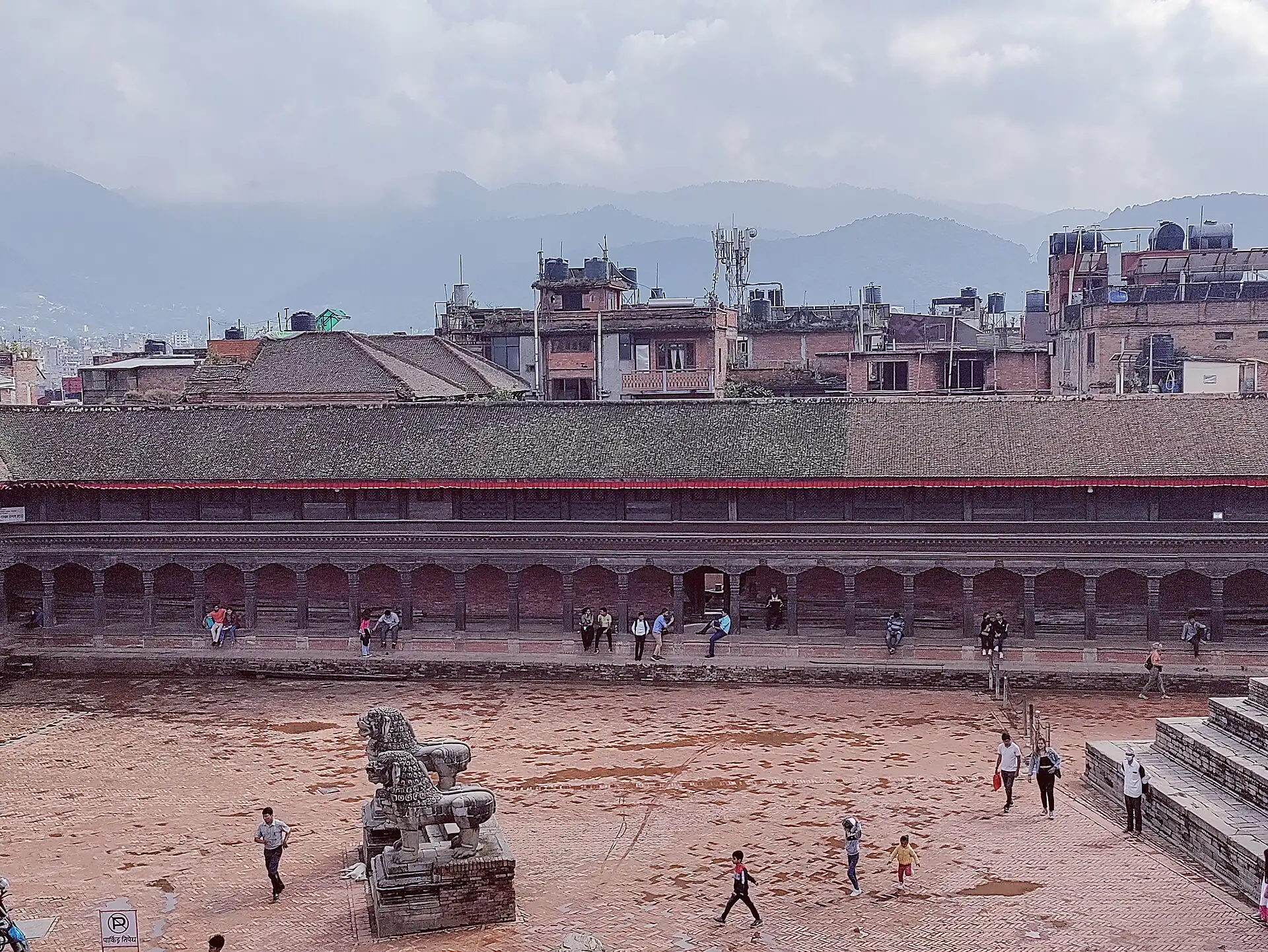 Photo: Janak Bhatta, CC BY-SA 4.0
Bhaktapur
goTaxi or bus 40–90 min
A medieval Newar town with a well-kept square and potters' lanes.
- Time
- Half or full day
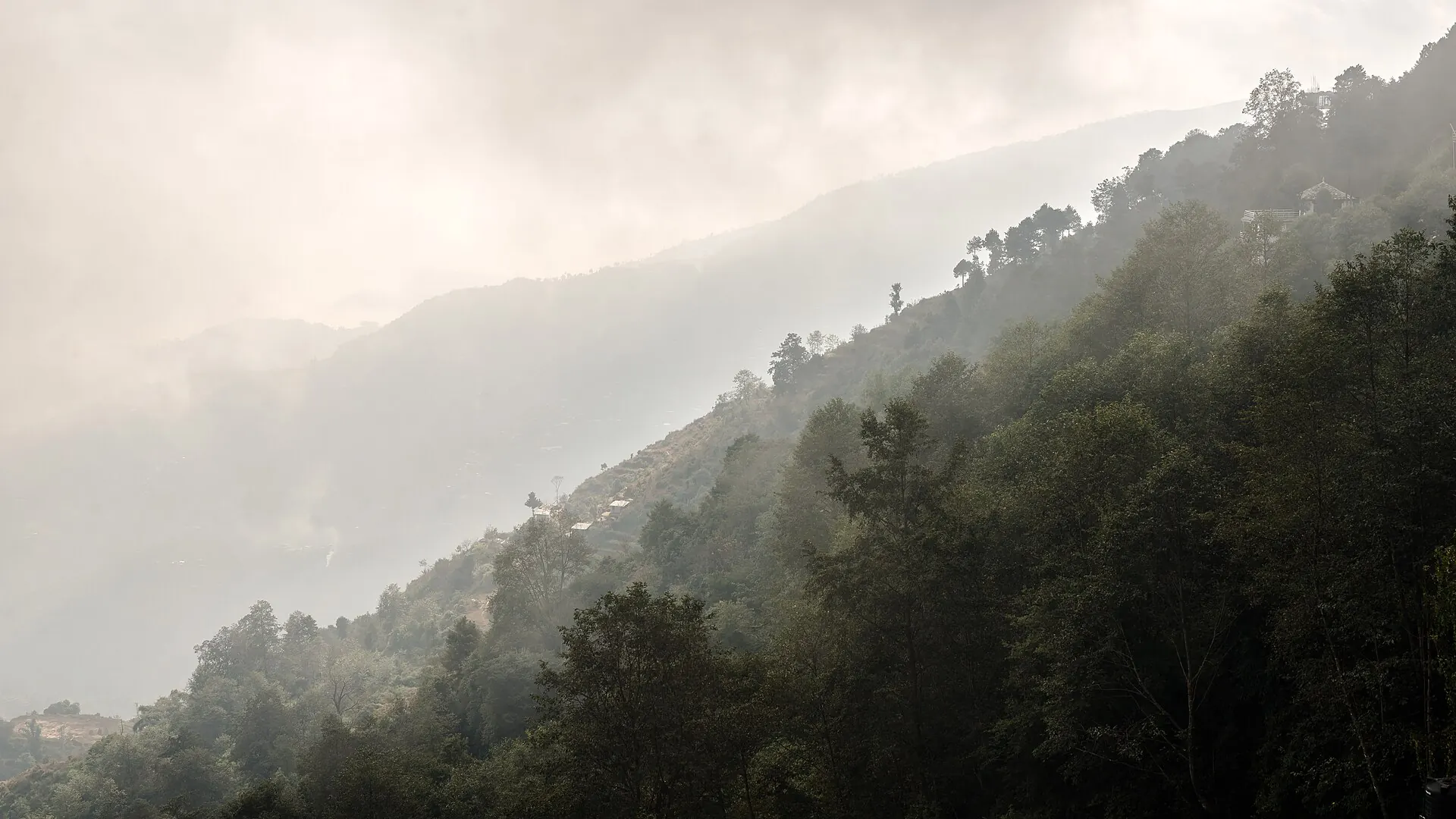 Photo: Bijay chaurasia, CC BY-SA 4.0
Nagarkot
goTaxi or bus 1–2 h
A ridge with Himalayan views; clear mornings in autumn and winter.
- Time
- Sunrise or an overnight
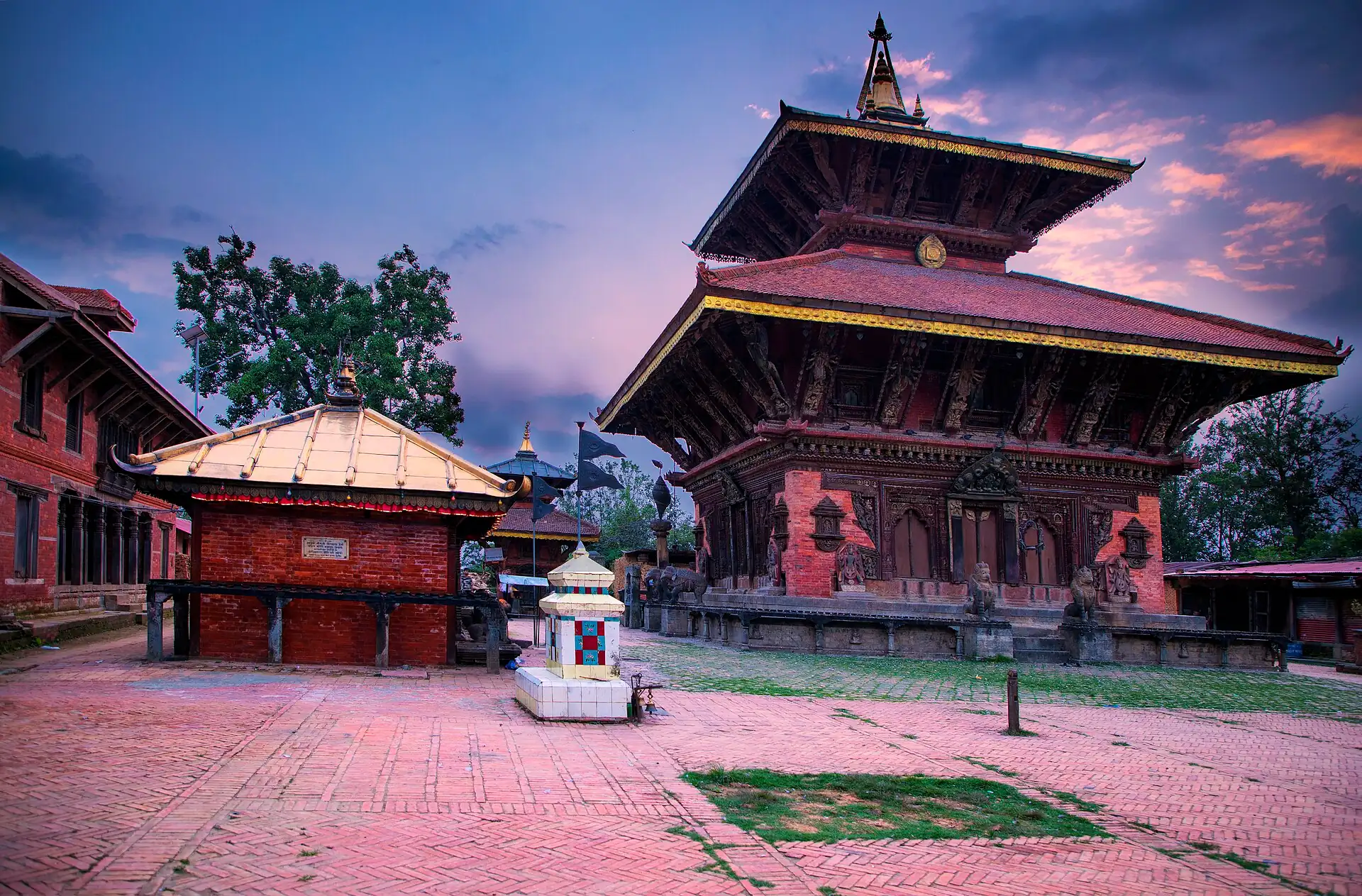 Photo: Mithun Kunwar, CC BY-SA 4.0
Changu Narayan
goTaxi 45–60 min
One of the oldest temples in the valley, with fine stone carving.
- Time
- Half day
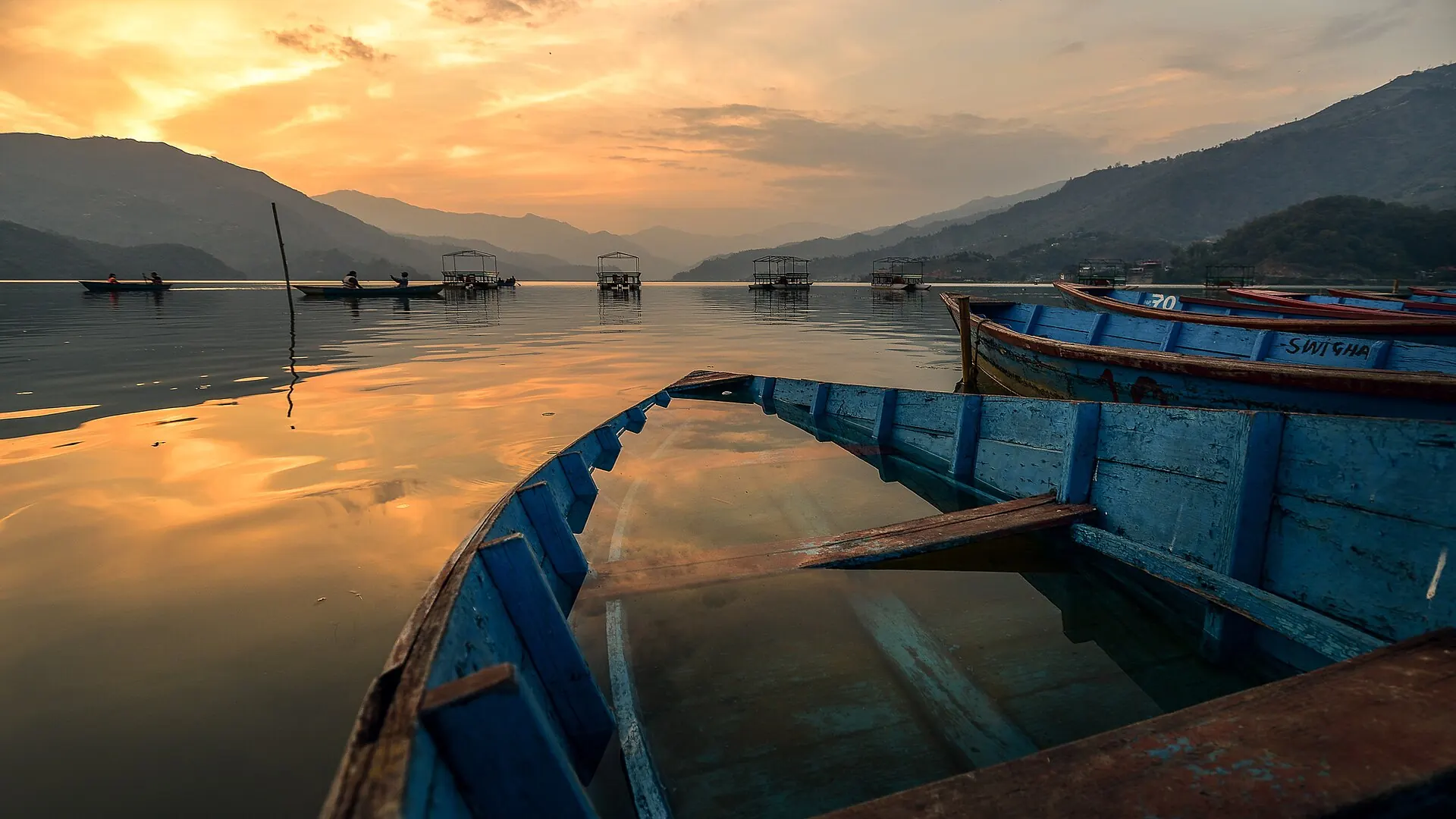 Photo: Q-lieb-in, CC BY-SA 4.0
Pokhara
overnightFlight 30 min or bus 6–8 h
The lakeside base for the Annapurna region.
- Time
- Overnight
Go next
Chitwan National Park
overnightDoor to door: Half a day
Tourist bus 5–6 h, or a short flight
Jungle safaris and one-horned rhinos; book lodges ahead; at least two nights.
Trekking (Langtang, Annapurna, Everest)
overnightDoor to door: One to three days to start
Bus or flight to the trailhead
Permits, a registered agency or a guide, and a weather buffer are needed; check current rules.
Eat & sleepWhere to eat and which area to sleep in
Eat & sleep
Where to eat and which area to sleep in
Eat
A short list of places worth crossing the city for, each with how to get a seat.
Restaurant finder: filter every place to eat in Kathmandu →
Vegetarian-friendly score
4.0 / 5 · Easy
- Country diet noteOur country guide rates vegetarian eating as easy.2 / 2
- Places to eat in this guide4 of 5 places with a known answer are vegetarian-friendly, 1 partly.1.35 / 1.5
- Budget eating lines0 vegetarian lines in "Eat by budget".0 / 0.6
- Meat-free national dishes5 meat-free dishes in the country food list.0.4 / 0.4
- Dedicated vegetarian kitchens0 mentions of vegetarian restaurants, Buddhist or fasting kitchens.0 / 0.5
Country note: Easy: dal bhat, veg momos and many curries are meat-free.
Vegetarian places near me →Make a diet card →
How we score
- Country diet note (up to 2): easy 2, workable 1, mixed 0.75, hard 0; no note 0.5.
- City places to eat (up to 1.5): 1.5 × (vegetarian-friendly + half of partly friendly) ÷ places with a known answer; needs 3 or more known places.
- Budget eating lines marked vegetarian (up to 0.6): 0.2 each.
- Meat-free national dishes (up to 0.4): 0.1 each.
- Dedicated vegetarian kitchens mentioned — Buddhist chay, shōjin ryōri, Jain, fasting food, vegan cafés (up to 0.5): 0.1 each.
- Total rounded to the nearest half point, 0 to 5. Built from our own pages only, not from reviews.
Eating and drinking guideEat by budget · Drink
Before you sit down to eat
Short version; full text linked
Eat by budget
Under NPR 500 a meal
| Where | Order | Area | Price | Note |
|---|---|---|---|---|
| Momo houses, Boudha | Steamed or fried momo with chutney | Boudha | NPR 200–400 | A staple snack or lunch. |
| Chiya, sel roti and sweets, Basantapur | Chiya, sel roti and sweets | Basantapur, Durbar Square | NPR 60–250 | A tea-stall break in the old core. |
| Street snacks and samosas | Samosa chaat, pakora, fried breads | Any street corner | NPR 50–150 | Choose hot, freshly fried stalls. |
Dishes to know
| Dish | What it is | Where to look | When | Price |
|---|---|---|---|---|
| Dal bhat | Rice with lentil soup, vegetables, pickle and sometimes meat | Homes, canteens and restaurants | Lunch, dinner | NPR 350–800 |
| Momo | Steamed or fried dumplings filled with meat or vegetables | Street stalls and momo houses | Any time | NPR 200–400 |
| Sel roti | A ring-shaped fried rice bread, sweet and crisp | Tea stalls | Morning | NPR 30–100 |
| Chatamari | A thin rice-flour crepe with toppings, often called Newari pizza | Newari restaurants | Lunch | NPR 200–500 |
| Choila and beaten rice (baji) | Spiced grilled meat with flattened rice and pickles | Newari restaurants | Lunch | NPR 400–1,000 |
| Juju dhau | Rich sweet yogurt from Bhaktapur, set in clay pots | Sweet shops and Bhaktapur | Dessert | NPR 100–250 |
| Thukpa | Tibetan noodle soup | Boudha restaurants | Lunch, cool evenings | NPR 250–500 |
| Chiya | Spiced milk tea | Stalls and cafés | All day | NPR 30–80 |
| Tongba | Warm millet beer in a wooden mug, refilled with hot water | Bars and restaurants | Evening | NPR 300–700 |
- Eat where the turnover is fast and the food is hot; choose busy stalls.
- Drink bottled or filtered water and avoid ice in cheap places.
- Use your right hand or a spoon when sharing; do not touch shared food with a plate you have eaten from.
Drink & nightlife
| Where | What | Until | Note |
|---|---|---|---|
| Thamel bars and rooftop lounges | Bars, live music, rooftops | About midnight | The main scene; go in a group and book your ride back. |
| Jhamel and Patan bars | Cafés and small bars | About 22:30About 10:30 PM | Calmer, with local crowds. |
| Boudha rooftop cafés | Cafés and tea houses | Evening | Quiet evenings with a view of the stupa. |
| Newari raksi and aila houses | Local spirit houses | Evening | Aila and raksi are strong; ask what you are drinking and go with a local friend. |
By style
| Style | What | Where | Price | Until |
|---|---|---|---|---|
| Chiya (milk tea) | Sweet spiced milk teaThe everyday drink; the first cup of the day for most people. | Tea stalls, cafés | NPR 30–80 | All day |
| Tongba and raksi | Warm millet beer in a wooden mug, and rice spiritTongba is refilled with hot water; raksi is strong. | Bars and restaurants | NPR 300–700 | Evening |
| Beer | Gorkha, Everest, TuborgPrices vary widely; ask before ordering. | Bars and restaurants | NPR 400–800 | About midnight |
| Lassi and juice | Yogurt drinks and fresh juiceCheck the water and ice. | Cafés and stalls | NPR 150–350 | Daytime |
Rules that bite
- Alcohol is sold only during certain hours and not on some festival days and election days (dry days); check locally.
- Do not accept drinks from strangers; keep your glass in sight.
- Book a ride home from bars: taxis thin out after midnight.
Sleep
Pick the area first: it decides your walk home at night and your first morning.
Which neighborhood fits you
Three questions, one recommendation, with the reasons.
Your best fit
- The stupa at the door; Pashupatinath is a short taxi ride.
- Guesthouses and monastery-run stays.
- Calmer at night; the stupa circuit is lively until about 21:00.
Watch out: Few restaurants after 21:00; the ring road is far from Thamel.
Next best: Thamel
Built from our 1–5 desk scores per area; your answers stay in this browser.
More on sleepingSleep by budget · Your area · With kids
Sleep by budget
| Band | Price | Where | Room types | What to expect |
|---|---|---|---|---|
| budget | NPR 1,500–3,500 | Thamel guesthouses and hostels | Hostels and small guesthouses | Simple rooms, hot water at set times, breakfast often extra. |
| mid | NPR 4,500–9,000 | Thamel, Boudha, Patan | 3-star hotels and boutique guesthouses | Lift (usually), breakfast, Wi-Fi, a generator for power cuts. |
| splurge | NPR 15,000–40,000+ | Lazimpat, Durbar Marg, heritage hotels | 5-star and heritage palace hotels | Pools, spas, garden space, airport transfers. |
Booking checks
- Ask about a backup generator or inverter: power cuts happen and heaters are not universal in winter.
- Confirm airport pick-up and a room at the back of the building away from bar noise.
- Ask about a hot-water schedule and heating in December to February.
Which area is yours
| If you are | Sleep in | Because |
|---|---|---|
| First visit, 2–3 nights, sights first | Thamel | Restaurants, trekking agents and taxis are at the door. |
| Quiet base, culture focus | Boudha | A calmer bed and dawn at the stupa; a taxi to the other sights. |
| Pre- or post-trek stop | Thamel | Gear shops, laundries and permit desks are all in Thamel. |
01Thamel
First-timers: cafés, gear shops and taxis are a short walk away, but pick a hotel with a night desk and a door the car can reach, not a guesthouse that locks the gate.
02Boudha
Quieter nights near the stupa and 15 minutes from the airport; pick this if you land late and want a short ride and a calmer morning.
Areas are in our default order until you tick a priority.
Scores are 1–5 desk judgements per priority (2026).
With kids
- Pavements are narrow and often missing; a carrier works better than a stroller in the old city.
- The Boudhanath circuit, pigeon-feeding at Durbar Square and a rickshaw ride suit children for short spells; keep visits under an hour and go in the morning.
- Dust, air quality and unfiltered water are the health issues; carry a mask and bottled water.
- Car seats are rare in taxis: bring a travel booster or ask the hotel to book a car that has one.
PracticalMoney, essentials, safety and the pocket card
Practical
Money, essentials, safety and the pocket card
Money
What a day costs at three comfort levels, and how to pay.
- Budget
- NPR 2,000–4,000 excl. bed / day
- Mid
- NPR 4,000–9,000 excl. bed / day
- High
- NPR 9,000+ excl. bed / day
- Transit card
- No transit card: walk inside a cluster, ride-hailing or taxis between clusters.
- Cash rule
- Keep NPR 3,000 in small notes; use ATMs inside banks, hotels or malls in daylight, not on dark lanes.
More on moneyCosts · Budget · Buy
What things cost
- Chiya (milk tea)NPR 30–80
- Momo plateNPR 200–400
- Large bottle of waterNPR 30–60
- Kathmandu Durbar Square, foreigner ticket (check)About NPR 1,000
- Boudhanath, foreigner ticket (check)About NPR 400
- Pashupatinath, foreigner ticket (check)About NPR 1,000
Trip budget
| Hotel double room1 × 3 nights × NPR 6,000 | NPR 18,000 |
| Food, local transport, entries2 × 3 days × NPR 6,500 | NPR 39,000 |
| Airport taxi, both ways1 × NPR 2,400 · one car per 4 people | NPR 2,400 |
| Monument entries (Durbar Square, Patan, Boudhanath, Pashupatinath)2 × NPR 3,400 · foreigner fees, check | NPR 6,800 |
| Tourist SIM, about a week2 × NPR 900 | NPR 1,800 |
| Buffer 20%Price creep, a taxi you did not plan, one splurge | NPR 13,600 |
| Trip total≈ NPR 13,600 per person per day, bed included | NPR 81,600 |
2026 estimate in NPR; flights, visas and treks excluded. Your choices stay in this browser.
Prices of common things
| Chiya (milk tea) | NPR 30–80 |
| Momo plate (8–10 pieces) | NPR 200–400 |
2026 estimate; check locally.
Buy
- Bargaining
- In Thamel and around the squares the first price to a visitor is often double or more: counter at about half, settle around 60–70%, and walk away politely if it does not move. Do not bargain in supermarkets or at shops with printed tags.
- Fixed-price check
- Check the price of the same item in a supermarket, a government-run handicraft shop or a fixed-price shop first; that is your ceiling.
Markets and shopping streets
| Where | What | When | Haggle | Note |
|---|---|---|---|---|
| Thamel shops and lanes | Trekking gear, pashmina, thangka, singing bowls, souvenirs | About 09:00–21:00About 9:00 AM–9:00 PM | hard | The main tourist market; quality varies, so compare a few shops before buying. |
| Asan Bazaar | Spices, vegetables, household goods, offerings | Early morning to early evening | medium | A crowded local market on the old trade route, near Durbar Square; a good place to see daily life. |
| Patan handicraft shops and workshops | Metalwork, statues, woodcarving, thangka | About 09:00–18:00About 9:00 AM–6:00 PM | medium | Ask to see how a piece is made and compare prices. |
| Boudha plaza shops | Prayer flags, singing bowls, Tibetan carpets | Daytime to evening | medium | Prices are usually more moderate than Thamel; check the material. |
| Supermarkets and malls (Bhat-Bhateni, Big Mart) | Snacks, toiletries, tea, fixed-price essentials | About 09:00–21:00About 9:00 AM–9:00 PM | no | Your price reference and an air-conditioned break. |
Shops by what they sell
| For | Where | Hours | Note |
|---|---|---|---|
| Trekking gear (jackets, boots, sleeping bags) | Thamel; try items on and check zips and stitching | Shop hours | Fakes are common; buy what you need for the trek or rent it in Thamel. |
| Tea, spices and honey | Asan Bazaar and supermarkets | — | Nepali tea (from Ilam) and spices are good gifts. |
| Singing bowls, thangka and metalwork | Patan and Boudha workshops | — | Ask who made it and how; compare at three shops. |
| Pashmina and woollens | Thamel and fixed-price shops | — | Check the fibre: wool blends are often sold as pure pashmina. |
Changing money
| Where | Verdict | Why |
|---|---|---|
| Licensed exchange counters (Thamel and the airport) | use | Compare rates; keep the receipt if you plan to change back. |
| Bank ATMs | use | Fees per withdrawal and low limits; choose machines inside banks or hotels. |
| Hotel front desk | ok | Convenient, at a weaker rate. |
| Street changers | avoid | Short-changing and counterfeit-note risk. |
ATMs
- Per withdrawal
- Machines typically cap a foreign card at about NPR 15,000–35,000 per withdrawal; the screen shows the limit.
- Fees
- A local fee per withdrawal plus your own bank's foreign fee; take the cap rather than small amounts.
- Where
- Machines inside bank branches, hotels and malls in daylight; not on dark lanes.
- Conversion
- If the machine offers to charge in your home currency, decline and pay in rupees.
Essentials and accessEssentials · Access
Essentials
- Plugs & power
- 230 V, 50 Hz; type C, D and M sockets are common. Bring a universal adapter.
- Toilets
- Hotels, cafés and malls; carry tissues and small coins. Public toilets are rare.
- Opening hours
- Offices run about 10:00–17:00 on weekdays; the weekend is Saturday; shops open about 09:00–20:00; sights open early.Offices run about 10:00 AM–5:00 PM on weekdays; the weekend is Saturday; shops open about 9:00 AM–8:00 PM; sights open early.
- Health
- Air quality, stomach bugs and altitude on treks; travel insurance with medical evacuation is strongly advised.
- Accessibility
- Pavements are broken and streets are shared with motorbikes; step-free access is limited.
- Laundry
- Thamel laundries wash by the kilo in a day; ask your hotel.
- Emergency numbers
- 100 police, 101 fire, 102 ambulance, Tourist Police 1144.
Pack
- A fine-particle mask for the dusty months
- Shoes that slip on and off easily for temples
- A scarf or shawl for shoulders and cold mornings
- A torch for dark lanes and power cuts
- Layers for cold mornings and evenings in Dec–Feb
Accessibility
Kathmandu is hard on wheels. Pavements are narrow, broken or missing, streets share space with motorbikes, and many temples have high plinths and steps. Plan by car and pick a hotel with a lift.
- Pavements
- Uneven and often blocked by vendors and parked motorbikes; the lanes in Thamel have no kerbs.
- Getting around
- Taxis and apps are the step-free option; buses and micro-buses are not.
- Hotels
- Larger hotels have lifts and step-free rooms on request; many guesthouses do not.
- Toilets
- In hotels, malls and some cafés; rare and often not accessible at temple sites.
- Trekking start
- Trails and lodges are not accessible; plan an easier day trip in the valley instead.
Sights, step-free or not
| Kathmandu Durbar Square | with help | Plinths, steps and cobbles; a ramp to the main paths (check). |
| Boudhanath Stupa | step-free | A flat plaza; step-free around the stupa; some cafés have steps. |
| Patan Durbar Square | with help | Flat square with cobbles; museum and temple entrances have steps. |
| Pashupatinath Temple and the ghats | hard | Steps and slopes at the ghats; the main temple is closed to non-Hindus. |
| Kumari Ghar | hard | Steep, narrow steps into the courtyard. |
| Golden Temple, Patan (Hiranya Varna Mahavihar) | with help | Narrow entrance and steps into the courtyard. |
Survive
Safety basics, the lines not to cross, and practical habits that save the day.
Safety
- Traffic and uneven pavements: look down and left-right at every crossing; footpaths end without warning.
- Air quality is poor in the dry season; a mask rated for fine particles helps on long walks.
- Earthquakes happen here: know your hotel's exit and never re-enter a damaged building.
- Emergency: 100 police, 101 fire, 102 ambulance; Tourist Police 1144.
Red lines
- Inside Hindu and Buddhist shrines: remove shoes where marked and walk clockwise around stupas.
- Leather items and shoes are refused at some temple entrances; ask at the gate.
- Do not photograph people at prayer or cremation ghats without asking.
Practical
- Toilets: cafés, hotels and malls; carry tissues.
- Tap water is not for drinking; use bottled or filtered water.
More on staying safeStay safe · Stay healthy · Safety map · Solo & women · Etiquette · Cope · Scams
After dark, by area
3 flagged areas
- Take care
- Take care
Pashupatinath
Take care
Day = about 07:00–19:00. What to watch in each area, day and night →
Scams and red flags
Walk away if you see these
- Fake guides at Durbar Square, Pashupatinath and Boudha who start a tour and then demand a high fee: decline, or agree a fee in writing first.
- Taxis quoting fixed high fares, especially at the airport and in Thamel: use the prepaid counter, an app or agree the fare first.
- 'Monks' or 'students' who ask for donations or lead you to a shop: donate at the monastery office.
- Trek permit touts who quote prices well above the official ones: check the rules and use a registered agency.
- Counterfeit gear sold as name brands: check labels and stitching, or rent instead.
Stay safe
Crossing the road
- 01Traffic drives on the left and rarely yields: cross at gaps and watch for motorbikes on pavements.
- 02Open drains, holes and loose wires appear without warning; look down as you walk.
Hustles specific to this city
| Hustle | Where | The tell | What to do |
|---|---|---|---|
| Fake guide | Durbar Square, Pashupatinath, Boudha | A friendly stranger offers a free tour and then asks a high fee | Decline politely or agree a fee in writing before you begin; use a registered guide. |
| Taxi overcharging | Airport, Thamel | A fare several times the going rate | Use the prepaid counter, an app, or agree the fare before you get in. |
| Tibetan carpet or 'monk' donation ask | Boudha and Thamel | A 'monk' or 'student' asks for a donation or leads you to a shop | Donate at the monastery office, not on the street. |
| Trek permit tout | Thamel | An agent quoting a permit price much above the official one | Check the official permit costs before you pay; book with a registered agency. |
| Fake gear | Thamel | Brand-name gear at a very low price | Assume it is a fake and check the stitching; rent for a trek if unsure. |
- Police
- Report thefts to the Tourist Police (1144) or the nearest station; insurers need the written report.
- Strikes (bandh)
- Strikes can close roads and shops for a day; check the news and avoid gatherings.
- Earthquakes
- Nepal lies in a seismically active zone; know your hotel's exit and follow staff guidance.
- Altitude and treks
- If you plan a trek, read the altitude guidance and buy insurance that covers helicopter evacuation.
Stay healthy
- Air quality
- Dust and smoke haze build from March to May; check an air-quality app and choose clearer mornings for long walks.
- Food and water
- Drink bottled or filtered water; eat where the food is hot and busy; ask about ice.
- Stomach bugs
- Traveller's diarrhoea is common; bring oral rehydration salts and ask a travel clinic about treatment.
- Altitude
- Kathmandu is 1,400 m; higher treks need acclimatisation; never ascend with symptoms of altitude illness.
- Vaccinations
- Ask a travel clinic several weeks before you go about typhoid, hepatitis A, tetanus and rabies.
- Medical care
- Private clinics and hospitals treat visitors; evacuation cover in your insurance is important for trekkers.
Hospitals and clinics: see Cope.
Safety by area and hour
| Area | Day | Night | What to watch |
|---|---|---|---|
| Thamel | fine | caution | Motorbikes in narrow lanes and touts; keep valuables in a front pocket and book a ride home. |
| Durbar Square and Basantapur | caution | caution | Crowded; pickpockets and touts posing as guides. |
| Boudhanath | fine | fine | Traffic on the ring road; normal city care. |
| Patan | fine | fine | Quiet in the evening; use a booked car back. |
| Pashupatinath | fine | caution | Persistent guides and monkeys near the ghats; keep food out of sight. |
- Keep bags in front and phones out of sight in Durbar Square and on packed lanes.
- Use a hotel-booked car or an app at night rather than a street taxi.
Solo, women and LGBTQ+ travellers
Solo
- Kathmandu is manageable for solo travellers: use registered taxis or apps after dark, keep valuables out of sight, and be wary of overfriendly strangers who offer tours.
- Many solo visitors join group treks and day tours; use a registered agency.
Women
- Verbal attention is common; a firm 'no' and keeping walking usually ends it. Avoid isolated lanes after dark and avoid getting into an unbooked car alone.
- Dress modestly: cover shoulders and knees, especially at shrines and outside Thamel.
LGBTQ+
- Nepal has some legal recognition of same-sex relationships and a visible community, but social attitudes are mixed and public displays of affection are best avoided.
- Check your government's travel advice before you go.
Etiquette in Kathmandu
- Temples and stupas
- Remove shoes where marked; walk clockwise around stupas; do not touch offerings or step over them.
- Dress
- Cover shoulders and knees at shrines; avoid leather in some Hindu temples; ask at the gate.
- Photos
- Ask before photographing people, especially at prayer and at cremation ghats; do not photograph the living goddess Kumari.
- Greetings
- Say 'Namaste' with palms together; use the right hand to give and receive things.
- Feet and heads
- Do not point your feet at a person or a shrine; do not touch a person's head.
- Tipping
- 10% in restaurants if service is not added; small tips for guides and porters.
- Bargaining
- Expected in tourist shops; smile and counter; not in shops with printed tags.
Cope
Hospitals and clinics that handle foreigners
| Where | Area | Use it for |
|---|---|---|
| CIWEC Clinic Travel Medicine Center | Lazimpat (close to Thamel) | A well-known travel clinic with English-speaking doctors; check current hours and services. |
| Private hospitals (for example Norvic, Grande, Mediciti) | Citywide | Private hospitals with international-patient desks; pay upfront and claim later. |
| Teaching hospitals | Maharajgunj and Kathmandu | Large public hospitals; busy and slower for visitors. |
Visa extensions
- Office
- The Department of Immigration is at Kalikasthan; weekday office hours; check the address and hours before going.
- Extending
- Tourist visas can be extended at the immigration office for a fee; bring a passport, photos and proof of funds (check).
- Overstay
- Fines accrue daily and are paid at exit; solve any problem before you reach the airport.
Embassies and consulates
| Country | Address | Phone | Note |
|---|---|---|---|
| United States | Maharajgunj | — | (check) |
| United Kingdom | Lainchaur | — | (check) |
| India | Lainchaur | — | (check) |
| Japan | Panipokhari | — | (check) |
| Australia | Bansbari | — | (check) |
| Germany | Gyaneshwor | — | (check) |
- Lost passport
- Police report at the nearest station or the Tourist Police (1144), then your embassy for an emergency document; allow a few working days.
- Pharmacies
- Pharmacies in every neighbourhood sell many medicines without a prescription; bring the generic name.
- Gyms and pools
- Day passes at larger hotel gyms and pools, roughly NPR 1,000–3,000 (2026 estimate).
- Co-working
- A few co-working spaces in Thamel, Jhamsikhel and Lazimpat sell day passes; many cafés have Wi-Fi.
- Laundry
- Thamel laundries wash by the kilo in a day; ask your hotel.
Apps and offline kitOffline kit
Offline kit
Set up before you leave, so Kathmandu still works with no signal or a dead roaming plan.
On your phone
- Maps: open the city in Google Maps, tap the place name, then Download offline map (or use an offline-maps app).
- Data: install an eSIM or buy a local SIM before the first taxi; the apps in this guide depend on it.
- Translation: download the local language for camera translation.
- Screenshots: booking confirmations, hotel address in the local script, and the emergency numbers.
This guide
Save the Kathmandu guide and its pages on this device; it opens without a connection.
Phrases that do the work
Greeting
Hello, greetings
Namaste
na-mas-tay
Thanks
Thank you
Dhanyabad
dhan-ya-bad
Market
How much is this?
Yo kati ho?
yo ka-ti ho
Market
Too expensive
Dherai mahango
dhe-rai ma-han-go
Food
Not spicy, please
Piro nahalnus
pee-ro na-hal-nus
Food
Water, please
Paani dinus
pa-ni dee-nus
Taxi
Please use the meter
Meter ma jaanus
me-ter ma ja-nus
Taxi
Please take me to this address
Malai yo thegana maa lagnu
ma-lai yo the-ga-na ma lag-nu
Everyday
No, thank you
Chaidaina
chai-dai-na
Help
I need help
Malai sahayog chahincha
ma-lai sa-ha-yog cha-hin-cha
Pocket card
Fill in, then print or save as PDF
Stays in this browser only; nothing is sent anywhere.
Kathmanduकाठमाडौँ
Pocket card · Voykit
My bed tonight
—
—
—
Kripaya malai yo thegana maa lagnuPlease take me to this address
Emergency
- Police100
- Fire101
- Ambulance102
- Tourist Police1144
Embassy
Most embassies are in Lainchaur, Maharajgunj and Bansbari; write your own embassy's 24-hour line below.
My embassy: —
Fare anchors (2026 estimate)
- Airport to Thamel, taxi: NPR 800–1,500, 20–60 min depending on traffic
- Short taxi ride, centre: NPR 300–700
- Thamel to Boudhanath, taxi: NPR 800–1,500, 30–60 min
Give your driver a nearby landmark, not only a street name.
Deep diveHistory, reading, photos and every source
Deep dive
History, reading, photos and every source
Sources
- officialNepal Tourism Board
- officialTribhuvan International Airport
- secondaryWikivoyage — Kathmandu
Ask about Kathmandu
Loading…
Was this useful?