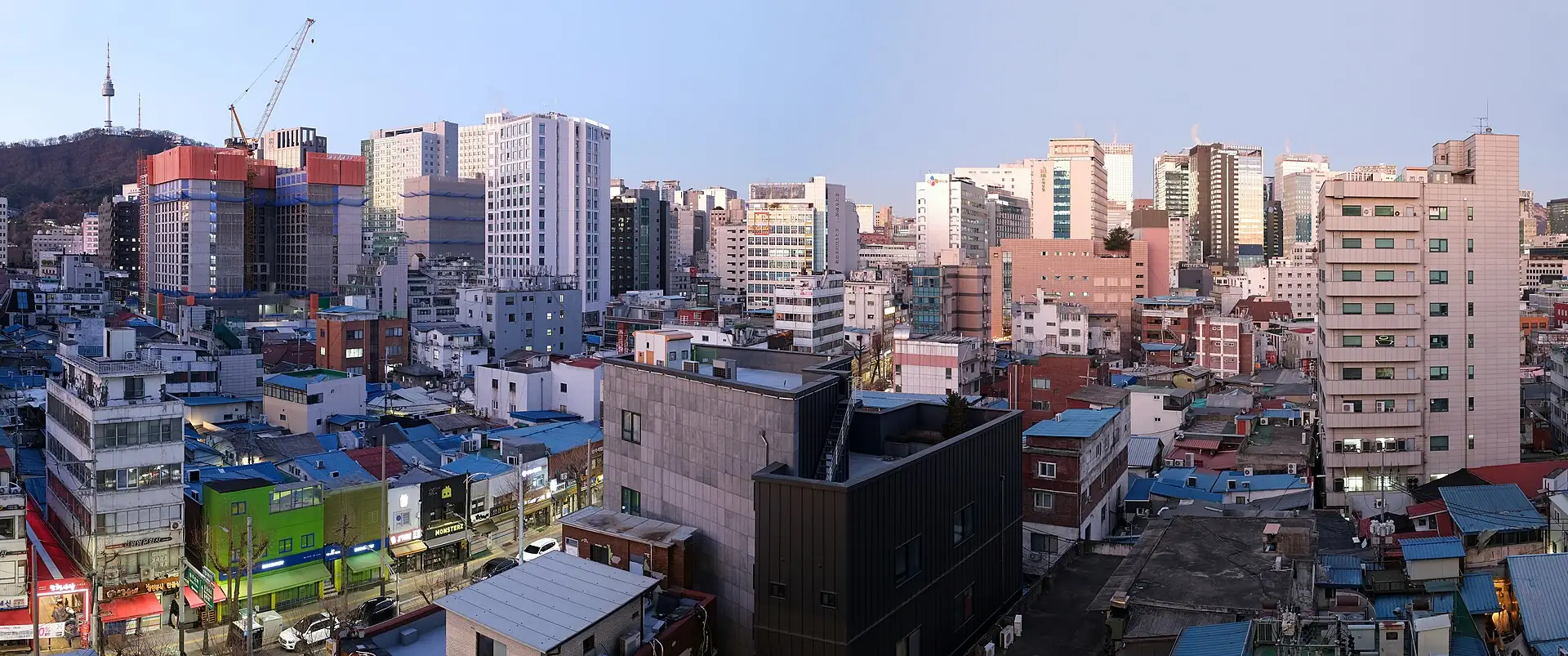
Seoul
서울
Code SE · 4 walking zones
Seoul is a subway city: do the palaces and Bukchon before 11:00, stay indoors at midday in summer, and save Myeongdong and Hongdae for the evening.Seoul is a subway city: do the palaces and Bukchon before 11:00 AM, stay indoors at midday in summer, and save Myeongdong and Hongdae for the evening.
Our quick read of Seoul, scored 1–5 (friction is out of 100). Cash need: how often you still need notes. Heat risk: how hot days get. Stroller: how easy wheels are. Friction: overall effort for a first visit. Desk judgements, so check before relying on them.
- Local time
- --:--
- Weather
- forecast below
- Currency
- KRW
- Best months
- Apr · May · Oct · Nov
- Airports
- Incheon (ICN) · Gimpo (GMP)
Walking zones: the 4 areas this guide plans a day around. Each is a district you can cover on foot, so you do one zone per half-day and ride the train between them. The code (SE 01, SE 02…) is just the zone's number on the Seoul line; the line under each name says how bags fare there and how much time it needs.
Map of Seoul
Use the switches to show or hide each kind of pin. A switch that is on shows its pins on the map; tap it again to hide them. "Show only" keeps just the pins that match (for example, places that fit a suitcase). Tap any pin for its name and a link to its page.
- Where to sleep
- Places
- Eat
- Walking clusters
- Rest stops
From the airport Incheon (ICN) to your bed · Gimpo (GMP) to your bed
Tap a pin for its card. Places without their own coordinates are shown by their walking cluster.
Why Seoul
Seoul's sights are spread over a wide basin, but the subway reaches all of them and runs late. The trips that go wrong pay for it in three ways: palaces on their closed weekday, hills with a suitcase in Bukchon, and a landing after 23:00 with a guesthouse door that locks. Four walking clusters cover a first visit; one bed is enough.
See first
- 1Changdeokgung and the Secret Garden · 2–2.5 h
- 2National Museum of Korea · 2–4 h
- 3Gwangjang Market food evening · 1.5 h
- 4N Seoul Tower and the Namsan walk · 2 h
- 5Myeongdong evening · 2 h
Fits
- Food and street-market trips
- Palace and museum days
- Short city breaks with a late flight home
Does not fit
- Wheelchairs on hill lanes
- Midday walkers in July and August
- Anyone who needs a car-only itinerary
How long
- 2 daysPalaces + Bukchon by day, Myeongdong in the evening
- 3 daysFour clusters, one per half-day
- 5 daysFour clusters + Suwon half-day + one market day
Good for
- First timers
- Foodies
- Budget
- Couples
- Solo
- Families
About Seoul
Seoul has been the capital since 1394, when the new Joseon dynasty laid out Hanyang between four mountains and the Han river. The palaces, the royal shrine and the stretches of city wall you walk past today follow that plan; almost all were burnt or dismantled at some point and rebuilt, so read dates on the boards carefully.
Japanese rule (1910–1945) turned palace grounds into parks, offices and a zoo, and the Korean War (1950–1953) left the city in ruins. What you see is mostly post-1960s: the fast growth known as the Miracle on the Han, which built Gangnam, the subway and the apartment towers on every horizon.
Good to know
- Gyeongbokgung is the main palace; Changdeokgung and Deoksugung are separate palaces with their own closing days.
- Official tourist information centres at Myeongdong (Euljiro entrance), Insadong, Hongdae and Seoul Station, plus red-jacketed mobile guides ('Moving Tourist Information') around Myeongdong, Insadong and Namdaemun. Check opening hours.
- HiKR Ground in Cheonggyecheon (Korea Tourism Organization) has free information desks and K-culture exhibits (check hours).
Go deeper 10 min read · 6 chapters
Seoul has been a capital for more than six hundred years, yet most of what you see was built in the last sixty. Palaces burnt and rebuilt, a colonial layer put up and pulled down, a war that flattened the city, then one of the fastest building booms in history. This deep dive reads the layers in order, so that a day from Gyeongbokgung to Gangnam becomes a walk through that story.
1History2 min
People farmed the Han river basin long before any capital stood here; the Neolithic pit houses at Amsa-dong in the east of the city are around six thousand years old. From about the 1st century BCE the Baekje kingdom ruled from walled towns on the south bank, whose earthen ramparts survive in Olympic Park. For the next thousand years the basin was a frontier fought over by Baekje, Goguryeo and Silla, then a secondary capital of the Goryeo kings, whose court sat far to the north at Kaesong.
In 1392 the general Yi Seong-gye founded the Joseon dynasty and, two years later, moved the court south to Hanyang. His planners chose a bowl between four guardian mountains with the Han to the south, a textbook site by the rules of geomancy. They built the main palace, Gyeongbokgung, the royal ancestral shrine, Jongmyo, and an 18 km wall along the ridges with eight gates. That plan, palace to the north, shrine to the east, altars of land and grain to the west, still shapes central Seoul.
The Japanese invasions of the 1590s burnt every palace. Changdeokgung was rebuilt first and served as the main residence for about 270 years, while Gyeongbokgung lay in ruins until the regent Heungseon Daewongun rebuilt it in the 1860s at crippling cost. The late 19th century brought trams, electricity and foreign legations to Jeong-dong; in 1895 Queen Min was murdered by Japanese agents inside Gyeongbokgung, and in 1897 King Gojong declared the Korean Empire from Deoksugung.
Japan annexed Korea in 1910 and ruled the city as Keijō for 35 years. The colonial government placed its headquarters directly in front of Gyeongbokgung's throne hall, turned Changgyeonggung into a zoo, and imprisoned independence activists at Seodaemun. After liberation in 1945 the city took the name Seoul, meaning simply 'the capital'. The Korean War then passed over it four times between 1950 and 1951; by the armistice in 1953 much of the city was rubble.
Reconstruction turned into a boom. From the 1960s to the 1990s factories, highways, the subway (from 1974) and apartment estates spread across both banks, and farmland south of the river became Gangnam. The 1988 Olympics marked the arrival of a democratic, wealthy country. Since then the city has been undoing some of its own growth: the colonial building was demolished in 1995–96, the Cheonggyecheon expressway was torn down to uncover a stream, and palace buildings are being rebuilt one by one.
- Joseon capital
- From 1394 (as Hanyang)
- City wall
- Built from 1396, about 18.6 km (12 mi)Built from 1396, about 12 mi (18.6 km)
- Colonial name
- Keijō (Gyeongseong), 1910–1945
- Korean War
- Changed hands four times, 1950–1951
- Population
- About 9.4 million; about 26 million in the capital area (2025)
- Area
- About 605 km² (234 sq mi)About 234 sq mi (605 km²)
2Neighbourhood stories1 min
Inside the old wall, Seoul was divided by rank as much as by street. Aristocratic families (yangban) lived on the slopes between Gyeongbokgung and Changdeokgung, the area that became Bukchon, the 'north village'. Court officials and technical specialists such as translators and doctors lived in Seochon, west of the palace, while merchants crowded the flat land along Jongno, the 'bell street', where the Bosingak bell rang the gates open and shut.
Most of Bukchon's hanok are not as old as they look. In the 1920s and 1930s developers split large estates into small plots and built rows of compact urban hanok for the new middle class, with glass doors and tiled roofs on a standard plan. By the 1990s many were being torn down for flats; city grants from 2001 saved the rest. Today the lanes are home to residents who put up with busloads of visitors, which is why part of Bukchon now has fixed visiting hours.
The south of the old city grew around commerce. Namdaemun Market sits by the great south gate, Myeongdong became the colonial shopping and banking district, and the neighbourhood around Myeongdong Cathedral was the setting of the 1987 protests that ended military rule. East of the centre, Dongdaemun's markets and garment workshops have run around the clock for decades; Gwangjang Market, opened in 1905, still feeds them.
Outside the wall, each district tells a later story. Itaewon grew beside the US Army base at Yongsan and became the city's international quarter. Hongdae formed around Hongik University's art school and turned into the home of indie music and clubs. Gangnam was rice fields until the 1970s, when the government moved schools, offices and bus terminals south of the river to pull people across. Seongsu's shoe factories are now cafés and flagship stores, a change repeated in Euljiro's printing alleys.
- Bukchon hanok
- Several hundred houses, mostly built 1920s–1930s
- Gwangjang Market
- Opened 1905
- Gangnam development
- From the 1970s
- Seoul districts
- 25 gu, over 400 dong
3Palaces and architecture2 min
Seoul has five Joseon palaces, and they are not copies of each other. Gyeongbokgung is laid out on a strict axis: gate, gate, throne hall, council hall and living quarters in a line, as a statement of order. Changdeokgung, by contrast, spreads its halls to follow the hills and streams, which is why UNESCO listed it in 1997. Deoksugung mixes wooden halls with stone buildings from the empire years, and Changgyeonggung and Gyeonghuigung are the quiet, half-rebuilt ones.
A Korean palace is built from a few elements. Stone platforms lift the halls; red-painted columns carry wooden brackets; multicoloured dancheong painting in green, red and blue protects the timber and marks rank; curved tiled roofs end in rows of small clay figures on the ridges, guardians against fire and bad luck. Look at the courtyard in front of a throne hall: stone markers set out where each rank of official stood.
The same logic scaled down makes the hanok house. Rooms are arranged around a courtyard, heated by ondol, a system of flues under the floor that carried smoke from the kitchen fire; the warm floor is why Koreans sit, eat and sleep low. Wooden-lattice doors are lined with hanji paper. Summer halls with raised wooden floors (maru) catch the breeze. A modern apartment keeps the heated floor even when everything else has changed.
The 20th century added its own layers. Japanese rule left red-brick and stone buildings such as the old Seoul Station (1925) and the former Bank of Korea; the war-era and 1960s city left concrete markets and elevated roads. Since 2000 the city has commissioned showpieces: Zaha Hadid's Dongdaemun Design Plaza on the site of a stadium, the 555 m Lotte World Tower, and Seoullo 7017, a 1970 highway flyover turned into a garden walkway.
- Five grand palaces
- Gyeongbokgung, Changdeokgung, Changgyeonggung, Deoksugung, Gyeonghuigung
- UNESCO in the city
- Changdeokgung (1997), Jongmyo (1995), Joseon royal tombs (2009)
- Gyeongbokgung rebuilt
- 1860s; restoration under way since 1990
- Gwanghwamun gate
- Moved back to its original position and rebuilt, 2010
- Lotte World Tower
- 555 m, opened 2017
4Food1 min
Korean meals are built around rice, soup and banchan, the small shared side dishes that arrive free and are refilled on request. Kimchi is the constant: there are hundreds of kinds, from cabbage and radish to cucumber and green onion, and the autumn kimjang, when families make a winter's supply together, was recognised by UNESCO in 2013. Fermented pastes, doenjang, gochujang and ganjang, give most dishes their depth.
Seoul's classic dishes come from its role as the capital. The royal court's cooking survives in refined, mildly seasoned dishes like sinseollo hot pot; Jongno's long-running restaurants serve seolleongtang and gomtang, milky beef-bone soups once eaten by market porters. Pyongyang-style cold noodles, brought south by refugees during the war, became a Seoul institution, and each old house has its devoted regulars.
Much of what visitors eat is younger. Barbecued pork belly spread in the 1970s and 1980s as pork became cheap; budae jjigae, 'army base stew', mixed Spam and sausages from US bases into kimchi stew; Korean fried chicken took off in the 1970s and exploded with delivery in the 1990s. Markets such as Gwangjang kept older street foods alive: mung-bean pancakes, blood sausage and tteokbokki. Samgyetang, whole young chicken with ginseng, is eaten on the three hottest days of summer to fight heat with heat.
Eating in Seoul is social and fast. Office workers eat together at lunch and again at hoesik, the team dinner that moves from barbecue to a second round of beer and a third of karaoke. Food arrives quickly, tables are cleared quickly, and many restaurants specialise in one dish only. At the other end, the city's fine-dining scene, recognised by its own Michelin guide since 2016, reinterprets temple food, fermentation and seasonal produce.
- Kimjang, UNESCO
- Inscribed 2013
- Michelin Guide Seoul
- Since 2016 (edition for 2017)
- Samgyetang days
- Chobok, jungbok, malbok: the three dog days of July–August
- Soju
- A Korean soju brand is often reported as the top-selling spirit brand worldwide by volume (check)
5Culture and the Korean Wave1 min
Hangeul is the city's everyday proof of an old idea. King Sejong and his scholars designed the alphabet in 1443 and published it in 1446 so that ordinary people could read without learning Chinese characters. Its 24 letters are grouped into syllable blocks; a visitor can learn to sound out signs in an afternoon. The story is told under Gwanghwamun Square, below the king's statue, and 9 October is a public holiday in its honour.
Confucian values still shape how Seoul behaves: respect for age and rank, the importance of education, family rites at Seollal and Chuseok. Korean speech changes with who you address, and people ask each other's age early to know which form to use. Buddhism and Christianity sit side by side: temple lanterns at Jogyesa in spring, neon crosses on church roofs across the night skyline.
Since the late 1990s the Korean Wave, hallyu, has turned Seoul into a pop-culture capital. TV dramas spread first through Asia, then K-pop groups built global fan bases; 'Gangnam Style' in 2012 put a Seoul district's name into every language, and 'Parasite' won the Oscar for best picture in 2020. Fans visit agency buildings in Gangnam and Seongsu, filming locations along the Han, and dance studios in Hongdae.
The same speed that built the city drives its culture. 'Ppalli-ppalli', hurry-hurry, describes deliveries in 30 minutes, broadband everywhere, pop-up shops that change every month and PC bangs where gamers play through the night. Visitors feel it as convenience; residents talk about the pressure that comes with it, from exam years to work hours, which many recent Korean novels and films explore.
- Hangeul created
- 1443; promulgated 1446
- Hangeul Day
- 9 October
- 'Gangnam Style'
- 2012
- 'Parasite' Oscar
- Best picture, 2020
- Nobel Prize in Literature
- Han Kang, 2024
6The Han river and the modern city2 min
The Han is about a kilometre wide as it crosses Seoul, and for most of history it was a barrier and a highway for boats rather than a place to relax. The floods of the 1960s and 1970s led to the Han River Development Project of the 1980s, which straightened and walled the banks, built expressways along both sides and created the riverside parks that now run for about 40 km through the city.
More than 30 road and rail bridges cross the river. Each carries a slice of history: the Hangang Railway Bridge of 1900, the Hangang Bridge blown up in the first days of the Korean War, the Seongsu Bridge whose collapse in 1994 led to a national rethink of building safety. Banpo Bridge now has a fountain along its sides and a lower deck, Jamsu Bridge, that floods in heavy summer rain.
On a warm evening the parks are the city's living room. Families picnic on mats, office workers order fried chicken to a numbered delivery zone, cyclists ride the long paths and couples watch the bridges light up. In summer there are outdoor pools and night markets; in winter the wind across the water is the coldest place in town. The river is also the dividing line people use to describe Seoul: north of the river, Gangbuk, and south, Gangnam.
The modern city keeps rebuilding itself around the river. Yeouido, once an airfield on a sandbank, became the home of the National Assembly, finance towers and the cherry-tree avenue. Jamsil's Lotte World Tower rises over the eastern bend. The city's plans for the coming decades aim to bring more housing, parks and transport, including the new GTX express lines deep below ground, to a capital area that already holds half of South Korea's people.
- River width in Seoul
- About 1 km (0.6 mi)About 0.6 mi (1 km)
- Riverside parks
- 11 Hangang parks along about 40 km (25 mi)11 Hangang parks along about 25 mi (40 km)
- Bridges
- More than 30 in the city
- Yeouido
- Seoul's first airfield (1916); the finance district since the 1970s
Read, watch, wordsReading · Watching · Glossary · Sources
Reading
- Korea's Place in the Sun: A Modern History — Bruce CumingsThe standard one-volume history of modern Korea, from the late Joseon to the democratic era.
- The Birth of Korean Cool — Euny HongA light, informed account of how the Korean Wave was built.
- Please Look After Mom — Shin Kyung-sookA novel that begins with a mother lost at Seoul Station; family and the city's pace.
- Kim Jiyoung, Born 1982 — Cho Nam-jooA short, much-debated novel of an ordinary woman's life in Seoul.
Watching
- Parasite — Bong Joon-ho, 2019Class in Seoul told through two homes, one on a hill and one below the street.
- The Host — Bong Joon-ho, 2006A monster film set on the Han river parks.
- Reply 1988 — tvN, 2015–2016A TV drama of one Seoul alley in the Olympic year.
Glossary
| Term | Local | Meaning |
|---|---|---|
| gung | 궁 | Palace, as in Gyeongbokgung. |
| mun | 문 | Gate, as in Gwanghwamun and Dongdaemun. |
| hanok | 한옥 | Traditional Korean house with a tiled roof and courtyard. |
| ondol | 온돌 | Underfloor heating, once by flue, now by hot water pipes. |
| dancheong | 단청 | Multicoloured painting on palace and temple woodwork. |
| gu / dong | 구 / 동 | District and neighbourhood. |
| ro / gil | 로 / 길 | Road and lane in street addresses. |
| banchan | 반찬 | Free shared side dishes. |
| hoesik | 회식 | After-work team dinner and drinks. |
| hallyu | 한류 | The Korean Wave of pop culture abroad. |
| ppalli-ppalli | 빨리빨리 | Hurry-hurry; the city's speed. |
Read for this deep dive
- Wikipedia — Seoul ↗
- Wikipedia — History of Seoul ↗
- Wikipedia — Bukchon Hanok Village ↗
- Wikipedia — Korean cuisine ↗
- Wikipedia — Han River (Korea) ↗
Background reading only: the text above is written by Voykit, not copied from these pages.
Photos
Seoul temple Photo: Basile Morin, CC BY-SA 4.0
Seoul street scene Photo: Aaaatu, CC BY-SA 4.0
Seoul park Photo: 디와이, CC BY-SA 4.0
Seoul landmark Photo: Adbar, CC BY-SA 3.0
Seoul street scene Photo: Basile Morin, CC BY-SA 4.0
Residential buildings in Seongdong-gu, seen from Maebong Mountain, Seoul Photo: kallerna, CC BY-SA 4.0
Eosumun Gate in Huwon Garden, Seoul Photo: Bernard Gagnon, CC0
Photo I took in Seoul in August 2024 Photo: Immanuelle, CC BY 4.0
Rules in force · 6
- East Asia ↗Every border in East Asia is a full international border, Hong Kong and Macau included: an entry permission for one never covers the next.
- East Asia ↗Ferries between Korea, Japan and China cancel in rough seas and typhoons; keep a flight or a spare day behind every sea leg.
- South Korea ↗Check K-ETA and visa status on the official sites before you fly; the list of nationalities exempted from registering online changes year by year.
- South Korea ↗Google Maps gives poor walking and driving directions in Korea; use Naver Map or Kakao Map for routes.
- South Korea ↗Buy a T-money card (or use a phone-based transit pass) for subway and buses; it also pays at convenience stores and many taxis.
- Seoul Capital Area ↗Dec–Feb in the capital area is dry and very cold (−10 to 3°C): pack a windproof layer and warm socks.
Entry rules depend on your passport. Full visa guide
Emergency numbers for Seoul112 ▾
Tap a number to call from your phone. These are the numbers listed in this guide; a row marked check has not been verified.
Planning is the full guide. I'm here keeps what is open and the cheat card.
Right now
Checking the weather…
Working out what is open near you…
What is open nowclock, closures, places open
Now in Seoul
Local time in Seoul
--:--
Loads in your browser · Asia/Seoul
This month
Month verdict appears here.
Closed today
See the weekly grid below.
| Weekly closure | Mon | Tue | Wed | Thu | Fri | Sat | Sun |
|---|---|---|---|---|---|---|---|
| Gyeongbokgung PalaceClosed every Tuesday; when a public holiday falls on Tuesday the rule can shift (check the official calendar). | · | ✕ | · | · | · | · | · |
| Changdeokgung and its Secret GardenSecret Garden entry is by timed ticket; book ahead in spring and autumn. | ✕ | · | · | · | · | · | · |
| Deoksugung | ✕ | · | · | · | · | · | · |
| Changgyeonggung | ✕ | · | · | · | · | · | · |
| Jongmyo shrineGuided entry on most days; free wandering on Saturdays and the last Wednesday of the month (check). | · | ✕ | · | · | · | · | · |
| War Memorial of Koreacheck | ✕ | · | · | · | · | · | · |
| Seodaemun Prison History Hallcheck | ✕ | · | · | · | · | · | · |
| Leeum Museum of ArtcheckTimed tickets online. | ✕ | · | · | · | · | · | · |
If today is a closure day: Monday: Changdeokgung, Deoksugung, Changgyeonggung, Gyeonghuigung and the War Memorial are shut, so do Gyeongbokgung and Bukchon. Tuesday: Gyeongbokgung and Jongmyo are shut, so do Changdeokgung and the Secret Garden.
Open every day: Bukchon Hanok Village.
- check Bukchon Hanok Village: No weekly closure, but visitors are asked to stay out of the core residential lanes outside 10:00–17:00 (check the current zone rules).
- check National Museum of Korea: Open daily except New Year's Day, Seollal and Chuseok days (check).
Weekly closures come from our place pages and the list below; Seollal, Chuseok and some holidays change them.
Cheat cardthe pocket version
Cheat card
The essentials on one card: save it as an image for your phone, share it, or print it.
Seoul
서울
- Money
- Keep ₩30,000 in small notes for markets; use Global ATMs in convenience stores or banks, not on dark streets.
- SIM
- Install an eSIM before you fly or pick up a SIM or pocket Wi-Fi at the Incheon arrivals counters (passport needed).
- Ride app
- Kakao T · Uber
- Emergency
- 112 police · 119 fire and ambulance · 1330 Korea Travel Helpline (not 911, 999 or 000)
- Plugs
- Sockets C/F. US/Canada (A/B): adapter · UK/Ireland (G): adapter · Australia/NZ (I): adapter. 220 V: US 120 V-only devices (hair dryers) need a converter; most chargers are dual-voltage.
Say it
- Hello: 안녕하세요 (an-nyong-ha-se-yo)
- Thank you: 감사합니다 (gam-sa-ham-ni-da)
- How much is this?: 이거 얼마예요? (i-go ol-ma-ye-yo)
- Not spicy, please: 안 맵게 해 주세요 (an maep-ke hae ju-se-yo)
- The bill, please: 계산해 주세요 (gye-san-hae ju-se-yo)
Top 5
- Gyeongbokgung Palace
- Changdeokgung and the Secret Garden
- Bukchon Hanok Village
- National Museum of Korea
- Gwangjang Market food evening
EssentialsQuick answers, what things cost and how to get around
Essentials
Quick answers, what things cost and how to get around
Quick answers
The questions people ask first about Seoul, one line each. Tap a card for the full answer.
- Cash or card?Cards work almost everywhere, including taxis, markets' larger stalls and convenience stores…
- SIM or eSIMInstall an eSIM before you fly or pick up a SIM or pocket Wi-Fi at the Incheon arrivals counters (passport needed).
- Ride-hailing appKakao T · Uber.
- Tap waterTap water is treated to drinking standard; most locals still drink filtered water, which restaurants serve free from a self-service dispenser.
- TippingNo tipping anywhere, including taxis and restaurants.
- Plugs & powerSockets C/F. US/Canada (A/B): adapter · UK/Ireland (G): adapter · Australia/NZ (I): adapter. 220 V: US 120 V-only devices (hair dryers) need a converter; most chargers are dual-voltage.
Show all 14 answers
- Safe at night?Take more care after dark in Hongdae, Itaewon.
- Emergency numbers112 police · 119 fire and ambulance · 1330 Korea Travel Helpline (not 911, 999 or 000)
- Your embassycheckUS, UK, Australia, Canada, NZ, Ireland embassies listed with addresses (check before you go).
- Closed which day?Mon: 6 on our list shut · Tue: 2 on our list shut.
- Sundays & holidaysWeekly closures come from our place pages and the list below; Seollal, Chuseok and some holidays change them.
- Late at nightCafés open from about 08:00–10:00 and run late; shops 10:30–22:00; many restaurants close between lunch and dinner (about 15:00–17:00).Cafés open from about 8:00 AM–10:00 AM and run late; shops 10:30 AM–10:00 PM; many restaurants close between lunch and dinner (about 3:00 PM–5:00 PM).
- Rainy-day planMonsoon days (late June–July) can rain all day: plan indoor mornings and use underground malls to move between stations.
- Landing latecheckICN: last aREX all-stop train to Seoul Station about 23:30, then airport limousine bus to central Seoul (check the last departure on the board) until about 23:00.ICN: last aREX all-stop train to Seoul Station about 11:30 PM, then airport limousine bus to central Seoul (check the last departure on the board) until about 11:00 PM.
Cost cheat-sheetwhat everyday things cost
Cost cheat-sheet
Typical prices for the everyday things, as ranges. Change the currency right here; the local price stays first.
2026 desk estimate · check
- CoffeeCoffee (americano at a chain café)₩2,000–5,500 (≈ US$2–4)
- Street or quick mealNoodle or rice dish at a simple restaurant₩9,000–13,000 (≈ US$7–10)
- Beerdraught in a hof / bottle in a convenience store₩4,000–7,000 (≈ US$3–6)₩2,500–4,500 (≈ US$2–4)
- Taxi, about 5 km (3 mi)Taxi, about 3 mi (5 km)5 km (3.1 mi) taxi by day / after 23:005 km (3.1 mi) taxi by day / after 11:00 PM3.1 mi (5 km) taxi by day / after 23:003.1 mi (5 km) taxi by day / after 11:00 PMNight surcharge runs 22:00–04:00, highest 23:00–02:00.Night surcharge runs 10:00 PM–4:00 AM, highest 11:00 PM–2:00 AM.₩9,000–13,000 (≈ US$7–10)₩12,000–18,000 (≈ US$9–13)
- Metro or bus rideSubway or city bus rideTransfers within 30 min are free or cheap on the same card.₩1,500–1,550 (≈ US$2) by card (check)
- SIM or eSIM, a weekTourist eSIM, about a week₩15,000–35,000 (≈ US$11–30)
- Museum or sight ticketPalace or museum entryFree–₩3,000 (≈ US$3)
- Budget bedHostel dorm bed, a night, per person₩25,000 (≈ US$18)
- Mid-range bedHotel double room, a night, per room₩160,000 (≈ US$120)
- High-end bedHotel double room, a night, per room₩450,000 (≈ US$350)
A day, not counting the bed: Budget ₩60,000 (≈ US$45) · Mid ₩130,000 (≈ US$95) · High ₩300,000 (≈ US$250)
Local prices, with USD next to them (rates 2026-09 (approximate); change it in the header). Ranges are desk estimates: check locally. Every price and the budget calculator →
Source: Prices in Seoul
Draft
Written from desk research. Not yet compared with the official source.
No official source is recorded for this figure.
Prices are 2026 desk estimates, not yet compared with an official source. Check on the day.
Not checked in the last 12 months (no check date on file).
DecideWho it suits, the trade-offs and when to go
Decide
Who it suits, the trade-offs and when to go
Best months at a glance
The guide's verdict for each month
Jan
Care
2°C (36°F)36°F (2°C)
Feb
Care
5°C (41°F)41°F (5°C)
Mar
Care
11°C (52°F)52°F (11°C)
Apr
Best
18°C (64°F)64°F (18°C)
May
Best
24°C (75°F)75°F (24°C)
Jun
Care
28°C (82°F)82°F (28°C)
Jul
Avoid
29°C (84°F)84°F (29°C)
Aug
Avoid
30°C (86°F)86°F (30°C)
Sep
Care
26°C (79°F)79°F (26°C)
Oct
Best
20°C (68°F)68°F (20°C)
Nov
Best
12°C (54°F)54°F (12°C)
Dec
Care
4°C (39°F)39°F (4°C)
Best: Apr–May, Oct–Nov. Mixed: Jun, Sep, Dec–Mar. Avoid: Jul–Aug. Month by month →
Warmest Aug (30°C (86°F)86°F (30°C)), coolest Jan (−6°C (21°F)21°F (−6°C) low), wettest Jul (17 rain days), driest Oct (6). Averages, not a forecast.
Seoul across the year
Best-looking months for Seoul: Apr, May, Oct. Rated avoid: Jul, Aug.
| Measure | Jan | Feb | Mar | Apr | May | Jun | Jul | Aug | Sep | Oct | Nov | Dec |
|---|---|---|---|---|---|---|---|---|---|---|---|---|
| Weather | Mixed (care) | Mixed (care) | Mixed (care) | Great (good) | Great (good) | Mixed (care) | Avoid (avoid) | Avoid (avoid) | Mixed (care) | Great (good) | Good (good) | Mixed (care) |
| Crowds | Low (good) | Medium (ok) | Medium (ok) | High (care) | High (care) | Medium (ok) | High (care) | High (care) | Medium (ok) | High (care) | Medium (ok) | Medium (ok) |
| Prices | Low (good) | Medium (ok) | Medium (ok) | High (care) | High (care) | Medium (ok) | High (care) | High (care) | Medium (ok) | High (care) | Medium (ok) | Medium (ok) |
| Events | 1 event (ok) | 1 event (ok) | 2 events (ok) | 4 events (ok) | 5 events (ok) | 2 events (ok) | 3 events (ok) | 2 events (ok) | 1 event (ok) | 4 events (ok) | 2 events (ok) | 2 events (ok) |
Green is good news, amber needs planning, red is a month to avoid; dashed grey with a question mark means our data does not say. Open the year heatmap →
Not checked in the last 12 months (no check date on file).
Source: Months, temperatures and crowds
Draft
Written from desk research. Not yet compared with the official source.
Monthly highs, rain and crowd levels are climate averages and desk estimates for the city, not a forecast.
Understand the cityUnderstand · Districts
Orientation & districts
The old city north of the Han river holds nearly everything a first visit needs: palaces and Bukchon in Jongno, Myeongdong and Namsan in Jung, Hongdae in the west. Gangnam, Seongsu and Jamsil are 20–40 minutes away by subway across the river.
Seoul has 25 districts (gu); people navigate by neighbourhood (dong) and subway station. This table uses the names drivers and apps recognise.
Shaded shapes: walking areas (click one). Black pins: sleep areas. Grey dots: places. Round badges: arrivals. Click the map to turn on scroll-wheel zoom.
Hover, tap or tab to an area to see what it is like. Pins are sleep areas; arrows at the edge point to the airport.
Off the map: Gimpo International Airport (GMP) (28–38 min by the usual route).
Not drawn yet (no coordinates in this guide): Seochon, Itaewon and Hannam, Seongsu, Gangnam and Sinsa, Jamsil, Yeouido, Dongdaemun, Yongsan and Seoul Station area. They are in the neighbourhood cards below.
Where’s what, as a list:
- Jongno: palaces and Insadong (종로): Gyeongbokgung, Changdeokgung, Jongmyo, Bukchon and Insadong on foot. Quiet after 22:00 away from Jongno 3-ga.Gyeongbokgung, Changdeokgung, Jongmyo, Bukchon and Insadong on foot. Quiet after 10:00 PM away from Jongno 3-ga. Suits: Palaces, museums, a traditional feel.
- Bukchon and Samcheong-dong (북촌 · 삼청동): Steep lanes and restricted visiting hours in the core; no big bags. Suits: A morning walk; hanok guesthouses for a slow stay.
- Seochon (서촌): Tongin Market, Suseong-dong valley below Inwangsan; calmer than Bukchon. Suits: Cafés and small restaurants west of Gyeongbokgung.
- Myeongdong and Jung-gu (명동 · 중구): One stop from Seoul Station; street food and cosmetics until late; loud and crowded. Suits: First visit, 2–4 nights, shoppers. Price band $$.
- Hongdae, Yeonnam and Mangwon (홍대 · 연남 · 망원): Direct AREX to both airports; busking, clubs and cafés; weekend nights are noisy. Suits: Young travellers, nightlife, budget. Price band $$.
- Itaewon and Hannam (이태원 · 한남): Hilly; mixed crowd; Line 6 is slow to reach the palaces. Suits: International food, bars, the Leeum museum.
- Seongsu (성수): Line 2; busy with queues at weekends. Suits: Pop-up shops, cafés in old factories, Seoul Forest.
- Gangnam and Sinsa (강남 · 신사): Wide roads and towers; 30–40 min to the palaces. Garosu-gil and Apgujeong Rodeo for shops. Suits: Business trips, shopping, K-pop agencies, clinics.
- Jamsil (잠실): Far south-east; one day covers it. Suits: Lotte World, Lotte World Tower, Seokchon Lake, baseball.
- Yeouido (여의도): Finance island; empty on weekday nights. Suits: Han river park, cherry blossom, The Hyundai Seoul mall.
- Dongdaemun (동대문): Wholesale malls run through the night; good hotel value. Suits: DDP, night fashion malls, Gwangjang Market nearby.
- Yongsan and Seoul Station area: Transit hub more than a place to spend time; the museums are the reason to come. Suits: Train connections, the National Museum and War Memorial.
- Sleep area Hongdae: suits Young travellers, nightlife, budget, price band $$.
- Sleep area Myeongdong: suits First visit, 2–4 nights, shoppers, price band $$.
- Gimpo International Airport (GMP), 28–38 min by the usual route.
- Incheon International Airport (ICN), about 49 km (30 mi)30 mi (49 km) from the centre, 62–75 min by the usual route.
Neighbourhoods at a glance
One tab per area, pulled together from this guide’s districts table, area notes, sleep-area scores and place pages. Scores are desk judgements (1–5); prices are estimates, check before you book.
Jongno: palaces and Insadong
종로
Gyeongbokgung, Changdeokgung, Jongmyo, Bukchon and Insadong on foot. Quiet after 22:00 away from Jongno 3-ga.Gyeongbokgung, Changdeokgung, Jongmyo, Bukchon and Insadong on foot. Quiet after 10:00 PM away from Jongno 3-ga.
- Suits:
- Palaces, museums, a traditional feel
- Best time:
- 09:00–12:00; evenings along Cheonggyecheon9:00 AM–12:00 PM; evenings along Cheonggyecheon
Pick this if: History, first day
Watch out for: Saturday rallies if you want quiet.
Getting around from here
- Subway south: about 15 min to Myeongdong & Namdaemun
- ICN: about 50 km (31 mi) in a straight line (arrival ride 62–75 min)ICN: about 31 mi (50 km) in a straight line (arrival ride 62–75 min)
Bukchon and Samcheong-dong
북촌 · 삼청동
Steep lanes and restricted visiting hours in the core; no big bags.
- Suits:
- A morning walk; hanok guesthouses for a slow stay
- Best time:
- 10:00–11:30 on weekdays10:00 AM–11:30 AM on weekdays
Pick this if: A morning walk
Watch out for: Loud groups, big bags and the residents' closed hours.
Getting around from here
- Taxi west: about 12 min to Gyeongbokgung & Gwanghwamun
- Subway south: about 15 min to Myeongdong & Namdaemun
- ICN: about 50 km (31 mi) in a straight line (arrival ride 62–75 min)ICN: about 31 mi (50 km) in a straight line (arrival ride 62–75 min)
Seochon
서촌
Tongin Market, Suseong-dong valley below Inwangsan; calmer than Bukchon.
- Suits:
- Cafés and small restaurants west of Gyeongbokgung
Myeongdong and Jung-gu
$$명동 · 중구
One stop from Seoul Station; street food and cosmetics until late; loud and crowded.
- Suits:
- First visit, 2–4 nights, shoppers
- Best time:
- 18:00–21:006:00 PM–9:00 PM
- Rooms:
- ₩130,000–230,000 (from the sleep guide)
Pick this if: Shopping, first nights
Watch out for: Expecting local restaurants at the door.
- Quiet nights2/5 Low
- Nightlife3/5 Medium
- Families4/5 High
- Late arrival5/5 Very high
Why these scores
- Quiet nights: Shopping crowds and street stalls until 22:00–23:00; ask for a high floor.
- Nightlife: Food and shopping late; bars are thin, but Euljiro is a 10-minute walk.
- Families: Hotels with lifts, flat streets and department stores with baby rooms.
- Late arrival: 24-hour desks are standard in the chain hotels.
Getting around from here
- 25–35 min walk to Gyeongbokgung & Gwanghwamun
- AREX or subway west: about 20 min to Hongdae & Yeonnam-dong
- ICN: about 49 km (30 mi) in a straight line (arrival ride 62–75 min)ICN: about 30 mi (49 km) in a straight line (arrival ride 62–75 min)
Hongdae, Yeonnam and Mangwon
$$홍대 · 연남 · 망원
Direct AREX to both airports; busking, clubs and cafés; weekend nights are noisy.
- Suits:
- Young travellers, nightlife, budget
- Best time:
- Friday and Saturday from 19:00Friday and Saturday from 7:00 PM
- Rooms:
- ₩25,000–45,000 dorm bed · ₩60,000–100,000 double (from the sleep guide)
Pick this if: Nightlife, young travellers
Watch out for: The main street at 03:00 if you are sober.
- Quiet nights1/5 Very low
- Nightlife5/5 Very high
- Families2/5 Low
- Late arrival3/5 Medium
Why these scores
- Quiet nights: Busking and bars until the small hours at weekends; streets are loud until 03:00–05:00.
- Nightlife: Clubs, live music and bars on the doorstep.
- Families: Late crowds and drunk groups on weekend nights.
- Late arrival: Many guesthouses use door codes rather than a 24-hour desk: get the code before you fly.
Getting around from here
- 20–30 min walk to Myeongdong & Namdaemun
- Subway north-east: about 30 min to Gyeongbokgung & Gwanghwamun
- ICN: about 44 km (27 mi) in a straight line (arrival ride 62–75 min)ICN: about 27 mi (44 km) in a straight line (arrival ride 62–75 min)
Itaewon and Hannam
이태원 · 한남
Hilly; mixed crowd; Line 6 is slow to reach the palaces.
- Suits:
- International food, bars, the Leeum museum
- Best time:
- Evenings; Leeum by day
Pick this if: Food from everywhere, art
Watch out for: Crowded alleys on Halloween weekend.
Seongsu
성수
Line 2; busy with queues at weekends.
- Suits:
- Pop-up shops, cafés in old factories, Seoul Forest
- Best time:
- Weekday afternoons
Pick this if: Shopping and coffee
Watch out for: Weekend queues for the newest pop-up.
Gangnam and Sinsa
강남 · 신사
Wide roads and towers; 30–40 min to the palaces. Garosu-gil and Apgujeong Rodeo for shops.
- Suits:
- Business trips, shopping, K-pop agencies, clinics
Jamsil
잠실
Far south-east; one day covers it.
- Suits:
- Lotte World, Lotte World Tower, Seokchon Lake, baseball
Yeouido
여의도
Finance island; empty on weekday nights.
- Suits:
- Han river park, cherry blossom, The Hyundai Seoul mall
Dongdaemun
동대문
Wholesale malls run through the night; good hotel value.
- Suits:
- DDP, night fashion malls, Gwangjang Market nearby
Yongsan and Seoul Station area
Transit hub more than a place to spend time; the museums are the reason to come.
- Suits:
- Train connections, the National Museum and War Memorial
Ward by ward
11 area guides. Open one for the short answer, the key facts and what the area is like; the full guide is linked inside. Prices marked (check) are estimates.
EastBest for: Seongsu cafés and pop-ups, Konkuk nightlife, Dongdaemun market and design plaza, Han River parks
Stay in East Seoul if you want Seongsu cafés, Konkuk nightlife or cheap Dongdaemun beds on Line 2, and you accept 20–35 minutes to the palaces. Skip it for a first trip built around Gyeongbokgung and Myeongdong; Jongno or Jung puts those within a walk. Seongsu prices rise on weekends.
- Districts:
- Dongdaemun, Jungnang, Gwangjin, Seongdong
- Best for:
- Seongsu cafés and pop-ups, Konkuk nightlife, Dongdaemun market and design plaza, Han River parks
- Weak for:
- Palace sightseeing, first-trip sightseeing on foot
- Subway:
- Lines 2, 5, 7 plus Gyeongui–Jungang and Gyeongchun; transfers at Konkuk University (2/7) and Gunja (5/7)
- To city centre:
- About 20–35 min by subway to Jongno or Myeongdong (check)
- Airport:
- No airport in the district; limousine bus or AREX plus subway transfer (check)
- January:
- -5 °C (23 °F) to 2 °C (36 °F)23 °F (-5 °C) to 36 °F (2 °C)
- July–August:
- Up to 30 °C (86 °F), humid; July is the wettest month at about 414 mmUp to 86 °F (30 °C), humid; July is the wettest month at about 414 mm
- Cash:
- Korean won (₩); cards accepted almost everywhere, tipping not expected
What the area is like
East Seoul covers four districts east of the city centre: Dongdaemun, Jungnang, Gwangjin and Seongdong. It is mostly residential and working districts rather than a sightseeing zone, threaded by the Han River on its south edge and the Jungnang Stream through the middle.
Seongdong is the part most visitors now know, because of Seongsu-dong: converted warehouses and small factories turned into cafés, galleries, pop-up stores and studios, with handmade shoe workshops still operating between them. Gwangjin is student territory around Konkuk University, with shopping complexes and a dense bar and restaurant strip. Dongdaemun mixes traditional markets and the design plaza with ordinary apartment blocks. Jungnang is the quietest of the four, known for its stream, parks and Sangbong Station rail interchange.
The area grew from farmland and riverside villages in the Joseon period into an industrial and transport belt in the late 19th and 20th centuries, then into the residential and university district it is today. Expect four clear seasons: cold, dry winters around -5 °C (23 °F) to 2 °C (36 °F) in January, and hot, humid summers reaching 30 °C (86 °F), with July the wettest month at roughly 414 mm of rain.The area grew from farmland and riverside villages in the Joseon period into an industrial and transport belt in the late 19th and 20th centuries, then into the residential and university district it is today. Expect four clear seasons: cold, dry winters around 23 °F (-5 °C) to 36 °F (2 °C) in January, and hot, humid summers reaching 86 °F (30 °C), with July the wettest month at roughly 414 mm of rain.
Full East guideShould you stay here
Stay in East Seoul if your trip is about cafés, nightlife, markets and river parks, or if you want a cheaper bed on a good subway line. Seongsu suits design-minded travellers and repeat visitors; Konkuk suits students and anyone who wants bars within walking distance of the hotel; Dongdaemun suits shoppers and late arrivals who want a 24-hour market nearby.
Do not make it your base if this is your first trip and you plan to spend the days at Gyeongbokgung, Bukchon, Insadong and Myeongdong. Those sit in Jongno and Jung, and you would spend 20–35 minutes each way on the subway. Families with small children may also prefer the flatter, quieter centre over the bar streets around Konkuk.
One practical warning: Seongsu is popular, so weekend hotel and guesthouse rates run higher than the rest of the east. Book early or shift your dates to weekdays.
Gangnam-SeochoBest for: Business travel, COEX events, upscale shopping, modern skyline
Stay in Gangnam-Seocho if you want modern Seoul, business hotels and the COEX area, and you accept a subway ride of roughly 30–40 minutes to the palaces (check). Skip it for a first visit built around Jongno and Jung, unless a work trip, a concert at COEX or a Gangnam hotel rate decides it.
- Best for:
- Business travel, COEX events, upscale shopping, modern skyline
- Weak for:
- Palace-and-market sightseeing; the historic centre is 30–40 min by subway
- Subway anchors:
- Gangnam (line 2, Sinbundang), Samseong (line 2), Express Bus Terminal (lines 3, 7, 9)
- Airport:
- Limousine buses run from Incheon and Gimpo direct to Gangnam and Seocho hotels (check route and fare)
- Landmark:
- COEX mall and convention centre, Bongeunsa temple, Seolleung and Jeongneung royal tombs
- Price level:
- Among the priciest hotel and dining zones in Seoul (2026 estimate)
- Quiet side:
- Seocho south of the expressway, and the Yangjae stream area, are residential and calm
What the area is like
Gangnam and Seocho are the modern half of Seoul, south of the Han River. Until the 1960s this was farmland; the government then built bridges, expressways, schools and courts here to create a second city centre, and the population and land prices followed. Seocho split off as its own district in 1988.
The area has two faces. Along the Han River, Apgujeong and Cheongdam hold the luxury boutiques, department stores and a calmer nightlife than Hongdae or Sinchon. Inland, Tehran-ro runs as a corridor of glass towers housing tech and corporate headquarters, with COEX and Bongeunsa temple at its east end and Gangnam Station, the busiest subway station in the country, at its west end.
Seocho is the residential and legal half: courts, schools, Samsung offices, and Seorae Village on its far west edge, a low-rise pocket of French expat restaurants and shops. Further south along the Yangjae stream it turns into tower blocks, parks and cram schools.
Full Gangnam-Seocho guideShould you stay here
Choose Gangnam-Seocho if your trip is about modern Seoul: COEX conventions, concerts, department stores, a business address, or a hotel brand you like at a rate the centre cannot match. Subway lines 2, 3, 7 and 9 and the Sinbundang line put most of the city within one or two changes.
Skip it if this is your first visit and your list is palaces, markets and hanok streets. Those sit in Jongno and Jung, across the river, and you will spend roughly 30–40 minutes each way on the subway (check). Also skip it if you want to walk out of your hotel into old Seoul at night.
A middle option: stay in Gangnam-Seocho for the hotel and the quiet, and treat the northern centre as a day plan rather than a doorstep.
JongnoBest for: First-timers who want the Joseon core on foot: Gyeongbokgung, Changdeokgung, Bukchon, Insadong, Jongmyo
Stay in Jongno if you want palaces, hanok lanes and old-Seoul food within a 20-minute walk, and you accept quiet nights and a 30–40 minute subway ride to Gangnam. Skip it if you want late clubs or a modern mall base. Anguk and Jongno-3ga are the useful stations.
- Best for:
- First-timers who want the Joseon core on foot: Gyeongbokgung, Changdeokgung, Bukchon, Insadong, Jongmyo
- Not for:
- Club nights and late bars (Hongdae, Gangnam), or a base for southern business districts
- Useful stations:
- Anguk and Gyeongbokgung (Line 3), Jongno-3ga (Lines 1, 3, 5), Gwanghwamun (Line 5), Dongdaemun (Lines 1, 4)
- Palace ticket:
- ₩3,000 for Gyeongbokgung; integrated palace + Jongmyo ticket ₩10,000, valid 3 months (2026 estimate)
- Palace closure:
- Gyeongbokgung closed Tuesdays; last admission 1 hour before closing (check seasonal hours)
- Airport transfer:
- AREX train Incheon (ICN) to Seoul Station, then subway or taxi; allow 1 h 30 door to door (check)
- Quiet hours:
- Most palaces, shops and cafés shut by about 22:00; this is not a nightlife districtMost palaces, shops and cafés shut by about 10:00 PM; this is not a nightlife district
What Jongno is like
Jongno (종로) is the northern half of Seoul's historic core; Jung is the southern half. Four of the five grand Joseon palaces sit here — Gyeongbokgung, Changdeokgung, Changgyeonggung and Gyeonghuigung — along with Jongmyo Shrine, Jogyesa Temple, the Bukchon hanok lanes, Insadong and the Hyehwa theatre quarter.
The district runs from the government and museum belt around Gwanghwamun up to the slopes of Bukaksan, and east to Dongdaemun. That range matters: 'Jongno' covers both a hotel beside Gwanghwamun Plaza and a guesthouse 25 minutes' walk uphill in Bukchon. Check the address against the nearest subway exit before booking.
Days here are for sightseeing and eating; evenings are calm. Winter is cold and dry, January roughly -8 °C (18 °F) to 1 °C (34 °F), and July is the wettest month with about 318 mm of rain, so plan indoor stops for midsummer afternoons.Days here are for sightseeing and eating; evenings are calm. Winter is cold and dry, January roughly 18 °F (-8 °C) to 34 °F (1 °C), and July is the wettest month with about 318 mm of rain, so plan indoor stops for midsummer afternoons.
Full Jongno guideGetting around and getting in
From Incheon Airport (ICN), the AREX train runs to Seoul Station, then transfer to Lines 1, 3 or 5 or take a taxi; allow about 1 h 30 door to door. Airport buses also stop around Gwanghwamun and Jongno (check current routes). From Gimpo (GMP), the subway and AREX are quicker.
Inside the district, walking beats the subway for Gyeongbokgung–Bukchon–Insadong–Jongmyo, but the blocks are long and the lanes climb. Use Anguk or Gyeongbokgung (Line 3), Jongno-3ga (Lines 1, 3, 5), Gwanghwamun (Line 5) and Dongdaemun (Lines 1, 4). A T-money card covers subway, bus and taxi payment.
Taxis are cheap by US and European standards and useful at night or in rain; tipping is not expected. Gwanghwamun Plaza is a straightforward walk from Jung along Sejong-daero, past the statues of King Sejong and Admiral Yi Sun-sin.
JungBest for: First trips, rail connections, shopping, palace-and-market sightseeing on foot
Stay in Jung if you want Seoul's historic core on foot: Seoul Station for KTX and the AREX airport train, Myeongdong and Namdaemun for shopping, Deoksugung and Namsan within a 30-minute walk. Skip it if you want quiet streets or cheap rooms — pick Jongno or the east instead.
- Best for:
- First trips, rail connections, shopping, palace-and-market sightseeing on foot
- Main stations:
- Seoul Station (KTX, AREX to Incheon), Myeongdong (Line 4), Euljiro 1-ga (Line 2)
- Walk to Deoksugung:
- About 5 minutes from City Hall Station
- Room prices:
- Budget dorms from about ₩25,000; mid-range doubles ₩90,000–180,000 (2026 estimate) (check)
- Quiet at night:
- No — Myeongdong and Dongdaemun stay busy late
- District website:
- tour.junggu.seoul.kr/english
What Jung is like
Jung-gu is the southern half of Seoul's old core, the other half being Jongno across the main road. It has been the administrative centre since the Joseon Dynasty, when palaces, government offices and markets clustered here. That history is still visible: Deoksugung, the only one of the five grand palaces outside Jongno, sits opposite City Hall, and early 20th-century buildings such as the old Seoul Station and the Bank of Korea survive from the colonial period.
Today it is the busiest part of central Seoul. Office towers fill the blocks between City Hall and Euljiro, Myeongdong is a wall of cosmetics shops and street-food carts, and Dongdaemun, on the eastern edge, is the country's largest fashion retail district with department-store complexes open into the night. Namdaemun Market and Gwangjang Market cover traditional commerce and food.
Namsan rises in the middle of the district, with park paths, a library, hiking trails and N Seoul Tower at the summit. The Cheonggye Stream runs along the northern edge towards Cheonggye Plaza — walkable for kilometres, but it can flood after heavy rain.
Climate is four-season. January runs about -5 °C (23 °F) to 2 °C (36 °F); July and August reach around 30 °C (86 °F) with the heaviest rain of the year, mostly in July.Climate is four-season. January runs about 23 °F (-5 °C) to 36 °F (2 °C); July and August reach around 86 °F (30 °C) with the heaviest rain of the year, mostly in July.
Full Jung guideShould you stay in Jung
Yes for a first trip, and especially if you arrive or leave by train. Seoul Station is the hub for KTX services nationwide and for the AREX train to Incheon International Airport, so a hotel here removes a transfer on arrival day. Myeongdong and City Hall give you two subway lines and dozens of bus routes, and most of the classic sights — Deoksugung, Namdaemun, Namsan, the Cheonggye Stream — are within a 30-minute walk.
No if you want calm or value. Myeongdong is loud until late, hotel rates in the shopping core run high, and the streets around Seoul Station plaza draw demonstrations and crowds. Jongno across the road is slightly quieter and closer to Gyeongbokgung; the east side around Dongdaemun is cheaper and still central; Gangnam-Seocho suits business travellers and nightlife rather than sightseeing.
Practical notes: rooms in the Myeongdong core cost more than the same standard one stop away, so compare a City Hall or Euljiro address before booking. Jung is compact and flat enough to walk, but Namsan is a hill — use the cable car or a bus rather than planning to walk up in summer heat.
NorthBest for: Bukhansan hiking, parks, quiet residential streets, cheaper rooms
Stay in northern Seoul only if you want mountains and quiet at the cost of a long ride downtown. Gangbuk, Dobong, Eunpyeong, Seongbuk and Nowon are residential districts around Bukhansan; pick them for hiking, cheap rooms and local food, not for palaces or nightlife. Base downtown and day-trip north instead.
- Best for:
- Bukhansan hiking, parks, quiet residential streets, cheaper rooms
- Worst for:
- First-trip sightseeing: palaces, markets and nightlife are 30–50 min away by metro
- Districts covered:
- Gangbuk, Dobong, Eunpyeong, Seongbuk, Nowon
- Metro:
- Lines 1, 3, 4, 6, 7 and the Ui-Sinseol line reach the area
- To downtown (Jongno):
- Roughly 25–45 min by metro depending on the district (check)
- Room prices:
- Generally below Myeongdong or Gangnam for the same standard (2026 estimate)
- Peak hiking days:
- Weekend mornings in spring and autumn; trails get busy by 09:00Weekend mornings in spring and autumn; trails get busy by 9:00 AM
What the area is like
Northern Seoul is the residential half of the city that sits under Bukhansan, the granite mountain inside the city limits. Gangbuk, Dobong, Eunpyeong, Seongbuk and Nowon are ordinary neighbourhoods: apartment blocks, local markets, school-run traffic, and trailheads at the end of bus routes. There is no single nightlife strip and no palace district here.
The area is greener and lower-rise than the centre. Dream Forest in Gangbuk is one of the largest parks in northern Seoul, with a lake, an observatory and walking paths, and it is free and open at all hours. Eunpyeong has a modern hanok village near Jingwansa Temple, and Seongbuk holds small museums such as the Korea Furniture Museum and the Korean Stone Museum.
Two things shape a stay here. First, distance: the metro is fast but you will spend 25–45 minutes each way to Jongno or Jung. Second, terrain: streets climb, and some guesthouses sit up slopes that are fine on foot and awkward with a suitcase.
Full North guideShould you stay here
Choose northern Seoul if hiking is the point of your trip, if you want a quiet base with cheaper rooms, or if you are staying a week or more and value space over location. Skip it on a first visit of three or four nights: the time you lose in transit is time you would spend at Gyeongbokgung, Insadong or the markets.
A middle option works well: stay downtown or in Jongno and give the north one full day for Bukhansan. Trails start from Dobong, Nowon and Eunpyeong, and you can be back in the city for dinner.
Seodaemun-MapoBest for: Nightlife, live music, cafés, university districts, Han River parks
Stay in Seodaemun-Mapo if you want Hongdae and Sinchon nightlife, indie music and university energy at lower room rates than Myeongdong, with Line 2 and AREX links to the rest of Seoul. Choose it for 2–4 nights; pick Jongno instead if palaces and markets are your priority.
- Best for:
- Nightlife, live music, cafés, university districts, Han River parks
- Subway:
- Lines 2, 5, 6 plus Gyeongui–Jungang and AREX
- Airport:
- AREX from Incheon (ICN) stops at Hongik University; roughly 50–60 min (check)
- Walk between Hongdae and Sinchon:
- About 20 minutes, or one subway stop on Line 2
- Seodaemun Prison:
- ₩1,500; Tue–Sun 09:30–18:00, closes 17:00 Nov–Feb (check)₩1,500; Tue–Sun 9:30 AM–6:00 PM, closes 5:00 PM Nov–Feb (check)
- Quiet hours:
- Hongdae clubs and bars run late; pick a room off the main strips if you sleep early
- Best months:
- April–June and September–November; July is the wettest month (check)
What the area is like
Seodaemun-Mapo covers two districts (gu) on the northwest side of Seoul, along the Han River. Mapo is the busier half: Hongdae, Sinchon and Hapjeong, built around universities, with live music rooms, clubs, cafés, street performance and a strong indie arts scene. Seodaemun is quieter and more residential, with colonial-era history, university campuses and neighbourhood markets.
The two are close enough to treat as one base. Hongdae and Sinchon sit a single Line 2 stop apart, about a 20-minute walk or a short bus ride. Hongdae draws a younger crowd and stays loud until dawn; Sinchon is student-focused and cheaper to eat in; Hapjeong, one stop west, is calmer and has cafés and small galleries.
Seodaemun-gu holds the historical weight. Seodaemun Independence Park and the former Seodaemun Prison record the Japanese colonial period, and Yonsei and Ewha universities sit nearby. The old Great West Gate that gave the district its name was dismantled during the colonial period; only the name remains.
The Han River edge gives the area its breathing space. Riverside parks along Mapo are used for cycling, picnics and evening walks, and the 2026 climate is the usual Seoul pattern: cold, dry winters around −5 °C (23 °F) to 2 °C (36 °F) in January, hot humid summers near 30 °C (86 °F), and a wet July.The Han River edge gives the area its breathing space. Riverside parks along Mapo are used for cycling, picnics and evening walks, and the 2026 climate is the usual Seoul pattern: cold, dry winters around 23 °F (−5 °C) to 36 °F (2 °C) in January, hot humid summers near 86 °F (30 °C), and a wet July.
Full Seodaemun-Mapo guideShould you stay here
Yes, if your trip is about nightlife, music, cafés and student food, or if you want a cheaper bed than Myeongdong with fast subway access. Hongdae is also the easiest area to land in from Incheon, because the AREX airport train stops at Hongik University station.
No, if you want palaces, traditional markets and old-city sightseeing on foot. Jongno puts you inside that, and Gangnam-Seocho suits business and upscale shopping. Seodaemun-Mapo is a 20–30 minute subway ride from the central sights, which is fine for a few days but tiring as a full-week base.
Book 2–4 nights here. If you are in Seoul for a week, split the stay: two or three nights in Seodaemun-Mapo for the evenings, the rest in Jongno or the south side for daytime sightseeing.
SongpaBest for: Families, Lotte World and aquarium visits, baseball and K-pop at Jamsil Sports Complex, Olympic Park walks
Stay in Songpa if you want Lotte World, Olympic Park and Jamsil's malls and concerts on your doorstep, with quieter riverside evenings than central Seoul. Skip it if your trip is palaces, markets and nightlife: you would ride Line 2 for 30–40 minutes each way. Families and sports or K-pop dates get the most from it.
- Best for:
- Families, Lotte World and aquarium visits, baseball and K-pop at Jamsil Sports Complex, Olympic Park walks
- Not for:
- First-timers whose list is Gyeongbokgung, Myeongdong and Hongdae nightlife
- Subway:
- Line 2 (Jamsil), Line 3 (Garak Market, Ogeum), Line 5 (Olympic Park, Bangi), Line 8, Line 9 (Sports Complex, Seokchon)
- To central Seoul:
- About 30–40 min by subway to City Hall or Myeongdong (check)
- To Gangnam:
- About 15–20 min on Line 2 from Jamsil (check)
- Airport:
- Incheon (ICN) by AREX plus transfer, roughly 1 h 20–1 h 40 (check)
- Quiet hours:
- Residential streets are calm; Jamsil and the tower area stay busy late
- Winter:
- January around -5 °C (23 °F) to 2 °C (36 °F); July is the wettest month (check)January around 23 °F (-5 °C) to 36 °F (2 °C); July is the wettest month (check)
What Songpa is like
Songpa (송파) sits in southeast Seoul on the Han River, next to Gangdong. It was the Baekje capital area in the early centuries AD, then a Gyeonggi village, and only became a Seoul district in 1988. The 1988 Olympics left the biggest mark: Olympic Park, the sports complex and the wide roads that still define the area.
Today it is a planned, residential district of large apartment blocks around Jamsil, with Lotte World Tower and its mall, the Lotte World theme park and aquarium, and Seokchon Lake. Garak Market, one of the city's main wholesale food markets, is here too. Streets are wider and calmer than in Jongno or Gangnam, and the riverside parks give it a greener feel than most of Seoul.
Gangdong, further east, is quieter still: Godeok and Cheonho are local neighborhoods with riverside and ecological parks. If you want a base that feels like ordinary Seoul rather than a tourist zone, this side of the city delivers that.
Full Songpa guideShould you stay here
Choose Songpa if your days are built around Lotte World, Olympic Park, Jamsil's malls and concerts, or a baseball game. Hotels cluster near Jamsil station and the tower, and Line 2 puts Gangnam 15–20 minutes away. Families with children do well here: the theme park, aquarium and lake walk are all within a few minutes of each other.
Look elsewhere if this is your first Seoul trip and you want palaces, Insadong, markets and nightlife. Those sit in Jongno and Jung, 30–40 minutes by subway, and you would pay that twice a day. Solo travellers chasing bars and late food will find more life in Hongdae or Itaewon. Couples wanting cafés and galleries often prefer Seocho or Hannam.
A middle option: stay in Songpa for two or three nights around a Lotte World or concert date, then move central. Splitting a week across two districts costs one subway ride with luggage and saves daily commuting.
SouthBest for: Student streets, riverside parks, Gwanaksan hiking, cheap eats
Stay in South Seoul only if you want everyday local Seoul, student prices and Gwanaksan hiking, not sightseeing. Dongjak, Gwanak and Geumcheon are residential and university districts with no palaces or big nightlife; base in Jongno or Gangnam and come here for a half day instead.
- Districts:
- Dongjak, Gwanak, Geumcheon (south of the Han)
- Best for:
- Student streets, riverside parks, Gwanaksan hiking, cheap eats
- Not for:
- Palaces, first-trip sightseeing, nightlife
- Subway:
- Lines 1, 2, 4, 7 and 9; last trains around 00:00, first around 05:30 (check)Lines 1, 2, 4, 7 and 9; last trains around 12:00 AM, first around 5:30 AM (check)
- Key stations:
- Noryangjin (Lines 1, 9), Sillim and Seoul National University (Line 2), Shindaebang (Line 2)
- Airport:
- AREX to Seoul Station, then subway; roughly 1 h 15–1 h 30 total (check)
- January:
- -5 °C (23 °F) to 2 °C (36 °F); July wettest, around 30 °C (86 °F)23 °F (-5 °C) to 36 °F (2 °C); July wettest, around 86 °F (30 °C)
- Tipping:
- Not expected
What the area is like
South Seoul covers three districts south of the Han River: Dongjak, Gwanak and Geumcheon. Under the Joseon dynasty this was farmland and villages outside the city walls, with Gwanaksan shaping where people settled. Late-20th-century growth turned it into apartment blocks, universities and transport lines, and Geumcheon's old industrial zone is now offices and digital businesses.
Dongjak runs along the river and holds memorial sites and riverside paths. Gwanak is built around its mountain and the university, so the streets are full of students, cheap restaurants and study cafés. Geumcheon mixes modern office complexes with working-class housing. Expect Korean everyday life, not a tourist trail.
Full South guideShould you stay here
Choose South Seoul if you have been to Seoul before, want a quiet base with local prices, or plan to hike Gwanaksan. Sillim and the streets around Seoul National University have the densest cluster of cheap restaurants and cafés, and hotel rates are usually below Myeongdong or Gangnam for the same standard.
Skip it on a first trip. The palaces, markets and main nightlife sit north of the river in Jongno and Jung, and Gangnam-Seocho covers shopping and business. From South Seoul you add 20–40 minutes each way on the subway to reach them, and evenings here end early. If you stay, pick a hotel within a few minutes of a Line 2 or Line 9 station.
WestBest for: Gimpo Airport (GMP) flights, Magok business trips, Seoul Botanic Park, local Mokdong dining
Stay in West Seoul only if you fly from Gimpo (GMP), have business in Magok, or want a quiet residential base on Line 5 or 9. Most first-time visitors should sleep in Jongno or Gangnam-Seocho and treat West as a transit stop or a half day at Seoul Botanic Park.
- Districts:
- Gangseo (강서) and Yangcheon (양천), west of the Han River
- Best for:
- Gimpo Airport (GMP) flights, Magok business trips, Seoul Botanic Park, local Mokdong dining
- Not for:
- First-trip sightseeing: palaces, markets and nightlife sit 30–50 min east by subway
- Airport:
- Gimpo International (GMP) is inside Gangseo; AREX to Incheon (ICN) about 30 min (check)
- Subway:
- Lines 2, 5 and 9 plus the Gimpo Gold Line and Seohae Line
- Seoul Botanic Park:
- ₩5,000 adult, 09:30–18:00 Mar–Oct, 09:30–17:00 Nov–Feb (2026 estimate)₩5,000 adult, 9:30 AM–6:00 PM Mar–Oct, 9:30 AM–5:00 PM Nov–Feb (2026 estimate) (check)
- Quiet hours:
- Residential streets; nightlife is small and local, not a bar district
What the area is like
West Seoul covers two districts, Gangseo and Yangcheon, on the far side of the Han River from the old centre. It is mostly housing: apartment blocks, schools, local markets and office towers around Magok. Nothing here is on a standard first-trip list, and that is the point — you get ordinary Seoul at ordinary prices.
Gangseo holds Gimpo International Airport (GMP), the Magok business district and a stretch of riverside park along the Han. Yangcheon is built around Mokdong: wide apartment complexes, sports facilities, a department store, an ice rink and a grid of neighbourhood restaurants and small bars that fill up with residents after work.
The one sight that pulls visitors across town is Seoul Botanic Park in Magok, a large park with lakes and a glass greenhouse kept near 30 °C (86 °F) year-round. Everything else — a wetland park on the river, a museum on Joseon medicine, a couple of towers — is low-key and best if you are already nearby.The one sight that pulls visitors across town is Seoul Botanic Park in Magok, a large park with lakes and a glass greenhouse kept near 86 °F (30 °C) year-round. Everything else — a wetland park on the river, a museum on Joseon medicine, a couple of towers — is low-key and best if you are already nearby.
Full West guideShould you stay here
Stay if your trip is built around Gimpo Airport, if you have meetings in Magok, or if you want a calm, cheaper base and do not mind a 30–50 minute subway ride to the sights. Families and longer stays often like Mokdong for the space and the everyday food streets.
Skip it on a first visit. The palaces, Insadong, Myeongdong and the main nightlife are all across the river; you would spend two hours a day commuting. If you land at Incheon (ICN) late and leave from Gimpo early, one night here is practical — otherwise sleep in the centre and pass through.
Yeongdeungpo-GuroBest for: Budget stays, business trips, Yeouido river parks, Line 1/2/9 connections
Stay in Yeongdeungpo-Guro if you want cheaper beds, fast Line 1/2/9 links and Yeouido's river parks, and you accept a 25-40 minute ride to the palaces. Skip it for a first trip built around Jongno or Hongdae nightlife; the area is offices, malls and residential blocks, not sightseeing.
- Best for:
- Budget stays, business trips, Yeouido river parks, Line 1/2/9 connections
- Worst for:
- First-timers who want palaces, hanok streets and nightlife on foot
- Subway:
- Yeongdeungpo: lines 1, 2, 5, 7, 9; Guro: lines 1, 2, 7
- To central Seoul:
- Yeongdeungpo to Jongno (City Hall) about 25-30 min by subway; Guro about 35-45 min (check)
- Airport link:
- AREX from Gimpo Airport to Yeongdeungpo, roughly 20 min; Incheon (ICN) about 50-60 min (check)
- Room prices:
- Budget double from about ₩60,000-100,000 a night (2026 estimate) (check)
- January:
- -5 °C (23 °F) to 2 °C (36 °F); July about 30 °C (86 °F) daytime with the year's heaviest rain23 °F (-5 °C) to 36 °F (2 °C); July about 86 °F (30 °C) daytime with the year's heaviest rain
What the area is like
Yeongdeungpo-Guro covers two western districts on the south bank of the Han River. Yeongdeungpo-gu holds Yeouido, the island with the National Assembly, LG and KBS headquarters, bank towers and the Times Square mall complex. Inland from the river, Yeongdeungpo Market and the streets around Yeongdeungpo Station keep the older commercial feel: offices by day, grilled-food alleys and bars at night.
Guro-gu sits further southwest, built around the Guro Digital Complex, a former industrial zone now full of IT offices, startups and dense apartment blocks. It is quieter and cheaper than the centre, with local restaurants and small bars rather than sights.
The two districts were farmland and riverside villages in the Joseon period, then rail and factory country through the 20th century. That history shows in the mix today: finance and media towers, traditional markets, and redeveloped industrial land side by side.
Full Yeongdeungpo-Guro guideShould you stay here
Choose Yeongdeungpo-Guro if price and transit matter more than walking to sights. Line 1 runs straight through to Seoul Station and Jongno, Line 2 loops the city, and Line 9 is the fast express to Gangnam. Yeouido's Han River parks, the 63 Building observation deck and Times Square are on your doorstep.
Look elsewhere if this is your first visit and you want palaces, Insadong, Bukchon or Hongdae nightlife within a short walk. Central districts cost more but save 30-60 minutes of commuting a day. Business travellers with meetings in Yeouido or Guro Digital Complex should stay here without hesitation.
The area is also a reasonable base for a longer stay: supermarkets, laundries and everyday restaurants are everywhere, and hotel rates run below Myeongdong or Gangnam for similar quality.
YongsanBest for: International food, nightlife, museums, Honam and Jeolla line trains
Stay in Yongsan if you want Itaewon's international food and nightlife, big museums and a direct train to Jeonju, Mokpo or Yeosu. Skip it if your trip is palaces and markets in Jongno, or shopping in Gangnam. Itaewon suits nightlife and English-first travel; Ichon and Yongsan Station suit families and rail departures.
- Best for:
- International food, nightlife, museums, Honam and Jeolla line trains
- Weak for:
- Palace sightseeing, hanok streets, quiet evenings
- Subway:
- Line 6 (Itaewon), Lines 1 and 4 plus Jungang Line (Yongsan Station), Line 4 and Jungang Line (Ichon)
- Rail:
- Yongsan Station: Honam and Jeolla lines to Jeonju, Mokpo, Gwangju, Yeosu
- Airport:
- AREX from Incheon (ICN) to Seoul Station, then Line 1 or 4 or a taxi
- Walk to Namsan:
- Namsan Park trails start uphill from Itaewon and Ichon; N Seoul Tower cable car from Myeongdong side (check)
- Nightly budget:
- Hostel dorm ₩25,000–45,000; mid hotel ₩90,000–160,000; 2026 estimate (check)
What Yongsan is like
Yongsan sits in the middle of Seoul, between Jongno and Jung to the north and Gangnam to the south. The district covers the southern slopes of Namsan and the flat land along the Han River, so you get pine-covered hills, one- and two-storey houses on quiet lanes, and a few very busy roads.
Itaewon is the part most visitors know: the most international strip in Korea, with Mexican, Turkish, Middle Eastern and Indian kitchens, souvenir and T-shirt stalls, and a nightlife scene that runs late. The US military presence nearby shaped it, and English works better here than almost anywhere else in the city.
The rest of the district is calmer and more institutional. Ichon and Seobinggo hold the National Museum of Korea and the National Hangul Museum. Samgakji has the War Memorial. Yongsan Station is a rail hub for the southwest of the country. The former US base area is being redeveloped, so expect construction and changing streets over the next few years.
Full Yongsan guideShould you stay in Yongsan
Choose Yongsan if food variety and evenings matter. Itaewon puts Korean, Middle Eastern, Indian and Mexican food within a few blocks, and the bars stay open later than in most districts. Choose it too if you are leaving Seoul by train to the southwest, because Yongsan Station is right there.
Skip it if your plan is palaces, hanok lanes and market food in Jongno and Jung, or if you want Gangnam shopping and offices. Those districts put you closer to what you came for. Yongsan is a short subway ride from both, so it works as a base, but you will spend 20–30 minutes each way.
Within the district: Itaewon for nightlife and first-time visitors who want English menus; Ichon and Yongsan Station for families, museum days and early trains; the Namsan hillside for quiet guesthouses if you do not mind the climb.
District guidesAll district guides in Seoul →
Famous streetsAll famous streets in Seoul →
Decide
The honest trade-off: what you will enjoy, what will wear you down.
You will like
- Fast, cheap subway
- Late-night food
- Palaces and hanok lanes
You will hate
- Hills with luggage
- Summer humidity
- Winter wind
Similar citiesif this one is not quite right
Similar cities
If Seoul does not fit your dates or budget, these match it on season, cost and feel.
- Istanbul
Türkiye (Turkey)
- Good in the same months: Apr, May, Oct, Nov
- A mid-range day costs about the same (≈US$110 vs US$94, excl. bed)
- Works well for first-timers, food trips, couples
- A similar climate through the year
- Tokyo
Japan
- Good in the same months: Apr, May, Oct, Nov
- A mid-range day costs about the same (≈US$108 vs US$94, excl. bed)
- Works well for first-timers, food trips, couples
- A similar climate through the year
- Kyrenia (Girne)
Northern Cyprus
- Good in the same months: Apr, May, Oct, Nov
- A mid-range day costs about the same (≈US$110 vs US$94, excl. bed)
- Works well for first-timers, food trips, couples
When
Best months: Apr, May, Oct, Nov. Month-by-month verdicts below, with the live forecast first. When to go, month by month →
Seoul: next 7 days
Loading forecast…
Forecast: Open-Meteo (CC BY 4.0), model data for this point.
Air quality
Loading…
Model estimate (CAMS via Open-Meteo), not a street-level station; readings near busy roads run higher.
Month by month, all 12best Apr, May, Oct, Nov
Very cold and dry; check Seollal dates.
Cold; Seollal closures some years.
Cold mornings; yellow dust on some days.
Blossoms and mild; palaces are busy.
Warm and dry; a good month.
Warming; monsoon rain starts late in the month.
Monsoon rain, heat and humidity.
Hottest and most humid; typhoons possible.
Still warm; Chuseok some years.
Best month for walking; autumn colour.
Cool and dry.
Cold; short days.
Climate, calendar and eventsClimate · Calendar · Events · Packing by season
Climate
| Jan | Feb | Mar | Apr | May | Jun | Jul | Aug | Sep | Oct | Nov | Dec | |
|---|---|---|---|---|---|---|---|---|---|---|---|---|
| High | 2°C (36°F)36°F (2°C) | 5°C (41°F)41°F (5°C) | 11°C (52°F)52°F (11°C) | 18°C (64°F)64°F (18°C) | 24°C (75°F)75°F (24°C) | 28°C (82°F)82°F (28°C) | 29°C (84°F)84°F (29°C) | 30°C (86°F)86°F (30°C) | 26°C (79°F)79°F (26°C) | 20°C (68°F)68°F (20°C) | 12°C (54°F)54°F (12°C) | 4°C (39°F)39°F (4°C) |
| Low | −6°C (21°F)21°F (−6°C) | −4°C (25°F)25°F (−4°C) | 1°C (34°F)34°F (1°C) | 7°C (45°F)45°F (7°C) | 13°C (55°F)55°F (13°C) | 18°C (64°F)64°F (18°C) | 22°C (72°F)72°F (22°C) | 23°C (73°F)73°F (23°C) | 18°C (64°F)64°F (18°C) | 10°C (50°F)50°F (10°C) | 3°C (37°F)37°F (3°C) | −3°C (27°F)27°F (−3°C) |
| Rain days | 8 | 7 | 8 | 9 | 10 | 11 | 17 | 15 | 9 | 6 | 9 | 8 |
| Verdict |
- Winter is continental: −10 °C (14 °F) mornings with a Siberian wind are normal in January; buildings and subways are well heated.Winter is continental: 14 °F (−10 °C) mornings with a Siberian wind are normal in January; buildings and subways are well heated.
- The monsoon (jangma) brings over half the year's rain between late June and late July, often as all-day downpours.
- April–May and late September–November are the walking windows; October has the fewest rain days of the year.
Events by month
Seollal (Lunar New Year)
holidaySeollal 2027 falls around 6–8 February · Whole city(check dates)
Three-day holiday: small restaurants and markets close, palaces often open free, trains and buses out of Seoul sell out.
Independence Movement Day
holiday1 March · Tapgol Park, Gwanghwamun
Ceremonies and flags; a public holiday.
Fine and yellow dust season
seasonMarch to May · Whole city
Some days the air quality index is unhealthy: move outdoor plans and wear a KF94 mask.
Cherry blossoms
seasonAbout the first two weeks of April · Yeouido Yunjung-ro, Seokchon Lake, palaces, Namsan(check dates)
Weekend crowds and road closures at Yeouido; hotel prices climb.
Royal Culture Festival
cultureSpring (and some autumn events) · The five palaces and Jongmyo(check dates)
Re-enactments, concerts and night openings; some events need online booking.
Lotus Lantern Festival
festivalThe weekend before Buddha's Birthday · Dongdaemun to Jogyesa along Jongno(check dates)
Evening lantern parade on the Saturday; street festival by Jogyesa on the Sunday.
Buddha's Birthday
holiday8th day of the 4th lunar month; 13 May in 2027 · Temples citywide(check dates)
Lanterns over Jogyesa and Bongeunsa; free temple meals at some.
Children's Day
holiday5 May · Parks, zoos, Lotte World
Family crowds everywhere; palaces often free for children.
Monsoon (jangma)
seasonLate June to late July · Whole city
Heavy rain days; Han river parks can flood and close briefly.
Seoul Queer Culture Festival
cultureEarly summer, one Saturday · Central Seoul (venue varies)(check dates)
Parade and booths; counter-protests nearby.
Han river summer
seasonJuly–August · Han river parks
Outdoor pools and night markets on the river (check dates); the evening is the time to be outside.
Liberation Day
holiday15 August · Gwanghwamun
Public holiday; ceremonies and occasional rallies.
Chuseok (harvest festival)
holiday15th of the 8th lunar month; around 14–16 September in 2027 · Whole city(check dates)
Three-day holiday: Seoul empties, many local restaurants close, palaces and museums mostly open.
Seoul International Fireworks Festival
festivalAn early-October Saturday · Yeouido Hangang Park(check dates)
Huge crowds; nearby stations skip stops in the evening.
National Foundation Day and Hangeul Day
holiday3 and 9 October · Nationwide
Two public holidays, often long weekends.
Autumn leaves
seasonLate October to mid-November · Palaces, Namsan, Bukhansan, Deoksugung stone-wall road
The best walking weeks; palace gardens crowded on weekends.
Seoul Lantern Festival
festivalNovember (dates vary) · Cheonggyecheon(check dates)
Lantern sculptures along the stream in the evenings; slow crowds at the Gwanghwamun end.
Christmas and year-end lights
festivalDecember · Myeongdong (department-store façades), Cheonggyecheon, Gwanghwamun market
Evening crowds on the shopping streets.
New Year bell ringing
holiday31 December, midnight · Bosingak pavilion, Jongno
Streets around Jongno close; the subway runs late that night (check).
Festivals and events that change the plan
| When | What | Effect on your plan |
|---|---|---|
| Late Jan–Feb (moves yearly) | Seollal (Lunar New Year) | Three-day holiday: many small restaurants and markets close, trains and buses out of Seoul sell out; palaces often open free (check). |
| Early April | Cherry blossom week | Yeouido, Seokchon Lake and the palaces are packed on weekends; book rooms early. |
| The weekend before Buddha's Birthday (Apr–May) | Lotus Lantern Festival | Lantern parade through Jongno on the Saturday evening; roads close around Dongdaemun, Jongno and Jogyesa. |
| Late Sep–early Oct (moves yearly) | Chuseok (harvest festival) | Three-day holiday: the city empties, many local restaurants close, palaces and museums mostly stay open. |
| Early October, one Saturday | Seoul International Fireworks Festival | Around a million people at Yeouido Hangang Park; subway stations nearby close or skip stops in the evening. |
What to pack, by season
From Seoul’s own climate table: the coldest, warmest and wettest three months, and what to bring for each.
Coldest months
Dec–Feb
-4° to 4°
Warm coat, hat, gloves and a thermal layer.
Warmest months
Jun–Aug
21° to 29°
Light clothes, sunglasses and sunscreen; a thin layer for air conditioning.
Wettest months
Jun–Aug
14 rain days a month
A compact umbrella or rain jacket and shoes that can get wet.
Arrive & moveGetting in, getting around, and your bags
Arrive & move
Getting in, getting around, and your bags
I land at…
Enter your landing time: what still runs from the airport, where you can eat when you get in, and which areas let you check in that late.
Out of the airport about 23:5311:53 PM (00:55 (next day)12:55 AM (next day) if immigration and bags are slow); in town about 00:48 (next day)12:48 AM (next day).
Transport from the airport
- GoneAREX all-stop train to Seoul Station. Last one about 23:30: gone by the time you are out.
- GoneAirport limousine bus to central Seoul (check the last departure on the board). Stops about 23:00.Stops about 11:00 PM.
- Any hourTaxi from ICN to your door (night surcharge and bridge toll). Any hour.
- Last resortOvernight at the airport. If nothing else works.
Places to eat open when you get in
We have no confirmed hours for the places to eat here yet. Plan on a convenience store or your hotel. What is open late →
Where to sleep with a late arrival
- Lets you inHongdae 24-hour desk. Many guesthouses use door codes rather than a 24-hour desk: get the code before you fly.
- Lets you inMyeongdong 24-hour desk. 24-hour desks are standard in the chain hotels.
Typical times from our airport data, not a timetable: check the last departure on the day. Full airport-to-bed plan for Incheon International Airport (ICN) →
Arrive
Each gateway has its own airport-to-bed page with timings and the last safe connection.
Getting in, in detailGet in
Get in by rail and road
| Station | Mode | Serves | Where | To the centre |
|---|---|---|---|---|
| Seoul Station서울역use | Train | KTX to Busan, Daegu, Gyeongju (Singyeongju) and Pohang; Korail regional trains; AREX; GTX-A | South edge of the old city, below Namsan · Jung-gu / Yongsan-gu | Line 4 one stop to Myeongdong; Line 1 to City Hall; taxi 5–10 minThe KTX hall is upstairs; AREX and GTX-A are deep below on the west side, allow 10 min to transfer. |
| Yongsan Station용산역use | Train | KTX to Jeonju, Gwangju and Mokpo (Honam line); ITX-Cheongchun to Gapyeong and Chuncheon | 2.5 km south of Seoul Station · Yongsan-gu | Line 1 or Gyeongui–Jungang line; taxi 15 min to Myeongdong |
| Suseo Station수서역use | Train | SRT high-speed trains to Busan and Mokpo; GTX-A south to Dongtan | South-east, beyond Gangnam · Gangnam-gu | Line 3 to Jongno and Gyeongbokgung, about 40 minSRT tickets are sold separately from Korail (SR app or site); handy if you sleep in Gangnam. |
| Cheongnyangni Station청량리역use | Train | KTX-Eum to Gangneung, Andong and the east; ITX-Cheongchun to Chuncheon | North-east · Dongdaemun-gu | Line 1 to Jongno, about 15 min |
| Express Bus Terminal (Gyeongbu/Yeongdong and Central City)고속버스터미널use | Bus | Express buses to Busan, Daegu, Gangneung (Gyeongbu hall); Jeonju, Gwangju and the south-west (Central City hall) | Banpo, south of the river · Seocho-gu | Line 3 to Jongno, about 25 min; lines 7 and 9 also stopTwo separate halls on either side of the Shinsegae store: check which one your ticket names. |
| Dong Seoul Bus Terminal동서울터미널ok | Bus | East coast (Sokcho, Gangneung), Seoraksan, Andong and the north-east | Gangbyeon, east bank of the river · Gwangjin-gu | Line 2 Gangbyeon, about 30 min to City HallDue for redevelopment: operations may move to a temporary site (check). |
| Nambu Bus Terminal남부터미널limited | Bus | Intercity buses south of Seoul (Chungcheong, some Jeolla routes) | Seocho · Seocho-gu | Line 3, about 30 min to Jongno |
| Airport limousine and intercity coachesuse | Coach | Incheon and Gimpo airports; some coaches to other cities stop at big hotels | Hotel doors and marked stops · Citywide | Already thereAsk your hotel which limousine bus number stops outside. |
- Book KTX and SRT seats a few days ahead for Friday evenings, Sundays and holiday weeks; standing tickets are sold when seats run out.
- The Korail Pass (for foreigners) covers KTX and regional trains but not SRT: compare it with point-to-point fares (check the current prices).
- Express buses with 'premium' seats (three across) are nearly as comfortable as the train and cheaper.
Move
The default way around, when a pass pays off, and when the last trains go.
- Default
- Walk inside a cluster; subway between clusters; taxi at night or with bags.
- Passes
- Usually no pass. A subway ride costs about ₩1,550 with a T-money card (2026 estimate); the short-term Climate Card for visitors only pays off at four or more rides a day (check). A short taxi is often ₩5,000–9,000.
- Last trains
- The subway stops around midnight; night taxis carry a surcharge. Check the last train in Naver Map before dinner.desk estimate
- Other modes
- Other modes (Rome2Rio) ↗
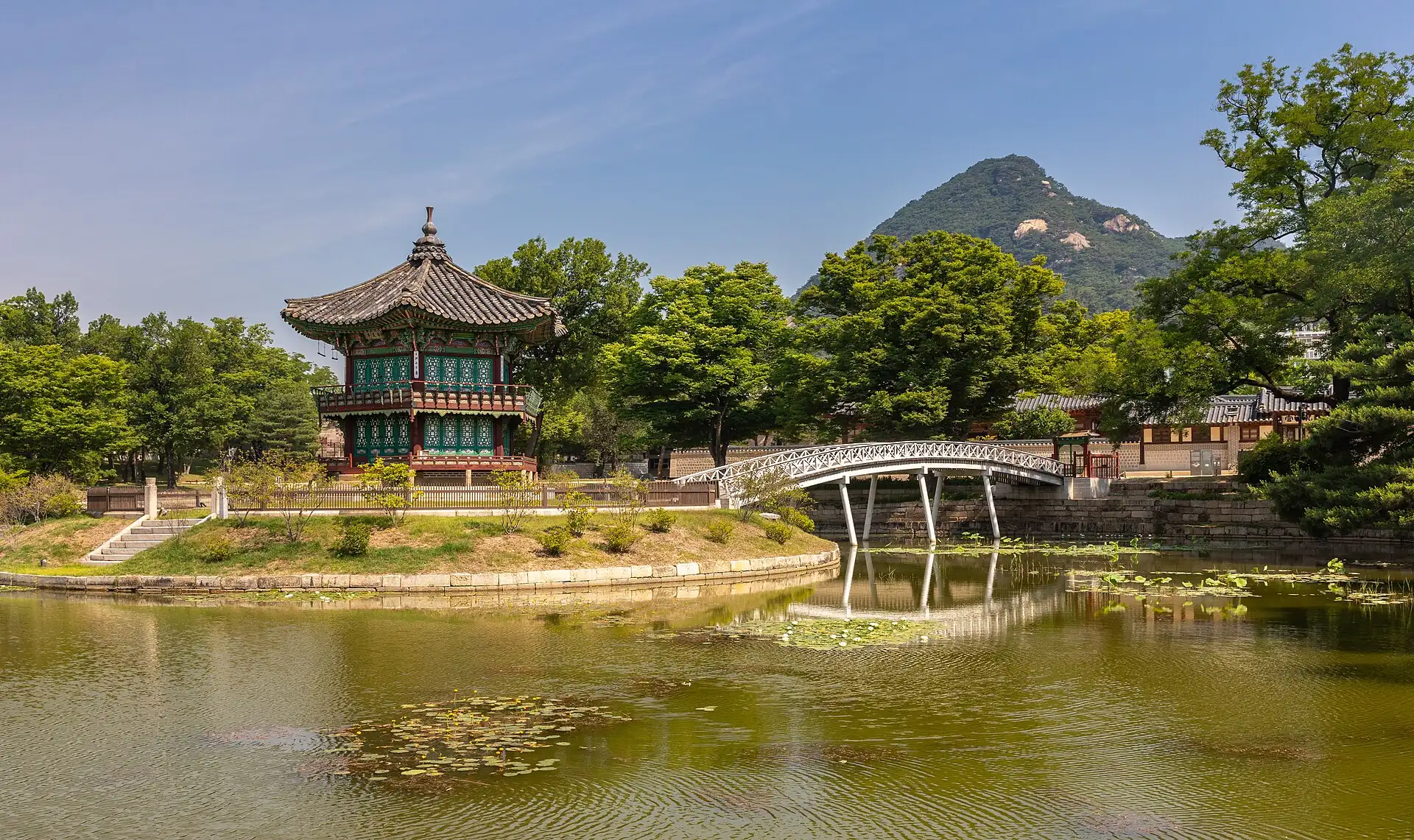
Getting around, in detailGet around · Connect
Get around
Subway for everything, walking inside a neighbourhood, taxis after midnight or with bags. One T-money card (or a WOWPASS or Climate Card) pays for subway, bus and many taxis; transfers within 30 minutes are discounted.
| Mode | Verdict | Fare | Use it for | What breaks |
|---|---|---|---|---|
| Subway | use | About ₩1,550 (≈ US$2) base by card, more by distance (check) | Every cluster, the airports, Gangnam, the river parks | Runs about 05:30–00:00 (last trains vary by line and weekday). Numbered exits: pick yours on the map before surfacing.Runs about 5:30 AM–12:00 AM (last trains vary by line and weekday). Numbered exits: pick yours on the map before surfacing. |
| T-money card | use | Card ₩3,000–4,000 (≈ US$3); top-up in cash at station machines and convenience stores | Subway, bus, taxis and convenience stores | Tap in and tap out on subway and bus, including when you leave the bus, or you lose the transfer discount. |
| Climate Card (short-term) | ok | 1–5-day versions for visitors, from about ₩5,000 (≈ US$4) plus the card (check) | Heavy subway and bus days inside Seoul | Not valid on the airport express, Shinbundang beyond the city or outside Seoul (check). |
| City bus | ok | ₩1,500 (≈ US$2) blue and green; ₩3,000 (≈ US$3) red express (check) | Namsan, Bukchon slopes, routes without a subway | Board at the front, tap in and tap out at the back door; KakaoMap shows arrivals. |
| Taxi | use | Base ₩4,800 (≈ US$4) for 1.6 km (1 mi); ₩9,000–13,000 (≈ US$7–10) for 5 km (3.1 mi)Base ₩4,800 (≈ US$4) for 1 mi (1.6 km); ₩9,000–13,000 (≈ US$7–10) for 3.1 mi (5 km) | Bags, groups of 3–4, after the last train | Night surcharge 20–40% from 22:00 to 04:00. Cards accepted in nearly all cabs.Night surcharge 20–40% from 10:00 PM to 4:00 AM. Cards accepted in nearly all cabs. |
| Deluxe (black) taxi | ok | Base about ₩7,000 (≈ US$6); higher per km | More space, English-speaking drivers more likely | No night surcharge on some deluxe models (check). |
| Walking | use | Free | Inside Jongno, Myeongdong, Hongdae | Gyeongbokgung to Myeongdong is about 2.5 km (1.6 mi) on flat streets via Cheonggyecheon.Gyeongbokgung to Myeongdong is about 1.6 mi (2.5 km) on flat streets via Cheonggyecheon. |
| Ttareungyi (public bikes) | ok | ₩1,000 (≈ under US$1) an hour; day passes (check) | Han river paths, Cheonggyecheon, Seoul Forest | Register in the app with a foreign card; ride on the paths, not the traffic lanes in the centre. |
| E-scooter | avoid | App rates per minute | Nothing a visitor needs | Riders need a Korean-recognised licence and a helmet; fines apply. |
| Rental car | avoid | ₩60,000 (≈ US$45)+ a day plus parking | Trips out of Seoul only | An International Driving Permit (1949 convention) is required; city traffic and parking are hard. |
Metro and rail lines
Nine numbered city lines plus AREX, GTX-A and suburban lines, one fare system. Stations have a line colour and a three-digit number (for example 426 = Line 4, Myeongdong). Trains run about 05:30–00:00; check the last train from your station.Nine numbered city lines plus AREX, GTX-A and suburban lines, one fare system. Stations have a line colour and a three-digit number (for example 426 = Line 4, Myeongdong). Trains run about 5:30 AM–12:00 AM; check the last train from your station.
Line 1
openSoyosan → Cheongnyangni → Jongno → Seoul Station → Guro → Suwon / Incheon (Korail suburban)
- Seoul Station — KTX, AREX
- City Hall — Deoksugung, Seoul Plaza
- Jonggak — Jongno, Bosingak
- Jongno 3(sam)-ga — Insadong, Tapgol Park, Ikseon-dong
- Dongdaemun — Gwangjang Market, the city gate
- Suwon — Hwaseong Fortress day trip
The oldest line; branches split south of Guro, so check the destination board.
Line 2
openLoop of about 50 stations: City Hall → Euljiro → DDP → Seongsu → Jamsil → Gangnam → Hongik Univ. → Sinchon
- Euljiro 1-ga — Myeongdong north, Lotte
- Dongdaemun History & Culture Park — DDP
- Seongsu — cafés and pop-ups
- Jamsil — Lotte World, Lotte World Tower
- Samseong — COEX, Bongeunsa
- Gangnam — the Gangnam district
- Hongik Univ. — Hongdae, AREX
Inner and outer circle run in opposite directions; about 90 minutes round.
Line 3
openDaehwa → Gyeongbokgung → Anguk → Jongno 3-ga → Chungmuro → Apgujeong → Express Bus Terminal → Suseo → Ogeum
- Gyeongbokgung — the main palace, Seochon
- Anguk — Bukchon, Insadong, Changdeokgung
- Chungmuro — Namsangol Hanok Village
- Apgujeong / Sinsa — Gangnam shopping, Garosu-gil
- Express Bus Terminal — long-distance buses
The palace line: Gyeongbokgung to Gangnam without a change.
Line 4
openJinjeop → Hyehwa → Dongdaemun → Myeongdong → Seoul Station → Ichon → Sadang → Oido
- Hyehwa — Daehangno theatres, Naksan wall walk
- Dongdaemun History & Culture Park — DDP
- Myeongdong — shopping, Namsan
- Hoehyeon — Namdaemun Market
- Seoul Station — KTX, AREX
- Samgakji / Ichon — War Memorial / National Museum of Korea
The Myeongdong line; one stop from Seoul Station.
Line 5
openBanghwa → Gimpo Airport → Yeouido → Gwanghwamun → Jongno 3-ga → Dongdaemun History & Culture Park → Gangdong (two eastern branches)
- Gimpo Airport — domestic and short international flights
- Yeouinaru — Yeouido Hangang Park
- Gwanghwamun — the square, Kyobo Book Centre
- Seodaemun — Gyeonghuigung, Seoul Museum of History
Links Gimpo directly with the centre.
Line 6
openEungam loop → Mangwon → Hapjeong → Sangsu → Gongdeok → Itaewon → Hangangjin → Sinnae
- Mangwon — Mangwon Market
- Sangsu / Hapjeong — Hongdae's quieter side
- Itaewon — bars and restaurants
- Hangangjin — Leeum, Hannam-dong
Slow and winding, but the only line through Itaewon.
Line 7
openJangam → Dobongsan → Konkuk Univ. → Cheongdam → Express Bus Terminal → Gasan → Seongnam / Incheon
- Dobongsan — hiking trails
- Ttukseom Resort — Ttukseom Hangang Park
- Cheongdam — luxury shops
- Express Bus Terminal — buses south
Mostly residential; useful for Ttukseom and the northern hills.
Line 8
openByeollae → Amsa → Cheonho → Jamsil → Mongchontoseong → Moran (Seongnam)
- Amsa — Neolithic settlement site
- Jamsil — Lotte World Tower
- Mongchontoseong — Olympic Park
South-east only; extended north to Byeollae in 2024 (check).
Line 9
openGaehwa → Gimpo Airport → Yeouido → Noryangjin → Sinnonhyeon → Sports Complex → VHS Medical Center
- Gimpo Airport — flights
- National Assembly / Yeouido — Yeouido park and malls
- Noryangjin — fish market
- Sinnonhyeon — Gangnam station area
- Sports Complex — Jamsil baseball stadium
Express trains (red on the board) skip most stops; the most crowded line at rush hour.
AREX (Airport Railroad)
openSeoul Station → Gongdeok → Hongik Univ. → Digital Media City → Gimpo Airport → Incheon Airport T1 → T2
- Seoul Station — city terminal; express trains start here
- Hongik Univ. — Hongdae
- Gimpo Airport — domestic and Japan/China flights
- Incheon Airport T1 / T2 — international flights
All-stop trains every 10–15 min, about 1 h to T1; the non-stop express (about 43 min, reserved seats) runs every 30–40 min (check).
Gyeongui–Jungang line
openMunsan → DMC → Hongik Univ. → Gongdeok → Yongsan → Oksu → Wangsimni → Cheongnyangni → Yangpyeong
- Hongik Univ. — Hongdae
- Seobinggo / Ichon — National Museum (Ichon)
- Wangsimni — transfers to lines 2, 5, Suin–Bundang
- Yangpyeong — river cycling day out
Suburban trains every 10–20 min; some start at Seoul Station instead of Yongsan.
Suin–Bundang line
openCheongnyangni → Wangsimni → Seoul Forest → Apgujeong Rodeo → Seolleung → Bundang → Suwon → Incheon
- Seoul Forest — the park, Seongsu
- Apgujeong Rodeo — Gangnam boutiques
- Seolleung — royal tombs, Line 2
- Suwon — Hwaseong Fortress
Long and slow; handy for Seoul Forest and Suwon.
Shinbundang line
openSinsa → Gangnam → Yangjae → Pangyo → Jeongja → Gwanggyo
- Sinsa — Garosu-gil
- Gangnam — Gangnam Station
- Pangyo — tech district
Driverless and fast, with a higher fare; extension north to Yongsan under construction.
GTX-A
partialUnjeong Jungang → Kintex → Daegok → Yeonsinnae → Seoul Station; separate southern section Suseo → Seongnam → Dongtan
- Seoul Station — deep platforms; transfer to KTX and AREX
- Yeonsinnae — Line 3
- Suseo — SRT trains
- Dongtan — southern terminus
Express rail about 50 m underground with a higher fare. The link between Seoul Station and Suseo, via Samseong, opens in stages from 2026 (check).
City buses a visitor actually uses
| Bus | Route | Useful for | Fare | Note |
|---|---|---|---|---|
| Blue buses (3 digits) | Trunk routes along main roads between districts | Long cross-town rides | ₩1,500 (≈ US$2) by card | Numbers follow zones: the first digit is where the route starts.(check) |
| Green buses (4 digits) | Branch routes feeding subway stations | Hills and neighbourhoods off the subway | ₩1,500 (≈ US$2) by card | (check) |
| Red buses (M and 9xxx) | Express buses to satellite cities (Suwon, Bundang, Ilsan) | Day trips south | ₩3,000 (≈ US$3) by card | (check) |
| Namsan buses 01A, 01B | Loops from Chungmuro and Myeongdong-area stops up to N Seoul Tower | The tower without the climb | ₩1,200–1,500 (≈ US$1–2) (check) | Private cars cannot drive up; these are the way on wheels.(check) |
| Night 'Owl' buses (N-numbers) | About 00:00–05:00 on main corridorsAbout 12:00 AM–5:00 AM on main corridors | After the last train | ₩2,500 (≈ US$2) by card (check) | (check) |
| Seoul City Tour Bus | Hop-on loops: downtown palaces, Namsan, night view | An overview on day one | About ₩24,000 (≈ US$18) a day (check) | Departs from Gwanghwamun; English audio.(check) |
Taxis and ride-hailing
Kakao T
app
The main taxi app; accepts many foreign cards and phone numbers (check). Blue 'Kakao T Blue' cars take automatic payment.
Uber
app
Books licensed Seoul taxis and larger vans with your home account.
K.Ride
app
English app for visitors from the tourism organisation and Kakao Mobility; foreign cards (check).
Regular taxis (orange, silver, white)
metered
Street hail: a red light on the dashboard sign means free. Meter always on; cards and T-money accepted.
Deluxe black taxis (mobeom)
metered
Higher fare, bigger cars, often drivers with some English.
International Taxi
airport
Booked English-speaking taxis with fixed airport fares by zone; reserve online or at the airport counter.
On foot and car-free hours
| Where | When | Note |
|---|---|---|
| Cheonggyecheon stream | Any time; lit at night | About 5.8 km (3.6 mi) from Gwanghwamun east below street level; cooler in summer.About 3.6 mi (5.8 km) from Gwanghwamun east below street level; cooler in summer. |
| Insadong-gil | Weekends, daytime | Main street car-free on Saturdays and Sundays (check). |
| Seoul City Wall: Naksan section | Late afternoon to night | Easy 2 km (1.2 mi) from Hyehwa to Dongdaemun gate with the city lighting up.Easy 1.2 mi (2 km) from Hyehwa to Dongdaemun gate with the city lighting up. |
| Seoullo 7017 | Any time | A former highway flyover turned elevated walkway beside Seoul Station. |
| Han river parks (Yeouido, Banpo, Ttukseom) | Evenings, April–October | Riverside paths, cycling and the Banpo Bridge fountain show (seasonal, check times). |
| Deoksugung stone-wall road | Any time; best in autumn | Tree-lined lane around the palace wall to Jeong-dong. |
More on getting around
Subway exits matter more than stations. Big stations have ten or more numbered exits, and maps in Naver or KakaoMap tell you which one; the yellow board by the gates does too. The fastest carriage for a transfer is shown in the app (for example '3-2' for car 3, door 2).
Rush hours are about 07:30–09:30 and 18:00–19:30. Lines 2 and 9 are packed then; carry a backpack in front. On buses, tap your card again when you get off: without it, the next ride charges full fare.
Connect
| Option | Verdict | What breaks |
|---|---|---|
| Tourist eSIM bought before you fly | use | Data only on most plans; cheapest and no queue. Some Korean apps and deliveries need a local number. |
| Carrier counters in Incheon arrivals (KT, SK Telecom, LG U+) | use | Data SIMs, eSIMs with a Korean number, and pocket Wi-Fi; posted prices and staff who speak English. Queues after big arrivals. |
| Carrier store in the city | ok | Longer-stay prepaid plans with a number; passport needed; 20–40 min. |
| Convenience-store data SIMs | ok | Sold in some GS25 and CU branches; you activate online with your passport (check). |
Naver Map
Walking, transit, restaurant info
The most accurate map; English interface. Google Maps gives transit but not reliable walking or driving directions.
KakaoMap
Maps, real-time bus arrival
Alternative to Naver; strong on bus times.
Kakao T
Taxis
Accepts many foreign cards and numbers (check); shows the fare estimate and driver.
Uber
Taxis
Books licensed Seoul taxis with your home account.
Papago
Translation
Naver's translator; better at Korean than most; camera mode reads menus.
KakaoTalk
Messaging
Hotels, guesthouses and tour operators use it for contact.
CatchTable
Restaurant bookings
Global version in English for popular and fine-dining restaurants (check).
- Wi-Fi
- Free public Wi-Fi in the subway, on buses and in parks (network 'Seoul' or 'Public WiFi Free'); fast in almost every café.
- Verification
- Some sites and apps ask for Korean identity verification by phone: a plan with a local number avoids that wall.
Luggage
Where big bags are a problem, and how to get rid of them for the day.
Rule
- Lockers
- Coin lockers at Seoul Station, Hongik Univ. Station and many major subway stations; hotels hold bags after check-out.
- Forwarding
- Luggage-delivery services run between the airport and some hotels; ask your hotel before you fly.
- Dead zone
- Late check-out flights: ask the hotel to hold bags and use a station locker, not a bus.
Bags, area by area
4 walking areas rated
- Bags forbidden
- Bags painful
Gyeongbokgung & GwanghwamunMyeongdong & NamdaemunHongdae & Yeonnam-dong
Lockers, forwarding and the gap between check-out and check-in are covered once, under Luggage.
See & doWalking clusters, day plans and the places worth the time
See & do
Walking clusters, day plans and the places worth the time
Clusters
Plan by cluster: each is a walkable area with a rescue point and a bag rule.
Morning cluster: the palace at opening, the gate and the square before the tour groups; open courtyards with little shade, so go before 11:00 in summer.
rescue 100% · max p90 6.8′ · half
Late-morning cluster: Bukchon lanes early, then Insadong's alleys and tea houses; steep and narrow, so a day pack only.
rescue 98% · max p90 7′ · half
Evening cluster: shopping streets, street food and the cathedral; crowded after 17:00, so eat early or late; flat with short bus-free walks.
rescue 100% · max p90 6.3′ · half
Afternoon and night cluster: cafés on Yeonnam-dong, the walking street and buskers after 18:00; flat, and on the AREX line to the airport.
rescue 91% · max p90 7′ · half
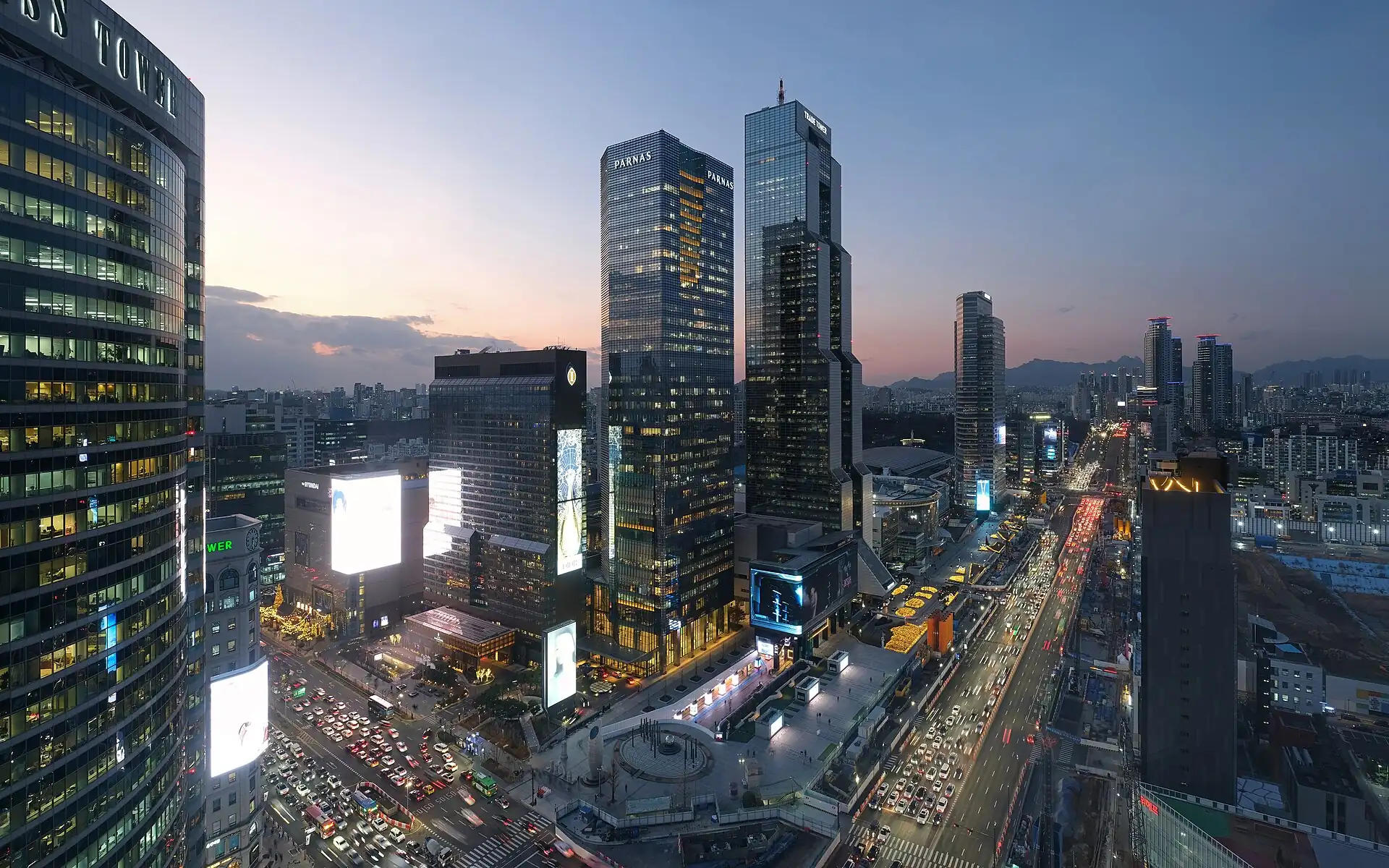
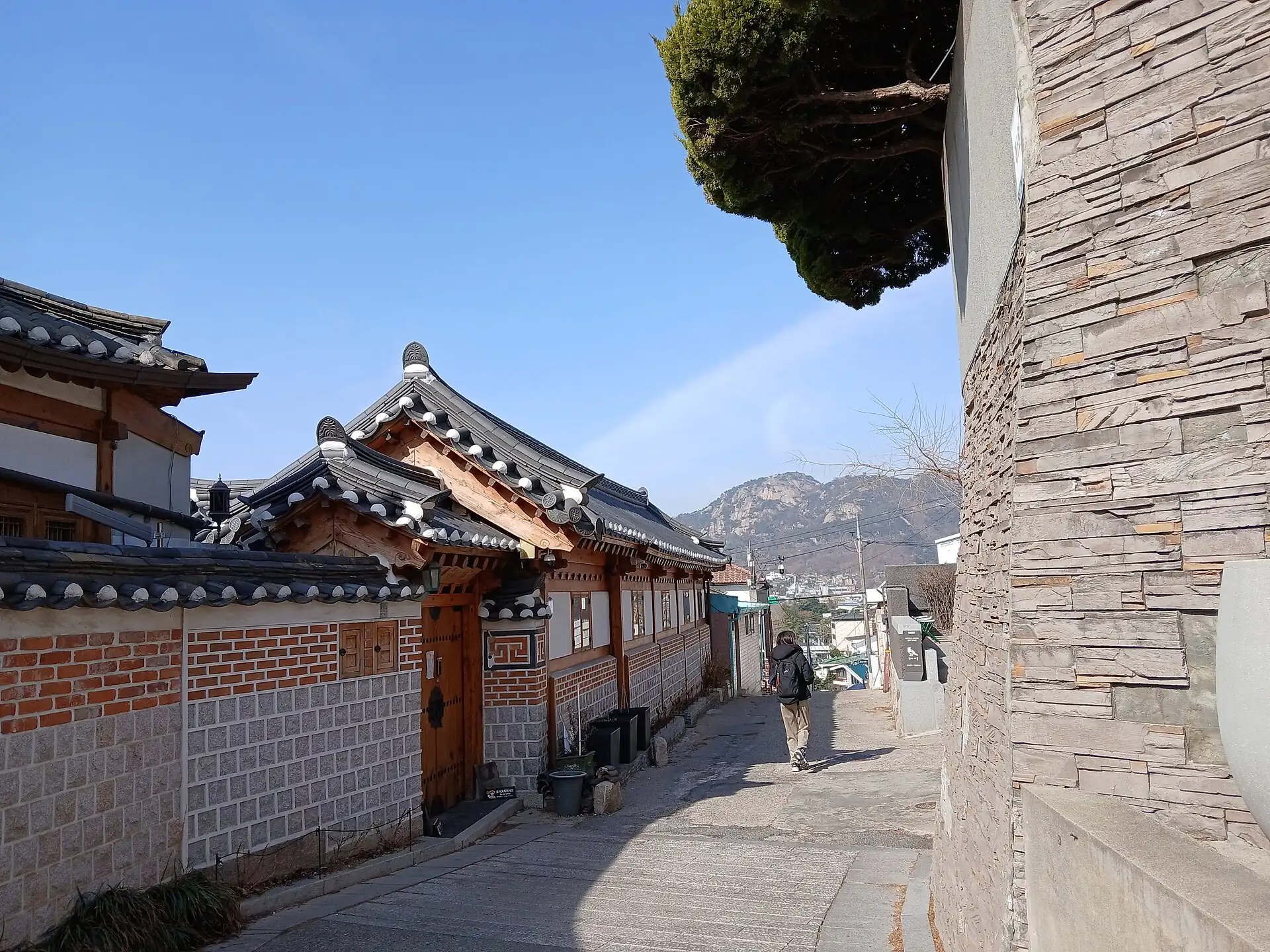
Days
Ready-made day plans, timed against opening hours and walking distances.
How long are you staying?
Loose outlines built on the weekly palace closures (Mon and Tue) and the heat and cold. The timed day plans check opening days and walking.
1 day
A stopover or a first day after a morning arrival
- 09:00Gyeongbokgung Palace — Gyeongbokgung at opening (not Tuesday); guard ceremony at 10:00Gyeongbokgung at opening (not Tuesday); guard ceremony at 10:00 AM
- 11:30Tosokchon Samgyetang — Samgyetang lunch
- 13:00Bukchon Hanok Village — Bukchon lanes, then down to Insadong
- 15:30Cheonggyecheon walk east to Gwangjang Market
- 17:30Pancakes and makgeolli at Gwangjang Market
- 19:30Myeongdong & Namdaemun — Myeongdong streets and N Seoul Tower by bus
Skip: Gangnam and Jamsil: a river crossing each way for little on a short day.
Seoul in 3 days
3 daysPalaces and hills in the morning, indoors at midday, streets at night; the last day ends with the bags already at the AREX station.
Day by day
Day 1 — Gyeongbokgung at opening, a 12:30 samgyetang lunch
- 08:30Gyeongbokgung Palace
- 12:30Lunch 12:30 (Seochon)
Day 2 — Bukchon early, Insadong tea, Myeongdong evening
Day 3 — Yeonnam-dong and Hongdae, AREX to Incheon at 12:00
- 12:00AREX from Hongik Univ. at 12:00
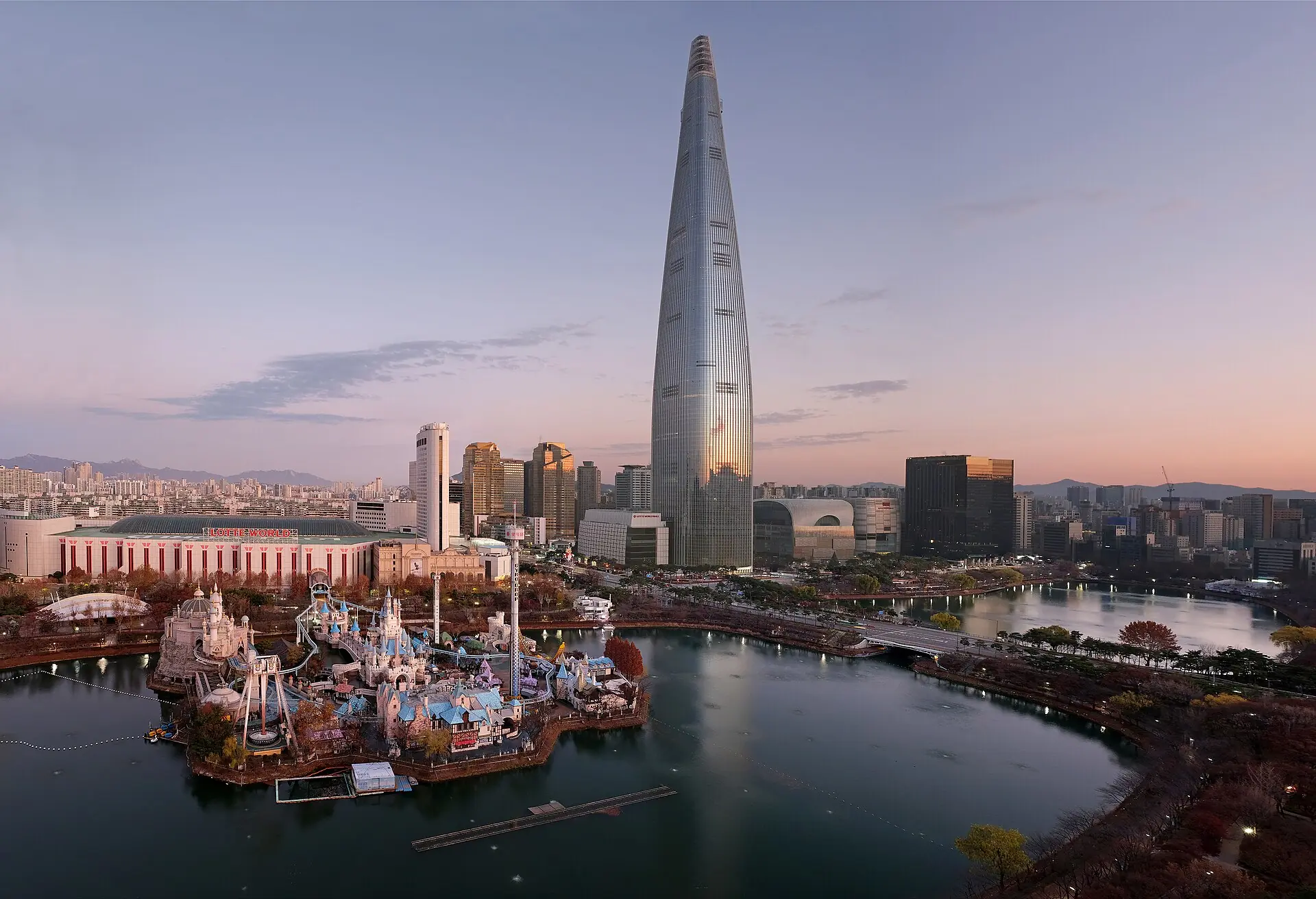
Places
“Best time” is when to arrive for the fewest crowds, for example “before 08:30”; “Go any time” means the hour makes little difference. More sights follow under “More sights and museums”.
2 places. Filters use the guide’s own ratings; a place with no rating is left out when a filter is on.
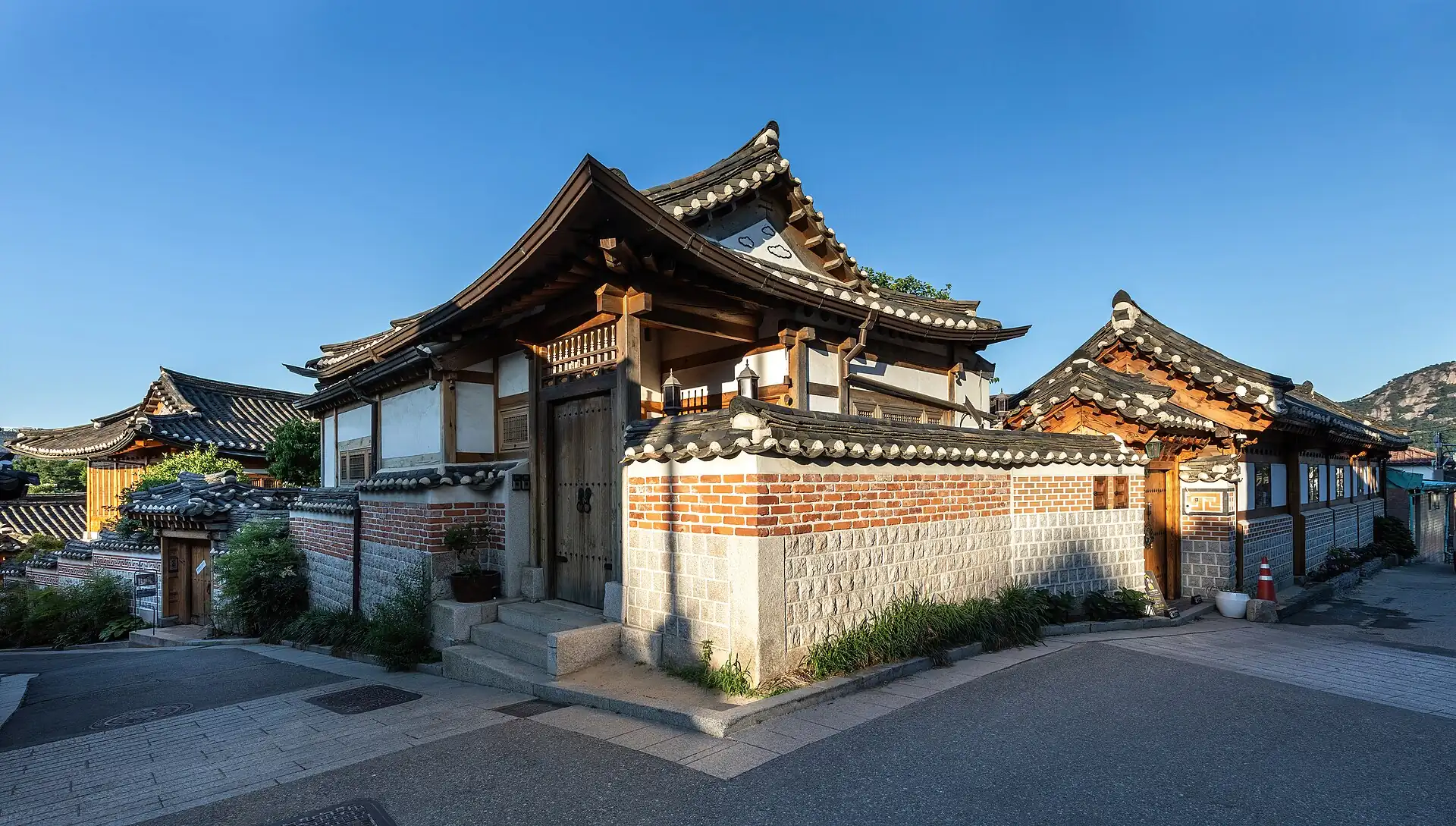
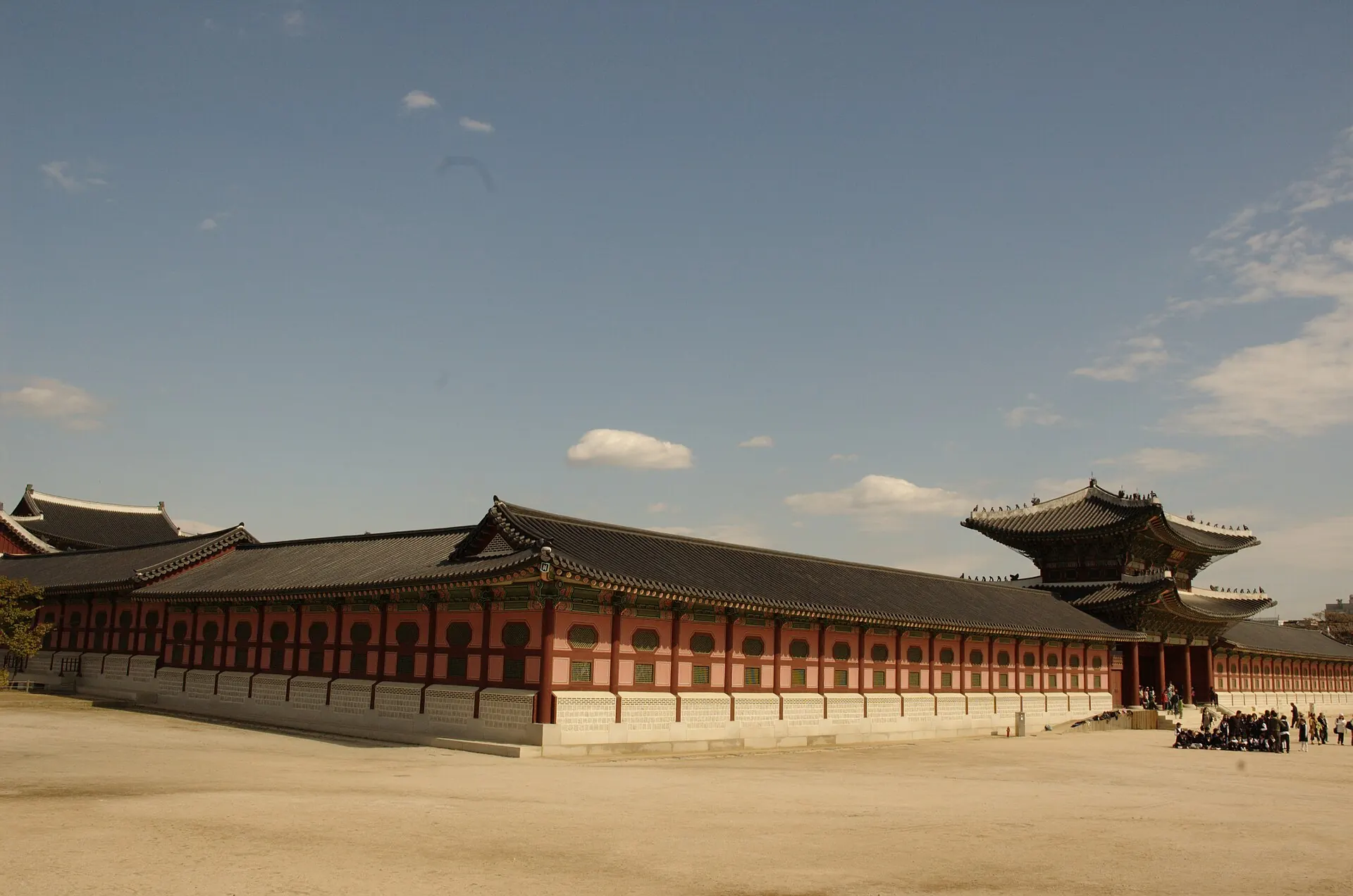
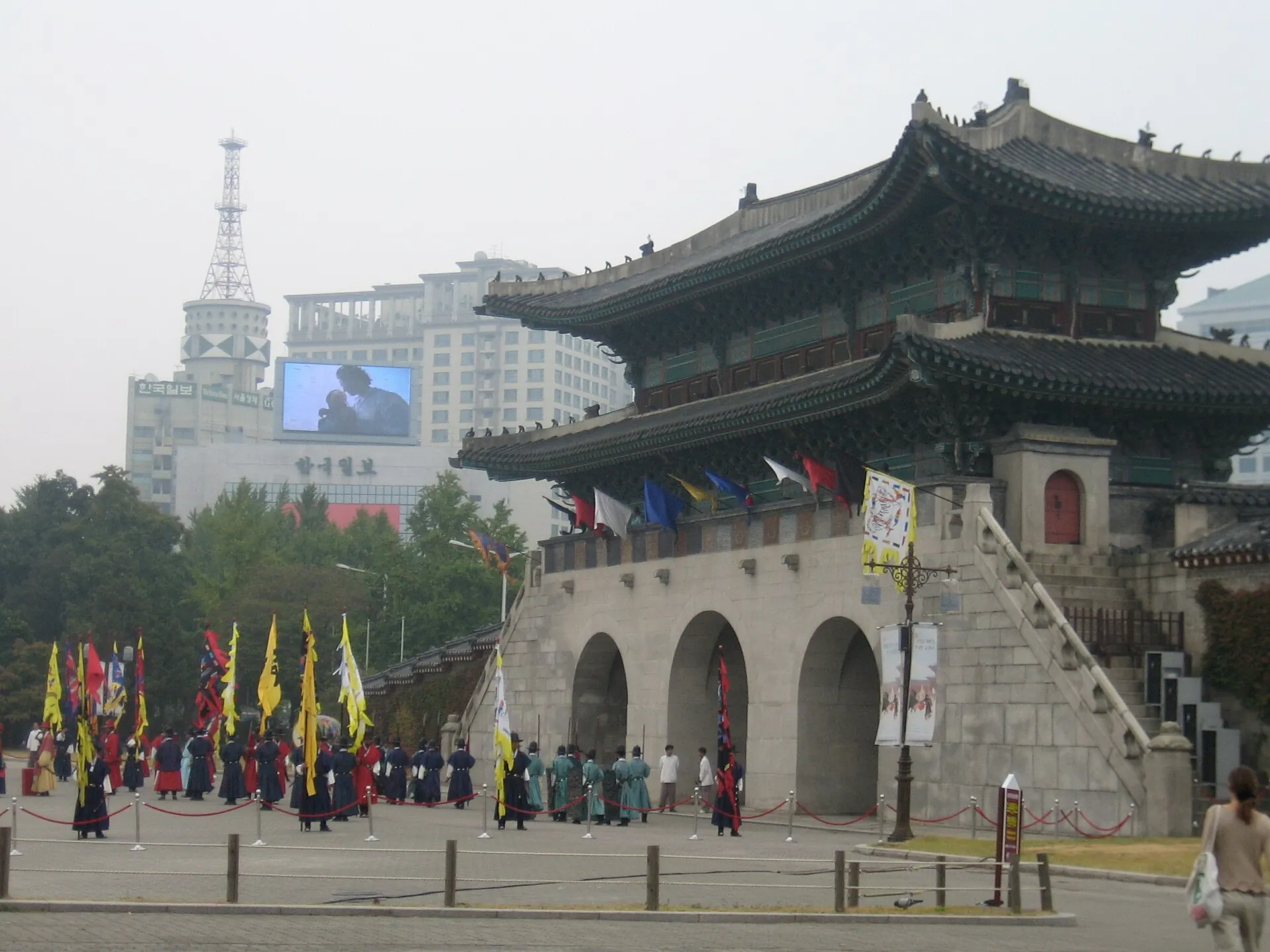
If you do ten things in Seoul
Ranked for a first visit of 3–5 days. Prices are 2026 estimates in won; hours marked (check) in the linked pages still need confirmation.
- 1
The main Joseon palace with its throne hall, lake pavilion and gate ceremony; in a hanbok, entry is free.
- Time
- 1.5–2 h
- Best
- 09:00 opening; closed Tue
- Cost
- ₩3,000 (≈ US$3)
- 2
Changdeokgung and the Secret Garden
The palace built to follow the hills, and a guided walk through royal pavilions and ponds in the woods behind it.
- Time
- 2–2.5 h
- Best
- Morning garden slot; closed Mon
- Cost
- ₩3,000 (≈ US$3) + ₩5,000 (≈ US$4) garden (check)
- 3
Lived-in lanes of tiled hanok roofs between two palaces, with views down to the towers.
- Time
- 45 min–1 h
- Best
- 10:00–11:30 on a weekday
- Cost
- Free
- 4
National Museum of Korea
Free, vast and calm: gold crowns, celadon and the pensive Buddhas room.
- Time
- 2–4 h
- Best
- Any day; the rainy or hot afternoon
- Cost
- Free
- 5
Gwangjang Market food evening
Mung-bean pancakes, gimbap and makgeolli at the counters of Seoul's oldest covered market.
- Time
- 1.5 h
- Best
- 17:00–20:00
- Cost
- ₩15,000–30,000 (≈ US$11–25)
- 6
N Seoul Tower and the Namsan walk
The whole basin from the central hill, reached on foot through woods or by bus.
- Time
- 2 h
- Best
- Late afternoon into dusk
- Cost
- Free; observatory about ₩21,000–26,000 (≈ US$16–19) (check)
- 7
Street food, cosmetics shops and the cathedral lit at night, one stop from Seoul Station.
- Time
- 2 h
- Best
- 18:00–21:00
- Cost
- ₩10,000–30,000 (≈ US$8–25) in snacks
- 8
Buskers, bars, clubs and cafés along the old rail-line park; the city's youngest quarter.
- Time
- 3 h+
- Best
- Friday or Saturday from 19:00
- Cost
- ₩30,000–60,000 (≈ US$25–45)
- 9
A Han river park evening
Bikes, lawns, fried chicken delivered to your mat and the bridge lights coming on.
- Time
- 2 h
- Best
- Sunset, April–October
- Cost
- ₩20,000–40,000 (≈ US$15–30) for chicken and beer
- 10
Whole ginseng chicken soup in a hanok-style hall next to the palace; the classic lunch after Gyeongbokgung.
- Time
- 45 min
- Best
- Before 11:30 or after 14:00
- Cost
- ₩20,000–28,000 (≈ US$15–25)
Good for…
Verdict is how well Seoul works for that traveller, not how nice it is.
Safe, signposted in English and linked by one of the best subways anywhere.
- 1Sleep in Myeongdong — one stop from the airport train and central to everything.
- 2Seoul in 3 days — the 3-day plan already avoids the Monday and Tuesday palace closures.
- 3AREX from Incheon — cheap and simple; the express saves 15 minutes for twice the price.
Barbecue, stews, markets and street snacks at every price, served until late.
- 1Tosokchon Samgyetang — ginseng chicken soup by the palace.
- 2Gwangjang Market — the city's best-known food counters in one covered market.
- 3A Korean barbecue dinner in Mapo — the pork-belly district, local and loud.
Beds cost more than in South-East Asia, but food, transport and most sights are cheap.
- 1Free sights — national museums, palace grounds in hanbok, Cheonggyecheon, the city wall and river parks.
- 2Snack bars and markets — a full meal for ₩5,000–9,000 (≈ US$4–7).
- 3Hongdae hostels — the most beds under ₩40,000 (≈ US$30).
- 1Palaces in hanbok — free entry and the photos everyone takes.
- 2Naksan wall walk at sunset — free, quiet and lit up after dark.
- 3An evening Han river cruise — an hour of city lights from the water.
- 1Counter restaurants and honbap places — eating alone is normal; kiosks do the ordering.
- 2A Gwangjang Market food tour — company and a crash course in what to order.
- 3Hostels in Hongdae or Jongno — social, with women-only dorms at many.
Clean, safe and easy with lifts everywhere; the cold and the heat are the hard parts.
- 1National Folk Museum children's museum — hands-on and free inside the palace grounds.
- 2Lotte World and COEX Aquarium — the indoor day for rain or cold.
- 3Han river parks — playgrounds, bikes and summer pools.
Comfortable with a hotel near a station; long subway transfers and hills are the strain.
- 1Myeongdong or Gwanghwamun hotel — flat streets and lifts at the stations.
- 2Deoksugung and Jeong-dong — a small, flat palace and a tree-lined lane.
- 3Seoul City Tour Bus — palaces and Namsan without the stairs (check the route).
- 1A hotel on Namsan or at Gwanghwamun — city views and palace walks from the door.
- 2A Michelin tasting menu in Cheongdam — modern Korean cooking at its most ambitious.
- 3Private palace guide — the stories on the halls you would otherwise walk past.
Subway lifts, low-floor buses and accessible toilets; avoid the hanok lanes.
- 1National Museum of Korea — step-free throughout with wheelchairs to borrow.
- 2Han river parks — long, flat paved paths reached by lift.
- 3
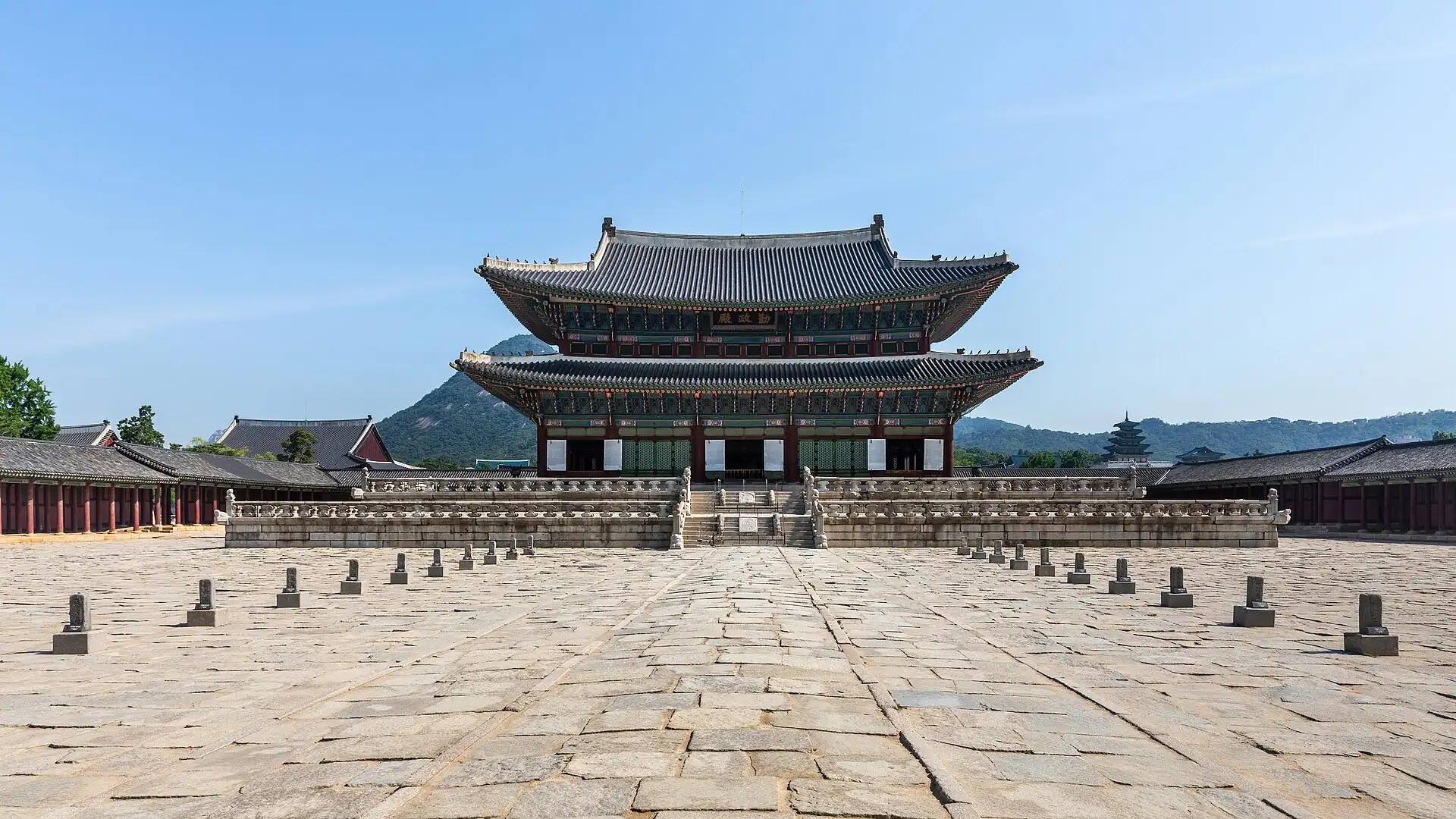 Gyeongbokgung Palace — the paved main axis works; side courts are gravel.
Tours and classes: book or skip
Book with an operator that lists inclusions and a cancellation policy in writing. Prices per person, group tour unless stated.
| Tour or class | Verdict | Typical price | Why | Check before paying |
|---|---|---|---|---|
| DMZ half- or full-day tour | book | ₩60,000–150,000 (≈ US$45–110) | The only way in; transport and passport checks are handled. | Whether the JSA is included and currently open (check), the passport deadline, and the refund rule if the military cancels. |
| Gwangjang Market or Euljiro food tour | book | ₩70,000–120,000 (≈ US$55–90) | Learn dishes and ordering on night one. | Group under 10; what drinks are included. |
| Free palace guided tour in English | do it yourself | Included with entry | Palace guides run set English tours at set times. | Times on the palace's official site (check). |
| Secret Garden tour at Changdeokgung | book | ₩5,000 (≈ US$4) plus palace entry (check) | Entry is by guided or timed visit only. | Book the English slot online; a few tickets are sold on the day. |
| Hanbok rental | do it yourself | ₩15,000–35,000 (≈ US$11–30) | Free palace entry while you wear it; shops around Gyeongbokgung. | Return time, deposit and whether hair styling costs extra. |
| Korean cooking class | book | ₩60,000–120,000 (≈ US$45–90) | Useful on a rainy or freezing day. | Hands-on stations per person; vegetarian options. |
| Nami Island and Petite France tour | maybe | ₩40,000–90,000 (≈ US$30–65) | Transport solved, but the stops are crowded and commercial. | Ferry tickets included; weekday departure. |
| Seoul City Tour Bus | maybe | About ₩24,000 (≈ US$18) (check) | Good orientation on day one; slow in traffic. | Which loop and the last departure. |
| Free walking tours by the city | do it yourself | Free | City-run volunteer-guided walks on set routes. | Book online a few days ahead (check availability in English). |
What each season brings
Spring
Mar–May
Cherry blossoms in early April, azaleas on the hills, the Lotus Lantern parade.
Watch: Fine and yellow dust days; blossom-week crowds and hotel prices.
Summer
Jun–Aug
Han river evenings, outdoor pools, bingsu and cold noodles.
Watch: Monsoon rain from late June; 30 °C and humid; typhoon tails in August.
Autumn
Sep–Nov
Clear skies, palace gardens in red and gold, the fireworks festival.
Watch: Chuseok closures; October is the busiest month for rooms.
Winter
Dec–Feb
Crisp blue days, hot street snacks, Christmas lights and ice rinks.
Watch: −10 °C mornings and wind; Seollal closures.
Photo spots and the light
Light times are for clear days; fine-dust days flatten the views.
| Spot | Best light | Tip |
|---|---|---|
| Gyeonghoeru pavilion over its pond | 09:00–10:00, or night openings | Shoot across the pond from the east side; reflections are best on still mornings. |
| Bukchon-ro 11-gil roofline | 10:00–11:00 | The downhill view of tiled roofs to the towers; stay on the path, keep voices down. |
| Naksan Park and the city wall | Sunset into blue hour | The lit wall curving down to Dongdaemun. |
| N Seoul Tower from Namsan | Dusk | The Namsan octagonal pavilion gives the tower and city together. |
| Banpo Bridge fountain | Evening shows (seasonal, check times) | Watch from Banpo Hangang Park; the lights change colour. |
| Dongdaemun Design Plaza | Night | The curved steel skin catches the city light; the LED garden appears in some seasons. |
| Lotte World Tower from Seokchon Lake | Blossom week, early morning | The tower above cherry trees; very busy at weekends. |
| Inwangsan ridge | Morning | Gyeongbokgung and the Blue House grounds laid out below Bugaksan. |
Seoul travel FAQ
Answers are 2026 desk estimates; fares and rules marked (check) change.
Is Seoul safe at night?
Yes, one of the safest big cities for visitors. The risks are traffic in lanes without pavements, drunk crowds late at weekends in Hongdae and Itaewon, and occasional overcharging taxis at night.
How do I get from Incheon Airport to the city?
AREX all-stop train to Seoul Station in about an hour for about ₩4,500 (≈ US$4) (check), or the limousine bus to your hotel area for about ₩17,000–18,000 (≈ US$13). A taxi is ₩65,000–90,000 (≈ US$50–65) including tolls.
Do I need cash in Seoul?
Very little. Cards work almost everywhere, including taxis. Keep ₩30,000–50,000 (≈ US$25–40) for street stalls, markets and topping up a T-money card, which station machines take in cash only.
Which palaces are closed on which days?
Gyeongbokgung and Jongmyo close on Tuesdays; Changdeokgung, Changgyeonggung, Deoksugung and Gyeonghuigung close on Mondays.
Is it free to enter palaces in hanbok?
Yes: visitors wearing hanbok enter the main palaces free (check the dress guidelines, which ask for traditional styles). Rentals cost about ₩15,000–35,000 (≈ US$11–30).
Can I use Google Maps in Seoul?
For transit only. Walking and driving directions are limited, so use Naver Map or KakaoMap, both with English menus.
Do I need a K-ETA?
It depends on nationality and the current exemptions; check the official K-ETA site before you book, as the list changes.
How many days do I need in Seoul?
Three full days for the palaces, markets, museums and one river evening; five with a DMZ tour and Suwon.
Is Seoul expensive?
Beds are mid-priced by Asian standards; food, transport and most sights are cheap. A mid-range day costs about ₩130,000 (≈ US$95) per person plus the room.
When is the best time to visit?
April–May and late September–November. July–August are hot and wet; January is very cold but dry and sunny.
Do people speak English?
Younger people, hotel staff and signs in the subway do. Taxi drivers and market sellers often do not: show the Korean address and use Papago.
What time does the subway stop?
Last trains leave around midnight, earlier on some branches and on weekends (check). After that, taxis and night buses (N-numbers) run.
Can I drink tap water?
Yes, it is treated to drinking standard; most restaurants serve free filtered water.
Should I tip?
No. Tipping is not expected anywhere, including taxis, restaurants and hotel staff.
Where should I stay?
Myeongdong for a first visit and shopping, Hongdae for nightlife and budget, Jongno or Insadong for palaces and quiet evenings, Gangnam for business.
Can I visit the DMZ on my own?
Not the main sites: the DMZ, JSA and tunnels need a registered tour with your passport details, booked days ahead.
What is the Climate Card?
Seoul's unlimited transit card; short-term versions for visitors cover 1–5 days on subway and bus inside Seoul. Compare with T-money: it pays off from about four rides a day (check prices and zones).
Are e-cigarettes and medicines allowed?
E-cigarettes are legal for adults. Some medicines common abroad, including certain ADHD and strong painkillers, are controlled: bring a prescription and check the Ministry of Food and Drug Safety rules before you fly.
More to see and doSee & do · Learn & work · Rain & heat
See & do
47 of 47
- Palaces
The main Joseon palace: throne hall, lake pavilion and the guard ceremony at the gate.
Jongno · 09:00–17:00/18:00/18:30 by season; closed Tue9:00 AM–5:00 PM/6:00 PM/6:30 PM by season; closed Tue · ₩3,000 (≈ US$3); free in hanbok(check)
Changdeokgung and the Secret Garden창덕궁 · 후원
PalacesUNESCO palace laid out to fit the hills; the Secret Garden tour is the best hour and a half in the city. Book the garden ahead.
Jongno · 09:00–17:30/18:00 by season; closed Mon9:00 AM–5:30 PM/6:00 PM by season; closed Mon · ₩3,000 (≈ US$3); Secret Garden ₩5,000 (≈ US$4) extra by timed entry(check)
Changgyeonggung창경궁
PalacesQuieter palace linked to Changdeokgung, with a 1909 glass greenhouse; open into the evening.
Jongno · 09:00–21:00; closed Mon9:00 AM–9:00 PM; closed Mon · ₩1,000 (≈ under US$1)(check)
Deoksugung덕수궁
PalacesSmall palace mixing wooden halls with a neoclassical stone palace; guard ceremony at Daehanmun on most days.
Jung-gu (City Hall) · 09:00–21:00; closed Mon9:00 AM–9:00 PM; closed Mon · ₩1,000 (≈ under US$1)(check)
Gyeonghuigung경희궁
PalacesPartly rebuilt western palace; empty and peaceful, next to the Seoul Museum of History.
Jongno (Seodaemun side) · 09:00–18:00; closed Mon9:00 AM–6:00 PM; closed Mon · Free(check)
Jongmyo Shrine종묘
Temples & shrinesUNESCO royal ancestral shrine with a 100 m-long hall; guided entry most days, Jongmyo Jerye rite in May and November.
Jongno · 09:00–17:30/18:00; closed Tue9:00 AM–5:30 PM/6:00 PM; closed Tue · ₩1,000 (≈ under US$1)(check)
- Neighbourhoods
Hundreds of lived-in hanok on steep lanes between two palaces; quiet voices, no courtyards.
Jongno · Core lanes 10:00–17:00 for visitors (check)Core lanes 10:00 AM–5:00 PM for visitors (check) · Free
National Museum of Korea국립중앙박물관
MuseumsOne of Asia's great museums: Silla gold crowns, celadon, and the dark room of two pensive Buddhas. Half a day.
Yongsan · 10:00–18:00; to 21:00 Wed and Sat (check)10:00 AM–6:00 PM; to 9:00 PM Wed and Sat (check) · Free (special exhibitions extra)(check)
National Palace Museum of Korea국립고궁박물관
MuseumsRoyal seals, robes, astronomy instruments and carriages beside Gyeongbokgung's main gate.
Jongno (Gyeongbokgung) · 10:00–18:0010:00 AM–6:00 PM · Free(check)
National Folk Museum of Korea국립민속박물관
MuseumsEveryday life in old Korea inside the palace grounds, with a children's museum and a street of old shopfronts.
Jongno (Gyeongbokgung) · 09:00–18:009:00 AM–6:00 PM · Free(check)
War Memorial of Korea전쟁기념관
War historyThe Korean War told at length, with aircraft and tanks outside; 2–3 hours.
Yongsan · 09:30–18:00; closed Mon9:30 AM–6:00 PM; closed Mon · Free(check)
Seodaemun Prison History Hall서대문형무소역사관
War historyColonial-era prison where independence activists were held; heavy but important.
Seodaemun · 09:30–18:00 (17:00 in winter); closed Mon9:30 AM–6:00 PM (5:00 PM in winter); closed Mon · ₩3,000 (≈ US$3)(check)
Leeum Museum of Art리움미술관
MuseumsSamsung's collection in buildings by Botta, Nouvel and Koolhaas: old Korean art and global contemporary.
Hannam-dong · 10:00–18:00; closed Mon10:00 AM–6:00 PM; closed Mon · Permanent collection free with a timed ticket; exhibitions extra (check)(check)
MMCA Seoul국립현대미술관 서울
MuseumsContemporary art between Gyeongbokgung and Bukchon; the café is the palace-day rest stop.
Jongno (Samcheong-dong) · 10:00–18:00; to 21:00 Wed and Sat (check)10:00 AM–6:00 PM; to 9:00 PM Wed and Sat (check) · About ₩2,000–5,000 (≈ US$2–4) by exhibition(check)
Dongdaemun Design Plaza (DDP)동대문디자인플라자
ArchitectureZaha Hadid's silver curve on the old stadium site; best at night with the LED rose garden (seasonal).
Dongdaemun · Exhibitions about 10:00–20:00; outside alwaysExhibitions about 10:00 AM–8:00 PM; outside always · Free outside; exhibitions vary
N Seoul Tower and NamsanN서울타워 · 남산
ViewsWalk or ride up the central hill for the whole-city view; the love-lock terraces are free.
Jung-gu / Yongsan · Observatory about 10:00–23:00Observatory about 10:00 AM–11:00 PM · Park free; observatory about ₩21,000–26,000 (≈ US$16–19) (check)(check)
Lotte World Tower and Seoul Sky롯데월드타워 서울스카이
ViewsThe 555 m tower's glass-floored decks; clear days only.
Jamsil · About 10:30–22:00About 10:30 AM–10:00 PM · About ₩31,000 (≈ US$25) (check)(check)
Gwanghwamun Square광화문광장
Citadel & old cityThe ceremonial boulevard to the palace gate, statues of King Sejong and Admiral Yi, fountains in summer.
Jongno · Free
Cheonggyecheon청계천
Lakes & parksA stream uncovered from under a highway in 2005; walk it at night from Gwanghwamun.
Jongno / Jung-gu · Free
Seoul City Wall (Naksan and Inwangsan sections)한양도성
Citadel & old cityThe Joseon wall along the ridges; Naksan is an easy sunset walk, Inwangsan a steeper climb with the best palace view.
Jongno · Free
Sungnyemun (Namdaemun gate)숭례문
Citadel & old cityThe great south gate, burnt in 2008 and rebuilt; two minutes on the way to the market.
Jung-gu · Free
Jogyesa조계사
Temples & shrinesHead temple of the main Buddhist order, next to Insadong; lanterns overhead in spring.
Jongno · Always open · Free
Bongeunsa봉은사
Temples & shrinesHillside temple with a giant Maitreya statue opposite COEX; the contrast with the towers is the point.
Gangnam (Samseong) · Day hours · Free
Myeongdong Cathedral명동성당
Architecture1898 brick Gothic cathedral on a rise above the shopping streets; a symbol of the democracy movement.
Myeongdong · Day hours; mass times · Free
Namsangol Hanok Village남산골한옥마을
Citadel & old cityRelocated hanok houses you can walk into, with free craft sessions; flat and easy with children.
Jung-gu (Chungmuro) · 09:00–21:00 (Apr–Oct), 09:00–20:00 (Nov–Mar); closed Mon9:00 AM–9:00 PM (Apr–Oct), 9:00 AM–8:00 PM (Nov–Mar); closed Mon · Free(check)
Gwangjang Market광장시장
MarketsCovered market famous for mung-bean pancakes and mayak gimbap; eat at the counters.
Jongno 5-ga · Food alley about 09:00–22:00Food alley about 9:00 AM–10:00 PM · Free
Noryangjin Fisheries Market노량진수산시장
MarketsBuy live seafood downstairs, have it cooked upstairs; ask the full price first.
Dongjak · Most of the day; auctions before dawn · Free
Starfield Library at COEX별마당도서관
Architecture13 m bookshelves in the middle of an underground mall; 15 minutes and a photo.
Gangnam (Samseong) · 10:30–22:0010:30 AM–10:00 PM · Free
Yeouido and Banpo Hangang Parks한강공원
Lakes & parksRiverside lawns, bikes and convenience-store picnics; the Banpo Bridge fountain show in the warm months (check).
Yeongdeungpo / Seocho · Free
Seoul Forest서울숲
Lakes & parksBig park with deer enclosures next to the cafés of Seongsu.
Seongdong · Free
Bukhansan National Park북한산
ActiveGranite peaks inside the city limits; Baegundae (836 m) is a hard half-day from Bukhansan-ui Station.
North edge of the city · Free(check)
Cheong Wa Dae (former presidential residence)청와대
Citadel & old cityOpened to the public in 2022 and closed again when the presidential office moved back; check before planning.
Jongno · Public visits suspended since 2025 (check) · —(check)
Palace guard-changing ceremony
Shows & musicCostumed royal guards, drums and banners for about 20 minutes; stand on the square side.
Gwanghwamun / Deoksugung · Usually 10:00 and 14:00 at Gwanghwamun; not Tue (check)Usually 10:00 AM and 2:00 PM at Gwanghwamun; not Tue (check) · Free(check)
Wear a hanbok for the palaces
CraftsFree palace entry while you wear one; book the time online to skip the morning queue at the shop.
Around Gyeongbokgung and Bukchon · Rental shops about 09:00–19:00Rental shops about 9:00 AM–7:00 PM · ₩15,000–35,000 (≈ US$11–30) for 2–4 h
Nanta or a non-verbal show
Shows & musicKitchen-percussion comedy with no language needed; 90 minutes.
Myeongdong / Hongdae · Evening shows daily (check) · ₩50,000–70,000 (≈ US$40–55)(check)
K-pop dance class
ClassesLearn a chorus routine with an instructor; some studios film the final run.
Hongdae / Gangnam · Daytime and evening, 1–2 h · ₩40,000–80,000 (≈ US$30–60)
Korean cooking class
ClassesKimchi, bulgogi or street food, often with a market visit; book a day ahead.
Jongno / Mapo · Morning or afternoon, 2–3 h · ₩60,000–120,000 (≈ US$45–90)
Gwangjang Market food tour
Food toursPancakes, raw beef, noodles and makgeolli with someone who orders for you.
Jongno 5-ga · Evenings, 3 h · ₩70,000–120,000 (≈ US$55–90)
Jjimjilbang night
Spa & massageHot baths (nude, single-sex), then the clothed sauna halls with baked eggs and sikhye.
Citywide · Often 24 h · ₩12,000–20,000 (≈ US$9–15)
Noraebang (karaoke room)
NightPrivate rooms with English song lists; the classic end to a group dinner.
Every nightlife street · Until dawn · ₩15,000–30,000 (≈ US$11–25) an hour per room
KBO baseball game
SportLG Twins or Doosan Bears at Jamsil, Kiwoom Heroes under the Gocheok dome; cheer squads, chicken and beer in the stands.
Jamsil / Gocheok · Evenings Apr–Oct · ₩10,000–40,000 (≈ US$8–30)(check)
Cycle the Han river
ActiveFlat riverside paths for tens of kilometres; Ttareungyi bikes from docks by the stations.
Yeouido / Ttukseom · Any daylight · ₩1,000–2,000 (≈ US$1–2) an hour
Hike Inwangsan or Bukhansan
ActiveInwangsan is 1.5–2 h with palace views; Bukhansan a serious half-day with granite scrambles.
Jongno / north Seoul · Morning · Free
Templestay or temple life programme
ClassesMeditation, bowing and a temple meal; short programmes need no overnight stay.
Jogyesa, Bongeunsa · Few hours or overnight · ₩30,000–80,000 (≈ US$25–60)(check)
Han river cruise
Shows & musicAn hour on the water; the evening boat with city lights is the one to take.
Yeouido · Afternoon and evening sailings · ₩16,000–40,000 (≈ US$12–30)
Lotte World
ActiveIndoor theme park with an outdoor island section; school groups fill weekday mornings in spring and autumn.
Jamsil · About 10:00–21:00About 10:00 AM–9:00 PM · About ₩60,000–70,000 (≈ US$45–55) a day (check)(check)
Cinema
CinemaForeign films shown in the original language with Korean subtitles; CGV Yongsan has one of the biggest IMAX screens.
Malls · Daily · ₩14,000–16,000 (≈ US$11–12)
- Booking
- The Secret Garden, palace night openings, Leeum and popular cooking classes sell out: book on the official sites a week or more ahead in April–May and October.
Learn & work
| What | Where | Cost | Note |
|---|---|---|---|
| Korean language (university institutes) | Yonsei Korean Language Institute, Sogang KLEC, Korea University, Seoul National University | About ₩1,800,000–2,000,000 (≈ US$1,300–1,500) per 10-week term (check) | Needs a D-4 student visa sponsored by the school for full-time study.(check) |
| Korean with a tutor or language exchange | Online platforms; language-exchange meetups in Hongdae and Sinchon | ₩20,000–50,000 (≈ US$15–40) an hour for tutors; exchanges free | |
| King Sejong Institute classes | Centres in Seoul and online | Low or free (check) | Government-backed courses for foreigners. |
| Traditional crafts and tea | Bukchon workshops (knots, hanji, embroidery), Insadong tea houses | ₩20,000–60,000 (≈ US$15–45) a session | Short one-off classes; book through the workshop. |
Working here
- Visa-free and K-ETA entry
- Tourist entry allows 30–90 days depending on nationality; it does not allow paid work, including freelance jobs done for Korean clients.
- Working holiday
- Available to young citizens of many partner countries (usually 18–30); apply at the Korean embassy at home before you travel.
- Teaching English
- The E-2 visa needs a degree, a clean criminal-record check and apostilled documents; public-school and private-academy (hagwon) jobs are recruited from abroad.
- Remote work
- The workation visa (F-1-D) for remote workers employed abroad requires a high income threshold and health insurance (check the current rules).
Rain-day and heat-day plan
Rain day
Monsoon days (late June–July) can rain all day: plan indoor mornings and use underground malls to move between stations.
- 01National Museum of Korea — Free, huge and dry; the pensive Buddha room is the highlight. Half a day.
- 02COEX mall and Starfield Library — Underground mall, aquarium and the library atrium, all linked to Samseong Station.
- 03War Memorial of Korea — Indoor galleries; the outdoor aircraft can wait (closed Mon, check).
- 04A jjimjilbang — Saunas, heated floors and a nap for the price of a lunch.
- 05Lotte World — The indoor theme park under a glass roof, Jamsil.
Heat day
Above 30 °C with monsoon humidity (Jul–Aug): outdoor sights before 11:00 and after 17:00, subways and museums in between.
- 09:00Gyeongbokgung Palace — Opening hour; shade under the eaves is thin in the main courts.
- 11:00National Palace Museum — Air-conditioned, free, inside the palace grounds.
- 13:00Lunch and a café in Seochon or Insadong — Samgyetang is the traditional heatwave dish.
- 15:00National Museum of Korea or a mall — The hottest hours indoors.
- 18:00Han river park or Namsan — River breeze and sunset; chimaek on a mat.
Day-trips and nearby
Places you can reach from Seoul in a day or with one night away, with the route and what it costs. Door to door, not ride time.
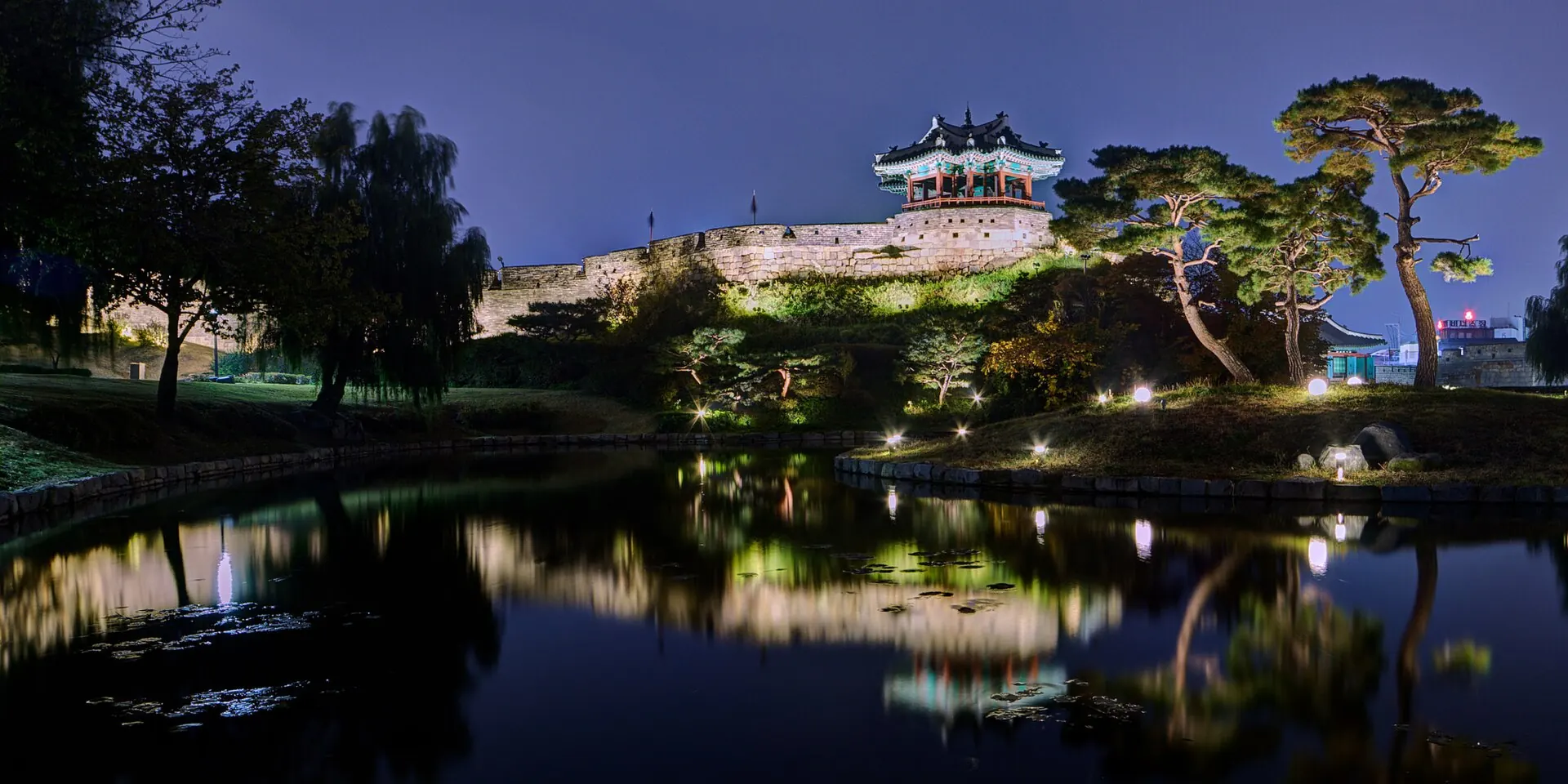 Photo: Mathew Schwartz, CC BY 3.0
Suwon Hwaseong Fortress
goSubway Line 1 or the Suin–Bundang line, or a Mugunghwa train from Seoul Station, then a local bus
Walk the 5.7 km wall; the fortress palace has a martial-arts show on some days (check).
- Time
- Half day to a full day
DMZ and the Joint Security Area
goGuided tour only; coach from central Seoul
Book several days ahead with passport details; JSA access has been suspended at times (check).
- Time
- Full day, pick-up 07:00–08:00Full day, pick-up 7:00 AM–8:00 AM
Nami Island and Gapyeong
go off seasonITX-Cheongchun train from Yongsan or Cheongnyangni, or a shuttle bus from Insadong
Weekends and autumn-leaf weeks bring long ferry queues.
- Time
- Full day
Incheon (Chinatown, Wolmido)
goSubway Line 1 to Incheon Station, about 1 h 10 min
Pair with a late flight from ICN.
- Time
- Half day
Korean Folk Village, Yongin
goSubway to Suwon or Giheung, then a shuttle or taxi; or a tour
Good with children; shows through the day.
- Time
- Full day
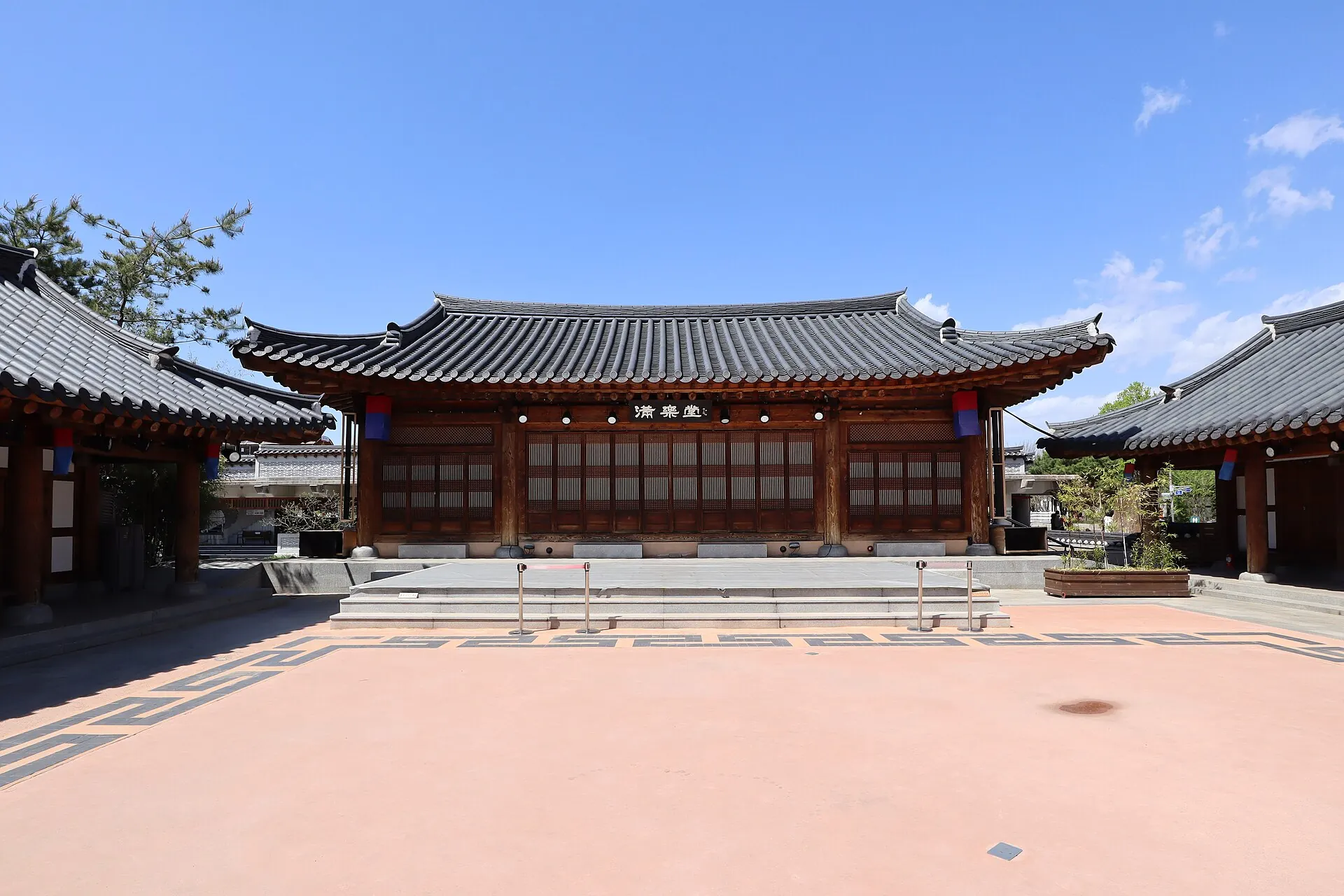 Photo: Mobius6, CC BY-SA 4.0
Jeonju Hanok Village
overnightKTX from Yongsan, about 1 h 40 min, then 20 min by taxi
Bibimbap's home town; the hanok lanes are busiest on weekends.
- Time
- Long day; better as one night
Go next
Door to door: 3–3.5 h hotel to hotel; train 2 h 15 min–2 h 40 min
KTX or SRT from Seoul, Yongsan or Suseo station
Beaches, fish markets and hillside villages; two nights minimum.
Door to door: 3–4 h
Flight from Gimpo, about 1 h 10 min; departures every few minutes
One of the busiest air routes in the world: fares are low outside holidays; rent a car there.
Gyeongju
overnightDoor to door: 3 h
KTX to Singyeongju, about 2 h, then a bus or taxi
Silla tombs, Bulguksa and Seokguram; one night lets you see the tombs lit up.
Door to door: 5–6 h
Flight from Gimpo to Haneda (about 2 h) or Incheon to Narita/Haneda
Gimpo–Haneda is the city-to-city route: both airports are close to the centre.
Eat & sleepWhere to eat and which area to sleep in
Eat & sleep
Where to eat and which area to sleep in
Eat
A short list of places worth crossing the city for, each with how to get a seat.
Vegetarian-friendly score
0.5 / 5 · Very hard
- Country diet noteOur country guide rates vegetarian eating as hard.0 / 2
- Places to eat in this guideToo few places with a known answer (1) to judge.0 / 1.5
- Budget eating lines2 vegetarian lines in "Eat by budget".0.4 / 0.6
- Meat-free national dishes2 meat-free dishes in the country food list.0.2 / 0.4
- Dedicated vegetarian kitchens1 mention of vegetarian restaurants, Buddhist or fasting kitchens.0.1 / 0.5
Country note: Hard: fish sauce, anchovy stock and meat hide in stews, kimchi and banchan.
Vegetarian places near me →Make a diet card →
How we score
- Country diet note (up to 2): easy 2, workable 1, mixed 0.75, hard 0; no note 0.5.
- City places to eat (up to 1.5): 1.5 × (vegetarian-friendly + half of partly friendly) ÷ places with a known answer; needs 3 or more known places.
- Budget eating lines marked vegetarian (up to 0.6): 0.2 each.
- Meat-free national dishes (up to 0.4): 0.1 each.
- Dedicated vegetarian kitchens mentioned — Buddhist chay, shōjin ryōri, Jain, fasting food, vegan cafés (up to 0.5): 0.1 each.
- Total rounded to the nearest half point, 0 to 5. Built from our own pages only, not from reviews.
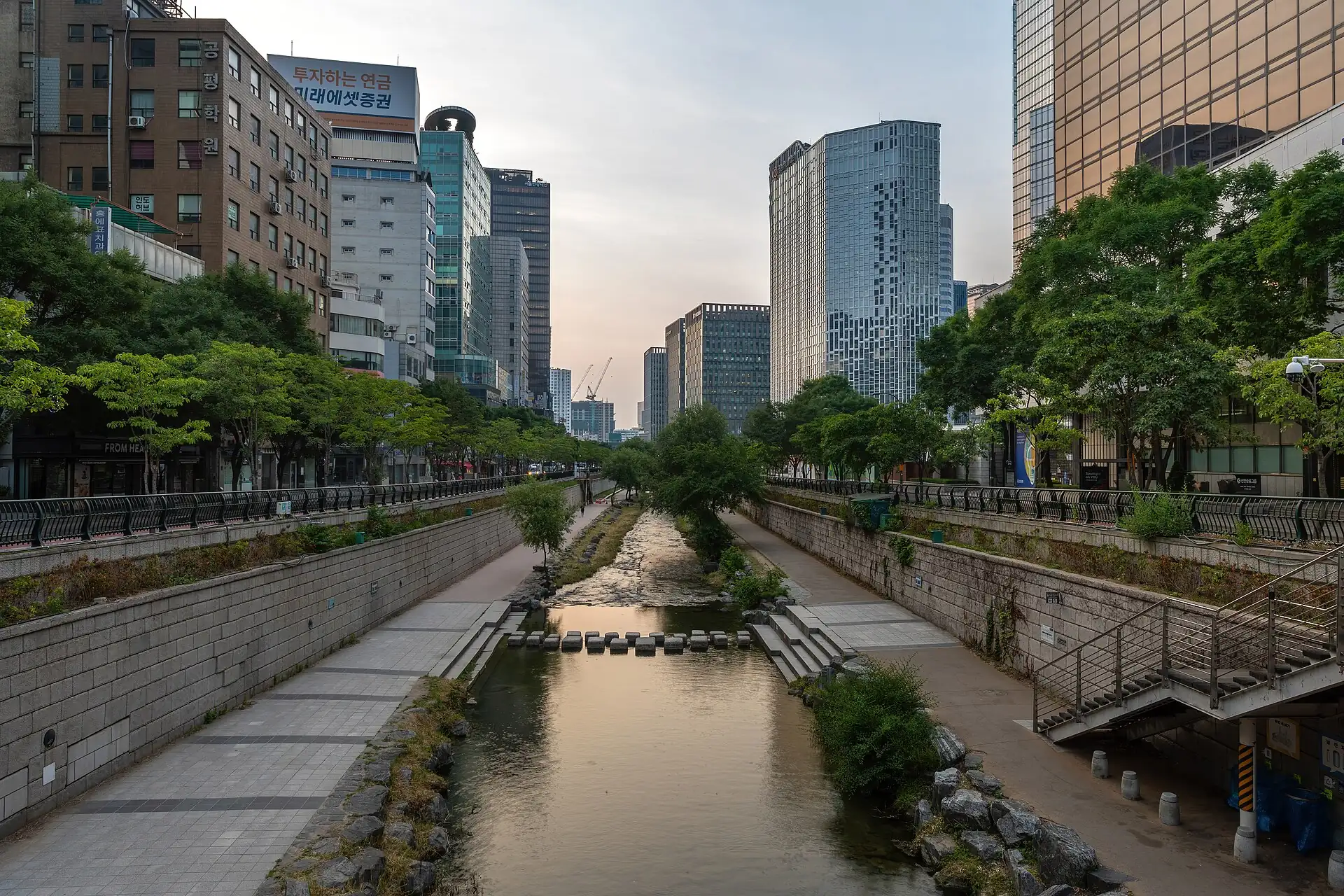
Eating and drinking guideEat by budget · Drink
Before you sit down to eat
Short version; full text linked
Eat by budget
Under ₩12,000 (≈ US$9) a meal
| Where | Order | Area | Price | Note |
|---|---|---|---|---|
| Gwangjang Market counters | Bindaetteok (mung-bean pancake), mayak gimbap | Jongno 5-ga | ₩5,000–10,000 (≈ US$4–8) | Check the price board before you sit. |
| Gimbap and snack chains (bunsikjip) | Gimbap, tteokbokki, ramyeon, fried dumplings | Every neighbourhood | ₩3,500–9,000 (≈ US$3–7) | Order at the kiosk; open late. |
| Myeongdong street stalls | Skewers, egg bread, hotteok, fried chicken | Myeongdong-gil, evenings | ₩3,000–8,000 (≈ US$3–6) an item | Priced for tourists; the market stalls are cheaper. |
| Convenience-store meals | Triangle gimbap, cup ramyeon with hot water, lunch boxes | Everywhere, 24 h | ₩1,500–6,000 (≈ US$2–5) | Eat at the counter inside. |
| Mangwon Market | Croquettes, fried chicken, dumplings | Mapo (Line 6 Mangwon) | ₩2,000–8,000 (≈ US$2–6) | |
| Temple-food buffets and vegetarian bibimbapveg | Bibimbap, vegetable dishes | Insadong, Jongno | ₩10,000–15,000 (≈ US$8–11) | Ask about fish sauce in kimchi.(check) |
Dishes to know
| Dish | What it is | Where to look | When | Price |
|---|---|---|---|---|
| Bibimbap비빔밥 | Rice topped with vegetables, egg and chilli paste, mixed at the table; dolsot is served in a hot stone bowl | Everywhere; Insadong and Jongno | Lunch | ₩9,000–15,000 (≈ US$7–11) |
| Samgyeopsal삼겹살 | Thick pork belly grilled at the table, wrapped in lettuce with garlic and ssamjang | Barbecue restaurants everywhere | Dinner | ₩17,000–22,000 (≈ US$13–16) a serving |
| Bulgogi불고기 | Thin sweet-soy beef, grilled or in a shallow broth | Traditional restaurants | Lunch, dinner | ₩15,000–30,000 (≈ US$11–25) |
| Kimchi jjigae김치찌개 | Sour kimchi stew with pork and tofu | Office-worker restaurants | Lunch | ₩9,000–12,000 (≈ US$7–9) |
| Samgyetang삼계탕 | Young chicken stuffed with glutinous rice, ginseng and jujube in a milky broth | Specialist houses near Gyeongbokgung and Myeongdong | Hottest summer days (boknal) | ₩18,000–28,000 (≈ US$13–25) |
| Tteokbokki떡볶이 | Chewy rice cakes in sweet chilli sauce | Snack bars, street stalls | Any time | ₩4,000–7,000 (≈ US$3–6) |
| Gimbap김밥 | Seaweed rice rolls with vegetables, egg and ham or tuna | Snack bars, markets, convenience stores | Breakfast, picnic | ₩3,000–6,000 (≈ US$3–5) |
| Naengmyeon냉면 | Cold buckwheat noodles in icy broth (mul) or with chilli sauce (bibim) | Specialist houses | Summer | ₩12,000–18,000 (≈ US$9–13) |
| Bindaetteok빈대떡 | Crispy mung-bean pancake | Gwangjang Market | Afternoon, with makgeolli | ₩5,000–8,000 (≈ US$4–6) |
| Korean fried chicken치킨 | Twice-fried chicken, plain, soy-garlic or sweet-spicy | Chicken shops, delivery | Evening, with beer | ₩20,000–28,000 (≈ US$15–25) a whole chicken |
| Jjajangmyeon짜장면 | Korean-Chinese noodles in black bean sauce | Chinese restaurants, delivery | Lunch | ₩7,000–10,000 (≈ US$6–8) |
| Haejangguk해장국 | 'Hangover soup' of ox-bone broth, cabbage and congealed blood | 24 h soup houses in Jongno and Cheongjin-dong | Early morning, late night | ₩10,000–13,000 (≈ US$8–10) |
| Hotteok호떡 | Pan-fried pancake filled with brown sugar and seeds | Street stalls, Namdaemun and Insadong | Winter | ₩2,000–3,000 (≈ US$2–3) |
| Bingsu빙수 | Shaved milk ice with red bean, fruit or injeolmi | Dessert cafés, hotel lounges | Summer | ₩12,000–25,000 (≈ US$9–18); hotel versions much more |
- Side dishes (banchan) are free and refilled on request; water is self-service from a dispenser.
- Barbecue and hot-pot places often require two servings minimum; tell staff 'hana' (one) at solo-friendly places.
- Press the call bell on the table for service; pay at the counter on the way out.
Drink & nightlife
| Where | What | Until | Note |
|---|---|---|---|
| Hongdae and Sangsu | Clubs, live-music venues, cheap bars | 05:00+ at weekends5:00 AM+ at weekends | The busiest weekend nightlife; crowds on the main walking streets after 22:00.The busiest weekend nightlife; crowds on the main walking streets after 10:00 PM. |
| Euljiro (Nogari Alley and 'Hipjiro') | Plastic-stool beer alleys, hidden bars in old printing workshops | About 00:00–02:00About 12:00 AM–2:00 AM | Dried pollack and draught beer; many bars have no sign on the street. |
| Jongno 3-ga pojangmacha row | Orange tent bars, soju, snacks | About 02:00About 2:00 AM | Check the price board; a few tents charge tourists more. |
| Itaewon and Haebangchon | International pubs, craft beer, LGBTQ bars (Homo Hill) | About 02:00–05:00About 2:00 AM–5:00 AM | Steep lanes; crowd control on Halloween weekend. |
| Han river parks | Convenience-store beer and delivered fried chicken on a mat | Late; parks are open all night | Drinking outdoors is legal; take your rubbish with you. |
| Gangnam and Cheongdam | Cocktail bars, clubs, lounges | About 02:00–06:00About 2:00 AM–6:00 AM | Dress codes at clubs; prices well above Hongdae. |
By style
| Style | What | Where | Price | Until |
|---|---|---|---|---|
| Soju | Clear rice or grain spirit, about 16% in green bottles; also fruit flavoursPour for others, never for yourself; take a first glass when offered. | Every restaurant, tent bar and convenience store | ₩5,000–7,000 (≈ US$4–6) a bottle in a restaurant | Whenever dinner ends |
| Makgeolli | Milky, lightly sparkling rice wineThe rainy-day drink, with savoury pancakes. | Pajeon and jeon restaurants; makgeolli bars in Mapo, Jongno and Seochon | ₩5,000–15,000 (≈ US$4–11) a bottle; craft ones more | About 00:00 |
| Chimaek | Fried chicken and draught beer | Chicken-and-beer shops everywhere; delivered to the Han river parks | ₩20,000–28,000 (≈ US$15–25) a whole chicken; beer ₩4,000–7,000 (≈ US$3–6) | About 01:00 |
| Pojangmacha | Tent or street bars with soju and hot snacksSeating is shared plastic stools; cash is often preferred. | Jongno 3-ga, Euljiro, near markets | Snacks ₩15,000–30,000 (≈ US$11–25) to share | About 02:00 |
| Craft beer | Korean craft breweries' IPAs and lagers | Itaewon, Haebangchon, Seongsu, Yeonnam | ₩8,000–12,000 (≈ US$6–9) a glass | About 00:00–02:00 |
| Cocktails | Speakeasies and hotel bars, several ranked in Asia's listsSome have a table charge; ask when you sit. | Cheongdam, Hannam, Euljiro, Four Seasons and hotel bars | ₩20,000–35,000 (≈ US$15–30) a drink | About 01:00–02:00 |
| Cafés | Coffee, dessert cafés, bingsu, tea housesThe alcohol-free night out; laptops welcome. | Everywhere; tea houses in Insadong and Bukchon | ₩4,000–7,000 (≈ US$3–6) coffee; bingsu ₩12,000–20,000 (≈ US$9–15) | About 22:00; 24 h cafés in Gangnam and near universities |
| Noraebang | Private karaoke rooms by the hourCoin noraebang booths cost about ₩500–1,000 (≈ under US$1) a song. | Every nightlife street | ₩15,000–30,000 (≈ US$11–25) an hour per room | About 04:00–06:00 |
Rules that bite
- Drink-driving limit is 0.03% blood alcohol, and scooters count: take a taxi or daeri (a designated driver service) instead.
- Legal drinking age is 19 by calendar year; bars check ID and a passport is the ID that works.
Sleep
Pick the area first: it decides your walk home at night and your first morning.
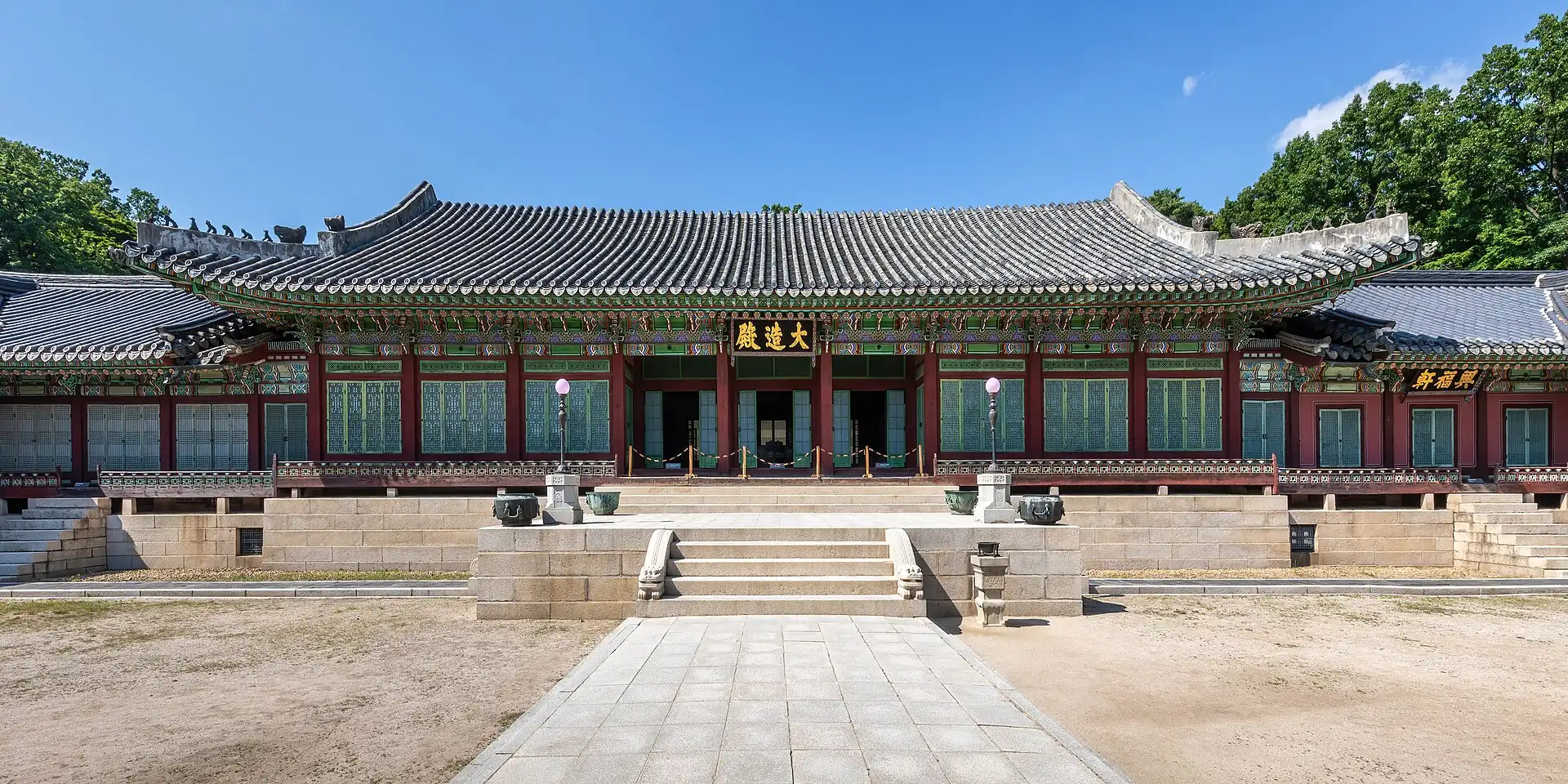
Which neighborhood fits you
Three questions, one recommendation, with the reasons.
Your best fit
- Gyeongbokgung, Changdeokgung, Jongmyo and Bukchon on foot.
- Quiet after 22:00 away from Jongno 3-ga.
Next best: Myeongdong · Hongdae
Built from our 1–5 desk scores per area; your answers stay in this browser.
More on sleepingSleep by budget · Your area · With kids
Sleep by budget
| Band | Price | Where | Room types | What to expect |
|---|---|---|---|---|
| budget | ₩25,000–45,000 (≈ US$18–35) dorm bed · ₩60,000–100,000 (≈ US$45–75) double | Hongdae, Sinchon, Jongno | Hostels, guesthouses, capsule-style pods | Small rooms, shared or tiny bathrooms, door codes instead of a desk after 22:00 at many.Small rooms, shared or tiny bathrooms, door codes instead of a desk after 10:00 PM at many. |
| mid | ₩130,000–230,000 (≈ US$95–170) | Myeongdong, Jongno, Dongdaemun, Gangnam | Business hotels and 3–4 star chains | Lift, small but efficient rooms, 24-hour desk, bidet toilets; breakfast often extra. |
| mid | ₩120,000–300,000 (≈ US$90–250) | Bukchon and Seochon | Hanok guesthouses | Traditional rooms with floor mattresses and underfloor heating; thin walls, shared courtyards, steps and a check-in cut-off. |
| splurge | ₩450,000–1,500,000 (≈ US$350–1,100)+ | Gwanghwamun, Namsan, Jamsil, Gangnam | International luxury hotels | Pools, spas and top-floor views; 10% service charge and VAT on top of some quoted rates. |
Booking checks
- Love motels are clean, cheap and private, with self-check-in; fine for a night, though some take no advance bookings and have odd décor.
- Ondol rooms mean sleeping on a mattress on a heated floor: ask for a bed if you need one.
- Hanok stays look good in photos but are steep to reach with luggage; book a hotel for the arrival night and a hanok later.
- Check whether the price includes the 10% VAT and service charge; comparison sites sometimes show it before tax.
Which area is yours
| If you are | Sleep in | Because |
|---|---|---|
| First visit, 2–4 nights, shoppers | Myeongdong | One stop from Seoul Station, flat streets and the most central hotels. |
| Young travellers, nightlife, budget | Hongdae | Direct train to both airports and nights that last until dawn. |
| Palaces, culture, quiet evenings | Jongno and Insadong | Everything historic on foot; pick a hotel over a hanok if you have big bags. |
First-timers: one subway stop from Seoul Station and a walk from the AREX line's Seoul Station hub; pick a hotel with a 24-hour desk and a lift.
02Hongdae
Evenings and the AREX airport line: two stops from Seoul Station and direct to Incheon; louder at night, so ask for a room away from the street.
Flat around Jongno and Insadong; hanok guesthouses in Bukchon are uphill with steps.
04Gangnam
Big hotels with car access; airport limousine buses stop at the large hotels.
Areas are in our default order until you tick a priority.
Scores are 1–5 desk judgements per priority (2026). Jongno/Insadong and Gangnam have no sleep-area page yet; they link to the districts table.
With kids
- Subways have lifts almost everywhere and priority seats; strollers work well except in Bukchon, Seochon and palace gravel courts.
- Lotte World (indoor theme park, Jamsil) and the COEX Aquarium are the rainy- and cold-day plans.
- The National Children's Museum inside the National Museum of Korea and the National Folk Museum's children's museum are free (book a time slot for some, check).
- Han river parks have playgrounds, bike hire and, in summer, open-air swimming pools (July–August, check).
- Children under 6 ride the subway free; child and youth T-money cards need registering to get the discount.
PracticalMoney, essentials, safety and the pocket card
Practical
Money, essentials, safety and the pocket card
Money
What a day costs at three comfort levels, and how to pay.
- Budget
- ₩50,000–90,000 (≈ US$40–65) excl. bed / day
- Mid
- ₩90,000–200,000 (≈ US$65–150) excl. bed / day
- High
- ₩200,000 (≈ US$150)+ excl. bed / day
- Transit card
- Buy a T-money card (or use a phone-based card) at the airport or a convenience store; the subway is cheap and reaches every cluster.
- Cash rule
- Keep ₩30,000 (≈ US$25) in small notes for markets; use Global ATMs in convenience stores or banks, not on dark streets.
More on moneyCosts · Budget · Buy
What things cost
- Gimbap roll or tteokbokki at a snack bar₩3,500–6,000 (≈ US$3–5)
- Bibimbap or kimchi stew at a simple restaurant₩9,000–13,000 (≈ US$7–10)
- Pork barbecue (samgyeopsal), one serving of about 150–200 g₩16,000–22,000 (≈ US$12–16)
- Ginseng chicken soup (samgyetang)₩18,000–24,000 (≈ US$13–18)
- Bottle of soju in a restaurant / convenience store₩5,000–7,000 (≈ US$4–6)₩1,900–2,500 (≈ US$2)
- Bottle of water, convenience store₩900–1,500 (≈ US$1–2)
- AREX all-stop train from Incheon to Seoul Stationabout ₩4,500 (≈ US$4) (check)
- Palace ticket₩1,000–3,000 (≈ US$1–3)
Trip budget
| Hotel double room1 × 4 nights × ₩160,000 | ₩640,000 |
| Food, local transport, entries2 × 4 days × ₩130,000 | ₩1,040,000 |
| Airport train (AREX all-stop), both ways2 × ₩9,000 · express train about ₩22,000 return (check) | ₩18,000 |
| eSIM or tourist SIM2 × ₩25,000 | ₩50,000 |
| Palace combination ticket2 × ₩10,000 · check current price | ₩20,000 |
| Buffer 10%Price creep, a taxi you did not plan, one splurge | ₩176,800 |
| Trip total≈ ₩243,100 per person per day, bed included | ₩1,944,800≈ US$1,400 |
2026 estimate in won; flights, visas and tours excluded. Your choices stay in this browser.
Buy
- Bargaining
- Prices are fixed almost everywhere, including department stores, chains and most market stalls with a price card. Light haggling works only at clothing and souvenir stalls in Namdaemun, Dongdaemun and some Insadong shops, and usually for several items: ask for a small discount (jom kkakka juseyo) rather than a counter-offer.
- Fixed-price check
- For cosmetics, snacks and souvenirs, check the price at an Olive Young, Daiso or a supermarket (Emart, Lotte Mart, Homeplus) first. Shops on the main tourist streets often charge more for the same item.
Markets and shopping streets
| Where | What | When | Haggle | Note |
|---|---|---|---|---|
| Gwangjang Market | Food alley (bindaetteok, gimbap, raw beef), silk and bedding upstairs | Food stalls about 09:00–22:00 (check)Food stalls about 9:00 AM–10:00 PM (check) | no | Some stalls add a tourist mark-up: check the price board before sitting. |
| Namdaemun Market | Clothes, kitchenware, ginseng, glasses, snacks | Daytime; many stalls closed Sundays (check) | light | Sprawling and oldest; the hotteok stall queues are part of it. |
| Dongdaemun fashion malls | Wholesale and retail clothing in towers | Retail malls to about 00:00; wholesale overnight (check)Retail malls to about 12:00 AM; wholesale overnight (check) | light | Wholesale floors may refuse single items; retail malls sell to anyone. |
| Insadong-gil | Crafts, hanji paper, ceramics, tea | About 10:00–20:00About 10:00 AM–8:00 PM | light | Ssamziegil is the spiral mall of small craft shops. |
| Mangwon Market | Local produce and cheap street snacks | Daytime to early evening | no | Where Hongdae residents shop; croquettes and fried chicken to go. |
| Noryangjin Fish Market | Live seafood; restaurants upstairs cook what you buy | Most of the day; auction at dawn (check) | light | Ask the total before the fish is killed; the restaurant charges a table fee on top. |
| Tongin Market | Snacks by the dosirak token system | Weekdays and Saturdays, lunch (check) | no | Buy brass tokens, fill a lunch tray from stalls; closed some Sundays and Mondays (check). |
Shops by what they sell
| For | Where | Hours | Note |
|---|---|---|---|
| Cosmetics and skincare | Myeongdong, Hongdae, Gangnam; Olive Young branches everywhere | About 10:00–22:00 | Tax refund at the till with your passport in participating stores; free samples are standard. |
| K-pop albums and goods | Myeongdong and Hongdae music shops; agency stores in Seongsu and Gangnam; COEX | About 10:30–21:00 | Album prices are fixed; photocards are the collectible. |
| Department stores | Lotte (Myeongdong/Euljiro), Shinsegae (Myeongdong, Gangnam), The Hyundai Seoul (Yeouido) | About 10:30–20:00; to 20:30 on weekends | Food halls in the basements; foreigners' tax-refund desks inside. |
| Crafts and hanji paper | Insadong, Bukchon workshops | Shop hours | Cheap copies from abroad mix in: look for maker names on the label. |
| Books and stationery | Kyobo Book Centre (Gwanghwamun), Starfield Library (COEX) | About 09:30–22:00 | Kyobo has a foreign-books section and a stationery hall. |
| Everyday bargains | Daiso (Myeongdong has a multi-floor branch) | About 10:00–22:00 | Most items ₩1,000–5,000 (≈ US$1–4); useful for adapters, umbrellas, snacks. |
| Outdoor gear | Jongno 5-ga and Dongdaemun outdoor shops; hiking-trail entrances | Shop hours | Korean hiking fashion is serious; prices are fixed. |
| Glasses | Namdaemun Market and near Hoehyeon Station | Shop hours | Frames and lenses made within an hour, cheaper than in most countries (check). |
Changing money
| Where | Verdict | Why |
|---|---|---|
| Licensed private money changers in Myeongdong | use | Usually the best rate in the city for USD, EUR, JPY and CNY; compare two boards and count the notes. |
| Banks (Woori, KB, Shinhan, Hana) | ok | Fair rates, passport needed; weekday hours 09:00–16:00.Fair rates, passport needed; weekday hours 9:00 AM–4:00 PM. |
| Incheon airport exchange booths | ok | Poorer rate: change ₩50,000–100,000 (≈ US$40–75) and top up in the city. |
| Currency-exchange kiosks and travel cards (WOWPASS and similar) | ok | Machines in stations and hotels load won onto a prepaid card; check the rate on screen. |
| Hotel desk | avoid | Convenient, poor rate. |
ATMs
- Where
- Only ATMs marked Global ATM or Foreign Card take overseas cards: in convenience stores (GS25, CU, 7-Eleven), banks and stations.
- Per withdrawal
- Caps are about ₩700,000–1,000,000 (≈ US$550–750) per withdrawal depending on the machine (check).
- Fees
- Local fee about ₩3,000–4,000 (≈ US$3) per withdrawal (2026 estimate) plus your bank's charge.
- Conversion
- If the ATM offers to charge in your home currency, decline and take won.
Essentials and accessEssentials · Access
Essentials
- Plugs & power
- 220 V, 60 Hz; round two-pin sockets (types C and F). Bring an adapter; most chargers handle the voltage.
- Toilets
- Free and clean in every subway station, park and department store; most have paper, some expect it in the bin rather than the bowl (follow the sign).
- Health
- Very cold, dry winters and hot, humid summers; fine-dust days from winter to spring. Hospitals are excellent but charge foreigners in full, so carry travel insurance with medical cover.
- Accessibility
- Subway stations almost all have lifts; pavements are smooth in the centre. Old lanes (Bukchon, Seochon, Ikseon-dong) are steep or cobbled, and palace courtyards are gravel.
- Laundry
- Self-service laundromats (ppallaebang) run 24 h in most neighbourhoods: about ₩4,000–5,000 (≈ US$3–4) a wash and the same to dry (2026 estimate). Hotels charge per item.
Pack
- A windproof coat, gloves and thermal layers for December–February
- A light rain jacket and quick-dry shoes for the July monsoon
- Socks without holes: shoes come off in floor-seated restaurants, homes and some guesthouses
- A KF94 mask for fine-dust days (sold in every convenience store)
- Comfortable shoes: station transfers are long and Bukchon is all slopes
Accessibility
Seoul is one of the easier Asian capitals on wheels: nearly every subway station has lifts, most buses are low-floor, and new buildings and department stores have accessible toilets. The hard parts are hills, palace gravel and old hanok lanes.
- Subway
- Lifts from street to platform at almost all stations (a few older ones use stair lifts or need a long detour, check). Gaps are marked; staff will place a ramp if you ask at the gate.
- Buses
- Most city buses are low-floor with a ramp, marked on the bus and in the KakaoMap app.
- Taxis
- Standard taxis take a folding wheelchair in the boot; wheelchair-accessible vans (call taxis) are mainly for registered residents, ask 1330 about visitor options (check).
- Pavements
- Wide and smooth in the centre with tactile paving; old lanes have no pavement and steep grades.
- Toilets
- Accessible toilets in subway stations, department stores and museums.
- Crossings
- Signals count down and many have audible signals; wide roads sometimes use underpasses with lifts.
Sights, step-free or not
| Gyeongbokgung Palace | with help | Paved main axis with ramps; side courts are gravel and thresholds are high. |
| Bukchon Hanok Village | hard | Steep lanes and steps throughout. |
| National Museum of Korea | step-free | Step-free throughout, wheelchairs to borrow. |
| Cheonggyecheon stream walk | with help | Lifts at a few points; many access points are stairs. |
| N Seoul Tower | with help | Low-floor Namsan buses reach the top plaza; the cable car has steps at the lower station (check). |
| Han river parks | step-free | Flat, paved paths; access from stations by lift at Yeouinaru and Ttukseom. |
Survive
Safety basics, the lines not to cross, and practical habits that save the day.
Safety
- Cross at signals; drivers turn into crossings, so look before stepping off the kerb.
- Summer (Jul–Aug): AC stop every 60–90 minutes; drink water.
- Emergency: 112 police, 119 fire and ambulance, 1330 Korea Travel Helpline.
Red lines
- Palaces: no climbing on walls or steps; follow guard instructions.
- Bukchon is a residential lane: keep quiet and follow the posted visiting rules.
- Do not photograph people at close range without asking.
Practical
- Public toilets are in every subway station and most parks; carry tissues.
- Tap water is drinkable; most people drink filtered or bottled water.
More on staying safeStay safe · Stay healthy · Safety map · Solo & women · Etiquette · Cope · Scams
After dark, by area
2 flagged areas
- Take care
Itaewon
Take care
Day = about 07:00–19:00. What to watch in each area, day and night →
Scams and red flags
Walk away if you see these
- Taxis at Myeongdong, Dongdaemun and the airport that quote a flat price or skip the meter at night: use the taxi rank, a taxi app or insist on the meter.
- Friendly students who ask you to fill in a survey or join a 'traditional ceremony' near Hongdae, Sinchon or City Hall are recruiting for religious groups; decline and walk on.
- Cosmetics shops on the main Myeongdong street price the same product higher than chain stores a block away: compare with Olive Young before buying.
- Bars in some night districts where a host sits with you and the bill arrives with unordered drinks: order from a printed menu and pay per round.
Stay safe
Crossing the road
- 01Cross only on green: signals are long, and jaywalking gets fines and angry horns.
- 02Cars turning right do not always wait for pedestrians even though the law says they must stop at crossings; look right before you step off.
- 03In lanes without pavements, keep to the edge; delivery motorbikes and cars squeeze past fast.
- 04Watch for e-scooters and bikes on pavements, especially near universities and the river.
- 05On wide roads use the signalled crossing or the underpass; many have lifts.
Hustles specific to this city
| Hustle | Where | The tell | What to do |
|---|---|---|---|
| Night taxi without the meter | Myeongdong, Dongdaemun, Itaewon, airport | Driver offers a flat price before you get in | Use a rank, Kakao T or Uber, or insist on the meter; report the plate to 120 or 1330. |
| Survey or 'ancestor rite' recruiters | Hongdae, Sinchon, City Hall, Myeongdong | Pair of friendly young people asking about your 'energy' or for a quick survey | Say no thank you and keep walking; do not follow them anywhere. |
| Tourist-price cosmetics | Main Myeongdong street | Big discount signs, prices not on the products | Compare at Olive Young; ask for the tax-refund receipt. |
| Bar with a host | Some Gangnam and Itaewon side streets | Someone sits with you and orders | Order from a printed menu and pay per round; leave if drinks arrive unasked. |
| Fake luxury goods | Night stalls in Dongdaemun and Namdaemun | Branded bags at a tenth of the price | Customs at home can seize them; buy brands in department stores. |
- Police
- 112, with interpreters. Police boxes (jigudae) in every busy district; tourist police in Myeongdong, Itaewon, Hongdae and Insadong.
- Help in English
- 1330 Korea Travel Helpline, 24 h; 120 Dasan call centre for Seoul city services.
- Crowds
- At festivals and big nights out, follow crowd-control staff and avoid narrow sloped alleys at peak times.
Stay healthy
Air quality by month
| Jan | Feb | Mar | Apr | May | Jun | Jul | Aug | Sep | Oct | Nov | Dec |
|---|---|---|---|---|---|---|---|---|---|---|---|
| poor | poor | poor | mixed | mixed | ok | ok | ok | ok | ok | mixed | mixed |
Fine dust (PM2.5) and yellow dust from the west are worst from December to April. Check a live index (AirKorea or IQAir) and wear a KF94 mask on 'bad' days; summer rain keeps the air cleaner.
- Cold
- January mornings with wind chill below −15 °C (5 °F): hat, gloves and heat packs (sold in convenience stores). Icy slopes in Bukchon and on hiking trails.January mornings with wind chill below 5 °F (−15 °C): hat, gloves and heat packs (sold in convenience stores). Icy slopes in Bukchon and on hiking trails.
- Heat
- July–August: 30 °C (86 °F) and very humid; tropical nights above 25 °C (77 °F). Take the midday hours indoors and drink water.July–August: 86 °F (30 °C) and very humid; tropical nights above 77 °F (25 °C). Take the midday hours indoors and drink water.
- Water and food
- Tap water is safe; hygiene in restaurants is high. Raw crab (ganjang gejang) and raw beef are local classics; eat them at busy places.
- Clinics
- International health centres at the big hospitals have interpreters; pay upfront and claim later. Ambulance calls on 119 are free.
- Pharmacies
- Pharmacists speak some English in tourist areas; many common medicines are sold without a prescription, but some imported drugs (strong painkillers, ADHD medicine) need a certificate at entry.
Hospitals and clinics: see Cope.
Safety by area and hour
| Area | Day | Night | What to watch |
|---|---|---|---|
| Gyeongbokgung and Gwanghwamun | fine | fine | Protest rallies at weekends around Gwanghwamun and City Hall: loud but orderly; go round them. |
| Bukchon and Insadong | fine | fine | Steep, slippery lanes in rain and snow; residents' rules and hours in the core lanes. |
| Myeongdong and Namdaemun | fine | fine | Pickpockets in the evening crush are rare but reported; street-stall prices and taxis quoting flat fares. |
| Hongdae | fine | caution | Weekend crowds and drunk groups after midnight; watch your drink in clubs; religious recruiters by day. |
| Itaewon | fine | caution | Narrow, steep alleys pack tight on Halloween and holiday weekends: follow crowd-control staff and avoid the alleys at peak times. |
| Han river parks | fine | fine | Cyclists and e-scooters on the paths; do not swim outside pools. |
| Namsan trails | fine | fine | Lit and patrolled up to the tower; icy steps in winter. |
- In lanes without pavements, walk on the edge and listen for delivery scooters and cars; they come fast and quietly.
- Violent crime against visitors is rare. After the last train, take a taxi from a rank or an app rather than an unlicensed car.
Solo, women and LGBTQ+ travellers
Solo
- One of the easiest cities alone: safe at night, single seats at counter restaurants and many solo diners (honbap).
- Some barbecue and hot-pot places need two servings minimum: pick places that post solo portions, or pay for two.
- Hostels in Hongdae and Jongno are social; tours to the DMZ and Nami Island are easy to join as one.
Women
- Street harassment is uncommon; the more common worry is hidden cameras in public toilets, which the city inspects regularly. Report anything odd to 112.
- Women-only floors and dorms exist in many hostels and some capsule-style hotels.
- Dress is relaxed; temples ask for covered shoulders in main halls.
LGBTQ+
- Same-sex relations are legal but not recognised; public attitudes are conservative among older people and relaxed among the young.
- Itaewon's 'Homo Hill' and Jongno 3-ga have the main gay bars; Seoul Queer Culture Festival runs in early summer (check dates and venue).
- Two men or two women sharing a double raise no issue at hotels.
Etiquette in Seoul
- Shoes
- Off where there is a raised floor or a shoe rack: homes, guesthouse rooms, floor-seated restaurants, temple halls.
- Age and hierarchy
- Greet elders first with a small bow; pour for others and turn your head slightly when drinking with seniors.
- Two hands
- Give and receive money, cards and drinks with two hands, or one hand supported by the other.
- Subway
- Talk quietly, no phone calls; leave the priority seats (and pink seats for pregnant women) empty.
- Chopsticks
- Do not stand them upright in rice; rest them on the table or the dish.
- Tipping
- None. Leaving money on the table may be chased after you.
- Rubbish
- Few public bins; carry rubbish to a convenience store or your hotel and sort it by type.
- Names
- Do not write a person's name in red ink: it is associated with the dead.
Cope
Hospitals and clinics that handle foreigners
| Where | Area | Use it for |
|---|---|---|
| Severance Hospital International Health Care Center | Sinchon, Seodaemun-gu | English-speaking coordinators; 24 h emergency room at the hospital. |
| Seoul National University Hospital International Healthcare Center | Daehak-ro, Jongno-gu | Near the palaces; foreign-patient desk on weekdays (check hours). |
| Samsung Medical Center International Health Services | Irwon-dong, Gangnam-gu | Large hospital; interpreters for many languages. |
| Soonchunhyang University Seoul Hospital | Hannam-dong, Yongsan-gu | Closest large hospital to Itaewon; international clinic (check). |
Visa extensions
- Office
- Seoul Immigration Office, Mok-dong, Yangcheon-gu (Omokgyo Station, Line 5); book a visit through the HiKorea site. Check the address and hours before going.
- Extending
- Visa-free and tourist stays are rarely extended; reasons like illness need papers. Apply before your permitted stay ends.
- Help line
- 1345 Immigration Contact Center answers in English and other languages on weekdays.
- Overstay
- Fines at departure and possible entry bans: sort it out before the airport.
Embassies and consulates
| Country | Address | Phone | Note |
|---|---|---|---|
| United States | 188 Sejong-daero, Jongno-gu (Gwanghwamun) | +82 2 397 4114 | (check) |
| United Kingdom | 24 Sejong-daero 19-gil, Jung-gu (beside Deoksugung) | +82 2 3210 5500 | (check) |
| Australia | 19th floor, Kyobo Building, 1 Jong-ro, Jongno-gu | +82 2 2003 0100 | (check) |
| Canada | 21 Jeongdong-gil, Jung-gu | +82 2 3783 6000 | Weekdays(check) |
| New Zealand | Jeongdong Building, 21-15 Jeongdong-gil, Jung-gu | — | (check) |
| Ireland | Jongno 1-gil area, Jongno-gu (check the floor and building) | — | (check) |
| France | 43-12 Seosomun-ro, Seodaemun-gu | — | (check) |
| Germany | Seoul Square, 416 Hangang-daero, Jung-gu (opposite Seoul Station) | — | (check) |
| Japan | Yulgok-ro, Jongno-gu (near Anguk Station) | +82 2 2170 5200 | (check) |
| China | 27 Myeongdong 2-gil, Jung-gu | — | Visa applications through the separate Chinese visa centre(check) |
| Vietnam | 123 Bukchon-ro, Jongno-gu | — | (check) |
- Lost passport
- Report at a police box (jigudae), then your embassy for an emergency passport; bring the police report to the airport immigration desk if you leave before replacing your entry record.
- Lost property
- Seoul lost-and-found centres collect items from the subway and taxis; search the Lost112 site or ask the 1330 helpline.
- Pharmacies
- Yakguk with a green cross on most streets, closed late evening and Sundays; convenience stores sell basic painkillers and cold medicine 24 h. A few public late-night pharmacies open to about 01:00 (check).Yakguk with a green cross on most streets, closed late evening and Sundays; convenience stores sell basic painkillers and cold medicine 24 h. A few public late-night pharmacies open to about 1:00 AM (check).
- Self-service laundry
- Coin laundries run 24 h near universities and residential streets: about ₩4,000–5,000 (≈ US$3–4) per wash, similar to dry.
- Jjimjilbang
- 24-hour bathhouses with saunas and sleeping halls, ₩12,000–20,000 (≈ US$9–15) (2026 estimate): a shower and nap after a late arrival or before a dawn flight.
- Co-working
- Chains such as WeWork, FastFive and Sparkplus sell day passes of about ₩20,000–40,000 (≈ US$15–30) (check); cafés allow laptops for hours.
Apps and offline kitOffline kit
Offline kit
Set up before you leave, so Seoul still works with no signal or a dead roaming plan.
On your phone
- Maps: open the city in Google Maps, tap the place name, then Download offline map (or use an offline-maps app).
- Data: install an eSIM or buy a local SIM before the first taxi; the apps in this guide depend on it.
- Translation: download the local language for camera translation.
- Screenshots: booking confirmations, hotel address in the local script, and the emergency numbers.
This guide
Save the Seoul guide and its pages on this device; it opens without a connection.
Phrases that do the work
Greeting
Hello
안녕하세요
an-nyong-ha-se-yo
Thanks
Thank you
감사합니다
gam-sa-ham-ni-da
Market
How much is this?
이거 얼마예요?
i-go ol-ma-ye-yo
Food
Not spicy, please
안 맵게 해 주세요
an maep-ke hae ju-se-yo
Food
This one, please
이거 주세요
i-go ju-se-yo
Restaurant
The bill, please
계산해 주세요
gye-san-hae ju-se-yo
Taxi
Please take me to this address
이 주소로 가 주세요
i ju-so-ro ga ju-se-yo
Taxi
Stop here, please
여기서 세워 주세요
yo-gi-so se-wo ju-se-yo
Anywhere
Where is the toilet?
화장실 어디예요?
hwa-jang-sil o-di-ye-yo
Pocket card
Fill in, then print or save as PDF
Stays in this browser only; nothing is sent anywhere.
Seoul서울
Pocket card · Voykit
My bed tonight
—
—
—
이 주소로 가 주세요Please take me to this address
Emergency
- Police112
- Fire and ambulance119
- Korea Travel Helpline1330
Embassy
Most embassies are around Gwanghwamun and Jeong-dong (US: Sejong-daero; UK: beside Deoksugung). Write your own embassy's 24-hour line below.
My embassy: —
Fare anchors (2026 estimate)
- Incheon → Seoul Station, AREX all-stop: about ₩4,500 (≈ US$4), 60 min (check)
- Incheon → Myeongdong, limousine bus: about ₩17,000–18,000 (≈ US$13), 60–80 min (check)
- Incheon → centre, taxi: ₩65,000–90,000 (≈ US$50–65) with tolls, 50–70 min
- Taxi across the centre: ₩9,000–13,000 (≈ US$7–10)
Say or show
- 안녕하세요 — Hello (an-nyong-ha-se-yo)
- 감사합니다 — Thank you (gam-sa-ham-ni-da)
- 이거 얼마예요? — How much is this? (i-go ol-ma-ye-yo)
- 안 맵게 해 주세요 — Not spicy, please (an maep-ke hae ju-se-yo)
- 계산해 주세요 — The bill, please (gye-san-hae ju-se-yo)
- 여기서 세워 주세요 — Stop here, please (yo-gi-so se-wo ju-se-yo)
Show drivers the Korean address or a pin in Naver Map or KakaoMap; romanised names are often misread.
Deep diveHistory, reading, photos and every source
Deep dive
History, reading, photos and every source
Sources
- officialVisit Seoul (official tourism)
- officialVisit Korea (Korea Tourism Organization)
- secondaryWikivoyage - Seoul
Ask about Seoul
Loading…
Was this useful?