Nicosia
Λευκωσία
Code NC · 4 walking zones
Nicosia is a morning-and-evening old town: the museum and walls before 12:00, a long lunch, and Ledra Street and Laiki Geitonia at dusk; the buffer zone crossing needs a passport.Nicosia is a morning-and-evening old town: the museum and walls before 12:00 PM, a long lunch, and Ledra Street and Laiki Geitonia at dusk; the buffer zone crossing needs a passport.
Our quick read of Nicosia, scored 1–5 (friction is out of 100). Cash need: how often you still need notes. Heat risk: how hot days get. Stroller: how easy wheels are. Friction: overall effort for a first visit. Desk judgements, so check before relying on them.
- Local time
- --:--
- Weather
- forecast below
- Currency
- EUR
- Best months
- Mar · Apr · May · Oct · Nov
- Airport
- Larnaca (LCA)
Walking zones: the 4 areas this guide plans a day around. Each is a district you can cover on foot, so you do one zone per half-day and ride the train between them. The code (NC 01, NC 02…) is just the zone's number on the Nicosia line; the line under each name says how bags fare there and how much time it needs.
Map of Nicosia
Use the switches to show or hide each kind of pin. A switch that is on shows its pins on the map; tap it again to hide them. "Show only" keeps just the pins that match (for example, places that fit a suitcase). Tap any pin for its name and a link to its page.
- Where to sleep
- Places
- Eat
- Walking clusters
- Rest stops
From the airport Larnaca (LCA) to your bed
Tap a pin for its card. Places without their own coordinates are shown by their walking cluster.
Why Nicosia
Nicosia's old town sits inside a Venetian wall shaped like a star, and a buffer zone crosses it. The trips that go wrong walk the walls at 14:00 in July, arrive by the north without knowing the rules, or plan the crossing without a passport. Four clusters cover a first visit: the Ledra Street and Laiki Geitonia lanes, the Famagusta Gate quarter, the Cyprus Museum by Paphos Gate, and Makarios Avenue on the new-town edge.
See first
- 1Cyprus Museum · 1.5 h
- 2
 Famagusta Gate and the walls · 45 min
- 3Laiki Geitonia at dusk · 1–2 h
- 4A meze dinner · 2 h
- 5Byzantine Museum · 1 h
Fits
- Short city breaks
- History and museum trips
- Travellers who want a base for the island
Does not fit
- Midday walkers in July and August
- Beach-first trips
- Travellers without a passport for the crossing
How long
- 2 daysCyprus Museum, Ledra Street and Laiki Geitonia, Famagusta Gate
- 3 daysFour clusters, mornings and evenings; middays indoors
- 4 daysAdd Makarios Avenue, a day in the Troodos foothills, or the crossing to the north
Good for
- First timers
- Foodies
- Budget
- Couples
- Families
- Luxury
About Nicosia
Nicosia, called Lefkosia in Greek and Lefkoşa in Turkish, sits in the middle of the island on the dry Mesaoria plain. Settlement here goes back thousands of years, and the city was already the seat of a king in antiquity. It became the capital of the Lusignan kingdom in the 12th century, when French crusader-kings ruled Cyprus and built the Gothic churches that are still standing.
The Venetians, who took the island in 1489, tore down the old city walls and built new ones in 1567: a perfect circle with eleven heart-shaped bastions, designed to hold off an Ottoman army. The Ottomans took the city anyway in 1570. They ruled for three centuries, turning churches into mosques and building the hans and hammams still seen in the old town. Britain took over administration in 1878 and the island became a crown colony in 1925.
Good to know
- Nicosia is the whole city; the old town is the walled centre; the north of the old town is under Turkish Cypriot administration and is reached through the buffer zone.
- Cyprus Tourism Organisation runs an information desk in the old town near Laiki Geitonia (check the address and hours before you go); leaflets and maps are free.
- The Municipality of Nicosia and the Leventis Museum publish walking-tour maps of the old town (check).
Go deeper 11 min read · 6 chapters
Nicosia is a small, walled city in the middle of a large island, and it is the last capital in Europe that a buffer zone still divides. This deep dive follows how the city grew from a Lusignan capital into a Venetian fortress, how the Ottomans and the British reshaped it, how the line through its heart came to be, and what its kitchens, churches and craft streets say about the people who live on both sides of it.
1History2 min
Nicosia has been a settled place for a very long time. Its Greek name, Lefkosia, and its Turkish name, Lefkoşa, come from the same root, and the inland plain it sits on, the Mesaoria, has been farmed since the Bronze Age. In antiquity a kingdom called Ledra stood near here, and the modern city grew around a medieval town that became a serious capital in the 12th century, when the crusader family of Lusignan took the island and made Nicosia the seat of a Latin kingdom.
The Lusignan kings ruled Cyprus from 1192 to 1489 and left Gothic churches with French-style vaults. The best known, the church of Saint Sophia, was where the kings were crowned; today it is the Selimiye Mosque on the northern side of the divide. Venice took control in 1489 and held the island for eight decades. Fearing an Ottoman attack, the Venetians pulled down the old walls in 1567 and built a new ring of eleven heart-shaped bastions around a smaller, circular city. They knocked down palaces and churches outside the circle to clear the ground. The ring is what visitors now walk beside, and it is still the clearest map of Nicosia.
The Ottomans took Nicosia in 1570 after a siege and ruled the island until 1878. They turned some churches into mosques, built hans (merchants' inns) and hammams, and gave the old town its mix of communities, with Greek Orthodox, Turkish Muslim, Armenian and Maronite quarters living side by side. Britain took over the administration in 1878, made Cyprus a crown colony in 1925, and began to build a new town outside the walls, where the government buildings and Makarios Avenue now stand.
Independence came in 1960. The constitution shared power between the Greek and Turkish communities, and it did not survive. In December 1963 fighting broke out in Nicosia, and a British general drew a line on the city map, commonly said to have been done with a green pencil, to separate the two sides. The name Green Line stuck. In 1964 a United Nations peacekeeping force arrived, and it is still there. After a coup in July 1974 and a Turkish military intervention that followed, the line hardened into a buffer zone across the whole island, and Nicosia was left with a Greek Cypriot south and a Turkish Cypriot north. The Republic of Cyprus joined the European Union in 2004 and adopted the euro in 2008; EU law is suspended in the north.
- Lusignan capital
- 1192–1489
- Venetian walls built
- 1567
- Ottoman conquest
- 1570
- British administration begins
- 1878
- Independence
- 1960
- UN buffer zone across the island
- From 1974, after a line first drawn in 1963–64
- EU accession
- 2004 (south)
2The divided city2 min
The buffer zone is the reason Nicosia feels unlike any other Mediterranean capital. It runs through the old town roughly east to west, only a few metres wide in some lanes, and much wider on the outskirts. The United Nations controls it, and in the old town you see it as walls of oil drums, sandbags and rusted barriers at the end of a shopping lane. Some streets that used to link the two communities simply stop. Buildings inside the zone have been left empty and fell into ruin.
For thirty years there was almost no crossing. In 2003 the Turkish Cypriot side allowed people to cross, and from 2008 the Ledra Street checkpoint reopened to walkers, which turned the main shopping street into a route between the two halves of the city. You cross on foot, with a passport, and show it on both sides; the rules on hire cars, goods and photography have changed over the years, so check them at the checkpoint on the day. On the northern side, the old town continues in the same street plan, with the Selimiye Mosque, the Büyük Han and the Arasta bazaar a short walk away.
The division is not only a matter of politics. It shaped how the two halves grew: the south became a modern, EU-linked capital with an airport at Larnaca and a busy centre of business, and the north developed under a separate administration recognised only by Turkey. Each side calls the city by its own name and describes events with different words. A visitor does best to listen more than to talk, and to avoid taking sides in casual conversation.
There are quiet reminders of the shared past. Old street names appear in two languages, doorways show Ottoman and Venetian stone, and the same ring of walls encloses both sides. Talks about reunification have gone on for decades, and there is no short answer. For a few hours, a walk from Ledra Street across the checkpoint and back is a clear way to see how close the two halves are and how different they feel.
- Peacekeeping force
- UNFICYP, since 1964
- Ledra Street crossing reopened
- 2008, on foot
- Currency in the south
- Euro
- Currency in the north
- Turkish lira (euros often taken in tourist shops, check)
- What to carry to cross
- Passport; check current rules
3Walls and architecture2 min
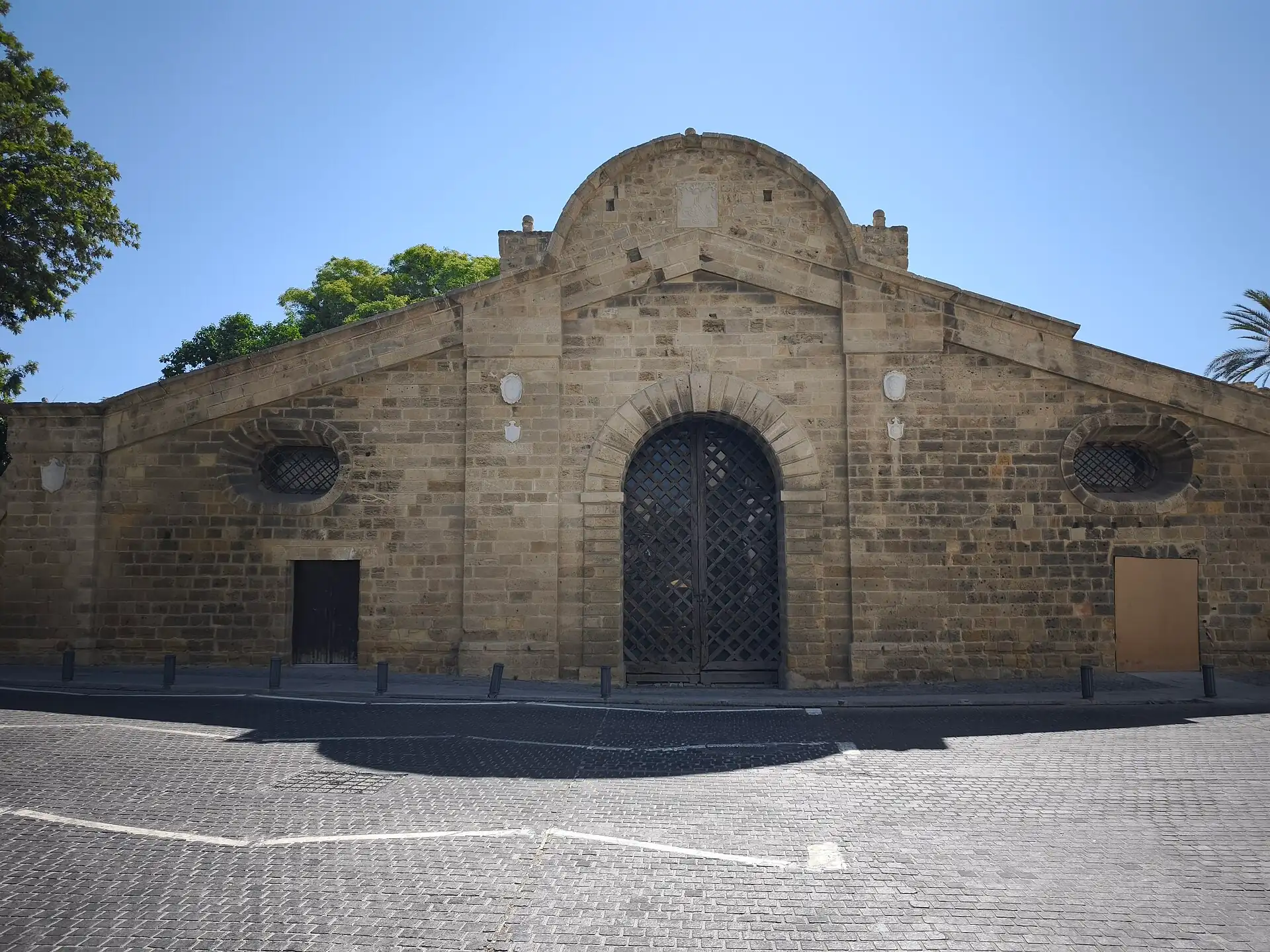
The Venetian walls are the city's main monument. They form a circle about 4.5 km around, with eleven bastions shaped like the points of a star, and three gates: Paphos Gate on the west, Famagusta Gate on the east, and Kyrenia Gate on the north. The bastions have Italian names and a Venetian lion or coat of arms is carved on some. The walls are not a museum in a park: buses and cars run alongside them, some bastions are gardens, and one is a football pitch.
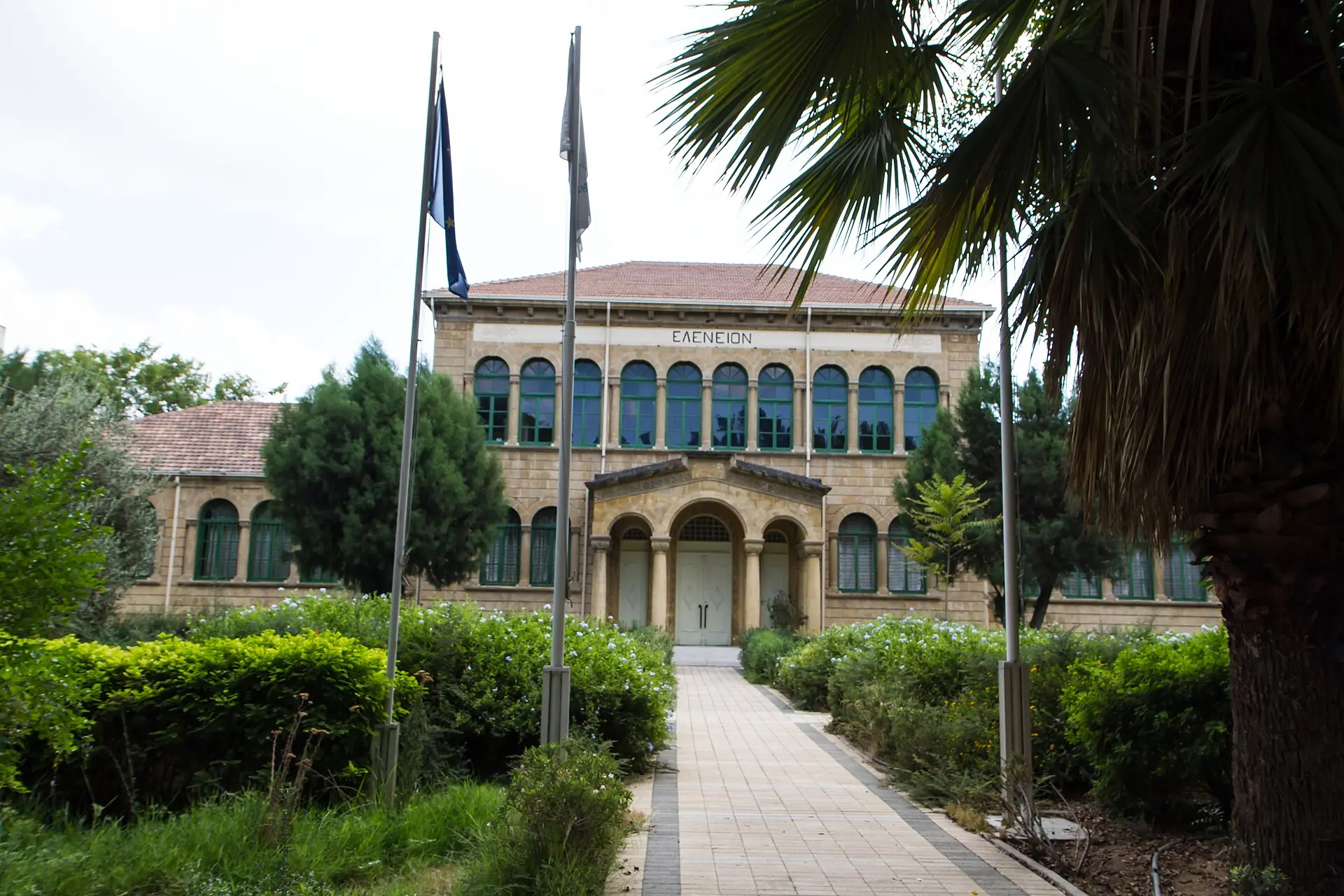
Famagusta Gate is the best gate to see. It is entered by a long vaulted passage, dark and cool even in July, and it has been restored as a cultural centre for exhibitions. Paphos Gate is smaller and sits beside the Cyprus Museum, the island's main archaeology museum, whose neoclassical hall dates from the British period. Between them, the old town keeps a mix of buildings: Byzantine and Lusignan churches, Ottoman mosques and hans, Armenian churches, and 19th-century houses with wooden balconies.
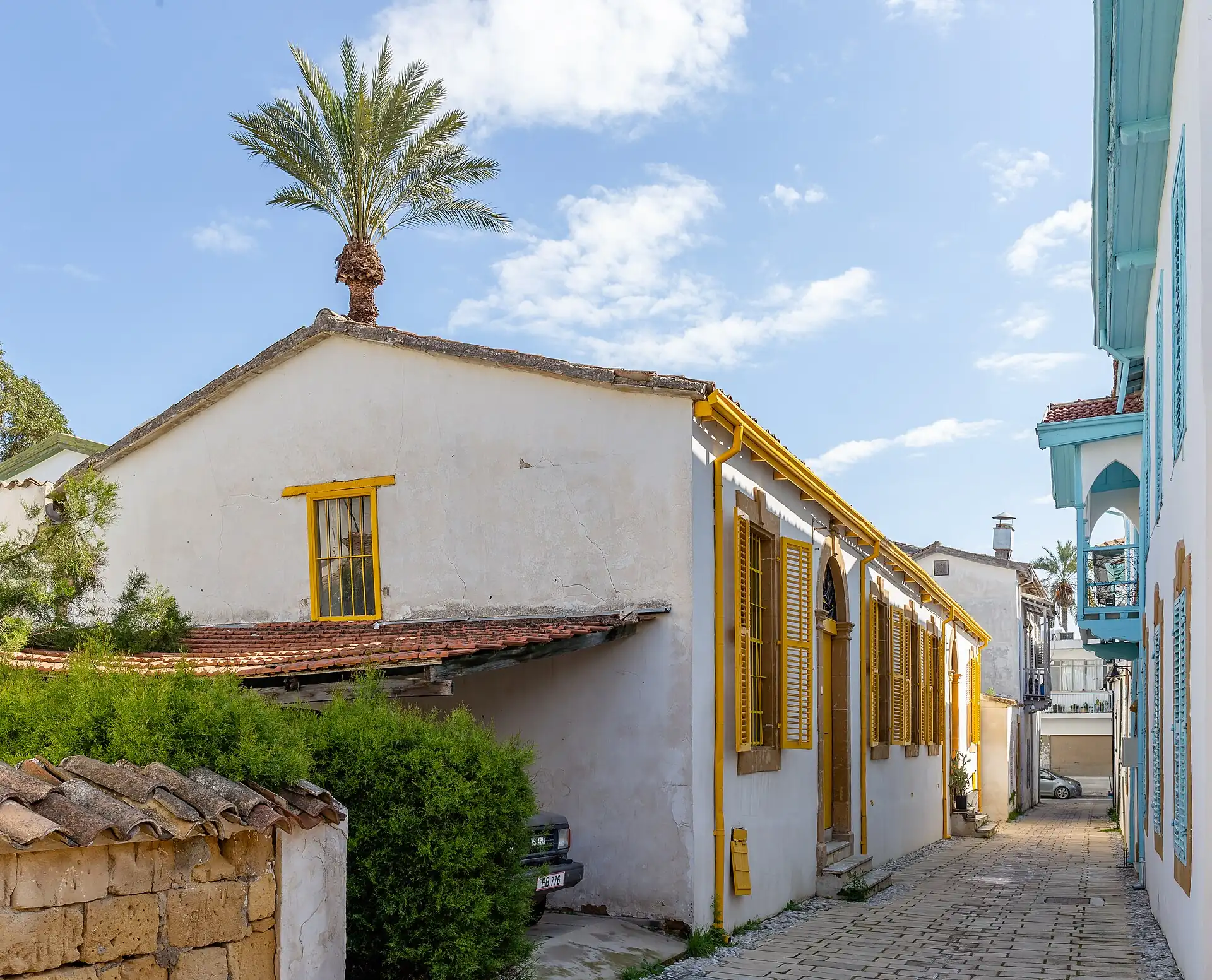
Laiki Geitonia, the 'popular neighbourhood', is a small quarter of restored houses that was rebuilt in the 1980s to keep the old town's look and to draw people back. Its lanes now hold craft shops and terraces. It is a good example of how conservation works here: some buildings are original, others are careful copies, and the city has learned to live with both. The Leventis Museum, in an old house nearby, explains the layers of the town in one visit.
The Archbishop's Palace quarter shows another side. The Byzantine Museum holds a large collection of icons from the 9th century to the 19th, and next door St John's Cathedral, built in the 18th century, is covered inside with painted scenes. The exterior is plain; the inside is the point. Modern Nicosia adds a very different note: the Shacolas Tower on Ledra Street and the glass and concrete blocks of the new town show a city that has grown quickly beyond its walls.
- Length of the walls
- About 4.5 km (2.8 mi) roundAbout 2.8 mi (4.5 km) round
- Bastions
- Eleven
- Gates
- Paphos, Famagusta and Kyrenia
- Laiki Geitonia restored
- 1980s
- Byzantine Museum icons
- 9th–19th century
4Food and the meze table2 min
Cypriot food sits between Greek and Turkish and Levantine cooking, and it is one of the reasons people enjoy Nicosia. The centre of it is meze, a meal built of many small dishes that arrive in waves. A full meze can run to more than twenty plates: olives, tahini and taramosalata, then grilled halloumi, sausages, lamb, grilled meat and often fish, and a tray of fruit to finish. It is usually ordered for the table, at a set price, and the waiter keeps bringing dishes until you say stop.
Halloumi is the best known product. It is a firm cheese made from sheep and goat milk, sometimes with cow milk, and mint, and it can be grilled or fried without melting. Other staples are souvlaki and sheftalia, the herbed minced-meat sausage wrapped in caul fat, and kleftiko, lamb slow-cooked in a sealed oven. Afelia is pork with red wine and crushed coriander seed; koupepia is rice and herbs in vine leaves; stifado is a sweet-sour stew of beef or rabbit and small onions. Village salad comes with almost every plate.
Bakeries sell a small round pastry called flaouna, filled with cheese and mint and traditional at Easter; koulouri, a ring of sesame bread; and cheese pies. Cypriot coffee is served in a small cup with the grounds still in it, and it comes in three sweetnesses: sketo (no sugar), metrio (medium) and glyko (sweet). Do not stir it; let the grounds settle. In summer, the iced freddo espresso is the drink of the day, and loukoumades, fried dough balls in honey syrup, are a favourite sweet.
Wine has a long history on the island. Commandaria, a sweet dessert wine made from sun-dried grapes in the Troodos foothills, is often described as one of the oldest named wines still in production. Zivania, a clear grape spirit, is drunk in small glasses after a meal. The wine scene has grown, and local grapes such as Xynisteri (white) and Maratheftiko (red) are now easier to find by the glass. On the northern side, you find Turkish Cypriot dishes such as hellim (the Turkish name for halloumi), kebabs, and sweets like lokma.
- Signature cheese
- Halloumi
- Signature meal
- Meze, usually 15–25 small dishes
- Easter pastry
- Flaouna
- Coffee order
- Sketo, metrio or glyko
- Dessert wine
- Commandaria
5Faith and the communities of the old town2 min
Nicosia's old town is a place of many faiths side by side. The Greek Orthodox Church is the largest, and the Archbishop of Cyprus is a powerful figure, both religious and political; Archbishop Makarios III was also the first president of the republic. The Maronite, Armenian and Latin communities have their own churches and schools in the city. Muslim communities, mostly Turkish Cypriot, have mosques on both sides of the line, and the 'Ömeriye Mosque' in the south is a former Augustinian church that was converted in the Ottoman period.
Religious buildings are working places, and visitors are guests. Cover your shoulders and knees, keep your voice low, and ask before you photograph inside. In an Orthodox church you may see icons kissed and candles lit; do not step in front of people who are praying. At a mosque, remove your shoes; women are asked to cover their hair; and the hours of prayer, especially Friday at midday, are not the time to visit. Some buildings on the northern side are open to visitors in the daytime, and some are not.
The calendar follows the Orthodox Church for most public holidays in the south. Easter is the biggest, with Holy Week processions, red-dyed eggs, lamb roasts and flaounes. Green Monday, the first day of Lent, is a public holiday with picnics and kites, and Kataklysmos, the Festival of the Flood, marks the day after Pentecost with water games. On 15 August, the Assumption is a public holiday in the worst of the heat. Dates move each year, so check the year's calendar.
Faith also shapes daily life in quiet ways: shop closing hours on Sundays, the sound of church bells, the call to prayer from northern mosques, a saint's day in a village. For a visitor these are best seen with respect and a little curiosity. Ask staff a question and you will usually get a friendly answer.
- Main faith in the south
- Greek Orthodox
- Main faith in the north
- Sunni Islam
- Smaller communities
- Maronite, Armenian, Latin
- First president
- Archbishop Makarios III (1960)
- Biggest holiday
- Orthodox Easter
6Heat and the daily rhythm2 min
Nicosia is inland and low, without a sea breeze, and it is one of the hottest capitals in Europe in summer. July and August highs often reach 37–40°C. The city has adapted over centuries: thick stone walls, shaded courtyards, narrow lanes that trap cool air in the morning, and a long break in the middle of the day. Shops used to close from about 13:00 to 16:00 and many small shops still do in summer, and on Wednesday afternoons some close for the week.
For a visitor, the day works best in three parts. The morning, from about 08:00 to 11:00, is for walking the walls, the gates and the lanes. The middle of the day is for a museum, a long lunch and a rest, and the Cyprus Museum's air-conditioned galleries are the classic refuge. From about 17:30, the streets refill: people walk, sit on terraces, and eat late. Dinner starts around 19:30 and often runs to midnight.
In winter the pattern reverses. From December to February the days are mild, around 15–17°C, with cool nights and short, sharp rain. The Troodos mountains, about an hour away, can have snow in January and February. Spring and autumn are the best seasons for walking: March to May and October to November have warm, dry days and cooler evenings. The first rains usually arrive in November, and the light in autumn is soft and clear.
The rhythm matters for planning. A first-time visitor who tries to walk the walls at 14:00 in July will be sorry, and one who arrives at a taverna at 17:00 will find it empty. Aim for outdoor stops before 11:00 and after 17:30 in summer; keep the middle of the day for indoor stops; and give dinner two hours. Drink water regularly, wear a hat, and take a taxi between clusters when the heat rises.
- Hottest months
- July and August, highs 37°C (99°F) or moreJuly and August, highs 99°F (37°C) or more
- Coolest months
- January and February, highs about 15°C (59°F)January and February, highs about 59°F (15°C)
- Best walking months
- March–May and October–November
- Dinner starts
- About 19:30About 7:30 PM
- Shops
- Long afternoon break in summer
Read, watch, wordsReading · Watching · Glossary · Sources
Reading
- Bitter Lemons of Cyprus — Lawrence DurrellA British writer's memoir of living on the island in the 1950s, just before independence; dated in places, but vivid on the landscape and the tensions.
- The Island of Missing Trees — Elif ShafakA recent novel about a Greek Cypriot and a Turkish Cypriot in love in Nicosia before 1974, and their families afterwards.
- Cyprus, a Modern History — William MallinsonA short history of the island since the British period, useful for the divided-city story (check the edition).
Watching
- Akamas — Panicos Chrysanthou, 2006 (check availability)A drama about a Greek Cypriot and a Turkish Cypriot in love, set against the island's division; a way into the story from the people's side.
Glossary
| Term | Local | Meaning |
|---|---|---|
| Lefkosia | Λευκωσία | The Greek name for Nicosia. |
| Lefkoşa | Lefkoşa | The Turkish name for Nicosia, used in the north. |
| Green Line | Πράσινη Γραμμή | The line of the buffer zone that divides the city and the island. |
| Meze | μεζέδες | A meal of many small dishes served in waves. |
| Halloumi | χαλούμι | A firm cheese that can be grilled; called hellim in Turkish. |
| Sheftalia | σεφταλιά | A herbed minced-meat sausage grilled on skewers. |
| Commandaria | κουμανδαρία | A sweet dessert wine from the Troodos foothills. |
| Zivania | ζιβανία | A clear, strong grape spirit. |
| Sketo, metrio, glyko | σκέτος, μέτριος, γλυκός | No sugar, medium and sweet coffee. |
| Kataklysmos | Κατακλυσμός | The Festival of the Flood, a water-themed holiday after Pentecost. |
Read for this deep dive
Background reading only: the text above is written by Voykit, not copied from these pages.
Rules in force · 4
- Cyprus ↗Cyprus is in the EU but not in the Schengen area: a Schengen visa is not valid; check the entry rules for your nationality.
- Cyprus ↗Crossing the Green Line: carry your passport, cross only at the official points, and do not photograph the buffer zone or soldiers. Check that your hire-car insurance covers the north.
- Cyprus ↗Traffic drives on the left; hire-car roundabouts and junctions take practice.
- Nicosia District ↗Plan every leg outside Nicosia by car, transfer or scheduled bus; distances are short, but buses are infrequent.
Entry rules depend on your passport. Full visa guide
Emergency numbers for Nicosia112 ▾
Tap a number to call from your phone. These are the numbers listed in this guide; a row marked check has not been verified.
Planning is the full guide. I'm here keeps what is open and the cheat card.
Right now
Checking the weather…
Working out what is open near you…
What is open nowclock, closures, places open
Now in Nicosia
Local time in Nicosia
--:--
Loads in your browser · Asia/Nicosia
This month
Month verdict appears here.
Closed today
See the weekly grid below.
| Weekly closure | Mon | Tue | Wed | Thu | Fri | Sat | Sun |
|---|---|---|---|---|---|---|---|
| State museums (for example the Cyprus Museum)checkConfirm the weekly closing day and hours before you go. | ✕ | · | · | · | · | · | · |
| Small shops and craft stalls in the old towncheckMany close on Sunday and in the afternoon on hot days. | · | · | · | · | · | · | ✕ |
If today is a closure day: Monday is the classic closing day for state museums: use it for the walls, Laiki Geitonia and Ledra Street, and move the Cyprus Museum to another morning. In July and August, do the walls before 11:00.
Weekly closures come from our place pages; public holidays and religious days add closures not shown here.
Cheat cardthe pocket version
Cheat card
The essentials on one card: save it as an image for your phone, share it, or print it.
Nicosia
Λευκωσία
- Money
- Keep EUR 30 in small notes for kiosks and taxis; withdraw at bank ATMs.
- SIM
- Cyprus operators (Cyta, Epic, Primetel) sell prepaid SIMs in town with a passport…
- Ride app
- Bolt
- Emergency
- 112 or 199 police · 112 or 199 fire · 112 or 199 ambulance (not 911, 999 or 000)
- Plugs
- Sockets G. US/Canada (A/B): adapter · UK/Ireland (G): fits · Australia/NZ (I): adapter. 230 V: US 120 V-only devices (hair dryers) need a converter; most chargers are dual-voltage.
Top 5
- Cyprus Museum
- Famagusta Gate and the walls
- Laiki Geitonia at dusk
- A meze dinner
- Byzantine Museum
EssentialsQuick answers, what things cost and how to get around
Essentials
Quick answers, what things cost and how to get around
Quick answers
The questions people ask first about Nicosia, one line each. Tap a card for the full answer.
- Cash or card?Cards and contactless work almost everywhere in the south, including cafés, taxis and museums; carry EUR 30–50 (≈ US$35–60) in small notes and coins for kiosks…
- SIM or eSIMCyprus operators (Cyta, Epic, Primetel) sell prepaid SIMs in town with a passport; an eSIM installed before you fly is simpler.
- Ride-hailing appBolt.
- Tap waterTap water is safe to drink but often hard and chlorinated; many people drink bottled water.
- TippingcheckService is often added in restaurants (check the bill); if not, 10% for good service.
- Plugs & powerSockets G. US/Canada (A/B): adapter · UK/Ireland (G): fits · Australia/NZ (I): adapter. 230 V: US 120 V-only devices (hair dryers) need a converter; most chargers are dual-voltage.
Show all 14 answers
- Safe at night?Take more care after dark in Famagusta Gate quarter, Buffer zone edges.
- Emergency numbers112 or 199 police · 112 or 199 fire · 112 or 199 ambulance (not 911, 999 or 000)
- Your embassycheckUK, US embassies listed with addresses (check before you go).
- Closed which day?Mon: 1 on our list shut · Sun: 1 on our list shut.
- Sundays & holidaysWeekly closures come from our place pages; public holidays and religious days add closures not shown here.
- Late at nightBars around Faneromeni and Onasagorou and the Laiki Geitonia terraces stay open late on weekends; the old town is quiet by 01:00 on weekdays.Bars around Faneromeni and Onasagorou and the Laiki Geitonia terraces stay open late on weekends; the old town is quiet by 1:00 AM on weekdays.
- Rainy-day planWinter rain comes in short, heavy showers: plan the Cyprus Museum and the Byzantine Museum for the wet hour and the walls for the dry one.
- Landing lateLCA: ride-hailing car or transfer to the door runs all night.
Cost cheat-sheetwhat everyday things cost
Cost cheat-sheet
Typical prices for the everyday things, as ranges. Change the currency right here; the local price stays first.
2026 desk estimate · check
- CoffeeCoffee (café)EUR 2.50–4.00 (≈ US$3–5)
- Street or quick mealBakery breakfast: flaouna, koulouri or a cheese pieEUR 1.50–3.50 (≈ US$2–5)
- BeerBeer (KEO or Leon), bar or restaurantEUR 3.50–5.00 (≈ US$5–6)
- Taxi, about 5 km (3 mi)Taxi, about 3 mi (5 km)Short taxi rideAsk for the meter or use an app.EUR 6–10 (≈ US$7–12)
- SIM or eSIM, a weekTourist SIM, about a weekEUR 5–15 (≈ US$6–18)
- Museum or sight ticketMuseum entryEUR 3–6 (≈ US$4–7)
- Budget bedHostel bed, a night, per person€22 (≈ US$30)
- Mid-range bedHotel double room, a night, per room€110 (≈ US$130)
- High-end bedHotel double room, a night, per room€220 (≈ US$300)
A day, not counting the bed: Budget €55 (≈ US$65) · Mid €95 (≈ US$120) · High €190 (≈ US$250)
Local prices, with USD next to them (rates 2026-09 (approximate); change it in the header). Ranges are desk estimates: check locally. Every price and the budget calculator →
Source: Prices in Nicosia
Draft
Written from desk research. Not yet compared with the official source.
No official source is recorded for this figure.
Prices are 2026 desk estimates, not yet compared with an official source. Check on the day.
Not checked in the last 12 months (no check date on file).
DecideWho it suits, the trade-offs and when to go
Decide
Who it suits, the trade-offs and when to go
Best months at a glance
The guide's verdict for each month
Jan
Care
15°C (59°F)59°F (15°C)
Feb
Care
16°C (61°F)61°F (16°C)
Mar
Best
19°C (66°F)66°F (19°C)
Apr
Best
24°C (75°F)75°F (24°C)
May
Best
29°C (84°F)84°F (29°C)
Jun
Care
34°C (93°F)93°F (34°C)
Jul
Avoid
37°C (99°F)99°F (37°C)
Aug
Avoid
37°C (99°F)99°F (37°C)
Sep
Care
33°C (91°F)91°F (33°C)
Oct
Best
28°C (82°F)82°F (28°C)
Nov
Best
21°C (70°F)70°F (21°C)
Dec
Care
17°C (63°F)63°F (17°C)
Best: Mar–May, Oct–Nov. Mixed: Jun, Sep, Dec–Feb. Avoid: Jul–Aug. Month by month →
Warmest Jul (37°C (99°F)99°F (37°C)), coolest Jan (5°C (41°F)41°F (5°C) low), wettest Jan (8 rain days), driest Jul (0). Averages, not a forecast.
Nicosia across the year
Best-looking months for Nicosia: Mar, Apr, Nov. Rated avoid: Jul, Aug.
| Measure | Jan | Feb | Mar | Apr | May | Jun | Jul | Aug | Sep | Oct | Nov | Dec |
|---|---|---|---|---|---|---|---|---|---|---|---|---|
| Weather | Mixed (care) | Mixed (care) | Great (good) | Great (good) | Great (good) | Mixed (care) | Avoid (avoid) | Avoid (avoid) | Mixed (care) | Great (good) | Great (good) | Mixed (care) |
| Crowds | Low (good) | Low (good) | Low (good) | Medium (ok) | Medium (ok) | High (care) | High (care) | High (care) | Medium (ok) | Medium (ok) | Low (good) | Low (good) |
| Prices | Low (good) | Low (good) | Low (good) | Medium (ok) | Medium (ok) | High (care) | High (care) | High (care) | Medium (ok) | Medium (ok) | Low (good) | Low (good) |
| Events | 2 events (ok) | 1 event (ok) | 2 events (ok) | 1 event (ok) | 2 events (care) | 1 event (ok) | None listed (ok) | 2 events (care) | None listed (ok) | 3 events (ok) | None listed (ok) | 2 events (ok) |
Green is good news, amber needs planning, red is a month to avoid; dashed grey with a question mark means our data does not say. Open the year heatmap →
Not checked in the last 12 months (no check date on file).
Source: Months, temperatures and crowds
Draft
Written from desk research. Not yet compared with the official source.
Monthly highs, rain and crowd levels are climate averages and desk estimates for the city, not a forecast.
Understand the cityUnderstand · Districts
Orientation & districts
The old town is a walled circle about 1.5 km across. The buffer zone runs east to west through it. Eleftheria Square and Ledra Street are on the southern side of the circle; Laiki Geitonia is a short walk east; the Cyprus Museum is west, near the Paphos Gate; the Famagusta Gate is the eastern end of the southern walls. Makarios Avenue and the new town lie just south, outside the walls.
Addresses in the old town are streets with English and Greek names; give your driver the district and a nearby landmark.
Shaded shapes: walking areas (click one). Black pins: sleep areas. Grey dots: places. Round badges: arrivals. Click the map to turn on scroll-wheel zoom.
Hover, tap or tab to an area to see what it is like. Pins are sleep areas; arrows at the edge point to the airport.
Off the map: Larnaca International Airport (LCA) (45–65 min by the usual route).
Not drawn yet (no coordinates in this guide): Archbishop's Palace area, Chrysaliniotissa and Faneromeni, North Nicosia (Lefkoşa). They are in the neighbourhood cards below.
Where’s what, as a list:
- Laiki Geitonia and Ledra Street: Restored lanes and a pedestrian shopping street; the heart of the tourist old town, cool at dusk. Suits: A first evening, craft shops and tavernas. Price band $$.
- Famagusta Gate quarter: A Venetian gate now used for exhibitions, with NiMAC nearby and a residential feel. Suits: Walls, the arts centre and quiet lanes.
- Paphos Gate and the Cyprus Museum: Air-conditioned archaeology galleries beside a bastion of the walls. Suits: A midday indoor stop.
- Makarios Avenue and Stasikratous: The new-town edge just south of Eleftheria Square: easy for cars and bags. Suits: Modern hotels, cafés and bakeries. Price band $$$.
- Archbishop's Palace area: A small quarter of the Byzantine Museum, St John's Cathedral and the Archbishopric buildings, north-east of Laiki Geitonia. Suits: Icons and frescoes.
- Chrysaliniotissa and Faneromeni: Residential streets in the old town with restored houses and small studios; best in the morning. Suits: Quiet lanes, churches and craft workshops.
- North Nicosia (Lefkoşa): The Turkish Cypriot side, with the Selimiye Mosque, the Büyük Han and Arasta bazaar; entry rules change, so check first. Suits: A day crossing with a passport.
- Sleep area Makarios Avenue: suits Modern hotels, cafés and bakeries, price band $$$.
- Sleep area Old Town (Laiki Geitonia): suits A first evening, craft shops and tavernas, price band $$.
- Larnaca International Airport (LCA), 45–65 min by the usual route.
Neighbourhoods at a glance
One tab per area, pulled together from this guide’s districts table, area notes, sleep-area scores and place pages. Scores are desk judgements (1–5); prices are estimates, check before you book.
Laiki Geitonia and Ledra Street
$$Restored lanes and a pedestrian shopping street; the heart of the tourist old town, cool at dusk.
- Suits:
- A first evening, craft shops and tavernas
- Best time:
- 17:30–23:005:30 PM–11:00 PM
- Rooms:
- EUR 40–70 (from the sleep guide)
Pick this if: A first evening, shopping, meze
Watch out for: Walking on hot stone at noon.
- Quiet nights3/5 Medium
- Nightlife4/5 High
- Families3/5 Medium
- Late arrival3/5 Medium
Why these scores
- Quiet nights: Quiet inside the lanes on weekdays; terrace noise near Laiki Geitonia on weekends.
- Nightlife: Tavernas and bars within a short walk.
- Families: Atmospheric but step-heavy; fewer green spaces.
- Late arrival: Small hotels may not staff the desk at night; confirm the bell or phone number.
Getting around from here
- 9–14 min walk to Cyprus Museum & Paphos Gate
- 15–22 min walk to Famagusta Gate & NiMAC
- Walk south: about 10 min to Makarios Avenue & Stasikratous
Famagusta Gate quarter
A Venetian gate now used for exhibitions, with NiMAC nearby and a residential feel.
- Suits:
- Walls, the arts centre and quiet lanes
- Best time:
- 08:00–11:008:00 AM–11:00 AM
Pick this if: Morning walks and a gallery
Watch out for: Late-night walks alone.
Getting around from here
- Walk west: about 10 min to Ledra Street & Laiki Geitonia
Paphos Gate and the Cyprus Museum
Air-conditioned archaeology galleries beside a bastion of the walls.
- Suits:
- A midday indoor stop
- Best time:
- 09:00–14:009:00 AM–2:00 PM
Pick this if: A midday indoor break
Watch out for: Arriving on a Monday.
Getting around from here
- Walk east: about 10 min to Ledra Street & Laiki Geitonia
Makarios Avenue and Stasikratous
$$$The new-town edge just south of Eleftheria Square: easy for cars and bags.
- Suits:
- Modern hotels, cafés and bakeries
- Best time:
- Daytime
- Rooms:
- EUR 80–140 (from the sleep guide)
Pick this if: Business stays, coffee and bakeries
Watch out for: Expecting old-town atmosphere.
- Quiet nights3/5 Medium
- Nightlife3/5 Medium
- Families4/5 High
- Late arrival4/5 High
Why these scores
- Quiet nights: Traffic noise on the main avenue; side streets are calmer.
- Nightlife: Cocktail bars and hotel terraces nearby; the old town is a 10-minute walk.
- Families: Lifts, pools in some hotels and smoother pavements.
- Late arrival: Staffed desks and taxis at the door.
Getting around from here
- 10–15 min walk to Ledra Street & Laiki Geitonia
Archbishop's Palace area
A small quarter of the Byzantine Museum, St John's Cathedral and the Archbishopric buildings, north-east of Laiki Geitonia.
- Suits:
- Icons and frescoes
Chrysaliniotissa and Faneromeni
Residential streets in the old town with restored houses and small studios; best in the morning.
- Suits:
- Quiet lanes, churches and craft workshops
North Nicosia (Lefkoşa)
The Turkish Cypriot side, with the Selimiye Mosque, the Büyük Han and Arasta bazaar; entry rules change, so check first.
- Suits:
- A day crossing with a passport
Decide
The honest trade-off: what you will enjoy, what will wear you down.
You will like
- Walled old-town lanes
- Meze taverns
- Museum with a short walk
You will hate
- July and August heat
- Afternoon closures
- Few late-night options
Similar citiesif this one is not quite right
Similar cities
If Nicosia does not fit your dates or budget, these match it on season, cost and feel.
- Kyrenia (Girne)
Northern Cyprus
- Good in the same months: Mar, Apr, May, Oct, Nov
- A mid-range day costs about the same (≈US$110 vs US$110, excl. bed)
- Works well for first-timers, food trips, couples
- A similar climate through the year
- Athens
Greece
- Good in the same months: Mar, Apr, May, Oct, Nov
- A mid-range day costs about the same (≈US$116 vs US$110, excl. bed)
- A similar climate through the year
- Istanbul
Türkiye (Turkey)
- Good in the same months: Mar, Apr, May, Oct, Nov
- A mid-range day costs about the same (≈US$110 vs US$110, excl. bed)
- Works well for first-timers, food trips, couples
When
Best months: Mar, Apr, May, Oct, Nov. Month-by-month verdicts below, with the live forecast first. When to go, month by month →
Nicosia: next 7 days
Loading forecast…
Forecast: Open-Meteo (CC BY 4.0), model data for this point.
Air quality
Loading…
Model estimate (CAMS via Open-Meteo), not a street-level station; readings near busy roads run higher.
Month by month, all 12best Mar, Apr, May, Oct, Nov
Cool and damp; bring a layer.
Cool; almond blossom, showers.
Mild; good for walking.
Warm; Orthodox Easter some years.
Warm and dry.
Hot; walk early.
Hottest; 38–40°C (100–104°F).Hottest; 100–104°F (38–40°C).
Very hot; Aug 15 holiday.
Hot; cooling late in the month.
Mild; Oct 1 and Oct 28 holidays.
Comfortable; first rains.
Cool and wet; Christmas closures.
Climate, calendar and eventsClimate · Calendar · Events · Packing by season
Climate
| Jan | Feb | Mar | Apr | May | Jun | Jul | Aug | Sep | Oct | Nov | Dec | |
|---|---|---|---|---|---|---|---|---|---|---|---|---|
| High | 15°C (59°F)59°F (15°C) | 16°C (61°F)61°F (16°C) | 19°C (66°F)66°F (19°C) | 24°C (75°F)75°F (24°C) | 29°C (84°F)84°F (29°C) | 34°C (93°F)93°F (34°C) | 37°C (99°F)99°F (37°C) | 37°C (99°F)99°F (37°C) | 33°C (91°F)91°F (33°C) | 28°C (82°F)82°F (28°C) | 21°C (70°F)70°F (21°C) | 17°C (63°F)63°F (17°C) |
| Low | 5°C (41°F)41°F (5°C) | 5°C (41°F)41°F (5°C) | 7°C (45°F)45°F (7°C) | 11°C (52°F)52°F (11°C) | 15°C (59°F)59°F (15°C) | 19°C (66°F)66°F (19°C) | 22°C (72°F)72°F (22°C) | 22°C (72°F)72°F (22°C) | 19°C (66°F)66°F (19°C) | 15°C (59°F)59°F (15°C) | 10°C (50°F)50°F (10°C) | 6°C (43°F)43°F (6°C) |
| Rain days | 8 | 7 | 5 | 3 | 2 | 1 | 0 | 0 | 0 | 2 | 4 | 7 |
| Verdict |
- July and August are the hottest months and the city sits inland, with no sea breeze: outdoor stops before 11:00 and after 17:30.July and August are the hottest months and the city sits inland, with no sea breeze: outdoor stops before 11:00 AM and after 5:30 PM.
- March to May and October to November are the comfortable months for walking the walls.
- Winters are mild but wet and cool at night; a rain jacket and a layer are enough.
Events by month
Epiphany
6 January · Churches
Public holiday; blessing of the waters.
Green Monday (Kathara Deftera)
religiousOrthodox calendar; late Feb or March · Citywide(check dates)
First day of Lent; public holiday; kite flying and picnics.
Greek Independence Day
25 March · Citywide
Public holiday; school parades.
Orthodox Easter and Holy Week
religiousOrthodox calendar, moves yearly · Churches and homes(check dates)
Good Friday processions, Easter lamb, shops closed.
Labour Day
1 May · Citywide
Public holiday.
Kataklysmos (Festival of the Flood)
religiousOrthodox calendar, moves yearly · Citywide and the coast(check dates)
Water fights and fairs; a public holiday.
Assumption of the Virgin
15 August · Churches
Public holiday in peak heat; many places close.
Independence Day and Ochi Day
1 and 28 October · Citywide
Public holidays; parades.
Christmas and New Year
24 December–6 January · Ledra Street and Eleftheria Square
Lights and markets; reduced hours on 25–26 December.
Festivals and events that change the plan
| When | What | Effect on your plan |
|---|---|---|
| 1 Oct | Cyprus Independence Day | Public holiday; parades and closed offices; museums may run reduced hours. |
| 28 Oct | Ochi Day | Public holiday; school parades in the centre and some road closures. |
| Variable (Orthodox calendar) | Orthodox Easter and Holy Week | Churches busy, shops and restaurants closed on Good Friday and Easter Sunday; lamb roasts everywhere. Check the year's date. |
| Late Feb or Mar (Orthodox calendar) | Green Monday (Kathara Deftera) | The first day of Lent; public holiday with picnics and kite flying; some places closed. |
| Variable (Orthodox calendar) | Kataklysmos (Festival of the Flood) | A water-themed holiday on the Monday after Pentecost; mainly at the coast, but shops and offices in Nicosia close. |
| 15 Aug | Assumption of the Virgin | Public holiday in the peak of summer heat; many places close. |
| 25 Dec–6 Jan | Christmas to Epiphany | Reduced opening hours; lights on Ledra Street and Eleftheria Square. |
What to pack, by season
From Nicosia’s own climate table: the coldest, warmest and wettest three months, and what to bring for each.
Coldest months
Dec–Feb
5° to 16°
A warm coat and layers.
Warmest months
Jun–Aug
21° to 36°
Light, breathable clothes, a sun hat and sunscreen; plan midday indoors and carry water.
Wettest months
Dec–Feb
7 rain days a month
Showers are occasional: a light shell is enough.
Arrive & moveGetting in, getting around, and your bags
Arrive & move
Getting in, getting around, and your bags
I land at…
Enter your landing time: what still runs from the airport, where you can eat when you get in, and which areas let you check in that late.
Larnaca International Airport (LCA)
Out of the airport about 23:4511:45 PM (00:35 (next day)12:35 AM (next day) if immigration and bags are slow); in town about 00:30 (next day)12:30 AM (next day).
Transport from the airport
- Any hourRide-hailing car or transfer to the door. Runs all night.
- GoneScheduled bus from the airport towards Nicosia (route and last departure unverified). Stops about 21:30.Stops about 9:30 PM.
- Last resortOvernight near the airport. If nothing else works.
Places to eat open when you get in
We have no confirmed hours for the places to eat here yet. Plan on a convenience store or your hotel. What is open late →
Where to sleep with a late arrival
- Lets you inMakarios Avenue 24-hour desk. Staffed desks and taxis at the door.
- Lets you inOld Town (Laiki Geitonia) 24-hour desk. Small hotels may not staff the desk at night; confirm the bell or phone number.
Typical times from our airport data, not a timetable: check the last departure on the day. Full airport-to-bed plan for Larnaca International Airport (LCA) →
Arrive
Each gateway has its own airport-to-bed page with timings and the last safe connection.
Getting in, in detailGet in
Get in by rail and road
| Station | Mode | Serves | Where | To the centre |
|---|---|---|---|---|
| Larnaca airport shuttle and intercity busIntercity busescheck | Bus | Larnaca Airport and Larnaca town, then Nicosia (check current routes) | Bus stops near the airport and the Nicosia bus station (check) | Car 10 min from the Nicosia bus stationTimetables change; confirm the current route and last bus before you rely on it.(check) |
| Service taxi (shared taxi)use | Coach | Nicosia, Larnaca, Limassol and Paphos | Book by phone; door to door (check) | Already thereA cheaper alternative to a private taxi; book a seat in advance. |
| Private transfer or taxiuse | Coach | Airport to your hotel | Arrivals hall | Already thereThe simplest choice on a late arrival: agree the fare before you get in or pre-book. |
- The island has no trains: buses run a few times a day on quiet routes and stop early in the evening.
- Hire cars are useful for Troodos and the villages; cars drive on the left.
Move
The default way around, when a pass pays off, and when the last trains go.
- Default
- Walk inside a cluster; taxi or ride-hailing between clusters in summer.
- Passes
- No pass. Short taxi rides inside the centre are cheap; use the meter or see the fare in the app.
- Last trains
- No metro or rail. Taxis and ride-hailing run late; availability drops after midnight.desk estimate
- Other modes
- Other modes (Rome2Rio) ↗
Getting around, in detailGet around · Connect
Get around
Walk inside the old town; use taxis, ride-hailing or a hire car to reach the new town and villages. Buses exist but are infrequent. There is no metro.
| Mode | Verdict | Fare | Use it for | What breaks |
|---|---|---|---|---|
| Walking | use | Free | Inside the old town | Cobbles and shade are patchy; hot at midday. |
| Taxi (metered) | use | EUR 6–10 (≈ US$7–12) across the old town | Short hops and bags | Ask for the meter; use a taxi rank or call by phone. |
| Ride-hailing (Bolt) | use | EUR 5–12 (≈ US$6–14) across the city | Between clusters, night | Fare shown before you ride (check coverage). |
| City buses | ok | EUR 1.50–2 (≈ US$2–3) (check) | Longer legs to the new town | Infrequent; check routes in an app. |
| Service taxi | ok | EUR 10–25 (≈ US$12–30) for intercity legs (check) | Larnaca, Limassol, Paphos | Book ahead; door to door. |
| Hire car | use | EUR 25–50 (≈ US$30–60) a day (check) | Troodos and villages | Drive on the left; park outside the walls. |
| Cycling | caution | Hire or e-bike (check) | Outside the walls | Cobbles and heat make old-town cycling hard. |
Taxis and ride-hailing
Bolt
app
A ride-hailing app; fare shown before you ride (check).
Taxi ranks at Eleftheria Square
rank
Ask for the meter.
Hotel-booked taxis
hotel
A fixed price for airport transfers.
On foot and car-free hours
| Where | When | Note |
|---|---|---|
| Laiki Geitonia to Ledra Street | Early morning or dusk | Cobbles and terraces; cool and quiet. |
| Along the Venetian walls | Morning | A walk of about an hour; shade is thin. |
More on getting around
Old-town streets change name between the Greek and Turkish sides and many lanes are closed to cars. Give your driver a landmark, such as Eleftheria Square, Laiki Geitonia or the Paphos Gate.
Cyprus drives on the left. Many taxis are Mercedes saloons and will use the meter on request. Rush hours are about 07:30–09:00 and 16:30–18:30; add ten minutes to any cross-city ride.
Connect
| Option | Verdict | What breaks |
|---|---|---|
| Cyta, Epic or Primetel shop in the city | use | Passport needed for registration; ask for a data-only prepaid plan. |
| eSIM installed before you fly | use | The fastest option; check that it covers Cyprus and not only the EU. |
| Street SIM sellers | avoid | SIMs must be registered to you; skip informal sellers. |
Bolt
Cars
Ride-hailing in Nicosia and Larnaca; fare shown before you ride (check current coverage).
Google Maps
Walking, addresses
Works well in the south; some north-side streets are not marked.
Cyprus Public Transport (bus app)
Buses
Real-time bus positions and routes; check for the latest app name.
- Wi-Fi
- Free in most cafés, hotels and museums; open Wi-Fi in the old town squares is patchy.
Luggage
Where big bags are a problem, and how to get rid of them for the day.
Rule
- Lockers
- Few public lockers; hotels hold bags after check-out.
- Forwarding
- No forwarding service culture; keep the big bag at the hotel for trips away.
- Dead zone
- Late flights: ask the hotel to hold bags and for a shower room; many do for a small fee.
Bags, area by area
4 walking areas rated
- Bags forbidden
- Bags painful
- Bags ok
Lockers, forwarding and the gap between check-out and check-in are covered once, under Luggage.
See & doWalking clusters, day plans and the places worth the time
See & do
Walking clusters, day plans and the places worth the time
Clusters
Plan by cluster: each is a walkable area with a rescue point and a bag rule.
Evening and early-morning cluster: the pedestrian lanes from Eleftheria Square to the crossing, tavernas and craft shops; cool at dusk, hot on stone at noon.
rescue 100% · max p90 5.2′ · half
Morning cluster: the Venetian gate, the municipal arts centre and the streets around them; small, flat and quiet before 11:00.
rescue 100% · max p90 5.3′ · 90m
Midday-safe cluster: the Cyprus Museum's air-conditioned galleries and the Paphos Gate walls; go at opening and use the museum as the heat shelter.
rescue 100% · max p90 5.3′ · half
Late-afternoon cluster: shops, cafés and bakeries on the new-town edge just south of Eleftheria Square; flat, air-conditioned inside.
rescue 100% · max p90 5.2′ · 90m
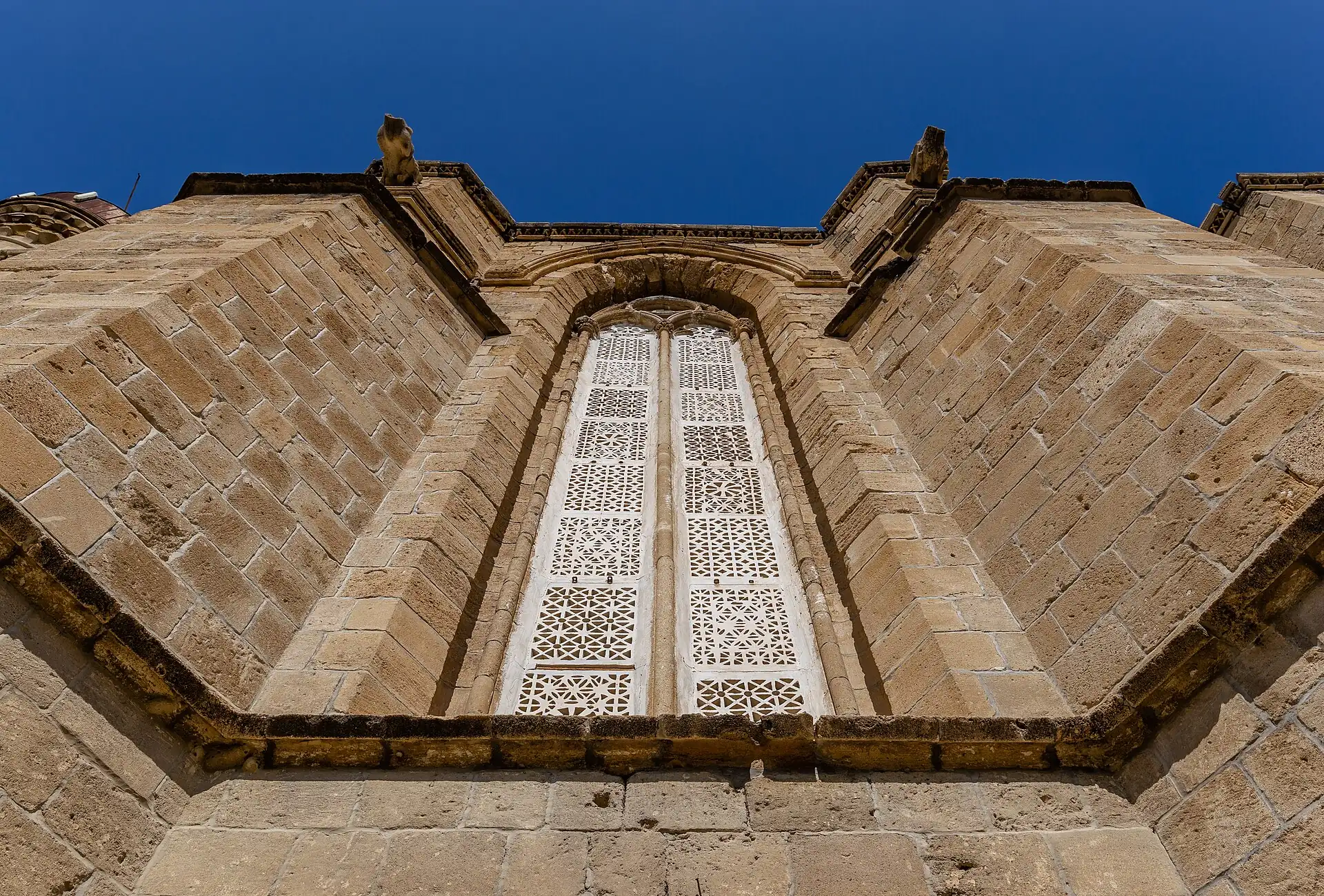
Days
Ready-made day plans, timed against opening hours and walking distances.
How long are you staying?
Loose outlines in the city's rhythm: outdoors early and at dusk, indoors at midday.
1 day
A stopover from Larnaca
- 09:00Cyprus Museum — Cyprus Museum
- 11:00Walk the walls to Laiki Geitonia
- 13:00Mayirika: Cypriot home-style lunch — Long lunch
- 16:00Ledra Observatory — Ledra Observatory and Ledra Street
- 19:30Zanettos Taverna — Meze dinner
Skip: The north crossing and villages: they need their own day.
Nicosia in 3 days
3 daysMuseum and a long lunch, gates and meze, lanes at dusk; the last day ends with the bags already in the car to Larnaca.
Day by day
Day 1 — Cyprus Museum, a 13:00 lunch table in Laiki Geitonia
- 09:00Cyprus Museum
- 13:00Lunch table 13:00 (Laiki Geitonia)
Day 2 — Famagusta Gate, NiMAC and meze
Day 3 — Laiki Geitonia, car to Larnaca at 11:00
- 11:00Car to Larnaca at 11:00
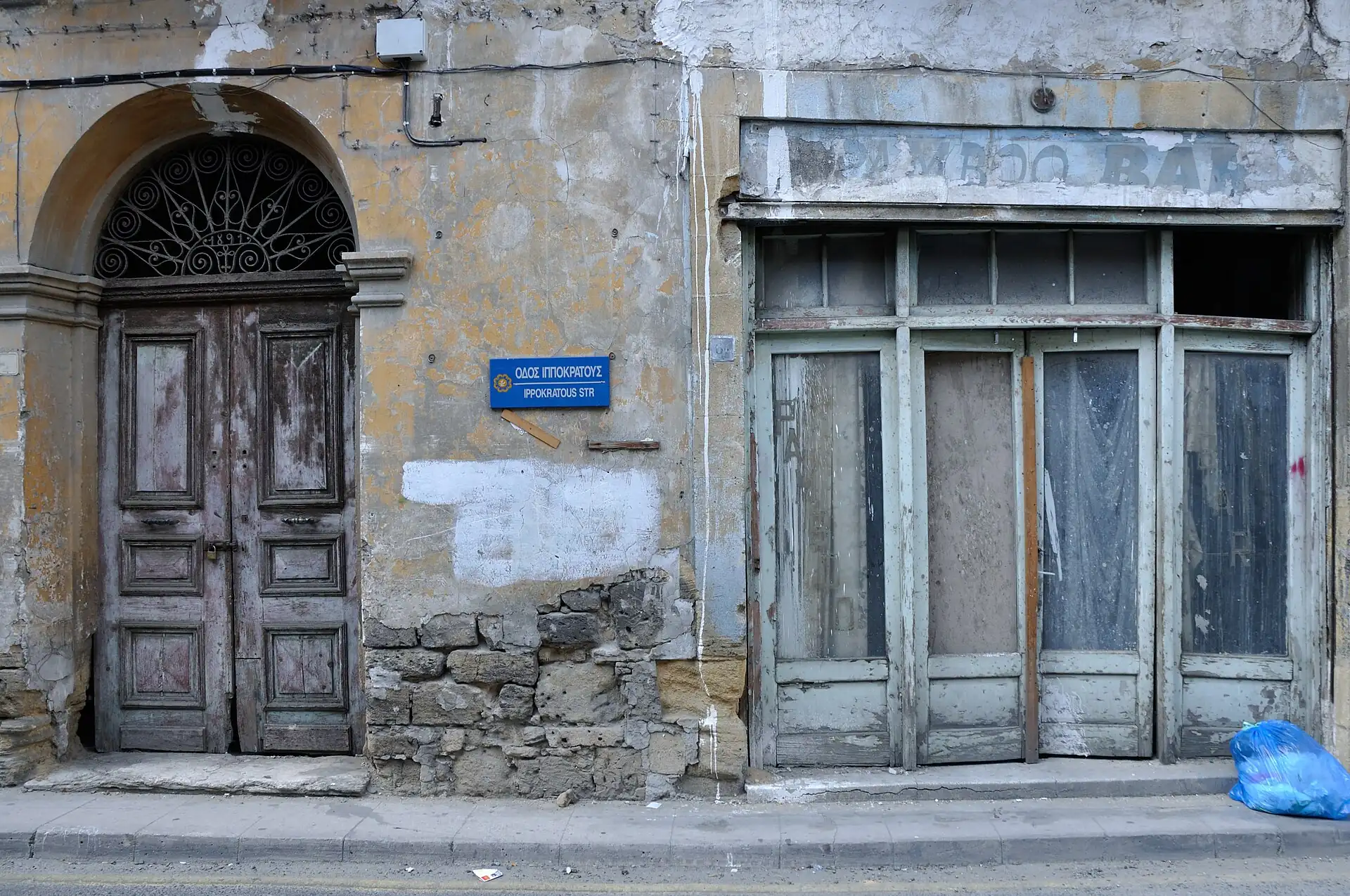
Places
“Best time” is when to arrive for the fewest crowds, for example “before 08:30”; “Go any time” means the hour makes little difference. More sights follow under “More sights and museums”.
6 places. Filters use the guide’s own ratings; a place with no rating is left out when a filter is on.
Tours, classes and shows in Nicosia →
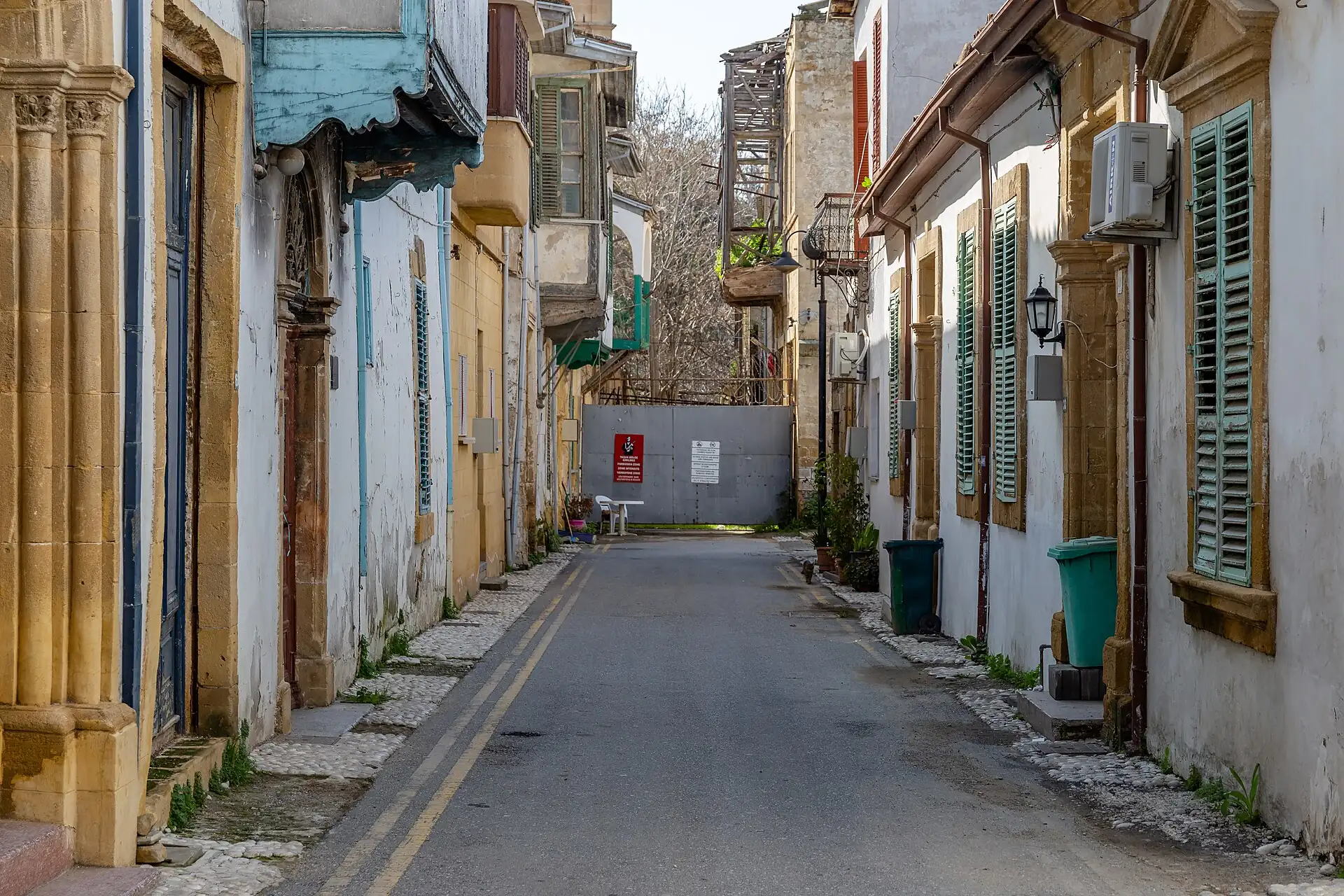
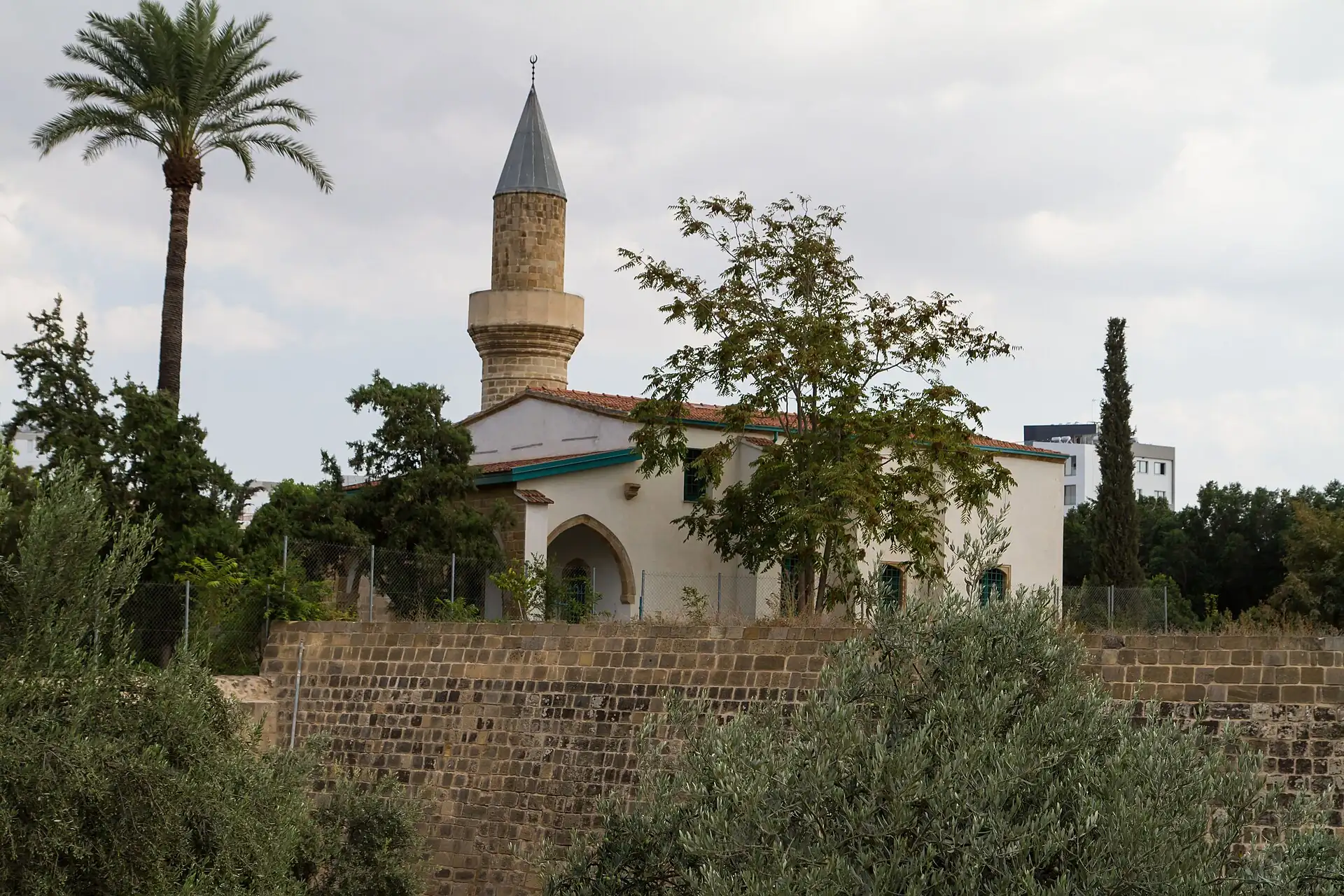
If you do ten things in Nicosia
Ranked for a first visit of 2–3 days. Prices are 2026 estimates in euros.
- 1
The island's main archaeology museum, air-conditioned and a good midday stop.
- Time
- 1.5 h
- Best
- At opening
- Cost
- EUR 3–6 (≈ US$4–7)
- 2
The Venetian circle of eleven bastions at its best.
- Time
- 45 min
- Best
- Morning
- Cost
- Free
- 3
Laiki Geitonia at dusk
Restored lanes with terraces and craft shops, cool after sunset.
- Time
- 1–2 h
- Best
- 18:30–21:00
- Cost
- Free to walk
- 4
The best way to eat a lot of Cyprus in one evening.
- Time
- 2 h
- Best
- Evening
- Cost
- EUR 22–35 (≈ US$30–45)
- 5
One of the largest icon collections in the Mediterranean.
- Time
- 1 h
- Best
- Weekday morning
- Cost
- EUR 3–6 (≈ US$4–7)
- 6
A short lift ride to a view over the divided city.
- Time
- 30 min
- Best
- Late afternoon
- Cost
- EUR 2–4 (≈ US$3–5)
- 7
- 8
A small church full of 18th-century wall paintings.
- Time
- 20 min
- Best
- Morning
- Cost
- Free or a donation
- 9
Crossing to North Nicosia on foot
The clearest way to understand the divided city.
- Time
- 3–4 h
- Best
- Morning
- Cost
- Free; passport needed
- 10
Troodos villages
Mountain air and painted Byzantine churches.
- Time
- Full day
- Best
- Weekday
- Cost
- Hire car or tour
Good for…
Verdict is how well Nicosia works for that traveller, not how nice it is.
Compact and easy: two days cover museum, walls and lanes.
- 1Cyprus Museum — the indoor anchor for a hot day.
- 2Laiki Geitonia at dusk — the classic old-town evening.
Meze, halloumi and grills are reason enough to come.
- 1Zanettos Taverna — a proper meze in the old town.
- 2Bakery: flaounes, koulouri and cheese pies — Cypriot pastries at breakfast.
- 3Souvlaki and sheftalia counter, old town — a cheap, filling counter lunch.
Street food and free sights help, but hotels and taxis add up.
- 1Souvlaki and sheftalia counter, old town — a meal for under EUR 7 (≈ US$9).
- 2Walking the walls — free and a good morning.
- 1A restored old-town guesthouse — quiet evenings in the lanes.
- 2Zanettos Taverna — a slow meze dinner.
Short indoor stops and taxis make it work; cobbles limit strollers.
- 1Cyprus Museum — short, air-conditioned galleries.
- 2Cypriot coffee and loukoumades café — a sweet stop kids like.
- 1A restored mansion hotel — quiet rooms and a courtyard.
- 2A private driver to Troodos — removes the hire-car stress.
Cobbles and high kerbs in the old town; use Makarios Avenue and museums with ramps.
- 1Cyprus Museum — lifts and ramps (check).
- 2Ledra Observatory — a lift to the top (check).
Tours and classes: book or skip
Book through the hotel or a licensed operator with written inclusions and a cancellation policy. Prices per person, group tour unless stated.
| Tour or class | Verdict | Typical price | Why | Check before paying |
|---|---|---|---|---|
| Walking tour of the old town and the buffer zone | book | EUR 20–40 (≈ US$25–50) (check) | A guide explains the division and the walls in a way a map does not. | Whether the crossing to the north is included and whether passports are needed. |
| Day trip to Troodos villages and painted churches | book | EUR 45–90 (≈ US$55–110) (check) | Saves hire-car stress and includes a guide. | Church entry fees, lunch and pick-up point. |
| Kyrenia and the north coast day trip | maybe | EUR 45–80 (≈ US$55–95) (check) | Useful if you want a guide for the crossing. | Whether the tour crosses at Ledra Street and how long each stop is. |
| Cyprus wine route | maybe | EUR 60–120 (≈ US$70–140) (check) | Villages and cellars in one day. | Tastings included, a designated driver and the return time. |
What each season brings
Spring
Mar–May
Mild weather, blossom and green fields; the best walking weather.
Watch: Easter crowds and closures; some rain in March.
Summer
Jun–Aug
Long evenings, festivals and late meze dinners.
Watch: 38–40°C in July and August; outdoor stops before 11:00 only.
Autumn
Sep–Nov
Warm days and cooler evenings; grape harvest and quieter streets.
Watch: First rains in November; September is still hot.
Winter
Dec–Feb
Mild, quiet and cheap; snow on Troodos in January and February.
Watch: Cool nights, wet days and reduced opening hours.
Photo spots and the light
Light times are for clear days.
| Spot | Best light | Tip |
|---|---|---|
| Famagusta Gate and the walls | Morning and late afternoon | Shoot the gate from the inner lane; use the walls for the bastion line. |
| The view from the observation floor | Late afternoon | Do not photograph soldiers or posts; frame the rooftops and the old town. |
| Laiki Geitonia lanes | Late afternoon and dusk | Ask before photographing people at tables; step aside from doors. |
| Icons and the church interior | Indoor | Photography rules apply; ask at the desk. |
Nicosia travel FAQ
Answers are 2026 desk estimates; fares and rules marked (check) change.
Is Nicosia worth a visit?
Yes for one or two days: the museum, the walls, the lanes and the divided-city story are compact and easy to combine.
Can I cross to the north?
Yes, at the official checkpoints, on foot at Ledra Street, with your passport. Rules for hire cars, goods and photography change, so check the current guidance at the crossing.
Do I need euros?
Yes in the south; cards work in most places. In the north the currency is the Turkish lira, though euros are often taken at tourist shops (check).
Is tap water safe?
Yes, though many people prefer bottled water because of the taste.
How far is the airport?
Larnaca airport is about 45 km (28 mi) and 45 minutes by road; Paphos airport is much further.Larnaca airport is about 28 mi (45 km) and 45 minutes by road; Paphos airport is much further.
How many days do I need?
Two days cover the four clusters; add a day for Troodos or the north.
What should I wear in churches and mosques?
Shoulders and knees covered; a light scarf works for both.
Taxi, app or bus?
Taxis with a meter or a ride-hailing app for most trips; buses only if you have checked the route.
Is Nicosia hot?
Yes in summer: 37°C (99°F) is common in July and August. Do outdoor stops before 11:00 and after 17:30.Yes in summer: 37°C (99°F) is common in July and August. Do outdoor stops before 11:00 AM and after 5:30 PM.Yes in summer: 99°F (37°C) is common in July and August. Do outdoor stops before 11:00 and after 17:30.Yes in summer: 99°F (37°C) is common in July and August. Do outdoor stops before 11:00 AM and after 5:30 PM.
Which area is best to stay in?
The old town for atmosphere; Makarios Avenue for lifts, level pavements and easy taxis.
More to see and doSee & do · Learn & work · Rain & heat · Free things · Wheelchair and stroller
Free things to do
Sights in Nicosia that cost nothing to enter. Each is described under Places or More sights; extra costs inside are marked there.
Wheelchair and stroller, place by place
How each place in this guide works for wheels, from its own page. Ratings are desk estimates unless a page says it was checked on the ground.
| Place | Step-free | Wheelchair | Stroller | What to know |
|---|---|---|---|---|
| Byzantine Museum and Art Galleries | partial | caution | ok | A historic complex with some steps; ask at the desk for the accessible route (check). |
| Cyprus Museum | yes | good | good | Lifts and ramps reach the galleries (check). |
| Famagusta Gate | partial | caution | ok | Cobbles and a ramped passage (check). |
| Ledra Observatory | yes | good | ok | A lift reaches the top floor; check the ground-floor entrance. |
| Leventis Municipal Museum of Nicosia | partial | caution | ok | A historic building with steps and small rooms; check the access route. |
| St John's Cathedral | partial | caution | ok | A step at the door; ask a caretaker for help (check). |
See & do
15 of 15
- Museums
The island's main archaeology museum: air-conditioned galleries from the Neolithic to the Roman era.
Paphos Gate · Weekday day hours; closed Mon (check) · EUR 3–6 (≈ US$4–7) (check)(check)
- monument
A Venetian gate at the end of the old town's main street, now used for exhibitions.
Famagusta Gate · Exhibition hours (check) · Free to walk around
One of the largest collections of Byzantine icons in the Mediterranean, in the Archbishop Makarios III Foundation.
Archbishop's Palace · Weekday day hours (check) · EUR 3–6 (≈ US$4–7) (check)(check)
- church
A small 18th-century Orthodox cathedral covered in painted scenes; a quiet ten minutes.
Archbishop's Palace · Day hours; services (check) · Free or a small donation (check)(check)
A city museum that tells Nicosia's story from the Bronze Age to today, in a restored old-town house.
Laiki Geitonia · Weekday day hours (check) · Free or low (check)(check)
- Views
An observation floor at the top of a tower on Ledra Street with a view over the old town and the buffer zone.
Ledra Street · Daytime (check) · EUR 2–4 (≈ US$3–5) (check)(check)
Laiki Geitonia lanes
streetRestored houses, craft shops and terraces; best at dusk.
Old town · Open lanes · Free
Ömeriye Mosque (exterior)
mosqueA mosque in a former Augustinian church; a respectful view from outside, with entry at the caretaker's discretion.
Old town · Outside prayer times (check) · Free(check)
NiMAC arts centre
galleryNicosia Municipal Arts Centre in a former power station; a good air-conditioned stop next to the gate.
Famagusta Gate · Exhibition hours (check) · Free or low (check)(check)
The Venetian walls and Paphos Gate
monumentThe circle of eleven bastions; the sections near the Paphos and Famagusta gates are the easiest to walk.
Old town · Open · Free
Walk the Venetian walls
walkAbout an hour, best before 10:00 when the light is soft and the streets are quiet.About an hour, best before 10:00 AM when the light is soft and the streets are quiet.
Old town · Early morning · Free
Cross to North Nicosia on foot
day tripGo with your passport; walk to the Selimiye Mosque and the Büyük Han and return before dark (check current rules first).
Ledra Street · Daytime (check) · Free
A long meze dinner
foodAsk the waiter for the meze and tell them when to stop; the meal takes two hours.
Old town · From 19:30From 7:30 PM · EUR 22–35 (≈ US$30–45) per person
Cypriot cooking class
ClassesLearn halloumi, koupepia and Cyprus salad; book ahead.
Old town or new town (check operator) · Half day · EUR 50–90 (≈ US$60–110) (check)
Wine tasting on the island
tastingLocal grapes such as Xynisteri and Maratheftiko; ask your hotel.
Nicosia or nearby villages (check) · Afternoon · EUR 15–40 (≈ US$18–50) (check)
- Booking
- Cooking classes, wine tastings and driver-guided village days are best booked a day or two ahead through your hotel or a licensed operator.
Learn & work
| What | Where | Cost | Note |
|---|---|---|---|
| Greek lessons for visitors | Language schools in Nicosia (ask your hotel; check) | Check current fees | Short intensive courses and one-to-one lessons are usually available. |
| Cypriot cooking | Cooking schools and guesthouses (check) | EUR 50–90 (≈ US$60–110) (check) | Half-day sessions covering halloumi, meze and Cypriot sweets. |
| Lace and pottery workshops | Old-town studios and the handicraft centre (check) | EUR 20–60 (≈ US$25–70) (check) | Short classes; book through the studio. |
Working here
- Tourist entry
- Cyprus is in the EU but outside the Schengen area; visa rules depend on your passport. Tourist entry does not allow paid work.
- Work permit
- Non-EU citizens need an employer-sponsored permit and residence formalities; EU citizens can work with a simple registration.
- Remote work
- A digital-nomad visa has existed for non-EU remote workers (check the current conditions and income rules); tourist entry alone is a grey area.
Rain-day and heat-day plan
Rain day
Winter rain comes in short, heavy showers: plan the Cyprus Museum and the Byzantine Museum for the wet hour and the walls for the dry one.
- 01Cyprus Museum — Indoor galleries; about an hour and a half.
- 02Byzantine Museum and Art Galleries — Icons and frescoes indoors; about an hour.
- 03Leventis Municipal Museum of Nicosia — Indoor city museum; about an hour.
- 04Mayirika: Cypriot home-style lunch — A long lunch under cover.
Heat day
In June to September do outdoor stops before 11:00 and after 17:30, and spend the middle of the day in an air-conditioned museum or café.
- 08:30Famagusta Gate — The walls are cool and quiet early.
- 10:30Cyprus Museum — Indoor and air-conditioned for the rising heat.
- 13:00Mayirika: Cypriot home-style lunch — Long lunch under shade.
- 18:30Ledra Observatory — Evening light over the buffer zone and the old town.
Day-trips and nearby
Places you can reach from Nicosia in a day or with one night away, with the route and what it costs. Door to door, not ride time.
Kyrenia (Girne) in the north
checkCross on foot at Ledra Street, then taxi or bus, about 40 min
The harbour and castle town on the north coast; carry your passport and check current crossing and car-hire rules first.
- Time
- Full day
Troodos mountains villages
goHire car about 1–1.5 h
Cool air, painted Byzantine churches (a UNESCO group) and walking trails; a hire car makes it easy.
- Time
- Full day
Larnaca and Choirokoitia
goBus or car 45 min–1 h
Salt lake, the seafront and a Neolithic village site on the way; a good way to end a trip by the airport.
- Time
- Full day
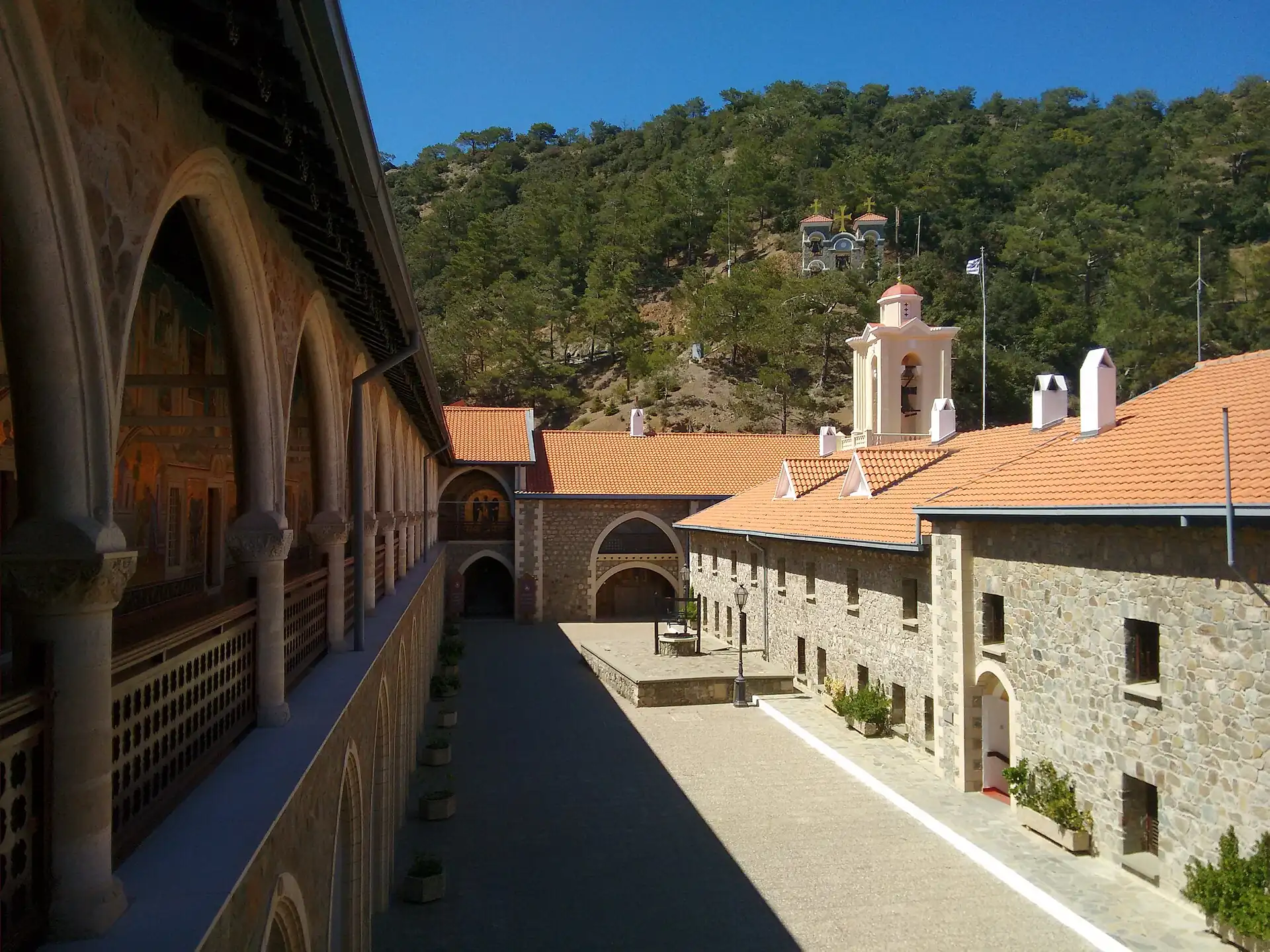 Photo: Héctor Ochoa 'Robot8A', CC BY-SA 4.0
Kykkos Monastery
cautionHire car about 1.5–2 h
A large mountain monastery with a museum; a long day by car, so combine it with Troodos villages.
- Time
- Full day
Go next
Limassol
goDoor to door: About 1–1.5 h
Bus or car about 1 h
Seafront, castle and old port; a city day out with a swim.
Paphos
overnightDoor to door: About 2 h
Bus or car about 1.5–2 h
Mosaics, tombs and harbour; better with a night than as a day trip.
Eat & sleepWhere to eat and which area to sleep in
Eat & sleep
Where to eat and which area to sleep in
Eat
A short list of places worth crossing the city for, each with how to get a seat.
Restaurant finder: filter every place to eat in Nicosia →
Vegetarian-friendly score
2.0 / 5 · Workable
- Country diet noteOur country guide rates vegetarian eating as mixed.0.75 / 2
- Places to eat in this guide2 of 5 places with a known answer are vegetarian-friendly, 3 partly.1.05 / 1.5
- Budget eating lines0 vegetarian lines in "Eat by budget".0 / 0.6
- Meat-free national dishes5 meat-free dishes in the country food list.0.4 / 0.4
- Dedicated vegetarian kitchens0 mentions of vegetarian restaurants, Buddhist or fasting kitchens.0 / 0.5
Country note: Halloumi, salads, dips, louvi and fasting dishes make it easy; meze is meat-heavy but kitchens adapt.
Vegetarian places near me →Make a diet card →
How we score
- Country diet note (up to 2): easy 2, workable 1, mixed 0.75, hard 0; no note 0.5.
- City places to eat (up to 1.5): 1.5 × (vegetarian-friendly + half of partly friendly) ÷ places with a known answer; needs 3 or more known places.
- Budget eating lines marked vegetarian (up to 0.6): 0.2 each.
- Meat-free national dishes (up to 0.4): 0.1 each.
- Dedicated vegetarian kitchens mentioned — Buddhist chay, shōjin ryōri, Jain, fasting food, vegan cafés (up to 0.5): 0.1 each.
- Total rounded to the nearest half point, 0 to 5. Built from our own pages only, not from reviews.
Eating and drinking guideEat by budget · Drink
Before you sit down to eat
Short version; full text linked
Eat by budget
Under EUR 8 (≈ US$10) a meal
| Where | Order | Area | Price | Note |
|---|---|---|---|---|
| Souvlaki and sheftalia counter, old town | Souvlaki or sheftalia in pitta | Old town | EUR 4–7 (≈ US$5–9) | Ask for it with the salad and tzatziki. |
| Bakery: flaounes, koulouri and cheese pies | Flaouna, koulouri or a cheese pie | Old town and Makarios Avenue | EUR 1.50–3.50 (≈ US$2–5) | Best in the morning while warm. |
| Cypriot coffee and loukoumades café | Cypriot coffee and loukoumades | Old town | EUR 4–8 (≈ US$5–10) | A sweet stop; ask for the honey and cinnamon. |
Dishes to know
| Dish | What it is | Where to look | When | Price |
|---|---|---|---|---|
| Halloumi | A firm sheep and goat cheese, grilled or fried | Everywhere | Any meal | EUR 4–9 (≈ US$5–11) |
| Meze | A series of small dishes: salads, dips, grilled meat and fish | Tavernas | Dinner | EUR 22–35 (≈ US$30–45) |
| Souvlaki and sheftalia | Grilled pork or chicken skewers; sheftalia is a herbed sausage | Grill counters | Lunch, late night | EUR 4–7 (≈ US$5–9) |
| Kleftiko | Lamb slow-cooked in an oven with potatoes and herbs | Tavernas and mayirika restaurants | Lunch, dinner | EUR 12–18 (≈ US$14–25) |
| Koupepia | Vine leaves stuffed with rice, herbs and sometimes mince | Tavernas | Meze, lunch | EUR 5–9 (≈ US$6–11) |
| Afelia | Pork cooked in red wine and crushed coriander seed | Tavernas | Lunch, dinner | EUR 10–14 (≈ US$12–17) |
| Flaouna | A small cheese and mint pastry, traditional at Easter | Bakeries | Breakfast, snack | EUR 1.50–3 (≈ US$2–4) |
| Loukoumades | Fried dough balls with honey syrup and cinnamon | Cafés and bakeries | Afternoon, dessert | EUR 3–6 (≈ US$4–7) |
| Cypriot coffee | Strong coffee served in a small cup with the grounds | Cafés | Any time | EUR 2.50–3.50 (≈ US$3–5) |
- Ask whether meze is per person and what it includes before you order.
- Lunch starts about 12:30 and dinner about 19:30; kitchens often close between them.Lunch starts about 12:30 PM and dinner about 7:30 PM; kitchens often close between them.
- Say when to stop: meze keeps coming until you tell the waiter.
Drink & nightlife
| Where | What | Until | Note |
|---|---|---|---|
| Laiki Geitonia and Ledra Street terraces | Cafés, wine bars, meze taverns | About 01:00About 1:00 AM | The main tourist evening strip; prices are higher than in the side lanes. |
| Faneromeni and Onasagorou streets | Bars, live music, student-friendly | Late on weekends | The younger, lively end of the old town; check which bars are open on the night. |
| Makarios Avenue and Stasikratous | Cocktail bars, hotel terraces | About midnight | Quieter and more polished; taxis are easy to find. |
By style
| Style | What | Where | Price | Until |
|---|---|---|---|---|
| Beer and meze | KEO or Leon beer with halloumi, olives and grilled meatThe default evening out; bars serve food with drinks. | Old-town tavernas | EUR 3.50–5 (≈ US$5–6) a beer | Late |
| Cypriot wine and Commandaria | Xynisteri whites, Maratheftiko reds and the sweet CommandariaAsk for a local wine by the glass; the island has a growing wine scene. | Wine bars and tavernas | EUR 4–7 (≈ US$5–9) a glass | Late |
| Zivania | A clear grape spirit served in small glassesStrong; sip it, and expect a second glass to arrive as a gesture. | Tavernas after a meal | EUR 2–4 (≈ US$3–5) | Late |
| Freddo espresso and cold coffee | Iced espresso and frappéA summer staple; ask for sketo (no sugar) or metrio (medium). | Any café | EUR 2.50–4 (≈ US$3–5) | Daytime |
Rules that bite
- No open-container ban in the old town, but drinking on the street outside a bar draws attention; stay on the terrace.
- Do not photograph soldiers or buffer-zone posts, even from a terrace.
Sleep
Pick the area first: it decides your walk home at night and your first morning.
Which neighborhood fits you
Three questions, one recommendation, with the reasons.
Your best fit
- Museum, walls, lanes and the crossing are all within a 15-minute walk.
Next best: Makarios Avenue
Built from our 1–5 desk scores per area; your answers stay in this browser.
More on sleepingSleep by budget · Your area · With kids
Sleep by budget
| Band | Price | Where | Room types | What to expect |
|---|---|---|---|---|
| budget | EUR 40–70 (≈ US$50–85) | Old town guesthouses, hostels | Hostels and small guesthouses | Simple rooms, air-conditioning, limited breakfast. |
| mid | EUR 80–140 (≈ US$95–170) | Old town and Makarios Avenue | 3–4 star hotels and boutique houses | Lift or courtyard, breakfast, air-conditioning. |
| splurge | EUR 160–300 (≈ US$190–350)+ | New town and old-town boutique houses | 5-star hotels and restored mansions | Pool, spa, valet, quiet rooms. |
Booking checks
- Air-conditioning is essential from June to September; confirm it works before you book.
- Old-town guesthouses may have steps and no lift; ask before you book if you have bags or mobility limits.
- Ask about the late check-in procedure if you land after 21:00.Ask about the late check-in procedure if you land after 9:00 PM.
Which area is yours
| If you are | Sleep in | Because |
|---|---|---|
| First visit, 2 nights, atmosphere first | Old Town (Laiki Geitonia) | Walk to the lanes and museum; choose a hotel with a staffed desk. |
| Business trip or bags and lifts first | Makarios Avenue | Modern hotels, level pavements and a short walk to the old town. |
| Families with a stroller | Makarios Avenue | Smooth pavements and lifts; taxi into the old town. |
First-timers: hotels inside the walls near Laiki Geitonia, a walk from the museum and Ledra Street; choose one with a 24h desk and a car-reachable door.
Modern hotels with lifts, a car at the door and a 10-minute walk to Eleftheria Square; less atmosphere, more ease.
Areas are in our default order until you tick a priority.
Scores are 1–5 desk judgements per priority (2026).
With kids
- Old-town lanes are cobbled and step-heavy: a carrier works better than a stroller inside the walls; Makarios Avenue and the new-town parks are smoother.
- The Cyprus Museum has short, seated, air-conditioned rooms that work as a heat break.
- The Ledra Observatory view of the buffer zone is short and free of steps except the lift.
- Taxis usually have no child seats: bring a travel booster or ask the hotel.
- In July and August, plan outdoor play in the evening after 18:30 only.In July and August, plan outdoor play in the evening after 6:30 PM only.
PracticalMoney, essentials, safety and the pocket card
Practical
Money, essentials, safety and the pocket card
Money
What a day costs at three comfort levels, and how to pay.
- Budget
- EUR 40–70 (≈ US$50–85) excl. bed / day
- Mid
- EUR 70–130 (≈ US$85–160) excl. bed / day
- High
- EUR 130 (≈ US$160)+ excl. bed / day
- Transit card
- No transit card needed: walking, taxis and ride-hailing.
- Cash rule
- Keep EUR 30 (≈ US$35) in small notes for kiosks and taxis; withdraw at bank ATMs.
More on moneyCosts · Budget · Buy
What things cost
- Souvlaki or sheftalia in pitta, takeawayEUR 4–7 (≈ US$5–9)
- Lunch plate at a home-style taverna (mayirika)EUR 9–15 (≈ US$11–18)
- Full meze, per person, at a tavernaEUR 22–35 (≈ US$30–45)
- Bottle of water, shopEUR 0.50–1.00 (≈ US$1–2)
Trip budget
| Hotel double room1 × 3 nights × €110 | €330 |
| Food, local transport, entries2 × 3 days × €95 | €570 |
| Airport transfer, both ways1 × €110 · one taxi per 4 people (check) | €110 |
| Museum entries, three2 × €15 | €30 |
| Tourist SIM, about a week2 × €10 | €20 |
| Buffer 12%Price creep, a taxi you did not plan, one splurge | €127 |
| Trip total≈ €198 per person per day, bed included | €1,187≈ US$1,400 |
2026 estimate in euros; flights, visas and tours excluded. Your choices stay in this browser.
Prices of common things
| Souvlaki in pitta | EUR 4–7 (≈ US$5–9) |
2026 estimate; check locally.
Buy
- Bargaining
- Prices are fixed in shops. At craft stalls and in the north's bazaar, a friendly discount of 10–20% is usual; do not bargain in shops with printed tags.
- Fixed-price check
- Compare lace, silver and halloumi in a supermarket or the state handicraft centre before you buy at a tourist stall; that is your reference price.
Markets and shopping streets
| Where | What | When | Haggle | Note |
|---|---|---|---|---|
| Central Market (Pagkypria Agora) | Fruit, vegetables, cheese, olives and meat | Morning, closed most afternoons and Sundays (check) | no | The everyday market of the old town; go before noon for the freshest produce. |
| Laiki Geitonia craft shops | Lace, pottery, silver, embroidery, olive-wood | About 10:00–19:00, shorter in winter (check)About 10:00 AM–7:00 PM, shorter in winter (check) | light | The most visitor-oriented shopping in the old town; check which items are made in Cyprus. |
| Cyprus Handicraft Service shop | State-run crafts: lace (Lefkara), pottery, basketry | Weekday day hours (check) | no | Fixed prices and a guarantee of local origin; the reference for craft prices. |
| Supermarkets | Halloumi, olives, wine, snacks | About 08:00–20:00, longer on weekdays (check)About 8:00 AM–8:00 PM, longer on weekdays (check) | no | Halloumi vacuum packs and Commandaria wine are cheaper than in gift shops. |
Shops by what they sell
| For | Where | Hours | Note |
|---|---|---|---|
| Halloumi, olive oil, carob syrup and dried fruit | Supermarkets and the Central Market | — | Vacuum-packed halloumi travels in cabin luggage if wrapped; check your destination's dairy rules. |
| Lefkara lace and silver | Laiki Geitonia and the Handicraft Service shop | — | Ask if it is made locally: cheaper imports are common. |
| Commandaria and zivania | Wine shops and supermarkets | — | A sweet dessert wine and a strong grape spirit; check your allowance. |
Changing money
| Where | Verdict | Why |
|---|---|---|
| Bank branches (Bank of Cyprus, Hellenic Bank) | use | Fair rate; passport needed; office hours only. |
| Cash machines in banks | use | The simplest way to get euros; your own bank charges apply. |
| Exchange bureaux on Ledra Street | ok | Compare commission before you change. |
| Exchange offices in the north (for lira) | ok | Change small amounts only; euros are often taken but at a weak rate (check). |
ATMs
- Per withdrawal
- Most machines allow EUR 300–500 (≈ US$350–600) per withdrawal; the screen shows the cap.
- Fees
- Your bank's foreign fee applies outside the euro area; bank-owned machines charge less than stand-alone ones.
- Where
- Machines in bank branches and on Makarios Avenue and Eleftheria Square.
- Conversion
- If a machine or terminal offers to charge in your home currency, decline and pay in euros.
Essentials and accessEssentials · Access
Essentials
- Plugs & power
- 230 V, 50 Hz; UK-style three-pin sockets (type G). Bring an adapter.
- Toilets
- Cafés, museums and malls; public toilets are few and often need a coin. Buy a coffee and use the café's.
- Opening hours
- Shops open about 08:30–13:00 and 16:00–19:00 on some days, with a long afternoon break on hot days and on Wednesday afternoons (check); larger shops and malls run all day. Museums usually close on Monday. Restaurants serve lunch 12:30–15:00 and dinner from 19:30.Shops open about 8:30 AM–1:00 PM and 4:00 PM–7:00 PM on some days, with a long afternoon break on hot days and on Wednesday afternoons (check); larger shops and malls run all day. Museums usually close on Monday. Restaurants serve lunch 12:30 PM–3:00 PM and dinner from 7:30 PM.
- Health
- Sun and heat (July and August above 38°C (100°F)), dehydration, and sea-urchin spines on the coast. EU citizens: bring the EHIC or GHIC card; everyone: travel insurance.Sun and heat (July and August above 100°F (38°C)), dehydration, and sea-urchin spines on the coast. EU citizens: bring the EHIC or GHIC card; everyone: travel insurance.
- Accessibility
- Old-town lanes are cobbled and uneven, with high kerbs; newer streets and Makarios Avenue are smoother.
- Laundry
- Hotels charge by the item; self-service laundrettes exist on the new-town side (ask your hotel).
- Emergency numbers
- 112 (EU number) or 199 for police, fire and ambulance.
Pack
- A brimmed hat, sunglasses and high-factor sunscreen
- Shoes with grip for cobbles and worn marble steps
- A light scarf or shawl to cover shoulders in churches and mosques
- A light layer for cool winter evenings and air-conditioned museums
- Passport (not a copy) if you plan to cross to the north
Accessibility
The old town is difficult on wheels: cobbles, uneven pavements and high kerbs. The new town and Makarios Avenue are smoother. Museums and newer hotels usually have ramps and lifts.
- Pavements
- Uneven cobbles and worn stones in the old town; smooth pavements on Makarios Avenue and around Eleftheria Square.
- Getting around
- Taxis and ride-hailing cars are the step-free option; buses are rarely step-free (check).
- Hotels
- Modern hotels on Makarios Avenue have lifts and accessible rooms; many old-town guesthouses have steps.
- Toilets
- Accessible toilets in museums, malls and larger hotels; rare in the lanes.
- Crossing to the north
- The Ledra Street crossing is on foot along a paved path; check with the officers about assistance.
Sights, step-free or not
| Cyprus Museum | good | Lifts and ramps to the galleries (check). |
| Byzantine Museum and Art Galleries | with help | Steps at the entrance; check the current access route. |
| Leventis Municipal Museum of Nicosia | with help | A historic building with some steps; check. |
| Famagusta Gate | with help | Cobbles and a ramped entrance (check). |
| Ledra Observatory | good | A lift reaches the top floor (check). |
Survive
Safety basics, the lines not to cross, and practical habits that save the day.
Safety
- Heat (July–August): no outdoor walking 12:00–16:30; drink water.Heat (July–August): no outdoor walking 12:00 PM–4:30 PM; drink water.
- Cobbles and worn steps in the old town: wear shoes with grip.
- Emergency: 112 (EU number) or 199.
Red lines
- Buffer zone and military areas: do not photograph, do not enter.
- Churches: covered shoulders and knees; no photos during services.
- Crossing to the north: passport required; follow the officers' instructions.
Practical
- Toilets: cafés and museums; carry small coins for public ones.
- Tap water is safe to drink but many people prefer bottled.
More on staying safeStay safe · Stay healthy · Safety map · Solo & women · Etiquette · Cope · Scams
After dark, by area
2 flagged areas
Buffer zone edges
Avoid after dark- Take care
Day = about 07:00–19:00. What to watch in each area, day and night →
Scams and red flags
Walk away if you see these
- Meters that are 'not working' or a fixed 'tourist' price for a short taxi: ask the driver to use the meter, or use a ride-hailing app that shows the fare first.
- A friendly stranger who invites you for a drink at a bar you have not chosen, followed by a very large bill: choose your own café and check prices on the menu.
- Unofficial 'guides' offering a shortcut across the buffer zone: crossing is only at the official checkpoints, on foot at Ledra Street, with your passport.
- Inflated prices for coffee and drinks on Ledra Street terraces at peak hours: read the menu before you sit.
Stay safe
Crossing the road
- 01Cars drive on the left and may not stop at zebra crossings: look right first, then left.
- 02Old-town lanes are shared by cars and pedestrians; step aside for cars in narrow lanes.
Hustles specific to this city
| Hustle | Where | The tell | What to do |
|---|---|---|---|
| Taxi with a broken meter | Taxi ranks, the airport | A fixed price is quoted well above the meter rate | Ask for the meter or use an app that shows the fare. |
| Terrace price shock | Ledra Street and Laiki Geitonia | No prices on the menu | Ask for the menu with prices before you sit. |
| Unofficial buffer-zone guide | Ledra Street area | A stranger offers a shortcut or private tour of the zone | Decline; use only the official crossing and marked viewing points. |
- Police
- 112 or 199; report thefts at the nearest station and keep the report for insurance.
- Buffer zone
- The zone is a military area; do not photograph soldiers or posts, or step past barriers.
- Heat
- Heat stroke is the most common problem in July and August; stay in the shade and drink water.
Stay healthy
- Heat
- July and August reach 38–40°C (100–104°F): outdoor stops before 11:00 and after 17:30, water every hour, sun hat and sunscreen.July and August reach 38–40°C (100–104°F): outdoor stops before 11:00 AM and after 5:30 PM, water every hour, sun hat and sunscreen.July and August reach 100–104°F (38–40°C): outdoor stops before 11:00 and after 17:30, water every hour, sun hat and sunscreen.July and August reach 100–104°F (38–40°C): outdoor stops before 11:00 AM and after 5:30 PM, water every hour, sun hat and sunscreen.
- Food and water
- Tap water is safe; food hygiene is high. Try local dairy and salads freely.
- Sun
- Strong sun all year; use sunscreen and a hat, even in winter.
- Sea and outdoors
- Sea urchins and jellyfish on rocky coasts; wear water shoes on day trips.
- Medical
- Standards are good; EU citizens can use the EHIC or GHIC; everyone should have travel insurance.
- Pharmacies
- Green-cross pharmacies with an on-call rota for nights and Sundays; your hotel can tell you which is open.
Hospitals and clinics: see Cope.
Safety by area and hour
| Area | Day | Night | What to watch |
|---|---|---|---|
| Laiki Geitonia and Ledra Street | fine | fine | Watch bags on crowded terraces on weekends. |
| Famagusta Gate quarter | fine | caution | Quiet residential lanes after dark; walk with a companion or take a taxi. |
| Cyprus Museum and Paphos Gate | fine | fine | Traffic on the ring road; use the crossings. |
| Makarios Avenue | fine | fine | Watch for pickpockets at busy café terraces. |
| Buffer zone edges | caution | avoid | Military posts and signs: do not photograph soldiers, cross barriers or wander into closed lanes. |
- Follow the signs at the buffer zone and do not photograph soldiers or military posts.
- Use the meter or an app; keep valuables out of sight on crowded terraces.
Solo, women and LGBTQ+ travellers
Solo
- Easy to manage: the old town is compact and lively until late. Use the meter or an app after dark.
- Cafés and tavernas are used to solo diners; ask for a half meze.
Women
- Generally comfortable in the south; dress modestly for churches and mosques.
- Some catcalling is possible in quiet streets after dark; a firm response and continuing to walk usually ends it.
LGBTQ+
- Same-sex relationships are legal in the Republic of Cyprus, and civil partnership exists. Attitudes are more conservative outside the capital; discretion is sensible.
- In the north, attitudes and laws differ; check current guidance before crossing.
Etiquette in Nicosia
- Churches
- Shoulders and knees covered; keep your voice low; no photos during services.
- Mosques
- Ask before entering; shoes off, women cover the hair; do not go during prayer times, especially Friday midday.
- Military and buffer zone
- Do not photograph soldiers, military posts or the buffer zone beyond marked viewing points.
- Coffee
- Cypriot coffee is served in a small cup with the grounds: do not stir, and leave the last sip.
- Meze
- Dishes arrive in waves and keep coming until you say stop; tell the waiter when you have had enough.
- Siesta hours
- Shops close for a long afternoon break in hot months; do not plan afternoon shopping.
- Politics
- The division of the island is a sensitive subject: listen more than you speak, and avoid taking sides in casual talk.
Cope
Hospitals and clinics that handle foreigners
| Where | Area | Use it for |
|---|---|---|
| Nicosia General Hospital | Strovolos, south-west of the old town | The main public hospital with a large emergency department; check current international-patient arrangements. |
| Private clinics (for example Apollonion and Aretaeio) | Strovolos and Engomi | Private hospitals used by visitors and expats; pay upfront, then claim from your insurer; check current services. |
| Pharmacies with a green cross | Citywide | An on-call rota covers nights and Sundays; your hotel can tell you which is open. |
Visa extensions
- Office
- Civil Registry and Migration Department in Nicosia; weekday office hours only. Check the address and hours before going.
- Extending
- Cyprus is in the EU but not in the Schengen area; the visa-free stay for eligible passports is limited, so check your allowance before you fly.
- Overstay
- Fines and an entry ban can follow an overstay; resolve any problem with the migration office before you leave.
Embassies and consulates
| Country | Address | Phone | Note |
|---|---|---|---|
| United Kingdom | High Commission, Alexander Pallis Street, Nicosia (check) | — | (check) |
| United States | Embassy, Metochiou and Ploutarchou Streets, Engomi (check) | — | (check) |
| Greece | Embassy, Nicosia (check) | — | (check) |
| France | Embassy, Nicosia (check) | — | (check) |
| Germany | Embassy, Nicosia (check) | — | (check) |
- Lost passport
- Report at the nearest police station, then your embassy or high commission for an emergency travel document; budget a few working days. Your passport also matters for crossing to the north.
- Police
- 112 or 199; report thefts at the nearest station and ask for the written report for insurance.
- Gyms and pools
- Day passes at larger hotel gyms and pools, roughly EUR 10–25 (≈ US$12–30) (2026 estimate).
- Co-working
- Several co-working spaces sell day passes in the new town and near the old town (check); many cafés welcome laptops.
- Laundry
- Hotels charge by the item; ask the front desk for a laundrette nearby.
Apps and offline kitOffline kit
Offline kit
Set up before you leave, so Nicosia still works with no signal or a dead roaming plan.
On your phone
- Maps: open the city in Google Maps, tap the place name, then Download offline map (or use an offline-maps app).
- Data: install an eSIM or buy a local SIM before the first taxi; the apps in this guide depend on it.
- Translation: download the local language for camera translation.
- Screenshots: booking confirmations, hotel address in the local script, and the emergency numbers.
This guide
Save the Nicosia guide and its pages on this device; it opens without a connection.
Phrases that do the work
Greeting
Hello (formal or to several people)
Γεια σας
yah sas
Greeting
Good morning
Καλημέρα
ka-lee-MEH-ra
Greeting
Good evening
Καλησπέρα
ka-lee-SPEH-ra
Thanks
Thank you
Ευχαριστώ
ef-ha-ree-STO
Thanks
Please, or you are welcome
Παρακαλώ
pa-ra-ka-LO
Café
A Cypriot coffee, medium sweet
Ένα κυπριακό μέτριο
EH-na kip-ree-a-KO MEH-tree-o
Food
The bill, please
Τον λογαριασμό, παρακαλώ
ton lo-ga-ree-as-MO pa-ra-ka-LO
Food
Is there meat in this?
Έχει κρέας;
EH-hee KREH-as
Taxi
To this address, please
Σε αυτή τη διεύθυνση, παρακαλώ
se af-TEE tee dee-EF-theen-see pa-ra-ka-LO
Everyday
Yes / No
Ναι / Όχι
neh / OH-hee
Pocket card
Fill in, then print or save as PDF
Stays in this browser only; nothing is sent anywhere.
NicosiaΛευκωσία
Pocket card · Voykit
My bed tonight
—
—
—
Σε αυτή τη διεύθυνση, παρακαλώTo this address, please
Emergency
- Police112 or 199
- Fire112 or 199
- Ambulance112 or 199
Embassy
Most embassies are in Nicosia's new town; write your own embassy's 24-hour line below.
My embassy: —
Fare anchors (2026 estimate)
- Airport to the city, taxi: EUR 45–70 (≈ US$55–85), about 45 min
- Short taxi ride, centre: EUR 6–10 (≈ US$7–12)
- Old town to the new town: EUR 5–8 (≈ US$6–10), or a 10-minute walk
Carry your passport when you cross to the north.
Deep diveHistory, reading, photos and every source
Deep dive
History, reading, photos and every source
Sources
- officialVisit Cyprus (Deputy Ministry of Tourism)
- officialHermes Airports (Larnaca)
- secondaryWikivoyage — Nicosia
Ask about Nicosia
Loading…
Was this useful?