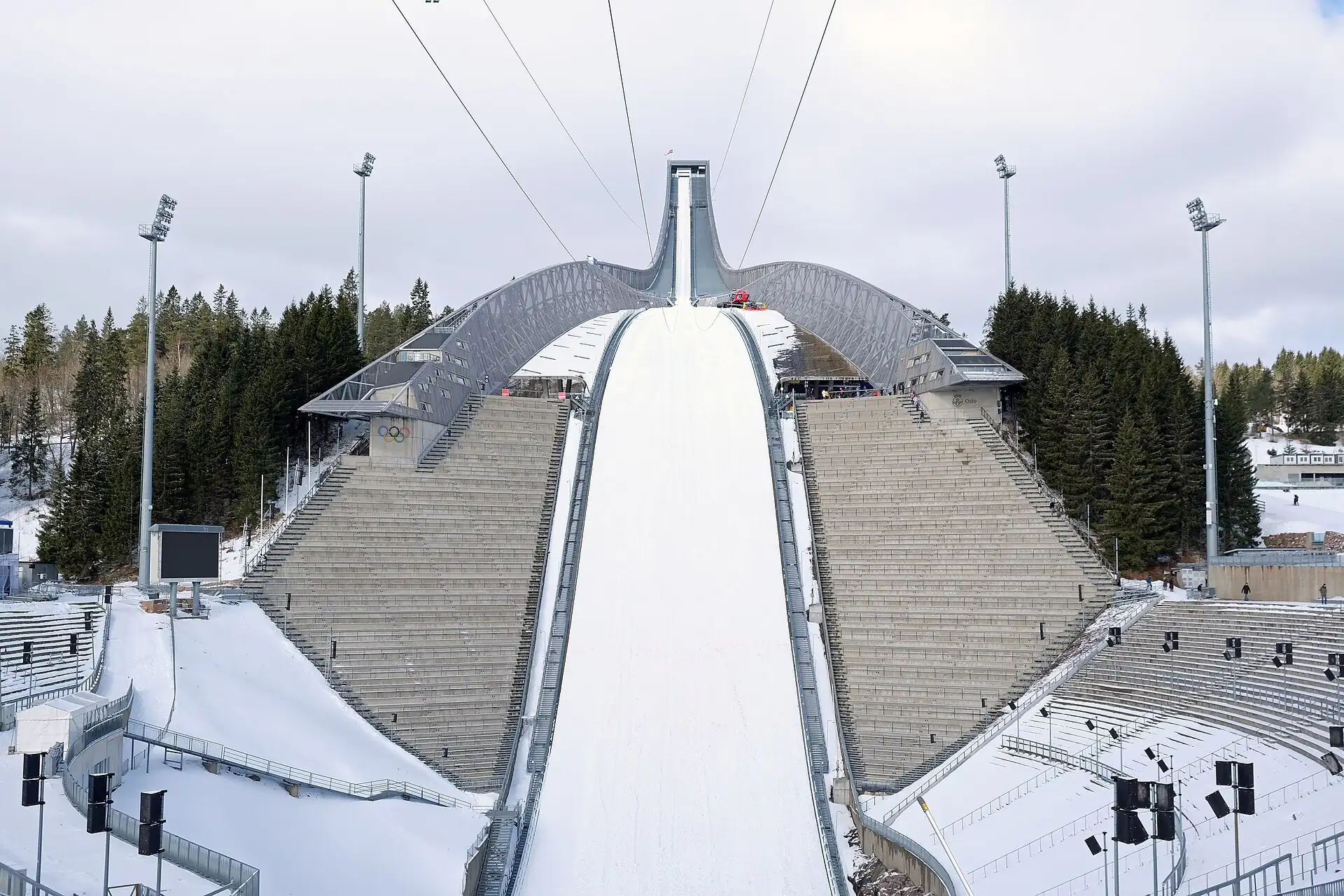
Oslo
Code NW · 4 walking zones
Oslo is a walk-and-ferry city: the harbour front, the Opera House roof and the museums in two days, with one indoor day for rain; it is expensive, so book the bed and eat from bakeries and food halls.
Our quick read of Oslo, scored 1–5 (friction is out of 100). Cash need: how often you still need notes. Heat risk: how hot days get. Stroller: how easy wheels are. Friction: overall effort for a first visit. Desk judgements, so check before relying on them.
- Local time
- --:--
- Weather
- forecast below
- Currency
- NOK
- Best months
- Apr · May · Jun · Aug · Sep
- Airport
- Oslo Airport, Gardermoen (OSL)
Walking zones: the 4 areas this guide plans a day around. Each is a district you can cover on foot, so you do one zone per half-day and ride the train between them. The code (NW 01, NW 02…) is just the zone's number on the Oslo line; the line under each name says how bags fare there and how much time it needs.
Map of Oslo
Use the switches to show or hide each kind of pin. A switch that is on shows its pins on the map; tap it again to hide them. "Show only" keeps just the pins that match (for example, places that fit a suitcase). Tap any pin for its name and a link to its page.
- Where to sleep
- Places
- Eat
- Walking clusters
- Rest stops
From the airport , Gardermoen (OSL) to your bed
Tap a pin for its card. Places without their own coordinates are shown by their walking cluster.
Why Oslo
Oslo is small for a capital: the centre, the harbour and the museums sit within a few kilometres, and a single transit ticket covers trams, buses, metro and the fjord ferries. The trips that go wrong pay for taxis, expect summer light in winter, or arrive after the last airport train without a plan. Four clusters cover a first visit: Karl Johans gate, the harbour front with the fortress, the Bjørvika waterfront with the Opera House, and Grünerløkka for cafés and food.
See first
- 1
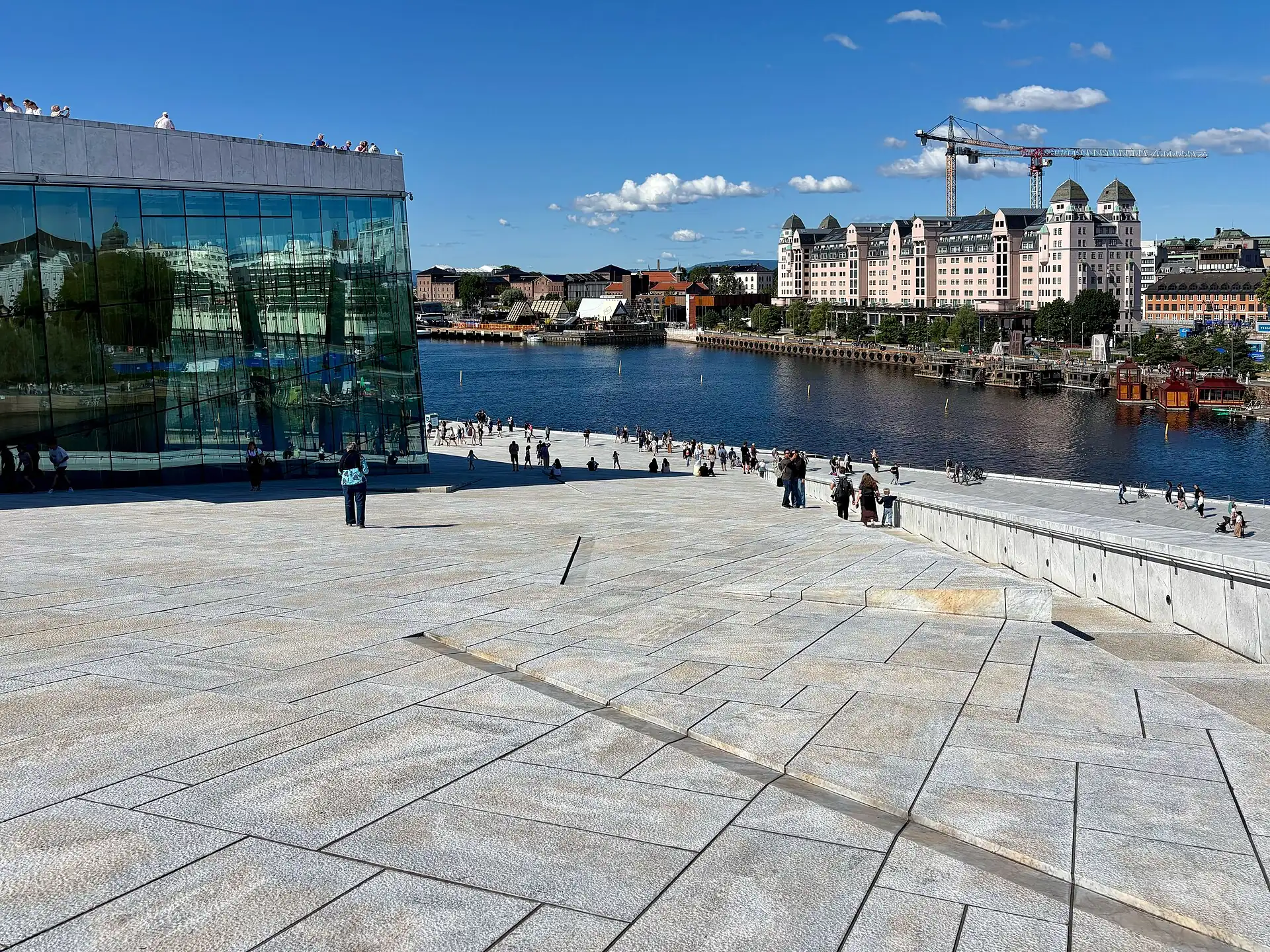 Opera House roof · 20 to 40 min
- 2
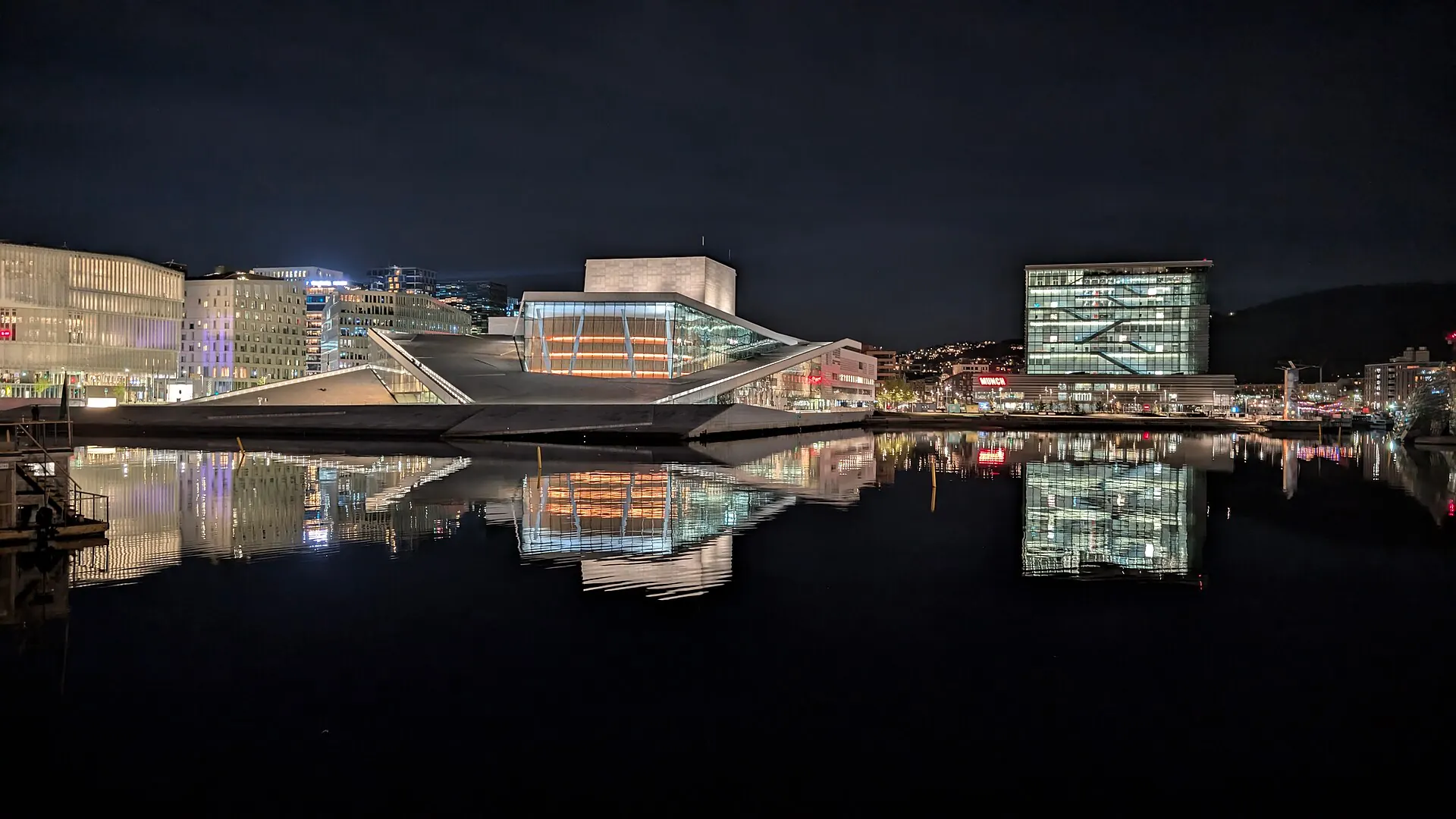 MUNCH · 90 min to 2 h
- 3
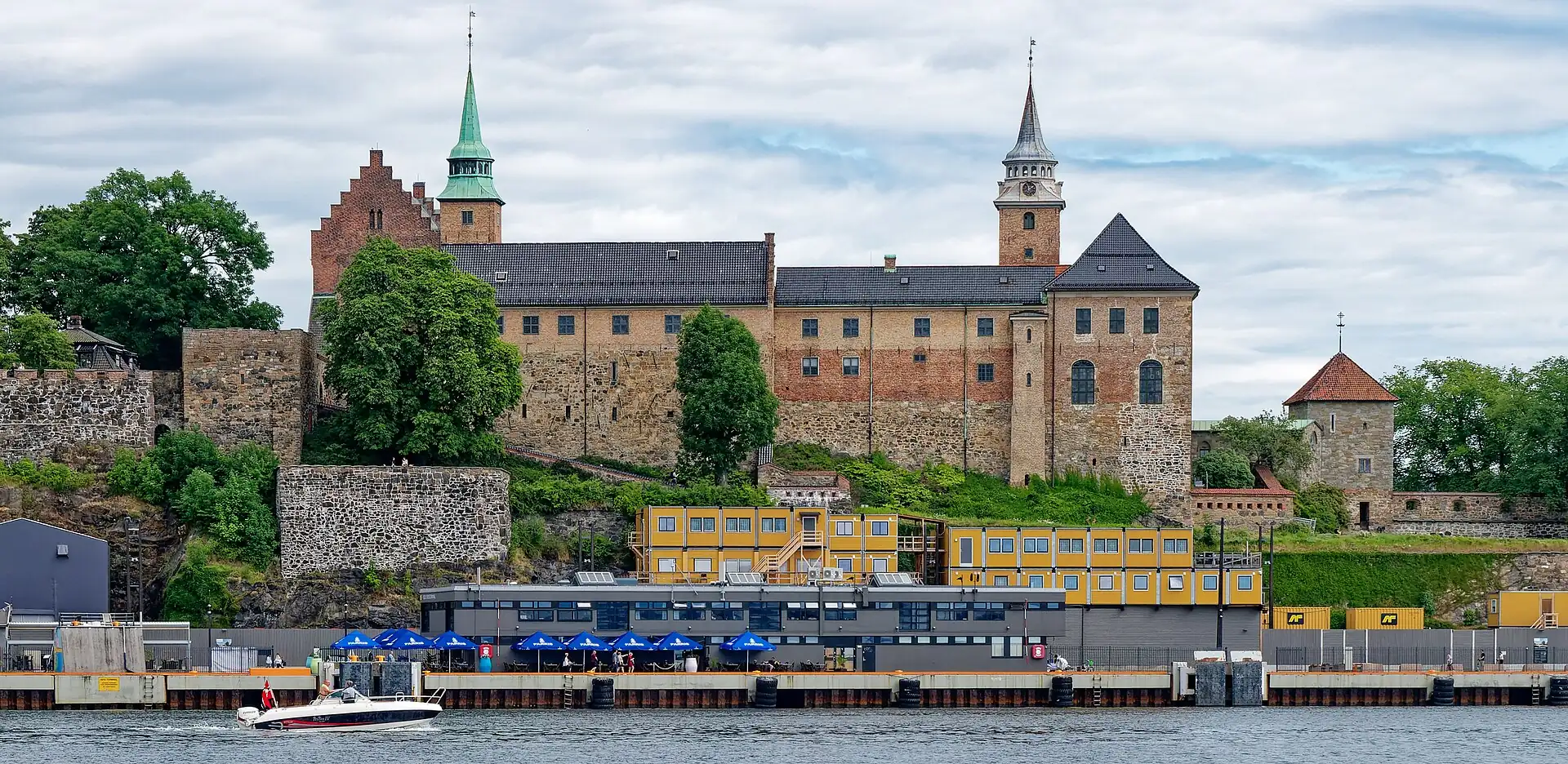
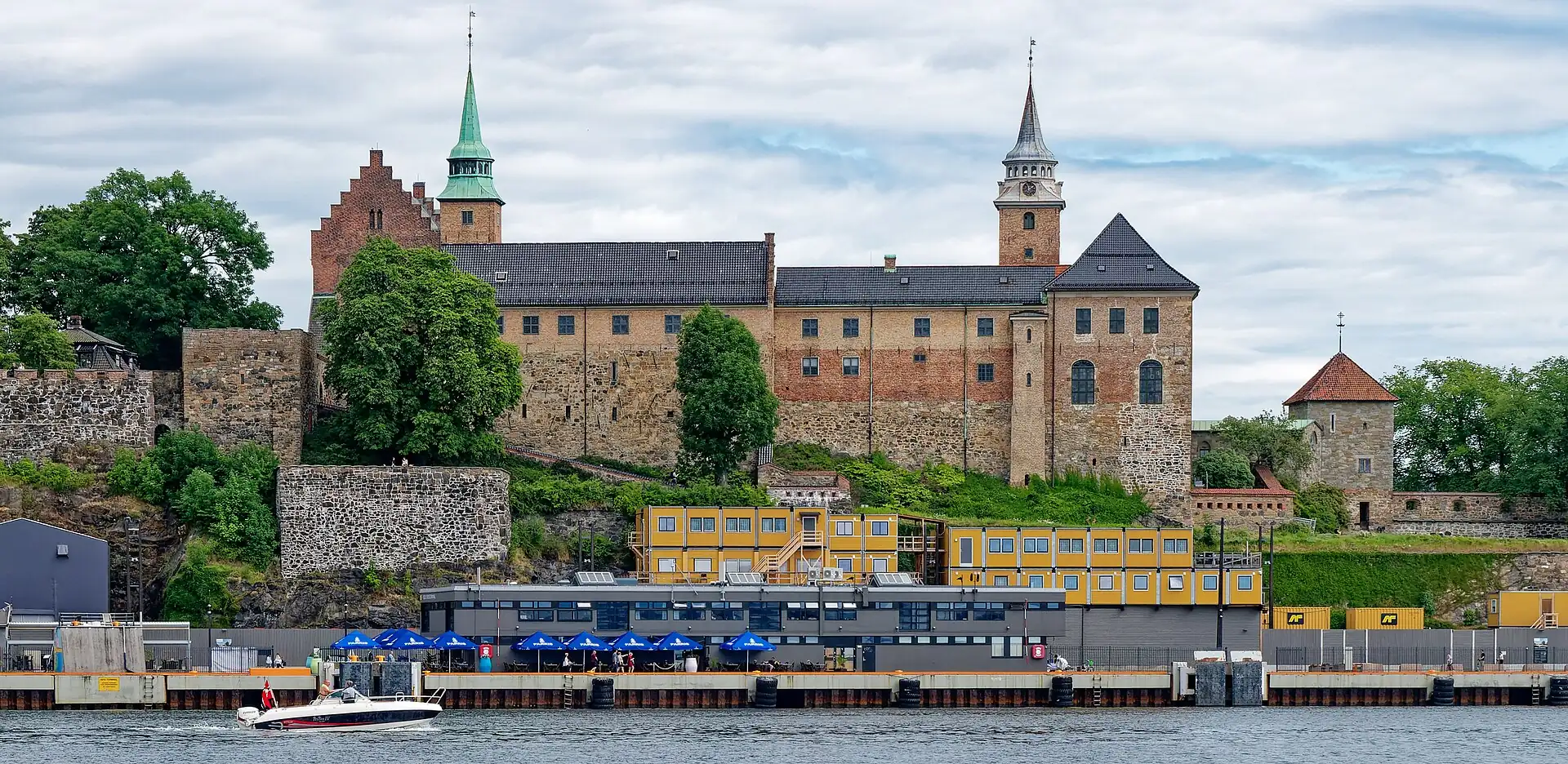 Akershus Fortress · 60 to 90 min
- 4City Hall · 30 to 45 min
- 5
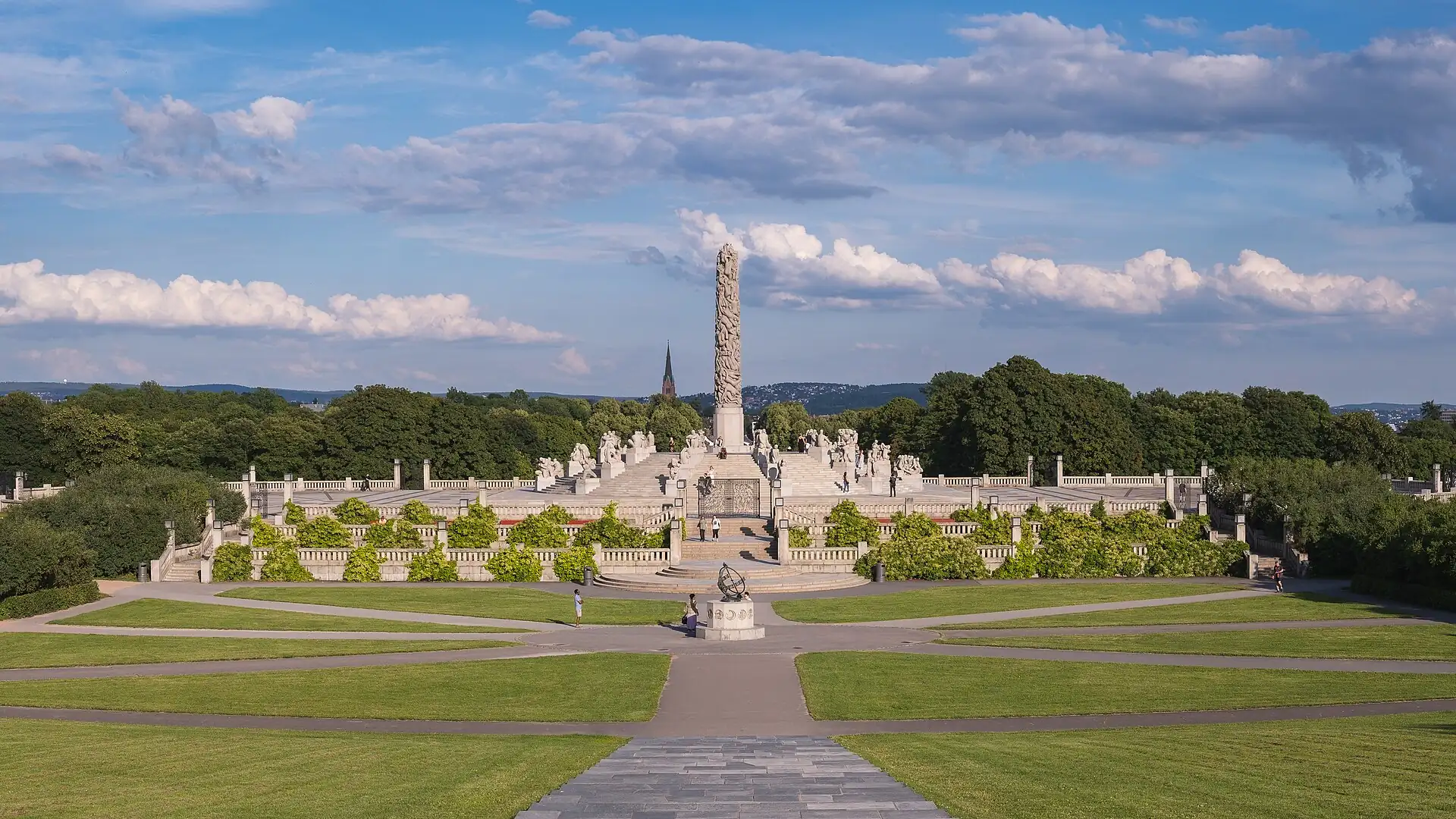 Vigeland Park · 60 to 90 min
Fits
- Short city breaks
- Museum and harbour walks
- Travellers starting the Bergen railway or a fjord trip
Does not fit
- Budget travellers who eat out every meal
- Winter visitors who expect long daylight
- Anyone planning to drive in the centre
How long
- 2 daysHarbour front and fortress, Opera House and Bjørvika, Karl Johans gate
- 3 daysFour clusters plus a museum day for rain
- 4 daysAdd a fjord-island ferry afternoon and a Grünerløkka evening
Good for
- First timers
- Foodies
- Budget
- Couples
- Solo
- Families
About Oslo
Oslo sits at the head of the Oslofjord in south-east Norway. The city was founded around 1000 and became a royal seat under King Haakon V, who began Akershus Fortress around 1300. After a fire in 1624 King Christian IV moved the town west and rebuilt it as Christiania, and the name stuck until 1925, when it went back to Oslo.
Norway was tied to Denmark and then to Sweden for centuries, and became fully independent in 1905. Oslo became a capital again with a national identity: a parliament on Karl Johans gate, a royal palace at the top of it, and a waterfront that is now being rebuilt for culture and housing.
The city is compact for a capital and unusually green: forest and fjord islands are within a tram or ferry ride of the centre. Norwegian is the language; nearly everyone speaks English well.
Good to know
- Oslo S is the central station; Oslo Airport is at Gardermoen, about 50 km north, not in the city.
- Visit Oslo runs a visitor centre near the city centre and publishes the official events calendar (check hours).
- The Oslo Pass bundles transport and many museums; do the sums before you buy.
Go deeper 11 min read · 6 chapters
Oslo is a small capital on a big fjord, and it is built to be used on foot, by tram and by ferry. This deep dive reads it in layers: the medieval town and the fire that moved it, the walk from the harbour to the palace, the art and architecture on the waterfront, the fjord and forest that press against the centre, the food and the price of it, and the plain rules for a city where the weather, the daylight and the opening hours set your day.
1History: from a medieval port to Christiania and back2 min
Oslo grew where the Akerselva river meets the head of the Oslofjord, a sheltered spot with farmland behind it. A settlement was here by around the year 1000, and a tradition, hard to prove, credits King Harald Hardrada with founding the town in 1049. The medieval town lay to the east of today's centre, in the area called Gamlebyen, and you can still see the ruins of the cathedral and the hospital there. Around 1300 King Haakon V made Oslo his base, began Akershus Fortress on the headland to the south-west, and turned the town into a capital in fact as well as in name.
In 1624 a fire burned most of the wooden town. The Danish-Norwegian king, Christian IV, ordered it rebuilt on a new site under the walls of Akershus, laid out on a grid, and renamed it Christiania. The straight streets of the quarter still called Kvadraturen, south of the cathedral, come from that plan. The name stayed for three centuries and returned to Oslo in 1925.
The city's modern shape comes from the nineteenth century. Norway was in a union with Denmark until 1814, when a constitution was signed at Eidsvoll on 17 May, and then in a looser union with Sweden until independence in 1905. Karl Johans gate was laid out in the 1800s to link the Royal Palace with the new station area, and it is still the spine of the centre. The German occupation from 1940 to 1945 left marks on Akershus, where the Norwegian Resistance Museum now stands.
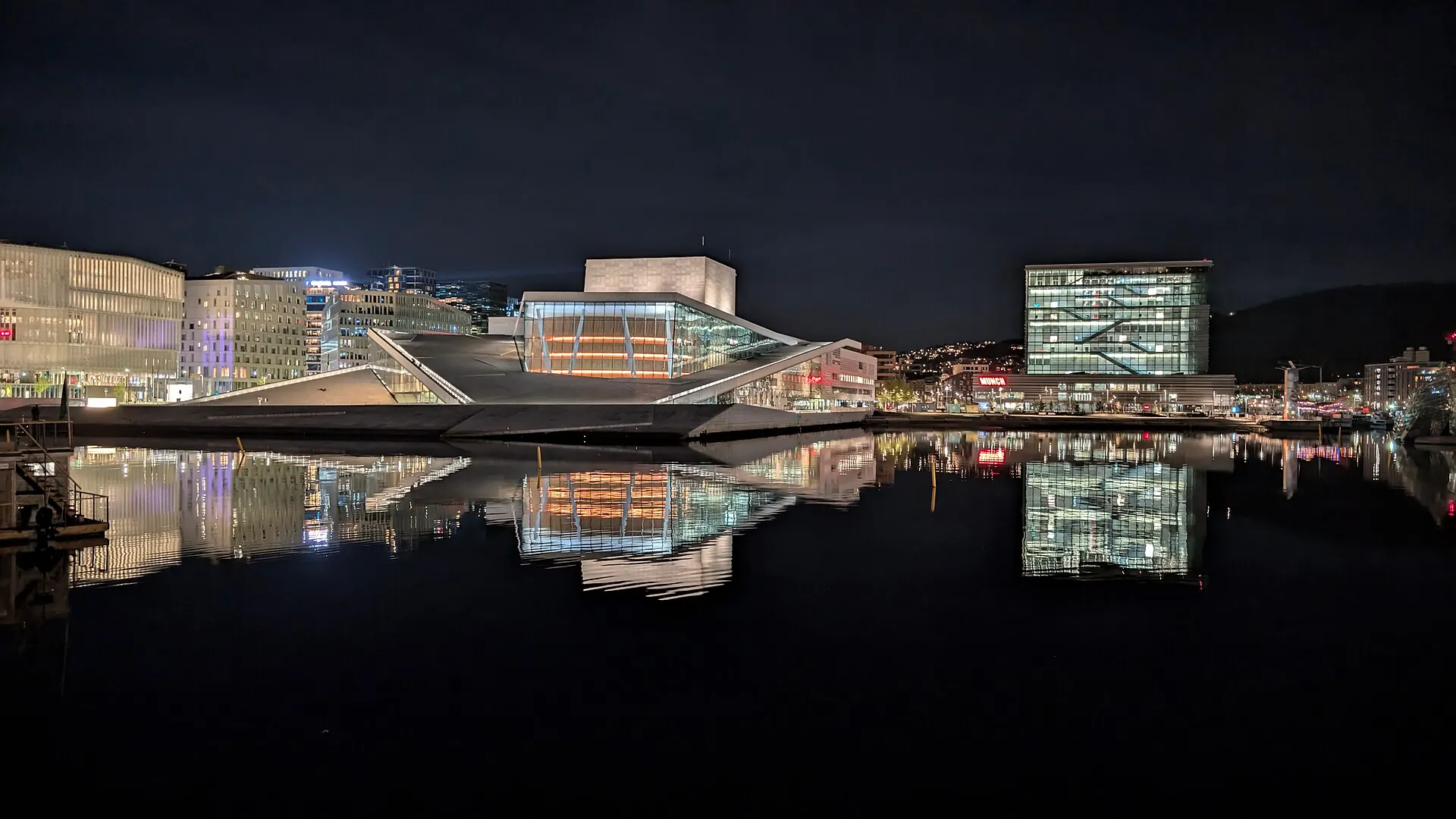
Since 1901 the Nobel Peace Prize has been awarded by a committee in Oslo, and since 1990 the ceremony has been held in City Hall on 10 December. In the last twenty years the waterfront has been rebuilt: the Opera House opened in 2008, the Bjørvika district followed with new offices, housing and the public library, and the MUNCH museum opened in 2021.
For a visitor, the layers are easy to find on a short walk. The medieval ruins are east of the centre, the fortress and the Kvadraturen grid are in the middle, the palace and the parliament are along Karl Johans gate, and the new waterfront is at the water's edge.
- Settled
- By around 1000
- Akershus begun
- Around 1300
- Great fire and rebuilding as Christiania
- 1624
- Name returns to Oslo
- 1925
- Independence from Sweden
- 1905
2The centre on foot: harbour, Karl Johans gate and the palace2 min
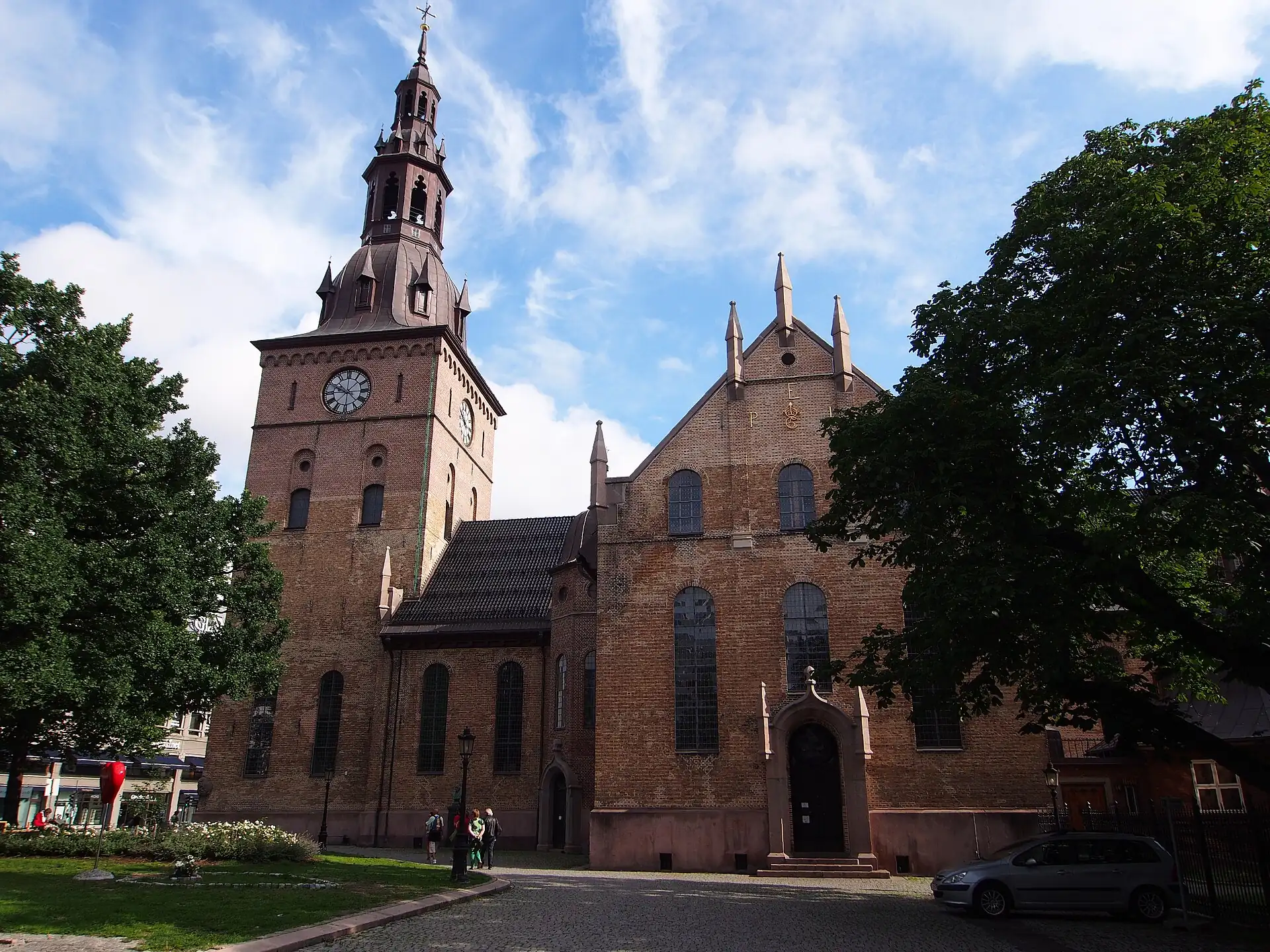
The centre of Oslo is small enough to walk in an afternoon, and it is easier to understand if you read it as three long lines. The first is Karl Johans gate, a straight pedestrian-friendly street that runs from Oslo S, the central station, up a gentle slope to the Royal Palace. Along it are the cathedral, the parliament (Stortinget), the National Theatre and the university, and its side streets hold most of the shops and hotels.
The second line is the harbour front, which runs from City Hall in the west, past the Aker Brygge and Tjuvholmen waterfront, the fortress headland and the ferry docks, to the Opera House and Bjørvika in the east. This is the part where you feel you are in a port city: gulls, ferries to the islands and terraces with a sea view. It is exposed to the wind, and in winter the piers can be icy.
The third line is the river. The Akerselva flows from the forest to the fjord through Grünerløkka, and the path beside it passes old mills, waterfalls and, at Vulkan, the Mathallen food hall. A walk north along the river from Mathallen is one of the most pleasant free things to do in the city.
Bjørvika is the newest piece. A motorway once cut it off from the sea; a tunnel now carries the traffic, and the surface has been given to culture and housing. The row of tall buildings on the eastern side is nicknamed the Barcode. It is an example of how quickly Oslo changes. If you have not been for ten years, the waterfront will look unfamiliar.
Distances are short. Oslo S to the Opera House is about ten minutes on foot, the cathedral to City Hall is around fifteen, and Grünerløkka is a tram ride of ten to fifteen minutes. One Ruter ticket covers trams, buses, the metro and the fjord ferries, so you rarely need a taxi, which is very expensive. In winter allow extra time for ice, and in any season wear shoes with grip.
- Main street
- Karl Johans gate, from Oslo S to the Royal Palace
- Oslo S to the Opera House
- About 10 minutes on foot
- Transit ticket
- One Ruter ticket covers tram, bus, metro and ferry
3Art and architecture: Munch, Vigeland and the waterfront buildings2 min
Oslo's reputation in the arts rests on two names and a run of modern buildings. Edvard Munch, the painter of The Scream, left most of his works to the city when he died in 1944, and they are now shown at MUNCH, the tall waterfront museum that opened in 2021. The museum rotates its works for conservation, so if you want to see one painting in particular, check what is on view before you go. The National Museum, which opened in 2022 near the harbour, is the largest art museum in the Nordic countries and also holds Munch's paintings.
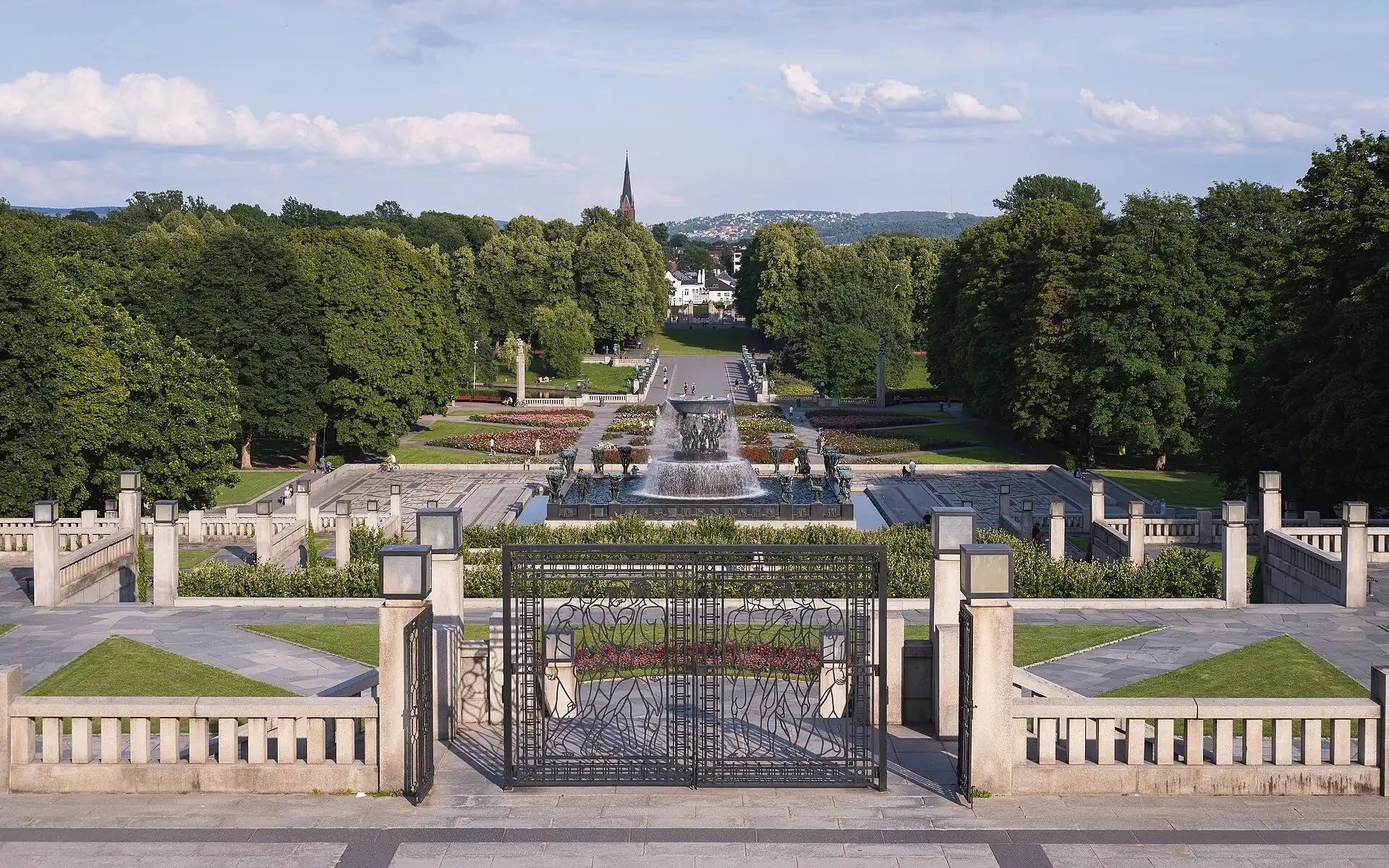
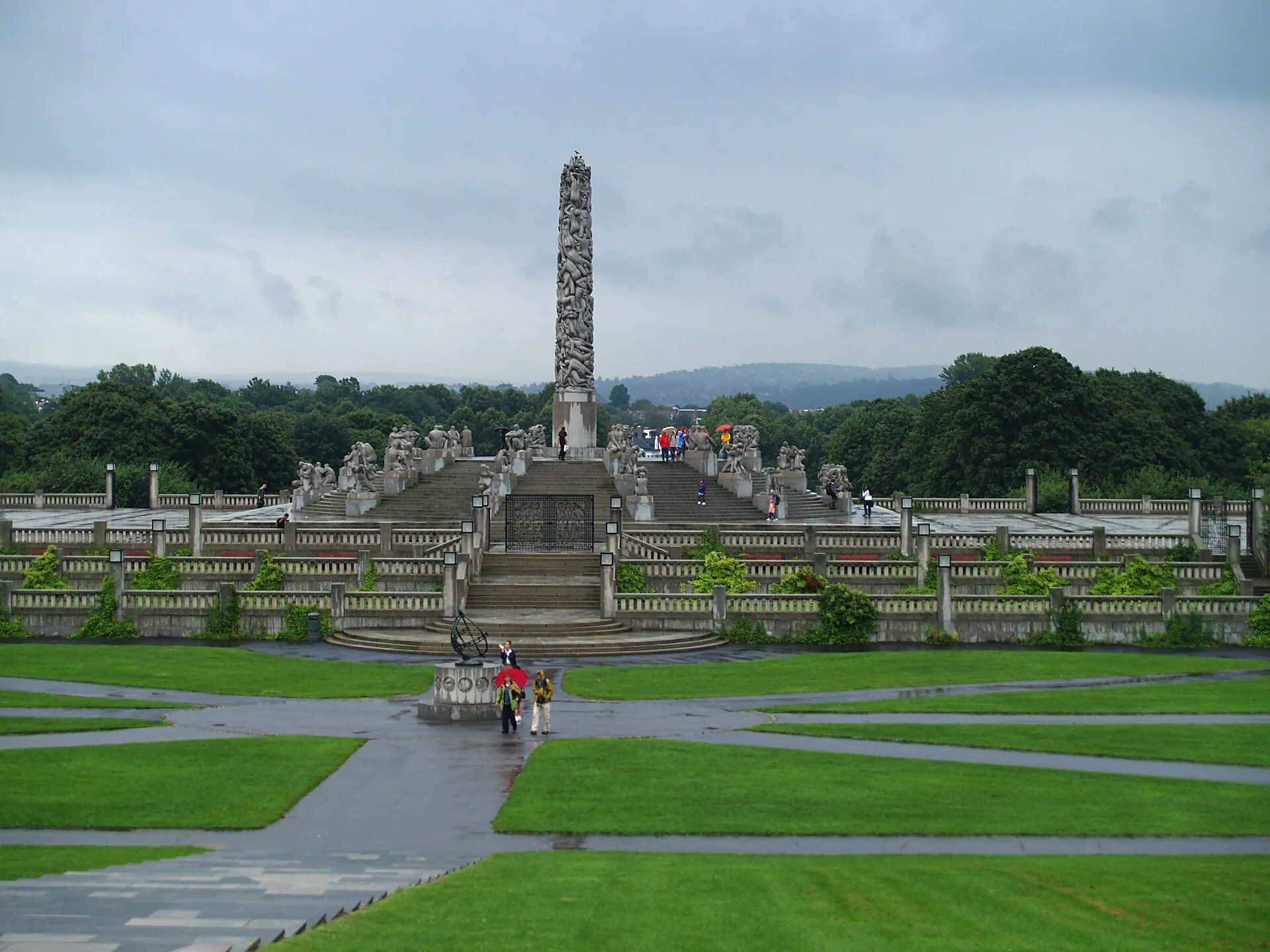
Gustav Vigeland is the other name. Between the 1920s and the 1940s he made the sculpture park in Frogner, with more than 200 bronze, granite and wrought-iron figures of people at every age, arranged along a bridge, a fountain and a tall central monolith. The park is free, open at all hours and reached by tram 12, and it is one of the most visited places in Norway. It is best early or at dusk, when the paths are quiet and the light on the granite is soft.
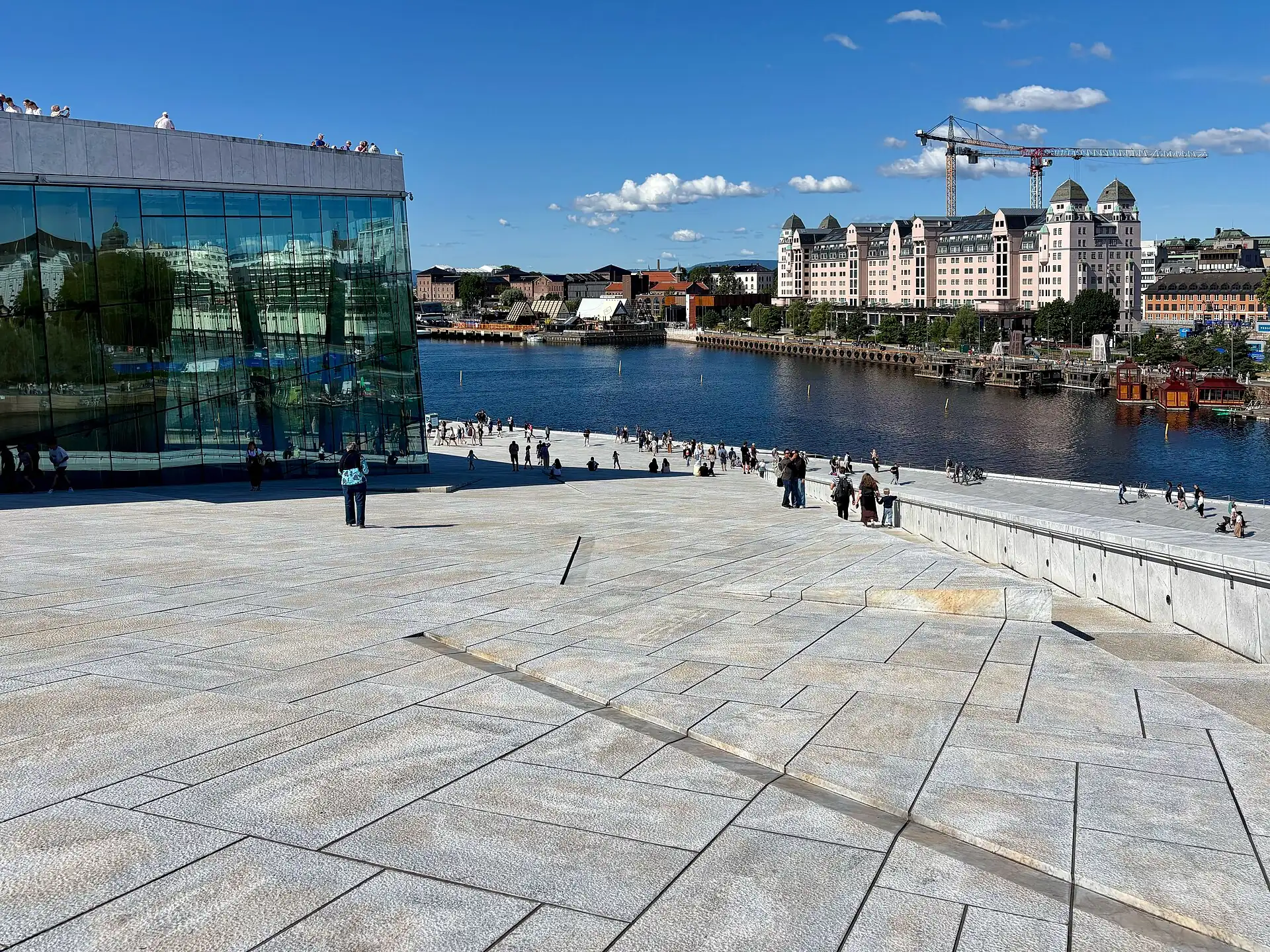
The buildings tell the modern story. City Hall, finished in 1950, is a brick building with two towers, big painted halls and a harbour-front square; it was built as a civic monument and is now the setting for the Nobel Peace Prize ceremony. The Opera House, by the architects Snøhetta, opened in 2008 with a white marble roof that slopes down to the water so you can walk up it. The public library in Bjørvika and the Barcode towers add to the new skyline.
Smaller museums fill in the picture. On the Bygdøy peninsula the Fram Museum holds the polar ship Fram, and the Kon-Tiki Museum tells the story of Thor Heyerdahl's raft voyage. The Viking ships that have long been shown on Bygdøy are being moved to a new museum, so check its status before you plan around them. The Holmenkollen ski jump has a ski museum and a tower with a view of the city and the fjord.
The practical rule is to pick one or two. A first visit works well with the Opera House roof and one museum, MUNCH or the National Museum, plus a free park or hall. Check opening days; many museums close on Mondays, and timed tickets save time at busy hours.
- MUNCH opened
- 2021
- Opera House opened
- 2008
- Vigeland Park
- More than 200 sculptures, free and open at all hours
- National Museum opened
- 2022
4The fjord and the forest: nature inside the city2 min
What makes Oslo different from most capitals is how close the outdoors is. The Oslofjord runs along the southern edge of the city, dotted with dozens of islands, and behind the city the forest, called the marka, covers hills and lakes for kilometres to the north. Locals use both all year: swimming and sauna in summer, cross-country skiing in winter, walking on weekends.
The fjord is the easiest to reach. Ferries leave from Aker Brygge and other piers and are covered by the same Ruter ticket as the tram. Hovedøya, about ten to twenty minutes by ferry, has the ruins of a medieval monastery, paths, small beaches and quiet places to swim. Other islands have cabins and picnic spots; the ferry hours reduce in winter, so check the timetable before you go. Bygdøy, to the west, is reached by a seasonal ferry and has beaches, museums and paths.
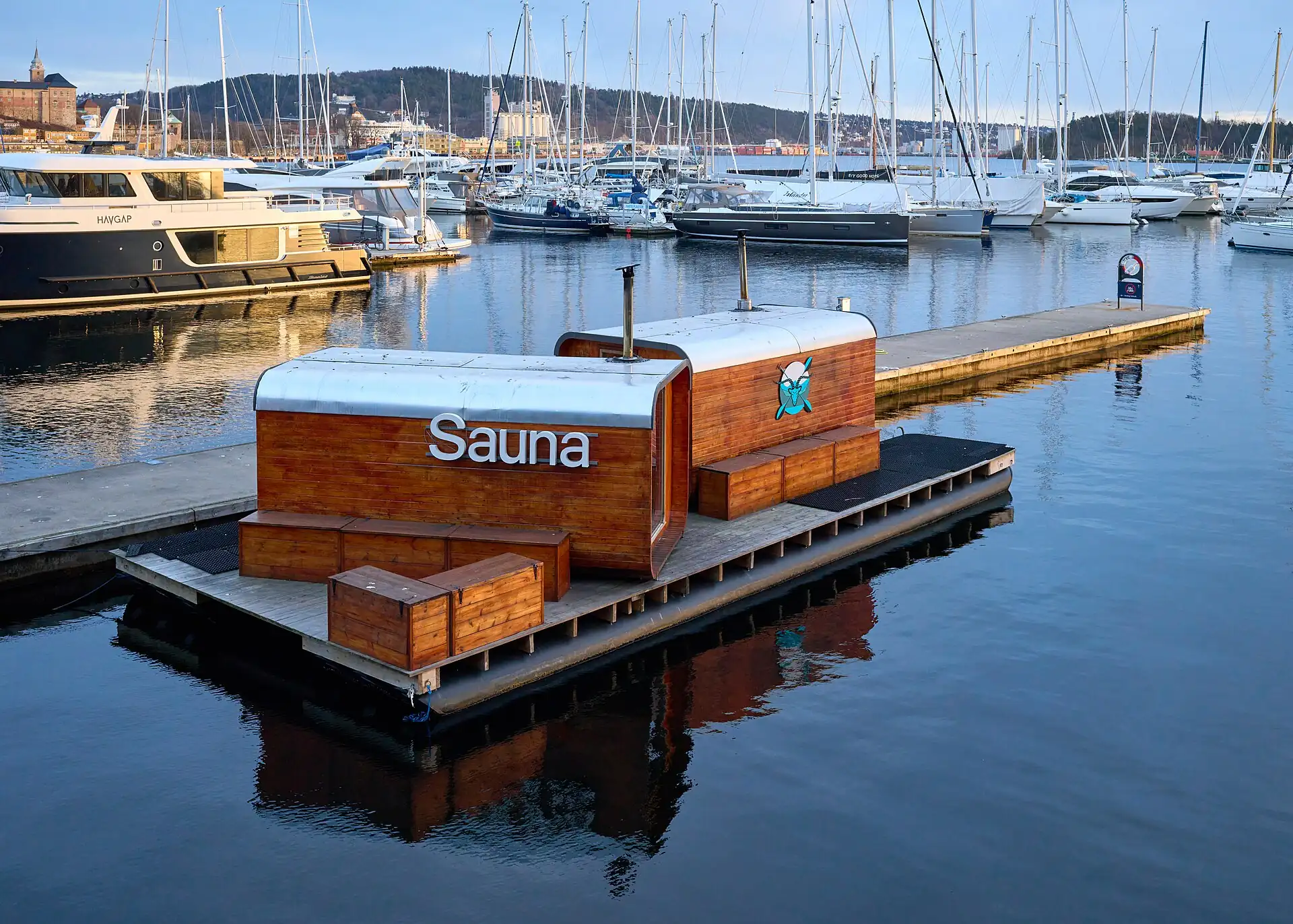
The sauna is now part of the waterfront. Floating and shore-side saunas on the harbour, and sea baths at Sørenga, let you sweat and then jump into cold water. Operators and hours change, so check who is running when you visit, and read the rules on towels and swimwear before you enter.
The marka is reached by metro. Line 1 climbs to Frognerseteren, where you can walk down through the forest and catch views over the city, and the line to Sognsvann puts you at a lake with a walking path around it. In winter the paths become ski tracks, and people go up after work with skis on their shoulders. The right to roam, called allemannsretten, lets you walk in the countryside and camp for a night or two away from houses, as long as you leave no trace.
Weather changes fast. In winter the daylight is short: about six hours in December, so plan outdoor time around it. In summer the light lasts until about 23:00 in June. Wear layers, carry a waterproof jacket and keep an indoor plan for rain.
- Ferry to Hovedøya
- About 10 to 20 minutes from Aker Brygge
- Daylight in December
- About 6 hours
- Right to roam
- Allemannsretten; leave no trace
- Forest access
- By metro to Frognerseteren or Sognsvann
5Food and drink: what to eat, what it costs, and the alcohol rules2 min
Norwegian cooking is built on fish, meat from cold country and dairy. The classic home dishes are kjøttkaker, meatballs in gravy with potatoes, and fiskekaker, fish cakes; in autumn the national dish, fårikål, a lamb and cabbage stew, appears on menus. Brunost, a sweet brown whey cheese sliced thin on bread, is a breakfast staple, and salmon, herring and prawns are common. In the modern restaurants you will find a Nordic style of seasonal, lightly cooked food at very high prices.
The cheapest real lunch is at a bakery or a kiosk. A skolebolle, a bun with custard and coconut, costs NOK 35 to 50; a hot dog in a soft potato flatbread costs about NOK 40 to 70. A lunch special, dagens, at a canteen-style restaurant such as Kaffistova costs around NOK 200 to 300. Street-food halls such as Vippa and Mathallen sit in the middle, at NOK 130 to 260 a dish, and a sit-down dinner in the centre starts at around NOK 350 a head.
Coffee is taken seriously. Norway is among the highest coffee-drinking countries, and Grünerløkka has specialist roasters and bars, including a well-known roaster who won a world barista title. Filter coffee is the usual order; a cinnamon bun goes with it.
Alcohol is the other cost. Beer, wine and spirits are heavily taxed. Supermarkets sell beer and other drinks up to 4.7% alcohol, but not late in the evening and not on Sundays, and wine and spirits are sold only at the state shops, called Vinmonopolet, which close early on Saturday and on Sunday. A beer in a bar costs NOK 100 to 140, and a cocktail more. Tap water is excellent and free.
Practical eating tips are short. Cards are accepted everywhere; cash is rarely needed and tipping is not expected. Eat lunch, not dinner, in the mid-priced restaurants, since lunch menus are cheaper. Buy fruit, bread and cheese at a supermarket for a picnic in a park. And check the closing time before you set out: kitchens close early by southern-European standards.
- Cheapest lunch
- Bakery bun or kiosk hot dog, NOK 35 to 120
- Canteen dagens
- NOK 200 to 300
- Beer in a bar
- NOK 100 to 140
- Wine and spirits
- State shops only
6Visiting well: money, transit, weather and manners2 min
Oslo is easy to visit and expensive to enjoy, so a little planning saves a lot. Start with the ticket. One Ruter ticket, bought in the app before you board, covers tram, bus, metro and ferry within the zone, for a set time; a 24-hour ticket pays off after three or four rides. From the airport, take the train to Oslo S in about 20 minutes. The taxi costs many times as much and offers no speed advantage at rush hour.
The second decision is the season. May to September gives long light and outdoor terraces; the summer holiday period in July empties some local businesses but not the main sights. Winter has Christmas lights and skiing in the forest, but also ice, cold and about six hours of daylight in December. Bring layers and a waterproof jacket in any month, and shoes with grip from November to March.
Money is simple. Norwegian kroner are used, cards and phone wallets work everywhere, and prices are fixed, so do not bargain. Tipping is not expected; round up or add 5 to 10% for good service. Decline the offer to be charged in your home currency when you pay by card.
Opening hours need attention. Most shops close on Sunday, and some close early on Saturday. Many museums close on Monday. On 17 May, Constitution Day, the city fills with children's parades and people in traditional costume, and most shops shut. At Easter and Christmas, many sights close. Check each place before you set out.
Safety is good, with the usual capital-city cautions. Pickpockets work at Oslo S and on the airport train, so keep your bag closed and on your lap. The station area is worth avoiding late at night. Follow signs near icy water and on the Opera House roof. The emergency numbers are 112 for police, 113 for an ambulance and 110 for fire.
Manners are quiet. Wait your turn in queues, keep your voice down on trams and in museums, and take your shoes off when you enter a home. In the forest and by the water, follow the right to roam and leave no trace. A short, plain greeting in Norwegian, hei or takk, is appreciated, even though everyone will answer in English.
- Airport train to Oslo S
- About 20 minutes
- Emergency numbers
- 112 police, 113 ambulance, 110 fire
- Shops on Sunday
- Mostly closed
- Tipping
- Not expected
Read, watch, wordsReading · Glossary · Sources
Reading
- Wikivoyage: Oslo — Wikivoyage contributorsA free travel guide with practical notes; check details before you go.
- Visit Oslo — Visit OsloThe official tourism site with events and opening hours.
Glossary
| Term | Local | Meaning |
|---|---|---|
| Allemannsretten | Allemannsretten | The right to roam in the countryside, with a duty to leave no trace. |
| Bunad | Bunad | Traditional regional costume, worn on 17 May. |
| Brunost | Brunost | A sweet brown whey cheese sliced on bread. |
| Dagens | Dagens | The dish of the day, usually the cheapest hot meal. |
| Friluftsliv | Friluftsliv | Outdoor life; the habit of spending free time outside. |
| Vinmonopolet | Vinmonopolet | The state shops that sell wine and spirits. |
Read for this deep dive
Background reading only: the text above is written by Voykit, not copied from these pages.
Photos
Night view of the Peloton bar and cafe in Torggata, Oslo Photo: Bahnfrend, CC BY-SA 4.0
Waiting-room for steamship passengers, built 1883 in Pipervika, Oslo, Norway Photo: Peulle, CC BY-SA 4.0
Mangelsgården Storgata 36 0182 Oslo Norway Photo: Spudgun67, CC BY-SA 4.0
Oslo central station Photo: kallerna, CC BY-SA 4.0
Oslo park Photo: Jeblad, CC BY-SA 4.0
Rules in force · 8Non-EU visitors get 90 days in any rolling 180-day window…
- Europe ↗Non-EU visitors get 90 days in any rolling 180-day window, counted across all 29 Schengen states together — not per country; the Entry/Exit System now logs each crossing, so an overstay is detected automatically.
- Europe ↗On the first Schengen entry since EES began, non-EU travellers give four fingerprints and a face photo at the border instead of a passport stamp; there is nothing to apply for or pay in advance.
- Nordic countries ↗Decide light or dark before anything else: summer trips (June–August) and aurora trips (September–March in the Arctic) need different countries, clothes and bases.
- Nordic countries ↗Sweden, Norway, Finland, Iceland and the Faroes sell stronger alcohol only in state shops with short hours; buy before evening and before Sundays and holidays.
- Norway ↗Norway is not in the EU but is in the Schengen area. Check the entry rules for your passport on official sources.
- Norway ↗Wine and spirits are sold only at the state Vinmonopolet shops; supermarkets sell beer, and not in the evenings or on Sundays.
- Norway ↗The right to roam (allemannsretten) lets you hike and camp on most uncultivated land, keeping a distance from homes and leaving no trace.
- Oslo and Eastern Norway ↗Book seats for long-distance trains ahead in summer; Interrail and Eurail passes need a seat reservation on most Norwegian services.
Entry rules depend on your passport. Full visa guide
Emergency numbers for Oslo112 ▾
Tap a number to call from your phone. These are the numbers listed in this guide; a row marked check has not been verified.
Planning is the full guide. I'm here keeps what is open and the cheat card.
Right now
Checking the weather…
Working out what is open near you…
What is open nowclock, closures, places open
Now in Oslo
Local time in Oslo
--:--
Loads in your browser · Europe/Oslo
This month
Month verdict appears here.
Closed today
See the weekly grid below.
| Weekly closure | Mon | Tue | Wed | Thu | Fri | Sat | Sun |
|---|---|---|---|---|---|---|---|
| ShopscheckMost shops close on Sundays; supermarkets at stations may open. | · | · | · | · | · | · | ✕ |
| Many museumscheckCheck each museum. | ✕ | · | · | · | · | · | · |
If today is a closure day: Weekday mornings before 11:00 are the quietest time for the Opera House, the cathedral and the museums; check opening hours since many museums close on Mondays.
Weekly closures come from our place pages; public holidays close most shops.
Cheat cardthe pocket version
Cheat card
The essentials on one card: save it as an image for your phone, share it, or print it.
Oslo
- Money
- Cash is rarely needed; carry a card and a phone wallet.
- SIM
- Install an eSIM before you fly, or buy a SIM at a convenience store (passport may be needed).
- Emergency
- 112 police · 113 ambulance · 110 fire (not 911, 999 or 000)
- Plugs
- Sockets C/F. US/Canada (A/B): adapter · UK/Ireland (G): adapter · Australia/NZ (I): adapter. 230 V: US 120 V-only devices (hair dryers) need a converter; most chargers are dual-voltage.
Top 5
- Opera House roof
- MUNCH
- Akershus Fortress
- City Hall
- Vigeland Park
EssentialsQuick answers, what things cost and how to get around
Essentials
Quick answers, what things cost and how to get around
Quick answers
The questions people ask first about Oslo, one line each. Tap a card for the full answer.
- Cash or card?Cards and phone wallets are accepted almost everywhere, including small kiosks; some places no longer take cash.
- SIM or eSIMInstall an eSIM before you fly, or buy a SIM at a convenience store (passport may be needed).
- Tap waterTap water is safe and cold; refill your own bottle.
- TippingNot expected; round up or add about 5–10% for good service in a restaurant.
- Plugs & powerSockets C/F. US/Canada (A/B): adapter · UK/Ireland (G): adapter · Australia/NZ (I): adapter. 230 V: US 120 V-only devices (hair dryers) need a converter; most chargers are dual-voltage.
- Safe at night?Take more care after dark in Karl Johans gate and Oslo S.
Show all 14 answers
- What to wearFollow the local rule for towels and swimwear; read the signs.
- RestroomsMuseums, food halls, stations and hotels; some public toilets need a small payment by card or app.
- Emergency numbers112 police · 113 ambulance · 110 fire (not 911, 999 or 000)
- Your embassycheckUS, UK, Canada embassies listed with addresses (check before you go).
- Closed which day?Mon: 1 on our list shut · Sun: 1 on our list shut.
- Sundays & holidayscheckShops close early on Saturdays and are mostly closed on Sundays; many museums close on Mondays; check each place.
- Rainy-day planRain is possible in any month: carry a waterproof jacket and keep an indoor plan.
- Landing lateOSL: last airport Express Train to Oslo S about 23:30, then airport coach or night train towards Oslo (operator and last departure unverified) until about 23:45.OSL: last airport Express Train to Oslo S about 11:30 PM, then airport coach or night train towards Oslo (operator and last departure unverified) until about 11:45 PM.
Cost cheat-sheetwhat everyday things cost
Cost cheat-sheet
Typical prices for the everyday things, as ranges. Change the currency right here; the local price stays first.
2026 desk estimate · check
- CoffeeCoffee at a caféNOK 45 to 70 (≈ US$5–7)
- Sit-down mealSit-down restaurant meal, per personNOK 250–500 (≈ US$25–50)
- Street or quick mealHot dog or bakery snackNOK 40–70 (≈ US$4–7)
- BeerBeer in a barNOK 100 to 140 (≈ US$10–14)
- SIM or eSIM, a weekTourist eSIM, about a week of dataNOK 100–250 (≈ US$10–25)
- Museum or sight ticketMuseum ticketNOK 130 to 220 (≈ US$13–25)
- Budget bedHotel double room, a night, per roomNOK 1,100 (≈ US$110)
- Mid-range bedHotel double room, a night, per roomNOK 1,900 (≈ US$190)
- High-end bedHotel double room, a night, per roomNOK 3,500 (≈ US$350)
A day, not counting the bed: Budget NOK 700 (≈ US$70) · Mid NOK 1,300 (≈ US$130) · High NOK 2,600 (≈ US$300)
Local prices, with USD next to them (rates 2026-09 (approximate); change it in the header). Ranges are desk estimates: check locally. Every price and the budget calculator →
Source: Prices in Oslo
Draft
Written from desk research. Not yet compared with the official source.
No official source is recorded for this figure.
Prices are 2026 desk estimates, not yet compared with an official source. Check on the day.
Not checked in the last 12 months (no check date on file).
DecideWho it suits, the trade-offs and when to go
Decide
Who it suits, the trade-offs and when to go
Best months at a glance
The guide's verdict for each month
Jan
Care
−1°C (30°F)30°F (−1°C)
Feb
Care
0°C (32°F)32°F (0°C)
Mar
Care
5°C (41°F)41°F (5°C)
Apr
Best
11°C (52°F)52°F (11°C)
May
Best
17°C (63°F)63°F (17°C)
Jun
Best
21°C (70°F)70°F (21°C)
Jul
Care
23°C (73°F)73°F (23°C)
Aug
Best
22°C (72°F)72°F (22°C)
Sep
Best
17°C (63°F)63°F (17°C)
Oct
Care
10°C (50°F)50°F (10°C)
Nov
Avoid
4°C (39°F)39°F (4°C)
Dec
Care
0°C (32°F)32°F (0°C)
Best: Apr–Jun, Aug–Sep. Mixed: Jul, Oct, Dec–Mar. Avoid: Nov. Month by month →
Warmest Jul (23°C (73°F)73°F (23°C)), coolest Jan (−6°C (21°F)21°F (−6°C) low), wettest Aug (12 rain days), driest Feb (7). Averages, not a forecast.
Oslo across the year
Best-looking months for Oslo: May, Jun, Aug. Rated avoid: Nov.
| Measure | Jan | Feb | Mar | Apr | May | Jun | Jul | Aug | Sep | Oct | Nov | Dec |
|---|---|---|---|---|---|---|---|---|---|---|---|---|
| Weather | Mixed (care) | Mixed (care) | Mixed (care) | Good (good) | Great (good) | Great (good) | Mixed (care) | Great (good) | Good (good) | Mixed (care) | Avoid (avoid) | Mixed (care) |
| Crowds | Low (good) | Medium (ok) | Medium (ok) | Low (good) | Medium (ok) | High (care) | High (care) | High (care) | Medium (ok) | Low (good) | Low (good) | Medium (ok) |
| Prices | Medium (ok) | Medium (ok) | Medium (ok) | Medium (ok) | Medium (ok) | High (care) | High (care) | High (care) | Medium (ok) | Low (good) | Low (good) | Medium (ok) |
| Events | None listed (ok) | None listed (ok) | 1 event (care) | 1 event (ok) | 2 events (ok) | 2 events (ok) | 1 event (ok) | 1 event (ok) | None listed (ok) | None listed (ok) | None listed (ok) | 2 events (ok) |
Green is good news, amber needs planning, red is a month to avoid; dashed grey with a question mark means our data does not say. Open the year heatmap →
Not checked in the last 12 months (no check date on file).
Source: Months, temperatures and crowds
Draft
Written from desk research. Not yet compared with the official source.
Monthly highs, rain and crowd levels are climate averages and desk estimates for the city, not a forecast.
Understand the cityUnderstand · Districts
Orientation & districts
The centre lies between Oslo S (the central station) in the east and the Royal Palace in the west, with Karl Johans gate between them. The harbour front, City Hall and Akershus Fortress are south-west of the station, the Bjørvika waterfront with the Opera House and MUNCH is south-east, Grünerløkka is a tram ride north along the Akerselva river, and Frogner and Vigeland Park are west.
Walk inside a cluster; use the tram, metro or ferry between clusters on one Ruter ticket.
Shaded shapes: walking areas (click one). Black pins: sleep areas. Grey dots: places. Round badges: arrivals. Click the map to turn on scroll-wheel zoom.
Hover, tap or tab to an area to see what it is like. Pins are sleep areas; arrows at the edge point to the airport.
Off the map: Oslo Airport, Gardermoen (OSL) (22–30 min by the usual route).
Not drawn yet (no coordinates in this guide): Frogner and Vigeland Park, Bygdøy. They are in the neighbourhood cards below.
Where’s what, as a list:
- Karl Johans gate and Oslo S (Sentrum): Busy and central. Suits: A first visit with every cluster a short ride away. Price band $$$.
- Harbour front, City Hall and Akershus (Rådhusplassen): Exposed in wind. Suits: A sea-air walk and the fortress.
- Bjørvika and the Opera House (Bjørvika): New waterfront district. Suits: The Opera House roof and the MUNCH museum.
- Grünerløkka (Grünerløkka): Quieter, a tram ride from the centre. Suits: Cafés, shops and the river. Price band $$.
- Frogner and Vigeland Park (Frogner): West of the centre by tram 12. Suits: A free sculpture park and quiet streets.
- Bygdøy (Bygdøy): A peninsula; check the ferry and museum status. Suits: Museums by ferry in summer.
- Sleep area Grünerløkka: suits Cafés, shops and the river, price band $$.
- Sleep area Oslo S and Karl Johans gate: suits A first visit with every cluster a short ride away, price band $$$.
- Oslo Airport, Gardermoen (OSL), 22–30 min by the usual route.
Neighbourhoods at a glance
One tab per area, pulled together from this guide’s districts table, area notes, sleep-area scores and place pages. Scores are desk judgements (1–5); prices are estimates, check before you book.
Karl Johans gate and Oslo S
$$$Sentrum
Busy and central.
- Suits:
- A first visit with every cluster a short ride away · Shops and the cathedral
- Best time:
- Morning
- Rooms:
- NOK 1,500–3,000 per room per night (mid-range); more in summer and event weeks
Pick this if: Late arrivals, rail trips onward, walking everywhere
Skip this if: You want a quiet residential street
- Quiet nights2/5 Low
- Nightlife3/5 Medium
- Families4/5 High
- Late arrival5/5 Very high
Why these scores
- Quiet nights: Busy streets and late trams.
- Nightlife: Bars nearby.
- Families: Close to everything.
- Late arrival: 24-hour desks near the station.
Getting around from here
- 8–12 min walk to Bjørvika & Opera House
- Walk south-west: about 12 min to Harbour front, City Hall & Akershus
Harbour front, City Hall and Akershus
Rådhusplassen
Exposed in wind.
- Suits:
- A sea-air walk and the fortress
- Best time:
- Morning
Pick this if: An outdoor morning
Watch out for: Icy days.
Getting around from here
- Walk north-east: about 12 min to Karl Johans gate & Oslo Cathedral
- Walk east along the harbour: about 15 min to Bjørvika & Opera House
Bjørvika and the Opera House
Bjørvika
New waterfront district.
- Suits:
- The Opera House roof and the MUNCH museum
- Best time:
- Dusk
Pick this if: The Opera House and MUNCH
Watch out for: Windy days on the roof.
Getting around from here
- Walk north-west: about 12 min to Karl Johans gate & Oslo Cathedral
- Walk west: about 15 min to Harbour front, City Hall & Akershus
Grünerløkka
$$Grünerløkka
Quieter, a tram ride from the centre.
- Suits:
- Cafés, shops and the river · Coffee and shops
- Best time:
- Mid-morning
- Rooms:
- NOK 1,200–2,500 per room per night (mid-range)
Pick this if: Café days, evenings, a local feel
Skip this if: You arrive late and need a staffed desk
- Quiet nights4/5 High
- Nightlife4/5 High
- Families3/5 Medium
- Late arrival3/5 Medium
Why these scores
- Quiet nights: Calmer streets.
- Nightlife: Bars and cafés on the river.
- Families: Parks and cafés nearby.
- Late arrival: Check for a night desk.
Getting around from here
- 18–24 min walk to Karl Johans gate & Oslo Cathedral
Frogner and Vigeland Park
Frogner
West of the centre by tram 12.
- Suits:
- A free sculpture park and quiet streets
- Best time:
- Morning
Pick this if: Vigeland Park
Watch out for: Expecting cafés on every corner.
Bygdøy
Bygdøy
A peninsula; check the ferry and museum status.
- Suits:
- Museums by ferry in summer
Ward by ward
6 area guides. Open one for the short answer, the key facts and what the area is like; the full guide is linked inside. Prices marked (check) are estimates.
Inner EastBest for: Budget and mid-range stays, food, nightlife, riverside walks
Stay in Inner East if you want cheaper rooms, international food and the city's main nightlife around Grünerløkka; skip it if you want quiet evenings or a five-minute walk to the Royal Palace. It sits 5–15 minutes by tram or metro from Sentrum, and the trade-off is street noise on weekend nights.
- Best for:
- Budget and mid-range stays, food, nightlife, riverside walks
- Not for:
- Travellers wanting quiet nights or a central address for museums
- To Sentrum:
- 5–15 minutes by tram, bus or metro (check)
- Airport:
- Gardermoen by Flytoget or Vy train to Oslo S, then metro or tram (check)
- Walkable core:
- Grünerløkka, Grønland, Tøyen, Kampen, Vålerenga, Gamlebyen
- Nightlife:
- Grünerløkka, busiest Friday and Saturday (check)
- Prices:
- 2026 estimate; Norway is expensive, Inner East is the cheaper half of central Oslo
What the area is like
Inner East is the wedge of Oslo east of the Akerselva river, north of the railway line and inside the ring road. It is the most mixed part of central Oslo: 19th-century brick blocks that were working-class housing, low wooden houses in Vålerenga and Rodeløkka, high-rises at Barcode by the fjord, and the medieval ruins of Gamlebyen, the original Oslo, on the slope below Ekeberg.
Grünerløkka is the best-known district: compact, low on traffic, with parks and a dense bar and restaurant strip. Grønland and Tøyen are the most international, with cheap groceries, mosques, churches of several denominations and two Buddhist temples. The Akerselva river runs through the whole area with a walking and cycling path past old industrial buildings, which is the single best free thing to do here.
It is a residential area first. Expect ordinary neighbourhood life, not a museum district.
Full Inner East guideShould you stay here
Yes, if you want to spend less on a room and eat better for less, and you do not mind a short ride to the sights. Grünerløkka and the streets near Oslo S and Barcode put you within a 10–20 minute walk or a few stops of Sentrum, the Opera and the Munch museum.
No, if you want silence after 22:00, or if your trip is built around the Royal Palace, Vigeland Park and Aker Brygge — the West and Sentrum are closer to those. Families often prefer quieter streets in Inner North or North.No, if you want silence after 10:00 PM, or if your trip is built around the Royal Palace, Vigeland Park and Aker Brygge — the West and Sentrum are closer to those. Families often prefer quieter streets in Inner North or North.
Book early for weekends in summer and around festivals; the good-value rooms here fill first.
Inner NorthBest for: Parks, river walks, university and museum quarter, mid-range hotels
Stay in Inner North if you want a quieter, greener base 10–20 minutes on foot or by tram from Karl Johans gate, with the Akerselva river path, St. Hanshaugen park and the university campus on your doorstep. Skip it if you want nightlife at the door or a fjord view; Sentrum or the waterfront suits that better.
- Best for:
- Parks, river walks, university and museum quarter, mid-range hotels
- Walk to Karl Johans gate:
- 10–20 minutes from the southern edge (check)
- Metro:
- Lines 4 and 5 reach the western part; tram 17 and 18 nearby (check)
- Buses:
- 37 for St. Hanshaugen; 34 and 54 along the Akerselva west bank (check)
- Typical hotel night:
- 1,200–2,000 NOK, 2026 estimate (check)
- Quiet at night:
- Yes, except along the main roads
- Akerselva walk:
- Free, open 24 h (check)
What the area is like
Inner North is the belt of Oslo between Ring 1 and Ring 3, bounded by Highway 168 in the west and the Akerselva river in the east. It is not one neighborhood but several: the grid streets of Hausmannskvartalene near the centre, the university and hospital quarter, and the residential slopes of St. Hanshaugen and Adamstuen. The lowest part blends into downtown.
The Akerselva is the spine of the area. The river runs from Maridalen, Oslo's main water reservoir, down to the fjord by the Central Station, and its old mill and factory buildings now sit along a continuous green corridor with walking and cycling paths and several small waterfalls. You can follow it for hours without leaving the city.
The Government Building Complex (Regjeringskvartalet) sits at the southern edge, a group of ministries and the Supreme Court built across 200 years, including the Y-building with Picasso's drawings carved into the concrete facade. It is a working government quarter, so expect construction and security rather than a sightseeing circuit.
Full Inner North guideShould you stay here?
Choose Inner North if your trip is about parks, the river path and everyday Oslo rather than nightlife. The southern streets are within walking distance of downtown, and the area has many hotels and restaurants within reach of Karl Johans gate. The trade-off is a quieter evening and a longer walk home after dinner downtown.
Skip it if you want bars and restaurants within two minutes of your door, a fjord view, or the shortest possible transfer to the airport train. Sentrum and the harbourfront do that better. Inner North also spreads out: pick a hotel near a tram or metro stop, or you will spend your trip walking to transport.
NorthBest for: Forest walks, cross-country skiing, ski jumps, city panoramas, quiet hotels
Stay in North only if your trip is about forest, skiing or city panoramas; it is quiet, green and 20–30 minutes from downtown by metro, but you need the metro for every meal and museum. Choose it for Holmenkollen and Nordmarka, not for nightlife. Skip it if you want to walk to dinner.
- Best for:
- Forest walks, cross-country skiing, ski jumps, city panoramas, quiet hotels
- Worst for:
- Nightlife, late dinners, walking to sights — everything needs the metro
- Metro to downtown:
- About 20–30 minutes from the outer stations
- Highest metro point:
- Close to 500 m above sea level
- Nordmarka:
- Marked trails and lakes in summer, ski trails and slopes in winter
- Typical hotel price:
- 1,300–2,200 NOK per night, 2026 estimate (check)
- Tap water:
- Drinkable
- Getting in:
- Metro lines 1, 2 and 3; Holmenkollbanen line 1 for Holmenkollen
What North is like
North Oslo is everything above the third ring road and the eastbound railway: the wooded hills of Nordmarka, the ski jumps at Holmenkollen, and residential suburbs that range from detached houses in the western hills to apartment blocks and terraced housing in the Groruddalen valley to the east.
The defining feature is the forest. Nordmarka starts where the city ends, with lakes, marked paths and viewpoints in summer and prepared ski trails and slopes in winter. The metro climbs to almost 500 m above sea level out here, which is why you get wide views over the city and the Oslofjord from the hill stations.
It is not a sightseeing district in the usual sense. You come here for one or two specific things — the ski jump, a museum, a forest walk — and then you go back down. Evenings are quiet, restaurants are few and spread out, and the streets are residential.
Full North guideShould you stay here?
Stay in North if the outdoors is the point of your Oslo stop: you want to ski or hike from the door, sleep somewhere quiet, and you are happy to ride the metro into town for museums and dinner. The hill hotels near Holmenkollen are the classic choice, and a few of Oslo's better restaurants sit up here too.
Do not stay here if this is your first visit and you want the Opera, Munch, the National Museum and Aker Brygge on foot. Downtown and the inner districts put those within walking distance; from North you add 20–30 minutes each way, every time.
A middle option: stay in the inner city and ride metro line 1 up for a half-day at Holmenkollen and a walk in Nordmarka. That covers the district's best without committing your nights to it.
SentrumBest for: First visits, short stays, train and airport transfers
Stay in Sentrum if you want Oslo's main sights, Central Station and the airport train within a 15-minute walk, and you accept street noise and few locals after dark. Skip it for a quieter, cheaper base if you are staying more than three nights or travelling with a car.
- Best for:
- First visits, short stays, train and airport transfers
- Walk to Oslo S:
- Most of Karl Johans gate is within 10–15 minutes
- Airport train:
- Flytoget and Vy from Oslo S to Gardermoen, about 20–25 minutes (check)
- Residents in the centre:
- About 1,000, so evenings are quiet outside restaurant streets
- Car:
- Tolls on all main roads in, limited and costly parking
- Typical hotel price:
- 1,200–2,200 NOK per night, 2026 estimate (check)
What Sentrum is like
Sentrum is the core of Oslo inside the first ring road, plus the Royal Palace area and the Tjuvholmen island. Karl Johans gate is the axis: the lower east end starts at Central Station and passes Oslo Cathedral, the upper west end runs between Parliament (Stortinget) and the Royal Palace across a wide green space.
This is where the national institutions sit — Parliament, the Royal Palace, City Hall, the Supreme Court and most ministries — along with the original University of Oslo buildings, the main theatre, the opera and the national art museums. Shopping, eating and drinking fill the main streets. Only about 1,000 people live in the centre, including the royal family, so the area empties out at night.
Torggata and Youngstorget form a pedestrian strip of small shops and cafés, and Torggata continues over the river towards Grünerløkka. Akersgata and streets around the ministries are also car-free. Akershus Fortress overlooks the harbour at the south-east edge.
Full Sentrum guideShould you stay here
Yes for a first trip of two or three nights, for anyone arriving by train or the airport express, and for travellers who want to walk to the Opera, Munch, the National Museum and Akershus without planning transport. The trade-off is price and noise: this is the most expensive part of Oslo to sleep in, and rooms facing Karl Johans gate or the tram lines pick up late-night sound.
No if you want a neighbourhood feel, cheaper beds or somewhere quiet to come back to. Inner North and Inner East are a short walk or one metro stop away with more locals, more independent food and lower rates. West suits museum-heavy days and the palace park; South is calmer and closer to the water.
SouthBest for: Beaches, family stays, cheaper rooms, a base away from the centre
Stay in South only if you want beaches, quiet suburbs and lower prices, and accept a 20–30 minute metro or bus ride to the centre. First-time visitors should base in Sentrum or the inner districts and come south for a beach day at Huk or a walk at Ekeberg.
- Best for:
- Beaches, family stays, cheaper rooms, a base away from the centre
- Worst for:
- Walking to the Opera, Munch or the National Museum; nightlife on foot
- Typical ride to Sentrum:
- 20–30 minutes by metro, tram or bus (check)
- Beaches:
- Huk and the Bygdøy beaches, plus fjord swimming spots south of the centre
- Views:
- Ekeberg hill and the Ekeberg sculpture park look back over the fjord and city
- Transport:
- Metro lines 1–5 and many buses and trams; single ticket covers all zones in the city (check)
- Quiet at night:
- Yes, mostly residential; nightlife sits in Sentrum and Grünerløkka
What the area is like
South Oslo runs along the east side of the inner fjord and up into the hills behind it. It is not one district but a chain of them: the harbour edge near the Opera and Bjørvika, the older working streets of Gamlebyen, the residential slopes of Ekeberg, and the suburbs and beaches further out toward Nordstrand and the fjord.
The feel is residential first. You get apartment blocks, villas, allotment gardens, forest edges and a lot of water. The centre is close in distance but not always in time: the fjord and the terrain mean you often ride rather than walk.
Summer is the reason many locals come here. Swimming, sunbathing and picnics on the rocks are a normal part of an Oslo week, and the south side has the easiest access to that.
Full South guideShould you stay here?
Choose South if your trip is built around water, family time or a cheaper room, and you are happy to use public transport every day. It also works if you are driving in or out of the city, since the main roads south and the E6 run through here.
Skip it for a first visit of two or three nights. Oslo's headline sights — the Opera, Munch, the National Museum, the Royal Palace — sit in Sentrum and the inner districts, and you will spend your short time on the metro instead of on foot. Skip it too if you want restaurants and bars within a few minutes' walk of your bed.
A middle option: stay in Sentrum or the inner east and treat South as a day trip for the beach or the Ekeberg views.
WestBest for: Museums, Vigeland Park, Bygdøy ferries, families, quieter evenings
Stay in West if you want Oslo's museums, Vigeland Park and Bygdøy within a short tram or bus ride, and quieter, pricier streets at night. Skip it if you want bars and cheap food on your doorstep — Sentrum or Inner East does that better. Base here for 2–3 nights with a tram pass.
- Best for:
- Museums, Vigeland Park, Bygdøy ferries, families, quieter evenings
- Not for:
- Nightlife, budget beds, late food — those sit in Sentrum and Inner East
- Getting in:
- Tram 12 or 19, or metro to Majorstuen; 2–3 km (1.2–1.9 mi) walk from downtownTram 12 or 19, or metro to Majorstuen; 1.2–1.9 mi (2–3 km) walk from downtown
- Day pass:
- Zone 1 Ruter ticket covers tram, metro, bus and the Bygdøy ferry link — check 2026 price (check)
- Top sights:
- Vigeland Park, Viking ships area and folk museum on Bygdøy, Astrup Fearnley, National Museum
- Walk to Sentrum:
- About 25–35 minutes from Majorstuen or Frogner (check)
- Quiet hours:
- Residential streets; keep noise down after 23:00Residential streets; keep noise down after 11:00 PM
What West is like
West covers everything west of Ring 1 and south of Ring 3 — Frogner, Majorstuen, Uranienborg, Skillebekk, Aker Brygge and Tjuvholmen on the water, plus the Bygdøy peninsula and the western suburbs beyond. It holds the city's highest incomes, and you see it in the architecture: 1890s apartment blocks with plaster fronts, wide streets, embassy gardens and well-kept parks.
The feel is calm and residential. Frogner Park and its Vigeland sculptures are the biggest single draw, with the museum cluster on Bygdøy a short bus or ferry hop away. Aker Brygge and Tjuvholmen, on the harbour edge, are the exception: modern, busy, waterfront restaurants and the Astrup Fearnley museum. Between those two poles the district is mostly locals going about their day.
Distances are short but not always flat. Majorstuen and Frogner are walkable from downtown; Bygdøy and the far west need transport.
Full West guideShould you stay here
Yes, if your Oslo list is museums and parks, or you are travelling with children and want quiet nights. You get tram and metro access to everything central without the noise, and Bygdøy is easier from here than from anywhere else.
No, if you want to step out of your hotel into bars, cheap eats and late-night life. That is Sentrum or Inner East. West is also the most expensive part of the city for hotels and food, so budget travellers should look east.
A middle option: stay in Sentrum and day-trip west by tram. The ride from central Oslo to Majorstuen is short, so you lose little.
Decide
The honest trade-off: what you will enjoy, what will wear you down.
You will like
- Waterfront walking
- Museums close together
- One ticket for trams, buses and ferries
You will hate
- High prices
- Winter darkness
- Rain without an indoor plan
Similar citiesif this one is not quite right
Similar cities
If Oslo does not fit your dates or budget, these match it on season, cost and feel.
- Stockholm
Sweden
- Good in the same months: Apr, May, Jun, Aug, Sep
- A mid-range day costs about the same (≈US$158 vs US$129, excl. bed)
- Works well for first-timers, couples, solo travel
- A similar climate through the year
- Copenhagen
Denmark
- Good in the same months: Apr, May, Jun, Aug, Sep
- A mid-range day costs about the same (≈US$125 vs US$129, excl. bed)
- Works well for first-timers, couples, solo travel
- A similar climate through the year
- Tallinn
Estonia
- Good in the same months: Apr, May, Jun, Aug, Sep
- A mid-range day costs about the same (≈US$105 vs US$129, excl. bed)
- Works well for first-timers, couples
- A similar climate through the year
When
Best months: Apr, May, Jun, Aug, Sep. Month-by-month verdicts below, with the live forecast first. When to go, month by month →
Oslo: next 7 days
Loading forecast…
Forecast: Open-Meteo (CC BY 4.0), model data for this point.
Air quality
Loading…
Model estimate (CAMS via Open-Meteo), not a street-level station; readings near busy roads run higher.
Month by month, all 12best Apr, May, Jun, Aug, Sep
Cold, dark by mid-afternoon; snow some years.
Cold; winter light improves late in the month.
Cold and changeable; days lengthen.
Cool; spring light; Easter closures.
Mild and long light; May 17 is Constitution Day.
Long light nearly all night; good for the harbour.
Peak season and fellesferie: many locals away, sights busy.
Warm and long light.
Crisp and bright.
Cool and wet; early dark.
Dark and grey; ferries and some sights run short hours.
Christmas markets and lights; early dark.
Climate, calendar and eventsClimate · Calendar · Events · Packing by season
Climate
| Jan | Feb | Mar | Apr | May | Jun | Jul | Aug | Sep | Oct | Nov | Dec | |
|---|---|---|---|---|---|---|---|---|---|---|---|---|
| High | −1°C (30°F)30°F (−1°C) | 0°C (32°F)32°F (0°C) | 5°C (41°F)41°F (5°C) | 11°C (52°F)52°F (11°C) | 17°C (63°F)63°F (17°C) | 21°C (70°F)70°F (21°C) | 23°C (73°F)73°F (23°C) | 22°C (72°F)72°F (22°C) | 17°C (63°F)63°F (17°C) | 10°C (50°F)50°F (10°C) | 4°C (39°F)39°F (4°C) | 0°C (32°F)32°F (0°C) |
| Low | −6°C (21°F)21°F (−6°C) | −6°C (21°F)21°F (−6°C) | −3°C (27°F)27°F (−3°C) | 2°C (36°F)36°F (2°C) | 7°C (45°F)45°F (7°C) | 11°C (52°F)52°F (11°C) | 14°C (57°F)57°F (14°C) | 13°C (55°F)55°F (13°C) | 9°C (48°F)48°F (9°C) | 4°C (39°F)39°F (4°C) | 0°C (32°F)32°F (0°C) | −4°C (25°F)25°F (−4°C) |
| Rain days | 9 | 7 | 7 | 7 | 8 | 10 | 11 | 12 | 11 | 12 | 11 | 10 |
| Verdict |
- Winters are cold and dark: highs around 0 degC, snow and ice from December to March, and only about 6 hours of daylight in December.
- Summers are mild and light: highs of 20 to 23 degC and light until 23:00 in June, though rain is possible in any month.Summers are mild and light: highs of 20 to 23 degC and light until 11:00 PM in June, though rain is possible in any month.
- The best months for a city break are May to September; layers and a waterproof jacket work all year.
Events by month
Easter
holidayMoves each year · Citywide(check dates)
Shops and some sights close; locals leave for the mountains.
Constitution Day
holidayMay 17 · Karl Johans gate
Children's parades; most shops closed.
Midsummer Eve
festivalJun 23 · Citywide and the fjord
Bonfires and family gatherings.
Oslo Pride
festivalLate June · City centre(check dates)
Parade and events.
Øya Festival and Oslo Jazz Festival
festivalAugust · Tøyen and the centre(check dates)
Concerts and crowds.
Nobel Peace Prize
holidayDec 10 · City Hall
Ceremony and closures around City Hall.
Christmas
holidayDec 24 to 26 · Citywide
Shops, museums and restaurants close; reduced transport.
Festivals and events that change the plan
| When | What | Effect on your plan |
|---|---|---|
| Easter (Maundy Thursday to Easter Monday) | Easter | Many shops and some sights close; locals leave for the mountains. |
| May 17 | Constitution Day | Parades on Karl Johans gate; very crowded, most shops closed. |
| June 23 | Midsummer Eve (Sankthansaften) | Bonfires and family gatherings; some shops close early. |
| July | Fellesferie (summer holidays) | Many Oslo locals away; some small businesses closed, tourist sights open. |
| Dec 24–26 | Christmas | Shops, restaurants and museums close; reduced transport. |
What to pack, by season
From Oslo’s own climate table: the coldest, warmest and wettest three months, and what to bring for each.
Coldest months
Dec–Feb
-5° to 0°
Warm coat, hat, gloves and a thermal layer.
Warmest months
Jun–Aug
13° to 22°
Layers: warm days, cooler evenings.
Wettest months
Aug–Oct
12 rain days a month
A compact umbrella.
Arrive & moveGetting in, getting around, and your bags
Arrive & move
Getting in, getting around, and your bags
I land at…
Enter your landing time: what still runs from the airport, where you can eat when you get in, and which areas let you check in that late.
Oslo Airport, Gardermoen (OSL)
Out of the airport about 23:4311:43 PM (00:32 (next day)12:32 AM (next day) if immigration and bags are slow); in town about 00:28 (next day)12:28 AM (next day).
Transport from the airport
- GoneAirport Express Train to Oslo S. Last one about 23:30: gone by the time you are out.
- RunningAirport coach or night train towards Oslo (operator and last departure unverified). Until about 23:45.Until about 11:45 PM.
- Any hourTaxi from the airport to your door (the costly last resort). Any hour.
- Last resortOvernight at the airport. If nothing else works.
Places to eat open when you get in
We have no confirmed hours for the places to eat here yet. Plan on a convenience store or your hotel. What is open late →
Where to sleep with a late arrival
- Lets you inGrünerløkka 24-hour desk. Check for a night desk.
- Lets you inOslo S and Karl Johans gate 24-hour desk. 24-hour desks near the station.
Typical times from our airport data, not a timetable: check the last departure on the day. Full airport-to-bed plan for Oslo Airport, Gardermoen (OSL) →
Arrive
Each gateway has its own airport-to-bed page with timings and the last safe connection.
Getting in, in detailGet in
Get in by rail and road
| Station | Mode | Serves | Where | To the centre |
|---|---|---|---|---|
| Oslo Airport Gardermoen (OSL)OSLuse | Air | International and domestic flights | About 50 km north of the city | Train to Oslo S in about 20 minutes |
| Oslo S (central station)use | Train | Trains from Bergen, Stockholm, Gothenburg and the airport | City centre | Walk to Karl Johans gate |
| Oslo Bus Terminaluse | Bus | Long-distance and airport coaches | Next to Oslo S | Walk 5 minutes |
| Ferry terminal (Stena and DFDS)ok | boat | Ferries from Denmark | Vippetangen, south of the harbour | Tram or bus 10 to 15 minutes |
- Take the train from the airport; a taxi costs many times as much.
- Book Bergen railway seats ahead for summer.
- The airport train stops at Oslo S; buy tickets in the app or at machines.
Move
The default way around, when a pass pays off, and when the last trains go.
- Default
- Walk inside a cluster; tram, metro or bus between clusters; ferries to the fjord islands.
- Passes
- A 24-hour or 7-day Ruter ticket in the app pays off after three or four rides a day.
- Last trains
- Trams and metro run late; night buses cover weekends. Check the Ruter app for the last departure on your line.desk estimate
- Other modes
- Other modes (Rome2Rio) ↗
Getting around, in detailGet around · Connect
Get around
Walk inside a cluster; use one Ruter ticket for trams, buses, metro and fjord ferries; avoid taxis, which are expensive.
| Mode | Verdict | Fare | Use it for | What breaks |
|---|---|---|---|---|
| Walking | use | Free | Inside the centre | Flat and easy; ice in winter. |
| Tram and metro | use | NOK 40 to 50 (≈ US$4–5) single; 24-hour ticket about NOK 130 to 150 (≈ US$13–15) (check) | Between clusters, Vigeland and Grünerløkka | Buy in the Ruter app; validate if needed. |
| Ferry | use | Included in the Ruter ticket | Fjord islands and Bygdøy | Hours reduce in winter. |
| Bike (city bikes) | ok | About NOK 50 to 100 (≈ US$5–10) a day (check) | Waterfront and river paths | Season and hills matter; check the app. |
| Taxi | avoid | NOK 100 to 300 (≈ US$10–30) across town | Late nights and mobility needs | Expensive; use an app or a rank. |
Taxis and ride-hailing
Licensed taxi
metered
Use an app or a rank; check the tariff.
On foot and car-free hours
| Where | When | Note |
|---|---|---|
| Karl Johans gate | Any time | Flat. |
| Akerselva river path | Daytime | A shaded walk north from Mathallen. |
More on getting around
The Ruter ticket is valid on trams, buses, metro and ferries for a fixed time; buy it before boarding and check the zone. Night buses replace trams on weekends.
Connect
| Option | Verdict | What breaks |
|---|---|---|
| eSIM bought before you fly | use | Works on landing; EU roaming rules apply for EU plans. |
| Telenor, Telia or Ice shops | ok | Passport may be needed. |
Ruter
Tickets and journey planning for trams, buses, metro and ferries
Buy the ticket before you board.
Vy
Regional trains and the airport train
Book long-distance trains ahead.
Google Maps
Routing and opening hours
Works; download offline maps.
- Wi-Fi
- Free in cafés, museums, hotels and on most trains.
- Ride-hailing
- Uber and local taxi apps operate; taxis are expensive, so use transit.
Luggage
Where big bags are a problem, and how to get rid of them for the day.
Rule
- Lockers
- Lockers at Oslo S and some museums; hotels hold bags after check-out.
- Forwarding
- No forwarding service culture; keep the big bag at the hotel for trips away.
- Dead zone
- Late flights: ask the hotel to hold bags; the airport train from Oslo S is quick.
Bags, area by area
4 walking areas rated
Lockers, forwarding and the gap between check-out and check-in are covered once, under Luggage.
See & doWalking clusters, day plans and the places worth the time
See & do
Walking clusters, day plans and the places worth the time
Clusters
Plan by cluster: each is a walkable area with a rescue point and a bag rule.
The main street from Oslo S towards the Royal Palace: shops, the cathedral and the parliament; flat, busy, and good in any weather.
rescue 100% · max p90 4.1′ · 90m
Waterfront cluster: City Hall square, Aker Brygge and the fortress walls; a walk with sea air and ferry docks, exposed in wind and rain.
rescue 100% · max p90 4.1′ · half
Waterfront cluster: the Opera House roof for a free walk with a fjord view, the library and the Munch museum; open ground, cold in wind.
rescue 100% · max p90 4.1′ · half
Evening cluster: a food hall, cafés and secondhand shops along the Akerselva river; flat, casual, best after 12:00 when cafés open.
rescue 100% · max p90 4.1′ · 90m
Days
Ready-made day plans, timed against opening hours and walking distances.
How long are you staying?
Loose outlines in the city's rhythm. The timed day plans check lunch anchors and the airport leg.
1 day
A stopover or a day between trains
- 09:30Oslo Opera House roof — Opera House roof
- 10:30Oslo Cathedral — Karl Johans gate and the cathedral
- 12:30Kaffistova (Norwegian home cooking) — Lunch at Kaffistova
- 14:00Akershus Fortress — Akershus Fortress
- 16:00Oslo City Hall and its square — City Hall
Skip: MUNCH and Vigeland unless you skip the fortress.
Oslo in 3 days
3 daysWaterfront and Opera House with a lunch on Karl Johans gate, then the fortress and a food hall, then a slow last morning; the last day ends with the bags already in hand for the airport train.
Day by day
Day 1: Opera House and Bjørvika, cathedral, a 13:00 lunch table
- 09:30Oslo Opera House roof
- MUNCH (Munch Museum) (optional)
- Oslo Cathedral (optional)
- 13:00Lunch table 13:00 (Karl Johans gate)
Day 2: Akershus Fortress, City Hall and Mathallen
Day 3: Grünerløkka and Karl Johans gate, train to the airport
- Grünerløkka cafés (Thorvald Meyers gate) (optional)
- 12:30Leave the hotel for the airport train at 12:30
Places
“Best time” is when to arrive for the fewest crowds, for example “before 08:30”; “Go any time” means the hour makes little difference. More sights follow under “More sights and museums”.
6 places. Filters use the guide’s own ratings; a place with no rating is left out when a filter is on.
Tours, classes and shows in Oslo →
If you do ten things in Oslo
Ranked for a first visit of 2 to 4 days. Prices are 2026 estimates in Norwegian kroner; hours marked (check) still need confirmation.
- 1
- 2
Edvard Munch's works on the waterfront.
- Time
- 90 min to 2 h
- Best
- Early or late
- Cost
- NOK 160 to 220 (≈ US$16–25)
- 3
- 4
- 5
More than 200 sculptures, free and always open.
- Time
- 60 to 90 min
- Best
- Morning or dusk
- Cost
- Free
- 6
- 7
- 8
Coffee and a river walk.
- Time
- 1 to 2 h
- Best
- Mid-morning
- Cost
- NOK 90 to 250 (≈ US$9–25)
- 9
Fjord island ferry
Ruins and swimming spots, on the transit ticket.
- Time
- Half day
- Best
- Summer
- Cost
- Ruter ticket
- 10
Bygdøy
Polar ships and raft voyages.
- Time
- Half day
- Best
- Summer
- Cost
- NOK 150 to 200 (≈ US$15–20) each
Good for…
Verdict is how well Oslo works for that traveller, not how nice it is.
Compact, walkable and easy on one transit ticket; the price is the shock.
- 1Sleep near Karl Johans gate — every cluster is a short ride.
- 2Oslo in 3 days — the 3-day plan uses the clusters.
- 3Oslo Opera House roof — a free view.
Seafood, brown cheese and specialist coffee; good but dear.
- 1Mathallen Oslo food hall — produce in one hall.
- 2Grünerløkka cafés (Thorvald Meyers gate) — coffee culture.
- 3Kaffistova (Norwegian home cooking) — traditional plates.
One of the most expensive cities in Europe; free sights and bakeries keep costs down.
- 1Vigeland Sculpture Park — free.
- 2Bakery and kiosk lunch — cheap lunch.
- 3Oslo Opera House roof — free.
- 1Oslo Opera House roof — a dusk walk.
- 2Vippa food hall — an easy dinner by the water.
- 1MUNCH (Munch Museum) — a full afternoon.
- 2Grünerløkka cafés (Thorvald Meyers gate) — cafés for one.
Parks, ferries and museums; strollers work on trams.
- 1Vigeland Sculpture Park — space to run.
- 2A fjord island ferry — an outing on the ticket.
Step-free trams and lifts in the big museums; cobbles and ice are the strain.
- 1Oslo City Hall and its square — lifts and level.
- 2MUNCH (Munch Museum) — lifts.
Most transport and museums are workable; cobbles and ice limit outdoor sights.
- 1MUNCH (Munch Museum) — lifts and wide floors.
- 2Oslo City Hall and its square — level entrances.
Tours and classes: book or skip
Book through a licensed operator with written inclusions and a cancellation policy. Prices per person, 2026 estimates.
| Tour or class | Verdict | Typical price | Why | Check before paying |
|---|---|---|---|---|
| Fjord cruise | maybe | NOK 300 to 500 (≈ US$30–50) | A sea view of the city and islands. | Duration, season and whether the ferry ticket does the same. |
| Sauna and swim session | book | NOK 150 to 300 (≈ US$15–30) | A local habit on the harbour. | Operator, slot and rules. |
| Walking tour of the centre | maybe | NOK 150 to 300 (≈ US$15–30) | A guide adds the history of Christiania. | Group size and meeting point. |
| Bygdøy museums by ferry | do it yourself | Ferry plus museum tickets | Easy to do yourself. | Ferry times and museum status. |
| Self-guided city walk | do it yourself | Free | The centre is compact. | Use a map and go early. |
What each season brings
Summer (Jun to Aug)
Jun to Aug
Long light, terraces and fjord swims.
Watch: Higher prices; July is fellesferie, when some local businesses close.
Autumn (Sep to Oct)
Sep to Oct
Crisp days and colour in the parks.
Watch: Rain and early dark from October.
Winter (Nov to Mar)
Nov to Mar
Christmas lights and skiing in the forest.
Watch: Cold, ice and only a few hours of daylight.
Spring (Apr to May)
Apr to May
Rising light and Constitution Day.
Watch: Changeable weather; Easter closures.
Photo spots and the light
Light times are for clear days; the sun is low in winter and high late in the evening in summer.
| Spot | Best light | Tip |
|---|---|---|
| The roof and the fjord | Dusk in summer | Shoot from the ridge toward the water. |
| City Hall and the harbour | Morning | Shoot from the quay with the sun behind you. |
| The monolith and the bridge | Early morning | Wide shots before the crowds. |
| The harbour from the walls | Morning | Include the ferries. |
| Bjørvika skyline | Blue hour | Shoot from the Opera House roof. |
Oslo travel FAQ
Answers are 2026 desk estimates; fares and rules marked (check) change.
Is Oslo expensive?
Yes; it is one of the most expensive cities in Europe. Free sights, bakeries and the transit ticket keep costs down.
How do I get from the airport?
Take the train to Oslo S in about 20 minutes; a taxi costs NOK 900 to 1,300 (≈ US$90–130).
Do I need cash?
Almost never; cards and phones work everywhere.
Do I need a transit pass?
A single Ruter ticket or a 24-hour ticket in the app is enough for most visits.
Is tap water safe?
Yes, and it is cold and good.
What is the best time to visit?
May to September for light and warmth; December for Christmas.
Are shops open on Sunday?
Most are closed; some supermarkets at stations open.
Can I buy wine in a supermarket?
No; wine and spirits are sold in Vinmonopolet shops; supermarkets sell beer.
How many days do I need?
Two for the centre and harbour; three or four with Grünerløkka, Vigeland and a ferry.
Is Oslo safe?
Yes; watch for pickpockets at Oslo S and on the airport train.
Can I see the northern lights?
Not in Oslo; you need to go far north.
More to see and doSee & do · Learn & work · Rain & heat · Free things · Wheelchair and stroller
Free things to do
Sights in Oslo that cost nothing to enter. Each is described under Places or More sights; extra costs inside are marked there.
Wheelchair and stroller, place by place
How each place in this guide works for wheels, from its own page. Ratings are desk estimates unless a page says it was checked on the ground.
| Place | Step-free | Wheelchair | Stroller | What to know |
|---|---|---|---|---|
| Akershus Fortress | partial | caution | caution | Cobbles and slopes on the grounds; some castle rooms have steps. |
| Oslo City Hall and its square | yes | good | good | Level entrances and lifts; the harbour-front square is flat. |
| MUNCH (Munch Museum) | yes | good | good | Lifts and level floors throughout; a tall building with many floors. |
| Oslo Opera House roof | partial | ok | ok | Gentle ramps up the roof; step-free entrance to the foyer. |
| Oslo Cathedral | yes | good | good | Level entrance; check the accessible toilet. |
| Vigeland Sculpture Park | yes | good | good | Wide, flat paths; some steps at the monolith terrace. |
See & do
15 of 15
- Architecture
A white marble roof you can walk up for a fjord view.
Bjørvika · Free
- Museums
The city's museum for Edvard Munch.
Bjørvika · NOK 160 to 220 (≈ US$16–25)
- fortress
A medieval fortress over the harbour.
Harbour front · Free grounds
Painted halls and the Nobel Peace Prize room.
Harbour front · Free
- church
A warm church with a painted ceiling.
Karl Johans gate · Free
More than 200 sculptures by Gustav Vigeland.
Frogner · Free
National Museum
MuseumsThe largest art museum in the Nordic countries.
Harbour front · Closed Mondays (check) · NOK 180 to 250 (≈ US$18–25) (check)(check)
Fram Museum and Kon-Tiki Museum
MuseumsPolar ships and raft voyages; go by ferry.
Bygdøy · Daily in summer (check) · NOK 150 to 200 (≈ US$15–20) each (check)(check)
Holmenkollen ski jump
ViewsA ski museum and a jump tower with city views.
North-west · Daily (check) · NOK 150 to 250 (≈ US$15–25) (check)(check)
Ekebergparken
parkA sculpture park above the city with fjord views.
East · Daylight · Free(check)
Fjord island ferry
tourHovedøya has ruins, paths and swimming spots.
Aker Brygge · Half day · Included in Ruter ticket(check)
Sauna and sea bath
ClassesFloating saunas and sea baths on the harbour; check current operators.
Bjørvika and Sørenga · Book a slot (check) · NOK 150 to 300 (≈ US$15–30) (2026 estimate)(check)
Bygdøy museums by ferry
self guidedFram, Kon-Tiki and the Folk Museum.
Bygdøy · Half day · NOK 150 to 200 (≈ US$15–20) per museum(check)
Akerselva river walk
self guidedA green walk from Mathallen north.
Grünerløkka · Any time · Free(check)
Nordmarka forest
ClassesTrails in summer, skiing in winter; take the metro to the end of the line.
North · Half or full day · Metro fare only(check)
- Booking
- Museums and saunas can sell out on weekends and in summer; book ahead.
Learn & work
| What | Where | Cost | Note |
|---|---|---|---|
| Sauna culture and cold-water swimming | Harbour and fjord saunas | NOK 150 to 300 (≈ US$15–30) (2026 estimate) | Read the rules and book ahead. |
| Cross-country skiing lessons | Nordmarka (winter) | NOK 500 to 900 (≈ US$50–90) (2026 estimate) | Check the snow and the operator. |
| Norwegian cooking class | Cooking schools and food halls | NOK 900 to 1,500 (≈ US$90–150) (2026 estimate) | Book ahead. |
Working here
- Tourist entry
- A tourist entry does not allow work; check work permit rules with the Norwegian Directorate of Immigration.
- Remote work
- Norway does not have a general digital-nomad visa; check the current rules before you plan to work while you stay.
- Cost of living
- Rent, restaurants and groceries are among the highest in Europe; plan a long stay carefully.
Rain-day and heat-day plan
Rain day
Rain is possible in any month: carry a waterproof jacket and keep an indoor plan.
- 01MUNCH (Munch Museum) — A big museum with a warm cafe.
- 02Oslo City Hall and its square — Free indoor halls.
- 03Oslo Cathedral — A short warm stop.
- 04Mathallen Oslo food hall — A covered food hall.
Heat day
Above 25 degC: shade is scarce on the roof and fortress; go early or late and carry water.
- 09:00Akershus Fortress — Go before the sun is high.
- 13:00MUNCH (Munch Museum) — Indoors and cool.
- 20:00Oslo Opera House roof — The roof in evening light.
Day-trips and nearby
Places you can reach from Oslo in a day or with one night away, with the route and what it costs. Door to door, not ride time.
Fjord islands (Hovedøya, Gressholmen)
goCity ferry about 10–20 min from Aker Brygge
Included on the Ruter ticket; hours reduce in winter.
- Time
- Half day
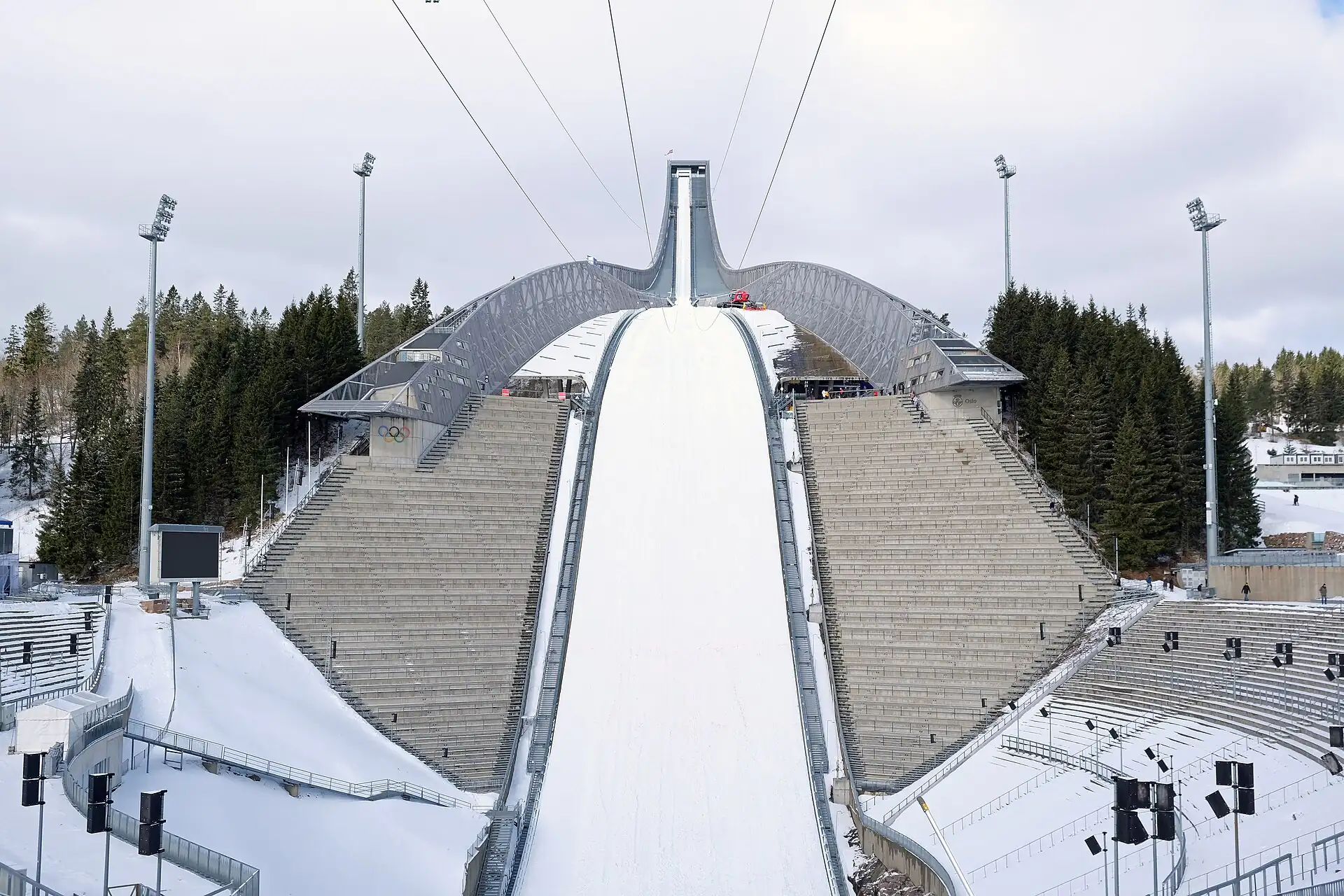 Photo: kallerna, CC BY-SA 4.0
Holmenkollen ski jump
goMetro line 1 about 30 min, then a short walk
Views and a ski museum; best in clear weather.
- Time
- Half day
Bergen by rail
overnightTrain about 7 h each way
Break at Flåm or sleep in Bergen; book seats ahead.
- Time
- Too long as a day trip
Go next
Door to door: 5 to 7 h
Train about 5 to 6 h or flight about 1 h
A capital of islands and museums.
Door to door: 3 to 4 h by air
Flight about 1 h or an overnight ferry
Another Scandinavian capital.
Eat & sleepWhere to eat and which area to sleep in
Eat & sleep
Where to eat and which area to sleep in
Eat
A short list of places worth crossing the city for, each with how to get a seat.
Restaurant finder: filter every place to eat in Oslo →
Vegetarian-friendly score
3.5 / 5 · Good
- Country diet noteOur country guide rates vegetarian eating as easy.2 / 2
- Places to eat in this guide2 of 5 places with a known answer are vegetarian-friendly, 3 partly.1.05 / 1.5
- Budget eating lines0 vegetarian lines in "Eat by budget".0 / 0.6
- Meat-free national dishes3 meat-free dishes in the country food list.0.3 / 0.4
- Dedicated vegetarian kitchens0 mentions of vegetarian restaurants, Buddhist or fasting kitchens.0 / 0.5
Country note: Easy in cities; rural menus lean on fish and meat.
Vegetarian places near me →Make a diet card →
How we score
- Country diet note (up to 2): easy 2, workable 1, mixed 0.75, hard 0; no note 0.5.
- City places to eat (up to 1.5): 1.5 × (vegetarian-friendly + half of partly friendly) ÷ places with a known answer; needs 3 or more known places.
- Budget eating lines marked vegetarian (up to 0.6): 0.2 each.
- Meat-free national dishes (up to 0.4): 0.1 each.
- Dedicated vegetarian kitchens mentioned — Buddhist chay, shōjin ryōri, Jain, fasting food, vegan cafés (up to 0.5): 0.1 each.
- Total rounded to the nearest half point, 0 to 5. Built from our own pages only, not from reviews.
Eating and drinking guideEat by budget · Drink
Before you sit down to eat
Short version; full text linked
House rules to know
- Cards are accepted almost everywhere.
- Tipping is not expected.
Eat by budget
Under NOK 150 (≈ US$15) a meal
| Where | Order | Area | Price | Note |
|---|---|---|---|---|
| Bakery and kiosk lunch | A bun or a hot dog in flatbread | Karl Johans gate | NOK 40 to 120 (≈ US$4–12) | |
| Supermarket picnic | Bread, cheese and fruit | Citywide | NOK 80 to 150 (≈ US$8–15) |
Dishes to know
| Dish | What it is | Where to look | When | Price |
|---|---|---|---|---|
| KjøttkakerKjøttkaker | Meatballs in gravy with potatoes | Kaffistova and traditional restaurants | Lunch or dinner | NOK 200 to 320 (≈ US$20–35) |
| FiskekakerFiskekaker | Fish cakes with sauce | Traditional restaurants | Lunch | NOK 200 to 320 (≈ US$20–35) |
| BrunostBrunost | Sweet brown whey cheese, sliced on bread | Supermarkets and Mathallen | Breakfast | NOK 30 to 60 (≈ US$3–6) |
| Pølse i lompePølse i lompe | A hot dog in potato flatbread | Kiosks | Snack | NOK 40 to 70 (≈ US$4–7) |
| SkolebolleSkolebolle | A bun with custard and coconut | Bakeries | Snack | NOK 35 to 50 (≈ US$4–5) |
| Salmon and shellfishLaks og skalldyr | Smoked or fresh fish and prawns | Harbour stalls | Lunch | NOK 150 to 300 (≈ US$15–30) |
| WafflesVafler | Heart-shaped waffles with jam and sour cream | Cafés | Afternoon | NOK 60 to 90 (≈ US$6–9) |
- Cards are accepted almost everywhere.
- Tipping is not expected.
- Lunch specials (dagens) are the cheapest hot meal.
- Alcohol is dear; drink tap water.
Drink & nightlife
| Where | What | Until | Note |
|---|---|---|---|
| Grünerløkka bars | Cafés and bars | About 01:00About 1:00 AM | Walkable bar streets by the river. |
| Aker Brygge and Tjuvholmen | Harbour terraces | About 00:00About 12:00 AM | Waterfront prices. |
| Karl Johans gate area | Pubs and bars | About 02:00About 2:00 AM | Busy on weekends. |
By style
| Style | What | Where | Price | Until |
|---|---|---|---|---|
| Beer | Local lagers and craft beer | Any bar | NOK 100 to 140 (≈ US$10–14) (2026 estimate) | Bar closing |
| Aquavit | A caraway-flavoured spirit | Restaurants and bars | NOK 110 to 160 (≈ US$11–16) (2026 estimate) | Bar closing |
| Coffee | Filter coffee at specialist bars | Grünerløkka and the centre | NOK 45 to 70 (≈ US$5–7) (2026 estimate) | Café closing |
Rules that bite
- Alcohol is heavily taxed and sold in state shops for wine and spirits.
- Do not drive after drinking; the limit is very low.
- Drink in a bar or on private ground; public drinking rules vary.
Sleep
Pick the area first: it decides your walk home at night and your first morning.
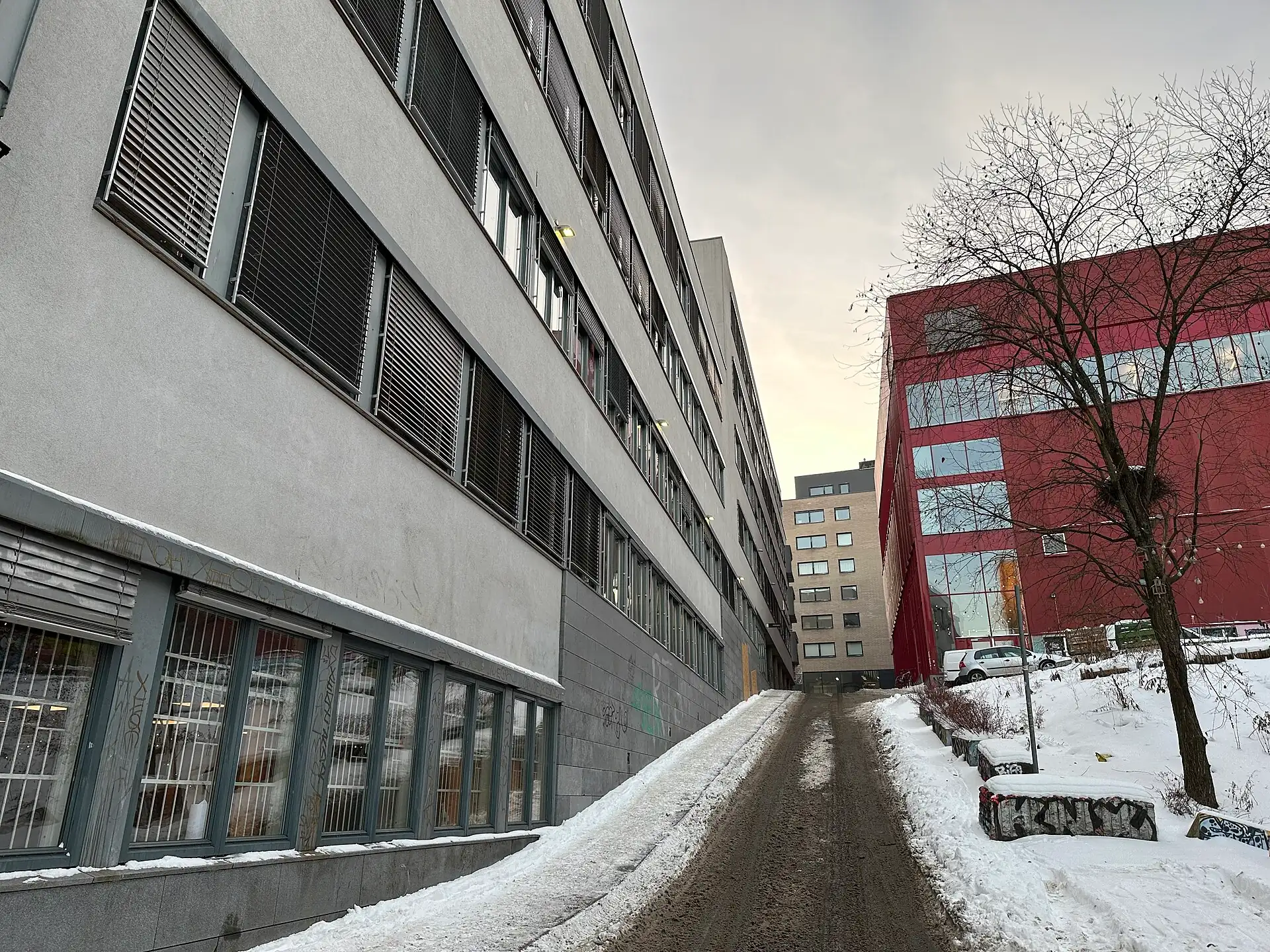
Which neighborhood fits you
Three questions, one recommendation, with the reasons.
Your best fit
- The fortress, cathedral and Opera House are a walk.
- 24-hour desks near the station.
Watch out: City-centre prices are high. Busy streets and late trams.
Next best: Grünerløkka
Built from our 1–5 desk scores per area; your answers stay in this browser.
More on sleepingSleep by budget · Your area · With kids
Sleep by budget
| Band | Price | Where | Room types | What to expect |
|---|---|---|---|---|
| budget | NOK 800 to 1,400 (≈ US$80–140) double | Hostels and small hotels near the station | Hostels and budget hotels | Compact rooms; shared bathrooms in some hostels. |
| mid | NOK 1,400 to 2,800 (≈ US$140–300) | Karl Johans gate and Grünerløkka | City hotels and boutique hotels | Breakfast, Wi-Fi and a central location. |
| splurge | NOK 3,000 to 6,000 (≈ US$300–600)+ | Harbour front and Bjørvika | Design and harbour hotels | Views, spa and restaurants. |
Booking checks
- Book early for May, June and August.
- Breakfast buffets are large; a hotel breakfast can replace lunch.
- Winter rates are lower; check for holiday pricing.
Which area is yours
| If you are | Sleep in | Because |
|---|---|---|
| First visit, want the sights on foot | Oslo S and Karl Johans gate | Everything is a short walk or tram ride. |
| Cafés and a quieter base | Grünerløkka | A neighbourhood feel with a tram to the centre. |
First-timers: a hotel between Oslo S and Karl Johans gate with a 24h desk; every cluster is a short walk or tram ride.
Cafés, vintage shops and a younger, quieter feel: fewer big hotels, a tram ride from the centre.
Areas are in our default order until you tick a priority.
Scores are 1-5 desk judgements per priority (2026).
With kids
- Vigeland Park has space to run and sculptures of children; it is free and always open.
- The fjord ferries to Hovedøya and the Bygdøy museums are good with children.
- Playgrounds are common in parks and squares; the Frogner park playground is large.
- Trams and metro are step-free at most stops and low-floor trams take strollers easily.
PracticalMoney, essentials, safety and the pocket card
Practical
Money, essentials, safety and the pocket card
Money
What a day costs at three comfort levels, and how to pay.
- Budget
- NOK 600–900 (≈ US$60–90) excl. bed / day
- Mid
- NOK 900–1,800 (≈ US$90–180) excl. bed / day
- High
- NOK 1,800 (≈ US$180)+ excl. bed / day
- Transit card
- Buy a Ruter ticket in the Ruter app; it covers trams, buses, metro and fjord ferries in the city.
- Cash rule
- Cash is rarely needed; carry a card and a phone wallet. If you need notes, use a bank ATM.
More on moneyCosts · Budget · Buy
What things cost
- Bakery lunchNOK 90–150 (≈ US$9–15)
- Bottle of water, shopNOK 25–40 (≈ US$3–4)
- Single transit ticket in the Ruter appNOK 40–50 (≈ US$4–5)
- Airport train to Oslo SNOK 100–250 (≈ US$10–25)
- Taxi from the airport to the centreNOK 900–1,300 (≈ US$90–130)
Trip budget
| Hotel double room1 × 3 nights × NOK 1,900 | NOK 5,700 |
| Food, local transport, entries2 × 3 days × NOK 1,300 | NOK 7,800 |
| Airport train, both ways2 × NOK 300 | NOK 600 |
| 24-hour Ruter ticket, each day2 × NOK 135 | NOK 270 |
| MUNCH entry2 × NOK 190 | NOK 380 |
| Buffer 15%Price creep, a taxi you did not plan, one splurge | NOK 2,213 |
| Trip total≈ NOK 2,827 per person per day, bed included | NOK 16,963≈ US$1,700 |
2026 estimate in Norwegian kroner; flights excluded. Your choices stay in this browser.
Prices of common things
| Bottle of water, shop | NOK 25 to 40 (≈ US$3–4) |
| Bakery bun | NOK 35 to 50 (≈ US$4–5) |
| Single Ruter ticket | NOK 40 to 50 (≈ US$4–5) |
2026 estimate; check locally.
Buy
- Bargaining
- Prices are fixed everywhere; do not bargain in shops, markets or taxis.
- Fixed-price check
- Supermarkets (Rema 1000, Kiwi, Coop) show fixed prices; use them for water, fruit and picnic food.
Markets and shopping streets
| Where | What | When | Haggle | Note |
|---|---|---|---|---|
| Basarhallene market halls | Food stalls and small shops beside the cathedral | Daytime (check) | no | A short stop with coffee. |
| Mathallen Oslo | Food hall with Norwegian produce | Daytime to evening (check) | no | See the eat page. |
| Grünerløkka flea market | Secondhand goods and crafts | Sundays in season (check) | some | Confirm whether it runs. |
Shops by what they sell
| For | Where | Hours | Note |
|---|---|---|---|
| Wool jumpers and outdoor wear | Karl Johans gate and department stores | About 10:00 to 20:00, Saturday to 18:00, closed Sunday | Expensive; check sales and tax-free rules. |
| Brunost (brown cheese) and smoked salmon | Mathallen and supermarkets | About 09:00 to 20:00 | Vacuum-packed goods travel well. |
| Wine and spirits | Vinmonopolet shops only | About 10:00 to 18:00, closed Sunday | State shops; no alcohol above 4.7% in supermarkets. |
Changing money
| Where | Verdict | Why |
|---|---|---|
| Bank ATMs | use | Fair rates; choose to be charged in kroner. |
| Exchange desks | avoid | Cash is rarely needed; rates are poor. |
ATMs
- Where
- Bank ATMs in the centre; cash is rarely needed.
- Currency
- Norwegian kroner; decline dynamic currency conversion at machines and card terminals.
Essentials and accessEssentials · Access
Essentials
- Plugs & power
- 230 V; two-pin sockets (types C and F).
- Health
- Winter ice and dark; summer sun and light sleep. Travel insurance with medical cover.
- Accessibility
- Trams and metro are step-free at most stops; some old streets have cobbles and steep hills to the north.
- Laundry
- Hotels and self-service launderettes; check the price list.
Pack
- Waterproof jacket and layers year-round
- Shoes with grip in winter
- A reusable water bottle
- An eye mask in summer for the light
Accessibility
Trams, metro and buses are step-free at most stops, and most major sights have lifts and ramps. Cobbles and hills are the main obstacles, and ice makes pavements hard in winter.
- Streets
- Flat in the centre; steep streets to the north; cobbles around the fortress.
- Public transit
- Most trams and buses are low-floor; check the line and stop.
- Hotels
- Newer hotels have lifts and step-free rooms; ask when you book.
- Sights
- The Opera House, MUNCH and City Hall have lifts; the fortress has cobbles.
Sights, step-free or not
| Oslo Opera House roof | step-free | Gentle ramps up the roof; foyer is step-free. |
| MUNCH (Munch Museum) | good | Lifts and wide floors. |
| Oslo City Hall and its square | good | Lifts and level entrances. |
| Akershus Fortress | hard | Cobbles and steep slopes. |
| Vigeland Sculpture Park | good | Wide, flat paths. |
Survive
Safety basics, the lines not to cross, and practical habits that save the day.
Safety
- Cold and ice (Nov–Mar): shoes with grip, layers, and a hat.
- Bike and e-scooter lanes on pavements: watch for riders when you step off a kerb.
- Petty theft at Oslo S and on the airport train: keep bags closed.
- Emergency: 112 police, 113 ambulance, 110 fire.
Red lines
- Do not walk on the Opera House roof edges or the fortress walls after ice forms.
- Swimming spots and saunas have their own rules: read the signs before you enter the water.
- Leave no trace in parks and the fjord islands.
Practical
- Toilets: museums, food halls and stations; some public ones charge a small fee.
- Tap water is excellent; refill a bottle.
More on staying safeStay safe · Stay healthy · Safety map · Solo & women · Etiquette · Cope · Scams
After dark, by area
1 flagged area
- Take care
Day = about 07:00 to 19:00. What to watch in each area, day and night →
Scams and red flags
Walk away if you see these
- Unlicensed taxis at the airport and stations: use the train, or a ride-hailing app or licensed taxi rank.
- Bag theft on the airport train and at Oslo S: keep bags on your lap or at your feet.
- Street sellers of 'gift' bracelets or petitions near the station: decline and walk on.
Stay safe
Crossing the road
- 01Traffic drives on the right; look both ways for trams and bikes.
- 02Bike lanes cross pavements; watch for riders.
Hustles specific to this city
| Hustle | Where | The tell | What to do |
|---|---|---|---|
| Unlicensed taxi | Airport and stations | A driver offers a fixed high fare | Use the train or a licensed rank or app. |
| Bag theft | Oslo S and the airport train | A distraction while your bag is grabbed | Keep bags closed and on your lap. |
| Petitions and bracelets | Station area | A clipboard or a gift bracelet, then a cash request | Decline and walk on. |
- Police
- 112; report theft at a police station for insurance.
- Night
- Use the night bus, a taxi app or a licensed taxi late; use lit streets.
- Government advice
- Check your government's travel advice for Norway before you go.
Stay healthy
- Cold and ice
- Wear shoes with grip and layers from November to March; ice is common.
- Water
- Tap water is safe and cold; refill your bottle.
- Sun
- Strong summer light and long days; use sun cream and an eye mask for sleep.
- Insurance
- Buy travel insurance with medical cover; non-residents pay for care.
Hospitals and clinics: see Cope.
Safety by area and hour
| Area | Day | Night | What to watch |
|---|---|---|---|
| Karl Johans gate and Oslo S | fine | caution | Pickpockets at the station and on the airport train; drug dealing near the station area at night. |
| Harbour front and Akershus | fine | fine | Ice in winter; wind on the piers. |
| Bjørvika and the Opera House | fine | fine | Slippery roof when wet; cold wind. |
| Grünerløkka | fine | fine | Busy bar streets on weekends; keep valuables close. |
- Keep your bag closed and on your lap on the airport train and at Oslo S.
- Take a licensed taxi or a night bus late; use the Ruter app for the last departure.
- Follow signs on ice and near water.
Solo, women and LGBTQ+ travellers
Solo
- Oslo is safe for solo travellers; keep bags closed at stations.
- Sauna and swimming spots have their own rules; read the signs.
Women
- Oslo is generally safe at night; use the same care as in any capital.
- Late trams and the metro are busy on weekends.
LGBTQ+
- Norway is very open and Oslo has a large Pride celebration in late June.
- Same-sex marriage is legal and discrimination is illegal.
Etiquette in Oslo
- Queueing
- Wait your turn; push-in queueing is not welcome.
- Noise
- Keep your voice low on public transport and in museums.
- Tipping
- Not expected; round up or add 5 to 10% for good service.
- Nature
- You may walk in forests and along the shore, but leave no trace.
- Saunas
- Follow the local rule for towels and swimwear; read the signs.
- Shoes
- Take your shoes off when you enter a home.
Cope
Hospitals and clinics that handle foreigners
| Where | Area | Use it for |
|---|---|---|
| Oslo legevakt (out-of-hours clinic) | Storgata 40 | Call 116 117 first; check opening hours and fees. |
| Hospital emergency departments | Oslo University Hospital sites | Call 113 for an emergency; keep insurance details ready. |
| Pharmacies (apotek) | Central Oslo and shopping centres | Some open late; ask for the vakt-apotek at night. |
Visa extensions
- Entry
- Norway is in the Schengen area but not the EU: check the entry rules for your passport, including any electronic authorisation, before you fly.
- Stay
- Visitors from many countries may stay up to 90 days in 180; check the current rule.
Embassies and consulates
| Country | Address | Phone | Note |
|---|---|---|---|
| United States | Morgedalsvegen 36 | check | (check) |
| United Kingdom | Thomas Heftyes gate 8 | check | (check) |
| Canada | Wergelandsveien 7 | check | (check) |
- Lost passport
- Report to the police, then contact your embassy.
- Emergency
- 112 police, 113 ambulance, 110 fire.
- Laundry
- Hotels and self-service launderettes; check the price list.
Apps and offline kitOffline kit
Offline kit
Set up before you leave, so Oslo still works with no signal or a dead roaming plan.
On your phone
- Maps: open the city in Google Maps, tap the place name, then Download offline map (or use an offline-maps app).
- Data: install an eSIM or buy a local SIM before the first taxi; the apps in this guide depend on it.
- Translation: download the local language for camera translation.
- Screenshots: booking confirmations, hotel address in the local script, and the emergency numbers.
This guide
Save the Oslo guide and its pages on this device; it opens without a connection.
Phrases that do the work
Greeting
Hello
Hei
hay
Thanks
Thank you
Takk
tahk
Please
Please / you're welcome
Vær så snill / Vær så god
vair saw snill / vair saw goo
Market
How much is this?
Hvor mye koster det?
voor mee-eh kos-ter deh
Food
Delicious!
Kjempegodt!
chem-peh-got
Café
The bill, please
Regningen, takk
ray-ning-en tahk
Basics
Excuse me
Unnskyld
oon-shull
Basics
Yes / No
Ja / Nei
yah / nay
Pocket card
Fill in, then print or save as PDF
Stays in this browser only; nothing is sent anywhere.
OsloOslo
Pocket card · Voykit
My bed tonight
—
—
—
Til denne adressen, takkTo this address, please
Emergency
- Police112
- Ambulance113
- Fire110
Embassy
Write your embassy's phone number below and save your insurer's line.
My embassy: —
Fare anchors (2026 estimate)
- Airport to Oslo S, train: About NOK 100 to 250 (≈ US$10–25), 19 to 25 min
- Single Ruter ticket, zone 1: About NOK 40 to 50 (≈ US$4–5); valid for a limited time on all modes
English is spoken almost everywhere; a greeting in Norwegian is appreciated.
Deep diveHistory, reading, photos and every source
Deep dive
History, reading, photos and every source
Sources
- officialUK FCDO travel advice: Norway
- officialVisit Oslo (official tourism site)
- officialOslo Airport (Avinor)
- secondaryWikivoyage: Oslo
Ask about Oslo
Loading…
Was this useful?