Santiago
Code CH · 4 walking zones
Santiago is a metro-and-hills city: do the centre and the two hills in the morning, eat a long lunch, and keep evenings to Lastarria and Bellavista, where you can walk back to a lit street.
Our quick read of Santiago, scored 1–5 (friction is out of 100). Cash need: how often you still need notes. Heat risk: how hot days get. Stroller: how easy wheels are. Friction: overall effort for a first visit. Desk judgements, so check before relying on them.
- Local time
- --:--
- Weather
- forecast below
- Currency
- CLP
- Best months
- Mar · Apr · May · Sep · Oct · Nov · Dec
- Airport
- Arturo Merino Benítez (SCL)
Walking zones: the 4 areas this guide plans a day around. Each is a district you can cover on foot, so you do one zone per half-day and ride the train between them. The code (CH 01, CH 02…) is just the zone's number on the Santiago line; the line under each name says how bags fare there and how much time it needs.
Map of Santiago
Use the switches to show or hide each kind of pin. A switch that is on shows its pins on the map; tap it again to hide them. "Show only" keeps just the pins that match (for example, places that fit a suitcase). Tap any pin for its name and a link to its page.
- Where to sleep
- Places
- Eat
- Walking clusters
- Rest stops
From the airport Merino Benítez (SCL) to your bed
Tap a pin for its card. Places without their own coordinates are shown by their walking cluster.
Why Santiago
Santiago's sights are close together along the Metro, with the Andes behind. The trips that go wrong are about timing and air: smog in winter, summer afternoon heat, and the hill funicular closing in high wind. Four clusters cover a first visit; Valparaíso and the wine valleys are day trips from one kept bed.
See first
- 1
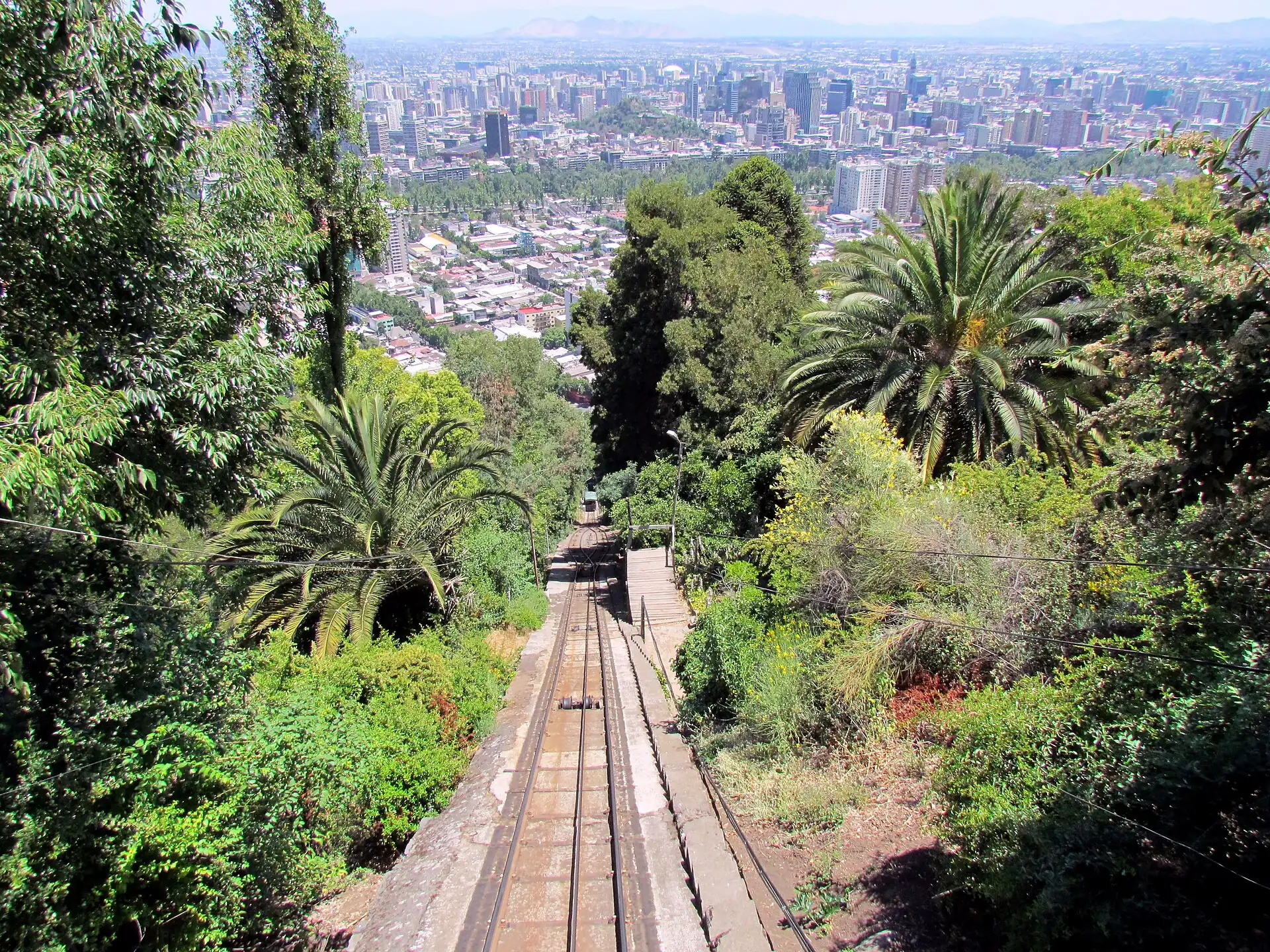 Cerro San Cristóbal funicular · 1.5–2 h
- 2
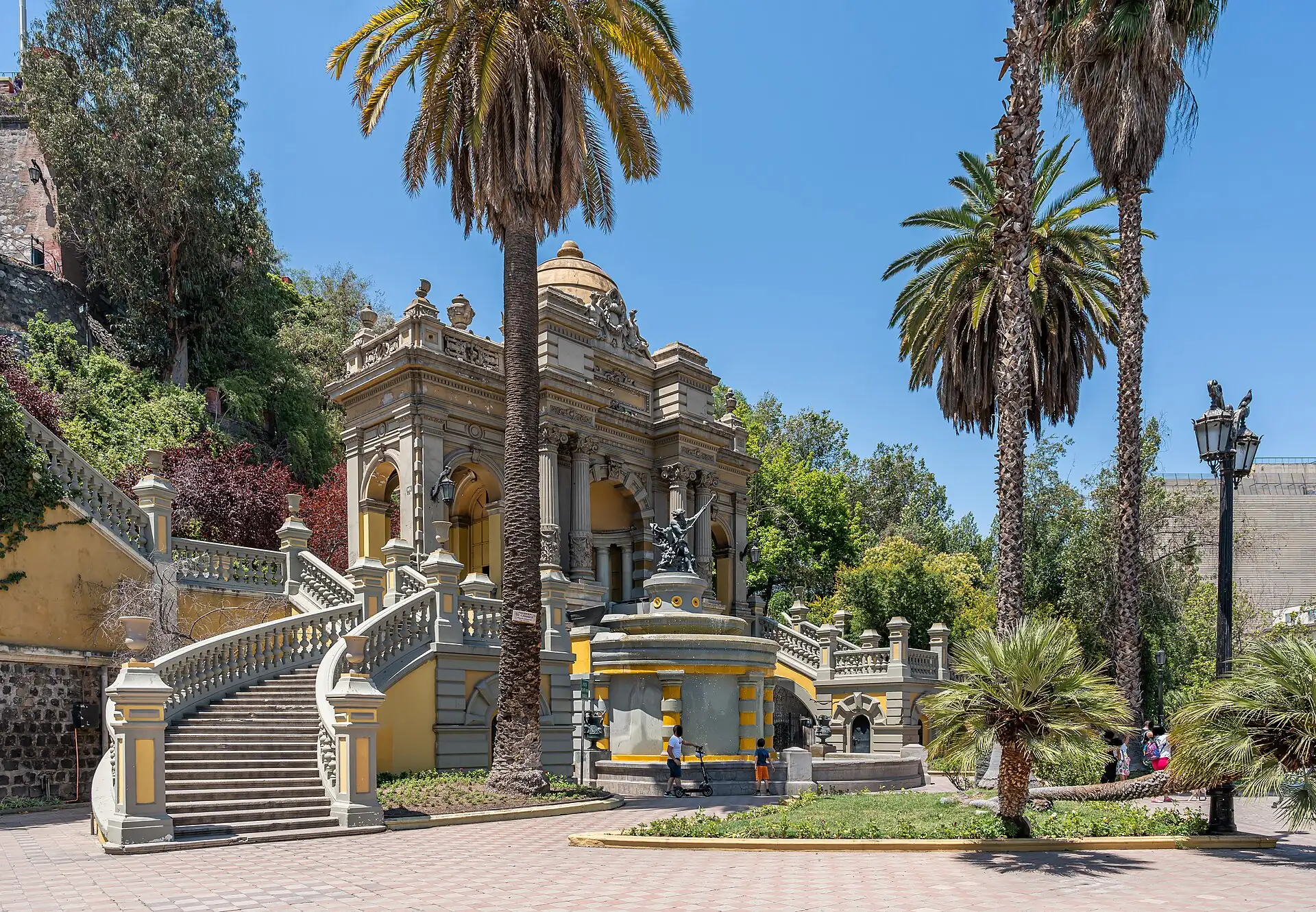
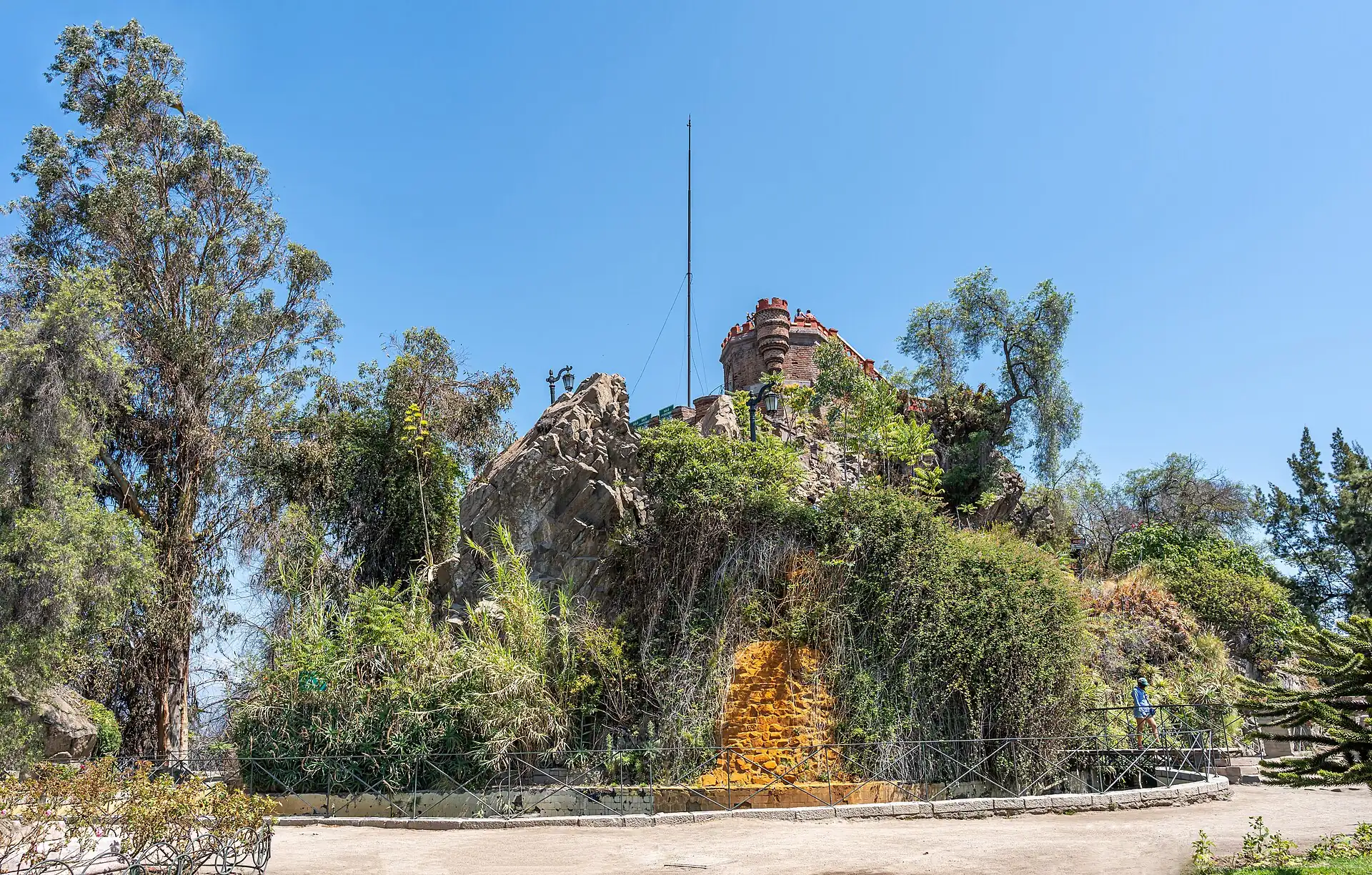 Cerro Santa Lucía · 45 min
- 3
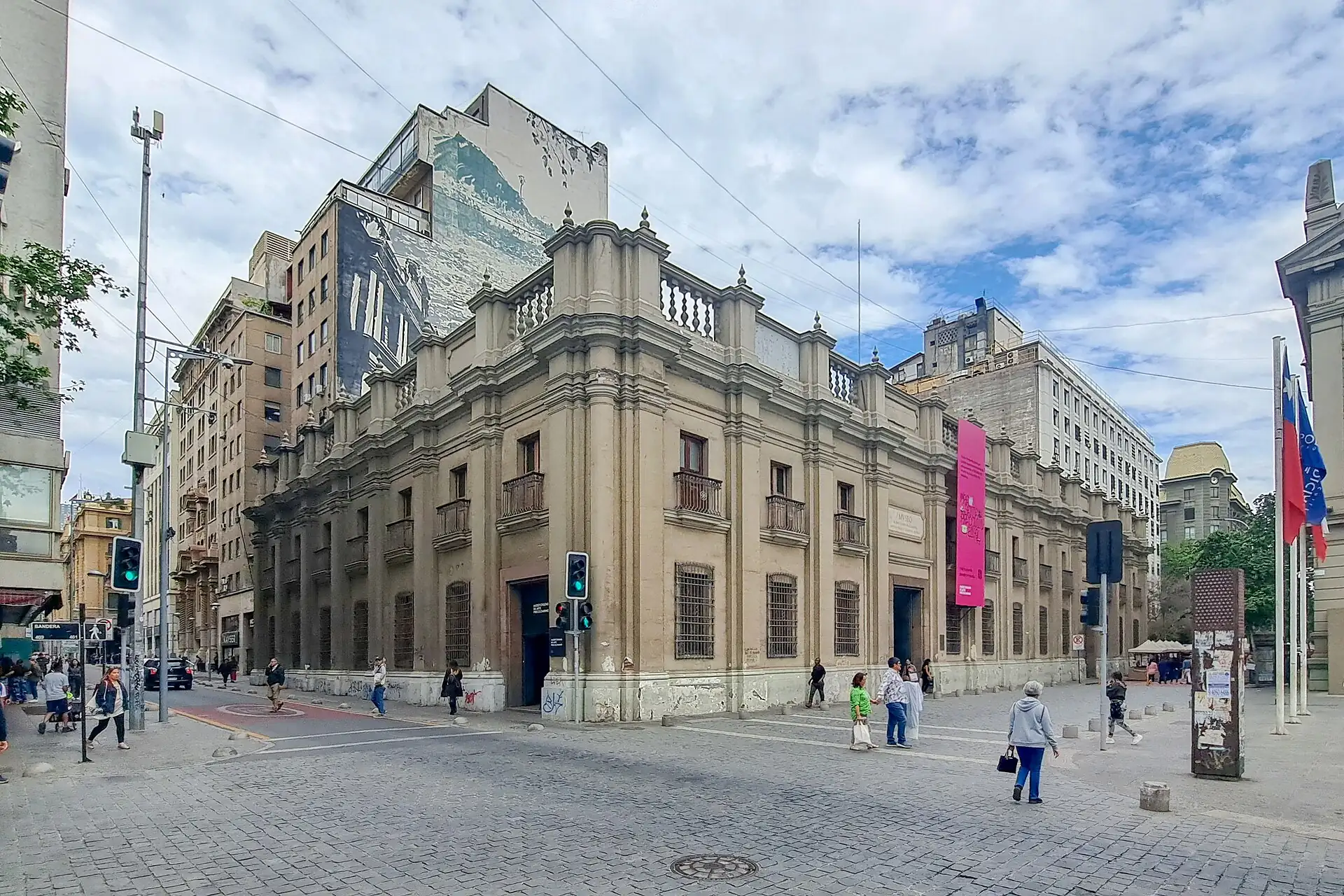
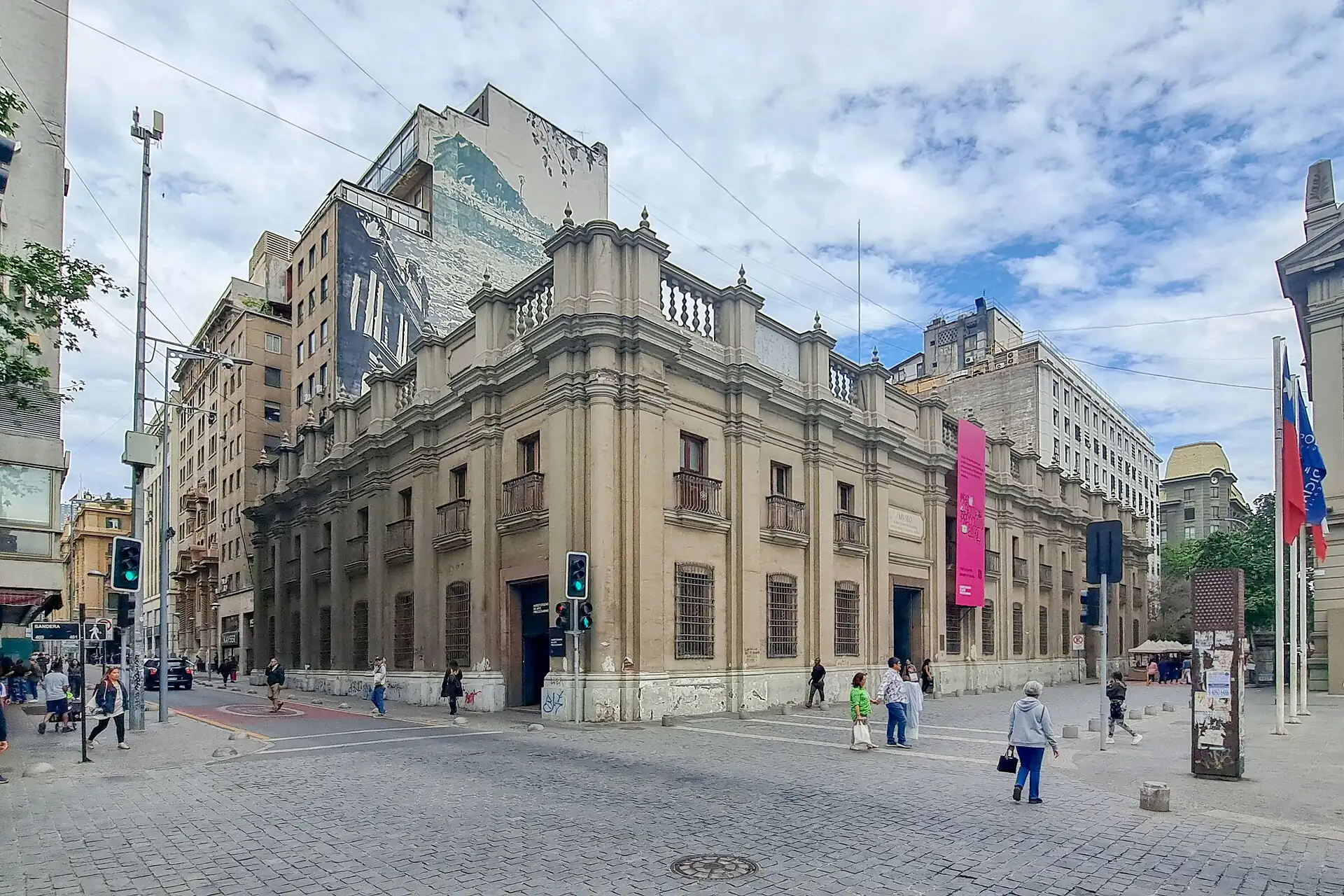 Museo Chileno de Arte Precolombino · 1.5 h
- 4Mercado Central seafood lunch · 1–1.5 h
- 5Sky Costanera at sunset · 1–1.5 h
Fits
- City breaks with food and views
- Travellers who use the Metro
- Trips that continue to Patagonia or Atacama
Does not fit
- Strollers and wheelchairs on the hills
- Winter travellers who dislike smog
- Late-night walkers without a car
How long
- 2 daysCentre and Lastarria on the first day, Bellavista and the hill on the second
- 3 daysFour clusters: the centre, Lastarria and the hill, Bellavista and San Cristóbal, Providencia's tower
- 5 daysFour clusters + Valparaíso day trip + a wine valley day
Good for
- First timers
- Foodies
- Budget
- Couples
- Families
- Luxury
About Santiago
Santiago sits in a broad valley 520 metres above sea level, framed by the Andes to the east and the lower coastal range to the west. On a clear day, especially after rain or in autumn, the snow-capped mountains are visible from almost everywhere, and the city is organized around that view.
Pedro de Valdivia founded the city on 12 February 1541, on the banks of the Mapocho river, near a rocky hill the Mapuche called Huelén (today Cerro Santa Lucía). The grid of streets around the Plaza de Armas is still the heart of the centre. Independence from Spain came in 1818, and Santiago stayed the capital and the country's power centre.
Good to know
- Santiago is both the city and the wider region; Valparaíso, Viña del Mar and the wine valleys are trips, not clusters.
- The city's tourist-information kiosks (Sernatur and the municipal points) operate around Plaza de Armas and Cerro Santa Lucía; opening hours vary, so check the day.
- Your hotel desk is the practical first stop for a map, a driver and a walking tour; free walking tours (tip-based) run from Plaza de Armas daily.
Go deeper 14 min read · 6 chapters
Santiago is easy to visit and hard to read at first glance. It is a large modern capital in a dry valley, backed by a mountain wall, built on a grid that a Spanish captain laid out in 1541 and shaken by earthquakes ever since. This deep dive reads it in six layers: the founding and the political story, the land and the air, the food and wine, the neighborhoods, the poets and the memory of the 1970s, and the two trips that most visitors add. Read it before you go, or on the Metro.
1History: a fort, a grid and a republic2 min
Before the Spanish, the valley of the Mapocho river was home to Picunche farmers, and the Inca had reached the area in the 15th century with roads and a small administrative presence. Pedro de Valdivia arrived in December 1540 and founded Santiago del Nuevo Extremo on 12 February 1541. He chose the flat ground between the Mapocho and a rocky hill that the Mapuche called Huelén, today's Cerro Santa Lucía, so that the hill could serve as a lookout and a fort. He laid out a grid of streets around a central square, the Plaza de Armas, and that grid is still the heart of the city.
The first year was hard. In September 1541, while Valdivia was away, a force led by the local leader Michimalonco attacked and burned much of the young settlement. By tradition Inés de Suárez, a woman in the Spanish party, played a decisive role in the defense. The city was rebuilt and survived, and for the next two and a half centuries it was a small, poor, earthquake-prone colonial town at the far end of the Spanish empire, governed by a Real Audiencia and a captain-general.
The 18th century added the buildings that visitors still see. The architect Joaquín Toesca, an Italian working for the Crown, designed the Metropolitan Cathedral on the Plaza de Armas in its present form and the Palacio de La Moneda, first a mint and later the seat of government. Independence came after the Battle of Maipú in April 1818, when Bernardo O'Higgins's forces and the Argentine army of José de San Martín defeated Spanish troops on the plain south-west of the city. The main boulevard, the Alameda, is officially named for O'Higgins.
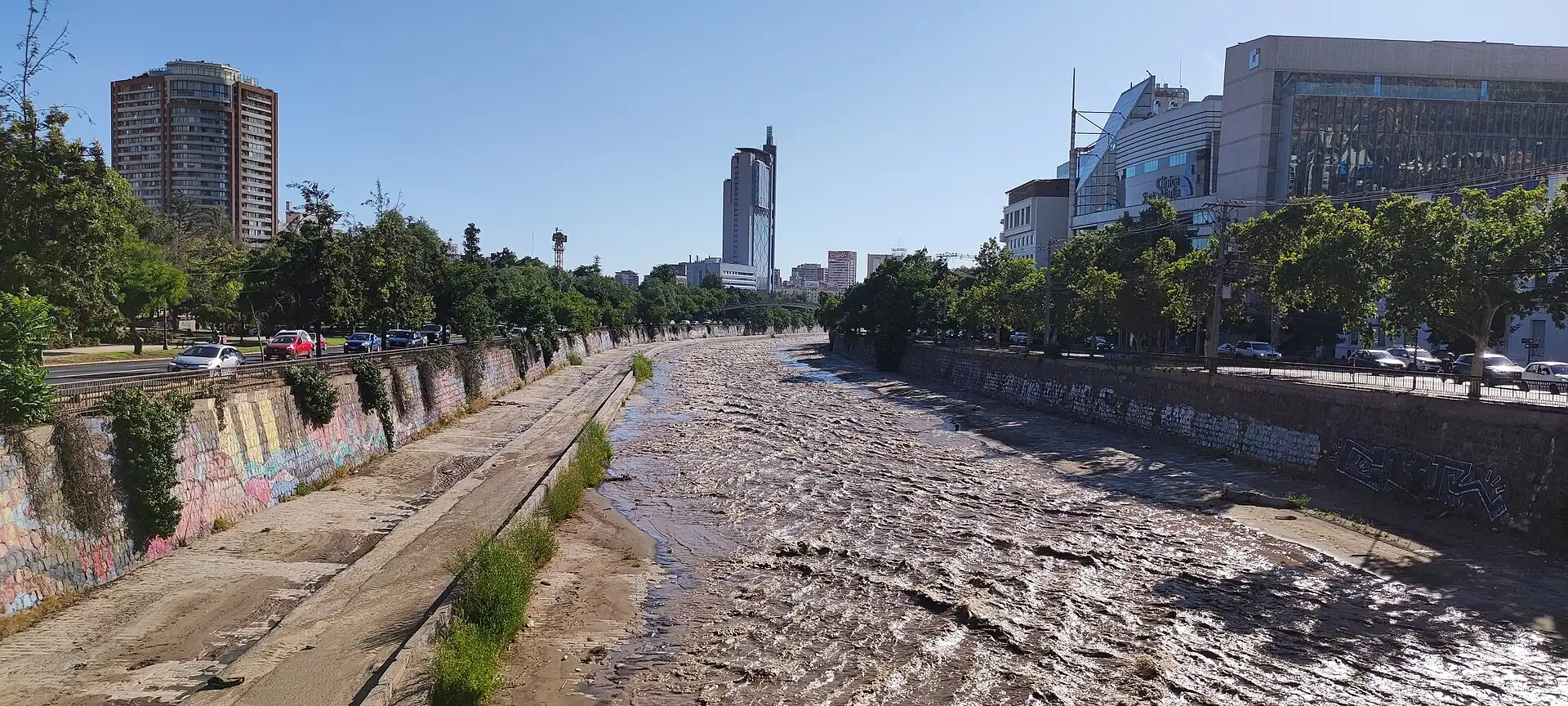
In the 19th century the city grew with mining and agricultural wealth, and in the 1870s the intendant Benjamín Vicuña Mackenna rebuilt Cerro Santa Lucía as a public park, planned promenades and pushed for the canalization of the Mapocho, which was completed in the following decades. The centenary of independence in 1910 left behind the Palacio de Bellas Artes in Parque Forestal and, completed just after, the Estación Mapocho rail terminal, now a cultural center. Through the 20th century the city spread east toward the mountains, and the wealthier districts followed.
The modern political story is stark. On 11 September 1973 the military overthrew President Salvador Allende and bombed La Moneda; the dictatorship of General Augusto Pinochet lasted until 1990, and a 1988 plebiscite ended it. The return to democracy brought steady growth. In October 2019 protests over inequality began in Santiago and centered on Plaza Baquedano, which many locals now call Plaza Dignidad. A proposed new constitution was rejected by voters in 2022. These events are not far below the surface when Chileans talk about their capital, and they explain why you may see graffiti, memorial plaques and museums about human rights in the city.
- Founded
- 12 February 1541 by Pedro de Valdivia, at the foot of Huelén (Cerro Santa Lucía)
- Independence
- Declared in 1818; the Battle of Maipú in April 1818 secured it
- Coup
- 11 September 1973; democracy returned in 1990
- Population
- About 7 million in the metropolitan area, roughly a third of Chile
2The land, the air and the ground under your feet2 min
Santiago sits at about 520 metres above sea level in a basin between two ranges: the Andes to the east, rising past 5,000 metres within a few dozen kilometres of the city, and the lower coastal range to the west. This shape explains almost everything about the weather. The Pacific to the west is cooled by the Humboldt Current, so summers are dry and hot in the valley but the nights cool quickly. Nearly all the rain falls between May and August, so a visit in January will almost certainly be dry.
The basin also traps air. On cold, still winter days a layer of warm air sits above the valley like a lid, and smoke and exhaust stay at street level. Santiago has had a long-standing smog problem, and authorities respond with alerts, traffic restrictions on older cars and limits on wood burning. A traveller can see the effect: on a smog day the Andes disappear entirely, and on the morning after a storm they look close enough to touch. That is why we suggest saving Cerro San Cristóbal and Sky Costanera for a clear day, and why winter travellers should check the air-quality reports before they buy a view.
Chile lies on the boundary where the Nazca plate slides under the South American plate, and earthquakes are part of ordinary life. The 1960 Valdivia earthquake in the south, magnitude 9.5, is the largest ever recorded. The 2010 Maule earthquake, magnitude 8.8, was felt strongly in Santiago and did remarkably little structural damage to modern buildings, because Chile's building code is one of the strictest in the world. Locals do not panic at a small temblor; visitors should still know the exit route from their hotel and follow the instructions in the emergency alerts sent to phones.
The Mapocho river runs through the city from the mountains in the east to the west, but for much of its length it is a concrete channel, walled in during the late 19th century. Parque Forestal, a long green strip along its south bank, was built on reclaimed ground and is the best walking path between the museums and the Metro. Beyond the city, the terrain rises quickly: the ski resorts of Farellones and Valle Nevado are within 90 minutes' drive, and the hiking valleys of the Cajón del Maipo begin about an hour out.
For a traveller, the practical rules are simple. Pick a clear morning for the hills, wear layers because the temperature swings 15 degrees between afternoon and night, put on sunscreen even in winter, and if you sleep light, choose a room on a middle floor away from a busy avenue. In summer, the heat is dry and manageable in the shade; in winter, the rain is short and the cold is not severe, but many older buildings have poor heating.
- Elevation
- About 520 metres; the Andes rise above 5,000 metres nearby
- Rain
- Nearly all of it falls May–August; summers are dry
- Smog season
- May–August on cold, still days; clears after storms
- Earthquakes
- The 2010 quake was M8.8; know your hotel exit
3Food and wine: what to order and when2 min
Chilean food is built on three things: cold-water seafood from the Humboldt Current, beef and corn from the central valley, and a long wine tradition. The cold sea gives the country conger eel, razor clams, sea urchin, hake and large scallops. The poet Pablo Neruda wrote an ode to conger-eel soup, caldillo de congrio, and the dish is on every serious seafood menu in the city. Mercado Central, an iron-and-glass hall from the 1870s, is the classic place to eat it, as long as you ignore the touts and pick a counter with a printed menu.
On land the staples are simple. The empanada de pino is a baked pastry of minced beef, onion, egg and olive; the pastel de choclo is a baked pie of ground corn over meat, served in a clay dish; the cazuela is a soup with a large piece of chicken or beef, corn and potato. Bread comes with pebre, a fresh salsa of tomato, onion, cilantro and chile. The completo, a hot dog loaded with mashed avocado, tomato and mayonnaise, is the everyday fast food; the barros luco, a steak-and-cheese sandwich, is said to be named after President Ramón Barros Luco, who was a regular at Confitería Torres.
Chile is a wine country, and Santiago is the doorway. Carménère, a Bordeaux grape that was once thought to be Merlot, was identified in Chilean vineyards in the 1990s and is now the country's signature red. The Maipo Valley, just south of the city, is known for Cabernet Sauvignon, and the Casablanca Valley, closer to the coast, is known for cooler-climate whites and Pinot Noir. You can taste a good glass in any wine bar for CLP 4,500–8,500, or take a half-day trip for a proper tasting.
Pisco is a grape brandy that Chile and Peru both claim; in Chile the main producing region is the Elqui Valley in the north. The pisco sour, made with lime and sugar, is the national cocktail and can be strong. The terremoto, the earthquake, is a sweet mix of white wine and ice cream that lives up to its name. For a non-alcoholic option, try mote con huesillo, a cold drink of wheat and dried peach that is sold from carts in summer.
Rhythms matter. Lunch is the main meal and runs from about 13:00 to 15:00; the menú del día, a fixed weekday menu of starter, main and drink, is the best-value meal in the city. Dinner starts late, usually after 20:30, and many kitchens close between 16:00 and 19:30. A 10% tip is customary and often suggested on the bill. If you want to eat like a local, take a set lunch, walk it off in the afternoon and eat a light dinner.
- Signature red
- Carménère, identified in Chile in the 1990s
- Lunch
- 13:00–15:00; a menú del día costs about CLP 8,000–12,0001:00 PM–3:00 PM; a menú del día costs about CLP 8,000–12,000
- Tip
- About 10%, usually suggested on the bill
- Classic snack
- The completo, a hot dog with avocado, tomato and mayonnaise
4Neighbourhoods and the Metro2 min
Santiago is made of comunas, municipal districts, and most of what a visitor needs sits in four of them. The centre, Santiago Centro, is where the grid begins: the Plaza de Armas, the cathedral, the post office, the pre-Columbian museum and Mercado Central. It is busy on weekdays and empty after dark. Lastarria, on the edge of the centre, is a small neighborhood of cafés, bookshops and museums at the foot of Cerro Santa Lucía, and most first-time visitors choose to stay here.
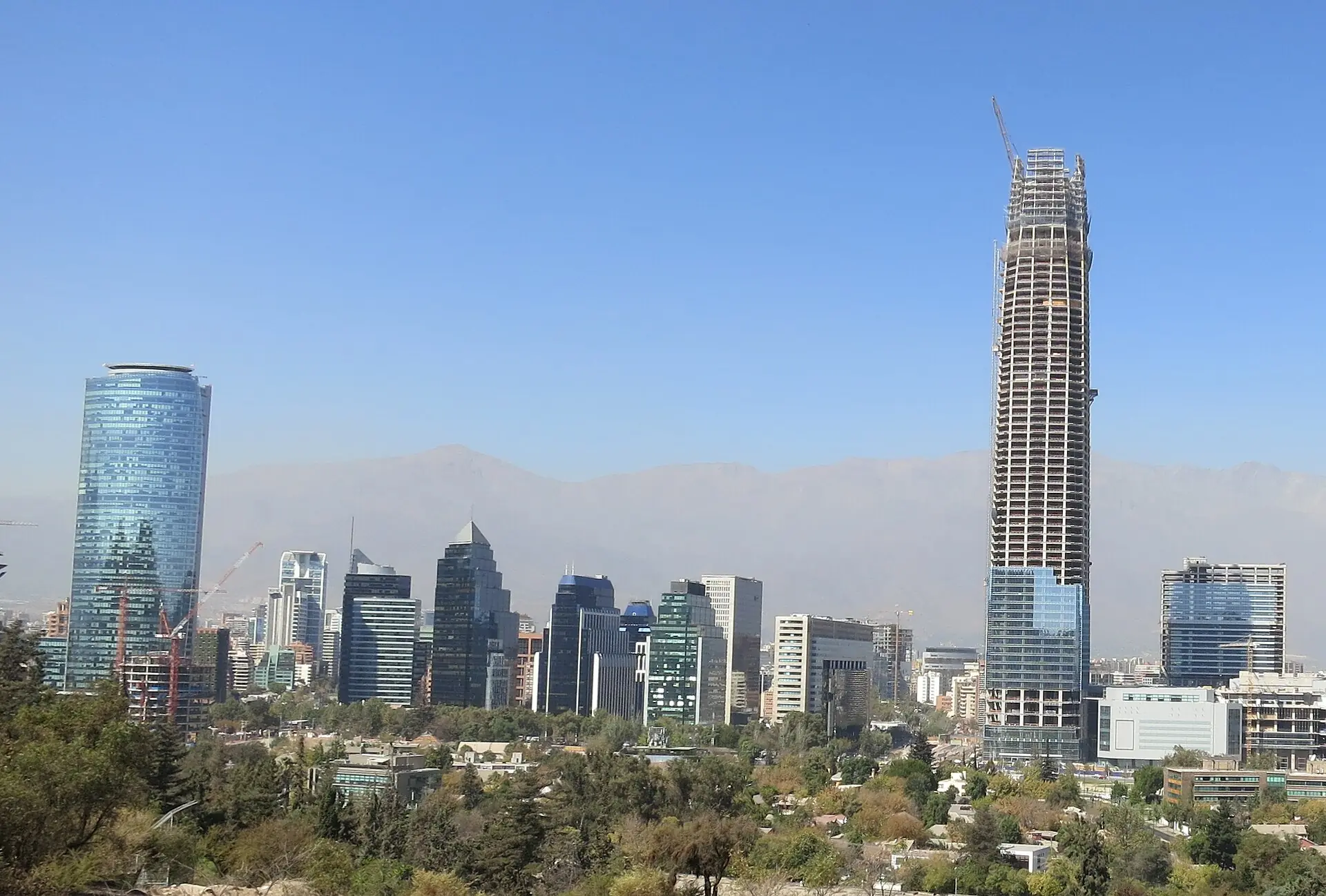
Bellavista lies on the north side of the Mapocho, at the foot of Cerro San Cristóbal. By day it is the funicular station, the Neruda house and craft shops; by night it is the city's main bar and restaurant zone, centered on Pío Nono street and the Patio Bellavista courtyards. Providencia, to the east, is a calmer, tree-lined district of apartment blocks, parks and shopping. Its Costanera Center complex includes the Gran Torre Santiago, about 300 metres tall and the highest tower in South America.
The Metro is the backbone of the city and the easiest way to move between these areas. It opened in 1975 and now has several lines, including line 1 (red), which runs east–west along the Alameda from Universidad de Chile through Baquedano to Tobalaba, and line 5 (green), which links the centre to Bellas Artes and Quinta Normal. Stations are clean and signs are clear. A Bip! card, bought at a station counter, is the fare card for the Metro and buses, and a ride costs about CLP 700–900 depending on the hour. The Metro runs from about 06:00 to 23:00, so plan a car for late evenings.
Beyond the four main areas, Barrio Italia and Ñuñoa, to the south-east, have antique shops, cafés and neighborhood restaurants and are good for a second visit. Las Condes and El Golf, to the north-east, are business districts with embassies and glass towers. To the west, Barrio Yungay and Barrio Brasil have historic mansions and street art, and are best explored with a local guide or in daylight. Estación Central and Barrio Meiggs are transit and wholesale zones that most tourists pass through but do not linger in.
A walking route that shows the whole system takes a morning. Start at Cerro Santa Lucía, walk along the Alameda to the Plaza de Armas, cross the Mapocho at Mercado Central, and then walk through Parque Forestal back to Lastarria. You will pass the founding hill, the founding square, the market and the park in about 5 kilometres, and you can shorten it with a Metro ride between stops. Keep phones in front pockets in the centre and stop for a coffee when your feet tell you to.
- Metro
- Opened 1975; fares about CLP 700–900; runs about 06:00–23:00Opened 1975; fares about CLP 700–900; runs about 6:00 AM–11:00 PM
- Best base
- Lastarria for walking; Providencia for quiet
- Tallest tower
- Gran Torre Santiago, about 300 metres
- Address tip
- Give the street, number and comuna to your driver
5Poets, art and the memory of the 1970s2 min
Chile has produced two Nobel Prize poets, Gabriela Mistral in 1945 and Pablo Neruda in 1971. Mistral gave her name to the Centro Cultural Gabriela Mistral, known as GAM, on the Alameda. The building was built in 1972 in a rush for a United Nations trade conference and, after the 1973 coup, became the seat of the military government, which used it under a different name. It was badly damaged by a fire in 2006 and reopened as a cultural center in 2010, and today has free galleries, a café and evening concerts.
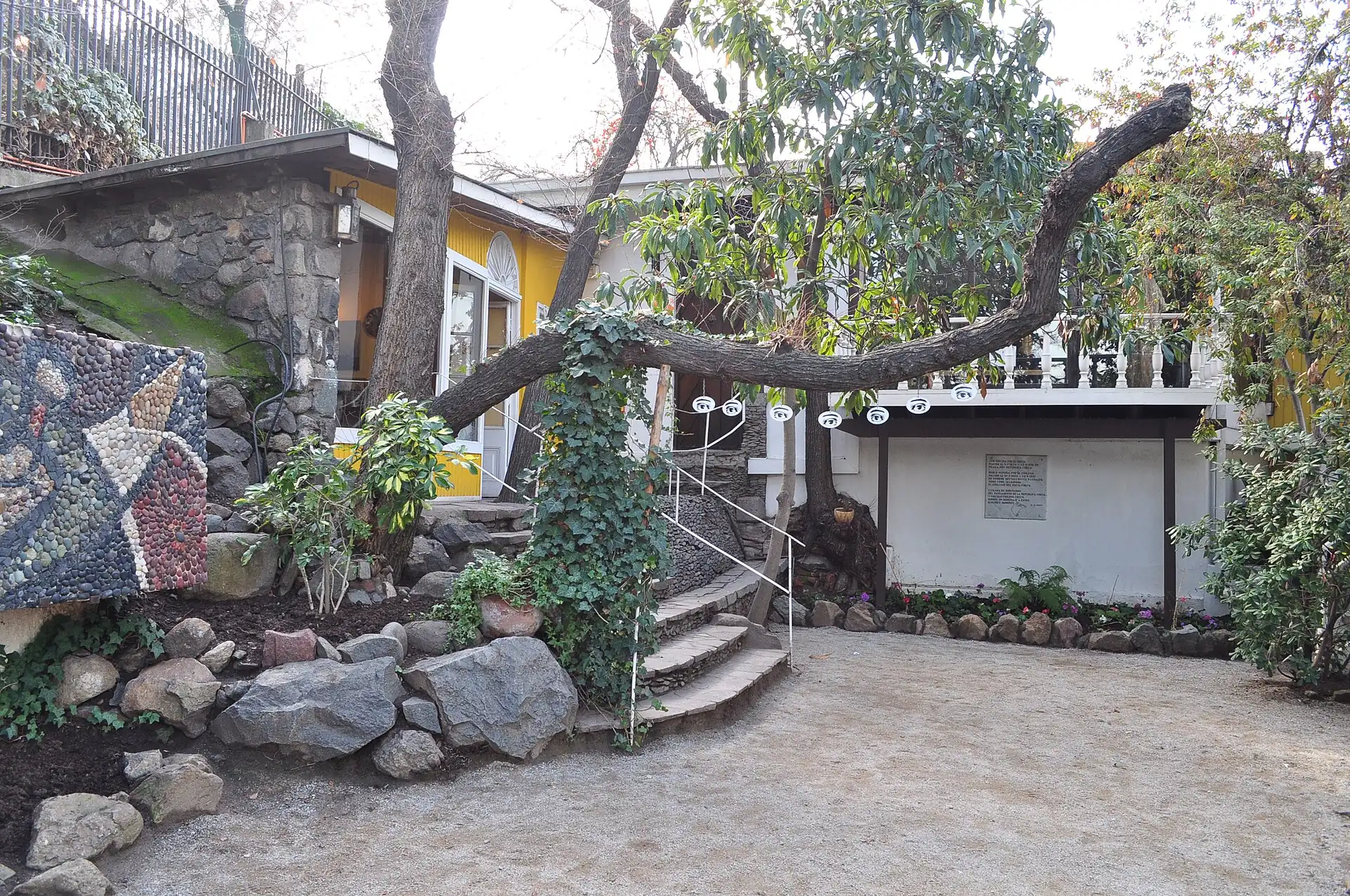
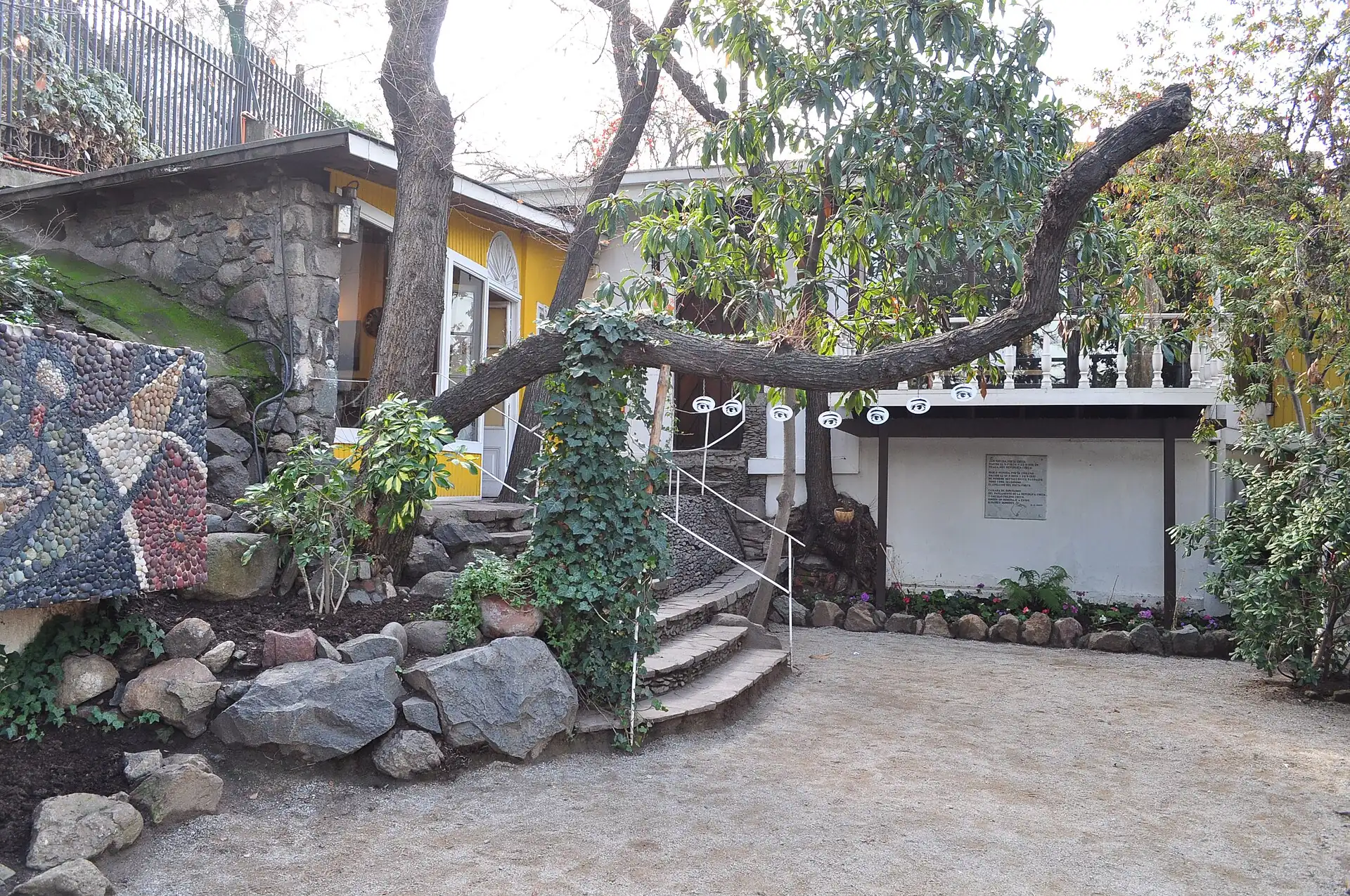
Neruda's Santiago house, La Chascona, sits at the foot of Cerro San Cristóbal. He built it in the 1950s for Matilde Urrutia, who became his wife; the name means the woman with the messy hair. The house has a ship-like layout, with low doors and rooms full of objects he collected on his travels, including bottles, shells, figureheads and paintings. After the coup the house was damaged, and when Neruda died in September 1973, his wake was held among the wreckage. The house has since been restored and is one of the three Neruda houses run by the foundation, with the others in Valparaíso and Isla Negra.
The 1970s and 1980s are also remembered in the city's museums and monuments. The Museo de la Memoria y los Derechos Humanos, opened in 2010 in Quinta Normal, documents the human-rights abuses of the dictatorship through photographs, letters, documents and video. The Estadio Nacional, used as a detention site in 1973, is now a sports stadium with a memorial. These are difficult places, and if you visit, go with time and quiet. Chileans have a range of views about this period, so ask questions gently and listen more than you talk.
Music and film are part of the same story. The Nueva Canción movement of the 1960s and 1970s, with singers like Violeta Parra and Víctor Jara, tied folk music to social change. Jara was killed after the coup, and his songs remain widely sung. More recently, Chilean cinema has gained an international audience, with films like No (2012) and Gloria (2013) set in Santiago and the years around the plebiscite. The Museo Nacional de Bellas Artes, in a neoclassical palace from 1910, shows the country's painters from the 19th century to the present.
For a traveller, a good day pairs art and outdoors. Start at the Bellas Artes museum in Parque Forestal, walk to GAM for a free gallery and a coffee, and cross to Bellavista for a booked tour of La Chascona in the afternoon. If you have a second day, add the Museo de la Memoria by Metro line 5 to Quinta Normal. Bring a light jacket, because the museums are air-conditioned, and keep your phone off in the quieter rooms.
- Nobel poets
- Gabriela Mistral (1945) and Pablo Neruda (1971)
- GAM
- Built 1972; reopened as a cultural center in 2010
- La Chascona
- Neruda's house built in the 1950s; book a timed tour
- Memory museum
- Museo de la Memoria y los Derechos Humanos, opened 2010
6Trips from one bed: Valparaíso, wine and the mountains2 min
Santiago works as a base. The three most popular trips are the port of Valparaíso and its neighbor Viña del Mar, the wine valleys, and the Andes. All are possible as day trips from a single hotel, which is why we recommend keeping the same room and traveling light. Do not try to combine all three in one day; the travel time will eat the visit.
Valparaíso is about 1.5 to 2 hours west by bus from the Alameda or Pajaritos terminals. The port sprawls up a series of steep hills, called cerros, and its historic quarter was placed on the UNESCO World Heritage list in 2003. Its old funiculars, called ascensores, carry passengers up the hills; the cerros Alegre and Concepción have painted murals, cafés and views over the harbor. Neruda's house La Sebastiana is on one of the hills. Streets are steep, some are quiet, and the return bus should be booked before dark. Viña del Mar, 15 minutes north, has beaches, gardens and a casino, and is more polished.
The wine valleys are closer. The Maipo Valley, the historic red-wine area, starts on the southern edge of the city; a driver can take you to Pirque for a tasting in under an hour. The Casablanca Valley, about an hour toward the coast, has a cooler climate and is known for Sauvignon Blanc, Chardonnay and Pinot Noir. Colchagua, farther south, is a full-day trip. Tastings usually need booking, and drinking and driving is illegal, so hire a driver or a tour.
The mountains are the third option. The Cajón del Maipo, a valley running south-east from the city, has hiking trails, hot springs and views of snowy peaks; the road is prone to closure after storms, so check the day. In winter, the ski resorts of Farellones and Valle Nevado are 1 to 1.5 hours away, with shuttles and tours from the city. On a clear day the Andes are a permanent backdrop; on a smog day, a trip to the mountains gets you above the layer.
Farther afield, Chile offers the driest desert in the world, the Atacama, and the Patagonian fjords, both reached by flight from Santiago airport. These are separate trips and need several nights each. The practical tip is to book them early in the season and to keep an extra day in Santiago at the end for a buffer in case of a flight change. For a short stay, one day trip is plenty; for a week, add a second.
- Valparaíso
- About 1.5–2 h by bus; UNESCO listing 2003; return before dark
- Wine
- Maipo (45–75 min) and Casablanca (about 1 h)
- Mountains
- Cajón del Maipo about 1–1.5 h; ski resorts about 1–1.5 h
- Rule
- Keep one bed in Santiago and travel light
Read, watch, wordsReading · Watching · Glossary · Sources
Reading
- Twenty Love Poems and a Song of Despair — Pablo NerudaThe poems that made his name; read a few before La Chascona.
- The House of the Spirits — Isabel AllendeA family saga set in an unnamed Chilean city through the 1973 coup.
- By Night in Chile — Roberto BolañoA short novel about the church, the arts and the dictatorship.
Watching
- No — Pablo Larraín (2012)The 1988 plebiscite campaign, set in Santiago.
- Gloria — Sebastián Lelio (2013)A portrait of a woman in her 50s in present-day Santiago.
Glossary
| Term | Local | Meaning |
|---|---|---|
| Comuna | comuna | A municipal district; give it with the street when you name an address. |
| Completo | completo | A hot dog loaded with avocado, tomato and mayonnaise. |
| Menú del día | menú del día | The fixed weekday lunch of a starter, a main and a drink. |
| Propina | propina | The tip, about 10%, usually suggested on the bill. |
| Bip! | tarjeta Bip! | The transit card for the Metro and buses. |
| Cerro | cerro | A hill: Santa Lucía and San Cristóbal in Santiago, or Alegre and Concepción in Valparaíso. |
| Pebre | pebre | A fresh salsa of tomato, onion, cilantro and chile served with bread. |
| Temblor | temblor | A minor earthquake, felt often and ignored by locals. |
Read for this deep dive
Background reading only: the text above is written by Voykit, not copied from these pages.
Photos
Construction point at Plaza La Aviación on Line 7 of the Santiago Metro, Chile Photo: TomasVial, CC0
Santiago from sky costanera Photo: Charles Hancock, CC BY-SA 4.0
Fundación CLEC, Oficina Regional para América Latina y el Caribe, Santiago 08 Photo: Carlos Figueroa Rojas, CC BY-SA 4.0
Plaza a la Aviación, a park in northern Santiago de Chile Photo: Christer T Johansson, CC BY 3.0
Rules in force · 7Above 2,500 m (Bogotá, Quito, Cusco, La Paz) keep the fir…
- South America ↗Above 2,500 m (Bogotá, Quito, Cusco, La Paz) keep the first day light; sleep lower where you can (Sacred Valley before Cusco) and descend if headache comes with vomiting or confusion.
- South America ↗A yellow fever certificate is required on arrival in French Guiana, and asked for on some routes into Bolivia, Paraguay, Suriname and Guyana, or when arriving from Amazon areas — vaccinate at least 10 days before travel and carry the card.
- South America ↗Overnight buses are the norm in Argentina, Chile and Peru, but pick top-tier companies and keep valuables on your body; on-board thefts from overhead racks are the common loss.
- Chile ↗Check entry rules for your passport with Chile's National Migration Service or a Chilean consulate; keep the entry slip or digital record you receive.
- Chile ↗Torres del Paine: campsites and refugios on the W and O treks must be booked in advance, and the park requires an entry ticket bought ahead; check the official park (CONAF) channels.
- Chile ↗Chile strictly controls food imports: declare fruit, meat, dairy, seeds and honey on arrival, or throw them away before customs.
- Santiago and central Chile ↗Valparaíso's hills are steep and quiet after dark: plan the return bus or car before dark.
Entry rules depend on your passport. Full visa guide
Emergency numbers for Santiago133 ▾
Tap a number to call from your phone. These are the numbers listed in this guide; a row marked check has not been verified.
Planning is the full guide. I'm here keeps what is open and the cheat card.
Right now
Checking the weather…
Working out what is open near you…
What is open nowclock, closures, places open
Now in Santiago
Local time in Santiago
--:--
Loads in your browser · America/Santiago
This month
Month verdict appears here.
Closed today
See the weekly grid below.
| Weekly closure | Mon | Tue | Wed | Thu | Fri | Sat | Sun |
|---|---|---|---|---|---|---|---|
| Most museumscheckMany are closed on Mondays; check each. | ✕ | · | · | · | · | · | · |
If today is a closure day: Check the air quality on smog days from May to August and Metro closure news around protests; avoid Plaza Baquedano when crowds gather. Plan Monday around closed museums.
Open every day: Cerro San Cristóbal funicular, Cerro Santa Lucía, GAM (Centro Cultural Gabriela Mistral), La Chascona (Neruda's Santiago house), Museo Chileno de Arte Precolombino, Museo Nacional de Bellas Artes, Plaza de Armas and the Cathedral, Sky Costanera.
Weekly closures come from our place pages; public holidays, strikes and protests can add closures.
Open now
The sights and places to eat on our list that are open at this moment, in the city's time, nearest first from where you are staying.
Loads in your browser with the city's local time.
Hours marked (check) are typical, not confirmed. Walking times are straight-line estimates. Open at another time →
Cheat cardthe pocket version
Cheat card
The essentials on one card: save it as an image for your phone, share it, or print it.
Santiago
- Money
- Cards work in most restaurants and shops; keep CLP 20,000 in small notes for markets and taxis…
- SIM
- Buy a prepaid SIM from Entel, Movistar, Claro or WOM at the airport or a branded shop with your passport…
- Ride app
- Uber, Cabify, DiDi
- Emergency
- 133 police (carabineros) · 131 ambulance · 132 fire (not 911, 999 or 000)
- Plugs
- Sockets C. US/Canada (A/B): adapter · UK/Ireland (G): adapter · Australia/NZ (I): adapter. 220 V: US 120 V-only devices (hair dryers) need a converter; most chargers are dual-voltage.
Top 5
- Cerro San Cristóbal funicular
- Cerro Santa Lucía
- Museo Chileno de Arte Precolombino
- Mercado Central seafood lunch
- Sky Costanera at sunset
EssentialsQuick answers, what things cost and how to get around
Essentials
Quick answers, what things cost and how to get around
Quick answers
The questions people ask first about Santiago, one line each. Tap a card for the full answer.
- Cash or card?Cards (Visa, Mastercard) work in most restaurants, hotels, malls and Metro-area shops; cash for markets, small counters, taxis and tips.
- SIM or eSIMBuy a prepaid SIM from Entel, Movistar, Claro or WOM at the airport or a branded shop with your passport, or use an eSIM.
- Ride-hailing appUber, Cabify, DiDi.
- Tap waterTap water in Santiago is treated and drinkable; it is hard and many visitors and locals prefer bottled or filtered water.
- TippingAbout 10% (propina) is customary at sit-down restaurants and is usually suggested on the bill; you can say 'sin propina' if the service was poor.
- Plugs & powerSockets C. US/Canada (A/B): adapter · UK/Ireland (G): adapter · Australia/NZ (I): adapter. 220 V: US 120 V-only devices (hair dryers) need a converter; most chargers are dual-voltage.
Show all 14 answers
- Safe at night?Take more care after dark in Centro (Plaza de Armas, Paseo Ahumada), Mercado Central and La Vega, Bellavista and more.
- What to wearCasual is fine; smart casual for restaurants; cover shoulders and knees in churches.
- Emergency numbers133 police (carabineros) · 131 ambulance · 132 fire (not 911, 999 or 000)
- Your embassycheckUS, UK, Canada, Australia, NZ, Ireland embassies listed with addresses (check before you go).
- Closed which day?Mon: 1 on our list shut.
- Sundays & holidaysWeekly closures come from our place pages; public holidays, strikes and protests can add closures.
- Rainy-day planRain is rare and usually falls May–August; if it rains, go to a museum first and wait for the Andes to appear the next day.
- Landing lateSCL: official taxi or pre-booked transfer to the door runs all night.
Cost cheat-sheetwhat everyday things cost
Cost cheat-sheet
Typical prices for the everyday things, as ranges. Change the currency right here; the local price stays first.
2026 desk estimate · check
- CoffeeCoffee (cortado)CLP 2,500–3,800
- Street or quick mealSet lunch (menú del día)CLP 8,000–12,000
- Taxi, about 5 km (3 mi)Taxi, about 3 mi (5 km)Short ride-hailing ride, centreRain and rush hour push fares up.CLP 4,000–8,000
- Metro or bus rideMetro single ridePrice depends on the hour; transfers within 2 hours are cheaper.CLP 700–900
- Museum or sight ticketMuseum entryCLP 3,000–10,000
- Budget bedHostel dorm bed, a night, per personCLP 12,000
- Mid-range bedHotel double room, a night, per roomCLP 90,000
- High-end bedHotel double room, a night, per roomCLP 220,000
A day, not counting the bed: Budget CLP 40,000 · Mid CLP 80,000 · High CLP 160,000
Local prices, with USD next to them (rates 2026-09 (approximate); change it in the header). Ranges are desk estimates: check locally. Every price and the budget calculator →
Source: Prices in Santiago
Draft
Written from desk research. Not yet compared with the official source.
No official source is recorded for this figure.
Prices are 2026 desk estimates, not yet compared with an official source. Check on the day.
Not checked in the last 12 months (no check date on file).
DecideWho it suits, the trade-offs and when to go
Decide
Who it suits, the trade-offs and when to go
Best months at a glance
The guide's verdict for each month
Jan
Care
30°C (86°F)86°F (30°C)
Feb
Care
30°C (86°F)86°F (30°C)
Mar
Best
27°C (81°F)81°F (27°C)
Apr
Best
23°C (73°F)73°F (23°C)
May
Best
19°C (66°F)66°F (19°C)
Jun
Care
15°C (59°F)59°F (15°C)
Jul
Care
15°C (59°F)59°F (15°C)
Aug
Care
17°C (63°F)63°F (17°C)
Sep
Best
20°C (68°F)68°F (20°C)
Oct
Best
23°C (73°F)73°F (23°C)
Nov
Best
26°C (79°F)79°F (26°C)
Dec
Best
29°C (84°F)84°F (29°C)
Best: Mar–May, Sep–Dec. Mixed: Jan–Feb, Jun–Aug. Month by month →
Warmest Jan (30°C (86°F)86°F (30°C)), coolest Jun (5°C (41°F)41°F (5°C) low), wettest Jun (4 rain days), driest Jan (0). Averages, not a forecast.
Santiago across the year
Best-looking months for Santiago: Mar, Apr, Oct.
| Measure | Jan | Feb | Mar | Apr | May | Jun | Jul | Aug | Sep | Oct | Nov | Dec |
|---|---|---|---|---|---|---|---|---|---|---|---|---|
| Weather | Mixed (care) | Mixed (care) | Great (good) | Great (good) | Good (good) | Mixed (care) | Mixed (care) | Mixed (care) | Good (good) | Great (good) | Great (good) | Great (good) |
| Crowds | High (care) | High (care) | Medium (ok) | Low (good) | Low (good) | Low (good) | Medium (ok) | Low (good) | Medium (ok) | Medium (ok) | Medium (ok) | High (care) |
| Prices | High (care) | High (care) | Medium (ok) | Medium (ok) | Low (good) | Low (good) | Medium (ok) | Low (good) | Medium (ok) | Medium (ok) | Medium (ok) | High (care) |
| Events | 1 event (ok) | 1 event (ok) | 2 events (ok) | 1 event (ok) | 2 events (ok) | 2 events (ok) | 1 event (ok) | 1 event (ok) | 1 event (ok) | 1 event (ok) | 1 event (ok) | 1 event (ok) |
Green is good news, amber needs planning, red is a month to avoid; dashed grey with a question mark means our data does not say. Open the year heatmap →
Not checked in the last 12 months (no check date on file).
Source: Months, temperatures and crowds
Draft
Written from desk research. Not yet compared with the official source.
Monthly highs, rain and crowd levels are climate averages and desk estimates for the city, not a forecast.
Understand the cityUnderstand · Districts
Orientation & districts
Four clusters cover a first visit: the centre (Plaza de Armas and Mercado Central), Lastarria and the hill, Bellavista at the foot of Cerro San Cristóbal, and Providencia with the Costanera Center tower. Metro line 1 runs east–west along the Alameda from Universidad de Chile to Los Leones and Tobalaba; the rest are short rides or walks.
Addresses use street name and number; many blocks in the centre have the same names in different districts (comunas), so give your driver the comuna (Santiago, Providencia, Las Condes) as well.
Shaded shapes: walking areas (click one). Black pins: sleep areas. Grey dots: places. Round badges: arrivals. Click the map to turn on scroll-wheel zoom.
Hover, tap or tab to an area to see what it is like. Pins are sleep areas; arrows at the edge point to the airport.
Not drawn yet (no coordinates in this guide): Barrio Italia and Ñuñoa, Las Condes and El Golf. They are in the neighbourhood cards below.
Where’s what, as a list:
- Centro (Santiago Centro): Plaza de Armas, the Cathedral, the pre-Columbian museum, Mercado Central and the pedestrian streets; busy by day, emptier after 19:00.Plaza de Armas, the Cathedral, the pre-Columbian museum, Mercado Central and the pedestrian streets; busy by day, emptier after 7:00 PM. Suits: A first morning of sights and the market.
- Lastarria and Barrio París-Londres: Cerro Santa Lucía, cafés, bookshops, museums and Parque Forestal within a few blocks of a Metro stop. Suits: First-timers, walkers, café lovers. Price band $$.
- Bellavista: Pío Nono street, Patio Bellavista, La Chascona and the entrance to Cerro San Cristóbal; lively at night, with dark side streets. Suits: Dinner, nightlife and the funicular.
- Providencia: Leafy avenue with cafés, parks and the Costanera Center; well served by Metro lines 1 and 4. Suits: Quiet nights, longer stays, shopping. Price band $$$.
- Barrio Italia and Ñuñoa: Antique shops, cafés and restaurants south-east of the centre (outside our clusters; ride-hailing or a longer Metro trip). Suits: Second-time visitors.
- Las Condes and El Golf: Glass towers, embassies and business hotels; less to see and more to travel. Suits: Business travellers.
- Sleep area Lastarria: suits First-timers, walkers, café lovers, price band $$.
- Sleep area Providencia: suits Quiet nights, longer stays, shopping, price band $$$.
- Arturo Merino Benítez International Airport (SCL), about 15 km (9.3 mi)9.3 mi (15 km) from the centre, 45–80 min by the usual route.
Neighbourhoods at a glance
One tab per area, pulled together from this guide’s districts table, area notes, sleep-area scores and place pages. Scores are desk judgements (1–5); prices are estimates, check before you book.
Centro (Santiago Centro)
Plaza de Armas, the Cathedral, the pre-Columbian museum, Mercado Central and the pedestrian streets; busy by day, emptier after 19:00.Plaza de Armas, the Cathedral, the pre-Columbian museum, Mercado Central and the pedestrian streets; busy by day, emptier after 7:00 PM.
- Suits:
- A first morning of sights and the market
- Best time:
- 09:00–18:00 weekdays9:00 AM–6:00 PM weekdays
Pick this if: A morning of sights and the market
Watch out for: Walking alone after dark.
Getting around from here
- Metro or car east: about 12 min to Lastarria, Santa Lucía and the GAM
- Metro or car north-east: about 15 min to Bellavista and Cerro San Cristóbal
- SCL: about 14 km (8.7 mi) in a straight line (arrival ride 45–80 min)SCL: about 8.7 mi (14 km) in a straight line (arrival ride 45–80 min)
Lastarria and Barrio París-Londres
$$Cerro Santa Lucía, cafés, bookshops, museums and Parque Forestal within a few blocks of a Metro stop.
- Suits:
- First-timers, walkers, café lovers
- Best time:
- Any time; lively in the evening
- Rooms:
- CLP 12,000–25,000 dorm bed · CLP 40,000–65,000 private room (from the sleep guide)
Pick this if: First-timers, walkers
Watch out for: The hill after dark.
- Quiet nights3/5 Medium
- Nightlife4/5 High
- Families3/5 Medium
- Late arrival4/5 High
Why these scores
- Quiet nights: Busy on weekend nights; rooms at the back are quieter.
- Nightlife: Cafés and bars are a walk away; the livelier Bellavista is a short car ride.
- Families: Walkable, but streets are busy and stairs on the hill.
- Late arrival: Hotels usually keep a 24-hour desk; apartments may not.
Getting around from here
- 18–25 min walk to Plaza de Armas and Mercado Central
- 18–25 min walk to Bellavista and Cerro San Cristóbal
- SCL: about 15 km (9.3 mi) in a straight line (arrival ride 45–80 min)SCL: about 9.3 mi (15 km) in a straight line (arrival ride 45–80 min)
Bellavista
Pío Nono street, Patio Bellavista, La Chascona and the entrance to Cerro San Cristóbal; lively at night, with dark side streets.
- Suits:
- Dinner, nightlife and the funicular
- Best time:
- From 20:00From 8:00 PM
Pick this if: Dinner and nightlife
Watch out for: Dark side streets after midnight.
Getting around from here
- Walk or car south-west: about 15 min to Lastarria, Santa Lucía and the GAM
- Metro or car east: about 15 min to Providencia and the Costanera Center
- SCL: about 15 km (9.3 mi) in a straight line (arrival ride 45–80 min)SCL: about 9.3 mi (15 km) in a straight line (arrival ride 45–80 min)
Providencia
$$$Leafy avenue with cafés, parks and the Costanera Center; well served by Metro lines 1 and 4.
- Suits:
- Quiet nights, longer stays, shopping
- Best time:
- Any time
- Rooms:
- CLP 130,000–220,000 (from the sleep guide)
Pick this if: Quiet nights and families
Watch out for: Expecting nightlife on every corner.
- Quiet nights4/5 High
- Nightlife3/5 Medium
- Families4/5 High
- Late arrival5/5 Very high
Why these scores
- Quiet nights: Leafy residential blocks and calm evenings.
- Nightlife: Wine bars and restaurants; the big nightlife is a ride away.
- Families: Parks, malls and safe streets.
- Late arrival: Business hotels have 24-hour desks and easy taxis.
Getting around from here
- 30–40 min walk to Lastarria, Santa Lucía and the GAM
- Metro or car west: about 15 min to Bellavista and Cerro San Cristóbal
- SCL: about 17 km (11 mi) in a straight line (arrival ride 45–80 min)SCL: about 11 mi (17 km) in a straight line (arrival ride 45–80 min)
Barrio Italia and Ñuñoa
Antique shops, cafés and restaurants south-east of the centre (outside our clusters; ride-hailing or a longer Metro trip).
- Suits:
- Second-time visitors
Las Condes and El Golf
Glass towers, embassies and business hotels; less to see and more to travel.
- Suits:
- Business travellers
Ward by ward
5 area guides. Open one for the short answer, the key facts and what the area is like; the full guide is linked inside. Prices marked (check) are estimates.
Bellavista and NorthBest for: Nightlife, food, Neruda's La Chascona, Cerro San Cristóbal access
Stay in Bellavista if you want nightlife, restaurants and walking access to Parque Metropolitano and Cerro San Cristóbal; skip it if you want quiet nights or a metro station at the door. North of Bellavista (Recoleta, Independencia) is cheaper and more local, but thinner on hotels and less convenient after dark.
- Best for:
- Nightlife, food, Neruda's La Chascona, Cerro San Cristóbal access
- Avoid if:
- You want quiet nights, early starts or a hotel next to a metro line
- Metro:
- Baquedano (Lines 1 and 5) at the district's south edge; Line 2 along Av. Recoleta, Line 3 along Av. Independencia
- Walk to Cerro San Cristóbal:
- Funicular base is on the district's north edge; the summit hike takes 45–90 minutes (check)
- La Chascona entry:
- CLP 9,500 (2026 estimate); closed Mondays — check current price (check)
- Funicular:
- CLP 1,500 one way, CLP 2,000 return (2026 estimate); higher at weekends — check current fares (check)
- Safety:
- Bellavista is the city's main nightlife district; keep to lit streets and check current local advice for late nights (check)
- Payment:
- Chilean peso (CLP); cards widely accepted, small stalls cash only
What the area is like
Bellavista sits between the Mapocho River and the slopes of Cerro San Cristóbal, a compact grid of low houses, bars, theatres and restaurants. It is the classic going-out district of Santiago: loud on Friday and Saturday nights, calm on weekday mornings. Pablo Neruda's La Chascona, one of his three Chilean homes, is here, and the funicular up Cerro San Cristóbal starts at the district's northern edge.
North of Bellavista, across the river and along Av. Recoleta and Av. Independencia, the city turns residential and commercial: the municipalities of Recoleta and Independencia, then Renca, Quilicura and Huechuraba further out. Colonial-era La Chimba covered much of this ground, and the area's old identity as a place of convents, cemeteries and hospitals still shows in the Cementerio General and the Vega Central market. It is mostly middle and working class, with newer high-income pockets in Huechuraba and Chicureo far to the north.
For a visitor, the practical district is Bellavista plus the Recoleta and Independencia strips near the metro. The outer north is suburban Santiago with little for a short trip.
Full Bellavista and North guideShould you stay here
Bellavista suits travellers who want to walk out of the door into dinner and drinks, and who value being close to the park and the city centre over metro convenience. Hotels and hostels cluster on and around Pío Nono and Dardignac; book early for weekends, when prices rise and the noise carries.
The trade-offs are real. Bellavista has no metro station of its own: you walk to Baquedano, or take a bus. Nights are noisy, especially Thursday to Saturday. North of the district, Recoleta and Independencia are cheaper and give a more everyday Santiago, but there are fewer places to stay and some blocks are quiet and poorly lit after dark.
If you want a calmer base with better metro access, Providencia next door is the usual alternative. If you want to be in the middle of everything, Central Santiago is a short walk or one metro stop away.
CentralBest for: First-timers who want monuments, museums and markets within walking distance
Stay in Central if you want Santiago's sights on foot: Plaza de Armas, La Moneda, Cerro Santa Lucía and the museums sit within about 20 minutes of each other, and Metro Lines 1, 2 and 5 cross the district. Choose Providencia or the east instead if you want quieter nights, green streets and restaurant choice.
- Best for:
- First-timers who want monuments, museums and markets within walking distance
- Metro:
- Lines 1, 2 and 5; stations include Plaza de Armas, Universidad de Chile, La Moneda, Santa Lucía, Santa Ana, Los Héroes, Puente Cal y Canto
- Walkability:
- High inside the district; most sights are 10–25 minutes apart on foot
- Avoid:
- Rush-hour metro and buses, roughly 07:00–09:00 and 18:00–20:00Rush-hour metro and buses, roughly 7:00 AM–9:00 AM and 6:00 PM–8:00 PM
- Driving:
- Not recommended: heavy traffic, one-way streets, little parking
- Quietest nights:
- The western and southern edges of the district, away from the Alameda and Plaza de Armas
- Daytime caution:
- Plaza de Armas and the Alameda are busy; keep phones and bags close, especially after dark (check)
What the district is like
Central is Santiago's historic and financial downtown, built along Avenida Libertador Bernardo O'Higgins — the Alameda — with the Mapocho river to the north and Cerro Santa Lucía at its eastern edge. It is mostly commercial, with government offices, banks, shops and a few traditional residential barrios mixed in.
The district is compact and flat, so you can cover the main sights in a day on foot. Plaza de Armas holds the cathedral and the main post office, and has its own metro station. A few blocks south is the Mercado Central, and along the Alameda sit La Moneda, the Teatro Municipal and the San Francisco church. Parque Forestal, with the Fine Arts and Modern Art museums, runs along the river and marks the border with Barrio Lastarria.
The trade-off is atmosphere. Central is busy and functional on weekdays, quieter at night and on Sundays, and the streets around the Plaza de Armas have a strong Peruvian immigrant community, with cheap calling centres and Peruvian restaurants. If you want cafés, parks and a relaxed evening, the eastern districts suit more people.
Full Central guideShould you stay here
Stay in Central if your trip is short and sight-led: two or three nights, museums and monuments by day, and you value being able to walk to dinner rather than ride. It is also the best base if you plan early buses or trains, since the main bus terminals and the airport bus routes connect here.
Skip it if you want quiet evenings, green streets or a wide choice of restaurants and bars. Providencia and the eastern districts are calmer and better for eating out, and Bellavista and the north side are better for nightlife. Central also empties out after office hours, which some travellers find dull and others find peaceful.
Within Central, the blocks between the Alameda and the river, and around Lastarria and Parque Forestal, are the most pleasant to sleep in. The area immediately around Plaza de Armas is the most convenient and the noisiest.
ProvidenciaBest for: First-time visitors who want a walkable, low-stress base with good metro access
Yes — stay in Providencia if you want a safe, central base with Metro Lines 1 and 4, restaurants and shops within a few minutes' walk, and Cerro San Cristóbal on the doorstep. Choose it over downtown for quieter nights; skip it if you want Barrio Bellavista's nightlife or the cheapest hostels.
- Best for:
- First-time visitors who want a walkable, low-stress base with good metro access
- Metro:
- Lines 1 and 4; Baquedano, Pedro de Valdivia, Los Leones, Tobalaba
- Walk to downtown:
- About 2 km (1.2 mi) to Parque Bustamante; longer to the Plaza de ArmasAbout 1.2 mi (2 km) to Parque Bustamante; longer to the Plaza de Armas
- Cerro San Cristóbal:
- Free to enter; walk up from Pedro de Valdivia or Pío Nono
- Set lunch:
- CLP 2,000–4,000 fixed menus, roughly 13:00–16:00 (2026 estimate)CLP 2,000–4,000 fixed menus, roughly 1:00 PM–4:00 PM (2026 estimate)
- Safety:
- Generally calm; usual big-city care with phones and bags at night (check)
What Providencia is like
Providencia is a mid-city district north-east of downtown, on the north bank of the Mapocho river. It runs from Plaza Baquedano east to Tobalaba, where it meets the glass towers of the financial district nicknamed Sanhattan. Avenida Providencia is the spine: shops, banks, offices, cafés and restaurants in a long, busy strip that is easy to walk.
The district mixes office blocks, apartment towers and low-rise streets with bakeries and neighbourhood restaurants. Barrio Italia, a few blocks south, is the design-and-café quarter; Barrio Bellavista sits on the other side of the river to the north-west. Cerro San Cristóbal, the hill with the zoo and viewpoints, is inside the district's boundaries, and the riverside parks along the Mapocho give it green space that downtown lacks.
It is not a colonial sightseeing district. You come here to sleep, eat and move around easily, then take the metro to the museums and plazas downtown.
Full Providencia guideShould you stay here or somewhere else
Stay in Providencia if you want a base that works at any hour: metro within a few blocks, restaurants open late, supermarkets and pharmacies nearby, and a short ride to both downtown and the eastern business district. It suits couples, solo travellers and families more than a party crowd.
Look elsewhere if nightlife is the priority — Bellavista is louder and closer to the bars — or if you want the cheapest dorm beds, which cluster around downtown and Bellavista. Downtown also puts the Plaza de Armas, the museums and the historic centre within walking distance, at the cost of more noise and more street hassle.
Within Providencia, the area near Baquedano is the most central and the busiest; Pedro de Valdivia and Los Leones are quieter and more residential; Tobalaba is closest to the malls and the towers.
Sanhattan and EastBest for: Modern hotels, shopping, parks, ski access, business travel
Stay in Sanhattan and East if you want modern hotels, malls, safe streets and quick access to the Andes ski centres; skip it if you want colonial streets, cheap food or nightlife within walking distance. Base in Las Condes or Vitacura for comfort, Ñuñoa for a younger, cheaper feel.
- Best for:
- Modern hotels, shopping, parks, ski access, business travel
- Skip if:
- You want historic streets, budget food or walkable nightlife
- Stay areas:
- Las Condes and Vitacura (upscale), Ñuñoa (younger, cheaper)
- Metro:
- Line 1 runs under Av. Apoquindo to Los Dominicos; Line 4 serves Ñuñoa and Macul
- To downtown:
- Metro Line 1, roughly 20–30 minutes from Las Condes
- Airport:
- Arturo Merino Benítez (SCL), west of the city; taxi or shared transfer 40–60 minutes (check)
- Ski centres:
- Valle Nevado, El Colorado, La Parva — closest from this side of the city
- Tap water:
- Safe to drink in Santiago (check)
What the area is like
Eastern Santiago covers the municipalities of Ñuñoa, Macul, La Florida, Peñalolén, La Reina, Las Condes, Vitacura and Lo Barnechea. Until the mid-20th century this was farmland and country estates; affluent families moved east from the centre, and from the 1970s the land east of Providencia filled with high-rise offices and apartments. The nickname Sanhattan blends Santiago and Manhattan.
The result is the city's financial district and its most upscale residential belt. Streets are wide and generally tidy, with malls, boutiques, parks and new or well-kept older buildings. The Andes rise directly behind the easternmost suburbs, and locals call going out that way "going up".
The districts differ. Las Condes and Vitacura hold the offices, embassies, malls and smarter restaurants and bars. La Reina and Lo Barnechea are quieter and more residential, with Lo Barnechea climbing into the foothills. Ñuñoa and Macul are the artsy, bohemian side, with cheaper rents, cafés and a student crowd.
Full Sanhattan and East guideShould you stay here
Choose Sanhattan and East if you value a calm, modern base: international hotels, apartment rentals, safe streets after dark, and the shortest route to the ski resorts. It also suits business travellers and anyone who prefers a mall and a supermarket to a corner shop.
Look elsewhere if you want to walk out of your door into colonial architecture, markets or a dense bar scene. The historic centre is cheaper and more atmospheric; Bellavista and Providencia are better for nightlife on foot. Eastern Santiago is car-oriented — some affluent pockets have thin bus coverage because most residents drive — and distances between sights are long.
For a first visit of two or three nights, many travellers split the stay: the centre or Providencia for sightseeing, then a night or two east for comfort and the mountains.
West and SouthBest for: Cheaper stays, Barrio Brasil and Barrio Yungay, museums on Avenida Matucana, airport access
Stay in West and South only if you want cheaper rooms, the airport, or the museums around Quinta Normal and Matucana; most first-time visitors sleep in Providencia or the East and visit here by metro. Barrio Brasil and Barrio Yungay are the walkable, sociable pockets. Skip it as a base if your days are built around the East.
- Best for:
- Cheaper stays, Barrio Brasil and Barrio Yungay, museums on Avenida Matucana, airport access
- Worst for:
- Nightlife and dining variety, walking to the East; southern districts are residential and spread out
- Airport:
- Comodoro Arturo Merino Benítez (SCL) sits in the western suburbs, about 20 km (12 mi) from downtownComodoro Arturo Merino Benítez (SCL) sits in the western suburbs, about 12 mi (20 km) from downtown (check)
- Metro:
- Line 1 west to Estación Central and Pajaritos; Line 2 south to San Miguel and La Cisterna; Line 5 to San Joaquín and La Florida; Line 3 to Puente Alto
- Trains:
- Estación Central for the national rail network; local train to San Bernardo (check)
- Walkable pockets:
- Barrio Brasil and Barrio Yungay, west of downtown
- Safety:
- Some southern districts are among the city's poorest; keep to main streets at night (check)
- Cash:
- Chilean peso (CLP); roughly CLP 900–1,000 per US$ (check)
What the area is like
West and South covers everything west and south of downtown: the western districts of Estación Central, Quinta Normal, Pudahuel, Maipú, Cerrillos, Lo Prado and Cerro Navia, and the southern districts of San Miguel, San Joaquín, La Cisterna, La Granja, San Ramón, Pedro Aguirre Cerda, Lo Espejo, El Bosque, La Pintana, Pirque, Puente Alto and San Bernardo.
The west is largely residential and keeps growing outward; the old town of Maipú, once separated from Santiago by farmland, is now joined to it. Avenida Pajaritos continues downtown's Alameda westward. The south is the most mixed part of the city, with some of the poorest districts alongside newer middle- and upper-class housing, plus the big malls and the wineries and outdoors of the Maipo river valley.
For a visitor the useful parts are compact: Barrio Brasil and Barrio Yungay just west of downtown, the museum cluster around Parque Quinta Normal and Avenida Matucana, and Estación Central, where you arrive if you come by train. The airport is out west in Pudahuel.
Full West and South guideEating and drinking
Barrio Brasil is the easiest place to eat in this part of town: a grid of cafés, sandwich places, pizzerias and bars around Plaza Brasil, busy with students and residents. Barrio Yungay, a few blocks north, is quieter and more traditional, with old-school places and a growing café scene.
Around Estación Central and the Alameda you get fast, cheap lunches and market-style food rather than destination dining. In the southern districts, eating is mostly neighbourhood and mall food courts; San Miguel and Gran Avenida have straightforward local places. For a serious restaurant list, cross to Providencia or the East.
Chilean staples to look for: completo (loaded hot dog), pastel de choclo, empanadas, cazuela and fresh seafood. Lunch is the main meal, and many places offer a fixed menú del día at midday for a fraction of dinner prices. Tipping of about 10% is suggested on restaurant bills.
Decide
The honest trade-off: what you will enjoy, what will wear you down.
You will like
- Views of the Andes
- Wine and food
- A good Metro
You will hate
- Winter smog
- Pickpockets
- Summer heat
Similar citiesif this one is not quite right
Similar cities
If Santiago does not fit your dates or budget, these match it on season, cost and feel.
- Montevideo
Uruguay
- Good in the same months: Mar, Apr, May, Sep and 2 more
- Works well for first-timers, food trips, tight budgets
- A similar climate through the year
- Cape Town
South Africa
- Good in the same months: Mar, Apr, May, Sep and 2 more
- Works well for first-timers, food trips, couples
- A similar climate through the year
- Budapest
Hungary
- Good in the same months: Mar, Apr, May, Sep and 2 more
- Works well for first-timers, tight budgets, couples
When
Best months: Mar, Apr, May, Sep, Oct, Nov, Dec. Month-by-month verdicts below, with the live forecast first. When to go, month by month →
Santiago: next 7 days
Loading forecast…
Forecast: Open-Meteo (CC BY 4.0), model data for this point.
Air quality
Loading…
Model estimate (CAMS via Open-Meteo), not a street-level station; readings near busy roads run higher.
Month by month, all 12best Mar, Apr, May, Sep, Oct, Nov, Dec
Hot and dry, 30°C (86°F)+ by day; locals leave in this month.Hot and dry, 86°F (30°C)+ by day; locals leave in this month.
Hot and dry.
Warm and clear; grape harvest.
Mild and clear.
Cool; smog begins some days.
Cold, rain some days; smog days restrict traffic.
Coldest month; snow in the Andes, smog in the city.
Cool; smog; Andes ski season.
Spring; Fiestas Patrias week (around 18 September) is busy.
Warm; jacaranda and clear views.
Warm and dry.
Warm to hot; Christmas week is quiet.
Climate, calendar and eventsClimate · Calendar · Events · Packing by season
Climate
| Jan | Feb | Mar | Apr | May | Jun | Jul | Aug | Sep | Oct | Nov | Dec | |
|---|---|---|---|---|---|---|---|---|---|---|---|---|
| High | 30°C (86°F)86°F (30°C) | 30°C (86°F)86°F (30°C) | 27°C (81°F)81°F (27°C) | 23°C (73°F)73°F (23°C) | 19°C (66°F)66°F (19°C) | 15°C (59°F)59°F (15°C) | 15°C (59°F)59°F (15°C) | 17°C (63°F)63°F (17°C) | 20°C (68°F)68°F (20°C) | 23°C (73°F)73°F (23°C) | 26°C (79°F)79°F (26°C) | 29°C (84°F)84°F (29°C) |
| Low | 14°C (57°F)57°F (14°C) | 13°C (55°F)55°F (13°C) | 12°C (54°F)54°F (12°C) | 9°C (48°F)48°F (9°C) | 7°C (45°F)45°F (7°C) | 5°C (41°F)41°F (5°C) | 5°C (41°F)41°F (5°C) | 6°C (43°F)43°F (6°C) | 8°C (46°F)46°F (8°C) | 10°C (50°F)50°F (10°C) | 12°C (54°F)54°F (12°C) | 13°C (55°F)55°F (13°C) |
| Rain days | 0 | 0 | 1 | 2 | 3 | 4 | 4 | 3 | 3 | 2 | 1 | 1 |
| Verdict |
- A Mediterranean climate: hot, dry summers (Dec–Mar) and cool, wetter winters (May–Aug), with almost all rain falling in winter.
- Winter smog is the main hazard on cold, still days (May–Aug): traffic restrictions apply, and the Andes disappear. After a storm the air clears and the views are at their best.
- Days are hot but nights are cool all year: bring layers, even in January.
Events by month
New Year
holiday1 January · Citywide
Public holiday; shops closed on the 1st.
Easter (Semana Santa)
religiousMoves yearly · Citywide(check dates)
Good Friday and Holy Saturday are public holidays; many shops close.
Labour Day
holiday1 May · Nationwide
Public holiday.
Día del Patrimonio
culturalLast weekend of May · Historic buildings(check dates)
Free access; queues.
Día de los Pueblos Indígenas
holidayAround 20–21 June · Nationwide(check dates)
Public holiday.
Fiestas Patrias
holiday18–19 September · Nationwide
Public holidays; fondas and barbecues; the city empties.
Encuentro de Dos Mundos
holiday12 October (moves to nearest Monday in some years) · Nationwide(check dates)
Public holiday.
All Saints' Day
holiday1 November · Cemeteries and churches
Public holiday.
Immaculate Conception and Christmas
holiday8 and 25 December · Nationwide
Public holidays; pilgrimage to the Virgin on San Cristóbal on the 8th.
Festivals and events that change the plan
| When | What | Effect on your plan |
|---|---|---|
| Around 18 September | Fiestas Patrias (Dieciocho) | A national holiday week: fondas (folk-food fairs) and barbecues; the city empties, and shops and some sights close on 18–19 September. |
| Last weekend of May | Día del Patrimonio | Free access to many historic buildings; queues at popular ones. |
| Late Mar (varies) | Lollapalooza Chile | Music festival at Parque O'Higgins; hotels and rides get busy (check dates). |
| Feb | Summer holidays | Locals leave for the coast; the centre is quieter and hot. |
| 1 January | New Year | Fireworks on the Costanera and Valparaíso; shops close on the 1st. |
| Jun–Aug | Ski season | Farellones and Valle Nevado are day trips from the city; roads are busy on weekends. |
What to pack, by season
From Santiago’s own climate table: the coldest, warmest and wettest three months, and what to bring for each.
Coldest months
Jun–Aug
5° to 16°
A warm coat and layers.
Warmest months
Dec–Feb
13° to 30°
Light clothes, sunglasses and sunscreen; a thin layer for air conditioning.
Wettest months
May–Jul
4 rain days a month
Showers are occasional: a light shell is enough.
Arrive & moveGetting in, getting around, and your bags
Arrive & move
Getting in, getting around, and your bags
I land at…
Enter your landing time: what still runs from the airport, where you can eat when you get in, and which areas let you check in that late.
Arturo Merino Benítez International Airport (SCL)
Out of the airport about 23:5511:55 PM (01:02 (next day)1:02 AM (next day) if immigration and bags are slow); in town about 00:40 (next day)12:40 AM (next day).
Transport from the airport
- Any hourOfficial taxi or pre-booked transfer to the door. Runs all night.
- GoneAirport bus (Centropuerto or Turbus) to a Metro or terminal stop. Stops about 23:30.Stops about 11:30 PM.
- Last resortOvernight near the airport. If nothing else works.
Places to eat open when you get in
We have no confirmed hours for the places to eat here yet. Plan on a convenience store or your hotel. What is open late →
Where to sleep with a late arrival
- Lets you inLastarria 24-hour desk. Hotels usually keep a 24-hour desk; apartments may not.
- Lets you inProvidencia 24-hour desk. Business hotels have 24-hour desks and easy taxis.
Typical times from our airport data, not a timetable: check the last departure on the day. Full airport-to-bed plan for Arturo Merino Benítez International Airport (SCL) →
Arrive
Each gateway has its own airport-to-bed page with timings and the last safe connection.
Getting in, in detailGet in
Get in by rail and road
| Station | Mode | Serves | Where | To the centre |
|---|---|---|---|---|
| Terminal AlamedaTerminal Alamedause | Bus | Turbus, Pullman and other long-distance buses to Valparaíso, Viña del Mar, La Serena and the south | Alameda near Metro Estación Central | Metro line 1 to Universidad de Chile, 10–15 minBuy at the counter or online; buses are frequent and comfortable. |
| Terminal PajaritosTerminal Pajaritosuse | Bus | Buses to Valparaíso and the coast; airport buses | Near Metro Pajaritos (line 1) | Metro line 1, 20–25 minAlso the airport bus interchange. |
| Terminal SurTerminal Suruse | Bus | Buses to the south: Concepción, Puerto Montt | Alameda near Metro Universidad de Santiago | Metro line 1, 10–15 minBook long overnight buses ahead in holidays. |
| Estación CentralEstación Centrallimited | Train | EFE trains to Rancagua and the south (limited service; check status) | Alameda | Metro line 1, 10 min(check) |
| Hotel or operator pick-upsuse | Coach | Wine tours, Valparaíso tours, Cajón del Maipo | Your hotel door | Already thereThe easiest option for day trips. |
- Long-distance buses are the standard way to travel in Chile: comfortable, on time and cheap; buy the ticket for the day and the time you want.
- Buses to Mendoza (Argentina) cross the Andes; the pass can close in winter storms, so check before you book.
Move
The default way around, when a pass pays off, and when the last trains go.
- Default
- Walk inside a cluster; Metro between clusters in daytime; ride-hailing or a taxi late at night.
- Passes
- No pass: a Bip! card covers Metro and buses; a short ride by car is cheap.
- Last trains
- The Metro closes late in the evening: check the closing time at a station and plan a car after it.desk estimate
- Other modes
- Other modes (Rome2Rio) ↗
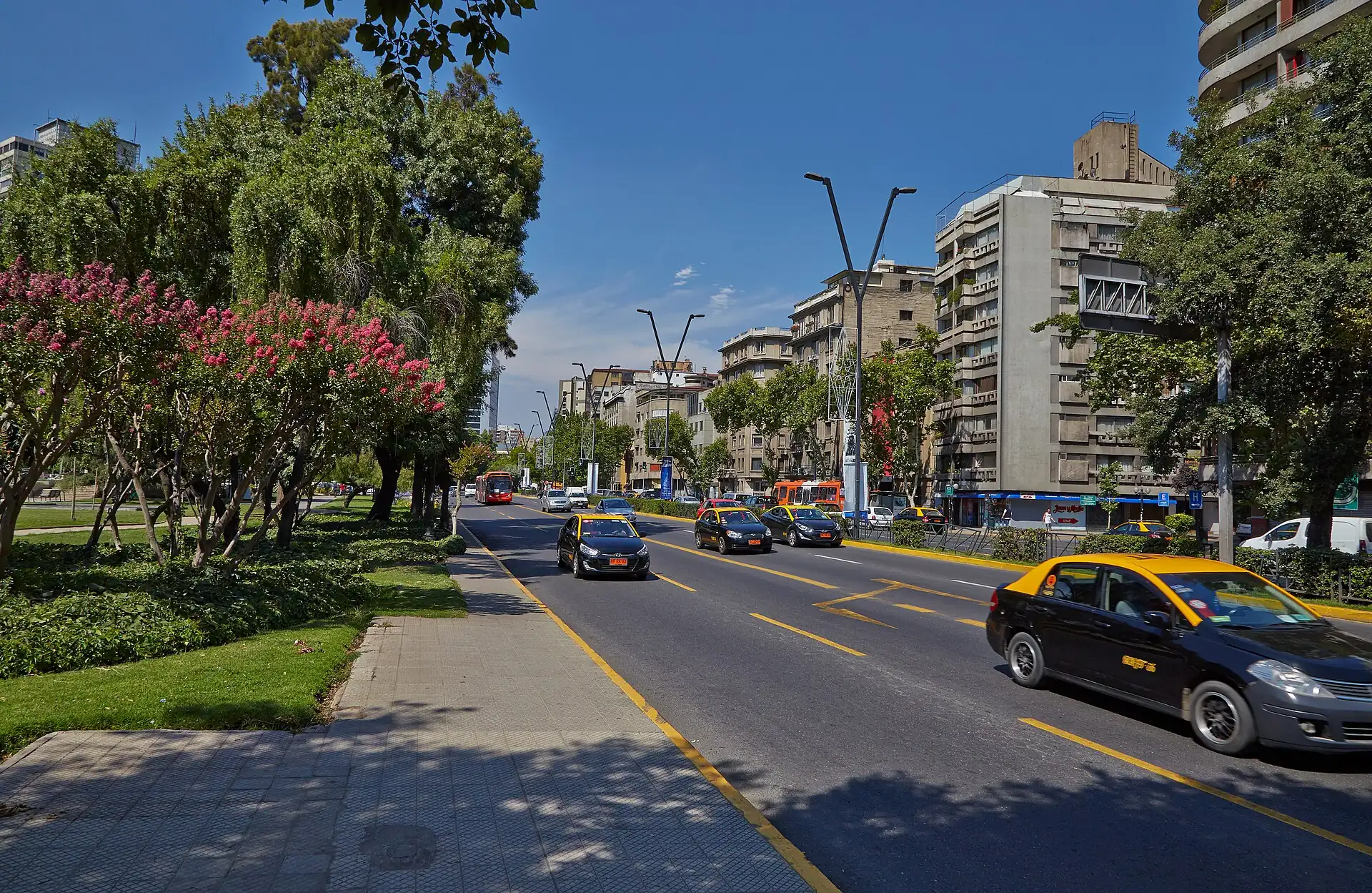
Getting around, in detailGet around · Connect
Get around
Walk inside a cluster; use the Metro between clusters by day and a ride-hailing car or a taxi after 21:00. The Bip! card covers Metro and buses.Walk inside a cluster; use the Metro between clusters by day and a ride-hailing car or a taxi after 9:00 PM. The Bip! card covers Metro and buses.
| Mode | Verdict | Fare | Use it for | What breaks |
|---|---|---|---|---|
| Walking | use | Free | Inside Lastarria, the centre and Providencia | Sidewalks are uneven; pickpockets work crowds. |
| Metro | use | CLP 700–900 by hour | Between clusters by day | Clean, fast and safe by day; lines 1 and 5 cover most visitor stops; avoid rush hour with luggage. Runs about 06:00–23:00 (check).Clean, fast and safe by day; lines 1 and 5 cover most visitor stops; avoid rush hour with luggage. Runs about 6:00 AM–11:00 PM (check). |
| Ride-hailing car (Uber, Cabify, DiDi) | use | CLP 4,000–10,000 across the centre | Night, luggage, hills | Fare shown in the app; ride from the door after dark. |
| Taxi (black with yellow roof) | caution | Metered: about CLP 4,000–9,000 for a short ride | When apps are slow | Confirm the meter is on; some drivers take long routes. |
| Bus (Red Metropolitana) | ok | CLP 700–900, Bip! card | Places off the Metro | Use Moovit or Google Maps for routes; buses are crowded at rush hour. |
| Colectivo (shared taxi) | caution | CLP 1,000–2,000 | Fixed local routes | Only for confident travellers who know the route. |
| Rental car | maybe | CLP 30,000–60,000 a day | Wine valleys and Cajón del Maipo | Driving in the city is heavy; for day trips, a tour or a driver is simpler. |
| Funicular and cable car (San Cristóbal) | use | CLP 3,000–5,000 | The hill | See the place page for the schedule. |
Taxis and ride-hailing
Uber, Cabify, DiDi
app
Fare shown before you ride; the default choice at night.
Black taxis with yellow roofs (metered)
metered
Confirm the meter is on before you set off; never accept a ride from an unofficial driver at the airport.
On foot and car-free hours
| Where | When | Note |
|---|---|---|
| Lastarria, Parque Forestal and the centre | Daytime, mornings | Walkable and flat; the walk from Lastarria to Bellavista is about 25 minutes along the river park. |
| Providencia avenues | Daytime and early evening | Wide, lit sidewalks with cafés. |
More on getting around
Buy a Bip! card at a Metro station counter (a card costs about CLP 1,500–2,000) and load CLP 10,000 to start; touch in at every station and bus; keep the card until you leave. Transfers between Metro and bus within two hours cost less.
Connect
| Option | Verdict | What breaks |
|---|---|---|
| Entel, Movistar, Claro or WOM shop (airport or mall) | use | Passport needed; prepaid data bundles of about CLP 5,000–15,000. |
| eSIM from an international provider | use | Easy before you land; coverage in Santiago is strong. |
| Home SIM roaming | caution | Check daily fees; some carriers charge a lot in Chile. |
Uber, Cabify, DiDi
Cars
All operate in Santiago; fare is shown before you ride. Airport pickup rules vary, check on the day.
Moovit / Google Maps
Metro and bus
Reliable Metro and bus directions; the Red Movilidad app has bus arrival times.
Bip!Go / a Bip! card
Transit fare
Card sold at Metro stations; top up at machines or kiosks.
Sernapred alerts / MSN (Monitoreo Sísmico)
Earthquake and emergency alerts
Keep phone alerts on.
- Wi-Fi
- Free in most cafés, hotels and malls; Metro stations have limited public Wi-Fi (check).
Luggage
Where big bags are a problem, and how to get rid of them for the day.
Rule
- Lockers
- Few public lockers; hotels hold bags after check-out.
- Forwarding
- No forwarding service culture; keep the big bag at the Santiago hotel for trips away.
- Dead zone
- Late flights: ask the hotel to hold bags and for a shower room; many do for a small fee.
Bags, area by area
4 walking areas rated
- Bags painful
Plaza de Armas and Mercado CentralBellavista and Cerro San Cristóbal
- Bags ok
Lastarria, Santa Lucía and the GAMProvidencia and the Costanera Center
Lockers, forwarding and the gap between check-out and check-in are covered once, under Luggage.
See & doWalking clusters, day plans and the places worth the time
See & do
Walking clusters, day plans and the places worth the time
Clusters
Plan by cluster: each is a walkable area with a rescue point and a bag rule.
Morning cluster: the Plaza de Armas, the pre-Columbian museum and the fish market lunch; flat and on the grid, with pickpockets to plan for.
rescue 100% · max p90 6.3′ · half
Late-morning and evening cluster: climb Cerro Santa Lucía for the city view, then Lastarria's cafés and the Plaza Mulato Gil de Castro; flat and lit in the evening.
rescue 100% · max p90 6′ · half
Half-day cluster: the funicular up San Cristóbal in the morning for the view, then Bellavista's street art and patios; take a car back after dark.
rescue 100% · max p90 6′ · half
Late-afternoon cluster: the Sky Costanera tower for the city and the Andes at sunset, then Providencia's cafés; all indoors or on wide sidewalks.
rescue 100% · max p90 6′ · half
Days
Ready-made day plans, timed against opening hours and walking distances.
How long are you staying?
Loose outlines in the city's rhythm: hills and museums in the morning, a long lunch, cool parks and dinner late.
1 day
A stopover between flights
- 09:00Cerro Santa Lucía — Cerro Santa Lucía
- 10:30Museo Chileno de Arte Precolombino — Museo Chileno de Arte Precolombino
- 12:30Mercado Central — Seafood lunch at Mercado Central
- 15:00Rest or a coffee in Lastarria
- 17:00Cerro San Cristóbal funicular — Cerro San Cristóbal for late light
- 20:30Patio Bellavista dinner — Dinner at Patio Bellavista, car back
Skip: Valparaíso needs a day of its own.
Santiago in 3 days
3 daysCentre and market first, the hill and the funicular next, the tower for a sunset; the last day is a hill morning with the bags already in the car.
Day by day
Day 1 — Cerro Santa Lucía, the museum and a market lunch
Day 2 — Bellavista and the funicular, Sky Costanera at sunset
Day 3 — Lastarria and Santa Lucía, car to the airport at 14:00
- 09:30Emporio La Rosa
- Confitería Torres (optional)
- 14:00Car to the airport at 14:00
Places
“Best time” is when to arrive for the fewest crowds, for example “before 08:30”; “Go any time” means the hour makes little difference. More sights follow under “More sights and museums”.
8 places. Filters use the guide’s own ratings; a place with no rating is left out when a filter is on.
Show 2 more placesShow fewer
Tours, classes and shows in Santiago →
If you do ten things in Santiago
Ranked for a first visit of 2–3 days. Prices are 2026 estimates in CLP.
- 1
The best view of the valley and the Andes on a clear morning.
- Time
- 1.5–2 h
- Best
- Weekday morning
- Cost
- CLP 3,000–5,000
- 2
The hill where the city started; stairs, fountains and a short view.
- Time
- 45 min
- Best
- Mid-morning
- Cost
- Free
- 3
Museo Chileno de Arte Precolombino
The best museum in the centre, calm and air-conditioned.
- Time
- 1.5 h
- Best
- Opening time
- Cost
- About CLP 10,000
- 4
Conger-eel soup and razor clams under an iron roof.
- Time
- 1–1.5 h
- Best
- 12:30–14:00
- Cost
- CLP 15,000–30,000
- 5
The tallest viewing deck in South America; the Andes turn pink.
- Time
- 1–1.5 h
- Best
- One hour before sunset
- Cost
- CLP 15,000–20,000
- 6
Pablo Neruda's Santiago house, guided and personal.
- Time
- 1 h
- Best
- Booked morning slot
- Cost
- CLP 10,000–15,000
- 7
Plaza de Armas and the Cathedral
The founding square and the start of the grid.
- Time
- 30–45 min
- Best
- Morning
- Cost
- Free
- 8
Museo Nacional de Bellas Artes
A 1910 palace of Chilean painting beside a shaded park.
- Time
- 1 h
- Best
- Afternoon
- Cost
- Free or low fee
- 9
A free cultural centre with galleries and evening shows.
- Time
- 45 min
- Best
- Late afternoon
- Cost
- Free; shows extra
- 10
A mid-afternoon stop after the hill.
- Time
- 20–30 min
- Best
- 15:00–17:00
- Cost
- CLP 4,000–12,000
Good for…
Verdict is how well Santiago works for that traveller, not how nice it is.
Compact, easy on the Metro and rewarding with a view; plan for smog and heat.
- 1Cerro Santa Lucía — the short view of the grid and the hill where the city began.
- 2Sleep in Lastarria — walkable to the hill, cafés and the Metro.
Seafood, corn pie and empanadas, and wine at every level.
- 1Mercado Central — conger-eel soup and razor clams.
- 2La Vega Central — a market lunch and fruit.
- 3Confitería Torres — the barros luco sandwich in a historic café.
Completos, set lunches and free hills keep the day under CLP 40,000.
- 1Completo counter on Paseo Ahumada — a full snack for CLP 3,000–4,500.
- 2Free sights — Cerro Santa Lucía, Plaza de Armas and GAM cost nothing.
A view at sunset and a long dinner in Bellavista.
- 1Sky Costanera — sunset over the Andes.
- 2Patio Bellavista dinner — a courtyard dinner and pisco sours.
The funicular and parks work; the Metro is crowded at rush hour.
- 1Cerro San Cristóbal funicular — a funicular ride and a picnic.
- 2Parque Bicentenario — space to run and a lake (check).
Great wine, food and hotels; fewer big-ticket sights.
- 1A private wine day in the Maipo — a driver and a tasting.
- 2A hotel in Providencia or Las Condes — views and spas.
Museums and Sky Costanera work; hills and old streets do not.
- 1Museo Chileno de Arte Precolombino — lift access.
- 2Sky Costanera — step-free lifts.
Tours and classes: book or skip
Book through your hotel or a licensed operator with written inclusions and a cancellation policy. Prices per person, group tour unless stated.
| Tour or class | Verdict | Typical price | Why | Check before paying |
|---|---|---|---|---|
| Free walking tour (tip-based) | book | CLP 5,000–10,000 tip (check) | A good first day; costs little and gives a map. | Meeting point and the tour language. |
| Valparaíso day tour | maybe | CLP 40,000–80,000 (check) | Removes the bus and hill logistics. | Whether entry to funiculars is included and when you return. |
| Maipo Valley wine tour | book | CLP 60,000–120,000 (check) | A driver and a tasting; drinking and driving is illegal. | Number of wineries and lunch. |
| Cajón del Maipo tour | maybe | CLP 40,000–80,000 (check) | Mountain day trip without a car. | Road status and the level of the hike. |
| Ski shuttle (Farellones/Valle Nevado) | maybe | CLP 25,000–60,000 (check) | Saves chains and traffic. | Rental gear and the return time. |
What each season brings
Summer
Dec–Feb
Hot, dry and clear evenings; the city is quieter in February as locals leave.
Watch: Heat above 30 °C by day; sunscreen and shade.
Autumn
Mar–May
Warm days, harvest in the wine valleys and clear Andes views.
Watch: Smog begins in May.
Winter
Jun–Aug
Snow in the Andes and ski season; rain clears the air.
Watch: Smog days and cold nights.
Spring
Sep–Nov
Blossom, warm days and Fiestas Patrias.
Watch: Busy on 18–19 September.
Photo spots and the light
Light times are for clear days; winter smog flattens contrast.
| Spot | Best light | Tip |
|---|---|---|
| San Cristóbal summit | 09:00–11:00 or late afternoon | The Andes line is sharpest after rain. |
| Santa Lucía terrace | Mid-morning | The centre grid and the cathedral spires below. |
| Sky Costanera | One hour before sunset to blue hour | Press the lens to the glass and use the outdoor terrace if open. |
| Plaza de Armas and the cathedral | 08:00–09:30 | Morning light on the façade; keep the camera strap short. |
| Parque Forestal | Late afternoon | Shaded lawns with the museum façade behind. |
Santiago travel FAQ
Answers are 2026 desk estimates; fares and rules marked (check) change.
Is Santiago safe for visitors?
Generally yes for the main clusters by day; the common problems are pickpocketing and phone snatching, not violent crime. Use a booked car after dark and check your government's travel advice, especially around protests.
Do I need a visa?
Citizens of the US, UK, Canada, Australia, New Zealand and Ireland can generally enter for tourism for up to 90 days without a visa (check your passport and current rules).
Do I need cash?
Some. Cards work in most restaurants, shops and hotels; carry CLP 20,000 in small notes for markets, taxis and tips.
Is tap water safe to drink?
Yes in Santiago; it is treated. Many visitors prefer bottled water.
How do I get from the airport?
Use the official taxi counter, a pre-booked transfer or a ride-hailing car (CLP 20,000–30,000), or the Centropuerto or Turbus airport bus to a Metro stop (CLP 2,000–3,500).
How many days do I need?
Two to three days cover the four clusters at an easy pace; add a day for Valparaíso and another for a wine valley.
What is the best time to visit?
March to May and September to November have warm days and clear views; December to February is hot; June to August has smog days.
Do I need to tip?
About 10% at sit-down restaurants; it is usually suggested on the bill.
Are earthquakes a risk?
Chile has frequent earthquakes and strong building codes; know your hotel exit and follow alerts.
Is the Metro safe?
Yes by day, but pickpockets work the crowded lines; keep bags in front and phones out of sight.
What should I pack?
Layers, sunscreen, a hat, comfortable walking shoes and a light rain layer for May–August.
What is the best area to stay?
Lastarria for a walkable first visit; Providencia for a quieter, longer stay.
More to see and doSee & do · Learn & work · Rain & heat · Free things · Wheelchair and stroller
Free things to do
Sights in Santiago that cost nothing to enter. Each is described under Places or More sights; extra costs inside are marked there.
Wheelchair and stroller, place by place
How each place in this guide works for wheels, from its own page. Ratings are desk estimates unless a page says it was checked on the ground.
| Place | Step-free | Wheelchair | Stroller | What to know |
|---|---|---|---|---|
| Cerro San Cristóbal funicular | partial | caution | caution | A few steps at stations; the summit paths are ramps. |
| Cerro Santa Lucía | no | poor | poor | Several hundred steps to the top by the main routes. |
| GAM (Centro Cultural Gabriela Mistral) | yes | good | good | No steps of note. |
| La Chascona (Neruda's Santiago house) | no | poor | poor | Multiple short flights inside and in the garden. |
| Museo Chileno de Arte Precolombino | yes | ok | ok | No steps of note. |
| Museo Nacional de Bellas Artes | partial | caution | caution | No steps of note. |
| Plaza de Armas and the Cathedral | yes | good | good | No steps of note. |
| Sky Costanera | yes | good | good | No steps of note. |
See & do
16 of 16
- Lakes & parks
The city's big hill park with the Virgin statue and a funicular; the best view of the valley and the Andes on a clear day.
Bellavista · Funicular late morning to early evening (check) · CLP 3,000–5,000(check)
- Views
The hill where the city was founded, with stairs, fountains and a short view of the centre.
Lastarria · Day hours (check) · Free
The best museum in the centre, on the Andes and Central America before Europe.
Centro · Tue–Sun, day hours (check) · About CLP 10,000
The founding square, with the cathedral, the post office and the History Museum.
Centro · Open at all hours; cathedral by day · Free
- Views
The tallest viewing deck in South America; go on a clear day at sunset.
Providencia · Late morning to about 21:00 (check)Late morning to about 9:00 PM (check) · CLP 15,000–20,000
Pablo Neruda's Santiago house; book a slot ahead.
Bellavista · Timed tours, Tue–Sun (check) · CLP 10,000–15,000
A 1910 palace of Chilean painting beside Parque Forestal.
Lastarria · Tue–Sun, day hours (check) · Free or low fee (check)
A free cultural centre with galleries, a café and evening shows.
Lastarria · Public areas from about 10:00; shows laterPublic areas from about 10:00 AM; shows later · Free galleries; tickets for shows
Museo de la Memoria y los Derechos Humanos
MuseumsThe museum of the 1973–1990 dictatorship; a sober and important visit, reached by Metro line 5 (Quinta Normal).
Quinta Normal (outside our clusters) · Tue–Sun, day hours (check) · Free (check)
Parque Bicentenario
Lakes & parksA modern park with a lake and birds, good for a family walk; a car ride from Providencia (check).
Vitacura · Day hours · Free
Free walking tour of the centre
walkingA guided first orientation from Plaza de Armas; useful on day one. Book online and bring water.
Centro · Morning and afternoon departures (check) · Tip-based; CLP 5,000–10,000 is typical
Valparaíso day trip
day tripHill port with murals and funiculars; go on a weekday and be on a bus before dark.
Valparaíso · Full day · Bus CLP 6,000–10,000 each way (check)
Wine tasting in the Maipo Valley
Food toursA winery visit with a driver; book the tasting ahead.
Pirque · Half day · CLP 30,000–60,000 for a tasting (check)
Chilean cooking class
ClassesLearn pisco sours, empanadas or a pastel de choclo; book through your hotel.
Providencia or Lastarria (check operator) · Half day · CLP 40,000–70,000 (check)
Football or a Sunday cycle in Parque Forestal
ActiveSome streets close to cars on Sunday mornings; a relaxed way to see the city.
Lastarria · Sunday morning · Free; bike rental about CLP 3,000–6,000 an hour (check)
Cajón del Maipo hike
ActiveMountain valley trails and views; check road and weather.
Cajón del Maipo · Full day · Tour CLP 40,000–80,000 (check)
- Booking
- Wine tastings and cooking classes are best booked one to three days ahead through your hotel; ski trips book a week ahead in season.
Learn & work
| What | Where | Cost | Note |
|---|---|---|---|
| Spanish classes | Language schools in Providencia, Bellavista and Lastarria (check operator) | CLP 150,000–350,000 a week for group classes (check) | Chilean Spanish is fast with local slang; a school helps. |
| Chilean cooking classes | Cooking schools and hotels (check operator) | CLP 40,000–70,000 | Half-day sessions cover empanadas, pastel de choclo and pisco sours. |
| Wine and pisco tasting courses | Wine bars and wineries | CLP 25,000–60,000 | Short, guided sessions in English. |
Working here
- Tourist entry
- Citizens of many countries, including the US, UK, Canada, Australia, New Zealand and Ireland, can enter for tourism for up to 90 days without a visa (check your passport and current rules). Tourist entry does not allow paid work in Chile.
- Work permit
- Legal work needs a work visa with a contract from a Chilean employer; check the immigration service (Servicio Nacional de Migraciones) for the current process.
- Remote work
- Working remotely for a foreign employer on a tourist stay is a grey area; check current rules before relying on it for a long stay.
Rain-day and heat-day plan
Rain day
Rain is rare and usually falls May–August; if it rains, go to a museum first and wait for the Andes to appear the next day.
- 01Museo Chileno de Arte Precolombino — Indoor and calm; 90 minutes.
- 02Museo Nacional de Bellas Artes — Indoor and quiet.
- 03GAM (Centro Cultural Gabriela Mistral) — Air-conditioned, free galleries and cafés.
Heat day
In January and February highs reach 30–35 °C; do the hills before 11:00, use a museum or mall at midday, and return to the parks after 17:00.
- 08:30Cerro Santa Lucía — Shade and cooler air; done by 10:00.Shade and cooler air; done by 10:00 AM.
- 10:30Museo Chileno de Arte Precolombino — Air-conditioned for the rising heat.
- 13:00A set lunch in a café with AC — Long lunches are normal.
- 17:30Cerro San Cristóbal funicular — Cooler air; go up for the late light.
Day-trips and nearby
Places you can reach from Santiago in a day or with one night away, with the route and what it costs. Door to door, not ride time.
Valparaíso and Viña del Mar
goBus from Terminal Alameda or Pajaritos, 1.5–2 h each way
Steep hill port with street art; go on a weekday and be back on a bus before dark.
- Time
- Full day
Maipo Valley wineries (Pirque)
goCar or organized tour, 45–75 min
Book a tasting; a driver is worth it.
- Time
- Half day
Casablanca Valley wineries
goCar or tour, about 1 h toward the coast
White wine and cool-climate reds; combine with Valparaíso in a long day only if you must.
- Time
- Half to full day
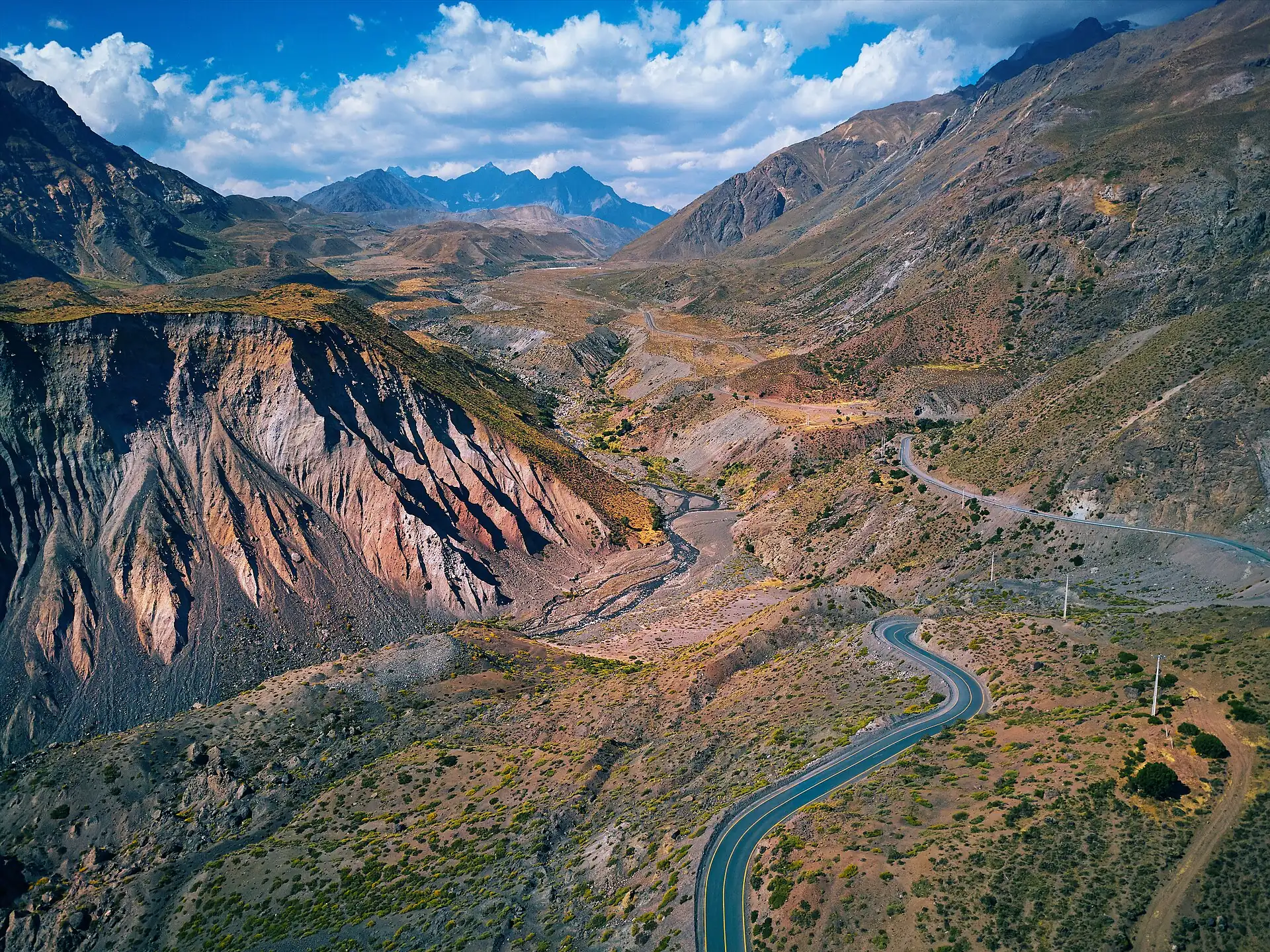 Photo: Deensel, CC BY 2.0
Cajón del Maipo
goCar, tour or public bus toward San José de Maipo, about 1–1.5 h
Mountain valley with hiking, hot springs and mountain views; check road and weather status.
- Time
- Full day
Farellones and Valle Nevado
maybeCar or shuttle, 1–1.5 h
Ski resorts in June–September; snow chains and traffic on weekends.
- Time
- Full day in ski season
Pomaire pottery village
maybeCar or bus, about 1 h
Clay bowls and cheap grilled meats; a local shopping trip, not a headline stop.
- Time
- Half day
Go next
Atacama (San Pedro de Atacama)
overnightDoor to door: About 5 h
Flight to Calama (about 2 h), then a 1.5 h transfer
Desert landscapes; plan 3 to 4 nights.
Patagonia (Torres del Paine)
overnightDoor to door: One long day
Flight to Punta Arenas or Puerto Natales, then road
Book flights and lodging months ahead in summer.
Mendoza
maybeDoor to door: About 8 h
Bus over the Andes, 6–8 h
Scenic but the pass can close in snow; check the day.
Eat & sleepWhere to eat and which area to sleep in
Eat & sleep
Where to eat and which area to sleep in
Eat
A short list of places worth crossing the city for, each with how to get a seat.
Restaurant finder: filter every place to eat in Santiago →
Vegetarian-friendly score
3.5 / 5 · Good
- Country diet noteOur country guide rates vegetarian eating as easy.2 / 2
- Places to eat in this guide2 of 6 places with a known answer are vegetarian-friendly, 4 partly.1 / 1.5
- Budget eating lines0 vegetarian lines in "Eat by budget".0 / 0.6
- Meat-free national dishes3 meat-free dishes in the country food list.0.3 / 0.4
- Dedicated vegetarian kitchens0 mentions of vegetarian restaurants, Buddhist or fasting kitchens.0 / 0.5
Country note: Easy in Santiago, Valparaíso and Pucón; harder in rural areas and Patagonia.
Vegetarian places near me →Make a diet card →
How we score
- Country diet note (up to 2): easy 2, workable 1, mixed 0.75, hard 0; no note 0.5.
- City places to eat (up to 1.5): 1.5 × (vegetarian-friendly + half of partly friendly) ÷ places with a known answer; needs 3 or more known places.
- Budget eating lines marked vegetarian (up to 0.6): 0.2 each.
- Meat-free national dishes (up to 0.4): 0.1 each.
- Dedicated vegetarian kitchens mentioned — Buddhist chay, shōjin ryōri, Jain, fasting food, vegan cafés (up to 0.5): 0.1 each.
- Total rounded to the nearest half point, 0 to 5. Built from our own pages only, not from reviews.
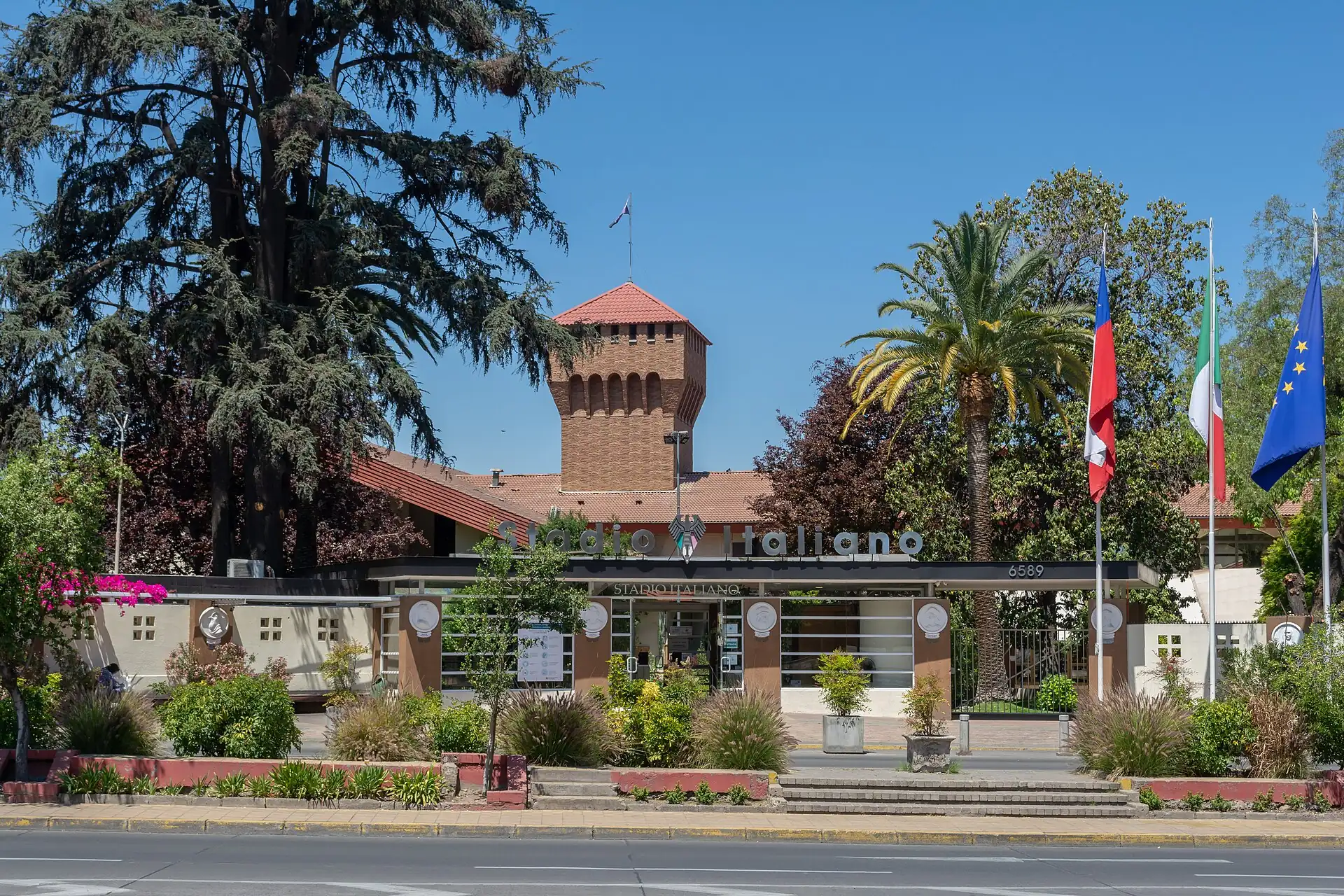
Eating and drinking guideEat by budget · Drink
Before you sit down to eat
Short version; full text linked
- Queues and hours
- Per person, one dish or one meal, 2026 estimate. More →
Eat by budget
Under CLP 6,000 a meal
| Where | Order | Area | Price | Note |
|---|---|---|---|---|
| Completo counter on Paseo Ahumada | Completo italiano | Centro | CLP 2,500–4,500 | A hot dog with avocado, tomato and mayonnaise. |
| La Vega Central | Set lunch in the market | Centro | CLP 5,000–8,000 | Soup and a main; go before 14:00.Soup and a main; go before 2:00 PM. |
| Empanada de pino | Beef-onion-olive pastry | Bakeries and stalls | CLP 1,800–3,500 | Baked is lighter than fried. |
Dishes to know
| Dish | What it is | Where to look | When | Price |
|---|---|---|---|---|
| Empanada de pino | A baked pastry filled with beef, onion, egg and olive | Bakeries and stalls | Any time | CLP 1,800–3,500 |
| Pastel de choclo | Baked corn and beef pie in a clay dish | Restaurants | Lunch | CLP 8,000–13,000 |
| Cazuela | A soup with meat, corn and potato | Markets and home-style restaurants | Lunch (best in winter) | CLP 4,500–8,000 |
| Caldillo de congrio | Conger-eel soup | Mercado Central | Lunch | CLP 9,000–16,000 |
| Completo | Loaded hot dog with avocado and mayonnaise | Street counters | Lunch or snack | CLP 2,500–4,500 |
| Sopaipilla and pebre | Fried squash-dough disc with a spicy tomato salsa | Street stalls and restaurants | Afternoon | CLP 1,000–3,000 |
| Mote con huesillo | A cold drink of wheat and dried peach | Street carts | Summer daytime | CLP 1,500–3,000 |
| Pisco sour | Pisco, lime and sugar cocktail | Any bar | Evening | CLP 4,500–8,000 |
- Lunch is late (13:00–15:00) and dinner starts after 20:30; kitchens can be closed between 16:00 and 19:30.Lunch is late (1:00 PM–3:00 PM) and dinner starts after 8:30 PM; kitchens can be closed between 4:00 PM and 7:30 PM.
- A 10% tip is usual and often suggested on the bill.
- Ask for 'la cuenta' when done; servers will not bring it until you ask.
Drink & nightlife
| Where | What | Until | Note |
|---|---|---|---|
| Bellavista (Pío Nono and Patio Bellavista) | Bars, live music, terraces | Late, especially Thu–Sat | The main nightlife area; go by car or ride-hail, and keep to busy streets. |
| Lastarria | Cafés, wine bars, small bars | About 01:00About 1:00 AM | Calmer and more walkable; the streets around Plaza Mulato Gil are busy in the evening. |
| Barrio Italia and Ñuñoa | Bars and restaurants | About 01:00About 1:00 AM | A local crowd; a short ride from the centre. |
| Providencia and El Golf | Hotel bars, lounges, wine bars | About midnight | Quieter and pricier. |
By style
| Style | What | Where | Price | Until |
|---|---|---|---|---|
| Pisco sour | Pisco, lime and sugar, sometimes egg whiteThe national cocktail; strong, one at a time. | Any bar and restaurant | CLP 4,500–8,000 | Late |
| Chilean wine | Carménère, Cabernet, Sauvignon BlancAsk for a glass of the house Carménère. | Wine bars and restaurants | CLP 4,500–8,500 a glass | Late |
| Craft beer | Local IPAs and lagersMany pubs run happy hours 18:00–21:00.Many pubs run happy hours 6:00 PM–9:00 PM. | Bellavista and Providencia pubs | CLP 4,500–7,000 | Late |
| Mote con huesillo | A cold summer drink of wheat and dried peachNon-alcoholic; check the cart's cleanliness. | Street carts and markets | CLP 1,500–3,000 | Daytime |
| Terremoto | White wine, pineapple ice cream and fernet or grenadineVery sweet and strong; one is a lot. | Bars in Bellavista and historic bars | CLP 4,500–7,000 | Late |
Rules that bite
- Drinking in public streets is illegal; drink at a bar or restaurant.
- Bring photo ID or a copy: bars can ask for ID.
- Do not leave a drink unattended.
Sleep
Pick the area first: it decides your walk home at night and your first morning.
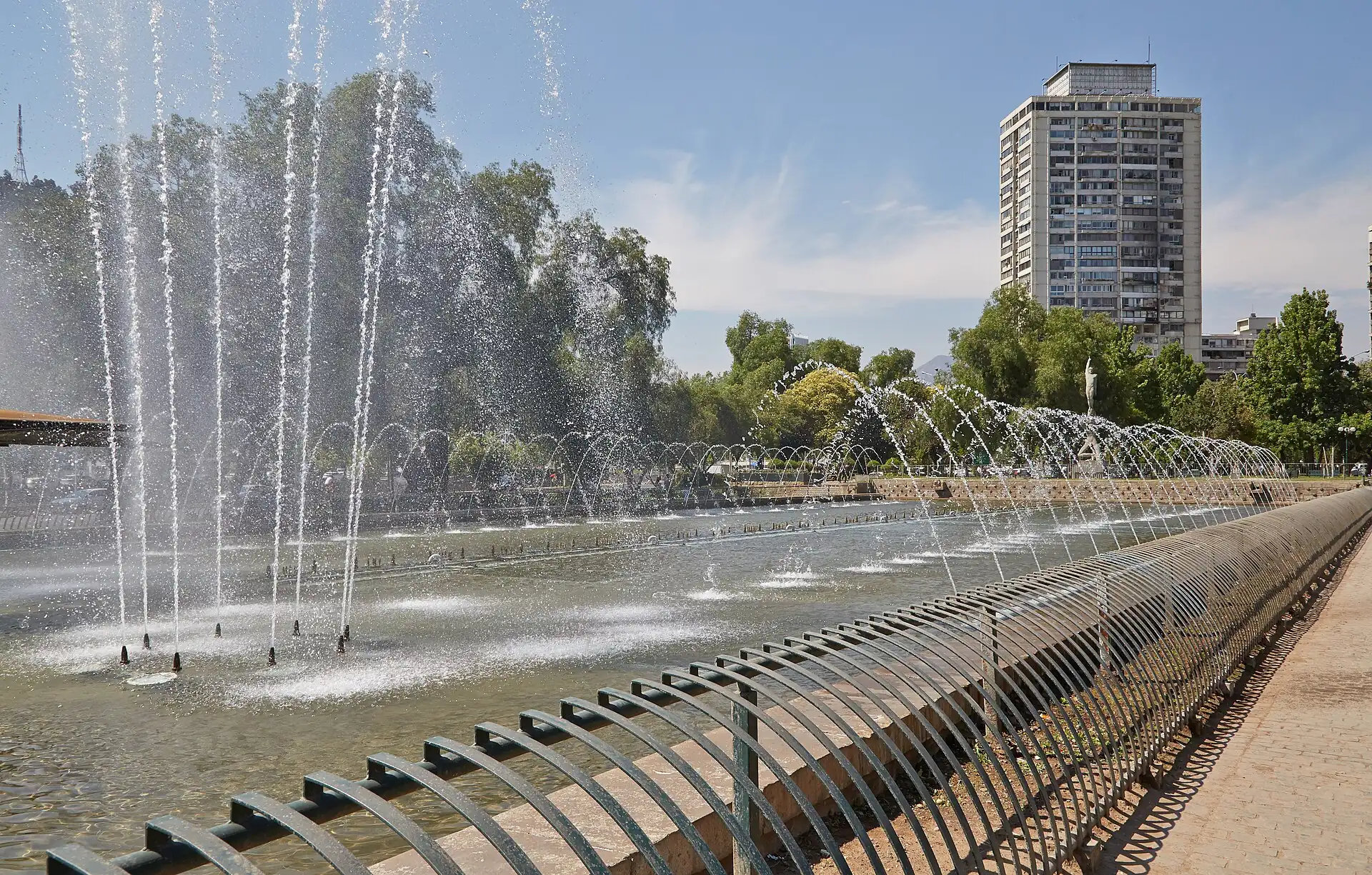
Which neighborhood fits you
Three questions, one recommendation, with the reasons.
Your best fit
- The hill, museums and the Metro are all within 10 minutes.
- Hotels usually keep a 24-hour desk; apartments may not.
Next best: Providencia
Built from our 1–5 desk scores per area; your answers stay in this browser.
More on sleepingSleep by budget · Your area · With kids
Sleep by budget
| Band | Price | Where | Room types | What to expect |
|---|---|---|---|---|
| budget | CLP 12,000–25,000 dorm bed · CLP 40,000–65,000 private room | Lastarria, Bellavista, Centro | Hostels and simple hotels | Small rooms, shared bathrooms in the cheapest; street noise on weekends. |
| mid | CLP 70,000–130,000 | Lastarria, Providencia | 3–4 star hotels and boutique hotels | Lift, breakfast, AC or heating, 24-hour desk in most. |
| high | CLP 130,000–220,000 | Providencia, Las Condes | 4–5 star hotels | Larger rooms, restaurants, gyms and pools. |
| splurge | CLP 220,000–450,000+ | Las Condes, Vitacura, Providencia | 5-star and boutique hotels | Spas, concierge and views of the Andes. |
Booking checks
- Ask about heating in winter: many hotels are cold, and an electric heater is common.
- Foreign tourists may be exempt from 19% VAT on the room when paying with a foreign card or currency; ask at booking (check).
- Confirm a late check-in with the hotel before your flight; apartments may not have a night desk.
- Rooms facing the street in Lastarria and Bellavista are loud on weekends; ask for a back room.
Which area is yours
| If you are | Sleep in | Because |
|---|---|---|
| First visit, want to walk to cafés and the hill | Lastarria | Five minutes to the hill and the Metro. |
| Quieter base, families, longer stay | Providencia | Safe, calm and close to the Metro; you ride to the centre. |
| Nightlife-focused, short stay | Lastarria | Bellavista is a short car ride, and the room is walkable at night. |
First-timers: walkable to the hill, cafés and the Metro; choose a hotel on or just off Lastarria with a 24-hour desk, and use a car at night from the door.
Quieter and more upmarket: wide sidewalks, malls and the Metro at the door, and the Sky Costanera nearby; a ride from the old centre.
Areas are in our default order until you tick a priority.
Scores are 1–5 desk judgements per priority (2026). Centro and Bellavista have no sleep-area page; the districts table covers them.
With kids
- The Metro is easy with children, but crowded at rush hour; use lifts where they exist and keep small children by the hand on platforms.
- Cerro San Cristóbal, the funicular, the cable car and the zoo are the top child-friendly outings; go on a weekday morning.
- Parque Bicentenario and Parque Forestal have space to run; Costanera Center has a kids' area and a food court for an air-conditioned afternoon.
- Cars and ride-hailing rarely carry child seats; bring a travel booster or ask the hotel to book one.
PracticalMoney, essentials, safety and the pocket card
Practical
Money, essentials, safety and the pocket card
Money
What a day costs at three comfort levels, and how to pay.
- Budget
- CLP 30,000–50,000 excl. bed / day
- Mid
- CLP 50,000–110,000 excl. bed / day
- High
- CLP 110,000+ excl. bed / day
- Transit card
- Buy a Bip! card at a Metro station and load it for Metro and buses; cards and phones tapped on some bus lines vary, so check before you board.
- Cash rule
- Cards work in most restaurants and shops; keep CLP 20,000 in small notes for markets and taxis, and use ATMs inside banks or malls.
More on moneyCosts · Budget · Buy
What things cost
- Completo (loaded hot dog) at a counterCLP 2,500–4,500
- Set weekday lunch (menú del día)CLP 8,000–12,000
- Seafood lunch at Mercado Central, per personCLP 15,000–30,000
- Pisco sour at a barCLP 4,500–8,000
- Short ride-hailing car across the centreCLP 4,000–8,000
- Car from the airport to Lastarria or ProvidenciaCLP 20,000–30,000
- Funicular round trip, San CristóbalCLP 3,000–5,000
- Sky Costanera, adultCLP 15,000–20,000
Trip budget
| Hotel double room1 × 4 nights × CLP 90,000 | CLP 360,000 |
| Food, local transport, entries2 × 4 days × CLP 80,000 | CLP 640,000 |
| Airport car, both ways1 × CLP 50,000 · one car per 4 people | CLP 50,000 |
| Metro and bus, per person per day2 × CLP 4,000 | CLP 8,000 |
| Prepaid SIM or eSIM, about a week2 × CLP 8,000 | CLP 16,000 |
| Buffer 15%Price creep, a taxi you did not plan, one splurge | CLP 161,100 |
| Trip total≈ CLP 154,400 per person per day, bed included | CLP 1,235,100 |
2026 estimate in CLP; flights, visas and tours excluded. Your choices stay in this browser.
Prices of common things
| Completo (loaded hot dog) | CLP 2,500–4,500 |
| Pisco sour | CLP 4,500–8,000 |
| Bottle of water, shop | CLP 800–1,500 |
2026 estimate; check locally.
Buy
- Bargaining
- Prices are fixed in shops, malls and supermarkets; a little haggling is accepted at craft markets and street stalls, usually 10–20% off the first price. Do not bargain in restaurants.
- Fixed-price check
- Check a supermarket (Jumbo, Lider, Unimarc) or the Mercado Central for the going price of wine, cheese or dried fruit before you buy a souvenir version.
Markets and shopping streets
| Where | What | When | Haggle | Note |
|---|---|---|---|---|
| Mercado Central | Fish, seafood and lunch counters | Daytime (check) | no | Eat here; buy fish only if you can cook it. |
| La Vega Central | Fruit, vegetables, dried goods, cheap lunches | About 07:00–15:00About 7:00 AM–3:00 PM | light | Best on weekday mornings; keep bags in front. |
| Pueblito Los Dominicos | Handicrafts, ceramics, copper and lapis lazuli jewelry | Daily except some Mondays (check) | light | Craft village in Las Condes; the easiest place to buy gifts. |
| Centro Artesanal Santa Lucía | Wool, leather and lapis lazuli | Daytime (check) | light | Small stalls near the hill. |
| Mall Costanera Center | International brands, food court, supermarket | About 10:00–21:00About 10:00 AM–9:00 PM | no | Air-conditioned and easy. |
Shops by what they sell
| For | Where | Hours | Note |
|---|---|---|---|
| Chilean wine (Carménère, Cabernet, Sauvignon Blanc) | Wine shops in Providencia and Las Condes, supermarkets and the airport | Shop hours | Buy at a shop and have it packed for the flight; 2026 prices from CLP 6,000 to CLP 60,000 a bottle. |
| Lapis lazuli jewelry and copper | Craft markets and Pueblito Los Dominicos | Shop hours | Ask for a certificate for lapis and check that the stone is not dyed. |
| Wool, alpaca and leather | Centro Artesanal and Los Dominicos | Shop hours | Check labels: alpaca and wool blends vary. |
| Merkén (smoked chile) and quinoa | Supermarkets and La Vega | Shop hours | Easy to pack; check your customs rules for food items. |
Changing money
| Where | Verdict | Why |
|---|---|---|
| Bank ATMs inside banks or malls | use | Fees are flat CLP 5,000–9,000 per withdrawal and caps apply; withdraw the maximum less often. |
| Casas de cambio (Agustinas, Moneda area and Providencia) | ok | Compare two before you change; ask for the rate and the fee. |
| Hotel front desk | ok | Convenient, weaker rate. |
| Street changers | avoid | Counterfeit notes and short-changing. |
ATMs
- Per withdrawal
- Typical caps are CLP 200,000–400,000 per withdrawal, with a flat fee per transaction; the screen states both.
- Fees
- Local fee plus your own bank's foreign-transaction fee; a few banks charge less, so check before you pull cash.
- Where
- Machines inside banks, malls or the airport, in daylight; avoid street-facing ATMs after dark.
- Conversion
- If an ATM or card terminal offers to convert to your home currency, decline and pay in CLP.
Essentials and accessEssentials · Access
Essentials
- Plugs & power
- 220 V, 50 Hz; Chile uses type C and type L sockets. A type C (two-round-pin) plug fits most; bring an adapter.
- Toilets
- Cafés, malls, Metro stations (a small fee at some) and museums; public toilets are few, so use a café.
- Opening hours
- Shops roughly 10:00–20:00 (malls to 21:00 or 22:00); lunch 13:00–15:00, dinner from 20:30. Museums are usually closed on Mondays. Offices run 09:00–18:00.Shops roughly 10:00 AM–8:00 PM (malls to 9:00 PM or 10:00 PM); lunch 1:00 PM–3:00 PM, dinner from 8:30 PM. Museums are usually closed on Mondays. Offices run 9:00 AM–6:00 PM.
- Health
- Strong sun (UV) and dry air; winter smog on some days; earthquake preparedness. Travel insurance with medical cover is advised. Tap water is safe; food hygiene is good in restaurants.
- Accessibility
- Sidewalks are uneven with steep curbs outside the centre; newer Metro stations have lifts; hills and stairs limit step-free access.
- Laundry
- Hotels and lavanderías offer wash-dry-fold by the kilo (about CLP 3,000–6,000 per kilo); self-service laundromats are few.
- Emergency numbers
- 133 Carabineros (police), 131 ambulance, 132 fire. Chile does not use 911 or 112 as the main number. Ask your hotel for the nearest clinic.
Pack
- Layers: nights are cool even in summer, and winter mornings are cold
- Sunscreen, hat and sunglasses; the sun is strong at altitude
- A light rain layer for May–August
- A money belt or zipped cross-body bag for the Metro and markets
- Comfortable shoes for the hills; a small daypack
Accessibility
Santiago is manageable with careful planning: newer Metro stations and malls have lifts, but sidewalks are uneven, curbs are steep and the hills have stairs. Choose a hotel with a lift and use ride-hailing between areas.
- Sidewalks
- Uneven, with steep curbs and few ramps outside the newer areas; Providencia and Las Condes are better.
- Metro
- Lines 1, 4 and newer stations have lifts; some older stations have stairs only (check the map).
- Taxis and ride-hailing
- Standard cars; ask for a larger vehicle if you need space for a chair.
- Hotels
- Larger hotels have accessible rooms on request; boutique hotels may have stairs.
- Toilets
- Accessible toilets in malls, museums and larger hotels; few on the street.
Sights, step-free or not
| Museo Chileno de Arte Precolombino | step-free | Lift access to the floors. |
| Cerro Santa Lucía | hard | Stairs and steep paths. |
| Cerro San Cristóbal funicular | with help | Funicular is accessible; upper paths are steep. |
| Sky Costanera | step-free | Lifts and level floors. |
| Plaza de Armas and the Cathedral | step-free | Flat paved plaza. |
| GAM (Centro Cultural Gabriela Mistral) | step-free | Modern building with lifts. |
| Museo Nacional de Bellas Artes | with help | Ramp on the main floor (check); some stairs. |
| La Chascona (Neruda's Santiago house) | hard | Stairs and narrow rooms. |
Survive
Safety basics, the lines not to cross, and practical habits that save the day.
Safety
- Pickpocketing is the main risk in the Metro, at markets and on the funicular: keep your phone and wallet in front pockets.
- Keep to lit streets in Bellavista and around Plaza Baquedano at night; use a car for the last leg.
- Chile has frequent earthquakes: know the exit route at your hotel and follow local alerts.
- Emergency: 133 Carabineros (police), 131 ambulance, 132 fire.
Red lines
- Do not photograph police or military sites.
- Do not carry your passport in a back pocket: keep a copy and the original in the hotel safe.
Practical
- Toilets: cafés, malls and Metro stations may charge a small fee.
- Tap water is treated, but many visitors drink bottled water.
More on staying safeStay safe · Stay healthy · Safety map · Solo & women · Etiquette · Cope · Scams
After dark, by area
5 flagged areas
- Avoid after dark
Plaza Baquedano (Plaza Italia)
Avoid after darkEstación Central and Barrio Meiggs
Avoid after dark- Take care
Day = about 07:00–19:00. What to watch in each area, day and night →
Scams and red flags
Walk away if you see these
- Distraction theft: a stranger spills something on you and offers to help while a partner takes your bag or phone. Decline, step away and check your pockets.
- Phone snatching from a hand at a Metro door, on a bench or at a café table: keep your phone in a front pocket and out of sight on the street.
- Unofficial taxi drivers in the airport hall: use the official counters or a ride-hailing app instead.
- Fake cash at street changers: use a bank, an ATM inside a bank or an established casa de cambio.
- Meter tricks: some taxis run a long route or a high tariff; use a ride-hailing app with a shown price or confirm the meter is on.
Stay safe
Crossing the road
- 01Traffic is fast and drivers may not stop for pedestrians on wide avenues; cross at signals and wait for the green.
- 02Scooters and bicycles share sidewalks in places; look both ways on pedestrian streets.
Hustles specific to this city
| Hustle | Where | The tell | What to do |
|---|---|---|---|
| Distraction theft | Plaza de Armas, Metro, markets | A stranger spills something or drops a coin and offers to help | Step away, keep both hands on your bag and phone. |
| Phone snatching | Metro doors, cafés, Parque Forestal | Someone passes close on a bike or scooter | Keep the phone in your front pocket and out of sight. |
| Airport taxi touts | SCL arrivals hall | A driver approaches you before you reach the counter | Use the official counter or a ride-hailing app. |
| Fake police or officials | Streets | Someone asks to see your wallet or passport | Do not hand it over; ask to go to a police station and ask hotel staff. |
- Police
- Carabineros handle theft reports; go to a comisaría with your passport for a written report (constancia); insurers need it.
- Protests
- Demonstrations occur on Plaza Baquedano and in the centre and can involve tear gas; leave the area and avoid crowds.
- Night
- The main risks are theft and quiet streets; after dark use a ride-hailing car rather than walking between areas.
Stay healthy
Air quality by month
| Jan | Feb | Mar | Apr | May | Jun | Jul | Aug | Sep | Oct | Nov | Dec |
|---|---|---|---|---|---|---|---|---|---|---|---|
| — | — | — | — | — | — | — | — | — | — | — | — |
Winter smog (May–Aug) is worst on cold, still days; alerts are posted on the SINCA site and in the news. Wear an N95 mask if you have asthma, and avoid hard exercise on alert days.
- Sun
- UV is strong even on cool days; use SPF 30+, a hat and sunglasses.
- Water and food
- Tap water is treated; many still prefer bottled water. Food hygiene in restaurants is good.
- Earthquakes
- Know your hotel's exit; follow the drop, cover, hold rule and the alerts from Sernapred.
- Altitude
- Santiago is at about 520 metres; no altitude issue. In the Andes above 3,000 metres (Farellones, Valle Nevado), take it easy for a day.
- Vaccines and health
- No vaccine is required for entry; check routine vaccines with your clinic. Hantavirus exists in rural southern areas, not in Santiago.
- Clinics
- Private clinics (Alemana, Las Condes, Santa María) offer 24 h emergency and travel advice.
Hospitals and clinics: see Cope.
Safety by area and hour
| Area | Day | Night | What to watch |
|---|---|---|---|
| Centro (Plaza de Armas, Paseo Ahumada) | fine | caution | Pickpockets by day; the streets empty after 19:00, and it is best to leave by car.Pickpockets by day; the streets empty after 7:00 PM, and it is best to leave by car. |
| Mercado Central and La Vega | fine | avoid | Pickpockets in the aisles; the area is not for evening walks. |
| Lastarria and Cerro Santa Lucía | fine | fine | Fine on lit streets; stay off the hill after dark. |
| Bellavista | fine | caution | Busy main streets; side streets are dark. Take a car home. |
| Providencia | fine | fine | Quiet, lit avenues; use normal city care. |
| Plaza Baquedano (Plaza Italia) | caution | avoid | Protest site; avoid when crowds gather. |
| Estación Central and Barrio Meiggs | caution | avoid | Transit and wholesale area; theft risk is higher. |
- Keep phones and cameras out of sight on the street, at outdoor tables and at Metro doors; snatching is quick.
- After dark use a ride-hailing car or a hotel-booked taxi between areas rather than walking through the centre or Parque Forestal.
Solo, women and LGBTQ+ travellers
Solo
- Manageable with normal city care: use ride-hailing at night, keep valuables out of sight and stay in a busy area.
- Hostels in Lastarria and Bellavista are good for meeting people; free walking tours are a friendly first day.
Women
- Street comments (piropos) occur but rarely escalate; a firm 'no' and walking on is usually enough.
- Dress is relaxed and similar to a European city; keep to busy streets at night and use a car for the last leg.
LGBTQ+
- Chile legalized same-sex marriage in 2022 and Santiago is broadly tolerant, especially in Bellavista, Lastarria and Providencia.
- Attitudes vary outside the main areas; public affection is generally fine in central neighborhoods, but use judgment.
Etiquette in Santiago
- Greetings
- A handshake or a single cheek kiss (between women, and man and woman) is common; say 'buenos días' or 'buenas tardes' when entering a shop.
- Tipping
- About 10% is customary and usually suggested on the bill; you can decline politely.
- Metro
- Let people off before boarding, keep bags in front, and stand to the right on escalators.
- Punctuality
- Social events start late; for restaurants and tours, arrive on time.
- Politics
- Avoid comparing the Pinochet years to anything casually; the topic is sensitive.
- Photos
- Do not photograph police, military or government sites; ask before photographing people.
- Dress
- Casual is fine; smart casual for restaurants; cover shoulders and knees in churches.
Cope
Hospitals and clinics that handle foreigners
| Where | Area | Use it for |
|---|---|---|
| Clínica Alemana de Santiago | Vitacura | Private hospital used by expats; 24 h emergency; ask your insurer about direct billing. |
| Clínica Las Condes | Las Condes | Private hospital with 24 h emergency. |
| Clínica Santa María | Providencia | Private hospital close to Providencia hotels; 24 h emergency. |
| Public hospitals and SAPU urgent-care centres | Citywide | Free or low cost but crowded; use private clinics if you can. |
Visa extensions
- Office
- The PDI (Policía de Investigaciones) handles immigration; check the address and appointment rules before you go.
- Extending
- Tourists from many countries get up to 90 days; extension is possible once for a fee (check the current rules and the fee).
- Overstay
- Fines and entry bans can apply; resolve any visa problem before you leave.
Embassies and consulates
| Country | Address | Phone | Note |
|---|---|---|---|
| United States | Las Condes | — | (check) |
| United Kingdom | Las Condes | — | (check) |
| Canada | Las Condes | — | (check) |
| Australia | Las Condes | — | (check) |
| New Zealand | Las Condes | — | (check) |
| Ireland | Las Condes | — | (check) |
- Lost passport
- Report to the Carabineros for a police report (constancia), then contact your embassy for an emergency document; allow several working days.
- Pharmacies
- Cruz Verde, Salcobrand and Ahumada are on most main streets; some are open 24 h. Many medicines need no prescription, but bring your own for regular ones.
- Laundry
- Lavanderías wash by the kilo; ask your hotel.
- Earthquakes
- Know the exit at your hotel; during a quake drop, cover and hold, then leave when it stops; follow local alerts.
Apps and offline kitOffline kit
Offline kit
Set up before you leave, so Santiago still works with no signal or a dead roaming plan.
On your phone
- Maps: open the city in Google Maps, tap the place name, then Download offline map (or use an offline-maps app).
- Data: install an eSIM or buy a local SIM before the first taxi; the apps in this guide depend on it.
- Translation: download the local language for camera translation.
- Screenshots: booking confirmations, hotel address in the local script, and the emergency numbers.
This guide
Save the Santiago guide and its pages on this device; it opens without a connection.
Phrases that do the work
Greeting
Hello / good morning
Hola / Buenos días
OH-lah / BWEH-nohs DEE-ahs
Thanks
Thank you
Gracias
GRAH-see-ahs
Market
How much is this?
¿Cuánto cuesta?
KWAN-toh KWEH-stah
Food
No chile, please
Sin ají, por favor
seen ah-HEE por fah-VOR
Café
The bill, please
La cuenta, por favor
lah KWEN-tah por fah-VOR
Taxi
Please take me to this address
Lléveme a esta dirección, por favor
YEH-veh-meh ah EH-stah dee-rehk-see-OHN por fah-VOR
Taxi
Stop here, please
Pare aquí, por favor
PAH-reh ah-KEE por fah-VOR
Everyday
Excuse me / pardon
Permiso / Disculpe
pehr-MEE-soh / dees-KOOL-peh
Everyday
Is it included?
¿Está incluido?
eh-STAH een-kloo-EE-doh
Pocket card
Fill in, then print or save as PDF
Stays in this browser only; nothing is sent anywhere.
SantiagoSantiago
Pocket card · Voykit
My bed tonight
—
—
—
Lléveme a esta dirección, por favorPlease take me to this address
Emergency
- Police (Carabineros)133
- Ambulance131
- Fire132
Embassy
Most embassies are in Las Condes; write your own embassy's 24-hour line below.
My embassy: —
Fare anchors (2026 estimate)
- Airport → Lastarria or Providencia, app car: CLP 20,000–30,000, 40–80 min depending on traffic
- Metro single ride: CLP 700–900
- Short ride-hailing ride, centre: CLP 4,000–8,000
Give your driver the street, number and comuna (Santiago, Providencia, Las Condes).
Deep diveHistory, reading, photos and every source
Deep dive
History, reading, photos and every source
Sources
- officialChile Travel (Sernatur, official tourism)
- officialUK FCDO travel advice: Chile
- secondaryWikivoyage — Santiago
Ask about Santiago
Loading…
Was this useful?